Supplementary Information
New aspects in the phase behaviour of poly-N-isopropyl acrylamide: systematic temperature dependent shrinking of PNiPAM assemblies well beyond the LCST
I. Bischofberger* and V. Trappe
University of Fribourg, Department of Physics, CH-1700 Fribourg
As inferred from the data shown in Figure 3(c) in the manuscript, the shrinking behaviour is set by T = T - Ta, where T is the quench temperature and Ta the temperature beyond which phase
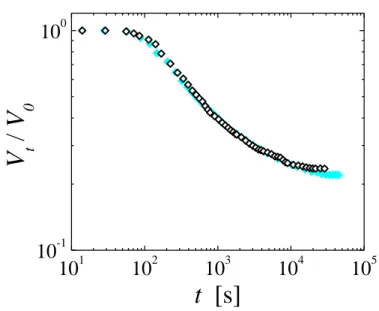
separation is arrested. Further evidence that T is the parameter governing the shrinking behaviour is shown in Figure S1, where we compare the shrinking of two PNiPAM-systems with LCSTs and accordingly arrest temperatures that differ by 10°C. Maintaining T fixed leads to identical shrinking behaviour.
Figure S1: Shrinking behaviour obtained for a PNiPAM microgel solution in water subjected to a quench to T = 45°C (filled cyan symbols) compared to that obtained for a PNiPAM microgel solution in a water/ethanol mixture with an ethanol molar fraction of X = 0.055 subjected to a quench to T = 35°C (filled black symbols). In both solutions c = 2∙10-2 g/ml and for both quenches T ≈ 9°C. The errors in Vt/V0 are ±0.01.
10
110
210
310
410
510
-110
0V
t/
V
0t [s]
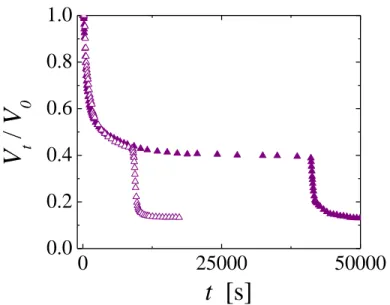
The shrinking of the gel body is not specific to the PNiPAM microgels discussed in the paper. As shown in Figure S2, a solution of linear PNiPAM chains exhibits the same shrinking behaviour as a solution of PNiPAM microgels. This shows that shrinking is a property of PNiPAM in general, independent of the PNiPAM architecture.
0
25000
50000
0.0
0.2
0.4
0.6
0.8
1.0
V
t/
V
0t [s]
Figure S2: Shrinking behaviour obtained for aqueous solutions of PNiPAM microgels (filled symbols) and linear PNiPAM (open symbols). The linear PNiPAM has a viscosity averaged molecular weight of Mv = 465 500 g/mol and polydispersity of Mw/Mn = 4.9, as indicated by the
supplier, Polymer Source Inc. Both systems equilibrated at 30°C are subjected to a two-step quench with first T = 2°C and subsequently T = 24°C. The second quench step is performed at t = 8800 s for the linear PNiPAM solution and at t = 41000 s for the PNiPAM microgel solution. The response of the gels to these quenches is identical for both PNiPAM systems, indicating that the formation of shrinking gels is a general feature of PNiPAM systems independent of the PNiPAM architecture.