Biology Open • Supplementary information
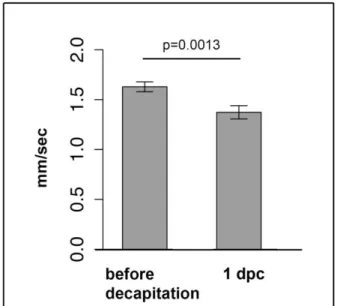
Biology Open (2015): doi:10.1242/bio.014266: Supplementary informationFig. S1. Locomotion before and after decapitation. Average locomotion speed of animals before
decapitation is 1.63 mm/s and 1 day after decapitation (dpc) is 1.37 mm/s, significantly decreased (**P=0.0013).
Biology Open • Supplementary information
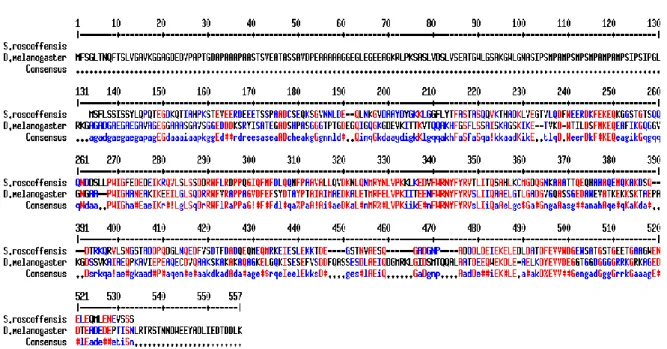
Biology Open (2015): doi:10.1242/bio.014266: Supplementary informationFig. S2. Amino acid alignment of D. melanogaster Sap47 to S. roscoffensis best BLAST hit.
Sap47 corresponds to human SYAP1 (synapse associated protein 1). Identical and highly similar amino acids are colored in red. In the boxed region there is >50% similarity. Alignment done with http://multalin.toulouse.inra.fr/multalin/
Biology Open • Supplementary information
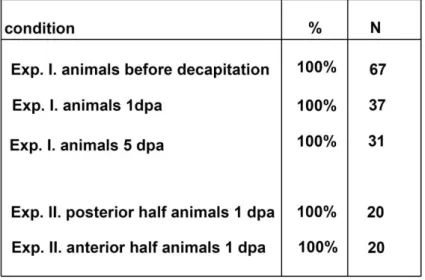
Biology Open (2015): doi:10.1242/bio.014266: Supplementary informationTable S1. Percentage of vibration induced body contraction. Experiment I: all animals before and
at 1 dpa or 5 dpa show a 100% response to vibration, these animals are identical with the ones tested for phototaxis and geotaxis. Experiment II: representing a control experiment to test if also smaller domains of the body are able to display vibration induced body contraction. All animals also show 100% response to vibration.