RESEARCH OUTPUTS / RÉSULTATS DE RECHERCHE
Author(s) - Auteur(s) :
Publication date - Date de publication :
Permanent link - Permalien :
Rights / License - Licence de droit d’auteur :
Bibliothèque Universitaire Moretus Plantin
Institutional Repository - Research Portal
Dépôt Institutionnel - Portail de la Recherche
researchportal.unamur.be
University of Namur
COS-OGA, a new oligosaccharidic elicitor that induces protection against a wide range of plant pathogens
Van Aubel, Géraldine; Buonatesta, Raffaele; Van Cutsem, Pierre
Published in:
IOBC-WPRS Bulletin
Publication date: 2013
Document Version
Publisher's PDF, also known as Version of record Link to publication
Citation for pulished version (HARVARD):
Van Aubel, G, Buonatesta, R & Van Cutsem, P 2013, 'COS-OGA, a new oligosaccharidic elicitor that induces protection against a wide range of plant pathogens', IOBC-WPRS Bulletin, vol. 89, pp. 403-407.
General rights
Copyright and moral rights for the publications made accessible in the public portal are retained by the authors and/or other copyright owners and it is a condition of accessing publications that users recognise and abide by the legal requirements associated with these rights. • Users may download and print one copy of any publication from the public portal for the purpose of private study or research. • You may not further distribute the material or use it for any profit-making activity or commercial gain
• You may freely distribute the URL identifying the publication in the public portal ?
Take down policy
If you believe that this document breaches copyright please contact us providing details, and we will remove access to the work immediately and investigate your claim.
403
COS-OGA, a new oligosaccharidic elicitor that induces protection
against a wide range of plant pathogens
Géraldine van Aubel1, Raffael Buonatesta2, Pierre Van Cutsem1,2
1
Unité de Recherche en Biologie Cellulaire Végétale, Université de Namur, Rue de Bruxelles 61, 5000 Namur, Belgium; 2FytoFend SA, Rue Phocas Lejeune 25-6, 5032 Isnes, Belgium
Abstract: COS-OGA is a new elicitor that combines oligochitosan and oligopectates in presence of
calcium ions. Elicitation of tomato plants with COS-OGA has been tested and resulted in leaf peroxidase activity increase, transcription of SA-associated defence genes and overexpression of PR, heat-shock and DNA/RNA remodelling proteins. Greenhouse and field trials confirmed the efficacy of the elicitor against powdery mildew on cucumber and grapevine.
Key words: oligochitosan, oligopectate, innate immune system, Sphaerotheca fuliginea, Erysiphe
necator
Introduction
Elicitor recognition by plant cells is one of the first lines of defense of the plant innate immune system and consists in the recognition of conserved non-self microbial signatures (pathogen-associated molecular patterns, PAMPs) and self molecules (damage-associated molecular patterns, DAMPs). The best-known elicitors comprise e.g. flagellin (flg22), elongation factor TU, lipopolysaccharides, chitin, ergosterol, hepta-b-glucoside and pectin fragments (Schwessinger & Ronald, 2012). These elicitors are recognized by receptor kinases called pattern recognition receptors (PRRs) mostly localized in the plasma-membrane. Molecular pattern-induced responses are called PAMP-triggered immunity (PTI) as opposed to effector-triggered immunity (ETI) that relies on direct injection in the cytoplasm of effector molecules by the pathogen.
We work on a specific elicitor that combines both chitosan oligomers (COS, non-self molecules) and pectin-derived oligogalacturonides (OGA, self molecules). COS polycationic molecules bind and stabilize the so-called egg box conformation of polyanionic oligopectates (Cabrera et al., 2010). The supramolecular complex comprizing calcium, OGA and COS triggers defense responses (alkalinization, potassium efflux, oxidative burst…) in Arabidopsis
thaliana cell suspensions. Here we show the efficacy of the elicitor in the protection of
cucumber against Sphaerotheca fuliginea and of grapevine against Erysiphe necator. We also report on the action mechanism of the COS-OGA elicitor using proteomics and quantitative RT-PCR on tomato plants. The results suggest SAR-like mechanisms of action of the oligosaccharide complex.
404
Material and methods
ProteomicsTomato plants (cv. Moneymaker) were sprayed with control (adjuvant 0.1%) or elicitor (50 ppm, adjuvant 0.1%) until run off three and one day before leaf harvest. Soluble proteins were extracted and peroxidase activity was tested with guaiacol substrate. Total proteins were submitted to2D-differential in gel electrophoresis (2D-DiGE) over a pI 4-7 range. Protein spots with at least 20% significant variation between control and treatments were picked up for identification in mass spectrometry.
Transcriptomics
cDNA was prepared from control and treated tomato leaves. Quantitative RT-PCR was carried out on three housekeeping genes (CAC, EF1 alpha and PGK) and five genes involved in plant defense: Pathogenesis-Related (PR)1, PR2 and PR3 that belong to the salicylic acid (SA) signaling pathway and LoxD and PI-1 that belong to the jasmonic acid (JA) pathway.
Field trials
A GEP greenhouse trial was set up to confirm the biological activity of the elicitor on cucumber against powdery mildew (S. fuliginea) under production conditions. The trial was carried out on the sensitive cucumber cultivar Sheila (Nunhems) grown on mineral wool. The COS-OGA complex (SL formulation, 25 g in 500 l/ha leaf wall area (leaf wall area: ground area multiplied by canopy height and divided by row distance)) was sprayed five times at 7 days intervals.
A field trial on grapevine and powdery mildew was conducted in Spain during 2012 on the very disease-sensitive table grape Moscatel. Six COS-OGA sprayings with 3 l/ha (SL formulation, 12.5 g/l COS-OGA) were done at 14-day intervals with total water volumes up to 1,000 l/ha. The frequency and the severity of powdery mildew caused by natural infection by E. necator were assessed on bunches.
Results and discussion
Tomato leaf proteinsThe peroxidase activity of elicitor-treated tomato leaves was 216 ± 17% compared to control plants. Peroxidases are potential producers of H2O2 and take part in defense responses. Reactive oxygen species (ROS), whether produced by membrane NADPH dehydrogenases or peroxidases play important signaling roles in the establishment of resistance and can act synergistically with other compounds such as SA (Daudi et al., 2012; Almagro et al., 2009).
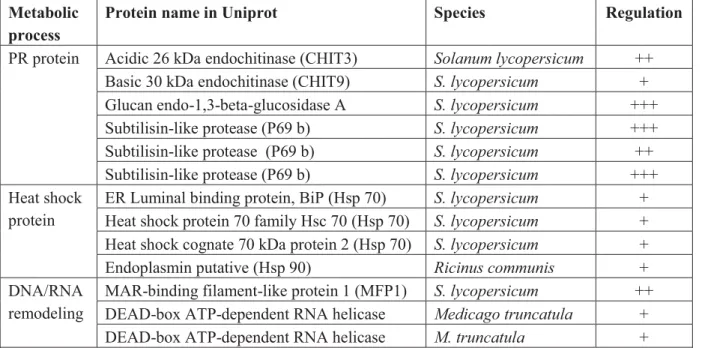
2D-DIGE on the same tomato leaves allowed detection of 64 spots significantly regulated by the elicitor. Mass spectrometry led to identification of 31 proteins that were classified in PR-proteins, heat-shock proteins and proteins involved in DNA/RNA remodeling (Table 1).
The most regulated group was the PR-protein class comprising two chitinases, one endo-1,3-E-glucosidase and three subtilisin-like proteases. These PR-proteins target pathogen cell walls that contain chitin, glucans and proteins (Edreva, 2005; Jorda and Vera, 2000). Four positively regulated heat shock proteins were identified with three members of the Hsp 70 family as well as a putative endoplasmin bearing a conserved domain from the Hsp 90 family. DNA/RNA remodelling proteins were also overexpressed after COS-OGA treatment.
The MFP1 protein is a MAR-binding protein that allows DNA interaction with nuclear matrix thereby promoting gene transcription (Dobreva et al., 2003). The DEAD-box dependent RNA helicase that was indentified twice is a zinc finger protein showing an ATP-dependent RNA helicase activity that can modify gene expression or activate transcription factors to allow expression of stress-related genes (Vashisht and Tuteja, 2006).
Table 1: Proteins induced by elicitation with COS-OGA and sorted by metabolic processes. The regulation is scored + for positive regulation between 100 and 150%, ++ for positive regulation between 150 and 200% and +++ for positive regulation between 200 and 300%.
Metabolic process
Protein name in Uniprot Species Regulation
PR protein Acidic 26 kDa endochitinase (CHIT3) Solanum lycopersicum ++
Basic 30 kDa endochitinase (CHIT9) S. lycopersicum +
Glucan endo-1,3-beta-glucosidase A S. lycopersicum +++
Subtilisin-like protease (P69 b) S. lycopersicum +++
Subtilisin-like protease (P69 b) S. lycopersicum ++
Subtilisin-like protease (P69 b) S. lycopersicum +++
Heat shock protein
ER Luminal binding protein, BiP (Hsp 70) S. lycopersicum + Heat shock protein 70 family Hsc 70 (Hsp 70) S. lycopersicum + Heat shock cognate 70 kDa protein 2 (Hsp 70) S. lycopersicum +
Endoplasmin putative (Hsp 90) Ricinus communis +
DNA/RNA remodeling
MAR-binding filament-like protein 1 (MFP1) S. lycopersicum ++ DEAD-box ATP-dependent RNA helicase Medicago truncatula +
DEAD-box ATP-dependent RNA helicase M. truncatula +
Tomato defence genes transcription
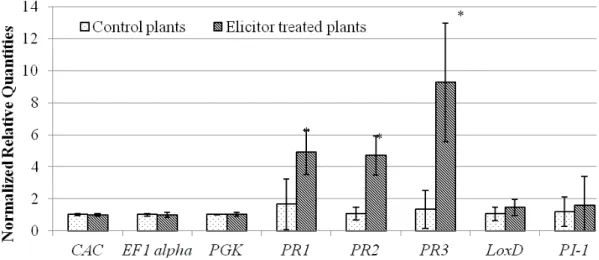
The qRT-PCR on tomato leaves showed that the PR1 gene and the two PR protein genes PR2 (encoding a β-1,3 glucanase) and PR3 (encoding a class II chitinase) were significantly upregulated by the elicitor treatment (Figure 1). PR gene expression is as a marker of Systemic Acquired Resistance (SAR) in plants mediated by SA accumulation (Edreva, 2005).
LoxD and PI-1 that are considered as JA-responsive genes (Fujimoto et al., 2011) were not
significantly regulated in our assays, pointing to a SAR-like mechanism of the COS-OGA elicitor. SA accumulation was confirmed by spectrofluorimetry (not shown).
Field trials
The elicitor was tested under commercial greenhouse conditions for protection of cucumber against S. fuliginea. Severity of the disease in the untreated control (UTC) was high (90%). Despite such severe conditions, the elicitor offered good protection (between 72 and 85%) compared to UTC. Use of the elicitor had no negative effect at all on yield and was plant safe. In the field trial on grapevine, powdery mildew spread continuously until the end of the experiment (22 August) to reach 54% infection of grape bunches in untreated plants. Disease severity increased to a much lower extent on COS-OGA-treated plants (13% severity at the end of the experiment). The protection of bunches decreased in terms of disease frequency (from 85% at first assessment down to 45% at the end of the experiment). However, in terms
406
of severity, protection offered by COS-OGA remained very high during the whole experiment: from 96% at first assessment to 76% at the end of the experiment (late August).
Figure 1: Normalized relative quantities of transcripts for CAC, EF1 alpha, PGK, PR1, PR2,
PR3, LoxD and PI-1 in tomato leaves cv. Moneymaker. Control plants were sprayed with
adjuvant 0.1%; treated plants were sprayed with COS-OGA elicitor 50 ppm and adjuvant 0.1%. Data are presented as mean ± SE (n = 4). The asterisks indicate significant differences from control plants (Student’s t-test, p < 0.05).
The COS-OGA elicitor appears to be a promising product for preventive use against a range of diseases. European registration as a plant protection product is underway.
Acknowledgements
We thank Région Wallonne (Belgium) for support.
References
Almagro, L., Gómez Ros, L. V., Belchi-Navarro, S., Bru, R., Ros Barcelo, A. & Pedren, M. A. 2009: Class III peroxidases in plant defence reactions. J. Exp. Bot. 60: 377-390.
Cabrera, J.-C., Boland, A., Cambier, P., Frettinger, P. & Van Cutsem, P. 2010: Egg Box Conformation of Oligogalacturonides. Chitosan Oligosaccharides strongly Modulate the Supramolecular Conformation and the Biological Activity of OGA in Arabidopsis. Glycobiol. 20: 775-786.
Daudi, A., Cheng, Z., O’Brien, J. A., Mammarella, N., Khan, S., Ausubel, F. M. & Bolwell, G. P. 2012: The Apoplastic Oxidative Burst Peroxidase in Arabidopsis Is a Major Component of Pattern-Triggered Immunity. Plant Cell 24: 275-287.
Dobreva, G., Dambacher, J. & Grosschedl, R. 2003: SUMO modification of a novel MAR-binding protein, SATB2, modulates immunoglobin gene expression. Genes Dev. 17: 3048-3061.
* *
Edreva, A. 2005: Pathogenesis-related proteins: Research progress in the last 15 years. Gen. Appl. Plant Physiol. 31: 105-124.
Fujimoto, T., Tomitaka, Y., Abe, H., Tsuda, S., Futai K. & Mizukubo, T. 2011: Expression profile of jasmonic acid-induced genes and the induced resistance against the root-knot nematode (Meloidogyne incognita) in tomato plants (Solanum lycopersicum) after foliar treatment with methyl jasmonate. J. Plant Physiol. 168: 1084-1097.
Jorda, L. & Vera, P. 2000: Local and Systemic Induction of Two Defense-Related Subtilisin-Like Protease Promoters in Transgenic Arabidopsis Plants. Luciferin Induction of PR Gene Expression. Plant Physiol. 124: 1049-1057.
Schwessinger, B. & Ronald, P. C. 2012: Plant Innate Immunity: Perception of Conserved Microbial Signatures. Annu. Rev. Plant Biol. 63: 21.1-21.32.
Vashisht, A. A. & Tuteja, N. 2006: Stress responsive DEAD-box helicases: A new pathway to engineer plant stress tolerance. J. Photochem. Photobiol. B: Biology 84: 150-160.