HAL Id: tel-00406511
https://tel.archives-ouvertes.fr/tel-00406511
Submitted on 22 Jul 2009HAL is a multi-disciplinary open access
archive for the deposit and dissemination of sci-entific research documents, whether they are pub-lished or not. The documents may come from teaching and research institutions in France or
L’archive ouverte pluridisciplinaire HAL, est destinée au dépôt et à la diffusion de documents scientifiques de niveau recherche, publiés ou non, émanant des établissements d’enseignement et de recherche français ou étrangers, des laboratoires
Secure multicast routing infrastructure : the network
operator point of view
Zainab Khallouf
To cite this version:
Zainab Khallouf. Secure multicast routing infrastructure : the network operator point of view. Net-working and Internet Architecture [cs.NI]. Institut National Polytechnique de Grenoble - INPG, 2006. English. �tel-00406511�
INSTITUT NATIONAL POLYTECHNIQUE DE
GRENOBLE
No assigned by the library
THESIS
for obtaining the degree of DOCTOR OF THE INPG
Specialty: Computer Science: Systems and Communications prepared at France T´el´ecom R&D and INRIA Rhˆone Alpes, Planete project-team
under a CIFRE convention
in the executive of l’Ecole Doctorale MATHEMATIQUE, SCIENCES ET TECHNOLOGIE DE L’INFORMATION
presented and publicly discussed by
Zainab Khallouf
on March 15th, 2006
Titre:
Secure Multicast Routing Infrastructure:
The Network Operator Point of View
Committee in Charge
Prof. Guy Mazar´e, ENSIMAG President
Dr. Isabelle Chrisment, (LORIA, Henri Poincar´e University (Nancy 1)) Reporter
Prof. Bernard Cousin, (IRISA, Rennes university) Reporter
Dr. Olivier Paul, INT, Evry Examiner
Prof. Andrzej Duda, (LSR-IMAG, ENSIMAG) Thesis Director
Dr. Vincent Roca, INRIA Rhˆone Alpes Supervisor
INSTITUT NATIONAL POLYTECHNIQUE DE
GRENOBLE
Noattribu´e par la biblioth`eque
TH`ESE
pour obtenir le grade de DOCTEUR DE L’INPG Sp´ecialit´e: Syst´emes et Logiciels
pr´epar´ee `a France T´el´ecom R&D et l’INRIA Rhˆone Alpes, proj`et Plan`ete sous d’une convention CIFRE
dans le cadre de l’ ´Ecole Doctorale MATH ´EMATIQUE, SCIENCES ET TECHNOLOGIE DE L’INFORMATION
pr´esent´ee et soutenue publiquement par
Zainab Khallouf
le 15 Mars, 2006
Titre:
Infrastructure S´
ecuris´
ee de Routage Multipoint:
Le Point de Vue de l’Op´
erateur R´
eseau
Composition de Jury
Prof. Guy Mazar´e, ENSIMAG Pr´esident
Dr. Isabelle Chrisment, (LORIA, Universtit´e Henri Poincar´e (Nancy 1)) Rapporteur Prof. Bernard Cousin, (IRISA / Universit´e de Rennes 1) Rapporteur
Dr. Olivier Paul, INT, Evry Examinateur
Prof. Andrzej Duda, (LSR-IMAG, ENSIMAG) Directeur de th`ese
Dr. Vincent Roca, INRIA Rhˆone Alpes Encadrement
Acknowledgements
Gratitude is when memory is stored in the heart and not in the mind . - Lionel Hampton Sincere appreciation from my heart can not be conveyed in words to all the people who helped me carry out the research reported in this dissertation, by their support and encouragement, and to all those who have made my stay in France, the land of liberty, equality, and fraternity, an exciting and rewarding experience by their friendship and kindness.
My sincere thanks to my advisors, Dr. Vincent Roca and Eng. S´ebastien Loye. I
am grateful for their advice, guidance, and patience. I am deeply indebted to Dr. Vincent Roca for giving me the chance to work with him, for his support, patience, and for all what I’ve learned from him. Many thanks also to Prof. Andrzej Duda the director of my thesis.
All my gratitude to prof. Bernard Cousin and Dr. Isabelle Chrisment for the time they spent reading and commenting my thesis, and for the reports they wrote. And
I also would like to thank Dr. Olivier Paul and Prof. Guy Mazar´e for taking part
in the committee of my thesis.
I would like to express my immense appreciation to Dr. Renaud Moignard the head
of the MTM (MPLS Traffic Engineering and Multicast) team at France T´el´ecom
R&D for his support during all this thesis period. I also wish to express appreci-ations to all my colleagues in the MTM team. A special thank to Mr. Jean-Luc Lehagre for his assistance in implementing the test-bed used in this study. I am grateful to Dr. Christian Guillemot, director of the CPN (Core Packet
Net-work for NGN) laboratory for welcoming me at France T´el´ecom R&D, and I would
like to thank all the members of the CORE/CPN laboratory at Lannion they all helped me in a way or in another.
I’m grateful to all the past and present members of the Plan`ete team, for their
support and helps. I was honored to work with them. I thank them sincerely for all the memorable moments, for their helps, and for their kindness.
I would like to thank the many people who helped, advised, and gave fruitful dis-cussions during this work. Many thanks to Eng. Jacqueline Boyer from France
T´el´ecom R&D at Lannion. I’m grateful for her help in the theoretical study
pre-sented in this thesis. I also would like to thank Dr. Mohammed Alchemlal from
France T´el´ecom R&D at Caen.
Special thanks to Mr. Jean Louis Le Roux, Mrs. Sana Abada, Mrs. Dina Sol, Mr.
Patrick Fleming, Mr. Yacine Mami, Miss. Im`ene Chaieb, Mrs. Thi Hue Nguyen,
Mr. Nawras Aldibbiat and all the other friends for their kindness and friendship. Thank you for everything!
Last but not least, I would like to thank my family, I’m grateful to my sisters Khouzam and Hadeel, my brother in law Morhaf and the small angle my nephew Karam for their love and support. And, it is beyond all expression my gratitude to my parents for their endless love, support and encouragement. I appreciate, with all my heart, all what they have done for me, for learning me that knowledge is liberator, for respecting my choices, and for encouraging me to be what I want to be. To them I would like to dedicate this dissertation.
Our Achievements: Published Papers and
Implementations
Conferences Papers
• Z. Khallouf, V. Roca, R. Moignard, S. Loye, A Filtering Approach for an IGMP Flooding Resilient Infrastrcuture. 4th Conference on Security and Network Architectures (SAR’05), Batz sur Mer (France), June 06-10, 2005.
• Z. Khallouf, V. Roca, R. Moignard, S. Loye, Infrastructure S´ecuris´ee de Routage Multipoint: le Point de Vue de l’Op´erateur R´eseau. 3rd Conference on Security and Network Architectures (SAR’04), La Londe, Cote d’Azur, France, June 2004.
Software (C/AWK/Linux)
• Implementation of a filtering mechanism to mitigate IGMP flooding attacks.
Abstract
Multicast is a promising technology for the distribution of streaming media, bulk data and many other added-value applications, yet the deployment of multicast still in its infancy.
Providing security is still one of the main challenge that hinders the introduction of multicast in the existing infrastructure. It is therefore critical to provide sound se-curity mechanisms that can protect the ISPs and the carriers infrastructure against multicast threats and allow them in the same time to get all the benefits of intro-ducing multicast in their networks.
This work considers one of the most challenging features of multicast deployment: the security of the multicast routing infrastructure.
In this thesis we adopt the security from the multicast Network Operator’s view-point. The kind of security required by a network operator, who manages and operates the multicast routing infrastructure, largely differs from that of end-to-end security. More specifically, the operator is concerned by service continuity no matter what happens. In other words, the operator wants the group communi-cation service provided to its clients (i.e. end users or other network operators with whom has peering relationships) must be operational at any time, in spite of anomalies in the multicast flows, no matter whether they are intentional (i.e. are the result of deliberate attacks) or not (e.g. are caused by a misbehaving component).
While many theoretically ideal proposals have been done to secure the routing pro-tocols, they have rarely been accepted by the operators community. For instance, because they require to modify existing and widely deployed protocols, or they in-troduce heavy authentication mechanisms, which is in practice almost impossible to deploy in legacy networks, and even infeasible, since a corrupted host may be the source of a DoS attack, even if it has been authenticated.
In this thesis analyze in depth the threats to the multicast infrastructure. We show that the vulnerability of the multicast model comes largely from the edge. More specifically, several attacks arise from the use of group management protocols, IGMP for IPv4 and MLD for IPv6. In the light of this analysis, we introduce and evaluate a simple, yet efficient filtering approach to thwart some DoS attacks that are based on IGMP or MLD flooding, and that threaten the whole operator’s infrastructure.
A key feature of our proposal is that it follows a realistic and pragmatic approach, and in particular it does not require any modification to the existing, widely de-ployed protocols.
Keywords: Multicast, Multicast Routing Protocols, Network Operator, IGMP/MLD, Infrastructure Security, DoS attacks.
R´
esum´
e
Le multicast est un m´ecanisme efficace qui permet `a un grand nombre de r´ecepteurs
de recevoir le mˆeme contenu puisqu’un paquet traverse une fois et une seule un
lien donn´e. Le multicast a ´et´e ´etudi´e de longue date et pourtant `a ce jour aucun
d´eploiement `a grande ´echelle n’a eu lieu. Aujourd’hui l’une des raisons du non
d´eploiement du multicast aupr`es des op´erateurs de r´eseaux est la probl´ematique de
la s´ecurit´e. Or, deux niveaux compl´ementaires de s´ecurit´e doivent ˆetre consid´er´es:
(1) la s´ecurit´e applicative qui est essentiellement la pr´eocupation des clients finaux
et les fournisseurs de contenu, et (2) la s´ecurit´e de l’infrastructure de routage
multicast, qui est la pr´eocupation de l’op´erateur de r´eseau.
Ce travail consid`ere la s´ecurit´e de l’infrastructure multicast du point de vue de
l’op´erateur de r´eseau. Or, l’op´erateur est essentiellement concern´e par un probl`eme
de ”continuit´e de service en toutes circonstances”, mˆeme dans le cas ou son r´eseau
est victime d’une attaque.
Dans cette th`ese nous identifions les attaques possibles, nous les classons selon leurs
dangerosit´e pour l’op´erateur, et identifions divers m´ecanismes de s´ecurit´e pour y
faire face. Cette ´etude r´ev`ele que l’infrastructure est fortement vuln´erable aux
at-taques DoS consommant les ressources de r´eseau, ce dernier devenant alors lent voir
indisponible. Ces attaques sont faciles `a lancer de la p´eriph´erie de r´eseau
(inten-tionnellement ou non) en utilisant les protocoles de gestion de groupe IGMP/MLD.
Notre ´etude r´ev`ele ´egalement les limites des approches propos´ees pour r´epondre `a
ces attaques.
A la lumi`ere de l’analyse d´etaill´ee de la probl´ematique, des vuln´erabilit´es, et des
solutions actuelles, nous proposons une nouvelle approche pour aider le r´eseau de
l’op´erateur `a se d´efendre contre les attaques bas´ees sur IGMP ou MLD. Notre
proposition suit une approche pragmatique et flexible, qui garantit qu’elle sera
facilement d´eploy´ee dans les infrastructures existantes, et vise ´egalement `a prot´eger
les clients l´egitimes en cas d’attaque.
Mots cl´es: Multicast, Les Protocoles de Routage Multicast, l’Op´erateur R´eseau,
Contents
1 An Overview 1
1.1 Introduction and Motivations . . . 1
1.2 Goals of the Thesis . . . 3
1.3 Dissertation Roadmap . . . 4
2 Multicast Deployment by the Network Operator: a State of the Art 7 2.1 Multicast Delivery: the Operational Model . . . 7
2.1.1 The Various Actors and the Services Provided . . . 7
2.2 Deployment Examples . . . 9
2.2.1 First Example: Commercial Delivery of Video Over xDSL . . . . 10
2.2.2 Second Example: Multicast Delivery of Free Content . . . 11
2.3 Conclusion . . . 11
3 Multicast Routing Protocols: Overview 13 3.1 Multicast Service Models . . . 13
3.2 Group Management Protocols . . . 14
3.2.1 Internet Group Management Protocol (IGMP) . . . 14
3.2.2 Multicast Listener Protocol (MLD) . . . 22
3.2.3 Group Management Protocols Proxying . . . 22
3.2.4 Group Management Protocols in Layer2 Switching environment . 22 3.3 Multicast Routing Protocols . . . 23
3.3.1 Intra-Domain Routing Protocols . . . 23
3.3.2 Inter-domain multicast routing architectures and protocols . . . 26
3.4 Consluion . . . 28
4 Taxonomy of Possible Attacks of Interest to the Network Operator 29 4.1 Introduction . . . 29
4.2 Internal Attacks . . . 30
4.2.1 Internal data attacks . . . 30
4.2.2 Internal control attacks . . . 30
4.3 Edge attacks . . . 31
4.3.1 Edge Data Attacks . . . 31
CONTENTS
4.4 Conclusion . . . 33
4.4.1 Classification of Attacks According to their Importance and Like-liness . . . 34
4.5 Conclusion . . . 35
5 A Focus on Group Management Protocols Specific Attacks 37 5.1 Introduction . . . 37
5.2 Attacks on the IGMP/MLD routers . . . 38
5.2.1 Querier Impersonation . . . 38
5.2.2 Querier Paralysis . . . 39
5.2.3 IGMP/MLD Querier Degradation . . . 40
5.3 Attacks on the Hosts . . . 40
5.4 Classifying the Group Management Protocols Threats According to their impacts on the Operator . . . 41
5.5 Conclusion . . . 42
6 A Survey of Proposals to Secure the Multicast Routing Infrastructure 43 6.1 Attack Avoidance Approaches: . . . 44
6.1.1 Securing the Edges of the Multicast Tree . . . 44
6.1.2 Protecting the Core of the Multicast Tree . . . 47
6.2 Attack Resiliency Approaches: . . . 48
6.3 Hybrid Techniques . . . 49
6.4 Conclusion . . . 50
6.4.1 Participant Authentication and Authorization . . . 50
6.4.2 Modifying Existing Protocols . . . 51
6.4.3 Inter-Domain Confidence . . . 51
6.4.4 Simple filtering . . . 51
7 Our Proposal: A Filtering Approach to Mitigate IGMP/MLD Flood-ing Attacks 53 7.1 Architectural Overview . . . 54
7.1.1 Packets Capturing . . . 54
7.1.2 Packets Classification . . . 54
7.1.3 Clients Purging . . . 55
7.2 A Closer View of the Various Building Blocks . . . 55
7.2.1 The packet capture and classification thread: . . . 55
7.2.2 The known clients queues creation thread: . . . 56
7.2.3 The main scheduling thread: . . . 56
7.2.4 The purging thread: . . . 56
7.3 Deployment . . . 57
7.4 Benefits in Front of a DoS Flooding Attack . . . 57
7.4.1 Naive Flooding DoS Attack Without IP Address Spoofing . . . . 57
7.4.2 Flooding DoS Attack With Random IP Address Spoofing . . . . 58
CONTENTS
7.4.4 What About other Group Management Specific Attacks? . . . . 59
7.5 Conclusion . . . 59
8 Filter Dimensioning: Theoretical Study 61 8.1 Key Parameters . . . 61
8.2 Dimensioning the Unknown Clients Queue: a Theoretical Study . . . 64
8.2.1 Deterministic Arrival Model . . . 64
8.2.2 Poisson Arrival Model . . . 65
8.3 Dimensioning the Known Client Queues . . . 66
8.3.1 Estimating the Number of Known Client Queues . . . 67
8.3.2 Estimating the Number of the Waiting Packets for the Known Client Queues . . . 68
8.3.3 Evaluating the Waiting Time . . . 70
8.4 Conclusion . . . 70
9 Evaluation 71 9.1 Introduction . . . 71
9.2 Experimental Environment . . . 72
9.3 Tests Scenarios . . . 73
9.4 IGMP Traffic Sent at a Constant Rate . . . 74
9.4.1 Filter Parameters . . . 74
9.4.2 Results Test 1: Single Forged IP Addresses . . . 75
9.4.3 Results for Test 2: 10 Forged IP Addresses . . . 77
9.4.4 Results for Test 3: 1000 Forged IP Addresses . . . 80
9.5 IGMP Traffic Sent with a Poisson Distribution . . . 80
9.5.1 Introduction to Poisson Distribution . . . 81
9.5.2 Generating Traffic with Poisson Distribution . . . 81
9.5.3 Filter Parameters . . . 82
9.5.4 Results Test 1: Single Forged IP Addresses . . . 82
9.5.5 Results Test 2: Ten Forged IP Addresses . . . 84
9.5.6 Results for Test 3: 1000 Forged IP Addresses . . . 87
9.6 Conclusion . . . 88
10 Discussion 89 10.1 Filter Deployment: Practical Examples . . . 89
10.1.1 Filter Deployment in the Operator Network . . . 89
10.1.2 Filter Deployment in a Campus Network . . . 92
10.2 Discussion of Some Extensions to Improve the Filtering Efficiency . . . 93
10.2.1 IP/MAC Addresses Spoofing Resiliency . . . 93
CONTENTS
11 Conclusion and Future Works 95
11.1 Reminder of the Objective of the Thesis . . . 95
11.2 Our Proposal: A Pragmatic and Deployable Filter-Based Solution . . . 96
11.3 Future Works . . . 97
11.3.1 Membership Policy . . . 97
11.3.2 Signature Based Anomaly Detection . . . 97
11.3.3 Using Learning Mechanisms . . . 98
11.4 Final Words . . . 98
12 Infrastructure S´ecuris´ee de Routage Multipoint: Le Point de Vue de l’Op´erateur R´eseau 101 12.1 Introduction . . . 101
12.2 Les Diff´erents Acteurs dans le Cadre d’un Service de Diffusion Multicast 102 12.2.1 Vue g´en´erale . . . 102
12.2.2 Premier exemple : service commercial de TV sur ADSL . . . 103
12.2.3 Deuxi`eme exemple: diffusion libre d’un contenu gratuit . . . 104
12.3 S´ecurit´e de l’Infrastructure du Point de Vue de l’Op´erateur R´eseau . . . 104
12.4 Taxonomie des Attaques Int´eressant l’Op´erateur R´eseau . . . 105
12.4.1 Attaques internes . . . 105
12.4.2 Attaques venant de la p´eriph´erie . . . 106
12.5 Taxonomie des M´ecanismes de Protection de l’Infrastructure de l’Op´erateur R´eseau . . . 107
12.5.1 M´ecanismes de D´efense Pr´eventifs . . . 107
12.5.2 M´ecanismes R´eactifs . . . 107
12.5.3 M´ecanismes Hybrides . . . 108
12.6 Discussion sur les Attaques et les Techniques de D´efense . . . 108
12.6.1 Classification des attaques selon leur impact sur le r´eseau de l’op´erateur . . . 108
12.6.2 Discussion sur les Techniques de D´efense . . . 109
12.7 Notre Proposition . . . 110
12.8 Le D´eploiement de Filtre . . . 111
12.9 Le D´eploiement de Filtre dans le R´eseau de l’Op´erateur: . . . 112
12.10Comment Initialiser le Filtre ? . . . 112
12.10.1 Les param`etres de filtre . . . 112
12.10.2 Le dimensionnement de Filtre . . . 112
12.11Les R´esultats Exp´erimentaux . . . 113
12.11.1 La plateforme de tests . . . 113
12.11.2 Les sc´enarios de tests . . . 113
12.12Discussion des Extensions Possibles . . . 114
12.12.1 l’Utilisation des identifiants non forgeables . . . 116
12.12.2 l’Utilisation des m´ecanismes d’apprentissage . . . 116
12.12.3 L’utilisation d’une politique de gestion de groups . . . 117
CONTENTS
12.13Concluions . . . 117
List of Figures
2.1 The different actors during a multicast content delivery session. . . 10
3.1 The Reports Suppression Mechanism. . . 16
3.2 IGMPv1 packet format. . . 16
3.3 IGMPv2 packet format. . . 17
3.4 IGMPv3 packet format. . . 19
3.5 IGMPv3 group record. . . 20
3.6 IGMPv3 query. . . 21
3.7 PIM-SM: Building a new branch of the forwarding tree. . . 25
3.8 MSDP source active messages propagation. . . 27
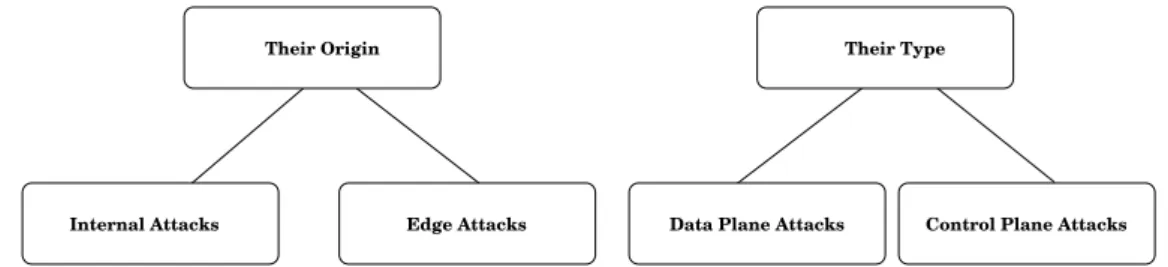
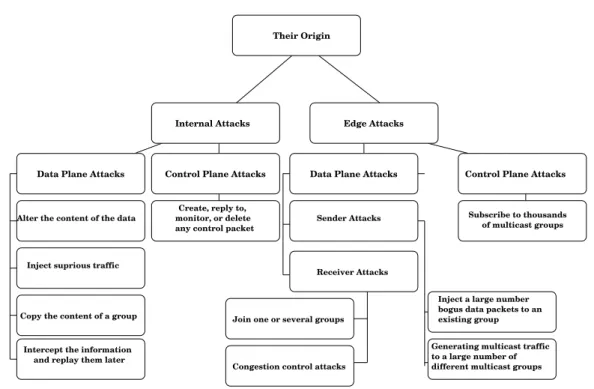
4.1 A General Classification of Possible Attacks of Interest to the Network Operator. . . 30
4.2 A General Classification of Possible Attacks of Interest to the Network Operator. . . 34
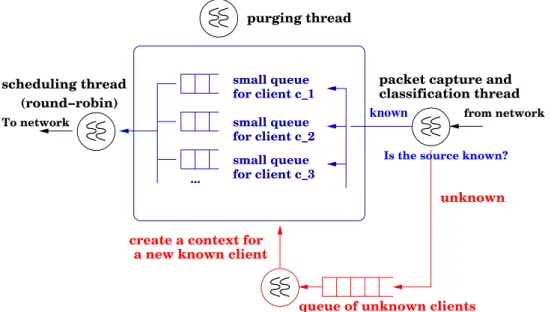
7.1 Architecture of the filter. . . 56
7.2 External versus internal deployment of the filter. . . 57
8.1 Successive waiting times. . . 65
8.2 Acceptance Probability (PK) for the Unknown Client Queue (UCQ). . . 65
8.3 Mean Number of Packets in the UKQ. . . 66
8.4 Number of known clients . . . 68
8.5 The number of waiting packets as a function of traffic intensity . . . 69
8.6 The number of waiting packets as a function of number of attackers . . 69
8.7 Evaluating the Average Waiting Time . . . 70
9.1 The Testbed. . . 73
9.2 Traffic Entering and Leaving the Filter (Test 1). . . 75
9.3 Memory Consumption of the Cisco Router Without/With Filter (Test 1) 76
9.4 PIM Control Traffic Without/With Filter (Test 1). . . 76
9.5 Known Clients (Test 1) . . . 77
9.6 Waiting Packets (Test 1) . . . 77
LIST OF FIGURES
9.8 Traffic Leaving the filter (Test 2). . . 78
9.9 Memory Consumption of the Cisco Router (Test 2). . . 78
9.10 Knwon Clients (Test 2) . . . 79
9.11 Waiting Packets (Test 2) . . . 79
9.12 Average Waiting Time (Test 2) . . . 79
9.13 Traffic Entering and Leaving the filter (Test 3). . . 80
9.14 Memory Consumption of the Cisco Router (Test 3). . . 81
9.15 Traffic Entering and Leaving the filter (Test 1-Poisson). . . 83
9.16 Known Clients Number (Test 1-Poisson) . . . 83
9.17 Simulation of the Number of Known clients (SIMSCRIPT) . . . 84
9.18 Waiting Packets (Test 1-Poisson) . . . 84
9.19 Average Waiting Time (Test 1-Poisson) . . . 85
9.20 Incoming traffic (Test 2-Poisson) . . . 85
9.21 scheduled traffic (Test 2-Poisson) . . . 85
9.22 Known clients (Test 2-Poisson) . . . 86
9.23 Simulation of the Known Clients Number (Test 2-Poisson) . . . 86
9.24 Waiting Packets (Test 2-Poisson) . . . 86
9.25 Average Waiting Time (Test 2-Poisson) . . . 87
9.26 Traffic entering and leaving the filter (Test 3). . . 87
10.1 Deploying the Filter in the DSALM. . . 90
10.2 Deploying the Filter in the BRAS. . . 91
10.3 Example of a Campus Network Architecture. . . 92
12.1 Les Diff´erents Acteurs dans le Cadre d’un Service de Diffusion Multicast.104
12.2 L’Architecture de Filter. . . 111
12.3 Le D´eploiement de Filtre. . . 111
12.4 The Testbed. . . 113
12.5 Le Trafic Entrant et Sortant (Test 1). . . 114
12.6 PIM Messages Sans/Avec Filtre (Test 1). . . 115
12.7 La Consumation de M´emoire sur le Routeur Cisco Avec/Sans filtre (Test 1)115
List of Tables
3.1 IGMPv1 message types . . . 17
3.2 IGMPv2 messages types . . . 18
List of Acronyms
AAA Authentication, Authorization, and Accounting ADSL Asymmetric Digital Subscriber Line
AAL ATM adaptation layer
ACL Access Control List
AH Authentication Header
ASM Any Source Multicast
ATM Asynchronous Transfer Mode BGP Border Gateway Protocol
BGMP Border Gateway Multicast Protocol B-RAS Broadband Remote Access Server CGMP Cisco Group Multicast Protocol
CHAP Challenge Handshake Authentication Protocol CIDR Classless Interdomain Routing
CPU Central Processing Unit
DHCP Dynamic Host Configuration Protocol
DR Designated Router
DSL Digital Subscriber Line
DSLAM Digital Subscriber Line Access Multiplexer DoS Denial of Service
DVMRP Distance Vector Multicast Routing Protocol EAP Extensible Authentication Protocol
EARTH EAsy IP multicast Routing THrough FIB Forwarding Information Base
FIFO First in First Out
HMAC Hashed Message Authentication Code IANA Internet Assigned Numbers Authority IETF Internet Engineering Task Force IDS Intrusion Detection System Module IGMP Internet Group Management Protocol IGMPv2 IGMP version 2
IGMPv3 IGMP version 3
ISP Internet Service Provider
LIST OF TABLES
LAN Local Area Network
MFIB Multicast Forwarding Information Base MIB Management Information Base
MLDv2 Multicast Listener Discovery MPLS Multi-protocol Label Switching MSDP Multicast Source Discovery Protocol
MAC Media Access Control; Message Authentication Code MARS Multicast Address Resolution Service
MBGP Multicast Border Gateway Protocol MBone Multicast Backbone
MD5 Message Digest 5
MSEC Multicast Security Group NAS Network Access Server NAT Network Address Translation
NO Network Operator
PEP Policy Enforcement Point PPP Point-to-Point Protocol
PIM Protocol Independent Multicast
PIM DM Protocol Independent Multicast Dense Mode PIM SM Protocol Independent Multicast Sparse Mode
PIM SSM Protocol Independent Multicast Source-Specific Multicast PKI public key infrastructure
PPPoE Point-to-Point Protocol over Ethernet PVC Permanent Virtual Circuit (or connection) RADIUS Remote Access Dial-In User Service RGMP Router-Ports Group Management Protocol RIF Routing Information Field
RLM Receiver-Driven Layered Multicast RP Rendezvous Point (router)
RPF Reverse-Path Forwarding STP Spanning Tree Protocol
STB Set-Top Box
SVC Switched Virtual Circuit SVI Switched Virtual Interface SFM Source-Filtered Multicast SSM Source Specific Multicast
TCP/IP Transmission Control Protocol/Internet Protocol
TTL Time To Live
UDP User Datagram Protocol
UCQ Unknown Client Queue
VLAN Virtual LAN
VENUS Very Extensive Non-Unicast Service
Chapter 1
An Overview
Contents
1.1 Introduction and Motivations . . . 1
1.2 Goals of the Thesis . . . 3
1.3 Dissertation Roadmap . . . 4
Multicast is a promising technology for the distribution of streaming media, bulk data and many other added-value application, yet the deployment of multicast still in its infancy. In this chapter, we glance over IP multicast technology. We summarize the advantages of multicast and the challenges facing its deployment by the ISPs (Internet Service Provider) and the carriers community. Finally, we introduce the goals and the organization of this thesis.
1.1
Introduction and Motivations
IP multicasting is the transmission of an IP datagram to a ”host group”, a set of zero or more hosts identified by a single IP destination address. A multicast datagram is delivered to all members of its destination host group with the same ”best-efforts” reliability as regular unicast IP datagrams. The membership of a host group is dynamic; that is, hosts may join and leave groups at any time. There is no restriction on the location or number of members in a host group. A host may be a member of more than one group at a time. A host need not be a member of a group to send datagrams to it. [24].
Currently, three different service models for multicast exist. The initial multicast model, which corresponds to the definition above, and referred to as Any Source Multi-cast (ASM) [24]; a new service model which was lately introduced called Source-Specific Multicast (SSM); and the Source-Filtered Multicast (SFM)
With ASM, hosts use the group management protocols (Internet Group Manage-ment Protocol (IGMP)v1, v2 [24] with IPv4 or the Multicast Lister Discovery Protocol
1. AN OVERVIEW
(MLD)v1 [25] with IPv6 to report their group membership interests to the Designated Router.
The SSM model provides host applications with a ”channel” abstraction, in which each channel has exactly one source and any number of receivers. An IP datagram is transmitted by a source S to SSM destination address G, and receivers can receive this datagram by subscribing to channel (S,G).
In order to support the new features of the SSM and SFM models, a new version of the group management protocol was introduced: IGMP v3 [16] with IPv4 and MLD v2 [72] with IPv6.
The multicast distribution tree is constructed by exchanging routing messages be-tween multicast capable routers according to an intra-domain routing protocol, the most widely used being currently the PIM-SM [25] protocol. Providing the reachability and path information between the multicast domains is achieved through inter-domain routing protocols: the Multicast Source Discovery Protocol (MSDP) [28] or the Border Gateway Multicast Protocol (BGMP) [70].
Using multicast delivery to send the same content to multiple receivers reduces the aggregate bandwidth required from the network compared to a unicast solution. However, multicast is not yet widely deployed in the Internet and it continues to be a challenging task for the carriers community [50]. Furthermore, as has been cited in [26]: Multicast is included with the standard set of protocols shipped with most commercial routers, but most IP carriers have not yet enabled the service in their networks. A number of issues have stalled the widespread use of multicast.
• Group management, including authorization for group creation, receiver autho-rization, and sender authorization.
• Distributed multicast address allocation.
• Security, including protection against attacks on multicast routes and sessions, as well as support for data integrity mechanisms.
• Support for network management.
Providing security is still one of the main challenges that hinder the introduction of multicast in the existing infrastructure. It is therefore critical to provide sound security mechanisms that can protect the ISPs and the carriers against multicast threats and allow them at the same time to get all the benefits of introducing multicast in their infrastructure. More specifically, two complementary levels of security must be considered:
• The application level security:
which is essentially the concern of the end users and the content providers. Secur-ing the multicast data content is commonly made possible by encryption meth-ods. A group key is shared by the members that belong to the group and this key needs to change every time a member joins (leaves) the group for backward access
1.2 Goals of the Thesis
control (forward access control). Application level security has been intensively studied [60] [55][77] [17], in particular, within the MSEC IETF working group [2]. • The multicast routing infrastructure security:
Securing the routing infrastructure have been the goal of many researches. We can divide theses approaches into three broad categories: we classify theses approaches into three broad categories:
– Attack avoidance approaches: attacks avoidance is performed by controlling the ability of entities (i.e. routers, receivers and senders) to take part in the multicast routing tree for a given group.
– Attack resiliency approaches:the attacks resiliency techniques aim to survive those attacks that could not be completely repelled.
– hybrid approaches: in this category we find the works whereby the access control and the filtering techniques are combined.
The Network Operator (Carrier), is the main actor in this thesis. This entity owns, manages and deploys the IP infrastructure (i.e. the routers, the Network Access Server/Broadband Access Server (NAS/BAS), the Digital Subscriber Line Multiplexer (DSLAMs), etc.). The Network Operator runs the IP multicast routing protocols. It also carries out the multicast peering relationships with other IP multicast Network Operators (e.g. to exchange the active source/group pairs in Multicast Domains with MSDP). The Network Operator provides IP multicast access to the end user. More specifically, the multicast operator infrastructure can be divided into two parts, the core and the edge. The core contains all the multicast routers and servers, and multicast routing protocols are used to construct the multicast distribution trees. The edge contains multicast-enabled edge nodes (edge routers and/or NAS/BAS) and hosts, and the IGMP protocol is used to communicate the group membership subscriptions. In this thesis we focus on the security of multicast from the network operator viewpoint.
1.2
Goals of the Thesis
This work considers the security from the multicast Network Operator’s viewpoint. The kind of security required by a network operator, who manages and operates the multicast routing infrastructure, largely differs from that of end-to-end security.
While many theoretically ideal proposals have been done to secure the routing pro-tocols, they have rarely been accepted by the operators community. For instance, because they require to modify existing and widely deployed protocols, or they intro-duce authentication mechanisms, which is in practice almost impossible to deploy in legacy networks, and even infeasible, since a corrupted host may be the source of a DoS attack, even if it has been authenticated.
The Network Operator’s security point of view for its group communication service can be summarized as follows:
1. AN OVERVIEW
Secondly, the group communication service provided to its clients (i.e. end users or other network operators with whom has peering relationships) must be operational at any time, in spite of anomalies in the multicast flows, no matter whether they are intentional (i.e. are the result of deliberate attacks) or not (e.g. are caused by a misbehaving component). Security is not the goal, but a mean to achieve the network operator’s ”continuation of service no matter what happens” goal. Security should not impact too much the unicast and multicast forwarding performances on the operator’s network.
The Network Operator can have additional requirements. For instance, it may want to guarantee that the traffic exchanged is not altered while traveling on its own routing infrastructure. It may also want to ensure some confidentiality of the traffic, in case an attacker eavesdrops on a link or a subverted router. These additional security considerations are more commonly addressed by end-to-end security.
Similarly, the physical failures affecting the links, the routers or the servers are not considered in this thesis either, even if they will affect the ”continuation of ser-vice” requirement. Note that our definition shares some similarities with the notion of ”network survivability” [79], but this latter is broader since it also considers physical failures.
The goal of this thesis is to analyze in depth the threats to the multicast infrastruc-ture, to understand the requirements of the network operator and to propose a realistic solution that can respond to these requirements and relieve the networks during a possible attacks. More specifically, this thesis has the following objectives:
1. Mitigating multicast specific attacks through a cost effective, scalable and transpar-ent mechanism. This mechanism aims,in particular, to protect the well-behaved clients against ill-behaved ones
2. Keeping the changes to the currently used multicast routing as minimum as pos-sible
3. Avoiding non realistic assumptions and techniques. For instance, a cryptographic authentication of each control packet (e.g. IGMP/MLD) sent by clients is not realistic (section 4.4.1, and as we will see, does not prevent attacks (section 6). This objective is close related to the point ”2” which states that changes must be kept to a minimum.
4. Keeping track of routers and network resources at the network layer and allows a fair resource regulation.
1.3
Dissertation Roadmap
The rest of the document is organized as follows:
• In chapter 2, we put in light the deployment aspects of multicast by the network operator.
1.3 Dissertation Roadmap
• In chapter 3, we present the different components and protocols of the group communication service.
• In chapter 4, we introduce and discuss the vulnerabilities of the multicast routing infrastructure from the point of view of the network operator. We classify the multicast specific threats into several categories according to their harmfulness to the operator network.
• In chapter 5, we present the group management protocols specific threats. We classify theses attacks according to their potential impact on the network operator infrastructure.
• In chapter 6, we present the state of the art in the field of multicast routing security. We present a taxonomy of the different propositions, and we discuss the pros and cons of the different categories of solutions.
• In chapter 7, we introduce our filtering proposal, its architecture and the dif-ferent building blocks involved in it. We also discuss some parameterizing and performance aspects.
• In chapter 8, we present a theoretical study that allows to easily dimension the filter and to find the different initializing parameters as a function of the traffic arrival models and the underlying infrastructure.
• In chapter 9, we evaluate experimentally the efficiency of our proposal. We com-pare the experimental and the theoretical results presented in the chapter5. Then, we conclude with a detailed discussion of several key issues that emerged from this study.
• In chapter 10, we explore the deployment of the filter in the operational networks then we discuss some extensions to improve the filtering efficiency.
• In chapter 11, we conclude the dissertation by revisiting the lessons learned from this work and presenting direction for future researches in this area.
Chapter 2
Multicast Deployment by the
Network Operator: a State of the
Art
Contents
2.1 Multicast Delivery: the Operational Model . . . 7
2.1.1 The Various Actors and the Services Provided . . . 7
2.2 Deployment Examples . . . 9
2.2.1 First Example: Commercial Delivery of Video Over xDSL . . 10
2.2.2 Second Example: Multicast Delivery of Free Content . . . 11
2.3 Conclusion . . . 11
In this chapter we present an operational overview of the multicast deployment in the network operator. Understanding the different components in multicast content delivery is essential to understand the security issues related to the multicast service. Moreover, Different deployment architecture have different repercussions on the security of the operator infrastructure or the subscribers.
2.1
Multicast Delivery: the Operational Model
The operational model describes the different actors participating in the multicast de-livery service and the different transactions between them. Our goal of introducing the operational model is to understand the role of the multicast operator and its relation-ships with the other actors.
2.1.1 The Various Actors and the Services Provided
Providing a multicast access service to receivers scattered over wide area networks requires the collaboration of different actors, which have relevant relationships and
2. MULTICAST DEPLOYMENT BY THE NETWORK OPERATOR: A STATE OF THE ART
their own set of roles.
In this thesis we consider the following entities (Figure2.1):
• The Network Operator (Carrier): This entity owns, manages and deploys the routing infrastructure (i.e. the routers, the Network Access Server/Broadband Access Server (NAS/BAS), the Digital Subscriber Line Multiplexers (DSLAMs), etc.). The operator network is composed from the following networks:
– Access Network : The access network encompasses the xDSL lines and the DSLAMs. The xDSL connect the xDSL modems in the CPE to the DSLAMs. The xDSL modem can operate as a bridge or a router. In the bridge mode a Point-to-Point Protocol (PPP) [35] connection is established between the CPE and the BRAS, whereas in the router mode the xDSL modem es-tablishes a direct IP connection. PPP allows to transport IP traffic over point-to-point links. PPP also established a standard for the assignment and management of IP addresses. Another way to assign IP address is the use of DHCP and DHCP relay [73]. Two variants of the PPP protocol are deployed: PPP over Ethernet (PPPoE) [35] and PPP over ATM (PP-PoA) [53]. Additionally, there is a combination of these protocols called PPP over Ethernet over ATM or PPPoEoA.
The DSLAM performs the following functions: ∗ Line Termination of the ADSL subscriber lines.
∗ Concentration/multiplexing of the ADSL subscriber lines toward the aggregation network.
∗ Termination of customer ATM signaling Channels (in the case of ATM based network)
The access network, as the gatekeeper for the multicast group, has a larger set of responsibilities during the IGMP processing [67].
– Aggregation Network : The aggregation network encompasses the Broadband Remote Access Server (BRAS). The BRAS is the aggregation point for the subscriber traffic. It provides aggregation capabilities (e.g. IP, PPP, ATM) between the Regional/Access Network and the ISP. Beyond aggregation, it is also responsible for policy management and IP QoS in the Regional/Access Networks.
– The Core Network : The core networks follows a continuous evolving process. Today’s core network has four layers: IP and other content-bearing traffic, ATM for traffic engineering, a Synchronous Optical Network/Synchronous Digital Hierarchy (SONET/SDH) transport network, and dense wave divi-sion multiplexing (DWDM) for fiber capacity.
The Network Operator runs the IP multicast routing protocols. It also carries out the multicast peering relationships with other IP multicast Network Operators (e.g. to exchange the active source/group pairs in Multicast Domains with MSDP.
2.2 Deployment Examples
The Network Operator provides IP multicast access to the end user but it does not have commercial relationships with them. It neither knows the user identity nor manages the users database.
• The Internet Service Provider (ISP) and the Service Provider: The ISP is in charge of commercial relationships to the final user. It provides Internet access to the end user as well as other basic services (e.g. E.mail, web, chat, portal). The Service Provider mainly focuses on the provisioning and marketing of service offers (digital TV broadcasting, VoD, ...) to the end user, and gives them a real-time access to valuable contents.
Both providers enable a user to subscribe or unsubscribe to a service. These providers own the user database: user login and password, access right, and charging. They work in close relationship with the network operator but do not manage the infrastructure themselves. In the remaining of the thesis, in order to simplify the discussion and also because we expect it will usually be the case, we assume that the same company plays the two roles, and we use the generic term ”Service Provider”.
• The Content Provider: This entity provides the information included in the ser-vice provided to users or via copyright to serser-vice providers. These added-value information can consist of text, images, video (digital TV or VoD), audio (radio, music), etc.
• The Content Aggregator: This entity builds bundles of channels from the con-tent provided by one or more Concon-tent Providers. It collects the concon-tents, turns them into the appropriate digital coding and broadcasts them on its IP network. The content aggregator has peering relationships and contracts with one or more Network Operators so as to forward its traffic up to the end users.
• The End User: The user owns an IP multimedia terminal, which can be either a PC or a TV/STB (Set Top Box).
One can notice that a same actor could play the role of several entities. For instance, a service provider could also be the network operator if it owns the network infrastruc-ture. On the contrary, within the same enterprise, different entities could play different roles with internal pseudo commercial relationships. Additionally, a multicast operator could play only a transit role domain for the multicast traffic of other operators of ISPs.
2.2
Deployment Examples
The previous discussion is illustrated with two major case studies: • A commercial delivery of video over xDSL, and
2. MULTICAST DEPLOYMENT BY THE NETWORK OPERATOR: A STATE OF THE ART
PC or TV+STB End−User Network Operator Content Provider Network Operator Service Provider Network Aggregation AAA server DSLAM BRAS
Figure 2.1: The different actors during a multicast content delivery session.
These two case studies are largely different in their assumptions. We believe that they perfectly illustrate the two classes of situations that can be found: An access to a commercial versus a free service.
2.2.1 First Example: Commercial Delivery of Video Over xDSL
In this section we describe a commercial multicast video delivery service over xDSL (i.e. ADSL, VDSL, etc.). xDSL provides an attractive platform for the delivery of services requiring ever-greater bandwidths like voice and video delivery.
Practically, in this type of service the service provider offers Internet broadband access service to the client. In this context, he performs several functions such as IP address configuration and user authentication, authorization and accounting. This is the first level of client authentication/authorization and it enables a user to get IP access and connectivity.
Some content, like basic TV programs already available on hertzian channels, will probably continue to be provided free of charge over xDSL. But commercial services like pay-per-view or premium TV programs must be controlled. Service usage should be monitored and logged in an Authentication Server like a RADIUS (Remote Access Dial In User Service) server. This is the second level of client authentication/authorization and it enables a user to get access to the service.
Accessing a video channel requires that the user joins the associated multicast channel. The IGMP with IPv4 or MLD with IPv6 is used between the User and the Network Operator.
Management flows, such as AAA flows to authenticate and charge a user, are ex-changed (or relayed) between the Network Operator and the Service Provider. In order to deliver the TV channels or videos to the end user, the Service Provider relies on the IP multicast transport service provided by the Network Operator. The Network Oper-ator owns the IP network infrastructure and runs the IP multicast routing protocols so as to build multicast distribution trees from the content sources located at the Content
2.3 Conclusion
Aggregator’s network to the end users. Therefore, a technical and physical relationship exists between the Network Operator and the Content Aggregator: Their IP multicast enabled networks are interconnected and Network Operator and Content Aggregator have multicast peering relationships so as to exchange the active source/group pairs in each Multicast Domains (through MSDP sessions for example). Therefore, content flows are transmitted from the Content Aggregator network, then transit in the Network Operator’s network to get to the end user without going through the Service Provider premises. The only flows transiting between the User and the Service Provider (through the Network Operator’s network) are the management flows such as AAA flows.
2.2.2 Second Example: Multicast Delivery of Free Content
The situation is completely different here, even if the access network can also be xDSL. This difference lies in the fact that clients that join the session to download the content (e.g. a software update, a video clip, etc.) have not previously subscribed to any service. They cannot be authorized since there is a free access to the content (said differently, the content provider needs no AAA server). Client authentication/authorization is only performed at the Service Provider level in this scenario, when the client gets connected to the Internet.
2.3
Conclusion
The purpose of this chapter is to only make an introduction to deployment of the multicast in the operational networks. As has been shown, providing a multicast access service to receivers scattered over wide area networks requires the collaboration of different actors, which have relevant relationships and their own set of roles. This thesis focuses on the network operator (Carrier) who owns, manages and deploys the routing infrastructure. The operator has a large set of responsibilities during the multicast groups management processing.
2. MULTICAST DEPLOYMENT BY THE NETWORK OPERATOR: A STATE OF THE ART
Chapter 3
Multicast Routing Protocols:
Overview
Contents
3.1 Multicast Service Models . . . 13
3.2 Group Management Protocols . . . 14
3.2.1 Internet Group Management Protocol (IGMP) . . . 14
3.2.2 Multicast Listener Protocol (MLD) . . . 22
3.2.3 Group Management Protocols Proxying . . . 22
3.2.4 Group Management Protocols in Layer2 Switching environment 22
3.3 Multicast Routing Protocols . . . 23
3.3.1 Intra-Domain Routing Protocols . . . 23
3.3.2 Inter-domain multicast routing architectures and protocols . 26
3.4 Consluion . . . 28
In this chapter we present the different components and protocols of the group communication service.
3.1
Multicast Service Models
Currently, three different service models for multicast exist. The initial multicast as has been introduced by Deering and referred to as Any Source Multicast (ASM) [24], the Source-Specific Multicast (SSM) a new service model and the Source-Filtered Multicast (SFM)
• Any-Source Multicast (ASM): With this model, an IP datagram is transmitted to a ”host group”, a set of zero or more end-hosts (or routers) identified by a single IP destination address taken from the class D space (224.0.0.0-239.255.255.255). ASM is an open model: any host can join any multicast group as a listener, and similarly, any host can start to transmit multicast traffic to a multicast group.
3. MULTICAST ROUTING PROTOCOLS: OVERVIEW
• Source-Specific Multicast (SSM): This is the multicast service model defined in [41]. SSM provides host applications with a ”channel” abstraction, in which each channel has exactly one source and any number of receivers. SSM is de-rived from earlier work in EXPRESS [42]. An IP datagram is transmitted by a source S to a SSM destination address G, and receivers can receive this datagram by subscribing to channel (S,G). The address range 232/8 has been assigned by IANA for SSM service in IPv4. For IPv6, the range FF3x::/96 is defined for SSM services.
• Source-Filtered Multicast (SFM): This is a variant of the ASM service model, and uses the same address range as ASM. It extends the ASM service model by introducing sources filtering. That is, each ”upper layer protocol module” can now request data sent to a host group G by only a specific set of sources, or can request data sent to host group G from all BUT a specific set of sources. Support for source filtering is provided by version 3 of the Internet Group Management Protocol (or IGMPv3) for IPv4, and version 2 of the Multicast Listener Discovery (or MLDv2) protocol for IPv6. Note that while SFM is a different model than ASM from a receiver standpoint, there is no distinction between the two for a sender.
3.2
Group Management Protocols
3.2.1 Internet Group Management Protocol (IGMP)
The Internet Group Management Protocol (IGMP) is used by IPv4 end hosts to report their group membership interests to their immediately neighboring multicast routers. Routers periodically query their attached subnetworks to determine if known group members are still active. IGMP is only locally significant; IGMP packets are not forwarded by routers (note that in the case of IGMP proxy the IGMP packets are gen-erated by the router on behalf of the receivers and not forwarded). Based on the group membership information learned from IGMP, a router is able to determine which (if any) multicast traffic needs to be forwarded to each of its ”leaf” subnetworks. Multi-cast routers use this information, in conjunction with a multiMulti-cast routing protocol, to support IP multicasting across the Internet. An IP multicast router may itself be a member of one or more multicast groups, in which case it performs both the ”multi-cast router part” of the protocol (to collect the membership information needed by its multicast routing protocol) and the ”group member part” of the protocol (to inform itself and other, neighboring multicast routers of its memberships).
Three versions of IGMP has been defined. Version 1, specified in RFC-1112 [24], was the first widely-deployed version and the first version to become an Internet Standard. Version 2 [29] adds support for ”low leave latency”, that is, a reduction in the time it takes for a multicast router to learn that there are no longer any members of a particular group present on an attached network. Version 3 [16] adds support for ”source filtering”, that is, the ability for a system to report interest in receiving packets only from specific
3.2 Group Management Protocols
source addresses, or from all but specific source addresses, sent to a particular multicast address. Version 3 is designed to be interoperable with Versions 1 and 2, Version 2 to be interoperable with Version 1.
IGMP Version 1
IGMP Version 1 was specified in RFC-1112 [24]. According to the specification, a host sends a Group Membership Report message to receive the flows destined for a multicast group. The report messages are sent with the address of the multicast group with a TTL of 1.
Multicast routers periodically send Membership Query messages to determine which groups have members on their directly attached networks. Query messages are ad-dressed to the all-hosts group (224.0.0.1) and have an IP TTL of 1.
When a host receives a Query message, it responds with a Host Membership Report for each host group to which it belongs. In order to avoid a storm of Reports, each host starts a randomly chosen delay timer for each of its group memberships. If, during the delay period, another Report is heard for the same group, the local host resets its timer to a new random value. Otherwise, the host transmits a Report to the reported group address, causing all other members of the group to reset their Report message timers. This procedure guarantees that Reports are spread out over a period of time and that Report traffic is minimized for each group with at least one member on the subnetwork.
When a host first joins a group, it immediately transmits a Report for the group rather than waiting for a router Query. This guarantees that the host will receive traffic addressed to the group if it is the first member of that group on the subnetwork.
It should be noted that a router does not need to maintain a detailed list of which hosts belong to each multicast group; the router only needs to know that at least one group member is present on a network interface. Multicast routers periodically transmit Queries to update their knowledge of the group members present on each network interface.
If the router does not receive a Report for a particular group after a number of Queries (by default this number equals 2), the router assumes that group members are no longer present on the interface and the group is removed from the list of group memberships for the directly attached subnetwork. This report suppression mechanism is depicted in the figure 3.1:
IGMP Version 1 Packet Format:
IGMPv1 packet is encapsulated in an IP packet with a protocol identifier of 2. Fig-ure3.2 depicts the packet format for IGMPv1.
IGMP Version 2
IGMP Version 2 [29] enhances and extends IGMP Version 1 while also providing back-ward compatibility with Version 1 hosts. IGMP Version 2 defines a procedure for the
3. MULTICAST ROUTING PROTOCOLS: OVERVIEW
Querier (Router with the lower
TTL = 1 Group Field = 0 Query sent to all hosts (224.0.01)
This Host hears the report
and doesn’t send a duplicate the Query and sends a reportThis Host send hears
for Group G. IP address)
Figure 3.1: The Reports Suppression Mechanism.
8 8
8 8
32 bits
Version Type Unused Checksum
Group Address
Figure 3.2: IGMPv1 packet format.
election of the multicast Querier for each LAN. In IGMP Version 2, the router with the lowest IP address on the LAN is elected the multicast querier. In IGMP Version 1, the Querier election was determined by the multicast routing protocol. This could lead to potential problems because each multicast routing protocol used different methods for determining the multicast querier.
IGMP Version 2 defines a new type of Query message: the Group-Specific Query message. Group-Specific Query messages allow a router to transmit a Query to a specific multicast group rather than all groups residing on a directly attached subnetwork.
Finally, IGMP Version 2 defines a Leave Group message to reduce IGMP’s ”leave latency”. When the last host to respond to a Query with a Report wishes to leave that specific group, the host transmits a Leave Group message to the all-routers group (224.0.0.2) with the group field set to the group to be left. In response to a Leave group message, the router begins the transmission of Group-Specific Query messages on the interface that received the Leave message. If there are no Reports in response to the Group-Specific Query messages, the group is removed from the list of group memberships for the directly attached subnetwork.
IGMP Version 2 Packet Format:
IGMPv1 packet is encapsulated in an IP packet with a protocol identifier of 2. Fig-ure 3.3depicts the packet format for IGMPv2.
3.2 Group Management Protocols
0x1 Membership Query 0x2 Membership Report Table 3.1: IGMPv1 message types
8 8 8 8 32 bits Checksum Group Address
Type Max Res.Time
Figure 3.3: IGMPv2 packet format.
IGMP Version 2 Timers:
IGMPv2 introduces many timers, these timers are configurable and allow to tune the burstiness of IGMP traffic in the network.
• Robustness Variable: The Robustness Variable allows tuning for the expected packet loss on a subnet. If a subnet is expected to be lossy, the Robustness Variable may be increased. IGMP is robust to (Robustness Variable-1) packet losses.
• Query Interval : The Query Interval is the interval between General Queries sent by the Querier. Default: 125 seconds.
• Query Response Interval : The Max Response Time inserted into the periodic General Queries. Default: 10 seconds.
• Group Membership Interval : The Group Membership Interval is the amount of time that must pass before a multicast router decides there are no more mem-bers of a group on a network. Group Memmem-bership Interval = ((the Robustness Variable) times (the Query Interval)) plus (one Query Response Interval). • Other Querier Present Interval : The Other Querier Present Interval is the length
of time that must pass before a multicast router decides that there is no longer another multicast router which should be the querier. This value equals to ((the Robustness Variable) times (the Query Interval)) plus (one half of one Query Response Interval).
• Startup Query Interval : The Startup Query Interval is the interval between Gen-eral Queries sent by a Querier on startup. Default: 1/4 the Query Interval. • Last Member Query Interval : The Last Member Query Interval is the Max
3. MULTICAST ROUTING PROTOCOLS: OVERVIEW
0x11 Membership Query
0x16 Version 2 Membership Report 0x12 Version 1 Membership Report 0x17 Version 2 Leave Group
Table 3.2: IGMPv2 messages types
messages, and is also the amount of time between Group-Specific Query messages. Default: 1 second.
• Unsolicited Report Interval : The Unsolicited Report Interval is the time between repetitions of a host’s initial report of membership in a group. Default: 10 sec-onds.
• Version 1 Router Present Timeout : The Version 1 Router Present Timeout is how long a host must wait after hearing a Version 1 Query before it may send any IGMPv2 messages. Value: 400 seconds.
IGMP Version 3
IGMP Version 3 [16] introduces support for Group-Source Report messages so that a host can request to receive traffic from only specific source addresses or from all but specific source addresses. IGMP Version 3 will help conserve bandwidth by allowing a host to select the specific sources from which it wants to receive traffic. Also, multicast routing protocols will be able to make use of this information to conserve bandwidth when constructing the branches of their multicast delivery trees. In order to enable this source access filtering mechanism, a system’s IP service interface must support the following operation: IPMulticastListen (socket, interface, multicast-address, filter-mode, source-list) where:
• Interface: the network interface on which reception of the specified multicast address is to be enabled/disabled.
• Multicast address: the IP multicast address to which the request pertains. • Filter-mode: this parameter can be either INCLUDE or EXCLUDE. In
IN-CLUDE mode, reception of packets sent to the specified multicast address is requested only from those IP source addresses listed in the source-list parameter. In EXCLUDE mode, reception of packets sent to the given multicast address is requested from all IP source addresses except those listed in the source-list parameter.
• Source-list : An unordered list of zero or more IP unicast addresses from which multicast reception is desired or not desired, depending on the filter mode.
3.2 Group Management Protocols
IGMP Version 3 provides support for Group-Source Leave messages. This feature allows a host to leave an entire group or to specify the specific IP address(es) of the (source, group) pair(s) that it wishes to leave.
Version 3 Membership Report Message:
IGMP Version 3 Membership Reports are sent by IP systems to report (to neighboring routers) the current multicast reception state, or changes in the multicast reception state, of their interfaces. Reports have the following format 3.4:
Type=0x22 Reserved
8 Bytes 8 Bytes 16 Bytes
Checksum
Reserved group record (M)Number of
1
Group record 2
Group record Group record
M
Figure 3.4: IGMPv3 packet format.
0x11 Membership Query
0x22 Version 3 Membership Report 0x12 Version 1 Membership Report 0x16 Version 2 Membership Report 0x17 Version 2 Leave Group
Table 3.3: IGMPv3 messages types
where each Group Record has the following format 3.5: The most interesting fields are:
• Group Record Types There are a number of different types of Group Records that may be included in a Report message:
– Current-State Record: This indicates the current reception state with re-spect to one multicast group at a given interface. It contains the filter mode (include or exclude) and the set of related sources. A Current-State record type is either MODE IS INCLUDE orMODE IS EXCLUDE.
3. MULTICAST ROUTING PROTOCOLS: OVERVIEW
8 Bytes 8 Bytes 16 Bytes
Record Type 1 2 N Source Address Source Address ... Source Address Multicast Address Number of Sources(N) Length Aux Data 1 2 N Auxiliary Data
Figure 3.5: IGMPv3 group record.
– Filter-Mode-Change Record: This indicates that the filter-mode of the recep-tion state has changed. It contains the new filter-mode and the set of related sources. A Filter-Mode-Change record type is eitherCHANGE TO INCLUDE
MODE orCHANGE TO EXCLUDE MODE.
– Source-List-Change Record: This indicates that the group’s associated sources have changed. A Source-List-Change record type isALLOW NEW SOURCES, when data from a new set of sources are to be received.
It is BLOCK OLD SOURCES, when data from an existing set of sources are not required.
• The Number of Group Records (M) field which specifies how many Group Records are present in this Report. Each Group Record is a block of fields containing information pertaining to the sender’s membership in a single multicast group on the interface from which the Report is sent.
• The Number of Sources (N) field specifies how many source addresses are present in this Group Record.
• The Multicast Address field contains the IP multicast address to which this Group Record pertains.
IGMP Version 3 Reports are sent with an IP destination address of 224.0.0.22, to which all IGMPv3-capable multicast routers listen. Since in IGMPv3 these packets are not addressed to the group joined (as in the previous versions) the router will effectively learn all hosts desiring to receive a given multicast group. This enables new enhancements in terms of expedited leave and simplified IGMP snooping architectures. Another feature added in IGMP v3 is that when a router sends, a query all hosts must respond with their group of interest to the address 224.0.0.22.
Version 3 Membership Query Message:
Membership Queries3.6are sent by IP multicast routers to query the multicast recep-tion state of neighboring interfaces.
3.2 Group Management Protocols
The functionality of an IGMPv3 querier is complex compared to the earlier versions (v1 or v2). An IGMPv3 querier has to handle the six types of group record information (discussed above) and maintain the state information for each reachable multicast group associated with each network interface. The state information consists of the following: multicast address, group timer, filter mode, and source records. Each source record contains source address and a source timer.
The filter mode for a multicast group in a querier is known as router filter mode. It is determined after processing all the received state record information from the neighboring IGMPv3 hosts for the group. When the filter mode is INCLUDE, the source record list contains the list of sources whose data are to be forwarded on the attached network. When the filter is EXCLUDE, the source record list contains two types of sources.
The first set (type) contains sources whose data needs to be forwarded by some routers while the second set contains sources whose data are not to be forwarded. The group timer is used when the filter mode is exclude.
When a Current-State Record with record type MODE IS EXCLUDE is received, the router filter for the group becomes exclude. When the host that had reported a Current-State Record with MODE IS EXCLUDE stops reporting and the group timer expires, the router filter changes to include.
Queries have the following format: The most interesting fields (IGMPv3 specific) are:
Reserved
8 Bytes 8 Bytes 16 Bytes
Checksum Record Type Multicast Address Number of Sources(N) Reserved 1 2 Source Address Source Address ... 1 2 Source Address (N)
Figure 3.6: IGMPv3 query.
• Group Address: this field is set to zero when sending a General Query, and set to the IP multicast address being queried when sending a Group-Specific Query or Group-and-Source-Specific Query.
• Number of Sources (N): this field specifies how many source addresses are present in the Query. This number is zero in a General Query or a Group-Specific Query, and non-zero in a Group-and-Source-Specific Query.
• Source Address [i]: these fields are a vector of n IP unicast addresses, where n is the value in the Number of Sources (N) field. In IGMPv3, General Queries
3. MULTICAST ROUTING PROTOCOLS: OVERVIEW
are sent with an IP destination address of 224.0.0.1, the all-systems multicast address. Group and Group-and-Source Queries are sent with an IP destination address equal to the multicast address of interest.
3.2.2 Multicast Listener Protocol (MLD)
MLD works with IPv6 in the same way that IGMP manages multicast groups for IPv4. MLD version 1 [25] implements the functionality of IGMP version 2, whereas MLD version 2 [25] implements the functionality of IGMP version 3. MLD is a sub-protocol of ICMPv6, that is, MLD message types are a subset of the set of ICMPv6 messages, and MLD messages are identified in IPv6 packets by a preceding Next Header value of 58. All MLD messages are sent with a link-local IPv6 Source Address, an IPv6 Hop Limit of 1.
3.2.3 Group Management Protocols Proxying
In some deployment scenarios, such in the case of an edge box with only one connection to the core network side and many connections to the customer side, it is not necessary to run a multicast routing protocol. It is sufficient to learn and proxy group membership information and simply forward multicast packets based upon that information. One typical example of such tree topology can be found on an edge aggregation box such as Digital Subscriber Line Access Multiplexer (DSLAM) [25].
3.2.4 Group Management Protocols in Layer2 Switching environment
Layer 2 switches cannot handle multicast MAC address. By default, when seeing a multicast MAC address the switch will forward the packet out of ALL its ports. This loads the switch up and results in multicast traffic being unnecessarily sent to hosts that have not requested it. To resolve this issue, the following approaches have been proposed. These approaches allow the switch to determine which interfaces should be used for egress processing. Therefore, reduce drastically the amount of unwanted multicast traffic.
• IGMP/MLD Snooping: A layer-2 switch supporting ”IGMP/MLD snooping” can snoop on IGMP Query, Report and Leave (IGMP version 2) packets transferred between IP Multicast Routers/Switches and IP Multicast hosts to learn the IP Multicast group membership. It checks IGMP/MLD packets passing through it, picks out the group registration information, and configures multicast forwarding tables accordingly. However, without some type of hardware (ASIC) assist, this additional decode process can be quite taxing on a central CPU-based switch. In fact, IGMP/MLD snooping may cause such switches to arbitrarily discard a large number of packets during times of multicast peaks. However, with the proper hardware assist, IGMP/MLD snooping is a viable solution. IGMP/MLD snooping is available on a variety of mid-to-high end switches.