RESEARCH OUTPUTS / RÉSULTATS DE RECHERCHE
Author(s) - Auteur(s) :
Publication date - Date de publication :
Permanent link - Permalien :
Rights / License - Licence de droit d’auteur :
Bibliothèque Universitaire Moretus Plantin
Institutional Repository - Research Portal
Dépôt Institutionnel - Portail de la Recherche
researchportal.unamur.be
University of Namur
Copper and myeloperoxidase-modified LDLs activate Nrf2 through different pathways
of ros production in macrophages
Calay, Damien; Rousseau, Alexandre; Mattart, Laurine; Nuyens, Vincent; Delporte, Cédric;
Van Antwerpen, Pierre; Moguilevsky, Nicole; Arnould, Thierry; Boudjeltia, Karim Zouaoui;
Raes, Martine
Published in:
Antioxidants and Redox Signaling
DOI:
10.1089/ars.2009.2971
Publication date:
2010
Document Version
Publisher's PDF, also known as Version of record
Link to publication
Citation for pulished version (HARVARD):
Calay, D, Rousseau, A, Mattart, L, Nuyens, V, Delporte, C, Van Antwerpen, P, Moguilevsky, N, Arnould, T,
Boudjeltia, KZ & Raes, M 2010, 'Copper and myeloperoxidase-modified LDLs activate Nrf2 through different
pathways of ros production in macrophages', Antioxidants and Redox Signaling, vol. 13, no. 10, pp. 1491-1502.
https://doi.org/10.1089/ars.2009.2971
General rights
Copyright and moral rights for the publications made accessible in the public portal are retained by the authors and/or other copyright owners and it is a condition of accessing publications that users recognise and abide by the legal requirements associated with these rights. • Users may download and print one copy of any publication from the public portal for the purpose of private study or research. • You may not further distribute the material or use it for any profit-making activity or commercial gain
• You may freely distribute the URL identifying the publication in the public portal ?
Take down policy
If you believe that this document breaches copyright please contact us providing details, and we will remove access to the work immediately and investigate your claim.
Copper and Myeloperoxidase-Modified LDLs
Activate Nrf2 Through Different Pathways
of ROS Production in Macrophages
Damien Calay,1Alexandre Rousseau,2Laurine Mattart,1Vincent Nuyens,2 Ce´dric Delporte,3Pierre Van Antwerpen,3Nicole Moguilevsky,4Thierry Arnould,1
Karim Zouaoui Boudjeltia,2and Martine Raes1
Abstract
Low-density lipoprotein (LDL) oxidation is a key step in atherogenesis, promoting the formation of lipid-laden macrophages. Here, we compared the effects of copper-oxidized LDLs (OxLDLs) and of the more physiologically relevant myeloperoxidase-oxidized LDLs (MoxLDLs) in murine RAW264.7 macrophages and in human peripheral blood monocyte-derived macrophages. Both oxidized LDLs, contrary to native LDLs, induced foam cell formation and an intracellular accumulation of reactive oxygen species (ROS). This oxidative stress was responsible for the activation of the NF-E2-related factor 2 (Nrf2) transcription factor, and the subsequent Nrf2-dependent over-expression of the antioxidant genes, Gclm and HO-1, as evidenced by the invalidation of Nrf2 by RNAi. MoxLDLs always induced a stronger response than OxLDLs. These differences could be partly explained by specific ROS-producing mechanisms differing between OxLDLs and MoxLDLs. Whereas both types of oxidized LDLs caused ROS production partly by NADPH oxidase, only MoxLDLs-induced ROS production was dependent on cyto-solic PLA2. This study highlights that OxLDLs and MoxLDLs induce an oxidative stress, through distinct ROS-producing mechanisms, which is responsible for the differential activation of the Nrf2 pathway. These data clearly suggest that results obtained until now with copper oxidized-LDLs should be carefully reevaluated, taking into consideration physiologically more relevant oxidized LDLs. Antioxid. Redox Signal. 13, 1491–1502.
Introduction
R
eactive oxygen species (ROS) are products of normal cell metabolism and play a major physiological role in intracellular signaling and regulation, such as the regulation of vascular tone, cell adhesion, or immune responses (10). However, an excessive and=or sustained increase in ROS production results in damage to cell structures (10, 40). In order to cope with an excess of ROS and the subsequent oxi-dative stress, humans have developed cellular mechanisms to maintain redox homeostasis. These involve antioxidant de-fenses such as glutathione (GSH), the major thiol antioxidant and redox buffer of the cell (11). Elevated ROS concentrations also lead to the activation of the NF-E2-related factor 2 (Nrf2) transcription factor, which is a central protein in the cellular response to oxidative stress. Once activated by ROS, Nrf2 strongly binds on DNA to the Antioxidant Response Element(46) sequence and, by this way, regulates the expression of protective genes such as the phase II drug metabolizing en-zymes, as well as the regulatory subunit of glutamate-cysteine ligase (Glcm) and heme oxygenase-1 (HO-1) (16). Gclm is the limiting enzyme in GSH synthesis (11). HO-1 is the rate-limiting enzyme in the degradation of heme, and induction of this enzyme causes cells to reduce their pools of heme and heme-containing proteins, eliminating potential pro-oxidants. Moreover, the by-products of this reaction— biliverdin and carbon monoxide—have antioxidant as well as anti-inflammatory properties (23, 30). Thus, it appears that Nrf2 is a key protein in the cellular response to oxidative stress and that its target genes (e.g., Gclm and HO-1) are induced for the purpose of coping with oxidative stress (19).
Despite these antioxidant defenses, when the level of ROS exceeds the antioxidant capacity of the cell, the intracellular redox homeostasis is altered and oxidative stress ensues.
1Laboratory of Biochemistry and Cellular Biology, University of Namur, Namur, Belgium. 2
Experimental Medicine Laboratory (ULB 222 Unit) CHU Charleroi, ISPPC Hoˆpital Ve´sale, Montigny-Le-Tilleul, Belgium. 3Laboratory of Pharmaceutical Chemistry, Institute of Pharmacy, Universite Libre de Bruxelles, Brussels, Belgium. 4Technology Transfer Office, University of Namur, Namur, Belgium.
ª Mary Ann Liebert, Inc. DOI: 10.1089=ars.2009.2971
Oxidative stress is considered to play a pivotal role in various pathological conditions, involving cardiovascular diseases, cancer, neurological disorders, and aging (35, 40). In partic-ular, excessive ROS production has been implicated in ath-erogenesis and throughout the development of this disease (35). Atherosclerosis is the major cause of heart disease and stroke, and is commonly viewed as a chronic inflammatory disease in which macrophages play a key role (18, 22). Actu-ally, oxidative modifications of low-density lipoproteins (LDLs) contribute to the accumulation of cholesterol-loaded macrophages, termed ‘‘foam cells,’’ that are a hallmark of the disease (18, 22, 36).
Nonetheless, although lipoprotein oxidation is well recog-nized to be implicated in atherogenesis (3, 36), the physio-logically relevant pathways mediating these oxidative modifications have not yet been unambiguously identified. In vitro, the most widely studied model of LDLs oxidation involves copper ions. Indeed, free metal ions such as iron and copper have been detected in atherosclerotic lesions, and high concentrations of metal ions are potent catalysts for in vitro LDL oxidation. However, the concentrations of copper sulfate currently used in vitro to oxidize LDL (e.g., 10–20mM) largely exceed physiological concentrations and lead to very different composition, structural, and biochemical features of the oxi-dized LDL (47).
That is why more recently alternative LDL oxidative pathways have been proposed involving for instance lipoxygenases (41), NAPDH oxidase (13), or myeloperoxidase (MPO) that focused our attention. MPO is certainly not the only enzyme mediating LDL oxidation in vivo, but there is accumu-lating evidence suggesting its implication in this process. Indeed, MPO, its specific by-product—3-chlorotyrosine—and MPO-oxidized LDL have been detected in human atheroscle-rotic lesions (8, 12, 28). Moreover, MPO strongly binds to Apo-B100 of LDL, retaining its catalytic activity. This could potentially enhance site-directed oxidation of the ApoB-100 of LDL and limit scavenging of reactive oxygen species by anti-oxidants (5). This enzyme may therefore represent one relevant pathway for LDL oxidation in vivo. Even though we are aware that MPO is not the only enzyme implicated in the in vivo modifications of LDL and that MoxLDL are only one kind of modified LDLs that can be found within atherosclerotic lesions, we decided to focus on LDL oxidation by MPO, which consti-tutes one of the more physiological mechanisms implicated in LDL oxidation (32).
The aim of this study was to highlight the differential ef-fects of the copper-oxidized LDLs (OxLDLs) and of the phys-iologically more relevant myeloperoxidase-oxidized LDLs (MoxLDLs) in macrophages, using murine RAW264.7 macro-phages, but also human monocyte-derived macrophages. We showed that both OxLDLs and MoxLDLs accumulate in macrophages, leading to foam cell formation, and induce an intracellular accumulation of ROS that is responsible for the activation of the Nrf2 transcription factor. Both OxLDLs and MoxLDLs also induce a ROS- and Nrf2-dependent over-expression of the antioxidant genes, Gclm and HO-1. However, MoxLDLs always induce a stronger response than OxLDLs, both in the generation of the oxidative stress and in the in-duction of the Nrf2 defensive pathway. We showed that this quantitative difference in the response to oxidized LDLs could be explained in part by qualitative differences in the ROS-producing mechanisms between OxLDLs and MoxLDLs.
Materials and Methods
Please see the supplemental data at www.liebertonline .com=ars for additional details.
Cell culture
The murine RAW264.7 macrophage cell line was obtained from the American Type Culture Collection (Manassas, VA) and grown in DHG-L1 medium (Dulbecco’s modified Eagle’s mediumþ high glucose (4.5 g=l) þ NaHCO3 (1.5 g=l))
con-taining 10% of heat-inactivated fetal calf serum (Gibco BRL). RAW264.7 macrophages were incubated for 1 h in DHG-L1 containing 1% of heat-inactivated serum before any treat-ment. Inhibitors and Trolox experiments were performed by incubating the cells with the molecules for 1 h prior to stim-ulation with LDLs. Cell viability was estimated using the classical LDH assay, and a maximal cytotoxicity of 30% was observed after 48 h of incubation with 200mg=ml of oxidized LDLs. Peripheral blood mononuclear cells (PBMC) were iso-lated using Ficoll (Histopaque-1077, Sigma Diagnostics, St. Louis, MO) following the manufacturer’s instructions. Briefly, heparinated blood was half-mixed with HBSS (Lonza, Belgium) and layered on Ficoll in a 50 ml centrifuge conical tube. After centrifugation at 400 g for 30 min at room temper-ature, the upper layer containing plasma was discarded and the interface containing the mononuclear cells (i.e., lymphocytes and monocytes) was collected. After two washes in HBSS, the mononuclear cells pellet was resuspended in RPMI 1640þ 1.5 mM L-glutamine (Lonza). After cell counting, mononuclear cells were diluted at a concentration of 100,000 cells=ml in RPMI 1640þ 1.5 mM L-glutamine, 1 mM sodium pyruvate, 50mM 2-mercaptoethanol, and 1% nonessential amino acids supplemented with 10% heat-inactivated autolo-gous serum (complete RPMI) and seeded in 6-well, 12-well, or 24-well plates. After 1 h, lymphocytes were washed away by PBS and monocytes were incubated in complete RPMI in the presence of M-CSF 20 ng=ml (R&D Systems, Abingdon, UK) for 5 days in a humidified incubator at 378C and 5% CO2for macrophage differentiation (33). Medium was
chan-ged with complete RPMI containing fresh M-CSF at day 3. LDL isolation and oxidation
Native LDLs (NatLDLs) were obtained by sequential den-sity gradient ultracentrifugation from plasma of healthy blood donors. The concentration of NatLDL in PBS was ad-justed to 1 mg=ml before incubation with 10mM copper sul-fate for 24 h at 378C. The oxidation was stopped by the addition of 25mM butylated hydroxytoluene and incubation on ice for 1 h. MoxLDL were generated mixing 8ml of HCl 1 M (final concentration: 4 mM), 45ml of recombinant human MPO (rhMPO) 92.4 U=ml (final relative activity: 4.2 U, or 2.6 U=mg LDL), a volume containing 1600mg LDL and 40 ml of H2O2
50 mM (final concentration: 1 mM). The volume was adjusted to 2 ml with PBS containing 1 g=L of EDTA, at pH 6.5. Simi-larly, for the generation of MoxLDL-C, 8ml of HCl 1 M (final concentration: 4 mM), 90ml of MPO 92.4 U=ml (final relative activity: 8.4 U, or 5.2 U=mg LDL), a volume containing 1600mg LDL, 40 ml of H2O250 mM (final concentration: 1 mM)
were mixed. The volume was adjusted to 2 ml with PBS containing 1 g=L of EDTA, at pH 4. rhMPO was provided by the Experimental Medicine Laboratory (ULB 222 Unit, CHU
Charleroi, Belgium). The oxidation reaction for the generation of MoxLDL and MoxLDL-C was immediately performed at 378C for 5 and 20 min, respectively, and stopped by incuba-tion on ice to inhibit the MPO enzymatic activity. NatLDLs, OxLDLs, MoxLDLs, and MoxLDL-C were desalted against RPMI-1640 without glutamine (Cambrex, Belgium) by using PD-10 desalting columns (GE Healthcare). LDLs were sterile filtered (0.2mm), stored in the dark at 48C and used within 4 days. The LDL concentration was determined by the Lowry method and used at a concentration of 200mg=ml, concen-tration effectively observed in patients suffering from chronic obstructive pulmonary disease (COPD) (49) and in patients under dialysis (39).
LDL characterization
Determination of purity and alteration in negative charge in LDL preparations was carried out by an agarose gel elec-trophoresis. The relative electrophoretic mobilities of OxLDL, MoxLDL, and MoxLDL-C were 1.42" 0.17, 1.55 " 0.14, and 1.44" 0.16, respectively, in comparison to NatLDL. As pre-viously described in Zouaoui Boudjeltia et al. (48), the MDA-HNE content, as determined by the TBARS assay, was clearly higher in copper-oxidized LDL compared to native LDL, whereas it was similar in MoxLDL. The extent of lipid per-oxidation of LDL was further estimated by a fluorescence-based method, according to Yagi et al. (42) (see supplemental data; Fig. 8A.). Compared to NatLDLs, OxLDLs showed an increased lipid peroxidation while it was only slightly in-creased in MoxLDLs. The lipid peroxidation content of MoxLDLs-C was intermediate as it was clearly higher than in MoxLDLs but was much more moderate compared to OxLDLs.
Statistics
SigmaStat software ( Jandle Scientific, Germany) was used for the analysis. Data are presented as means" SEM and were evaluated by one-way ANOVA, using the Holm-Sidak method.
Results
Macrophages incubated with MoxLDLs accumulate more lipid droplets and display a very distinct morphology compared to OxLDLs-incubated macrophages
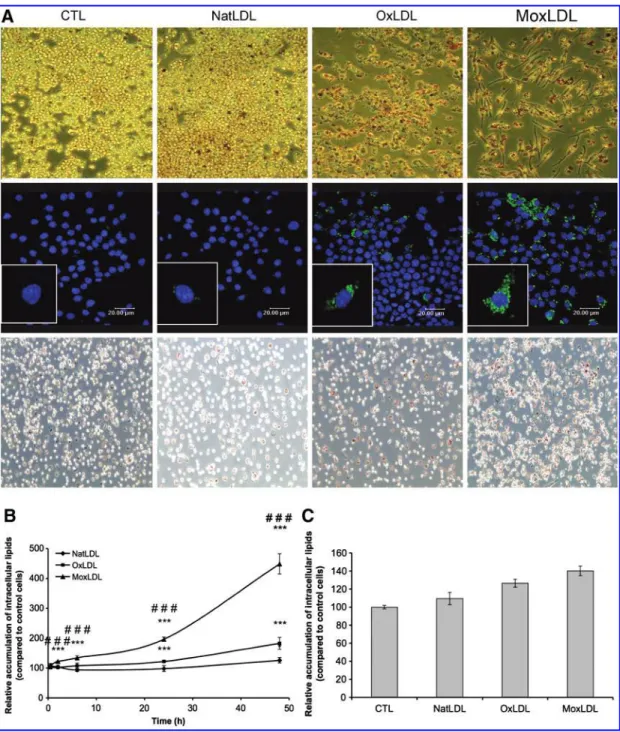
The ability of the murine RAW264.7 macrophages to ac-cumulate modified LDLs and consequently to differentiate into foam cells was first assessed. RAW264.7 macrophages were therefore treated with native or oxidized LDLs for 48 h before lipid staining by Oil Red O (Sigma, St. Louis, MO) or Bodipy!(Invitrogen, Carlsbad, CA) Fig. 1A, top and middle panels, respectively). Both stainings clearly show that mac-rophages internalize NatLDLs in a regulated manner as only a small number of intracellular lipid droplets is observed. Indeed, native LDLs are recognized by the LDL receptor (LDL-R) that is downregulated by the intracellular cholesterol content through a signaling pathway implicating SREBP (45). Thus, the internalization of native LDLs is tightly controlled and never leads to an excessive accumulation of intracellular lipid droplets and subsequent foam cell formation. On the opposite, large amounts of lipid droplets are observed throughout the cytoplasm of both OxLDLs- and
MoxLDLs-incubated macrophages (Fig. 1A). A quantification of the Oil Red O staining after 30 min to 48 h (Figure 1B) confirmed these observations, with OxLDLs and MoxLDLs, respectively, causing an intracellular 2.9" 0.26 and 4.1 " 0.37 fold accu-mulation of lipids after 48 h compared to control cells. A sig-nificant accumulation of lipid droplets was observed after 48 h of incubation with NatLDLs, probably due to some oxi-dation of the NatLDL in the contact of the cells for long pe-riods of time. However, a significant accumulation of lipid droplets was already observed after 24 h and 2 h of incubation with OxLDLs or MoxLDLs, respectively. Moreover, the MoxLDLs-induced accumulation of lipids was significantly higher than the one caused by OxLDLs. In addition, whereas RAW264.7 macrophages incubated with OxLDLs appeared very rounded, a more typical spread morphology of macro-phages, with long cytoplasmic extensions, was observed in the presence of MoxLDLs (Fig. 1A, top panel). The accumu-lation of intracellular lipid droplets was confirmed in human M-CSF differentiated macrophages prepared from PBMC, although more difficult to visualize, due to larger amounts of lipids in control cells and in NatLDLs-treated cells (Fig. 1A, bottom panel). However, the quantification of the Oil Red O staining showed that the incubation with both oxidized LDL induced an accumulation of intracellular lipid droplets, but to a lesser extent than in RAW264.7 macrophages (Fig. 1C). Moreover, it seems that the internalization was more impor-tant in MoxLDLs-treated macrophages than in OxLDLs-incubated cells, as observed for the murine RAW264.7 cells. Oxidized LDLs induce an intracellular oxidative
stress in RAW264.7 and in human PBMC-derived macrophages
Oxidized LDLs are claimed to largely contribute to the oxidative context of atherosclerosis (36). To directly assess this oxidative stress, RAW264.7 and PBMC-derived macrophages were incubated with native or oxidized LDLs (200mg=ml) and the intracellular accumulation of ROS was monitored (Figs. 2A and 2B, respectively). In RAW264.7 macrophages, where NatLDLs had no effect, an accumulation of ROS was observed in the presence of oxidized LDLs. However, the oxidative stress produced by the MoxLDLs was more intense than the one caused by OxLDLs (Fig. 2A). Trolox, an antioxidant and hydrophilic vitamin E analogue, totally abolished the oxi-dized LDL-induced ROS accumulation (Fig. 2A). This accu-mulation of ROS was also observed in PBMC-macrophages incubated with OxLDLs or MoxLDLs, whereas in incubations with NatLDLs, a decrease in oxidative stress was observed (Fig. 2B). Moreover, a clear difference was observed between OxLDLs and MoxLDLs-induced ROS accumulation as OxLDLs only induced a slight increase in ROS production, whereas it was more intense for MoxLDLs (Fig. 2B).
Oxidized LDLs activate the transcription factor Nrf2 in a ROS-dependent manner
As Nrf2 is a well-known ROS-activated transcription factor (16, 19), its activation state in RAW264.7 macrophages after incubation with native or oxidized LDLs was assessed using a reporter plasmid. The stimulation of macrophages with oxi-dized LDLs induced the activation of Nrf2 (Fig. 3),whereas, similarly as for the ROS production, the incubation of mac-rophages with NatLDLs did not. Moreover, MoxLDLs
triggered a significantly stronger activation of Nrf2 than OxLDLs (Fig. 3). The regular addition of Trolox significantly decreased the oxidized LDLs-induced activation of Nrf2 (Fig. 3), which suggests a prevalent role of ROS in this activation. Oxidized LDLs induce the overexpression
of the antioxidant genes, Gclm and HO-1
Following oxidative stress, cells activate a global tran-scriptional response, notably through Nrf2, in order to
counteract the accumulation of ROS. Among the genes in-volved in this response, Gclm and HO-1 play a crucial role in the generation of antioxidants such as glutathione and bili-rubin. The relative abundance of the mRNA for these two genes was evaluated after incubation of the RAW264.7 mac-rophages with 200mg=ml of native or oxidized LDLs (Figs. 4A and 4B). NatLDLs were unable to induce an overexpression neither of Gclm nor HO-1, in comparison to control cells. However, the mRNA abundance of both genes was increased after incubation with OxLDLs or MoxLDLs (Figs. 4A and 4B). FIG. 1. Differential lipid accumulation in macrophages incubated with OxLDLs or MoxLDLs.RAW264.7 cells (A, top and middle panels, B) and human PBMC-derived macrophages (A, bottom panel, and C) were incubated for 48 h with native or oxidized LDLs (200mg=ml), stained with Oil Red O (A, top and bottom panels) or Bodipy (A, middle panel) and visualized with an optical (objective 20X) or a confocal microscope, respectively. (B) The absorbance of Oil Red O staining was normalized by the quantity of cells. Results represent the mean of four replicates" SEM. N.S. ¼ nonsignificant, ***p < 0.001 OxLDL or MoxLDL vs. control;###p < 0.001 OxLDL vs. MoxLDL.
For Gclm, a peak of overexpression was observed after 6 h of incubation with OxLDLs or MoxLDLs, but again differences between the OxLDLs-induced and MoxLDLs-induced over-expression were remarkable throughout the kinetics (Fig. 4A). Regarding HO-1, the maximal overexpression was detected after 4 h of incubation with MoxLDLs, whereas the peak of expression was more attenuated and observed after 6 h of incubation with OxLDLs. Moreover, a second wave of over-expression was observed after 12 h of incubation of the mac-rophages with MoxLDLs, which was not seen with OxLDLs (Fig. 4B.). The overexpression of HO-1 was also observed in human PBMC-derived macrophages incubated with 200mg=ml of oxidized LDL for 6 h (Fig. 4C). This over-expression was not observed when the cells were incubated with NatLDLs. Moreover, MoxLDLs induced a stronger overexpression of HO-1 than OxLDLs. In RAW264.7 macro-phages, the overexpression of HO-1 and Gclm after oxidized LDLs treatment was confirmed at the protein level (Fig. 4D). Whatever the time of incubation (from 2 to 24 h), NatLDLs did never induce an increased abundance neither of Gclm nor HO-1, in comparison to control cells (Fig. 4D). However, the abundance of Gclm was increased and maximal after 12 h of
incubation with OxLDLs or MoxLDLs, and much more pro-nounced in the presence of MoxLDLs (Fig. 4D). While MoxLDLs induced a peak of abundance for HO-1 between 8 and 12 h of incubation, this peak was more attenuated and clearly observed after 8 h of incubation with OxLDLs. More-over, contrary to MoxLDLs, the OxLDLs-induced HO-1 overexpression returned to basal levels after 24 h (Figure 4D). These observations were confirmed by immuno-ytochemistry using confocal microscopy (Fig. 4E).
Oxidized LDLs-induced overexpression of Gclm and HO-1 is partly mediated by ROS
Gclm and HO-1 are induced by numerous stimuli, which have in common that they produce an oxidative stress through ROS production (2, 11). Therefore, in order to assess the role of the oxidized LDL-induced ROS production in the overexpression of these genes, macrophages were incubated in the presence of Trolox, shown to abolish the ROS produc-tion (Fig. 2A). As shown respectively in Figures 5A and 5B, the oxidized LDL-induced overexpression of Gclm and HO-1 was significantly reduced by the addition of Trolox. For Gclm, we observed a 2.9- and 3.2-fold reduction in the abundance of mRNA for OxLDLs and MoxLDLs, respectively; for HO-1, we obtained a 2.1- and 2.5-fold reduction, respectively, for OxLDLs and MoxLDLs. While the addition of Trolox com-pletely abolished the accumulation of ROS induced by oxi-dized LDLs (Fig. 2), it was unable to reduce the expression of Gclm and HO-1 to their basal levels, supporting the hypothesis that other pathways, independent of ROS, are involved in the oxidized LDLs-induced overexpression of Gclm and in par-ticular of HO-1.
Nrf2 is the major transcription factor involved in the oxidized LDLs-induced
overexpression of Gclm and HO-1
To assess the specific contribution of Nrf2 in the LDLs-induced overexpression of Gclm and HO-1, the RNA FIG. 2. Oxidized LDLs induce an intracellular
accumu-lation of ROS that can be abolished by Trolox.RAW264.7 (A) or PBMC-derived macrophages (B) loaded with the H2DCF-DA probe were stimulated with native or oxidized
LDLs (200mg=ml) in the presence or absence of Trolox 500mM for 6 h. The fluorescence of oxidized DCF was nor-malized by the protein quantity and compared to control cells arbitrarily set to 1. The graph A is the mean of three replicates" SEM and is representative of two independent experiments. N.S.¼ nonsignificant, ***p < 0.001 vs. control;
###p < 0.001 OxLDL vs. MoxLDL; $$$p < 0.001 absence vs.
presence of Trolox.
FIG. 3. Oxidized LDLs, but not native LDLs, induce the activation of Nrf2. After the transfection with the ARE-luc reporter plasmid, the macrophages were incubated with native or oxidized LDLs (200mg=ml) in the presence or ab-sence of Trolox (500mM). Results were compared to control cells arbitrarily set to 1 and are given as the mean of six replicates" SEM. N.S. ¼ nonsignificant, ***p < 0.001 vs. con-trol; ###p < 0.001 OxLDL vs. MoxLDL;$$$p < 0.001 absence
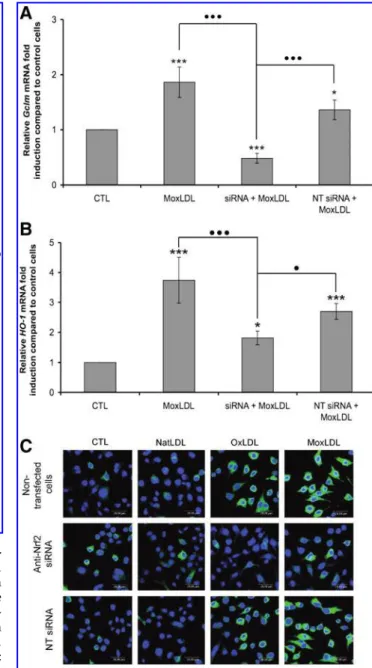
interference strategy was applied. The invalidation of Nrf2 led to a strong reduction of the MoxLDLs-induced over-expression of Gclm and HO-1 (Figs. 6A and 6B). However, whereas this invalidation totally abolished the expression of Gclm, for HO-1, we still observed an over-expression compared to control cells, suggesting that other transcription factors activated by oxidized LDLs could intervene in its overexpression. The oxidized-LDLs induced overexpression of Gclm (data not shown) and HO-1 (Fig. 6C) at the protein level was also clearly reduced by the in-validation of Nrf2, whereas transfection of RAW264.7 macrophages with nontargeting siRNA had no effect. NADPH oxidase plays a role in the ROS production induced by both oxidized LDLs, but cytosolic PLA2 are involved only in MoxLDLs-treated cells
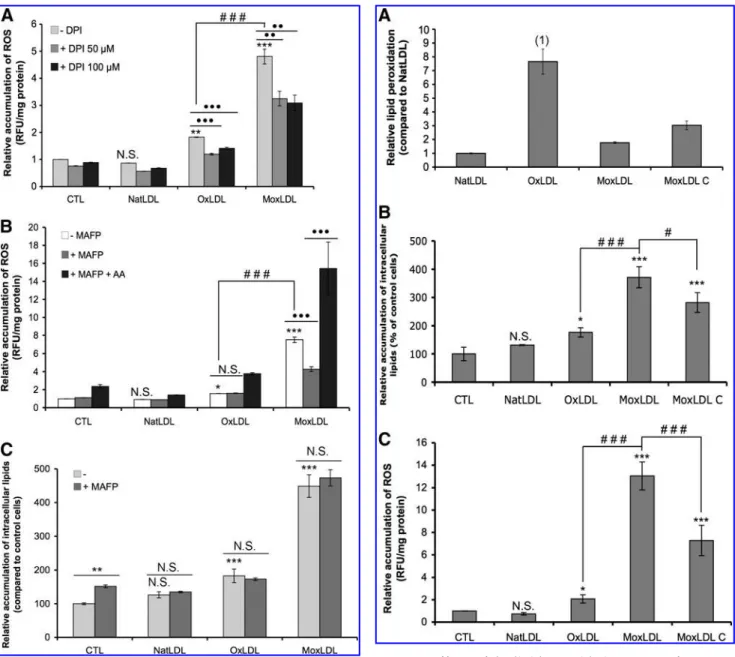
Searching to elucidate some of the molecular mechanisms responsible for the oxidized LDLs-induced ROS production, we showed that the use of diphenylene iodonium (DPI), which inhibits NADPH oxidase, significantly reduced both OxLDLs- and MoxLDLs-induced ROS accumulation (Fig.
7A). However, DPI was unable to completely abolish the ROS production even when used at 100mM (Fig. 7A), supporting the fact that other ROS generating enzymes than NADPH oxidase are implicated in oxidized LDLs-induced ROS accu-mulation.
Several studies highlight that oxidized LDLs activate the Ca2þ-dependent and Ca2þ-independent cytosolic phospholi-pase A2 (cPLA2 and iPLA2, respectively), which results in the specific release of arachidonic acid (AA) (1, 21), and the sub-sequent activation of NADPH oxidase (34), although this pathway of ROS production by AA is not exclusive (17). Hence, the effect of methyl arachidonyl fluorophosphonate (MAFP), an inhibitor of both Ca2þ-dependent and Ca2þ -in-dependent cytosolic PLA2, on the oxidized LDLs-induced ROS production was evaluated. As shown in Figure 7B, while MAFP did not decrease the OxLDLs-induced generation of ROS, it significantly reduced the MoxLDLs-generated ROS accumulation by 43%. When exogenous AA was added to-gether with MAFP, ROS production not only was recovered but was even higher than with the oxidized LDLs (Fig. 7B). The effect of MAFP on the intracellular accumulation of lipids was also investigated. As shown in Figure 7C, no difference FIG. 4. Gclm and HO-1 are induced by oxidized LDLs. RAW264.7 and PBMC-derived macrophages were incubated with 200mg=ml of native or oxidized LDLs for indicated times and 6 h, respectively (A–C). The relative abundance of Gclm (A) and HO-1 (B and C) mRNA was evaluated by real-time RT-PCR and compared to control cells arbitrarily set to 1. TBP and 18S were used as housekeeping gene for RAW264.7 and PBMC-derived macrophages, respectively. Results are given as the mean of four replicates" SEM. (D) Cell lysates were subjected to SDS-PAGE and immunoblotting, and the relative protein abundance of Gclm and HO-1 was revealed by chemiluminescence. ERK2 was used as loading control. (E) RAW264.7 macrophages were treated with native or oxidized LDLs (200mg=ml) for 6 h before Gclm or HO-1 fluorescent im-munostaining and visualization by confocal microscopy, with the nuclei in blue (Topro) and the proteins in green (Alexa 488) (objective 63X). The experiments on RAW264.7 macrophages are representative of two independent replicates. N.S.¼ non-significant, *p < 0.05, **p < 0.01, ***p < 0.001 vs. control;#p < 0.05,##p < 0.01,###p < 0.001 OxLDL vs. MoxLDL.
was observed between macrophages incubated in the pres-ence or in the abspres-ence of MAFP for 48 h. Therefore, it seems that PLA2 (at least cPLA2 and iPLA2) is not implicated in foam cell formation of macrophages incubated with OxLDLs or MoxLDLs. In conclusion, whereas NADPH oxidase is in part implicated in both OxLDLs- and MoxLDLs-induced ROS production, only the MoxLDLs-induced ROS generation seems to implicate cytosolic PLA2 and the subsequent AA release. Moreover, despite its role in MoxLDLs-induced ROS production, cytosolic PLA2 are not implicated in the accu-mulation of intracellular lipid droplets in macrophages incu-bated with OxLDLs or MoxLDLs.
LDLs oxidized at both the lipid and protein moieties by MPO behave betwixt Ox- and MoxLDLs
Based on the results obtained in Figure 7, and on the fact that MoxLDLs, contrary to OxLDLs, are only slightly modi-fied at the lipid level (Fig. 8A) (48), we hypothesized that the
fatty acids that are not modified and in particular arachidonic acid (AA), can be released from the MoxLDLs by cytosolic PLA2 and subsequently trigger ROS production. To support this hypothesis, we generated MoxLDLs oxidized at the lipid moiety (28), named MoxLDLs-C (see Materials and Methods; Fig. 8A). To confirm the lipid modification of MoxLDLs-C, the FIG. 5. Trolox reduces the oxidized LDLs-induced
over-expression of Gclm and HO-1. The cells were stimulated with native or oxidized LDLs (200mg=ml) for 6 h in the presence or absence of Trolox 500mM. The relative abundance of Gclm (A) and HO-1 (B) mRNA was evalu-ated by real-time RT-PCR and results are expressed as in Figure 4 and given as the mean of four replicates" SEM. N.S.¼ nonsignificant, **p < 0.01, ***p < 0.001 vs. control;
###
p < 0.001 OxLDL vs. MoxLDL; $p < 0.05, $$$p < 0.001
ab-sence vs. preab-sence of Trolox. FIG. 6. Oxidized LDLs-induced Gclm and HO-1 over-expression is essentially mediated by Nrf2.RAW264.7 cells were transfected with anti-Nrf2 siRNA or nontargeting (NT) siRNA. After stimulation with 200mg=ml of MoxLDLs for 2 h, the relative abundance of Gclm (A) and HO-1 (B) mRNA was evaluated by real-time RT-PCR. Results are expressed as previously described and given as the mean of three repli-cates" SEM. (C) RAW264.7 cells transfected with anti-Nrf2 siRNA or nontargeting (NT) siRNA were incubated with 200mg=ml of native or oxidized LDLs for 6 h. Gclm and HO-1 were visualized by confocal microscopy, as described in Figure 4. *p < 0.05, ***p < 0.001 vs. control;$p < 0.05 siRNAþ MoxLDL vs. MoxLDL or NT siRNAþ MoxLDL,$$$p < 0.001 siRNAþ MoxLDL vs. MoxLDL or NT siRNA þ MoxLDL.
extent of lipid peroxidation in NatLDLs, MoxLDLs, and MoxLDLs-C was determined by a fluorescence-based meth-od, according to Yagi et al. (42) (Fig. 8A). Zouaoui Boudjeltia et al. (48) already showed that lipid peroxidation in OxLDLs was much more intense in comparison to NatLDLs (Fig. 8A). In striking contrast, lipid peroxidation was only slightly in-creased in MoxLDLs, supporting the statement that MoxLDLs
mainly used in this work are almost not modified at the lipid level. The analysis of MoxLDLs-C showed elevated levels of lipid peroxidation in comparison to MoxLDLs, but this in-crease was lower than in OxLDLs (Fig. 8A). Therefore, lipid oxidation of MoxLDLs-C is intermediate between OxLDLs FIG. 7. Effects of DPI and MAFP on ROS production
in-duced by oxidized LDLs. RAW264.7 macrophages loaded with the H2DCF-DA dye were stimulated with native or
ox-idized LDLs (200mg=ml), and=or AA (20 mM) in the presence of DPI (50mM or 100 mM) (A) or MAFP (50 mM, B). After 30 min, the fluorescence of oxidized DCF was measured and expressed as described in Figure 1. (C) RAW264.7 macro-phages were incubated with LDL for 48 hours in the presence or absence of MAFP (50mM) before lipid staining by Oil Red O. Results are given as the mean of three replicates" SEM. N.S.¼ nonsignificant, *p < 0.05, **p < 0.01, ***p < 0.001 vs. control;###p < 0.001 OxLDL vs MoxLDL; $$p < 0.01 absence
vs. presence of the inhibitor,$$$p < 0.001 absence vs. presence of the inhibitor or MAFP vs MAFPþ AA.
FIG. 8. Effects of the lipid peroxidation extent of LDLs on foam cell formation and on intracellular ROS accumula-tion. Lipid peroxidation of native and oxidized LDLs was evaluated by a fluorescence-based method as described in the Materials and Methods. The extent of lipid peroxidation was expressed in comparison to NatLDLs arbitrarily set to 1 (A). RAW264.7 macrophages were incubated for 48 h with native or oxidized LDLs (200mg=ml), stained with Oil Red O, and the absorbance of the staining was normalized by the quantity of cells (B). Cells loaded with the H2DCF-DA dye
were stimulated with native or oxidized LDLs (200mg=ml). After 30 min, the fluorescence of oxidized DCF was mea-sured and expressed as described in Figure 1 (C). Results are given as the mean of three replicates" SEM. N.S. ¼ nonsig-nificant, *p < 0.05, ***p < 0.001 vs. control; #p < 0.05, ###p < 0.001 OxLDL or MoxLDL-C vs. MoxLDL; (1) based on
and MoxLDLs. In the same way as the incubation with OxLDLs or MoxLDLs, the treatment of RAW264.7 macro-phages with MoxLDLs-C for 48 h also induced a significant accumulation of intracellular lipid droplets (Fig. 8B). Fur-thermore, we showed that the MoxLDLs-C-induced ROS production after 30 min was lower when compared to MoxLDLs, but higher compared to OxLDLs (Fig. 8C). Inter-estingly, this result suggests that ROS production is inversely related to the extent of lipid peroxidation observed in the different types of modified LDL (Fig. 8A).
Discussion
The oxidative modifications of LDLs contribute to the path-ogenesis of atherosclerosis, and the presence of cholesterol-loaded macrophages is an important feature throughout the development of the lesion. However, in vivo neither the mechanisms nor the site of LDLs oxidation are totally eluci-dated. Oxidative modifications of LDLs are often produced in vitro by the use of copper ions. However, in 1996, Berliner and Heinecke already provided data questioning the role of copper in in vivo LDL oxidation (3). This was sustained afterwards by numerous data and studies. First of all, low concentrations of albumin, the most abundant protein in plasma, inhibit metal ion-dependent LDL oxidation, and this protein also avidly binds free copper (37). Indeed, there is no convincing evidence that either free iron or copper do exist in plasma, and extracellular free metal ions are, therefore, un-likely to be present in normal arterial tissue. Metal ions might become available under pathologic conditions, however, perhaps as a result of dying cells accumulating in advanced atherosclerotic lesions. On the other hand, even if copper could have a potential role in LDL oxidation in vivo, the concentrations of copper sulfate currently used in vitro to oxidize LDL (e.g., 10 to 20mM), largely exceed physiological concentrations (47). Ziouzenkova and collaborators notably underlined that LDL oxidized with copper sulfate used at the concentration of 0.03mM, which is in the range of physiolog-ical concentrations, display major differences in composition compared to LDL oxidized using copper sulfate at 10mM (47). Concomitantly with numerous other studies, these authors emphasized that it is uncertain if this in vitro model reflects any aspects of LDL oxidative modification in vivo. In 2003, this was also corroborated by Zarev and collaborators who highlighted that the use of low concentrations of copper, far below the saturation of the LDL binding sites and capable to initiate low LDL oxidation rates, could be more relevant re-garding in vivo LDL oxidation (46). They also showed that different concentrations of copper not only lead to significant differences in LDL oxidation kinetics, but also to different forms of oxidized LDL with specific physicochemical and probably biological features (46).
Alternatively, oxidizing enzymes present in pro-inflam-matory conditions have been proposed to play a role in the in vivo oxidation of LDL, such as lipoxygenases (in particular 15-lipoxygenase) (41), NADPH oxidase (13), and MPO, that was privileged in this work. MPO is found as a catalytically active enzyme within atherosclerotic lesions, as evidenced by the presence of immuno-detected MPO, its specific products, as well as MPO-modified LDLs, suggesting a role for this enzyme in the in vivo modifications of LDLs (8, 12, 28). Moreover, in atherosclerotic lesions, MPO colocalizes with
macrophage-derived foam cells (8) and is able to strongly bind to Apo-B100 of LDL (5). Finally, using mass spectrom-etry, Leeuwenburgh et al. detected a 100-fold selective in-crease in o,o’-dityrosine levels in LDL isolated from human atherosclerotic lesions compared to circulating LDLs. Al-though in vitro incubation of LDL with copper increased both o-tyrosine and m-tyrosine, little change in the level of o,o’-dityrosine was observed. In contrast, o,o’-o,o’-dityrosine was selectively produced in LDL oxidized with tyrosyl radical generated by myeloperoxidase (20). Therefore, the detection of a selective increase in o,o’-dityrosine levels with limited changes in either o-tyrosine or m-tyrosine in LDL isolated from human vascular lesions, is consistent with the hypoth-esis that oxidative damage in human atherosclerosis is mediated in part by tyrosyl radical generated by myeloper-oxidase. MPO is therefore considered as one of the potential enzymes implicated in LDL oxidation in vivo (32).
However, in striking contrast with a deleterious role for MPO in atherogenesis through its implication in LDL oxida-tion, MPO-deficient mice developed 50% larger atheroscle-rotic lesions than WT mice (4). Nonetheless, MPO levels are 5-fold to 10-fold higher in humans than in mice and MPO regulation may also differ significantly. Moreover, in contrast to human atherosclerotic lesions that readily stain for MPO (8) and show clear evidence of 3-chlorotyrosine (12), only small amounts of MPO are found within murine atherosclerotic lesions and the 3-chlorotyrosine levels observed in the mouse are barely above the limit of detection (4), suggesting limited catalytically active MPO in the artery wall in mice. Therefore, although mouse models have provided important insights into the pathogenesis of atherosclerosis, the limited levels of MPO and 3-chlorotyrosine observed in mouse atheroma might at first glance suggest that the murine model has lim-ited relevance for studies of MPO in atherosclerosis.
In order to better evaluate the role of human MPO (h-MPO) in atherogenesis, McMillen et al. generated transgenic mice that expressed h-MPO exclusively in macrophages (27). This cell-specific expression of h-MPO increased the average size of the atherosclerotic lesions by 2.3-fold compared to mice transplanted with WT bone marrow. The larger atheroscle-rotic lesions observed in MPO-deficient mice and in trans-genic mice expressing h-MPO in macrophages strongly suggest that MPO from neutrophils and monocytes play a role in atherogenesis that is distinct from that of macrophage-associated MPO in the artery wall. This supports the hypothesis that macrophage-specific expression of MPO is atherogenic and raises the possibility that lipoprotein oxida-tion via MPO is an important mechanism.
Copper and myeloperoxidase induce some distinct bio-chemical alterations of LDLs (44). Actually, the oxidation of LDLs with copper ions causes important modifications of both the lipid and protein moieties of the LDLs (46). On the other hand, MoxLDLs used in this work are predominantly modified only in their protein moiety, with limited modifi-cations of the lipids (24, 48). Moreover, the concentrations of MoxLDLs used (200mg=ml) correspond to pathophysiological concentrations indeed observed in patients suffering from COPD (49) or undergoing dialysis (39) and prone to cardio-vascular disease.
Interestingly, the signal transduction pathways activated by OxLDLs are relatively well-known and the active com-pounds identified up to now are generally lipids (26). Much
less information is available about MoxLDLs and although numerous studies have characterized the cellular responses either to OxLDLs or, to a lesser extent, to MoxLDLs, com-parative studies are much more difficult to find. For these reasons, in this study, the differential effects of OxLDLs and MoxLDLs were compared in RAW264.7 macrophages and the results were partly validated in human PBMC-derived macro-phages.
First of all, we showed that macrophages incubated with MoxLDLs accumulate more intracellular lipid droplets than when incubated with OxLDLs. Given the differential modi-fications of ApoB-100 by copper and the MPO–H2O2–Cl
-system (44), a differential affinity for or a differential recog-nition by the diverse scavenger receptors could be a possible explanation to interpret this distinction. Although the scav-enger receptors for OxLDLs are well described and comprise predominantly SR-A and CD36, those for MoxLDLs are not yet unambiguously identified. Nevertheless, in vitro studies on THP-1 macrophages have shown that class B scavenger receptors, namely CD36 and SR-BI, play a role in the inter-nalization of MoxLDLs (25). The specific scavenger receptors implicated in the internalization of OxLDLs and more par-ticularly of MoxLDLs should certainly deserve more atten-tion. On the other hand, the incubation of macrophages with OxLDLs or MoxLDLs also differentially affects their mor-phology. RAW264.7 macrophages incubated with MoxLDLs display a characteristic spreaded morphology while they re-main rounded in the presence of OxLDLs. Although OxLDLs could affect cytoskeletal components, such as actin or vi-mentin (9, 31), the effect of MoxLDLs on these proteins is still not known, and could explain the observed differential mor-phology.
Second, in view of the biochemical differences between OxLDLs and MoxLDLs, it is not surprising to observe dif-ferences between OxLDLs and MoxLDLs in the activation of Nrf2 and the induction of Gclm and HO-1, with a stronger response towards MoxLDLs. The protective and stress-induced Nrf2 pathway is functionally critical and tightly controlled in the cell. Its activation leads to the generation of metabolizing and scavenging systems to remove excessive ROS, which are detrimental and affect cells functions. Gclm constitutes the rate-limiting enzyme in glutathione synthesis, the most important and most abundant endogenous antioxi-dant (11). GSH participates in many cellular reactions in-cluding antioxidant defenses of the cell, but also cell signaling (11, 15). Indeed, alterations in the redox balance by exposure to ROS cause changes in the reduced=oxidized glutathione (GSH=GSSG) equilibrium, which potentially affect a number of target proteins by causing oxidation at specific cysteine residues, such as the Nrf2 cytoplasmic repressor Keap1 (38). As a consequence, Gclm, as the rate-limiting enzyme in GSH synthesis, could play a crucial role in maintaining an optimal GSH=GSSG balance, providing a protective antioxidant mechanism against oxidative stress-induced cellular dys-function. On the other hand, contrary to Gclm, the beneficial role of HO-1 and its by-products in atherogenesis has been largely described (7, 29). In vascular cells and macrophages, HO-1 is induced by most of the well-established cardiovas-cular risk factors, including oxidized LDLs (43), and Nrf2 is essential for its overexpression (6, 14). The proposed mecha-nism by which HO-1 exerts its cytoprotective effects includes its ability to degrade pro-oxidative heme, to release biliverdin
and subsequently convert it into bilirubin, both of which have antioxidant properties, and to generate carbon monoxide, which has antiproliferative, anti-inflammatory and vasodila-tory properties (7, 29). Therefore, HO-1 participates to the anti-atherogenic defence systems of the macrophages, nota-bly by increasing antioxidant protection in atherosclerotic lesions.
Finally, another and very important distinction between OxLDLs and MoxLDLs was observed in the intensity of the induced oxidative stress. As we have shown by the use of Trolox, the oxidized LDL-induced accumulation of ROS is mainly responsible for the activation of Nrf2 and for the overexpression of Gclm and HO-1, which suggests that the differential oxidative stress generated by OxLDLs and MoxLDLs is the leading cause of the subsequent variations observed in the response to these two types of LDLs. We showed that although NADPH oxidase is implicated in both oxidized LDLs-induced ROS accumulation, the release of AA by some PLA2 isoforms, possibly cPLA2 and=or iPLA2, only takes part in the MoxLDLs-induced activation of NADPH oxidase. This is not surprising since MoxLDLs contrary to OxLDLs, are not affected in their lipid moiety (24, 48), which means that the fatty acids and thus AA, are not modified and can be cleaved by PLA2. This model was supported by the production of MoxLDLs oxidized not only at the protein level, but also at the lipid level, named MoxLDLs-C. Indeed, in specific conditions, MPO can also modify the lipid moiety of the LDL. Fluorescence-based analysis of LDLs showed that the extent of lipid peroxidation in MoxLDLs-C was interme-diate between OxLDLs and MoxLDLs. In agreement with our hypothesis, the MoxLDLs-C-induced ROS production was smaller than the one caused by MoxLDLs, but largely higher than the OxLDLs-induced ROS accumulation, indicating that there seems to be an inverse relation between lipid perox-idation in modified LDL and the capacity to induce ROS production. In conclusion, the nonoxidized lipids of LDLs seem to be implicated in the LDLs-induced ROS production. In the presence of NatLDLs, we could hypothesize that their recognition by the LDL-R and not by the scavenger receptors prevents this ROS accumulation, but also that cPLA2 and=or iPLA2, would not be activated (21). This observation under-lines an important difference in the ROS-producing mecha-nisms between OxLDLs and MoxLDLs, which could in part explain the distinct cellular responses observed in this study between both types of LDLs.
In conclusion, this study highlights that at concentrations observed in patients suffering from COPD or in patients under dialysis, the more relevant MoxLDLs that are only modified in their protein moiety, induce a stronger antioxi-dant and protective response than OxLDLs in macrophages, as revealed by the activation of the Nrf2 pathway. As the oxidative stress plays an important role in the pathogenesis of many diseases, including atherosclerosis, the understanding of redox regulation and the effects of disturbed redox ho-meostasis on cell functions could be used to develop new strategies for the treatment or prevention of those diseases. In this way, the differential generation of ROS and the distinct ROS-producing mechanisms induced by OxLDLs and MoxLDLs, should be taken into account, and all the data obtained until now with copper oxidized-LDLs carefully re-evaluated taking into consideration physiologically more relevant oxidized LDLs.
Acknowledgments
This article presents research results of the Belgian Pro-gramme on Interuniversity Poles of Attraction (PAI 6=30) initiated by the Belgian State, Prime Minister’s Office, Science Policy Programming. Damien Calay and Laurine Mattart are recipients of a doctoral fellowship of the FRIA (Fonds pour la Formation a` la Recherche dans l’Industrie et dans l’Agri-culture). We also thank the Fonds National de la Recherche Scientifique (FNRS), the Institut de Recherche en Pathologie et Ge´ne´tique (IRSPG) and the Fonds pour la Recherche Me´dicale dans le Hainaut for financial support.
Author Disclosure Statement
No competing financial interests exist. References
1. Akiba S, Yoneda Y, Ohno S, Nemoto M, and Sato T. Oxidized LDL activates phospholipase A2 to supply fatty acids required for cholesterol esterification. J Lipid Res 44: 1676–1685, 2003. 2. Alam J and Cook JL. How many transcription factors does it
take to turn on the heme oxygenase-1 gene? Am J Respir Cell Mol Biol 36: 166–174, 2007.
3. Berliner JA and Heinecke JW. The role of oxidized lipopro-teins in atherogenesis. Free Radic Biol Med 20: 707–727, 1996. 4. Brennan ML, Anderson MM, Shih DM, Qu XD, Wang X, Mehta AC, Lim LL, Shi W, Hazen SL, Jacob JS, Crowley JR, Heinecke JW, and Lusis AJ. Increased atherosclerosis in myeloperoxidase-deficient mice. J Clin Invest 107: 419–430, 2001.
5. Carr AC, Myzak MC, Stocker R, McCall MR, and Frei B. Myeloperoxidase binds to low-density lipoprotein: potential implications for atherosclerosis. FEBS Lett 487: 176–180, 2000. 6. Chan K and Kan YW. Nrf2 is essential for protection against acute pulmonary injury in mice. Proc Natl Acad Sci USA 96: 12731–12736, 1999.
7. Chung HT, Pae HO, and Cha YN. Role of heme oxygenase-1 in vascular disease. Curr Pharm Des 14: 422–428, 2008. 8. Daugherty A, Dunn JL, Rateri DL, and Heinecke JW.
Mye-loperoxidase, a catalyst for lipoprotein oxidation, is ex-pressed in human atherosclerotic lesions. J Clin Invest 94: 437–444, 1994.
9. Deng TL, Yu L, Ge YK, Zhang L, and Zheng XX. Intracellular-free calcium dynamics and F-actin alteration in the formation of macrophage foam cells. Biochem Biophys Res Commun 338: 748–756, 2005.
10. Droge W. Free radicals in the physiological control of cell function. Physiol Rev 82: 47–95, 2002.
11. Franco R, Schoneveld OJ, Pappa A, and Panayiotidis MI. The central role of glutathione in the pathophysiology of human diseases. Arch Physiol Biochem 113: 234–258, 2007. 12. Hazen SL and Heinecke JW. 3-Chlorotyrosine, a specific
marker of myeloperoxidase-catalyzed oxidation, is mark-edly elevated in low density lipoprotein isolated from human atherosclerotic intima. J Clin Invest 99: 2075–2081, 1997. 13. Hwang J, Ing MH, Salazar A, Lassegue B, Griendling K, Navab M, Sevanian A, and Hsiai TK. Pulsatile versus os-cillatory shear stress regulates NADPH oxidase subunit ex-pression: Implication for native LDL oxidation. Circ Res 93: 1225–1232, 2003.
14. Ishii T, Itoh K, Ruiz E, Leake DS, Unoki H, Yamamoto M, and Mann GE. Role of Nrf2 in the regulation of CD36 and
stress protein expression in murine macrophages: activation by oxidatively modified LDL and 4-hydroxynonenal. Circ Res 94: 609–616, 2004.
15. Jefferies H, Coster J, Khalil A, Bot J, McCauley RD, and Hall JC. Glutathione. ANZ J Surg 73: 517–522, 2003.
16. Kensler TW, Wakabayashi N, and Biswal S. Cell survival responses to environmental stresses via the Keap1-Nrf2-ARE pathway. Annu Rev Pharmacol Toxicol 47: 89–116, 2007. 17. Kim C, Kim JY, and Kim JH. Cytosolic phospholipase A(2),
lipoxygenase metabolites, and reactive oxygen species. BMB Rep 41: 555–559, 2008.
18. Klinkner AM, Waites CR, Kerns WD, and Bugelski PJ. Evi-dence of foam cell and cholesterol crystal formation in mac-rophages incubated with oxidized LDL by fluorescence and electron microscopy. J Histochem Cytochem 43: 1071–1078, 1995. 19. Lee JM and Johnson JA. An important role of Nrf2-ARE pathway in the cellular defense mechanism. J Biochem Mol Biol 37: 139–143, 2004.
20. Leeuwenburgh C, Rasmussen JE, Hsu FF, Mueller DM, Pennathur S, and Heinecke JW. Mass spectrometric quanti-fication of markers for protein oxidation by tyrosyl radical, copper, and hydroxyl radical in low density lipoprotein isolated from human atherosclerotic plaques. J Biol Chem 272: 3520–3526, 1997.
21. Lupo G, Nicotra A, Giurdanella G, Anfuso CD, Romeo L, Biondi G, Tirolo C, Marchetti B, Ragusa N, and Alberghina M. Activation of phospholipase A(2) and MAP kinases by oxidized low-density lipoproteins in immortalized GP8.39 endothelial cells. Biochim Biophys Acta 1735: 135–150, 2005. 22. Lusis AJ. Atherosclerosis. Nature 407: 233–241, 2000. 23. Maines MD. The heme oxygenase system: A regulator of
second messenger gases. Annu Rev Pharmacol Toxicol 37: 517–554, 1997.
24. Malle E, Marsche G, Arnhold J, and Davies MJ. Modification of low-density lipoprotein by myeloperoxidase-derived ox-idants and reagent hypochlorous acid. Biochim Biophys Acta 1761: 392–415, 2006.
25. Marsche G, Zimmermann R, Horiuchi S, Tandon NN, Sattler W, and Malle E. Class B scavenger receptors CD36 and SR-BI are receptors for hypochlorite-modified low density lipo-protein. J Biol Chem 278: 47562–47570, 2003.
26. Maziere C and Maziere JC. Activation of transcription fac-tors and gene expression by oxidized low-density lipopro-tein. Free Radic Biol Med 2008.
27. McMillen TS, Heinecke JW, and LeBoeuf RC. Expression of human myeloperoxidase by macrophages promotes athero-sclerosis in mice. Circulation 111: 2798–2804, 2005.
28. Moguilevsky N, Zouaoui Boudjeltia K, Babar S, Delree P, Legssyer I, Carpentier Y, Vanhaeverbeek M, and Ducobu J. Monoclonal antibodies against LDL progressively oxidized by myeloperoxidase react with ApoB-100 protein moiety and human atherosclerotic lesions. Biochem Biophys Res Commun 323: 1223–1228, 2004.
29. Morita T. Heme oxygenase and atherosclerosis. Arterioscler Thromb Vasc Biol 25: 1786–1795, 2005.
30. Morse D and Choi AM. Heme oxygenase-1: The "emerging molecule" has arrived. Am J Respir Cell Mol Biol 27: 8–16, 2002. 31. Muller K, Dulku S, Hardwick SJ, Skepper JN, and Mitch-inson MJ. Changes in vimentin in human macrophages during apoptosis induced by oxidised low density lipopro-tein. Atherosclerosis 156: 133–144, 2001.
32. Nicholls SJ and Hazen SL. Myeloperoxidase and cardio-vascular disease. Arterioscler Thromb Vasc Biol 25: 1102–1111, 2005.
33. Sharif O, Bolshakov VN, Raines S, Newham P, and Perkins ND. Transcriptional profiling of the LPS induced NF-kappaB response in macrophages. BMC Immunol 8: 1, 2007. 34. Shiose A and Sumimoto H. Arachidonic acid and phos-phorylation synergistically induce a conformational change of p47phox to activate the phagocyte NADPH oxidase. J Biol Chem 275: 13793–13801, 2000.
35. Singh U and Jialal I. Oxidative stress and atherosclerosis. Pathophysiology 13: 129–142, 2006.
36. Stocker R and Keaney JF, Jr. Role of oxidative modifications in atherosclerosis. Physiol Rev 84: 1381–1478, 2004.
37. Thomas CE. The influence of medium components on Cu(2þ)-dependent oxidation of low-density lipoproteins and its sensitivity to superoxide dismutase. Biochim Biophys Acta 1128: 50–57, 1992.
38. Townsend DM, Tew KD, and Tapiero H. The importance of glutathione in human disease. Biomed Pharmacother 57: 145– 155, 2003.
39. Vaes M, Zouaoui Boudjeltia K, Van Antwerpen P, Babar S, Deger F, Vanhaeverbeek M, and Ducobu J. Low-density lipoprotein oxidation by myeloperoxidase occurs in the blood circulation during hemodialysis. Atherosclerosis Sup-plements 7: 525, 2006.
40. Valko M, Leibfritz D, Moncol J, Cronin MT, Mazur M, and Telser J. Free radicals and antioxidants in normal physio-logical functions and human disease. Int J Biochem Cell Biol 39: 44–84, 2007.
41. Wittwer J and Hersberger M. The two faces of the 15-lipoxygenase in atherosclerosis. Prostaglandins Leukot Essent Fatty Acids 77: 67–77, 2007.
42. Yagi K. A simple fluorometric assay for lipoperoxide in blood plasma. Biochem Med 15: 212–216, 1976.
43. Yamaguchi M, Sato H, and Bannai S. Induction of stress proteins in mouse peritoneal macrophages by oxidized low-density lipoprotein. Biochem Biophys Res Commun 193: 1198– 1201, 1993.
44. Yan LJ, Lodge JK, Traber MG, Matsugo S, and Packer L. Comparison between copper-mediated and hypochlorite-mediated modifications of human low density lipoproteins evaluated by protein carbonyl formation. J Lipid Res 38: 992– 1001, 1997.
45. Yokoyama C, Wang X, Briggs MR, Admon A, Wu J, Hua X, Goldstein JL, and Brown MS. SREBP-1, a basic-helix-loop-helix-leucine zipper protein that controls transcription of the low density lipoprotein receptor gene. Cell 75: 187–197, 1993.
46. Zarev S, Bonnefont–Rousselot D, Jedidi I, Cosson C, Cou-turier M, Legrand A, Beaudeux JL, and Therond P. Extent of copper LDL oxidation depends on oxidation time and copper=LDL ratio: chemical characterization. Arch Biochem Biophys 420: 68–78, 2003.
47. Ziouzenkova O, Sevanian A, Abuja PM, Ramos P, and Es-terbauer H. Copper can promote oxidation of LDL by markedly different mechanisms. Free Radic Biol Med 24: 607– 623, 1998.
48. Zouaoui Boudjeltia K, Legssyer I, Van Antwerpen P, Kisoka RL, Babar S, Moguilevsky N, Delree P, Ducobu J, Remacle C, Vanhaeverbeek M, and Brohee D. Triggering of inflamma-tory response by myeloperoxidase-oxidized LDL. Biochem Cell Biol 84: 805–812, 2006.
49. Zouaoui Boudjeltia K, Tragas G, Babar S, Moscariello A, Nuyens V, Van Antwerpen P, Gilbert O, Ducobu J, Brohee D, Vanhaeverbeek M, and Van Meerhaeghe A. Effects of oxygen therapy on systemic inflammation and myeloperoxidase modified LDL in hypoxemic COPD patients. Atherosclerosis 2009.
Address correspondence to: Damien Calay University of Namur (FUNDP)—URBC Rue de Bruxelles 61 5000 Namur Belgium E-mail: [email protected] Date of first submission to ARS Central, October 27, 2009; date of final revised submission, April 27, 2010; date of acceptance, May 1, 2010.
Abbreviations Used
AA¼ arachidonic acid
ARE¼ antioxidant response element
COPD¼ chronic obstructive pulmonary disease cPLA2¼ calcium-dependent cytosolic
phospholipase A2
DPI¼ diphenylene iodonium chloride
Gclm¼ glutamate cysteine ligase, regulatory subunit GSH¼ reduced glutathione
GSSG¼ oxidized glutathione
H2DCF-DA¼ 2’,7’-dichlorodihydrofluorescein diacetate
HO-1¼ heme oxygenase-1
iPLA2¼ calcium-independent cytosolic phospholipase A2
LDL-R¼ LDL receptor
LDLs¼ low-density lipoproteins
MAFP¼ methyl arachidonyl fluorophosphonate M-CSF¼ macrophage colony stimulating factor MoxLDLs¼ myeloperoxidase-oxidized LDLs
NatLDLs¼ native LDLs
Nrf2¼ NF-E2-related factor 2 OxLDLs¼ copper-oxidized LDLs
PBMC¼ peripheral blood mononuclear cells rhMPO¼ recombinant human myeloperoxidase
ROS¼ reactive oxygen species
Trolox¼ 6-hydroxy-2,5,7,8-tetramethylchromane-2-carboxylic acid