
Process assessment for use in very small enterprises: the NOEMI assessment methodology
15
0
0
Texte intégral
(2) 1 Introduction Nowadays, organizations are highly dependent on their Information Technology (IT) services. They expect them not only to deliver high-quality services at the lowest cost but also to enhance innovation in their business. The Software Process Improvement (SPI) community is dramatically aware of these requirements and deploys huge efforts to meet this ambitious objective. Numerous companies are involved – in some cases for a long time already – in process improvement. Software processes have been closely targeted by fine-tuned methods. The international standard ISO/IEC 15504 [1], as the result from the Software Process Improvement and Capability dEtermination (SPICE) initiative, plays an important role in SPI. IT Service Management (ITSM) area is also largely – if not entirely – covered by other standards. Many companies have also significantly improved their investment in this way. In that context, the IT Infrastructure Library (ITIL) [2], which has been produced by the Office of Government Commerce (OGC) in the United Kingdom since the late 1980’s, is probably the most comprehensive approach on providing IT-services. The ITIL is publicly available and has become the worldwide de facto standard for IT Services Management. Standards contribute dramatically to enhance business value through IT-disciplines, enabling efficient software development, provision of high-quality services at the lowest cost, and business innovation [3]. Furthermore, implementing some of these powerful standards is obviously not an easy task. Implementation projects are resource consuming, require skills, and are expensive. Large organizations have usually the means to match their ambitions and they can resolutely engage themselves in such ways. The situation is dramatically different for very small enterprises (VSEs), which have no IT-dedicated staff. They are often ready to invest but they have rarely the time and never – or almost never – the skills. Even if they have the same expectations than big companies, it is very difficult for them to implement standards and to improve significantly IT-quality. Founded in 1987, the Centre de Recherche Public Henri Tudor2 has the prime mission of strengthening the economic structure of the Grand-Duchy of Luxembourg through technology development and innovation, especially in the information and communication technology (ICT) fields. The Centre is notably involved in providing assistance to VSEs of the Grand-Duchy of Luxembourg as well as the “Grande Région” which includes Wallonia in Belgium, the Lorraine region in France and the Saar in Germany. In that way, the Centre set up a public research project called “New Organisation of IT-Production and Support” [Nouvelle Organisation de l’Exploitation et de la Maintenance Informatiques (NOEMI)], which aims to develop a model of collaborative IT-management for use in VSE clusters in order to optimise the management of their respective information systems in terms of quality, reliability and cost [4]. Through this project, the Centre focussed on the improvement of IT-practices for the use of VSEs. The developed model is currently being experimented with VSEs in Luxembourg. It proposes to the VSEpartners to gather their IT-services and manage them in a collaborative and cross-participative manner. Pragmatically, the collaborative management can take two basic forms: either the partners establish a common organization that insource their respective IT-activities or they can outsource their clustered IT-activities to an external provider. The results of the experimentation are promising and should allow the validation of the model in its final release by June 2004. One of the most critical requirements for the model is the homogeneity of the partners’ IT-capabilities. Indeed, in the case of sourcing to an internal common IT-organization, the heterogeneity of ITcapabilities of the partners could lead to management issues, particularly in the financial area. So assessing the IT-capability on an extended IT-scope, with an holistic approach and a focus on business value is one of the model keys of success. 2. Called hereafter the Centre. See www.tudor.lu and www.citi.tudor.lu. Bernard Di Renzo & Christophe Feltus. Page 2 of 15. December 2003.
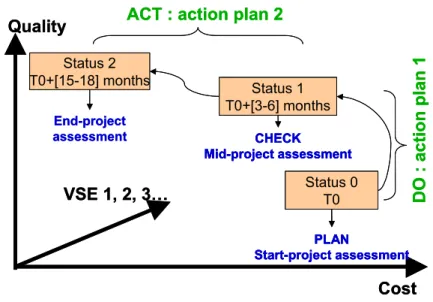
(3) This paper describes the assessment methodology developed as a critical topic of the NOEMI project with particular focus on the objectives, the links with ISO/IEC 15504 standard and ITIL, and the results of the experimentation of the methodology through case studies.. 2 Objectives of the NOEMI assessment methodology The assessment methodology must be aligned with the scope and objectives of the project, which allows VSEs to control IT in terms of cost and quality. The assessment must also contribute directly to the implementation of the model within the VSE-partners. According to these requirements, a specific assessment methodology was then developed as a critical topic of the NOEMI project. The operational implementation of the NOEMI model is based on the Deming cycle and consists of a five-stage project for each VSE partner [4]: 1. Start-project assessment of the IT-practices including the first capability determination and the improvement program topics 2. Action Plan 1 consisting of the implementation of a first part of the improvement program 3. Mid-project assessment driving to the second capability profile and evaluation of the partner satisfaction 4. Action Plan 2 consisting of the completion of the improvement program as the continuity of the first Action Plan 5. End-project assessment driving to the third capability profile. ACT : action plan 2. Status 2 T0+[15-18] months End-project assessment. DO : action plan 1. Quality. Status 1 T0+[3-6] months CHECK Mid-project assessment. Status 0 T0. VSE 1, 2, 3…. PLAN Start-project assessment. Cost Figure 1: Operational implementation of the NOEMI model Assessment occurs at stages 1, 3 and 5 in the implementation project of the NOEMI model. It allows one to objectively measure the gap bridged by both Action Plans on both quality and cost axis, according to the dual objectives of the model i.e. cost control and service quality optimisation. Furthermore, the assessment itself, extracted from the model, has been performed within several VSEs in Luxembourg. The success of the methodology allows us to consider the NOEMI assessment as a fully independent service especially designed for usage in VSEs. The NOEMI assessment could obviously drive to the creation of a repository of capability profiles of Luxembourgish VSEs. This point of view is illustrated later in the case study. Moreover, the NOEMI assessment methodology is ready to be promoted outside the Grand-Duchy of Luxembourg using a few transfer projects from the Centre. In this context, several regions in France and provinces in Belgium are very interested in the NOEMI assessment methodology.. Bernard Di Renzo & Christophe Feltus. Page 3 of 15. December 2003.
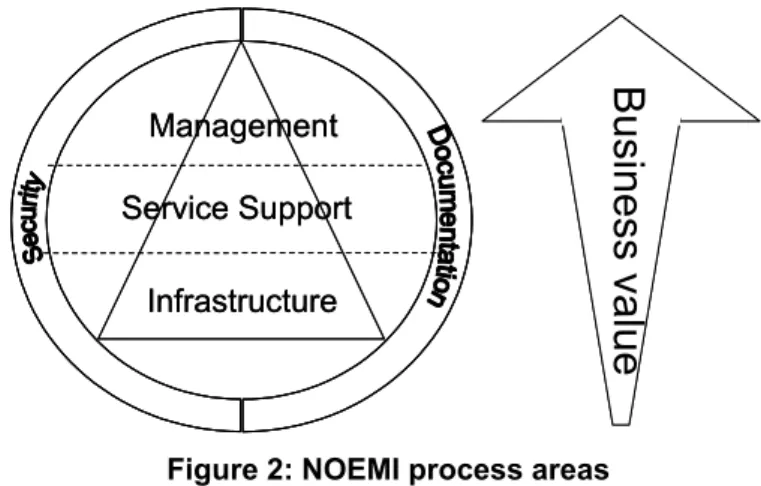
(4) 3 Links between NOEMI assessment methodology and ISO/IEC 15504, service management and security management The international standard ISO/IEC 15504 provides a framework for the assessment of software processes [1]. As a standardized and public approach, it provides a shared methodology of assessment and understanding of software process portfolio. Process assessment within this standard targets two main purposes: process improvement and capability determination. Even if ISO/IEC 15504 is considered nowadays as a software-oriented standard, it is relevant that it is suitable for use in any other context of process assessment. The NOEMI assessment methodology is directly inspired from ISO/IEC 15504 standard, tailored for use in VSE. Created in the late 1980’s in the UK, the IT Infrastructure Library (ITIL) [2] [5] is a public library that focuses on IT Services Management (ITSM). Today, it is recognized as the worldwide de facto standard for high-quality service provision. The main volumes of the ITIL concern the Service Support and the Service Delivery. These two domains are organized in comprehensive and exhaustive sets of processes. Service Support area covers incident management, problem management, configuration management, release management and change management. The Service Delivery deals with capacity management, availability management, financial management for IT-services, Service Continuity for IT Services and service level management. The ITIL has clearly a best practices-based approach and encourages continuous quality improvement. As the NOEMI assessment deals not only with software processes but also with IT-service processes, the ITIL has been selected to provide matters that are not covered by ISO/IEC 15504 [6]. In addition to the SPI and the ITSM, security management, as a third discipline, is considered in the NOEMI assessment in order to get an IT-wide process scope. ISO/IEC WD 18028, ISO/IEC JTC1/SC27/WG1 [7] provides matter for this discipline. Outputs of other projects of the Centre bring a complementary view to the methodology [8].. 4 The NOEMI assessment methodology. 4.1. Defining an holistic process portfolio for use in VSEs. An initial tailoring of the ISO/IEC 15504 concerns the process portfolio in order to make it fit within the scope of the NOEMI model. According to the objectives of the project, it leads to get the most holistic coverage of the usual IT-activities in VSEs. Based on the experience of the Centre through numerous project outputs [4] [6] [8], five process areas were defined to fully cover the IT-scope of VSEs: infrastructure, service support, management, security, and documentation. So a lean-process portfolio covering an holistic IT-approach were defined within the NOEMI assessment methodology. The processes are driven by ISO/IEC 15504, the ITIL, and security discipline standards. Other quality management standards [11] [13] [14] [15] bring complementary topics to fulfil the matter in order to define the processes. They are tailored for use in VSEs without any dedicated IT-staff. The formalism of the process is taken directly from ISO/IEC 15504.. Bernard Di Renzo & Christophe Feltus. Page 4 of 15. December 2003.
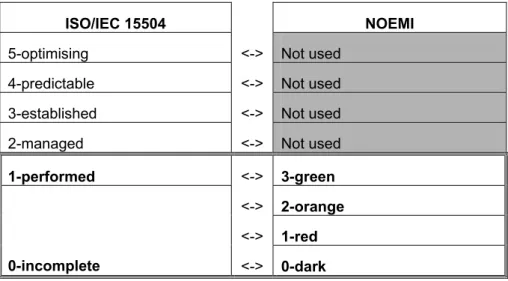
(5) The following figure shows the areas of processes within the NOEMI model. The structure is directly related to the business value brought by the process area.. Service Support Infrastructure. Business value. Management. Figure 2: NOEMI process areas The infrastructure area covers the following technical processes: network management, system management, connected-workstations management, and groupware management. These technical processes are based on best practices collected in this area [2] [9] [10]. As the bottom of the pyramid, the infrastructure area deals with the first processes to consider for VSEs in order to control IT. It is the base of the pyramid and will contribute very little to the business value. Nevertheless, it is necessary to allow the upper areas – service support and management – to deliver their own added-value. The service support area includes the five ITIL processes in this discipline i.e. incident management, problem management, change management, configuration management and release management [2] [5] [10]. As the centre of the pyramid, the service support area offers a middle value to the business i.e. more than the infrastructure area and less than the management one. Both the infrastructure and service support areas are necessary for the management one to be efficient. The management area deals only with the most usual processes used by VSEs . It includes provider management, acquisition management, project management and IT-financial management [1] [2] [8] [16]. As the top of the pyramid, this area drives the largest value for business but expects a good capability of lower areas. In order to fit with the understanding that VSEs usually have of this field, the security area [7] [12] focuses on the basics. It includes only the following processes: server availability management, electrical power management, backup and restoration management, anti-virus management, technical room management, resource access management, external access management. Transverse to the pyramid, the security area impacts directly on all the other areas of the model. Moreover, these processes are compliant with recommendations of the Luxembourg government with respect to the security field. The documentation [11] area is based on document inspection. It consists of a deep analysis of the documents, based on criteria related to structure, completeness, consistency, and clarity.. 4.2. Defining a capability model for use in VSEs. The international standard ISO/IEC 15504 defines a capability model on 6 levels: 0-incomplete, 1perfomed, 2-managed, 3-established, 4-predictable, 5-optimising. Based on the field experience of the Centre, the capability level of the most VSEs in Luxembourg is between the level 0-incomplete and the level 1-performed for almost any IT processes, and rarely up to the level 2-managed. The gap between levels 0-incomplete and 1-performed defined in ISO/IEC 15504 appears then to be too deep for use in VSE-context with any relevant accuracy. The NOEMI capability model is derived directly from standard ISO/IEC 15504 by an ad hoc tailoring in order to fit with the reality of the VSE’s world. Additional levels between level 0-incomplete and level 1-. Bernard Di Renzo & Christophe Feltus. Page 5 of 15. December 2003.
(6) performed have been defined as described in the following table.. ISO/IEC 15504. NOEMI. 5-optimising. <->. Not used. 4-predictable. <->. Not used. 3-established. <->. Not used. 2-managed. <->. Not used. 1-performed. <->. 3-green. <->. 2-orange. <->. 1-red. <->. 0-dark. 0-incomplete. Figure 3: Links between ISO/IEC 15504 and NOEMI capability models The NOEMI capability model defines intermediate levels before to get the level 1-perfomed, allowing a more accurate quantification of the capability of the VSE. The levels are colour-coded (dark – red – orange – green) thus allowing intuitive understanding by people without any knowledge of or practice with capability models. The capability profile is achieved by the process areas and not by processes as in ISO/IEC 15504. It aims to get the same scope of assessment for any VSE with the determination of a capability level for each one of the five process areas. This pragmatic approach allows an easy comparison of the VSE within a global IT-coverage. The NOEMI capability levels are defined as following. Level. Description. 3-green. An area has a level 3-green capability when its processes are developed and performed in a globally satisfying way. Proactivity and mean term planning are notions usually related to such an area. In term of business value, it offers a competitive advantage to the VSE. An area with a capability at level 2-orange means that the VSE achieves considerable efforts to develop and perform the processes of the area. Reactivity and short term are notions inside a level 2-orange capability area. The business value of such an area is less than what the VSE could expect from it. An area has a level 1-red capability when its processes are very partially performed, usually following specific or local needs. Most requisites are missing. Lakes of efficiency and productivity inside the company counterbalance the business value brought by such a level. Moreover it can lead to potential risk for the business. Any process of a level 0-dark capability area is performed. The area is a brake for the efficiency of the VSE. It is a dramatic risk for the company.. 2-orange. 1-red. 0-dark. Figure 4: NOEMI capability model. Bernard Di Renzo & Christophe Feltus. Page 6 of 15. December 2003.
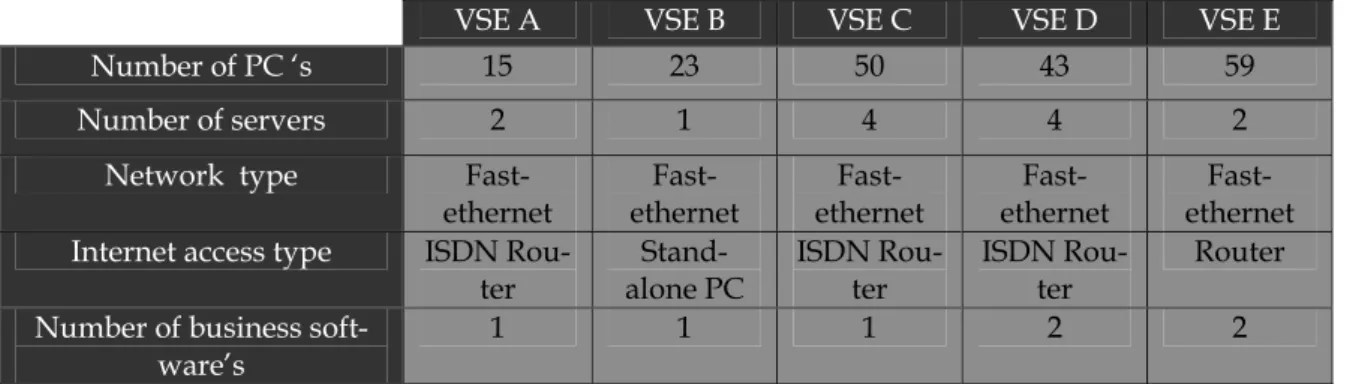
(7) 4.3. Defining the assessment process for use in VSEs. The NOEMI assessment process is based on ISO/IEC 15504. All the processes are systematically assessed in any performance. It allows having a global approach of IT-activities in VSEs according to the project’s objectives. The assessment process schema is illustrated in the following Figure.. Kick-off meeting. Interview of the people dealing with IT. Assets and financial data analysis. 3 interwiews with end-users. Report writing •Strengths and weaknesses •Capability profile •Improvement program. Report validation. Report presentation Figure 5: NOEMI assessment process schema The report is driven from a structured based template including chapters dedicated to each area of processes and a conclusion. For each area, there is a summary of the strengths and the weaknesses of the area, a detailed analysis, and the recommendations. The conclusion chapter introduces a synthesis with the consolidated table of strengths and weaknesses, the capability profile, and the improvement program.. 5 Case study. 5.1. Assessment context. In a VSE, a manager, an accountant or a member of staff showing interest and having acquired knowledge by practice are managing the IT-system. No real IT-professional was met during the assessments. This statement is due to the size of the assessed IT-infrastructures, which is limited to an average of 40 PCs, some servers and one or two business software (see Figure 6).. Bernard Di Renzo & Christophe Feltus. Page 7 of 15. December 2003.
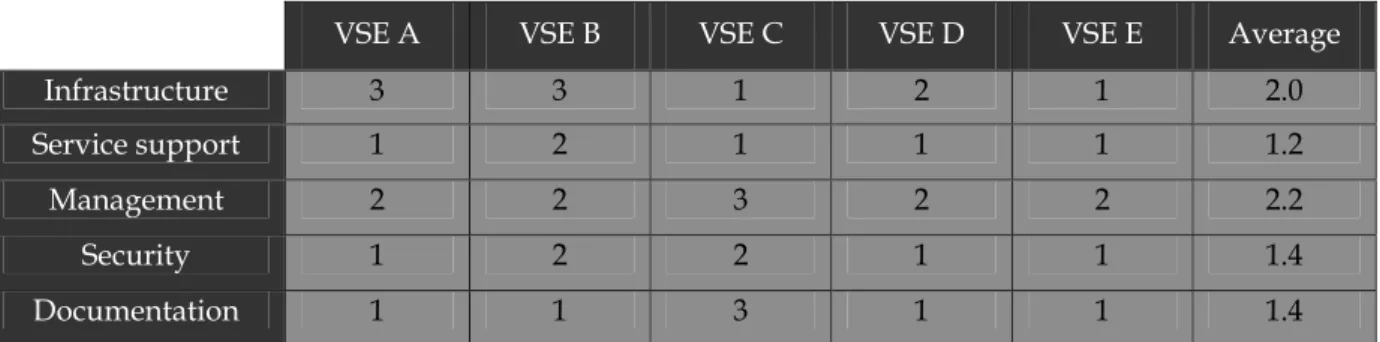
(8) VSE A. VSE B. VSE C. VSE D. VSE E. Number of PC ‘s. 15. 23. 50. 43. 59. Number of servers. 2. 1. 4. 4. 2. Network type. Fastethernet ISDN Router 1. Fastethernet Standalone PC 1. Fastethernet ISDN Router 1. Fastethernet ISDN Router 2. Fastethernet Router. Internet access type Number of business software’s. 2. Figure 6: Compositions of the IT infrastructure by encountered companies From the above table, it can be seen that in all assessed companies, the useful manpower needed for the IT-management was insufficient to justify hiring a full-time IT-employee.. 5.2. Reactivity of the VSEs. Assessed companies realized, before the submission of the final report, the potential improvements within their IT-production. This led to actions taken in order to cure critical situations even before the report was delivered. For example: •. VSE D, which did not have an up-to-date inventory, used the time between the assessment and the report presentation to bring it nearer to reality.. •. VSE A, which did not have an anti-virus protection on its servers, did not wait for our written recommendations to set up effective anti-virus protection.. 5.3. Capability profiles. A similarity in the assessed areas’ capability level was observed inside each company. The infrastructure is the strongest area in three out of five VSEs. In the assessed companies, ITinfrastructure is too restrictively considered at hardware and software. Taking into account and investing in elements such as the service support or documentation remains a luxury. Companies allocate resources for business processes more readily than for IT-processes because an added-value is easily quantifiable. IT-documentation remains the weakest area in four out of five VSEs. Documentation is limited to a more or less up-to-date inventory, some maintenance contracts and the assets or software invoices. Analysis shows a lack in the basic rules such as document identification, storage, and utility for the enterprise. Practices regarding the service support are also only slightly put in place in four out of five VSEs. An efficient help-desk is always lacking and limited to a deputy member of staff, whose mission is “fire fighting" and lending first “assistance” when the IT system malfunctions. Once more, the added-value of such a service remains difficult to quantify and priorities are placed on business processes. The table below illustrates VSEs’ capability profile per area. The minimum capability is 1 and the maximum is 3.. Bernard Di Renzo & Christophe Feltus. Page 8 of 15. December 2003.
(9) VSE A. VSE B. VSE C. VSE D. VSE E. Average. Infrastructure. 3. 3. 1. 2. 1. 2.0. Service support. 1. 2. 1. 1. 1. 1.2. Management. 2. 2. 3. 2. 2. 2.2. Security. 1. 2. 2. 1. 1. 1.4. Documentation. 1. 1. 3. 1. 1. 1.4. Figure 7: VSE capability profile per area. 5.4. Example of assessment recommendations. This chapter presents the more frequent assessment recommendations classified by areas.. 5.4.1 Assessment of management practices Several recommendations were made in each VSE within the area of the assessment of management practices. Among these, there are three relating to project management, financial management, suppliers and acquisitions management. Improvement of project management Project management is the success driver of all IT-projects. Effective project management makes it possible for companies to make a maximum profit from their investment. Several weaknesses were observed. Figure 8 shows three of them: VSE. Weaknesses. VSE A. Delegation of the software selection project management directly to the software users. VSE B. Insufficient time for the project leader to enable him to conclude his work. VSE C. No training for the project leader. Consequently, he does not effectively establish and manage the users’ requirements Figure 8: Encountered weaknesses regarding project management. Improvement of knowledge in project management is the most important recommendation among the management practices assessment area. Improvement of financial management. Several weaknesses were observed regarding financial management, here are four of them: VSE. Weaknesses. All VSEs. Financial resources are not management. All VSEs. IT budget not established. All VSEs. Long-term visibility is lacking. All VSEs. Investments are decided on a case-by-case by management according to needs and opportunities Figure 9: Encountered weaknesses regarding financial management. Bernard Di Renzo & Christophe Feltus. Page 9 of 15. December 2003.
(10) Encountered companies are rarely aware of the hidden costs due to the losses of non-productivity. These costs represent a loss generally higher than the annual cost of the IT-infrastructure. The assessment recommends thus to improve financial management. Improvement of suppliers and acquisition management Suppliers and acquisition management is also not a well-established practice among the companies assessed: Here are two interesting encountered cases: VSE. Weaknesses. VSE B. By acquiring its business software, VSE B underestimated implementation costs. The consequences of this under evaluation were that several years after the initial acquisition, the software is still not entirely in production. The fact that the software implementation cost is higher than its acquisition cost is not always clear for a non IT-professional VSE D became aware a short time after acquiring its business software, that it does not correspond entirely to its requirements.. VSE D. Figure 10: Encountered weaknesses regarding suppliers and acquisitions management Consequently, the assessment report proposes to establish an acquisition policy. This one includes acquisitions guidelines such as acquisition frequency and material types. With regard to software acquisitions, it is also recommended to improve project leaders the know-how via training.. 5.4.2 Assessment of the service support practices Several recommendations were made in each VSE within the area of the assessment of the service support practices. Among this, here are three relating to help-desk, incidents reduction program, and the assessment of the IT-users satisfaction level. To establish a recognized and accessible help desk The management of incidents is the help-desk’s first mission. Its objective is to restore the correct functioning of the IT as quickly as possible. In all of the assessed companies, a minimum help-desk was in place. It was staffed by one or sometimes two “power-users”. The help-desk activity was a secondary task for them. In case of incident, the users either request the help-desk or solves themselves the problem. The setting up of a recognized and accessible help-desk was a recommendation of the assessment. It included the required means (financial, time, technical training) and the education of the users to systematically refer to it. To establish and set up a program of incidents reduction Within the assessed companies, the estimation of the number of incidents per month and user varies strongly considerably depending on view: the users give the higher number than the help-desk as shown in Figure 11. VSE A. VSE B. VSE C. VSE D. VSE E. Minimum. N/A. 5. 10. 15. N/A. Maximum. N/A. 10. 28. 20. N/A. Figure 11: Number of Incidents per month and users An incident is defined according to ITIL criteria's, namely: "Any event that is not part of the agreed. Bernard Di Renzo & Christophe Feltus. Page 10 of 15. December 2003.
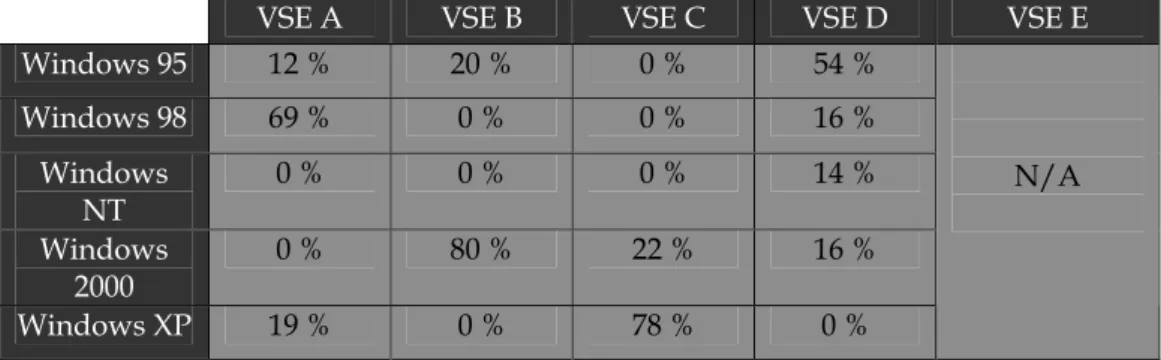
(11) service". It is thus neither depending on the time for resolution, nor the solution found to cure it, nor of the person or service which it solves. The recommendation proposed, on the one hand, to get the average number of incidents ranging between 2 and 5 per month and per user and, on the other hand, to establish a help desk working in a "pro-active" way. This means that it identifies the problems at the source of many incidents and solves them definitively by implementing call abatement projects. The setting up of an incident reduction program requires additional resources (with necessary competences) during its implementation. To assess the IT-users satisfaction level None of the assessed companies measures their IT-users satisfaction level. The level of User Satisfaction is a perception, always subjective, of the effectiveness and quality of the use of the IT. Its measurement allows one to apprehend, without large effort, the hidden IT-costs related to incidents loss of productivity, lacks of knowledge, or inadequacies between staff needs and software tools. Moreover, concrete improvement actions resulting from users’ satisfaction assessments have motivating effects on company staff. A report recommendation is put forth in all the assessments currently carried out.. 5.4.3 Assessment of the IT-infrastructure Several recommendations were made in each VSE within the area of the assessment of the ITinfrastructure. Among this one, here are two relating to the operating system (OS) standardization and the use of the files server. OS standardization Repartition of the operating system running under the workstations is presented above. VSE A. VSE B. VSE C. VSE D. Windows 95. 12 %. 20 %. 0%. 54 %. Windows 98. 69 %. 0%. 0%. 16 %. Windows NT Windows 2000 Windows XP. 0%. 0%. 0%. 14 %. 0%. 80 %. 22 %. 16 %. 19 %. 0%. 78 %. 0%. VSE E. N/A. Figure 12: Distribution of the operating systems Assessed VSE do not have a strong operating system guideline. For the main part of the PC’s, the operating system is generally the one delivered with the workstations, so that by analysing the figures of Figure 12, it can be seen that companies B and C have renewed their IT infrastructure recently relatively to 78 and 80 percent. On the other hand, companies A and D have workstations running under almost the whole Windows OS family. This situation is difficult to manage. It complicates maintenance and consequently increases security risks. These two companies were advised to make an OS standardization. To develop the use of the file server Advantages of the files servers are: documents’ unity and accessibility, secure files storage and up-todate information.. Bernard Di Renzo & Christophe Feltus. Page 11 of 15. December 2003.
(12) All assessed companies have a file server. But the way they use it is nevertheless not the same from one company to another. It is usual that users save professional information on the workstation hard drives. It is recommended to create awareness in order to use the file server to store professional documents. This file server must, moreover, be structured in an efficient way and explained on the VSE-guidelines.. 5.4.4 Assessment of practices regarding security Several recommendations were made in each VSE within the area of the assessment of practices regarding security. Among this one, here are three topics relating to password procedure, anti-virus protection and back up operation. To improve the password procedure Password is the first protection against intrusions. The use of passwords’ pratices is the most divergent topic within the assessed companies. In one VSE out of five, the password was used conscientiously and the employees kept it completely confidential. In the others, the password management procedure was in place but the confidential was limited. The assessment recommends setting up a policy which forces staff to keep the password personal and confidential. This confidentiality is extended to the system administrator. To improve anti-virus Anti-virus is important so as not to get corrupted files on the internal network. Among all of the security area procedures, anti-virus is the one most commonly in place. It was not installed in a consistent way from one VSE to the other. One out of five of the assessed VSEs used up-to-date anti-virus software on the entire infrastructure. The others did not use an anti-virus on all PC’s and servers: they used an anti-virus protection that is more-or-less up-to-date, on almost the entirety of the infrastructure. Because all of them had an Internet access and can import corrupted files, a recommendation was each time introduced. To optimise the back up operation A back up is a second copy of the data onto a tape or another media making it possible to restore data in the event of loss or destruction of the original media. This procedure exists in the all assessed companies, but the rigour and the quality varies from one to the other. A certain number of gaps are identified, among those: daily complete back up rather than differential, lack of awareness of the staff about the data taken into account in the back up, restore procedure not systematically tested, or out-of-date back up media. Recommendations regarding these gaps were made to improve the process by integrating all of the above elements.. 5.4.5 Assessment regarding document management Only one recommendation was made in each VSE within the area of the assessment regarding document management. This recommendation was the improvement of the document management. To improve the document management Document management is the weakest point of all the companies. In each one, the documentation is stored without any particular rule: invoices are stored at accounting; contracts are kept by the management; technical documentation stored by IT staff. The documents are on an electronic or a paper format according to possibilities. They only are partially identified and the version numbering was al-. Bernard Di Renzo & Christophe Feltus. Page 12 of 15. December 2003.
(13) ways missing. This generalized weakness documentation has a negative impact on VSE’s efficiency. Moreover, the lack of documentation represents a risk in a hypothetical departure of someone from the “IT-staff”.. 6 Conclusion The NOEMI assessment methodology was specially designed to cover the global IT-activities of VSEs as a critical topic of a public research project of the Centre Henri Tudor in Luxembourg. The initial objective of this methodology was to directly contribute to the implementation of a model of collaborative IT-sourcing developed in the same project. The process portfolio is mainly derived from ISO/IEC 15540, the IT Infrastructure Library, security standards, and outputs of other projects of the Centre. The capability model deeply explores the gap between both the lowest levels of the ISO/IEC 15504 model in order to match closely with the reality of VSE. It focuses on five areas of processes: infrastructure, service support, management, security, and documentation. The assessment process itself is directly based on ISO/IEC 15504 and systematically involves all processes defined within the five areas. However at the time of writing this paper, the methodology was already experimented with five times. Each performance was a success according to the positive feedback of the VSEs. Two other assessments are currently in progress. And more than ten VSEs are interested in being assessed using our methodology, which is a significant number with regard to the current promotional effort. Furthermore, some of the Centre’s research and dissemination partners are interested in experimenting with it in France and Belgium. This success story of the NOEMI assessment methodology with the VSEs leads us to consider it as an independently packaged tool that can contribute pragmatically to the efficiency and competitiveness of the VSE thanks to IT-quality improvement in software processes, in service management, and in security. Overall, it serves to enable business value through IT-innovation. Today we can already consider the dissemination stage of the NOEMI assessment methodology. Private consultants – as free-lance or service provider – could be trained to use this methodology within an ad hoc partnership in order to ensure the related deontological framework. In a similar approach, the NOEMI assessment methodology is ready to be transferred to non-profit or public organisations as a new public assessment methodology that closely matches the needs of very small companies.. Bernard Di Renzo & Christophe Feltus. Page 13 of 15. December 2003.
(14) 7 Literature [1] ISO/IEC JTC 1/SC7, ISO/IEC TR 15504, 1998 [2] IT Infrastructure Library – Service Support, Service Delivery, Application Management, ICT Infrastructure Management, Office of Government Commerce, United Kingdom, 2000 – 2002 [3] Henderson J.C., Venkatraman N., Strategic Alignment: Leveraging Information Technology for Transforming Organisations, in: IBM Systems Journal, Vol. 32, No. 1, pp. 4-16, 1993 [4] Di Renzo B., Feltus C., Development and experimentation of a model of IT collaborative management for use in SME, in: Proceedings of the International Conference AIM 2003, Grenoble, France, 2003 [5] IT Infrastructure Library – Practices in small IT unit, Central Computer and Telecommunication Agency, 1995 [6] Barafort B., Di Renzo B, Merlan O., Benefits resulting from the combined use of ISO/IEC 15504 with the Information Technology Infrastructure Library, in: Proceedings of the International Conference Profes 2002, Rovaniemi, Finland, 2002 [7] ISO/IEC WD 18028, ISO/IEC JTC1/SC27/WG1, 2001 [8] Barafort B., Hendrick A., A SME dedicated framework to evaluate the internal usage of IT, in: Proceedings of the International Conference Software Process Improvement, SPI’98, Monte-Carlo, Principauté de Monaco, 1998 [9] Lyke H., Cottone D., IT automation: the quest for “lights out”, Prentice Hall, Upper Saddle River, NJ 07458, USA, 2000 [10] Bonjean C., Help desk: assistance utilisateurs et relations clients, Hermes Science publication, Paris, France, 1999 [11] NFEN ISO 9001:décembre 2000 [12] IT Infrastructure Library – Security management, Office of Government Commerce, United Kingdom, 2002 [13] The EFQM Excellence Model – Small and Medium sized Enterprises, EFQM publications, 1999-2001 [14] Mark C. Paulk, Bill Curtis, Mary Beth Chrissis and Charles Weber, Capability Maturity Model for Software, Version 1., SEI, CMU/SEI-93-TR-24, Pittsburgh, Pa, Feb. 1993 [15] SPIRE Project Information Pack - ESSI Project 23873 – April 1997 [16] Sturm R., Morris W., Jander M., Foundations of service level management, SAMS edition, Indianapolis, USA, 2000. Bernard Di Renzo & Christophe Feltus. Page 14 of 15. December 2003.
(15) 8 Author CVs. Bernard DI RENZO Bernard Di Renzo graduated as a “Civil Engineer” in electronics and computer science from the University of Liege (Belgium) in 1989. He first worked as a project engineer in the engineering company of an international industry group. There he managed several projects related to the IT discipline. From 1993 to 1999, he was the head of the IT-affiliate of a banking group in Luxembourg. In this function he developed an accurate focus on quality service provision. He got high quality results through process approach, software automation and staff empowerment. Then he joined an international clearinghouse for wireless operators as the Head of Worldwide Client Support. Since 2001, he has worked in the CITI (Centre d’Innovation par les Technologies de l’Information) department of the Centre de Recherche Public Henri Tudor (Luxembourg). He has managed several projects related to quality in the IT discipline with a special focus on process assessment and improvement program, security management, risk management, IT clustering… He is a SPICE Qualified Assessor, ITIL Foundation Certified, and Quality System Auditor certified. He is the coordinator of a project portfolio related to quality and certification. He also the head of a research unit related to process assessment and improvement, service management, operational risk management, strategy management, and new organisation framing.. Christophe FELTUS Christophe Feltus graduated an Electromechanics Engineer from the Institut Supérieur Industriel des Art et Métiers Pierrard in Virton, Belgium. He worked for several years in private companies as : Production Head at Pfizer SA in Jette, Belgium, Project Coordinator at Nizet Entreprise in Louvain-la-Neuve, Belgium, and Assessor for the Civil Belgium Aviation Administration in Brussels, Belgium. He joined the Centre de Recherche Public Henri Tudor in the Grand-Duchy of Luxembourg in 1999 to work in the Centre d’Innovation par les Technologies de l’Information (CITI). There he has taken part in a project called Prisme Tremplin for the accompaniment of SMEs towards the information society. In 2002, he integrated the project Noemi (Nouvelles Organisation de l’exploitation et de la Maintenance Informatique) as Assessor and he now leads the projet AIDILL (Aide, Information & Développement de l'Informatique Libre au Luxembourg) which aims to promote and develop free software in Luxembourg.. Bernard Di Renzo & Christophe Feltus. Page 15 of 15. December 2003.
(16)
Figure
+4

Documents relatifs