Mentouri University-Constantine
Faculty of Letters and Languages
Department of Languages
Improving learners’ Performance in Analysing the Rhetorical functions of
Description and Definition in Scientific Texts.
The Case of Master One Learners, University of Constantine
Dissertation Submitted in Partial Fulfilment of the Requirement of the Degree for Master in Applied Language Studies
Board of Examiners
President: Dr. Atamna M. C, University of Constantine
Supervisor: Dr. Labed Nacif M. C, University of Constantine
Presented by: Supervised by
Miss. Karima Boukhedoua Dr. Nacif Labed
Dedication
To my parents for their incomparable love, patience, and understanding who helped
me to complete this project.
T o my sister and my cousin for their constant encouragement, without which
this project could not see the light.
To all my friends for their moral support and to all those who contributed to
Acknowledgments
I would like to express my deepest thanks to Dr.Labed my honourable professor and adviser who provided me with invaluable advice and consultation during the process of thesis writing. His helpful suggestions really guided me through different steps of the project.
My special thanks also go to Dr. Ahmed Sid who helped me during the administration of the questionnaire and the test, and all my teachers.
Last but not least, I am also grateful for Master One learners who answered the test and the questionnaire.
Abstract
The present study is composed of two chapters. The first one is theoretical represents an overview of EST related literature as our field of interest. The second one is practical devoted to the analysis of the elicited data. The study aims to shed light on one of the main problems that Master One EST Practice students encounter when analysing scientific and technical texts. They confuse between the most frequent rhetorical functions and between definition and description in particular. The study attempts thus to test EST Practice students’ ability in the rhetorical analysis. On the other hand, we aim to see to what extent placing more focus on these specific functions results in a better comprehension of a given scientific discourse. To achieve this purpose we hypothesised that the learners of learners of EST would increase their performance in comprehending a scientific text when their teachers put more focus on different types of the rhetorical functions of description and definition. A sample of 25 Master One Learners from the Department of Languages was randomly chosen. Moreover, for our research we used a questionnaire and a test as means to gather data. The results obtained are tabulated and analysed.
List of Abbreviations
ESP: English for Specific Purposes EST: English for Science and Technology EAP: English for Academic Purposes EOP: English for Occupational Purposes EBE: English for Business and Economics EMP: English for Medical Purposes ELP: English for Law Purposes
List of Figures
Figure 1: Scientific Discourse, Universal for All Languages………..15 Figure2: Gold Prices during the Last Decade……….………..22
List of Tables
Table 1: EST Practice Courses Attendance………..32
Table 2: Frequency of Attendance………32
Table 3: Students’ Ability in Analysing Scientific Texts……….33
Table 4: The Source of Difficulty……….33
Table 6: Strategies Used to Identify Rhetorical Functions………...…34
Table 7: Confusion among Rhetorical Functions ………....…34
Table 8: The Most Confused Rhetorical Functions………..35
Table 9: Difficulties in Identifying Definition and Description………35
Table 10: Students’ Opinion about Providing a Descriptive Account………..…36
Table 11: Students Scores in Identifying the Rhetorical Functions……….……….38
Table of Contents
Introduction
Statement of the Research Problem………...……..…….2
Purpose of the Study………..………...…………3
Statement of the Research Questions and Hypothesis………...…..……….4
Subjects………...……4
Means of Research………...…...4
Chapter One: English for Science and Technology, an Overview
1.1. Introduction ………..………..61.2. Definition of ESP………..……...6
1.2.1. Strevens and Dudley-Evans Approaches to Define ESP.………8
1.3. Classification of ESP and the Emergence of EST……….…….9
1.4. EST Definition ……….…....10
1.5. EST Course Description………....12
1.6. The Development of English for Science and Technology……….……….13
1.6.1. A Shift from Sentence Level to Textual Level………...…………..13
1.6.2. Widdowson’s View of Scientific Discourse……….14
1.6.3. Trimble’s Rhetorical Approach ……….………...16
1.7. The EST Paragraph……….…………..17
1.7.1. Deductive Paragraphs………...………...……….18 1.7.2. Hybrid Paragraphs……….………18 1.7.3. Inductive Paragraphs……….………19 1.7.4. Implicit Paragraphs………...19 1.8. Rhetorical Techniques………....…19 1.9. Rhetorical Functions……….……….…20
1.9.2. The rhetoric of Instruction……….………...……22
1.9.3. The Rhetoric of Visual-Visual relationship……….………...…..22
1.9.4. The Rhetoric Definition ……….………...23
1.9.5. The Rhetoric of Description………..26
1.10. Conclusion……….…...28
Chapter Two: Research Situation Analysis
2.1. Introduction………..…….….302.3. Means of Research………..…..….31
2.3.1. The Questionnaire………...…31
2.3.2. The Rhetorical Analysis Test……….……….37
2.3.3. Discussion of the Results………...………..………...39
2.4. Conclusion………..…...42
General Conclusion and Recommendation……….………..43
References...45
Introduction
1. Statement of the Research Problem……….2
2. Purpose of the Study………3
3. Statement of the Research Questions and Hypothesis……….4
4. Subjects………4
Introduction
English for Science and Technology (EST) has made considerable contributions to both academic and professional spheres. It has become thus of great importance for EST learners to access information in science and technology and to be familiar with different updates which they may need during their education. To access scientific knowledge they are required first to understand the organisational patterns of scientific discourse and how the linguistic and rhetorical features work to convey a particular meaning.
In our Department, Master One students have an EST course which helps them to develop the ability to comprehend a given scientific discourse. But, we have noticed that they still have problems and some difficulties in differentiating between different types of rhetorical functions. More precisely, they can’t make clear cut-lines between the sub-types of definition and description. For that, we attempted to carry out the following research aiming to see to what extent putting more focus on these rhetorical functions results in better performance.
1. Statement of the Research Problem
Based on the marks of EST learners in the exams we noticed that there is a problem with learning the rhetorical functions. In that, the majority of Master One students still confuse between different types of rhetorical functions in terms of description, definition, classification, instruction, and visual-verbal relationships. Those learners have more particular problems with the following sub-types are concerned, namely physical description, process description, function description, and formal definition, semi-formal
definition, non-formal definition. Weak performances of learners in EST Practice may be due to that they make insufficient or almost no effort to learn the rules underlying EST. Yet, from another side, teachers of EST Practice don’t devote enough time and focus on these two types of EST rhetorical function.
2. Purpose of the Study
Master One learners of EST need to access a detailed account on how to differentiate among those rhetorical functions, as well as the techniques that are most frequently used by scientific and technical writers to establish each type in order to ameliorate their performance in EST Practice
Hence, the aim of our study is to help EST learners develop the following competences to be able to:
a) Identify and explain different types of the rhetorical functions of description and definition.
b) Distinguish the various rhetorical techniques that are more frequent with these aforementioned types.
c) Make sense of EST discourse types.
The other objective of our study is to determine if putting more focus on the areas of difficulty that EST learners come across will result in producing better performances.
Hence, we aim to prevent future learners from getting confused with the different types of rhetorical functions mainly description and definition, and as a further aim provide them with an insight on how to access and understand materials on science and technology.
3. Statement of the Research Questions and Hypothesis
For our research we raised the following questions:a) What are the most difficult rhetorical functions EST learners have to recognise? b) Does putting more focus on those functions help the learners avoid confusion in
EST Practice?
c) What are the significant associations that exist between performances of learners in EST Practice and the focus on the areas of difficulty that they face in analysing scientific texts?
In the light of the above questions we hypothesize that:
EST Practice learners would increase their performance and would overcome confusion, when their teachers put more focus on the different types of the rhetorical functions of description and definition.
4. Subjects
For our research population, we will randomly choose a sample of 25 Master One learners from one of the four available groups in the Department of Languages. We will see further how we would work for randomisation.
5. Means of Research
In order to test our hypothesis and obtain the information from our subjects, we are going to use a questionnaire, and a test which is given in the form of a scientific text to be analysed. The questionnaire attempts to verify the role of learning in details the specific rhetorical functions of definition and description in overcoming confusion. The aim of the test, however, is to show us the areas of difficulty that learners really have. The results will be henceforth tabulated, described and analysed.
Chapter One: English for Science and Technology, an Overview
1.1. Introduction ………..6
1.2. Definition of ESP………...6
1.2.1. Strevens and Dudley-Evans Approaches to Define ESP.………8
1.3. Classification of ESP and the emergence of EST………...9
1.4. EST Definition ………....10
1.5. EST Course Description………..12
1.6. The Development of English for Science and Technology……….13
1.6.1. A Shift from Sentence Level to Textual Level………..13
1.6.2. Widdowson’s View of Scientific Discourse……….…….14
1.6.3. Trimble’s Rhetorical Approach ……….………...16
1.7. The EST Paragraph………..17
1.7.1. Deductive Paragraphs………...……….19 1.7.2. Hybrid Paragraphs……….………19 1.7.3. Inductive Paragraphs……….………20 1.7.4. Implicit Paragraphs……….……...20 8. Rhetorical Techniques………20 1.9. Rhetorical Functions………21
1.9.1. The Rhetoric of Classification……….………..22
1.9.2. The rhetoric of Instruction……….………23
1.9.3. The Rhetoric of Visual-Visual relationship……….………..23
1.9.4. The Rhetoric Definition ……….…………...24
1.9.5. The Rhetoric of Description……….27
Chapter One: English for Science and Technology, an Overview
1.1. Introduction
This chapter is concerned with the theoretical basis of English for Science and Technology as a branch of ESP which has received a considerable amount of attention and interest. In fact, the shift of concern from register analysis to discourse or rhetorical analysis has played a central role in the development and the popularity of EST. At that time, many researchers were interested in identifying the organisational patterns for the scientific discourse and the linguistic means by which these patterns are signalled. Therefore, it has become inevitable for non native learners of English in scientific fields to become aware of such patterns and functions for a complete understanding of the scientific and technical discourse.
1. 2. Definition of English for Specific Purposes
ESP has experienced an extraordinary interest since its development as an applied linguistic discipline. Many scholars tried to find out a comprehensive definition that covers all aspects of this new trend of teaching foreign languages.
Mackay and Mountford (1978) defined ESP on the one hand as the teaching of English for a "clearly utilitarian purpose" (p 2) which is defined by the learners needs. These needs in turn determine the ESP curriculum to be taught. They defined it, on the one hand, as the special language that takes place in a particular setting by particular participants. Strevens (1977) also argued that ESP courses are those which are based on the analysis of participants ‘needs as a key and crucial element.
As for a broader definition of ESP, Hutchinson and Waters (1987) theorise that "ESP is an approach to language teaching in which all decisions as content and method are based on the learner’s reason for learning." ( p. 19)
On a similar stand, Anthony (1997) notes that there is no clear-cut line where ESP courses ends and general English courses begin. Numerous non-specialist instructors use an ESP approach in the sense that their syllabi are based on the analysis of their learners’ needs and their own personal specialist knowledge of using English for real communication.
The above attempts to define ESP reveal that most ESP scholars agree on three key elements to set up what ESP is: (1) the nature of the language to be taught, (2) the learners, and (3) the setting within which the two previous elements take place. As such, these three aspects of ESP are closely connected and can be combined to establish that ESP is the teaching of specific English to specific learners in a particular setting to achieve a utilitarian goal or purpose.
Furthermore, Hutchinson and Waters (1987) stated that the emergence of ESP as a new trend in education was influenced by three central factors.
First, the expansion in scientific discourse during the post-war period which was in turn a result of expansion in science and technology. For this, there was a necessity to develop an international language as a means of communication.
Second, a revolution in linguistics, when there was a shift from describing the rules of language to studying it in use. That is to say looking at context as one of the key elements for language teaching.
The last factor that contributed to the development of English for Specific Purposes was the shift of focus on the learners’ needs. Researchers tried to identify the
specific needs and interests of learners aiming at motivating them for a better performance.
1.2.1. Strivnes and Dudley-Evans approaches to define ESP
Strivens (1988) attempts to define ESP through describing its absolute and variable characteristics:
1.2.1.1. Absolute characteristics: These characteristics define ESP as being:
• Designed to meet specified needs of the learners.• Related in context (i.e. in its themes and topics) to a particular discipline, occupations and activities.
• Centred on the language appropriate to those activities in syntax, lexis, discourse, semantics, etc., and analysis of this discourse.
• In contrast with general English.
1.2.1.2. Variable characteristics
: ESP may be, but not necessarily • Restricted as the language skills to be learned (e.g. reading only). • Not taught according to any pre-oriented methodology (pp.1-2).Later Dudley-Evans and Johns (1998), who are very aware about the current confusion about the meaning of ESP, modified Strevens’ definition. Dudley removed the absolute characteristic that ESP is "in contrast with General English" (John et al, 1991: 298), and he has increased the number of variable characteristics. Even so, defining ESP through recognizing its absolute and variable characteristics in particular serves as a helpful means to seek a comprehensive answer of what ESP is.
1.3. Classification of ESP and the Emergence of EST
Most scholars mentioned two or three sub-divisions of ESP. English for Science and Technology (EST), which is the main concern of our study, emerged as the major and the most popular branch of ESP, this may be a result of the rapid progress in science and technology. Kennedy and Bolitho (1985) stated that it is very important to recognise that EST has contributed to the development of ESP since scientists and technologists are required to deal with linguistic issues related to the nature of their professions.
A first attempt of classification was carried out in 1975 in Great Britain. When the British council under the auspices of the ministry of foreign affairs provided a taxonomy of ESP which included two main sub-sets based on both specificity and purpose (EAP) which included English for Science and Technology (EST). The other one was English for Occupational Purposes (EOP). Later in 1977, Strevens presented another classification as a component of the above attempt. He proposed a taxonomy in which ESP was subcategorised into two main sub-divisions; English for Science and Technology (EST) and English for Other Purposes (EAP): English for Academic Purposes (EAP), English for Occupational Purposes (EOP), etc.
Celce-Murcia (2001), classified EST as a branch of English for Academic Purposes (EAP) along with, English for Medical Purposes (EMP), English for the Law (ELP), and English for Business and Economic (EBE). Whereas she called the other big branch English for Occupational Purposes (EOP).
A further contribution to find a comprehensive and a more detailed classification is the work of Hutchinson and waters (1987) who designed an "ESP family tree": EST, EAP, and EOP as the main branches stem from this tree.
On the other hand, Carter (1983) gave three types of ESP: 1. English as a restricted language.
2. English with academic and occupational purposes. 3. English with specific topics.
English with specific topics was recognised by Carter (1983) as a type only when there was a shift from purpose to topic. This author asserted that this branch is solely concerned with anticipating future English needs, and it is workable for scientists requiring English for postgraduate reading studies, attending conferences and working in foreign institutions. However, some scholars such as Gatehouse (2001) argues that it is not a separate branch in its own right, it is in fact an integral component of ESP courses which a situational language focus.
It is clearly stated that most scholars recognised three distinctions of ESP types. On this basis, it is significant to end up with the idea that English for Academic Purposes (EAP), English for Occupational Purposes (EOP) and English for Science and Technology (EST) constitute the main broad branches of ESP.
1.4. Definition of EST
As there was an increasing recognition of ESP as a new trend of teaching foreign languages, there was in parallel an increasing need to clearly define those areas which exist as its subsets, especially, English for Science and Technology (EST) which has been considered one of its major subdivisions.
Trimble (1985) defined EST by saying that it "covers the areas of English written for academic and professional purposes and English written for occupations (and vocational purposes), including the often informally written discourse found in trade journals and in scientific and technical materials written for the layman" (p.6). In fact, this quote is a clear indication that the "audience" is a crucial concept for writers producing
already working in fields as engineering, physics, or computer sciences, and thus have occupational purposes (EOP). Moreover, EST may have an academic focus for those students at universities who deal with scientific and technical subjects.
Widdowson (1979), on the other hand, attempted to define EST stating that it "is best considered not a separate operation but a development from alternative realisation of what has already been learned of existing knowledge." (p.45). Then he added "thus a knowledge of EST can be derived from that the student knows of science and the functioning of his own language in association with what he learnt of English usage." To make it clearer, Widdowson means that EST learners have a special knowledge of science in addition to some English knowledge.
Many other linguists share Widdowson’s view as Hutchinson and Waters (1981) who assert that the knowledge that science students posses should be used as a base for target language learning.
Strevens (1977) defined EST in terms of what makes it distinct from all the other types of ESP courses. Comparing it to English for general purposes, he found that they share the same rules for sentence formation, except those features which are considered as a property of the language of science and technology.
In the same vein, Swales (1985) argues that EST compared to ESP is senior in age, since it has witnessed a large number of publications as well as practitioners involved. Besides, he classified three categories under EST:
1. The first one deals with the level of education depending on the context in which it is taught, for example, English taught in: secondary school, and universities.
2. The second category concerns the subject matter. That is, when English is used for general science, biology, and so forth.
3. The last category deals with the types of activities involved such as: reading, writing, and attending seminars.
Last but not least, it is worth mentioning that our study will focus on the third category, namely, when English is used to read and analyse scientific materials. In other words, we will try to focus on reading comprehension of scientific texts.
1.5. EST Course Description
Due to the importance of English for Science and Technology in education, Master One learners (Applied Language Studies) of EST Practice at the university of Constantine are required to attend an EST course whose main objective is to allow them have access to scientific information and to develop accuracy and speed in reading scientific materials.
The learners are free to select their texts from any area of science they prefer such as Biology, Engineering, Chemistry, Computer Sciences, and so on. Thus, they will find the topics very interesting, and given the opportunity to be familiar with different forms and qualities of scientific knowledge. Then, they read and analyse the selected texts on the basis of the predominant rhetorical functions, rhetorical techniques, cohesive markers, and grammatical features. As a result, EST learners are exposed to texts that reflect different and most common rhetorical functions such as description, definition, classification, illustration, and visual-verbal relationship, in addition to techniques as cause/effect, illustration, exemplification, comparison, similarity, etc.
The rational for giving the above mentioned is to:
1. Help learners improve their vocabulary and discover the terminology features of different scientific domains.
2. Familiarise learners with different rhetorical functions of scientific English. 3. Help them develop key techniques that could be adopted while reading texts.
4. Stimulate their interest in the topics dealt with and most significantly being in touch with the current updates in the field of science and technology.
Regardless the above outcomes of the course, it is important to mention that the time allocated to achieve them - one session a week - is really insufficient. In fact, learners do the analysis under the pressure of time constraints and the teacher faces a difficulty in giving efficient feedback and evaluation on their performance. Hence, these obstacles should be taken into account for better achievements.
1.6. The development of EST discourse
1.6.1. A Shift from Sentence Level to Textual Level
At the beginning of the 1960s, ESP and EST as the main area of interest have undergone many phases of development. Many scholars such as Halliday, Mchntosh (1964), and others started to search into the nature of scientific and technical English. They followed in that the linguistic trends when the sentence was the main objective of study. That is, they were interested in identifying grammatical and lexical features that are unique to that special field. Those features were then used as a content of the EST syllabus, since the goal was to focus on the language forms learners would commonly need in their field of specialization.
Later, however, this linguistic approach was subject to harsh criticism by many other scholars. Widdowson (1974), for example, takes the position that attempts to identify the formal characteristics of scientific English which led to the development of register-based ESP materials can serve only a part of the needs of language users. In fact, the work of Widdowson created a new perspective of what the understanding of the language used in science and technology might involve. According to Widdowson and Allen (1974), the description of scientific discourse necessitates the understanding of the formal properties as well as the understanding of the rhetorical functions of language in
use. As a result, there was a shift of attention from the sentence level to the textual level (i.e. the level above the sentence), to see how sentences were combined to form paragraphs, and whole texts (or discourses); and how such combinations serve to recognise the purpose of the writer. So, it was then proposed that the content of EST courses could be defined not in terms of syntax and lexis, but in terms of rhetorical functions that these linguistic elements are used to realise.
In short, the main concern of the rhetorical approach to the description of language is the functional aspects of language use and how the choices of the linguistic elements affect the meaning of the text. That is, technical writers’ choices of linguistic elements depend on the meaning they attempt to produce. Simply, the form of the text depends on the function it plays.
1.6.2. Widdowson’s View of Scientific Discourse
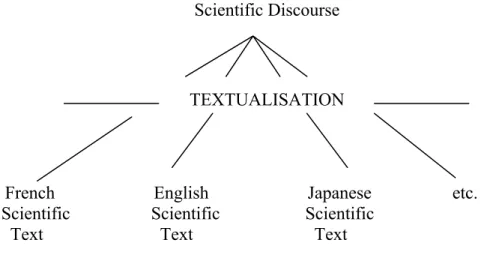
Widdowson (1979) was among the pioneers who attempted to set up the characteristics of scientific discourse in Great Britain. The idea of discourse universality that is processed by textualization and realised by scientific text is the base for Widdowson's approach. He suggested that "scientific discourse is a universal mode of communicating. Or a universal rhetoric which is realized by scientific text in different language by the process of textualization." (p. 52). According to him, scientific discourse is a set of concepts and procedures that are independent not only in language but also in subject. In other words, the way in which language is functionally realised to produce a coherent text in the area of science is universally similar and the only difference lies in the text form. He simply summarised the idea of scientific discourse universality in the following figure:
Scientific Discourse
TEXTUALISATION
French English Japanese etc. Scientific Scientific Scientific Text Text Text
Figure 1. Scientific discourse, universal for all languages (Widdowson 1979: 52)
Based on the idea of textualisation, Widdowson (1979) further stated that the learner of English in a teaching situation can use the knowledge of the discourse he already learned in his native language in the area of science and technology for learning the particular textualization of this discourse in English.
In addition to the quality of universality in scientific discourse, Widdowson (1979) considers formulae, diagrams, charts and graphs as non-verbal modes of communication and at the same time other characteristics of scientific discourse.
To conclude, it is of a crucial importance to note that Widdowson’s idea of universality doesn’t match with the Algerian realities. Each year hundreds of high school learners having different specialities register in the Department of English. So, those students who, for example, have a literary background, are not or less familiar with the scientific knowledge in their native language and will then face difficulties in learning science in English. Hence, they need first to access how the scientific discourse is structured and organised to know how to grasp up its total meaning.
1.6.3. Trimble’s Rhetorical Approach
Trimble’s (1985) Rhetorical Approach is based on the belief that scientific discourse has a number of rhetorical characteristics which make it distinct from the other forms of written English discourse. Those elements, in fact, play a crucial role in organising and presenting scientific information as well as in comprehending the overall meaning of discourse. Trimble tried to identify those characteristics and he used the results of his study to develop classroom materials to be taught to non-native speakers. The findings of the study aim to teach and facilitate first reading and secondary writing for them.
The rhetorical approach is built around three main rhetorical concepts: 1- The nature of EST paragraph.
2- The rhetorical functions most commonly used in written EST discourse. 3- The rhetorical techniques most commonly used in written EST discourse.
Trimble (1985) looks at the notion of "paragraph" as the key element and the basic unit for approaching the analysis of EST discourse. For him, it carries appropriate pieces of information and shows how they are related to each other. Furthermore, understanding the rhetorical functions and techniques should be proceeded by understanding how EST discourse is organised. For that, he made a distinction between the physical and the conceptual paragraph which are one of the EST discourse characteristics, in addition to other ones which we will see with more details further down.
Rhetorical functions are another base for Trimble’s (1985) approach which are defined as "a name for what a given unit of discourse is trying to do" (p.12). He presents description, definition, classification, illustration, and visual-verbal relationship as the
Finally, rhetorical techniques are recognised as the third concept. They are those elements which bind together the pieces of information in a given scientific discourse. They may be in natural and logical order.
1.7. The EST Paragraph
When dealing with the EST paragraph, one cannot escape the way in which Trimble (1985) defined it when he said that it is "a unit of written English discourse that presents the reader with a selected amount of information on a given area of a subject. This information is so organized by the writer that the rhetorical concepts chosen and the relationship between these concepts are the most functional for both the rhetorical purpose of the paragraph and for the level of reader; that is, the reader’s position in respect to the subject matter under discussion-beginner, expert, etc." (pp. 14-15).
What is new in Trimble’s definition is that the EST discourse can be viewed as having distinct characteristics which make it different from other typical paragraphs; hence, it represents a distinct phenomenon.
Still to Trimble (1985) the actual organization of EST paragraph is more apparent if we recognise two types of paragraphs rather than one. For that, he provided a distinction between the physical and the conceptual paragraph.
The conceptual paragraph "consists of all the information chosen by the writer to develop a generalisation, whether this is stated or only implied by the content" (p.15). In other words, it contains all the essential concepts to convey the overall meaning of the discourse.
On the contrary, the physical paragraph is "that amount of information relating to the generalization which is set off from other parts of the discourse by spacing and indentation" (p. 15) as Trimble stated.
Another worth mentioning point is that this way of looking at the EST paragraph necessitates the idea of "correspondence" and "core generalisation". When the discourse is developed in only one physical paragraph, we say that there is one-to-one- correspondence. However, there is one-to-more than-one correspondence when it is developed in two or more physical paragraphs.
The concept "core generalization" is a key element in the rhetorical approach it is used to refer to the general idea which the EST discourse is all about. Generalization, in fact, can be stated both explicitly; by a sentence, a clause, a phrase, etc; and thus called "the core statement". It can also be implied and called "the core idea" which can be guessed from reading the discourse. Furthermore, with regard to the placement of the core statement, it is interesting to note that four types of paragraph are distinguished.
1.7.1. Deductive Paragraphs
They are those which have their core statement at the beginning. In this sense, the core statement comes in the first sentence which is supported by the other sentences that constitute the paragraph. This type of paragraph is more frequent in scientific discourse, because often the writer presents at the very beginning the theme he wants to discuss in the rest of the paragraph.
1.7.2. Hybrid Paragraphs
They are those paragraphs whose core statement comes at the middle. The paragraph of this type is structured in a way which begins with information of specific type that leads to the core statement and ends up with other information related to the core statement. Thus, the core statement here combines the information that proceeds and
1.7.3. Inductive Paragraphs
They have their core statement at or near the end and they constitute the third type of paragraphs. Such paragraphs are developed inductively and thus lead to a logical ending. It is mostly found in a piece of writing in which the events lead to a given discovery or a new hypothesis.
1.7.4. Implicit Paragraphs
Their core statement is stated in an implicit way. The writer relies on the reader’s ability to identify the core generalisation. In order to grasp what the paragraph is exactly about, the reader is required to posses a certain knowledge that allows him to establish relationships between different pieces of information and arrive at the intended core statement.
1.8. Rhetorical Techniques
They constitute another base for Trimble’s (1985) Rhetorical Approach and they are defined as "those rhetorical elements that bind together the information in a piece of EST text." (p.18). In this sense, they are recognised as means to hold different pieces of information together and form the whole shape of the discourse. In fact rhetorical techniques provide the bases for the procedures that help students recognise which grammatical and rhetorical features or elements that scientific writers have chosen to establish their information. This in turn, helps the students understand why a given grammatical element such as a verb tense and definite article is preferred rather than another. Trimble (1985) also presented two types of rhetorical techniques: natural and logical order.
Natural order are those techniques that are imposed by the nature of material and they include space order, time order, and cause/effect. Logical orders, on the other hand, are those techniques that are imposed by the writer’s choice when he prefers a given pattern rather than another to convey a particular kind of information. Logical order includes order of importance, comparison, and analogy.
In fact, it is interesting to note that rhetorical functions sometimes act as rhetorical techniques and thus serve to develop the main rhetorical function. For instance, the rhetorical function of description may be used as a rhetorical technique to develop the rhetoric of definition. In this way, we have two rhetorical functions within the same sentence. The first one acts as a technique which is used to develop the main rhetorical function. Hence, EST learners should be aware about all these possibilities.
1.9. Rhetorical Functions
The basic rhetorical functions commonly found in EST discourse are fundamental elements in the organisation of scientific and technical information. When a technical writer intends to present a given rhetorical function, he attempts to use certain grammatical elements which are more appropriate to develop that particular function. Then, EST learners use those elements as clues to discover which rhetorical function is developed. That is, there exist a relationship between the rhetorical functions and the grammatical elements that are used to establish them and the determination of those elements and other rhetorical and lexical features which enable the reader to get the full meaning from a piece of text and a clear understanding of the discourse being analysed.
Trimble (1985) defined rhetorical functions as "a name for what a given unit of discourse is trying to do." (p.12). He identified description, definition, classification,
in EST discourse. However, we will give the lion’s share of explanation only to the functions of our interest, namely description and definition- the main areas of confusion to our learners.
1.9.1. The Rhetoric of Classification
It is adopted by technical writers to group things that all have one important element in common. That is, most often classification is associated with categorising elements which fall under the same object (i.e. two types of the same thing). The word "type" here is very important because its substitution by the word "part" will be misleading, since we will be in fact describing the different parts of something and not categorising its types. So, the learners need to be aware that the rhetorical function in this case will be description and not classification. Like description and definition, classification is also divided into three types: complete, partial and implicit classification.
First, in complete classification the writer gives three types of information: the term being classified, the class to which the members belong, and the basis for classification. That is, he represents two or more terms that have a relationship. Then, he gives the class to which they belong with additional information that exist between them, and finally explains how they are different or similar.
Second, partial classification is not concerned with indicating the core basis that the writer follows when he classifies various items. In other words, he presents only two out of the three sets of information. The writer avoids indicating the basis of his classification, because he feels that it can be easily identified from the context.
Finally, implicit classification is another type of classifying information where the writer doesn’t state directly the three familiar sets of classification. In this sense, there exists a classification in the paragraph and the readers have to guess it.
1.9.2. The Rhetoric of Instruction
This type is most frequently found in technical discourse and manuals. Trimble (1985) defined it as "the rhetoric of telling someone what to do and how to do it to achieve a certain goal" (p. 20). It can be either direct or indirect.
Direct instruction is usually stated in the imperative form. It is presented as a list which is preceded by the goal or the purpose of the instructions provided. Indirect instruction, on the other hand, is often used in a paragraph which sounds better as suggestion rather than command. Besides, it is usually associated with modals as "can", "should", and "may".
1.9.3. The Rhetoric of Visual-Verbal Relationship
According to Trimble (1985), visual-verbal relationship refers to the use of visual aids such as charts, tables, diagrams, drawings, etc., in parallel with a given text. The role of such visual aids is to provide the reader with further information and illustrations. The chart of gold prices (c.f. figure) which is taken from the internet indicates that it is too difficult to transmit such information through words only. Furthermore, it makes information clearer and more accessible for the reader. So, he will read the scientific text and consult the chart for more clarity.
1.9.4. The Rhetoric of Definition
It is used when the writer intends to present new concepts, new way of looking at old ideas and when new technologies need explanation. Definition can be categorised in three main types: formal, semi-formal, and non formal.
1.9.4.1. Formal Definition
It provides the reader with as much information as possible. To make it clear and distinguish it from other types of definition Trimble (1985) set up the following equation: T = C + D. In other words, T is the term being defined; C is the class or the set of which the term is a member; and D is the sum of differences given to distinguish the term from the other members that constitute the set. Trimble views that scientific writers provide three categories of information when he formally define a given term. Furthermore, he provided the below example for learners who still confuse among the sub-types of definition.
E.g.: An arachnid is an invertebrate animal having eight legs extending at equal intervals from a central body.
This example, in fact, is a formal definition, because it fits the above equation as follows:
1- T = Arachnid. 2- C = invertebrate.
3- D = having eight legs extending at equal intervals from a central body.
Because of the importance of the relationship that exists among the different classes of formal definition, Trimble (1985) asserts that it is necessary for non native
learners of scientific and technical discourse to be familiar with the above equation (T= C+D) to differentiate among the sub-types of definition.
Flowerdew (1992b) defines a formal definition through providing an example "an element is a substance which cannot be broken down into simpler substances." (p. 167). He sets up this example on the basis of the following typical syntactic structure he presents for formal definition: NP +copula+ NP (including relative clause or other pre- or post modifier), and he distinct it from the formulae of semi-formal definition which is: NP + copula + NP (without relative clause).
Besides, he stated that the formal definition as well as the semi-formal one in his corpus could be sub-classified into the following subcategories according to the semantic content of the specifying characteristics: a) behaviour / process / function, b) composition / structure, c) location / occurrence, d) attribute / property. Also Flowerdew (1992a), on the contrary to Trimble (1985), views that the term being defined doesn’t appear always at the beginning of the sentence; it may appear at the end.
1.9.4.2. Semi-Formal Definition
By definition, a semi-formal definition "contains only two of the three basic defining elements: the term being defined and the statement of difference." (Trimble 1985, p. 77), and, the class to which the defined term belongs is left out. Trimble views that the writers leave it out because they assume that it is obvious or it is too large and thus meaningless.
Flowerdew (1992b) suggested that "formal and semi-formal definitions are most commonly used where the information conveyed by the definition is the main focus of the discourse (...) and substitution are used most common where definition is not the main
As we have stated before, he provided the typical structure for semi-formal definition as follows: NP + copula + NP (without relative clause), and he presented the word copula as the most common syntactic device. Besides he added the following example to show semi-formal definition "the circulatory system concerns the movement of blood in all animals" (1992b, p. 168). We can note that both authors agreed that a semi-formal definition provides us with less amount of information than that provided by formal definition.
1.9.4.3. Non Formal Definition
Non formal definition defines a general sense, so that the reader can see the familiar element regardless of what the new term is. Trimble (1985) sees that most non formal definitions are found in the form of synonyms. In fact, scientific writers attempt to substitute a technical term with a word or a phrase that the reader is familiar with. Trimble (1985) also asserts that EST discourse learners or readers need to be taught how to recognise the different amounts and kinds of information given by each type of definition in order to overcome confusion. According to him, other forms of non formal definition may be: definition by antonyms and by negative statements and definition by antonyms. He added that the most frequent ones are indicated by expressions such as: named as, that is called, known as, etc., which are also the most apparent signals of defining. In this Concern, Darian (1981), suggested "general formulas" for defining as "relative clause with third person singular", "which/ that + be + past verb", and the use of limited number of verbs such as "means", "refers to", etc.
In the same vein, Flowerdew (1992a) represented defining by substitution as one type of expressing definition. In fact, Flowerdew’s definition by substitution is similar to an extent to Trimble’s non- formal definition, and the only difference lies in that Trimble
(1985) recognised it as one way of expressing non-formal definition, however, Flowerdew (1992a) dealt with it in a more detailed way and as a specific sub-type of the rhetorical function of definition.
1.9.5. The Rhetoric of Description
Trimble (1985) views that EST discourse writers usually use this type of rhetoric when they intend to describe physically a given object, a given process or a given function. As such, Trimble (1985) identified three types of description: physical, process, and function. However, these types do not necessarily occur in isolation. We may, for instance, have a sentence developed first with physical description and then moves toward function. Thus, our students should be conscious that they are exposed to different kinds of amounts of information.
1.9.5.1. Physical Description
It is concerned with the physical characteristics of an object and different spatial relations that exist between its parts from one another and to the whole object. Trimble (1985) said that usually physical characteristics as: shape, size, color, texture, dimension, etc, do most frequently occur when EST writers use description. Besides, physical description may fall into: general description through using terms as "above", "below", "in front of" or a specific description which is characterized by the use of more precise terms as: "at the angle of 90". As a further step, Trimble (1985) has mentioned that space order is the most frequent rhetorical technique that is used by the writers of scientific texts to develop description.
are usually universals. The most commonly used verbs are to be and to have." (p.160). He also mentioned the use of modifiers (which is a word, a phrase, or a clause that describes or modifies another word) and adjectives ending with "ed" or "ing" as ways of expressing description.
1.9.5.2. Function Description
Trimble (1985) recognised it as giving the reader information into two main types. The first one is the purpose of the device being described as in his example (the helical gear reduces the ratio), and the second one is how the device functions (depressing the lever causes the spring to compress). Hence, this type usually associates with cause/effect relationship. In addition, the description of the elements functionally depends mainly on the writer’s choice since he may describe the function of only those elements which he feels important, and not another one.
Ahmad (2009) expressed function description in a similar way to that provided by Trimble. He stated that it "gives readers information relating as a rule to the purpose and functioning of various devices of the machine. These bits of information are also associated with causality and result" (p. 43).
1.9.5.3. Process Description
It is defined as a series of steps which lead to a definite goal, and each step will depend on the previous one. So, cause/effect is the most frequent rhetorical technique that is used to establish such a type since the cause of what happened before gives a result in the next step.
However, according to Trimble’s (1985) view, in contrast to physical and function description which may deal only with elements that the writer feels important, process
description usually left none of the steps that lead to the definite goal. And, this can be used as a base to distinguish between process and function description which both use cause/effect as a technique.
1.10. Conclusion
This chapter is concerned with the theoretical basis for our research. We introduced first ESP as a new trend in language teaching stressing in that the learners needs and purposes as the key elements for its specificity. Then we dealt with EST as the main concern of our research and as the area of great importance for many researchers. Course description is another aspect which we stood at to have insights on what an EST course for Master One students is all about. Moreover, we turned more attention to the basic contributions of Widdowson (1979) and Trimble (1985) as the pioneers who attempted to describe scientific discourse. Finally, we focused on different rhetorical functions devoting in that the lion’s share for definition and description.
Chapter Two: Research Situation Analysis
2.1. Introduction……….30 2.2. Population, sampling, and randomisation………...30 2.3. Means of Research………..31 2.3.1. The Questionnaire………31 2.3.2. The Test………37 2.3.3. Discussion of the results………...39 2.4. Conclusion………...42
Chapter Two: Research Situation Analysis
2.1. Introduction
This chapter is devoted to the practical part of our research. It describes in some details how we conducted our experiment and the tools we used to check whether our students really have problems with the rhetorical functions of definition and description. On the other hand, we will try to verify to what extent providing a descriptive account will be helpful to overcome these problems and promote the students’ performance. For this purpose, we designed a formal questionnaire and a test as suitable means to collect data from our sample of interest. We will also provide the analysis to the results obtained and discuss the findings of our study.
2.2. Population, Sampling, and Randomisation
Our population of interest is Master One EST Practice learners from the Department of Languages, University of Constantine. We have purposefully chosen to work with Applied Languages students, since they are the only students concerned with EST Practice courses.
The research population was randomly chosen. Simply, we randomly picked up 25 students from one of the four available groups as could be chosen any other group, and we did not look for any particular characteristics for our sample.
2.3. Means of Research
2.3.1. The Questionnaire
We used a questionnaire to have insights about our students’ ability to analyse authentic scientific texts in terms of the rhetorical functions of definition and description. The questionnaire was also meant to see to what extent the learning of such functions in a more detailed way results in better performance as well as a total understanding of the scientific discourse. (c.f. Appendix 1)
The questionnaire consists of eleven closed and open questions. Besides, the language used in the questionnaire is very simple English. Hence, our subjects face no difficulty in understanding all the questions and they could ask the writer whenever it is required. As this allowed us to collect data about the importance of EST courses for our students to know their real difficulties with the analysis, and the degree of that difficulty. We aimed also to know what strategies they followed during the analysis, and if they are aware of the role that rhetorical techniques play in helping understand a given scientific discourse. Finally, we wanted to know their opinions about whether putting more focus on these functions would result in a better performance.
2.3.1.1. Administration of the Questionnaire
The questionnaire was administered by the writer during the end of the second term to guarantee thus that all of them have become familiar with the rhetorical analysis. In addition, they were given enough time to deal carefully with each question.
2.3.1.2. Analysis of the Results
Question 1:
Table 1. Attendance of EST Practice Courses
The total (100 %) number of respondents (N= 25) answered by yes. That is, all of them stated that they attend EST Practice courses.
Question 2:
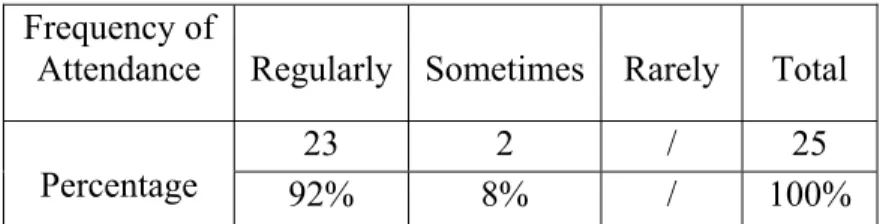
Table 2: Frequency of Attendance
Form the above table we can note that of the total respondents (N=25), (92%) answered that they attend EST courses in a regular way; against only (8%) said that they sometimes attend these courses.
Frequency of
Attendance Regularly Sometimes Rarely Total Percentage
23 2 / 25
92% 8% / 100%
EST Course
Attendance Yes No Total
Percentage
25
/
25Question 3: .
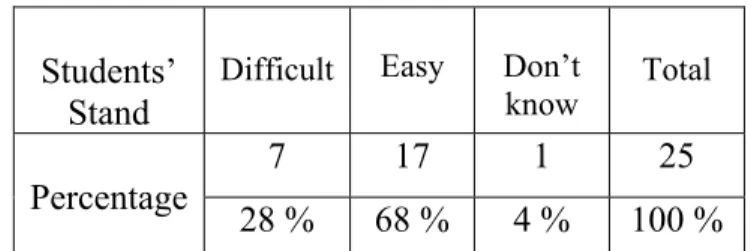
Table 3: Students’ Ability in Analysing Scientific Texts
17 students (68 %) stated that they don’t face any difficulty in analysing authentic scientific texts. However, (28 %) said that they really come across different problems during the analysis; against only one student (4 %) views that the analyses are neither difficult nor easy and it requires only time and concentration.
Question 4:
The Source
of Difficulty The texts are so technical You don’t know the rules of rhetorical analysis
You know the rules but you
don’t know how to apply them Others No answer Total Percentage 8% 4% 8% 2 1 2 5 20% 60% 15 100% 25 Table 4: The Source of Difficulty
The majority of students (60%) did not give an answer, while (20%) provided other reasons. (8%) think that they have difficulties because the texts are so technical, another (8 %) agree on the fact that they know the rules but they fail in applying them; against only (4 %) who said that ignoring the rules is the main source of difficulty.
Students’ Stand
Difficult Easy Don’t
know Total
Percentage
7 17 1 25 28 % 68 % 4 % 100 %
Question 5:
All the five reasons provided by the students are centred around the lack of time and concentration, the ignorance and the difficulty to recognise the existence of such clues which facilitate the analysis, and that the lessons are less focused since they quickly move from one rhetorical function to the next one.
Question 6:
Table 6: Strategies Used to Identify Rhetorical Functions
The results in the above table shows that more than half of the subjects (55.17%) read the sentences and guess directly the intended rhetorical function, (37.93%) look for clues that help and guide them to the functions used; against only (6.89%) use other strategies. Question 7: Strategies used by the Students Look for clues that help them recognise the intended rhetorical functions Read the sentences and guess directly the intended rhetorical function Others Total Percentage 9 15 1 25 36 % 60 % 4 % 100% Confusion among Rhetorical Functions Yes No Total Percentage 8 17 25 32 % 68 % 100%
About difficulties and confusion in identifying the five most frequent rhetorical functions, more than half of the subjects (65.38%) answered by no, whereas (34.61%) answered by yes.
Question 8:
Rhetorical
Functions Definition Description Classification Instruction
Visual-verbal
relationship Total
Percentage 52% 13 10 2 40 % 8 % / / / / 100% 25 Table 8: The Most Confused Rhetorical Functions
(52 %) of the total respondents (N= 25) stand for description as the most confused rhetorical function, followed by definition in the second position (40 %), classification comes third with (8 %), and no difficulties marked for both the rhetorical functions of instruction and visual- verbal relationship.
Question 9:
Table 9: Difficulties in Identifying Definition and Description.
This question is more focused than question 7. It aims to seek information on whether EST Practice learners really have problems in differentiating between the
Confusion between Definition and Definition Yes No Total Percentage 12 13 25 48 % 52 % 100 %
description, definition and their sub-types in particular. (56%) answered that they don’t confuse among them, while (44%) students said they do.
Question 10:
Table 10: Students’ Opinion about Providing a Descriptive Account Of the total respondents (N=25), (52%) said that learning rhetorical functions in details is beneficial for them and help them get; better performance, (40%) did not give an answer at all; only 8 % didn’t see the utility of providing a descriptive account of rhetorical functions.
Question 11:
Only four students provided other suggestions in addition to answering by "yes" in the previous question. Three of them stressed the same idea which is the teachers must be more focused and must provide the criteria for distinguishing between different types of rhetorical functions as well as the rhetorical techniques that are mostly used to establish each type. One of them went even further and suggested to devote at least one session for each type of rhetorical functions. Whereas one of them sees that it is better to do more practice.
Students’
opinion Yes No No answer Total Percentage
13 2 10 25
2.3.2. The Rhetorical Analysis Test
2.3.2.1. The Aim of the Test
We aim also to arrive at an evaluation of our students’ level in analysing authentic scientific and technical texts and have an insight on the correlation that exist between their answers in the questionnaire and their performance in the test.
.
2.3.2.2. Description of the Test
The test consists of an authentic scientific text taken from a technical book entitled "English for Science" (Zimmerman 1989). It consists of two physical paragraphs of 15 lines each, and about 208 words, so it is neither long nor short. Besides, it is an expository text where we find definitions, descriptions, and classifications. The students were asked to analyse the text in terms of the five most frequent rhetorical functions: definition, description, classification, illustration, and visual-verbal relationship.
2.3.2.3. Administration of the Test
The test was administered at the end of the second term. No absences were marked during the administration. Students were given enough time to analyse the text in terms of rhetorical functions developed by the writer of the text, and each one of them worked independently.
2.3.2.4. Analysis of the Results
As we are concerned in the present study with definition, description and their sub-types in particular, we are going to analyse the students’ performance in terms of the above functions only. The students were required to identify all the 13 available functions
to get 13 points. The following tables summarise their performance in the analysis of the text.
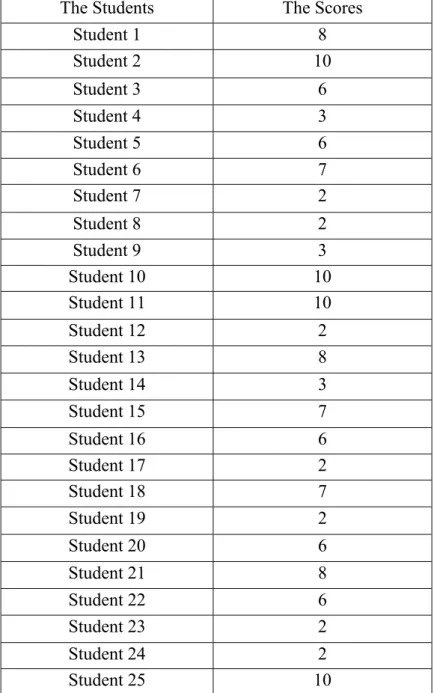
Table 11: Students Scores in Identifying the Rhetorical Functions
The Students The Scores
Student 1 8 Student 2 10 Student 3 6 Student 4 3 Student 5 6 Student 6 7 Student 7 2 Student 8 2 Student 9 3 Student 10 10 Student 11 10 Student 12 2 Student 13 8 Student 14 3 Student 15 7 Student 16 6 Student 17 2 Student 18 7 Student 19 2 Student 20 6 Student 21 8 Student 22 6 Student 23 2 Student 24 2 Student 25 10
Table 12: The Percentage of the Students Scores in the Rhetorical Functions Analysis
The results obtained from the students’ performance (cf Table 11, Appendix )in the analysis show that none of them succeeded wholly in identifying all the rhetorical functions that are developed by the writer of the text. Only (16 %) succeeded in getting ten points, (12%) identified eight correct functions; (16%) of them got seven points by identifying seven functions, (20%) extracted five correct functions and thus gained five points; however, (12%) and (24%) identified only three and two functions respectively.
2.3.3. Discussion of the Results
The results of the questionnaire are of a paramount importance. The data obtained from (Table1) and (Table2) show that (92%) out of (100%) attend the courses in a regular basis, against only (8%) who sometimes been absent. This in fact reveals that the majority of students are aware enough about the importance of EST Practice for their studies. On the other hand, the frequencies of attendance (Table 2) show also that they have been familiar with the rhetorical analysis for the whole year. Hence, many scientific texts have been analysed (about 37 texts). These results can be also related to what we have stated in course description to end up that the problems that may rise during the analysis may be due to other factors such as time constraints or lack of focus rather than lack of practice as some students assume (see question 11).
Scores 2pts 3pts 6pts 7pts 8pts 10pts total Students 6 3 5 4 3 4 25 Percentage 24% 12% 20% 16% 12% 16% 100%
The figures in (Table 3) demonstrate that most students (68%) analyse scientific texts with easiness, whereas (28%) face different difficulties during the analysis. The source of this difficulty according to (8%) of these students is their ignorance of how to apply the knowledge of rhetorical analysis they posses, another (8%) believe that the technical words pose more difficulties for them, and (4%) see that some problems occur because they are ignorant of the rules governing rhetorical elements. Whereas, the majority of students (60%) didn’t answer this question at all. One possible explanation for this might be their answer in (Table3) where they stated that they didn’t have any difficulty. All the additional reasons provided (see question 5) are centred around lack of time and concentration, and the difficulty to figure out the intended functions because the lessons are less focused.
The sixth question aims to identify the strategies used by the learners, and try to relate them with the difficulties that may appear during the analysis. Based on the results obtained from (Table 6) one can note that the majority of students (60 %) read the sentences and guesses directly the intended rhetorical function. However, only (40 %) follow some clues to arrive at the intended meaning. These results can be interpreted as either most students are ignorant of how to use those rhetorical and grammatical elements to codify the intended rhetorical function or they still ignore their role as facilitators.
As we supposed them to be (Table 8) entails that definition and description stand as the most confused rhetorical functions compared to classification, illustration, and
visual-verbal relationship. In fact, this provides a partial support for our hypotheses when
these two functions are supposed to cause more difficulties and confusion for EST Practice learners. Another strong support for our hypothesis is derived from the students’ answers in (Question 11) when they stressed the importance of learning those specific functions in more detail through devoting at least one session for each.
Furthermore, there exist some significant correlations with some findings of the questionnaire. The same 17 students who answered by "no" in the third question (Table 3) said that they don’t confuse among the rhetorical functions in (Question 7). On the other hand, all the subjects (28 %) who come across difficulties when analysing scientific texts agreed that they confuse mainly between the sub-types of definition and description. They also believe in the utility of learning those particular functions in a more detailed way to result in a better performance as well as a total understanding of the discourse. These results in turn are in line with our hypothesis.
An apparent contradiction can be noticed from the results of (Table 3) compared to (Table 9). On the contrary (Table 9) shows an approximation in the number of "yes" (48 %) and "no" answers (52 %), (Table 3) indicates that the number of those who answered by "no" is far away from those who said "yes". These significant differences entails that further analyses are needed. For this end, the rhetorical analysis test was designed to allow us check the validity and reliability of the results obtained from the questionnaire. The scores of students’ performance in percentages were summarised in (Table12). In contrast to their answers in the questionnaire, the students’ performance reveals that none of them succeeded wholly in identifying the rhetorical functions used in terms of definition, description and their sub-types. Only 4 students of the total number (N=25) show a considerable ability to indicate what the writer wants exactly to say by scoring 10 points. However, the scores (28 %) ranged from seven and eight points which are not yet satisfactory results. Unsurprisingly, the majority of students show weak performances since they identified only from tow to six rhetorical functions of the thirteen functions presented.
Based on the results obtained from the test and the questionnaire altogether, we can end up that Master One students really have problems with rhetorical analysis. These
problems emerge mainly from their confusion among definition, description and their sub-types. Furthermore, they are not aware enough about the crucial role that some rhetorical and grammatical clues play in facilitating the analysis. These results in fact strongly support our hypothesis, because it is inevitable for EST students to access and understand how different linguistic and rhetorical elements tie the discourse and signal the rhetorical function developed. In addition how they work for the total understanding of the scientific text. Simply, putting more focus on definition and description as the areas of higher confusion will result in better performance.
2.4. Conclusion
The main concern of this chapter is to test our hypothesis and arrive at comprehensive answers for the questions we have raised at the beginning of the present research. As a first step, we presented our sample of interest and explained how we proceeded for randomization. Then, we dealt with the tools we have chosen for data collection. We used a formal questionnaire together with a test as the more suitable means for our research situation. The results obtained revealed that EST Practice students really face difficulties in identifying the specific rhetorical functions of definition and description. Furthermore, we found that one way to overcome these difficulties is to make the lessons more focused.
General Conclusions and Recommendations
Our study has been conducted to investigate the role of a detailed learning of definition and description on our EST Practice students’ performance. It allowed us to draw insights on how to overcome confusion between these two rhetorical functions and hence ameliorate our learners’ achievements. On the other hand; we arrived at a better understanding of other aspects related to our research questions such as the strategies used by students during the analysis
In the first chapter, we placed our topic of interest on the field of English for Science and Technology (EST). We subsequently presented the different rhetorical contributions to the study of scientific discource. The lion’s share as such was given to the rhetorical functions of definition and description. So, this chapter helped us to know more about our research situation and understand better these particular rhetorical functions.
The second chapter, on the other hand, yielded very interesting results. EST learners showed enough awareness of the importance of EST for their studies. But, they are less aware of the existence of some difficulties that they come across when analysing scientific texts. The majority of them also do not pay attention to the role of different linguistic and rhetorical elements as facilitators and meaning conveyors. More importantly, our research hypothesis is confirmed when the majority of learners stressed the effectiveness of putting more focus on definition and description to improve their performance.
So, due to the importance of these observations, and the analyses of the results we recommend the following: