HAL Id: halshs-00405176
https://halshs.archives-ouvertes.fr/halshs-00405176
Submitted on 19 Jul 2009HAL is a multi-disciplinary open access archive for the deposit and dissemination of sci-entific research documents, whether they are pub-lished or not. The documents may come from teaching and research institutions in France or abroad, or from public or private research centers.
L’archive ouverte pluridisciplinaire HAL, est destinée au dépôt et à la diffusion de documents scientifiques de niveau recherche, publiés ou non, émanant des établissements d’enseignement et de recherche français ou étrangers, des laboratoires publics ou privés.
To cite this version:
Jean-Claude Regnier. Statistical Education and E-learning.. Statistics Education : Statistics and Internet, Aug 2003, Berlin, Germany. pp.1-10. �halshs-00405176�
STATISTICAL EDUCATION AND E-LEARNING
Jean-Claude RégnierDépartement de Sciences de l'éducation
Laboratoire LIRCA [EA 648] Centre de Recherche en Éducation, Université Lumière Lyon 2, France
Since the start of the 2002 academic year, the Department of Sciences of Education of the University of Lyon2, in partnership with the University of Rouen and the CNED (Centre National d'Enseignement à Distance ) of Poitiers (France), has put forward a pedagogical plan of action allowing students to prepare a B.SC degree in Sciences of Education.
The goal of this article is the presentation of the problematic of the teaching - learning of the Statistics in this context.
Key-words: guidance, e-learning, statistical education, teaching and learning of statistics .
A long French version of this article is accessible to URL :
ftp://nte.univ-lyon2.fr/users/regnier/public/IASE/BERLIN/. INTRODUCTION
This paper is an extension of an earlier paper presented at: XXXIVème journées de la Société Française de Statistique, presented at Brussels, May, 2002, at a workshop dealing
with distance teaching. [ URL= http://www.stat.ucl.ac.be/jsbl2002/]
Since 2000, the University of Lyon2, in partnership with the University of Rouen and the C.N.E.D.[CENTRE NATIONAL D’ENSEIGNEMENT A DISTANCE] based in Poitiers, organised a pedagogical program for the distance teaching and e-learning of a diploma in the educational sciences. The academic courses were intended to give a epistemological and methodological basis: In particular, the economy of education or psychology would mobilise the use of statistics tools, but the systematic study of the mastery of statistics concentrated on "qualitative and quantitative methods". To support the learning of statistical concepts and techniques, a problem situation was proposed whose solution was provided by the production of a "methodological dossier" describing a specific study: The dossier was supervised by a tutor.
1. The distance teaching and e-learning of statistics in educational sciences: contextualisation and construction of a study object examining student population
School Year 2000-2001 2001-2002 2002-2003
Student Number 611 730 900
Table 1-1 : number of students enrolled anually
More than 1000 students participate in the program. 3/4 of the students live in metropolitan France and the remainder, outside of this metropolitan area: Martinique, Guadeloupe, New Caledonia, Japan, Malaysia, Vietnam, Switzerland, Tunisia, Morocco, Mayotte, Tchad, etc. More than 80% are women, ages vary between 20 and 55 years, the average age is 30. More than 2/3 work mainly in the educational sector. For the majority of students reason for choosing this program is not related to a particular interest for this work, but it is related to personal and professional limitations.
1.1. Program Contents
The program curriculum [http://www.sciencedu.org] is formed of 12 courses which are related to the fields of teaching education, and two courses related to methodology and statistics.
1.2. Tutorial of students on their experiences of teaching education and the role of Internet
The principal pedagogical resource is comprised of traditional lectures presented on hard copy (paper). However, a pedagogical program to help with the studies was composed of two main elements:
1.2.1. Training Exercises for the exams (Exercices d'Entraînement à l'Examen) [EEE]
For each course the students would produce an intermediate written work which was produced from specific instructions. This exercise is constituted by formative evaluation developed either by the author of the course or one of his assistants. The corrected text is devolved for the student with an evaluation guide. The only function of the score is to regulate the formative evaluation. You can see an example of this stage of the process regarding the evaluation of the statistics course at l'URL :
http://nte.univ-lyon2.fr/liscned/annales.html [7007].
1.2.2. Tutorial
The tutorial is a guarantee of support for the student. Each tutor supervises 30 students. The communication between tutor and the student is facilitated through current resources, such as: mail, telephone, fax, and email. Previous research shows that the use of these resources was fundamental to maintaining the students on the program. The functionality of the Internet was a crucial resource in which the tutor had support. For example, since the beginning of the program, a web site was produced for the use of student participants at the University of Lyon2,
http://nte.univ-lyon2.fr/liscned/. A web based discussion group was available for all students of the program. The interchanges are important pedagogical and didactic supports, which can be conceptualised as aspects of socio-constructivist cognitive developments of individuals. The written documents are like “memories” of the experiences of participants and they were available at URL: http://nte.univ-lyon2.fr/liscned/archiv-liscned.html. After September of 2002, the Campus numérique (Website) was developed of (http://www.sciencedu.org) which integrated progressively the Internet functionalities. All courses are digitalised as hypermedia available online or in CD-ROMs. The hyper mediation process of the Statistics and Quantitative Advanced Methods course is in course. From September of 2003, it will be start experimental research-evaluation, which will investigate the didactics effects of the use of CD-ROMs during the process of the program.
2. Statistics distance teaching and learning: the didactic and pedagogy problematization
In this program, the tutors also have an important pedagogical role on supervision of the elaboration of the “methodological dossier”. The analysis of this aspect provoked the discussion of a central and first question:
(Q1) What should be the tools and procedures, which should be purposed and constructed for the statistics non-specialists tutors, develop their supervision work with the participant student?
During the development of the program were elaborated documents for giving theoretical support to the tutors. With base on the pedagogical and didactical engineering it was developed a first material support called guide of elaboration of methodological dossier, available at URL
http://perso.wanadoo.fr/jean-claude.regnier/joao_claudio/sitiodogato1.htm#dossiermetho. This tool was constructed based on the messages daily exchanged between the participants at the list of discussion and from other sources.
2.1. An inspiration from the situations didactics theory and Conceptual fields The analysis of pedagogical actions involved in this program Statistics teaching makes a demand for considerations of two aspects:
- The Statistics learning-teaching of “novice” and non-specialists students (Régnier 2002b)
- The distance teaching education requires that the students develop specific competences related to the self-learning supported by tutorial and certain level of autonomy that allow them manage the absence and presence of the supervisor.
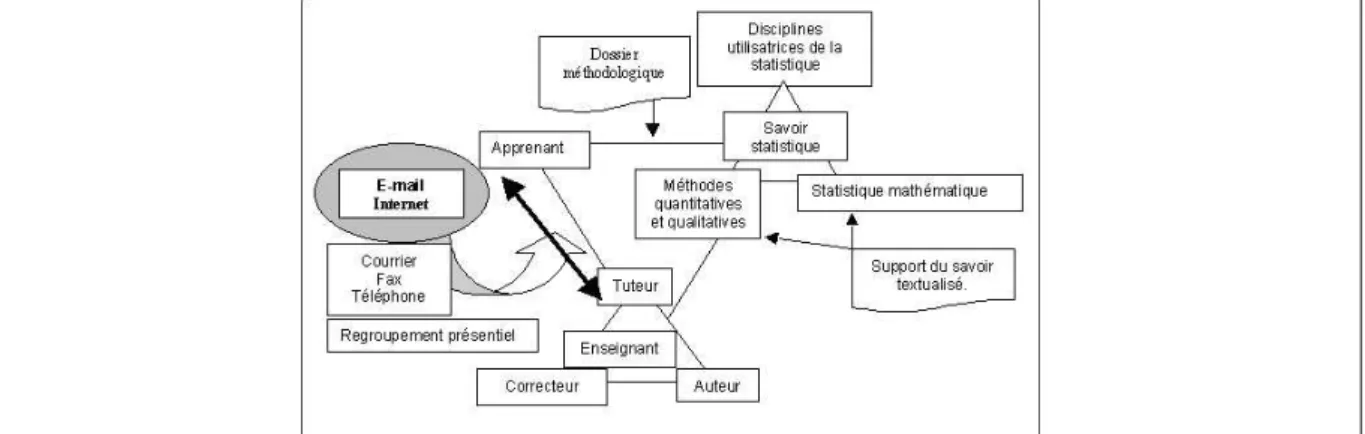
The didactical situations theory (Brousseau, 1998) offers us the systematic model of didactical triangulation, in which we can distinguish the three poles: teacher, student and Statistics. However, the context in which happens the didactical action does not have the same components of a conventional classroom. At the distance teaching program the student is physically isolated. The relationships between lectures, tutors and students are dialectically organised by the absence-presence in the context of the virtual classroom. The pole of teacher himself/herself is a system constituted for the roles of evaluator, author and tutor. The relationship between the author of the statistics and quantitative methods course and the student happens initially through a material support of paper fascicules. Subsequently, that relationship occurs through the digital support of the hypermedia, which has the written statistical knowledge an the product of the operation of didactic transposition.
Figure 2.1-1 : Didactic Triangulation at the context distance teaching
Initially, the students contact with statistical knowledge is based on the material supports of the courses, which are composed of textual knowledge and problem situations that lead to the application of the concepts and techniques presented. Students are then able to resolve and correct the problems presented by the course documents on their own. The difference between this form of teaching and “face-to-face teaching” is that the knowledge is not the result of oral verbalization followed by comments, which are regulated by the student’s reaction. Evidently, the format of hypermedia allowed audio-visual sequences of the intervention of the author teacher, but these interactions cannot be considered yet. Therefore, the Internet offers an immense amount of available resources in real time, but raises the issue of control of validity of its contents for the novices.
Figure 2.1-2 : As mediações do aluno face ao saber estatistico
The problem situation, which is purposed for the students, is similar to the situation that they are going to find at the final exams. Those situations are evaluated and scored by one corrector-teacher who gives the results and correction guide for the students. Currently, in the context of the program, the reactions of the students for the evaluation of this activity are collected by the tutor-teacher, however those reactions are not expressed by exchange of emails. Problem situation types are similar to the questions that confront the students in mathematics didactical situations. Nevertheless, it seems that statistics learning requires a supplementary situation through the effective use of concepts and techniques, of problem situations of applied statistics. It seems the statistical didactic needs to consider the above condition as an important characteristic, but this supplementary aspect should not be necessary for mathematics didactic. If the mathematics learning is related to resolution of mathematical problems which can remain into the mathematics field, it does not seem possible to conceptualise the statistics learning unless the students have been confronted with problem-situation “outside” of the statistical mastery. In particular, the students should be conducted to do a statistical modelisation of those outside problem situations. What we called (for commodity linguistic) a problem situation of applied statistics.
The purpose of the development of the methodological dossier is founded on the perspective of the operation of mediation between the student and statistical knowledge. This situation is similar to a non-didactical situation (Brousseau 1998 p. 58-60), which is modified for reasons of didactical objectives. This modified situation determines the statistical knowledge, which is taught during the teaching contexts, in particular, that the modified situation is adopted with effects of transformations of the original statistical mathematics situation.
This aspect is also based on the idea that the understanding of the concept of statistics cannot be developed without reference to the conceptual field, as a group of situations which operate one concept. This is a perspective developed by Vergnaud (1991): “the theory of conceptual fields is a cognitive theory, which is intended to give a coherent framework and some principles of base for the study of the development and learning of complexes competencies, mainly those that depend on the sciences and techniques (…) [e] for the understanding of the filiations and ruptures between different knowledge” (Vergnaud, 1991 p.135).
In this learning-teaching situation, the didactic contract which is established between the teacher and the student, is placed on the framework of the didactic situations of mathematics. This is confirmed in the functions of the three actors of the teaching process: author-teacher, tutor-teacher and corrector-teacher. Each one intervenes on a different level for the management of the didactical contract. However, the tutor-teacher has a specific role of regulation, because he/she is only who can interact verbally with students under his/her supervision.
Therefore, the question (Q1) seems a fundamental issue for which we just have answers empirically constructed with bases on the “knowledge in action” in the statistical didactic field (Vergnaud 1994 p.177-191).
We can develop the idea of co-regulation between pairs of didactical contract through exchanges between emails on the discussion group, and also because the proposition of the final exam by the author-teacher and corrector-teacher was based on the content of the messages and on their eventual interventions in virtual debates.
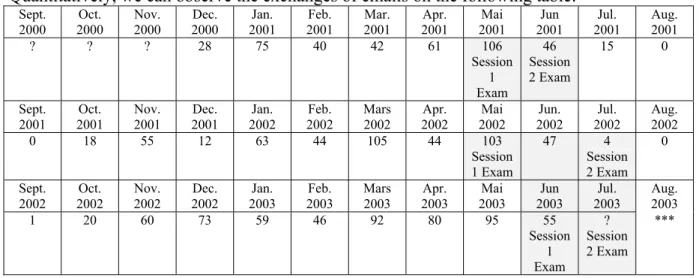
2.2. A didatical issue arises from the anlysis of exchanges by email Quantitatively, we can observe the exchanges of emails on the following table:
Sept. 2000 Oct. 2000 Nov. 2000 Dec. 2000 Jan. 2001 Feb. 2001 Mar. 2001 Apr. 2001 Mai 2001 Jun 2001 Jul. 2001 Aug. 2001 ? ? ? 28 75 40 42 61 106 Session 1 Exam 46 Session 2 Exam 15 0 Sept.
2001 2001 Oct. Nov. 2001 2001 Dec. 2002 Jan. 2002 Feb. Mars 2002 2002 Apr. 2002 Mai 2002 Jun. 2002 Jul. Aug. 2002 0 18 55 12 63 44 105 44 103 Session 1 Exam 47 4 Session 2 Exam 0 Sept. 2002 Oct. 2002 Nov. 2002 Dec. 2002 Jan. 2003 Feb. 2003 Mars 2003 Apr. 2003 Mai 2003 Jun 2003 Jul. 2003 Aug. 2003 1 20 60 73 59 46 92 80 95 55 Session 1 Exam ? Session 2 Exam ***
Table T 1 : : Number of messages monthly exchanged at discussion group
Four categories of object arisen from a preliminary classification of messages:
Object 1: messages with several objects without relationship between the teaching contents and methods.
Object 2: message associated with management issues about several objects, such as: receiving courses documents (hard copy texts), correction exercises, university enrolment etc
Object 3: messages related to pedagogical issues, such as: personal work, learning about direct or indirect relationships between different quantitative and qualitative contents and methods.
Object 4: message associated with the quantitative and qualitative methods.
This last category is particularly important for our work. We find some difficulties in applying this classification, because the messages can have multiples objects. Therefore, only part of the messages are classified on these categories. However, we included in the category Objecto_4, all messages which are related to quantitative and qualitative methods.
The statute of the author of the message is another criterion for classification, because the intervention can have an important role on the regulation process of the didactical contract. Therefore, we can consider four émetteurs:
Em_1 Em_2 Em_3 Em_4
Students Tutors Coordinator of pedagogical team l CNED Coordinators Analysing the messages of the type Object_4 during the exchanges realised by the four different groups of émetteurs, we identified some themes related to the statistics learning-teaching which will be discussed afterwards. The invariants are a topic present in the majority of the messages. We make reference to these invariants through other fundamental questions arisen from the reflection of author-teacher.
• (Q2) What types of supports (digital or paper) and which conditions make distance statistical teaching efficient?
• (Q3) What are the minimal mathematical and statistical pre-requisites for a novice and non-specialist student?
• (Q4) What didactic situations can be organized considering the specificities of the sciences of education students in the situation of distance education learning, and the finalities of the tutorial developed by tutors with a basic level of expertise in statistics.
It seems that the theoretical framework of the didactic of statistics can help us to answer the four central questions: (Q1), (Q2), (Q3) et (Q4). The use of resources associated with Internet and pertinent and not too sophisticated hypermédiatisations are elements, which constitute and support efficient statistics teaching. The place and role of Java applets seemed to be very important for us. We believe that the confrontation of the students in didactical sequences based on problem situations like the methodological dossier, and an activity of tâtonnement expérimental (Régnier 2000) should lead to an efficient support for learning. Another hypothesis related to the conditions of efficiency can be related to the tutor-teacher education in statistics mastery.
3. The return to the issue of statisitcs education
The important issue of statistics teaching-learning has in the main, arisen from quantitative methods teaching, as well as from qualitative methods (e.g. when the analysis of content is approached as analysis of textual data based on lexicometrics). We can realise that the majority of the students have low ability in mathematics. Some developed a negative relationship with statistics, supporting a negative attitude of distrustful and also unconditional repulsion for this area of knowledge. In distance studies situations, the student is isolated. This situation is particularly investigated for the significance of absence and presence of the teacher (Jacquinot, 1993). The risk of increased isolation is the possibility of abandoning the process. The exchanges by mail become a resource in which students can discharge aggressive feelings and reduce the stress. The analysis of the messages reveals the role of the representations, which are mobilised in adult education process. The exercise seems to be dependent on a behaviourist conception of human learning (Skinner, 1968, 1979) rather than a constructivist or socio-constructivist perspective (C.R.E.S.A.S., 1987; Vygotski, 1985). Without the negation of the efficacy of the behaviourist approach for short-term aspects, we our questions remain regarding the long-short-term aspects involved in the learning process. Therefore, the course on quantitative methods was organised with an alternation model that made explicit concepts and techniques, and the problem situations in which they operate. The possible solutions for these problems were introduced in self-evaluative and self-corrective procedures (Régnier 2000). The introduction written for the course of methodology was intended to explain the significance of our pedagogical and didactic approach (Régnier & Trancart, 2001; Bezille & Régnier, 2001)
The analysis of the contents of the messages reveals problems on the meta-cognitive activities (Noël 1991), which are important in making decisions and obtaining a balance between emotional and rational aspects. The major obstacle for statistics learning is not the memorization of formulas, but the absence of the understanding of meaning of models constructed for the realization of a instrumental study of an object. The priority criterions are: the pertinence of the choice of the formula, the validation and the pertinence of the choice of the formula, the validation and efficacy of the
interpretation of the results which produce this formula. The statistics teaching is not a final point but a way to instrumental statistics. This instrumental technical process might be psychological (Vygostki, 1985; Rabardel, 1995) and is useful for the sciences of education mastery, because it is an important tool to understand the ways in which the validation of scientific knowledge is produced.
We observed that the issue of the significance of this kind of teaching process was discussed by the different messages exchanged, (Blanchet & al 1991). The students noted that there is a repetition of the teaching of mathematics, in which experience of learning was sometimes difficult in a near or distant schooling past. In addition, it was observed that the effects of a social representation could make opposition between qualitative and quantitative methods. A detailed analysis of the discourse and the practices revealed that most of the researchers and lecturers have as a main form of data analysis, the qualitative methods. In general, this is not just a pertinent choice, but mainly because they do not know about the concepts of statistical techniques.
3.1. Pedagogical and didactical of the instrument to help the learning: methodological instrument
The elaboration of the methodological dossier is placed at formative logic, and intends to facilitate the individual significant construction of concepts, of instruments, and of the techniques required for the qualitative and quantitative methods. The realisation of this dossier, with the supervision of the tutor is compulsory. At the beginning of the program the deadlines were fixed for the submission of the dossiers. This document should be based on a questionnaire and an interview. The student should choose a theme that was validated by the tutor, who checked the relevance of same.
3.2. Obstacles and difficulties found by students: attempts of remediation The questions raised by the introduction of this pedagogical instrument are related to the statistical knowledge constructed by the students associated with the elaboration of the methodological dossier. The analysis of the data from a random sample of all the methodological dossiers, provided a comparison with the answers of the questionnaires completed by a group of students, and the results of the final exams reveal positive effects about the learning of concepts and statistical techniques (Régnier 2002a, Régnier, Mazzoleni, De Smet, 2003).
In this present article, due to space constraints, only the results related to the first examination of message exchanges by students are presented. We intended to reach the understanding of phenomena that happens at the learning-teaching situation during the quantitative methods course with students with non-scientific bases (e.g. Humanities) and non-specialists in Statistics. The identification of difficulties, of obstacles and mistakes is an important stage of the project of investigation.
In the current stage, the analysis of message contents indicates elements related to obstacles of learning:
• Didactical contract
• Autonomy of the student (Régnier 2000)
• Subjacent conceptualisations in the application of data construction and data analysis methods
3.3. The understanding of the didactical contract for the students:
One of demands for the elaboration of the dossier is: “ this questionnaire must have 5 questions which cover 4 types of variables which will be approached by this course”. A range of opinions exchanged expressed some difficulties of learning. For example, the sentence: “at least 5 questions” appeared to generate problems.
3.4. Inferences about the process of autonomy of the student
At the end of academic year 2001/2002, a student expressed the idea that “as I learn the basic concepts of statistics, shortcomings in my understanding of more complex issues become evident”, in other words: increasing the level of understanding in statistics, generates more complex statistical questions.
3.5. About the questionnaire
The messages related to questionnaires revealed the difficulties in the degree of modelisation and conceptualisation required. Therefore, we thought that the construction and the conduction of the research by questionnaire constituted pertinent problems situations through which students could learn basic statistical concepts. In our didactical perspective, this perspective is inverted. The analysis of the messages reveals the way in which students learn from the problem situation of the methodological dossier. Therefore, the doubts related to the questions which have the possibility of several answers, related to the concept of vector-variable, the notion of open question, the notion of quantitative variable, the notion of continue quantitative variable etc.
3.6. About the use of Excel software
Another category of doubts arose from the students when we asked them to use Excel. In particular, several messages were related to problems related to continuous quantitative variables.
About distributions of frequencies, test of hypothesis and estimations
So far we have just discussed the descriptive statistics. The expectations of the didactical contract constructed during the methodological dossier do not reach beyond of this field. The approach of inferential statistics is initially made from problem situations presented on printed media for the course and on the preparatory exams. The contents of the messages reveal the difficulties, which the students can find when they confront the concepts and techniques of inferential statistics.
The following extract expresses the difficulties of a student with statistics tables used during the course
[Text n° C 1] “Sunday, 21 January. Nowadays I am immersed in a course of quantitative methods, and I am blocked with the variable of Laplace Gauss, specifically with the utilization of the table of distribution of frequencies. I cannot understand how and when to use it. I think it should have a relation to the frequency of results of intervals [mu-2sigma; mu+2sigma], for example, but I do not know each one exactly (if there is any one). On other way, I understood very well the principle, apart from the calculation.” [Alexia G.] »
Another student expresses his difficultly modelling the application of the test of statistical hypotheses and for the construction of hypotheses statements.
[Text n° C 2] “Wednesday, February 07, 2001. I cannot understand how I can choose between these two variables H0 and H1. In fact, I could choose H0 as the value for "all is OK" and for H1 "all is not OK", but I also could invert H0 e H1 … How can I decide which one, H0 or H1 should be the attribute for one or two opposite values…” [Walter]
This student received the following answer from a colleague:
[Text n° C 3] “Thursday, February 8, 2001 (…) In relation to the hypotheses, I was initially thinking like Walter. But as soon as I finished my exercise I realised that the H0 null hypothesis corresponded to the negation of the affirmation that should be tested (otherwise, the conclusions would not correspond correctly… with an insight I
had to make everything again). And then, if it will not be this, I will be in trouble!” [Alexia G.]
CONCLUSION
In this article, I attempted to draw a description and analysis of a program of distance education teaching, identifying the difficulties and obstacles found by the students in statistical learning as part of field of technical and conceptual instruments of quantitative methods. The data collection obtained by emails during discussions contains elements to answer our questions. Some of the cited difficulties were discussed for Batanero et coll. (Batanero 2001). Therefore, the data presents similar invariants identified in subjects who are confronted with statistical learning processes. In the statistical didactic field, our aim is develop knowledge about phenomena linkage with statistics learning and teaching processes. Those phenomena are understood through the complexity of pedagogical program distance teaching education. The pedagogical intention was based on conditions of efficiency of the perspective of statistics education for all. Evidently, methodological difficulties arose within this project. Therefore, according to the inquests completed by the students, distance is a limitation that should be included in the protocols. The hypothesis of efficiency of the elaboration of the methodological dossier related to the individual construction of knowledge and the development of competencies in the statistical field remains likely, but we are trying construct a finer and adapted experimental protocol in which the modalities of distance education, increases reliability.
We identified that in addition to the similar characteristics of traditional face-to-face teaching education (e.g., doubts arisen from students, attitudes with statistics, obstacles to learning and understanding of concepts and techniques of this field), the situation of distance learning-teaching education amplifies the stress related to the absence of direct mediation of lecturer. Therefore, the didactic engineering can use functionalities of TICE (ICT – New technologies) and of the Internet as a FORSE [FOrmation et Ressources en Sciences de l'Éducation]. However, technical instruments cannot be a substitute for the human dimension of supervisor the on the students progress. That is why the tutors have capital importance.
REFERENCES
Acioly-Régnier, N. M., Gurtner, J.-L., Tomeh, B., (2000) Psychologie de l'éducation, Poitiers : CNED
Batanero, C. (2001) Didáctica de la Estadística, Granada : GEEUG
Bézille, H., Régnier, J-C., & al. (2001) Méthodes qualitatives pour les études et la recherche
en sciences de l'éducation, Poitiers : CNED.
Blanchet, A, & al, (1991) L'interaction : négociation du sens Connexions (57) Toulouse : Erès Brousseau, G., (1998) Théorie des situations didactiques, N. Balacheff, M. Cooper, R.
Sutherland, V. Warfield (Eds.) Grenoble : La Pensée Sauvage
C.R.E.S.A.S. (1987) On n'apprend pas tout seul. Interactions sociales et constructions des
savoirs Paris : ESF Ed.
Jacquinot, G., (1993) Apprivoiser la distance et supprimer l'absence ou les défis de la formation à distance, Revue Française de Pédagogie, (102) Paris : I.N.R.P. pp. 55-67 Noel, B., (1991) La métacognition, Bruxelles : De Boeck Université,
Rabardel, P. (1995) Les Hommes et les Technologies. Approche cognitive des instruments contemporains. Paris : Armand Colin.
Régnier, J-C., (2000) Auto-évaluation et autocorrection dans l'enseignement des
mathématiques et de la statistique. Entre praxéologie et épistémologie scolaire, Note de
Régnier, J-C, Trancart, D., (2001) Méthodes quantitatives pour les études et la recherche en sciences de l'éducation, Poitiers : CNED.
Régnier, J-C., (2002a) Étude des difficultés d'apprentissage de la statistique dans le cadre d'un enseignement à distance. (Chapitre d’un ouvrage collectif en préparation faisant au Symposium International de pédagogie universitaire de la statistique, UCO Angers dec. 2002)
Régnier, J-C., (2002b) A propos de la formation en statistique. Approches praxéologiques et épistémologiques de questions du champ de la didactique de la statistique . Revue du
Centre de Recherche en Éducation Saint-Étienne : Université J. Monnet de Saint-Étienne
pp. 157-201
Régnier J-C., Mazzoleni-Pauly F., De Smet M. (2003) Étude didactique de la réalisation d’un dossier méthodologique et effet sur l’apprentissage de la statistique (Article en préparation)
Skinner, B.F. (1979) Pour une science du comportement : le behaviorisme, Neuchatel-Paris :Delachaux&Niestlé,.
Skinner, B.F., (1968) La révolution scientifique de l'enseignement, Bruxelles : Ed. Dessart Vergnaud, G., (1991) La théorie des champs conceptuels, Recherches en Didactique des
mathématiques, 10/2.3, pp 133-169
Vergnaud, G., (1994) Le rôle de l'enseignant à la lumière des concepts de schème et de champ conceptuel., M. Artigue, R. Gras, C. Laborde, P. Tavignot (Eds) Vintg ans de didactique
des mathématiques Grenoble : La pensée Sauvage, p.177-191