HAL Id: tel-03052063
https://tel.archives-ouvertes.fr/tel-03052063v2
Submitted on 2 Mar 2021
HAL is a multi-disciplinary open access
archive for the deposit and dissemination of
sci-entific research documents, whether they are
pub-lished or not. The documents may come from
teaching and research institutions in France or
abroad, or from public or private research centers.
L’archive ouverte pluridisciplinaire HAL, est
destinée au dépôt et à la diffusion de documents
scientifiques de niveau recherche, publiés ou non,
émanant des établissements d’enseignement et de
recherche français ou étrangers, des laboratoires
publics ou privés.
changing climate : a deep learning glacio-hydrological
modelling approach
Jordi Bolibar Navarro
To cite this version:
Jordi Bolibar Navarro. Past and future evolution of French Alpine glaciers in a changing climate : a
deep learning glacio-hydrological modelling approach. Glaciology. Université Grenoble Alpes [2020-..],
2020. English. �NNT : 2020GRALU018�. �tel-03052063v2�
THÈSE
Pour obtenir le grade de
DOCTEUR DE
L’UNIVERSITE GRENOBLE ALPES
Spécialité : Sciences de la Terre et de l’Univers et de l’Environnement Arrêté ministériel : 25 mai 2016
Présentée par
Jordi BOLIBAR
Thèse dirigée par
Antoine RABATEL, Physicien-Adjoint, Univ.
Grenoble Alpes, IGE
et codirigée par
Isabelle GOUTTEVIN, IPEF, Météo-France
et
Eric SAUQUET, Directeur de recherche, INRAE
préparée au sein de
l’Institut des Géosciences de
l’Environnement et INRAE
dans
l'École Doctorale Terre, Univers, Environnement
Past and future evolution of
French Alpine glaciers in a
changing climate: a deep
learning glacio-hydrological
modelling approach
Thèse soutenue publiquement le
29 octobre 2020,
devant le jury composé de :
M Ben MARZEION
Professeur, University of Bremen, Allemagne, Rapporteur
M Daniel FARINOTTI
Ass. Professeur, ETH Zurich, Suisse, Rapporteur
Mme Delphine SIX
Physicienne, Univ. Grenoble Alpes, France, Présidente du Jury
M Jocelyn CHANUSSOT
Professeur, Grenoble INP, France, Examinateur
M Matthieu LE LAY
Ingénieur docteur, EDF-DTG, France, Examinateur
M Antoine RABATEL
To my parents.
Abstract
The European Alps are among the most affected regions in the world by climate change, displaying some of the strongest glacier retreat rates. Long-term interactions between society, mountain ecosys-tems and glaciers in the region raise important questions on the future evolution of glaciers and their derived environmental and socioeconomic impacts. In order to correctly assess the regional response of glaciers in the French Alps to climate change, there is a need for adequate modelling tools. In this work, we explore new ways to tackle both glacier evolution and glacio-hydrological modelling at a re-gional scale. Glacier evolution modelling has traditionally been performed using empirical or physical approaches, which are becoming increasingly challenging to optimize with the ever growing amount of available data. Here, we present, to our knowledge, the first effort ever to apply deep learning (i.e. deep artificial neural networks) to simulate the evolution of glaciers. Since both the climate and glacier systems are highly nonlinear, traditional linear mass balance models offer a limited representation of climate-glacier interactions. We show how important nonlinearities in glacier mass balance are cap-tured by deep learning, substantially improving model performance over linear methods.
This novel method was first applied in a study to reconstruct annual mass balance changes for all glaciers in the French Alps for the 1967-2015 period. Using climate reanalyses, topographical data and glacier inventories, we demonstrate how such an approach can be successfully used to recon-struct large-scale mass balance changes from observations. This study also offered new insights on how glaciers evolved in the French Alps during the last half century, confirming the rather neutral ob-served mass balance rates in the 1980s and displaying a well-marked acceleration in mass loss from the 2000s onwards. Important differences between regions are found, with the Mont-Blanc massif presenting the lowest mass loss and the Chablais being the most affected one. Secondly, we applied this modelling framework to simulate the future evolution of all glaciers in the region under multiple (N=29) climate change scenarios. Our estimates indicate that most ice volume in the region will be lost by the end of the 21st century independently from future climate scenarios. We predict average
glacier volume losses of 75%, 80% and 88% under RCP 2.6 (n=3), RCP 4.5 (n=13) and RCP 8.5 (n=13), respectively. By the end of the 21st century the French Alps will be largely ice-free, with glaciers only
remaining in the Mont-Blanc and Pelvoux massifs. From this point, we used these results as a case study to investigate the effects of nonlinear glacier response to climatic forcing. We show that linear glacier MB models partially ignore nonlinearities in glacier MB compared to nonlinear deep learning, overestimating and underestimating extreme positive and negative MB rates respectively. Depending on future extreme climate scenarios, this behaviour can potentially introduce a significant cumulative bias in glacier MB projections in the last decades of the 21stcentury. This could therefore have
remark-able consequences on projections of future glacier evolution, suggesting that current global glacier models based on linear MB relationships might potentially be giving estimates of future sea-level rise that are too low for climate scenarios with the highest and lowest greenhouse gases emissions.
This marked glacier retreat in the French Alps will produce an array of consequences that will im-pact water resources during the warmest months of the year. Glaciers provide cold fresh water re-sources well after all snow has melted during summer, essential to inhabitants in the region that de-pend on it for agriculture, industry, ski resorts, hydropower generation and domestic use. Moreover, several aquatic and terrestrial ecosystems depend on these late summer water resources, that keep water temperature low and ecosystems humid throughout the year. Predicting these changes is of paramount importance in order to correctly anticipate the resulting impacts and to design adequate mitigation strategies. Hydrological models currently used in France generally suffer from a simplified representation of glaciers, modelling them as static ice reservoirs. This representation is highly
prob-lematic in the current context of rapid glacier retreat. Here, we introduce a dynamic representation of glaciers for the process-based J2K hydrological model, validated in a case study in the Arvan partially glacierized catchment. By taking into account the daily area evolution of glaciers, this updated glacio-hydrological model represents an excellent tool to assess the diverse glacio-hydrological consequences of glacier retreat at the scale of the French Alps.
Résumé
Les Alpes européennes sont parmi les régions du monde les plus touchées par le changement cli-matique, avec des taux de recul des glaciers parmi les plus élevés. Les interactions à long terme entre la société, les écosystèmes de montagne et les glaciers de la région soulèvent d’importantes questions sur l’évolution future des glaciers et les impacts environnementaux et socio-économiques qui en découlent. Afin d’évaluer correctement la réponse régionale des glaciers des Alpes françaises au changement climatique, il est nécessaire de disposer d’outils de modélisation adéquats. Dans ce travail, nous explorons de nouvelles façons d’aborder à la fois l’évolution des glaciers et la modéli-sation glacio-hydrologique à l’échelle régionale. La modélimodéli-sation de l’évolution des glaciers a tradi-tionnellement été réalisée à l’aide d’approches empiriques ou physiques, dont l’optimisation est de plus en plus difficile compte tenu de la quantité croissante de données disponibles. Ici, nous présen-tons, à notre connaissance, le premier effort jamais entrepris pour appliquer l’apprentissage profond (i.e. des réseaux neuronaux artificiels profonds) pour simuler l’évolution des glaciers. Comme les systèmes climatique et glaciaire sont tous deux fortement non linéaires, les modèles traditionnels linéaires de bilan de masse offrent une représentation limitée des interactions entre le climat et les glaciers. Nous montrons comment des non-linéarités importantes liées au bilan de masse des glaciers sont capturées par une méthode d’apprentissage profond, ce qui améliore considérablement les per-formances des modèles par rapport aux méthodes linéaires.
Cette nouvelle méthode a été appliquée pour la première fois dans une étude visant à reconstruire les changements annuels du bilan de masse de tous les glaciers des Alpes françaises pour la période 1967-2015. En utilisant des réanalyses climatiques, des données topographiques et des inventaires de glaciers, nous démontrons comment une telle approche peut être utilisée avec succès pour recon-struire les changements de bilan de masse à grande échelle à partir d’observations. Cette étude a également apporté de nouveaux éclairages sur l’évolution des glaciers dans les Alpes françaises au cours du dernier demi-siècle, confirmant les taux de bilan de masse observés plutôt neutres dans les années 1980 et montrant une accélération bien marquée de la perte de masse à partir des années 2000. On constate des différences importantes entre les régions, le massif du Mont-Blanc présen-tant la perte de masse la plus faible et le Chablais éprésen-tant le plus touché. Ensuite, nous avons appliqué ce cadre de modélisation pour simuler l’évolution future de tous les glaciers de la région selon de multiples scénarios de changement climatique (N=29). Nos estimations indiquent que la plupart du volume de glace dans la région sera perdue d’ici la fin du XXIe siècle, indépendamment des scénarios climatiques futurs. Nous prévoyons des pertes moyennes de volume des glaciers de 75%, 80% et 88% dans le cadre des scénarios RCP 2.6 (n=3), RCP 4.5 (n=13) et RCP 8.5 (n=13), respectivement. D’ici la fin du XXIe siècle, les Alpes françaises seront en grande partie libres de glace, avec des glaciers ne subsistant que dans les massifs du Mont-Blanc et du Pelvoux. Nous avons ensuite utilisé ces résultats comme un cas d’étude pour analyser les effets de la réponse non linéaire des glaciers au forçage cli-matique. Nous montrons que les modèles linéaires de bilan de masse de glaciers ignorent une grande partie des non-linéarités dans le bilan de masse par rapport à l’apprentissage profond non linéaire, en sur-estimant et sous-estimant les taux positifs et négatifs extrêmes du bilan de masse respective-ment. En fonction des scénarios climatiques futurs extrêmes, ce comportement peut potentiellement introduire un biais significatif dans les projections de bilan de masse des glaciers dans les dernières décénnies du XXIe siècle. Cela pourrait donc avoir des conséquences remarquables sur les projections de l’évolution future des glaciers, ce qui suggère que les modèles globaux actuels des glaciers basés sur des relations linéaires de bilan de masse pourraient potentiellement donner des estimations de l’élévation future du niveau des mers qui sont trop faibles pour les scénarios climatiques avec les plus
fortes et plus faibles émissions de gaz à effet de serre.
Ce recul marqué des glaciers dans les Alpes françaises aura un ensemble de conséquences avec notamment un impact sur les ressources en eau pendant les mois les plus chauds de l’année. Les glaciers fournissent des ressources en eau douce froide bien après la fonte des neiges en été, ce qui est essentiel pour les habitants de la région qui en dépendent pour l’agriculture, l’industrie, les stations de ski, la production d’énergie hydroélectrique et l’utilisation domestique. En outre, plusieurs écosys-tèmes aquatiques et terrestres dépendent de ces ressources en eau de fin d’été, qui maintiennent la température de l’eau à un niveau bas et l’humidité des écosystèmes tout au long de l’année. La prévi-sion de ces changements est d’une importance capitale pour anticiper correctement les impacts qui en résulteront et pour concevoir des stratégies d’atténuation adéquates. Les modèles hydrologiques actuellement utilisés en France souffrent généralement d’une représentation simplifiée des glaciers, les modélisant comme des réservoirs de glace statiques. Cette représentation est très probléma-tique dans le contexte actuel de recul rapide des glaciers. Nous présentons ici une représentation dynamique actualisée des glaciers pour le modèle hydrologique J2K, validée dans une étude de cas dans le bassin versant partiellement englacé de l’Arvan. En prenant en compte l’évolution quotidienne de la surface des glaciers, ce modèle hydrologique basé sur les processus représente un excellent outil pour évaluer les conséquences hydrologiques du recul des glaciers à l’échelle des Alpes françaises.
Mots clés: Alpes françaises, glaciers, apprentissage automatique, apprentissage profond, modéli-sation, hydrologie
Acknowledgements
This PhD work has been, by all means, a collective effort. I would have never been able to accomplish this without the help, kind words or time from a multitude of people. I am extremely grateful for that, for this project has been an incredible human experience. There are a lot of people that I would like to thank, and I sincerely hope I will not forget anyone. First of all, I would like to thank my parents, for giving me the opportunity and freedom to pursue my studies, which gave me the independence to control my professional career and aim it towards the things I love and matter to me. All of this would not have been possible without Kadia, my closest companion, the hidden co-author, who took care of me during these years despite the long rants on glaciers, climate and machine learning. I am also extremely grateful for the family I have. Laia, Mariona, Andrew, for all the time shared together, especially in New Zealand; and my grandparents, particularly avi Robert, who taught me maths and physics, and who I wish I could show this work.
Then, I would like to thank my supervisors, who gave me the possibility to do this work, and who always respected my vision and way of working. Antoine, for his availability, dedicating whatever time needed to my problems, and protecting me from several ordeals regarding French paperwork. Being able to discuss in Spanish at the beginning of the PhD was a great way to engage in deep discussions on glaciers, and improved my confidence as a total newcomer to the field. Isabelle, who guided me in the most kind way, and provided invaluable insights on climatology and hydrology, especially during the last hectic weeks of the PhD debugging the hydrological model. I particularly appreciate the freedom I was given to work on the ideas that drive me, knowing the cost that this represented on her research part. For that, I am grateful, but also sorry for not having managed to include them in a better way. Eric and Thomas, who provided insightful comments throughout my work, and whose hydrological expertise helped me during the last part of this work. Special thanks go to Clovis Galiez, who has played the role of a bonus supervisor. I learnt so much about machine learning from him, and our discussions have been to me some of the most stimulating ones during these three years, including several times when his suggestions unlocked problems that I had for weeks. Sven Kralisch has also provided me with guidance on hydrological modelling during the last months. Despite finally not being able to visit Jena, I have always been surprised by his sincere kindness, availability and will to help.
My PhD companions have proved to be my best allies for such a long journey, with many people I would like to thank. Julien, Joseph, Gabi and Nathan shared with me some of the most memorable adventures on two wheels, from the Alps to Utah. Maria, Gabi, both Juliens, Jai, Jonathan, Joseph and Ambroise shared many hours of skinning up and skiing down snowy mountains, reminding us why we love them so much. Ugo, for the long discussions in the office, attempting to solve the world’s prob-lems besides finishing our PhDs, and for the amazing time in Stiappa. Lucas, Olivier and Juan Pedro, for being excellent office partners, and for the stimulating conversations. Romain, Marion, Astrid, Am-ber, Diego, Hans, Foteini, Isabelle, Albane, Sammy, Jinwha, Laura, Pedro, Peter, Sarah, Claudio, Maxim, Fanny and Marco, for the great times shared in the lab, in conferences, in the mountains or at the bar. I acknowledge the long term help and support from Molts Ànims, my good old friends in Sant Cugat, who have always been there and who always make me feel home despite the long seven years living abroad. And particularly Edu, who besides sharing almost all the university years with me, provided me with lots of insight on machine learning at the beginning of my PhD.
I am also grateful to Delphine, Olivier and Bruno, who taught me how to measure glacier mass balance in the field, in some of the most breathtaking landscapes I have ever seen. I had so much fun doing that, but I will particularly remember the day when, together with Delphine, we measured
all the ablation stakes in Mer de Glace in one long and arduous push. I am especially thankful to the members of my PhD jury for accepting to review this work. I have been lucky enough to have exactly the jury I wished for, and I really appreciate the time and effort that it involves. Moreover, I would also like to thank Christian, Thomas and Agnès, for taking part in my thesis committee, and guiding me with insightful comments and making it feel more like a conversation than an evaluation. There are many people in the lab(s) that I would also like to thank, for the friendly and interesting conversations in the cafeteria and for the shared small talk: Jérémie, Nico, Sophie, Patrick, Jean-Manu, Gilles, Martin, Manon, Lionel and Vincent.
Finally, I am grateful for the many scientific interactions I had outside the lab, particularly during conferences and paper reviews. I would like to thank Fabien Maussion, Ben Marzeion and Matthias Huss, who besides being an inspiration to me, provided constructive feedback that truly managed to improve my work. I can only hope to have the same luck with reviewers in the future. I am also very thankful to Daniel Farinotti, who always showed kind interest in my work from the beginning, and who is currently helping me to pursue my scientific ideas for a postdoc. I had the chance to meet Fernando Pérez in San Francisco last year, resulting in stimulating discussions on scientific modelling. I hope we will be able to collaborate in the future, once the currently troubled times calm down. I have very fond memories of my winter school in Mendoza, Argentina. I learnt a lot from Lucas Ruiz, Pierre Pitte, Lidia Ferri, Laura Zalazar, Maxi Viale and Mariano Masiokas, and I met some lovely people with whom I experienced the beauty of the Andes. I also had the pleasure to be part of the NASA ICESat-2 Hackweek, which despite having a virtual format, allowed me to learn from, interact and collaborate with great people from all around the world. At last, I am also thankful for the discussions and feedback from Harry Zekollari for my latest paper, with whom I share very similar research interests and the pleasure of writing long e-mails with lots of figures.
I acknowledge the funding of my PhD work by INRAE, the Labex OSUG@2020 (Investissement d’Avenir, ANR ANR10 LABX56), the Auvergne-Rhône-Alpes region through the BERGER project, the VIP Mont-Blanc project (ANR-14 CE03-0006-03) and the CNES (KALEIDOS-Alpes and ISIS projects grants).
I like to believe that these three years have been a small taste of what science is about: a diverse, inclusive, open and collective discussion on the investigation and discovery of nature.
1 Introduction 1
1.1 On the importance of glaciers . . . 1
1.2 Glaciers in the French Alps . . . 3
1.3 Modelling large-scale glacier evolution . . . 4
1.4 Teaching machines about glaciers . . . 5
1.5 Modelling glacierized mountain catchments . . . 7
Objectives of this PhD work 8 A short note to the reader 8
I Glaciers
11
2 Deep learning applied to glacier evolution modelling 13 2.1 Abstract . . . 142.2 Introduction . . . 14
2.3 Model overview and methods . . . 16
2.3.1 Model overview and workflow . . . 16
2.3.2 Glacier-wide surface mass balance simulation . . . 18
2.3.3 Glacier geometry update . . . 22
2.4 Case study: French alpine glaciers . . . 22
2.4.1 Data . . . 22
2.4.2 Glacier-wide surface mass balance simulations: validation and results . . . 24
2.4.3 Glacier geometry evolution: Validation and results . . . 31
2.5 Discussion and perspectives . . . 32
2.5.1 Linear methods still matter . . . 32
2.5.2 Training deep learning models with spatiotemporal data . . . 33
2.5.3 Perspectives on future applications of deep learning in glaciology . . . 34
2.6 Conclusions . . . 35
2.7 Supplementary material . . . 36
2.7.1 Filtering of DEM rasters . . . 36
2.7.2 SMB statistical error analysis . . . 36
2.7.3 Topographical glacier-wide SMB predictors . . . 37
2.7.4 Supplementary figures . . . 38 xi
3 A deep learning reconstruction of mass balance series for all glaciers in the French Alps:
1967-2015 43
3.1 Abstract . . . 44
3.2 Introduction . . . 44
3.3 Data and methods . . . 45
3.3.1 Training data . . . 45
3.3.2 Methods . . . 47
3.3.3 Uncertainty assessment . . . 47
3.4 Dataset overview . . . 49
3.4.1 Dataset format and content . . . 49
3.4.2 Overall trends . . . 49
3.4.3 Regional and topographical trends . . . 50
3.4.4 Comparison with previous studies and observations . . . 53
3.5 Conclusions . . . 54
3.6 Supplementary material . . . 55
3.6.1 Comparison with independent geodetic mass balance data . . . 56
3.6.2 Model differences between the updated version of Marzeion et al. (2015) and this study . . . 56
3.6.3 Influence of area in glacier-wide MB signal and proof on non overfitting . . . 57
3.6.4 Supplementary figures . . . 59
4 Deep learning unveils nonlinear climate-glacier interactions through the 21st century deglaciation of the French Alps 65 4.1 Introduction . . . 66
4.2 Results . . . 67
4.2.1 Glacier evolution through the 21st century . . . 67
4.2.2 Nonlinear climate-glacier interactions . . . 69
4.3 Discussion . . . 75
4.4 Materials and methods . . . 77
4.4.1 Glacier mass balance modelling . . . 77
4.4.2 Glacier geometry evolution . . . 78
4.4.3 Model comparison and extraction of nonlinearities . . . 79
4.4.4 Statistical analysis . . . 80
4.5 Supplementary material . . . 80
4.5.1 Supplementary figures . . . 80
4.5.2 Supplementary tables . . . 86
II Glacierized mountain catchments
89
5 Glacio-hydrological modelling of glacierized mountain catchments 91 5.1 Introduction . . . 915.2 Methods . . . 93
5.2.1 Study area . . . 93
5.2.2 Data . . . 93
5.2.3 The J2K hydrological model . . . 95
5.2.5 An updated glacier module . . . 98
5.3 Results . . . 100
5.3.1 Glacier dynamics . . . 100
5.3.2 Glacier mass balance . . . 101
5.3.3 Glacier runoff . . . 102
5.4 Discussion and conclusions . . . 103
5.5 Code availability . . . 105
III Outlook
107
6 Conclusions and perspectives 109 6.1 Summary of the results . . . 1096.2 Perspectives on future research venues . . . 111
Chapter
1
Introduction
Even in science, the object of research is no longer nature itself, but man’s investigation of nature.
Werner Heisenberg
1.1 On the importance of glaciers
Glaciers are fascinating natural systems to study. Their beauty originates from complex interactions between climate and topography, creating unique natural features that shape landscapes, influence ecosystems and even climates wherever they flow. These perennial ice masses originate in places allowing the accumulation of snow, that over the course of years gradually transform into firn and eventually ice. Due to gravity, this ice flows downwards, reaching lower elevations with higher tem-peratures where ice is lost through different processes of ablation, such as ice melting or calving (IPCC, 2018). The sum of all accumulation and ablation in a glacier determines its mass balance, which is es-sential to monitor the evolution of glaciers through time and their contribution to sea level rise (Fig. 1.1). Glaciers are excellent climate proxies, adjusting their geometry and size to changes in climate. They represent a large part of the cryosphere, covering some 10% of the Earth’s land surface and stor-ing about 69% of the world’s fresh water (Cuffey and Paterson, 2010). In their study, glaciers are often divided into mountain glaciers (Fig. 1.1) and ice-sheets, which differ in size and geographical location, with ice-sheets being much larger than mountain glaciers and situated in Greenland and Antarctica (Benn and Evans, 2014).
Mountains are the water towers of the world, acting as buffers that store solid precipitation and distribute fresh water resources throughout the year (Immerzeel et al., 2020). Seasonal and long-term cryospheric changes in mountain environments regulate water, nutrient and sediment supply downstream (Huss et al., 2017). Glaciers play a major role in this, providing water resources during the warmest or driest months well after all snow has melted. This late summer runoff is essential to many ecosystems requiring cold water and humid habitats throughout the year (Cauvy-Fraunié and Dangles, 2019; Carlson et al., 2020). About 10% of the global population live in mountain areas and the contiguous plains, depending on these water resources for agriculture, industry, hydropower, recreation activities or domestic use (Huss and Hock, 2018; Farinotti et al., 2019b). Mountain areas are amongst the most affected regions by anthropogenic climate change, outpacing global warming with an increase of +0.3ºC per decade (IPCC, 2018). These rapid changes in climate are causing a widespread retreat of glaciers (Fig. 1.1), with many regions already having reached "peak water", i.e. the maximum
glacier runoff. Once this point is reached, glaciers progressively reduce their water contributions, altering the hydrological regime of glacierized watersheds (Huss and Hock, 2018). The disappearance of glaciers produces an early release of accumulated solid precipitation in spring and early summer, with potential droughts in late summer (Brunner et al., 2019). This represents a transition from a nivo-glacial hydrological regime towards a nival hydrological regime. These fast changes in mountain glaciers also result in glaciers currently being important contributors to sea level rise (0.92 ± 0.39 mm a−1), as much as the massive Antarctic and Greenland ice-sheets combined over the 20th century,
despite representing less than 1% of the ice on Earth (Zemp et al., 2019; Hock et al., 2019a).
Figure 1.1: Glacier mass budgets for eleven different mountain regions and their combined results. Regional time series of annual mass change are based on glaciological and geodetic balances (Zemp et al., 2019). Superimposed are multi-year averages by Wouters et al. (2019) based on the Gravity Recovery and Climate Experiment (GRACE), only shown for the regions with glacier area > 3,000 km2. Estimates by Gardner et al. (2013) were used in the IPCC 5th Assessment Report (AR5). Annual and time-averaged mass-budget estimates include the errors reported in each study. Glacier areas (A) and volumes (V) are based on RGI Consortium (2017) and Farinotti et al. (2019), respectively. Red and blue bars on map refer to regional budgets averaged over the period 2006–2015 in units of kg m˘2a˘1and mm sea level equivalent (SLE) a˘1, respectively, and are derived from each region’s available mass-balance estimates. Figure from IPCC’s Special Report on the Ocean and Cryosphere in a Changing Climate (SROCC,
2019).
Mountain glaciers are predicted to lose an important fraction of their overall mass by the end of the 21st century, with great differences between regions (Hock et al., 2019a). An accurate assessment
of future glacier evolution is essential to understand and quantify the environmental and social conse-quences of their retreat. Since glaciers have become an icon of climate change, accurate predictions
paired with effective communication can prove a great way to raise awareness on climate change. Despite scientific efforts to precisely quantify and understand glacier retreat, the main driver of fu-ture uncertainty in long-term predictions are anthropogenic greenhouse emissions (Marzeion et al., 2020). Scientific studies on glaciers must find their way into a wider audience in order to effectively contribute to their conservation (Moser, 2010). By combining an improved understanding of glacier processes with targeted communication of relevant results, we can aim at preserving our very own subject of study.
1.2 Glaciers in the French Alps
Glacierized massifs French alpine glaciers
SPAIN FRANCE ITALY SWITZERLAND GERMANY Chamonix Grenoble Chambéry Gap Briançon Albertville Haute-Tarentaise Mont-Blanc Chablais Vanoise Haute-Maurienne Grandes Rousses Oisans Belledonne Champsaur Pelvoux Ubaye 7º E 6º E 45º N 46º N
Figure 1.2: Glacierized massifs in the French Alps, with the ex-tent of glaciers for the year 2015.
The French Alps are located in the western-most part of the European Alps, between 44º and 46º13’N and 5.08 and 7.67ºE. Their geographical location amidst the Mediter-ranean sea and continental Europe pro-duces a particular climate gradient, from south-east to north-west. The south-ern massifs are more influenced by a Mediterranean climate, receiving less pre-cipitation than their northern counterparts. West Atlantic fluxes bring higher amounts of precipitation to north-western massifs, whereas eastern glaciers close to the Ital-ian border receive most precipitation from east returns (Durand et al., 2009). These different climatic patterns, together with al-titudes ranging from sea level to 4810 m at the summit of Mont-Blanc, create an ar-ray of sub-climates that influence the evo-lution of glaciers. A total area of 231 km2 was covered by glaciers in the year 2015 the French Alps (Gardent et al., 2014, with 2015 update).
Like most of the European Alps, the French Alps have been inhabited for many centuries, developing a close relationship between alpine society and mountains. As
for mountain peaks, the general social attitude towards glaciers has strongly evolved in the last cen-turies, transitioning from disdain and terror to awe and curiosity (Zryd, 2008). During the Little Ice Age, glaciers in the Mont-Blanc massif used to reach the valley, threatening villages and settlements (Fig. 1.3). During this time, glaciers were regarded as monsters, which were even exorcised to stop their advance (Ponchaud et al., 2012). This relationship between society and glaciers progressively changed in the first half of the 18thcentury, integrating them as an important cultural elements, thus becoming
symbols of identity for alpine societies throughout the European Alps. This means that the loss of glaciers has an additional social consequence in the French Alps, on top of the environmental ones
found in all glacierized regions (Smit et al., 2019).
These long-term interactions between people and glaciers resulted in some of the earliest studies and observations on glaciers in the world. From the 18thcentury, the first mountain expeditions were
seen as scientific endeavours, providing valuable observations of unknown natural sites (Richalet, 2001). This tradition has continued ever since in the whole European Alps, with the longest observation series of glacier change in the world (GLAMOS, 2019). In France, the GLACIOCLIM national observatory is now responsible for this task, providing uninterrupted multiple glacier measurements from the field every year since the 1950’s. These long-term observations, combined with the rather easy access to glaciers, provide an excellent testbed for glaciological studies. The European and French Alps are some of the regions in the world with a strongest observed glacier mass loss (Fig. 1.1), a trend that is expected to make them one of the regions with the highest mass loss for this century (Marzeion et al., 2020).
Figure 1.3: The Mer de Glace in 1822, during the Little Ice Age. By then, its tongue reached the valley, receiving the name of Glacier des Bois, due to the fact that it reached the low-lying forests. Painting by Jean Dubois
In many aspects, people in the French Alps have built their lives around mountains and glaciers, whose vast forecasted retreat will impact their socioeconomic model (Mourey and Ravanel, 2017; Span-dre et al., 2019). Emblematic regions such as the Mont-Blanc massif depend on glaciers for tourism (Schut, 2013), water resources and hydropower generation (Laurent et al., 2020). Moreover, natural hazards derived from glacier retreat might potentially impact populations in valleys (Magnin et al., 2020). All these effects demand deep changes in the socio-economic model of these regions in order to correctly adapt to these changes in time. This adaptation is impossible without accurate predictions of future glacier evolution. Models can provide answers to these questions, allowing the anticipation and prioritization of actions.
1.3 Modelling large-scale glacier evolution
"At last, combining the three causes which contribute to the maintenance of glaciers, it would be interesting to arrive at the mass which is supplied to them each year; but one feels that it is only possible to have on this subject more or less probable conjectures; it is especially here that we lack and will always lack observations, which must be the first element to lead to the intelligence of nature."
modern glacier modellers are still struggling with (Rendu and Bischof, 1840). First and foremost, ob-servations are a key element in our understanding of glacier processes. Past obob-servations enable the creation of equations and models to represent in an approximate manner the complex behaviour of glaciers. All glacier models, independently from their approach, will have to solve the two main pro-cesses that determine the evolution of glaciers: (a) Glacier mass balance, as the consequence of the mass gained via accumulation (e.g., snowfall, avalanche deposition) and the mass lost through abla-tion (e.g., ice melting, calving). Mass balance can be seen as the main consequence of climate-glacier interactions (Benn and Evans, 2014); (b) Glacier ice dynamics, that govern the movement of ice down-wards due to gravity. Since ice is a viscoelastic material, this movement can occur as a combination of plastic deformation of the ice (also known as creep), sliding of ice over the bed and the deforma-tion of the bed itself (Cuffey and Paterson, 2010). The interplay of mass balance and ice dynamics determines the advance or retreat of glaciers, as a consequence of climate and topography. Past ob-servations of these two main processes have enabled the development of a variety of glacier models of different complexities, used to simulate glacier evolution at different geographical scales. As for any geophysical problem, the larger the study area the more simplifications are used in models. This holds especially for glaciers, for which several parameterizations and simplifications are needed for models to operate at regional or global scale (e.g., Marzeion et al., 2012; Huss and Hock, 2015; Maussion et al., 2019).
Predicting the future of glaciers is a complex task. It demands a correct representation of past observed glacier changes, accompanied with the hypothesis that the past observed relationships used in the modelling framework will remain constant in the future. This hypothesis would not be necessary with a detailed-enough representation of the physical processes involved in glacier evolution, but a large geographical scale hinders this level of detail in current models. Most importantly, future climate and therefore glacier evolution depend on future anthropogenic greenhouse emissions, introducing large uncertainties in projections that cannot be avoided (Marzeion et al., 2020). Therefore, the quest of the modern glacier modeller is to strike a balance between data availability, model complexity and geographical scale.
1.4 Teaching machines about glaciers
Regional and global glacier evolution models have been developed following a wide variety of proaches. The detailed representation of glacier processes is still a huge challenge, so modellers ap-proach simplifications in different manners.
The complex physics involved in glacier processes can be simplified using empirical parameter-izations, based on assumptions derived from observations. Despite their simplicity, these parame-terizations often display a better performance than more complex approaches, since they are well adapted to large-scale problems where some physical processes become less important compared to others (Réveillet et al., 2018). Parameterizations have been applied to both glacier mass balance (e.g., a temperature-index model) and ice dynamics (e.g., area-volume scaling, ∆h parameterization), providing the tools for the vast majority of regional and global glacier evolution models (e.g., Marzeion et al., 2012; Huss and Hock, 2015; Maussion et al., 2019; Hock et al., 2019a).
Alternatively, statistical models approach simplifications from a purely data-driven perspective. Re-lationships found in past observations can be used to create statistical models, used to analyse these relationships and performing predictions for unseen cases. Traditional linear statistical models have been applied in glaciology for more than 50 years (Hoinkes, 1968; Martin, 1974). In the last decades,
statistics have seen a massive increase in both their popularity and research output with the advent of machine learning. The ever-growing amount of data stored by humans is becoming increasingly challenging to use, process and interpret, leading to the development of advanced methods in data science (Mjolsness, 2001). As in many research fields, machine learning has made its way into glaciol-ogy (Fig. 1.4), albeit with much less intensity than other fields in Earth sciences such as climatolglaciol-ogy (e.g., Liu et al., 2016; Ham et al., 2019; Jiang et al., 2018) or oceanography (e.g., Ducournau and Fablet, 2016; Lguensat et al., 2019). Linear machine learning models have been applied to regression problems in order to interpret climate-glacier interactions (Maussion et al., 2015), and a shallow neural network was applied to model a glacier’s mass balance and length (Steiner et al., 2005, 2008).
Machine learning is a relatively new research field, with a lot of complicated jargon that is in constant evolution due to the high research output of the last years. This rapid evolution, often displaying rather spectacular results in particular applications, has nonetheless been counterbalanced by a repu-tation that machine learning models act essentially as "black boxes". They are regarded as opaque models, taking input data, training on them in or-der to reproduce the patterns in the dataset, and spitting out the results without the possibility of un-derstanding what is going on inside them. While this might be true for certain situations, this gen-eral statement is quite misleading, and it can be the source of a great deal of confusion. Deep learning, being a particular family of machine learning, can often act as a black box as I am going to show in this work, but this is not the case for many other algorithms. The so-called "accuracy vs interpretabil-ity" tradeoff tells us that, as a rule of thumb, meth-ods with the strongest predictive power are also the most complex ones to interpret. Therefore, machine learning can still be used to interpret relationships in data, at the cost of sacrificing some predictive power (Bratko, 1997). Nonetheless, this notion is currently being challenged by a new wave of inter-pretable machine learning methods, spearheaded by interpretable deep learning (e.g., Dong et al., 2017; Zhang et al., 2018; Rackauckas et al., 2020). These new methods, as I am going to elaborate in the last chapter, have a huge potential to overcome the cur-rent limitations of machine learning.
The "black box" effect In the last years, neural networks
have been revolutionized with new meth-ods enabling the training of deep neu-ral networks (i.e. deep learning), com-posed of multiple intermediate layers. This depth allows the neural networks to capture more complex non-linear pat-terns in data, resulting in improved performance in a wide range of prob-lems (Wang and Raj, 2017). Nonethe-less, very few efforts have been made in this direction in glaciology in the re-cent years, with most rere-cent research fo-cusing on classification problems (Moha-jerani et al., 2019; Baumhoer et al., 2019; Zhang et al., 2019). Classification lems offer a more straightforward prob-lem to validate in geosciences, avoid-ing the tricky question of reproducavoid-ing physical processes with a "black box" ap-proach (Karpatne et al., 2017). Applying deep learning to geophysical regression problems is a complex task, demanding a solid validation of the results in or-der to avoid pitfalls related to spatiotem-poral data independence (Roberts et al., 2017).
In this manuscript, I introduce my at-tempt to apply deep learning to model glacier evolution at a regional scale. The French Alps are used as a case study, for which their evolution is studied from the late 1960’s until the end of the 21st
cen-tury. As it often happens in science, this investigation on deep learning was not included in my original PhD project.
machine learning and eventually into deep learning. A great deal of what is included in this manuscript are the lessons learnt from numerous problems, mistakes and dilemmas that I encountered during these three years.
2000 2002 2004 2006 2008 2010 2012 2014 2016 2018 2020 Year 0 5 10 Occurrences
Figure 1.4: Number of scientific articles containing the words "glacier machine learning", based on queries on Web of Science in August 26 2020.
1.5 Modelling glacierized mountain catchments
The correct assessment of the consequences of glacier retreat requires not only an understanding of the evolution of glaciers, but a hydrological, ecological and social perspective of their role at the catch-ment scale. In the French Alps, this type of studies are only found at the scale of the whole European Alps (Coppola et al., 2018) or the Mont-Blanc massif (Laurent et al., 2020). The J2K hydrological model (Krause, 2002), developed at the University of Jena (Germany), has been applied and co-developed for many years by hydrologists in many countries, including France, in a wide variety of catchment configurations (Branger et al., 2012; Braud et al., 2017; Horner et al., 2020). Among these studies, a special focus was placed in glacierized catchments, with a few glacio-hydrological modelling studies in Himalayan mountain catchments (Gao et al., 2012; Nepal et al., 2014). The current representation of glaciers in J2K takes into account a wide variety of processes, including snow accumulation, subli-mation, ageing and melt; and ice melt under different conditions including debris cover (Nepal et al., 2014). Nonetheless, the absence of glacier geometry evolution hinders its application for long-term projections in glacierized mountain catchments. Indeed, in the current version of J2K, glaciers are included as static objects, acting as unchanging ice reservoirs (Nepal et al., 2014). This approach is highly problematic in the current context of rapid glacier retreat. Other hydrological models in France (e.g., GR rainfall-runoff models, Coron et al. (2017)) suffer from a lack of representation of glaciers, highlighting the gap in knowledge on the fate of glacierized catchments in the French Alps.
In this manuscript, I introduce an attempt to bridge this gap, using output data from a glacier evolu-tion model developed during this project (Bolibar, 2020), in order to take into account glacier evoluevolu-tion in the J2K hydrological model. The initial objective of my PhD was to correctly assess the future glacio-hydrological changes in the French Alps and the whole Rhône river catchment. It combined a first part on regional glacier modelling with a second part about glacio-hydrological modelling at the scale of the whole Rhône river catchment. This initial objective was driven by the BERGER project funded by the Auvergne-Rhône-Alpes region. This project, which partially funded my PhD work, aims at un-derstanding the impacts of future glacier retreat in the French Alps on aquatic communities living in glacier-fed streams. By providing accurate estimates of future glacier evolution and glacier runoff, ecologists will be able to extrapolate how changes in runoff intensity, water temperature and season-ality might affect these communities (Robinson et al., 2014; Cauvy-Fraunié and Dangles, 2019). Due to
the unexpected turn of events during the three years of this project, a great fraction of the time was focused on machine learning applications for glacier evolution modelling (Sect. 1.4). This impacted the original objectives, leaving less time to work on regional glacio-hydrological modelling. Therefore, efforts on glacio-hydrological modelling have been focused on a technical implementation of glacier dynamics in a well-documented glacierized catchment, and the assessment of glacier retreat and its hydrological effects over the recent past. This work provides a validated novel methodology, ready to be applied at a larger geographical scale in future studies.
Objectives of this PhD work
The work of my PhD has contributed to two main research axes: (a) the methods, where I introduce a first effort to apply deep learning to model glacier evolution at a regional scale, and the addition of glacier evolution into a process-based hydrological model; (b) the results, where I analyse and present the results of numerical simulations of the evolution of all glaciers in the French Alps from the late 1960’s to the end of the 21stcentury. With the combination of these two axes I attempt to address the
following scientific questions:
Question 1 - Can deep learning be applied to model annual glacier mass balance changes at a re-gional scale? What are the benefits of using nonlinear deep learning models compared to linear machine learning?
Question 2 - What are the annual glacier changes of all glaciers in the French Alps for the last half century?
Question 3 - How will French alpine glaciers evolve during the 21stcentury? How does glacier retreat
affect the climate signal on glaciers? What are the main factors that determine glacier survival in the French Alps? What are the benefits of using a nonlinear mass balance model for future glacier projections?
Question 4 - What are the current limitations in the representation of glaciers in hydrological models in France? How can this be improved?
After answering these questions during this work, a new one arose, setting the direction of future research venues:
Question 5 - What are the caveats of the deep learning modelling approach used in this work? What improvements are needed to overcome these limitations for glaciological studies?
A short note to the reader
This manuscript consists of three parts: one dedicated to regional glacier evolution modelling, another one to glacio-hydrological modelling of glacierized alpine catchments and a final one as an outlook. Part I, being the largest one, is built around three papers: two published and one in preparation. Each paper is included as a dedicated chapter, with a small preface giving the necessary context to the reader. This regional glacier modelling part follows a logical structure found in most publications: a first paper dedicated to the methods (Chapter 2), a second paper dedicated to the results of the appli-cation of this method to reconstruct past mass balance changes in the French Alps (Chapter 3), and a third paper dedicated to the future evolution of French alpine glaciers under different scenarios of cli-mate change (Chapter 4). Part II, dedicated to glacio-hydrological modelling of glacierized catchments, is included as a single chapter (Chapter 5) with a section detailing the modelling approach, and a
re-sults section presenting the preliminary rere-sults. At last, Part III, with Chapter 6, serves as a conclusion, where various relevant topics of this manuscript are discussed and some perspectives are laid down regarding the most promising future research venues of this work.
Glaciers
Chapter
2
Deep learning applied to glacier
evolution modelling
All models are wrong, but some are useful.
George Box
Preface
Models are becoming increasingly important in science. The ever growing amount of data is fostering the development of more and more complex models, that can be used to interpret relationships and structures in data, but also to make predictions for unobserved cases. Nonetheless, as stated in this famous quote by George Box, all models are just more or less acceptable approximations of nature. The most important element in scientific modelling, is therefore to understand the characteristics needed for a certain study, and to develop a model tailored to its needs. This implies being aware of the model’s deficiencies, but also trying to achieve the most accurate results for the right reasons. In this chapter, I introduce a first effort to apply deep learning to model glacier evolution at a regional scale. This method was developed purely out of curiosity, starting with a simple statistical modelling and slowly escalating complexity in order to tailor the methods to the needs of the data. This exploratory process implied interactions with many people, and particularly a fruitful collaboration with Clovis Galiez from the Laboratoire Jean Kuntzmann, from whom I learnt so much. Investigating these ideas involved a great deal of dead ends, complications and tradeoffs. A shadow of doubt was present throughout the development of this method, with many results taking weeks to be fully understood. I believe the main effort in this work has been to attempt to achieve the best results for the right reasons. With this, I mean trying to validate (and cross-validate) with all resources at hand the results obtained, in order to be as sure as possible of the reasons explaining them. I am also grateful for the insightful comments by Fabien Maussion and an anonymous reviewer during the open peer review of this work. Their comments helped address many weak aspects of the paper, and resulted in highly stimulating discussions on glacier evolution modelling. With this chapter, and the resulting discussion in Chapter 6, I aim at explaining why certain aspects worked, what are the pitfalls of this method, and most importantly, how it should be improved in the future.
Based on Bolibar, J., Rabatel, A., Gouttevin, I., Galiez, C., Condom, T., and Sauquet, E.: Deep learn-ing applied to glacier evolution modelllearn-ing, The Cryosphere, 14, 565–584, doi: 10.5194/tc-14-565-2020, URL
https://www.the-cryosphere.net/14/565/2020/, 2020a.
2.1 Abstract
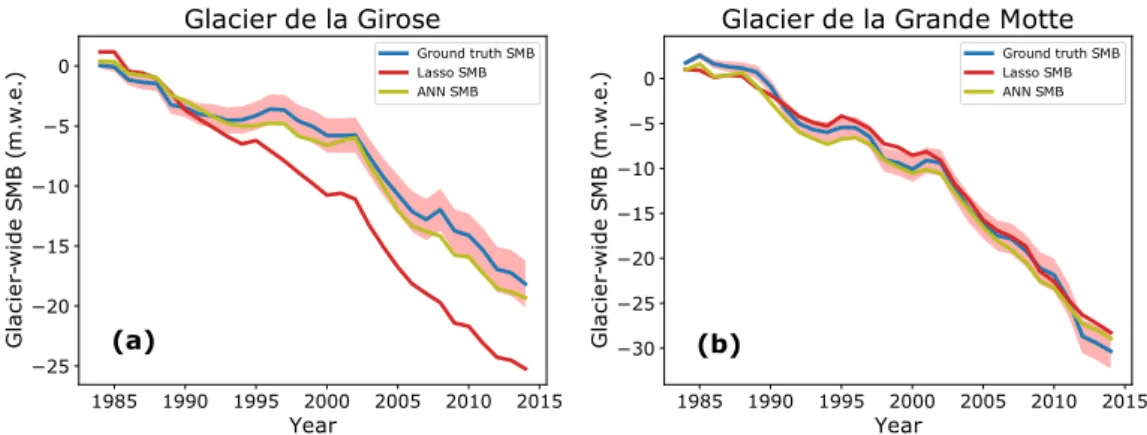
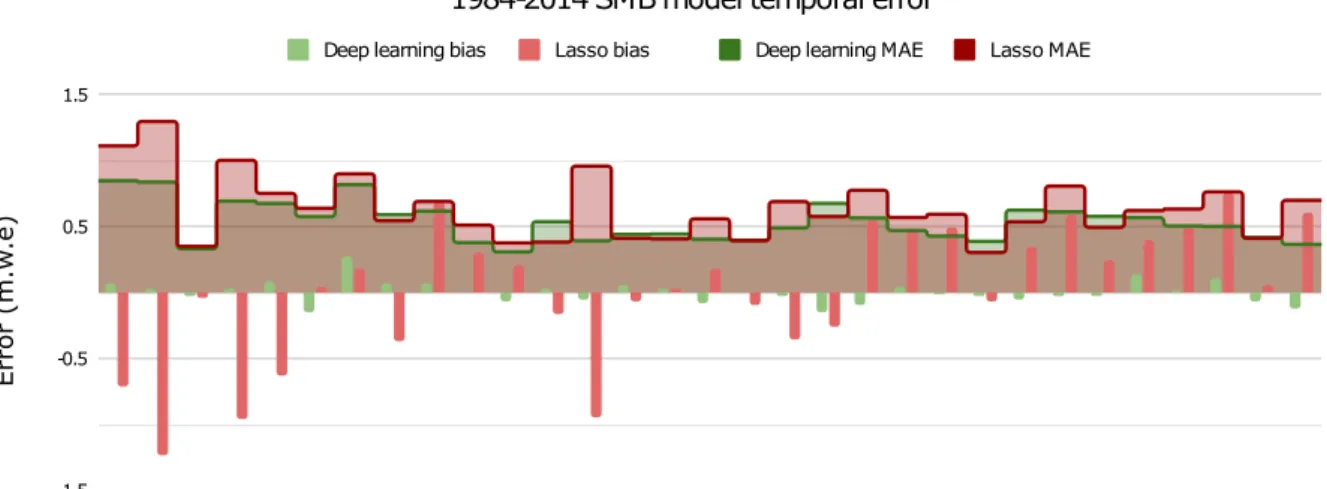
We present a novel approach to simulate and reconstruct annual glacier-wide surface mass balance (SMB) series based on a deep artificial neural network (i.e. deep learning). This method has been in-cluded as the SMB component of an open-source regional glacier evolution model. While most glacier models tend to incorporate more and more physical processes, here we take an alternative approach by creating a parameterized model based on data science. Annual glacier-wide SMBs can be simulated from topo-climatic predictors using either deep learning or Lasso (regularized multilinear regression), whereas the glacier geometry is updated using a glacier-specific parameterization. We compare and cross-validate our nonlinear deep learning SMB model against other standard linear statistical meth-ods on a dataset of 32 French alpine glaciers. Deep learning is found to outperform linear methmeth-ods, with improved explained variance (up to +64% in space and +108% in time) and accuracy (up to +47% in space and +58% in time), resulting in an estimated r2of 0.77 and RMSE of 0.51 m.w.e. Substantial nonlinear structures are captured by deep learning, with around 35% of nonlinear behaviour in the temporal dimension. For the glacier geometry evolution, the main uncertainties come from the ice thickness data used to initialize the model. These results should encourage the use of deep learning in glacier modelling as a powerful nonlinear tool, capable of capturing the nonlinearities of the climate and glacier systems, that can serve to reconstruct or simulate SMB time series for individual glaciers in a whole region for past and future climates.
2.2 Introduction
Glaciers are arguably one of the most important icons of climate change, being climate proxies which can depict the evolution of climate for the global audience (IPCC, 2018). In the coming decades, moun-tain glaciers will be some of the most important contributors to sea level rise and will most likely drive important changes in the hydrological regime of glaciarized catchments (Beniston et al., 2018; Vuille et al., 2018; Hock et al., 2019a). The reduction in ice volume may produce an array of hydro-logical, ecological and economic consequences in mountain regions which requires to be properly predicted. These consequences will strongly depend on the future climatic scenarios, which will de-termine the timing and magnitude for the transition of hydrological regimes (Huss and Hock, 2018). Understanding these future transitions is key for societies to adapt to future hydrological and climate configurations.
Glacier and hydro-glaciological models can help answer these questions, giving several possible outcomes depending on multiple climate scenarios. (a) Surface mass balance (SMB) and (b) glacier dynamics both need to be modelled to understand glacier evolution on regional and sub-regional scales. Models of varying complexity exist for both processes. In order to model these processes at large scale (i.e. on several glaciers at a catchment scale), some compromises need to be made, which can be approached in different ways:
(a) Regarding SMB:
1. Empirical models, like the temperature-index model (e.g. Hock, 2003), simulate glacier SMB through empirical relationships between air temperature and melt and snow accumulation.
re-lationships found in data from a selection of topographical and climate predictors (e.g. Martin, 1974; Steiner et al., 2005).
3. Physical and Surface Energy Balance (SEB) models take into account all energy exchanges be-tween the glacier and the atmosphere, and can simulate the spatial and temporal variability of snowmelt and the changes in albedo (e.g. Gerbaux et al., 2005).
(b) Regarding glacier dynamics:
1. Parameterized models do not explicitly resolve any physical processes, but implicitly take them into account using parameterizations, based on statistical or empirical relationships, in order to modify the glacier geometry. This type of models range from very simple statistical models (e.g. Carlson et al., 2014) to more complex ones based on different approaches, such as a calibrated equilibrium-line altitude (ELA) model (e.g. Zemp et al., 2006), a glacier retreat parameterization specific for glacier size groups (Huss and Hock, 2015) or volume/length-area scaling (e.g. Marzeion et al., 2012; Radić et al., 2014).
2. Process-based models, like GloGEMflow (e.g. Zekollari et al., 2019) and OGGM (e.g. Maussion et al., 2019), approximate a number of glacier physical processes involved in ice flow dynamics using the shallow ice approximation.
3. Physics-based models, like the finite elements Elmer/Ice model (e.g. Gagliardini et al., 2013), ap-proach glacier dynamics by explicitly simulating physical processes and solving the full Stokes equations (e.g. Jouvet et al., 2009; Réveillet et al., 2015).
At the same time, the use of these different approaches strongly depend on available data, whose spatial and temporal resolutions have an important impact on the results’ quality and uncertainties (e.g., Réveillet et al., 2018). Parameterized glacier dynamics models and empirical and statistical SMB models require a reference or training dataset to calibrate the relationships, which can then be used for projections with the hypothesis that relationships remain stationary in time. On the contrary, process-based and specially physics-based glacier dynamics and SMB models have the advantage of representing physical processes, but they require larger datasets at higher spatial and temporal reso-lutions with a consequently higher computational cost (Réveillet et al., 2018). For SMB modelling, me-teorological reanalyses provide an attractive alternative to sparse point observations, although their spatial resolution and suitability to complex high-mountain topography are often not good enough for high-resolution physics-based glacio-hydrological applications. However, parameterized models are much more flexible, equally dealing with fewer and coarser meteorological data as well as the state of the art reanalyses, which allows to work at resolutions much closer to glaciers’ scale and to reduce uncertainties. The current resolution of climate projections is still too low to adequately drive most glacier physical processes, but the ever-growing datasets of historical data are paving the way for the training of parameterized machine learning models.
In glaciology, statistical models have been applied for more than half a century, starting with simple multiple linear regressions on few meteorological variables (Hoinkes, 1968; Martin, 1974). Statistical modelling has made enormous progress in the last decades, specially thanks to the advent of ma-chine learning. Compared to other fields in geosciences, such as oceanography (e.g., Ducournau and Fablet, 2016; Lguensat et al., 2018), climatology (e.g., Rasp et al., 2018; Jiang et al., 2018) and hydrology (e.g., Marçais and de Dreuzy, 2017; Shen, 2018), we believe that the glaciological community has not yet exploited the full capabilities of these approaches. Despite this fact, a number of studies have taken steps towards statistical approaches. Steiner et al. (2005) pioneered the very first study to use arti-ficial neural networks (ANNs) in glaciology to simulate mass balances of the Grosse Aletschgletscher in Switzerland. They showed that a nonlinear model is capable of better simulating glacier mass
bal-ances compared to a conventional stepwise multiple linear regression. Furthermore, they found a significant nonlinear part within the climate/glacier mass balance relationship. This work was contin-ued in Steiner et al. (2008) and Nussbaumer et al. (2012) for the simulation of glacier length instead of mass balances. Later on, Maussion et al. (2015) developed an empirical statistical downscaling tool based on machine learning in order to retrieve glacier surface energy and mass balance (SEB/SMB) fluxes from large-scale atmospheric data. They used different machine learning algorithms, but all of them were linear, which are not necessarily the most suitable for modelling the nonlinear climate sys-tem (Houghton et al., 2001). Nonetheless, more recent developments in the field of machine learning and optimization enabled the use of deeper network structures than the 3-layer ANN of Steiner et al. (2005). These deeper ANNs, which remain unexploited in glaciology, are capable of capturing more nonlinear structures in the data even for relatively small datasets (Ingrassia and Morlini, 2005; Olson et al., 2018).
Here, we present a parameterized regional open-source glacier model: the ALpine Parameterized Glacier Model (ALPGM, Bolibar, 2020). When most glacier evolution models tend to incorporate more and more physical processes in SMB or ice dynamics (e.g., Maussion et al., 2019; Zekollari et al., 2019), ALPGM takes an alternative approach based on data science for SMB modelling and parameteriza-tions for glacier dynamics simulation. ALPGM simulates annual glacier-wide SMB and the evolution of glacier volume and surface area over time scales from a few years to a century at a regional scale. Glacier-wide SMBs are computed using a deep ANN, fed by several topographical and climatic vari-ables, an approach which is compared to different linear methods in the present paper. In order to distribute these annual glacier-wide SMBs and to update the glacier geometry, a refined version of the ∆h methodology (e.g., Huss et al., 2008) is used, for which we dynamically compute glacier-specific ∆h functions. In order to validate this approach, we use a case study with 32 French alpine glaciers for which glacier-wide annual SMBs are available over the period 1984-2014 and 1959-2015 for certain glaciers. High resolution meteorological reanalyses for the same time period are used (SAFRAN, Du-rand et al., 2009) while the initial ice thickness distribution of glaciers are taken from Farinotti et al. (2019a), for which we performed a sensitivity analysis based on field observations.
In the next section, we present an overview of the proposed glacier evolution model framework with a detailed description of the two components used to simulate the annual glacier-wide SMB and the glacier geometry update. Then, a case study using French alpine glaciers is presented, which enables to illustrate an example of application of the proposed framework including a rich dataset, the parameterized functions, as well as the results and their performance. In the end, several aspects regarding machine and deep learning modelling in glaciology are discussed, from which we make some recommendations and draw the final conclusions.
2.3 Model overview and methods
In this section we present an overview of the ALPGM glacier model. Moreover, the two components of this model are presented in detail: the Glacier-wide SMB Simulation component and the Glacier Geometry Update component.
2.3.1 Model overview and workflow
ALPGM is an open-source glacier model coded in Python. The source code of the model is accessible in the project repository (see Code availability). It is structured in multiple files which execute specific
sep-Figure 2.1: ALPGM structure and workflow
arate tasks. The model can be divided into two main components: (1) the Glacier-wide SMB Simulation and (2) the Glacier Geometry Update. The Glacier-wide SMB Simulation component is based on ma-chine learning, taking both meteorological and topographical variables as inputs. The Glacier Geome-try Update component generates the glacier-specific parameterized functions and modifies annually the geometry of the glacier (e.g., ice thickness distribution, glacier outline) based on the glacier-wide SMB models generated by the Glacier-wide SMB simulation component.
Figure 2.1 presents ALPGM’s basic workflow. The workflow execution can be configured via the model interface, allowing to run or skip any of the following steps:
1. The meteorological forcings are preprocessed in order to extract the necessary data closest to each glacier’s centroid. The meteorological features are stored in intermediate files in order to reduce computation times for future runs, automatically skipping this preprocessing step when the files have already been generated.
2. The SMB machine learning component retrieves the preprocessed climate predictors from the stored files, retrieves the topographical predictors from the multitemporal glacier inventories, and then it assembles the training dataset by combining all the necessary topo-climatic predic-tors. A machine learning algorithm is chosen for the SMB model, which can be loaded from a previous run or it can be trained again with a new dataset. Then, the SMB model(s) are trained with the full topo-climatic dataset. These model(s) are stored in intermediate files, allowing to skip this step for future runs.
3. Performances of the SMB models can be evaluated with a leave-one-glacier-out (LOGO) or a leave-one-year-out (LOYO) cross-validation. This step can be skipped when using already es-tablished models. Basic statistical performance metrics are given for each glacier and model, as well as plots with the simulated cumulative glacier-wide SMBs compared to their reference
values with uncertainties for each of the glaciers from the training dataset.
4. The Glacier Geometry Update component starts with the generation of the glacier specific pa-rameterized functions, using a raster containing the difference of the two pre-selected digital elevation models (DEMs) covering the study area for two separate dates, as well as the glacier contours. These parameterized functions are then stored in individual files to be used in the final simulations.
5. Once all previous steps have been run, the glacier evolution simulations are launched. For each glacier, the initial ice thickness and DEM rasters and the glacier geometry update function are retrieved. Then, in a loop, for every glacier and year, the topographical data is computed from these raster files. The climate predictors at the glacier’s current centroid are retrieved from the climate data (e.g. reanalysis or projections) and with all this data the input topo-climatic data for the glacier-wide SMB model is assembled. Afterwards, the glacier-wide SMB for this glacier and year is simulated, which combined with the glacier-specific geometry update function allows to update the glacier’s ice thickness and DEM rasters. This process is repeated in a loop, therefore updating the glacier’s geometry with an annual timestep and taking into account the glacier’s morphological and topographical changes in the glacier-wide SMB simulations. For the simulation of the following year’s SMB, the previously updated ice thickness and DEM rasters is used to re-compute the topographical parameters, which in turn are used as input topographical predictors for the glacier-wide SMB machine learning model. If all the ice thickness raster pixels of a glacier become zero, the glacier is considered as disappeared and is removed from the simulation pipeline. For each year, multiple results are stored in data files as well as the raster DEM and ice thickness values for each glacier.
2.3.2 Glacier-wide surface mass balance simulation
Annual glacier-wide SMBs are simulated using machine learning. Due to the regional characteristics and specificities of topographical and climate data, this glacier-wide SMB modelling method is, for now, a regional approach.
Selection of explanatory topographical and climatic variables
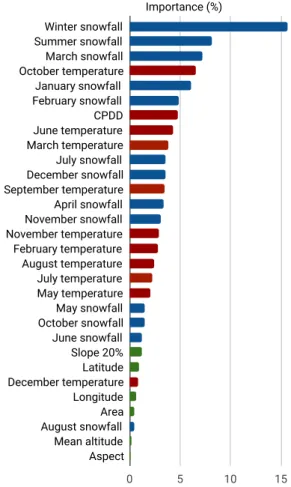
In order to narrow down which topographical and climatic variables best explain glacier-wide SMB in a given study area, a literature review as well as a statistical sensitivity analysis are performed. Typ-ically used topographical predictors are longitude, latitude, glacier slope and mean altitude. As for meteorological predictors, cumulative positive degree days (CPDD), but also mean monthly tempera-ture, snowfall and possibly other variables that influence the surface energy budget are often used in the literature. Examples of both topographic and meteorological predictors can be found in the case study in Sect. 2.4. A way to prevent biases when making predictions with different climate data is to work with anomalies, calculated as differences of the variable with respect to its average value over a chosen reference period.
For the machine learning training, the relevant predictors must be selected, so we perform a sen-sitivity study of the annual glacier-wide SMB to topographical and climatic variables over the study training period. This can be performed with individual linear regressions between each variable and glacier-wide SMB data. After identification of the topographical and climatic variables that can poten-tially explain annual glacier-wide SMB variability for the region of interest, a training dataset is built. An effective way of expanding the training dataset in order to dig deeper into the available data is to
Figure 2.2: Glacier-wide SMB simulation component workflow. Machine learning models are dynamically created based on training data
combine the climatic and topographical input variables (Weisberg, 2014). Such combinations can be expressed following equation 2.1
SMBg,y= f ( ˆΩ, ˆC) + εg,y (2.1)
Where ˆΩis a vector of the selected topographical predictors, ˆC is a vector with the selected climatic features and εg,yis the residual error for each annual glacier-wide SMB value, SMBg,y.
Once the training dataset is created, different algorithms f (two linear and one nonlinear, for the case of this study) can be chosen to create the SMB model: (1) OLS (Ordinary Least Squares) all-possible multiple linear regressions; (2) Lasso (Least absolute shrinkage and selection operator) (Tibshirani, 1996); and (3) a deep Artificial Neural Network (ANN). ALPGM uses some of the most popular machine learning Python libraries: StatsModels (Seabold and Perktold, 2010), Scikit-learn (Pedregosa et al., 2012) and Keras (Chollet, 2015) with a TensorFlow backend. The overall workflow of the machine learning glacier-wide SMB model production in ALPGM is summarized in Fig. 2.2.
All-possible multiple linear regressions
With the ordinary least squares (OLS) all-possible multiple linear regressions, we attempt to find the best subset of predictors in Eq. 2.1 based on the resulting r2adjusted, while at the same time avoiding overfitting (Hawkins, 2004) and collinearity, and limiting the complexity of the model. As its name indicates, the goal is to minimize the residual sum of squares for each subset of predictors (Hastie et al., 2009). n models are produced by selecting all possible subsets of k predictors. It is advisable to narrow down the number of predictors for each subset in the search to reduce the computational cost. Models with low performance are filtered out, keeping only models with highest r2adjusted possible, a variance inflation factor (V IF) < 1.2 and a p-value < 0.01/n (in order to ensure the Bonferroni correction). Retained models are combined by averaging their predictions, thereby avoiding the pitfalls related to stepwise single model selection (Whittingham et al., 2006). These criteria ensure that the models explain as much variability as possible, avoid collinearity and are statistically significant.
Lasso
The Lasso (Least absolute shrinkage and selection operator) (Tibshirani, 1996) is a shrinkage method which attempts to overcome the shortcomings of the simpler step-wise and all-possible regressions. In these two classical approaches, predictors are discarded in a discrete way, giving subsets of vari-ables which have the lowest prediction error. However, due to its discrete selection, these different