Human Translation Technologies and Natural
Language Processing Applications in Meaning-based
Translation Learning Activities
Éric Poirier
Université du Québec à Trois-Rivières
Abstract
The chapter describes how human translation (HT) technology and natural language processing (NLP) applications can be of use in the design of meaning-based translation learning activities for a professional translation training course. Meaning-based translation learning activities are part of a new instrumental approach aiming at the operationalisation of meaning-based operations (source language understanding, meaning transfer, target language drafting) through iterative and replicable learning tasks. The instrumental approach makes use of HT technology as one of the three groups of translation tools identified by Bowker (2002) which also includes computer-aided translation (CAT), the commonly-used term for machine-assisted translation (MAT), and machine translation (MT), a diminutive of human-assisted machine translation (HAMT). The instrumental approach involves task-based and objectively assessable and replicable learning activities on processing meaning in translation operations. The activities suggested in this chapter are all replicable in different language pairs and involve the processing of meaning by means of HT and NLP applications. They are also measurable in the context of grade-based assessment and traditional (instructional) teaching practices. To the best of our knowledge, those activities with their intensive use of HT and NLP applications have not been suggested elsewhere. The instrumental approach is centered on what technology and tools can do in the resolution of meaning-based translation difficulties and in the validation of correct performing of crucial translation operations.
Keywords: human translation (HT), natural language processing (NLP), instrumental
approach, task-based activity, human learning, meaning
1. INTRODUCTION
According to Bowker (2002: 4 and 7), human translation (HT) technology such as word processors, spelling and grammar checkers, electronic resources (terminology data banks and bilingual dictionaries) and the Internet is one of the three types of technology used in translation, the others being computer-aided translation (CAT), the most commonly used term for referring to machine-assisted human translation (MAHT), and machine translation (MT), a diminutive for human-assisted machine translation (HAMT). The recognition of HT processes in translation technology and the active role humans are playing in the implementation of CAT and MT tools are a reminder that translation is in
COPY-EDITED VERSION, before publication. The final version is published here :
Poirier, É. (2018). Human Translation Technologies and Natural Language Processing Applications in Meaning-based Translation Learning Activities. In G. Corpas Pastor & I. Duran-Munoz (Eds.), Trends in e-tools and resources for translators and interpreters (pp. 85-106): Brill/Rodopi.
essence a meaning-based human activity. Whatever the translation results one can obtain with translation technology, a well-informed human, preferably a professional trained in translation, will always be required to check for their accuracy and aptness. This might have to do with the fact that most translation technologies for HT, CAT and MT just process forms and texts which in their turn support meaning and messages and do not process meaning at all. For translation technologies and applications concerned with the processing of meaning and messages in translation, one must turn to natural language processing (NLP) which includes computational linguistics and, by definition, semantics and meaning processing as well1. This paper presents an instrumental approach to using HT and NLP applications for the correct translation of messages and interlanguage transfer of meaning.
2. TRANSLATION TEACHING USING TECHNOLOGY
Translation is a complex cognitive activity that is hard to replicate exactly with different people, and even with the same individual at different times, as the experiment conducted by Gile has shown (2005: 75-100). The individual and cultural variations of communication understanding, information content, language acceptability, norms and idiolects are all making translation teachers’ job very complicated if their goal is to make learners produce professional quality translations. Even if teachers are proficient and experts in translation, their expertise is not to be replicated strictly but transferred in principle with, inevitably, acceptable individual (and socio-cultural) stylistic shifts or deviations. Learners therefore, cannot do without numerous empirical and controlled trials and errors in the context of practical learning activities. From the teachers’ perspective, getting as many translation exercises as possible might look like the way to go. Besides the fact that the simple traditional translation exercises have been described as depressing (Kelly, 2005: 97) for learners, these typical exercises are also diverting teaching and learning efforts on translation modalities related to contingent parameters of a particular document or text genre, as opposed to meaning-based translation techniques that apply regardless of documents or text genres.
The complexity of human translation processes is due to both the cognitive operations related to knowledge and information processing in understanding source text, transferring meaning, and drafting it in the target language, as well as to the vast number of conceptual and linguistic objects to which these cognitive processes can be applied to. There is no known method agreed on as regards the counting of translation objects. Since Chomsky and the finite set of recursive rules defining an infinite number of sentences, translation objects are probably finite even if there is an infinite number of source language and target language sentences.
It is therefore conceptually difficult to reduce this complexity of translation to its core and replicable processes that should be addressed in translation training sessions of limited duration. This difficulty has an impact on the empowerment of the teacher and the learners and is a source of confusion in the methods, processes and techniques to teach and to learn, especially in a methodology-oriented or beginner’s course. Instead of coping with much learning difficulty by simulating the whole set of complex operations with
1 Most current machine translation systems such as the one provided in Google use a probabilistic model
which does not process meaning but textual segments or chains of characters, as opposed to rule-based systems which process linguistic and symbolic data such as information provided in dictionaries and by syntax and semantic (meaning) analysis.
traditional translation activities, we suggest a new instrumental approach in order to operationalise course content, instructions and learning activities with technological tools and electronic resources such as online bilingual dictionary, terminological records and natural language processing applications. Operationalisation of course content involves the identification, separation and simulation of single iterative and replicable tasks that are involved and combined sequentially in the translation process, from reading and understanding the source text, to the transfer of meaning and drafting of final target language text2.
The chapter presents first the crucial role of meaning in the context of HT learning and in the designing of learning activities in the instrumental approach. The organisation of the chapter then follows the sequentially-structured tasks involved in the translation process, and suggests new pedagogical activities making use of resources and tools commonly used in human translation. Learning activities presented in detail below are the contextual identification and detection of subject fields or domains associated with terms and expressions (which involve a conceptual structuration of fields of expertise), the understanding and analysis of texts with a simplified phrasal-based representation of meaning in sentences, the effective seizing of lexical senses in source text and the effective finding of bilingual correspondences in bilingual dictionaries entries. All these tasks are representative of professional translator’s competencies and skills.
With non-subjective and task-based learning activities, the instrumental approach contributes to enhance translation learning in online as well as on-site environments by operationalizing and structuring the learning process of translation operations. This new approach to teaching translation opens up new opportunities for learners on the uses of HT technologies and NLP applications not only for translation operations but also in providing better scientific and technical consulting services. Ultimately, this new approach may point to substantial enhancements of HT tools and NLP applications used for translation purposes.
3. MEANING IN TRANSLATION TECHNOLOGY AND PEDAGOGY A core principle in the teaching of translation first needs to be recognized; that is, the centrality of meaning. Garnier (1985: 40), as cited in Guidère (2008: 79) states that meaning is very largely recognised as having primacy in the translation operation. Several approaches to translation and theories in linguistics acknowledge the centrality of meaning: the interpretative approach in teaching translation and interpretation, as described in Seleskovitch and Lederer (1989); the meaning-text theory (MTT) in linguistics, as described in Mel’čuk (1981); the meaning-based translation learning manual of Larson (1998), the translation learning manual of Delisle and Fiola (2013). In English translation studies, specialists and academics seem to be less explicit about the importance of meaning and more suspicious of mental processes and cognitive reality of meaning, although there are exceptions (like Larson). Most authors recognise the existence of extra-linguistic meaning codes and linguistic meaning (lexical and grammar,
2 From a learning perspective, CAT tools, bilingual concordancers and MT engines uses are
counter-productive in the operationalisation of translation processes by compelling learners to take cognitive shortcuts from the series of meaning-based tasks required in human translation. Those shortcuts might be valuable for practicing experienced translators but for learners and beginners it seems disempowering in the way that these tools take them away from meaning-based operations. Through repetition of attested solutions, novel translation solutions become progressively inaccessible to the beginners as their core activities are centered on slavishly replicating already existing material.
at least). By acknowledging that a translation process is an act of communication, one implicitly admits that there is a meaning that is communicated and mediated through translation. Scarpa (2010: 85) for instance defines specialised translation as an interlinguistic communication of information through documents written in special languages.
As we have seen, translation operations are complex, especially as regards meaning. With the help of HT technologies and NLP applications, the instrumental approach aims to break up complex operations involved in translating into sequences of simpler tasks. For instance, translation involves two primary operations: the understanding (or analysis) of the source text and its drafting (synthesis) in the target language. As a central principle in translation, meaning needs to be processed in both operations. For learners, this processing is not to be confused with text processing that is very similar except that it does not take the contextual meaning into account. With the help of HT tools and NLP applications, it is possible to break up the analysis and synthesis operations in a sequence of smaller mandatory tasks like the correct understanding of the subject field or domain of the text to be translated, the seizing of the grammatical meaning of each sentence to be translated, and the proper search of a relevant translation in a bilingual dictionary (not all good translations can be found in dictionaries, but the modeling of translation need to recognise at first this important step in the efficient processing of professional translation solutions). Those three simple tasks within the general process of translating are just examples of what functional uses of HT technology and NLP applications can provide for a better understanding and modeling of cognitive operations in translation.
The interest of the meaning-based approach for teaching translation is that the meaning must be studied in connection with communication forms and codes. It cannot be studied alone since it is an intangible phenomenon attested indirectly through forms. Meaning is always mediatised and cognitively processed through linguistic features such as morphemes, tokens (word forms), texts and lexical units, or parts of. Even a social or cultural code may contribute to the interpretation of meaning. As regard the instrumental approach, technology in translation is used to process all forms, codes and means used to communicate meaning. Meaning is mediated through technology. Although the instrumental approach shares many features of translation learning and teaching with the competency approach of the PACTE group (operationalisation of competence, task-based approach), its global approach towards technology and meaning differ from the conventional translation competencies approach where technology use is confined in an instrumental sub-competence that is “predominantly procedural knowledge related to the use of documentation resources and information and communication technologies applied to translation” (Hurtado Albir, 2015: 259). The main interest of technology-mediated meaning in the instrumental approach is that it recognises iterative and replicable processes that can be modelised and operationalised in learning activities with HT technologies and NLP applications.
The instrumental approach takes its origin from the beginning of a book on pedagogy by City E. A. et al. (2009). Because of its role in the instrumental approach to translation technology in translation teaching, online and onsite, it is worth citing it.
There are only three ways to improve student learning at scale. The first is to increase the level of knowledge and skill that the teacher brings to the instructional process. The second is to increase the level and complexity of the content that students are asked to learn. And the third is to change the role of the student in the instructional process. That’s it. If you are not doing one of these three things, you are not improving instruction and learning. Everything else is
instrumental. That is, everything that’s not in the instructional core can only affect student learning and performance by somehow influencing what goes inside the core. (City E. A. et al., 2009: 24).
This statement contributes to translation teaching by reminding us of what are the three fundamental elements (what the authors call the instructional core) which may have a lasting impact on the quality of learning; that is content, teacher (their skills and knowledge), and learners (their active efforts). The adjective instrumental means here that all the non-core instructional features of a course exist or may be used uniquely to have an impact on the three instructional cores. In other words, everything (even technologies) that you had in a training course must contribute directly to one of the three instructional cores to improve learning. What is interesting is that the statement implies that there is no learning improvement (or maybe more extremely no learning at all) if a course feature (such as one mediated with technology) does not enhance or improve instructional cores of a course.
As regards translation technology, this view has interesting consequences. First, technology is generally not part of the instructional cores of any course, and of translation training courses, except for courses dedicated to the use of technology tools as translation aids. Second, if one wants to enhance the learning of translation through technology, then one has to integrate technological features that have an impact on one of the instructional cores, and most significantly on the content of the course and on the efforts that learners put in their learning. The agreed principle that translation is a “savoir-faire” which can only be learned through practice is at the origin of this last requirement. The demonstration of the first requirement has been evidenced negatively with the “relative” failure of translation memory courses that were designed as a translation learning course per se. Translation memory tools are just tools, they are not and should not be the primary focus of translation learning3.
Translation is a genuine language activity that is situated in a social and cultural context or environment. Because of that, translating a specific text in a translation class or course does not much contribute to the learning of learners more than what is needed to know to translate this specific text. It appears to be a good reason why learners feel bored (as reported above) when translating texts in translation teaching courses. They might have expected knowledge more pervasive that relates to translation, in general, not only to the translation of a specific text. On the content side of the instructional core, the instrumental approach is centered on generating abstract knowledge that is iterative and replicable and that can be used for several texts and in fact throughout the professional life of learners. This knowledge is also very different from source language proficiency and involves instead textual correlations between source language segments and target language segments. Since meaning is intangible and linked to forms and codes, technology may, therefore, play an instrumental role in the discovery and advance of abstract and generic knowledge on translation.
4. INSTRUMENTATION OF SUBJECT FIELDS AND DOMAINS
Translation is a communication act dealing with all human activities and fields of knowledge, and with all text-types and communication methods. There is no universal classification of translation specialisation either in fields of knowledge or text types,
3 This is not at all to say that there is no need for learning how to use translation memory software in a
although specific communication methods, like oral or sign languages, serve to distinguish interpretation from translation. Specialisation of translators in one activity or field of knowledge is technically possible, but most translators tend to work in a large field or similar fields of knowledge so that this content-based delimitation of competencies will not negatively impact translator’s business opportunities. For example, one translator could decide to specialise in the translation (and terminology) of sports but less likely in a particular sport like tennis or golf. The main reason for this grouping is the ability for translators to have enough clients to make a living while making synergies in the knowledge and expertise required to translate efficiently and accurately (in comparison with non-professional translators). Too much specialisation theoretically involves a limitation of business opportunities, and too much broadening in one’s practice involves the risk of not being able to demonstrate adequate expertise and knowledge that is expected from field-based content specialists.
This enlarging approach to translation fields of practice has led to conventionally agreed translation specialisations sharing similar knowledge, training institution and programs as well as interests in communication practices. Translation specialisations (excluding interpretation services) generally recognised are: scientific and technical translation, economic, business and financial translation, administrative and legal translation, literary and advertising translation, localisation, audio-visual and multimedia translation, as well as general translation, dealing with (in theory) translation principles overlapping all translation specialisation and (more practically) with non-specialised texts. It is effectively possible to ungroup these seven designations and make them individual specialisations like scientific translation, technical translation, economic translation, business translation, and so on. In any case translation specialisations may vary from 7 to 13 different fields of practice.
In some translation specialisations, it is not very clear which similarities are involved, and the category is defined by opposition or by contrast with other fields of specialisation (Gouadec, 2009). For example, scientific translation seems to stand in contrast with literature translation more than for any other inherent or organic criteria. Other criteria for classification are the document types that are most commonly translated. Operating manuals and owner’s manuals are translated with a scientific and technical translation approach, as opposed to a literary approach. As well, accounting information is most often translated into a business, financial or economic context where for instance number uses are domain specific (different from general use).
The classification of translation subdomains is also dependent on knowledge-based domain hierarchies that are much more numerous than translation specialisations. Some initial activities in an introductory course may use technology tools such as online terminological databases (and eventually corpus-based tools, but that topic is complex and beyond the scope of this chapter) to make learners aware of translation specialisations and their close link with knowledge-based domains of human activities as organised in education institutions: humanities (literature, law, philosophy, history, etc.), health sciences, engineering, industrial trades (carpentry, mechanics, insurance, etc.), management (business, finance), computer sciences, performing arts, natural sciences (biology, chemistry, physics, mathematics, astronomy, etc.), to name a few and without being comprehensive. This simple but factual knowledge does probably explain why translators do generally acquire in their training and in their practice a strong general culture. The next section describes a group of iterative and replicable learning activities that may be used to make learners aware of specialised terms belonging to knowledge-based domains.
4.1. Find the one odd out activity
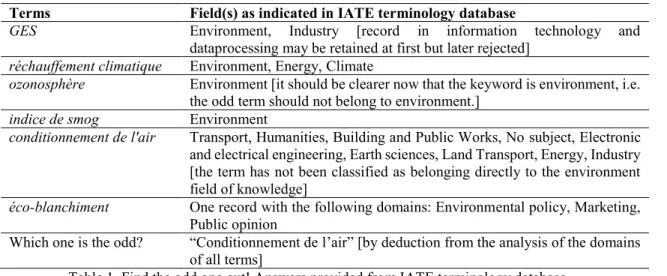
This learning activity consists simply of identifying in a group of terms the one that doesn’t belong in the subject field or domain of the others, as indicated by the record of the terms in a terminological data bank (it could be TermiumPlus or IATE–The EU's multilingual term base). This activity is much like the game called “find the odd one out.” It involves analysis of the records found with a character search in a terminological database. When the search gives multiple records, learners must select a relevant record and/or eliminate all the others based on the comparison of keywords used as their subject field or domain determination. Only the subject fields or domains of the record to be chosen as being representative or sharing similarities with other terms are to serve as group definition criteria. If this choice is difficult or undecidable for learners, it is possible to indicate which record is to be selected. An example is provided in the table below with details of the reasoning to apply to find the correct solution.
Terms Field(s) as indicated in IATE terminology database
GES Environment, Industry [record in information technology and dataprocessing may be retained at first but later rejected]
réchauffement climatique Environment, Energy, Climate
ozonosphère Environment [it should be clearer now that the keyword is environment, i.e. the odd term should not belong to environment.]
indice de smog Environment
conditionnement de l'air Transport, Humanities, Building and Public Works, No subject, Electronic and electrical engineering, Earth sciences, Land Transport, Energy, Industry [the term has not been classified as belonging directly to the environment field of knowledge]
éco-blanchiment One record with the following domains: Environmental policy, Marketing, Public opinion
Which one is the odd? “Conditionnement de l’air” [by deduction from the analysis of the domains of all terms]
Table 1. Find the odd one out! Answers provided from IATE terminology database.
The most immediate benefit of this activity is to invite learners to read all the relevant records of a specific term and go beyond the first potential translation found with a precise chain of characters. It especially encourages them not to take unnecessary risks by relying systematically on the most common meaning of an expression. The “critical” reading and analysis of terminological records has become an important skill to master in a knowledge-based trade such as professional translation. The activity models this competency and invites learners to seize the relevant subject fields or domains of a text to do specialised content searches in order to get a better understanding of the notions and concept organisations in a given text. Learners will also be familiarised with the criteria to use to exclude terms and their meanings according to the co-occurrence of other terms and meanings in context. With this kind of activity, the instrumental approach will help learners to activate a general organisation of subject fields and domains and their respective multidimensional relationships.
This activity might also be considered as an exploration of the hyperonym semantic relationship in as much as the belonging of a term to a domain can be associated with this peculiar semantic relationship. Since there have been no studies on the criteria of domain attributions for terms, it is difficult to determine to what extent the hyperonym relationship is involved in the attribution of subject fields or domains to terms. For that reason, the hyperonym hypothesis cannot be rejected. One important pitfall to be avoided
is that the group of terms chosen for that activity needs to be cautiously selected because it’s possible to find groups of terms for which several groupings and solutions may be possible. Since the attribution of subject fields and domains to terms involves some form of knowledge constructions and terminological conventions, the experience gained with one class may serve to another class as regards the selection of groups of terms. Some groups may provide for richer analysis than other ones.
An extension of this activity is possible for term identification criteria. This other activity might be suggested for advanced learners or terminology classes. On a conceptual level, it would be interesting to create an activity to make learners aware of the differences between an agrammatical sequence of characters or words, a linguistic expression, a textual unit, a multiword unit, and a complex terminological unit, as well as when and how those differences are applicable4.
The last step of this activity is to ask learners to classify in which translation specialisation domain the group of terms would belong to. That specialisation, described in the previous section, should be provided beforehand to learners. Neutral definitions also need to be offered to learners since the criteria of specialisation vary slightly from one translation region to the other (i.e. the markets and work environments in Europe are different from North American, which are different from Africa and Asia).
In relation to this activity, another aspect of knowledge classification, in general, has been very difficult to apply non-subjectively in the design of valuable learning activities. Even when learners were invited to use the ten main classes of the Dewey Decimal Classification or its equivalent in translation or in library science, the criteria to apply in the categorisation of texts were difficult to replicate among learners. Without clear and neutral criteria of classification of knowledge, which would require enormous work on an epistemological level, we have not been able to design iterative learning activities on the categorisation of texts in a particular subject field or domain. Still, the interest of this task is strong in translation since the final decision on the interpretation of words and expressions often depends on this text classification ability.
5. INSTRUMENTATION OF GRAMMATICAL MEANING
As a consequence of the centrality of meaning in human communication and in translation, understanding the source text is a prerequisite for translation into any target language. No translation is even possible without decoding or interpretation of source message. For teachers and learners, it is very helpful to know or to detect when a wrong understanding of the source text is the cause of inadequate translation. A complete representation of what one understand is not at reach for now in science, but it’s possible to operationalise and represent grammatical meaning and rationally explain related understanding errors with common syntactic analysis tools.
5.1. An instrumental approach to syntax
As a formal representation of grammatical meaning establishing dependency and coordination relationships among lexical elements of a sentence, and for which we have good descriptions of their lexical meanings (in monolingual and bilingual dictionaries), syntax is the perfect tool to conceptualise critical elements of textual meaning in translation. The instrumental approach takes advantage of grammatical analysis
technologies now available on the Web. These tools are used to illustrate visually correct and incorrect representations of source language grammatical meaning. If learners design and build an incorrect representation of source language grammatical analysis for a sentence, there is a strong possibility of incorrect understanding, unless there is a representation error. In the instrumental approach, grammatical meaning has to be systematically modelised at the phrasal level, but the modeling doesn’t need to be systematically done at the lexical level. The detailed representation of the lexical level is needed only when an interpretation difficulty arises.
Unlike grammatical analysis in linguistics where all the terminal elements of a sentence (and its phrases) need to be identified and tagged, the instrumental approach proposes a simplified phrasal analysis that can be used to represent meaning for translation purposes. The objective of the phrasal analysis is not to create a deep syntactical analysis. Its goal is to show learners how to identify and tag phrases in sentences and to represent their relationships in the sentence. Units of analysis are not content words but propositions and four types of phrases such as subject, predicate, phrasal modifiers and sentence modifiers. Phrasal modifiers are attached to the phrase they modify, but they often need to be identified because of their strong similarities with sentence modifiers. In order to operationalise this representation, translation learners need to become proficient in the use of brackets to separate and identify syntactic constituents in a sentence. Brackets in the syntactical analysis are very similar to html tags; they both contain an identifying keyword (the type of the phrase such as NP, VP, AP, etc.) and are used in pairs to define the beginning and the end of phrases in the sentence. What is interesting for learning is that the correct identification of phrases implies a correct analysis of terminal elements in the phrase (lexical units), even if those constituting elements are not represented formally.
Although this exercise might be fairly easy in one’s native language, the difficulty level is much higher in the case of a second language user, as it is the case for most professional translators which generally translate from their second language to their mother tongue. The difficulty level is also increased for complex sentences where different subjects and predicates are coordinated or subordinated. A secondary benefit of this activity comes from the fact that metalinguistic names referring to phrases in a sentence and basic analysis of sentences may differ from one language to another. That forces learners to develop and acquire sentence understanding through the prism of another metalinguistic referential system, and not simply calque their native language metalinguistic apparatus to the second language. The phrasal analysis of the instrumental approach gives the opportunity to translation learners to apply second language analysis skills which will be instrumental in the understanding of second language sentences that they will translate. Unlike lexical meaning which applies to lexical units in any language, the grammatical meaning is not transferable directly from one language to another; some features are unique to one language and culture. Translators need in that case to find and use several acceptable grammatical alternatives in the target language. Some examples in English grammar are the implicit meaning relationships of compound elements in complex terms, as opposed to French and probably other Roman languages where the meaning relationships of compound elements are made explicit (with prepositions). Another lexicogrammatical distinctiveness of English are the gerund syntactical structures and interpretations as being both nominal and verbal (Aarts, 2008). The next section describes a group of iterative and replicable learning activities designed to make learners experiment simplified phrasal analysis with a NLP generator of graphical syntax trees.
5.2. Drawing a syntax tree activity
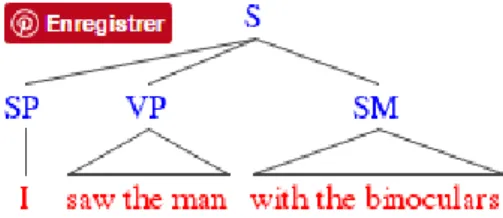
Once learners have acquired the uses of brackets to represent phrases in sentences, they are given some examples of equivocal sentences for which there are two meanings or interpretations. The simplified phrasal analysis with bracket representation of the meaning will make it possible to visualise the two different meanings of the sentence. A classic example is the sentence “I saw the man with the binoculars”. Simply put, one reading makes the phrase “with the binoculars” independent from the nominal phrase “the man” (so that it could be attached semantically to the subject and the whole sentence) while the other will attach the same phrase to the nominal phrase “the man” (so that the meaning will be “a man holding or using binoculars”). The same phrase could then be analyzed as a phrasal modifier (dependent on the nominal phrase) or a sentence modifier (dependent on the whole sentence). The following bracket representations of this equivocal sentence are provided to the translation learners, where S stands for sentence, SP stands for subject phrase, VP stands for verb phrase and SM stands for sentence modifier:
Meaning description Bracket representation
Meaning 1, “with the binocular” as sentence
modifier [S [SP I] [VP saw the man] [SM with the binoculars]] Meaning 2, “with the binocular” as phrasal
modifier [S [SP I] [VP saw the man with the binoculars]] Table 2. Bracket representations of grammatical meanings.
Even though the two representations are sensibly different, this meaning difference is intangible as regards the surface form of the sentence (“I saw the man with the binocular”). This is the reason why in order to seize the difference, it is useful to have a graphical representation tool or application that makes this difference tangible. A free NLP tool such as phpSyntaxTree by IronCreek Software (2003) is just the application to use for making this difference tangible, and for creating a simplified grammatical representation of meaning in learning human translation. When learners have their bracket representation ready, they copy it in the phpSyntaxTree text box to automatically generate a syntax tree with the bracket representation provided. As explained above, the simplified phrasal analysis allows learners to identify and tag the sentence nodes, the subject phrase nodes and the verb phrase nodes. A lot of grammatical ambiguities can be represented at the phrasal level, and there is no need to detail the representation at the terminal level (although this type of analysis needs to be done in order to identify and tag the phrases in the sentence). If we input the previous bracket representations in one of these tools, we can generate the following syntax trees:
Figure 2. Phrasal modifier meaning representation.
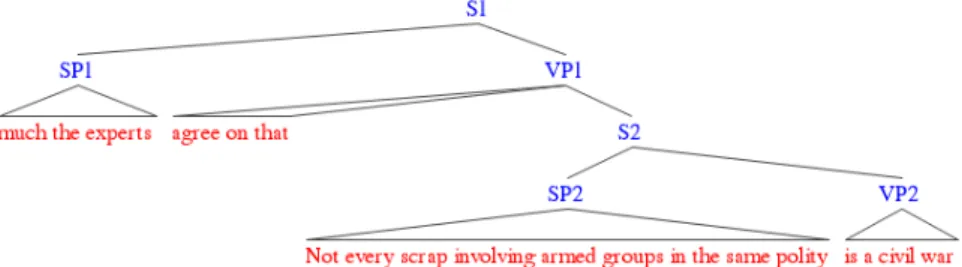
As shown in the figures, triangles represent phrases in the sentence, and the structural relationships of triangles represent a visual representation of the simplified grammatical meaning of phrases. As explained earlier, there is a different representation of the phrasal modifier meaning and the sentence modifier meaning for the same tangible segment. The phrasal modifiers are integrated to the phrase they modify while sentence modifiers are represented as independent phrase groups in the sentence. In that sentence, the resolution of the ambiguity involves fairly simple sentence and phrasal analysis, but translators are often required to understand and analyze much more complicated sentences, such as this one which is the first sentence of an article published in The Economist (2013) on the definition of a civil war “Not every scrap involving armed groups in the same polity is a civil war: on that much the experts agree.” This orthographic sentence contains two propositions or grammatical sentences identified with the symbols S1 and S2. A correct bracket representation of its meaning is the following:
[S1 [SP1 much the experts] [VP1 agree on that [S2 [SP2 Not every scrap involving armed groups in the same polity] [VP2 is a civil war]]]]
Table 3. Bracket representation of a complex sentence.
This logical and meaning-based rearrangement of phrases and propositions makes it much easier to understand the information content of the sentence and greatly facilitates the transfer of information and its translation into another language.
Figure 3. Complex sentence meaning representation
The instrumental approach in the representation of grammatical meaning gives learners means to make a tangible representation of grammatical meaning so that they are able to validate their correct understanding of sentences before translating. The learning activity is a technological and pedagogical simulation of what needs to be done mentally. This activity on the identification and visual representation of grammatical meaning also shows that knowledge of word meanings (and bilingual dictionaries) are simply not the only meaning features that translators need to handle. Translators also need to become proficient in the understanding of the phrase organisation within source and second language sentences.
From the teacher’s point of view, the instrumentation of grammatical meaning helps to operationalise the highly cognitive process of grammatical meaning seizing and makes it possible for learners to visualise an incorrect interpretation of the sentences that often leads to an incorrect translation in the target language since one can only translate what one understood. Another benefit of this activity is that it shows the importance of understanding not only words from a second language but their specific structure and construction within phrases and sentences. This knowledge contributes to the required contrastive approach that is needed when translators and learners redraft the meaning of the message in the source language in the target language, which has its own requirements regarding word collocations and phrasal constructions.
6. INSTRUMENTATION OF SENSE SEIZING AND CORRESPONDENT SELECTION
It has been shown by Gile (2005: 75-100) that the wording of a sequence of events (nouns) simply listed has a high degree of variation in the organisation of primary and secondary information. The replicable experiment was realised in 1982 with a group of about 18 students (some were second language speakers, but their results were excluded for the sake of the analysis of native speaker results). The sequence of events was, in fact, the proper name of French presidents followed by a question mark, indicating a question as to who could succeed to the current president. The same experiment can be done in American English with the following sequence of words:
Clinton -> Bush -> Obama -> ?
Table 4. Sequence of events to paraphrase.
For eight native speakers of French, Gile recorded eight different statements that range from a correct understanding with various degrees of explicitations (schematic wording to fully natural question such as “Who will succeed to Barack Obama as the president of the United States?”) to incorrect understandings of what was asked to redraft (such as “Is this the correct chronological order of United States presidencies?”).
6.1. The neutralisation of the individual variations
There is no doubt that the kinds of variations illustrated above are at play in translation assignments where students are asked to translate from the same source text. This is precisely the conclusion at which comes Gile too, reflecting on the accuracy of translations. However, what happens when learners use the same bilingual documentation source?
The next activity that can be used in the instrumental approach to teaching translation is focussing on the neutralisation of the individual variations in redrafting information and meaning with the help of a bilingual dictionary for beginner, or a more detailed documentation source for advanced learners (described below). In the learning activity, all learners must use the same bilingual resource to select the proper sense expressed in an occurrence and its corresponding translation in the target language. From a teacher’s point of view, the use of the same documentation source allows for the neutralisation of variations in translation which are due to the use of different documentation sources. This condition makes it possible to verify first if translation
learners know how to use the dictionary. More importantly, the translation teacher can verify if their use of the bilingual dictionary is tailored to the meaning-based requirements of a translation task (the correct understanding of a particular segment that needs to be translated). The understanding of translation learners can be operationalised non-subjectively and unbiasedly, provided the tools used by learners be known so that their reasoning or thinking process can be tracked for assessment purposes.
This activity is also useful for learning translation because it makes learners aware of different word uses and senses which are a very significant source of meaning variations. For instance, it has been said that the verbal lexical unit SET in English may have as much as 400 different senses and uses. Since individual variation in redrafting meaning is somehow inescapable, it makes sense to make learners aware of the importance to start with the correct information and interpretation of each word in the source text. It even seems that the interpretation of words in complex terms and phrases may follow specific rules as we have shown in the interpretation of business in complex terms in a recent paper (Poirier, 2015). The next section describes a group of iterative and replicable learning activities designed to assess the understanding skills of learners in sense seizing and correspondent selection.
6.2. Sense seizing and correspondent matching learning activity
The activity consists of translating the French noun “valorisation” using only the information contained in the corresponding entry of the word in a selected bilingual dictionary. An example of a question and its multiple choice answer is provided below. The selection of the word “valorisation” is inspired by a bulletin published by Anglocom (n.d.)5 rightly titled Valorisation. This paper shows very interestingly that the French word “valorisation” has potentially 14 nominal correspondents and no less than 16 different verbal correspondents. Clearly, each translation correspondent does not necessarily determine a precise meaning or sense of the lexical unit “valorisation” in the source language. Still, the French-English dictionary should recognise a larger amount of senses to “valorisation” than the ones that are recorded in monolingual French dictionaries. This document shows that contrastive analysis of senses and the taking into account of different translations seem to provide more sense distinctions than the traditional monolingual analysis where no more than three senses are generally associated with the noun “valorisation”. On a theoretical level, this situation calls for the definition of mapping criterion of translation and correspondents on source language senses and the distinction between senses and translation variants. In the example below, the bilingual dictionary entry is used for the purpose of sense seizing and correspondent selection.
5 Translation agency based in Québec City. The full document is available at
Figure 4. Robert & Collins (2004) entry provided to learners.
In the French-English bilingual entry used (Robert & Collins, 2004, online version), the word “valorisation” has only three different subentries: a, b, and c. Each of these numbers refers to a particular sense identifier and subentry of the noun “valorisation”. In the case of a, some periphrases are listed as a form of meaning description with a direct correspondent associated to each periphrase. For b, just one periphrase is listed, and different collocations are listed with each their own proper correspondent showing that the head noun is translated slightly differently depending on the collocate. In the case of c, the sense is characterised in a different field label (ecology) which is identified by a very specific use of the word that cannot be associated or described with the two others. The following table shows a question that has been drafted for the instrumentation of the sense seizing and correspondent selection learning activity.
Using the entry VALORISATION in the Robert & Collins English-French dictionary available online, find the subentry where is given the correct correspondent of the particular use of the word “valorisation” in the following statements to be translated.
Q1. Le projet aide le groupe cible à découvrir de nouvelles sources de valorisation et à éviter
la dépendance aux drogues, la délinquance et le décrochage. Your answer: [response options: a, b or c]
Q2. Next occurrence of “valorisation” in a sentence.
Your answer: [response options: a, b or c]
Q3. Etc.
Table 5. Example of a correspondent selection question and response options.
In the learning activity designed with the instrumental approach, the bilingual dictionary entry serves as a referential representation of potential correspondents for the word
“valorisation”, organised by meaning or senses. Learners must, therefore, read the occurrences of the word and seize which sense described in the bilingual dictionary fits the meaning used in the sentence provided. The bilingual dictionary used for reference distinguishes three different senses (a, b, and c) and could be used in beginner classes. A more detailed bilingual documentation source such as Anglocom’s bulletin discussed above could be used for advanced learners of translation. In this case, since numerous translation solutions are provided, the teacher would need to establish clear criteria to follow in the selection of acceptable and unacceptable translation solutions. The drafting of translation questions with more numerous response adds up to the difficulty of designing good generic response options fitting many or several occurrences of “valorisation.” Also, with more potential translation solutions, the criteria to use need to be made explicit and tangible, which is often difficult and not always possible.
Overall, this activity represents a replicable and iterative solution to address the lack of contextual understanding of words in the text among learners, as most translation teachers have experienced and as have advocated Kussmaul (1995: 106) very early in translation studies. The activity is not designed to make learners aware of bilingual dictionaries defects and issues, but there is no doubt that it could certainly show some concrete examples of these problems for translators.
7. SUMMARY AND CONCLUSION
In this chapter, we have shown different uses of human translation (HT) technology and natural language processing (NLP) applications in the design of meaning-based translation learning activities for a professional translation training course. This use of HT technology and NLP applications is part of the instrumental approach in translation teaching which aims at modeling simple tasks involved in complex translation processes. The chapter describes three examples of instructional content that can be taught with technology in translation classes. Each of these practical learning scenarios are illustrated with a concrete example of activity that can be offered to translation learners: instrumentation of subject fields and domains (Find the one odd out activity), instrumentation of grammatical meaning (Drawing a syntax tree activity) and instrumentation of sense seizing and correspondent selection (correspondent selection learning activity).
The learning activities are based on repetitive and similar (iterative) meaning processing tasks that are part of the instructional core of learning to translate. The replicability and iteration of meaning-based tasks are very significant features for the study of translation processes and methods. With the use of technology, the instrumental approach supports a rational and non-subjective approach to the assessment of meaning processing for translation purposes. Because of its non-subjective description and assessment of tasks involved in translation, the instrumental approach is very efficient in teaching translation, whether in an online or onsite environment.
Another benefit of the instrumental approach for translation teaching is that the use of technology is for once designed for human translators and human translation learning and not for machine translation (MT) or human-assisted machine translation (HAMT) applications. The contribution of technology is essential to the development of meaning-based translation learning. It may also be of primary importance in the development of scientific and shareable data for the advancement of knowledge on human translation and in translation studies.
References
Aarts, B. (2008). Approaches to the English gerund. In Trousdale F. and Gisborne, N. (Eds.), Constructional Approaches to English Grammar, Berlin, Boston: De Gruyter Mouton, pp. 11-31.
Anglocom (n. d.). Valorisation. Retrieved from http://www.anglocom.com/documents/ toolbox/Valorisation.pdf (Consulted on 03/03/2017).
Bowker, L. (2002). Computer-Aided Translation Technology: A Practical Introduction, Ottawa: University of Ottawa Press.
City, E. A., Elmore, R. F., Fiarman, S. E. & Teitel, L. (2009). Instructional Rounds in Education: A Network Approach to Improving Teaching and Learning, Harvard Educational Press, pp. 24-27.
Delisle, J. & Fiola, M. A. (2013). La traduction raisonnée: Manuel d'initiation à la traduction professionnelle de l’anglais vers le français (3rd ed.), Ottawa: University of Ottawa Press.
Garnier, G. (1985). Linguistique et traduction. Éléments de systématique verbale comparée du français et de l’anglais, Caen: Paradigme.
Gile, D. (2005). La traduction. La comprendre, l’apprendre, Paris: Presses universitaires de France.
Gouadec, D. (2009). Profession : traducteur, Paris: La Maison du dictionnaire. Guidère, M. (2010). Introduction à la traductologie (2nd ed.), Bruxelles: De Boeck. Hurtado, A. (2015). The Acquisition of Translation Competence. Competences, Tasks
and Assessment in Translator Training, Meta 60(2), 256-280.
IATE – The EU's Multilingual Term Base. Luxembourg: Translation Centre for the Bodies of the European Union. Retrieved from http://iate.europa.eu (Consulted 03/03/2017).
IronCreek Software (2003). phpSyntaxTree - drawing syntax trees made easy. Retrieved from http://ironcreek.net/phpsyntaxtree/ (Consulted on 03/03/2017).
Kelly D. (2005). A Handbook for Translator Trainers: Translation Practices Explained, Manchester, UK & Northampton MA: St. Jerome Publishing.
Kussmaul, P. (1995). Training the Translator. Amsterdam/Philadelphia: John Benjamins. Mel’čuk, I. A. (1981). Meaning-Text Models: A recent trend in Soviet linguistics. Annual Review of Anthropology 10, 27-62. http://www.annualreviews.org/doi/abs/10.1146/ annurev.an.10.100181.000331 (Consulted on 03/03/2017).
Larson, M. L. (1998). Meaning-Based Translation: A Guide to Cross-Language Equivalence (2nd ed.), Lanham, Mar.: University Press of America.
Poirier, E. (2015). The interpretation of business in specialized expressions and compound terms for translation purposes, Intralinea 17 (2015). Retrieved from http://www.intralinea.org/specials/article/the_interpretation_of_business_in_speciali zed_expressions (Consulted on 03/03/2017).
Robert & Collins (2004). Grand Robert et Collins (bilingue) [e-dictionary], Paris: Le Robert.
Scarpa, F. (2010). La traduction spécialisée. Une approche professionnelle à l’enseignement de la traduction. Ottawa: Presses de l’Université d’Ottawa. Translated and adapted from Italian into French by M. A. Fiola.
Seleskovitch, D. & Lederer M. (1989). Pédagogie raisonnée de l’interprétation. Paris: Didier Érudition.
TermiumPlus (2017). The Government of Canada’s terminology and linguistic data bank. Ottawa: Translation Bureau. Retrieved from http://www.btb.termiumplus.gc.ca/ (Consulted on 03/03/2017).
The Economist (2013). Defining Conflicts – What makes it a war? (2013). Retrieved from
http://www.economist.com/news/briefing/21589432-some-say-killing-25-people-yearenough-others-suggest-1000-what-makes-it-war (Consulted on 03/03/2017).