HAL Id: hal-01873066
https://hal.archives-ouvertes.fr/hal-01873066
Submitted on 12 Sep 2018
HAL is a multi-disciplinary open access
archive for the deposit and dissemination of sci-entific research documents, whether they are pub-lished or not. The documents may come from teaching and research institutions in France or abroad, or from public or private research centers.
L’archive ouverte pluridisciplinaire HAL, est destinée au dépôt et à la diffusion de documents scientifiques de niveau recherche, publiés ou non, émanant des établissements d’enseignement et de recherche français ou étrangers, des laboratoires publics ou privés.
Marion Cousin, Takeshi Miyakawa
To cite this version:
Marion Cousin, Takeshi Miyakawa. Evolution of proof form in Japanese geometry textbooks. CERME 10, Feb 2017, Dublin, Ireland. �hal-01873066�
Evolution of proof form in Japanese geometry textbooks
Marion Cousin1 and Takeshi Miyakawa2
1Lyons Institute of East Asian Studies, Lyon, France; [email protected] 2Joetsu University of Education, Joetsu, Japan; [email protected]
This study discusses the evolution of mathematical proofs in Japanese junior high school geometry textbooks and the conditions and constraints that have shaped them. We analyse the evolution of these proofs from their inception in the Meiji era (1868–1912) to the present. The results imply that features of the Japanese language affected the evolution of proof form in Japan and shaped the use of proofs in Japan as written, but not oral, justification for mathematical statements.
Keywords: Secondary school mathematics, history of education, textbook analysis.
Introduction
Proving mathematical statements is a very important part of mathematics. However, there were no proofs in the texts of wasan, the traditional mathematics dominant until the mid-19th century in Japan. In wasan, following Chinese tradition, Japanese mathematicians concentrated on elaborating procedures to solve problems rather than proving statements. As one consequence of the educational reforms that accompanied the opening and modernization of the country in the Meiji era (1868–1912), axiomatic Euclidean geometry with mathematical proof was adopted in secondary school mathematics.
Today, Japanese students learn mathematical proof in junior high school, and often face difficulties doing so (MEXT, 2009; Kunimune et al., 2009), as do students in other countries (see Mariotti, 2006; Hanna & De Villiers, 2012). These difficulties vary by country, for two reasons linked to the cultural and social dimensions of teaching. The first involves what is taught; one recent study compared France and Japan and showed that proof to be taught, specifically what constitutes a proof and the functions of proofs, is different between the countries (Miyakawa, 2017). The second reason relates to how students employ and understand justification and argumentation in their daily life, which affect how they approach mathematical proof in the classroom and which differ across cultures (Sekiguchi & Miyazaki, 2000).
The Anthropological Theory of the Didactic (ATD) posits that knowledge taught/learnt in a given
institution (here, the Japanese educational system and culture) is shaped by a process of ‘didactic
transposition’ reflecting the conditions and constraints specific to that institution (Chevallard, 1991; Bosch & Gascón, 2006). In this paper, we study the didactic transposition of proofs in Japan and the effects of the cultural and social dimension. We expect that this will help us better understand the nature of these difficulties and will show the needs for studying this dimension of proof-and-proving in different countries to improve teaching and learning everywhere.
Methodology
We adopted ATD to frame our research question and determine what should be investigated so as to better understand the cultural and social dimension of proof. The research question we focused on is as follows: What cultural and social conditions and constraints shape the nature of proof to be taught
evolution of the proof in Japanese junior high school geometry textbooks from its first appearance during the Meiji era to the present.
From out of the many textbooks published since the Meiji era in Japan we selected those that were widely used, to construct a representative corpus. Textbooks from the Meiji and Taishō (1912–1926) eras were more important than later ones, since proofs in geometry first appeared in Japan during these periods and since the way they were presented and taught changed more than in later periods. For the Meiji period, we identified major textbooks by consulting prior research (Neoi, 1997; Tanaka & Uegaki, 2015); however, for the Taishō era and up to the Second World War, we had no statistics on the use of textbooks, and so we selected textbooks that remain relatively well known today and that have been the topic of historical studies (Nagasaki, 1992). For the post-war era, we selected one or two textbooks that were widely used from the period following each successive reform of the national curriculum. The current system of selection of textbooks was firmly established by 1965 (Nakamura, 1997, p. 90) and the market share of each textbook series is known thereafter. From that point to the present, the most widely used textbooks have been those published by Keirinkan and by Tōkyō Shoseki.
The process of analysis we followed had three steps. First, we determined the role of the proofs in the geometry teaching approaches employed by the textbooks: Did the textbooks reflect a general strategy concerning proof learning? If yes, what was it? Were proofs important in geometry learning? Second, for each textbook, we analysed the forms (including intermediate steps) of sample proofs (worked examples) related to parallelograms, which were found in most of the textbooks, for overall formatting or organization, use of symbols, and formulation of properties (theorems, definitions, axioms, etc.) and statements. We use the terms paragraph and semi-paragraph to reflect the extent of sentences versus symbols in a proof, with paragraphs being all written language and semi-paragraphs a mix of words and symbols. Third, we looked at the authors’ comments on the proof or on proof learning.
Below, we first describe the proofs one finds in Japanese mathematics textbooks today, and then show what they evolved from and how. However, as this work is currently only at a preliminary stage, our analysis remains general on the evolution of proof form in Japan.
Proof in Japanese mathematics textbooks today
Nowadays, the term ‘proof’ is introduced in Japanese junior high school mathematics, specifically in grade 8 geometry. Figure 1 shows a sample proof taken from a grade 8 textbook from Keirinkan, proving a property of parallelograms: ‘Two pairs of opposite sides in a parallelogram are equal’. The figure provides an image of the proof with our own translation; the translation is quite literal, to maintain data integrity. One may first note the use of mathematical symbols for equality, parallelism, triangles, and angles. Statements (not properties) used as conditions or deduced as conclusions in a deductive step are written all in symbols (e.g. BAC = DCA). Deduced statements are given separately from other statements and properties, and some are numbered for use in later steps. In contrast, properties used in deductive steps, such as the condition for congruent triangles, are given as written Japanese phrases, without symbols—not in if-then form as in French mathematics textbooks (Miyakawa, 2017). The proof presented here thus represents the semi-paragraph type, with a mix of natural sentences and symbols; below, we consider the origin and history of such proofs.
(Our translation) Draw the diagonal AC. In ABC and CDA,
since the alternate-interior angles of parallel lines are equal,
from AB // DC,
BAC = DCA … (1) from AD // BC,
BCA = DAC … (2) And, since AC is common, AC = CA … (3)
From (1), (2), and (3), a pair of sides and the angles of both sides are equal,
ABC CDA
since corresponding sides of congruent figures are respectively equal,
AB = CD, BC = DA
Figure 1. A sample present-day proof from a Keirinkan textbook (Okamoto et al., 2016, p. 133)
Proofs in geometry textbooks from the Meiji era to the present
Before the Meiji era—that is, before the modernization of Japan—geometry teaching was based on
wasan, and centred on problem-solving: questions about the measurement of geometric figures were
asked, and procedures (sometimes employing algebraic or analytic tools) were applied to acquire the correct answer. Although some wasan mathematicians questioned the accuracy of the results yielded by this method, proofs were not used in mathematical texts until the mid-19th century, at the beginning of the modernization movement began (for a general view of the evolution of Japanese mathematics and its teaching, see Ueno, 2012, and Baba et al., 2012).
With the Decree on Education (Gakusei, 1872), the Japanese government abandoned wasan teaching and imposed learning of Western-style knowledge and teaching methods (for example, one-on-one teaching was replaced with lecture-type classes in groups). Western textbooks were translated to provide teaching materials for schools of this new type, and the first geometry proofs in Japanese appeared in this context. Since proofs were new to Japan, no convention and no stipulation in the curriculum constrained how they were written or formatted, and the forms used by Western authors and their Japanese translators varied widely. The situation can be quite confusing. For example, in the Japanese translation of an American version of Legendre’s textbook (Nakamura, 1873), proofs were written in paragraph form only, whereas in translations of other American textbooks (Miyagawa, 1876; Shibata, 1879), symbolic expressions were also mobilized. This situation, and the fact that no author-translators provided any remarks on proofs or reasoning in geometry and sometimes even removed remarks on the nature of mathematical statements that had been present in the original textbooks (see Cousin, 2013) betrays the lack of importance attached by Meiji-era scholars and authorities to proof learning; it also may have occurred partly because of the need for rapid translation of textbooks to meet new requirements, which led translators to focus on developing a basic vocabulary for the new geometry in Japanese and producing textbooks understandable enough for use. We also encountered textbooks from this period in which some functions of proofs were obscured compared to the original source: for example, while the axiomatic systematization function of proofs is emphasized in Davies (1870), the abridged Japanese version of this textbook (Nakamura, 1873) does not preserve this emphasis (see Cousin, 2013).
During the 1880s, Tanaka Naonori (1853–?) compiled works by English, American, and French authors as well as Chinese and Jesuit translators to produce a series of textbooks that were adopted widely in Japanese junior high schools (see Cousin, 2013, pp. 277–282). Tanaka was better trained in Western mathematics than the 1870s author-translators and had teaching experience as well. His proofs used few formulas and provided exposition (the part of the proof where the hypothesis is expressed using specific names for the elements considered in the proposition) and determination (the conclusion expressed using these names) using only symbolic expressions. Moreover, unlike previous authors, Tanaka gave after each statement a reference number corresponding to the property he used to justify it, highlighting the need for systematic justification of every statement in a proof. He was also the first Japanese author to discuss the nature of proof per se, explain its role in geometry (see Cousin, 2013, pp. 305–310), describe inductive and deductive ways of proving, and emphasize that we ‘prove the propositions thanks to the axioms, the postulates and the propositions that already have been proven’ (Tanaka, 1882, p. 15).
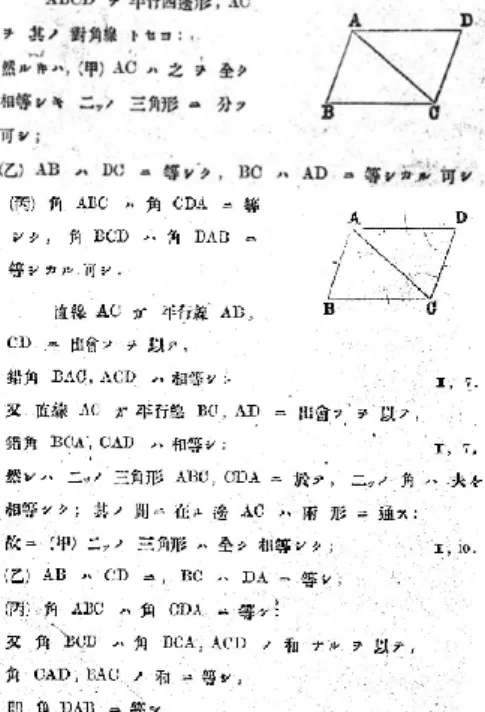
In the late 1880s, the publication of textbooks by Kikuchi Dairoku (1855–1917) marked a new stage in Japanese geometry textbook production, and Kikuchi fixed a new Japanese mathematical language and proof form that would remain for decades, as his textbooks were used until the beginning of the Taishō era. In his view, it was important to create a Japanese mathematical language that unified oral and written expression so that geometry proofs could be written in paragraph form, without relying on symbols. Moreover, like Tanaka, he highlighted the systematic aspect of proof by putting on the right-hand side the number of properties used in each deductive step (Figure 2). Kikuchi was clearly influenced by his education in England, where the aim of geometry teaching was to cultivate young spirits to reasoning: ‘Wherever Mathematics has formed a part of a Liberal Education, as a discipline of the Reason, Geometry has been the branch of mathematics principally employed for this purpose. […] For Geometry really consists entirely of manifest examples of perfect reasoning: the reasoning being expressed in words which convince the mind, in virtue of the special forms and relations to which they directly refer’ (Whewell, 1845, p. 29). Kikuchi provided extensive explanation of
(Our translation)
Let ABCD be a parallelogram and AC be its diagonal; Then (1) AC divides it into two completely equal triangles; (2) AB is equal to DC, BC is equal to AD;
(3) The angle ABC is equal to the angle CDA, the angle BCD is equal to the angle DAB.
Because the line AC intersects with the parallel lines AB and CD, alternate-interior angles BAC and ACD are equal; I, 7.
And because the line AC intersects with the parallel lines BC and AD, the alternate-interior angles BCA and CAD are equal; I, 7. Now, in the two triangles ABC and CDA, two pairs of angles are respectively equals, and the side AC between them is common to both figures.
So (1) the two triangles are completely equals; I, 10. (2) AB is equal to CD, and BC is equal to DA;
(3) The angle ABC is equal to the angle CDA: and because the angle BCD is the sum of the angles BCA and ACD, it is equal to the sum of the angles CAD and BAD, which is the angle DAB.
geometric reasoning, and paid particular attention to the language used and the organization of geometric properties; in doing so, he tried to highlight the importance of the systematization and justification functions of proofs.
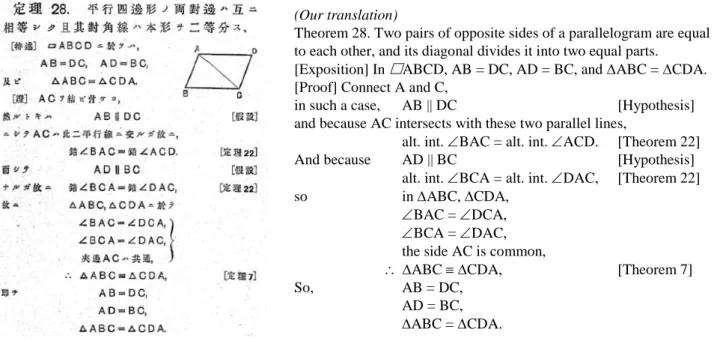
However, the form of Kikuchi’s proofs (Figure 2) soon came in for criticism by his contemporaries, for being difficult to teach. Nagasawa Kamenosuke (1861–1927), in his own textbook, criticized the paragraph form of Kikuchi’s proofs in strong terms: ‘Writing proofs of theorems with sentences in a complete and perfect manner is the vice of those who agree with the Euclid movement that came from England’ (Nagasawa, 1896, pp. 3–4). Nagasawa instead wrote proofs in a semi-paragraph form very different from Kikuchi’s, especially in terms of the use of symbols, as seen in Figure 3. In particular, Nagasawa put more importance on the proof as a written form, and in fact his proofs cannot be used for oral justification due to certain features of the Japanese language and the use of symbols. For example, the statement ‘AB || DC’ would usually be read or spoken aloud in Japanese as ‘AB hēkō DC’ (‘AB parallel DC’). However, this is just a pronunciation of each symbol in succession and not a grammatically sound phrase; to be grammatical, it should instead be pronounced as ‘AB wa DC ni hēkō’ (‘AB is parallel to DC’), whose shortened version would be ‘AB DC ||’, as an adjective with a
be-verb should always be placed at the end of a phrase in Japanese. Beginning around the end of the
Meiji era, proofs written in semi-paragraphs appeared in many Japanese geometry textbooks (e.g. Nagasawa, 1896; Kuroda, 1917), even Kikuchi’s (Kikuchi, 1916), and Kikuchi’s goal of a language that unified oral and written expression was abandoned.
(Our translation)
Theorem 28. Two pairs of opposite sides of a parallelogram are equal to each other, and its diagonal divides it into two equal parts.
[Exposition] In ABCD, AB = DC, AD = BC, and ABC = CDA. [Proof] Connect A and C,
in such a case, AB || DC [Hypothesis] and because AC intersects with these two parallel lines,
alt. int. BAC = alt. int. ACD. [Theorem 22] And because AD || BC [Hypothesis]
alt. int. BCA = alt. int. DAC, [Theorem 22] so in ABC, CDA,
BAC = DCA, BCA = DAC, the side AC is common,
ABC CDA, [Theorem 7] So, AB = DC,
AD = BC, ABC = CDA.
Figure 3. A sample proof from Nagasawa’s textbook (Nagasawa, 1896, p. 53)
Moreover, until the end of the 19th century, although various ways of writing proofs were seen, all textbooks nevertheless followed a classic pattern in the teaching of geometry: theorems and problems were stated one after the other and, beginning in the 1880s, statements in proofs were justified with the reference number of the relevant property. Beginning in the Taishō era, however, the ‘practical’ approach, meaning one that tried to be more related to ordinary life, gained more and more success, influenced by the work of Treutlein (e.g. 1911), and Japanese authors distanced themselves from the classic pattern. For example, in the first quarter of Kuroda’s textbook (1917), measuring instruments were presented and geometric matters were treated without theorems or proofs, while in the latter
part, several practical questions were asked. This evolution of geometry teaching also had an influence on proof form. In Kikuchi (1889), all the statements were expressed without using symbols and the justifications were expressed only by presenting reference numbers for properties (Figure 2), whereas in Yamamoto (1943), new statements were expressed with symbols and the justifications were expressed using literal expressions, without using numbers to refer to properties. Under this practical approach, the systematic aspect of justification in geometry came to be less emphasized. With the 1942 curriculum reform, the national curricula explicitly adopted this practical approach. The general axiomatic system became less and less explicit in the textbooks, and more and more problems appeared that were related to everyday life. For instance, no proofs at all appeared in 1947’s
Secondary Mathematics (Chūtō sūgaku), published by the national Ministry of Education
(Monbushō, 1947). Nevertheless, between 1949 and 1955, proofs gradually reappeared in geometry textbooks.
Since the 1960s, proofs have been introduced beginning in the 8th grade; however, although the concepts used in geometry teaching in Japan have not changed much in this period, proof form has continued to change, a little. For example, in Kodaira et al. (1974), in the New Math period, properties were always given on the right hand-side, in brackets, and symbols were frequently used (more than in any previous or later textbooks). Later, in Kodaira et al. (1986), the same authors returned to a strategy similar to that observed in the 1940s but also to that used today: symbols were used to express statements in the proofs, but natural language sentences were used to express the properties justifying these statements.
Discussion and conclusion
The proofs in Japanese mathematics textbooks take the forms they do as a result of the process of didactic transposition, which involves their exposure to different conditions and constraints that affect their nature as proofs. For instance, this study on the evolution of proofs in geometry education in Japan has shown that one factor that significantly affected proof form was certain features of the Japanese language. As mentioned above, Kikuchi tried to develop a Japanese mathematical language unifying oral and written expression, in order to help train students in rigorous logical thinking, adopting the approach of structuring proofs in paragraph form as part of this project; however, our study has shown that Kikuchi’s paragraph-form proofs disappeared, as they were viewed as too hard to teach. It was replaced by the semi-paragraph form, which is still used for proofs in Japan today. One consequence is that the distance between the forms of the written proof and the oral justification is still bigger in Japanese education than in English or French, and statements written with symbols cannot be directly used in the oral justification. This leads us to think that Japanese students may experience a proof as a particular written object (like an algebraic equation), a formalism with little relationship to ‘actual’ oral justification or argumentation. As such a distinction implies, it will be useful to investigate the distance between written proofs and oral justifications across countries, which will help us benefit more fully from existing research results on argumentation and mathematical proofs.
Acknowledgment
References
Baba, T., Iwasaki, H., Ueda, A., & Date, F. (2012). Values in Japanese mathematics education: Their historical development. ZDM, 44(1), 21–32.
Bosch, M. & Gascón, J. (2006). Twenty-five years of the didactic transposition. ICMI Bulletin, 58, 51–65.
Chevallard, Y. (1991). La transposition didactique: Du savoir savant au savoir enseigné. Grenoble: La Pensée Sauvage (1st edition, 1985).
Cousin, M. (2013). La « révolution » de l’enseignement de la géométrie dans le Japon de l’ère Meiji
(1868-1912) : Une étude de l’évolution des manuels de géométrie élémentaire (PhD dissertation).
University Lyon 1.
Davies, C. (1870). Elements of geometry and trigonometry, with applications in mensuration. New York, Chicago: A.S. Barnes.
Hanna, G. & De Villiers, M. D. (Eds.) (2012). Proof and proving in mathematics education: The 19th
ICMI study. Dordrecht, the Netherlands: Springer.
Kodaira, K. (1974). Atarashii sūgaku 2 [Nouvelles mathématiques 2]. Tokyo: Tokyo shoseki. Kodaira, K. (1986). Atarashii sūgaku 2 [Nouvelles mathématiques 2]. Tokyo: Tokyo shoseki. Kikuchi, D. (1889). Shotō kikagaku kyōkasho [Textbook of elementary geometry]. Tokyo: Monbushō
henshūkyoku.
Kikuchi, D. (1916), Kikagaku shinkyōkasho [New geometry textbook]. Tokyo: Dainihon honzu kabushiki kaisha.
Kunimune, S., Fujita, T., & Jones, K. (2009). Why do we have to prove this? Fostering students’ understanding of proof in geometry in lower secondary school. In F. L. Lin, et al. (Eds.),
Proceedings of the ICMI Study 19 conference: Proof and Proving in Mathematics Education (Vol.
1, pp. 256–261). Taipei: National Taiwan Normal University.
Kuroda, M. (1917). Kikagaku kyōkasho [Geometry textbook]. Tokyo: Baifūkan.
Mariotti, M. A. (2006). Proof and proving in mathematics education. In A. Gutiérrez & P. Boero (Eds.), Handbook of research on the psychology of mathematics education (pp. 173–204). Rotterdam: Sense Publishers.
MEXT (2009). Zenkoku gakuryoku gakusyū jōkyō chōsa chūgakkō hōkokusyo [Report on results of the national achievement test: junior high school]. Tokyo: NIER.
Miyakawa, T. (2017). Comparative analysis on the nature of proof to be taught in geometry: The cases of French and Japanese lower secondary schools. Educational Studies in Mathematics, 94(1), 37–54.
Miyagawa, H. (1876). Kika shinron [New theories in geometry]. Tokyo: Ōmura chōei.
Monbushō (1947). Chūtō sūgaku dai ni gakunen yō (1), (2) [Secondary Mathematics for grade 8 (1), (2)]. Tokyo: Chūtō gakkō kyōkasho kabushiki geisha.
Nagasaki, E. (1992). Wagakuni no chūtō sūgaku kyōiku ni okeru heimen zukei no shidō no hensen [Evolution of plan geometry teaching in Japanese secondary mathematics education]. Tokyo
Gakugei Journal of Mathematics Education, 4, 133–141.
Nagasawa, K. (1896). Chūtō kyōiku kikagaku kyōkasho [Geometry textbook for secondary teaching]. Ōsaka: Miki shōten.
Nakamura, K. (Ed). (1997). Kyōkasho no hensan hakkō tō kyōkasho seido no hensen ni kansuru
chōsa kenkyū [Survey on the evolution of textbook system, editing, publication]. Tokyo: Japan
Textbook Research Center.
Nakamura, R. (1873). Shōgaku kikayōhō [Rules for the use of geometry in elementary schools]. Tokyo: Chūgai dōbotsuda.
Neoi, M. (1997). Meiji ki chūtō gakkō no sūgaku kyōkasho ni tsuite [On the mathematics textbooks used in Meiji era secondary schools]. Journal of History of Mathematics, 152, 26–48.
Okamoto, K. et al. (2016). Mirai he hirogaru sūgaku 2 [Gateway to the future math 2]. Osaka: Keirinkan.
Sekiguchi, Y. & Miyazaki, M. (2000). Argumentation and mathematical proof in Japan. The Proof
Newsletter. January/February 2000. Retrieved from http://www.lettredelapreuve.org/
Shibata, K. (1879). Kikagaku [Geometry]. Tokyo: Chugaido.
Tanaka, N. (1882). Kika kyōkasho [Textbook of geometry]. Tokyo: Shirai renichi.
Tanaka, N. & Uegaki, W. (2015). On the aspects of mathematics textbooks for secondary schools in the late Meiji era. Bulletin of the Faculty of Education, Mie University, 66, 309–324. (in Japanese) Treutlein, P. (1911). Der geometrische Anschauungsunterricht. Leipzig, Berlin: B. G. Teubner. Ueno, K. (2012). Mathematics teaching before and after the Meiji Restoration. ZDM, 44(4), 473–481. Whewell, W. (1845). Of liberal education. London: J. W. Parker.
Yamamoto, K. (1943). Sūgaku (chūgakkō yō) 2 dai ni rui [Lower secondary mathematics second category 2]. Tokyo: Chūtō gakkō kyōkasho kabushiki kaisha.