HAL Id: tel-02065030
https://hal.archives-ouvertes.fr/tel-02065030
Submitted on 2 Apr 2019HAL is a multi-disciplinary open access archive for the deposit and dissemination of sci-entific research documents, whether they are pub-lished or not. The documents may come from teaching and research institutions in France or abroad, or from public or private research centers.
L’archive ouverte pluridisciplinaire HAL, est destinée au dépôt et à la diffusion de documents scientifiques de niveau recherche, publiés ou non, émanant des établissements d’enseignement et de recherche français ou étrangers, des laboratoires publics ou privés.
Dynamic Geometry Software in Developing
Mathematically Gifted Students’ Geometric Creativity
in High Schools
Mohamed El-Demerdash
To cite this version:
Mohamed El-Demerdash. The Effectiveness of an Enrichment Program Using Dynamic Geometry Software in Developing Mathematically Gifted Students’ Geometric Creativity in High Schools. Hu-manities and Social Sciences. Pädagogischen Hochschule Schwäbisch Gmünd, 2010. English. �tel-02065030�
Students’ Geometric Creativity in High Schools
DISSERTATION
Submitted to the University of Education Schw¨abisch Gm¨und for the degree of
DOCTOR OF PHILOSOPHY in
Mathematics Education
Presented by
Mohamed El-Sayed Ahmed El-Demerdash Master of Education (Curriculum and Instruction)
Born 1st December 1970 Citizen of Egypt
Under Supervision of
Professor Dr. Ulrich Kortenkamp Professor of Mathematics and Education Institute of Mathematics and Computer Science
University of Education Karlsruhe
Students’ Geometric Creativity in High Schools
Von der P¨adagogischen Hochschule Schw¨abisch Gm¨und zur Erlangung des Grades eines
Doktors der Philosophie (Dr. phil.)
angenommene Dissertation von
Mohamed El-Sayed Ahmed El-Demerdash aus
Talkha – Dakahlia, ¨Agypten 01.12. 1970
Zweitgutachterin: Professorin Dr. habil. Astrid Beckmann
Fach: Mathematik
It goes without saying that students can learn and develop their creative potential if appropriate programs are used that successfully teach them the creative skills and oper-ations necessary. However, mathematics in general and geometry in particular, by their own nature, have a lot of possibilities that can be used in developing creativity. The purpose of the present study was threefold: First, to identify the principles of prepar-ing a suggested enrichment program in Euclidean geometry usprepar-ing dynamic geometry software to develop the mathematically gifted students’ geometric creativity in high schools; second, to develop an enrichment program based on the identified principles; third, to investigate the e↵ectiveness of this program by testing it with high school students.
By reviewing the prior literature and studies related to the subject of the study, the principles of developing the suggested enrichment program were identified. Then, a suggested enrichment program based on these identified principles using the Interactive Geometry Software, Cinderella was developed. Moreover, within the present study an instrument, a geometric creativity test (GCT), was developed and a grading method for assessing the mathematically gifted students geometric creativity was established.
The material was tested with a group of 7 mathematically gifted students in the Landes-gymnasium f¨ur Hochbegabte (LGH), a public high school for highly gifted and talented students in Schw¨abisch Gm¨und – Baden-W¨urttemberg, Germany. The students came from 11th (5), 10th (1) and 9th (1) grade, two of them were male, five female.
In the study, the researcher used a one-group pretest – intervention – posttest pre-experimental design. In this context the GCT was administered to students as a pretest at the beginning of the study; then the suggested enrichment program was introduced to them in 12 weekly 90-minutes sessions during the first semester of the academic year 2008/09. The students retook the GCT as a posttest at the end of the study.
test and its subscales in favor of the post measurement. The results also revealed that the suggested enrichment program was significantly e↵ective in developing geometric creativity as a whole ability and its four sub-components – fluency, flexibility, originality, and elaboration.
The results of the study suggest that the prepared enrichment program using DGS has a positive impact on the mathematically gifted students’ geometric creativity. The positive impact can be traced back to the content of the suggested enrichment program and its open-ended and divergent-production geometric situations and problems. Also, the positive impact can be attributed to the use of DGS along the program sessions that provide the subjects with not only many opportunities to explore, experiment, and make new mathematical conjectures, but also to solve problems and pose related problems.
However, the study requires replication and improvements before any firm conclusions can be made. One of the biggest improvements would be to have more subjects so that the results become more generalized and meaningful. Moreover, pertaining to the experimental design, further studies are needed to investigate the e↵ectiveness of the suggested enrichment program using both quasi-experimental and true-experimental designs.
Other avenues for research may focus on students’ a↵ective and emotional domains (e.g. self confidence, attitudes, and achievement motivation, among others), and might as well include an analysis of gender-related individual di↵erences.
Praise is to Allah the Lord of the Worlds, and peace and blessings of Allah on His Messenger, his family, companions and those who follow them until the last Day.
I praise Allah subhanahu wa taala for His favor to me in completing this work, praying Him to accept this as a sincere service for His sake, and for the benefit of mankind.
The financial support of the Egyptian government represented in the ministry of high ed-ucation and the cultural office in Berlin toward this study is herby acknowledged. With-out such support it would have been extremely difficult to carry With-out this study.
I would like to thank my supervisor, Professor Dr. Ulrich Kortenkamp for his en-couragement, direction, and advice provided throughout my work in this dissertation, especially his insights into the use of Cinderella in preparing the suggested enrichment program.
Special thanks are also due to the co-examiner of the dissertation, Professor Dr. Astrid Beckmann, for sincerely encouraging me through the process of the study, in validating the Geometric Creativity Test (GCT) and the developed Enrichment Program, and for having the time to evaluate the dissertation before holding her new position as a president of the University of Education Schw¨abisch Gm¨und.
I also appreciate Dipl. P¨ad. Axel M. Blessing in his support along my work in the disser-tation, especially his support in developing the html indices of the suggested enrichment program and being there whenever I need him.
A big thank you is due to my special colleague M.A. Enas Mohamed Farahat who sup-ported me along my work through her accurate editing, proofreading, encouragements, and deep, insightful suggestions. May Allah (swt) guide her to the Straight Path!
hypotheses.
Special thanks are also due to all jurors and experts who validated the geometric cre-ativity test and the enrichment program for their generous spirit and the sincere support they gave me.
I wish to acknowledge all the help and advice given by my colleagues at the University of Education Schw¨abisch Gm¨und, especially Christian Dohrmann, Simon Zell, and Dr. Silke Ladel whose beneficial discussions enhanced this work.
Special thanks to the students of the University of Education Schw¨abisch Gm¨und stu-dents, especially Markus B¨ockler, Jonathan H¨artel, and Samuel Preuß, who helped me in writing and editing the German text in both the program applets and the students handouts.
Thanks also go to Dr. Albert Organian and Dr. Olga Lomonosova, the mathematics teachers at Landesgymnasium f¨ur Hochbegabte (LGH) school who supported me during the experimental study at the Landesgymnasium f¨ur Hochbegabte and helped me to identify the study subjects.
I also wish to express my indebtedness, gratitude, and love to my parents, my brothers, my wife and my special daughters, for standing by and believing in me when I was not ready to believe in myself.
It is Allah Who bestows success, and guides to the Straight Path.
Mohamed El-Demerdash
Schw¨abisch Gm¨und – Karlsruhe, Germany
1 Problem of the Study 1
1.1 Background of the Problem . . . 1
1.2 Problem of the Study . . . 4
1.3 Terms of the Study . . . 5
1.3.1 Dynamic Geometry Software (DGS) . . . 5
1.3.2 Mathematically Gifted Students . . . 5
1.3.3 Geometric Creativity . . . 5
1.4 Aims of the Study . . . 6
1.5 Significance of the Study . . . 6
1.6 Limitations of the Study . . . 7
1.7 Variables of the Study . . . 8
1.8 Methodology of the Study . . . 8
1.9 Instrument of the Study . . . 8
1.10 Experimental Design of the Study . . . 8
1.11 Hypotheses of the Study . . . 9
1.12 Procedures of the Study . . . 10
1.13 Structure of the Thesis . . . 11
2 Review of Literature 15 2.1 The Use of Dynamic Geometry Software . . . 15
2.1.1 Definitions of Dynamic Geometry Software . . . 16
1) Drag Mode . . . 18
2) Generating Locus/ Loci of Points . . . 18
3) Developing Macro-constructions . . . 18
2.1.3 Types of Dynamic Geometry Software . . . 19
1) Examples of 2-dimensional Packages . . . 19
2) Examples of 3-dimensional Packages . . . 22
2.1.4 Purposes and Functions of Dynamic Geometry Software . . . 23
1) DGS as a Construction Tool . . . 23
2) Measurement . . . 24
3) DGS as a Visualization Tool . . . 24
4) Exploration and Discovery . . . 24
5) DGS as a Modeling Tool . . . 25
6) Experimentation . . . 25
7) DGS as a Problem Solving and Problem Posing Tool . . . 26
8) Transformation . . . 26
9) Proof . . . 27
2.1.5 The Role of DGS in Geometry Education . . . 27
1) The Role of DGS in Developing Geometric Thinking . . . 28
2) The Role of DGS in Developing the Academic Achievement . . 31
3) The Role of DGS in Developing the A↵ective Domain . . . 32
2.2 The Mathematically Gifted Education . . . 33
2.2.1 The Nature of Giftedness . . . 33
1) Lewis Terman View of Giftedness . . . 34
2) Joseph Renzulli’s Three-Ring Conception of Giftedness . . . 34
2) Fran¸coys Gagn´e’s Di↵erentiated Model of Giftedness . . . 36
2.2.2 The Nature of Mathematical Giftedness . . . 39
2.2.3 Characteristics of the Mathematically Gifted Students . . . 42
1) Cognitive Characteristics . . . 43
2) A↵ective Characteristics . . . 45
2.2.4 Educational Di↵erentiation for Gifted Students . . . 46
1) Acceleration . . . 47
2) Enrichment . . . 50
2.2.5 Teaching and Learning Models and Strategies for Gifted Students 52 1) Enrichment Triad Model . . . 52
2) Multiple Talent Model . . . 53
3) Autonomous Learner Model . . . 54
4) Creative Problem Solving (CPS) Process . . . 55
2.2.6 General Principles of Developing Enrichment Programs . . . 56
1) Program Aims . . . 57
2) Program Content . . . 57
3) Program Instruction . . . 57
4) Program Assessment . . . 58
2.3 Geometric Creativity Development . . . 58
2.3.1 The Nature of Creativity . . . 59
1) Fluency . . . 59
2) Flexibility . . . 60
3) Originality/Novelty . . . 60
4) Elaboration . . . 60
2.3.2 The Nature of Geometric Creativity . . . 61
2.4 The Significance of Using Dynamic Geometry Software for Geometric Creativity . . . 64
3 Related Studies 67 3.1 Studies Related to the Use of Dynamic Geometry Software . . . 67
3.1.1 Studies Concerned with Developing New Interactive Systems or Software . . . 68
3.1.2 Studies Concerned with Developing Students’ Learning Outcomes 70 3.1.3 Studies Concerning Interaction with the Software . . . 77
3.2.1 Studies Concerned with Identifying Mathematically Gifted
Stu-dents’ Characteristics . . . 80
3.2.2 Studies Concerned with Providing Tailored Educational Di↵eren-tiations . . . 88
3.3 Studies Related to Geometric Creativity Development . . . 94
3.3.1 Studies Concerning the Development of Creative Potential in Ge-ometry . . . 94
3.3.2 Studies Concerning the Assessment of Creative Potential in Ge-ometry . . . 98
3.4 Commentary on Related Studies . . . 99
3.5 The Principles of Developing the Suggested Enrichment Program . . . 106
4 Method and Procedures 109 4.1 The Suggested Enrichment Program . . . 109
4.1.1 Why Cinderella? . . . 110
4.1.2 Principles of Developing the Suggested Enrichment Program . . . 111
4.1.3 Aims of the Suggested Enrichment Program . . . 111
4.1.4 Content of the Suggested Enrichment Program . . . 113
1) Student’s Handouts . . . 114
2) Teacher’s Guide . . . 114
3) CD-ROM . . . 116
4.1.5 Appropriateness of the Suggested Enrichment Program . . . 116
4.1.6 Time-range for the Program Activities . . . 117
4.1.7 The Student’s Role . . . 118
4.1.8 The Teacher’s Role . . . 120
4.2 The Geometric Creativity Test . . . 121
4.2.1 Specification of the Aim of the Test . . . 121
4.2.2 Specification of the Components that the Test Measures . . . 122
4.2.3 Creation of a Preliminary Form of the Test . . . 122
4.2.5 Content Validity Check . . . 127
4.2.6 The Piloting of the Test . . . 128
1) The Reliability Coefficient . . . 129
2) Item-internal Consistency Reliability . . . 129
3) The Experimental Validity . . . 132
4) The Suitable Time-range . . . 132
4.3 Procedures of the Experimental Study . . . 133
4.3.1 Subjects of the Study . . . 133
4.3.2 Experimental Design of the Study . . . 134
4.3.3 Before the Intervention . . . 134
4.3.4 Administering the Pretest . . . 134
4.3.5 Administering the Suggested Enrichment Program . . . 135
4.3.6 Administering the Posttest . . . 137
4.4 Researcher’s Notes During the Experimental Study . . . 137
5 Findings and Interpretation 141 5.1 Analysis of Findings . . . 142
5.1.1 Results of the Pretest . . . 142
5.1.2 Results of the Posttest . . . 143
5.1.3 Results of Testing Hypothesis One . . . 144
5.1.4 Results of Testing Hypothesis Two . . . 146
5.1.5 Results of Testing Hypothesis Three . . . 147
5.1.6 Results of Testing Hypothesis Four . . . 149
5.1.7 Results of Testing Hypothesis Five . . . 149
5.1.8 Results of Testing Hypothesis Six . . . 152
5.1.9 Results of Testing Hypothesis Seven . . . 152
5.1.10 Results of Testing Hypothesis Eight . . . 153
5.1.11 Results of Testing Hypothesis Nine . . . 153
5.1.12 Results of Testing Hypothesis Ten . . . 154
5.3 Conclusions . . . 159
6 Summary, Conclusions and Recommendations 161 6.1 Background of the Problem . . . 161
6.2 Problem of the Study . . . 162
6.3 Aims of the Study . . . 163
6.4 Significance of the Study . . . 163
6.5 Principles of Developing the Enrichment program . . . 164
6.6 The Suggested Enrichment Program . . . 165
6.7 Instrument of the Study . . . 166
6.8 The Experimental Study . . . 166
6.9 Results of the Study . . . 167
6.10 Conclusions and Implications . . . 168
6.11 Recommendations . . . 169
6.12 Suggestions for Further Research . . . 171
Bibliography 173 Appendices 185 A Student’s Handouts (English Version) 187 Handout 1. The Suggested Enrichment Program Outcomes . . . 191
Handout 2. Launching and Exploring Cinderella . . . 193
Handout 3. Basic Commands and Modes of Cinderella . . . 199
Handout 4. Dragging and Measuring Facilities of Cinderella . . . 209
Handout 5. Automatic Proving Facilities of Cinderella . . . 211
Handout 6. Developing Macro-constructions . . . 214
Handout 7. Animating and Tracing Loci Facilities of Cinderella . . . 219
Handout 8. Midpoints of the Sides of a Quadrilateral . . . 222
Handout 9. Angular Bisectors of a Parallelogram . . . 223
Handout 10. Constructing a Parallelogram . . . 224
Handout 12. Constructing a Rectangle . . . 230
Handout 13. Constructing a Square . . . 233
Handout 14. Posing Geometric Problems . . . 236
Handout 15. Finding Geometric Relationships . . . 237
B Student’s Handouts (German Version) 239 Handout 1. Lernziele des Enrichment Programms . . . 243
Handout 2. Starten und Erkunden von Cinderella . . . 245
Handout 3. Grundlegende Befehle und Konstruktionen von Cinderella . . . 252
Handout 4. Zugmodus und Messwerkzeuge von Cinderella . . . 263
Handout 5. Der Automatische Beweiser von Cinderella . . . 265
Handout 6. Entwicklung von Makros . . . 268
Handout 7. Animation und Definition von Ortskurven mit Cinderella . . . 274
Handout 8. Mittelpunkte der Seiten eines Vierecks . . . 277
Handout 9. Winkelhalbierenden eines Parallelogramms . . . 278
Handout 10. Konstruieren eines Parallelogramms . . . 279
Handout 11. Konstruieren eines Rhombus . . . 282
Handout 12. Konstruieren eines Rechtecks . . . 285
Handout 13. Konstruieren eines Quadrats . . . 288
Handout 14. Geometrische Aufgabenstellungen . . . 291
Handout 15. Finden Geometrischer Beziehungen . . . 292
C Teacher’s Guide 293 To the Teacher . . . 297
The Content of the Teacher’s Guide . . . 302
Aims of the Suggested Enrichment Program . . . 304
Cinderella Getting Started . . . 306
The Enrichment Activities of the Program . . . 308
Enrichment Activity 1. Dragging and Measuring Facilities of Cinderella . . . . 309
Enrichment Activity 2. Automatic Proving Facilities of Cinderella . . . 320
Enrichment Activity 4. Animating and Tracing Loci Facilities of Cinderella . . 342
Enrichment Activity 5. Midpoints of the Sides of a Quadrilateral . . . 362
Enrichment Activity 6. Angular Bisectors of a Parallelogram . . . 378
Enrichment Activity 7. Constructing a Parallelogram . . . 386
Enrichment Activity 8. Constructing a Rhombus . . . 395
Enrichment Activity 9. Constructing a Rectangle . . . 395
Enrichment Activity 10. Constructing a Square . . . 395
Enrichment Activity 11. Posing Geometric Problems . . . 396
Enrichment Activity 12. Finding Geometric Relationships . . . 410
Resources Used in Developing the Suggested Enrichment Program . . . 421
D Experts Who Validated the Enrichment Program 423 A List of the Experts Who Validated the Suggested Enrichment Program . . . 425
E A Letter to Experts for Judging on the Program Appropriateness 427 A Letter to the Experts for Judging on the Appropriateness of the Program . 429 F A Letter to Judges for Validating the Geometric Creativity Test 431 A Letter to the Judges for Validating the Geometric Creativity Test . . . 433
G Judges Who Validated the Geometric Creativity Test 435 A List of the Judges Who Validated the Geometric Creativity Test . . . 437
H The Geometric Creativity Test (GCT – English Version) 439 The Geometric Creativity Test . . . 443
Index of the Mathematical Symbols Used in the Test . . . 445
Item 1 . . . 447 Item 2 . . . 449 Item 3 . . . 451 Item 4 . . . 453 Item 5 . . . 455 Item 6 . . . 457
Item 7 . . . 459 Item 8 . . . 461 Item 9 . . . 463 Item 10 . . . 465 Item 11 . . . 467 Item 12 . . . 469
I The Geometric Creativity Test (GCT – German Version) 471 Test zur Geometrischen Kreativit¨at . . . 475
Verzeichnis der im Test verwendeten mathematischen Symbole . . . 477
Aufgabe 1 . . . 479 Aufgabe 2 . . . 481 Aufgabe 3 . . . 483 Aufgabe 4 . . . 485 Aufgabe 5 . . . 487 Aufgabe 6 . . . 489 Aufgabe 7 . . . 491 Aufgabe 8 . . . 493 Aufgabe 9 . . . 495 Aufgabe 10 . . . 497 Aufgabe 11 . . . 499 Aufgabe 12 . . . 501
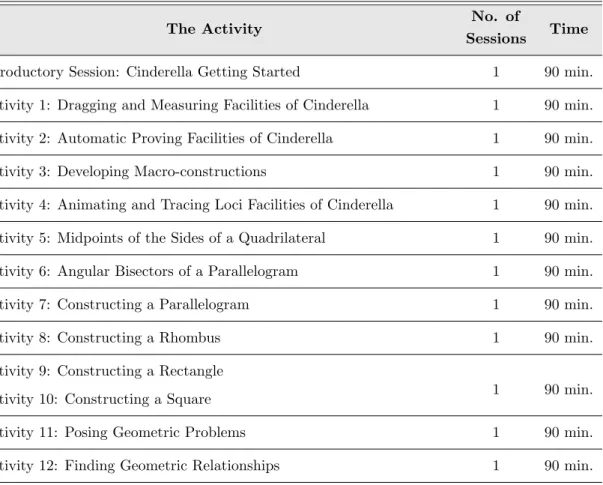
4.1 Time-range for the Program Activities . . . 118
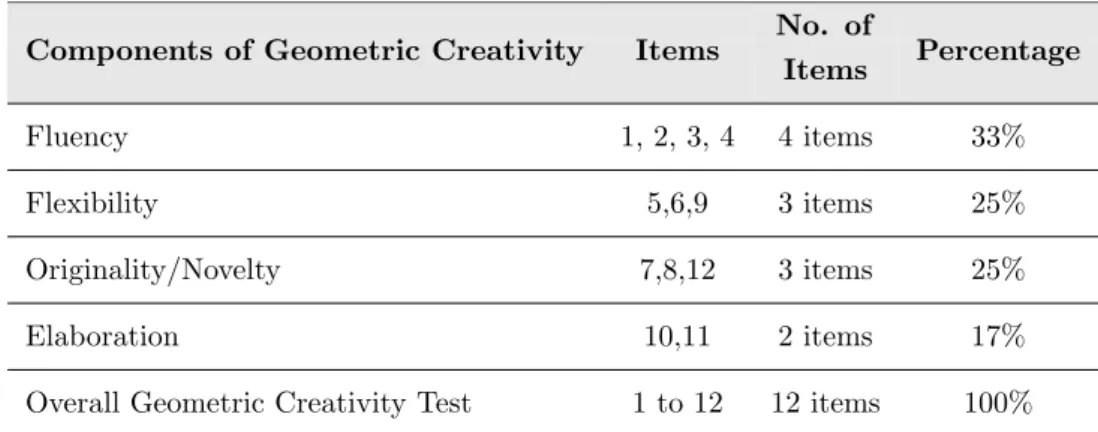
4.2 Specifications of the Geometric Creativity Test . . . 123
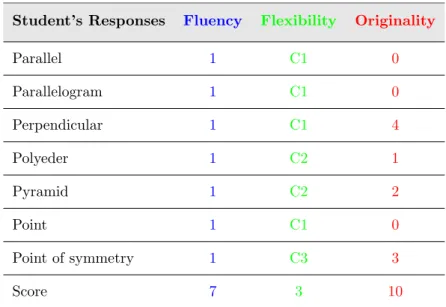
4.3 Item 1 and Assessing Di↵erent Geometric Creativity Components . . . 124
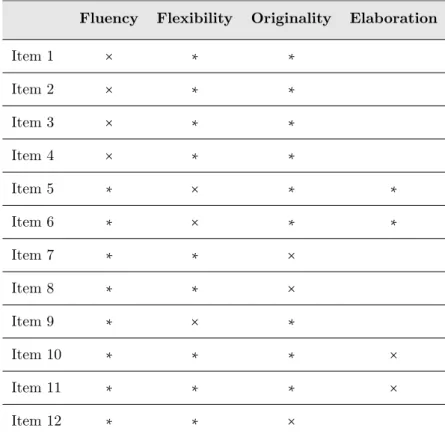
4.4 Test Items and Geometric Creativity Components . . . 125
4.5 Originality/Novelty Scores for the Geometric Creativity Test. . . 126
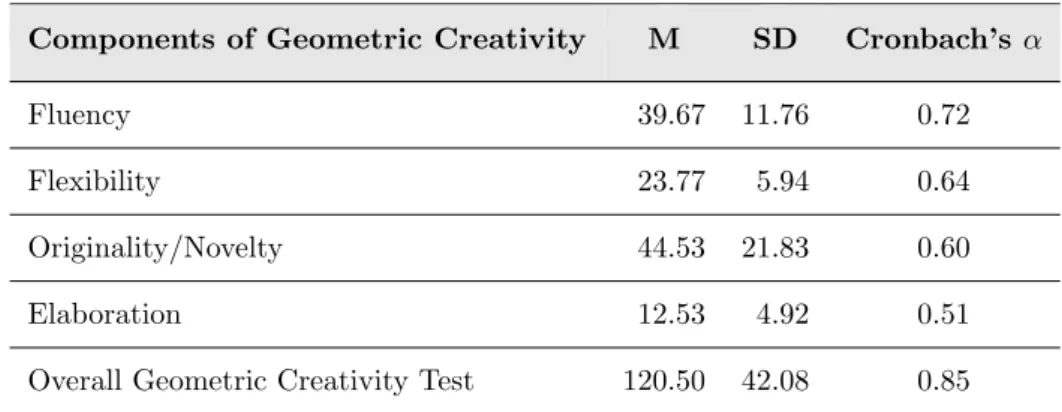
4.6 Statistics Attributes of the Pilot Study of the Geometric Creativity Test . . . . 131
4.7 Statistical Attributes of the Test Time in the Pilot Testing. . . 132
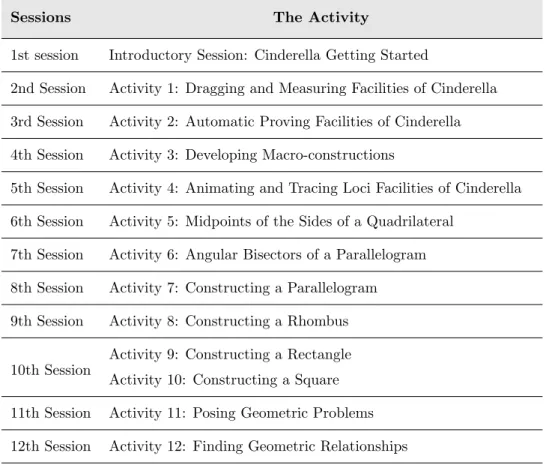
4.8 The Schedule of the Suggested Enrichment Program . . . 135
5.1 Pretest Results . . . 143
5.2 Posttest Results . . . 143
5.3 Geometric Fluency Test Results . . . 145
5.4 Geometric Flexibility Test Results . . . 146
5.5 Geometric Originality/Novelty Test Results . . . 148
5.6 Geometric Elaboration Test Results . . . 149
5.7 Overall Geometric Creativity Test Results . . . 150
5.8 The E↵ect Size of the Enrichment Program on Geometric Fluency . . . 152
5.9 The E↵ect Size of the Enrichment Program on Geometric Flexibility . . . 152
5.10 The E↵ect Size of the Enrichment Program on Geometric Originality . . . 153
5.11 The E↵ect Size of the Enrichment Program on Geometric Elaboration . . . 154
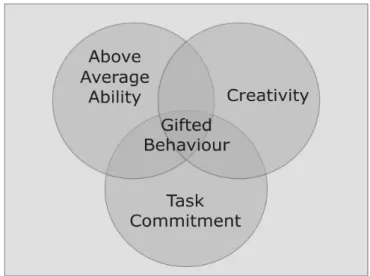
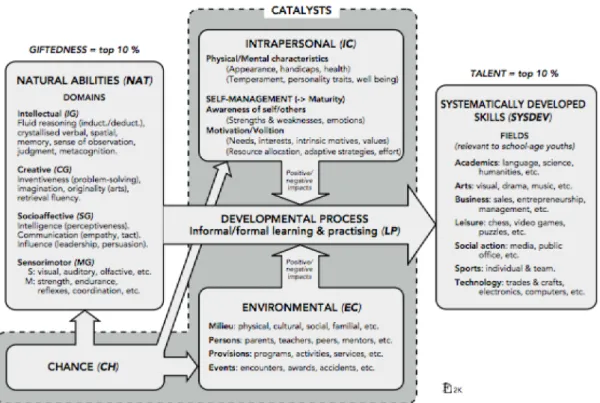
2.1 Graphical Representation of Renzullis Three-Ring Conception of Giftedness . . 35 2.2 Graphical Representation of Gagn´e’s Di↵erentiated Model of Giftedness and Talent 37
5.1 Mean Scores of the Subjects on the Pretest and Posttest . . . 144 5.2 Fluency Scores of the Subjects on the Pretest and Posttest. . . 145 5.3 Flexibility Scores of the Subjects on the Pretest and Posttest . . . 147 5.4 Originality/Novelty Scores of Subjects on the Pretest and Posttest . . . 148 5.5 Elaboration Scores of the Subjects on the Pretest and Posttest . . . 150 5.6 Overall Geometric Creativity Scores of the Subjects on the Pretest and Posttest 151
Problem of the Study
1.1
Background of the Problem
Nowadays, many countries all over the world seek to give due care to the gifted and talented, believing in the importance of their role in setting and carrying out the goals of scientific and technical developments. Since education is considered the most important means of human development, these countries sponsor the gifted and talented students through special educational programs and curricula to promote their creative potentials and prepare them as scientists capable of thinking properly and contributing to the scientific and technological developments of the computer and information age.
The development of creativity and innovation in the field of mathematics for gifted and talented students has become a major topic discussed in many international conferences and meetings. It focuses on the role of the teacher in promoting mathematical creativity and calls for o↵ering qualified programs and curricula for gifted and talented students in the field of mathematics. Consequently, many educational programs have been de-veloped to provide the gifted with various experiences in order to promote their creative potential (Cho et al., 2004; Eraky, 2004; Mohamed, 2003; Velikova, 2004, among others). In this concern, two main approaches emerge. Some researchers see that creativity can be learned and developed directly using specific programs that teach creativity skills and
its operations regardless of the subject matters. On the other hand, other researchers assert that teaching creativity should be associated with the subject matters and it should be a part of the corresponding lesson plans that teachers prepare (Jerwan, 2002, p. 38).
With respect to mathematics as a subject matter, there has been a growing interest in using mathematical content to develop creativity. As a result, new terminologies about creativity emerge, such as mathematical creativity which refers to creativity in the field of mathematics. Also, recent studies used geometric content to develop the creative potential among students (e.g., Al-Baz, 1999; El-Rayashy and Al-Baz, 2000; Mohamed, 2003; Weth, 1998b).
In the context of growing concern with developing creativity in the field of mathematics, a new trend appears that calls for using technology as a way to help promote creativity. For addressing this call, many studies were conducted adopting the integrated learning environment with technology in order to develop creativity (e.g., Kakihana, Fukuda, and Watanabe, 2008; Wurnig, 2008).
On the other hand, examining the status quo of the mathematically gifted education, supported by both research and experience, indicates that there are not any series of mathematics textbooks that are written specially for the mathematically gifted students and most of the textbooks are written for the general population of students. Namely, they are not always appropriate for the gifted students because their needs dictate a curriculum that is deeper, broader and faster than what is delivered to the other students (Johnson, 2000, p. 4). That is, these students have needs that di↵er in nature from those of other students and therefore they require some curricula and instruction di↵erentiation.
Furthermore, many programs for the mathematically gifted students, as literature indi-cates (Rotigel and Fello, 2004, p. 47), are inadequate and poorly designed; leaving the classroom teachers behind, struggling in an attempt to e↵ectively meet the educational needs of the mathematically gifted. Even though rich and varied learning programs that o↵er the mathematically gifted possibilities for investigation and exploration, can give
them further possibilities to reach new levels in mathematics.
Studying geometry is very important as a requirement for many scientific, technical and occupational areas as well as in studying mathematics itself. The reason why it is important is that through teaching and learning geometry a wide range of creativity and divergent thinking such as conjecturing, experimenting, comparing, and applying can be developed. However, geometry is often neglected as a result of the extension of other disciplines of mathematics such as algebra and calculus in most high schools. Some possible reasons for this negligence would be the lack of resources such as con-crete materials, computer software, and the lack of knowledge and expertise about how to use computers and other materials for instructional purposes (Olkun, Sinoplu, and Derzakulu, 2005, p. 1).
As a result of the radical development in the field of computer technology in both of its levels, hardware and software, and the widespread of computers uses and their powerful computing tools in the schooling system, many educational systems and applications have emerged, which did not exist before, (e.g., Intelligent Tutoring System ITS, and Intelligent Learning Environment (ILE)) (Eraky, 2004, p. 21). Moreover, with respect to mathematics education in general and geometry education in particular, a sort of dynamic applications known as “Dynamic Geometry Software” (DGS) has emerged over the last two decades as a new system in the teaching and learning of geometry and as an attractive alternative to ruler and compass. This alternative can be used to construct with points, lines, circles, conics and possibly more types of objects. It enables users to drag free elements later while automatically maintaining the construction, i.e., the relation between the objects (Kortenkamp, 1999, pp. 163-164).
The appearance of DGS with its constructing and dragging facilities (among others) is considered a paradigm shift in the teaching and learning of geometry since it has established new norms and standards and deepened our understanding of tool-situated learning (Talmon and Yerushalmy, 2003, p. 6). It supports students’ understanding of properties of geometrical objects and enables them to become geometric experimenters and make their own discoveries. Now, dynamic geometry software has become a
stan-dard tool for students, teachers, and mathematicians in schools and universities. Fur-thermore, the teaching and learning of geometry utilizing dynamic geometry software have been explicitly articulated in Principals and Standards for School Mathematics of the National Council of Teachers of Mathematics (NCTM) (National Council of Teach-ers of Mathematics (NCTM), 2000).
Leading from this, the researcher attempts this study seeking to address those previously-mentioned calls and the increasing need for qualified programs and curricula in the field of teaching and learning mathematics to the mathematically gifted students by develop-ing an enrichment program in Euclidean geometry usdevelop-ing Dynamic Geometry Software (DGS) and investigates its e↵ectiveness in promoting the mathematically gifted stu-dents’ geometric creativity. The suggested enrichment program could be considered a step forward toward designing and using precisely tested programs for the mathe-matically gifted students by using the latest powerful computing tools and software to develop the mathematically gifted students’ geometric creativity in high schools.
1.2
Problem of the Study
The present study investigates the following basic question: “How far is a suggested enrichment program using dynamic geometry software e↵ective in developing the math-ematically gifted students’ geometric creativity in high schools?”
This question is branched out into the following sub-questions:
1. What are the principles of developing a suggested enrichment program using dy-namic geometry software for developing the mathematically gifted students’ geo-metric creativity in high schools?
2. What is the suggested enrichment program using dynamic geometry software for developing the mathematically gifted students’ geometric creativity in high schools?
e↵ective in developing the mathematically gifted students’ geometric creativity in high schools?
1.3
Terms of the Study
In the present study, the researcher deals with some terms; namely, “dynamic geometry software”, “mathematically gifted students”, and “geometric creativity” To elaborate on these terms, the researcher made use of current literature in the field (e.g., Al-Baz, 1999; Cho et al., 2004; Choi and Do, 2008; El-Rayashy and Al-Baz, 2000; Eraky, 2004; Kortenkamp, 1999; Mohamed, 2003; Str¨aßer, 2002; Velikova, Bilchev, and Georieva, 2004)
1.3.1 Dynamic Geometry Software (DGS)
DGS, in this study, is a type of software which provides an intelligent environment for mathematics education in general and for geometry education in particular, and in which the mathematically gifted students can engage in constructing, exploring, conjec-turing, testing, and confirming geometric notations through the suggested enrichment program.
1.3.2 Mathematically Gifted Students
Mathematically gifted students in this study are those who are determined by highly qualified and professional persons, and those students have high mathematical abilities and the ability to set a high performance in solving mathematical problems.
1.3.3 Geometric Creativity
Geometric creativity is to be known, in the present study, as a directed intellectual activity for generating new geometric ideas over the known or familiar ones of the mathematically gifted students in the high schools in a non-routine geometric situation,
and the new ideas reflect the abilities of fluency, flexibility, originality/novelty, and elaboration. The term geometric creativity is objectively defined, in this study, as the student’s score on the geometric creativity test prepared by the present researcher.
1.4
Aims of the Study
The present study aims at:
1. Identifying the principles of the suggested enrichment program using dynamic geometry software for developing the mathematically gifted students’ geometric creativity in high schools.
2. Developing the suggested enrichment program using dynamic geometry software for developing the mathematically gifted students’ geometric creativity in high schools.
3. Measuring the e↵ectiveness of the enrichment program using dynamic geometry software in developing the mathematically gifted students’ geometric creativity in the high schools.
1.5
Significance of the Study
The present study can contribute to the following domains:
1. Helping the teachers and program designers of the mathematically gifted students to acknowledge the ways DGS contribute to developing the mathematically gifted students’ geometric creativity.
2. Providing some enrichment topics in mathematics using dynamic geometry soft-ware for the mathematically gifted students in high schools.
3. Enabling gifted students to use the dynamic geometry software to mathematically communicate with others through the World Wide Web, the electronic mail, and web pages.
4. Developing a validated and reliable instrument for assessing the geometric cre-ativity of the mathematically gifted students in high schools.
5. Meeting the increasing need for a large number of studies in the field of teaching mathematics to the mathematically gifted students. The suggested program is considered a step forward toward designing and using precisely tested programs for such students.
1.6
Limitations of the Study
The present study is bound by the following limitations:
Purpose: Developing the four adopted components of the geometric creative poten-tial (fluency, flexibility, originality/novelty, and elaboration) among the mathematically gifted students in high schools.
Instructional Limitations: Using the Interactive Geometry Software, Cinderella as dynamic geometry software along the suggested enrichment program.
One instrument is used; the geometric creativity test, which is designed by the re-searcher.
Population Subjects: The study is limited to a sample of 7 (5 eleventh grader, 1 tenth grader, and 1ninth grader - 2 male, 5 female) mathematically gifted students at Landesgymnasium f¨ur Hochbegabte (LGH), a public high school for gifted and talented students in Schw¨abisch Gm¨und – Baden-W¨urttemberg, Germany.
Content Subjects: the content is limited to the content of the suggested enrichment program prepared by the researcher.
Time Limit: The suggested enrichment program only covers 12 weekly 90-minute sessions during the first semester of the academic year 2008/09.
1.7
Variables of the Study
The variables, in this study, are classified as follows:
1. Independent Variable: This is the variable whose e↵ect is to be measured in this study. This variable is represented in the suggested enrichment program using DGS and its use (in teaching) with the mathematically gifted.
2. Dependent Variable: This is the variable whose e↵ect on the independent variable is to be measured before and after the experimental manipulation. This variable is represented in the geometric creativity of the mathematically gifted as measured by the geometric creativity test prepared by the present researcher.
1.8
Methodology of the Study
The researcher in this study made use of both the pre-experimental and descriptive method. The pre-experimental method is used in investigating the e↵ectiveness of the suggested enrichment program using the dynamic geometry software in developing the mathematically gifted students’ geometric creativity in high schools. On the other hand, the descriptive method is used as well to collect and analyze data, and describe the suggested enrichment program and the instrument of the study.
1.9
Instrument of the Study
The researcher prepared a geometric creativity test to assess the mathematically gifted students’ geometric creativity before and after the intervention.
1.10
Experimental Design of the Study
The researcher made use of the pre-experimental one-group, pretest – intervention – posttest design to investigate the e↵ectiveness of the suggested enrichment program
in developing geometric creativity among the mathematically gifted students in high schools.
1.11
Hypotheses of the Study
To answer the third question of the present study, which is: “How far is the suggested enrichment program using dynamic geometry e↵ective in developing the mathematically gifted students’ geometric creativity in high schools?” the following ten hypotheses1 were formulated:
1. There is a statistically significant di↵erence at the level 0.05 between the mean ranks of subjects’ scores on the pre-post measurements of the geometric fluency component, as measured by the designed geometric creativity test, in favor of the post measurement.
2. There is a statistically significant di↵erence at the level 0.05 between the mean ranks of the subjects’ scores on the pre-post measurements of the geometric flexi-bility component, as measured by the designed geometric creativity test, in favor of the post measurement.
3. There is a statistically significant di↵erence at the level 0.05 between the mean ranks of the subjects’ scores on the pre-post measurements of the geometric origi-nality/novelty component, as measured by the designed geometric creativity test, in favor of the post measurement.
4. There is a statistically significant di↵erence at the level 0.05 between the mean ranks of the subjects’ scores on the pre-post measurements of the geometric elabo-ration component, as measured by the designed geometric creativity test, in favor of the post measurement.
5. There is a statistically significant di↵erence at the level 0.05 between the mean
1The hypotheses of the study were formulated in a predictive directive and alternative way based
on the indicators of the prior studies and literature related to the subject of the study. For more details see: Chapter 2. Review of Literature and Chapter 3. Related Studies.
ranks of the subjects’ scores on the pre-post measurements of geometric creativity as a whole ability, as measured by the designed geometric creativity test, in favor of the post measurement.
6. The suggested enrichment program using dynamic geometry software has a suit-able level of e↵ectiveness in developing the mathematically gifted students’ geo-metric fluency component in high schools.
7. The suggested enrichment program using dynamic geometry software has a suit-able level of e↵ectiveness in developing the mathematically gifted students’ geo-metric flexibility component in high schools.
8. The suggested enrichment program using dynamic geometry software has a suit-able level of e↵ectiveness in developing the mathematically gifted students’ geo-metric originality/novelty component in high schools.
9. The suggested enrichment program using dynamic geometry software has a suit-able level of e↵ectiveness in developing the mathematically gifted students’ geo-metric elaboration component in high schools.
10. The suggested enrichment program using dynamic geometry software has a suit-able level of e↵ectiveness in developing the mathematically gifted students’ overall geometric creative potential in high schools.
1.12
Procedures of the Study
To answer the study questions and examine the validity of its hypotheses, the researcher went through the following procedures:
1. Specifying the principles of preparing the suggested enrichment program using dynamic geometry software for developing the mathematically gifted students’ geometric creativity in high schools.
2. Preparing the enrichment program in its initial form in the light of the principles specified before.
3. Presenting the program, in its initial form, to a group of experts and education-alists who are experienced in teaching and learning mathematics to decide on its appropriateness to the mathematically gifted students in high schools and suggest any changes to modify it.
4. Preparing an instrument, a geometric creativity test, to assess the geometric cre-ativity of the mathematically gifted students in high schools.
5. Presenting the geometric creativity test, in its initial form, to a group of judges specialized in teaching and learning mathematics to decide on its validity and suggest any changes to modify it.
6. Conducting the experimental study.
7. Collecting data and treating them statistically using the appropriate methods.
8. Interpreting and discussing results.
9. Presenting the suitable suggestions and recommendations to make full use of the study results.
1.13
Structure of the Thesis
Chapter 2. Review of Literature: reviews prior literature related to the subject of the present study in three domains:
� The use of dynamic geometry software in the teaching and learning of math-ematics
� The mathematically gifted education � Geometric creativity development
Based on the given data and results of prior literature, in this chapter, the re-searcher attempts to determine the significance of using dynamic geometry soft-ware in developing the mathematically gifted students’ geometric creativity in high schools.
Chapter 3. Related Studies: reviews the prior studies related to the subject of the present study in three main domains:
� Studies related to the use of dynamic geometry software in the teaching and learning of mathematics.
� Studies related to the mathematically gifted education. � Studies related to geometric creativity development.
Then, the researcher presents his commentary on related studies, and attempts to figure out the principles of preparing the suggested enrichment program. By the end of this chapter, the first question of the study which is: “What are the principles of developing a suggested enrichment program using dynamic geometry software for developing the mathematically gifted students’ geometric creativity in high schools?” is answered.
Chapter 4. Method and Procedures: presents in detail the development of both the suggested enrichment program and the geometric creativity test as well as the procedures of the experimental study. In this chapter, the second question of the study, which is: “What is the suggested enrichment program using dynamic geometry software for developing the mathematically gifted students’ geometric creativity in high schools?” is answered.
Chapter 5. Findings and Interpretation: presents the statistical analysis results of testing the study hypotheses as well as interpretation and implications of these results in the light of the literature review and purposes of the study. By the end of this chapter, the third question of the study which is: “How far is the suggested enrichment program using dynamic geometry e↵ective in developing the mathematically gifted students’ geometric creativity in high schools?” is answered.
Chapter 6. Summary, Conclusions and Recommendations: includes a sum-mary of the study. It also includes recommendations pertinent to the findings of the program and concludes with the suggestion for further research related to the use of dynamic geometry software in the teaching and learning of mathematics,
Review of Literature
In this chapter, the researcher reviews prior literature related to the subject of the present study and surveys it under three main domains: The use of dynamic geometry software in the teaching and learning of mathematics, the mathematically gifted edu-cation, and the geometric creativity development. By the end of the chapter, based on the given data and the results of prior literature, the researcher attempts to determine the significance of using dynamic geometry software in developing the mathematically gifted students’ geometric creativity in high schools.
2.1
The Use of Dynamic Geometry Software in the
Teach-ing and LearnTeach-ing of Mathematics
DGS is the short form of Dynamic Geometry Software. It is also known as Dynamic Geometry Environment (DGE) and Dynamic Geometry Systems (DGS).
It is a sort of computer software that provides a range of tools for constructing geometric objects from a range of “primitive” objects such as points, straight objects (line seg-ments, lines, rays, and vectors) and circles (or arcs) to “classical” constructions (e.g., midpoint, parallel lines, perpendicular lines). It also provides tools for “transforma-tional” geometry (e.g., reflection, translation, rotation, similarity). Once the geometric
object is drawn using the software, measurements can be taken from objects (e.g., length, angle, area) (Oldknow, 1997, p. 4). The dynamic feature comes from the ability to drag free or semi-free objects, such as points, around the computer screen with the mouse (Jones, 2005, p. 27). The dragging facilities deform the constructed object; however, some aspects of the geometric object remain the same. An important task is to observe the invariant aspects of the geometric object under the dragging facilities.
Furthermore, some dynamic geometry software embraces other facilities (e.g., animat-ing and tracanimat-ing loci facilities, developanimat-ing macro-constructions facilities, and automatic proving facilities). More details about these facilities will be explained in the next sections.
Over the last two decades, dynamic geometry software has become one of the most widely used pieces of mathematics software in schools, colleges, and universities all over the world1 (Jones, 2005, p. 28). Unlike other mathematics software, the dynamic ge-ometry software is not question-and-answer based tutorial. It is context-free learning software suitable for implementation in an experimental discovery-based learning envi-ronment as well as for demonstration purposes. It is common in middle school, high school, and college geometry classrooms but is occasionally used in other subject areas or with younger students (Hull and Brovey, 2004).
In this part of the dissertation the researcher surveys in detail some aspects of the DGS such as its definitions, types, functions and purposes, and its role in geometry education.
2.1.1 Definitions of Dynamic Geometry Software
There are many definitions for the dynamic geometry software based on one or more of its main characteristics, features, purposes or functions. One such definition, defined by Wikipedia encyclopedia, emphasizing the drag mode of the dynamic geometry environ-ment is: “Dynamic geometry environenviron-ment is a computer program which allows one to
1There are versions of the software in Arabic, Chinese, Dutch, English, French, German, Hungarian,
create and then manipulate geometric constructions”. Namely, one starts construction by putting a few points and using them to define new objects (lines, circles, other points, etc). After some construction is done, one can move the points he/she starts with and see how the construction changes.
The term dynamic geometry software is carried further by Cho et al. (2004), who em-phasized the functions of the software as an experimental discovery-based learning envi-ronment and stressed the role of learners in this envienvi-ronment. In this respect, Cho et al. define the dynamic geometry software as “an experimental environment in which the learners hypothesize, justify, and confirm geometric and algebraic properties through mouse exploration”. Accordingly, the use of such software changes the role of mathemat-ics students from passive spectators into conceptual participants involved in a scientific process for exploring theorems through: hypothesizing, justifying, and confirming.
Str¨aßer (2002) also defines dynamic geometry software as “a certain type of software which is predominantly used for construction and analysis of tasks and problems in elementary geometry”.
Reviewing these samples of definitions and many others, the present researcher adopts a definition that combines some attempts to define the term in one comprehensive def-inition that fits the purposes of the present study. Dynamic geometry software, in this study, is a type of software which provides an intelligent environment for mathematics education in general and for geometry education in particular, and in which the math-ematically gifted students can engage in constructing, exploring, conjecturing, testing, and confirming geometric notations through the suggested enrichment program.
2.1.2 Key Features of Dynamic Geometry Software
Even though there are many dynamic geometry software packages, which di↵er in their conceptual design, most of them still share the following three key features (Str¨aßer, 2002, p. 65): (1) Drag mode, (2) Generating a locus/loci of points, and (3) Developing macro-constructions.
1) Drag Mode
The dragging facilities, which are embedded in all dynamic geometry software, are the fundamental improvements versus the technical devices: the straightedge and the compass (Kortenkamp, 1999, p. 16). Dragging in DGS simply means the possibility to move free object or semi-free object (such as a point, a straight line, or even an edge of a circle) of a geometric figure by dragging the mouse so that the rest of the figure follows the moves and changes/responses accordingly and the figures is updated automatically to show the new position of the figure objects, which depend on the moved object.
The use of these facilities has great educational implications in the teaching and learning of geometry in particular and in mathematics in general since it produces a dynamic behavior for each element in the construction that allows users to move certain elements of the construction and to observe how others respond to the altered conditions (Talmon and Yerushalmy, 2003, p. 1). In other words, dragging facilities allow free elements of the construction to be moved, while the rest of the construction follows the moves and changes/responses accordingly. But some aspects of the construction remain the same. The software allows a focus on the important geometric ideas of invariance. Therefore, dragging within DGS is considered a tool for investigating relationships in geometry figures at both perceptual and formal levels (Jones, 2005, p. 27).
2) Generating Locus/ Loci of Points
Many of the dynamic geometry software packages include the facilities of generating and tracing locus/loci of points – drawing the traces of elements when other elements are moved on a path, such as a line or a circle – as well as performing automatic animations.
3) Developing Macro-constructions
Dynamic geometry software usually has the ability to group or capsulate a sequence of construction commands into a new command or tool. For example, constructing
the perpendicular bisector using two circles and their intersections can be capsulated to a macro, a new command or tool, that issues the necessary steps automatically (Kortenkamp and Richter-Gebert, 1998, p. 2)
2.1.3 Types of Dynamic Geometry Software
There are two main types of DGS packages: 2-dimensional packages and 3-dimensional packages.
1) Examples of 2-dimensional Packages
Cabri-Geometry2 (also known as Cabri-G´eometr`e) is a dynamic geometry application o↵ering an interactive environment for doing Euclidean, transformational, and analytical geometries. Cabri-Geometry was initially developed at IMAG, as a joint research of the department of Information Technology and Applied Mathematics Universit´e Joseph Fourier and CNRS (the National Centre for Scientific Research), France, and it started in 1985 in order to make it easier to teach and learn geometry. Cabri-Geometry is considered the first dynamic geometry software package developed for the teaching and learning of geometry. It was presented by Jean-Marie Laborde and Franck Bellemain for the first time on ICME-6 (1988) Budapest (Hungary). In 1989, Cabri-Geometry was available on French educational market and supported by the ministry of education, then later on in many countries as MacOS and DOS version. Since 1992, Cabri-Geometry has been integrated and become compatible with TI-92 graphic calculators.
Through Cabri-Java, Cabri-Geometry has the possibility to create and export its geo-metric constructions into web pages on Java-enabled Web browsers.
Cinderella3 is interactive geometry software. Cinderella is designed to cover a wide range of di↵erent geometric disciplines. It provides native supports for doing Euclidean geometry, hyperbolic geometry, elliptic geometry, and projective geometry on the
com-2Laborde, J. M. and Bellemain, F. (1988). Cabri-Geometry. Online at: http://www.cabri.com/ 3Richter-Gebert, J. and Kortenkamp, U. (2006). The Interactive Geometry Software Cinderella,
puter. It is a joint project that has been conducted by J¨urgen Richter-Gebert and Ulrich Kortenkamp since 1996 and it is a development of an earlier project carried out by J¨urgen Richter-Gebert and Henry Crapo between 1993 and 1995. The latest ver-sion of the software, Cinderella.2.0, consists of three main environments: Cinderella – an interactive dynamic geometry environment for doing geometry, CindyLab – an ex-perimental physics simulation environment for doing interactive physics experiments, and CindyScript – a high-level programming environment for fast flexible and freely programmable interactive scenarios. The three environments can be used almost in-dependent from each other; however, Cinderella has its full power/potential when the three environments are integrated (Richter-Gebert and Kortenkamp, 2006). Cinderella has the possibility to easily publish and export geometric constructions into web pages on Java-enabled Web browsers.
Compass and Ruler4(also known as C.a.R) is dynamic geometry software simulating compass and ruler on the computer. C.a.R is the short form of Compass and Ruler as construction tools or Construct and Rule as user’s roles. Ren´e Grothmann is the designer of this software. It is a free and open source available under the GPL license. It can be used as a tool for constructing and exploring Euclidean and non Euclidean geometries. C.a.R. is a java-based program running on many platforms. C.a.R. has the possibility to export the geometric constructions and assignments into web pages on Java-enabled browsers.
Euklid DynaGeo5 is a Windows program for doing geometry on the computer. It was originally developed in the mid 90’s as a German program, and later on in 1997 was available in English. Roland Mechling is the main designer of the program. Euklid DynaGeo has many features starting from the possibility to create geometric objects (e.g., points, segments, circles, polygons) going through the built-in constructions (e.g., perpendicular, bisector, perpendicular bisector) ending by the built-in transformations (e.g., reflection, translation, rotation, dilation). Euklid DynaGeo also has the possibility
4Grothmann, R. (2004). C.a.R. – Compass and Ruler. Online at: http://zirkel.sourceforge.
net/doc_en/index.html
to export its geometric construction into web pages using its own viewer, which is called Euklid DynaGeo X viewer. It is not a java applet but rather it is an Active X control.
GeoGebra6is dynamic software that connects geometry, algebra, and calculus. Markus Hohenwarter was the main designer of the software in 2001/2. GeoGebra is written in Java and thus available for multiple platforms. It allows users to do constructions with points, vectors, segments, lines, conic sections as well as functions and change them dynamically. Equations and coordinates can be entered directly. Thus, it can deal with variables for numbers, vectors and points and find derivatives and integrals of functions. It is possible to publish and export the constructions made by GeoGebra into web pages on Java-enabled browsers.
Geometer7 is dynamic geometry software that runs on Macintosh or Windows for do-ing geometry. Tom Davis is the designer of the program. Geometer has two amazdo-ing features. The first is the proof mechanism feature that enables teachers to prepare step-by-step proofs that can be used to lead students gradually through the proof. The second is the test diagram feature that reports and shows many geometric relationships about the configuration that include reporting points on a line, concurrent lines, tri-angles of equal areas, equal tri-angles, supplementary tri-angles, equal length segments, and ratios.
The Geometer’s Sketchpad 8is interactive dynamic geometry software for exploring Euclidean geometry, algebra, calculus and other areas of mathematics. The Geometer’s Sketchpad is considered one of the first two software packages that could be used for dynamic geometry which first appeared in 1989, and Cabri-Geometry, dating back to 1988 (Kortenkamp, 1999, p. 17). The Geometer’s Sketchpad began as an outgrowth of the Visual Geometry Project (VGP) at Swarthmore College, headed by Eugene Klotz and Doris Schattschneider in 1985 (Scher, 2000, p. 42). Nicholas Jackiw was the main designer and programmer of the Sketchpad. After several years of development in the
6Hohenwarter, M. (2001). GeoGebra. Online at: http://www.geogebra.org/cms/
7Davis, T. (2002). Geometer. Online at: http://www.geometer.org/geometer/index.html 8Jackiw, N. (1989). The Geometer’s Sketchpad. Online at: http://www.keypress.com/x5521.xml
academic setting, The Sketchpad underwent a year of field-test in schools across the United States, and in 1991, the first commercial Macintosh version was released. In 1993, the Sketchpad version for Microsoft Windows was produced. In 1995, a third version extended the scope of the program from Euclidean and transformational geometry to include analytic geometry. More significant changes came in 2001, when the fourth version of Sketchpad extended dynamic geometry to the teaching and learning of algebra and calculus as well.
The Geometer’s Sketchpad needs additional software called JavaSketchpad (JSP) in or-der to create and publish sketches from the Geometer’s Sketchpad on the Internet.
In addition to the dynamic geometry software packages mentioned and surveyed above, there are many others for doing and exploring geometry on the computer. For a list of other dynamic geometry packages see the link: http://en.wikipedia.org/wiki/ Dynamic_geometry_software. What the present researcher would like to emphasize here is that even though there is a wide rage of di↵erent types of dynamic geometry software, there is no significant di↵erence between them if one needs only basic compass and straightedge constructions.
2) Examples of 3-dimensional Packages
Cabri 3D9 is an interactive software package for doing geometry in three dimensions, in which a 3D environment containing objects such as points, lines, planes, and polyhedra is represented on a 2D screen. Jean-Marie Laborde presented it for the first time at CabriWorld in Roma in September 2004. Cabri 3D can run on Mac and Windows platforms. The last version, Cabri 3D v2, includes both numeric and geometric tools and unique 3D visualization tools. The key features of Cabri 3D can be summed up in the following points:
� Create solid geometric construction with just a few clicks of the mouse. � Integrate numeric data using measurements and calculation tools.
� Manipulate and animate constructions and reshape objects using only the mouse. � Print out patterns from virtual constructions and transform them into real objects. In addition to Cabri 3D as an example of the 3-dimentional packages for constructing, manipulating and exploring space geometry, there are many others such as: Archimedes Geo3D10, Geometria11, Geomview12, just to mention some. The reader might use their URLs inserted in footnote to check their own features.
2.1.4 Purposes and Functions of Dynamic Geometry Software
Dynamic geometry software has a variety of purposes and functions. A big body of literature and studies pertaining to DGS focus on its uses as a mediation tool for per-forming geometric constructions and transformations that support the inquiry approach in teaching and learning mathematics and encourage students to use problem solving and posing processes such as modeling, conjecturing, experimenting, and generalization (Christou et al., 2005). There is also emphasis on its characteristics in providing a window onto the students’ mathematical meaning that enables deeper discussion and directed mediation (Budge, 1999, p. 86). In more detail, the researcher surveys these purposes and functions in the following framework:
1) DGS as a Construction Tool
Dynamic geometry software provides an accurate constructor for creating geometric configurations and has the ability to automatically adjust and preserve the variant and invariant properties of constructed geometric configurations under dragging in a visual, efficient, and dynamic manner.
10Archimedes Geo3D. Online at: http://www.raumgeometrie.de/drupal/en 11Geometria. Online at: http://geocentral.net/geometria/
2) Measurement
Most of the dynamic geometry software packages have facilities of measurements that can be used to measure the distance between two points, the measurement of angles, and the areas of polygons as well as automatically updating these measurements under dragging of free elements.
3) DGS as a Visualization Tool
Dynamic geometry software, as a visualization tool in mathematics classrooms, can help students to visualize mathematical and geometric situations. In this concern, research indicated that uses of the dynamic geometry environment allow mathematical notations to become visible to students (Budge, 1999, pp. 86-94). Christou et al. (2005) in their research observed that DGS helps students to construct accurate images of the geometric situations and also helps them to visually explore the geometric situations and reflect on them. In addition, the extracted images from the constructed images enable students to explore at a perceptual level and make conjectures about the geometric situations. (Patsiomitou, 2008, p. 386) also asserted “creating visual mathematical representation in the software can make it easier for students to grasp the relevant concepts by allowing the continuous manipulation of mathematical objects in real time”.
4) Exploration and Discovery
Dynamic geometry is considered as an ideal tool in mathematics classrooms for explo-ration and discovery through utilizing its special facilities of constructing, dragging, measuring, and calculating. Constructing and dragging are two important features em-bedded in all dynamic geometry software that provide students with not only one case of geometric configuration but also many cases of this configuration that can enable students to explore and make mathematical conjectures. Measuring and calculating features can then enable students to check the correctness of their conjectures during exploration and discovery processes. Furthermore, using these facilities of DGS during
the exploration and discovery processes allow students to consider not only special or general cases of geometric configuration but also extreme cases, cases that textbook au-thors never imagine (Christou et al., 2005, pp. 136-137). Accordingly, using DGS can help teachers to implement an inquiry approach for teaching and learning mathematics. In this respect, Contreras (2003) also recommended “All students should be engaged in discovering mathematical ideas on their terms and DGS can facilitate such discoveries within geometric tasks”.
5) DGS as a Modeling Tool
Dynamic geometry software can efficiently be used for mathematical modeling and simu-lation in the field of teaching and learning of geometry (Schumann, 2000). Mathematical modeling and simulation with DGS is an important example of the usage of computer tools in geometry since it opens up a wide range of creative activities for both teachers and students (Schumann, 2003).
The di↵erent embedded facilities in dynamic geometry software, which allow the user to perform calculations on measurements and use such results to plot the coordinates of a point on specific axes, open the gate for mathematical modeling using such software in mathematics education (Oldknow, 2003, p. 16). Furthermore, an interesting form of modeling becomes available in DGS by virtue of its possibility to import a picture and construct axes and graphs on it, which allows the users to model captured images either geometrically or algebraically or both (Oldknow, 2003, pp. 16-19).
6) Experimentation
The use of dynamic geometry software in mathematics classrooms opens new horizons for experimentation and could turn mathematics into a laboratory science (Olive, 2000, p. 17), in which students’ main duties will be observing, recording, manipulating, predicting, conjecturing and testing, and developing theory to explain the phenomena concerned (Man and Leung, 2005, p. 2).
For using DGS in mathematics experimentation, Friedrich (1999) articulated a working scheme (experiment, guess, test, and proof) supported with an example that designs an experiment of the locus of the heights intersection points of a triangle. For further research about the use of DGS in mathematics experimentation, refer to (Haja, 2005), (Kortenkamp, 2004), and (Man and Leung, 2005).
7) DGS as a Problem Solving and Problem Posing Tool
Dynamic geometry software is considered as a tool that mediates students strategies in solving and posing problems (Christou et al., 2005). Christou et al. further contend “In the DGS environment the problem solving processes involve the generation of new prob-lems, supporting the relationship between problem-solving strategies and the tendency to pose extension problems”.
Contreras (2003) also states that the constructing, dragging, measuring, and calculating facilities of the dynamic geometry software can enable students to make and investi-gate mathematical conjectures, solve problems, and pose related problems. Moreover, Budge (1999) concludes that the use of the dynamic geometry environment generally encourages investigation and problem solving in geometry.
8) Transformation
Most dynamic geometry software allow several kinds of geometric transformations (re-flections, translations, rotations, and dilations, among others) that can perform on figures or their parts in the front of students’ eyes (Schattschneider and King, 1997). Man and Leung (2005) provided two illustrative examples on how to use dynamic ge-ometry software in teaching transformational gege-ometry in an undergraduate mathe-matics course, in order to deepen the student teachers’ understanding of the concepts behind. Olive (2000) points out, in implications of using dynamic geometry technol-ogy, the importance of dynamic geometry in investigating transformational concepts in di↵erent levels and grades and constructing understanding of mental transformational
images.
9) Proof
Even though DGS cannot actually produce proofs in deductive logical steps, the inter-active, dynamically visual evidence it provides produces a strong conviction that can motivate the desire for proof (Schattschneider and King, 1997). In the same concern, Kortenkamp (2004) articulates that the experimental techniques of computer software (including DGS) could supplement, enrich, and enhance the proving process. He also displays how these experimental techniques can be used to motivate proofs, eliminate proofs, make proofs understandable, and find proofs. Furthermore literature (Patsiomi-tou, 2008, p. 386) asserts that “the software tools can assist cognitive functions with a view to analyzing the data and composing the solution and make it easier for students to reach decisions and teachers can thus improve their students’ knowledge by eliciting mental schemas from them, which students can be guided to reach conclusions which form a step-by-step visual proof”.
In terms of van Hiele geometric thinking levels and the logical proving process, Jones (2002) points out that such use of DGS does help students to connect between the informal explorations and logical deductive arguments, which in turn help them in writing proof argumentation.
2.1.5 The Role of DGS in Geometry Education
The role of DGS in the teaching and learning of geometry is surveyed in terms of three main domains: (1) The role of DGS in developing geometric thinking, (2) The role of DGS in developing the academic achievement, and (3) The role of DGS in developing the a↵ective domain.
1) The Role of DGS in Developing Geometric Thinking
There is no doubt that a central aim of geometry education is to raise the students’ geometric thinking levels. In this context, Two Dutch mathematics educators, Pierre van Hiele and Dina van Hiele-Geldof, developed a pedagogical theory describing levels of thinking in Euclidean geometry that students pass through as they develop their understanding of new geometric topics. The van Hiele theory originated in the doctoral dissertations of Pierre van Hiele and his wife Dina van Hiele-Geldof in 1957.
The van Hiele Theory of Geometric Thinking13
The van Hieles originally numbered the levels from 0 to 4. Since their work has been translated into English the levels are often numbered from 1 to 5. Additionally, multiple terms are used to describe some levels. For clarity and for a reason to be mentioned later, the present researcher used the 1-to-5 numbering scheme and multiple terms to describe levels as needed.
Level 1 (Visualization or Recognition)
Students recognize geometric shapes by their general appearance, often through com-paring them by prototype. At this level, students are not able to explicitly identify the properties of geometric shapes and make decisions based upon perception rather than reasoning.
Level 2 (Analysis or Descriptive)
Students begin to analyze and name the properties of geometric shapes, but they do not see the relationships between these properties. At this level, students are not able to identify which properties are necessary and which are sufficient to indicate or describe the geometric object.
Level 3 (Abstraction, Ordering, Informal Deduction or Argumentation)
Students can see the relationships between the properties of geometric shape and
be-13The van Hiele theory has been investigated and validated by numerous studies (e.g., Clements and
Battista, 1991; Johnson, 2002; Mason, 1998; Usiskin, 1982) and the researcher made use of them to elaborate on this theory.