Department of English
Teaching Literatures in English: An Empirical
Algerian University Experiment
Dissertation submitted for the Degree of “Doctorat es-Sciences” in Applied Linguistics
Submitted by: Yasmina Djafri Supervised by: Pr. Lakhdar Barka Sidi Mohamed
Board of Examiners
1. Prof. Abbès Bahous Chairman University of Mostaganem 2. Prof. Sidi Mohamed Lakhdar Barka Supervisor University of Oran/Es-Sénia 3. Prof. Fewzia Bedjaoui Examiner University of Sidi-Bel-Abbès 4. Dr. Bakhta Abdelhay Examiner University of Mostaganem 5. Dr. Belabbès Ouerrad Examiner University of Sidi-Bel-Abbès
I would like to express my deep gratitude to all those who contributed to the fulfilment of this dissertation and to those without whom I would not be able to realize myself. I suppose that to celebrate the efforts made all along this research and the achievements obtained afterwards, I need not forget all those who make them possible. At the very least and in my case, I have appreciated those formal classes and even casual conversations, either with my colleagues or students, in the course of which the issues of the present research were debated and acknowledgments are the space to thank all those who have triggered my curiosity off to explore the teaching of literatures in English to Algerian university learners.
I am greatly indebted to my supervisor Pr. S.M. Lakhdar Barka. His support and continual encouragements for this project were constant. I would like to thank him for providing me valuable guidance, for allowing me the freedom to wander where my data led me, for finding my work interesting even when I found it most boring and mainly for being an incomparable mentor. I would like to thank him too for his patience while reading, correcting, and commenting on every single part of this dissertation.
I am honoured and very much indebted to Pr. A. Bahous, Pr. F. Bedjaoui, Dr. B. Abdelhay, and Dr. A. Ourad for having so kindly accepted to provide me with critical readings and certainly challenging expert views on this work as members of the jury.
My heartfelt thanks are to Pr. A. Bahous whose useful advice, comments and help, in moments of despair, I would never forget.
I am extremely grateful to my wonderful friend and colleague, Djamila Aissat, who patiently encouraged me all throughout the preparation of this dissertation, who has been a present ear to all my worries and troubles all along these seven years. Her enormous understanding, encouraging attitude, her endless patience and moral support boosted me whenever I wanted to give up.
A special mention goes to my graduate students at the English department who took part in the different experiments I undertook for this research. Without their participation and contribution this project would not have been possible.
I am specifically indebted to all those people who gave me direct assistance in preparing this thesis:
- Ms Nadia Abdelhadi for her kindness, devotion, and unforgettable friendship. - Dr Neddar and Mrs I. El Ouchdi for their moral support.
- Ms S. Ould Si Bouziane and M. Abdellahbenselwa from EDOLAS for their substantial contribution.
- Mrs Dalel and Hanane Sarnou for their friendship, moral support and technical assistance.
For a very long time, literary reading has been jailed in a set of conventions already decided by the theorist and said to be accessible by few bright minds capable of violating the obstacles imposed by the intricacies of the literary text. Hence, it goes without saying that ordinary readers, who wish to make an understanding of the literary text from their own perspective, feel alienated by the complexities of the established conventions, contributing once more to the serious decline of literary studies in academic settings. More dangerously is the fate of these readers in foreign language contexts considered most of the time as idiosyncratic to deserve worthy attention. Therefore, the objective of the present research is to examine empirically; through the collection of data; the responses, both cognitive and affective, of thirty three Algerian university students to a literary selection of texts in English language. Indeed, this same study attempts to demonstrate whether literary response springs from capacities that are intrinsic to these readers or from other extrinsic predispositions. It, then, raises four main issues: first, Are all kinds of literary texts able to generate an appreciation in the Algerian reader? Second, Is literary competence necessary for an Algerian reader to appreciate a text of literature in English? Third, Is foregrounding responsible for generating response in Algerian readers of literary texts in English? Fourth, Which kind of feeling does foregrounding generate in these readers? The study is divided into six chapters; the first three chapters highlight the importance of the empirical approach to literary reading at the expense of a review of the major reader-response theories as traditionally conceived and which point out the limitation of literary interpretation. The fourth chapter proposes an empirical experiment on thirty three Algerian university students/readers so as to depict their profile and their potential predispositions in engaging with literary texts in English. In the fifth chapter, readers’ depth of appreciation of two short stories, one canonical and one contemporary, is measured and compared in order to demonstrate the importance of possessing a literary competence for a reader of a literary text in English. The sixth and last chapter carries on a last experiment which aims at measuring the impact of foregrounding on Algerian readers of literary texts in English and the kind of affect the latter generates in these same readers. The results of this study suggest that Algerian students/readers of literary texts in English are capable of generating a literary appreciation of all kinds of literary texts written in English and more particularly of short stories. The second main finding shows that these naïve and unsophisticated readers are sensitive to intrinsic values of the literary text that surpass any extrinsic impact, which is an indication that literary competence is not necessary for mere appreciation. Finally, the last finding shows that despite their appreciation of literary texts while responding to foregrounding features, these readers are unable to develop the adequate strategies of interpretation which help them build their own understandings.
5 RR 5 Readers Reading by Norman Holland (1975) CI The Critical I by Norman Holland (1992) SC Subjective Criticism by David Bleich (1976) IV Interpreting the “Variorum” by Stanely Fish (1976) CP Cognitive poetics FL Foreign language D.A. Depth of appreciation L.F.T.U. Letter from the Understudy by Kathryn Simmonds (2007) T.C. The Confession by Guy de Maupassant
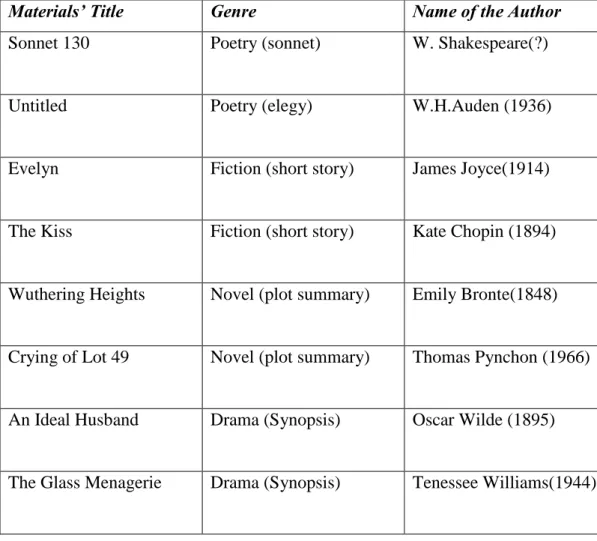
Table 4.1. The Literary Selection………156
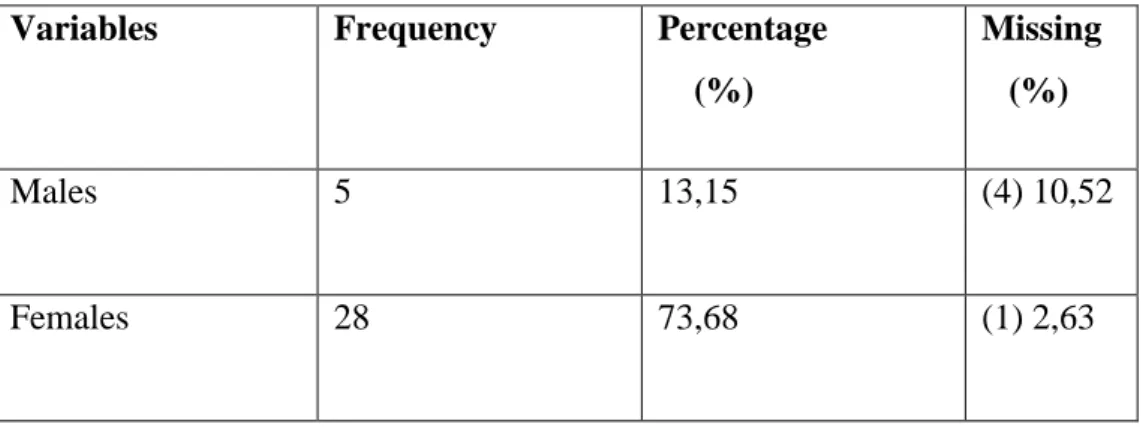
Table 4.2. The Subjects………158
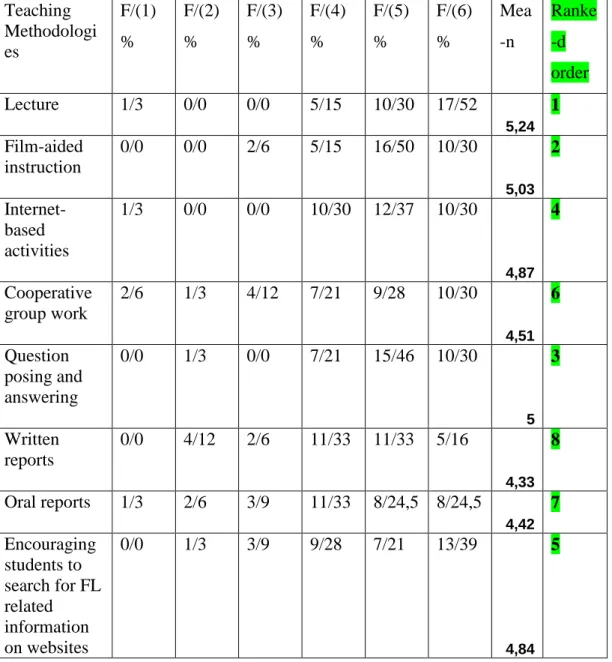
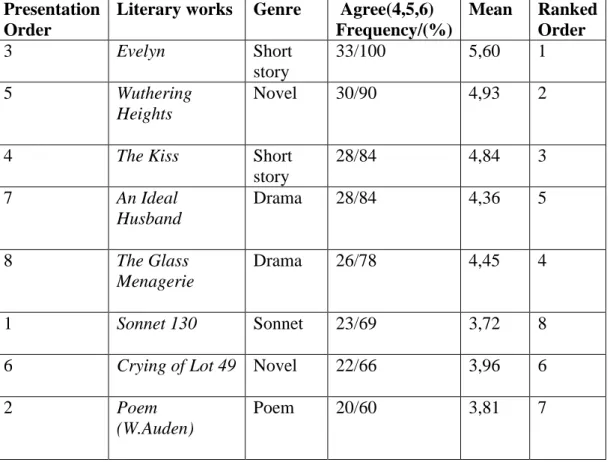
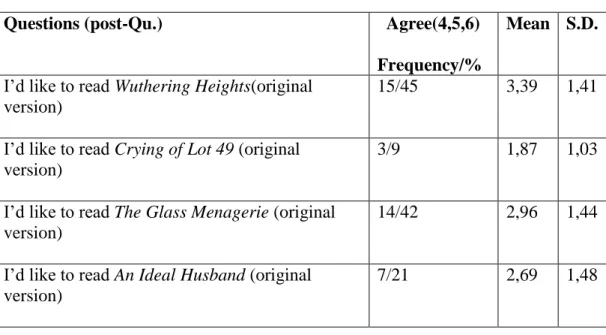
Table 4.3. Pre-and-Post Attitude toward Foreign literature subject status at university level and its Proper Hour Allotment………..159 Table 4.4. Preferred Teaching Methodologies………..162 Table 4.5. Literary works students like most in the literary selection………..165 Table 4.6. Descriptive Statistics of Students’ Perceptions of Literary genres in the Presentation………...167 Table 4.7. Descriptive statistics of Questions X-X1………169 Table 5.1. Mean Evaluation of The Confession and Letter from the Understudy after first and second reading………...199 Table 5.2. Grand Mean Evaluation of Four questions’ Depth of Appreciation in The Confession………201 Table 5.3. Grand Mean Evaluation of Four questions’ Depth of Appreciation in Letter from the Understudy………..203 .
Table 5.4. Mean Evaluation after First and Second Reading for Ten participants………205 Table 5.5. Some Participants’ Written Protocols………..208 Table 6.1. Illustration of the questionnaire responded to by the evaluators and foregrounding analysis of all the segments of The Kiss ………...242 Table 6.2. Analytical Framework for Affect………260 Table 6.3. Coding for categories of language affect……….261
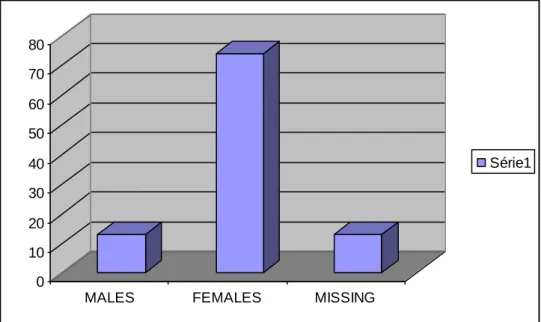
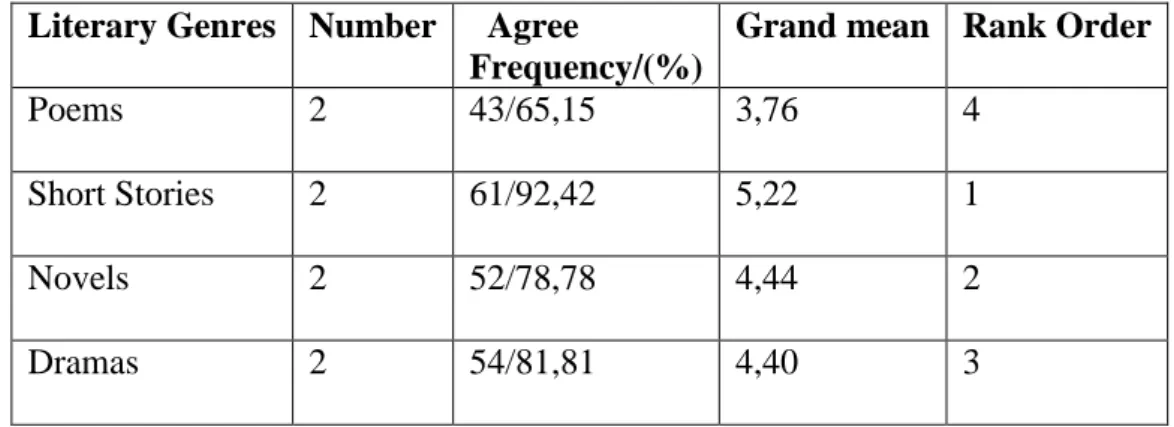
Figure 4.1. Gender distribution of the experiment’s participants………159 Figure 4.2. Rank order of most preferred Teaching Methodologies from 1 to 8…….163 Figure 4.3. Grand Mean Distribution of most Preferred Literary Genres………168 Figure 5.1. Grand Mean Overall Evaluation of First and Second Reading of The
Confession………..203
Figure 5.2. Grand Mean Overall Evaluation of First and Second Reading of Letter from the Understudy……….204
Figure 5.3.Mean Evaluation of first and second reading of The Confession for each participant………..206 Figure 5.4. Mean Evaluation of first and second reading of Letter from the Understudy for each participant………206 Figure 5.5. Grand Mean Overall Evaluation of The Confession and Letter from the Understudy after First and Second Reading………..207 Figure 5.6. Number of Words of three Participants’ Protocols after First and Second Reading………..211 Figure 6.1. Linguistic-psychological-aesthetical cycle of refamiliarization …………238 Figure 6.2. Evaluators’ Distribution of Foregrounding Features per Segment in The
Kiss……….…...255
Figure 6.3. Readers’ Mean Importance Distribution per Segment In The
Kiss………. ………..256
Figure 6.4. Comparison between the Evaluators’ distribution of Foregrounding features per Segment and Readers’ Mean Importance Distribution per Segment in The
Kiss………258 Figure 6.5. Protocol 2………...262 Figure 6. 6. Protocol 1………..263 Figure 6.7. Protocol 3………...264 Figure 6.8. Protocol 4………...266
Appendix I. Pre and Post Course Questionnaires………300
Appendix II. The Literary Selection………..………..305
Appendix III. Letter from the Understudy and The Confession………..321
Appendix VI. Post Test (1) & (2)……….327
Acknowledgements………...II Abstract………....IV List of Abbreviations………V List of Tables……….…..VI List of Figures….………...VII List of Appendices………....VIII Contents……….. IX GENERAL INTRODUCTION……….…16
CHAPTER I. THEORETICAL REVIEW OF READER RESPONSE
THEORIES
Introduction………...26
I.1. Reader-response criticism vs. Reception theory ………28
I.2. Theoretical review………..32
I.2.1. Norman Holland………..38
I.2.2. David Bleich………42
I.2.3. Stanely Fish……….46
I.2.4. Wolfgang Iser………..50
Conclusion……….53
I.3. The Limitation of the theory………...54
Introduction………...54
I.3.1. Literature and Professionalism: danger then decline………...56
I.3.2. The Myth of the canon……….64
Conclusion……….68
CHAPTER II. THE LIMITATION OF INTERPRETATION
Introduction………..70II.2. Cognitivism………...75
II.3. The Limitation of Interpretation and the need to transcend it...79
II.4. Literariness………81
Introduction………...81
II.4.1. CP & Literariness………...85
II.5. The Absence of Feeling………88
II.6. The Role of Feeling in the Comprehension of Literary Narratives………...……92
II.6.1. Schema Theory………...92
II.6.2. Graesser’s Model (1981)………93
II.6.3. Semino’s Model (1997)………..97
II.7. Defamiliarisation………...99
Conclusion………...100
CHAPTER III. ON THE NEED OF BECOMING EMPIRICAL
Introduction……….102III.1.1. Background……….102
III.1.2. Reviews of Literature in Response to Literature……….104
III.1.2.1. Loban’s Study (1948)………...104
III.1.2.2. Cooper’s Study (1971)……….106
III.1.2.3. Purves & Beach’ Study (1972)………107
III.1.2.4. Hanson’s Study (1973)……….108
III.1.2.5. Petrosky’s Study (1977)………..109
III.1.2.6. Appelebee’s Study (1977)………...109
III.1.2.7. Galda’s Study(1983)………111
III.1.3.1. Shortcomings………112
III.2. Empirical Theory of Literature and Actual Readers’ Responses………...113
III.2.1. Reasons………...116
III.2.2. Theoretical Issues………117
III.2.5. Schmidt and Constructivism………...124
III.2.6. Shortcomings………..127
III.2.7. Miall & Kuiken’s Empirical Method……….129
Conclusion………..114
CHAPTER IV. LITERARY READING IN AN EFL CONTEXT: AN
ALGERIAN EMPIRICAL EXPERIMENT
Introduction……….132IV.1.1. A Review of the Major Approaches and Theories Implemented in an EFL Literature Context………...134
Conclusion………...140
IV.1.2. The status of literature in the syllabus of English language as taught in Algerian universities………..140
IV.1.3. Uses of Literature in the Foreign Language Classroom……….141
IV.1.3.1. Linguistic Development………..141
IV.1.3.2. Personal Involvement………..142
IV.1.3.3. Cultural Enrichment………142
IV.1.4. Foreign Literature Syllabus in the Algerian Degree of English Language: Some Bitter Truth……….143
IV.1.5. Selection of Literary Texts: Some Criteria (EFL Context)………147
Introduction……….147
IV.1.5.1. Objectives through the Selection of Literary texts………..149
IV.1.5.2. Literary Text Selection………150
IV.1.5.3. Background of the Research………150
IV.1.5.4. Short Stories: Why Modern Ones?...152
IV.2. Demonstration………153
IV.2.1. Method………153
IV.2.2. Research Questions……….153
IV.2.4. Teaching Materials………..155
IV.2.5. Teaching procedure………156
IV.2.6. Instrument………..157
IV.2.7. Results and Discussion………...159
IV.2.7.1. Students’ Attitudes………..159
Conclusion………..171
CHAPTER V. LITERARY COMPETENCE: KEY ELEMENT OR NOT IN
AN EFL CONTEXT?
Introduction……….173V.1.1. Literary Competence seen in the Light of the Impact of the literary Language on the Reader……….174
V.1.2. Hypothesis………177
V.1.3. Genre Convention and its Role in Interpretation………...177
V.1.4. The Manipulation of Genre………..183
Conclusion………...185
V.2. Demonstration……… 186
Introduction……….186
V.2.1.Interpretation in the Light of Literary Processing: Dixon and al. Empirical Concepts.. ……….188
V.2.2. Who is the Empirical Reader?...188
V.2.3. What is a Population of Readers?...188
V.2.4. What is a Measurement?...190
V.2.5.Background………...192
V.2.6.Rereading: A Discovery in Itself………..194
V.2.7.Experiment………197
V.2.7.1.Population and Sample………...198
V.2.7.2. Measurement Procedure………198
V.2.7.2. B………....203
V.2.8. Some participants’ Written Protocols………..207
V.2.9. Results and Discussion……….211
Conclusion………...213
CHAPTER VI. FOREGROUNDING IN THE RESPONSE TO LITERARY
TEXTS: AN ALGERIAN EMPIRICAL EXPERIMENT
VI.1. Theoretical Background……….217Introduction………...217
VI.1.2. Assumption of the Analysis………217
VI.1.3. Foregrounding………219
VI.1.3.1. Definition……….219
VI.1.3.2. Properties………...220
VI.1.4. Evolution of the Theory………..221
VI.1.5. Literature review of Foregrounding Theory Use in Practical Studies………224
VI.1.6. Foregrounding: the theory between a highly promising future and limitations…..230
VI.1.6.1. Discussion………230
VI.1.7. Foregrounding and its Effects………232
VI.1.7.1. Foregrounding responsible for Strikingness………232
VI.1.7.2. Foregrounding generating Affect………233
VI.1.7.3. The Relationship Foregrounding/ Reading Time……….234
VI.2. Demonstration………236
Introduction……….236
VI.2.1. Methodology………...239
VI.2.1.1. Participants………..239
VI.2.1.2. Methodology Procedures………....240
VI.2.1.3.The Kiss: The Short Story………241
VI.2.1.4. Research Tools………...253
VI.2.2.1.A. Results and Discussion………255
VI.2.2.1.B. Results and Discussion………258
VI.2.3.1 Investigating the process: Qualitative Analysis………...262
VI.2.3.2. Discussion………267 Conclusion………..268 GENERAL CONCLUSION……….271
BIBLIOGRAPHY
………281 Appendix I………..300 Appendix II…...………...305 Appendix III……..………321 Appendix VI…………..………327 Appendix V………329 Abstract in Arabic……..………...333 Abstract in French…….………...334It is commonly agreed that reading literary texts contributes to enlighten and civilise the minds of its readers. Western traditions of literary reading, more particularly, have elevated the reputation of this process; making of it unique in its ability to violate the familiar vision of the real world. Unfortunately, these arguments no longer carry the conviction they used to have because these modern theorists hold an arbitrary set of assumptions to distinguish between literary reading and other kinds of readings. Reader-response theorists, for instance, from I. A. Richards to the most contemporary ones, have succeeded in advancing an interesting range of theoretical proposals on the issue at stake while considering literariness a social convention, a harassing point, as it were! Yet, those readers, far from Fish or Holland‟s views, still consider the experience of literary reading a unique moment, so, on which ground do these readers value the experiences that literary reading offers as distinctive? Is it actually socially bound?
From among the various discussions I had with my students and later participants in this investigation, I could deduce that reading literature is seriously endangered, both in academic and non-academic settings. When asked what image literary scholarship had in the students‟ minds, the answer was disappointing: no particular thought, few pompous names were collected with the least of details. While this study is not another lament for the decline of literary studies, I will make my own complaints about the treatment of literary reading by contemporary theorists and how the latter fail to consider the particularity of foreign language contexts.
The starting point of this study points out an interesting number of personal observations I could collect through the several years of my literature
teaching at university. The experience, as actually taking place, seems to hold no promising prospects. At least these were my impressions since my early moments of the teaching experience. At the beginning, I questioned my ability to transmit some aspects of the subject, and to a certain extent it was a daily challenge for me to go beyond my capacities and surpass different obstacles in dealing with literature in front of students whose knowledge of the subject was very meagre. Yet, challenging myself was not enough. As my self-confidence acquired more maturity, as my frustration grew deeper. I first attributed the obstacles encountered to my personal immature experience, but then I noticed that despite the efforts made and the extensive readings and the continual research, literature subject remained unwelcome by my students.
With the assumption that literature facilitates the acquisition of a foreign language, English language in our case, and with the assumption that literature represents the repository of morals and values of the other that are necessarily reflected through the foreign language, I found and I still find it very odd that our students, Algerian ones then, feel rebutted and alienated when dealing with literary texts in English language, at such an extent that if offered the opportunity not to attend literature lectures, they would not. Actually what helped me conclude that literature is really not appreciated among learners of English as a foreign language is the alarming number of fourth year students willing to read for memoirs in literature, regardless of the kind of literature? Hence, my curiosity to discover the reasons behind grew steadily and stimulated my research in this direction.
Despite the huge number of investigations about the fate of literature in foreign language contexts, very few studies have attempted to examine the experiences of these actual readers, considering them most of the time too idiosyncratic to deserve worthy attention. Rather than speculating about the effects of reading, as traditional reader- response theories have attempted to propose for instance, the acute examination of these readers and their involvement while engaging with literary texts in a foreign language context deserves, to my sense, more attention.
Questions as: Are all kinds of readers idiosyncratic? What does it mean to engage empathically with a character in a novel? Is there such a quality as literariness? Do sound structures in literary texts systematically influence readers? Does reading literature perform some function for us that no other experience can provide? represent some of the issues that remain very obscure within the field of literary reading as traditionally perceived, both in the native and non-native language contexts. Hence, my turn towards an empirical approach could be justified by the collection of evidence from the examination of actual Algerian university readers of texts of literature in English. It goes without saying, on the other hand, that the present study does not aim at dismissing the importance of theory in the field. On the contrary, it is motivated by a will to sustain theoretical propositions with empirical investigations, for no one could exist without the other. Both are required in order to establish significant insights into the nature of literary reading.
Thus, what is distinctive about the present approach? And what does it tell us about literary reading that we did not already know? I will attempt to indicate
the objectives of this study by an overall description of some of the major issues and their empirical implications.
My concern will fall on the examination of university readers of literary texts in English, since my experimental work is built on the voluntary participation of students of English language willing to experience the assumptions raised by my research. In this view of things, I suggest that in contrast to the contemporary view that literary reading depends upon the acquisition of the appropriate conventions, literariness is manifested by the special nature of the interaction between reader and text. Put differently, and while I do not dismiss the relevance of literary convention, I assume that literary texts‟ effect on readers is responsible for their literariness, and that could be attributed, to use the Russian Formalists‟ claim, to the identification of some formal features that appear to be confined largely to literary texts.
Second, as it has been pointed out by numerous investigations in the past, learners‟ responses to literature were primarily studied in the cognitive domain attempting simply to measure readers‟ knowledge or comprehension of a literary selection in terms of what is known about cognitive functions such as schemata and frames, figure and ground, theory of the mind, and the like. Research in response to literature in the affective domain seemed and still seems to be a sensitive area of exploration. Therefore, the purpose of this study will be to extend our store of knowledge of response to literature in the affective domain by describing the responses of Algerian university readers to a literary selection of texts in English language. Indeed, this same study aims to demonstrate whether
literary response springs from capacities that are intrinsic to the reader, as held by Miall & Kuiken (1994a), or from other predispositions?
Third, assuming that most readers aim at an understanding of what they read, the approach I am advocating favours an experience of literature rather than its interpretation. ( Miall & Kuiken, 2002; Miall, 2005; Danaher, 2006) To focus on experience, therefore, would imply the depiction of responses to literary texts that emerge from personal interactions with these same texts. In other terms, the distinction experience vs. interpretation allows to distinguish between those ordinary and actual readers interested in the mere significance of literary texts they read and those scholars whose primary besetting preoccupation is to interpret these same texts. The attention to experience in an EFL context also provides specifically for an empirical approach, since it prompts us to ask what experiences of literary reading Algerian readers of texts in English have, and to what extent these are distinctively literary.
Fourth, I assume that the cultural differences which distinguish the Algerian readers from the texts they are reading are not responsible for this lack of appreciation and more dangerously for this indifference, for how could it be explained that these same learners do appreciate all that represents the other; the foreigner like its music, its fashion, and its language. I can advance, and in spite of their rarity, that across these teaching years, I have met very enthusiastic learners who actually attended my literature classes with great pleasure, an indication that other barriers appear to hamper the teaching of this literature in a foreign language not necessarily related to its cultural associations.
Thus, the investigation will be conducted then under the following assumptions:
1- The classroom is considered an appropriate research setting.
2- The literary texts selected for the investigation are unfamiliar ones of high interest and accessible vocabulary to all readers.
3- The literary texts selected are segmented textually to analyse the response of readers to the different deviations of language.
4- Readers‟ cultural background does not restrict their appreciation of the literary texts in the foreign language.
5- Literary discourse has a particular effect on the mind, refreshing and changing readers‟ mental representations of the world (Cook, 1994; Semino, 1997; Hakemulder, 2004) and feeling is a central part in the constructive work required by readers of literary texts (Miall & Kuiken, 1994)
6- Readers‟ literary competence is not necessary for the fulfilment of the research. (Van Peer, 1986. Miall & Kuiken, 1994; Fialho, 2007)
The issues raised above, then, motivate the discussions on offer throughout the dissertation and aim at answering the following questions:
1- What are the Algerian students‟ attitudes toward literature in English at university?
2- What are the teaching methods and activities Algerian students like the
most at university?
4- Are all kinds of literary texts able to generate an appreciation in the Algerian reader?
5- Is literary competence necessary for an Algerian reader to appreciate a text of literature in English?
6- Is foregrounding responsible for generating response in Algerian readers of literary texts written in English?
7- Which kind of feeling does foregrounding generate in these readers?
Overall, the first part including the first three chapters is designed to provide a survey of the theories, issues and methods that I have found important in my work. The reader unfamiliar with the empirical approach I am favouring in this work might wish to understand the reasons that have contributed to shape this line of thought from my own perspective. The second part including the three last chapters offers accompanying empirical experiments to all the theoretical concepts I have aimed at considering in an Algerian university context.
The first chapter entitled “Theoretical Review of Reader Response Theories” is not presented as a mere review of the most prominent theoretical contributions in the field of Reader response theory, rather it is aimed at pointing the limitations of this theory despite its central focus on the reader.
I start by arguing that literary works should be considered as no more than a form of language, thus, I point to the narrowness of reader-response theorists‟ view of language, which does not appear to provide satisfactory elements in the understanding of literature, especially in an EFL context.
In the second part of this same chapter, I point to the discrepancies of the Reader-response theory as it has traditionally been implemented in the teaching field and aim at discussing the reasons behind its decline.
Finally, I point to the role and place of the canon within literature and put the emphasis on the dangers of perpetuating these texts at the expense of failing teaching and learning experiences. This last issue is of a particular interest to my study since it remains among the most triggering questions that I raise and on which I will conduct an empirical experiment.
In the next chapter, “The Limitation of Interpretation,” I consider in some detail the problem of interpretation and its limitation, and appeal to the evidence of one of Henry James‟ short stories. In “The Figure in the Carpet” the search for the „figure‟ embedded in the literary text appears as an unreachable end and presents itself as an illusion. I point further to the contribution of the innovative cognitive poetics approach which carried on serving the objectives of interpretation. I point also to the disregard of feelings in the mechanisms of reading literary texts and how the latter are necessarily needed to complete cognitive processes already advanced by the proponents of schema theory.(Graesser, 1981; Cook, 1994; Semino, 1997)
In the third chapter, “On the Need of becoming Empirical,” I point to several studies which focused on the use of various methods of evaluating response to literature and populations of subjects. In this same review of earlier empirical works in North America, I aim at showing those researchers in the field as being primarily concerned with improving educational practices at the expense of mere literary appreciation. Then, I point to the need to reach a theoretical
consensus among scholars combining earlier empirical theories on literature with future expected satisfactory implications. Hence, I expose the empirical contributions of major researchers in the field as Groeben and Schmidt and point to the originality of Miall & Kuiken‟s approach and its possible relevance in an EFL context.
In the fourth chapter entitled: “Literary reading in an EFL context: an Algerian Empirical Experiment” I start by describing the major popular approaches implemented in the teaching of literature in EFL contexts thus highlighting the prominence of stylistic approaches in generating an affective engagement from the part of readers. I carry on by describing the status of literature in the syllabus of English at the level of the Algerian university and how the latter suffers drastically, both from the part of the teacher and the institution. In the second part of this chapter I propose an empirical experiment through which I aim at drawing a profile of the students/readers at university, their attitudes, their preferences and their expectations. The objective of this first stage is to depict students‟ predispositions in engaging with literary texts in English.
In the fifth chapter “Literary Competence: Key element or not in an EFL context?” I begin by reviewing scholars‟ views on the necessity for readers to be literary competent in order to engage with literary texts. However, I also put to the fore some empirical investigations which already demonstrated the importance yet not the necessity to posses neither literary nor generic competencies to appreciate literary texts. I propose, then, another experiment to be conducted on the same participants of the earlier stage. In it I expose the participants to two short stories, one canonical and another more contemporary, following a Rereading paradigm
as devised by Dixon and al. (1993) and whose objective is to measure the depth of appreciation of both short stories and proceed later to a concluding comparison.
In the last chapter entitled: “Foregrounding in the response to Literary texts: an Algerian Empirical Experience” I start by explaining the concept of foregrounding, its theoretical evolution and most importantly its implementation in practical studies like the ones of Van Peer (1986) and Miall & Kuiken (1994a) and others. Then I point to the limitation of the theory as advanced by some scholars. In the next point, I point to the effects of foregrounding and highlight one study in particular because the latter points out the crucial effect of affect in the response to literary texts. In the second part, I propose a third experiment made of two stages. In the first stage I expose an original and a segmented version of the short story The Kiss to both students and evaluators and proceed to a comparison about their respective findings. Finally, in the last stage, I collect the written protocols of the same students and devise the kind of feelings they have used while engaging with the literary text. The objective from this experiment is to measure the impact of foregrounding on Algerian readers of literary texts in English and the kind of affect the latter generates in these same readers.
Introduction
Whether oral or written, the productions of literature are meant to be interpreted, for meaning seems to represent the objective for which readers and critics strive to reach whatever the approach used. Yet, one noticeable feature is the fact that up to the present moment research in the domain has not agreed upon whether literature is ranged within a particular kind of discourse with special distinctive properties or simply is the result of a set of cultural conventions which have been institutionalised.(Miall, 2000: 321) For a very long time, the literary text has been approached from various perspectives, but which can be in fact, included within one of the two major traditions: either a hermeneutic approach, centred on the text or a contextual approach, which deals with the external factors that have contributed to the production of that literary text.
Relatively new, reader response theory, however, has revolutionised the already established traditions; in that, it has placed readers at the centre of interest and claimed the no more passive role they should have. This same theory has been used to describe a multiplicity of approaches which focus on the reading process. Put differently, this theory highlights the active role of readers, questions sharply the autonomy of the text, and insists on the construction of meaning rather than its discovery.
In the 1960s, Hans Robert Jauss, a German exponent of reception theory1 and a precursor to reader response theory, used the term “horizon of expectations” to deny the universality of meaning. He stated that literary texts should be interpreted according to the period in which they were written and as such readers
1 In the following part of my discussion, I will explain the conceptual difference between
over time would build new meanings which might largely differ from the intention of the author at the time they were produced (Holub, 1984). On the other hand, another major figure of reader response theory, Wolfgang Iser, held that readers engage in the reading of a literary text using their own values, experiences, and extra literary norms, thus, it is only through “the act of reading” that the text is completed. Therefore, both Iser and Jauss recognised the fact that many readers can produce as many readings as possible of the same text.
In his turn, Stanley Fish suggests that there is no meaning enclosed within a text. It is the reader or more exactly the reading communities, rather, that actually create meaning in the process of reading. Fish has granted readers a more serious responsibility than the one attributed by Iser and considered them as possessing full meaning of the text. In other terms, because of the unstable nature of meaning, Fish claims, the text could not bear it, only the reader could.
Hence, it is noteworthy to state that the proliferation of theoretical and practical investigations has not produced conceptual unanimity on what precisely is reception theory or what is meant by reader response theory. A major difficulty remains perhaps in determining exactly what the two concepts mean and how they overlap. Therefore, I will begin my discussion by pointing out a deliberate distinction between the two theories. This discrimination so far is done on purpose so as to justify the theoretical support selected in this study.
I.1. Reader Response Criticism vs. Reception Theory
How does Rezeption (reception) differ from Wirkung (usually rendered by “response” or “effect”)? Apparently, both terms have to do with the impact of the work on someone and it seems unclear that they can be separated completely; yet, they still represent one of the most persistent dilemmas in the literary community. Actually, the most frequent suggestion has been to view “reception” as related to the reader, while “response” is supposed to pertain to textual aspects and arrangements. (Holub: 1984)
As a striving endeavour to refine terminology, which in fact is not to be neglected or dismissed, theorists have attempted to simplify some of the possible confusions and adopted their own particular policy of definition. For Holub, for instance, “reception theory” refers “throughout to a general shift in concern from the author and the work to the text and the reader.”(1984: xii) He, therefore, used it as an umbrella term which encompassed both Jauss and Iser‟s projects as well as empirical research and the traditional occupations with influences. In her turn, Patricia Harkin used the term “reception theory” to refer to an “inquiry into a text‟s effect on specific classes of readers.”(2005: 411) By specific classes of readers, she addressed women, members of the working class in Liverpool, residents of formerly colonized areas, devotees of George Eliot, persons who enjoy hard-boiled detective stories, and so forth. (2005:411)
Yet, the learner acquainted with recent American criticism2 will be more likely to wonder how reception theory is related to what has become known as “reader-response criticism”. Holub carries on his policy of definition and sees the term “reader-response criticism” as another umbrella term that accommodates systems as diverse as Norman Holland‟s “transactive criticism”, Johnathan Culler‟s “structuralist poetics”, and Stanley Fish‟ “affective stylistics”. Again, it refers to a general shift from the author of the work to the text-reader pole3. More acutely, Harkin defines it as the effort to provide an account of what happens when human beings engage in a process they call “reading”4
. Such accounts are warranted in any of the several disciplines like psychoanalysis, linguistics, semiotics, phenomenology, etc. Harkin‟s understanding of the term seems to offer a closer definition to that of millions of readers, since it attempts to provide tentative answers to the question: “ What happens when human beings encounter written texts?” 5
At a first level of discrimination, Holub appears to separate deliberately the German from the other groups of theorists dealing with similar issues, and explains that a number of important features is at the origin of this categorization. First, he points out the designation itself and which he explains has been applied ex post facto to a number of writers who had very little contact with or influence
2 By recent American criticism, I refer to the bulk of theories that emerged during the late
seventies and early eighties in the U.S. and which in fact gained the credit of being part of an interesting policy of teaching literature while developing an appropriate pedagogy.
3
Interestingly enough, Holub sees W.Iser an exception because ranged among the initiators of both reception theory and reader-response criticism.
4 Harkin (2005) distinguishes between the use of the term « reader-response criticism », a naming
which categorizes such thinkers as Iser, who refers to a reading of a given text or texts, and the use of « reader-response theory » which refers to a general account of reading.
5 Harkin (2005) has translated the urge to understand what was nearly in every reader‟s mind. She
Reader-on Reader-one another. They do not form a school of thought or a unified trend; Reader-on the contrary, they seem to have responded independently with their proper methods to quite different predecessors and circumstances. More strikingly, is the fact that some of the critical views which gathered under the same label seem to provide great disparity of position, “if reader-response criticism has become a critical force, as some would maintain, it is by virtue of the ingenuity of labelling rather than any commonality of effort.”(Holub, 1984: xiii)
By contrast, “reception theory” is seen as more cohesive, conscious, and as the result of a collective enterprise. It emerged as a group of effort on both the institutional and critical levels, involving a productive exchange of ideas among its advocates. Besides, many proponents of the theory are associated with the University of Constance, either as professors or graduates6.
Finally, reception theory may be separated from reader-response criticism on the basis of lack of mutual influence. Apart from Iser whose writings received extensive approval among both sides, there has been practically no contact between the two groups.
Therefore, the relative value accorded in the academy to each category is clearly distinguished. It appears implicitly in J. Mashor and P. Goldstein‟s Reception Study when they remark the following:
Since the mid-1980s collections and casebooks have re-examined the reception of Hamlet, Huckdeberry Finn, Pride and Prejudice….to mention just few titles, and major works, including Steven Mailloux’s Rhetorical Power and Reception Histories, Gary Taylor’s Re-inventing Shakespeare, Jane Tompkin’s Sensational Designs, and Peter Widdowson’s Hardy in History, have contributed markedly to Anglo-American reception criticism. Add to this work the reception studies in cultural studies-from Janice Radway’s Reading the
6 The advocates were also participants to biannual colloquia, whose proceedings were published
under the series title Poetik and Hermeneutik. The core group of the participants has contributed most to the reorientation of West German literary theory that has gone under that name.
Romance and Tony Bennett and Janet Wollacott’s Bond and Beyond to Michael Bérubé’s Public Access- as well as work in the history of the book, and it becomes apparent that reception study has been anything but marginal. (in Harkin, 2005:412)
While the issue at stake is not to debate which theory is better than the other, especially if we consider that the similarities in general critical perspective between reader-response criticism and reception theory are ultimately too superficial and too abstract for a merging point, my discussion, will revolve around reader-response criticism because of its pedagogical implications and the impact it has on the teaching field. For the first time, I need to stipulate, and as opposed to reception theory, reader-response theory sought to explain what happens when people read, it made reading teachable (Harkin, 2005:415). In No One Afraid‟s of Wolfgang Iser (1981), Fish points to the ease through which Iser‟s phenomenological account of reading acts could be co-opted into a set of instructions for producing new critical readings. A theory of reading was made accessible to the community of teaching at the expense of a disqualification from “high theory”7
- in the same way writing was to become professionalized8.
Marginalising the power of the authorial intention was not sufficient to provide answer to the question; “how could readers decipher “hidden meanings”?” Actually, there is much credit to be gained by perpetuating the mystery around “the figure in the carpet” by Iser since idiosyncratic readings, which represent the core of the theory of reading, render this same theory teachable- teachable in a way that was in the language of the eighties
7 I am borrowing the term from Harkin, who explains that: “theories disappear- as theories- when
they become naturalized- when they become (apparently) so easy to understand that they no longer serve to demarcate their adherents as more knowledgeable or more intrinsically intelligent than the average person.” (2005: 416)
“empowering”. (Harkin, 2005) To my sense, it is the teachability of this theory which has contributed to its survival, and contrary to Fish, I do see it neither a disqualification from „high‟ status nor from seriousness. Interestingly enough, this same theory was amenable to a variety of courses which emphasized the importance of writing on topics that were literary; hence, the pedagogical aspects of Iser and Fish‟s works, for instance, were examined more practically. The marriage between the literary community and the composition studies has contributed to help students read and write more competently rather than expound or apply the theory. It has also permitted if not obliged early reading theorists whose principal commitment was to absolute literary criticism to associate themselves to its pedagogical implications at the extent of professionalisation9.
Reader-response theory has certainly evolved to the degree of a pedagogical field that dominates the literary community, yet, the achievements should not have been realised at the expense of great theorist‟ actions, which are, in fact, at the origin of the emergence of that pedagogy,
Bleich, Holland, Iser, Rosenblatt, and even Fish told us not merely that readers make meanings but also how. They taught us that accounts of reading acts need not dwindle sets of restrictive instructions in what particular texts mean. From their work, a pedagogy is still recuperable. (Harkin,2005:422)
In what follows, a review of the main reader response theorists‟ contributions, which have allowed the emergence of a theory of reading, is presented.
I.2. Theoretical Review
The argument so far aims at discussing the theory that supports the view that different readers of the same literary work could produce different readings
9 By professionalisation, I refer to those groups of researchers who organised themselves as
associations which share and develop a body of knowledge of its own. (See Richard Ohmann for more information)
and therefore could generate different interpretations. It aims also at speculating on the extent to which that theory could fit an EFL context, where readers are not only different, but also ones dealing with texts of literature in a different language. The first point to highlight is that reader-response theories gain the credit of presenting a multitude of different interpretations as coming from different readers of the same literary texts. They succeeded in holding the conviction that different readers could produce different interpretations, yet, validating the conviction appeared to be a more complicated matter. A.I.Richards (1929) was one of the first practitioners who presented a selection of poems to a group of Cambridge undergraduate students, where he found the results just but “astonishing” in their variety and differences. Some years later, Norman Holland (1975) succeeded in supporting the above view and presented more evidence on the “idiosyncrasy” of responses in his experiment. He experienced the free associations of five readers of Faulkner‟s A Rose for Emily and reached the conclusion that the difference in interpretations reflected each reader‟s patterns of defence and fantasy. In his turn, David Bleich saw that a subjective motivation is at the origin of each individual interpretation and as such explained that responses spring from disharmonious feelings related to the reading experience.
Hence, the most striking point rests in the fact that despite the uniqueness and individuality of the interpretations of the literary works, it seems inherent that those critics would like to see people agree and join them in their understanding of the works. On the one hand, they claim openly that interpretation is proper to each individual reader; while on the other hand, their writings support major trends of understanding which would gather more than one unique reader, as if they want to
generate common interpretations of the same literary work, a controversial issue, as it were.
From this view of things, which to my sense, has contributed to weaken the validity of the theory, I intend to have a close look at the assumptions and analyses of N.Holland, D.Bleich, as well as S.Fish and W.Iser10.
My first assumption aims at understanding literary works and considering them as no more than a form of language. Thus, I see in those theorists‟ view of language a problematic issue which does not offer solid foundation to the understanding of literature.
My second assumption goes to criticise contradictory views of these theorists who seem to present readers forming similar understanding of many aspects of a literary text while neglecting the power of the word in the text.
In “I. A. Richards revisited: Do readers agree in their interpretations of Literature?” (Martndale & Dailey, 1995), Richard‟s experiment was reproduced on 32 psychology11 students who were asked to read the same poems. After 3mn reading, the results showed a high degree of agreement. (1995: 304) In the second part of the experiment, 11 psychology students were asked to read three of the poems by Richard‟s selection and write a short essay on each poem. The results were analysed by a computer as well as by the researchers who concluded that, “most people extract a similar meaning or gist from a poem.”( 1995: 307)
10 I have not included Louise Rosenblatt‟s Literature as Exploration, originally published in 1938,
since my interest falls on theorists‟ contributions after the 1970s and in spite of the popularity of her work which offered critics and even the community of teachers‟ insights on how meanings are constructed and contextualised by readers.
11 The participants of the experiment were undergraduate women selected from psychology
departments and not literature ones in order to demonstrate that ordinary readers as opposed to professional ones are those readers to whom Richards directed his experiment.
Far more interestingly, a similar study to the one by Martindale & Dailey was conducted by Therman (2003) and whose aim was to show, on one hand, the weaknesses of Richards‟ study, and on the other hand, the possibility to reinforce and supplement the study by the introduction of some prose texts. Actually, the selection of prose texts rather than poetry ones would offer a larger spectrum of responses, particularly to the learners of texts of literature in a foreign language12. In addition, I see in Therman‟ study one of the first attempts to make non native readers meet texts of literature in a foreign language and point out some of the weaknesses of Richards‟ study.
After having repeated the experiment of Martindale & Dailey on herself, Therman ran through two problems. First, she discovered that she did not have ready criteria for assessing the poems through the terms of the rating “static”, “tense”, or “strong”, and saw that it would have been more appropriate to read and analyse the various problems, and only after having proceeded to a comparison that she could say which kind of poem it is. Unfortunately, the time frame did permit such a procedure (3mn). The second problem was due to deficiencies in language skills from her part, yet, she did not forget to notice that even Richards‟ students, native speakers then, ran through similar difficulties in understanding the poems, and even those of Martindale & Dailey reported the same difficulty. She concluded then, that similarity in rating (choosing the same answers among the proposed ones) does not necessarily reflect similarity in opinions, thus these similar solutions could in fact be the result of the same reaction to the difficulties
12 From a personal experience of a teacher of literature, experiencing poetry has always proved to
be a fastidious exercise which could be accessed by very few minds. In addition, reading poetry is seen by a majority of approaches, whether stylistic, formalist or conventional, as constraining and being the property of a particular class of advanced learners. (See Hanauer, 1998 for more
in understanding the poem. While analysing the second part of the experiment, she understood that there is much advantage to be drawn from the freely worded responses of the students. These responses seem to offer a wide range of explanations to the difficulties readers encounter while reading the literary texts. For instance, which kinds of associations to personal life readers do while interpreting the text? Which kind of external or internal factors affect interpretation? Which kind of details in the text form the interpretation of the reader?...
I have chosen to examine the theories of N.Holland, D.Bleich, S.Fish, and W.Iser because to my sense they offer influential insights in the understanding of literature. Besides, these theories rest on four different approaches to explain reader-response criticism and appear interesting in the sense that each theory influenced the other and contributed to its growth. They are also interesting because of their assumptions related to the nature of language and the mechanisms that make communication possible.
Hence, explaining what is meant by interpretation, formal feature, objectivity, and idiosyncrasy is necessary.
When reading texts, we necessarily form an understanding of a multitude of things in the text and we do it at the same time. Everything is intertwined and mixed up in a flow of questions: What is behind the character‟s behaviour? What does he aim at? And Why? Why has the writer chosen such an environment?... Hence, a multitude of possibilities is considered and that despite the fact that we are not obliged to choose among.
We also necessarily proceed to an evaluation, how is the language of the text? Its composition, the characters, and what about the author? Thus, “interpretation” appears as an act of “construction” of an understanding among so many different possibilities. Not surprisingly, all of Holland, Bleich, Fish, and Iser highlight interpretation as an act of construction by the reader.
In his early works, Holland advanced that perception involves a subjective and “objective” component because people make use of the world around them to
recreate their personal identity, while in his later works the main argument revolves around readings as being products of unique brain processes and how the latter cannot be achieved out of external reality. In his turn, Bleich suggests that readers can only know their own symbolisations of objects, and that urges us not to confuse these with real objects, which presumably we cannot know. Fish argues that readings cannot be objective because they are always tied to a particular point of view, but they are not subjective either because all available points of view are socially bound. (1980:335)
Fish seems to refer to some absolutely neutral point of view outside a particular social frame when he hints about “objective”. More interestingly, Holland and
Bleich join Fish and argue that our knowledge is always limited to our point of view, while Iser seems to believe that literature is one means of freeing us from this point of view in order to gain new knowledge and holds that the moment we stop reading and building images, we “find ourselves detached from our world, to which we are intrexicably tied, and able to perceive it as an object”(1978: 130), another contradiction it is, that which makes Holland, Bleich, and Fish point out the subjectivity of the literary response, and which, in fact, abandon the term
objective from its use. Besides, and again because the point of departure of this discussion which supposed an ambiguity behind the similarity in the readers‟ responses, we suggest that text are objective entities. Thus, even if readers differ in the process used to construct an understanding of a text or simply perceive it differently, they may agree on its outcome, because simply their perceptions are built and depend on common social definitions and criteria.
Central to Fish‟ argumentation, the term “formal feature” is defined as the
points at which he would declare readers to have produced an interpretive act. (1976:476) In other words, since the points which have enabled readers to shape their interpretive act could only be identified by referring to words, the term “formal feature” may be seen as referring to words and the properties of arrangements of these words.
To end with concepts central to this discussion, the term “idiosyncratic” is often used by Holland and Bleich. The former suggests that perception relies on idiosyncratic processes while the latter argues that people have idiosyncratic language systems. Following the above definitions of the term idiosyncratic, it appears that neither the language nor the process is common to two readers, on the contrary, it is peculiar to each person and could be then very unique.
I.2.1. Norman Holland
Holland aimed at answering the question: Why do people interpret the same text differently? (1975). His first assumption rests on Freud‟s theory of psychoanalysis which he sees a good basis for understanding literature. His second assumption is that each individual has a unique unchanging core that
guides all his dealings with the world. (1975: 53) This core consists of strategies with which the individual tries to gain maximum pleasure and ward off anxiety caused by conflicts between desires and demands of reality.(1975:55) These strategies remain the same throughout life, and Holland suggests that the constancy arising from them could be called the “identity theme”.(1975:56)
After having conducted a series of experiments on students‟ responses to a story after having read it, he concluded that reading is governed by four principles:
1- style seeks itself
2- defences must be matched 3- fantasy projects fantasies
4- character transforms characteristically13
In this research (5RR), Holland suggests, on one hand, that texts are just dead signs “specks of carbon” (1975:12), which each reader moulds to fit the dictates of his or her unique defences and fantasies. On the other hand, he suggests that texts represent something shared; he called “a sharable promptuary”. (1975:282) Thus, Holland seems to attribute differences in responses to the differences in the reader‟s characteristic strategies for avoiding anxiety and seeking pleasure while the similarity would be due to “the sameness used to create the experience”.(1975:247)
13 First, the reader responds positively to a work or a part of it only when the latter fulfils his or her
hopes towards the work. Second, the reader must find in the work something that corresponds to his or her way of defending against anxiety. Third, from the material that has matched his or her defences; the reader will create his or her typical wish-fulfilling fantasy. Finally, the reader will
Yet, there seems to be aspects in Holland‟s work that could be challenged. Bleich, for instance, sees it unclear how Holland has determined what in a response represents defence and what determines fantasy. In other terms, Bleich criticises the use of personality tests which he considers as inconclusive and lacking persuasiveness in the result. For Bleich, the personality tests could not provide an independent reference point as Holland seems to pay little attention to the similarities in the answers of his students.
The second question Holland has raised is: What weight should we give to the unique aspects of responses? In other words; how are we to say whether the responses are unique or similar, is there a means?
In “A Rose for Emily” by W. Faulkner, Holland failed to explain the existing similarities in the answers of the readers depicting the “tableau”.14
More exactly, Holland seemed to have deliberately concentrated on the idiosyncrasy of the readings and as such saw them the result of personal strategies. He seemed to have dismissed the similarities of the answers which could actually have shown the weaknesses of his own study. Therman(2003), in her turn, wonders whether it would be possible to explain how readers, who were different in defences and fantasies, assigned similar intellectual content to the word “horsewhip”15? Thus, in his failure or more exactly the failure of his theory to explain the similarities in responses, Therman proposes, instead, the view of L.Wittegentein, which suggests
14 In 5RR(1975), Holland was interested to see how each reader interpreted what might the image
of the “tableau” mean. Interestingly enough, all readers and even Holland himself considered the tableau as an indication of what relationship between the father and the daughter was like, an indication, as it were, of an existing similarity among readers that Holland deliberately dismissed.
15 All readers of the experiment made relevant converging remarks around the horsewhip and
that responses could come from habit, training, shared rules, and common understanding of human beings16.(2003:89)
Hence, in The Critical I (1992), Holland realises that similarities in responses should have deserved more attention than he had devoted in his earlier work. Identity is still central to his research, but instead of being the unique core of strategies used to gain pleasure and defend against anxiety, he defined it more trivially as: “a construct, a way to represent the continuities we see in someone.”(1992:27) Most importantly, he goes to advance that identity governs a person‟s cognitive processes to build his responses while reading the literary text. (1992:28) Holland comes to realise, then, that words in themselves do not mean but people bring them to mean through mental processes of hypotheses formation, which are governed by identity. The rules of determining the meaning of a word are shared and rigid but their application varies, “words mean different things to different people.” (Therman, 2003:19)
Holland‟s main shortcoming appears in the triviality of his explanation while making the reader sole responsible for the interpretation of the rule. Can a conventional interpretation reflect various identities? Is it sensible to try to explain it with identity rather than convention?
Interestingly enough, Holland‟s view makes us necessarily think about the polysemy of words- when Wittegenstein explains that a word does have different uses, depending on the context of use, and if ever used out of context, it necessarily means different meanings that do not suggest that two readers are likely to generate two different meanings of the same word and thus produce two
different responses.17 Indeed, Holland‟s view of language appears ambiguous and misguiding. Initially, he suggested that words are essentially “dead specks of carbon” which gain meaning from the readers‟ mental operations. Later on, he included the notion of culturally shared rules for determining the meaning of words but every one applies them differently. Despite the fact that his assumption about language carries a shared basis of language, I think that it is insufficient to assign meanings to words according to the readers‟ psychological defences and fantasies rather than a common logic in applying the rules of determining the meaning of words, and which in fact implies the prominent role of convention in the interpretation of literary texts. Possibly, these psychological strategies could determine the meaning of words on the page and therefore deviate from the convention, but only exceptionally.
I.2.2. David Bleich
Bleich‟s argumentation is summed up in the idea that all knowledge, whatever its nature, has a subjective motive.(1978: 65/69) He advances then, and after having examined the works of Freud on the interpretation of dreams, that rather than disclosing the actual cause of a dream, an interpretation reveals the interpreter‟s motive to join that interpretation.(1978:79) Hence, Bleich concludes that interpretation, in general, is,
motivated and organised by the conscious desires created by disharmonious feelings and/or self-images; the goal of these desires is increasing the individual‟s sense of psychological and social adaptability. (1978:83/4)
17 I support Wittegenstein‟s view which suggests that an association reveals the meaning of a word
under the assumption that understanding is a matter of associating a word with its referent, and the object a word stands for its meaning.(For more information, see Therman (2003: 8/12))