Publisher’s version / Version de l'éditeur:
Media Divides: Communication Rights and the Right to Communicate in Canada, pp. 145-174, 2010
READ THESE TERMS AND CONDITIONS CAREFULLY BEFORE USING THIS WEBSITE.
https://nrc-publications.canada.ca/eng/copyright
Vous avez des questions? Nous pouvons vous aider. Pour communiquer directement avec un auteur, consultez la
première page de la revue dans laquelle son article a été publié afin de trouver ses coordonnées. Si vous n’arrivez pas à les repérer, communiquez avec nous à [email protected].
Questions? Contact the NRC Publications Archive team at
[email protected]. If you wish to email the authors directly, please see the first page of the publication for their contact information.
NRC Publications Archive
Archives des publications du CNRC
Access and use of this website and the material on it are subject to the Terms and Conditions set forth at
Internet
McIver Jr., William J.
https://publications-cnrc.canada.ca/fra/droits
L’accès à ce site Web et l’utilisation de son contenu sont assujettis aux conditions présentées dans le site LISEZ CES CONDITIONS ATTENTIVEMENT AVANT D’UTILISER CE SITE WEB.
NRC Publications Record / Notice d'Archives des publications de CNRC: https://nrc-publications.canada.ca/eng/view/object/?id=e809742e-a1d6-423f-a987-d13e5707b3a5 https://publications-cnrc.canada.ca/fra/voir/objet/?id=e809742e-a1d6-423f-a987-d13e5707b3a5
CHAPTER 7
Internet
William J. McIver, Jr.1
The analysis of communication rights -- or a unified right to communicate -- in
the context of new information and communication technologies (ICTs) is continually
confronted by two situations. First, certain aspects of new ICTs may reproduce an
existing mode of communication about which potential threats and violations of norms
are well-understood. For example, the applicability of privacy protections to
Internet-based telephony can be seen as a natural extension of the norms around previous forms of
telephony.2 Second, a new ICT is also likely to produce potential modes of
communication, interactions, or conditions that were not contemplated during its design.
Such potentials are referred to as “affordances” in human-computer interaction and
design research (Norman 2002). A new ICT offers affordances in the sense that it makes
possible certain actions through its properties. The potentials for such actions may be
readily apparent, as in the reproduction of an existing mode of communication; or, more
importantly, the potentials may be latent. For example, while the applicability of privacy
protections to Internet-based telephony may have been readily-apparent, technical
properties unique to the new form of telephony have afforded various actors with new
methods of violating privacy which may or may not have been apparent to the public or
1An early discussion with Bill St. Arnaud of CANARIE helped the author to further the development of an
analysis of trends in Internet architectures and applications. Research support and conceptual discussions with Mary Milliken were invaluable.
2This does not address the issue of whether such expectations are actually held by the public. Evidence suggests they might not. For example a Zoby survey in 2007 found divergent expectations of privacy on the Internet between young and older respondents (Claburn, 2007).
regulators.
The general problem posed by the existence of technological affordances in
communication rights is not new (McIver & Birdsall, 2004). Jean D’Arcy's (1969)
introduction of the notion of a right to communicate can be seen as emanating from the
identification of new affordances offered by satellite-based communications technologies
(see Chapter 2). Fundamental properties of the Internet have enabled an environment in
which affordances that challenge existing norms and human rights codes are produced
more rapidly than in earlier communication technology frameworks like analog telephony
or telegraphy (McIver & Birdsall, 2004). Further, these same properties have enabled the
production of higher-order affordances – affordances resulting from the combination of
others – which are increasing the complexity of addressing communication rights. For
example, as we will discuss later in this chapter, non-neutral network policies result in
higher-order impacts on various types of Internet applications.
This chapter will examine communication rights in the context of three Internet
technology areas: the practice of network traffic shaping; the broad area of Semantic Web
and Web 2.0 applications; and Internet telephony. These three areas are linked through
the layered architecture of Internet applications. Internet applications depend
fundamentally on the exchange of data through functionality provided by technologies at
lower layers of the Internet. Thus, technologies that are implemented at higher layers are
partially an expression of the functionality presented and constraints posed by lower
Semantic Web, Web 2.0, and Internet telephony applications depend. Each of these
technology areas presents different affordances to different actors, resulting in sites of
conflict around communication rights. Semantic Web, Web 2.0, and Internet telephony
have enabled the expansion of social and political communication for individuals, with
significant reductions in cost barriers in many cases. Network traffic shaping capabilities
– a form of control over Internet data exchange -- are actionable by the state and private
sector network operators and, objectively, present both barriers and benefits to citizens.
Canadian Internet Policy Objectives
The impacts of Internet technologies on communication rights in Canada must be
examined in the context of the country's policy objectives. The Canadian government set
out a course for data networking early in the history of what was to become the Internet.
The build-out of the U.S.-funded ARPANET – the principal ancestor of the Internet --
started in 1969. The defunct Science Council of Canada (1971, p. 4) issued a proposal for
the establishment of “a nationwide system of computer communication networks” only
two years later.3 This proposal articulated a policy approach meant to ensure Canadian
control over its networks in the face of market forces, stating in part:
A “laissez-faire” attitude will eventually result in the supply of most computing
and information services via spur lines from U.S. computer communications
networks.
and called for equitable access to these networks, saying:
The system of networks should not be allowed to practice “cream-skimming” by
concentrating exclusively on the densely populated, highly profitable regions of
Canada. It must link all important centres in Canada in order to bring computing
and information services to the greatest number of Canadians.
Two decades later, the 1993 Canadian Telecommunications Act defined a broad
and overlapping set of policy objectives in economic, social, and technical areas for
telephony in Canada (See Canada 1993). Although the Internet as we know it today was
still in its infancy, a number of these policy objectives relate to social communication, the
complex of rights relating to communication, and – indirectly – the Internet itself. These
include:
1. strengthening of the “social and economic fabric of Canada” (para. 7.a);
2. making possible “reliable and affordable telecommunications services” to
Canadians in both “urban and rural areas” (para. 7.b);
3. fostering the creation of innovative ICT services in Canada through “research and
development (para. 7. g);
4. responding to “the economic and social requirements of users of
telecommunications services” (para. 7.h); and
The requirements of the Telecommunications Act coupled with the emergence of
new Internet-based communications technologies continues to create new conditions
under which existing rights can be challenged. The Canadian Government recognized the
need to update its telecommunication policy framework given new technological and
market realities and formed a Telecommunications Policy Review Panel in 2005 Though
the TPRP report (see Sinclair, Intven & Tremblay 2006), was, as discussed in Chapter 6,
hardly framed around communication rights, some of the recommendations from its final
report are nonetheless revealing about the challenges that the diffusion of Internet
technologies pose to existing Telecommunications policies in Canada
Traffic Shaping, Network Neutrality and Communication Rights
The Internet is comprised of many separately-managed networks which are
interconnected, hence 'Inter' and 'net.' The networks that participate in the Internet are
implemented with hardware and software from a variety of sources. The ability of diverse
networks to inter-operate to form the Internet has been made by a common set of
technical protocols to which vendors and network operators adhere. Transmission Control
Protocol / Internet Protocol (TCP/IP) and the Domain Name System (DNS) are key
examples. Thus, the operation of the Internet has depended in a large part on the
cooperative implementation and equitable use of protocols among its constituent
networks.
One dimension of the Internet's operation where cooperation and equity are most
relevant is the handling of packets as they cross individual networks from sender to
receiver. Network traffic shaping is the practice of controlling the flow of packets through
a network based on the type of data they contain, current network conditions, and other
constraints. Packets are the basic unit of transmission for any type of data sent across a
network, including e-mail messages, audio and video files, and documents.
Packet flows are “shaped” in the sense that they are handled in a differential
manner according to their volumes or the types of data they contain. There are several
basic traffic shaping policies. Some types of packets may be given priority over others so
that they will reach their destinations with shorter delays. This is a practice that is
sometimes referred to as “throttling.” Limits may be placed on the volume of certain
types of packets to preserve a network's channel capacity (also know as 'bandwidth') for
other types of packets or certain classes of users of a network. Some types of packets may
be blocked altogether by a network operator. Any type of packet that is not prioritized
must be handled within whatever network capacity remains due to the other policies.
Traffic shaping is often necessary in managing a network. Each network has
practical limits as to the volume and arrival frequency of packets that it can service
effectively. When a network's channel capacity is approached or exceeded, the quality of
service (QoS) that it supports decreases and services may eventually cease to function
Traffic shaping provides an operator with the ability to maintain a certain QoS
offered by its network under a heavy load. For example, a provider of real-time voice or
video communication services will want to prioritize traffic generated by those services
over others given that delays and interruptions in natural language are less tolerable than
those that might occur with e-mail. An operator might also choose to limit the amount of
data that any one user can transfer to ensure a minimal QoS to everyone on its network.
Some networks shape traffic based on time of day, where more stringent policies are
implemented during times when heavier loads are expected.
Finally, organizations must use traffic shaping if they wish to respond to the
arrival of undesirable data on their networks from other networks. If a user engages in
illegal music or video file sharing, their Internet service provider may face legal threats.
Independent of their legal status, music and video files may be less desirable because
they are orders of magnitude larger than typical Web page transfers or e-mail messages.
Networks now commonly experience performance problems related to the transfer of
video and audio files. Traffic shaping allows an operator to constrain or block undesirable
data outright to prevent unwanted activities on their network. One recent example is Ohio
University's (2007) effort to address both legal threats and performance problems caused
by music file sharing. The university was classified in 2007 by the Recording Industry
Association of America (RIAA) as one of the top institutions in which music piracy was
Traffic shaping is of interest here because its use has come to be seen – under the
term network neutrality – as antithetical to communication rights.
Network neutrality
The concept of network neutrality has arisen in recent years as a framework for
describing the practice of traffic shaping in the context of the interconnected networks
that make up the Internet. Network neutrality is a traffic shaping policy whereby all data
are treated equally in terms of restrictions and costs for their transit across a network.
Controversy has arisen in recent years around non-neutral network practices proposed by
commercial Internet service providers.
The concepts of network neutrality and network traffic shaping are often
conflated, which is improper. These two concepts must be examined as distinct, though
potentially inter-related. Network traffic shaping refers mainly to the technical dimension
of routing content across networks. Network neutrality refers mainly to a set rights
pertaining to both Internet users and network operators: operators should not discriminate
in terms of performance or access between the sources or types of data to which they
provide their users or other interconnecting networks; and network operators should have
limited liability for the data they permit across their networks (Mueller 2007).
Supporters of network neutrality link the characteristics of TCP/IP with network
perspective is that network neutrality relates to the operationalization of TCP/IP suite.
From the example depicted in Figure 1, the message sent from Computer1 to Computer2
traverses only Network1 which connects the origin and destination computers. At
minimum, the devices on Network1 must examine the address on the message to route it
to Computer2. Network1 may choose to do more, however. It may give preferential or
prejudicial treatment to the delivery of the message based on its origin or destination
addresses depending on the policies of the owners of the network. Further, Network1
might choose to examine the contents of the message and give preferential or prejudicial
treatment to its delivery. A network neutral approach would be to deliver the message
without prejudice as to its origin, destination, or content.
A network neutral approach is key to enabling the commonly-held notion that
telecommunication common carriers should provide transmission services to the public
without discrimination. According to Noam (1994, para. 8), common carrier principles
were developed “to guarantee that no customer seeking service upon reasonable demand,
willing and able to pay the established price, however set, would be denied lawful use of
the service or would otherwise be discriminated against”. Noam (1994, para 20) cites
U.S. legal precedent in stating that “[the] prohibition on unreasonable discrimination is
the most important component of the common carrier obligation”.
The development of common carriage principles began well before the regulation
of telecommunications services, having origins that predate early English common law.
by giving carriers certain benefits, such as physical rights-of-way and monopoly
protections, in exchange for the anti-discrimination restrictions placed on them. Common
carriage was applied to telecommunications as early as 1848 in the context of telegraphy
and was a key part of the U.S. Communications Act of 1934 (Noam 1994). It also exists
within Canadian law.
The Canadian Telecommunications Act of 1993 states that “[no] Canadian carrier
shall, in relation to the provision of a telecommunications service or the charging of a rate
for it, unjustly discriminate or give an undue or unreasonable preference toward any
person, including itself, or subject any person to an undue or unreasonable disadvantage”
(Canada 1993, at sec. 27.2). The Act frames its obligation to protect consumers against
discrimination, unjust and unreasonable rates, and preference or disadvantage as solely a
function of Canadian carriers being subject to sufficient competition (Canada 1993, at
Frequently, arguments for network neutrality are given at an engineering level in
terms of its importance to innovation. This has been derived mostly from the 'end-to-end'
(e2e) principle in the design of the Internet (Saltzer, Reed, & Clark 1984). The e2e
argument applies to communications in general, not just the Internet. It addresses the
engineering dilemma of where to place data communications services, such as message
ordering, filtering or error detection, when they can either be implemented in a network
or be made the responsibility of the systems that use the network. The e2e principle holds
that as long as sufficient basic data communications functionality exists at a lower layer,
advanced functionality can and should be added later at higher layers. The implication is
that the network should not discriminate between the types of applications it is serving.
One example of advanced functionality in this context would be specialized methods for
handling packets containing specific data types, such as voice or video. The e2e principle
holds that advanced functionality is best implemented above the basic service layer of the
network inside of the specific applications that require it.
The consequences of non-discrimination from an e2e perspective must viewed not
from isolated perspectives around specific technologies, but from the standpoint of its
impacts on performance and innovation across the whole Internet “ecology.” Saltzer
Reed, & Clark (1984, 9) showed that this approach is necessary to achieve optimal
modularity and economy in developing software, where complex and expensive
functionality need not be designed ahead of time and then locked into the lower layers of
a network. The authors described this as “a kind of 'Occam's razor' when it comes to
choosing the functions to be provided in a communication subsystem”. The use of the e2e
principle has been cited as a major factor in enabling the rapid evolution of on-line
services. An example of what has been made possible by the end-to-end principle is the
relative ease with which TCP/IP has been able to support higher level protocols that are
the basis for the Web, such as the Hypertext Transfer Protocol (HTTP). Google (2007,
para. 2) has stated that network neutrality has “allowed many companies, including
Google, to launch, grow, and innovate” because of this principle.
Fundamental aspects of the Internet's architecture are being reexamined, including
the appropriateness of the e2e principle across all classes of services (Clark 2005; Clark
et. al 2003). Security and mobility, for example, have been shown to be ill-served by the
reexamining adherence to the e2e principle for all services (Feldman 2007). While not an
immediate challenge to network neutrality, the potential impacts of these efforts – known
as the Clean Slate approach – should be studied by policy makers.
Non-neutral network policies
Arguments for non-neutral network policies have originated from major
commercial Internet service providers (ISPs) such as telephone and cable television
companies. Many of these ISPs do not simply provide their customers with access to the
Internet. They offer content-based services of their own and view them as complementary
to their data communications product offerings. Services include e-mail, web site hosting,
news feeds, and music downloading. The business proposition is that content-based
services make their core products – data communications services – more attractive.
Conflicts of interest are seen by ISPs where third party content providers are concerned.
Popular examples include Google.com, YouTube.com, Yahoo.com, Vonage.com, and
Skype.com. When a customer of an ISP accesses a third party content provider, the
resulting data are communicated over the ISP's network infrastructure. Thus, the packets
from the third party 'compete' with the ISP's own content, potentially slowing down the
network where data-intensive content such as video is concerned. An ISP may also view
third party content providers as getting a 'free ride' since they do not invest in network
construction and operation. This position is exemplified by Edward Whitacre (quoted in
How do you think they're going to get to customers? Through a broadband pipe.
Cable companies have them. We have them. Now what they would like to do is
use my pipes free, but I ain't going to let them do that because we have spent this
capital and we have to have a return on it. So there's going to have to be some
mechanism for these people who use these pipes to pay for the portion they're
using. Why should they be allowed to use my pipes?
The Internet can't be free in that sense, because we and the cable companies have
made an investment and for a Google or Yahoo! or Vonage or anybody to expect
to use these pipes [for] free is nuts!
Developments around the practice of non-neutral network policy by the private
sector have evolved considerably since Whitacre's comments in 2005. Comcast, one of
the largest residential Internet service providers in the U.S., retreated from its policy of
restricting data in its network resulting from the popular peer-to-peer (P2P) BitTorrent
protocol, which is used most often to download large video and audio files (Comcast
2008). In Canada, Bell Canada acknowledged its practice of restricting P2P data on its
Sympatico Internet Service (CbcNews 2008c). The most important policy developments
in Canada have emanated from a complaint filed with the Canadian Radio-television and
Telecommunication Commission (CRTC) in April 2008 against Bell Canada by the
Canadian Association of Internet Providers (CAIP).
companies such as Bell Canada for resale as a retail service to their customers. CAIP
claimed that Bell Canada's traffic shaping policies for its wholesale Asymmetric Digital
Subscriber Line (ADSL) Internet service violates several parts of the
Telecommunications Act in that they, among other claims, (1) are not part of the
conditions established under the tarrif approved by the CRTC for the wholesale Internet
service in question; (2) result in a form of unjust control and influence over content of
public telecommunications and its meaning; and (3) result in a form of unjust
discrimination toward certain users of their services (CRTC, 2008-108). Some parties
testified that data transfer rates over Bell's ADSL service used via these ISPs were
reduced significantly for P2P applications due to traffic shaping. This is seen as
problematic because the files are typically very large, which can cause congestion, and
many of these files are in violation of copyright laws. Complainants against Bell disputed
claims by Bell that their customers were the cause of congestion or even that it existed.
Bell Canada argued that its traffic shaping policies were not in violation of the
tarrif, in part, because (1) the tarrif specifies only the upper and lower bounds on
communication rates guaranteed to wholesale subscribers and (2) that traffic shaping is
necessary for the company to “ensure fair and proportionate use of its network as
specified in its Commission-approved Terms of Service.” They claimed that their
network experiences congestion due to the use of peer-to-peer (P2P) technologies by the
retail customers of the ISPs who buy their wholesale service (CRTC, 2008-108, sec. I.
The CRTC denied CAIP's complaint saying, in summary, that Bell had
demonstrated that (1) P2P contributed disproportionate load and congestion on Bell's
network, (2) traffic shaping was the only practical method of managing its network under
such load conditions, and (3) they applied traffic shaping equally to their own retail
customers and those of the ISPs who buy their wholesale ADSL service.
The CRTC did find that Bell's introduction of traffic shaping caused impacts of
such significance on the retail customers of the ISPs who buy their wholesale ADSL
service that advanced notice should have been given. Ironically, the CRTC did not find
this lack of notice to be in violation of its earlier requirements to provide advanced notice
of changes.
The most important outcome surrounding the CRTC's decision is that it initiated a
consultation process and scheduled a hearing for July 2009 on network neutrality in
recognition that these issues have not been satisfactorily resolved (CRTC, 2008-19).
Major concerns remain over large carriers' use of traffic shaping despite the
CRTC 2008-108 decision. The major carriers do not apply traffic shaping in a manner
that is transparent to the public, as evidenced by testimony for the CRTC 2008-108
decision. Traffic shaping prevents customers from making full use of services at
advertised rates. P2P technologies are objectively legitimate and ideal, technologies for
transferring large files. The presumption that P2P file transfers and other data rich
such as video and audio, are now common for legal data transfers over the Internet and,
thus, traffic shaping policies have the effect of undue discrimination against
communications that are constitutionally-protected. Finally, carriers who sell wholesale
services to companies with which they compete for retail customers in the same class of
services enjoy an unreasonable competitive advantage in establishing network policies,
especially when they can do so in nontransparent ways.
Responses to this consultation have, thus far, yielded some unexpected arguments
against network neutrality regulations as well as arguments in support of ISPs' rights to
employ traffic shaping and content blocking policies from some ISPs and content
providers who compete against the major network operators. Companies representing
these points of view see such policies as providing valid and necessary tools for
controlling unwanted content, including viruses, spam, child pornography,, and
illegally-copied content (Anderson 2009).
Network neutrality and the process of social communication
Network neutrality, as shown above, is often framed in a market context, with a
communication rights dialectic pitting the rights of individuals to enjoy completely
unfettered data packet exchange against entities motivated to impose cost-based traffic
shaping policies. Non-neutral network policies are often seen as cost barriers to social
those who want to use their services should have to pay a premium to their Internet
service providers (CRTC 2006c). Depending on how such policies are implemented,
those who do not pay for premium services could experience poor voice quality or
outright blocking of voice data. The CRTC has not found this to be true thus far (CRTC
2006c, 2008-108). Some early commentators pointed to rulings in the U.S. to suggest that
it was possible that this practice could occur in Canada (Geist 2005, May 16).
Mueller (2007) and others argue that competition based on tiered service could
yield positive impacts on Internet access for all users, even those who may not be able to
afford top tier services. These potentials, according to Mueller, include overall
improvement in bandwidth availability as operators upgrade their networks to compete in
tiered service markets and, which is then expected to reduce bandwidth costs for
everyone due to overall increases in network capacity.
A reliance on market-based solutions to ensure network access and network
neutrality would be problematic, both in terms of market dynamics and existing legal
frameworks. Evidence shows that both market and political forces have at times
encouraged non-neutral network policies. Van Schewick (van Schewick and Farber,
2009) has documented a series of recent cases in North America where network operators
have implemented traffic shaping policies to thwart competition or to block Web content
for political reasons.
been slow relative to other aspects of computing, such as processing power. The expected
returns on the large investments required to grow bandwidth may not be sufficient to
motivate carriers who worry about maximizing returns on investment from existing
infrastructure and avoiding new competition. Providing larger bandwidth to consumers
has made it possible for third parties to compete against carriers over their own networks.
Skype and Vonage are examples of Internet-based telecommunications services that
effectively compete against the telephony services offered by the carriers who also offer
Internet services.
Competition has historically not guaranteed network access by people in rural
and remote regions where infrastructure development costs are usually higher due to
geography and potential profits are lower due to sparse consumer markets. Governments
have historically had to subsidize such services.
Competition has also not been a reliable force for the introduction of life-critical
communications services. The extention of wireline 9-1-1 emergency services to wireless
telephony is a prime example, where Canada lags behind the U.S. Interventions by
government, in this case the CRTC, have often been necessary to force carriers to make
such infrastructure improvements.4
Van Schewick points out that antitrust law may be too narrowly-defined to include
4 The CRTC has required wireless telephony companies to implement 9-1-1 on their networks by February 1, 2010.
certain types of anticompetitive behaviour involving non-neutral network policies. Under
U.S. law, for example, traffic shaping policies would have to be shown to create or
provide the potential for monopoly power to be found anticompetitive. In this case, some
traffic shaping policies may fall short of providing ISPs with monopoly power, but are
still harmful to its competitors, as some examples above showed. Indeed, a 2007 OECD
study on network neutrality, discussed below, calls for a re-examination of competition
laws.
Market-based networking neutrality protections are also not likely to be stable.
Defenders of network neutrality change positions for business reasons. Google, an early
and outspoken defender of network neutrality, has recently announced an effort to arrange
preferential treatment for the transmission of its data – search results and advertisements
– with selected telecommunications companies (Kumar and Rhoads 2008).5
Some network traffic shaping policies may transcend competitive practices,
leaving consumers without recourse, as has been pointed out by van Schewick. If all
network operators within a market decide to block P2P services, for example, then
changing one's ISP will not be an option for obtaining those services.
From the perspective of the practical social communications needs that all citizens
have, non-neutral network policies are unjust barriers, with exceptions discussed below.
While network neutrality is often discussed in the context of non-life-critical
5 This move by Google is not entirely unexpected. Cringely (2005) has been pointed to Google's acquisition of dark fiber and its development of mobile data centres as a means of implementing its own Internet – the
communications, such the downloading of movies and music for entertainment, the
Internet is becoming the medium through which increasing amounts of life-critical
communication takes place. Non-neutral services will be unacceptable in this context to
the extent that they create either economic or operational barriers to communication. For
example, we anticipate a time in the near future where 911 will benefit from the use of
two-way video communication between citizens in need and emergency responders.
Non-discriminatory treatment of such data will then be necessary if people are not to be put at
risk. Some people will not be able to afford the QoS necessary to exchange life-critical
information.
Non-neutral network policies are not necessarily discriminatory in an economic
sense. Sometimes such policies are actually necessary to guarantee adequate QoS for
critical communication needs. Rural and remote aboriginal communities in Canada
present on such setting where the dominant market-based, binary framing of network
traffic shaping is not appropriate. The Keewaytinook Okimakanak (KO) First Nations
tribal council, which is comprised of seven First Nations in Northern Ontario, formed the
Kuhkenah Network (K-Net) in the late 1990s to address major gaps in
telecommunications between its communities that were arguably completely outside the
norms of most communities in Canada at the time. The only telephone service that many
members of these First Nations had prior to before K-Net was through their local tribal
council offices. K-Net, an TCP/IP-based network implemented with a sophisticated
hybrid architecture of satellite communications and landlines, brought Internet access to
parts of Canada, Internet access became the life-critical medium for most communication
throughout the KO communities. Unique also to the KO communities is that the use of
video and voice communications over the Internet is far more common than in most other
parts of Canada, where e-mail and Web accesses are still prevalent. In this case, the
affordance of telephony over the Internet was not an alternative, but the only practical
communications services between KO communities and the outside world.
It is in this context that network traffic shaping is seen by K-Net administrators as
as a vital tool for preserving their community members' abilities to communicate
effectively (O’Donnell, Perley, Walmark et al. 2007). Since K-Net hosts many data
intensive video conferencing and voice communication sessions concerning life-critical
matters such as health care and governance, it is critical that network QoS be managed in
a highly disciplined way. Inappropriate use of the network could conceivably present
life-threatening situations to the citizens of the KO First Nations, such as preventing
emergency communications from taking place.
The most ominous example of non-neutral network policies is the use by
governments of packet filtering to implement censorship and surveillance (HRW 2006).
Deibert Deibert, Palfrey, Rohozinski, et al. (2008) have shown how many countries use
packet filtering to prevent their citizens from exchanging news with the outside world.
Human rights groups are, thus, prevented from reporting on events within their own
countries to people outside of their countries; and they are also prevented from accessing
communications offers in a unique form of censorship is the implementation of efficient
content substitution. By examining packet contents, origins, and destinations, a network
operator can decide whether to add or substitute information on its way to a recipient.
Rogers Cable has reportedly experimented with content substitution whereby commercial
messages are added to Google search results (Geist 2007d). Content filtering prevents
people and communities from exchanging life-critical information. Content substitution
results in inaccurate communications and reduces the confidence that people have in the
information they request.
Impacts of network traffic shaping policy on communication rights in Canada
Non-technical arguments for network neutrality are usually given in terms of a
user's rights. Google (2007, para. 2) has described network neutrality as allowing people
to take “control of what content they view and what applications they use on the
Internet.”
Non-neutral network policies might be interpreted as infringements on the
exercise of civil rights in Canadian society. One approach is to link guarantees in the
Charter of Rights and Freedoms with the intent of Canadian telecommunication policy.
Article 2 (b) of the Charter provides for the “freedom of the press and other media of
communication.” (Canada 1982). Freedom here could be interpreted broadly to include a
positive right of equal access to media of communication. The Telecommunications Act
does make clear that the Act is rooted in supporting the “essential role” of
telecommunication in “the maintenance of Canada's identity and sovereignty” (Canada
1993, para. 7). Further, the Act includes the objective of “[rendering] reliable and
affordable telecommunications,” as discussed above (para. 7.b). There are arguments that
non-neutral network policies have the potential to prevent the attainment of this objective
(see Geist, 2004).
The implications of network neutrality or non-neutrality become more complex
and potentially disruptive when multiple networks are interconnected. Messages might
need to traverse multiple networks to reach their destinations. A sender might know and
be prepared for the consequences of their own network's policies; however, a sender
would not make use of a network if it could not be certain of the network's policies
regarding their data.
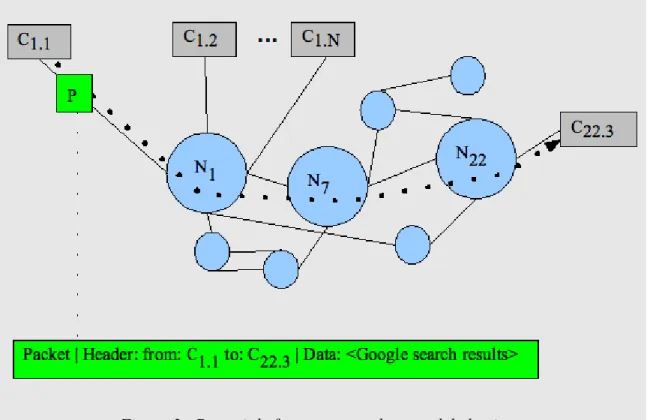
Revisiting the example depicted in Figure 1, suppose a packet is to be sent from
computer Computer1.1 on Network1 to Computer22.3 on Network22 via another network that
connects them, Network7. This is shown in Figure 2. At minimum, Network1, Network7,
and Network22 must examine the address of the message to determine how to route it
properly from Computer1.1 to Computer22.3. Network7 and Network22 would be
non-neutral if they refused to assist in the delivery of the packet on the basis of the type of
data it contains or the IP addresses indicating its origin or destination. It is also possible
they cross each of these networks.
Impacts of non-neutral network policies extend to international contexts. A
number of popular services running on top of the Internet protocol suite -- and as such
susceptible to non-neutral policies -- are often used for communication across Canadian
borders. For example, Voice over Internet Protocol services, such as Skype, have become
attractive substitutes for traditional international long distance calling for many people
because of their low costs.
International Internet data traffic traverses multiple jurisdictions, each with its
own network neutrality policies (if any). Thus, a policy framework for Canada would not
be sufficient for addressing impacts felt within its borders. Mueller sees network
neutrality as a “global principle for Internet governance” (2007, p.1). Activity on
network neutrality has taken place at the international level within the Organisation for
Economic Co-operation and Development (OECD). The OECD's Working Party on
Communication Infrastructures and Services Policy of the Committee for Information,
Computer and Communications Policy (CISP) issued a report on “Internet Traffic
Prioritization” (OECD 2007). The Government of Canada is represented on the CISP as a
member state of OECD. Among the CISP's key findings in this study were that (1)
network service providers should operate in a manner that is transparent to customers
with respect to network traffic shaping policies and their expected impacts; (2) antitrust
laws must be re-examined in the context of traffic shaping concepts and realities; and (3)
entry into the broadband market should be made easier to encourage competition. The
OECD report does not, however, deal with cross border issues of network neutrality.
Non-neutral network policies might be interpreted in the international dimension
of communication rights as a corollary to domestic human rights interpretations. In this
context, such policies might be seen as infringements on Articles 19 and 27 of the
UDHR.
The CRTC has supported public consultation processes on issues relating to
network neutrality. Comments were sought, in particular, for its proceeding on VoIP
services. Canadian incumbent telecommunications providers and VoIP providers gave
However, by using these submissions as a basis for accentuating the principle of
technology neutrality, the CRTC largely steered clear of adopting a position on the issues
related to network traffic shaping until the its 2008-108 decision and the consultation
and hearing process it announced in CRTC 2008-19, which is scheduled to conclude in
July 2009.
Semantic Web and Web 2.0 Technologies
The semantic Web and Web 2.0 are related and competing research and
development movements attempting to improve the usefulness of the World Wide Web.
The semantic Web aims to change the way information is represented on the Web to
enable computers in ways that are more useful to humans (Berners-Lee, Hendler, Lassila,
2001). The initial approach to sharing information on the Web has been human-oriented
in that Web documents have been defined largely in terms of their structure and visual
presentation and less so with respect to the meaning of their content. Information
represented in this way is difficult for machines to process and, thus, limits the ways in
which it can be searched, interpreted, and used. For example, search engines cannot
reliably search for Web pages by their authors' names because that information is often
not explicitly represented. A software agent cannot reliably interpret the contents of
travelers' Web pages for their opinions on hotels without being told how to locate it
within a page and how it should be evaluated. How is a machine to understand the
differences or similarities between “the hotel was decent” and “I found it to be clean but
Web 2.0 generally refers to human-oriented techniques for improving the usability
of Web content and an evolving set of business models that depend on these techniques.
Web 2.0 shares some of the technologies for representing content developed for the
semantic Web, but it depends largely on interaction of humans to process information in
ways that make it more useful to whole communities. O'Reilly (2005, section 2 at para.
24) has characterized Web 2.0 as a “harnessing [of] collective intelligence.” If a software
agent cannot be made to locate and process information intelligently, software can make
it easier for larger numbers of humans to collaborate in carrying out such tasks. This is
known as “collaborative filtering.”
Web 2.0 encompasses blog systems, social networking services, “mash-ups,” and
rich Internet applications (RIAs). The essential contribution of Web 2.0 technologies to
blog systems is the concept of tagging, which allows human authors and readers to
categorize entries so as to make searching more effective. Web services help people
establish social networks on the Internet, including facilities for finding people with
common interests, managing contact lists, and analyzing one's own network. Tagging and
social networking should be seen as new forms of communication subject to protection.
A mash-up is a process of combining two or more existing Web services to form a
new service to solve a specific problem. A well-known example is the combination of
Google's traditional search service with its mapping service to allow users to either locate
forms of information. For example, one can ask to see certain kinds of businesses near a
certain address along with opinions about them. This is an example of a service that is
dependent on the cooperation of multiple users, in this case to contribute opinions and
rankings.
RIAs are provided by web services running in users' web browsers, but they
provide interactivity and functionality that are similar to traditional applications resident
on personal computers. RIAs do not just mimic traditional applications. The Web
dimension of RIAs allows real-time collaboration and remote storage of documents. A
well-known example of an RIA is Google Docs, a web-based service that allows people
to edit documents and spreadsheets.
Semantic Web, Web 2.0 and the process of social communication
Traditional knowledge creation is being supported and extended by semantic Web
and Web 2.0 technologies. Researchers, writers, composers and artists can collaborate
with others over the Internet in more sophisticated ways using these technologies. RIAs
exist that support real-time collaborative text editing. Photographers are using blogging
systems to display their work and to allow people to search their portfolios. Web 2.0
technologies are offering new affordances in the area of knowledge creation. The tagging
facilities in blogging systems have made it possible for communities of scholars to
semi-automatically generate taxonomies of any knowledge space. These have been termed
Distribution of knowledge using Web 2.0 technologies is being accomplished on
multiple levels. Interpersonal and group communication occurs using blogs, chat and
e-mail RAIs. Gatekeeping is achieved using access controls and editorial functions on
shared knowledge spaces such as blogs. Filtering takes place through collaboration, as
discussed above. Gatekeeping and filtering are, thus, barriers to communication; they
deny or remove access to knowledge. In contrast, many Web 2.0 technologies support
dissemination and distribution processes whereby knowledge is promoted and
recommended to people on the basis of voting or sophisticated processing of their
pre-defined preferences.
Practical access to knowledge using Web 2.0 technologies generally requires only
a personal computer with a Web browser and Internet service; however the necessary
characteristics of Internet service are changing. Documents containing only text and
images were once the dominant form of Web content, but video and audio are now
prevalent. This type of content can be orders of magnitude larger than text documents.
Thus, to have effective access to knowledge using Web 2.0 technologies people are being
required to obtain Internet services that permit higher data transmission rates. Some Web
2.0 services may require the installation of software in addition to the Web browser. In
contrast to communication costs, software costs are often not a barrier in Web 2.0. The
dominant Web 2.0 business model provides software and access to data for free with the
objective of generating revenue from the viewing of Web content through advertising and
The capacity to use knowledge accessed via Web 2.0 technologies is limited
largely to their ease of use and, in some cases, to the ability to install the necessary
software . The usability of Web 2.0 technologies, including Web browsers and RIAs, is
generally no worse than traditional PC applications.
Use and interaction of knowledge via Web 2.0 technologies takes place in the
context of the public sphere, business activities, identity formation, and cultural activities.
In the public sphere, Web 2.0 technologies are supporting democratic processes and
social organization. The functionality provided in social networking and blogging
systems have been combined to support political campaigns and other forms of activism.
In terms of business activities, Web 2.0 as a movement has fostered an inversion
of the dominant business relationship between software and data. Profit in Web 2.0
enterprises is now generated from data and not the software used to process them. For
example, people submit music recordings and opinions on music to the Canadian
inDiscover.net6 Web service for free. The service then offers collaborative filtering
services for free using those recordings and opinions to help people buy music they will
like.
Identity and cultural formation are also facilitated by social networking services.
One example is Cyber Yugoslavia, a Web site which serves as a virtual nation for former
citizens of Yugoslavia7.
The process of social learning within social communication is not automatically
supported by Web 2.0 technologies; this depends on their application. Communities are
using the functionality discussed above, such as social networking and collaborative
filtering tools for problem solving. Some notable examples of Web 2.0 being used in
Canadian communities include the following:
1. Pep Talk Community Health Resource Mapping Tool: The University of Toronto
Medical School has created a Google Maps mash-up that helps people locate
health care facilities by type, medical condition, and postal code (2007). (see
http://icarus.med.utoronto.ca/mapping/ver0.6/default.asp)
2. Toronto Public Library Finder: This mash-up site by Greg Smith (2006) shows
the geographic locations of libraries as a set of icons on a Google map and
provides the street address when the user clicks on an icon. Alternatively, a user
may select a library by name, in which case its geographic location and street
address are shown. (see http://www.tplfinder.com/)
3. Psychiatric Survivors of Ottawa – Blog: This Web log sponsored by the
Psychiatric Survivors of Ottawa (2007) allows people involved in the mental
health system to share knowledge and opinions concerning their health and care
name of a blogger. (see http://www.psychiatricsurvivors.org/weblog/index.php)
Impacts of Semantic Web and Web 2.0 technologies on communication rights in Canada
Semantic Web and other Web 2.0 technologies offer technical potentials for
reducing communication barriers and invigorating the public sphere. RIAs and Web 2.0
are now discussed in terms of “cloud computing” whereby applications are made freely
available to users not on their own computers, but in the “cloud” that is the Internet
(Baker 2007). This trend could potentially reduce some communications costs for users,
since it will reduce the need to invest in certain types of software necessary for
communication via the Web.
Significant efforts have been made to apply Web 2.0 technologies to increase the
exercise of democratic and consensual participation in society. They provide new modes
of communication and interaction for community activism, elected officials, and the
electorate. The Crossing Boundaries National Council (CBNC) has sponsored projects in
the use of ICT to enhance democratic participation as part of a broader mandate (cf.
http://www.crossingboundaries.ca). New Brunswick MLA the Hon. Jody Carr and
Saskatchewan MLA the Hon. Doreen Hamilton piloted CBNC's “Wired Elected Official”
system (CBNC 2007). This suite of advanced Web tools includes: managing constituents'
files, performing on-line consultations with citizens, and publishing content. The
that the system “improved effectiveness and efficiency” of elected officials and their
constituency office staff and that “citizens value the additional communication channels
and the improved responsiveness.”
Web 2.0 technologies have provided new modes for communicating knowledge,
many of which allowed citizens to side step traditional media such as news organizations.
Older media have often operated as gatekeepers and filters. Objectively, gatekeeping and
filtering functions are necessary for some media such as enforcing a discipline in the
reporting of news, even if they are not always performed in an ideal manner. Some argue
that many such gatekeepers have often prevented or failed to enable the communication
of useful knowledge. Market forces are identified as a major factor. In many cases,
market forces have led to uncompetitive environments resulting in a lack of diversity of
content. Market forces have also led to a reduction in original content formation, such as
in-house reporting and the reporting of local news. This has resulted in a lack of diversity
of content.
The key affordance offered by Web 2.0 mechanisms such as blogging, content
management, and video upload systems is that they allow people with Internet access to
communicate with a wide range of people in forms that were once the sole province of
traditional media. The Canadian member web sites of the global Independent Media
Center (IMC) are examples (cf. http://canada.indymedia.org ). Indymedia has provided a
mechanism for people to publish news content which may otherwise not be published by
Semantic Web and Web 2.0 technologies have offered only technical potentials
for improving access to mass media by communities and individuals, and for invigorating
democratic processes in society. These technologies have in reality not helped people
fully achieve their transformative potentials. They have arguably weakened quality
journalism and replaced it with a flood of amateur commentary and junk information in
the form of blogs, web sites, text message broadcasts, videos, junk e-mail, and other new
media. While these technologies have made significant impacts on certain types of
political engagement, most prominently fundraising, the evidence that they have made
significant, positive, transformative impacts on political participation is still unclear
(Muhlberger 2009).
One civil rights issue involving Web 2.0 services is the question of data
ownership. The blogosphere and other segments of the Web 2.0 sector, such as web-based
e-mail services, Internet chat facilities, and free web content hosting services, all have a
critical dependence on the externalization of personal or community knowledge. That is,
they exist only through individuals or groups of people contributing and managing
personal data via their web services. O'Reilly (2005, section 1 at para. 21) cites this as a
central tenet of Web 2.0: “the service automatically gets better the more people use it.”
Massive numbers of users now regularly externalize detailed personal knowledge by
'posting' text, pictures, video, and audio on web services owned and controlled by
someone else. Technorati.com, a highly recognized monitor of the blogosphere, stated as
of May 26, 2006 that they were monitoring 41.2 million blogging sites having 2.4 billion
eventually asks: “Who owns the data?” This was also the subject of a high-level
discussion at the 2006 W3C Technical Plenary and WG Week, the main forum for
working groups and interest groups within the World-Wide Web Consortium (W3C,
2006).
The initial assumption in popular Web 2.0 services, such as Blogger.com,
MySpace.com, and Facebook.com, was that users would retain ownership and copyright
of data that they input. Blogger.com, a popular blog hosting site owned by Google,
declares that it “claims no ownership or control over any content submitted, posted or
displayed by you ...” (n.d., Article 6). MySpace.com also affirms in its terms of service
that the users “continue to retain all ownership rights” of content they post on the site
(2006, Article 6.1). The original terms of service (TOS) for Facebook.com imply that
users own their own data: “All content on the Web site ... are the proprietary property of
the Company, its Users or its licensors with all rights reserved” (2008, para. 5).8 More
recently, however, Facebook tried to quietly change its data ownership policies to require
that users agree to license ownership of the data they create in perpetuity to the company
(EPIC 2009). This was seen as an attempt to derive even more commercial value out of
users' data. Public pressure and an impending complaint to the U.S. Federal Trade
Commission forced Facebook to restore its original TOS.
8
Although, questions have been raised about how Facebook operates in the grey areas of such statements. A complaint was filed with the Office of the Privacy Commissioner of Canada in 2008 by The Canadian Internet Policy and Public Interest Clinic (CIPPIC) against Facebook that alleges that Facebook does not adequately inform members about how their personal information is shared with third parties. A finding on the CIPPIC complaint had not been made as of March 2009. The question of data ownership though separate, is a related issue and the CIPPIC compliant should raise questions about Facebook’s performance in this area (see CIPPIC 2008).
Work-related blogging is now a common activity. The copyright and contents of
employee blogs that are managed by an organization's systems may be owned by that
organization. Hewlett-Packard, for example, owns the copyrights and data for blogs
created by its employees using its corporate facilities (Foley 2005). Employees are
equally capable of using a third party blogging service outside of the control of their
employer. In these cases, it is becoming common for employers to issue guidelines
concerning their employees’ responsibilities when discussing corporate matters in their
blogs. Examples among prominent corporations that practice these policies include:
Yahoo! (2005), Sun Microsystems (n.d.), and Microsoft (Weil, 2005).
Another communication rights question that has arisen is whether the Web
2.0-enabled endeavors such as blogging can be classified as journalistic activities with the
civil rights protections it is afforded in Canada and other countries. One case is that of
Charles LeBlanc, a self-professed blogger who has been a frequent observer of the New
Brunswick legislature. He was arrested and charged with obstruction in June of 2006
while taking pictures at a business conference in Saint John, New Brunswick (CBC News
2006). Police erased his photographs. He was apparently viewed by police as a protester.
LeBlanc claims to have told them that he was a “blogger,” implying that he should be
afforded the same status as traditional, credentialed journalists at the event. LeBlanc
challenged this in provincial court. The court's decision in November 2007 was that
LeBlanc should be recognized as a journalist and dismissed the charges against him
Independent of data ownership and civil rights issues, users are likely to have
limited control over the data they create and manage using commercial Web 2.0 services.
Many common software applications store data in file formats that can be transported
easily between computers and that can often be used by different applications. For
example, the applications Microsoft Word, OpenOffice, NeoOffice, and TextEdit are all
capable of sharing documents in several common formats; and those documents can be
transferred between computers with ease. This is often not the case with the data that
users enter into their blogs and other types of Web 2.0 services. While much of the
underlying technologies used to implement blogging systems are non-proprietary –
Extensible Markup Language (XML) and HyperText Transfer Protocol (HTTP), for
example – there is not yet agreement on higher level formats for storing blog information.
There is also no agreement on communication protocols for transferring blog data
between different systems. Blogger.com, one of the most popular blogging sites in the
world, states (n.d.):
Blogger does not have an export or download function. However, you can use the
following instructions to create a single file with all your posts which you may
publish and then copy to your own computer for use as desired.
This is followed by a process that average users would probably find to be complex.
Arguably such knowledge management arrangements are not yet engineered with the
Internet Telephony
The Internet has enabled the creation of a new type of telephony known as Voice
over Internet Protocol (VoIP). Instead of delivering voice in analog as is still done in
large parts of the public switched telephone network (PSTN), VoIP converts voice to
packets and sends them via the Internet -- and sometimes over the PSTN -- to their
destination.
VoIP services are attractive because they offer inexpensive long distance calls and
because a subscriber's telephone number or user identifier is not tied to a specific
location. VoIP allows telephone services to be delivered wherever there is Internet
access. In comparison to mobile telephony, VoIP services are not tied to a specific device
and there is no home calling area where roaming charges are concerned. One's telephone
number need not be dependent on a physical location or a home area in the context of
mobile telephony. The location-independent nature of VoIP has enabled competition in
traditional local and long distance telephone markets, where barriers to competition have
been based largely around physical access to facilities. In the case of rural and remote
communities like the First Nations within KO, VoIP is a life-critical service.
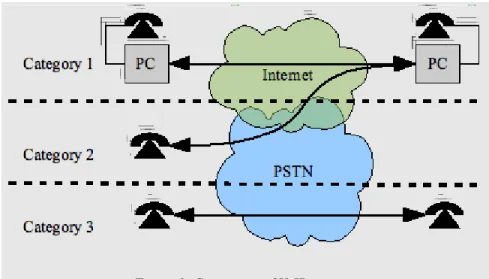
VoIP comes in several forms depicted in Figure 2. The CRTC (2005b, para. 29)
defines Category 1 VoIP services as allowing users to communicate between PCs over an
Internet connection. Category 2 VoIP services allow users to communicate in either
telephone network. Category 3 VoIP services allow users to communicate between
telephones, and other devices, on a public switched telephone network.9 These categories
represent affordances emanating out of the layered architecture of the Internet, which has
provided a nexus for the integration of different forms communication, in this case, the
bridging of new and older forms of telephony.
An example of a Category 1 service is Skype-to-Skype calls where all voice data
are transmitted through the Internet. An example of a Category 2 service is SkypeOut
where voice data are exchanged between a device on the Internet and a device, such as a
telephone or FAX machine, on the traditional public switched telephone network (cf.
http://skype.com ). Examples of Category 3 services are traditional telephone services
offered by Vonage and Primus (cf. http://vonage.ca and http://primus.ca ) which are
implemented by using traditional public switched telephone networks managed by
incumbent carriers, such as Bell or Aliant. Incumbents such as Telus offer Category 3
services. Some services like Skype and Vonage offer integrated services that fit in both
Category 1 and 2.
9The CRTC defines a Category 4 which is not seen as highly relevant to this chapter. It involves business
Canada was early among nations to develop a regulatory framework for VoIP
(Lemay-Yates Associates, Inc., 2005). The distinctions between categories of VoIP were
central to the creation of a regulatory framework. If VoIP is equivalent to 'plain old
telephone service' or 'POTS', the logic goes, it should be regulated in the same way.
The CRTC (2005b, para. 113) determined that VoIP Categories 2 and 3 are
equivalent to POTS since they provide “two-way, real-time voice communications to
and/or from anyone on the PSTN.” This is an example of technology-neutral regulation.
Category 1 services were viewed as Internet services under the framework, which are
exempt from regulation under this framework. The (2005b) decision included the
following regulations (paras. 213, 214, 225, 242, 326):
Local number portability obligations for incumbents extends to VoIP service
providers;
Equal ability for VoIP providers to assign telephone numbers as incumbents;
Equal requirements for accessing incumbent facilities and providing access to
others for network interconnection purposes;
VoIP providers must file tariffs like incumbents.
VoIP services under Categories 2 and 3 were also found to be eligible to make
contributions to the CRTC's national fund, which is intended to subsidize the high cost
rural and remote service (CRTC, para. 14). Any company with annual revenues over $10
million must pay a percentage of that income into the fund. This helps to support
Canada's telecommunication policy objectives, as discussed in Section 2.3. Also, given
that Category 2 and 3 services are viewed as equivalent to POTS, they must also abide by
the 911 emergency requirements under CRTC's earlier Telecom Decision 2005-21.
Internet telephony and the process of social communication
VoIP subscriber services offer yet another medium of interpersonal
communication through which knowledge can be delivered. It is important in this respect
because of the advantages it provides over land-line and mobile telephony. These include:
location independence, land-line independence, elimination of mobile telephony roaming
charges, and advanced calling services. Since VoIP services are implemented using the
Internet, services can be provided in a largely location-independent manner, unlike
land-line telephony, which depends on a fixed PSTN infrastructure. A subscriber only needs to
service provider can map the traditional telephone number they were assigned to the
specific Internet address being used at the moment. Thus, for example, if a VoIP
subscriber connects to their service from an airport lounge in Bangkok, anyone calling
their VoIP-enabled phone number in the New Brunswick area code can be routed
transparently and at no additional cost for many VoIP services to that computer in
Thailand. This can be done because the VoIP software that subscribers use notifies the
service of its location. Some VoIP services, such as Skype, allow calls between computers
at no cost.
The other advantages of VoIP are related to location independence. Since VoIP
requires only Internet access, subscribers can potentially avoid paying for traditional
land-line telephony services altogether. Though it is often the case, that VoIP subscribers
must obtain Internet services from local telephone companies. Thus, telephony costs must
sometimes be factored into the overall cost of VoIP services. The advantage of VoIP over
mobile telephony is that the costs of roaming are potentially greatly reduced. A subscriber
needs only to negotiate the cost of Internet access when they are away from their local
calling area to initiate and receive VoIP calls. Thus, per call mobile telephone roaming
charges can be replaced by a short term Internet access fee (e.g. in an airport lounge).
Thus, the cost of that fee amortized over each VoIP call becomes the effective roaming
charge with corresponding economies of scale. The combination of routing and
parallelism capabilities offered by the Internet has allowed VoIP services to offer average
subscribers a wide array of advanced calling services at a relatively low cost. These