Publisher’s version / Version de l'éditeur:
Systems, Man and Cybernetics (SMC), 2010 IEEE International Conference on,
pp. 1945-1952, 2010-10-01
READ THESE TERMS AND CONDITIONS CAREFULLY BEFORE USING THIS WEBSITE. https://nrc-publications.canada.ca/eng/copyright
Vous avez des questions? Nous pouvons vous aider. Pour communiquer directement avec un auteur, consultez la
première page de la revue dans laquelle son article a été publié afin de trouver ses coordonnées. Si vous n’arrivez pas à les repérer, communiquez avec nous à [email protected].
Questions? Contact the NRC Publications Archive team at
[email protected]. If you wish to email the authors directly, please see the first page of the publication for their contact information.
NRC Publications Archive
Archives des publications du CNRC
This publication could be one of several versions: author’s original, accepted manuscript or the publisher’s version. / La version de cette publication peut être l’une des suivantes : la version prépublication de l’auteur, la version acceptée du manuscrit ou la version de l’éditeur.
For the publisher’s version, please access the DOI link below./ Pour consulter la version de l’éditeur, utilisez le lien DOI ci-dessous.
https://doi.org/10.1109/ICSMC.2010.5642262
Access and use of this website and the material on it are subject to the Terms and Conditions set forth at
An agent-based service-oriented approach for facility lifecycle
information integration and decision supports
Shen, Weiming; Hao, Qi; Xue, Yunjiao
https://publications-cnrc.canada.ca/fra/droits
L’accès à ce site Web et l’utilisation de son contenu sont assujettis aux conditions présentées dans le site LISEZ CES CONDITIONS ATTENTIVEMENT AVANT D’UTILISER CE SITE WEB.
NRC Publications Record / Notice d'Archives des publications de CNRC:
https://nrc-publications.canada.ca/eng/view/object/?id=2d8380be-e986-4970-9ff2-a7512cac4296 https://publications-cnrc.canada.ca/fra/voir/objet/?id=2d8380be-e986-4970-9ff2-a7512cac4296
http://www.nrc-cnrc.gc.ca/irc
An Age nt -ba se d se rvic e -orie nt e d a pproa c h for fa c ilit y life c yc le
inform a t ion int e gra t ion a nd de c ision support s
N R C C - 5 3 2 9 5
S h e n , W . ; H a o , Q . ; X u e , Y .
O c t o b e r 2 0 1 0
A version of this document is published in / Une version de ce document se trouve dans:
2010 IEEE International Conference on Systems, Man, and Cybernetics (IEEE
SMC 2010), Istanbul, Turkey, October 10-13, 2010, pp. 1-8
The material in this document is covered by the provisions of the Copyright Act, by Canadian laws, policies, regulations and international agreements. Such provisions serve to identify the information source and, in specific instances, to prohibit reproduction of materials without written permission. For more information visit http://laws.justice.gc.ca/en/showtdm/cs/C-42
Les renseignements dans ce document sont protégés par la Loi sur le droit d'auteur, par les lois, les politiques et les règlements du Canada et des accords internationaux. Ces dispositions permettent d'identifier la source de l'information et, dans certains cas, d'interdire la copie de documents sans permission écrite. Pour obtenir de plus amples renseignements : http://lois.justice.gc.ca/fr/showtdm/cs/C-42
An Agent-based Service-oriented Approach for
Facility Lifecycle Information Integration and
Decision Supports
Weiming Shen, Qi Hao, Yunjiao XueCentre for Computer-assisted Construction Technologies, Institute for Research in Construction National Research Council Canada, London, Ontario, Canada
[weiming.shen, qi.hao, yunjiao.xue]@nrc.gc.ca
Abstract—With the objective of providing the best decision
support to facility management and maintenance, this paper presents an agent-based, serviced-oriented approach for integrating data, information, and knowledge captured and accumulated during the entire facility lifecycle from its project planning, design, construction, material / component / equipment procurement, to operations and maintenance. All data / information / knowledge sources and hardware / software applications are loosely integrated through agent-based web services, either proactive or reactive, to provide decision supports over all the stages of the facility lifecycle, and particularly to optimize facility operations and maintenance. Proof-of-concept prototypes have been implemented to validate the proposed approach.
Keywords—SOA, agents, decision support, facility lifecycle
information integration, facility management and maintenance.
I. INTRODUCTION
A study by the US National Institute of Standards and Technology (NIST) [1] identified and estimated efficiency losses of $15.8 billion in 2002 in the US capital facilities industry resulting from inadequate interoperability among computer-aided design, engineering, and software systems. FIATECH studies [2] went further and identified some major causes of productivity problems and challenges in the increasingly complex construction industry environment including: poor access to accurate data / information / knowledge in a timely manner; lack of interoperability between software systems; lack of an integrated view of multiple domains for decision supports; lack of integrated and scalable solutions; lifecycle problems not well understood and addressed; and, inability to assess uncertainties, risks, and the impact of failures.
In its vision on Lifecycle Data Management & Information Integration as defined in the Capital Projects Technology Roadmap [2], FIATECH envisioned that “the execution of future capital projects and operation of capital facilities will be radically enhanced by seamless access to all data, information, and knowledge needed to make optimal decisions in every phase and function of the capital project/facility lifecycle.”
During the past few years we have been working towards developing integrated intelligent decision support tools for the management and maintenance of critical facilities. We envision
that such decision support software tools will integrate project and process information from facility design and construction, historical and current information from facility operations, as well as real time data and analysis results from facility condition monitoring and assessment. These tools will also integrate or co-operate with existing facility operations management systems and computerized maintenance management systems as well as other related systems including geographic information systems and enterprise resource planning systems.
Based on our previous experience in the related fields, we strongly believe that an agent-based service-oriented integration approach is appropriate to achieve such a vision. This paper presents some preliminary results of our recent work in this area. It describes a conceptual framework of the proposed agent-based service-oriented integration approach for facility lifecycle information integration, with a particular objective of proving decision supports to facility operations management and maintenance management. The rest of the paper is organized as follows: Section 2 provides a brief review of the related research literature; Section 3 describes the proposed conceptual framework and discusses some key concepts proposed and developed in this work; Section 4 presents proof-of-concept implementations; Section 5 provides a brief conclusion and some discussion of our future work.
II. LITERATURE REVIEW
With the rapid advancement of information and communication technologies, particularly Internet and Web-based technologies during the past two decades, various systems integration and collaboration technologies have been developed and deployed to different application domains, including architecture, engineering, construction, and facility management (AEC/FM). After many years of R&D, the AEC industry has now started to embrace and adopt software systems that support and promote the concepts of integration and interoperability [3]. However, due to the unique nature of the construction sector, the development and deployment of systems integration technologies in AEC/FM are behind other sectors. We have conducted a comprehensive literature review on this topic [4]. Here is only a brief summary of the research literature related to the integration and sharing of data, information, and knowledge among the various software and hardware systems across the facility lifecycle.
The very basic idea for integrating two or more software systems is to enable them to communicate, share or exchange information, and then to inter-operate in order to achieve a common objective. We view system interoperability from two different perspectives: data interoperability and frameworks interoperability. While data interoperability is preferable to achieve efficient systems integration and effective collaboration, it is not practical for the integration of legacy software applications that were initially developed by different vendors and were not expected to work together [4]. So incorporating legacy systems and achieving frameworks interoperability at a higher level is a challenge currently faced by the construction industry. In order to achieve frameworks interoperability, various technologies have been proposed, developed, and deployed.
Early simple integration uses a Web-based three-tier system architecture. As we discussed in [4], a simple Web-based system may be adequate for daily construction project management, but it is not sufficient to meet the requirements of facility lifecycle information integration.
A popular integration approach is based on the object-oriented programming paradigm that can be traced back to the 1960s and has been used in various application domains for about two decades. It emphasizes programming efficiency by stressing the modularity of data structures and code sharing. It uses a centralized or tightly- coupled integration approach. It has been widely used for systems integration, particularly after the development and deployment of three major Distributed Objects standards: CORBA by the Object Management Group (OMG), COM/DCOM by Microsoft, and Java RMI.
Faraj and Alshawi [5] presented an object-oriented implementation of a rapid prototyping environment called SPACE (Simultaneous Prototyping for an Integrated Construction Environment) which supports a subset of a construction project lifecycle. It integrated a number of commercial software packages including AutoCAD/AEC, World Tool Kit (for visualization in virtual reality), and Super Project Expert (for planning) as well as several other applications developed in-house. A centralized (modularized) project model is used to connect all these applications. Halfawy and Froese [6] proposed building integrated AEC systems using smart objects. In the proposed approach, smart objects are 3D parametric entities that combine the capability to represent various aspects of project information required to support multidisciplinary views of the objects, and the capability of encapsulating “intelligence” by representing behavioral aspects, design constraints, and lifecycle data management features into the objects. Halfawy and Froese [3] further extended the model-based approach (using smart objects) into a component-based approach with widely used three-tier system architecture. In fact, this component-based approach can be easily extended to a service-oriented approach and implemented using Web services technology and related standards. Similar approaches using distributed object technologies (particularly CORBA) can also be found in [7, 8]. However, Lu and Issa [7] emphasize a loosely-coupled integration, compared to standards-based approaches like IFC-based integration [3, 6, 9]. We believe that such loosely-coupled integration is more easily achieved using software
agents and Web services technologies as presented in this paper.
The application of intelligent software agents to systems integration has also been studied for about two decades. Parunak [10] has analyzed where agent technology can be best used in industrial applications: “agents are best suited for applications that are modular, decentralized, changeable, ill-structured, and complex”. The reasons often given for adopting an agent approach are linked to their being proactive object systems and to the simplification of the architecture of the software systems. The real gain obtained from an agent-based approach, however, often comes from a better description of the real world by focusing on objects rather than functions. When used appropriately, this leads to the desired modularity, allowing flexible simulations, better response and improved software reusability [4]. In addition, agents can cope with a dynamically changing world by performing dynamic linking, allowing them to handle ill-structured or rapidly changing situations in a more economical way [11]. There have been a few applications of the agent technology for systems integration in AEC/FM: Bilek and Hartmann [12] presented an agent-based approach to support complex structural design processes in AEC; Reffat [13] proposed an approach for architectural design to be carried out collaboratively and synchronously inside real-time 3D virtual environments within which architects design with intelligent agents based on the view of situated digital architectural design; Rueppel and Lange [14] applied intelligent agents and Petri-Nets to support cooperation and coordination in distributed planning processes in civil engineering; Aziz et al. [15] presented a mobile collaboration support infrastructure by integrating the Semantic Web (to provide a framework for shared definitions of terms, resources and relationships), Web Services (to provide dynamic discovery and integration) and intelligent software agents (to help mobile workers accomplish particular tasks); Alda et al. [16] proposed and developed an integrated multi-agent and peer-to-peer software architecture for supporting collaborative structural design processes. However, no R&D efforts have been reported on the application of the agent technology for integrating facility information across the entire lifecycle.
The application of service-oriented architecture (SOA) to systems integration has been one of the most active research topics during the past decade. The basic Web servers are passive (or reactive), i.e., they only reply to requests from users, rather than actively or proactively sending data/information to users or other servers; neither do they cooperate or coordinate. The Web service technology officially proposed by W3C in 2002 is meant to address these challenges. In fact, it is very similar to the concept of Active and Proactive Web Servers that we proposed in 2000 [17].
Even though Web services and the Semantic Web have been widely used in systems integration and collaboration in other domains (particularly in e-business applications), very few reported results have been found in AEC/FM. Schevers et al. [18] reported the application of Semantic Web technology, particularly the Resource Description Framework (RDF) and the Web Ontology Language (OWL) to the implementation of a digital facility model for the Sydney Opera House. El-Diraby et al. [19] presented a domain specific taxonomy for
construction management. Kosovac [20] presented a Web services based framework for managing information from heterogeneous, distributed, and autonomous sources in AEC/FM with a pilot implementation. Wang et al. [21] presented a middleware framework for integrating heterogeneous building automation systems on the Internet (focusing only on the integration of building automation systems rather than over the building project lifecycle). Boddy et al. [22] proposed a process driven approach by integrating software agents and Web services technologies for computer integrated construction. It is the most relevant to the work presented in this paper, but our approach focuses on loose coupling integration solutions for enhanced flexibility, reliability, and scalability.
III. PROPOSED APPROACH
A. Agent-Based Web Services
According to Bakis et al. [23], “in the construction industry, the use of a single central repository to store the design information is not usually a viable option due to the fragmented nature and adversarial behavior that characterizes the industry.” Therefore, as we concluded in [4], “distributed loosely coupled integration solutions using intelligent agents and Web services technologies would be most promising”.
Based on our previous work on agent-based service-oriented approaches for multidisciplinary design optimization [24] and collaborative intelligent manufacturing [25], as well as our recent detailed literature review on systems integration and collaboration for AEC/FM [4], this paper presents our recent work on the development of an agent-based service-oriented approach for facility lifecycle information integration, with a focus on application to facility operations management and maintenance management.
The basic idea is similar to what we previously proposed and developed for multidisciplinary design optimization and collaborative intelligent manufacturing. However, it is a novel application of an agent-based service-oriented approach to the construction domain for facility lifecycle information integration, with some unique features including proactive services and reactive services, ontology-based data /information mapping and data fusion (ontology fusion) (reported separated in [26]), integration of real-time asset tracking into facility operations and maintenance management (to be reported in detail in a separate paper).
By agent-based Web services, we mean that Web services are dynamically orchestrated on the Internet using built in agent behaviors [25]. The purpose of integrating software agents and Web services technologies into a cohesive entity is to overcome the weaknesses of each individual technology, while reinforcing their individual strengths. As described in [25], the integration of software agents and Web services can be proposed at both the design level and the implementation level. At the design level, Web services are encapsulated as agent models so that each agent functions on behalf of a Web service in its action and relation to the environment. In this sense, we can treat a Web service as a semi-autonomous agent. On the
other hand, Web services can be used to describe the external behaviors of software agents. Therefore, agents can be used to build high-level models with flexible interaction patterns, while Web services are more suitable for solving interoperability problems between various applications in real implementations. At the implementation level, UDDI, WSDL and SOAP provide such capacities as discovery, deployment, and communication, while specifications such as BPEL4WS provide service composition and process enactment.
The proposed loosely coupled computing environment can be considered as a collection of economically motivated agent-based Web services. Software agents are dynamically implemented as services with different functionalities and roles. In fact, the dynamic agent-based behavior models plus the Web service-based interoperable protocols can generate a flexible, reconfigurable and coordinated approach to archive integration of data, information, and knowledge at almost any level of complex systems.
B. Conceptual Architecture
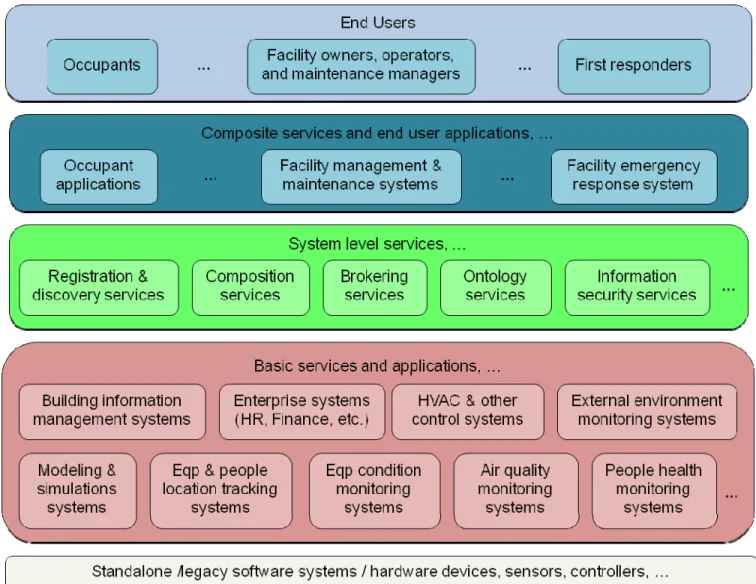
A conceptual architecture of the proposed agent-based service-oriented approach for facility information integration is illustrated in Figure 1. With this approach, all software systems (in fact, hardware systems are also wrapped and integrated through software systems) are organized and represented as a set of services including basic services and composite services. Each service is made available to all the software applications used by the stakeholders at all stages of the facility lifecycle through standard interfaces, though this paper targets primarily the stakeholders (end users) during facility operations and maintenance.
In the proposed conceptual architecture, we distinguish three types of services: basic services (and applications); composite services (and end user applications), and system level services.
Basic services are those functionally independent services either wrapped from legacy software applications and standalone systems (e.g., enterprise information systems or enterprise resource planning (ERP) systems – most importantly for FMM are human resources and finance management, HVAC and other control systems which are usually provided by specific vendors and are usually not “open” for integration), or developed for specific purposes (e.g., building information management systems, equipment and people location tracking systems, and air quality monitoring systems). Note that building information management is a major R&D activity within our research centre and will be reported separately. From the facility lifecycle information integration point of view, building information management systems will capture, integrate, and manage facility lifecycle data and information from its design, construction, and procurement phases using the similar agent-based service-oriented approach.
It should be pointed out that one basic service may also support other basic services, e.g., an Air Quality Monitoring system may provide input to the HVAC system in order to automatically address the building’s air quality needs.
Keeping these basic services and applications independent and loosely coupled has a number of advantages:
- providing greater feasibility for composing or implementing composite services and end user applications;
- offering better scalability for future extensions;
- and, most importantly, ensuring the reliability of end user applications, by avoiding or reducing the impact of any basic service failure on the operation of end user applications.
Composite services and end user applications are specialized systems developed for end users during facility operations and maintenance. End users can be facility operations managers, facility maintenance managers, first responders, residents, special service providers, like healthcare providers in case of healthcare facilities, and senior homes. These systems require input from various hardware and software systems which are implemented as basic services, as mentioned above.
While all the basic services / applications, composite services, and end user applications are mostly domain specific, system level services are generic and usually required for all complex, agent-based service-oriented industrial applications [11, 25]. Note that some system level services may not be totally domain independent, e.g., an ontology-based service is implemented with a generic framework but requires domain ontologies in order for it to be useful. We have developed such system level services in a number of our previous applications in other domains [24, 25]. We believe the following generic services are useful in the development and deployment of facility lifecycle information integration and decision support systems:
Figure 1. Conceptual Architecture for Service-Oriented Decision Supports in Facility Management and Maintenance
- Registration and discovery services provide registration and lookup services similar to the yellow pages [11]. Typically, only one registration and discovery service is needed in one agent-based service-oriented computing environment. A redundant registration and discovery service (which needs to be synchronized with the premier one) can be deployed to ensure the system reliability. All the basic services (basic applications
must be encapsulated into services) must be registered with this registration and discovery service. If a composite service will provide services to other applications, it also needs to be registered. If an end user application will provide services to other applications, it first needs to be encapsulated into a service and then registered.
- Composition services provide support for automatic or semi-automatic deployment of composite services or end user applications, usually by discovering, integrating, and executing existing services. This can be done in such a way that previously existing services are orchestrated into one or more new services that better fit the needs of the specific end user. This can also be done with the help of creating new services based on business logic programmed in Java or C#.
- Brokering services provide capability-based integration or requester-provider mapping services [11]. The brokering allows a requester to describe the properties of a requested service. Then, on behalf of the requester, it establishes interactions with service providers to fulfill the requests. It is one of the key techniques to protect information privacy in distributed service-oriented computing environments.
- Ontology services are provided by ontology servers. An ontology server integrates a repository of domain ontologies. The ontology server framework is domain independent, but each ontology server is domain specific when it contains ontologies for a specific application domain, e.g., healthcare facility operations management and maintenance. A detailed discussion is provided below in Section III.D.
- Information security services ensure the information privacy and security at the system level. While specific information protection policies need to be well defined and implemented at the individual service and application level, it is important to define and implement policies and rules at the entire system level to define, for example, which basic services / applications can only be accessed by certain composite services and end user applications, or by certain categories of end users. Further discussion follows in Section III.E.
C. Proactive and Reactive Services
In the proposed service-oriented framework, we distinguish two types of services: proactive services and reactive services. All service requesters need to subscribe with the proactive services so that the proactive service providers can proactively inform the requesters when an event happens or information changes. For example, in a healthcare facility, an equipment location tracking service (agent) can be developed into a proactive service so that it can send any equipment location change information to all the subscribed requesters (applications). On the other hand, reactive service providers (agents) will only provide services when asked to do so. This can significantly improve the entire system performance by providing fast responses to events and at the same time reducing the network communication load.
D. Ontology and Semantic Mapping
One of the objectives of the system integration is to enable the systems to communicate, interact, and collaborate with each other. To achieve this objective the systems should share a common agreement on the concepts and relationships in a domain. Usually these systems are built for the same domain, therefore it is guaranteed that they share a common conceptualization. However, at the modeling level, the systems may adopt various modeling paradigms and are designed independently, resulting in heterogeneous information models in terms of their supporting infrastructures, syntactic representations of information, schematic designs of information models, and semantics of information.
Ontology acts as a vehicle that carries information semantics and can be utilized to discover the semantic mappings between systems. In our previous research, we explored the approaches of discovering semantic mappings based on available ontologies [27] or available instance data [28]. Such mappings provide indications of common concept reference while the concepts are modeled and represented in different ways in multiple systems. The ontology-based mapping services, with these approaches built in, can help address the semantic heterogeneities and facilitate the systems' interaction at the semantics level.
E. Information Security and Privacy
Information security and privacy is very important for facility lifecycle information integration, particularly for critical facilities, such as, airports, defense facilities, government buildings, nuclear power plants, and healthcare facilities. It is imperative to guarantee that data and information are only accessible to the right people and software applications. In the proposed service-oriented framework, information security and privacy protection is implemented through four means: (1) applying Web service security standards across the service-oriented computing environment; (2) defining and implementing security and privacy policies and rules at individual services and applications; (3) defining and implementing system level policies and rules through specialized information security services; (4) providing brokering services, as needed, to enhance information protection.
IV. PROOF-OF-CONCEPT PROTOYPE IMPLEMENTATIONS
Proof-of-concept prototypes have been implemented to loosely integrate an internally developed facility maintenance management system (FMM) [29] with a commercial WiFi RFID location tracking system called AeroScout® (http://www.aeroscout.com/), and an internally developed building information management system called BIM Server (to be reported separately).
Figure 2 shows the integration layer between the three systems. Components in this layer are implemented as Web services using different technologies such as JAX-WS and .NET. Because of the small scale integration, we omitted the system level services layer (in Figure 1) for service registration, discovery, brokering, and ontology-based mapping. Instead, the consumer system uses the client package produced by the published WSDL to access the services provided by other
systems. So in some sense, each system is both a client and a server, since they all provide services as well as consume services.
The demonstration of integration processes can be classified by four types of interactions.
(1) The three systems, namely FMM, AeroScout and BIM server all have their own set of private assets and properties. In order to talk to each other, these assets need to be linked so the three systems can create a common base for reference. A Universally Unique Identifier (UUID) is a 16-byte (128-bit) number. In its canonical form, a UUID consists of 32 hexadecimal digits. The purpose of UUID is to enable distributed systems to uniquely identify a piece of information without significant central coordination. Our assumption is that the UUID is first issued to both FMM and AeroScout systems by the BIM Server when an asset element is created in the IFC model. However, since IFC uses GUID (Globally Unique IDentifier) as its element’s identifier, which is a 22-character string formed by alphanumeric characters and some specific characters, we have developed a specific utility function to translate a GUID to UUID and vice versa. (2) The FMM system gets the asset list and detailed
properties from the BIM server and saves the data to its local database; while, as the owner of facility maintenance data, updates assets’ condition information to the BIM server. This situation envisages that when a building is delivered to the owner or
facility operator, a set of data in the BIM model can be transferred to a FMM application. Tracking System FMM System BIM Server UUID GUID GUID UUID UUID UUID 1 1 1 2 3 Update condition
Asset list & properties
Update location (coordinates)
Maps & Map configuration 3 BIM Model (IFC File) AeroScout Engine AeroScout 2D/3D Viewer 4 Update location (logical) AeroScout Mobile View 4
Figure 2: Architecture for Integration of FMM, AeroScout and BIM Server
(3) Static assets have their geometry and location representation in the BIM model, directly. However, the location of movable assets is only detectable by a location tracking system, the owner of the location data. In order to put the movable assets in a common reference (for example, a building), the location tracking system needs to get maps from the BIM server to calibrate the maps with the BIM model so that it can update accurate location information in the BIM model with the correct reference.
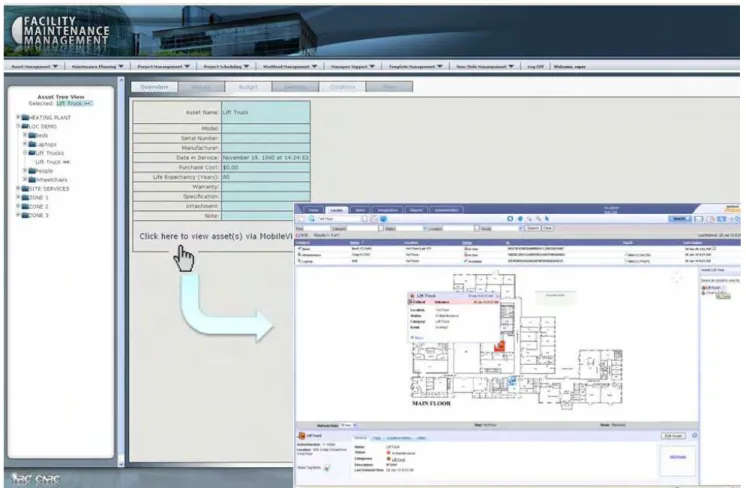
(4) FMM application is able to get a graphical representation of assets’ location through the FMM system by accessing a 2D/3D graphical viewer provided by the location tracking system or a BIM model Viewer. Currently, a 2D location map, rendered by AeroScout Mobile View, can be linked to the FMM’s assets (as shown in Figure 3).
V. CONCLUSION AND FUTURE WORK
Based on our previous work on the development and application of agent-based service-oriented approaches to multidisciplinary design optimization and collaborative intelligent manufacturing, this paper presents a novel application of a similar approach to facility lifecycle information integration, with additional features including proactive services, real time data collection services (for real time decision supports), and dynamic building information
management. The proposed approach has been validated through prototype implementations and case studies (reported separately).
Our planned future work includes:
- With more services to be added, a registration and discovery service will be implemented;
- Fully implement the real time decision supports for facility operations management and maintenance management;
- Extend the decision supports in construction job sites for real time construction project management;
- Implement modeling and simulation services, including physics-based modeling, structure or equipment deteriorations modeling, energy consumption modeling, emergency response and evacuation simulation;
- Develop an ontology server to support semantic mapping among existing services and applications.
ACKNOWLEDGMENT
We would like to acknowledge the contributions our colleagues and visiting workers at the National Research Council Canada’s Centre for Computer-assisted Construction Technologies (NRC-CCCT) have made during the development of the proposed framework and the implementation of proof-of-concept prototype systems,
including Russ Thomas, Helium Mak, John Dickinson, Henry Xue, Brian Jones, and Hongbo Sun.
Figure 3: Screen shots from the FMM system showing its integration with AeroScout Mobile View
REFERENCES
[1] M.P. Gallaher, A.C. O’Connor, J.L. Dettbarn, Jr., and L.T. Gilday, “Cost analysis of inadequate interoperability in the U.S. capital facilities industry,” U.S. Department of Commerce Technology Administration, National Institute of Standards and Technology, NIST Report No. GCR 04-867, 2004.
[2] FIATECH, http://www.fiatech.org/
[3] M. Halfawy, T. Froese, “Component-Based Framework for Implementing Integrated Architectural/ Engineering/ Construction Project Systems,” Journal of Computing in Civil Engineering, 2007, 21(6), 441-452.
[4] W. Shen, Q. Hao, H. Mak, J. Neelamkavil, H. Xie, J. Dickinson, J.R. Thomas, A. Pardasani, H. Xue, “Systems integration and collaboration in architecture, engineering, construction and facilities management: a review,” International Journal of Advanced Engineering Informatics, 2010, 24(2), 196-207.
[5] I. Faraj, M. Alshawi, “A Modularised Integrated Computer Environment for the Construction Industry: SPACE,” ITcon, 1999, Vol. 4, 37-52. [6] M. Halfawy, T. Froese, “Building Integrated Architecture /Engineering
/Construction Systems Using Smart Objects: A Methodology and Implementation,” Journal of Computing in Civil Engineering, 2005, 19(2), 172-181.
[7] H. Lu, RRA. Issa, “Extended Production Integration for Construction: A Loosely Coupled Project Model for Building Construction,” Journal of Computing in Civil Engineering, ASCE, 2005, 19(1), 58-68.
[8] A. Zarli, O. Richaud, “Requirements and Technology Integration for IT-Based Business-Oriented Frameworks in Building and Construction,” ITcon, 1999, Vol. 4, 53-75.
[9] T. Froese, M. Fischer, F. Grobler, J. Ritzenthaler, K. Yu, S. Sutherland, S. Staub, B. Akinci, R. Akbas, B. Koo, A. Barron, J. Kunz, “Industry foundation classes for project management—A trial implementation,” ITcon, 1999, Vol. 4, 17–36.
[10] H.V.D. Parunak, “What can agents do in industry, and why? An overview of industrially-oriented R&D at CEC,” in Cooperative information agents II, Klusch, M. and Weiss, G. (ed.), Paris, France, Springer, 1998, pp. 1-18.
[11] W. Shen W., D.H., Norrie, J.P. Barthes, Multi-Agent Systems for Concurrent Intelligent Design and Manufacturing, Taylor and Francis, London, UK, 2001.
[12] J. Bilek, D. Hartmann D,“Development of an agent-based workbench supporting collaborative structural design,” Proceedings of the CIB W78's 20th International Conference on IT in Construction, April 2003, Waiheke Island, New Zealand.
[13] R.M. Reffat, “Computing in architectural design: reflections and an approach to new generations of CAAD,” ITcon, 2006, Vol. 11, 655-668. [14] U. Rueppel, M. Lange, “An integrative process model for cooperation
support in civil engineering,” ITcon, 2006,Vol. 11, 509-528.
[15] Z. Aziz, C. Anumba, D. Ruikar, P. Carrillo, D. Bouchlaghem, “Semantic web based services for intelligent mobile construction collaboration,” ITcon, 2004, Vol. 9, 367-379.
[16] S. Alda, J. Bilek, A.B. Cremers, D. Hartmann, “Awareness and workflow based coordination of networked co-operations in structural design,” ITcon, 2006, Vol. 11, 489-507.
[17] W. Shen, “Web-Based Infrastructure for Collaborative Product Design: An Overview,” Proc. of CSCWD2000, Hong Kong, 2000, pp. 239-244. [18] H. Schevers, J. Mitchell, P. Akhurst, D. Marchant, S. Bull, K.
McDonald, R. Drogemuller, C. Linning, “Towards digital facility modelling for Sydney opera house using IFC and semantic web technology,” ITcon, 2007, Vol. 12, 347-362.
[19] T.A. El-Diraby; C. Lima; B. Feis, “Domain Taxonomy for Construction Concepts: Toward a Formal Ontology for Construction Knowledge,” Journal of Computing in Civil Engineering, ASCE, 2005, 19(4), pp.395-406.
[20] B. Kosovac, A Framework for Managing Information from heterogeneous, Distributed, and Autonomous Sources in the Architecture, Engineering, Construction, and Facilities Management Domain, PhD Thesis, Dept. of Civil Engineering, University of British Columbia, Canada, 2007.
[21] S. Wang, Z. Xu, J. Cao, J. Zhang, “A middleware for web service-enabled integration and interoperation of intelligent building systems,” Automation in Construction, 2007, 16(1), 12-121.
[22] S. Boddy, Y. Rezgui, G. Cooper, M. Wetherill, “Computer integrated construction: a review and proposals for future direction,” Advances in Engineering Software, 2007, 38(10), 677-687.
[23] N. Bakis, G. Aouad, M. Kagioglou, “Towards distributed product data sharing environments – progress so far and future challenges,” Automation in Construction, 2007, 16(6), 586-595.
[24] W. Shen, Q. Hao, “A Service Oriented Framework for Blow Molded Automotive Parts Design and Optimization,” Proceedings of SAE 2004, Detroit, MI, March 8-10, 2004, SAE 2004-01-1244
[25] W. Shen, Q. Hao, S. Wang, Y. Li, H. Ghenniwa, “An agent-based service-oriented integration architecture for collaborative intelligent manufacturing,” Robotics and Computer-Integrated Manufacturing, 2007, 23(3), 315-325.
[26] H. Sun, W. Fan, W. Shen, Xiao, T. “Ontology Fusion in HLA-based Collaborative Product Development”, Proceedings of the IEEE SMC 2010 (same proceedings), October 10-13, 2010, Istanbul, Turkey. [27] Y. Xue, H. H. Ghenniwa, W. Shen, “A Tree Similarity Measuring
Method and its Application to Ontology Comparison,” Journal of Universal Computer Science, 2009, 15(9), 1766-1781.
[28] Y. Xue, H. H. Ghenniwa, W. Shen. "Instance-based Domain Ontological View Creation towards Semantic Integration,” Expert Systems with Applications, in press, 2010.
[29] Q. Hao, Y. Xue, W. Shen, B. Jones, J. Zhu, “A Decision Support System for Integrating Corrective Maintenance, Preventive Maintenance and Condition-based Maintenance,” Proceedings of 2010 Construction Research Congress, Banff, Alberta, Canada, May 8-10, 2010.