
Publisher’s version / Version de l'éditeur:
Vous avez des questions? Nous pouvons vous aider. Pour communiquer directement avec un auteur, consultez la
première page de la revue dans laquelle son article a été publié afin de trouver ses coordonnées. Si vous n’arrivez pas à les repérer, communiquez avec nous à [email protected].
Questions? Contact the NRC Publications Archive team at
[email protected]. If you wish to email the authors directly, please see the first page of the publication for their contact information.
https://publications-cnrc.canada.ca/fra/droits
L’accès à ce site Web et l’utilisation de son contenu sont assujettis aux conditions présentées dans le site LISEZ CES CONDITIONS ATTENTIVEMENT AVANT D’UTILISER CE SITE WEB.
Fiber Lasers VIII: Technology, Systems, and Applications, SPIE Proceedings;
Volume 7914, pp. 79140Y-1-79140Y-8, 2011-03-01
READ THESE TERMS AND CONDITIONS CAREFULLY BEFORE USING THIS WEBSITE.
https://nrc-publications.canada.ca/eng/copyright
NRC Publications Archive Record / Notice des Archives des publications du CNRC :
https://nrc-publications.canada.ca/eng/view/object/?id=8d414a54-4b71-4b50-b18e-d488800dcf78
https://publications-cnrc.canada.ca/fra/voir/objet/?id=8d414a54-4b71-4b50-b18e-d488800dcf78
NRC Publications Archive
Archives des publications du CNRC
This publication could be one of several versions: author’s original, accepted manuscript or the publisher’s version. / La version de cette publication peut être l’une des suivantes : la version prépublication de l’auteur, la version acceptée du manuscrit ou la version de l’éditeur.
For the publisher’s version, please access the DOI link below./ Pour consulter la version de l’éditeur, utilisez le lien DOI ci-dessous.
https://doi.org/10.1117/12.875552
Access and use of this website and the material on it are subject to the Terms and Conditions set forth at
Picosecond programmable laser sweeping over 50 mega-wavelengths
per second
Kim, Youngjae; Burgoyne, Bryan; Godbout, Nicolas; Villeneuve, Alain;
Lamouche, Guy; Vergnole, Sébastien
Picosecond programmable laser sweeping
over 50 mega-wavelengths per second
Youngjae Kim
a, Bryan Burgoyne
a, Nicolas Godbout
b,
Alain Villeneuve*
a, Guy Lamouche
c, and Sébastien Vergnole
ca
Genia Photonics, 1111 rue Lapierre, Montreal, Qc, Canada, H8N 2J4;
bEngineering Physics
Department, École Polytechnique de Montréal, Montreal, Canada,
cNational Research Council
Canada, 75 de Mortagne, Boucherville, QC, Canada J4B 6Y4
ABSTRACT
We report here the successful realization of 25 millions wavelengths per second using an SOA based PL around 1565 nm at a 75 MHz repetition rate. The laser is simply composed of an SOA, a CFBG (10 ps/nm) with a 100 nm bandwidth, an optical circulator, an EOM (intensity modulator), and an output coupler (20%). Pulse duration is around 45 ps and OSNR of the pulse is around 35 dB at 1565 nm without sweeping. Tunable dispersion compensating module (TDCM) was used to compress the chirped pulse output and 10 ps pulse duration was obtained at 1548 nm. Finally 25 mega-wavelengths per second was realized with under 3 pulses per wavelength and 1024 discrete mega-wavelengths. Linear k-space sweeping function was enabled in the swept-source OCT (SS-OCT) system through graphical user interface (GUI).
Keywords: programmable ps pulse, SSOCT, nonlinear OCT, pump-probe OCT, nonlinear spectroscopy, CARS, SRS, remote sensing
1. INTRODUCTION
Picosecond lasers are enhancing many diverse application areas; from techniques such as optical coherence tomography (OCT), coherent anti-Stokes Raman spectroscopy (CARS), stimulated Raman spectroscopy (SRS), and stimulated depletion microscopy (STED) for biomedical imaging to enhanced drilling, cutting, and etching for laser micromachining [1]. Such applications could make use of fast tuning picosecond tunable lasers in order to perfrom nonlinear imaging. However, the tuning range of most picosecond lasers today is not broad enough and conventional techniques such as active or passive mode locking and gain switching cannot provide the desired fast sweeping rates. Sweeping speed is an essential criteria for picosecond lasers in nonlinear biomedical imaging systems using hyperspectral CARS, SRS microscopes and nonlinear OCT imaging. Such fast sweeping would allow high-speed imaging at high sensitivity which is definitely desired for clinical purposes.
Furthermore, laser specifications are expected to vary widely to precisely fit each application area. As a result the laser needs to be versatile to linear and nonlinear measurement systems at the same time. For an example, swept-source OCT (SS-OCT) requires fast swept source with long coherence length (from a few mm to tens of mm depending on biological samples). Current technologies available in the market are based on quasi-CW lasers. Even though these lasers exhibit state of the art performances, the nonlinear response of tissue samples are not detectable because it requires high peak power in short durations otherwise molecules will be damaged permanently. To produce high peak power and narrow pulse width, people deploy femtosecond fiber lasers or femtosecond Ti:Sapphire lasers. However these lasers cannot support fast wavelength sweep functions due to the inherent passive mode-locking mechanisms required to generate the femtosecond pulses. Rapid wavelength sweep capability is desired for linear or nonlinear spectroscopy and microscopy applications because it can simplify the detection system. Lasers for CARS and SRS should undoubtedly add more complexity because two different wavelengths (pump and stokes) must be synchronized in time and as well as in space [2-3]. Another intrinsic drawback of using femtosecond pulses in CARS spectroscopy is degraded spectral resolution owing to wide spectral width of laser pulses [4]. One possible weak side of picosecond pulses versus femtosecond pulses
would be towards other nonlinear microscopy applications like second harmonic generation (SHG) microscopy and two photon excitation (TPE) microscopy. However it has been also demonstrated that a several picoseconds pulse width is efficient enough to get high contrast image in second harmonic generation (SHG) microscopy and two-photon excitation (TPE) microscopy [5-6].
To sum up, each application area typically needs a dedicated laser because laser parameters like pulse width, peak power, repetition rate and so on should be adjusted specifically. We have already demonstrated that pulse widths, repetition rates, wavelengths and output powers can be controlled in Genia's programmable lasers through a simple user interface [1]. In this paper, we present a number of preliminary results showing that optical pulse with 10 ps pulse width is feasible from programmable lasers and wavelength swept speed as fast as 25 Mλ/s (with 3 pulses/wavelength and 1024 wavelengths, the sweep rate is 25 kHz) in k-domain is realized. We believe that the optimized programmable laser will reduce the measurement time and enable real time linear and nonlinear spectroscopic measurements and imaging.
2. EXPERIMENTAL RESULTS
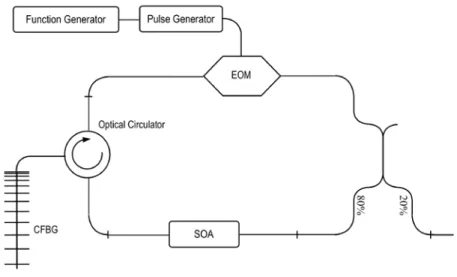
2.1 Laser characteristics without sweepingOperation principle of general programmable lasers can be found in various references [1]. Programmable lasers are dispersive actively mode-locked fiber-based lasers where the wavelength is decided not by an optical filter but by a timing filter. Since the cavity has a large dispersion, different wavelengths experience difference round trip times and repetition rates. The variable repetition rate of the cavity is determined by the electric signal driving the electro-optic modulator (EOM), which mode-locks the laser. Only the wavelength with the matching repetition rate can oscillate in the laser. Pulse width agile and wavelength agile performances can be implemented by several laser design parameters like the amount of chromatic dispersion, the amount of optical pulse energy, and the electrical pulse width. Fig. 1 shows a programmable laser setup with semiconductor optical amplifier (SOA) as the gain medium.
Figure 1. Schematic diagram of a SOA programmable laser. A chirped fiber Bragg grating (CFBG) creates a high chromatic dispersion for dispersive wavelength selection. The EOM is connected to the RF function generator and electric pulser.
The entire laser cavity is composed of PM components. The cavity dispersion of -10 ps/nm comes mostly from the CFBG which spans 100 nm from 1520 nm to1620 nm. An anomalous dispersion was chosen in order to compress the optical pulse since the SOA induces a positive chirp (self-phase modulation) due to nonlinear gain dynamics [7-8]. The
small signal gain of the SOA is 25 dB. Electric pulse with ~ 200 ps pulse width was used to drive the 10 GHz bandwidth EOM. 10 GHz telecom driver was used to amplify electric pulse from pulser. The fundamental repetition rate of the laser cavity is ~25 MHz, corresponding to an 8 m cavity length. In the experiments, we operated the laser in its third harmonic frequency, so about ~ 75 MHz.
Figure 2. Wavelength variation with modulation frequency. A single wavelength is associated at each repetition rate. The linear relationship comes from the linear dispersion slope in the grating.
Fig. 2 shows the linear relation between applied modulation frequencies and pulse wavelengths. It is well fitted with linear function and it reflects the linear time delay made by CFBG. Since the wavelength is controlled by the applied repetition rate, the laser can generate arbitrary wavelength sweep functions. Such functions are programmable through the user interface. For SS-OCT application, an interesting function is one that yields linear k-space sweeps instead of linear wavelength sweeps. Such a sweep avoids nonlinear distortions of swept signals in the Fourier domain after fast Fourier transform (FFT) and does not require the resampling processes which are typically necessary in SS-OCT systems.
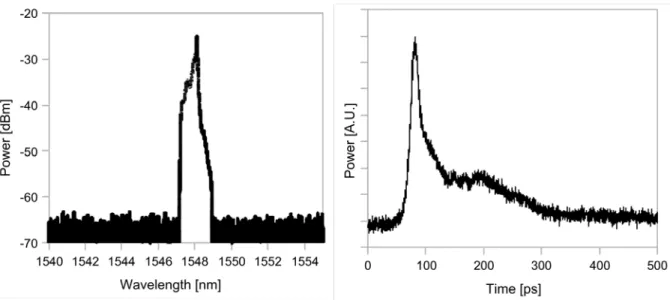
Pulse measurements described in Fig. 3 were taken using an optical spectrum analyzer (OSA) and a high-speed oscilloscope with a 45 GHz bandwidth photodetector (PD). As is shown on the left figure in Fig. 3, the optical spectrum using an SOA as the gain medium is quite different from the pulse spectra obtained using a fiber gain media (Erbium and Ytterbium). It is mainly due to the nonlinear gain response of SOA [7-8]. Typical optical and temporal pulse shapes are close to Gaussian function when Erbium or Ytterbium doped fiber amplifier are deployed in programmable lasers [1]. The optical spectrum exhibits sharp a peak in the longer wavelengths and a broad tail in the shorter wavelengths region. There are also several small peaks observed in shorter wavelength region. The 3 dB bandwidth was 0.06 nm. It is not certain why there are multiple side peaks in the shorter wavelengths region. It could be Kelly sidebands [9] or certain combined effects coming from the high peak power and the SOA, however, we are still investigating it. The right side of figure in Fig. 3 shows the optical pulse. It shows a 45 ps pulse width at the leading edge and a relatively long trail ~ 150 ps. Asymmetric pulse shape and long pedestal can be readjusted and removed by use of external short time gating.
Figure 3. Typical optical spectrum and pulse shape measured using OSA and high-speed sampling scope. The 3dB spectral width is 60 pm and the pulse duration 150 ps.
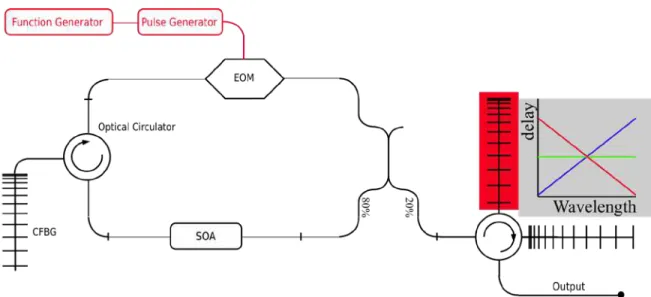
As dispersive mode-locked lasers generate chirped pulses, we can compress them to shorten their duration. It was demonstrated that pulse durations as short as a few picoseconds are required in order to get two photon excitation and second harmonic generation images from biological samples [5-6]. Picosecond pulses can be also used as a seed source for a master oscillator power amplifier (MOPA) for industrial applications like micro-machining and ablation [11]. However for CARS and SRS, longer pulses are better because they are free of non-resonant background and shows high spectral resolution [2,4,12]. We conducted pulse compression experiments with tunable dispersion compensation module (TDCM). Fig. 4 shows the schematic diagram of TDCM. It is based on two CFBGs and amount of net dispersion is controlled by temperature (Teraxion). Optical spectrum and pulse trace are described in Fig. 5 when we applied zero dispersion in TDCM.
Figure 5. Pulse in optical domain and temporal domain after TDCM with zero dispersion. Due to the spectral filtering inside the TDCM, 18 ps pulse was obtained instead of 45 ps.
In order to match the peak wavelength of TDCM, we shifted the peak wavelength of programmable laser which is shown in Fig. 3. As the spectral width of TDCM is narrower than the pulse spectrum, there was spectral filtering out of TDCM. The left figure in Fig. 5 shows the optical spectrum after TDCM. Using numerical simulations, we found that even though a linear chirp is dominant in central part of pulse spectrum, a nonlinear chirp is observed in the shorter wavelengths region. The reason the pulse duration was reduced to 18 ps is that the nonlinear chirp components in the shorter wavelengths region was filtered out.
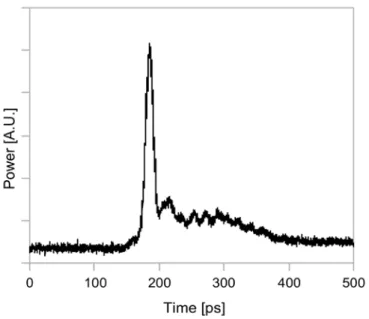
Fig. 6 shows the pulse after compression with a dispersion of -60 ps/nm from the TDCM. The minimum pulse width was found to be 10 ps. The result was also confirmed with an intensity autocorrelator. If we lower or raise the dispersion strength from -60 ps/nm, the pulse width almost linearly increases. We measured a pulse duration of 16.4 ps at -30 ps/nm and 22.7 ps at -200 ps/nm. According to our numerical simulations, a few ps pulse duration is achievable if we use a shorter electric pulse and a lower dispersion CFBG. In any case, once the optimal dispersion is known, the TDCM can be replaced by a CFBG.
2.2 Laser characteristics while sweeping
In conventional SS-OCT sources, wavelength sweeping is realized by rapidly changing the peak wavelength of an optical tunable filter [13-14]. Wavelength sweeping in dispersive mode-locked lasers is achieved by changing modulation frequencies applied to the EOM [1,15]. Since our programmable lasers is a pulsed source, the sweep rate, which directly means a number of A scans per second in SS-OCT and denotes the number of pixels in hyperspectral CARS or SRS, is given by the number of pulse per wavelength and the number of wavelengths in the swept optical bandwidth. We will presents characterization results by using the point-spread function (PSF) calculated from the fringe pattern in a standard OCT measurement set-up. Fig. 7 presents interference fringe patterns using SS-OCT setup where a mirror is placed as a sample. It was measured with a 0.5 mm depth in air. For this measurement, we chose 12 pulses per wavelength averaged for 1024 wavelengths between 1530 nm and 1590 nm using equal pulse count in k-space sweep function of our programmable lasers. It corresponds to 6.25 million wavelength/s or 6.1 kHz. As wavelength swept occurs in k-space and not in wavelength space, it is not necessary to do any resampling which is commonly required with conventional SS-OCT system [14].
Figure 6. Compressed pulse after -60 ps/nm TDCM. Pulse width was narrowed 10 ps.
Figure. 7 Interference fringe patterns at 0.5 mm depth. Measurement was done with 6.25 million wavelengths/s (12 pulses per wavelength and 1024 wavelengths from 60 nm bandwidth) corresponding to 6 kHz swept rate.
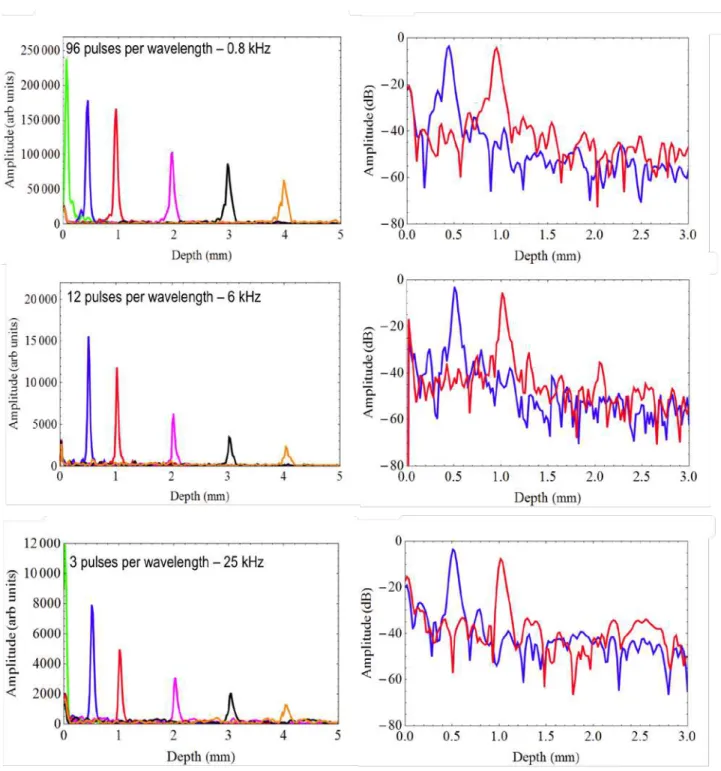
It is very important to understand the laser dynamic in sweep mode at the various sweep speeds. It takes a number of round trips for any pulse to build up and reach steady state. Of course it is closely related with the coherence length (temporal spectral bandwidth of pulse) of the programmable laser for SS-OCT applications and other nonlinear spectroscopic applications. We also measured a group of point spread functions (PSFs) at different number of wavelengths/s. The PSF were calculated by directly doing the FFT of the raw data. Two figures in the first row in Fig. 8 show PSFs measured in different depths using 0.78 million wavelengths/s. Left figure describes the result in linear scale and right one in logarithm scale. Swept speed was 0.8 kHz and 96 pulses were selected in every 1024 wavelength. Sensitivity roll-off was found to be 6 dB at 4 mm. At the swept speed of 6 kHz (6.25 million wavelengths/s), coherence
property of laser was degraded as shown in second row in Fig. 8. When the swept rate was 25 million wavelengths/s (25 kHz), sensitivity roll-0ff was about 6 dB at 1 mm as shown in the last row of Fig. 8. We believe it should be possible to get a better signal to noise ratio, longer coherence length, better axial resolution, and faster swept speed if we reduce the cavity length and optimize the SOA as to reduce its inherent nonlinearity.
3. CONCLUSIONS
We presented the realization of a 25 million wavelengths/s swept source using a SOA-based programmable laser. Using a 10 ps/nm CFBG, we got 45 ps pulse width and we could further reduce the pulse width as short as 10 ps after pulse compression in a TDCM. According to our numerical simulations, pulses shorter than 10 ps could be obtained if we implement an electrical pulser of 25 ps and lower the dispersion. In order to analyze the swept source signal quality for SS-OCT applications, we measured point spread functions at three different speeds. As a result we obtained sensitivity roll-off of 6dB at length of 4 mm, ~ 1.5 mm, and ~ 1 mm at 0.8 kHz (0.78 million wavelengths/s), 6 kHz (6.25 million wavelengths/s), and 25 kHz (25 million wavelengths/s), respectively. These measurements were taken using linear k-space sweeping function available from graphical user interface (GUI) of our programmable laser. The PSF were obtained by doing a direct FFT of the raw data. We believe that it is feasible to optimize the laser in order to provide longer coherence length, faster swept speed, higher axial resolution, and signal to noise ratio.
ACKNOWLEGMENT
We would like to acknowledge the NRC-IRAP program #698648 for their contribution to this project.
REFERENCES
[1] Burgoyne, B. and Villeneuve, A., “Programmable laser:design and applications”, Photonics West, paper 7580-1 (2010)
[2] Cheng, Ji-Xin and Xie, X. Sunney, “Coherent anti-Stokes Raman scattering microscopy: Instrumentation, Theory, and applications,” J. Phys. Chem B (108), 827-840 (2004)
[3] Freudiger, C. W., Min, Wei., Saar, B. G., Lu, S., Holtom, G. R., He, C., Tsai, J. C., Kang, J. X. and Xie, X. S.,"Label-free biomedical imaging with high sensitivity by stimulated Raman scattering microscopy," Science (322), 1857–1861 (2008)
[4] Pegoraro A. F., Ridsdale, A., Moffatt, D. J., Jia, Y., Pezacki, J. P., and Stolow, A., “Optimally chirped multimodal cars microscopy based on a single Ti:sapphire oscillator,” Opt. Express (17), 2984–2996 (2009)
[5] Kuramoto M., Kitajima, N., Guo, H., Furushima Y., Ikeda, M., and Yokoyama, H., “Two-photon fluorescence bioimaging with an all-semiconductor laser picosecond pulse source,” Opt. Lett (32), 2726–2728 (2007)
[6] Yokoyama, H., Sato, A., Guo, H. -C., Sato, K., Mure, M., and Tsubokawa, H., “Nonlinear-microscopy optical-pulse sources based on mode-locked semiconductor lasers,” Opt. Express (16), 17752–17758 (2008)
[7] Agrawal, G. P. and Olsson, N. A., “Self-phase modulation and spectral broadening of optical pulses in semiconductor laser amplifiers,” IEEE J. Quantum Electron. (25), 2297–2306 (1989)
[8] Quinlan, F., Gee, S., Ozharar, S., and Delfyett, P. J., “Ultralow-jitter and -amplitude-noise semiconductor-based actively mode-locked laser,” Opt. Lett (31), 2870–2872 (2006)
[9] Kelly, S. M., “Characteristic sideband instability of periodically amplified average soliton”, Electron. Lett. (8), 806-807 (1992)
[10] Duan, L., Dagenais, M., and Goldhar J., “Smoothly Wavelength-Tunable Picosecond Pulse Generation Using a Harmonically Mode-Locked Fiber Ring Laser”, J. Lightwave Technol. (21), 930-937 (2003)
[11] Momma, C., Chichkova, B. N., Nolte, S., Alvensleben, F. von, Tünnermann, A., Welling, H. and Wellegehausen, B., “Short-pulse laser ablation of solid targets ”, Opt. Communine (21), 930-937 (2003)
[12] Kieu, K., Saar, B. G., Holtom, G. R., Xie, X. S., and Wise, F. W., “High-power picosecond fiber source for coherent Raman microscopy,” Opt. Lett. (34), 2051–2053 (2009)
[13] Yun, S. H., Boudoux, C., Tearney, G. J., and Bouma, B. E., “High-speed wavelength-swept semiconductor laser with a polygon-scanner-based wavelength filter,” Opt. Lett. (28), 1981–1983 (2003)
[14] Huber, R., Wojtkowski, M. ,and Fujimoto, J. G., “Fourier Domain Mode Locking (FDML): a new laser operating regime and applications for optical coherence tomography,” Optics Express (14) 3225–3237 (2006)
[15] Yamashita, S., Nakazaki, Y., Konishi, R., and Kusakari, O., “Wide and Fast Wavelength-Swept Fiber Laser Based on Dispersion Tuning for Dynamic Sensing”, Journal of Sensors (2009) 1-12 (2009)

![[PDF] Tour d'horizon de PhotoFiltre 6.3 | Formation Informatique](data:image/gif;base64,R0lGODlhAQABAIAAAP///wAAACH5BAEAAAAALAAAAAABAAEAAAICRAEAOw==)