HAL Id: hal-02348735
https://hal.archives-ouvertes.fr/hal-02348735
Submitted on 5 Nov 2019
HAL is a multi-disciplinary open access
archive for the deposit and dissemination of
sci-entific research documents, whether they are
pub-lished or not. The documents may come from
teaching and research institutions in France or
abroad, or from public or private research centers.
L’archive ouverte pluridisciplinaire HAL, est
destinée au dépôt et à la diffusion de documents
scientifiques de niveau recherche, publiés ou non,
émanant des établissements d’enseignement et de
recherche français ou étrangers, des laboratoires
publics ou privés.
A yeast two-hybrid knockout strain to explore
thioredoxin-interacting proteins in vivo
Florence Vignols, Claire Bréhélin, Yolande Surdin-Kerjan, Dominique
Thomas, Yves Meyer
To cite this version:
Florence Vignols, Claire Bréhélin, Yolande Surdin-Kerjan, Dominique Thomas, Yves Meyer. A yeast
two-hybrid knockout strain to explore thioredoxin-interacting proteins in vivo. Proceedings of the
National Academy of Sciences of the United States of America , National Academy of Sciences, 2005,
102 (46), pp.16729-16734. �10.1073/pnas.0506880102�. �hal-02348735�
A yeast two-hybrid knockout strain to explore
thioredoxin-interacting proteins
in vivo
Florence Vignols*†, Claire Bre´he´lin*‡, Yolande Surdin-Kerjan§, Dominique Thomas§¶, and Yves Meyer*
*Laboratoire Ge´nome et De´veloppement des Plantes, Centre National de la Recherche Scientifique, Unite´ Mixte de Recherche 5096, 66860 Perpignan, France;§Centre de Ge´ne´tique Mole´culaire, Centre National de la Recherche Scientifique, Unite´ Propre de Recherche 2167, Bâtiment 26, 1 Avenue de la Terrasse, 91190 Gif-sur-Yvette, France; and¶Cytomics Systems SA, Bâtiment 5, 1 Avenue de la Terrasse, 91190 Gif-sur-Yvette, France
Edited by Bob B. Buchanan, University of California, Berkeley, CA, and approved September 23, 2005 (received for review August 9, 2005)
All organisms contain thioredoxin (TRX), a regulatory thiol:disul-fide protein that reduces disulthiol:disul-fide bonds in target proteins. Unlike animals and yeast, plants contain numerous TRXs for which no function has been assigned in vivo. Recent in vitro proteomic approaches have opened the way to the identification of >100 TRX putative targets, but of which none of the numerous plant TRXs can be specifically associated. In contrast, in vivo methodologies, including classical yeast two-hybrid (Y2H) systems, failed to reveal the expected high number of TRX targets. Here, we developed a yeast strain named CY306 designed to identify TRX targets in vivo by a Y2H approach. CY306 contains a GAL4 reporter system but also carries deletions of endogenous genes encoding cytosolic TRXs (TRX1 and TRX2) that presumably compete with TRXs introduced as bait. We demonstrate here that, in the CY306 strain, yeast TRX1 and TRX2, as well as Arabidopsis TRX introduced as bait, interact with known TRX targets or putative partners such as yeast perox-iredoxins AHP1 and TSA1, whereas the same interactions cannot be detected in classical Y2H strains. Thanks to CY306, we also show that TRXs interact with the phosphoadenosine-5-phosphosulfate (PAPS) reductase MET16 through a conserved cysteine. Moreover, interactions visualized in CY306 are highly specific depending on the TRX and targets tested. CY306 constitutes a relevant genetic system to explore the TRX interactome in vivo and with high specificity, and opens new perspectives in the search for new TRX-interacting proteins by Y2H library screening in organisms with multiple TRXs.
affinity chromatography兩 gene disruption 兩 thioredoxin targets 兩 two-hybrid system兩 redox
T
hioredoxins (TRXs) are small heat-stable oxidoreductases con-taining two redox-active half-cysteine residues in an active site with a conserved amino acid sequence CXXC (where X indicates various amino acids) (1). TRX was originally identified as hydrogen donor for the reduction of methionine sulfoxide (MetSO) (2) and of sulfate (3) in yeast and received its name when it was charac-terized as a small protein dithiol hydrogen donor to Escherichia coli ribonucleotide reductase (4). TRX is a hydrogen donor to perox-iredoxins (5) and is also required for a number of metabolic enzymes as part of their catalytic cycle. TRX is implicated in many cellular processes, including protein folding and regulation of transcription factors (6), protein repair after damage by oxidation, sulfur metabolism (7, 8), reduction of dehydroascorbate (9), ger-mination, or reduction of the Calvin cycle and stromal enzymes in plants (10, 11).Occurrence of TRXs in all genomes is highly variable and somewhat complex, depending on the organisms concerned. Most organisms, such as E. coli, the yeast Saccharomyces cerevisiae, and mammals (12) contain a limited number of TRX or TRX-like genes (usually fewer than five). In contrast, plants possess numerous TRX isoforms (13, 14) or TRX-like proteins (11, 13–15). During the latest inventories in the Arabidopsis genome,⬎40 TRX isoforms have been identified (14). Such diversity raises the problem of the function and specificity of each TRX. To answer these questions, much recent work has been devoted to large-scale searches for their
putative targets. Various improved in vitro proteomic approaches [such as affinity chromatography (16–21), labeled gel electrophore-sis in which target proteins are revealed after reduction of protein extract by a TRX兾NADPH thioredoxin reductase (NTR) system (22–24), or coimmunoprecipitation (25)] suggested⬎100 putative TRX targets, but for which further investigations will be required for target validation regarding TRX specificity. Other methods devoted to the large-scale isolation of TRX兾target complexes established in vivo have also been developed, including affinity chromatography of TRX兾target complexes established in vivo during cell culture or the yeast兾mammalian two-hybrid methods (26–31). However, such in vivo methods have led to the identifi-cation of only a few true TRX-interacting proteins. Their low efficiency to reveal TRX targets is directly correlated with the presence of functional endogenous TRX proteins in organisms in which large-scale search of TRX-interacting proteins is performed. These endogenous TRXs either compete with the foreign TRXs used as bait or most probably reduce the disulphide bond estab-lished in vivo between the TRX bait and its target protein (26).
In the present work, we have developed a yeast two-hybrid (Y2H) system to allow high throughput detection of TRX兾target interac-tions in vivo. The main characteristic of this genetic selection is to bypass the disulfide bond reduction by endogenous yeast TRX1 and TRX2 cytosolic proteins, while establishing in vivo interaction between TRX introduced as bait and its putative targets. For this purpose, we created a yeast strain, termed CY306, that is depleted in both TRX1 and TRX2 genes but bears a functional Gal4 Y2H system. We show that CY306 exhibits the same phenotypes as those previously described for other trx1⌬ trx2⌬ yeast mutants. Thanks to strain CY306, we demonstrate in vivo Y2H interactions between TRXs and known or putative TRX targets that could not be revealed to date by classical Y2H systems or other in vivo systems. We specially show here that the yeast TRX2 interacts specifically with yeast AHP1 and TSA1 peroxiredoxins involved in oxidative stress response, whereas TRX1 preferentially interacts with PAPS reductase (MET16), an enzyme involved in sulfate assimilation. Regarding MET16, the use of CY306 was of great help in revealing the cysteine residue required for TRX binding. Finally, the high level of specificity in TRX兾target recognition obtained by the CY306 Y2H system contrasted with that observed by a His-tag affinity chromatography (His-TAC) approach with the same TRX baits. The use of the CY306 strain will be of great help first in analyzing by Y2H the numerous potential targets already isolated
Conflict of interest statement: No conflicts declared. This paper was submitted directly (Track II) to the PNAS office.
Abbreviations: t-BOOH, tert-butyl hydroperoxide; His-TAC, His-Tag affinity chromatogra-phy; MetSO, methionine sulfoxide; TRX, thioredoxin; Y2H, yeast two-hybrid; MSRA, me-thionine sulfoxide reductase; MET16, PAPS reductase.
†To whom correspondence should be addressed at: Laboratoire Ge´nome et De´veloppe-ment des Plantes, Centre National de la Recherche Scientifique, Unite´ Mixte de Recherche 5096, Universite´ de Perpignan, 52 Avenue Paul Alduy, 66860 Perpignan, France. E-mail: [email protected].
‡Present address: Laboratoire de Physiologie Ve´ge´tale, Universite´ de Neuchâtel, Case Postale 2, Emile Argand 11, CH-2007 Neuchâtel, Switzerland.
© 2005 by The National Academy of Sciences of the USA
in vitro, especially in plants, and second in opening new perspectives
for the systematic in vivo search for new TRX-interacting proteins in all organisms.
Materials and Methods
Strains and Media.The yeast strain EMY63 (32) was used for both phenotypic comparisons and production of recombinant TRXs. The Y2H strains YRG2 (Stratagene) and YM954 (33) were used for deletion of TRX1 and TRX2, respectively. Construction of strain CY306 was achieved by the long flanking homology method (34) and is described in Supporting Materials and Methods, which is published as supporting information on the PNAS web site. Chem-icals [H2O2, tert-butyl hydroperoxide (t-BOOH), diamide, Met, and
MetSO) were purchased from Sigma. All media are detailed in
Supporting Materials and Methods.
Molecular Cloning. Yeast and Arabidopsis ORFs, primers, and MluI.NaeI.BglII (MB) adaptor used in this study are given in Table 2, which is published as supporting information on the PNAS web site. PCR products were obtained by using the long expand template enzyme (Roche Applied Science). Mutation of cysteine residues was obtained by using the Site-Directed Mutagenesis kit (Stratagene). All DNA fragments were systematically checked by sequencing.
TRX His-Tagging and Purification of TRX兾Target Complexes. TRX baits were cloned into a modified version of the pFL61 shuttle vector (ref. 35 and Supporting Materials and Methods) and were separately introduced in EMY63 strain for production of recom-binant His-tagged TRX baits. Cultures, protein extractions, and complex purifications were performed as described (26) by using 1 ml of His䡠Bind Ni2⫹resin (Novagen) per liter of cell cultures (OD600
ranging between 1.4 and 2). Protein complexes were treated immediately or frozen at⫺80°C.
Protein Analysis.Extraction of total proteins for immunoblot anal-yses are described in Supporting Materials and Methods. All proteins were quantified by using a protein assay kit (Bio-Rad). Proteins for mass spectrometry were concentrated by using frozen acetone and, once lyophilized, were solubilized in 500l of solubilization buffer [9 M urea兾4% CHAPS (3-[(3-cholamidopropyl)dimethylammo-nio]-1-propanesulfonate)兾0.5% Triton X-100兾0.5 immobilized pH-gradient (IPG) buffer (Amersham Pharmacia)兾3 mM tributyl phosphin]. Proteins (300g) were first separated along linear IPG strips (pH 3–10, 18 cm long) by using an IPGphor apparatus (Amersham Pharmacia Biosciences) and further treated as de-scribed (36). Second dimensions were performed in 13% polyacryl-amide兾SDS gels. Proteins were stained by colloidal Coomassie and digested by trypsin, and individual spots were analyzed by MALDI-TOF (BIFLEX III, Bruker, Billerica, MA) at the Montpellier LR Genopole (France).
Two-Hybrid Experiments. All experiments were performed in the yeast reporter strains YRG2 (Stratagene) and CY306 (this study). cDNAs encoding AtTRXh2ser62, AtTRXh3ser42, the yeast
TRX1ser33, and TRX2ser34are available in our laboratory and were
cloned at EcoRI-BamHI sites of pGBKT7 (Clontech). Target cDNAs [AHP1, TSA1, methionine sulfoxide reductase (MSRA), and MET16] were obtained by PCR amplification on yeast genomic DNA by using restriction site-containing primers (Table 2), and cloned into pGADT7 (CLONTECH) at corresponding sites. AtTDX⌬[270–380] and SSB2 constructs are from ref. 37. Double transformants in YRG2 and in CY306 strains were selected as cells growing in the absence of leucine and tryptophan, and in the presence of Met and geneticin for CY306 strain. Cells bearing interacting proteins were selected on media lacking leucine, tryp-tophan, and histidine, but containing Met and 20 mM
3-aminotria-zole (3AT), and tested for -galactosidase activity as described (Stratagene).
Results
Development and Phenotypic Analysis of CY306 trx1⌬ trx2⌬
Two-Hybrid Yeast Strain.The aim of our study was to obtain a new yeast two-hybrid strain allowing the search for specific thioredoxin tar-gets in vivo, by getting rid of competition between the TRX introduced as bait and endogenous TRXs. For this purpose, our strategy consisted in replacing both endogenous TRX1 (ORF YLR043C) and TRX2 (ORF YGR209C) genes by a KanMX4 cassette in a Y2H strain, leading to a trx1⌬ trx2⌬ mutant strain named CY306. The feasibility of such a genetic system was based on the good knowledge of yeast trx1⌬ trx2⌬ mutants [such as the EMY63 trx1⌬ trx2⌬ strain (32)] that remain viable despite several severe phenotypes (32).
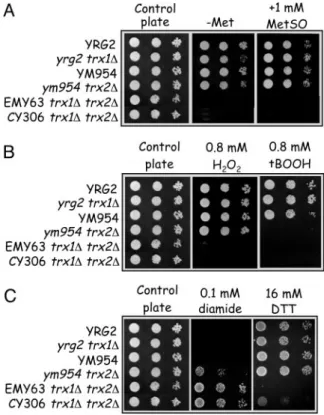
We next performed phenotypic analyses on CY306 cells to confirm that this strain behaves like other yeast trx1⌬ trx2⌬ mutants. Because trx1⌬ trx2⌬ mutants are unable to grow on media con-taining sulfate as the sole source of metabolic sulfur (32), organic sulfur auxotrophy was the second criterion after geneticin resistance that allowed us to select the CY306 trx1⌬ trx2⌬ cell lines during tetrad analysis. CY306, like EMY63 trx1⌬ trx2⌬ mutant, is unable to grow on a medium lacking Met as sole source of organic sulfur (Fig. 1A). Similarly, CY306 cells are unable to grow on B medium containing MetSO as source of sulfur (Fig. 1 A), as previously shown for EMY63 strain (38). Because strains deleted for both TRX1 and
Fig. 1. CY306 yeast cells are true trx1⌬ trx2⌬ mutants regarding Met auxotrophy and sensitivity to oxidative stress. (A) CY306 cells are unable to grow on solid yeast extract nitrogen base (YNB) medium without Met and cannot reduce MetSO. (B) CY306 cells are also sensitive to oxidant molecules such as H2O2and t-BOOH. (C) Effect of diamide and DTT on CY306 growth. In
B, C, and D, control plates contain 1 mM Met. Cultures of wild-type (YRG2,
YM954), single mutant (yrg2 trx1⌬; ym954 trx2⌬), and double mutant (EMY63
trx1⌬ trx2⌬; CY306 trx1⌬ trx2⌬) cells were grown into stationary phase and adjusted to an OD600of 0.5, 5⫻ 10⫺2, and 5⫻ 10⫺3before spotting onto appropriate plates. Plates were incubated at 30°C for 3 days before scoring growth. Results shown here are the means of three independent experiments.
TRX2 are also hypersensitive to oxidant molecules such as H2O2
(32) and t-BOOH (39), we checked that CY306, like EMY63 mutant, is unable to grow on plates containing H2O2(Fig. 1B). Both
strains were also unable to grow on plates containing 0.8 mM
t-BOOH (Fig. 1B). Interestingly, the ym954 trx2⌬ mutant was also
unable to grow, suggesting that TRX1 cannot compensate the function of TRX2 in the case of reduction of alkyl hydroperoxides by TRXs. Finally, the CY306 mutant showed resistance to diamide and sensitivity toward DTT (Fig. 1C), similarly to trx2⌬ (32) and
trx1⌬ trx2⌬ (40) mutants. Altogether, these results indicate that the
CY306 strain is true trx1⌬ trx2⌬ mutant regarding phenotypes.
CY306trx1⌬ trx2⌬ Yeast Strain Is a Y2H Tool That Reveals Thioredoxin
Targetsin Vivo.To evaluate the efficiency of the Y2H CY306 strain to reveal interaction involving thioredoxins, binary interactions between TRXs and putative targets were assayed in both the mutant CY306 and the wild-type YRG2 strains. All TRXs used as bait carried a mutation of the second cysteine of the TRX active site into a serine (TRX1ser33 and TRX2ser34), in accordance with the
ability of mutated TRXs to establish stable mixed disulfide complex
in vivo (26). Four different targets were chosen, either because they
had already been described as TRX targets by other means, or because of strong presumption that they are TRX targets.
The first protein tested was the thioredoxin-dependent peroxi-dase AHP1, a yeast protein involved in alkyl hydroperoxide detox-ification (39, 41). Biochemical and genetic evidence indicates that AHP1 is a TRX target (26) and is consistent with sensitivity of trx1⌬
trx2⌬ yeast mutants to H2O2and t-BOOH. However, a previous
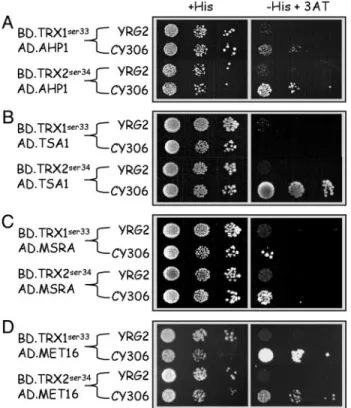
study using classical Y2H systems failed to reveal a TRX兾AHP1 interaction (26). Fig. 2A shows that, in the mutant strain CY306, a faint interaction could be detected between TRX1ser33and AHP1,
and between TRX2ser34and AHP1 to a much greater extent. We
also tested the interaction between both TRXs and TSA1, a thiol-specific antioxidant also involved in hydroperoxide detoxifi-cation and that requires the TRX兾NADPH thioredoxin reductase (NTR) reductase system (5). A strong interaction was obtained with TRX2ser34only in the CY306 strain (Fig. 2B), whereas no
interac-tion was found with TRX1ser33. None of the two TRXs interacted
with both targets in the YRG2 strain.
Another putative TRX-interacting protein that was assayed is the yeast MSRA. MSRA is another antioxidant enzyme that exerts its protection against oxidative stress by maintaining a low level of oxidized Met, either in protein-bound or free amino acid form (42).
In vivo and in vitro analyses of yeast (38) and E. coli (43, 44) TRX
mutants indirectly suggested that TRX is the reductase that reac-tivates methionine sulfoxide reductase (38, 43, 44), which is con-sistent with the inability of trx1⌬ trx2⌬ yeast mutants to grow on plates containing MetSO as the sole Met source (ref. 38 and this work). As shown in Fig. 2C, cells bearing either MSRA兾TRX1ser33
or MSRA兾TRX2ser34were able to grow on selective medium only
in the strain CY306, thus confirming that both TRXs directly interact with MSRA in vivo.
All trx1⌬ trx2⌬ yeast mutants described in the literature exhibit a Met auxotrophy, due to the inability to assimilate inorganic sulfur (32, 40). In yeast, TRX is required in sulfur assimilation (7, 8) and is supposed to ensure the reduction of a conserved cysteine in the PAPS reductase (MET16), a key enzyme required for Met biosyn-thesis (45). We actually found a strong interaction between MET16 and TRX1ser33 in CY306 strain (Fig. 2D), but a weaker but
significant interaction with TRX2ser34could also be demonstrated
in this strain. In both cases, such interactions could not be observed in the wild-type strain YRG2.
All interactions visualized using His3 reporter gene under Gal4 control were confirmed by using LacZ reporter gene, for both the presence and intensity of interaction (data not shown). No inter-action (using both reporter genes) was observed when nonmutated forms of TRX were used as bait (data non shown).
CY306trx1⌬ trx2⌬ Yeast Strain Reveals Specific and Low-Abundant TRX Targets.To compare the efficiency of the CY306 strain and the TRX-specific Y2H system with other in vivo approaches, we performed a series of purifications of TRX-target complexes es-tablished in vivo after production of His-Tagged mutated TRXs in the yeast mutant EMY63 trx1⌬ trx2⌬. Experiments were performed by using yeast TRX1ser33and TRX2ser34as bait, but also Arabidopsis
AtTRXh2ser62and AtTRXh3ser42.
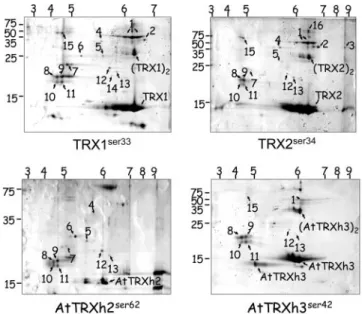
Among the targets identified by MALDI-TOF (Fig. 3), we confirmed AHP1, TSA1, and MET16 as putative targets. Except for the case of AtTRXh3ser42, which did not allow TSA1 and MET16
purification, these targets were always isolated (reproductive iso-lation), independent of the bait used (Table 1). This apparent lack of specificity contrasted with that observed with the CY306 Y2H system (Table 1 and Fig. 2). Of particular interest was the nonspe-cific purification of TSA1 using all baits in the His-TAC method, although it only interacted with the yeast TRX2ser34in CY306 (Fig.
2B). In this case, the Y2H result was more consistent with the putative function of the yeast TRX2 in response to oxidative stress produced by alkyl hydroperoxides, as shown by phenotypic analyzes of trx1⌬ trx2⌬ yeast mutants (Fig. 1B and ref. 41). This difference of specificity between the two targeting systems was also shown when plant TRXs were used as bait. AtTRXh2ser62always captured
AHP1, TSA1, and MET16 by the His-TAC method (Fig. 3), although it interacted with MET16 only by the CY306 Y2H approach (Table 1). Only the result obtained by using CY306 is consistent with the ability of AtTRXh2 to complement EMY63
trx1⌬ trx2⌬ mutant for Met auxotrophy by its ability to reduce the Fig. 2. CY306, but not the classical YRG2 strain, efficiently reports Y2H
interactions involving thioredoxins. The following interactions are observed only in CY36 cells. (A) TRX1ser33and TRX2ser34differentially interact with alkyl hydroperoxide protein AHP1. (B) TRX2ser34, but not TRX1ser33, interacts with thiol-specific antioxidant TSA1. (C) MetSO reductase MSRA equally interacts with TRX1ser33and TRX2ser34. (D) TRX1ser33, and TRX2ser34to a lesser extent, interacts with the PAPS enzyme MET16. In all pictures, control plates (Left) contain histidine and test plates (Right) contain 20 mM 3-aminotriazole (3-AT) without histidine. Results shown here are the means of three independent experiments.
MET16兾PAPS enzyme, whereas it is unable to complements EMY63 for sensitivity to oxidative stress (38).
In the His-TAC approach, we also found that AHP1, TSA1, and MET16 were always similarly isolated (2D-spot density). On the opposite, the CY306 strain not only allowed the detection of TRX兾target interactions in a specific manner, but also revealed different levels of interaction depending on the partners analyzed (Table 1).
Finally, except for the mid-abundance MET16 protein, all of the targets identified by the His-TAC method were high-abundance proteins (Fig. 3), although we did not identify low-abundance proteins including the MSRA protein among the 2D-spots. In contrast, a Y2H interaction could be detected in CY306 between MSRA and TRXs (Fig. 2C), even when AtTRXh2ser62 and
AtTRXh3ser42were used as bait (Table 1), which is consistent with
the ability of both proteins to complement the EMY63 trx1⌬ trx2⌬ mutant for reduction of MetSO phenotype (38).
Altogether, these results suggest that, even if the His-TAC is very helpful in the isolation of TRX targets, the CY306 Y2H system is far more sensitive for TRXs target recognition. The CY306 Y2H system provides information that is consistent with functional complementation data (38) and the specificity and sensitivity values that are lacking in the His-TAC system developed here.
CY306trx1⌬ trx2⌬ Yeast Strain as a Tool to Reveal Essential Cysteines
in TRX Targets.We finally investigated the ability of the CY306 strain to reveal critical residues such as cysteines involved in TRX interaction with its target. We took as an example the MET16 enzyme that contains two cysteine residues: C112, which does not possess any catalytic activity (46), and C245 in the consensus sequence KxECG(L兾I)H, which is required for MET16 activity (47). Before this work, the identity of the cysteine residue targeted by TRX in MET16 was unknown. Two mutated MET16C112Sand
MET16C245S were then constructed in pGADT7 and further
as-sayed for interaction with both TRX1ser33and TRX2ser34. As shown
in Fig. 4, the C112S mutation in the MET16 protein did not affect its interaction with TRX1ser33 and TRX2ser34 because CY306
growth remained similar to that observed for the wild-type protein. In contrast, the C245S mutation in MET16 drastically abolished its binding to both TRXs as revealed by the absence of CY306 growth. This result first confirmed that C245 is the essential cysteine for MET16 interaction with TRXs (47). Second, this experiment demonstrated that the CY306 strain is a functional and reliable tool to discriminate cysteines targeted by TRXs in vivo.
Discussion
Proteins rarely work by themselves and almost all require other molecules to execute their functions. TRXs are among such
pro-Fig. 3. Bidimensional electrophoresis of TRX兾targets complexes established
in vivo in EMY63 trx1⌬ trx2⌬ cell culture. The different TRXs used as baits are indicated under the corresponding panels. Numbers refer to identified pro-teins兾ORF as follow: 1, alcohol dehydrogenase兾YOL086C; 2, glyceraldehyde-3-phosphate dehydrogenase, isozyme 3兾YGR192C; 3, glyceraldehyde-3-phosphate dehydrogenase, isozyme 1兾YJL052W; 4, thioredoxin reductase兾 YDR353W; 5, MET16兾YPR167C; 6 and 12–14, eukaryotic initiation factor 4E兾 YOL139C; 7, TSA1兾YML028W; 8–11 and 15, AHP1兾YLR109W; and 16,D-lactate dehydrogenase兾YEL071W. The pH gradient is indicated above the panels. Size of markers is indicated in kDa on the left of each panel. Control experiments using nonmutated TRX exhibited only spots corresponding to the baits used (data not shown). Results shown here are the means of four independent experiments for each TRX bait.
Table 1. Comparative analysis between His-TAC and Y2H methods to efficiently reveal specific
TRX兾target complexes in trx1⌬trx2⌬ yeast mutants
Targets
Affinity chromatography* Yeast two-hybrid†
TRX1 TRX2 Ath2 Ath3 TRX1 TRX2 Ath2 Ath3
AHP1 ⫹⫹⫹ ⫹⫹⫹ ⫹⫹⫹ ⫹⫹⫹ ⫹⫹ ⫹⫹⫹ ⫺ ⫹⫹
TSA1 ⫹⫹ ⫹ ⫹ NI ⫺ ⫹⫹⫹⫹ ⫺ NT
MET16 ⫹ ⫹ ⫹ NI ⫹⫹⫹ ⫹⫹ ⫹⫹ ⫺
MSRA NI NI NI NI ⫹ ⫹⫹ ⫹兾⫺ ⫹兾⫺
All TRX baits are mutated and carry a CXXS active site. NT, not tested; Ath2, AtTrxh2; Ath3, AtTrxh3. *Plus signs (⫹,⫹⫹,⫹⫹⫹), spot density as observed on 2D gels. NI, the corresponding target was not identified
among the 2D spots analyzed.
†Plus signs (⫹,⫹⫹,⫹⫹⫹), the level of two-hybrid interactions; ⫺, no interaction occurred between partners tested; ⫹兾⫺, a faint but reproducible interaction.
Fig. 4. CY306 strain allows detection of the essential cysteine residue in the PAPS reductase that is required for TRX interaction. Both the TRX1ser33or TRX2ser34baits were tested for two-hybrid interaction with the two variants MET16ser112and MET16ser245of the MET16 enzyme. Cells were grown and spotted as described in Fig. 1. Results shown here are the means of three independent experiments.
teins that were historically shown to be involved in substrate reduction and regulation of enzymes in physiological conditions. In the last few years, extended efforts have been devoted to large-scale searches for potential TRX targets in various organisms. Thanks to
in vitro approaches (affinity chromatography and proteomics),
several nonexhaustive lists of putative TRX targets have been established, deciphering new pathways and metabolic functions involving TRXs (11). Because of a real need to go further in the analysis of TRX兾target complex specificity, we describe here a tool consisting of a yeast strain devoted to the study of binary protein兾 protein interactions and Y2H screenings in vivo, specifically de-signed for the identification and analysis of TRX targets. We propose that this tool will be of great help, first to assign specific targets to specific TRXs, and second to isolate new and兾or low-abundant candidates for reduction by TRXs in vivo.
A Two-Hybrid System for Thioredoxins.Numerous two-hybrid sys-tems have been described, most of them using bacterial or yeast cells. The Y2H system was selected in our strategy for several reasons. Yeast combines an ease of manipulation comparable with that of bacteria with the characteristics of eukaryotic cells, such as posttranslational modifications. The Y2H system is adaptable to most kinds of baits and targets from any organelle or organism, and allows not only the study of binary interaction between two proteins, but also the search for new partners in DNA libraries. Interactions occur in vivo, which distinguishes this approach from other protein-targeting methods, and can be performed between two proteins from different organisms. Unfortunately, when we first used commercial Y2H systems to search for TRX targets using DNA libraries, using yeast or plant TRXs as bait, very few targets were isolated, in contrast to the numerous putative targets isolated by using in vitro proteomics (19, 20, 48). Even Y2H binary inter-actions involving TRX targets isolated by another in vivo method failed in classical Y2H yeast strains (26). The poor efficiency of classical Y2H systems to reveal TRX targets has been observed in previous library screenings (28–30, 49), and only a few TRX partners have been isolated up to now (27–31). Some TRX-interacting partners, such as ASK1 (50), the S Locus receptor kinase SRK (51), and the Cf-9 protein (52) were also revealed, but in which TRXs were captured as the targets of these proteins. These data are consistent with the very few TRX-interacting proteins found by using large-scale two-hybrid arrays (53, 54). Such screenings have generated a tremendous amount of protein data and identified thousands of interactions, among which none or very few involving a TRX were described (55–57). Interestingly, other in vivo ap-proaches such as the tandem-affinity purification (TAP) also failed to reveals TRX-containing complexes (58, 59). All these high-throughput methods are usually performed in vivo by using wild-type strains and nonmutated baits, reinforcing the presumption that the search of TRX targets requires adapted strategies.
The low efficiency of in vivo methods to isolate a high number of TRX targets could reside in the presence of functional endogenous TRX1 and TRX2 proteins in strains routinely used for such strategies. Based on our previous observations using the wild-type EMY60 yeast strain in a His-TAC in vivo approach (26), we suspected that endogenous TRXs either compete with the foreign TRX introduced as bait, and兾or most probably reduce the newly established disulphide bond between the TRX bait and its target protein. Because of our successful experience in isolating the first TRX target in vivo from an organism depleted in endogenous TRXs (26) and because the same approach was also successful in a trxA⫺bacteria (19), we decided to create a yeast strain depleted in TRX1 and TRX2 genes, devoted to the specific Y2H search and analysis of TRX targets. The results we present here confirm that deletion of both TRX1 and TRX2 genes in a Y2H strain leads to an efficient genetic system that allows visualization of Y2H interac-tions with foreign TRXs that could not be seen up to now in routine strains. The nature of Y2H interactions correlates with trx1D trx2D
yeast mutant complementation and phenotypes (38–40). This finding supports endogenous TRXs competition with TRX bait to capture protein targets in organisms where they are present, but not an unlikely differential nuclear import of complexes for Gal4 activation depending on target identity.
Looking for Specificity in Target Recognition by Thioredoxins.To date, affinity chromatography, combined with proteomics, has probably been the most powerful tool to reveal a large number of TRX targets. Extended lists of putative TRX targets have been obtained from organelles and organisms (11) that have increased our knowledge about their putative functions, mostly by revealing pathways involving such dithiol proteins. Nevertheless, some limits inherent to both methodologies have been brought to light. Con-cerning affinity chromatography, one may question the unspecific binding on affinity column of proteins unrelated to TRX function, the absence of clear results concerning specificity of the targets regarding cellular compartments, and the variety of proteins cap-tured by the different dithiol isoforms (21). In our His-TAC system, we also observed low specificity in the targets isolated, probably due to the use of a multicopy shuttle vector for production of recom-binant TRX bait in vivo. On the other hand, using CY306 strain, we found that yeast TRX1 interacts preferentially with the yeast PAPS enzyme, although TRX2 preferentially interacts with peroxidases involved in detoxification toward oxidant molecules. Interestingly, both TRX1 and TRX2 interact with the TRX-dependent AHP1, whereas only TRX2 interacts with the thiol peroxidase TSA1. The CY306 Y2H system demonstrates that a specificity in TRX兾target recognition can be revealed and opens perspectives in deciphering the true functions of the numerous TRX isoforms. Many putative targets have already been isolated, even with low specificity, and could be now tested for Y2H interaction with the different TRX isoforms originated from the same organism.
CY306 Strain Is a New Tool for the Identification of Residues Required for TRX兾Target Interactions.Interestingly, all interactions shown in this study were obtained with TRX baits carrying only a Cys-to-Ser mutation on the second cysteine of the CXXC active site, confirm-ing the requirement of such mutation to establish stable interme-diate complexes between the TRX and targets tested here. Nev-ertheless, several putative targets already isolated by in vitro means do not contain any conserved cysteines (18, 60). Other targets contain cysteines that are not conserved in other organisms (18). These observations raise the question as to how TRX binds to such targets. We have shown that CY306 is able to reveal the C245 as the amino acid targeted by TRX in MET16 protein. The same analysis could now be performed with other putative targets for which a question mark still remains about being true TRX partners, by using both wild-type and mutated TRXs as bait to answer whether cysteines of both partners are required for interaction.
Searching for Low-Abundant and兾or New TRX-Interacting Proteins.
One of the realities of large-scale in vitro proteomics is the low efficiency to reveal low-abundance protein targets. In our His-TAC approach, almost all of the putative targets isolated by the His-TAC approach were highly abundant proteins. Despite several purification experiments, we always failed to isolate low-copy targets, such as the MSRA protein, probably because the more abundant targets such as AHP1 quench the foreign TRX bait. On the other hand, Y2H systems are usually efficient to detect low-copy-number proteins, such as transcription fac-tors, because interactions are required for cell life. By using the CY306 Y2H strain, we obtained an interaction between MSRA and both TRX1ser33and TRX2ser34, as well as with AtTRXh2ser62
and AtTRXh3ser42, suggesting that CY306 is better adapted to
reveal low-abundant partners. This result was confirmed by the isolation of a low-abundant transcription factor of the TFIID complex from a yeast cDNA library screening using the Y2H
method (F.V., unpublished results). Our CY306 Y2H system may contribute to the cloning and characterization of relevant new TRX targets that have remained unknown up to now because of their low abundance.
Finally, CY306 remains a relevant genetic system because it allows the specific search for TRX targets in vivo from any organism. Except in bacteria (19) and in yeast (32), there is no organism, especially in plants, depleted in TRX genes that could allow the search for TRX targets in optimized conditions. Numer-ous knock-out mutants in TRX genes are available as transposon and T-DNA [portion of the Ti (tumor-inducing) plasmid that is transferred to plant cells] lines of Arabidopsis collections, but all those studied have so far exhibited symptomless phenotypes (C. Laloi and Y.M., unpublished results). In such lines, gene redun-dancy and兾or compensation events by other redoxins most prob-ably occur (14), preventing the use of strategies such as in planta TRX-partner tandem-affinity purification (TAP) targeting. Be-cause the CY306 Y2H system is free of competing endogenous TRXs, and because it is adapted to all organisms, it opens per-spectives for library screenings in relation with metabolism, devel-opment, or tissue specificity.
Concluding Remarks.Deciphering the entire TRX interactome is now required for our understanding of their functions and inter-pretation of sequenced genomes. Plants are probably the most complex organisms regarding TRX gene families, with⬎40 TRX-related proteins (e.g., for Arabidopsis). Up to now, we have been unable to assign a specific TRX to a specific protein among the numerous putative targets revealed by proteomics. With the avail-ability of CY306, we hope to overcome this problem. The next step involves starting a Y2H for all of the Arabidopsis TRXs and putative partners already isolated by different means from this plant. Combined with proteomics, the CY306 tool should be of great help in exploring the composition of TRX-containing complexes and in proceeding to TRX biological functions in plants as well as in other organisms.
We thank R. Cooke for careful reading of the manuscript and B. B. Buchanan for helpful suggestions. We also thank Y. Chartier and J. P. Brizard for technical support. We are grateful to GENOPLANTE for financial support. C.B. was a fellow of Centre National de la Recherche
Scientifique兾Re´gion Languedoc-Roussillon.
1. Holmgren, A. (1989) J. Biol. Chem. 264, 13963–13966.
2. Black, S., Harte, E. M., Hudson, B. & Wartofsky, L. (1960) J. Biol. Chem. 235, 2910–2915.
3. Wilson, L. G., Asahi, T. & Bandurski, R. S. (1961) J. Biol. Chem. 236, 1822–1829. 4. Laurent, T. C., Moore, E. C. & Reichard, P. (1964) J. Biol. Chem. 239, 3436–3444. 5. Chae, H. Z., Chung, S. J. & Rhee, S. G. (1994) J. Biol. Chem. 269, 27670–27678. 6. Hirota, K., Matsui, M., Iwata, S., Nishiyama, A., Mori, K. & Yodoi, J. (1997) Proc.
Natl. Acad. Sci. USA 94, 3633–3638.
7. Russel, M., Model, P. & Holmgren, A. (1990) J. Bacteriol. 172, 1923–1929. 8. Draculic, T., Dawes, I. W. & Grant, C. M. (2000) Mol. Microbiol. 36, 1167–1174. 9. Reitsch, A. & Beckwith, J. (1998) Annu. Rev. Genet. 32, 163–184.
10. Buchanan, B. B., Schu¨rmann, P., Wolosiuk, R. A. & Jacquot, J. P. (2002)
Photosynth. Res. 73, 215–222.
11. Buchanan, B. B. & Balmer, Y. (2005) Annu. Rev. Plant Biol., 56, 187–220. 12. Vlamis-Gardikas, A. & Holmgren, A. (2002) Methods Enzymol. 347, 286–296. 13. Meyer, Y., Vignols, F. & Reichheld, J. P. (2002) Methods Enzymol. 347, 394–402. 14. Meyer, Y., Reichheld, J. P. & Vignols, F. (2005) Photosynth. Res., in press. 15. Pekkari, K. & Holmgren, A. (2004) Antioxid. Redox Signal. 6, 53–61. 16. Motohashi, K., Kondoh, A., Stumpp, M. T. & Hisabori, T. (2001) Proc. Natl. Acad.
Sci. USA 98, 11224–11229.
17. Balmer, Y., Koller, A., Del Val, G., Manieri, W., Schu¨rmann, P. & Buchanan, B. B. (2003) Proc. Natl. Acad. Sci. USA 100, 370–375.
18. Balmer, Y., Vensel, W. H., Tanaka, C. K., Hurkman, W. J., Gelhaye, E., Rouhier, N., Jacquot, J. P., Manieri, W., Schu¨rmann, P., Droux, M. & Buchanan, B. B. (2004) Proc. Natl. Acad. Sci. USA 101, 2642–2647.
19. Kumar, J. K., Tabor, S. & Richardson, C. C. (2004) Proc. Natl. Acad. Sci. USA
101,3759–3764.
20. Lemaire, S. D., Guillon, B., Le Marechal, P., Keryer, E., Miginiac-Maslow, M. & Decottignies, P. (2004) Proc. Natl. Acad. Sci. USA 101, 7475–7480.
21. Yamazaki, D., Motohashi, K., Kasama, T., Hara, Y. & Hisabori, T. (2004) Plant
Cell Physiol. 45, 18–27.
22. Yano, H., Wong, J. H., Moo Lee, Y., Cho, M. J. & Buchanan, B. B. (2001) Proc.
Natl. Acad. Sci. USA 98, 4794–4799.
23. Wong, J. H., Balmer, Y., Cai, N., Tanaka, C. K., Vensel, W. H., Hurkman, W. J. & Buchanan, B. B. (2003) FEBS Lett. 547, 151–156.
24. Wong, J. H., Cai, N., Balmer, Y., Tanaka, C. K., Vensel, W. H., Hurkman, W. J. & Buchanan, B. B. (2004) Phytochemistry 65, 1629–1640.
25. Rey, P., Cuine, S., Eymery, F., Garin, J., Court, M., Jacquot, J. P., Rouhier, N. & Broin, M. (2005) Plant J. 41, 31–42.
26. Verdoucq, L., Vignols, F., Jacquot, J. P., Chartier, Y. & Meyer, Y. (1999) J. Biol.
Chem. 274, 19714–19722.
27. Nishiyama, A., Matsui, M., Iwata, S., Hirota, K., Masutani, H., Nakamura, H., Takagi, Y., Sono, H., Gon, Y. & Yodoi, J. (1999a) J. Biol. Chem. 274, 21645– 21650.
28. Nishiyama, A., Ohno, T., Iwata, S., Matsui, M., Hirota, K., Masutani, H., Nakamura, H. & Yodoi, J. (1999b) Immunol. Lett. 68, 155–159.
29. Yamanaka, H., Maehira, F., Oshiro, M., Asato, T., Yanagawa, Y., Takei, H. & Nakashima, Y. (2000) Biochim. Biophys. Res. Commun. 271, 796–800. 30. Matsumoto, K., Masutani, H., Nishiyama, A., Hashimoto, S., Gon, Y., Horie, T.
& Yodoi, J. (2002)) Biochem. Biophys. Res. Communun. 295, 663–667. 31. Hwang, C. Y., Ryu, Y. S., Chung, M. S., Kim, K. D., Park, S. S., Chae, S. K., Chae,
H. Z. & Kwon, K. S. (2004) Oncogene 23, 8868–8875.
32. Muller, E. G. D. (1991) J. Biol. Chem. 266, 9194–9202.
33. Wilson, T. E., Fahrner, T. J., Johnston, M. & Milbrandt, J. (1991) Science 252, 1296–1300.
34. Wach, A. (1996) Yeast 12, 259–265.
35. Minet, M., Dufour, M. E. & Lacroute, F. (1992) Plant J. 2, 417–422. 36. Be´camel, C., Gale´otti, N., Poncet, J., Jouin, P., Dumuis, A., Bockaert, J. & Marin,
P. (2002) Biol. Proced. Online 4, 94–104.
37. Vignols, F., Mouaheb, N., Thomas, D. & Meyer, Y. (2003) J. Biol. Chem. 278, 4516–4523.
38. Mouaheb, N., Thomas, D., Verdoucq, L., Monfort, P. & Meyer, Y. (1998) Proc.
Natl. Acad. Sci. USA 95, 3312–3317.
39. Lee, J., Spector, D., Godon, C., Labarre, J. & Toledano, M. B. (1999) J. Biol.
Chem. 274, 4537–4544.
40. Trotter, E. W. & Grant, C. M. (2002) Mol. Microbiol. 46, 869–878.
41. Jeong, J. S., Kwon, S. J., Kang, S. W., Rhee, S. G. & Kim, K. (1999)) Biochemistry
38,776–783.
42. Moskovitz, J., Berlett, B. S., Poston, J. M. & Stadtman, E. R. (1997) Proc. Natl.
Acad. Sci. USA 94, 9585–9589.
43. Russel, M. & Model, P. (1986) J. Biol. Chem. 261, 14997–15005.
44. Mo¨ssner, E., Huber-Wunderlich, M., Rietsch, A., Beckwith, J., Glockshuber, R. & Aslund, F. (1999) J. Biol. Chem. 274, 25254–25259.
45. Thomas, D. & Surdin-Kerjan, Y. (1997) Microbiol. Mol. Biol. Rev. 61, 503–532. 46. Thomas, D., Barbey, R. & Surdin-Kerjan, Y. (1990) J. Biol. Chem. 265, 15518–
15524.
47. Berendt, U., Haverkamp, T., Prior, A. & Schwenn, J. D. (1995) Eur. J. Biochem.
233,347–356.
48. Marchand, C., Le Mare´chal, P., Meyer, Y., Miginiac-Maslow, M., Issakidis-Bourguet, E. & Decottignies, P. (2004) Proteomics 4, 2696–2706.
49. Junn, E., Han, S. H., Im, J. Y., Yang, Y., Cho, E. W., Um, H. D., Kim, D. K., Lee, K. W., Han, P. L., Rhee, S. G. & Choi, I. (2000) J. Immunol. 164, 6287–6295. 50. Saitoh, M., Nishitoh, H., Fujii, M., Takeda, K., Tobiume, K., Sawada, Y.,
Kawabata, M., Miyasono, K. & Ichijo, H. (1998) EMBO J. 17, 2596–2606. 51. Bower, M. S., Matias, D. D., Fernandes-Carvalho, E., Mazzurco, M., Gu, T.,
Rothstein, S. J. & Goring, D. R. (1996) Plant Cell 8, 1641–1650.
52. Rivas, S., Rougon-Cardoso, A., Smoker, M., Schauser, L., Yoshioka, H. & Jones, J. D. (2004) EMBO J. 23, 2156–2165.
53. Uetz, P. (2001) Curr. Opin. Chem. Biol. 6, 57–62.
54. Ito, T., Ota, K., Kubota, H., Yamaguchi, Y., Chiba, T., Sakuraba, K. & Yoshida, M. (2002) Mol. Cell. Proteomics 1, 561–566.
55. Uetz, P., Giot, L., Cagney, G., Mansfield, T. A., Judson, R. S., Knight, J. R., Lockshon, D., Narayan, V., Srinivasan, M., Pochart, P., et al. (2000) Nature 403, 623–627.
56. Ito, T., Tashiro, K., Muta, S., Ozawa, R., Chiba, T., Nishizawa, M., Yamamoto, K., Kuhara, S. & Sakaki, Y. (2000) Proc. Natl. Acad. Sci. USA 97, 1143–1147. 57. Ito, T., Chiba, T., Ozawa, R., Hattori, M. & Sakaki, Y. (2001) Proc. Natl. Acad.
Sci. USA 98, 4569–4574.
58. Gavin, A.-C., Bo¨sche, M., Krause, R., Grandi, P., Marzioch, M., Bauer, A., Schultz, J., Rick, J. M., Michon, A.-M., Cruciat, C.-M., et al. (2002) Nature 415, 141–147. 59. Ho, Y., Gruhler, A., Heilbut, A., Bader, G. D., Moore, L., Adams, S.-L., Millar,
A., Taylor, P., Bennett, K., Boutilier, K., et al. (2002) Nature 415, 180–183. 60. Maeda, K., Finnie, C. & Svensson, B. (2004) Biochem. J. 378, 497–507.