COMBINING WORK AND HOME LIFE
SUCCESSFULLY:
An Investigation of
Antecedents, Processes, and Outcomes
Regina Jensen
Hildesheim (Deutschland)
Dissertation zur Erlangung der Doktorwürde
an der Philosophischen Fakultät der Universität Freiburg (CH)
Genehmigt von der Philosophischen Fakultät auf Antrag der Professorin und Professoren Petra L. Klumb (1. Gutachterin), Laurenz L. Meier (2. Gutachter) und Achim Elfering (3. Gutachter)
Freiburg, den 25.06.2018
THANK YOU – MERCI – DANKE AN…
…Petra L. Klumb: für die unterstützende Betreuung, die sich nicht nur in der Lösungsfindung für verschiedene Herausforderungen gezeigt hat, sondern auch in der täglichen Zusammenarbeit. Danke auch für die perfekte Balance zwischen Freiräumen und begleitender Unterstützung, von der ich nicht nur in der Forschung, sondern auch in der Lehre sehr profitiert habe.
…Laurenz L. Meier: für das Coaching in inhaltlichen, methodischen und allen sonstigen Fragen und für die unermüdliche Bereitschaft, mich jederzeit zu unterstützen. Danke auch für das Vorleben, wie viel Freude Forschung machen kann und natürlich für die Begutachtung dieser Dissertation.
…Achim Elfering: für spannende Diskussionen und hilfreiche Anmerkungen sowie für die Begutachtung dieser Dissertation.
…Sebastian Siegler: für die angenehme Zusammenarbeit und für das unglaublich geduldige Erklären von methodischen Fragen und Statistikprogrammen. Wie schön, dass wir das Projekt gemeinsam durchführen konnten!
…Philine Behrendt und Selina Combertaldi: für die vielen lustigen und lehrreichen Momente und Gespräche, für das Auflockern des Arbeitsalltags und die schönen gemeinsamen Aktivitäten. Wie schön, dass wir uns getroffen haben!
…Carolin Grassmann und Johanna Renker: für das gemeinsame Gehen des gleichen Weges. Was für ein Glück, zwei so gute Freundinnen zu haben, die sich in der gleichen Situation befinden! …die Mitautoren der Manuskripte Petra L. Klumb, Laurenz L. Meier, Christoph Nohe,
Dominik Schöbi und Sebastian Siegler: für die gemeinsamen Überlegungen und Diskussionen und die vielen hilfreichen Anregungen.
…die Projektpartner vom CENOF-Projekt: für die konstruktive und spannende Zusammenarbeit. …Myriam Ebinger, Alicia Frei, Michelle Grossglauser, Léonore Guiet-Pasquier, Nicole Kopp, Camille Morgenthaler, Adrian Naas, Isabelle von Büren, Dominique Weber und Linda Zimmermann: für die tatkräftige Unterstützung bei der Durchführung der verschiedenen Projekte.
…Martin Jensen, Kevin Juelfs, Katharina Lampe und Kirsten Liebke: für das bereitwillige, genaue und zum Teil auch kurzfristige Korrekturlesen.
…meine Familie: für das geduldige Zuhören, die vielen Ermutigungen und die Unterstützung in allen Fragen, nicht nur die Dissertation betreffend – danke, dass ihr jederzeit für mich da seid! …die vielen anderen, nicht zuletzt die Kollegen vom Departement für Psychologie in
ABSTRACT
The challenge of completing an urgent task at work but being at home for dinner is a daily situation for many working adults. They search for an answer to the question how to combine work and home life successfully. This question is highly relevant as a successful integration of several life domains positively affects the well-being and behavior and has important consequences for family members as well as employers. This dissertation aimed to refine the theoretical understanding of the work-home interface and to provide extensive and detailed insights that can help to facilitate a healthy combination of work and home life. For this purpose, several assumptions derived from ten Brummelhuis and Bakker’s work-home resources model were tested. A number of these assumptions could be confirmed drawing upon data from a meta-analysis and two ecological momentary assessment studies. The meta-analysis (Study I) showed that demands are related to mutual negative influences of the two domains (i.e., work-home conflict), whereas resources are associated with mutual positive influences (i.e., work-home enrichment). Consistently, positive interactions at work were correlated with more positive and less negative parenting behavior in Study III. This relationship was mediated by positive mood. Besides the confirmation of several assumptions, the analyses revealed result patterns that complement the underlying model. Contextual resources such as autonomy at work or social support at home were found to be related to less work-home conflict in Study I. The combination of Study II and Study III proposes that parents might be able to selectively prevent negative and enable positive effects of the work domain on the home domain. The integration of these results leads to the proposition of an extended work-home resources model that refines the existing theoretical knowledge. The dissertation furthermore provides a comprehensive view on the work-home interface by shedding light on antecedents, processes and outcomes and offers a basis for practical measures. The integrated findings suggest for instance that strengthening contextual as well as personal resources is promising for a successful combination of work and home life.
CONTENT
1 Introduction ... 1
2 The Work-Home Interface ... 4
2.1 Describing the Work-Home Interface: Terms, Constructs, and Measurement Approaches ...4
2.1.1 Negative Effects: Work-Home Conflict...5
2.1.2 Positive Effects: Work-Home Enrichment ...6
2.1.3 Measuring the Work-Home Interface...8
2.2 Explaining the Work-Home Interface: The Work-Home Resources Model ... 10
2.2.1 Antecedents of Work-Home Conflict and Enrichment ... 12
2.2.2 Processes of Work-Home Conflict and Enrichment ... 15
2.2.3 Outcomes of Work-Home Conflict and Enrichment ... 17
2.3 Summarizing the Aims of this Dissertation ... 20
3 Overview of Studies ... 22
3.1 Study I: A Meta-Analysis on the Antecedents of Work-Home Enrichment and a Comparison to Work-Home Conflict ... 22
3.2 Study II: The Influence of Daily Conflicts at Work on Parenting Behavior ... 24
3.3 Study III: The Influence of Daily Positive Interactions at Work on Parenting Behavior ... 25
4 General Discussion ... 27
4.1 Theoretical Implications and Future Directions ... 27
4.1.1 Antecedents ... 27
4.1.2 Processes ... 32
4.1.3 Outcomes ... 34
4.1.4 Proposal of an Extended Work-Home Resources Model ... 36
4.2 Practical Implications ... 38
4.3 Strengths and Limitations ... 40
5 General Conclusion ... 43
6 General Reference List ... 44
7 Full-Length Manuscripts ... 57 7.1 Study I ... 58 7.2 Study II ... 127 7.3 Study III ... 169 8 Appendix ... 202 8.1 Declaration of Authorship ... 202 8.2 Curriculum Vitae ... 203
INDEX OF TABLES
INDEX OF FIGURES
Figure 1: Four-Fold Taxonomy of the Work-Home Interface (Adapted from Frone, 2003) ...8 Figure 2: The Work-Home Resources Model (ten Brummelhuis & Bakker, 2012)... 11 Figure 3: Illustration of the Aspects of the Work-Home Resources Model (ten Brummelhuis
& Bakker, 2012) Investigated in the Three Studies ... 21 Figure 4: Extended Work-Home Resources Model (ten Brummelhuis & Bakker, 2012;
LIST OF ABBREVIATIONS
COR theory conservation of resources theory EST ecological system theory
H-t-W home-to-work
JD-R theory job demands–resources theory
WHC work-home conflict
WHE work-home enrichment
W-H R model work-home resources model
1 Introduction
1 INTRODUCTION
“How [may] individuals […] simultaneously minimize negative and maximize positive outcomes of engaging in both work and family roles?" (Chen, Powell, & Greenhaus, 2009, p. 82). When we think of our own life, we will admit that there is no easy answer to this question. A range of diverse reasons makes the successful combination of work and home life to one of the greatest challenges that individuals, families, and organizations face in today's society (Kossek & Lambert, 2005): Family structures are changing (e.g., increasing number of double-income couples), work-home boundaries blur more and more (e.g., permanent availability due to new communication technologies), demographic changes lead to additional obligations (e.g., working individuals who have eldercare responsibilities; Allen & Eby, 2016b). At the same time, a successful combination of work and home life is crucial not only for our own well-being (e.g., Frone, 2000; Grant-Vallone & Donaldson, 2001; Zhang, Xu, Jin, & Ford, 2018), but also for the well-being of our family members (Bakker & Demerouti, 2013; Cho & Ciancetta, 2016; Westman, 2001) as well as for organizational stakeholders (e.g., Carlson, Ferguson, Kacmar, Grzywacz, & Whitten, 2011; ten Brummelhuis, Haar, & Roche, 2014; ten Brummelhuis, Van Der Lippe, & Kluwer, 2010). Due to these profound effects of a successful combination of work and home life, this topic has become an important "kitchen table subject" (Allen, 2012, p. 1163) discussed not only by families as well as decision-makers in organizations and politics, but also by researchers. All parties involved try to find an answer to the question raised by Chen et al. (2009) how individuals may reduce negative and foster positive effects of the integration of work and home life simultaneously.
This dissertation aims to provide new insights which contribute to answer this question. To do so, three components are indispensable. First, a solid theoretical understanding of the work-home interface should be further developed (Allen & Eby, 2016a). Theoretical models provide an informative view on how work and home life mutually influence each other, on the factors that trigger and shape these processes, and on the outcomes that arise from the mutual influence of the two life domains. These theoretically derived assumptions are necessary to systemize existing knowledge as well as to trigger targeted empirical studies and therefore to move forward the knowledge of the combination of work and home life.
Second, negative and positive effects of the integration of work and home life should be investigated simultaneously; only an integral understanding of both facets enables researchers to discern the common and distinct features of positive and negative processes.
1 Introduction
For instance, social support seems to influence both processes (French, Dumani, Allen, & Shockley, 2018; Lapierre et al., 2017). A deeper understanding of those similarities, but also of the differences allows individuals, families, and organizations to take appropriate measures that simultaneously reduce negative and foster positive effects.
Third, an approach should be taken that integrates antecedents, processes, and outcomes of the work-home interface. Antecedents describe characteristics of the work and home domains or characteristics of the individual that hinder or foster a successful combination of work and home life (e.g., long working hours or supportive supervisors; Byron, 2005). A deeper knowledge of these factors is helpful for organizations and politicians to provide structures that support individuals to minimize negative and maximize positive effects. Furthermore, individuals and families can use this knowledge to search for as well as to create these environments. Processes designate the mechanisms linking the work and home domains (e.g., the spillover of negative or positive mood from one domain in the other; Repetti & Wang, 2009). Knowledge of these processes allows to define and change boundary conditions that shape the processes and therefore can reduce the negative and foster the positive effects. Outcomes describe the consequences of the combination of work and home life for an individual as well as for important stakeholders (e.g., reduced or enhanced well-being; Frone, 2000; Zhang et al., 2018). Knowing various outcomes of a more or less successful combination of work and home life stresses the relevance of this topic. It is pertinent, for instance, for HR practitioners who are interested in improving the well-being of employees.
The work-home resources model (W-H R model; ten Brummelhuis & Bakker, 2012) brings together these three components on a theoretical level. By combining the conservation of resources theory (COR theory; Hobfoll, 1989) and the research on the work-home interface, it provides new theoretical insights into how the two domains influence each other (ten Brummelhuis & Bakker, 2012). Additionally, it focuses not only on either negative or positive effects of the combination of work and home life but describes both integrally. Lastly, it is conceptualized as an input-process-output model, and therefore makes assumptions about antecedents, processes, as well as outcomes of the integration of work and home life.
In order to provide new insights into a successful combination of work and home life, the three components described above are integrated in this dissertation, which leads to three specific aims. The first aim is to empirically test the W-H R model (ten Brummelhuis & Bakker, 2012). Based on three studies with different methodological approaches, this dissertation strives for a refinement of the theoretical basis of the work-home interface by
1 Introduction confirming assumptions of the model as well as by integrating inconsistent and complementary results. The resulting theoretical insights can provide explanations for existing results; they furthermore can trigger future research and move forward the understanding of the work-home interface. The second aim is to take an integrative approach investigating simultaneously negative and positive effects of the combination of work and home life. Comparing a range of various characteristics of the work and home domains in terms of their potential to reduce negative and increase positive effects provides promising avenues for a successful combination of work and home life. The third aim is to investigate antecedents, processes, as well as outcomes of the combination of work and home life. Considering all three aspects provides a comprehensive picture of the work-home interface and helps to understand the interrelationship between specific features of the both domains and respective consequences. By pursuing these aims, this dissertation helps to answer the question how individuals may simultaneously minimize negative and maximize positive effects of the engagement in the work and home domains.
2 The Work-Home Interface
2 THE WORK-HOME INTERFACE
In this chapter, I firstly describe the basic constructs of the work-home interface to clarify the meaning of negative and positive effects and outline different approaches to measure the constructs (Chapter 2.1). Then I introduce the W-H R model of ten Brummelhuis and Bakker (2012) which is the theoretical framework of this dissertation, describe the state of knowledge concerning antecedents, processes, and outcomes of the work-home interface, and derive the research questions addressed in this dissertation (Chapter 2.2).
2.1 DESCRIBING THE WORK-HOME INTERFACE: TERMS,
CONSTRUCTS, AND MEASUREMENT APPROACHES
Work and home life are characterized by specific roles, for instance, the role as an employee, coworker, or supervisor, the role as a parent, spouse, or friend, the role of a member of a soccer team or an orchestra. Consistently, “the life of the individual can […] be seen as an array of roles which he [she] plays in the particular set of organizations and groups to which he belongs” (Kahn, Wolfe, Quinn, & Snoek, 1964, p. 11). It is widely accepted that these various roles are not independent of each other but rather intertwined with each other (e.g., Allen, Cho, & Meier, 2014; Frone, 2003). Not only researchers, but also individuals, families, organizations, and politicians are very interested in how different roles influence each other (Allen, 2012). The main focus thereby lies on the combination of work and family roles (Fisher, Bulger, & Smith, 2009).
Focusing only on the interrelation of work and family roles, however, is narrow in scope as the interrelation of two or more roles is an important aspect for all employees regardless of their family life status (Fisher et al., 2009). Hence, a more inclusive approach is necessary (Kreiner, 2006). In the last years, several other concepts than family have been proposed in order to investigate roles outside the work setting more broadly, such as personal
life (Fisher et al., 2009), leisure (Knecht, Wiese, & Freund, 2016), and self (Demerouti, 2012).
Other concepts are nonwork (e.g., Kirchmeyer, 1992; Kreiner, 2006) and home (e.g., Greenhaus & Kossek, 2014; ten Brummelhuis & Bakker, 2012). In this dissertation, the focus of the two primary studies (Studies II and III) lies on the influence of work on the family life. A broader approach is taken in the first study, including other nonwork roles. Therefore, and to be consistent with the underlying W-H R model (ten Brummelhuis & Bakker, 2012), the term
2 The Work-Home Interface 2.1.1 NEGATIVE EFFECTS: WORK-HOME CONFLICT
The idea of negative effects that arise when combining work and home life has its roots in the role theory (Allen, 2012). The role theory proposes that every role is combined with specific role expectations, i.e., beliefs and attitudes held by other people about what the role incumbent should do or should not do as part of his/her role (Biddle, 1986; Kahn et al., 1964). In order to align the role incumbent's behavior with these expectations, the persons in the role's network try to influence the role incumbent. This influence is called role pressure (Kahn et al., 1964). Interferences between role pressures from the work and home domains lead to a work-home conflict (WHC), defined as a “form of interrole conflict in which the role pressures from the work and family [home] domains are mutually incompatible in some respect” (Greenhaus & Beutell, 1985, p. 77). For instance, as an employee, one might feel pressure of the supervisor to stay at work until late to finish a task. At the same time, one might feel pressure of the spouse to pick up groceries on the way back and to be at home for dinner.
This example shows that the definition of WHC does not imply any directionality or causality but just mutual incompatibility (Greenhaus & Beutell, 1985). The directionality of the conflict only arises by the response to conflicting role pressures and the respective attribution. In the given example, the employee can decide to stay at work to finish the task and consequently will neither be able to shop groceries nor be at home in time to have dinner with the family. This might result in the perception that work is hindering the home life resulting in a work-to-home conflict (W-t-H C). Contrary, the employee can decide to go home, knowing that he/she will not finish the task on time. In this case, home life is hindering work life resulting in a perceived home-to-work conflict (H-t-W C). Empirical evidence proposes that W-t-H C and H-t-W C are related to each other, but are nevertheless distinct constructs (Mesmer-Magnus & Viswesvaran, 2005).
The example describes a time-based conflict: The incompatibility between the two roles arises as time devoted to one role cannot be devoted to the other role anymore, resulting in difficulties to meet the expectations in the second role (Greenhaus & Beutell, 1985). The authors describe two further types of WHC: strain-based conflict and behavior-based conflict. Strain-based conflict arises when energy invested in one role is no longer available to meet the expectations in the other role. For instance, a new project at work requires so much attention that—coming home—one cannot concentrate anymore on helping the child with the homework. Behavior-based conflict arises when the behavior required in one role is incompatible with the behavior required in the other role. For instance, the behavior that a policeman should show during an interrogation is not appropriate during a discussion with
2 The Work-Home Interface
the spouse in the evening. A forth proposed type is psychological conflict which describes that the psychological preoccupation by one role hinders the engagement in the other role (van Steenbergen, Ellemers, & Mooijaart, 2007). For instance, a parent might keep thinking about work-related problems during dinner what might interfere with his/her capacity to pay attention to what the spouse or the children are telling. The idea of WHC is based on the assumption that energy is a finite and scarce resource. As every role requires the investment of energy, consequently, individuals are more prone to experience interrole conflicts with any additional role in which they might be engaged (scarcity hypothesis; Goode, 1960).
2.1.2 POSITIVE EFFECTS: WORK-HOME ENRICHMENT
This narrow perspective of energy as a finite resource was questioned and supplemented by the proposition that energy is not only limited, but abundant and expandable (e.g., Kirchmeyer, 1992): Engagement in one role can create energy that can be used in the same or in another role (Marks, 1977). Hence, beneficial effects of being engaged in several roles might outweigh the negative effects (i.e., role expansion approach; Marks, 1977; role accumulation; Sieber, 1974). The idea of role expansion was transferred to the investigation of the work-home interface; work and home life were no longer seen only as enemies but as allies (Friedman & Greenhaus, 2000). For instance, a successful day at work can make the employee leave work in a good mood which can have a positive influence on the behavior towards the spouse and the children at home.
Various construct names have been used to study this idea including positive spillover, enhancement, enrichment, and facilitation. Spillover is defined as “effects of work and family [home] on one another that generate similarities between the two domains” (Edwards & Rothbard, 2000, p. 180) in terms of affect, values, skills, and behaviors.
Enhancement is conceptualized as experiences of gains through an engagement in a specific life
domain (Wayne, 2009). Allen (2012)—in contrast—uses the term enhancement as a generic term to describe benefits of multiple role engagements. Enrichment is described as the “extent to which experiences in one role improve the quality of life in the other role” (Greenhaus & Powell, 2006, p. 72). Facilitation is defined similarly as the “extent to which participation at work (or home) is made easier by virtue of the experiences, skills, and opportunities gained or developed at home (or work)" (Frone, 2003, p. 145).
The distinction of the constructs is not well understood yet (Zimmerman & Hammer, 2010). Nevertheless, researchers emphasize that the constructs describe not the same phenomenon, but slightly different phenomena which has also been shown empirically (Carlson, Kacmar, Wayne, & Grzywacz, 2006; Hanson, Hammer, & Colton, 2006; Masuda,
2 The Work-Home Interface McNall, Allen, & Nicklin, 2012). Several attempts were made to distinguish the diverse constructs (e.g., Allen, 2012; Carlson et al., 2006; Hanson et al., 2006; Masuda et al., 2012; van Steenbergen et al., 2007; Wayne, 2009; Zimmerman & Hammer, 2010). Summarizing these differentiations, three main differences on which several authors seem to agree emerge between positive spillover, enrichment, and facilitation: (1) Positive spillover purely describes the process that aligns two life domains. The consequences of this process are not part of existing conceptualizations. Therefore, positive spillover is seen as an antecedent of enrichment and facilitation: It is a necessary process that positive consequences can occur (Carlson et al., 2006; van Steenbergen et al., 2007; Wayne, 2009). (2) The constructs of enrichment and facilitation refer to different levels of analysis: While enrichment includes the positive consequences of participating in different life domains for an individual, facilitation describes these consequences for the whole system in which the individual lives (e.g., the home system or the work system; Allen, 2012; Grzywacz, Carlson, Kacmar, & Wayne, 2007; Wayne, 2009; Wayne, Grzywacz, Carlson, & Kacmar, 2007). (3) The constructs include different types of resources that are important for the experienced gain: While the construct of positive spillover focuses on personal resources, enrichment and facilitation also include the transfer of capital resources from one domain to the other (Hanson et al., 2006; Zimmerman & Hammer, 2010). Despite these differences, the terms are sometimes still used interchangeably (Allen, 2012). In this dissertation, I follow the authors of the underlying W-H R model (ten Brummelhuis & Bakker, 2012) and use the term enrichment.
Contrary to the definition of WHC, the definition of work-home enrichment (WHE) includes directionality by proposing that the experiences in one role have a positive influence on outcomes in the other role. The example of a successful day at work that influences the mood and behavior at home describes how work influences the home domain in a positive way (work-to-home enrichment, W-t-H E). In a similar vein, it is possible that spending a nice evening with the family, looking TV or playing board games, helps to recover from work and gives new energy which improves the performance at work the next day (home-to-work
enrichment, H-t-W E). The distinction of the two directions has been proposed theoretically
(Greenhaus & Powell, 2006) and confirmed empirically (Shockley & Singla, 2011).
The example given above describes energy-based enrichment: The participation in one role can create energy that can be used in the other domain (van Steenbergen et al., 2007). A second type of WHE is time-based enrichment: Obligations in one role can help to use time available in the other domain more efficiently (van Steenbergen et al., 2007). For instance, having to stay at work longer than usual can lead to more efficient house cleaning. A third type of WHE is behavioral enrichment: Individuals can learn behaviors and skills in one role that
2 The Work-Home Interface
are useful in the other role (van Steenbergen et al., 2007). For instance, parents tend to become more patient when they have young children. This patience can be helpful when they interact with project partners. The last type described by van Steenbergen et al. (2007) is
psychological enrichment: The participation in one role can broaden the perspective which can be
beneficial for the other role. For instance, the birth of a child might relativize problems at work which helps the employee to take a less stressed and more productive perspective on the problems.
To conclude, the work-home interface can be described along two dimensions. The first dimension is the direction of the effect differentiating W-t-H and H-t-W effects. The second dimension is the type of the effect: WHC describes negative effects whereas WHE describes positive effects. The combination of these two dimensions results in a four-fold taxonomy of the work-home interface (Frone, 2003; see Figure 1).
2.1.3 MEASURING THE WORK-HOME INTERFACE
When investigating the work-home interface, participants are typically asked to which extent they experience the combination of work and home life as conflicting or enriching (Allen, 2012; Keeney & Ilies, 2012). This is done with items such as "Due to all the pressures at work, sometimes when I come home, I am too stressed to do the things I enjoy." (Carlson, Kacmar, & Williams, 2000) or "My involvement in my work puts me in a good mood and this helps me be a better family member." (Carlson et al., 2006). Meta-analyses in the field of work-home interface summarize studies that use this approach (e.g., Amstad, Meier, Fasel, Elfering, & Semmer, 2011; Lapierre et al., 2017; Nohe, Meier,
Work-to-Home
Conflict Work-to-Home Enrichment
Home-to-Work
Conflict Home-to-Work Enrichment
Direc tion of I nf lue nc e W or k-to -Home Home -to -W or k Type of Effect Conflict Enrichment
Figure 1: Four-Fold Taxonomy of the Work-Home Interface (Adapted from Frone, 2003)
2 The Work-Home Interface Sonntag, & Michel, 2015). The number of studies included in these meta-analyses illustrates that there exists a large body of primary studies that used the experience approach. This approach, however, comes with several disadvantages. First, causes and consequences are confounded as both are included in the items (Allen, 2012). This combination might inflate the relationships between WHC and WHE on the one hand and respective antecedents and consequences on the other hand. Second, participants are asked to report a complex process and not only to describe, for instance, a characteristic of their work environment. This can lead to biased assessments (Du, Derks, & Bakker, 2018).
To overcome these disadvantages, a second measurement approach has emerged: the process approach. This approach is applied by measuring work and home variables and by then analyzing to which extent the experiences in one domain have an impact on affective or behavioral responses in the other domain (Amstad & Semmer, 2013; ten Brummelhuis & Bakker, 2012). The link between the work and the home domain is therefore deduced by investigating the direct relationship between work and home constructs (Keeney & Ilies, 2012). The process approach has the advantage that the processes that link the work and home domains can be investigated in more detail (Keeney & Ilies, 2012). In this dissertation, both approaches are combined: The meta-analysis (Study I) takes the advantages of the large body of studies that have used the experience approach. As the Studies II and III focus on the processes that link the work and the home domains, a process approach is taken in these studies which directly relates work experiences to behavior at home.
It is possible to apply different study designs, irrespectively of the measurement approach. The large majority of studies in the work-home interface field are designed as cross-sectional survey studies (Casper, Eby, Bordeaux, Lockwood, & Lambert, 2007; Lapierre & McMullan, 2016). When focusing on processes that link the two domains, however, the field can profit greatly from ecological momentary studies (Butler, Song, & Ilies, 2013; Klumb, Elfering, & Herre, 2009), i.e., participants provide several short reports per day of specific events and their experiences (Bolger, Davis, & Rafaeli, 2003). Surprisingly, between 2004 and 2013, only 6% of studies that investigated the interplay of the work and home domains applied such a design (Lapierre & McMullan, 2016). Applying a process approach, the Studies II and III are designed as ecological momentary assessment studies. This study design allows to investigate intraindividual processes with a focus on individuals’ daily life experiences.
2 The Work-Home Interface
2.2 EXPLAINING THE HOME INTERFACE: THE
WORK-HOME RESOURCES MODEL
“A major challenge in the work-family research field is to identify clearly the causal process at work in the relationship between work and family” (ten Brummelhuis & Bakker, 2012, p. 545). This notion illustrates the need to gain knowledge of the underlying mechanisms of WHC and WHE. It is based on the observation that most theoretical models in the context of the work-home interface, especially models on WHC, do not provide assumptions about these mechanisms (ten Brummelhuis & Bakker, 2012). Out of this situation, ten Brummelhuis and Bakker (2012) developed the W-H R model providing a theoretical basis to explain the causal processes of both conflict and enrichment. Based on the assumptions about the underlying mechanisms, it is possible to derive propositions about antecedents and consequences of the conflicting and enriching processes. As a particularity, the W-H R model considers WHC and WHE simultaneously. Therefore, it is the only model that can be used to investigate antecedents, processes, and outcomes of WHC and WHE concurrently.
As the W-H R model (ten Brummelhuis & Bakker, 2012) is based on the conservation of resources theory (COR theory; Hobfoll, 1989; Hobfoll, Halbesleben, Neveu, & Westman, 2018), resources—defined as "anything perceived by the individual to help attain his or her goals” (Halbesleben, Neveu, Paustian-Underdahl, & Westman, 2014, p. 1338)—are at the core of the model. One of the basic tenets of the COR theory is the proposition that individuals try to retain and protect their current resources and to gain new resources (Halbesleben et al., 2014; Hobfoll, 1989; Hobfoll et al., 2018). One way to reach this goal is the investment of resources. Two corollaries arise of this resource investment process: First, when individuals lose resources, for instance, due to high demands, it becomes more difficult to invest resources. This corollary describes a resource loss spiral (Hobfoll et al., 2018). Second, when individuals gain resources, it becomes easier to invest these resources to gain new resources. This corollary describes a resource gain spiral (Hobfoll et al., 2018).
Ten Brummelhuis and Bakker (2012) apply the idea of resource loss and gain spirals to the phenomena of WHC and WHE, respectively. WHC can be understood as a resource loss spiral: Facing demands in the work or home domain (designated as contextual demands; e.g., social conflict at work) requests the investment of resources (i.e., personal resources) to cope with these demands. Therefore, it becomes more difficult to invest resources in the respective other domain resulting in negative outcomes in the second domain (e.g., less
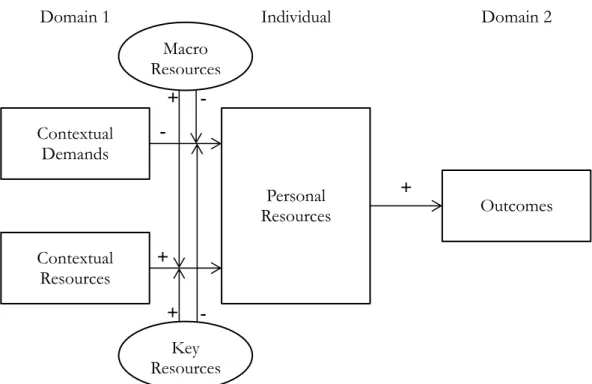
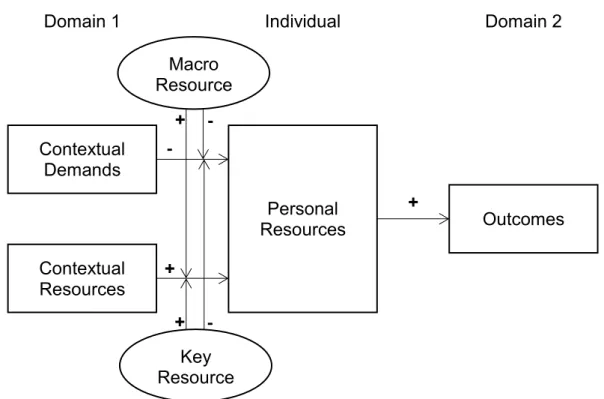
2 The Work-Home Interface availability for family members). The process of lacking resources due to demands in the other domain corresponds to incompatible role pressures from the two domains described by Greenhaus and Beutell (1985). Similarly, WHE can be understood as a resource gain spiral: Resources available in one domain (designated as contextual resources; e.g., social support at work) can be used to generate new resources (i.e., personal resources) that can be invested in the other domain. Consequently, outcomes in the second domain are improved (e.g., more availability for family members) which correspond to the idea of enrichment described by Greenhaus and Powell (2006). The consumption and generation of personal resources are therefore described as the basic mechanism linking the work and home domains. The extent to which personal resources are reduced or generated varies as a function of characteristics of the individuals (i.e., key resources) and of the environment (i.e., macro resources). The W-H R model (ten Brummelhuis & Bakker, 2012) is depicted in Figure 2. In the following, I describe propositions of this model on antecedents, processes, and outcomes of WHC and WHE, combine them with empirical evidence, and derive the research questions that this dissertation addresses. Contextual Demands Contextual Resources Personal Resources Outcomes - + Macro Resources - + +
Domain 1 Individual Domain 2
Key Resources
- +
2 The Work-Home Interface
2.2.1 ANTECEDENTS OF WORK-HOME CONFLICT AND ENRICHMENT
The conceptualization of WHC and WHE as resource loss and gain spirals, respectively, leads to two important corollaries about the respective antecedents. The first corollary is that contextual demands constitute the main antecedents of WHC since they are seen to trigger the loss spiral. Similarly, contextual resources are seen to trigger the gain spiral and therefore constitute the main antecedents of WHE. Until today, a lot of primary studies have investigated the antecedents of WHC and WHE. Several reviews and meta-analyses summarize the knowledge of factors shaping the experience of WHC (e.g., Allen, Johnson, Kiburz, & Shockley, 2012; Byron, 2005; Michel, Kotrba, & Mitchelson, 2011) and WHE (Lapierre et al., 2017). These analyses show patterns that are consistent with the assumptions derived from the W-H R model (ten Brummelhuis & Bakker, 2012): Contextual demands such as work and family role overload are related to the experience of WHC whereas contextual resources such as family-friendly work culture or social support are related to the experience of WHE. Besides the expected patterns, however, the meta-analyses show patterns that propose a more complex picture: Contextual resources such as social support at work and home (French et al., 2018; Kossek, Pichler, Bodner, & Hammer, 2011) or family-friendly work arrangements (Allen et al., 2012) are significantly and negatively related to WHC. This suggests that contextual resources have the potential to be an antagonist to contextual demands. In a similar vein, Lapierre et al. (2017) found contextual demands (e.g., job insecurity) to be significantly negatively related to WHE suggesting that contextual demands can counteract the effect of contextual resources.
These propositions should be investigated further due to two reasons. None of the existing meta-analyses has investigated the pattern of relationships for all four components (contextual demands, contextual resources, WHC and WHE) simultaneously thus far. Only a simultaneous investigation, however, enables to draw conclusions on the differential effects of contextual demands and resources on WHC and WHE. Second, the results are not consistent for all contextual demands and resources: Some of the contextual resources investigated by Michel et al. (2011) were not related to WHC (e.g., autonomy). Similarly, some of the contextual demands investigated by Lapierre et al. (2017) had no significant relationship with WHE (e.g., work role overload and family role overload). This observation raises the question whether contextual resources and demands differ in their potential to trigger the experience of WHC and WHE, respectively.
The second corollary that results from the W-H R model (ten Brummelhuis & Bakker, 2012) is that work characteristics are the main antecedents of W-t-H processes
2 The Work-Home Interface whereas home characteristics are the main antecedents of H-t-W processes. Yet, it is possible that characteristics of the receiving domain alter the need to invest resources. For instance, when the need to invest resources is low in the home domain due to support from the partner, the outcome of resource losses due to contextual demands at work should not be the same as when the need to invest resources is high. Consequently, characteristics of the receiving domain should also be considered as factors that shape the work-home interface. Byron (2005) explicitly tested the hypotheses that work variables are stronger related to W-t-H C and home variables are stronger related H-t-W C. The hypothesis was confirmed for W-t-H C but not for H-t-W C. No empirical results exist concerning this pattern for WHE. Knowing the influence of the receiving domain for the work-home processes, however, is important to gain a deeper understanding of which factors can be changed to achieve a successful combination of work and home life.
As mentioned in Chapter 1, one of the aims of this dissertation is to focus simultaneously on both negative as well as positive effects of the combination of work and home life. One aspect that is particularly interesting in this context are social interactions: Different to other work and home characteristics, they can vary considerably in their valence. On the one hand, social interactions at work can elicit negative emotions or be emotionally draining, e.g., when conflicts arise (Spector & Bruk-Lee, 2007), when people have to show emotions that they do not feel or to suppress felt emotions (i.e., experience of emotional dissonance; Zapf & Holz, 2006), or when people have to deal with difficult customers (Dormann & Zapf, 2004). On the other hand, social interactions at work can reduce strain or elicit positive emotions, e.g., when coworkers or supervisors provide support (Viswesvaran, Sanchez, & Fisher, 1999), when employees actually feel emotions that are appropriate and helpful in their job (i.e., deep acting; Kammeyer-Mueller et al., 2013), or when coworkers become friends (Colbert, Bono, & Purvanova, 2016).
Considering the dual valence of social interactions, it is no surprise that social aspects are the only element that arises in both categories contextual demands (i.e., emotional demands) and contextual resources (i.e., social support) in the W-H R model (ten Brummelhuis & Bakker, 2012). Concerning emotional demands, it is striking that meta-analyses on antecedents of WHC hardly take them into consideration: Byron (2005) included family conflicts (e.g., marital tensions, parental conflicts) as antecedents of WHC, but did not included emotional work demands in her meta-analysis. Michel et al. (2011) did not consider emotional demands at all. The lack of consideration in meta-analyses is an indication that only few studies investigated the relationship between emotional demands and WHC. This is surprising since social conflicts are one of the most important source of stress
2 The Work-Home Interface
at work (Spector & Bruk-Lee, 2007). The picture changes for studies on the daily level. Repetti and her colleagues were among the first who investigated the influence that negative social interactions at work can have on home life (Repetti, 1994; Repetti & Wood, 1997; Story & Repetti, 2006). More recently, additional studies investigated the influence of social work demands on home outcomes (e.g., Gassman-Pines, 2011; Klumb, Voelkle, & Siegler, 2017; Lim, Ilies, Koopman, Christoforou, & Arvey, 2016; Malinen, Rönkä, Sevón, & Schoebi, 2017; Martinez-Corts, Demerouti, & Boz, 2015; Meier, Gross, Spector, & Semmer, 2013; Pereira & Elfering, 2014; Sanz-Vergel, Rodríguez-Muñoz, Bakker, & Demerouti, 2012; Sanz-Vergel, Rodríguez-Muñoz, & Nielsen, 2015; Volmer, Binnewies, Sonnentag, & Niessen, 2012). Therefore, concerning social work demands, this dissertation focuses on processes as well as boundary conditions that shape these processes (see Chapter 2.2.2) and on parenting behavior as important behavioral outcome (see Chapter 2.2.3).
Concerning emotional aspects in terms of contextual resources, ten Brummelhuis and Bakker (2012) stress the importance of social support which is a construct with much attention in the work-home interface research. Results show consistently that social support is negatively related to WHC (French et al., 2018; Kossek et al., 2011) and positively related to WHE (Lapierre et al., 2017). Interactions at work do not need to have a supportive function in order to have the potential to generate resources (Bhave & Lefter, 2018; Colbert et al., 2016; Lilius, 2012). Social contextual resources other than social support, however, are not considered with regard to WHE (Lapierre et al., 2017) nor in daily diary studies (for one recent notable exception, see Bhave & Lefter, 2018).
Integration and own Studies
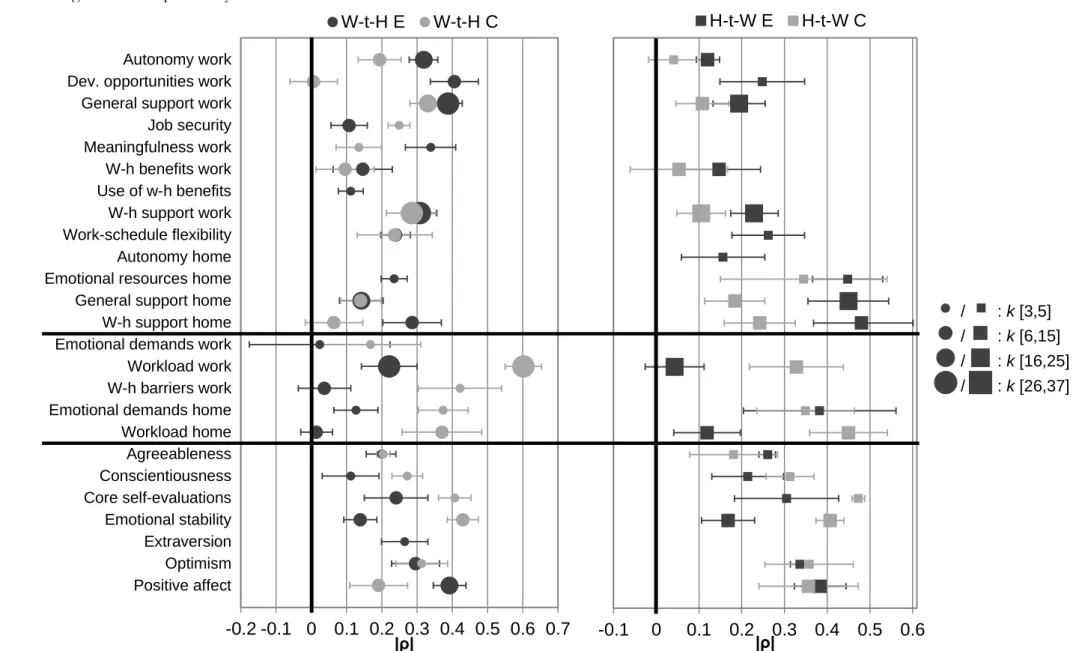
The considerations show that a large body of research has already investigated the antecedents of WHC and WHE. However, to advance the theoretical understanding of the influence that specific characteristics of the two domains have on the respective other domain and, consequently, to support individuals to combine work and home life successfully, further knowledge of antecedents of WHC and WHE is necessary. Study I of this dissertation aimed primarily at a meta-analytic investigation of antecedents of WHE. Very recently, Lapierre et al. (2017) published a comparable meta-analysis. Contrary to the study of Lapierre et al. (2017), Study I investigates WHC and WHE simultaneously. Therefore, Study I provides additional insights into the factors that shape the work-home interface by addressing the questions raised above: (1) Do WHC and WHE have only different or also common antecedents? (2) Which role do contextual demands play for WHE and which role do contextual resources play for WHC? (3) Which role do characteristics of the receiving domain play for the experience of WHC and WHE? Besides the meta-analytic
2 The Work-Home Interface investigation of different antecedents, this dissertation aims to fill the gap concerning the investigation of social work characteristics in the context of work-home interface (Studies II and III) with a special focus on positive workplace interactions in Study III by addressing the following questions: (4) Which influence do positive workplace interactions have on well-being and behavior at home?
2.2.2 PROCESSES OF WORK-HOME CONFLICT AND ENRICHMENT The W-H R model (ten Brummelhuis & Bakker, 2012) conceptualizes the work-home interface as resource loss and gain spirals. A basic tenet of this conceptualization is that “personal resources are the linking pins between the work and home domains” (ten Brummelhuis & Bakker, 2012, p. 549): Coping with contextual demands reduces personal resources which are no longer available in the other domain. Contrary, contextual resources help to generate personal resources that can be invested in the other domain (see Figure 2).
Personal resources describe aspects of the self that are linked to resilience, and therefore helpful
to cope with stressful situations (Hobfoll, Johnson, Ennis, & Jackson, 2003). Five categories of personal resources are proposed in the W-H R model (ten Brummelhuis & Bakker, 2012): (1) physical (e.g., physical energy), (2) psychological (e.g., self-efficacy), (3) affective (e.g., mood), (4) intellectual (e.g., experiences), and (5) capital (e.g., time). Affective mechanisms, for instance, negative mood spilling over from the work domain in the home domain, have been shown to play an important role in linking work and home life (Amstad & Semmer, 2013; Butler et al., 2013). In order to understand better how to form this mechanism and how to prevent negative spillover processes, it is important to focus on boundary conditions that influence these processes. The W-H R model (ten Brummelhuis & Bakker, 2012) describes two categories of boundary factors: key resources and macro resources.
Key resources describe dispositional resources that facilitate the management of other
resources, i.e., the selection, alteration, and implementation of resources (Hobfoll, 2002; ten Brummelhuis & Bakker, 2012). Examples for key resources are optimism, self-esteem, or conscientiousness (Halbesleben et al., 2014; ten Brummelhuis & Bakker, 2012). The availability of those key resources is proposed to buffer the resource loss when facing contextual demands and to intensify the resource gain when contextual resources are available (see Figure 2). Focusing on affective mechanisms, emotion regulation competence can be seen as a key resource. Emotion regulation describes the process "by which individuals influence which emotions they have, when they have them, and how they experience and express these emotions” (J. J. Gross, 1998, p. 275). Being able to apply
2 The Work-Home Interface
emotion regulation as a strategy means “to regulate stress or emotions when they are not appropriate to the context” (Brasseur, Grégoire, Bourdu, & Mikolajczak, 2013, p. 2). Applied to the work-home interface, emotion regulation competence is proposed to neutralize the negative effect of event-related negative mood influencing the other domain (Grandey & Krannitz, 2016). Integrating this proposition in the W-H R model (ten Brummelhuis & Bakker, 2012) leads to the assumption that emotion regulation competence is a key resource that impedes the loss of personal resources (i.e., the decrease in positive and the increase in negative mood) when facing demands. Researchers agree that the role of emotion regulation is not well understood in the context of work-home interface since only few studies investigate this resource (Allen, 2012; Grandey & Krannitz, 2016). Besides key resources,
macro resources, that are defined as characteristics of the economic, social, and cultural system
relevant for the work-home interface (ten Brummelhuis & Bakker, 2012), shape the mutual influence of the work and home domains. An example for macro resources is the existence of public day care facilities for children (ten Brummelhuis & Bakker, 2012). However, macro resources are not considered in detail due to this dissertation’s focus on individual processes.
When stating that the affective mechanism linking work and home life is well understood, researchers (e.g., Allen, 2012; Butler et al., 2013) mainly refer to studies investigating conflicting processes. On a theoretical level, the affective path linking the work and home domains plays an important role also for enriching processes: The affective path is proposed as the main linking mechanism besides an instrumental path (Greenhaus & Powell, 2006). Only few studies have investigated how positive affective reactions following experiences in one domain influence behaviors and attitudes in the other domain. As an exception, a study could show an indirect effect of helping behavior at work on supportive behavior towards the spouse in the evening, mediated by positive affect at home (Lin, Ilies, Pluut, & Pan, 2017). Contrary, a study with working mothers could not find a relationship between positive experiences at work and positive mood at home rated by their children (Lawson, Davis, McHale, Hammer, & Buxton, 2014). These disparate results show that the role of positive affect as a linking mechanism is not clear yet.
Integration and own Studies
Of the five proposed categories of personal resources, the role of affective resources has been studied most extensively and it has been shown, that this mechanism plays an important role (Amstad & Semmer, 2013; Butler et al., 2013). For a full understanding of this process, however, it is important to know boundary conditions that can influence the link between the work and home domains. This knowledge can be used to help individuals to combine work and home life successfully: Knowing key resources
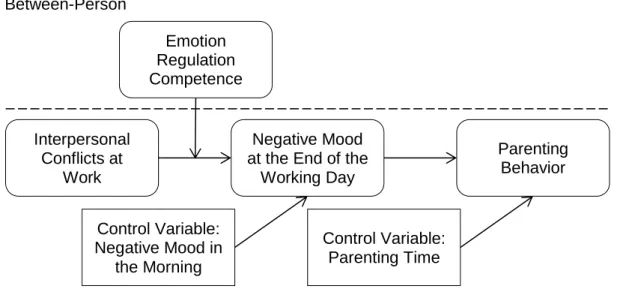
2 The Work-Home Interface (i.e., person characteristics) that impede the loss spiral can be a starting point for individual trainings about how to reduce negative influences of experiences in one domain on the other domain. As the affective mechanism has been shown to be an important linking mechanism, it is promising to investigate factors influencing this mechanism. Therefore, in Study II, the following question is addressed: (1) Which role does emotion regulation competence play for the resource drain process when facing demands at work?
Despite the extensive research on affective mechanisms linking the work and home domains, this mechanism is not well understood for enriching processes. For a successful combination of work and home life, however, it is equally important to understand negative as well as positive processes. Strengthening positive processes is also a way of improving the work-home interface. Hence, for a better understanding of the processes that link work and home life positively, Study III addresses the following question: (2) Which role does positive affect play in the enriching process of work experiences influencing behavior in the home domain?
2.2.3 OUTCOMES OF WORK-HOME CONFLICT AND ENRICHMENT The conceptualization of WHC and WHE as resource loss and gain spirals, respectively, results in the notion, that all outcomes that require the investment of resources are affected by conflicting and enriching processes. Ten Brummelhuis & Bakker (2012) distinguish three different categories of outcomes that can be affected by losses or gains of personal resources: (a) productive outcomes (e.g., meeting deadlines is easier when enough resources are available), (b) behavioral outcomes (e.g., a lack of resources makes it more difficult to behave empathically and supportive), (c) attitudinal outcomes (e.g., available resources enhance the satisfaction of individuals with the work and home domains). An extensive body of research has shown the relationships between WHC and WHE and attitudinal outcomes such as satisfaction, well-being, and commitment (Allen, Herst, Bruck, & Sutton, 2000; Amstad et al., 2011; McNall, Nicklin, & Masuda, 2010; Shockley & Singla, 2011; Zhang et al., 2018). These attitudinal outcomes primarily affect the individual. The combination of the W-H R model (ten Brummelhuis & Bakker, 2012) with the ecological system theory (EST; Bronfenbrenner, 1977, 1979) and with crossover theories (e.g., Bakker & Demerouti, 2013), however, points out the importance to consider also productive and behavioral outcomes: The understanding of the influence of resource losses and gains on these outcomes shifts the focus from consequences for the individual to consequences for important stakeholders.
2 The Work-Home Interface
the life of an individual is embedded in a social context (i.e., microsystem) that includes specific interaction partners. Since work and home roles are important in the life of working adults (Frone, 2003), work and home constitute two important microsystems (Perry-Jenkins, Newkirk, & Ghunney, 2013; Voydanoff, 2002). As a second basic tenet, the EST suggests that not only the microsystem in which a person is directly embedded plays a role for the development of the individual, but also the microsystems in which the interaction partners are embedded. Hence, individuals’ work-home interface has consequences for the stakeholders in the specific microsystems. For instance, the work environment of parents influences the development of their children (Cho & Ciancetta, 2016). Similarly, the employee’s home microsystem influences coworkers at work (e.g., ten Brummelhuis et al., 2010).
Crossover theories explain how these effects come into existence. Crossover describes the "interindividual dyadic transmission process that operates when one person's experience affects the experience of another person in the same social environment" (Carlson et al., 2011, p. 771). Behavior is described as important mediating mechanism in this transmission process (Westman, 2001): A person's experiences shape the behavior towards the interaction partner and therefore influence the experiences of the other person. Crossover per se is a within-domain effect. Consistent with the EST, Bakker and Demerouti (2013) combine the crossover model with a spillover process: Experiences in one domain of life are transmitted to another domain of life (spillover) and then transmitted to the partner through social interactions.
Few studies have shown the relationship between experiences of the work-home interface and behavior at work. For instance, the leaders' experience of W-t-H C has been found to be related to leaders' burnout which reduced their supportive behavior towards their followers. The reduced support, in turn, was related to followers' increased burnout (ten Brummelhuis et al., 2014). On the positive side, the leaders' experience of W-t-H E was related to their followers' schedule control which resulted in the followers' increased levels of W-t-H E (Carlson et al., 2011). Furthermore, several family characteristics seem to be related to helping behavior at work: Having a partner was related to more helping behavior at work mediated by increased skills and fulfillment, whereas having conflicts with the partner was negatively related to helping behavior through reduced fulfillment (ten Brummelhuis et al., 2010). Much more research exists on spillover–crossover effects affecting the partner. These studies show consistently that the behavior towards the partner is an important transferring mechanism between work experiences and consequences for the partner: Experienced strain leads to more social undermining (e.g., Bakker, Demerouti, & Dollard, 2008; Westman &
2 The Work-Home Interface Vinokur, 1998), to more angry and withdrawn marital behavior (Schulz, Cowan, Cowan, & Brennan, 2004), and to less social support from the partners (Bakker, Demerouti, & Burke, 2009).
Cho and Ciancetta (2016) take an EST perspective to illustrate the role that parents' work experiences play for the development of the child emphasizing parent-child interactions as key mediating mechanism. Several studies have shown the detrimental effect of diverse work experiences (e.g., high workload, less supportive work environments, negative interactions) on parent-child interactions (see Cho & Ciancetta, 2016, for a review); the potential beneficial effects of parents' work experiences on the interactions with their children has largely been ignored thus far (Cho & Ciancetta, 2016). As explained in Chapter 2.2.2, affect is an important linking mechanism between the work and home domains. This is assumed to be true also for the linkage of parents' work characteristics and the interactions with their children: “Implicit to these studies [investigating the direct link between parents’ work experiences and parents’ interaction with their child] is that stressful and demanding work produces negative affect that is transferred to the family domain” (Cho & Ciancetta, 2016, p. 156). Dix (1991) proposes parents' affect to shape their behavior towards the children in such a way that parents are prone to show more affect-congruent behavior (e.g., speaking more harshly when experiencing negative affect or showing more encouragement when experiencing positive affect) and less affect-incongruent behavior (e.g., giving less support when experiencing negative affect and showing less disciplinary behavior when experiencing positive affect). While these propositions focus on affective reactions arising from experiences with the child (Dix, 1991), affective reactions can also arise outside the home domain and then spill over to it (Larson & Almeida, 1999). The integration of these considerations in the W-H R model (ten Brummelhuis & Bakker, 2012) proposes that the loss and gain of resources in terms of increases in negative and positive affective experiences, respectively, which arise due to contextual work characteristics, should shape the parent-child interactions. However, especially for positive spillover effects, the consequences of work experiences for parent-child interactions are not well understood yet. Integration and own Studies
The preceding chapter shows the importance to investigate behavioral outcomes of the work-home interface to understand one of the mechanisms linking the work-home experiences with outcomes of important stakeholders in the work and home domains. Besides coworkers and spouses, children are important stakeholders that influence parents’ well-being and therefore also have an indirect influence on the work domain (Cho & Ciancetta, 2016). However, they are considered as "unseen stakeholders" of organizations
2 The Work-Home Interface
(Allen, 2012, p. 1174). To protect children from negative influences of their parents' work experiences as well as to enhance the positive effects, it is important to understand how parents' work experiences shape the interactions with their children. To this end, the relationship between parents’ work experiences and their parenting behavior in the evening is investigated in the Studies II and III of this dissertation. The following questions should be answered: (1) Do negative affective reactions that arise from experiences at work have a detrimental effect on fathers’ parenting behavior in the evening by increasing negative and decreasing positive behaviors (Study II)? (2) Do positive affective reactions after coming home have a comparable effect on parents’ behavior towards their children by increasing positive and decreasing negative behavior (Study III)?
2.3 SUMMARIZING THE AIMS OF THIS DISSERTATION
With this dissertation, I seek for an empirical test of the W-H R model (ten Brummelhuis & Bakker, 2012) in order to refine the theoretical understanding of the work-home interface, and therefore to provide a theoretical and empirical basis for practical measures that improve the combination of work and home life. To this end, I take a broad approach by addressing research questions on antecedents, processes, and outcomes integrally for WHC and WHE. Concerning the antecedents, the question of the role of demands and resources of both the work and the home domains for WHC and WHE is addressed (Study I). Understanding common and distinct antecedents of WHC and WHE, as well as considering both domains integrally is important to design environments that are adjuvant for a successful combination of work and home life. Furthermore, I examine the role of social work characteristics (Studies II and III). They can vary significantly in their valence (e.g., negative when conflicts arise or positive when coworkers are supportive); therefore, these work characteristics are particularly suitable to investigate negative and positive effects simultaneously. Moreover, nearly every job includes interactions with clients, coworkers, and supervisors. Hence, working life is characterized by social interactions and the understanding of consequences of this work characteristic is significant for nearly every employee.
Concerning the processes, I examine the role of affective spillover as mediating mechanism. This mechanism is already well understood for negative spillover. I go a step further and investigate boundary conditions that influence this process by examining the role of emotion regulation competence (Study II). Creating knowledge of personality characteristics that shape the process of work and home integration is an important starting point for individual measures that foster a successful combination of both life domains. The
2 The Work-Home Interface role of positive affect as linking mechanism is not well understood yet. Thus, I focus on this process in Study III.
Concerning the outcomes, I take a closer look on the influence of parents' work characteristics on their parenting behavior (Studies II and III). Children are important stakeholders in the family system which is influenced by parents’ work system. A more detailed understanding of this influence—in terms of negative as well as positive effects— can help parents to prevent negative and foster positive consequences for their children. Figure 3 illustrates the parts of the W-H R model (ten Brummelhuis & Bakker, 2012) investigated by the studies.
Positive Mood Contextual Demands Contextual Resources Negative Mood Parenting Behavior + + -
Domain 1 Individual Domain 2
Stud
y I
Study II
Study III
+ - Emot. RegulationFigure 3: Illustration of the Aspects of the Work-Home Resources Model (ten Brummelhuis & Bakker, 2012) Investigated in the Three Studies
3 Overview of Studies
3 OVERVIEW OF STUDIES
The three studies included in this dissertation differ in terms of type (WHC and WHE) and direction (W-t-H and H-t-W) of effects as well as the components investigated (antecedents, processes, outcomes) in order to provide a broad and inclusive picture. Furthermore, two different methodological approaches (a meta-analytic approach and an ecological momentary assessment approach) were taken. An overview of the studies and the respective features is given in Table 1. The three studies are briefly summarized in the following, focusing on the study description and the results to allow the general discussion and conclusion. The full-length manuscripts with comprehensive theoretical parts and discussions can be found in Chapter 7.
3.1 STUDY I: A META-ANALYSIS ON THE ANTECEDENTS OF
WORK-HOME ENRICHMENT AND A COMPARISON TO
WORK-HOME CONFLICT
The first study is a meta-analytic investigation of antecedents of WHE. Until very recently, meta-analyses conducted thus far investigated either WHC (e.g., Amstad et al., 2011; Byron, 2005; Michel et al., 2011) or the consequences of WHE (McNall et al., 2010). Study I aims to complete the picture by providing a meta-analytic review of antecedents of WHE. Simultaneously, Lapierre et al. (2017) conducted a similar meta-analysis. Study I, however, still makes two important contributions to the existing literature. First, it tests several assumptions theoretically derived from the W-H R model (ten Brummelhuis & Bakker, 2012) and advances the theoretical understanding of WHE. Second, it empirically compares the relationship between several antecedents and WHE and WHC, respectively, and therefore provides an integrative picture to understand both processes.
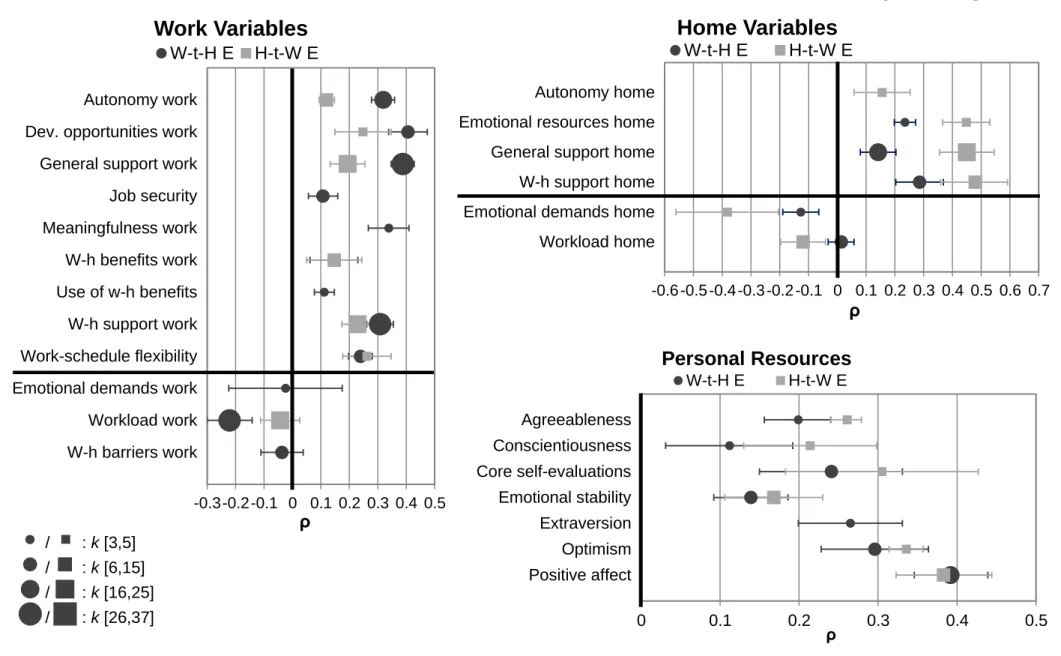
To identify relevant primary studies, a literature search was conducted in several databases as well as in existing meta-analysis. Finally, a total of 131 samples were included in the meta-analysis. Effect sizes were calculated for 13 contextual resources (nine work resources and four home resources), five contextual demands (three work demands and two home demands), and seven personal resources following the methodological approach of Schmidt and Hunter (2015). All contextual resources were significantly and positively related to both directions of WHE (i.e., W-t-H E and H-t-W E), irrespectively of the origin domain (i.e., work and home). Generally, work resources correlated significantly stronger with W-t-H E than with H-t-W E and vice versa for home resources. No such differences in effect sizes were found between W-t-H E and H-t-W E in terms of resources that aim to facilitate the
3 Overview of Studies Table 1. Overview of the Studies of this Dissertation
Note. W-t-H = Work-to-Home; H-t-W = Home-to-Work
Study
Methodo-logical Approach
Type of Effect Direction of Effect Components Investigated Conflict Enrich-ment W-t-H H-t-W Ante- cedents Pro-cesses Out-comes Study I Jensen, R., Meier, L. L., Nohe, C., &
Klumb, P. L. (in prep.). Work-Home Enrichment: A Meta-Analysis on its Antecedents and a Comparison to Work-Home Conflict.
Meta-Analysis x x x x x
Study II Jensen, R., Siegler, S., Meier, L. L., & Klumb, P. L. (in prep.). The Influence of Daily Interpersonal Conflicts at Work on Parenting Behavior –
Examining the Role of Negative Mood and Emotion Regulation Competence.
Ecological Momentary Assessment
x x x x x
Study III Jensen, R., Schoebi, D., & Klumb, P. L. (in prep.). The Influence of Positive Workplace Interactions on Mood and Parenting Behavior at Home.
Ecological Momentary Assessment