DEVELOPMENT OF FULL-BODY MODELS FOR HUMAN JUMP LANDING DYNAMICS AND CONTROL
by
D. Keoki Jackson
S.B., Massachusetts Institute of Technology, 1989
S.M., Massachusetts Institute of Technology, 1992
Submitted to the Department of Aeronautics and Astronautics in Partial Fulfillment of the Requirements for the Degree of
Doctor of Science in Aeronautics and Astronautics at the
Massachusetts Institute of Technology June 1997
* 1997 Massachusetts Institute of Technology
All rights reserved
Si gnature of Author ______...-________________
Departmenthif Aeronautics and Astronautics May 23, 1997
Certified by __
Dava 1. Ne man, Thesis Committee Chair Assistant Professor of Aeronau, cs and Astronautics
/
71 aurence R. Young Ap'll o Professor of Astronautics Department of Aeronautics and AstronauticsNeville Hogan Professor of Mecbanipal Engineering
James D. Paduano Associate ofbssor of Aronati and Astronautics Accepted by
DEVELOPMENT OF FULL-BODY MODELS FOR HUMAN JUMP LANDING DYNAMICS AND CONTROL
by
D. Keoki Jackson
Submitted to the Department of Aeronautics and Astronautics
on May 28, 1997 in Partial Fulfillment of the Requirements for the Degree of Doctor of Science in Aeronautics and Astronautics
ABSTRACT
Human mechanisms for control of posture and motion are normally optimized to perform in Earth's 1-G
environment. The mechanisms by which the central nervous system controls and integrates posture and movement are the subject of considerable controversy and ongoing study. The control of jump landings is particularly interesting: (1) the control algorithm involves elements of preplanned trajectory formulation and sensory feedback; (2) dynamic interaction with the environment must be addressed; and (3) the controller exhibits rapid adaptation when exposed to changes in environmental or perturbation conditions. When modeling the human motor control
mechanisms, these issues must all be accounted for at various levels of detail.
Exposure to microgravity in astronaut subjects provide a novel opportunity to test models of human motion control. Microgravity alters the body dynamics, placing considerably different demands on the controller. When astronauts adapt to space flight, they exhibit quantitatively different control strategies, often measured as postflight degradation in performance for balance, locomotion, and jumping. The research described here centers on the development of dynamic models of motor control for human jumping to provide a framework for testing three hypotheses:
1. Postflight changes in astronaut jump landings result from alterations in commanded impedance.
2. The experimentally observed characteristics of downward jumps in humans can be captured by a control model based on an equilibrium point formulation.
3. An optimization procedure based on a set of physically and biomechanically plausible variables is sufficient to
reconstruct key features of the experimentally observed trajectories for jump landings.
Three experiments are designed to test these hypotheses, and are performed at Johnson Space Center, MIT, and the Massachusetts General Hospital. Several astronaut subjects are tested before and after space flight to determine the effects of microgravity adaptation on jump landing performance. A "moonwalker" experiment simulates short term partial gravity exposure to supplement the astronaut tests. A novel "false platform" protocol assesses virtual trajectory generation and impedance modulation during jump landings by measuring free limb trajectories when subjects unexpectedly fall through the landing surface.
Three models for the control of jump landings are developed: (1) A linear second order model of center of mass (CM) vertical motion; (2) A second order model of CM vertical motion using a knee joint; and (3) A planar three link inverted pendulum model. The false platform data are used in concert with these models to estimate body stiffness and damping properties immediately following the time of impact. Optimization techniques are used to interpret modeled jump landing trajectories.
Astronaut results indicate that reduced inflight postural control demands result in one of two responses postflight. Postflight-Compliant (5/9) subjects retain somewhat reduced leg stiffnesses after space flight, while Postflight-Stiff (2/9) subjects exhibit an overcompensatory increase in leg stiffness. Moonwalker subjects follow the Postflight-Compliant group, indicating that partial weight unloading provides a useful analogue for certain
aspects of microgravity adaptation. Impedance estimates using the false platform data indicate negative stiffnesses during the period immediately following impact. This implied instability suggests that such simple equilibrium
point models cannot adequately describe jump landings. Optimization results capture the general features of the jump landing trajectories and indicate that controller requirements include impact force reduction as well as joint
coordination to ensure appropriate mass center motion.
Thesis Supervisor: Dava J. Newman
This work is dedicated to my grandparents Henry and Juanita Brodersen "Papa" Robert and "Tutu" Janet Jackson
And in the twelfth year, on the seventh day of Ielool, the month of reaping, he climbed the hill without the city walls and looked seaward; and he beheld his ship coming with the mist. Then the gates of his heart were flung open, and his joy flew far out to sea.
And he closed his eyes and prayed in the silences of his soul. But as he descended the hill, a sadness came upon him,
and he thought in his heart: How shall I go in peace and without sorrow? Nay, not without a wound in the sprit shall I leave this city. Long were the days of pain I have spent within its walls, and aloneness;
and who can depart from his pain and his aloneness without regret? Too many fragments of the spirit have I scattered in these streets, and too many are the children of my longing that walk naked among these hills,
and I cannot withdraw from them without a burden and an ache. It is not a garment I cast off this day,
but a skin that I tear with my own hands. Nor is it a thought I leave behind me, but a heart made sweet with hunger and with thirst.
Yet I cannot tarry longer.
The sea that calls all things unto her calls me, and I must embark. For to stay, though the hours burn in the night,
is to freeze and crystallize and be bound in a mould. Fain would I take with me all that is here. But how shall I?
A voice cannot carry the tongue and the lips that gave it wings.
Alone it must seek the ether.
And alone and without his nest shall the eagle fly across the sun.
Kahlil Gibran
ACKNOWLEDGMENTS
I am grateful to the members of my committee for their "advice and consent" on this thesis. Prof. Jim Paduano--thank you for your thorough reading of my draft and the skeptical "outsider's perspective." Prof. Neville Hogan, I appreciate your rigorous questions about the experiments and analysis, as well as the time you took to discuss the results--your enthusiasm makes me sorry to switch fields of work. Prof. Larry Young, your encyclopedic knowledge of the biomedical field and spaceflight literature was invaluable and inspiring. I have thoroughly enjoyed working with you over the past several years, and I am grateful for the tremendous opportunities you granted me to work with the human space program. Above all, I am indebted to Prof. Dava Newman--advisor, teacher, ex-officemate, mentor, and friend. Your unflagging support made the doctoral program endurable and often enjoyable. Now let's go sailing ....
Dr. Jacob Bloomberg and his colleagues at the Neuroscience Laboratory at JSC made the astronaut work in this thesis possible, and provided me with several enjoyable and educational visits to Houston. Dr. Bloomberg designed the astronaut jumping experiment, and also sponsored my NASA GSRP fellowship. Thanks also to Brian Peters and Shannon Smith, who performed the astronaut tests, and to Dr. Vernon McDonald for useful discussions and commentary on the analysis. Similarly, I am grateful to Dr. David Krebs of MGH for making available his laboratory and providing me with the opportunity to become intimate with UNIX. Mahalo to all of the great people in the BML who made my time there enjoyable as well as productive: Dan, Ronny, Jose, Lisa, and above all Simone Bortolami, who has been a great friend, advisor, commiserator and fellow caffeine addict. Thanks to all of my experimental subjects: astronauts, fellow students and friends. I'm afraid I have a knack for designing
uncomfortable experiments, from scleral coils to "just go ahead and jump--you'll be fine. Trust me!" And then there's the moonwalker harness. Thanks for volunteering--and then coming back to do the exciting balance tests.
I am deeply appreciative of the support of Prof. Win Markey, who hired me to TA undergraduate controls and inspired me to attempt to meet his high standards of teaching. Prof. Markey-I've learned much from you in recent years that goes beyond what you taught me in your course my junior year. Likewise, thanks to Prof. Lenny Gould for the chance to teach "over in Course 6"--I enjoyed your enthusiasm and fine sense of humor. I am also grateful to all of the staff members who helped me to navigate the ways of the Institute: Anne Maynard, Ping Lee, Liz Zotos, Marie Stuppard, Jennie Leith, Barbara Glas, Beverly Linton, Don Wiener and Dick Perdichizzi. And of course, Sherry Modestino and Jim Costello--I was truly sorry to see you leave the MVL.
And cheers to all the fellow MVL students and associates over the years, from Jock and Glaw to the latest crop. A toast to all of the people who made SLS-2 such a blast: Karla Polutchko, Dan Merfeld, Juan-Carlos Mendoza, Ted Liefeld, Scott Stevenson, Corrie Lathan, Stuart Johnston (and George). Clear skies to Karl Schultz, who provided unending hilarity and bottomless beers in his memorable to years at MIT. Hugs and kisses to my outrageous officemate Jen Rochlis (not that I've been in the office much)--you'll get your dessert someday. Grant Schaffner--you've lost your only competitor for "old man of the lab"-keep up the great work and take care of my kids at Next House. Don't forget to invite me to the wedding. Amir--thanks for all of your help and support in the past months--your graciousness and poise provide an example to all of us. Steve Robinson, it was great having you with us at MIT--I look forward to the day when we all rejoin you at JSC. Meanwhile, thanks for the floor space.
One aspect of MIT I will miss the most is my time as a floor tutor at Next House. Good luck to all my "kids", past and present--I hope you enjoyed the food, because certainly I enjoyed your good company, high spirits and wall-shaking music. Bora and Liba Mikic, I am sorry to be leaving you, and not just because of all the incredible food. Thanks to all of the other floor tutors and to the RCA staff for a great sense of community--now let's get in a circle and hold hands. Others I will miss are the noontime "fast" lane at the MIT pool--Phil and Phil, Christian, and Pete and Pete. Keep up the yardage. Best wishes to Joelle, Paula, Charrissa, Peter (Noymer), Harald, Mike T., Piero, Marcos, and all of the others whom my sleep-deprived condition is preventing me from
remembering, but who made MIT a place to remember fondly. Finally, thanks to Scott Adams for creating Dilbert, and to McKinsey & Co. for offering me tons of money so that I can feel noble about turning down the job and "staying true to the engineer in me."
To my family--Nicole, Jodi, Keaka, mom and dad--thank you for believing in me, and yes, I really am graduating this spring! To the friends who have shared my triumphs and failures, hopes and fears, joys and sorrows-especially Bill Coleman, Alan Nash, Mike Feeney, Peter Neirinckx, Richard Seet, John Carey and Karla Polutchko, I look forward to many years of good times to come (now that this PhD thing is out of the way). And most of all, I thank Nikol Heacock, without whom I could never have accomplished what I did. Experimental subject, data analyst, graphic artist and typesetter--those are only your direct contributions to my thesis. More importantly, you have been a constant source of support, encouragement, nourishment both physical and spiritual, and love, and I am forever indebted to you. To all of you--I couldn't have done it without you, and I wouldn't have wanted to.
TABLE OF CONTENTS
ACKNOWLEDGMENTS 4 TABLE OF CONTENTS 5 LIST OF FIGURES 8 LIST OF TABLES 10 1 INTRODUCTION 11 1.1. HYPOTHESES 13 1.2. THESIS OVERVIEW 151.3. ACRONYMS AND ABBREVIATIONS 16
2 BACKGROUND AND LITERATURE REVIEW 18
2.1. JUMPING 18
2.1.1. VOLUNTARY DOWNWARD JUMPS 18
2.1.2. SUDDENFALLS 19
2.1.3. JUMP TAKEOFF CONTROL 19
2.2. SPACE FLIGHT EFFECTS 20
2.3. EQUILIBRIUM POINT HYPOTHESIS FOR MOTOR CONTROL 21
2.3.1. LAMBDA MODEL OF EQUILIBRIUM POINT HYPOTHESIS 22
2.3.2. ALPHA MODEL OF EQUILIBRIUM POINT HYPOTHESIS 24
2.3.3. VIRTUAL TRAJECTORlES IN VOLUNTARY ARM MOVEMENTS 25 2.4. ADDITIONAL ISSUES IN POSTURE AND MOTION CONTROL 26
2.4.1. IMPEDANCE CONTROL 26
2.4.2. POSTURE CONTROL 28
2.4.2.1. Movement Patterns and Muscle Synergies 28
2.4.2.2. Anticipatory Postural Reactions and the "Body Scheme" 30
2.4.2.3. Simplified Inverted Pendulum Models 30
2.4.2.4. Performance Constraints and Optimization 31
2.4.3. HIERARCHICAL CONTROL DESIGN 32
3 JUMPING ADAPTATION VIA MICROGRAVITY
AND PARTIAL WEIGHT UNLOADING 34
3.1. ASTRONAUT JUMPING FOLLOWING MICROGRAVITY EXPOSURE 3.1.1. ASTRONAUT JUMPING EXPERIMENT METHODS
3.1.1.1. Astronaut Jumping Experiment Design 3.1.1.2. Astronaut Data Analysis
3.1.1.3. Model of CM Vertical Motion 3.1.2. ASTRONAUT JUMPING RESULTS
3.1.2.1. Astronaut Joint Kinematics 3.1.2.2. Center of Mass (CM) Kinematics 3.1.2.3. Subject Classification
3.1.2.4. Modeled CM Vertical Motion
3.2. PARTIAL WEIGHT UNLOADING EXPERIMENTS
3.2.1 "MOONWALKER" PARTIAL WEIGHT UNLOADING EXPERIMENT DESIGN 3.2.1.1. Experimental Apparatus
3.2.1.2. Moonwalker Experimental Protocol 3.2.2. MOONWALKER VIDEO DATA PROCESSING
3.2.2.1. Video Digitization
3.2.2.2. Marker Position Within Video Images ABSTRACT DEDICATION 32 I 34 35 35 36 40 42 42 44 46 53 58 58 58 65 68 68 69
3.2.2.3. Estimation of 3-D Marker Coordinates from Image Coordinates 71
3.2.3. MOONWALKER ADAPTATION RESULTS 75
3.2.3.1. Force Plate Data 75
3.2.3.2. Leg Joint Kinematics 77
3.2.3.3. Second Order, Single Degree of Freedom Model of Vertical CM Motion 81 3.3. DISCUSSION OF ASTRONAUT AND MOONWALKER RESULTS 85
3.3.1. ADAPTIVE CHANGES IN ASTRONAUT PERFORMANCE 85
3.3.1.1. Astronaut Joint Kinematics 85
3.3.1.2. Sensory Feedback 86
3.3.1.3. Limb Stiffness 87
3.3.2. MOONWALKER ANALOGUE TO ASTRONAUT EXPERIMENTS 89 3.3.2.1. Limitations of the Moonwalker Experiments 89 3.3.2.2. Moonwalker Results Follow P-C Pattern of Astronauts 91 3.3.3. MODELED STIFFNESS IN THE ASTRONAUT AND MOONWALKER EXPERIMENTS 92
4 FALSE PLATFORM JUMPING EXPERIMENT 96
4.1. FALSE PLATFORM EXPERIMENT DESIGN 96
4.1.1. EXPERIMENTAL APPARATUS 97
4.1.1.1. Body Segment Kinematic Data Acquisition (TRACK) 97
4.1.1.2. Ground Reaction Forces 102
4.1.1.3. Muscle Electromyograms (EMG) 102
4.1.1.4. Data Acquisition and Processing Computers 103
4.1.1.5. False Platform Jumping Equipment 103
4.1.2. EXPERIMENTAL SUBJECT SELECTION 105
4.1.3. FALSE PLATFORM EXPERIMENTAL PROTOCOL 106
4.1.3.1. Human Use Approval 106
4.1.3.2. Subject Preparation 107
4.1.3.3. Test Procedure 107
4.1.3.4. Resting EMG 108
4.1.3.5. Establishment of Segment to Array Coordinate Transformations 108
4.1.3.6. Baseline Jumps 109
4.1.3.7. False Platform Jumps 110
4.2. FALSE PLATFORM DATA ANALYSIS 112
4.2.1. BODY SEGMENT KINEMATICS 112
4.2.1.1. Reference Frames 112
4.2.1.2. Array Position and Orientation 113
4.2.1.3. Joint Centers and Segment to Array Transformations 114
4.2.1.4. Joint Angle and Joint Center Calculations 117
4.2.1.5. Body Segment Inertial Properties 118
4.2.1.6. Full Body Mass Center Calculation 118
4.2.1.7. Data Stationarity and Selection of Platform (P) Jumps 119
4.2.1.8. Alignment of Platform (P) and No-Platform (NO-P) Data 121
4.2.2. FORCE PLATE AND EMG DATA 121
4.3. FALSE PLATFORM RESULTS 123
4.3.1. PLATFORM JUMPS 123
4.3.2. NO-PLATFORM JUMPS 128
4.3.3. FALSE PLATFORM ELECTROMYOGRAMS 140
4.3.3.1. Pre-Impact EMG Timing 140
4.3.3.2. Comparison of P and NO-P EMG after Nominal Impact 144
4.4. DISCUSSION OF FALSE PLATFORM RESULTS 152
4.4.1. FORCE PLATE RESULTS 152
4.4.2. PRE-PROGRAMMED ACTIVITY IN THE LEG MUSCULATURE 153
4.4.3. JOINT KINEMATICS IN THE NO-P JUMPS 156
5 JUMP LANDING MODELS 159
5.1.1. MODEL DERIVATION AND PARAMETER ESTIMATION 159
5.1.2. MODEL FITS To EXPERIMENTAL DATA 162
5.2. MODEL 2: CM VERTICAL MOTION: SECOND ORDER WITH KNEE 169
5.2.1. MODEL DERIVATION AND PARAMETER ESTIMATION 169
5.2.2. MODEL 2 FITS TO EXPERIMENTAL DATA 172
5.3. MODEL 3: THREE LINK PLANAR 177
5.3.1. DESCRIPTION OF THE THREE LINK MODEL 177
5.3.2. THREE LINK MODEL DYNAMIC EQUATIONS 180
5.3.3. ESTIMATION OF JOINT STIFFNESS AND DAMPING PROPERTIES 182
5.3.3.1. Estimation of Joint Trajectories for Three Link Models 182 5.3.3.2. Three Link Model Stiffness and Damping Estimates 185
5.3.3.3. Rate Command in the Virtual Trajectory 187
5.3.3.4. Goodness of Fit for the Three Link Model 188
5.3.3.5. Cartesian Endpoint Impedance at the HAT CM 189
5.3.3.6. Estimation of Virtual Trajectories for the Three Link Model 190
5.3.4. THREE LINK MODEL RESULTS 192
5.3.4.1. Estimated Joint Torques 192
5.3.4.2. Joint Impedance Estimates (Position-Only Virtual Trajectory) 193
5.3.4.3. Cartesian Impedance at the HAT CM (Position-Only VT) 197
5.3.4.4. Estimated Joint VTs for Subject ssy (Position-Only VT) 201 5.3.4.5. Virtual Trajectories Incorporating Rate Commands 201
5.4. DISCUSSION OF JUMP LANDING MODELS 206
5.4.1. TWO MODELS OF CM VERTICAL MOTION 206
5.4.2. CONTROL OF VELOCITY IN THE VIRTUAL TRAJECTORY 209
5.4.3. NEGATIVE STIFFNESS AND THE EQUILIBRIUM POINT HYPOTHESIS 210
5.4.3.1. Potential Sources of Error in Impedance Estimates 211 5.4.3.2. Supporting Evidence for Negative Stiffness in Jump Landings 213 5.4.3.3. Implications of Negative Stiffness for Equilibrium Point Control 215 5.5. OPTIMALITY CONSIDERATIONS IN JUMP LANDINGS 216
5.5.1. VERTICAL MOTION OF THE FULL BODY MASS CENTER 216
5.5.2. OPrIMAL LANDING TRAJECTORIES FOR THE THREE LINK PLANAR MODEL 222
5.5.3. VARIATION OF COSTS WEIGHTS TO EXPLORE TRAJECTORY TRADEOFFS 231 6 CONCLUSIONS AND RECOMMENDATIONS FOR FUTURE WORK 232
6.1. MICROGRAVITY ADAPTATION ALTERS CONTROL OF LEG STIFFNESS 232 6.2. EQUILIBRIUM POINT CONTROL IS NOT SUPPORTED BY FALSE PLATFORM
RESULTS 233
6.3. OPTIMIZATION EFFORT PROVIDES PLAUSIBLE OBJECTIVE FUNCTIONS 236
6.4. RECOMMENDATIONS FOR FUTURE WORK 237
6.5. SUMMARY OF CONTRIBUTIONS 241
APPENDIX A EXPERIMENTAL SUBJECT CONSENT FORMS 242
A.1. CONSENT FORM FOR MOONWALKER EXPERIMENT 242
A.2. CONSENT FORM FOR FALSE PLATFORM EXPERIMENT 245
APPENDIX B ATAXIA TESTS FOR JUMPING SUBJECTS 248
B.1. MOONWALKER SUBJECT ATAXIA RESULTS 249
B.2. FALSE PLATFORM SUBJECT ATAXIA RESULTS 250
APPENDIX C THREE LINK MODEL CODE 252
C.1. AUTOLEV CODE FOR THREE LINK MODEL 252
C.2. MATLAB CODE FOR THREE LINK MODEL 256
LIST
OF FIGURES
CHAPTER 2
Figure 2.1. Invariant characteristics in lambda equilibrium point model. 23
Figure 2.2. Alpha model of equilibrium point control about a single joint. 25
CHAPTER 3
Figure 3.1. Astronaut subject sagittal plane body model. 38
Figure 3.2. Second order model of CM vertical (Z) motion following impact. 41 Figure 3.3. Comparison of pre- and postflight joint phase-plane portraits. 43 Figure 3.4. Comparison of pre- and postflight CM motion for P-C subject S-1. 45
Figure 3.5. Peak knee flexion after impact for all subjects. 48
Figure 3.6. Peak knee flexion rate after impact for all subjects. 49
Figure 3.7. Peak hip flexion rate after impact for all subjects. 50
Figure 3.8. Peak CM downward displacement for all subjects. 51
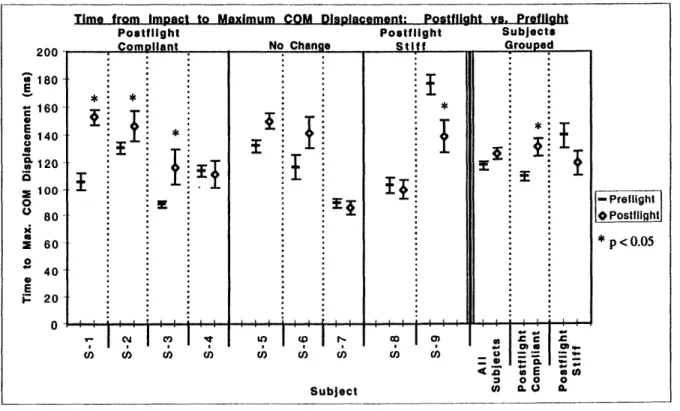
Figure 3.9. Time from impact to peak CM displacement for all subjects. 52
Figure 3.10. Modeled CM vertical motion for representative subject. 54
Figure 3.11. Mean pre- and postflight model vertical stiffnesses. 55
Figure 3.12. Moonwalker suspension system and jump apparatus. 59
Figure 3.13. Moonwalker spring length-tension data and linear fit. 61
Figure 3.14. Array of video image calibration markers. 65
Figure 3.15. LabView program to select and record marker positions. 70
Figure 3.16. Video camera field of view geometry. 73
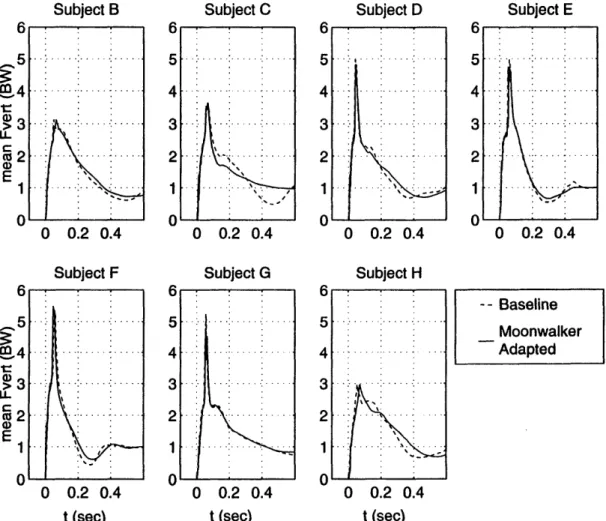
Figure 3.17. Moonwalker experiment vertical ground reaction force traces. 76
Figure 3.18. Moonwalker GRF time from impact to reach 1 body weight. 78
Figure 3.19. Moonwalker vertical GRF minimum value. 78
Figure 3.20. Moonwalker baseline and adapted joint phase-plane portraits. 80
Figure 3.21. Moonwalker model stiffness estimates for all subjects. 82
CHAPTER 4
Figure 4.1. TRACK measures kinematics of LED arrays on 11 body segments. 98
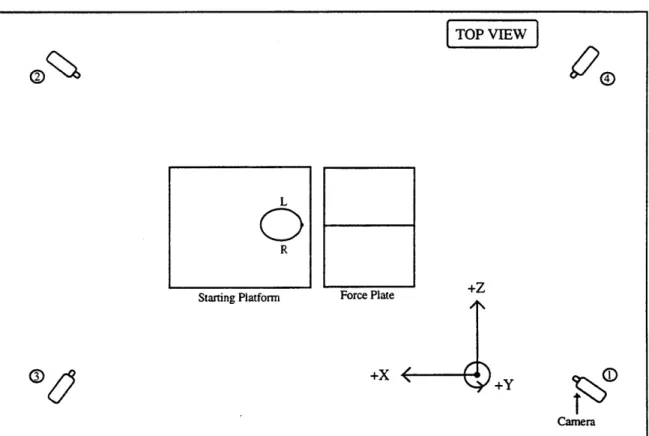
Figure 4.2. Position of Selspot H cameras, jump platform and force plates. 99
Figure 4.3. Array slip is reduced by tightening, rotating downward. 101
Figure 4.4. Schematic of false platform jumping apparatus. 104
Figure 4.5. Frequency response of the Kalman filter and RTS smoother. 113
Figure 4.6. Optimization improves discrepancy in estimated joint locations. 116
Figure 4.7. Joint optimization to re-estimate array to segment transformations. 117
Figure 4.8. Measured vertical GRF and predicted GRF from CM estimates. 120
Figure 4.9. Frequency response of high-pass FIR filter for EMG data. 122
Figure 4.10. P jump vertical ground reaction forces and CM motion. 124
Figure 4.11. Magnitude of vertical ground reaction force for Type 2 jumps. 126
Figure 4.12. Distribution of Type 1 and Type 2 jump landings for all subjects. 127
Figure 4.13. Typical NO-P leg length and joint angle trajectories, subject aqk. 129
Figure 4.14. Average NO-P and P leg length and joint angle trajectories, all subjects. 133
Figure 4.15. NO-P free trajectory leg configuration measurements. 137
Figure 4.16. Typical P jump leg muscle EMG patterns. 141
Figure 4.17. Gastrocnemius onset time prior to impact, all subjects. 142
Figure 4.20. Average hamstrings P and NO-P activation, all subjects. 146
Figure 4.21. Average tibialis anterior P and NO-P activation, all subjects. 147
Figure 4.22. Average quadriceps P and NO-P activation, all subjects. 148
Figure 4.23. P and NO-P integrated EMG for leg muscles. 149
Figure 4.24. EMG activity after nominal impact in gastrocnemius and hamstrings. 150
Figure 4.25. Timing of NO-P EMG bursts after nominal impact. 151
Figure 4.26. NO-P activity model based on control of stretch reflex threshold level. 156
CHAPTER 5
Figure 5.1. Model 1: Second order linear model of CM vertical motion. 160 Figure 5.2. Impedance estimates for landing Types I and 2, subject djn. 163
Figure 5.3. Individual subject stiffness and damping for Model 1. 165
Figure 5.4. Stiffness and damping for Model 1 averaged across all subjects. 166
Figure 5.5. GRF decreases with increasing leg compression relative to NO-P. 166
Figure 5.6. Average of subject virtual trajectories for Model 1. 167
Figure 5.7. Individual subject estimated VTs for Model 1. 168
Figure 5.8. Second order model of vertical CM motion with knee joint. 169 Figure 5.9. Model 2 stiffness and damping estimates, all subjects averaged. 173
Figure 5.10. Individual subject knee stiffness and damping for Model 2. 174 Figure 5.11. Virtual trajectories for Model 2, all subjects averaged. 175
Figure 5.12. Individual subject knee angle virtual trajectories for Model 2. 176
Figure 5.13. Three link planar human body model. 178
Figure 5.14. GRF results for three link model for two different joint angle estimates. 183
Figure 5.15. Limb geometry used to estimate joint angles for three link planar model. 184 Figure 5.16. All-subject average of three link model joint torques after landing. 192
Figure 5.17. Torque fit error for different assigned ankle equilibrium angles. 194 Figure 5.18. Joint impedance estimates for three link model, all subjects. 195
Figure 5.19. All-subject averages of joint stiffness and damping estimates. 197
Figure 5.20. HAT CM cartesian endpoint stiffness and damping ellipses. 198
Figure 5.21. All-subject averages of the HAT CM vertical endpoint impedance. 199
Figure 5.22. Individual subject HAT CM endpoint vertical impedances. 200
Figure 5.23. Virtual trajectories for three link model (position-only VT) 202
Figure 5.24. Impedance estimates for VT incorporating joint rates 203
Figure 5.25. Virtual trajectories for three link model (rate incorporated in VT) 205
Figure 5.26. Comparison of Models 1 and 2 for constant-parameter fits. 208
Figure 5.27. Goodness of fit for VTs with and without rate information. 209
Figure 5.28. Comparison of data and model simulation for best-fit LQR weights. 219
Figure 5.29. Effects of variation in relative LQR weights on model simulations. 220 Figure 5.30. Summary of LQR weight variations on CM and GRF behavior. 221 Figure 5.31. Optimal three link trajectories for nominal cost function weights. 225
Figure 5.32. Effects of variations in vertical GRF cost weight for three link optimization. 227 Figure 5.33. Effect of variations in joint angle cost weights for three link optimization. 228 Figure 5.34. Effect of variations in joint rate cost weights for three link optimization. 229 Figure 5.35. Effect of variations in joint torque cost weights for three link optimization. 230
LIST
OF TABLES
CHAPTER 3
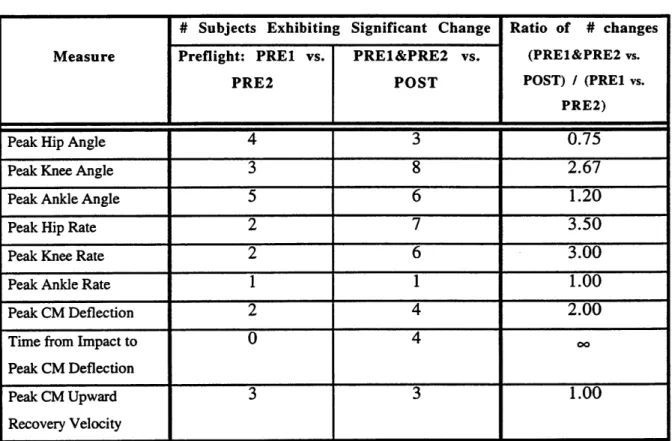
Table 3.1. Significant test session effects in measures pre- and postflight. 39 Table 3.2. Subject classification based on kinematic measurements. 47
Table 3.3. Stiffness and damping in second order model 56
Table 3.4. Second order response parameters 57
Table 3.5. Trunk rest angle at various harness loading conditions. 62 Table 3.6. Moonwalker experimental subject descriptions. 66 Table 3.7. Variability in measurement of constant inter-marker distance. 75
Table 3.8. Moonwalker experiment maximum joint flexion after impact. 79 Table 3.9. Moonwalker second order model stiffness and damping estimates. 83 Table 3.10. Moonwalker model natural frequency and damping ratio. 84
CHAPTER 4
Table 4.1. Resonant frequencies of array vibration. 102
Table 4.2. False platform subject parameters. 106 Table 4.3. False platform jump order (all subjects except djn). 110 Table 4.4. Summary of CM vertical motion for platform (P) trials. 125 Table 4.5. Timing of CM vertical trajectory events. 125 Table 4.6. Timing of vertical ground reaction force events. 126 Table 4.7. NO-P timing of body configuration events about nominal impact. 139
CHAPTER 5
Table 5.1. Goodness of fit measures for Model 1. 164 Table 5.2. Goodness of fit measures for Model 2. 172 Table 5.3. Goodness of fit measures for three link model fits (position-only VT). 196 Table 5.4. Goodness of fit measures for three link model fits (rate command in VT). 204
APPENDIX B
Table B.1. Sharpened Romberg scores for moonwalker experimental subjects. 249
Table B.2. WALEC scores for moonwalker experimental subjects. 250 Table B.3. Sharpened Romberg scores for false platform experimental subjects. 250 Table B.4. WALEC scores for false platform experimental subjects. 251
1
INTRODUCTION
Investigation of human postural and full-body motion behavior has largely focused on the descriptive aspects: data on body kinematics, electromyogram (EMG) measures of muscle activation, and ground reaction forces have been collected for a variety of human movements including voluntary actions and reflex motions. In the midst of this profusion of data, however, there is still little agreement on questions as fundamental as whether posture and movement should be considered as independent or integrated control problems. Patterns of movement and muscle synergies have been identified, and the issue of which different sensory modalities contribute to postural corrections has been addressed, yet the answers to very basic questions remain elusive: how are postural and movement
commands formulated from motor programs and sensory input? Perhaps more important,
why does the central nervous system (CNS) command certain motions and corrections but
not others?
The study of jump landings is no exception. Patterns of muscle activation have been studied for both voluntary jumps and unexpected falls. The body kinematic behavior has been recorded and joint torques have been computed. Experimental conditions such as the height of the jump, the visual surround motion and the composition of the landing surface have been varied, and the effects on muscle and motion patterns have been
described. However, the underlying processes by which the CNS generates commands to actuate the joints and control the landing have not been adequately modeled.
Given the ongoing debate about the mechanisms of motor control in tasks ranging from simple single joint arm motions to full-body, multiple joint activities such as
locomotion, it is not surprising that many aspects of motor control adaptation in
microgravity and readaptation upon return to earth are not well understood. The effects of gravity in the normal terrestrial environment are pervasive, and control of posture and movement has evolved in tandem with the structure of the body to take advantage of life in the gravitational potential field. Even so, the structure of the nervous system permits a marvelous level of adaptability, and astronauts quickly learn to enhance their performance in microgravity during space flight, potentially at the expense of modifying or eliminating patterns of motor control optimized for the I-g environment. Exposure to microgravity has
a substantial effect on human postural control during jump landings, locomotion and even quiet standing upon return to earth-normal gravity.
The central goal of this thesis is to advance the understanding of human motor control by investigating the way humans land from downward jumps. This thesis makes
contributions in three particular areas. First, the problem of explaining changes in downward jumping in astronauts following microgravity exposure is addressed, and a simple model based on adaptive control of limb stiffness is formulated to clarify key features of astronaut postflight jumping performance.
Second, the possibility that stiffness may contribute more fundamentally to the motor control of jump landings is considered. The equilibrium point hypothesis for motor control states that posture and movement may be controlled by a common process [Bizzi et
al., 1992a] that relies on springlike properties of the muscles and their stretch reflexes.
Appropriate choices of muscle length-tension curves may define equilibrium limb positions and simultaneously set impedance properties, allowing the CNS to generate limb
trajectories via a control signal that defines a series of equilibrium points in time. Under the equilibrium point hypothesis, the springlike properties of the neuromuscular system cause torques based on the difference between the actual limb position and the equilibrium point, resulting in limb trajectories that follow the equilibrium trajectory. The actual trajectory depends on the commanded impedance, limb dynamics and environmental perturbations as well as the virtual trajectory. It has been suggested that equilibrium point control could equally well subserve free motions and tasks requiring interaction with the environment. By definition, jump landings require interaction between the body and the environment and are used here to test the applicability of the equilibrium point hypothesis to this class of problems.
Third, an optimization approach is used to evaluate the trajectories observed experimentally in jump landings. Optimal control approaches have been applied successfully to the problem of understanding the takeoff phase in maximum height jumping, but have not yet been applied to the impact absorption phase of jump landings.
This thesis considers the possible optimality of jump landings to gain insight into the factors that shape jump landing trajectories.
Initially, the landing control problem might seem relatively simple, requiring only that the kinetic energy developed during the flight phase of the jump be dissipated while moving the body center of mass (CM) to lie over the base of support (the feet). However, the problem is both interesting and complicated for several reasons. The role of sensory feedback from muscle spindles, tendon organs and vestibular and visual modalities must be considered, but the system response is not simply that of a regulator reacting to a
disturbance input. Instead, the body trajectory and limb impedance are actively controlled in flight and at impact, indicating some level of motor pre-programming and feedforward trajectory generation. Furthermore, the controller must maintain stability both in free flight
controller exhibits adaptive behavior upon exposure to changes in environmental or perturbation conditions.
Currently, better dynamic models are needed to explore the control of downward jumping in humans and provide a theoretical base to address the changes in jump
performance following microgravity exposure. Models of the motor control laws that enable successful stable landing from jumps in humans must incorporate the human body dynamics at varying degrees of complexity. The control models described here attempt to replicate the key features found in experimental observations of jump landings, and are used to explicate the effects of microgravity adaptation and evaluate the equilibrium point hypothesis. This thesis describes three experiments and associated dynamic models designed to validate or disprove three hypotheses concerning the way humans control landings from downward jumps. These three hypotheses are detailed in the next section, and followed by an overview of the remainder of the thesis, including the experiments, analysis, modeling and discussion.
1.1. HYPOTHESES
Hypothesis 1: Posoflight changes in astronaut
jump landings result
from alterations in
commanded impedance characteristics which derive
from motor adaptation appropriate
to the demands of microgravity.Upon returning to earth and its gravity field following space flight, astronauts often show remarkable decrements in the performance of everyday tasks. Examples include exaggerated postural sway during standing (especially in the dark, or in the presence of moving visual displays), wide foot placement and difficulty in negotiating turns during walking, and instability during the landing phase of "drop" experiments [Nicogossian et
al., 1994]. Recently, research on NASA astronauts has targeted postflight decrements in
coordination between eye and head movements, evaluated pre- and postflight muscle activation patterns during gait, and investigated adaptive changes in single-joint kinematics through phase-plane and intersegmental energy transfer analysis [Bloomberg et al., 1997; Layne et al., 1996; McDonald et al., 1996].
However, little quantitative analysis has been performed to explain the underlying adaptive physiological mechanisms, especially in terms of dynamic whole-body motor control. It is believed that motor programs evolved for the control of body motion and limb-environment interactions under Earth-normal l-g conditions are often inappropriate in
microgravity, and astronauts adapt accordingly during space flight. These adaptations appropriate to O-g prove maladaptive upon return to 1-g, and the astronauts exhibit musculoskeletal responses that result in quantifiable differences from preflight in body posture, locomotion and jumping performance. The hypothesized dependence of postflight jumping changes on leg impedance characteristics is tested using body kinematic data and a
simple model of the CM motion.
While the CNS adaptation to the reduced demands on the postural control system in microgravity likely plays an important role in postflight changes, many other effects related to space flight may also take part. For this reason, a ground-based partial weight unloading experiment is designed to supplement the astronaut data. Its aim is to show that simply reducing the support requirements on the legs for a short time can induce changes analogous to those seen in astronauts following space flight, while avoiding potentially confounding issues such as muscular atrophy and vestibular reinterpretation.
Hypothesis 2: The experimentally observed characteristics of downward jumps in humans can be captured by a control model which defines a "virtual trajectory"for the limbs during the flight and impact absorption phases of the jump landing. The impedance of the limbs with respect to the commanded trajectory is also specified by this model, determining the perturbation response and the actual trajectory of the limbs upon landing.
Various studies of single and multijoint movement have provided evidence for the equilibrium point hypothesis of motor control [Bizzi et al., 1992]. The majority of studies to date have considered single joint arm motions or planar reaching arm motions involving two joints. Use of a comparable paradigm in the control of robot manipulators has
demonstrated stable performance during free motion, motion during contact with a rigid surface, and transitions between the two conditions [Hogan, 1987]. To date, equilibrium point approaches have not been seriously attempted for lower extremity or full-body motion. Furthermore, few attempts have been made to apply the virtual trajectory hypothesis to intact motor control in tasks dealing with substantial environmental interaction.
Extension of this theory to the control of jump landings requires experimentally derived knowledge of the commanded virtual trajectory as well as models of the human body dynamics, the CNS control of limb impedance and the interaction with the
attractive virtual trajectory. The equilibrium point hypothesis is interpreted using three models of increasing complexity, from a single degree of freedom linear model of vertical
CM motion to a nonlinear three link inverted pendulum model of the human body.
Hypothesis 3: A trajectory optimization procedure based on a set of physically and
biomechanically plausible variables is sufficient to reproduce key features of the experimentally observed trajectories for jump landings. Specific optimization criteria include CM excursions, joint motion, joint torques and impact forces.
An important goal of this thesis is understanding why certain trajectories are selected by the CNS. Prior work has focused on the optimality of takeoffs in maximum height jumping [Pandy et al., 1990; Pandy and Zajac, 1991; Selbie and Caldwell, 1996]. In this thesis, objective functions are formulated for two models of jump landing dynamics to generate optimal trajectories that closely match the actual trajectories seen in the impact absorption phase of the jump landing. Weights in the cost functions are varied to gain insight into the tradeoffs made by the CNS in selecting appropriate landing trajectories.
1.2. THESIS OVER VI EW
The remainder of this thesis is divided into five chapters. Chapter 2 provides additional background and a literature review of topics relevant to this thesis. Chapters 3 and 4 are devoted to descriptions of the thesis experiments and their results. Chapter 5 develops dynamic models of jump landings, and applies these models to the equilibrium point hypothesis. Optimality properties for the models are also considered in Chapter 5. Finally, Chapter 6 summarizes the conclusions from the thesis work and provides recommendations for future study. The chapter contents are summarized below.
Chapter 2: This chapter presents relevant prior work described in the literature. Specific areas of focus include (1) studies of downward jumping in humans and animals; (2) microgravity adaptation effects on human motor performance; (3) theories of motor control, with emphasis on equilibrium point hypotheses; and (4) optimality in motor performance.
Chapter 3: The experiments dealing with adaptation effects on downward jumping are detailed here. The astronaut pre- and postflight tests are presented first, followed
by the "moonwalker" partial weight unloading experiments. A second order model
of vertical CM motion is developed and applied to both data sets. The results from the two experiments are compared.
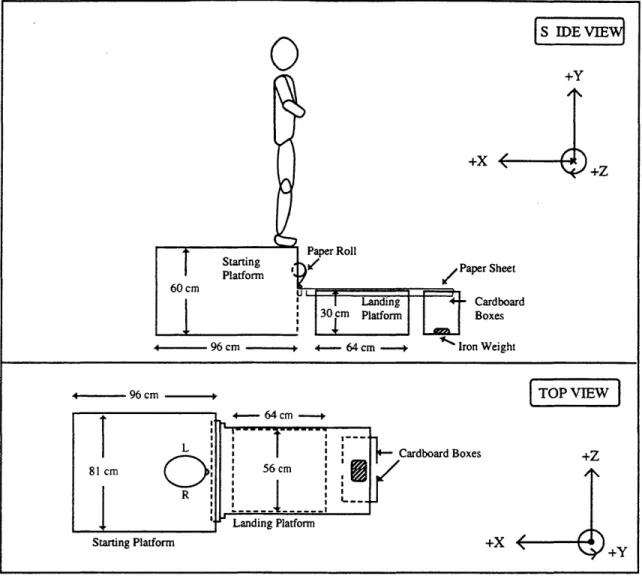
Chapter 4: In this chapter, the false platform jumping experiments are described. Processing and analysis of the kinematic data is covered. The results of the platform (P) and no-platform (NO-P) jumps are compared, and the significance of the NO-P results is discussed.
Chapter 5: Three models are developed for the impact absorption phase of jump landings. The first two models consider only the vertical motion of the full body CM. In one model, the CM is supported by a linear spring and damper. In the second, a knee joint is incorporated about which a torsional spring and damper act, providing a vertical stiffness which depends on the knee joint angle. The third model consists of a planar, three link inverted pendulum pinned to the ground at the ankle. Using the data from the false platform experiment, the equilibrium point hypothesis is assessed for each model. Best fit stiffness and damping values are calculated, and virtual trajectories are computed for suitable stiffness and damping fits. The viability of the equilibrium point hypothesis for the jump landing task is discussed. Also, objective functions are developed for the first and third models to derive optimal trajectories which match the experimental data. The weights in the objective functions are varied, and the results are discussed.
Chapter 6: The conclusions from the experimental and modeling sections are summarized. Based on these conclusions, possible topics for future work are proposed.
1.3. ACRONYMS AND ABBREVIATIONS
The following acronyms and abbreviations are used in this thesis: foot
inch
0-g zero gravity or microgravity
1-g Earth normal gravity
ANOVA analysis of variance
BML Biomotion Laboratory
BW body weight
CNS EC EMG EO FAS FIR GRF HAT JSC kg LED LQR MANOVA MGH m mm ms NASA N-C NO-P P P-C POST PREl PRE2 P-S RMS ROT RTS SS TA TRACK TRANS VT
central nervous system
eyes closed (astronaut jumping experiment) electromyogram
eyes open (astronaut jumping experiment) feasible acceleration set
finite impulse response ground reaction force head, arms and trunk Johnson Space Center kilogram
light emitting diode linear quadratic regulator multivariate analysis of variance Massachusetts General Hospital meter
millimeter millisecond
National Aeronautics and Space Administration
no change (subjects in the astronaut jumping experiment)
no platform (jumps where the subject falls through the paper target) platform (jumps where the landing platform is present under the paper) postflight-compliant (subjects in the astronaut jumping experiment) postflight test session (astronaut jumping experiment)
first preflight test session (astronaut jumping experiment) last preflight test session (astronaut jumping experiment) postflight-stiff (subjects in the astronaut jumping experiment) root mean square
postural support dorsiflexion rotations Rauch-Tung-Striebel (filter)
sum of squares tibialis anterior
Telemetered Real-time Acquisition of Kinematics postural support backward translations
2
BACKGROUND AND LITERATURE REVIEW
This section reviews some of the major relevant work in the fields of biomechanics, posture and movement control, robot control and human space flight adaptation. Literature on jumping and landing from unexpected falls is covered first. Results dealing with the effects of microgravity exposure during space flight on the control of posture and
movement are considered next. Posture control and applicable models are discussed in the third section, and further issues relevant to motor control are presented last.
2.1. JUMPING
2.1.1. Voluntary Downward Jumps
Study of jump landings has largely been limited to descriptions of the joint kinematics, EMG activation patterns and lower extremity joint moments. McNitt-Gray
[1993] examines the leg kinematics and kinetics for jump landings from three different
heights. She finds that ankle moments are plantarflexor throughout the landing phase, and hip and knee moments are also extensor except during the early landing phase. During the first quarter of the landing phase the knee and hip moments tend to oscillate out of phase with each other. Although joint moments tend to peak earlier with increased landing velocity, overall the kinematic and kinetic events are consistent across velocities. Knee and hip flexion (but not ankle flexion) increase for larger drops, as do all three joint angular velocities and joint moments. The relative increase in moment for higher drops is largest for the knee, followed by the hip and ankle respectively, indicating that relatively greater demands are placed on the knee for energy absorption at higher landing velocities. At higher impact velocities, recreational athletes use more hip flexion, lower peak extensor moments and longer landing phases than gymnasts, who favor less hip flexion and higher peak extensor moments. She suggests that a common landing strategy is used for different height jumps, and is progressively adjusted by selectively changing joint moment gains.
McKinley and Pedotti [1992] study changes in joint kinematics and EMG patterns for jump landings on rigid and compliant surfaces. In general they find that the lower limb reaches its largest extension prior to landing, and that the limbs are already slightly flexed at impact. The early part of ground contact is characterized by simultaneous flexion of the
ankle, knee and hip joints, while only the knee and hip continue to flex during the latter part of the impact phase. A consistent muscle pattern is also observed. A burst of the biceps femoris in flight corresponds to the slight flexion of the limb before impact. The rectus
femoris and vastus lateralis become active slightly before touchdown and remain active throughout the ground contact phase. The ankle extensors are continuously active from mid-flight, while the tibialis anterior activity begins within 150 ms prior to impact, is more burst-like, and peaks during the ground contact.
Skilled subjects exhibit larger ankle extension at impact when landing on the rigid surface as compared to foam surface landings, combined with greater ankle range of motion during impact absorption. Unskilled subjects choose a single "default" angle for both landing conditions in the middle of the range of angles used by skilled subjects on the two surfaces. Both skilled and unskilled subjects show a global shift of muscle activation to onsets closer to impact for landings on the compliant surface. The onset of leg
musculature activation in a distal to proximal sequence prior to landing indicates advance preplanning of the motion. Other investigators demonstrate that EMG onset is closely linked to expected time of impact, by using false paper platforms and changing the height of jumps for blindfolded animals [McKinley and Smith, 1983; Dyhre-Poulsen and Laursen, 1984]. The observation that knowledge of the landing surface compliance overrides visual cues regarding time to impact hints that the muscle synergies may well be preprogrammed before flight.
2.1.2. Sudden Falls
In addition to the variable muscle activation patterns seen for voluntary jumps, reflex reactions occur in subjects exposed to sudden drops. The otolith-spinal reflex elicited by sudden falls has been studied by Melvill Jones and Watt [197 lb] and Watt et aL.
[1986]. This involuntary response is triggered by otolith excitation and can be observed in
many flexor and extensor muscles throughout the body. In the ankle extensors, the
reaction takes the form of two bursts of EMG activity. The early burst, which occurs from
50 to 150 ms after fall onset, is fixed relative to the time of release and is independent of
fall height. It is proportional to the acceleration stimulus magnitude and is reduced by rotating the gravity vector 900 relative to the body. Furthermore, it does not habituate with repeated testing. It appears that the earliest phase of this early burst is not susceptible to voluntary control, while the later phase is influenced by mental set.
2.1.3. Jump Takeoff Control
Pandy, Zajac and others have applied optimal control techniques to the problem of maximum height jumping [Zajac, 1993; Pandy and Zajac, 1991; Pandy et aL., 1990; Selbie and Caldwell, 1996]. They model the body as a four segment planar linkage with
Hill-type muscle models driven by a first order representation of activation dynamics. Because the derivatives of the states are linear in the controls, the formulation of the problem leads to bang-bang optimal controls. The solution to the optimal control problem then depends on finding the switching times for the controls. The authors also address the issue of the discontinuity in the system dynamics in the transition from the flat-footed part of the jump to the heel-off portion. They succeed in replicating the major features of maximum height jumps, including muscle activation sequences, limb kinematics and ground reaction forces. Findings indicate that jump height is relatively insensitive to musculotendon compliance, and that uniarticular muscles (gluteus maximus and vastus lateralis) generate the propulsive energy while biarticular muscles fine-tune the
coordination.
2.2. SPACE FLIGHT EFFECTS
A wide variety of tests have been performed on astronauts since the beginning of
the space age to assess the effects of microgravity on human performance [Nicogossian et
al., 1994]. Experiments by Young, Oman and others have demonstrated significant
changes in the interpretation of sensory cues following adaptation to microgravity: utricular otolith signals are apparently reinterpreted to indicate head linear acceleration rather than tilt, and increased weighting is placed on visual and tactile cues for posture control and the perception of orientation [Young et al., 1986]. Following space flight, subjects exhibit difficulty maintaining erect posture with eyes closed except within a narrow "cone of stability."
Gurfinkel [1994] reviews some of the results relevant to motor and posture control from two Franco-Soviet space flights. In space, the astronaut tends to maintain the typical erect postural configuration, although he leans forward to a greater extent than on earth for the first 2-3 days of space flight. The distribution of tonic antigravity muscle activity is also altered: the high soleus activity found in earth conditions is replaced by activity in the antagonist tibialis anterior, and increased EMG responses are found in the quadriceps. Interestingly, counterphase motions of the trunk and lower limbs that maintain the mass center over the base of support during significant body tilts are retained in space even though the functional balance requirement have been removed. Rapid arm raising
movements which produce anticipatory suppression of soleus activity in 1-g instead cause suppression of tibialis anterior activity in space. Even some low-level postural responses are changed: the stretch reflex of the tibialis anterior is shown to be considerably weakened following 2-3 days of flight.
Experiments conducted by Watt et al. [1986] find alterations in the vestibulo-spinal reflex under microgravity conditions. The earliest subcomponent of the "early" phase of the otolith-spinal reflex response to a sudden fall is shown to diminish immediately upon reaching orbit. It continues to decrease during the flight, and stimuli that elicited strong responses preflight are found to be close to or below the response threshold after the first mission day. This result suggests that otolith information is gradually ignored by the nervous system in weightlessness. However, responses found postflight are not
significantly different from preflight, indicating that the readaptation process takes place very quickly. All subjects are unsteady postflight, and one falls over backwards
consistently, commenting that his legs are always further forward than he expects them to be. Another subject states postflight that he feels the floor is coming up to meet him, and is there before he is ready for it on the way down. Such comments point to altered perception
of both vestibular and proprioceptive cues.
Bloomberg et al. [1997] observe a "head-locking" strategy during gait in some astronauts postflight, a strategy often adopted by patients with defective vestibular systems. Similarly, astronauts demonstrate abnormal postural sway oscillations and drift
immediately postflight for a sway-referenced support surface; the data are almost identical to tests of a patient with reduced vestibular function [Paloski et al., 1993].
2.3.
EQUILIBRIUM POINT HYPOTHESIS FOR MOTOR CONTROLThe spatial features of voluntary body and limb movements in extrinsic coordinates appear to be represented and planned at some high level of the CNS such as the motor cortex. An important area of motor control research involves the transformation of desired trajectories into appropriate muscle activations. Some investigators propose that the CNS
solves the inverse kinematics problem to determine joint trajectories from the desired limb endpoint trajectory, then explicitly derives the necessary muscle forces using an inverse dynamics solution [Hollerbach and Atkeson, 1987]. Such computations imply internal estimates of body segment inertial parameters and dimensions and muscle moment arms. Slotine [1985] has shown that small errors in the estimates of inertial properties may result in instability. The apparent computational complexity and sensitivity to model errors in this approach has led to a quest for simpler solutions to the inverse kinematics and inverse dynamics problems.
The equilibrium point hypothesis was first proposed by Feldman [1966] and has been the subject of several reviews [Feldman, 1986; Bizzi et al., 1992a; McIntyre and Bizzi, 1993; Feldman and Levin, 1995]. This hypothesis is based on the idea that the neuromuscular system exhibits position-dependent properties which tend to restore the
limbs to a commanded equilibrium posture. A key point of the hypothesis is that muscles exhibit spring-like behavior, and somewhat resemble tunable springs with force generation that depends on both length and neural activation [Rack and Westbury, 1974]. Control of relative activation of the relative agonist and antagonist muscles acting about a joint results in the specification of an equilibrium posture for the joint as well as the stiffness about the equilibrium position. A study of perturbations from static arm posture in humans [Mussa-Ivaldi et al., 1985] shows that the conservative components of the elastic force field are much larger than the non-conservative components, indicating that the neuromuscular properties are largely spring-like in the multiarticular arm.
Central commands may generate a sequence of equilibrium positions for a limb, and the spring-like properties of the system will tend to drive it along a trajectory which follows these intermediate equilibrium postures. Hence, the same mechanism applies to the control of both static posture and voluntary movement. Because the equilibrium position is defined as the position which the limbs would attain in the absence of external forces if central commands were frozen at a particular moment, the actual equilibrium point is generally different from the commanded equilibrium in the presence of static loads. Hence, the commanded equilibrium position is often referred to as a virtual position, and a time sequence of commands gives rise to a set of virtual positions known as a virtual trajectory. It has been noted that the virtual trajectory need not remain within the feasible workspace of the limb, and may pass into solid objects or surfaces [Bizzi et al., 1992a].
The equilibrium point hypothesis has two especially attractive features: simplicity and stability. First, the centrally commanded equilibrium trajectory resembles the desired actual trajectory, avoiding explicit solution of the inverse kinematics and inverse dynamics problems. Second, passive stiffness and damping properties of the neuromuscular system provide stability for free motions and movement during contact with the environment. Two main versions of the equilibrium point hypothesis exist, and are known as the "alpha" and
"lambda" models.
2.3.1. Lambda Model of Equilibrium Point Hypothesis
The lambda model of the equilibrium point hypothesis is based on the idea that shifts in the equilibrium state of the motor system can be generated by changing the threshold (X) of the stretch reflex [Feldman, 1986]. When lambda remains constant, an invariant characteristic relates muscle length and force, so that the muscle in concert with central and reflex commands acts like a nonlinear spring (Figure 2.1).
N-m 5 0 OW 00 160* Angle
I"
xX
LengthFigure 2.1. Invariant characteristics in lambda equilibrium point model.
This family of invariant characteristics (ICs) relates joint angle and joint torque for elbow flexors (upper curves) and extensors (lower curves). The dashed line indicates passive joint characteristics when both muscles are relaxed. The parameter X for a given IC corresponds to the muscle length where the active IC deviates from the passive curve [from Feldman and Levin, 1995].
Muscle recruitment F is given by
F = F(x - A*)
where
{
0 V X-A* O a(x- 2*) -V x - *< Ox = muscle length
v = rate of change of muscle length
= static threshold muscle length for stretch reflex
= damping factor
c(s) = monotonically increasing function of s EMG I44
60
<D z (2-1)Muscles are activated reflexively due to perturbations in x or centrally due to changes in A. Feldman and Levin [1995] suggest that the threshold lengths A for antagonist muscles acting about a joint are set by descending reciprocal (R) and coactivation (C) commands. Ramp changes in the R and C commands generate shifts in the joint equilibrium position, causing movement of the limb. Movement speed is controlled by varying the duration of the ramp changes.
Three main criticisms have been leveled against the lambda model [reviewed by Bizzi et al., 1992a]. First, its reliance on reflex pathways for the generation of movement is inconsistent with experimental demonstration of the ability of deafferented monkeys to make goal-directed movements in the absence of proprioceptive or visual position
feedback. Second, the gain of the stretch reflex during movement appears to be too small to contribute significantly to force generation. Third, time delays in the reflex loops may contribute to instability.
2.3.2. Alpha Model of Equilibrium Point Hypothesis
The alpha model is based on the inherent mechanical properties of muscle. In this model, central commands set rest lengths and stiffnesses for the muscles. For two or more muscles acting in opposition about a joint, combined muscle settings result in an
equilibrium position of the joint at which net torques are zero. Displacement of the limb from this position generates restoring torques, and movements can be generated by adjusting muscle activation levels to vary the equilibrium point along the desired path. Appropriate values of muscle stiffness and damping will cause the actual path of the limb to approximate closely the equilibrium point trajectory.
The reliance on intrinsic muscle properties in this model avoids difficulties with time delays in neural feedback, and is consistent with the ability of deafferented monkeys to perform pointing movements in the absence of feedback [Bizzi et al., 1984]. The
experiments with deafferented monkeys do show decrements in performance in the absence of feedback, however, and Figure 2.2 shows a formulation of the alpha model which incorporates both intrinsic muscle properties and stretch reflex pathways. Because the inherent stiffness properties of the muscles are essential to the alpha formulation, the validity of the alpha model has been questioned on the basis of negative stiffness
measurements in individual muscles and about joints in portions of the normal operating range [Hasan, 1992]. The impact of this criticism is unclear, however, as the force-position relationship need only be positive definite throughout a region which includes the equilibrium point [Bizzi et al., 1992b]. Won and Hogan [1995] demonstrate strong
positional stability properties in the arm during perturbed point-to-point arm movements, reinforcing the idea that an attractive virtual trajectory underlies such movements.
--- De- - -~1 ~~i acks Reflex Feedback X 1/se " KMuscle G Mu~sculo-SkeletalSystem
This model includes intrinsic muscle properties (stiffness K and damping B) and reflex function (position gain G, and velocity gain Gve). I represents the limb inertia, and s is the Laplace transform variable. [From McIntyre and Bizzi, 1993.]
2.3.3. Virtual Trajectories in Voluntary Arm Movements
One of the most attractive properties of the equilibrium point hypothesis is the potential ability to use simple virtual trajectories which can be planned without complex computation. Flash [1987] demonstrates that the equilibrium point hypothesis can be used to model two-joint planar reaching movements in the arm at moderate speeds. She
simulates straight-line virtual trajectories with between the two endpoints with unimodal velocity profiles. Using joint stiffness parameters derived from experimentally measured static values, she shows that her model captures both qualitative features and quantitative kinematic details of the experimentally measured trajectories.
However, the simple trajectories found by her and others [McIntyre and Bizzi,
1993] depend on adequate stiffness values. More complex "N-shaped" virtual trajectories
have been found necessary by other investigators [Hogan, 1984; Latash and Gottlieb,