HAL Id: insu-02793804
https://hal-insu.archives-ouvertes.fr/insu-02793804
Submitted on 5 Jun 2020
HAL is a multi-disciplinary open access
archive for the deposit and dissemination of
sci-entific research documents, whether they are
pub-lished or not. The documents may come from
teaching and research institutions in France or
abroad, or from public or private research centers.
L’archive ouverte pluridisciplinaire HAL, est
destinée au dépôt et à la diffusion de documents
scientifiques de niveau recherche, publiés ou non,
émanant des établissements d’enseignement et de
recherche français ou étrangers, des laboratoires
publics ou privés.
An interactive chemical dynamical radiative
two-dimensional model of the middle atmosphere
G. Brasseur, M.H. Hitchman, S. Walters, M. Dymek, Michel Pirre
To cite this version:
G. Brasseur, M.H. Hitchman, S. Walters, M. Dymek, Michel Pirre. An interactive chemical dynamical
radiative two-dimensional model of the middle atmosphere. Journal of Geophysical Research,
Ameri-can Geophysical Union, 1990, 95 (D5), pp.5639-5655. �10.1029/JD095iD05p05639�. �insu-02793804�
JOURNAL OF GEOPHYSICAL RESEARCH, VOL. 95, NO. D5, PAGES 5639-5655, APRIL 20, 1990
An Interactive Chemical Dynamical Radiative Two-Dimensional Model
of the Middle Atmosphere
G. BRASSEUR,
1 M. H. HITCHMAN,
2 S. WALTERS,
1 M. DYMEK,
3 E. FALISE,
3 AND
M. PIRRE
4
This paper describes a new two-dimensional model of the stratosphere and the mesosphere in which dynamics, radiation and chemistry axe treated interactively. The transport equations axe expressed in the transformed Eulerian fraxnework. Momentum deposition associated with Rossby wave absorption and gravity wave breaking and related eddy diffusion coefficients are paxaxneterized as a function of the mean zonal state of the atmosphere. Diabatic heating and cooling is derived from the detailed National Center for Atmospheric Reseaxch community climate model radiative code. The distributions of chemically active species belonging to the oxygen, hydrogen, nitrogen and chlorine families axe calculated for present-day conditions. By applying neax the tropopause a different dynamical forcing in each hemisphere, the model produces
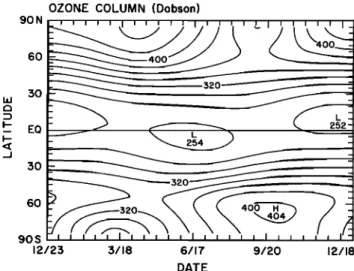
significant hemispheric asymmetries in dynamical quantities (e.g., temperature) and trace gas densities (e.g., column ozone), in good agreement with climatological values. It is shown that the
calculated distributions of source gases, such as nitrous oxide and methane, axe very sensitive to the
calculated (and pararneterized) dynamical quantities and that species produced in the atmosphere,
like carbon monoxide and odd nitrogen, can provide interesting information on the role of atmospheric transport. A major problem that remains to be elucidated is the underestimation by most models of the ozone density in the upper stratosphere. Because of the many feedback mechaaftsms included in its formulation, the model is well adapted to study the effects of human or natural perturbations. The response of the atmosphere to perturbations resulting from increasing emissions of CO2 and chlorofluorocaxbons is considered.
1. INTRODUCTION
Two-dimensional chemical transport models have been extensively developed in the last 2 decades to study the behavior, as a function of latitude and height, of atmo- spheric trace species. These models provide useful in- formation on the zonally averaged distribution and the• sources and sinks as well as the meridional transport of these chemically active constituents. One advantage of
two-dimensional formulations over one-dimensional mod-
els is their ability to represent the effects of dynamics in redistributing constituents in the meridional plane. A difficult problem, however, in representing zonally aver- aged distributions arises from the nature of stratospheric transport, which is due in large part to planetary waves and is thus three-dimensional by essence. In the so-called Eulerian models, the mass and energy fluxes are sepa- rated into a component involving the zonally averaged meridional winds and a component associated with the eddies, i.e., the departure of the variables from their zonal mean. The contribution by the eddies requires additional information through a closure relation by which the eddy transport of quasi-conservative tracer is specified in terms
of the gradient of their mixing ratios (based on hnear
theory assumptions). In the two-dimensional models of
the first generation, the mean circulation is prescribed, and the mixing coefficients are specified and are based on a mixing length hypothesis; their values are generally obtained from studies on the dispersion of nuclear debris
iNational
Center
for Atmospheric
Research,
Boulder,
Colorado.2Depaxtment of Meteorology, University of Wisconsin,
Madison.
3Belgian Institute for Space Aeronomy, Brussels.
4Laboratoire de Physique et Chimie de l'Environnement,
Orl6ans, France.
Copyright 1990 by the American Geophysical Union.
Paper number 89JD02868.
0148-0227 / 90 / 89 JD-02868505.00
[Reed
and German, 1965; Gudiksen
et al., 1968]. According
to the noninteraction
and nontransport
theorems
(see, for
example, Andrews
et al., [1987] for a discussion),
however,
the transport by the Eulerian mean kirculation and by
the large-scale
eddies nearly cancel, so that inaccuracies
in the specified diffusivities lead to •ignificant errors in
the determination of the net transport.
The assumption that eddy transport can be properly modeled by a simple diffusion law was questioned, for
example, by Mahlraan [1975], who found from a gen-
eral circulation model (GCM) study that the eddy flux
is not always diffusive in nature and that some of the
assumptions
made by Reed and German [1965] regarding
the conservative nature of the species, the particle tra- jectory and the mean slope of the mixing surfaces are dubious. Solving the eddy perturbation equations with
the linear wave approximation,
it was found (see, for ex-
ample, Plumb [1979], Pyle and Rogers [1980b], Matsuno
[1980]) that the flux-gradient
relation suggested
by Reed
and German can be retained but that the eddy tensor can be separated into a symmetric and an antisymmetric component. The latter, advective in character, depends on the mean parcel displacement and, if combined with the mean meridional circulation, provides an effective trans- port circulation. The former, which is a dispersive com- ponent, is determined by the time variation of the parcel
displacement
(transient eddies) and by the photochemical
relaxation rate (chemical
eddies). Dunkerton
[1978] sug-
gested that the transformed
Eulerian mean (TEM) circu-
lation (residual
circulation)
(•*, W*) defined
by Andrews
and Mcintyre [1976] and Boyd [1976]
5639
5640 BRASSEUR ET AL.: INTERACTIVE MODEL OF THE MIDDLE ATMOSPHERE
where (•, W) represents
the Eulerian mean (EM) circula-
tion (see the notation
section
for other definitions)
would
account for essentially all the mass and energy transport and be similar to the diabatic circulation proposed earlierby Brewer [1949], Dobson
[1956], and Murgatroyd
and Sin-
gleton [1961] and to the Lagrangian mean circulation of
air parcels. In the two-dimensional models developed fol-
lowing the TEM theory, based on a global advective trans- port circulation [e.g., Garcia and Solomon, 1983; Guthrie et al., 1984; Stordal, 1985], eddy diffusivities were nev- ertheless added in the thermodynamic and trace species continuity equations to account for transient and dissipa- tive processes which are expected to become important especially in winter. The magnitude of the eddy diffusivi- ties required by these models is approximately an order of magnitude smaller than in the classical Eulerian models. In this formulation, the values of the eddy diffusivity are usually specified empirically, and the relationships among dissipation mechanisms, the distribution of wave absorp- tion, and irreversible mixing are therefore ignored. In the most recent models however, these processes are deter-
mined in a consistent manner.
The purpose of this paper is to describe a two-
dimensional model formulated in transformed Eulerian co-
ordinates, in which chemical, radiative, and dynamical processes are treated interactively, and to present results obtained regarding the present-day and the perturbed at- mosphere. The model includes a detailed radiative scheme which derives the diabatic heating rates consistently with calculated distributions of temperature and trace species densities. Calculated wave driving and eddy mixing coeffi- cients resulting from gravity and Rossby wave absorption vary with the evolving distribution of the mean zonal wind. Through the large number of interactive processes included, the model is particularly adapted to the study
of feedback mechanisms regulating the middle atmosphere
when natural or man-made perturbations are produced.
2. MODEL DESCRIPTION
œ.1. Dynamics
The model, which is used in the present
study, extends
from pole to pole with a latitudinal resolution of 5 o and from the surface to 85 km with a vertical resolution of I km. The potential temperature and the chemical species are advected by the transformed Eulerian mean
meridional
circulation
in log-pressure
coordinates,
which is
forced
by spatial
gradients
in wave
driving
and the related
net radiative
heating.
The dynamical
fields
(•, •*, •*, 0)
are obtained
from the thermodynamic,
zonal momentum,
mass continuity and thermal wind equations00 •. •0
•0 --
O--•+
•-• +•*•z = Q + D8
(1)
07 07_,O
t rt
•* q-
•zz
w -- F
(2)
I 0 cos 40y•--(•*
cos
4) + • 0
••(•o•*)
=o
07 g 00• = -• o-•
(4)
where1 0 (7 cos
4)
(5)
cos
• Oy
is the absolute vorticity and where tan•b
7 = f q- 27
(6)
The other variables are defined in the notation section.
The eddy heat flux divergence D0 expressed by
= - o-T
• Oo
w,S,
+ o•/oz
•,o,
(•)
is generally small except where transience and dissipation is important, for example, in the mesosphere, where gravity wave breaking can cause a substantial downward heat flux. The wave driving F is assumed to be due to
Rossby
(FR) and gravity (Fg) wave dissipation,
which can
be expressed
by the divergence
of wave activity flux (or
Eliassen-Palm
(EP) flux E)
1
•=•n+ • = oo
• cos
4, v.r
(s)
where the meridional and vertical components of E are
Ey
=
po
a
cosqS
[ O•'/Oz
O0/Ozv'O'
--
u'v']
(9a)
M/Oz - .,w,
(9•)
Equations
(1) to (4) can be combined
to give a diagnostic
equation for the mean meridional stream function [Garcia and Solomon, 1983]
%Y•j•
+%• OyOz ••+%•+c,•
= c• cos
•
(10)
where the •velocity" stream function X •nd the "m•ss" stream functions • •re related to the components of the mean meridionM velocity by
_.
v ...
•
o (OoX)
-
•
(11a)
po cos 40z po cos 40z
_.
w ....
•
o (ooX) •
(11b)
po cos 40y po cos 40y
the equation coefficients
(Cry, %•, O•, %, ana O•)
are functions of the mean zonal wind and temperature
distributions [Garcia and Solomon, 1983], and the forcing
term (7 F is a function of the meridional gradient of the heating rate and the vertical gradient of the momentum torque associated with wave breaking:
R 0 --
fOF
C•,
= • •yy(Q
- Do)
+ •
(12)
Given the forcing term (to be described
shortly), previous
values
of 0 (or T) and 7, and the boundary
conditions
(X
= 0 at the poles, Ox/Oz = 0 at the top and a specified
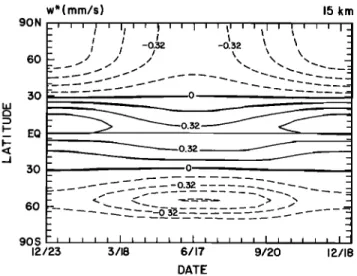
BRASSEUR ET AL.: INTERACTIVE MODEL or THE MIDDLE ATMOSPHERE 5641 90N 6O 3O EQ 30 60 w" (mm/s) 15 km - [ [ ] / ] Ii [ [ [/ [ [ I • [ •[ • • I [ • [ [ [ 1 - i I I x - -0.:32 -0.:32 \ \ -
Z /I /I //
\• • \\ \ •
-
Aside from the influence of the 15-km boundary con- dition, the dynamical system is kept from radiative equi-
librium conditions
(7* - •* - 0; • - 0) through
momen-
tum deposition associated with wave dissipation. In the present version of the model, only the effects of gravity waves and of Rossby waves are taken into account. The effect of equatorial waves will be included in a further developed version of the code in order to study additional large-scale phenomena such as the semiannual and the quasi-biennial oscillation of the atmosphere.The contribution of gravity waves is parameterized by the scheme proposed by Lindzen [1981] and Holton
[1982] and adopted by Garcia and Solomon [1985]. In
this scheme, zonally traveling waves break when their
90S-' ' ,, i I • •, •, !,,,
] • I • [ t [ t I-
amplitudes
become
so large
that they become
convectively
12/23 3/18 6/17 9/20 12/18 unstable. Momentum deposition above the breaking level
DATE
tends to accelerate (or decelerate) the zonal wind speed
• toward the zonal phase speed c of the wave. In the
Fig. 1. Transformed
Eulerian
mean
vertical
velocity
(in millime- region
between
the breaking
level
zb and the critical
level
ters
per
second)
specified
at iS-kin
altitude
(tropospheric
forc- (where
•
c) wave
amplitudes
are
assumed
to cease
ing),
as a function
of latitude
and season.
Contour
interval:
0.16 zc
--
,
mm/s.
their exponential
growth
with altitude and are reduced
classical alternating direction method and provides the
transformed Eulerian mean meridional circulation.
For the calculations of the dynamical quantities, the lower boundary is located at 15-km altitude where the
to a constant profile by convective turbulence. The body
force transferred from the waves to the local mean flow
is given by
(13)
vertical
velocity
is specified
as shown
in Figure
1. (This in the range
zb < z < ze, where
the breaking
level is
condition,
which simulates
the dynamical
forcing
from determined
by
the troposphere, is equivalent to a specified value of the
stream
function
X.)
Below
15
km,
where
the
formulation
of
mass
and
energy
transport
by
the
residual
circulation zb
= 3H
In [c-•[
(14)
is not straightforward because of the large transient
and dissipative effects, the stream function is specified and where H is the scale height. Parameters B and •,
as a "return flow" to close up the two stratospheric which represent
wave properties at 15 km (see, for exam-
meridional
cells. Sensitivity calculations
have shown that ple, Brasseur
and Hitchman [1987]) are specified
in Table
the structure of the temperature field as well as the I for the spectrum of phase speeds used in the present
slope of the mixing ratio isolines of the tracers in the study. The values of these parameters have been adjusted lower stratosphere is very sensitive to the strength of to make the calculated body force consistent with the
the circulation specified at 15 km. For example, the momentum budget of the middle atmosphere established
temperature minimum at the tropical tropopause changes for mid-December 1978 from the limb infrared monitor
by about 10 K if the wind velocity at the tropopause
is of the stratosphere
(LIMS) observations
[Hitchman and
modified by 50%. Therefore we have tuned the values Leovy, 1986]. The algorithm then was applied at all times. of the wind condition in order to obtain a temperature According to the parameterization of Lindzen, the verti-
distribution in fair agreement with climatological values. cal eddy diffusion coefficient associated with gravity wave
This forcing varies with season and is different in each breaking above the zb level is given by
hemisphere. It should be noted that the use of a
fixed
"frozen"
dynamical
circulation
boundary
and
temperature
condition
at 15
below
km
this
and
level
a
IYzz
--•'•
B (6_•)3
(c_•)_{_3H•z
z
reduces
the consistency
of the model and limits the Profiles
of Fg and IYzz are smoothed
in the vertical
accuracy
of calculated
ozone perturbations
in response to avoid numerical
problems
when solving
the transport
to anthropogenic effects. This problem cannot be easilyresolved, since the circulation in the lower stratosphere is driven by the wave forcing in the troposphere, a quantity that cannot be accurately estimated, especially in a two-dimensional model. Perhaps a way to improve the dynamical formulation in the lower stratosphere, with
consistent
mean circulation and wave driving (see below),
is to determine both vertical velocity and wave activity in the troposphere from zonal mean climatological fields. At the present stage of the model development, an empirical
wind condition determined to fit the observed ozone
column and the temperature seems more appropriate.
TABLE 1. Parameters Adopted for the Calculation of
Wave Drag and Eddy Diffusion Associated with
Gravity Wave Breaking
c, m/s B, 10-9s/m 2 •, m/s -40 0.5 3.0 -20 1.0 3.0 0 2.0 3.0 +20 1.0 3.0 +40 0.5 3.0
5642 BRASSEUR ET AL.: INTERACTIVE MODEL OF THE MIDDLE ATMOSPHERE
equations.
A background
value
of 0.1 m2/s is added
and accounts for all additional processes not included in
Lindzen's formulation.
To determine the momentum deposition
rate as well as
eddy coefficients
associated
with planetary
wave
breaking,
an equation
for Rossby
wave activity is added to the
system.
According
to Edmon
et al. [1980]
and Hitchman
and Brasseur
[1988],
Rossby
wave
activity
A is conserved
following
the WKBJ group velocity
(7 unless
there are
sources or sinks; so thatOA 1 O
+
oy
+
O (GzA)--c•A (16)
This equation can be solved provided that the merid-
ional and vertical components
of the group velocity (Gy
and Gz) as well as the wave damping rate a are known
and that proper boundary conditions are specified. Hitch-
man and Brasseur [1988], using the dispersion
relation for
quasi-stationary undamped waves on the beta plane, have
derived an expression for the group velocity components as a function of the mean zonal state of the atmosphere. Given a source of wave activity at 15-km altitude, based on climatological values and accounting for the tropo- spheric forcing of the planetary waves, and using a damp- ing rate
c•(z)=0.7+0.6
tanh[(Z(k•)•
-50)]
day_•
intended to represent the effects of radiative and mechan-
ical damping on Rossby waves, equation (16) is solved
through an alternating direction method. The upper boundary condition is A = 0, while OA/Oy = 0 is spec- ified at the poles. The components of the Eliassen-Palm flux, from which the body force can easily be calculated, are then given by the simple linear wave approximation
[Hitchman and Brasseur, 1988]
=
œ• =G•A
(17b)
Since for quasi-geostrophic Rossby waves, the meridional
flux of eddy potential vorticity (vtq
t) is proportional to
the divergence of the quasi-geostrophic EP flux lEdmort
et al., 1980], the mixing coefficient for potential vorticity
(q) can be derived from the following expression
V.E
Kyy
-- - poacosc)O•/Oy (lS)
Thus in this formulation the dissipative processes respon- sible for wave driving are also responsible for irreversible mixing of potential vorticity. As discussed by Hitchman
and Brasscur
[19881,
the vMues of Kyy derived from (lS)
for potential vorticity are generally applicable to chemi- cMly active tracers. If the lifetime of the tracer is similar to that of potentiM vorticity or if mechanicM dissipation dominates, Kyy can be used for the tracer. If the tracer concentration is photochemicaHy controlled, the behavior
of the species is insensitive to the value of Kyy. If Rossby
wave activity is primarily radiatively damped and if simul- taneously the tracer •fetime is much larger than that for potential vorticity, then other values of Kyy should be
determined for the tracer. In this study we assume that
Kyy and Kzz derived
from the formulations
described
in
this paper apply to all variables.
The temperature
distribution
is derived
from the ther-
modynamic
equation
(1) in which the contribution
of the
small-scale
eddies
(Do) is assumed
to be related
to verti-
cal eddy exchanges,
so that Do is parameterized
by
Do=
1
0
[ 0•] (19)
where Kzz includes the diffusivity associated
with gravity
wave breaking.
œ.œ. Radiation
The net diabatic heating rate Q is calculated from
the detailed radiative code used in the latest version of
the National Center for Atmospheric
Research
(NCAR)
community
climate model (CCM1)[Kiehl et al., 1987].
The routines include the absorption of solar radiationby several
trace gases: the contribution
of ozone
in the
ultraviolet and visible is calculated following Lacis andHansen [1974], the effect of water vapor in the near-
infrared is derived from the parameterization of Kratzand Cess
[1985]
for the direct beam and the formulation
of Lacis and Hansen
[1974]
for the reflected
beam, and the
effect of carbon dioxide in the near-infrared is calculated
from the formulation of Sasamori et al. [1972]; finally,
the contribution of molecular oxygen in the near-infrared
is determined from the parameterization of Kiehl and
Yamanouchi
[1985]. The radiative transfer equation is
solved for two large spectral regions: 0-0.9 #m and 0.9-
4.0 #m, respectively. The 24-hour average of the solar
heating is calculated
consistently
with the method used
to derive the 24 hour average of the photodissociation coefficients. In the present version of the model, the
effect of clouds is ignored, and the surface albedo at all
wavelengths
is taken to be 0.1. The ground temperature
is specified
by climatological
values. However, since the
dynamics in the model is calculated interactively only
above the tropopause, the temperature calculated below 10 km is replaced by climatological values compiled by
Randel [1987]. A hnear interpolation
between
calculated
and climatological values is performed between 10 and
15 km.The integration of the thermodynamic
equation, which
provides the distribution of the zonally averaged temper-
ature, is spht into two successive
steps and performed by
an alternating direction algorithm [Peaceman
and Rach-
ford, 1955]. This method is also used to solve the trace
species
equation (see the appendix). A comparison
with
other numerical techniques
(purely explicit, positive defi-
nite advection
scheme
(Smolarkiewicz
[1983], among oth-
ers)) shows
that this "sphtting"
method is computation-
ally efficient and stable even for long time steps [Pirre
and Delannoy, 1989]. The solutions
are very close to the
values obtained by the other methods (e.g., the explicit
method, which is known to be accurate but requires very
small time steps), and mass and energy appear to be
reasonably well conserved even after several years of inte-
gration. The entire system is stable for a time step of 15 days, which is used when the integration is performed for
BP,.A$$EUP,. ET AL.: INTERACTIVE MODEL OF THE MIDDLE ATMOSPHERE 5643
term scenarios to be calculated with detailed radiative, chemical, and dynamical codes in a rapid and accurate
manner.
œ.3. Chemistry
The model includes about 35 chemical species. For those which have a long chemical lifetime and are there- fore sensitive to dynamics and chemistry, a full continuity- transport equation is solved
OXi
Ot
•OXi •OXi
--+
O(cos,Xox
o( ox)
+c7s0y
+
z
(20)where $i is the net source term accounting for all chemical and photochemical processes involved in the formation and destruction of a given constituent i. In this equation the off-diagonal components of the diffusion matrix (Kyz and Kzy) have been deliberately omitted. As
was shown by Smith et al. [1988] in the case of ozone, the
horizontal eddy transport associated with planetary wave is dominated by the Kyy term. Similarly, the largest contribution to vertical eddy transport is due to the Kzz term associated with gravity wave breaking. Jackman et al. [1988], however, have shown that the concentration
of source gases such as N20 could be sensitive
to Kyz,
especially in the middle stratosphere, at high latitudes in winter. Values derived for Kyz and for its seasonal variation are very uncertain, so that the introduction of
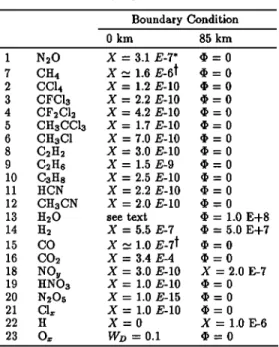
TABLE 2. Species or Family of Species for Which a Continuity Equation is Solved
Boundary Condition 0 km 85 km 1 N20 X = 3.1 E-7* ß = 0
7
CH4
X •_ 1.6 E-6• (• = 0
2 CC14 X = 1.2 E-10 ß = 0 3 CFCI• X = 2.2 E-10 (I) = 0 4 CF•CI• X = 4.2 E-10 (I) = 0 5 CH•CCI• X = 1.7 E-10 (I) = 0 6 CHIC1 X = 7.0 E-10 ß = 0 8 C•H• X = 3.0 E-10 (I) = 0 9 C•H• X = 1.5 E-9 (I) = 0 10 C•Hs X = 2.5 E-10 ß = 0 11 HCN X = 2.2 E-10 (I) = 0 12 CH•CN X = 2.0 E-10 (I) = 0 13 H20 see text (I) = 1.0 E+8 14 H2 X = 5.5 E-7 (I) = 5.0 E+7
15 CO X "- 1.0 E-7• (I) = 0
16 CO2 X = 3.4 E-4 (I) = 0
18 N Oy X = 3.0 E-10 X = 2.0 E-7
19 HNO• X = 1.0 E-10 (I) = 0 20 N•O5 X -- 1.0 E-15 (I) = 0 21 CI• X = 1.0 E-10 (I) = 0
22 H X=0 X=I.0E-6
23 O• Wz) = 0.1 (I) = 0
Adopted boundary conditions are given at the Earth
surface (0 km) and at the mesopause (85 km). X is mixing ratio; (I) is flux (cm -2 s-l). WD is deposition ve- locity (cm s -1. Species in photochemical equilibrium or
whose concentration is derived from a transported fam-
ily are 03, O(3P), O(1D), OH, HO2, CH302, N, NO2,
NO3, HObNOb, C1, C10, HOC1, HC1, and C1ONO•. * Read 3.1 E-7 as 3.1 x 10 -?.
lVariable with latitude.
this component would not improve the validity of the
results.
For the short-lived chemical species with a lifetime shorter than the dynamical time constants, photochemical equilibrium conditions apply and the concentration of
trace gas /is derived
from an algebraic
equation
S'• (Xi)
- O. Table 2 gives a list of the constituents for which acontinuity is solved (and the boundary conditions
imposed
on these species)
as well as of those which are assumed
to
be in photochemical equilibrium. The different reactions
introduced in the model with the related reaction rates
based on the Jet Propulsion Laboratory (JPL) 1985
compilation [DeMote et al., 1985] are given in Tables 3a,
3b, and 3c. The absorption cross sections used for the calculation of the photodissociation coefficients are very similar to the values suggested in the JPL 1985 tables.
Values of the solar irradiance are from Brasseur and Simon
[1981].
In order to avoid mathematically stiff systems due to the large dispersion in the lifetime of the several species, some of the fast-reacting constituents are grouped into more stable families for which a full continuity equation
(20) is solved. In our model, the following families
have been
formed:
O, = Oa + O(3p) + O(•D), NO•
= N + NO + NO2 + 2N205 + NOa + HNOa + HO2NO2 + C1ONO2, and C1, = C1 + C10 + HC1
+ HOC1 + C1ONO2. It should be noted that HNOa
and N205 are also calculated independently from the
NOu family because of their weak coupling with the
other odd nitrogen species, particularly at high latitude and in winter. The water vapor is transported in the stratosphere, but in the troposphere the relative humidity
is prescribed
according
to Cess [1976] and the mixing ratio
of H20 is calculated as a function of the local temperature and pressure. The concentration of the individual fast- reacting species belonging to a given family are derived using relations based on the assumption of photochemical equilibrium.
3. MODEL RESULTS AND DISCUSSION
The model provides a large amount of output for differ- ent times of the year, and therefore only selected results
(primarily for solstice conditions)
will be presented
and
discussed. Additional results will be given in subsequent papers in which specific problems will be considered. 3.1. Radiation and Dynamics
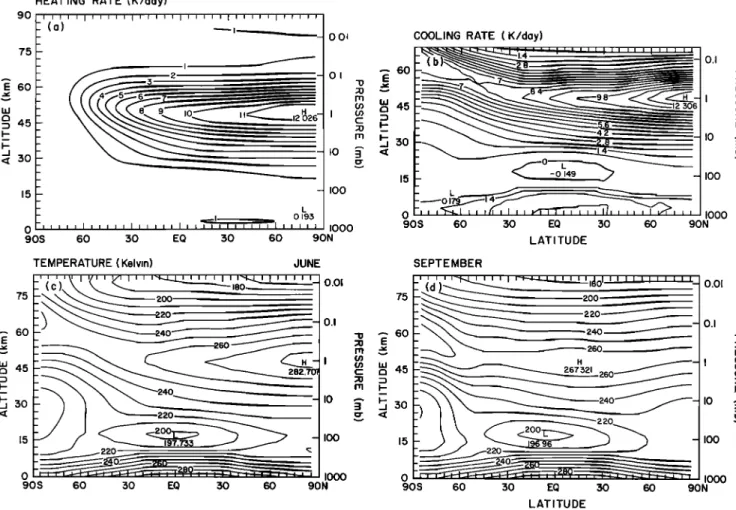
The deposition of energy in the stratosphere arises primarily from the absorption of solar radiation by the
Hartley band of ozone (200-300 nm). The heating rate
peaks near 50 km altitude with a maximum value (12.3
K/day) over the summer pole (see Figure 2a).
At
the equator, the 24 hour averaged heating rate reaches
a maximum value of about 10 K/day. The radiative
heating of the cloudless troposphere is due primarily to the radiative action of water vapor and the corresponding diabatic heating rate in this layer, where strong convective exchanges take place is only of the order of I K/day or less. At present, however, as was indicated earlier, tropospheric temperatures are specified from a climatology compiled by Randel [1987]. The contribution of molecular oxygen, which absorbs ultraviolet radiation at wavelengths shorter than 242 nm, remains smaller than about I
5644 BRASSEUR ET AL.: INTERACTIVE ,XIODEL OF THE MIDDLE ATMOSPHERE
TABLE 3a. Chemical Reactions Included in the Model and Corresponding Rate Constants
Reaction Rate Constant
H + O•+M--+HO• + M O(1D) +H•O•OH + OH H + 03-+02 + OH O(•D) + CH4-+CHs q- OH O(•D) + H•.-•OH + H 0 + OH-+O•. + H OH + O3--+ HO• + O• HO• + O3--+OH + 20• O + HO•--+OH + O• OH+HO•. •H20 + 0•. OH+H2-+H•.O + H H + HO2-+OH + OH H + HO2--+H2 + O• H + HO2-+H20 + O H•. + O-+OH + H NO + HO2-+ NO2 + OH OH + CO•CO•. + H O + NO2--+NO + O•_ O3 + NO--+ NO2 + O2 N + NO--+N2 + O N+O2-+NO + O 03 + NO2-+ NO3 q- 02 HNOs + OH-+H20 + NOs
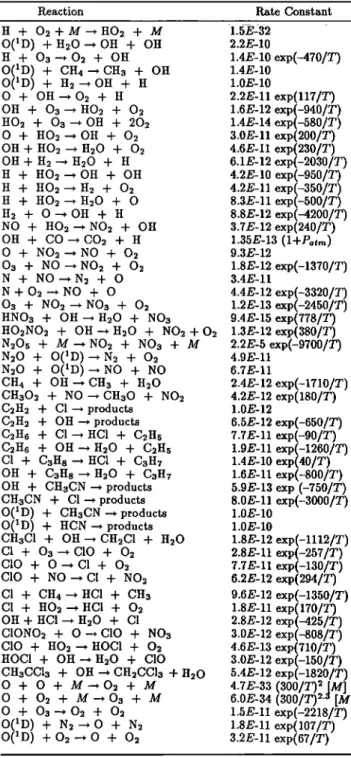
1.5E-32 2.2E-10 1.4E-10 exp(-470/T) 1.4E-10 1.0E-10 2.2E-11 exp(117/T) 1.6E-12 exp(-940/T) 1.4E-14 exp(-580/T) 3.0E-11 exp(200/T) 4.6E-11 exp(230/T) 6.1E-12 exp(-2030/T) 4.2E-10 exp(-950/T) 4.2E-11 exp(-350/T) 8.3E-11 exp(-500/T) 8.8E-12 exp(-4200/T) 3.7E-12 exp(240/T) 1.35E-13 (I+P•,,•) 9.3E-12 1.8E-12 exp(-1370/T) 3.4E-11 4.4E-12 exp(-3320/T) 1.2E-13 exp(-2450/T) 9.4E-15 exp(778/T)
HO2NO2 + OH--, H20 + NO2 + 02 1.3E-12 exp(380/T)
N205 + M--+ NO2 + NOs + M 2.2E-5 exp(-9700/T)
N20 + O(1D)-+N•. + 0•.
N•.O + O(1D)•NO + NO
CH4 q- OH-+ CHs q- H20 CHsO2 + NO-+ CHsO + NO•. C2H2 + C1--+ products C2H2 + OH--+ products C2Ht; + C1 -+ HC1 + C2H5 C2H6 q- OH-+ H20 q- C2H5 CI q- C3H 8 --+ HC1 + Call7 OH q- C3H8 --+ H20 + C3H7 OH q- CHsCN --+ products CHsCN q- C1 --• products O(1D) + CHsCN--, products O(•D) + HCN --+ products CHsC1 + OH-+ CH2C1 + H20 C1 + 03--* ClO + O2 ClO + O-,C1 + O2
ClO + NO-+C1 + NO•.
C1 q- CH4-•HC1 q- CHs C1 + H02--* HC1 + 02 OH + He1 --+ H20 + C1 C1ONO2 q- O--+ C10 q- NOs ClO + HO2-,HOC1 + 02 HOCI q- OH-•H20 q- ClO
CHsCCls q- OH--, CH2CCls q-H20 0 + 0 + M•02 + M 0 + 02 + M•03 + M O + O3->O2 + 02 O(1D) + N2--+O + N2 O(1D) +02 •0 + 02 4.9E-11 6.7E-11 2.4E-12 exp(-1710/T) 4.2E-12 exp(180/T) 1.0E-12 6.5E-12 exp(-650/T) 7.7E-11 exp(-90/T) 1.9E-11 exp(-1260/T) 1.4E-10 exp(40/T) 1.6E-11 exp(-S00/T) 5.9E-13 exp (-750/T) 8.0E-11 exp(-3000/T) 1.0E-10 1.0E-10 1.8E-12 exp(-1112/T) 2.8E-11 exp(-257/T) 7.7E-11 exp(-130/T) 6.2E-12 exp(294/T) 9.6E-12 exp(-1350/T) 1.8E-11 exp(170/T) 2.8E-12 exp(-425/T) 3.0E-12 exp(-808/T) 4.6E-13 exp(710/T) 3.0E-12 exp(-150/T) 5.4E-12 exp(-1820/T)
4.7E-33
(300/T)_
2
6.0E-34 (300/T) TM [M] 1.5E-11 exp(-2218/T) 1.8E-11 exp(107/T) 3.2E-11 exp(67/T) E-11 corresponds to 10 -ll. T is the temperature (K), [M] isthe atmospheric
density
(cm-S),
Paur,
is the pressure
expressed
in
atmosphere.K/day below the mesopause, although this constituent is the largest contributor to solar heating in the upper
mesosphere. The cooling (Figure 2b) resulting from
the emission of infrared radiation by carbon dioxide, ozone, and water vapor is nearly in balance with the solar heating in the illuminated part of the atmosphere. In these regions the temperatures calculated by the model are similar to radiative equilibrium conditions. In the polar region during winter, when no solar light is
available, the cooling (of as much as 7 K/day at 60-
TABLE 3b. Three-Body Reaction With the Following Expressions
for Their Rate Constant k (cm 3 s -1)
Rate Exponent
NOs + NO2 + M -, N205 + M t• o .300 2.2 E-30 naooøø = 1.0 E-12 NO2 + OH + M -• HNOs + M .s00 = 2.6 E-30
•0 = 2.4 E-11 NO2 + HO2 + M -• HO2NO2 + M t% .300 = 2.3 E-31 o
•soo = 4.2 E-12
CIO + NO2 + M --• C1ONO2 + M naoøø = 1.8 E-31
•soo = 1.5 E-11 n=2.8 m=0 n=2.9 rn = 1.3 n=4.6 m=O n=3.4 m=1.9
The rate constant is derived by k = [t%[M]/(1 + t•o [M]/•oo)]
ß 300
0.6
{•+[•ø•ø(•ø[M]/•=)]•}-•
with •:o
= .3oo
•o(T/300)-" and
• = •
(T/300) -•.km altitude) is counterbalanced
by compressional
heating
through substantial downward motion of air. In the lower stratosphere, where the radiative time constant is larger than 10 days, the meridional circulation plays a dominant role in establishing the temperature distribution.
The meridional distribution of the temperature obtained by solving the thermodynamic equation, in which radia- tive transfer and heat transport are included explicitly, is shown in Figure 2c for June conditions. The stratopause maximum near 50-km altitude reaches a value of nearly 284 K over the summer pole but gradually decreases to- ward the winter pole. In the mesosphere the latitudinal gradient in the temperature is reversed as a consequence of momentum drag by gravity waves. The temperature at the mesopause is of the order of 170 K over the sum- mer pole and 220 K over the winter pole. With the adopted boundary conditions, a temperature minimum of about 205 K is derived at the tropopause over the tropics. There are differences between the two hemispheres for the
TABLE 3c. Photochemical Reactions Included in the Model Reaction s(o,) s'(o,) 7(o3) s'(oa) S(H,O) S(NO) S(CO,) S(CH4) S(NO) J(HNOs) J(CF2C12) J(CFC13) J(CC14) J(ItOCl) J(CH3CC13) J(HO2NO2) S(CHC0 S(C•ONO•) S(N•O•) S(NO) 02 q- hv --• o(sr) q- O(SP) 02 q- hv --+ O(1D) q- O(sP) Os + h•, --+ O(S_P) + 02 03+h•'•O(•D)+02 H20 + h•, --+ OH + H N20 + h•, --+ N2 + O(•D) CO2 +h•,•CO+O CH4 + h•, --+ products NO2 + hy --+ NO + O(3p) fiNOs + h• -• NO2 + OH CF2C12 q- h•, --, CF2CI q- C1 CFCIs + ht, -• CFC12 + C1 CC14 + h•, --+ CCls + C1 HOG1 + h•, --+ C10 + H CHsCCIs + h•, • CHsCC12 + C1 HO2NO2 + h•, -• NO2 + HO2 CHsC1 + hy -• CHs + C1 ClONO2 + h•, --+ NOs + C1 N205 + h•, --+ NO2 q- NOs NO + h•,--+ N + O
BRA$$gUR BT AL ß INTER. ACTIVE MODBL OF THB MIDDLE ATMOSPHERB 5645 9O 75 E 60 :::) 45 <• 30
HEATING RATE (K/day)
I I I I I J I I I I I J I I I I I J I I I I I J I I I I I J I I I I I a '--""-- I -•---.-.-.-...• _ _ _ - I o 9os -,tlilllliilllliillll•,,l,,•,,li,iil I000 60 30 EQ 30 60 90N
O.Ot COOLING RATE (K/day)
O.I
5
ß
.._.,
•0•---'-••
-0.149 JO0'"
. 1
'øø
o
....
ooo
eos eON
TEMPERATURE (Kelvin) JUNE
/ • • • •V I I/I I I/,q I • I I--I-...I.•k• III I I I r'-,• i i I i I/
• (c) • ••
•,•o•
• o.ol
260 I/
_,oo
/,ooo
90 S 60 30 EQ 30 60 90 N.• 60 •
30
75ß
'o -• 60
c: c3 45 i1-1 I- LATITUDE SEPTEMBER i240 • 0.01 0.1 •220 x • •oo•-__•• •o r-•
,, qs?,,,
•/iooo
90S 60 30 EQ 3,0 60 90N LATITUDEFig. 2. Meridional distribution of (a) the solar heating rate and (b) the infrared cooling rate expressed in Kelvins
per day (June
conditions),
and
meridional
distribution
of the zonally
averaged
temperature
(expressed
in Kelvins),
(c) in June
and (d) in September.
Contour
intervals:
1 K/day (Figure
2a), 0.7 K/day (Figure
2b),
and 10 K (Figures
2c and 2d).
same season, those being direct consequences of the lati- tudinal asymmetry in the specified dynamical conditions at the 15-km boundary. For example, the temperature in
the lower stratosphere
(20 km) is of the order of 185-
190 K over Antarctica in September (Figure 2d) but is
nearly 10 K warmer over the Arctic 6 months later. This difference between the two hemispheres is consistent with climatologicM data and explains the more frequent pres- ence and the different nature of polar stratospheric clouds
in winter over Antarctica than over the Arctic.
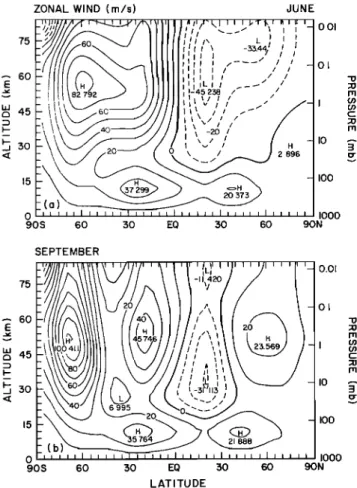
The zonal wind, in gradient balance with the tempera- ture, is shown for June and September in Figures 3a and 3b. For solstice conditions, the westerly wind in the south-
ern hemisphere
(winter) reaches
a velocity of 90 m/s near
the stratopause
at 60
ø. In the northern
hemisphere
(sum-
mer) the easterly winds are a factor of 2 weaker (about
40 m/s in the upper stratosphere
and in the mesosphere).
In September the model produces a strong polar vortex in the southern hemisphere with a maximum wind velocity
of 100 m/s near the stratopause between 600 and 700 lat-
itude. A substantially weaker stratospheric jet is found 6
months later in the springtime
northern hemisphere
(not
shown)
with maximum wind speed
of 88 m/s.
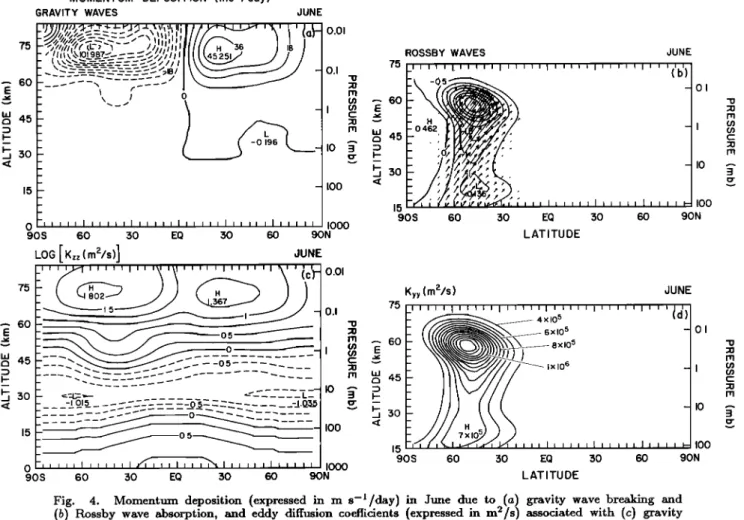
The momentum sources from gravity and Rossby wave
absorption are shown in Figures 4a and 4b, respectively.
A large easterly
torque
of more than 100 m s-i/day is
derived in the winter mesosphere, while a westerly drag
of up to 50 m s -z/day is calculated
in the summer
meso-
sphere, as a result of gravity wave breaking. Momen- tum deposition due to Rossby waves is produced only in the winter hemisphere since the upward propagation of these waves requires the presence of westerly winds. TheEliassen-Palm
flux, which is shown by the arrows in Fig-
ure 4b, is directed upward and toward the equator. The torque associated with Rossby wave absorption is for this
particular
case
in the range 0.5 to 6 m s-l/day in the
latitudinal band of 300 to 600 . The eddy diffusion coef-
ficients used in the transport scheme of the model and
derived from the parameterization
of wave breaking are
shown for June conditions in Figures 4c and 4d. The
vertical eddy diffusivity, as derived from the gravity wave
formulation,
is characterized
by a strong vertical gradient
in the stratosphere. Kzz coefficients of the order of 1 to
70 m2/s are calculated
above
the stratopause,
with the
highest values above the westerly jet core. In the lower stratosphere, below the breaking level of the waves, small
background
values
of the order of 0.1 m2/s are adopted.
In the troposphere, where rapid vertical mixing occurs,
values
of the order of 5-10 m2/s are specified
with a
variation in latitude to account for the varying height of the tropopause. The meridional diffusivity associated with planetary wave absorption for the particular case shown
in Figure 4d reaches values of the order of (0.5-2.0) x
106 m2/s at mid-latitude.
In the summer
hemisphere,
5646 BRASSEUR ET AL.: INTERACTIVE MODEL OF THE MIDDLE ATMOSPHERE
ZONAL WIND m/s) JUNE
._
h'/•i,?ll//r
•
7•' ¾1'1' •__ , , - o.o,
Vii/If/ • • • I/1/I I• • f-•- / • - 0.1I000
90 S 60 50 EO 50 60 90N SEPTEMBER
' i" p,' , ';' "Y" ' "
oo,
/• 0.1
0
90S 60 50 EO 50 60 90N
LATITUDE
Fig. 3. Meridional distribution of the zonal wind (expressed in
meters per second), (a) in June and (b) in September. Contour
intervals: 10 m/s.
where no planetary waves
penetrate,
a background
value
of 3 x 10
5 m2/s is adopted
to account
for subgrid
mixing
processes.
Finally, the transformed
mean Eulerian meridional
cir-
culation,
driven by momentum
drag associated
with grav-
ity and planetary
wave dissipation,
is shown
in Figures
5a
and 5b for June and September. The two stratosphericcells affecting
the temperature
and the density of trace
gases
in both hemispheres
are clearly
visible.
Because
the
boundary conditions
on the stream function specified
at
15 km are not symmetric on each side of the equator, the flow in the northern hemisphere tends to transport
mass and energy all the way to the pole in the northern
hemisphere
while it reaches
only a region
near 600-700
latitude in the southern hemisphere. An important con-sequence
of this hemispheric
difference
is that the model
diagnoses
the Antarctic region to be closer to radiative
equilibrium conditions
in winter than the Arctic during
the same season. Because polar night temperatures over Antarctica are relatively cold, radiative cooling in this
region is small. The net heating becomes
transitorily pos-
itive and reaches
about 0.3 K/day near 30-km altitude, as
the Sun returns over Antarctica in late winter. Since the
vertical velocity specified at 15 km as boundary condition
is zero over the region of the South Pole (see Figure 1),
the model therefore predicts some upwelling during this short transition period but its strength, which is not large
enough to deplete ozone significantly,
is highly dependent
on the ozone density in the lower polar stratosphere. This
upward flow will be substantially reduced and even sup-
pressed if ozone gets destroyed by chemical processes in
late winter or early spring, as has been observed since the
late 1970s (Furman et al. [1985] and others; see Solomon.
[•988] or Brasseur
et al., [1988a1
for a review). A more
refined analysis of the dynamical conditions in the polar re•ions in winter and sprin• requires a three-dimension• study describin• exchanges between the troposphere and the stratosphere and accountin• for the full interactions between chemistry, radiation, and dynamics. The present twodimensional model, however, is capable of describing the net meridional transport in some det•l and accounts for hemispheric differences in the tropospheric forcing of stratospheric dynamics.
3.œ. Chemistry
The distribution of selected trace constituents will now
be presented with the purpose of validating the model formulation. Figures 6a and 6b present the calculated
distributions of nitrous oxide and methane for June con-
ditions. In both cases the Hadley cell, through which these gases are transported from the troposphere into the stratosphere, produces the high mixing ratios over the tropics in the stratosphere. The meridionM slope of the isomixing ratio contours between 15- and 40-km altitude results from the opposing action of the meridionM circu-
lation (which tends to enhance the latitudinal gradients)
and eddy diffusion (which tends to mix the trace gases
along the quasi-horizontal
isentropes) [see Holton, 1981].
SeasohM variations in the mixing ratio, driven by the Sun, can be seen in the upper stratosphere and meso- sphere, where the photochemical time constant is smaller than the characteristic timescale for transport. Hence the effect of the chemistry is most pronounced in the summer hemisphere and is stronger for N20 than for CH4 as a re- sult of the photochemical lifetime's being 10 times larger for CH4 than for N20 at 60 km and 60øN in June. The decrease with Mtitude of the mixing ratio in the meso- sphere is reduced by vertical mixing resulting from gravity wave breaking. Since in our model, vertical eddy diffusiv- ity is strongest near the core of the stratospheric jets and is substantially weaker in the tropics, a weak double peak
structure appears occasionally in the meridional distribu-
tion of the source gases. Such a structure, to be compa-
rable to the global observations
of the stratospheric
and
mesospheric
sounder
(SAMS) instrument
[Jones
and Pyle,
1984], requires the presence
of an additional momentum
source located in the tropics. Gray and Pyle [1986] have
attributed such a source to the absorption in the strato- sphere of Kelvin waves. Finally, the distribution of the
source gases in the mesosphere depends on the strength
of the meridional circulation, which is directed from the summer to the winter hemisphere. The strength of this cell is determined by the momentum deposition of gravity waves in the mesosphere and upper stratosphere.
The distribution of water vapor in the middle atmo- sphere is shown in Figure 7a. In the lower stratosphere, where H20 is a purely conservative tracer, the slope of the mixing ratio lines is determined by the strength of the meridional flow. Clearly, the model underpredicts the mixing ratio of water vapor at high latitudes. A rea- son for the discrepancy between calculated and observed distributions could be an improper representation of trans-
75 --- 6O E • 4,5 _j $0 75 --- 6O E _j $0 o 9os o 9os 60 30 EQ 30 60 90N
LOG
[Kzz
(mZ/s)]
JUNE
' ' ' '
' ' ' ' ' I ' ' ' ' • I ' ' '' ' I ' ' • ' ' I ' ' iCW
-o.,
_- -
- - ...
- ....
I •---L---
-I 015 ....•
•---•-- 'T .•-_0.5- •--• ...'-•--•
_-J.Q3_•L
--
IO
Ii,-,-,
60 :50 EQ 30 60_
_
_
MOMENTUM DEPOSITION (ms-•/doy)
GRAVITY WAVES JUNE
"._•,.•J..I".,J•-L•,\I'•II,|I•IIJJ I,/-"1'""'!•_1 I • I•L I I I / I/
:
o.o,
//7////,/r(L-• -• /////111'lll[/ H 5• / 18 I /I
_ _ _ _ - _ _ _ - _ -- _ ß '• HIoo
<
'
'
90S 60 :30 EQ I000 0.01 ivvv 90NROSSBY WAVES JUNE
75 _•
• • [ • i • • • • • I • t t [ • I t • • • • I • • • • • I • • •(•b
•)
_ -I ß LI II II III II III II I1 I I I 1• $0 6o 90N LATITUDE 75 15 90SKyy
(mZ/s)
JUNE
_ Illlllll]111111111
••
4x,o
5
IIIIIIIII
III I Ill
d:
x IO 6 I
60 :30 EQ :30 60 90N
LATITUDE
Fig. 4. Momentum
deposition
(expressed
in m s -l/day) in June due to (a) gravity wave breaking
and
(b) Rossby
wave
absorption,
and eddy diffusion
coefficients
(expressed
in m2/s) associated
with (c) gravity
wave breaking and (d) Rossby wave absorption. The vectors in Figure 4b are proportional to the Eliassen-
Palm flux (maximum
vector length, 2.7 x 10⁸ kg m -1 s-2). Note in the case of Figure 4c that the
diffusivity is represented by its decimal logarithm and that the specified tropospheric values are also represented.
Contou•
intervals:
9 m s -•/day (Figure
4a), 0.5 m s -•/day (Figure
4b), 0.25 (Figure
4c), and 1 x 10⁵ m2/s
(Figure 4d). 0.1 100 0.1 100 "13 :;13 C:: :;13
MERIDIONAL CIRCULATION JUNE LOG (N20 M,xing Rat,o) JUNE
75 /I I I I I I I I I I I/ I I I\1 ',1 •d,-'l--I--.I-..l_.] r'-I i',,I
I- .-_ ... _a•... x •.. • • x• •xx,•xxx x "--I U.UI 0.1 I- --- • • • " "r•r• '" -104 x x •. • •. i
.... F ..-
..--•,-...-.:--__--.:..-..-...;-1o.• •
/ -- .- --' -" "'- • ---...'--..•. .. x \ \ x I15
I00
15
I00
90S 60 :30 EQ :30 60 90N ioooLOG (CH 4 Mixtng Ratio) JUNE
I_l
I I I I r,.11
•_i---i-.i
'----i r--I..l•l•l•E•-I-_t:l--_l_-_[--_l:l_-•_l-q•l•l•l•fi
'--.-:• ... ---•-- 0.01..-..
75
...
,-_._t-:----•:=t:.:t--:t:--_/
'-" ( -• \ ::::El LU 60 --x m - \ \ (J') - \ I / -- -- _. x % /" -•--- I C45 - /
/ / / "'"
- -- '""'"
'• • '•'"
'"
• -½479 m
<•
:_-%S;..-;.--_
....
so_---"-L--"j•-•
a
:30_
IO •
_15 -I--I-I;-•--I'•"['•
• • I I I •1•
•1 •tt •F-Im-•-•-•--r-
I00
9()S 60 :30 EQ :30 60 90N
LATITUDE
Fig. 6. Meridional distribution (June conditions) of the zonally
averaged mixing ratio of (a) nitrous oxide and (b) methane.
Contour intervals: 0.2.
90S 60 30 EQ 30 60 90N LATITUDE
Fig. 5. Stream function of the transformed Eulerian mean merid-
ional circulation in (a) June and (b) September.
o 90 s 60 30 EQ 30 60 90N SEPTEMBER

![Fig. 9. Meridional distribution (June conditions) of œ]te zonally averaged f-x production rate of • o• rdtrogen (expressed in molecules per cubic centimeter per second), (b) mixing ratio of NOy (expressed in parts per billion by volume), (c](https://thumb-eu.123doks.com/thumbv2/123doknet/14710838.567511/12.891.73.820.81.517/meridional-distribution-conditions-production-expressed-molecules-centimeter-expressed.webp)