HAL Id: halshs-00645133
https://halshs.archives-ouvertes.fr/halshs-00645133
Submitted on 28 Nov 2011HAL is a multi-disciplinary open access archive for the deposit and dissemination of sci-entific research documents, whether they are pub-lished or not. The documents may come from teaching and research institutions in France or abroad, or from public or private research centers.
L’archive ouverte pluridisciplinaire HAL, est destinée au dépôt et à la diffusion de documents scientifiques de niveau recherche, publiés ou non, émanant des établissements d’enseignement et de recherche français ou étrangers, des laboratoires publics ou privés.
Bernard Caron
To cite this version:
Bernard Caron. Number in South-Bauchi-West Languages. Number in Africa and Beyond: Grammar, Semantics and Social Deixis., Sep 2011, Cologne, Germany. �halshs-00645133�
N
UMBER IN
S
OUTH
-B
AUCHI
-W
EST
LANGUAGES
B.
CARON
*The 27 or so lects grouped into the SBW sub-group of Chadic languages are spoken in the South of the Bauchi State (Nigeria) stretching from Bauchi to the south of the state over less than 100 kms. Among them, only Zaar is relatively less unknown (Caron 2002a, 2002b ; Schneeberg 1971, 1974) and is often used to characterise the whole SBW group.
SOUTH BAUCHI EAST 1 - Boghom 2 – Kir 3 – Tala 4 – Guruntum SOUTH BAUCHI WEST
5 – Geji 6 – Polci 7 - Zeem 8 – Dass 9 - Saya
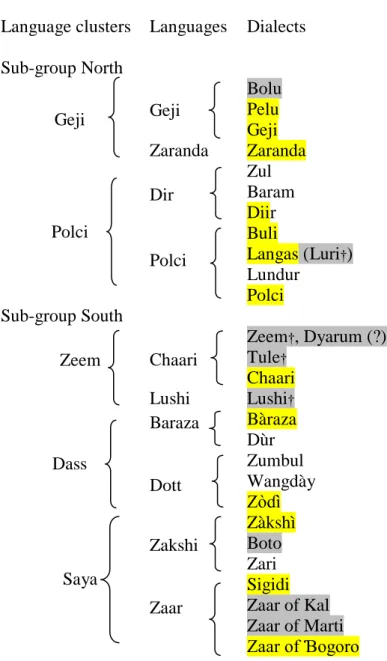
The comparison of the basic vocabulary of SBW languages proves their genetic relationship, and it has enabled Shimizu to propose the following classification:
Table 1. SBW Classification1
Language clusters Languages Dialects
Sub-group North
Geji
Geji
Bolu
Pelu
Geji
Zaranda
Zaranda
Polci
Dir
Zul
Baram
Diir
Polci
Buli
Langas (Luri
†)
Lundur
Polci
Sub-group South
Zeem
Chaari
Zeem
†, Dyarum (?)
Tule
†Chaari
Lushi
Lushi
†Dass
Baraza
Bàraza
Dùr
Dott
Zumbul
Wangdày
Zòɗì
Saya
Zakshi
Zàkshì
Boto
Zari
Zaar
Sigidi
Zaar of Kal
Zaar of Marti
Zaar of Ɓogoro
However, various elements tend to set the Zaar language (Sigidi and Zaar proper) apart:
1. From a socio-linguistic and historical point of view: the name Ɓaaraawaa used by Shimizu (78) and Cosper (89) to name the group is not
acknowledged by the Zaar (Sayawa) and Gùùs (Sigidi) people. If all the
Ɓaaraawaa agree to be closely related and all originate from the same area,
viz. the Buli and Zaranda hills near Bauchi, the Zaars say they came from Bornu through Zaria; they say they settled in the hills South of Tafawa Balewa after some cohabitation with the Angas, Pyem and Jarawa.
1
After Shimizu 1978, p. 13. I have named the languages (which are just numbered by Shimizu) after the best known dialects. The languages whose name is highlighted in yellow are referred to in the text. Those in grey have been surveyed but are not mentioned in the text. Luri, Zeem, Tule and Lushi are now extinct. Dyarum (Zeem cluster) is mentioned by Blench as almost extinct.
2. Zaar and Gùùs have a very elaborate and profusive TAM system when compared to the other languages.
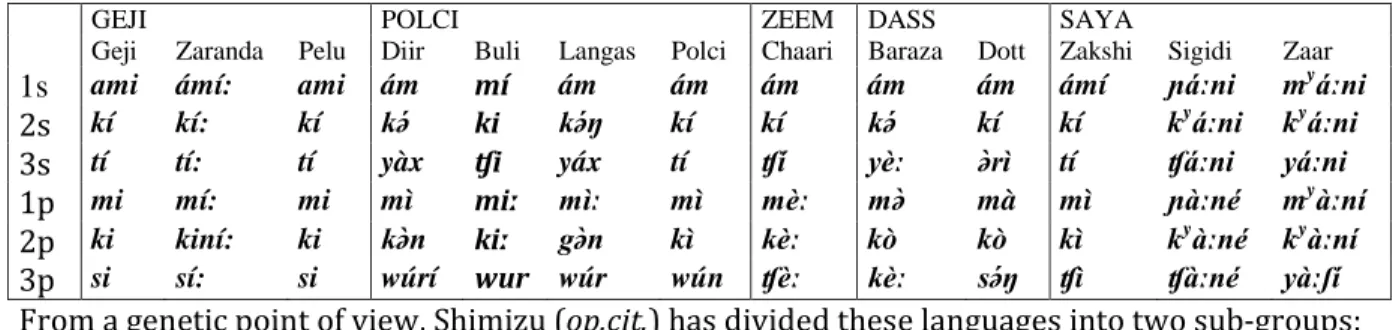
SBW languages have lost the gender, inclusive/exclusive and dual markers which characterise Afro-Asiatic languages. The remaining singular/plural number opposition is apparent in the paradigms of independent pronouns.
Table 2. SBW Independent Pronouns
GEJI POLCI ZEEM DASS SAYA
Geji Zaranda Pelu Diir Buli Langas Polci Chaari Baraza Dott Zakshi Sigidi Zaar 1s ami ámí: ami ám mí ám ám ám ám ám ámí ɲáːni myáːni
2s kí kí: kí ki kí kí kí kí kyáːni kyáːni
3s tí tí: tí yàx ʧi yáx tí ʧí yèː tí ʧáːni yáːni
1p mi mí: mi mì miː m ː mì mèː m mà mì ɲàːné myàːní
2p ki kiní: ki n kiː n kì èː kò kò kì kyàːné kyàːní
3p si sí: si wúrí wur wúr wún ʧèː èː ʧì ʧàːné yàːʃí
From a genetic point of view, Shimizu (op.cit.) has divided these languages into two sub-groups: the North sub-group (Geji and Polci) and the South sub-group (Zeem, Dass and Saya). The same division is observed if we examine the exponents of plurality in SBW languages.
Common SBW does not possess grammatical gender or nominal classes and as a rule, few nouns form a plural (morpho-lexical plural)2. The plural inside the NP is expressed through the noun
modifiers. There is no agreement between the verb and its arguments3. However, plurality
appears in the verb phrase in two places: (i) the formation of the imperatives (ii) a verbal derivation forming what has come to be called, since Newman 1990, ‘pluractionals’. The South sub-group (Zeem, Dass, Saya) differs in that it has developed a set of noun plurals through the use of various morphological devices, but most commonly, a –(Vn)sə suffix.
In this paper, we will present first the situation of noun plurals in the northern sub-group (Geji, Polci) which we will then contrast with the situation in the southern sub-group (Zeem, Dass, Saya). Then we will present the situation of verbal plurals. Finally, as a bonus, we will examine the case of number in 2nd person.
2 In this presentation, we will ignore the Hausa lexemes borrowed with their original Hausa plural, e.g. in
Zaar:
singular plural animal dabbà dabboːb
car móːta moːtoːʧi
soldiers oːʤoːʤi
book tágàrda tàgàrdu
I.
N
OUN PLURALS IN THE NORTHERN SUB
-
GROUP
A.
N
OUNP
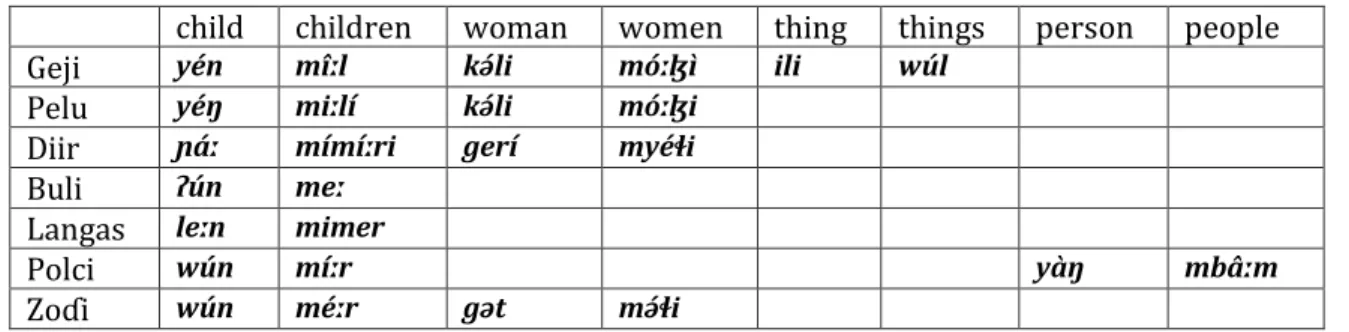
LURALSApart from one case of plural formed by suffixation with the suffix –aːsə n (Geji bukaːsə n, ‘parent’, sg. Buk), noun plurals are represented by very few suppletive plurals, generally limited to ‘child’ and ‘woman’. Table1 below lists all the noun plurals found in the sub-group. Zoɗi, although it belongs to the southern sub-group, appears in this summary as it behaves like the northern sub-group of SBW languages.
Table 3: Noun Plurals in the Northern SBW sub-group
child children woman women thing things person people
Geji yén mîːl kə li móːɮì ili wúl
Pelu yéŋ miːlí kə li móːɮi
Diir ɲáː mímíːri gerí myéɬi
Buli ʔún meː
Langas leːn mimer
Polci wún míːr yàŋ mbâːm
Zoɗi wún méːr gət mə ɬi
B.
M
ODIFIERSPlurality is otherwise expressed by the noun modifiers, while the head noun remains invariable. In the nominal system, plurality is marked in the indefinite, in demonstratives, relative
pronouns, and in the pronominal system. NB: adjectives have no plural form in these languages. We will show a few examples taken from Zoɗi, a member of the Dass cluster.
1.
INDEFINITE DETERMINERThe indefinite determiner, translated as some/other(s) is ələ m for the singular and ilə m for the plural.
ɗiː ma b n m m ndi
NEG.PERF 1P know thing some.SG NEG
We don’t know anything.
bukáː mbə rti ilə m
after day some.PL
after a few days
2.
DEMONSTRATIVESZoɗi demonstratives are sensitive to number:
proximal distal
Adverbs woní here wéj there
Determinants sg (ɬáː) oní this (cow) (ɬáː) wej that (cow) pl (ɬáː) ʤoní these (cows) (ɬáː) ʤwej those (cows) Pronouns sg goní this one gwej that one
3. G
ENITIVE LINK(G
EJI)
The genitive link (s.) / ʤ (pl.), ‘of’ is optional and incompatible with [-human] possessors (in a broad sense). It appears in the structure <SN1 /ʤ SN2>, <the SN1 of SN2>, where SN2 stands
for a [+human] possessor . It is sensitive to number, manifesting the number of SN1.
puka puka ʤì
knife of Audu knife of.PL Audu
Audu’s knife. Audu’s knifes.
The same genitive link manifests itself in possessive pronouns, manifesting the number of the possessed: Gen. Pro sg. pl. 1s gi:ni ʤi:ni 2s gwa: ʤwa: 3s gwa:si ʤwa: i 1p n n ʤin n 2p wa: n ʤwa: n 3p wa: n ʤwa: n
4.
RELATIVE CONSTRUCTION(Z
OƊI)
The relative pronouns are gu for singular and wú ʤu for plural head nouns.
toː séj kon wún-i pi m gu a ndá -ti
well then male boy-DEF do thing REL cont want-VN
Well, then the boy did the thing that he wanted.
II.
N
OUN PLURALS IN THE SOUTHERN SUB
-
GROUP
A. N
OUN PLURALSSome traces of the suppletive plurals of the north sub-group can be found in the Zeem and Saya clusters of the southern sub-group:
child children woman women Chaari na ː mímyéːrə kə l mə ɮì
Guus ŋǎːŋ miméːr
Zaar ŋáː məːri
However, a much larger group of complex noun plurals4 have developed in these languages,
using suffixation and other morphological devices.
4 The complexity of these plurals parallels what is well known for Hausa and other Chadic languages. Cf.
Newman (1990).
séj méː m ɬ wú ʤu t pat máni
then children girl REL.PL 3P.AOR take man
ɗiː t do a ndi
NEG.PERF 3P.AOR return 3P.ICP PERF NEG
1. S
AYA(S
IGIDI)
Our survey of the Sigidi lexicon has yielded 235 verbs, 15 adjectives, 527 singular nouns and 267 plural nouns. Two classes of plural can be distinguished:
Regular plurals use suffixes. The most common is frequently combined with lengthening of a radical vowel, plus some other morphonological changes (apophony, restitution of
etymological consonants, etc.).
-s pl.suff. sg. pl. pumpkin ɓò á ɓò àː cloud ɓ ːn ɓ ːn groundnut dàl dà shrew ʤaːɓa ʤàːɓàː stone ɗàːj ɗàː
Nouns finishing in or replace these with a -ees suffix:
Other plurals, limited in number, display different types of vowel lengthening and apophony :
apophony sg. pl. iguana d d èː worm ɓ ɓèː wife d uːd baboon u áːn lizard ɓ ɓ òːn squirrel ɮàʧ ɮ tàːj bone ɮe a ɮi aːj broom vot vwaːt
kinship terms: ʤ è = grand-fathers ; ʤíː a = grand-children ; áːw = uncles, etc.).
2. S
AYA(Z
AAR)
Our survey of the Zaar lexicon has yielded 578 verbs, 52 adjectives, 1479 singular nouns and 50 plural nouns. Regular plurals are formed with the suffix –s 5, and its variants -ʃi, -tsə, -Vnsə associated to various tone patterns.
sg. pl. head gàm gàm(t)s
hen gèri gers
dog káɗì kaɗa
mouse mbâp mbapts
chief u
vulture kwáɗâk kwaɗaks
viper ʤ uː í ʤi uː ín
5 In the Marti dialect of Zaar, the suffix is –sá, i.e. kansá (from kǎn, uncle), vs kansə in the Ɓogoro dialect.
-eː pl.suff. sg. pl. locust-bean ɓ ɬ ɓ ɬ eː thorn ʤ b ʤ b è : leaves wa ɗ wà ɗèː
The irregularities are proportionally quite numerous: sg. pl. woman g t guɗi arrow pîs piská guest s m s md sheep t m timsá
As in Sigidi, a good number of family nouns form a pseudo-plural with a –(k)t [-ɣtə] suffix and MH tones:
sg. pl. in-law ʤìt ʤiɗ kt
cousin úndàː kundakt
mother naː nakt
sister waːt watsakt
brother jês jest
3. C
HAARIOur survey of the Chaari lexicon has yielded 190 verbs, 19 adverbs, 25 adjectives, 693 singular nouns and 56 plural nouns. The basic plural suffix is –Vːsə / -Vːʃi /-nsə / -nʃi, combined with various other processes, where V: stands for the lengthening of the final lexical vowel.
sg. pl. pot sp. dàkà dá áː hut ɗàwkè ɗàw èː dog kàɗ káɗíːʃí hyena vúlì vúl ns bone ɲìs ɲís ns tooth ʃy èːn ʃy éːn nʃí king l k l k nʃí
Final /i/ and /ə/ in the singular exhibit various degrees of apophony:
sg. pl. water spring àː áː íː hut byèːn byéːnéː
old man kwàrí wà ː
basket d rʃí d rʃyèː
Two nouns use an –aːsə suffix:
sg. pl.
pot sp. ʤá á ʤá á áː
arm táwò tàwàː
4. S
EMANTIC FIELDS OF NOUN PLURALSIn Zaar, noun plurals relate to [+animate] terms, e.g. humans and animals. In Sigidi and Chaari, where the number of plurals is proportionally more important than in Zaar, no specific semantic field seems to be predominant, and both animate and inanimate terms have a plural form. This may be due to the fact that the survey of Chaari and Sigidi was done over a couple of weeks, and was strictly morphological, whereas the work on Zaar has been going on for 20 years, and has been more thorough and extensive. During a morphological survey, speakers can produce morphologically sound plurals, by applying processes mechanically, while the resulting plurals
would hardly be used by a speaker. I suspect this was the case during the survey of Sigidi and Chaari, and the lexicon gathered in Zaar has a good chance of reflecting the way the Saya languages work as a whole, from a cognitive point of view.
B. M
ODIFIERSContrary to the Northern sub-group, the languages of the Southern sub-group vary as regards plural agreement in their determiner, whether indefinite or demonstrative. Let us take our examples from Sigidi and Zaar, two members of the Saya cluster:
1. I
NDEFINITE DETERMINERIn Zaar, the indefinite gón does not vary with the number of the head noun it modifies. : za :r
gón (a man) ; zàːrsə gón (some people)
In Sigidi, the indefinite determiner (some/other(s))is gón for the singular, gján for the plural:
kùn ón / mimíːri ján, ‘a boy/some boys’.
2. D
EMONSTRATIVESThe two Zaar demonstratives are: proximal gə n, ‘this’ and distal íː ‘that’, used both with the plural and the definite form of the singular: zàrsə gə n/ íː, these/those people zaːr-i gə n/ íː, this/that man.
The two Sigidi demonstratives are: proximal gwíni, ‘this’ (pl. gíni, ‘these’) ; distal gwa gə gwi, ‘that’ (pl. gja gə gi, ‘those): zaːr wíni/ wa ə gwi, ‘this/that man’ ; zàːrsə gíni/gwà gə gwi, (these/those men).
3. R
ELATIVE CONSTRUCTIONThe relative construction in Zaar uses an invariable relativizer, ɗan, wich does not agree with the pivot noun. Only the resumptive pronoun agrees in number with a [+human] antecedent.
mur-íː / zàrsə íː ɗam mə jél=tə/ʃí [...]
man-PROX / people PROX rel 1sg.aor see=3sg/3pl.acc This man / those people that I saw...
4. A
DJECTIVESContrary to what obtains in the Northern sub-group, the adjectives have a singular and a plural form that agrees with the head noun. Morphologically, adjectives are a "nouny" category. They cannot be combined to a negative marker nor to a comparative morpheme. They have a plural and a definite form. When these two affixes are combined, four forms can be obtained. Let's take the adjective 'evil' as an example:
lexical definite singular kúsk úːʃi
plural u ú u ú ʃi
They draw their number feature by agreement with the noun they modify. When they operate as noun modifiers, adjectives can be simply juxtaposed on the left of the noun : <Adj N> or appear on the right and are introduced by genitive link : <N=k Adj>. The GL structure is not used with plural adjectives.
d ll ʃir ndu ú ʃa ndí lât k muː i
big stick short(-legged) pots new leather
When they operate as predicates, adjectives use the PTCL.PRED n , and optionally the verb ji, 'be' :
modifier predicate singular kúsk zaː
an evil man D. n úːʃi D. is evil plural u ú zàrs
evil people zàrs ʧì
6
n u ú ʃi
people are evil
III.
V
ERBAL PLURALITY IN
SBW
Verb/Subject agreement in SBW languages is limited to the Imperative, with an opposition between singular and plural addressees. Another phenomenon is the presence of a derivation well-known in Chadic languages, producing what has been named ‘pluractional verbs’ by Paul Newman (Newman 1990).
A. T
HEI
MPERATIVE PLURAL1. G
EJI(G
EJI)
The imperative is characterized by a specific tone pattern replacing the lexical tone pattern of the verb: M* for verbs beginning with an initial depressor consonant (D verbs) and HH(M) otherwise (T verbs)7. Direct object pronouns and directional adverbial particle (i.e. ka, ‘away’)
are cliticized to the verb, and included in the Imperative tone pattern.
The plural is formed with a –n suffix. An epenthetic /ə/ is added to verbs ending in a final consonant. When the verb finishes in a vowel, the nasal consonant disappears, but the nasal feature remains on the vowel, which results in lengthening and nasalization of the vowel.
Geji Singular Imperative Plural Imperative
wipe ɬok ɬók ká!
wipe.IMP.SG away Wipe! (pl.; cf. Fr: Essuie!)
ɬók-ə n ka!
wipe-IMP.PL away Wipe! (pl.; cf Fr: Essuyez!) switch off ɬo ɬó ká !
kill.imp.sg away
Switch (it) off! (sg.; cf. Fr: Éteins!)
ɬ ː (< ɬón) ka !
kill.IMP.PL away
Switch (it) off! (pl.; cf. Fr:Éteignez!)
NB: verbs finishing with /i/ use both forms of the plural: the /i/ is either lengthened or replaced with the -ən suffix.
6 ʧì < tə +yi (be+3SG.AOR).
7 M* = all-mid tones; HH(M) = H on 1 and 2-syllable verbs ; HHM on 3-syllable verbs. See (Caron 2009) for
bàllì
turn back ballə turn_back.IMP.SG ki! 2SG
Turn back! (sg.; cf. Fr: Va t’en!)
ball-ən ki8!
turn_back-IMP.PL 2PL
Turn back! (pl.; cf. Fr: Allez-vous en!)
The bare imperative (viz. without an object or a directional adverbial particle) is added a -(n)i suffix:
Geji Sg. Imperative Pl. Imperative
farm kól kólí kólə nni
take ka ː kámí kámə nni
pound dòp doɓi doɓiːni
stand ɮə l ɮəli ɮələnni
Exception: a number of monosyllabic verbs ending in a short vowel do not take the –i suffix in the singular:
Geji Imperative Sg Pl go su sú súːni
drink ɬa ɬá ɬáːni
enter te té téːni
climb to tó tóːni
emigrate yo yó yóːni
billow gù gu uːni
put zì zi zənni
2. P
OLCI(P
OLCI)
The situation in Polci is close to that of Geji, with the exception that depressor consonants do not exist in Polci. The tone pattern of the Imperative is H for singular and HL for plural.
Polci Imperative Sg. Pl. pound dès désí désə nnì grill bùk búkí búkə nì open ɓúl ɓúlí ɓúlə nnì enter té téː téːnì
3. Z
EEM(C
HAARI)
In Chaari, the tone patterns of the Imperative are H for singular and LHL for plural. The plural suffix is -əne. Chaari Imperative Sg. Pl. shoot mbák mbákí mbàkə nè take kám kámí kàmə nè blow fát fátí fàtə nè tie ngán ngání ngànə nè
4. D
ASS(Z
OƊI)
We have no examples of imperative plurals in Zoɗi.
8 The verb bàllì (turn back, intr.) is followed by an Intransitive Copy Pronoun. The tonal difference
between ki (2sg.) and kî (2pl.) is cancelled by the imperative Mid tone pattern associated with D verbs. This is compensated by the -ən plural suffix.
5. S
AYA(S
IGIDI)
The form of the Imperative singular is the same as the lexical form of the verbs. The plural is formed with a –(ə)n suffix and HL(L) tones.
Sigidi Imperatives Sg. Pl. unroll taː tâːn
knead aː áː n chop jaːt jáːt n lick ɓat ɓát n
B. P
LURAL VERBS(“
PLURACTIONALS”)
Plural verbs, also called « pluractionals », mark agreement with a plural subject in case of intransitive verbs, and repeated or distributed action in case of transitive verbs. They are best represented in the Southern sub-group, and more precisely in the Saya sub-branch. In the northern sub-group, only one verb in Geji can be considered to be a pluractional: zine, ‘cook’, related (?) to zì ‘put down’.
1. S
AYA(Z
AAR)
Two forms of pluractionals exist in Zaːr :
- an internal plural through lengthening of the radical vowel, or replacement of this vowel by the vowel /aː/, resulting in a H verb : ʤom / ʤwáːm : ‘pile up, gather’ (with a plural object) ; kír / íː , ‘run’ (with a plural subject) ; nʤol > nʤwáː , ‘leave, go’ (with a plural subject) ; ɮop /
ɮwáːp, ‘sting’ ; mal / máː , ‘get lost’ ; nat / náːt, ‘tie up’ ; dat / dáːt, ‘nail’ ; ʧim / ʧíːm, ‘call’ ; k p /
k ːp, ‘weave, plant’ ; m s / m ː , ‘die’ ; vjer / vjáː , ‘insult’
- an external plural through suffixation of – / – n. We saw náːt (pl. < nat, ‘tie up’), which alternates with the form naɗ n (pl. : ‘tie up several times, or several things, or several people tying up sth.’). We have ɓ t / ɓ ɗ n : ‘move along’ ; s ː / s ːn ː ‘breathe’ ; ɬ / ɬ n, ‘go’ ; wum /
wum n ː ‘feel’.
2. S
AYA(G
UUS)
There are traces of a pluractional derivation through lengthening of the first vowel :
combine, glue mbat gather mbaːt
bite nas chew naː
tie nat tie naːt see, look at ngal examine n aː
answer n i refuse n iː cease ɮe stand, stop ɮeː
3. D
ASS(Z
OƊI)
Verbs and verbal nouns sometimes take a 1 suffix (with a preceding floating Hi tone) in
agreement with plural subjects or objects: ə r/ ə rni ‘do’; ʧi/ʧíni ‘eat’; ɬəɓə t/ɬəɓə tni ‘get up, start, grow up, migrate’. This suffix is incompatible with the Perfective.
i gu máː ʧi aɗa man ʧí-ni gálba
3s rel 1s.fut eat pro 1p.fut eat-PL victory it’s what I shall eat with we will win
ú ɬ ɓ t ma ɬ ɓ t-ni ú oːtí
2s.aor grow_up 1p.aor migrate-PL gen far
you grew up we came from far
4. Z
EEM(C
HAARI)
Only two instances of verbs looking like pluractionals appear in our survey of Chaari:
Verb Pluractional divide/distribute ɓ í ɓ èː
dance ɲápí ɲáɲàpí
IV.
C
ONCLUSION
The study of plurality in SBW languages has introduced some nuances in the vision we have of the divide introduced by Shimizu (78) between the northern and southern sub-groups, with the Dass cluster (i.e. Zoɗi) behaving like the Northern languages as regards nominal and adjectival plurals. Pluractionals seem to be absent, and replaced by a –ni suffix which looks more like an agreement flexion than a pluractionals derivation.
Plurals Determiners Adjectives Imperative Pluractionals Northern Geji — + — + — Polci — + — + — Southern Zeem + + + + + Dass — + — ? ? Saya + +/- + + +
The presence of nominal and adjectival plurals in the Zeem and Saya clusters seems to be an innovation departing from a situation where plurality is expressed only by the personal pronouns, by the modifiers within the nominal system, and by the imperative9. Pluractionals,
although they are widespread in many Chadic languages, seem to be an innovation of Zeem and Saya as well. These innovative features may have developed through the influence of plateau languages in the case of Zeem and Saya. The innovation has gone one step further in Zaar proper with the loss of plural agreement on the nominal determiners.
V.
P
OST
-S
CRIPTUM
:
T
HE
2
NDPERSON
P
LURAL IN
SBW
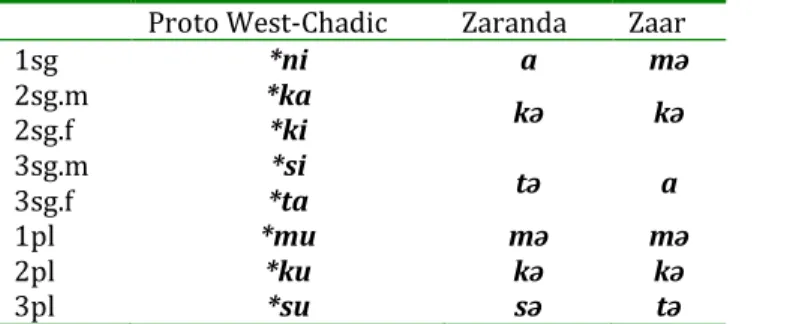
From proto-West Chadic where person and number contrast in the pronominal system is marked by vocalic contrast, what can be observed in SBW is a situation where the final vowels have been lost and replaced by a central neutral vowel /ə/ resulting in segmental ambiguity between singular and plural. Let us illustrate this by looking at the two geographically most distant languages : Zaranda and Zaar:
Proto West-Chadic Zaranda Zaar 1sg *ni a mə 2sg.m *ka kə kə 2sg.f *ki 3sg.m *si tə a 3sg.f *ta 1pl *mu mə mə 2pl *ku kə kə 3pl *su sə tə
In Caron (2006) I summarized the situation in the proto-SBW pronominal system in the
following table, where no segmental difference is made between singular and plural pronouns: Table 4. Proto SBW pro.syst.
1sg/pl *n/m
2sg/pl *k
3sg/pl *t/s
We can see that a new segmental forms (e.g. a) has emerged in various languages in the 1st and
3rd persons to remove the ambiguity. But this segmental ambiguity remains prevalent in all SBW
in the 2nd person, much in the same way as the difference between thou and you has been lost in
modern English. However, the SBW languages have found various ways of maintaining the opposition active, as the following table shows for the Aorist/Subjunctive:
Zda Geji Pelu Diir Lgas Ch Pci Bza Zɗi Zshi Sdi Zaar
1s à à à àH à m a ám à á m m
2s kə kə kə kə H kə kə kə kə ú k kə kə
3s t t t yàːH yáː t jàː/ r* jèː Ø t ʧi á
1pl m m m mùL m H m m m mà m m m
2pl kə Vpl kə Vpl kə Vpl kə L Vpl gə H kə kə kò kò k kə kə
3pl s s s Vpl wùL wù t wú kì tì t ʧì t
* : ər = [-human] ; jàː = [+human]
The means developed by the SBW languages to solve the ambiguity between 2sg & 2pl pre-verbal pronous are quite varied :
1) Baraza & Zoɗi have developed a new set of vowels, resp. kə /kò and ú/kò
2) Langas has used the [+/- voiced] feature to differentiate the singular (kə ) from the plural (gə ) in the 2nd person only;
3) Other languages have used tone to oppose the singular and the plural: Zakshi opposes High tones for singular to Low tones for plural in the whole paradigm (kə /kə ); Guus does the same with Mid and Low (kə/kə ) ; Zaar Mid and High (kə/kə ).
4) Other languages use a floating tone that attaches to the 1st syllable of the following verb:
Dir uses this device for all the persons: High for the singular and Low for the plural; Langas combines a High floating tone on the plural 1st and 2nd person pronouns with the
voice opposition seen above for the 2nd person;
5) Finally, four languages (Zaranda, Geji, Pelu and Diir) use a suffix that attaches to the 2nd
person plural10. This suffix, which is the same as that of the Imperative plural, is the only
distinctive mark of plural for Zaranda and Geji, and reinforces the floating Low tone for Diir.
Let us see an example of the plural suffix on the 2nd person plural in the Subjunctive in Pelu:
laː 11 poːl hunká.
3PL.AOR want 2.SBJV sweep room
They want you (sg.) to sweep the room.
laː póːl- n hunká.
3PL.AOR want 2.SBJV sweep-PL room
They want you (pl.) to sweep the room.
This suffix which appears here in the 2nd person plural is a remarkable development in so far as
it is the only instance of plural agreement in the verb in SBW languages.
VI.
R
EFERENCES
Caron, B. (2001). "Guus, aka Sigidi (Chadic, West-B, South-Bauchi): Grammatical notes and vocabulary." Afrika und Übersee 84: 1-60.
Caron, B. (2002). "Dott, aka Zoɗi (Chadic, West-B, South-Bauchi): Grammatical notes, vocabulary and text." Afrika und Übersee 85: 161-248.
Caron, B. (2002). "Review of Ɓarawa Lexicon: a wordlist of eight South Bauchi (West Chadic) languages: Boghom, Buli, Dott, Geji, Sayanci and Zul' by Ronald Cosper, Munich: LINCOM EUROPA, 1999." Chadic Newsletter 1 (23): 46-80.
Caron, B. (2003). A propos de Kal et de Sigidi: problèmes de dialectologie Zaar (tchadique sud Bauchi). Actes du 3e Congrès Mondial de Linguistique Africaine, Lomé 2000. K. Lébikaza. Köln, Rüdiger Köppe: 271-280.
Caron, B. (2004). Le luri. Quelques notes sur une langue tchadique du Nigeria. Langues et cultures: terrains d'Afrique. Hommages à France Cloarec-Heiss. P. Boyeldieu and P. Nougayrol. Louvain-Paris, Peeters: 193-201.
Caron, B. (2005). Za:r (Dictionary, grammar, texts). Ibadan (Nigeria), IFRA.
Caron, B. (2006). South-Bauchi West Pronominal and TAM Systems. Sprachbund in the West African Sahel. B. Caron and P. Zima. Louvain/Paris, Peeters: 93-112.
Caron, B. (2008). Bu: aka Zaranda (Chadic, South-Bauchi West): Wordlist and grammatical Notes. Semito-Hamitic Festschrift for A.B. Dolgopolky and H. Jungraithmayr. G. Takacz. Berlin, Dietrich Reimer: 93-119.
11 tə k is analysed as tə+kə = complementizer + Aorist, resulting in a subset of Aorist with a subjunctive
Caron, B. (2009). Depressor Consonants in Geji. Proceedings of the Special World Congress of African Linguistics (São Paulo, 2008): Exploring the African Language Connection in the Americas. M. Petter and R. B. Mendes. São Paulo, Humanitas: 129-138.
Cosper, R. (1999). Barawa Lexicon: a wordlist of eight South Bauchi (West Chadic) languages: Boghom, Buli, Dott, Geji, Jimi, Polci, Sayanci and Zul. Munich, LINCOM EUROPA.
Newman, P. (1989). "The historical change from suffixal to prefixal reduplication in Hausa pluractional verbs." Journal of African Language and Linguistics 11: 1-8.
Newman, P. (1990). Nominal and Verbal Plurality in Chadic. Dordrecht, Foris.
Newman, P. and R. G. Schuh (1974). "The Hausa aspect system." Afroasiatic Linguistics 1(1): 1-39.
Shimizu, K. (1975). Boghom and Zaar: Vocabulary and Notes. Kano.
Shimizu, K. (1978). "The Southern Bauchi Group of Chadic Languages. A survey report." Africana Marburgensia 2 (Special Issue): 50.
Schneeberg, N. (1971). "Sayanci verb tonology." Journal of African Languages (Special Chadic Issue) 10(1): 87-100.