HAL Id: hal-00659520
https://hal.archives-ouvertes.fr/hal-00659520
Submitted on 13 Jan 2012
HAL is a multi-disciplinary open access
archive for the deposit and dissemination of
sci-entific research documents, whether they are
pub-L’archive ouverte pluridisciplinaire HAL, est
destinée au dépôt et à la diffusion de documents
scientifiques de niveau recherche, publiés ou non,
Pneumocystosis: a network survey in the Paris area
2003-2008
D. Magne, A. Angoulvant, F. Botterel, C. Bouges-Michel, M.-E. Bougnoux, P.
Bouree, C. Chochillon, M. Cornet, E. Dannaoui, A. Fekkar, et al.
To cite this version:
D. Magne, A. Angoulvant, F. Botterel, C. Bouges-Michel, M.-E. Bougnoux, et al.. Pneumocystosis: a
network survey in the Paris area 2003-2008. European Journal of Clinical Microbiology and Infectious
Diseases, Springer Verlag, 2011, 30 (5), pp.673-675. �10.1007/s10096-010-1139-0�. �hal-00659520�
Pneumocystosis : A Network Survey in the Paris Area 2003-2008
Denis Magnea, Adela Angoulvantb, Françoise Botterelc, Claire Bouges-Micheld,
Marie-Elisabeth Bougnouxe, Patrice Bouree
f, Christian Chochillong, Muriel Corneth,
Eric Dannaouii, Arnaud Fekkarj, Guy Galeazzik, Helene Yeral, Claudine Sarfati
m, and
Patricia Rouxa
Assistance Publique – Hôpitaux de Paris (AP-HP), France : a : St Antoine, Paris ; b :
Tenon, Paris ; c : Henri Mondor, Créteil ; d : Avicenne, Bobigny ; e : Necker, Paris, f :
Kremlin-Bicêtre, Paris ; g : Bichat-Claude Bernard, Paris ; h : Hôtel Dieu, Paris ; i :
Hôpital. Européen Georges Pompidou, Paris ; j : Pitié Salpétrière, Paris ; k : Louis
Mourier, Colombes; l : Cochin, Paris ; m : St Louis, Paris.
Correspondance :
Denis Magne
Parasitogie-Mycologie, Hôpital Saint Antoine, AP-HP
184, rue du Faubourg Saint Antoine
75571 Paris cedex 12, France
tel 33 1 49 28 27 84
fax 33 1 49 28 30 30
ABSTRACT
The aims of this network are to collect epidemiological data of PcP cases in 14 hospitals in the Paris area and to determine the Di-Hydro Pteroate Synthase (DHPS) genotypes, genetic marker for possible sulfamide resistance.
From 01/01/2003 to 12/31/2007, 805 (mean: 161/year) PcP cases have been reported. 61% of patients were HIV-positive. The median count of CD4 lymphocytes was 32/mm3 (30 in HIV-positive patients, 158 in HIV-negative patients). In HIV-positive patients, PCP revealed the HIV infection in 39 %. Among 211 PCP occurring in HIV known infected patients, no prophylaxis was prescribed for 72 %;
cotrimoxazole prophylaxis had been prescribed to 39 patients but only one of them had the right
compliance. In HIV-negative patients (264), corticosteroids were prescribed in 54 % and chemotherapy in 36 %; 93 % did not receive prophylaxis. 128 tumoral pathologies and 86 transplantations were notified. The mortality rate was 16% at day 14 (13% in HIV-positive patients, 26% in HIV-negative patients). Mutations in DHPS genes were detected in 51 samples; 33 patients were infected with several strains. Total annual number of cases has been stable for five years but the proportion of HIV-negative patients increased from 25% to 41%.
INTRODUCTION
Despite a decrease in incidence associated with the introduction of the high antiretroviral therapies (HAART), pneumocystosis due to Pneumocystis jirovecii (or PcP for Pneumocystis pneumonia) remains one of the main fungal infection diagnosed in Europe in AIDS and other immunocompromised patients [1, 2]. Due to strict host-species specificity, humans may be the main source of Pneumocystis jirovecii organisms and human-to-human and nosocomial transmission may occur [3]. Before the HAART era, HIV infection represented the main predisposing factors depending on the number of CD4 cells/ml. Genetic markers for possible sulfamide/sulfone-resistance (point mutations 165 and 171 of P. jirovecii dihydropteroate synthase (DHPS) gene, encoding for amino acid 55 and 57 of the protein) have been reported and are still debated [4]. The aims of this study were to revaluate the epidemiological
characteristics of pneumocystosis in the Paris area and to analyse the relation between point mutation(s) in the DHPS gene and the breakthrough of prophylaxis.
MATERIALS AND METHODS
A network was initiated in 2003 to collect demographic and epidemiological data related to the cases of pneumocystosis diagnosed in 14 University hospitals of Assistance Publique - Hôpitaux de Paris (AP-HP). Microscopic observations of bronchoalveolar lavage fluid (BALF) samples taken from these patients were performed using standard methods. These included Giemsa staining and the use of commercially available fluorescein-labeled monoclonal anti-Pneumocystis antibodies (BIORAD, Monofluokit
Pneumocystis carinii) of BALF smears. Microscopic detection of the organism was taken as proof of PcP diagnosis. The following data were collected : date of birth, sex, department where analysis was
performed, HIV serological status, PcP as HIV-revealing infection, immunosuppression due to other than HIV infection, solid organ transplantation information, tumor pathologies, immunosuppressive
treatments, genetic immunodeficiency, date when the sample that revealed PcP was taken, first episode of PcP or no previous diagnosis, prophylaxis, intolerance or compliance to cotrimoxazole, CD4+
lymphocyte counts, initial treatment of PcP, and clinical progression. In addition, samples were analysed to determine DHPS genotypes (mutations at positions 165 and 171) using PCR direct sequencing.
RESULTS
From 01/01/2003 to 12/31/2008, 993 cases of PcP were reported (mean : 166 cases/year). The sex ratio was 2.2 and the median age was 47 years. Sixty-five % of the patients were HIV-positive. Among them, the HIV infection was already known in 304 patients, while pneumocystosis revealed the retroviral infection in 39% of the cases. The median count of CD4 lymphocytes was 30/mm3 +/- 89/mm3 (range from 0 to 694). PcP was a first episode in 91.5%. HIV-positive patients had not received any anti-Pneumocystis chemoprophylaxis at the time of pneumocystosis diagnosis in 64% of the cases. In the remaining cases, cotrimoxazole prophylaxis had been prescribed to 47 patients but only one of them had a right compliance. Drug intolerance was observed in 20.5% of these patients. When pyrimethamine + dapsone, atovaquone or pentamidine were used as prophylaxis, treatments were stopped in half cases because of intolerance to these drugs.
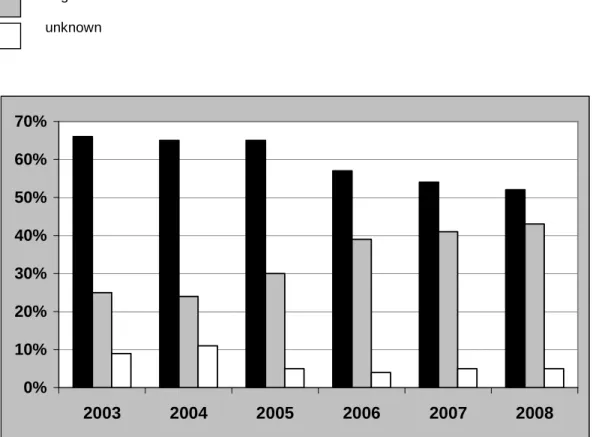
The proportion of HIV-negative patients (n = 264) increased from 25% of the cases in 2003 to 43% in 2008 (figure 1). The CD4+ lymphocytes count was 152/mm3 +/- 264/mm3 (range from 0 to1000). In these patients, PcP was a first episode in 97.3% of cases. The main underlying diseases or risk factors were: haematological malignancies (73 leukemias, 51 lymphomas, 10 Hodgkin’s diseases, 29 bone marrow transplantations, 5 myelomas), tumoral pathologies (169) and solid organ transplantations (116 transplantations; kidney : 48, heart :15: liver : 12, lung : 1). Fifty-nine % of the patients received corticosteroid therapy and 34% cytotoxic chemotherapies. Except tumoral pathologies and transplantations, the most frequent pathologies in HIV-negative patients were lupus (5), SCID (5), sarcoidosis (3), cirrhosis (3), dermatomyositis (3). Seventy-eight % of the HIV-negative patients had not received any anti-Pneumocystis prophylaxis.
Mortality at day 14 was 26% in HIV- negative patients versus 13% in HIV-positive patients. When the diagnosis of PcP was performed, 44 % of HIV-negative patients and 26% of HIV-positive patients were in units of intensive care.
Forty-two % of specimens were available for DHPS genotyping. Forty six (14%) of the samples did not amplify. Mutations in DHPS genes were detected in 18,5% of samples. Co-infections with at least two different strains were observed in 12,5% of the isolates. Double mutation (at positions 165 and 171) was
DISCUSSION
From 01/01/2003 to 12/31/2008, the incidence of PcP in the Paris area is stable despite prophylaxis and frequent use of HAART in HIV-infected patients. It confirms previous data in 2003-2004 in the same geographical area [5]. PcP still often reveals HIV infection (39% of the cases) indicating extensive lack of HIV status testing. Among known HIV-infected patients when PcP was diagnosed, prophylaxis is often missing (64%) or not in compliance when used.
The proportion of HIV-negative patients increased continuously from 2003 to 2008. The main risk factors in HIV-negative patients were corticotherapy and chemotherapies. Cotrimoxazole is difficult to use in case of haematological malignancies because of its cytological side effects. Alternative drugs with their own side effects are less effective against Pneumocystis. The CD4+ lymphocytes count is less relevant in these patients for PcP risk managing because the mechanisms of immunosuppression are different than in HIV infection [1].
Genotyping for DHPS gene was not effective for 14% of the specimens without any amplification; this is due to the fact that DHPS is present in single copy. The prevalence of DHPS mutations varies with geographic location and could be related to the frequency of chemotherapeutic drugs used to clear PcP [6]. In our survey, no significant relationship was observed between mutation and outcome or mortality, or between mutation and prophylaxis. Indeed, mutations were detected in patients without prophylaxis. In 9.5 % of the isolates, mutations were detected in both sites (165 and 171). Expression mutant genes in recombinant Saccharomyces cerevisiae systems showed that the presence of two mutations results in higher resistance than the presence of only one [6]. An initial mutation in P. jirovecii DHPS might first occur in drug-treated patients without clinical consequences and later other mutations could come about leading to the spread of organisms with high resistance to cotrimoxazole. So, the risk of emergence of resistant strains exists and epidemiological surveillance is needed
Despite risk factors and effective prophylaxis being known, PcP remains a frequent fungal disease associated with AIDS and in other immunocompromised patients as well. PcP still often reveals HIV infection at a late stage. Prophylaxis needs to be prescribed in patients receiving long-term corticosteroid
REFERENCES
[1] Roblot F, Godet C, Le Moal G, Garo B, Faouzi Souala F, Dary M et al. (2002) Analysis of underlying diseases and prognosis factors associated with Pneumocystis carinii pneumonia in immunocompromised HIV-negative patients. Eur J Clin Microbiol Infect Dis 21: 523-31.
[2] Magne D, Lacube P, Angoulvant A, Meliani L, Botterel F, Bougnoux ME et al. (2007)
Pneumocystosis : Survey in 14 Hospitals from Assistance publique-Hôpitaux de Paris (AP-HP), France, 2003-2005. Bulletin Epidémiologique Hebdomadaire, InVS (France), BEH 5/6 février 2007.
[3] Stringer J, Beard CB, Miller RF, Wakefield AE. (2002) A new name (Pneumocystis jirovecii) for Pneumocystis from humans. Emerg Infect Dis 8: 891-6.
[4] Meneau I, Sanglard D, Bille J, Hauser PM. (2004) Pneumocystis jirovecii dihydropteroate synthase polymorphisms confer resistance to sulfadoxine and sulfanilamide in Saccharomyces cerevisiae. Antimicrob Agents Chemother 48: 2610-6.
[5] Magne D., Lacube P., Angoulvant A., Meliani L., Botterel F., Bougnoux M.E., Chochillon C.,Cornet M., Dannaoui E., Datry A., Dunand J., Galeazzi G., Bouges-Michel C., Yera H., Sarfati C., Roux P. (2006) Pneumocystosis : survey and DHPS genotype analysis in 14 Parisian hospitals in 2003 and 2004. J Eukaryot Microbiol 53: S106-S107.
[6] Friaza V, Montes-Cano MA, Respaldiza N, Morilla R, Calderón EJ, de la Horra C. (2009) Prevalence of dihydropteroate synthase mutations in Spanish patients with HIV-associated Pneumocystis pneumonia. Diagn Microbiol Infect Dis 64:104-5.
[7] Moukhlis R, Boyer J, Lacube P, Bolognini J, Roux P, Hennequin C. (2010) Linking Pneumocystis jirovecii sulfamethoxazole resistance to the alleles of the DHPS gene using functional complementation in Saccharomyces cerevisiae. Clin Microbiol Infect 16 : 501-7.
Figure 1. HIV serological status positive negative unknown