HAL Id: hal-03060382
https://hal.archives-ouvertes.fr/hal-03060382
Submitted on 13 Dec 2020HAL is a multi-disciplinary open access archive for the deposit and dissemination of sci-entific research documents, whether they are pub-lished or not. The documents may come from teaching and research institutions in France or abroad, or from public or private research centers.
L’archive ouverte pluridisciplinaire HAL, est destinée au dépôt et à la diffusion de documents scientifiques de niveau recherche, publiés ou non, émanant des établissements d’enseignement et de recherche français ou étrangers, des laboratoires publics ou privés.
Visual continuity during blinks and alterations in time
perception
Marianne Duyck, Thérèse Collins, Mark Wexler
To cite this version:
Marianne Duyck, Thérèse Collins, Mark Wexler. Visual continuity during blinks and alterations in time perception. Journal of Experimental Psychology: Human Perception and Performance, American Psychological Association, 2020, �10.1037/xhp0000864�. �hal-03060382�
Visual continuity during blinks and alterations in time perception
Marianne Duyck 1,2, Thérèse Collins 1, and Mark Wexler 1,*1 Integrative Neuroscience and Cognitive Center, CNRS UMR 8002, Université de Paris,
Paris, France
2 Laboratory of Sensorimotor Research, National Eye Institute, Bethesda, MA, USA
* Corresponding author: mark.wexler@u‐paris.fr
Abstract
Eye blinks strongly attenuate visual input, yet we perceive the world as continuous. How this visual continuity is achieved remains a fundamental and unsolved problem. A decrease in luminance sensitivity has been proposed as a mechanism, but is insufficient to mask the even larger decrease in luminance due to blinks. Here we put forward a different hypothesis: visual continuity can be achieved through shortening of perceived durations of the sensory consequences of blinks. Here we probed the perceived durations of the black-outs caused by blinks, and of visual stimuli interrupted by blinks. We found that the perceived durations of black-outs due to blinks are about half as long as artificial black-black-outs immediately preceding or following the blink. Stimuli interrupted by blinks were perceived as briefer than uninterrupted stimuli, by about the same duration as the interruption—but so were stimuli interrupted by optically simulated blinks. There was a difference between real and simulated blinks, however: the decrease in perceived duration depended on the duration of the interruption for simulated, but not for real, blinks. These profound modifications in time perception during blinks show a way in which temporal processing contributes to the solution of an essential perceptual problem.
Significance statement
Although eye blinks effectively shut off the light entering the eyes for brief but significant periods every few seconds, we hardly perceive the black-outs or the visual images seen before and after the blink as interrupted. In this study we showed that the perception of time is altered around blinks: both the period of darkness during the blink, and the duration of brief images straddling the blink, are perceived as significantly briefer than equivalent periods of darkness before or after the blink, or images with the same duration that aren’t interrupted by blinks. This alteration in the perception of time may be the reason why we hardly perceive the interruptions in vision due to blinks.
Keywords: blinks, time perception, vision
Introduction
We blink on average 15 times per minute (Ponder & Kennedy, 1927; Bentivoglio et al., 1997). Blinks cause a drastic decrease in luminance—about 1.5-2.5 log units, depending on frequency (Ando & Kripke, 1996; Moseley et al., 1988; Robinson et al., 1991)—and a near-complete loss of pattern vision, typically lasting about 100-300 ms (Slater-Hammel, 1953). However, these drastic sensory consequences of blinks go unnoticed, or nearly so, and the visual world is perceived as being continuous across blinks. Simulated blinks—interruptions of light with similar durations but with the eyes open—are perceived as much more salient than actual blinks (Riggs et al., 1981; Volkmann et al., 1980). We use the term visual continuity to refer to this near-perfect suppression of the sensory consequences of blinks. Visual continuity in spite of frequent and otherwise salient blackouts is a fundamental problem for any theory of vision that takes the retinal input as a starting point.
In order to account for visual continuity, Volkmann et al. (1980) proposed that sensitivity to light was actively suppressed during blinks, similarly to saccadic suppression (Volkmann, 1986; Burr et al., 1994). Volkmann, Riggs and colleagues were able to measure visual thresholds during blinks by, ingenuously, lighting the retina from behind, by means of an optical fiber connected to a light source inside the mouth. They found a decrease in sensitivity of about 0.5 log units around blinks. This decrease started before the beginning of eyelid closing and ended around 300 ms after closure (Volkmann et al., 1980). The increase in threshold is caused by the closing rather than by the opening of the eyelid (Volkmann et al., 1982), increases as the amplitude of the eyelid motion goes from partial to full closure (Stevenson et al., 1986) and does not differ between reflexive and voluntary blinks (Manning et al., 1983). The interpretation given by Volkmann, Riggs and their colleagues was that the drop in visual sensitivity is caused by the corollary discharge of the blink, and that this drop accounts for visual continuity.
There is some physiological evidence in favor of an extra-retinal suppression of blinks. Gawne and Martin (2000, 2002) found that some neurons in areas V1-V4 in monkeys differentiate between visual interruptions due to blinks and those due to external darkening: the transient burst of activity present at the onset of an external darkening was absent at the onset of a blink, suggesting that there might be active suppression of this transient during blinks. Bristow, Haynes, Sylvester, Frith, and Rees (2005) used the same paradigm as Volkmann et al. (1980), bypassing the eyelid, to compare BOLD activity during blinks to identical retinal input without blinks. They found no significant differences in LGN, V1 and V2 but a significant decrease in activity during blinks in higher areas: V3 and many regions of parietal and pre-frontal cortices. These results suggest that blink suppression occurs at later stages of visual processing.
Regardless of the origin of the small decrease in visual sensitivity around blinks, it seems unlikely that it could account for visual continuity: a 0.5 log unit decrease in sensitivity cannot mask 1.5-2.5 log unit drop in luminance. We therefore put forward a different hypothesis, that visual continuity around blinks is at least partly caused by an alteration in the perception of time and duration around blinks that makes their sensory consequences less salient. This hypothesis is motivated by an observation made by Riggs et al. (1981): while simulated blinks (we’ll call them
blanks) seem much more salient than blinks of the same duration, much briefer blanks do appear
similar to blinks. If the perceived duration of the visual interruption introduced by a blink is reduced, this might contribute to perceptual continuity across blinks. Closely related ideas about time perception and continuity across blinks have recently been put forward by Irwin and Robinson (2016) and Grossman, Guata, Pesin, Malach and Landau (2019). The empirical results of these studies overlap with part of the results of our Experiment 2 (see below for further discussion).
The interruption caused by blinks has two consequences. The first is the period of darkness itself. To what extent do we perceive it as briefer than its true duration, as predicted by our hypothesis? In order to address this question, in Experiments 1a and 1b we artificially extended the period of darkness after the end of the blink, or before its beginning. In a task in which participants reported the combined duration of the blink-induced and artificial darkness, we used a multivariate analysis to evaluate the relative contribution of the two durations. We could therefore evaluate the perceived duration during the blink relative to blanks immediately preceding or following the blink. If the duration of blink-induced darkness is perceived differently than externally-induced darkness, we can conclude that the origin of the effect is extra-retinal.
The second consequence of blinks is the interruption of visual stimuli that straddle the blink. To what extent does the blink reduce the perceived overall duration of such stimuli? When participants are asked to judge the time interval between the initial onset and the final offset of a stimulus with a temporal gap, the perceived duration is smaller than for stimuli without gaps (e.g., Fortin, Bédard, & Champagne, 2005). In Experiment 2, we checked whether this is true for stimuli interrupted by blinks as well as by blanks, and how the reduction in perceived duration depends on the duration of the blink or blank.
Experiment 1a: Perceived duration of blink compared to post‐blink duration
Methods
Participants
Sixteen people took part in the experiment (mean age 23.5 years, range 20-28 years, 12 women). All reported normal or corrected-to-normal vision. Except for the first author, all were naïve regarding the hypotheses and were paid 10€ per hour. All participants provided prior informed consent, in accordance with a procedure that adhered to the ethical principles of the Declaration of Helsinki. (The experiment was not reviewed by an ethics committee because in France legal ethics committees do not review noninvasive protocols.) Two of the 16 participants were excluded from the analysis for reasons given in the Results section below.
Sample sizes for all three experiments in this study were selected using pilot data for Experiment 2, from which we concluded that the relative main effect of blinks would be roughly 0.2: on the order of 100 ms for judgments of intervals of 500 ms. Assuming a relative standard deviation likewise of 0.2, and a power of 0.8, yields a sample size of 8. To be conservative, and in anticipation of participants unable to carry out the task, we fixed sample sizes in all experiments to be between 12 and 16 participants. Sample sizes were not changed after the experiment began.
Apparatus
The experiment took place in a dimly lit test room (0.02 cd/m2). Visual stimuli were displayed using a PROPixx projector (VPixx Technologies Inc., Canada). This DLP projector was operated at an input rate of 120 Hz, and an output rate of 1440 Hz, at resolution 960 x 540 pixels in 8-bit grayscale. (Twelve frames were coded in each input frame, which the projector displays at 12 times its input frequency.) Moreover, the projector’s three LED lamps can be controlled directly by the attached PC. Participants sat 190 cm from the projection screen that subtended 41 by 23 degrees of visual angle [dva]. The right eye was monitored using an EyeLink 1000 Plus desktop mount eyetracker (SR Research Ltd.) operated at 1000 Hz. A head and chin rest stabilized the head. The precise latencies of the projector and the eyetracker were determined using separate procedures, described in the Supplementary Materials.
Insert Figure 1 about here
Stimuli
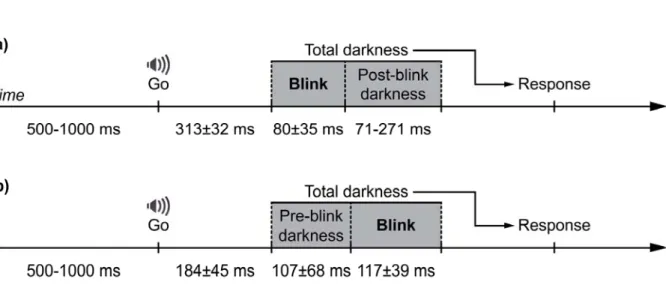
There were two conditions, BLINK and REPLAY. The timeline of a BLINK trial is shown in Figure 1a. At the beginning of a trial, participants viewed a random texture of a low spatial frequency noise, generated by low-pass filtering random pixels (100 cd/m2). After a random delay between
0.5 and 1 s, an auditory beep served as the signal for the participant to blink. The projector lamps, the only source of light in the experiment room, were turned off as soon as the beginning of the blink was detected (by which time the eyes were closed). As soon as the end of the blink was detected (which happened 58 ms after the actual end of the blink: see Supplementary Materials for details), the lamps were kept off for an additional duration drawn randomly from a uniform distribution between 0 and 200 ms. It was determined that the time required for the lamps to reach 50% luminance was 13 ms (Supplementary Materials). Therefore, blinks were followed by a period of darkness lasting between 71 and 271 ms. At the end of that period the projector lamps were turned back on and participants saw the random texture again. The reason for turning the lamps off during the blink was to make the darkness during the blink and the darkness after the blink as similar to each other as possible. As mentionned previously, light is attenuated incompletely by the eyelid during blinks, so the lamps had to be extinguished during the blink for the two types of ‘darkness’ to be roughly equally dark.
In the REPLAY condition (the data from which were only used to calibrate our data analysis procedure—see below), stimuli were identical to corresponding BLINK trials and presented in the same order, but participants were instructed not to blink. Projector lamps were turned off and back on at the same time as in corresponding BLINK trials.
Procedure
In the BLINK condition, participants were instructed to blink as naturally as possible as soon as they heard the auditory signal. To probe the perceived duration of darkness, we used the method of single stimuli (Morgan et al., 2000), asking participants to judge on each trial whether the total duration of darkness—caused by their blink and the additional period of darkness immediately following the blink—was longer or shorter than the average duration of total darkness experienced over the course of previous trials. Participants gave their response by pressing one of two keys. Trials where blink duration was above 250 ms, or where blink latency was below 100 ms or above 1 s, were identified online, discarded, and rerun later during the experiment.
In the REPLAY condition, participants were instructed not to blink, but the visual and auditory stimuli were identical, trial-by-trial, to BLINK trials in a preceding block. The task was also the same: to judge whether the period of darkness was briefer or longer than an internal standard. The experiment began with a training block of 100 trials in the BLINK condition (not included in the analysis), followed by 4 experimental blocks of 300 trials each. In 15 out of 16 participants, a BLINK block was followed by a REPLAY block, followed by a second BLINK and a second REPLAY block. Because of operator error, in one participant the two BLINK blocks were performed first,
followed by the two REPLAY blocks. Eleven participants ran the entire experiment in one session, while the remaining participants ran the experiment over two separate days.
Analysis
Determining accurate blink duration
Because knowing the actual duration of the blink is crucial to our experiment we wanted to check that the beginning and end of a blink, as detected by the eyetracker, corresponded to the actual complete occlusion of the pupil (our definition of a blink in this study). To do that we filmed the eyes of 3 additional participants on 100 trials with a 240 Hz camera (Hero 3, GoPro, California, USA) and compared the times of the beginning and end of blink, derived from manual frame-by-frame by examination of the video, to those computed by the eye-tracker. We found a constant overestimation of the blink duration by the eyetracker and corrected for it in the subsequent analyses (see Supplementary Materials for details).
Offline trial selection
We removed the data of two participants from subsequent analysis because, in contrast to othre participants, their responses were flat as a function of duration (in other words, they were not performing the task).
We removed 3.5% (±3.3%: between-participant standard deviations will be noted using the “±” sign) of trials for which the duration of the blink was more than 3 standard deviations from the mean of each participant, or for which blink duration was null (i.e., no complete occlusion of the pupil).
Data analysis
We assumed that the perceived duration was a linear combination of the two subintervals, the blink and post-blink durations: 𝛽𝐷 𝐷 . We fitted the responses to a logistic function of this linear combination:
𝑅 ~ 1 exp 𝛼 𝛽𝐷 𝐷 𝐷 (1)
The three parameters of model (1) are:
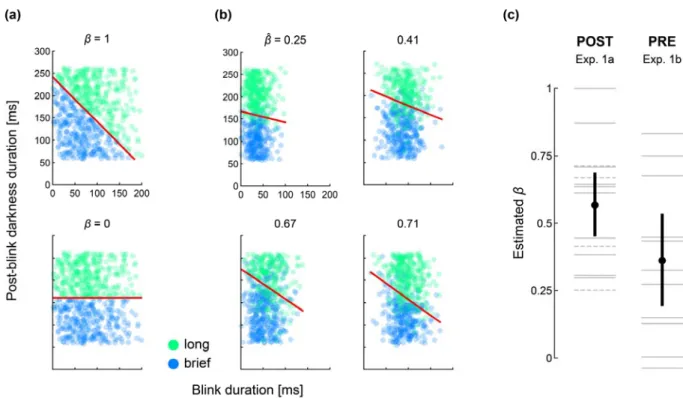
𝛽 : quantifies the relative contribution of post-blink darkness to overall duration. Hypothetical data from the extreme cases of 𝛽 1 or 0 are shown in Figure 2a. If 𝛽 1, then blink and post-blink durations contribute equally to the perceived duration of darkness, which then would depend linearly on the sum of the two durations. This is the null hypothesis: durations within the blink are estimated no differently than durations
outside of the blink. If, in contrast, 𝛽 0, then the duration of the blink does not contribute at all to the perceived duration of darkness, which would then depend only on the post-blink duration. If 𝛽 is equal to 0.5 then a given duration is perceived as half as long during the blink as it is during the post-blink darkness.
𝛼: quantifies the precision of overall timing performance. Higher values of slope 𝛼 imply lower variability when presented with the same stimulus, while the inverse of 𝛼 can be considered to be a measure of the just-noticeable difference.
𝐷 : the point of subjective equality, the standard adopted by the participant as the “average” in the single-stimulus task
Insert Figure 2 about here
In most participants, mean blink durations change systematically over the course of the experimental session, and probably so does the implicit standard for the single-stimulus task. This makes it tricky to fit model (1) to the data of an entire session, because such a fit implicitly assumes that the parameters are stationary over time. We solved this problem by fitting the model in a sliding window of 50 trials. Further details concerning the fits can be found in the Supplementary Materials.
Results
Mean blink duration was 80 ms (±35 ms).
The raw data of four representative participants are shown in Figure 2b, along with the results of the model, giving the estimates of the 𝛽 parameter for each of the participants, and the corresponding line of subjective equality separating the brief and long durations. In each of the participants the fitted value of the 𝛽 parameter was below 1, meaning that in total duration judgments, the within-blink darkness was weighted less than post-blink darkness.
The distribution of individual 𝛽 coefficients for all participants is shown in the left panel of Figure 2c. The mean of the individual estimates was 𝛽̅ 0.57. This implies that, on average, the dark period during a blink is perceived as lasting a little over half as long as the dark period following the blink. The 95% confidence interval on 𝛽̅ was [0.46, 0.68], calculated using a bootstrap and resampling the individual point estimates 10 samples). This confidence interval excludes the null-hypothesis value 𝛽 1, at which durations are perceived in the same way during the blink and immediately following the blink. The result also excludes the value 𝛽 0, showing that the
component of the total duration during the blink is not entirely ignored, either. The same objective duration of darkness during the blink is judged as being briefer than an equivalent duration after the blink, with the blink duration discounted by almost half.
Experiment 1b: Perceived duration of blink compared to pre‐blink duration
The previous experiment showed that the blink contributes less than the post-blink period to the total perceived duration of darkness. This effect could be due to an underestimation of duration specifically during blinks. Instead, it could be due to the overestimation of the duration of the post-blink darkness. Another possible explanation is the overestimation of duration at the start of an interval—imagine a stopwatch that starts too slow and accelerates to normal speed. To check whether these last two explanations could account for the effect found in Experiment 1a, we performed a similar experiment, but with the additional period of darkness preceding—rather than following—the blink.
Methods
Apparatus, stimuli, and analyses were almost identical to the previous experiment except that instead of remaining for an additional period after the blink, the dark period was presented before the blink.
Participants
16 participants ran the experiment (mean age: 24.7 years, range: 20-30 years, 6 men). All reported normal or corrected-to-normal vision and were naïve regarding the hypotheses tested in the experiment. None had participated in the previous experiment. They gave informed consent and were paid 10€ per hour. The procedure adhered to the ethical principles of the Declaration of Helsinki.
Procedure
The timeline of the trials is shown in Figure 1b. On each trial, participants viewed a random texture filtered to include only low spatial frequencies (as in Experiment 1). They were instructed to blink as naturally as possible when they heard an auditory signal, and to try to maintain a regular interval between the beep and their blink. We used the median latency in previous trials of the same block to adjust the timing of the blink dark period. The target duration of the pre-blink period was drawn from a uniform distribution between 0 and 200 ms; but because of eyetracker delays, the actual duration was slightly longer (see Supplementary Materials). As in Experiment 1, we kept the lamps off during the blink itself (in addition to the interval of darkness preceding the blink). After the beginning of the blink was detected online, we waited for the end
of the blink, defined as 5 consecutive samples with measurable pupil size, before turning the projector lamps back on.
As previously, participants were asked to judge whether the total duration of darkness caused by their blink and the additional period before their blink on that trial was longer or shorter than the average duration of total darkness experienced over the course of previous trials. They gave their response by pressing one of two keys. Trials for which blink latency was below 100 ms or above 1 s were discarded and replayed later during the experiment. The experimental session included a training phase of 100 trials (not included in the analysis) and the main experiment (600 trials in 2 blocks of 300 trials separated by a break).
Analysis
Offline trial selection
We removed trials for which the duration of the blink or of the pre-blink was outside of 3 standard deviations from the mean of each participant. We additionally discarded trials with null blink duration (no complete pupil occlusion) and trials for which the online criteria for detecting the end of the blink failed (trials with a difference of more than 20 ms between our online detection of the blink and the detection of the end of the blink by the EyeLink). Because 2 participants had over 10% rejected trials, their data were excluded from further analyses. For the remaining participants, 2.9% (±1.4%) of their trials were discarded. In order to equalize as much as possible the distributions of additional darkness periods in Experiments 1a and 1b, we further discarded the 5% of the trials in which pre-blink darkness duration was 0 (i.e., the blink began before the projector lamps were turned off), or where it was greater than 271 ms (the maximum in Experiment 1a).
Statistics
We performed the same analyses as in Experiment 1a, except that, in model (1), the duration of pre-blink darkness, 𝐷 , replaced that of post-blink darkness. The data of 3 participants could not be fitted and they were excluded from further analyses. Thus, the results presented below are based on the data of 11 participants.
Results
Average blink duration was 118 ms (±41 ms) and the pre-blink darkness ranged between 1 ms and 271 ms, with an average duration of 111 ms (±7 ms).
We fitted the same model to the data as in Experiment 1a, with 𝐷 instead of 𝐷 . Individual estimates of 𝛽 are shown in Figure 2c. Averaging the coefficients of the individual participants, we
find that mean 𝛽̅ 0.36, with a 95% confidence interval of [0.20, 0.53], calculated using the bootstrap. This means that, on average, the darkness during the blink was perceived as less than half as long as the darkness preceding the blink. The mean β coefficient was lower in Experiment 1b than Experiment 1a, but their difference was not significant, although it did approach significance (𝑡 1.98, two-tailed 𝑝 0.06).
Thus, the results of Experiments 1a and 1b taken together show that visual interruptions caused by blinks are systematically underestimated. Darkness caused by blinks is perceived to last about half as long as the darkness immediately preceding or following the blink.
Experiment 2 – Perceived duration of stimuli that straddle blinks
In Experiment 1, we found evidence that an extra-retinal signal around blinks reduces the perceived duration of blink darkness, compared to intervals immediately preceding or following the blink. Another effect of a blink is to ‘puncture a hole’ in stimuli that straddle the blink in time. Does this reduced duration play a role in the perceptual suppression of the blink-induced hole? To address this question we examined the perceived duration of stimuli that straddle blinks. First, we compared the perceived duration of visual stimuli punctured by blinks to unpunctured stimuli, occurring after the blink. Second, we compared the effect of blink-induced punctures to the effect of an identical but external optical puncture—a ‘blank’—on perceived duration. If we interpret the results of Experiments 1a and 1b as signifying that the blink itself is perceived as being briefer than its true duration, we might expect that a stimulus straddling a blink be likewise perceived as briefer than an unpunctured stimulus.
Methods
Participants
Twelve people took part in the experiment. One participant who could not reach criterion on the pretest (see below) was excluded from the experiment. Data from the remaining 11 participants were included in the analysis (mean age: 23.5 years, range: 19-31, 3 men). None had previously participated in an experiment on perception around blinks and all were naïve regarding the hypotheses tested in the experiment. All reported normal or corrected-to-normal vision and no neurological disorders. They were paid 10€ per hour. The procedure adhered to the ethical principles of the Declaration of Helsinki.
Apparatus
The apparatus was the same as in Experiments 1a and 1b, except that participants sat at 130 cm from the projection screen that subtended 60 34 dva.
Insert Figure 3 about here
Design and stimuli
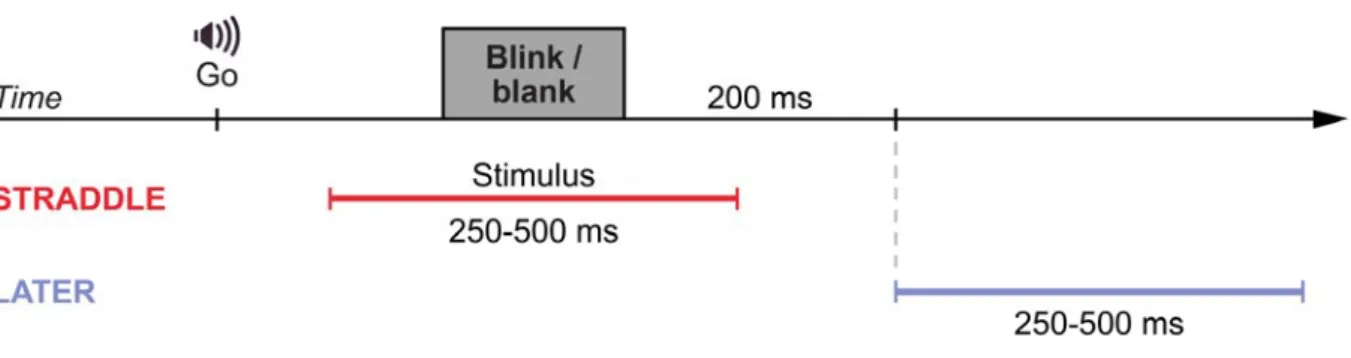
We used a within-participant design: every participant performed the two puncture conditions, BLINK and BLANK, and the two timing conditions, STRADDLE and LATER (Figure 3). Participants viewed a gray background (49 cd/m2). On every trial a darker gray square (19 cd/m2, 5 dva side) was presented, whose duration was chosen from a uniform distribution between 250 and 500 ms. The BLINK condition was always run first. Participants were instructed to blink upon hearing the go signal. In STRADDLE trials, the presentation of the square was timed so as to straddle the blink. In LATER trials, the square was presented 200 ms after the end of the blink as detected online. In order for the blink to happen during the presentation of the square in the STRADDLE condition, we adjusted the timing of the onset of the square relative to the auditory go signal. To do that, we computed the median blink duration and latency since the beginning of the experimental block, and updated those values on every trial. Median blink duration and latency were combined with stimulus duration, with the goal of making the midpoint of the blink coincide with the midpoint of the stimulus. The BLANK condition was always run second, because the time course of the stimuli and order of trials was yoked to that of corresponding trials in the BLINK condition. The only difference was that the puncture was caused by turning all the pixels on the display to their lowest possible luminance (0.08 cd/m2) for the same duration as the blink in a corresponding BLINK trial.
Procedure
All participants came to the laboratory on two separate days: they ran the BLINK condition on the first day and the BLANK condition on the second day.
Each experimental session consisted of 3 phases: a pretest, a training phase and a finally the main experiment. The task was the same for all phases: using the method of single stimuli (Morgan et al., 2000), we asked participants to press one of two keys to indicate whether the duration of the square was longer or briefer than its average duration. In the BLANK condition, participants were told that the screen would momentarily turn black but that they should not pay attention to this and focus on the duration of the stimulus. Participants were instructed to maintain fixation around screen center. (We considered explicitly instructing participants to report either the interval between the initial appearance and the final disappearance of the square stimulus, or, on the contrary, instructing them to discount any disappearance in their reported duration. However, we found that such instructions were impossible to follow, partly because the stimuli were so brief and partly because, at least in the BLINK condition, participants did not perceive the blink period
as a disappearance. We therefore chose the most neutral instructions: evaluate whether the duration of the square was longer or briefer than the average.)
The goal of the pretest was to check that participants could perform duration discrimination. The 100 trials consisted of a simple presentation of the square stimulus lasting 250-500 ms, without any blinks or blanks, while participants performed the same duration task as in the main experiment, namely to classify the intervals as “brief” or “long.” At the end of a pretest block we fitted responses to a logistic function of the duration of the square. If the resulting slope was above 0.01 ms the participant moved on to the training phase, and otherwise the pretest was run again. One participant who could not reach the criterion after three pretests was dropped from the experiment.
In the training and main phases that followed, participants heard a beep after a randomly chosen duration between 500 and 750 ms after the start of a trial. In the BLINK conditions participants were instructed to blink as naturally as possible as soon as they heard the beep. In the BLANK condition they were instructed not to blink, while fixating the center of the display. The training block consisted of 50 trials (25 each in STRADDLE and LATER) and the main phase consisted of 3 blocks of 120 trials (60 per timing condition). Only trials from the main experiment were used for the analyses. Each of the two sessions lasted between 1 and 1.5 hours.
Online trial criteria
To ensure a sufficient number of usable trials, we applied several online criteria in the BLINK condition. Only trials with blink duration below 250 ms were allowed. If duration was above this threshold, a sound informed the participant that their blink was too long (some participants at the beginning of the experiment made unnaturally long blinks). In the STRADDLE condition only trials for which the blink started after the beginning of the stimulus and ended before the end of the stimulus were considered valid. Trials that did not meet those criteria were discarded and replayed later on during the experiment.
Analysis
Offline trial selection
In the BLINK condition, we additionally removed trials for which the beginning of the blink occurred less than 30 ms after the onset of the square and trials for which the end of the blink occurred less than 30 ms before the offset of the stimulus. The corresponding trials in the BLANK conditions were also removed. Trials for which participants blinked before the go signal were also removed from further analysis. In the BLANK condition, we discarded trials for which participants blinked between the auditory stimulus and the end of the stimulus. We furthermore removed an
additional 0.6% of the trials which had incorrect parameters due to a programming error discovered during the analysis. Finally, we removed any trials whose corresponding trial in the BLINK or BLANK condition was removed, ensuring that trials in the two timing conditions remained matched.
Models
As in Experiments 1a and 1b, we assumed that the perceived duration is a linear combination of the total stimulus duration 𝐷 (i.e., the time from initial stimulus onset to its final offset, 250-500 ms), and the duration of the blink or blank, 𝐷 / . We fit responses to a model similar
to that for Experiments 1a and 1b:
𝑅 ~ 1 exp 𝛼 𝐷 𝛽𝐷 / 𝐷 (2)
The three parameters of model (2) are:
𝛽: quantifies the fraction of blink or blank duration is subtracted from overall perceived duration. If 𝛽 0 then the blink or blank does not affect the perception of stimulus duration, which would then depend only on the time interval between initial stimulus appearance and its final disappearance. If, on the contrary, 𝛽 1, then the perceived stimulus duration depends on total stimulus duration minus the duration of the puncture—in other words, the duration that the stimulus is visible. If 𝛽 is equal to 0.5 then perceived duration depends on a variable equal to the total duration minus half the duration of the puncture.
𝛼: quantifies the precision of overall timing performance, as in model (1) for Experiments 1a and b. Higher values of slope 𝛼 imply lower variability when presented with the same stimulus, while the inverse of 𝛼 can be considered to be a measure of the just-noticeable difference.
𝐷 : the point of subjective equality, the standard adopted by the participant as the “average” in the single-stimulus task, as in model (1) for Experiments 1a and b
The fit of model (2) was performed separately for each of the four combinations of the puncture conditions (BLINK, BLANK) and timing conditions (STRADDLE, LATER). The analysis was performed in the same way as for Experiments 1a and 1b, using a sliding window of trials (see Supplementary Materials for details).
A separate, simplified 2-parameter model was also fitted to the data using the same procedures as model (2):
𝑅 ~ 1 exp 𝛼 𝐷 𝐷 (3)
Results
Participants ran on average 1.2 pretest blocks in the BLINK condition and had a mean slope of 0.024 (±0.0079) on their final pretest block. In the BLANK condition, they ran a mean of 1.1 pretest sessions and had a mean slope of 0.023 (± 0.0088). 7.1% (5.2%) of the trials in the main experimental blocks were excluded according to the criteria listed above. Mean blink duration was 81 ms (±36 ms).
Insert Figure 4 about here
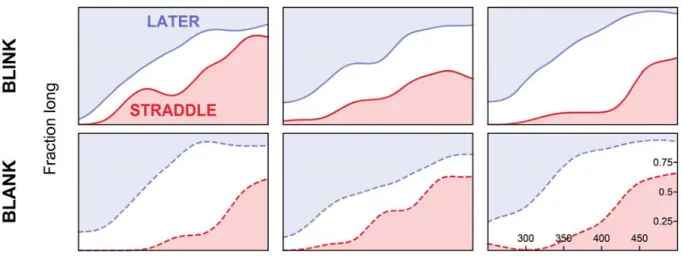
Examples of responses as a function of stimulus duration, in the four conditions, are shown in Figure 4 for three representative participants. The fraction of “long” responses increases with stimulus duration with a sigmoid shape, showing that participants successfully performed the duration judgment task. An effect of the discrete conditions that can be seen in Figure 4 (and as will be borne out by the analysis below) is that the STRADDLE curves lie below the LATER curves. This means that a stimulus, when punctured by a blink or blank, is perceived as briefer than a stimulus of the same duration when unpunctured. In other words, the point of subjective equality is higher for STRADDLE than for LATER. However, there does not seem to be a systematic difference between BLINK and BLANK conditions, at least as their dependence on stimulus duration is concerned—again, this will be borne out by the analyses below.
Insert Figure 5 about here
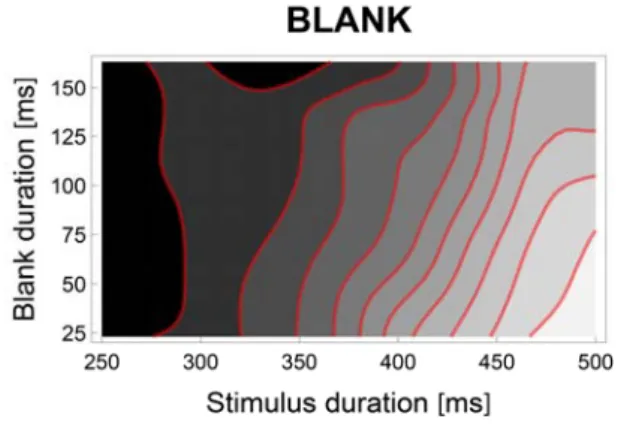
If punctured stimuli are perceived as briefer, does this decrease in perceived duration depend on the duration of puncture? To answer this question, we examined the effect on responses of the second continuous variable, blink or blank duration, which varied from trial to trial. Figure 5 illustrates mean responses in the STRADDLE condition, as a function of both stimulus duration and blink/blank duration. The response patterns in the BLINK and BLANK conditions are quite different. In both conditions, we see a strong dependence of reported duration on stimulus duration (as already seen from the rising curves in Fig. 4)—the contours are mainly vertical. However, the two conditions differ in their dependence on blink or blank duration. In the BLINK condition, on the one hand, there is little systematic dependence of reported durations on the
blink duration. In the BLANK condition, on the other hand, the sloping contours indicate a systematic dependence of perceived duration on the duration of the blank: the longer the blank, the briefer the perceived stimulus. Thus, the decrease in perceived duration due to the puncture seems to depend on the duration of the puncture in the BLANK, but not in the BLINK, condition.
Insert Figure 6 about here
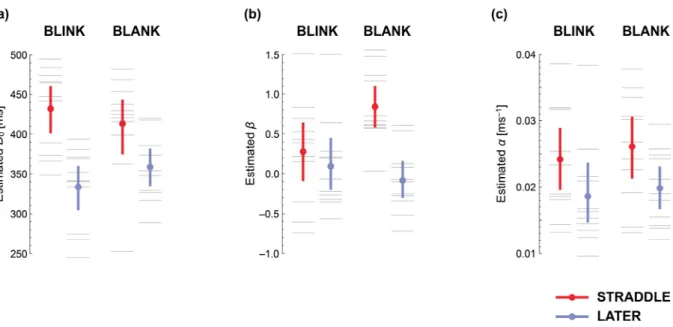
We therefore decided to fit the responses to the 3-parameter model (2), with the perceived duration a linear combination of stimulus and blink/blank durations, separately for each of the four conditions. The results for the 𝐷 and 𝛽 parameters of the model are shown in Figure 6. An ANOVA on 𝐷 showed only a main effect of timing condition: 𝐷 was about 76 ms higher in the STRADDLE than in the LATER conditions (Figure 6a; 𝐹, 57.7, 𝑝 0.001 . This means that, all other factors being equal (durations of the stimulus and of the blink or blank), the punctured STRADDLE stimuli are perceived as being 76 ms briefer on the average than the unpunctured LATER stimuli. This difference is quite close to the mean duration of the blink or blank, 81 ms. Thus, punctured stimuli are judged to have a duration roughly equal to the total duration minus the duration of the puncture. However, the amount of time subtracted due to the puncture seems to be no different for blinks than for blanks, because there was no significant interaction between timing and puncture conditions (𝐹, 1.86, 𝑝 0.1 .
However, the behavior of the 𝛽 (Fig. 6b) parameter shows that there is, in fact, a difference between BLINK and BLANK. In both LATER conditions the mean values of 𝛽 are close to zero (𝛽̅ 0.09 0.20, 0.45 for BLINK, 0.08 0.31, 0.15 for BLANK, with bootstrap-derived 95% confidence intervals given in square brackets); both confidence intervals include zero. This is not surprising: because the blink or blank falls outside the stimulus, it makes sense that its exact duration should have no effect on the perceived duration of the stimulus. The same is true for blinks in the STRADDLE condition: 𝛽̅ 0.28 0.09, 0.65 . However, this is not true for blanks in STRADDLE, where we find that 𝛽̅ 0.84 0.58, 1.10 , and therefore significantly greater than zero. A paired t test on individual estimates revealed that 𝛽 was significantly greater for blanks than for blinks ( 𝑡 3.43, 𝑝 0.006 ). Similarly, a repeated-measures ANOVA revealed a significant interaction between puncture and timing conditions (𝐹, 14.4, 𝑝 0.003).
Finally, the results for 𝛼, the slope of the psychometric curve, are shown in Fig. 6c. Contrary to what one might expect, the slopes are larger in the STRADDLE condition, where the stimulus is punctured, than in the LATER condition, where it is not (𝛼 21.5 in STRADDLE and 19.2 in
LATER). This difference is confirmed by an ANOVA, where the main effect of timing condition is the only significant effect (𝐹, 8.64, 𝑝 0.015).
Thus, the perceived duration of a stimulus that straddles a blink either does not take into account the actual duration of the blink, in a trial-to-trial way, or does so significantly less than when stimuli straddle blanks. Does this mean that stimuli that straddle blinks are perceived as longer than those that straddle blanks? To find out, we fitted the data to the simplified model (3), which only takes into account stimulus duration (but not blink/blank duration). In this model, variations in the 𝐷 parameter quantify differences in perceived duration. We found effects very similar to the ones shown in Fig. 6a, namely large values of 𝐷 in STRADDLE (453 [429, 474] for BLINK, 468 [440, 490] for BLANK) and smaller ones for LATER (346 [328, 364] for BLINK, 357 [336, 376] for BLANK). A repeated-measures ANOVA shows only a main effect of timing condition (𝐹,
78.7, 𝑝 0.0001).
Thus, intervals punctured by blinks seem briefer than unpunctured ones. The average reduction in perceived duration is 98 ms (full model (2)), calculated by taking the difference of the values of 𝐷 between the STRADDLE and LATER conditions. We have shown that, in contrast to blanks, this value is not correlated from trial to trial with the actual duration of each blink—in this sense we can say that the value of the duration reduction is generic. Where can this generic value come from? As we mentioned above, the fact that the reduction in perceived duration is close to the average blink duration—81 ms in this experiment—strongly suggests that the two durations are related. A signal of this relationship would be a within-participant correlation between duration reductions and blink durations, in this condition. We found that the Pearson correlation coefficient between them was 𝑅 0.27, but a bootstrap test showed that the correlation was not significantly different from zero (𝑝 0.26). Therefore we cannot exclude such a correlation, but our experiment does not have enough statistical power to reveal it.
To summarize the results of this experiment: a stimulus punctured by either a blink or a blank is perceived as briefer than an unpunctured stimulus. In the case of blanks, this reduction reflects the actual duration of the blank on each trial. For blinks, however, the reduction in duration is independent of the blink duration, and seems to be a generic value close to the average blink duration.
Discussion
In two experiments we have shown that the perceived duration of darkness during blinks differs from externally caused darkness. The first experiment directly compared blink-induced to externally produced darkness, either directly preceding or directly following a blink. We found that about half of the duration of the blink-induced darkness was discounted with respect to
external darkness. In the second experiment we found that the duration of visual stimuli optically punctured by blinks or blanks was perceived as briefer than that of unpunctured stimuli, regardless of whether the puncture was caused by a blink or a blank (i.e., an externally produced period of darkness). However, in the case of blanks the reduction in perceived duration accurately reflected the duration of the blank, which varied from trial to trial; whereas in the case of blink, the reduction depended much less or not at all on actual blink duration.
The results of Experiments 1a and 1b show that an extra-retinal signal is involved in modulating time perception around blinks, because there is no retinal difference between pre-, intra-, and post-blink darkness. Likewise for Experiment 2: even though the blank condition simulated the retinal information during blinks, the dependence on blink or blank duration differed in the two conditions. Previous studies have found an effect of ocular saccades on temporal perception (Morrone et al., 2005; Yarrow et al., 2001), but more recent work has shown that those effects can be replicated using optically simulated saccades (Knöll et al., 2013; Zimmermann et al., 2014). In contrast, the results that we report here, a reduced perceived duration of blink-induced darkness, do seem to rely on extra-retinal signals.
One of the two results of Experiment 2 was the same for blinks and blanks: stimuli punctured by both blinks and blanks appeared briefer than stimuli without the puncture by about 100 ms, the approximate mean duration of the blinks and blanks. It can also be compared to past studies of slightly longer stimuli, between 0.5 and several seconds, that also found that punctured stimuli are perceived as briefer than unpunctured ones (Fortin et al., 2005, 2009). Interestingly, the presence of the puncture did not decrease the slopes of the psychometric curves, which indicates that the subtraction was probably perceptual rather than deliberate or decisional. It is also notable that, although in stimuli punctured by blanks the interruption appeared much more salient and longer-lasting than in stimuli punctured by blinks, their reported durations were about equal. However, another result of Experiment 2 did distinguish between blinks and blanks: for blanks the amount by which the stimulus appeared briefer tracked trial-by-trial variations in the blank durations. In contrast, for blinks the reduction in perceived duration was much less correlated to actual blink duration on each trial, seeming to be a default value—close to the duration of a typical blink. While we cannot pinpoint the precise mechanism for this effect, there is an argument for why it makes sense. Although the duration of blinks varies from one blink to the next, the variation is not very large. In Experiment 2, for instance, mean duration was 81 ms, and its mean within-participant standard deviation was 25 ms. Thus, the visual system can assume a certain blink duration instead of measuring it without introducing too much error (after all, with slopes of about 20 ms , JNDs are roughly 50 ms—above the typical variability for blink
durations). Blanks, on the other hand, can have any duration whatsoever, and thus it is important to measure their duration.
Another difference between blinks and blanks in Experiment 2 is the voluntary nature of the blinks in contrast to the involuntary nature of blanks. This difference may have a role to play in explaining the different effects that we found of the two types of interruption on the perception of duration, given connections that have been established between voluntary action and time perception (Haggard et al., 2002). It would therefore be interesting in future studies to vary the voluntary/involuntary and blink/blank dimensions in more systemic ways.
There is a seeming contradiction between the results of the first and second experiments. In Experiments 1a and 1b we showed that the durations of blinks are underestimated by about 50% as compared to the intervals of darkness or blanks immediately preceding or following the blink. In the second experiment we found that punctured intervals are perceived as briefer than unpunctured ones—but that this reduction in perceived duration is not significantly smaller for blinks than for blanks. This would be a genuine contradiction if we assumed a single timing mechanism for all visual stimuli. In recent years, however, the notion that there exist multiple timing mechanisms, even within single modalities, has become widespread (Bruno & Cicchini, 2016; Gorea, 2011). Thus, we have some evidence that the timing of blink-induced darkness, and of brief stimuli punctured by blinks, may be performed by distinct timing mechanisms. From a functional perspective it might be useful for the visual system to attenuate the perceived duration of the blackout caused by blinks, for the same reason that it is useful to attenuate the perceptual consequences of actions in general. However, when estimating the duration of external stimuli interrupted by blinks, a generic time interval is discarded from the duration of the stimulus, likely due to the fact that the external world usually does not change much in the blink of an eye, making it unnecessarily costly to keep precise track of the duration of the interruption.
It is also worth pointing out that Experiments 1 and 2 may not actually be in contradiction to one another, simply because they test quite different situations. In Experiment 1 the objective total duration is 𝐷 𝐷 / , so if the observer were veridically reporting the total duration, we
would find that 𝛽, the coefficient of 𝐷 in our model 𝛽𝐷 𝐷 / , to be equal to 1. In contrast, in Experiment 2 there is no clear objective total duration. On one hand, one could fill in the interruption, in a temporal analogue to the spatial filling-in of scotomas. In that case, the correct duration would be 𝐷 , and the coefficient 𝛽 in our model 𝐷 𝛽𝐷 would be equal to 0. On the other hand, the dark interval could be subtracted from the perceived duration, in which case we would have 𝛽 1. The point is that the status of the 𝛽 parameter is quite different in Experiments 1 and 2, despite the similar-looking models. As it turns out, there is a
decrease in perceived duration due to the interruption, but that the decrease depends differently on the duration of blinks than on the duration of blanks. In short, the results of Experiments 1 and 2 may not be immediately comparable because of the differences in the stimuli.
Two recent studies have put forward a hypothesis compatible with ours, namely that alterations in time perception help to bring about visual continuity during blinks (Grossman et al., 2019; Irwin & Robinson, 2016). Both of these studies feature experiments similar to a subset of our Experiment 2, in which the perceived duration of visual intervals punctured by blinks is compared to unpunctured intervals—and both find results similar to our Experiment 2, namely that blink-punctured intervals are perceived as briefer than unblink-punctured intervals, by about the average duration of the blink. It is interesting to note that one of these studies was carried out using spontaneous blinks (Grossman et al., 2019) rather than the voluntary blinks used here. As mainly automatic actions, these spontaneous blinks are at least partially physiologically distinct from the voluntary blinks in our study (VanderWerf et al., 2003). Nevertheless, the fact that perceived interval duration is discounted by the same amount, on the average, for involuntary as for voluntary blinks, and by a similar amount for completely involunary blanks, shows once again that the decrease in perceived duration, at least on the average, may be independent of the detailed motor aspects of the interruption.
In addition to the discounting of the perceived duration of blink-punctured intervals that we find in common with the two recent studies (Grossman et al., 2019; Irwin & Robinson, 2016), here we also compared intervals punctured by blinks to those punctured by blanks, and found that both are perceived as briefer, by about the same amount. Furthermore, we were able to demonstrate a difference between blinks and blanks: whereas, for blanks, the shortening of perceived duration depends on the actual duration of the blanks, this is not the case for blinks.
The discounted perception of blink durations (Experiment 1) or their unavailability for further processing (Experiment 2) could be a special case in which the reafferent sensory effects of our motor actions are reduced or discarded from perceptual processing (see, for example, Blakemore, Wolpert, & Frith, 1998; Cardoso-Leite, Mamassian, Schütz-Bosbach, & Waszak, 2010). A corollary signal could achieve this discounting by dampening general processing of that information— accounting for diminution of brain activity found around blinks (Bristow, Frith, et al., 2005; Bristow, Haynes, et al., 2005) and inhibition of the neural reaction to the onset of the interruption of light (Gawne & Martin, 2000, 2002). Time compression could be a behavioral marker of this decreased processing, in agreement with the notion that the amount of energy committed to processing environmental stimuli accounts for the perception of duration (Eagleman & Pariyadath, 2009; see Wittmann & van Wassenhove, 2009 for a theoretical review), or, more
generally, with distributed mechanisms of time perception, in which perceived duration of perceptual events is derived directly from the operation of intrinsic perceptual circuits (Ivry & Schlerf, 2008; Muller & Nobre, 2014).
A spatial analog of the temporal interruption of visual information by blinks is the blind spot, which is perceptually filled in. Two types of theories have been proposed for the filling-in (Weil & Rees, 2011): either the visual system simply ignores the absence of information, or it actively fills in the missing area of the visual field. These theories can be translated to the temporal gap created by blinks: does the visual system ignore the gap, in effect ‘going to sleep’ at the start of the blink and ‘waking up’ near the end, or does it actively interpolate information across the gap? Our results, showing that information about durations being discounted or becoming unavailable across the blink suggest that the gap is simply ignored.
Author contributions
All authors contributed to the study design. Stimuli were programmed by M. Duyck and M. Wexler. Data was collected by M. Duyck. M. Duyck and M. Wexler performed the data analysis. All authors contributed to the manuscript and approved the final version for submission.
Acknowledgments
This work was supported by a doctoral fellowship given to MD by the Direction Générale de l’Armement. We thank Matteo Lisi for his generous help with the data analysis, and Arielle Veenemans for help in testing.
References
Ando, K., & Kripke, D. F. (1996). Light attenuation by the human eyelid. Biological
Psychiatry, 39(1), 22–25. https://doi.org/10.1016/0006-3223(95)00109-3
Bentivoglio, A. R., Bressman, S. B., Cassetta, E., Carretta, D., Tonali, P., & Albanese, A.
(1997). Analysis of blink rate patterns in normal subjects. Movement Disorders, 12(6), 1028–
1034. https://doi.org/10.1002/mds.870120629
Blakemore, S. J., Wolpert, D. M., & Frith, C. D. (1998). Central cancellation of self-produced
tickle sensation. Nature Neuroscience, 1(7), 635–640.
Bristow, D., Frith, C., & Rees, G. (2005). Two distinct neural effects of blinking on human
visual processing. NeuroImage, 27(1), 136–145.
https://doi.org/10.1016/j.neuroimage.2005.03.037
Bristow, D., Haynes, J.-D., Sylvester, R., Frith, C. D., & Rees, G. (2005). Blinking
Suppresses the Neural Response to Unchanging Retinal Stimulation. Current Biology, 15(14),
1296–1300. https://doi.org/10.1016/j.cub.2005.06.025
Bruno, A., & Cicchini, G. M. (2016). Multiple channels of visual time perception. Current
Opinion in Behavioral Sciences, 8, 131–139. https://doi.org/10.1016/j.cobeha.2016.02.028
Burr, D. C. (2005). Vision: In the Blink of an Eye. Current Biology, 15(14), R554–R556.
https://doi.org/10.1016/j.cub.2005.07.007
Cardoso-Leite, P., Mamassian, P., Schütz-Bosbach, S., & Waszak, F. (2010). A new look at
sensory attenuation. Action-effect anticipation affects sensitivity, not response bias.
Psychological Science, 21(12), 1740–1745. https://doi.org/10.1177/0956797610389187
Eagleman, D. M., & Pariyadath, V. (2009). Is subjective duration a signature of coding
efficiency? Philosophical Transactions of the Royal Society of London. Series B, Biological
Sciences, 364(1525), 1841–1851. https://doi.org/10.1098/rstb.2009.0026
Fortin, C., Bédard, M.-C., & Champagne, J. (2005). Timing during interruptions in timing.
Journal of Experimental Psychology. Human Perception and Performance, 31(2), 276–288.
https://doi.org/10.1037/0096-1523.31.2.276
Fortin, C., Fairhurst, S., Malapani, C., Morin, C., Towey, J., & Meck, W. H. (2009).
Expectancy in humans in multisecond peak-interval timing with gaps. Attention, Perception,
& Psychophysics, 71(4), 789–802. https://doi.org/10.3758/APP.71.4.789
Gawne, T. J., & Martin, J. M. (2000). Activity of Primate V1 Cortical Neurons During Blinks.
Journal of Neurophysiology, 84(5), 2691–2694.
Gawne, T. J., & Martin, J. M. (2002). Responses of primate visual cortical neurons to stimuli
presented by flash, saccade, blink, and external darkening. Journal of Neurophysiology, 88(5),
2178–2186. https://doi.org/10.1152/jn.00151.200
Gorea, A. (2011). Ticks per thought or thoughts per tick? A selective review of time
perception with hints on future research. Journal of Physiology, Paris, 105(4–6), 153–163.
https://doi.org/10.1016/j.jphysparis.2011.09.008
Grossman, S., Guata, C., Pesin, S., Malach, R., & Landau, A. (2019). Where does time go
when you blink?
Haggard, P., Clark, S., & Kalogeras, J. (2002). Voluntary action and conscious awareness.
Nature Neuroscience, 5(4), 382–385. https://doi.org/10.1038/nn827
Irwin, D. E., & Robinson, M. M. (2016). Perceiving a continuous visual world across
voluntary eye blinks. Journal of Experimental Psychology. Human Perception and
Performance, 42(10), 1490–1496. https://doi.org/10.1037/xhp0000267
Ivry, R. B., & Schlerf, J. E. (2008). Dedicated and intrinsic models of time perception. Trends
in Cognitive Sciences, 12(7), 273–280. https://doi.org/10.1016/j.tics.2008.04.002
Knöll, J., Morrone, M. C., & Bremmer, F. (2013). Spatio-temporal topography of saccadic
overestimation of time. Vision Research, 83, 56–65.
https://doi.org/10.1016/j.visres.2013.02.013
Manning, K. A., Riggs, L. A., & Komenda, J. K. (1983). Reflex eyeblinks and visual
suppression. Perception & Psychophysics, 34(3), 250–256.
https://doi.org/10.3758/BF03202953
Morgan, M. J., Watamaniuk, S. N. J., & McKee, S. P. (2000). The use of an implicit standard
for measuring discrimination thresholds. Vision Research, 40(17), 2341–2349.
Morrone, M. C., Ross, J., & Burr, D. C. (2005). Saccadic eye movements cause compression
of time as well as space. Nature Neuroscience, 8(7), 950–954. https://doi.org/10.1038/nn1488
Moseley, M. J., Bayliss, S. C., & Fielder, A. R. (1988). Light transmission through the human
eyelid: In vivo measurement. Ophthalmic & Physiological Optics: The Journal of the British
College of Ophthalmic Opticians (Optometrists), 8(2), 229–230.
Muller, T., & Nobre, A. C. (2014). Perceiving the passage of time: Neural possibilities.
Annals of the New York Academy of Sciences, 1326, 60–71.
https://doi.org/10.1111/nyas.12545
Ponder, E., & Kennedy, W., P. (1927). On the act of blinking. Quarterly Journal of
Experimental Physiology, 18(2), 89–110.
Riggs, L. A., Volkmann, F. C., & Moore, R. K. (1981). Suppression of the blackout due to
blinks. Vision Research, 21(7), 1075–1079.
Robinson, J., Bayliss, S. C., & Fielder, A. R. (1991). Transmission of light across the adult
and neonatal eyelid in vivo. Vision Research, 31(10), 1837–1840.
Slater-Hammel, A. T. (1953). Blackout Interval during Eye Blinks. Research Quarterly.
American Association for Health, Physical Education and Recreation, 24(3), 362–367.
https://doi.org/10.1080/10671188.1953.10624933
Stevenson, S. B., Volkmann, F. C., Kelly, J. P., & Riggs, L. A. (1986). Dependence of visual
suppression on the amplitudes of saccades and blinks. Vision Research, 26(11), 1815–1824.
VanderWerf, F., Brassinga, P., Reits, D., Aramideh, M., & Ongerboer de Visser, B. (2003).
Eyelid Movements: Behavioral Studies of Blinking in Humans Under Different Stimulus
Conditions. Journal of Neurophysiology, 89(5), 2784–2796.
https://doi.org/10.1152/jn.00557.2002
Volkmann, F. C. (1986). Human visual suppression. Vision Research, 26(9), 1401–1416.
Volkmann, F. C., Riggs, L. A., Ellicott, A. G., & Moore, R. K. (1982). Measurements of
visual suppression during opening, closing and blinking of the eyes. Vision Research, 22(8),
991–996.
Volkmann, F. C., Riggs, L. A., & Moore, R. K. (1980). Eyeblinks and visual suppression.
Science (New York, N.Y.), 207(4433), 900–902.
Weil, R. S., & Rees, G. (2011). A new taxonomy for perceptual filling-in. Brain Research
Reviews, 67(1–2), 40–55. https://doi.org/10.1016/j.brainresrev.2010.10.004
Wittmann, M., & van Wassenhove, V. (2009). The experience of time: Neural mechanisms
and the interplay of emotion, cognition and embodiment. Philosophical Transactions of the
Royal Society B: Biological Sciences, 364(1525), 1809–1813.
https://doi.org/10.1098/rstb.2009.0025
Yarrow, K., Haggard, P., Heal, R., Brown, P., & Rothwell, J. C. (2001). Illusory perceptions
of space and time preserve cross-saccadic perceptual continuity. Nature, 414(6861), 302–305.
https://doi.org/10.1038/35104551
Zimmermann, E., Born, S., Fink, G. R., & Cavanagh, P. (2014). Masking produces
compression of space and time in the absence of eye movements. Journal of
Neurophysiology, 112(12), 3066–3076. https://doi.org/10.1152/jn.00156.2014
Figures
Figure 1. (a) The timeline of a trial in the BLINK condition in Experiment 1a. Here, darkness is maintained for a variable duration following a blink. The blink latency and duration are given as mean values with between-participant standard deviations. The durations of the delay preceding the go signal, and the post-blink darkness were drawn randomly from uniform distributions with the limits shown. (b) The timeline of a trial in Experiment 1b, where the duration of the blink-induced darkness is artificially lengthened by a preceding period of darkness.
Figure 2. Results of Experiments 1a and 1b and their interpretation. (a) In our presentation of the raw data, each trial is shown as a dot, with the horizontal coordinate representing blink duration, and the vertical coordinate representing the duration of the additional darkness period, either post-blink (Experiment 1a) or pre-blink (Experiment 1b). The dot’s color codes the response: blue for “brief” and green for “long”. The two graphs illustrate hypothetical data at the two limits of our model, in which perceived duration is proportional to a linear combination of blink and post/pre-blink durations, 𝛽𝐷 𝐷 . The top graph shows hypothetical data for 𝛽 1, when the perceived duration depends veridically on the total duration, 𝐷 𝐷 . The bottom graph shows the case 𝛽 0 , when perceived duration depends on 𝐷 alone (and therefore the blink duration is discounted completely). (b) Data of four representative participants in Experiment 1a. The lines of subjective equality as determined by the model are shown in red, and corresponding estimates of 𝛽 are given above each graph. (c) The estimated values of 𝛽 for the individual participants in Experiment 1a (“POST”) and Experiment 1b (“PRE”) are shown in gray. The four participants whose data are shown in panel (b) are highlighted with dashed lines. The estimated population mean values of 𝛽 are shown as dots for the two experiments, with the bars showing the bootstrap-derived 95% confidence intervals of the mean. The fact that the estimates of 𝛽 are significantly smaller than 1 implies that the duration of the blink is estimated with a lower gain than the periods of darkness immediately preceding or following the blink.
Figure 3. Time course of trials in Experiment 2. In the STRADDLE condition, the stimulus straddles the interruption (blink or blank), whereas in the LATER condition, the stimulus is presented 200 ms after the blink or the blank. When we talk about “stimulus duration,” we mean the time from the initial appearance of the stimulus to its final disappearance.
Figure 4. Data of Experiment 2, for 3 representative subjects (the three columns). The curves show smoothed responses (expressed as the fraction of “long” responses) as a function of total stimulus duration (scale shown on the bottom right graph). The red curves show the STRADDLE condition, in which the visual stimulus straddles the blink or blank, while the blue-gray curves show the LATER condition, in which the stimulus occurs after the blink or blank. The top panels show the BLINK condition, while the bottom panels show the BLANK condition.
Figure 5. Mean response as a function of stimulus duration and blink/blank duration in the BLINK and BLANK interruption conditions, in the STRADDLE timing condition of Experiment 2. Responses are coded in shades of gray, with lighter shades indicating more frequent “long” responses. In the BLINK condition the contour lines are mainly vertical, which means that there is little systematic dependence on blink duration. In the BLANK condition, in contrast, the contours are diagonal, especially on the right-hand side of the graph. The diagonal contours indicate that stimuli were systematically reported as briefer with increasing blank duration. (Individual data were smoothed using a Gaussian kernel with width 20 ms. Data for all participants have been averaged by normalizing each participant’s blink/blank duration range and averaging the normalized data.)
Figure 6. Model results of Experiment 2. (a) The constant 𝐷 parameter in the three-parameter model. The four combinations of interruption and timing conditions are shown in separate columns. Gray horizontal lines show parameter estimates for individual participants, dots sample means, and vertical bars bootstrap-derived 95% confidence intervals of the means. Here, only the main effect of timing condition is significant, with 𝐷 in the STRADDLE conditions significanly higher than in the LATER conditions. This means that a stimulus punctured by either a blink or a blank is perceived as significantly briefer than an unpunctured stimulus. (b) The 𝛽 parameter, quantifying how much of the interruption duration is subtracted from the total duration. In the STRADDLE condition, 𝛽 is significantly higher in the BLANK than in the BLINK condition (it is not significantly different from 0 in BLINK, and not significantly different from 1 in BLANK). It is also not significantly different from 0 in the LATER conditions. Thus, when a visual stimulus is punctured, participants seem to have less access to the duration of the puncture for blinks than for blanks. (c) The 𝛼 parameter, which is the slope of the psychometric curve. The only significant effect is that of the timing condition, showing that the slope is significantly greater in the STRADDLE condition where the stimulus is punctured by a blink or a blank than in the LATER condition where it is not punctured.