Speed of call delivery is related to context and caller identity
in Campbell
’s monkey males
Alban Lemasson&Karim Ouattara&Hélène Bouchet& Klaus Zuberbühler
Abstract Call rate can be a salient feature in animal communication. Depending on the species, different psy-chological variables appear to influence call rates but the exact nature of these relationships remains poorly explored. Here, we demonstrate for free-ranging Campbell’s monkeys that the call rates of four different alarm series (termed H, K, K+, and B series) vary systematically as a function of context, associated behaviour, and identity of the caller. K+ series were given more rapidly to predation than non-predation events, K+ and K series more rapidly to visual than auditory predator detection, and H series more rapidly while counterattacking an eagle than staying put. Finally, there were individual differences in B series, suggesting that call rate potentially provides listeners with cues about the caller’s anti-predator behaviour, event type experienced, and his identity.
Keywords Prosody . Tempo . Semantic . Loud call . Cercopithecus . Predation
Introduction
Animal communication research has revealed a number of ways by which individuals signal their motivations, behavioural intentions, or assessments of external events (Blumstein 1995). One mechanism is to produce calls of distinct acoustic structures in response to very specific external events, such as a particular type of predator (vervet monkeys, Seyfarth et al.1980). However, prosodic features are also common in animal communication, such as changes in amplitude of individual calls or in the relative or absolute frequency of calls. For example, marmots produce single notes to aerial and multiple notes to terrestrial disturbances (Blumstein and Arnold 1995), whereas blue monkeys produce more eagle alarms if group members are close than far from a suspected eagle (Papworth et al.2008). In response to food, some primates respond with more calls depending on whether or not food is preferred (Hauser and Marler 1993; Dittus 1984), divisible (Hauser et al. 1993), or whether or not they are with allies (Slocombe et al.2010).
A related mechanism is to vary the call rate within an entire bout, series, or sequence, which can be independent of call number. For example, tufted capuchin monkeys produce‘hiccup’ alarms to terrestrial predators, but there is a positive correlation between the initial call rate and urgency of the situation (Wheeler 2010). Similarly, tamar-ins produce higher rates of food calls to preferred than non-preferred foods (Caine et al. 1995; Roush and Snowdon
2001). Differences in call rates and rhythmicity have also been found in bird song with possible links to context A. Lemasson (*)
:
K. Ouattara:
H. BouchetEthologie Animale et Humaine, U.M.R.6552-C.N.R.S, Université de Rennes 1, Station Biologique,
35380 Paimpont, France
e-mail: [email protected] K. Ouattara
Laboratoire de Zoologie et Biologie Animale, Université de Cocody,
10 BP770 Abidjan 10, Côte d’Ivoire K. Zuberbühler
School of Psychology, University of St Andrews, KY16 9JP St Andrews, Scotland, UK
K. Ouattara
:
K. ZuberbühlerCentre Suisse de Recherches Scientifiques, Taï Monkey Project, 01 BP1303 Abidjan 01, Côte d’Ivoire
(Holland et al. 2000). In humans, the rate of sound production, a prosodic feature, is important in conversations and can encode a variety of underlying psychological
processes, as well as speaker identity (Scherer et al.2002;
Ethofer et al.2009), processes that have also been proposed
for non-human primates (Scherer and Kappas1988; Owren
and Rendall1997).
In earlier work, we have shown that male Campbell’s monkeys (Cercopithecus campbelli) produce six loud call types (K+, W+, H+, K, H, and B) to a range of external
events (Ouattara et al.2009a). These calls are concatenated
into context-specific sequences, such as to neighbouring groups, falling trees, crowned eagles, leopards, or the desire
to change the location (Ouattara et al. 2009b). In pilot
observations, we noted that four call types (H, K, K+, and B) varied in their speed of delivery within sequences, which led us to hypothesise that call rate differences might co-vary with caller identity and the context experienced by the caller (perceived threat, mode of predator detection, and anti-predator behaviour) beyond what is already encoded by the composition of the sequence. In particular, we predicted a general positive correlation between call rates and levels of threat, but individual differences in call rates to be more prominently visible in less dangerous situations.
Material and methods
We recorded call sequences from three habituated Campbell’s
monkey males in Taï National Park, Ivory Coast. Data were collected between January 2006 and September 2007 from two one-male groups composed of 14 and 10 individuals, respectively. In December 2006, the male of group 1 (M1) disappeared and was succeeded by another male (M2). The male of group 2 (M3) maintained his tenure throughout the study. Observations consisted of 15-min focal and ad libitum samples collected between 0800 and 1700 hours GMT. Observation conditions in this rainforest habitat prevented us from uninterrupted monitoring of subjects, although all were well habituated to human observers. KO managed to collect 40 h of focal samples: M1, 14 h (11 months); M2, 6 h (7 months); and M3, 20 h (6 months). Ad libitum sampling over about 2,000 h generated an additional sample of N= 2,479 calls combined in sequences. For all these sequences, the observer recorded the associated behaviour and any unusual event preceding the call, e.g. a falling of tree or large branch, the detection of a leopard (Panthera pardus) or crowned eagle (Stephanoaetus coronatus) or the alarm calls of nearby Diana monkeys (Cercopithecus diana), for which
Campbell’s monkeys understand the referring external event
(Zuberbühler2001). Natural encounters with real predators
were rare (leopards: N=3; crowned eagles: N=11). We therefore conducted field experiments during which we
presented predator models, either by positioning a visual replica or by broadcasting playbacks of predators’ vocal-isations (N=6 per stimulus category). To avoid habituation, we spaced trials by at least 2 months.
To investigate the relation between call delivery rate, context, and caller identity, we selected all sequences produced to (a) crowned eagles (composed of series of K+, W+, H+, or H calls); (b) leopards (composed of series of
K+or K calls); and (c) falling trees (composed of series B
and K+calls). To standardise comparisons, we focussed on
sequence fragments, consisting of series of the same calls (K+, K, H, B) and measured all inter-call durations using RAVEN 1.3 (sampling rate: 44,100 Hz, accuracy: 16 bit). We then allocated each series to its original context of emission, that is (a) the level of threat: predatory (crowned eagle, leopard) vs. non-predatory (falling tree or branch), (b) the mode of detection: visual (real predator, predator model) vs. auditory (Diana monkey alarms, predator call playbacks), (c) the caller’s own anti-predator behaviour: attack (run towards the predator and charge it from a distance of about 2 m) vs. stay (maintain a safe distance of at least 10 m), and (d) the caller’s identity: M1, M2, and M3. We extracted inter-call durations from suitable call series of 90 different sequences, that is, 90 different events (N[M1/M2/M3] = Eaglevisual[6/6/6], Eagleacoustic[6/4/5], Leopardvisual[5/2/5], Leopardacoustic[4/1/2], Tree fall[18/15/5]).
We compared each call series type (i.e., H, K, or K+series)
using a general linear mixed model with context and caller identity as fixed factors and sequence as the random factor (nested within individual) [Inter-call duration∼Context+ Individual + Context × Individual + Sequence(individual)], followed by pair-wise comparisons. In some cases, one or two males did not produce series composed of only one call type and could not be included in the analysis. Individual differences related to B series during tree falls were assessed with a two-tailed Kruskal–Wallis test and a PIC index (potential for individual identity coding=inter-individual co-efficient of variation/mean of intra-individual coefficients
of variation; Robisson et al.1993).
Results
Predatory vs. non-predatory
K+ series were given to a range of disturbances including
falling trees, crowned eagles, and leopards. The series was delivered at significantly higher call rates to predator-related than non-predator-related events in a non-individualised way
(Context: F4,28.1=22.45, P≤0.001; Individual: F2,31.2=2.01,
P= 0.151; Context × Individual: F5,31.5= 2.37, P= 0.06;
GLMM; see pair-wise comparisons in Fig. 1a), but not
Mode of detection
K+series were delivered at significantly higher call rates if
the caller could see the predator compare to detecting it
acoustically (Fig. 1a; eagle: all three males; leopard: M3
only; M1–2 alternated between K and K+or produced pure
K series). Calls in K series were also delivered significantly more rapidly if the caller could see the leopard rather than
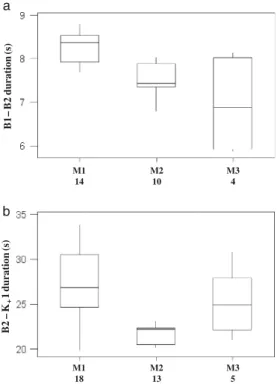
M1 18 M2 13 M3 5 B2 – K+ 1 duration (s) M1 14 B1 – B 2 duration (s) M2 10 M3 4 a b
Fig. 3 Individual call rate differences in the B series of sequences to falling trees. Sequence sample sizes are indicated below each male (M) 0 0,2 0,4 0,6 0,8 1 1,2 1,4 1,6 1,8 Attack Wait M1 20 (3) M1 15 (3) M3 15 (3) M3 20 (5) Anti-predator behaviour Mean inter -H duration (s) SE
***
Fig. 2 Call delivery rates of H sequences produced as part of different anti-predator behaviour. Two males (M) produced significantly shorter inter-call intervals while attacking (white bars) a real or model crowned
eagle than staying put (black bars) (***P≤0.001). Inter-call duration
sample sizes are indicated below each context. These intervals were measured in several sequences; sample sizes are indicated in brackets
Mean inter -K+ duration (s) SE Disturbance
a
0 1 2 3 4 5 6 7 42 (6) M1 61 (4) M1 65 14) M1 48 (5) M1 36 (5) M2 77 (3) M2 78 (12) M2 37 (4) M3 38 (4) M3 38 (5) M3 43 (5) M3 44 (2) M3 ** * *** *** *** *** Ev Ea T La Lv Disturbance Mean inter -K duration (s) SE 18 (4) 114 (5) 44 (4) 48 (2) 0 1 2 3 4 5 M1 M1 M3 M3 **b
Lv LaFig. 1 Call delivery rates of K+and K sequences produced to different
disturbances. a All three males (M) produced significantly longer inter-call intervals to falling trees (T–black bars) than to predatory eagles
(E–unstriped bars) or leopards (L–striped bars; pair-wise comparisons:
*P≤0.05, **P≤0.01, ***P≤0.001). Inter-call intervals did not differ
between predator types (Ea−La: P=0.256; Ev−Lv: P=0.9). Visual (v–white
bars) predator detection caused significantly shorter inter-call intervals than
acoustic (a–grey bars) detection. b Two males produced significantly
longer inter-call intervals to acoustic (squared bars) than visual (spotted
bars) leopard detection (pair-wise comparisons: **P≤0.01). Inter-call
duration sample sizes are indicated below each context. These intervals were measured in several sequences; sample sizes are indicated in brackets
hear it (Context: F1,8.7=12.21, P≤0.01; Individual: F1,8.7=
7.91, P≤0.05; Context×Individual: F1,8.7=1.44, P=0.262;
GLMM; Fig.1b; M1–3 only; M2 never produced pure K
series).
Anti-predator behaviour
To leopards, males sometimes approached in an attempt to establish visual contact at a safe distance while producing alarm call sequences. To crowned eagles, M1 and 3 sometimes attacked, and in these cases, their H series were delivered significantly more rapidly than if they remained
(Context: F1,66=27.84, P≤0.001; Individual: F1,66=2.36,
P= 0.129; Context × Individual: F1,66= 3.35, P= 0.072;
GLMM; Fig.2).
Individual differences
K+ sequences in response to falling trees were always
preceded by two B calls, and the three males differed significantly in the inter-B durations (Kruskal–Wallis test,
dl=2, H=11.89, P<0.01, Fig.3a) as well as in the inter-call
intervals between the B and subsequent K+ series (H=
14.85, dl=2, P<0.001, Fig. 3b), with high potentials for
identity coding (PICB1−B2= 1.05, PICB2−K+1= 1.55). We
found no individual differences in the delivery of K+ and
H series, but M3 and M1 differed significantly in the production of K series to leopard (see previous GLMM
analysis; Fig. 1b).
Discussion
We have shown that sections of the call sequences
produced by Campbell’s monkeys vary in their temporal
organisation in systematic ways, hereby potentially gener-ating cues for receivers that are not yet conveyed by calls or sequence concatenation. Specifically, we have shown that caller identity, level of threat, mode of detection, and type of anti-predator behaviour were reliably linked with
differ-ences in call rates. K+series, which have an unspecific alert
function (Ouattara et al. 2009a), were slower in
non-predatory than non-predatory contexts. We found no call rate effects related to predator types, but faster rates in cases of
visual than auditory predator detection for both K+series to
both predators, and K series to leopards specifically. For H series, the critical variable was whether or not the caller attacked the eagle.
One interpretation of these findings is that differences in call rates within sequences are related to the psychological state induced by the eliciting stimuli. It seems safe to assume that non-predatory events, such as falling branches, rank lower in terms of perceived threat than predators.
Also, seeing a predator may be perceived as more urgent than hearing its calls from a distance or via the alarm calls
of another species (Blumstein et al. 2000; Schel et al.
2009). The relationship between the psychological states
experienced by an animal and the morphology of the generated sound is poorly understood. Most researchers tacitly assume a gradual relationship, with increased arousal leading to increased changes in the acoustic features, although there are no strong reasons to rule out other types of relations, such as a threshold function.
One call series, the B series, differed individually, something that has been found previously in penguins
(Searby et al. 2004). Many forest guenons produce
stereotypic series of B calls to various non-predatory events
(Gautier 1988). In Campbell’s monkeys, B series always
consist of two calls, but inter-call intervals differed reliably between individuals. Campbell’s monkeys discriminate between other subtle acoustic features (Lemasson et al.
2005), suggesting that the monkeys perceive these
biolog-ically relevant cues of identity.
In conclusion, male Campbell’s monkeys produce a rich set of acoustic cues, which co-vary systematically with several event features experienced by the caller, many of which are crucial for listeners in order to make adaptive decisions. Although the necessary playback experiments have yet to be done, a variety of evidence from closely related species suggests that listeners would attend to these features to identify individuals (Cercopithecus nictitans;
Arnold and Zuberbühler 2008) and to draw inferences
about external events (Arnold and Zuberbühler2008).
Acknowledgements Funding was by the European Commission
(FP6“What it means to be human”), ESF-Eurocore (“Origin of Man,
Language and Languages”), the French ministry of foreign affairs, the
Centre Suisse de Recherches Scientifiques, the Leverhulme Trust,
PICS-CNRS and ANR “Orilang”. We are grateful to the Office
Ivoirien des Parcs et Réserves for permissions in conducting this study and to the Wissenschaftskolleg zu Berlin for the support.
References
Arnold K, Zuberbühler K (2008) Meaningful call combinations in a
non-human primate. Curr Biol 18:202–203
Blumstein DT (1995) Golden-marmot alarm calls. I. The production of situationally specific vocalizations. Ethology 100:113–125 Blumstein DT, Arnold W (1995) Situational specificity in
Alpine-marmot alarm communication. Ethology 100:1–13
Blumstein DT, Daniel JC, Griffin AS, Evans C (2000) Insular tammar wallabies (Macropus eugenii) response to visual but not acoustic
cues from predators. Behav Ecol 11:528–535
Caine NG, Addington RL, Windfelder TL (1995) Factors affecting the rates of food calls given by red-bellied tamarins. Anim Behav
50:53–60
Dittus WPJ (1984) Toque macaque food calls: semantic communica-tion concerning food distribucommunica-tion in the environment. Anim
Ethofer T, Van De Ville D, Scherer K, Vuilleumier P (2009) Decoding of emotional information in voice-sensitive cortices. Curr Biol
19:1028–1033
Gautier J-P (1988) Interspecific affinities among guenons as deduced from vocalizations. In: Gautier-Hion A, Bourlière F, Gautier J-P, Kingdon J (eds) A primate radiation: evolutionary biology of the
African guenons. University Press, Cambridge, pp 194–226
Hauser MD, Marler P (1993) Food-associated calls in rhesus macaques (Macaca mulata): II. Costs and benefits of call
production and suppression. Behav Ecol 4(3):206–212
Hauser MD, Teixidor P, Field L, Flaherty R (1993) Food-elicited calls in chimpanzees: effects of food quality and divisibility. Anim Behav 45:817–819
Holland J, Dabelsteen T, Lopez Paris A (2000) Coding in the song of the wren: importance of rhythmicity, syntax and element
structure. Anim Behav 60:463–470
Lemasson A, Zuberbühler K, Hausberger M (2005) Socially meaningful
vocal plasticity in Campbell’s monkeys. J Comp Psychol 119:220–229
Ouattara K, Lemasson A, Zuberbühler K (2009a) Campbell’s monkeys
use affixation to alter call meaning. PLoS ONE 4(11):e7808 Ouattara K, Lemasson A, Zuberbühler K (2009b) Wild Campbell's
monkeys concatenate vocalizations into context-specific call
sequences. Proc Natl Acad Sci USA 106(51):22026–22031
Owren MJ, Rendall B (1997) An Affect‐Conditioning Model of
Nonhuman Primate Vocal Signaling. In: Owings DH, Beecher MD, Thompson NS (eds) Perspectives in Ethology, Vol. 12.
Plenum Press, New York., pp 299–346
Papworth S, Böse A‐S, Barker J, Schel AM, Zuberbühler K (2008) Male blue monkeys alarm call in response to danger experienced by others. Biology Letters 4:472–475
Robisson P, Aubin T, Brémond JC (1993) Individuality in the voice of emperor penguin Aptenodytes forsteri: adaptation to a noisy
environment. Ethology 94:279–290
Roush RS, Snowdon CT (2001) Food transfer and development of feeding behaviour and food-associated vocalization in Cotton-top
tamarins. Ethology 107:415–429
Schel AM, Tranquilli S, Zuberbühler K (2009) The alarm call system of black-and-white colobus monkeys. J Comp Psychol
123:136–150
Scherer KR, Kappas A (1988) Primate vocal expression of affective state. In: Todt D, Goedeking P, Symmes D (eds) Primate vocal communication. Springer-Verlag, Berlin, pp 171–194
Scherer KR, Grandjean D, Johnston T, Klasmeyer G, Bänziger T (2002) Acoustic correlates of task load and stress. Proceedings of
ICSLP:2017–2020
Searby A, Jouventin P, Aubin T (2004) Acoustic recognition in macaroni penguins: an original signature system. Anim Behav
67:615–625
Seyfarth RM, Cheney DL, Marler P (1980) Monkey responses to three different alarm calls: evidence of predator classification and
semantic communication. Science 210:801–803
Slocombe KE, Kaller T, Turman L, Townsend S, Papworth S, Squibbs P, Zuberbühler K (2010) Production of food-associated calls in wild male chimpanzees is dependent on the composition of the audience. Behav Ecol Sociobiol (in press)
Wheeler BC (2010) Production and perception of situationally variable alarm calls in wild tufted capuchin monkeys (Cebus apella nigritus). Behav Ecol Sociobiol 64:989–1000
Zuberbühler K (2001) Predator-specific alarm calls in Campbell's guenons. Behav Ecol Sociobiol 50:414–422