Gifts, emotions and cognitive processes: An inquiry
of gift receiving from a consumer psychology
perspective
A dissertation presented by
Marta Pizzetti
Supervised by
Prof. Michael Gibbert
Prof. Peter Seele
Submitted to the
Faculty of Communication Sciences
Università della Svizzera italiana
for the degree of
Ph.D. in Communication Sciences
i
Board
Prof. Dr. Chiara Orsingher, Alma Mater Studiorum – Università di Bologna, Italy Prof. Dr. Isabella Soscia, Skema Business School, France
Prof. Dr. Michael Gibbert, Università della Svizzera italiana, Switzerland Prof. Dr. Peter Seele, Università della Svizzera italiana, Switzerland
Officially submitted to the Ph.D. committee of the Faculty of Communication Sciences, Università della Svizzera italiana, in February 2016.
ii
iii
Summary
Gift exchange is a universal, social, cultural, and economic phenomenon. Over the past 90 years, it has fascinated scholars from different disciplines within the social sciences thanks to its diffusion across societies and centuries. Since Marcel Mauss’ foundational paper (1925), scholars have agreed on the social integrative function of gifts, which are tools to build and maintain relationships. Giving gifts generates a virtuous circle of reciprocity, within which gifts are exchanged to attain a balanced reciprocity between the parties. Gifts are also intrinsically associated with identity definition and influence recipients’ and givers’ self-view. Above all, the gift is a symbolic communication, “a language that employs objects instead of words as its lexical elements” (Caplow, 1984, p. 1320), by which the giver communicates a variety of meanings, such as affection for the recipient, image of the recipient, or intention with regard to the relationship with the recipient.
Because of gift relevance in the market economy and household budget, marketing scholars have devoted considerable attention to gift giving. To identify how a firm can be effective in helping givers select gifts, scholars have analyzed the gift selection process, the drivers of givers’ choice, the givers’ attitude toward gift shopping or recipients, and givers’ expectations of gift exchange. Despite the increasing attention on the gifting phenomenon, the research conducted so far has mostly reflected a giver-centric perspective, and less effort has been devoted to understanding the recipient’s experience within the gift exchange. The scarce research on the recipient has mostly focused on the drivers of gift appreciation, the consequences of not-liked gifts, and the impact of successful and not successful gifts on the relationship with the giver. Recently, some studies have examined whether and how the gift exchange makes products given as gifts different from other forms
iv
of consumption experience, opening venues for investigating gift exchange as a unique context for the analysis of goods and services.
The work presented in this dissertation aims to contribute to the knowledge on gift exchange by focusing on the recipient and examining how the gift receiving affects the experience with products. Empirical studies, which are the backbone of this dissertation, have been conducted to shed light on how gift receipt modifies the consumption experience of some products (i.e., personalized and (un)ethical products). In this regard, I use the metaphor of the resonance box to explain how gift receipt modifies the experience with a product. The sound entering a resonance box bounces and echoes off the faces of the box and exits in a mediated and amplified way. The same happens when a product is given as a gift because the recipient experiences emotions and cognition in a mediated and amplified way.
This dissertation starts by offering a review of the relevant literature on gift exchange (Chapter 1) and highlighting the theoretical approach that guided the execution of the studies conducted. By providing empirical evidence from four sets of study, this dissertation shows that consumers perceive, elaborate, and evaluate products differently when are received as gifts. Specifically, the findings of two studies qualitatively describe (Chapter 2) and quantitatively demonstrate (Chapter 3) that gift receiving allows for a mediated and vicarious experience of emotions. Moreover, the experimental designs involving (un)ethical products (Chapter 4 and Chapter 5) show that gift receipts amplify the cognitive and affective consequences of the consumption of such products.
This dissertation contributes to the literature on gift exchange in several ways. First, it deepens the knowledge related to gift recipients, who have been mostly neglected in prior investigations. Second, it contributes to the literature on asymmetrical differences between givers and recipients by employing an integrative approach that directly compares the two experiences and includes a special case of
v
gifts (i.e., self-gifts). Moreover, the present work contributes to the literature on personalization and (un)ethical consumption. Personalization is the context of investigation of Empirical Part I. The findings of two sets of study show that the feeling of achievement and pride the customizer feels when self-designing a product translates to the end user (i.e., the recipient). In Empirical Part II, the context of the investigation is (un)ethical consumption, which is undertaken by involving extremely ethical and extremely unethical products.
Keywords: gift exchange, gift recipients, personalization, ethical consumption, experimental design
vi
vii
Acknowledgments
First and foremost, I want to thank my supervisors Prof. Michael Gibbert and Prof. Peter Seele. I appreciate their contributions of time and ideas to make my PhD experience challenging and stimulating.
I also thank Prof. Chiara Orsingher and Prof. Isabella Soscia for their reviews. Their comments and suggestions helped to improve the dissertation and the individual papers.
I gratefully acknowledge the funding sources that made my PhD experience possible. The first two years of my PhD were funded by the FNSNF project awarded to Prof. Gibbert, and I was honored with the Doc.Mobility grant for the fourth year, which I spent at Technical University of Munich (Germany). In this regard, I would like to thank Prof. Lütge for kindly hosting me.
The members of the IMCA have immensely contributed to my professional and personal time in Lugano. It has been an honor to be their colleague. Special thanks go to my dear friend and invaluable counselor, Dr. Cristina Longo, for encouraging me over the last years. She has been a source of hope and courage.
Finally, I would like to thank my family, Marco, and my dearest friends Marta, Simone, and Susanna for all the love, encouragement, and faithful support in all the stages of this crazy experience. It was so appreciated!
Marta Pizzetti Università della Svizzera italiana April 2016
viii
ix
Table of contents
INTRODUCTION ... 1 I. PURPOSE OF THE RESEARCH ... 1 II. RESEARCH OBJECTIVES ... 5III. STRUCTURE OF THE THESIS ... 7
CHAPTER 1 -A ROADMAP INTO THE TERRAIN OF GIFT EXCHANGE ... 11 1.1 INTRODUCTION ... 12 1.2 TOWARDS A DEFINITION OF GIFT EXCHANGE ... 14 1.3 THE GIFT EXCHANGE PROCESS ... 16 1.4 WHAT IS A GIFT? ... 19 1.5 THE ONE WHO GIVES: THE GIVER ... 23 1.6 GIFT END CONSUMER: THE RECIPIENT ... 26 1.7 SPECIAL CASES OF GIFTS ... 29
1.7.1 GIVING SOMETHING TO ONESELF: SELF-GIFTS ... 29
1.7.2 GIVING SOMETHING TO UNKNOWN OTHERS: CHARITABLE DONATIONS ... 32 1.8 TRADITIONAL AND EMERGENT APPROACHES TO GIFT EXCHANGE ... 34 1.9 CONCLUSIONS ... 43 EMPIRICAL PART I - PERSONALIZATION ... 45 CHAPTER 2 - DID YOU DESIGN THAT YOURSELF? – AND JUST FOR ME? AN EXPLORATORY ANALYSIS OF PERSONALIZED GIFT RECEIVING. ... 47 2.1 INTRODUCTION ... 48
2.2 GIVER- AND RECIPIENT-CONGRUENT GIFTS ... 50
2.3 THE PRESENT RESEARCH ... 52
2.3.1 THE CONTEXT UNDER INVESTIGATION: THE PERSONALIZATION PROCESS ... 52
2.3.2 RESEARCH METHODOLOGY ... 53
2.3.3 SEMI-STRUCTURED INTERVIEWS ... 54
2.3.4 CRITICAL INCIDENT SURVEY ... 56
2.4 ANALYSIS ... 58
2.5 EMERGENT THEMES FROM PERSONALIZED GIFT RECEIVING ... 61
2.5.1 THEME 1: GIVER-CONGRUENT DIMENSIONS ... 61
2.5.2 THEME 2: RECIPIENT-CONGRUENT DIMENSIONS ... 64
2.5.3 THEME 3: EMOTIONAL CONNOTATIONS ... 70
2.6 DISCUSSION ... 73
2.6.1 MANAGERIAL IMPLICATIONS ... 76
2.7 LIMITATIONS AND FUTURE RESEARCH ... 76
x CHAPTER 3 - VICARIOUS PRIDE: WHEN GIFT PERSONALIZATION INCREASES RECIPIENTS’ APPRECIATION OF THE GIFT ... 79 3.1 INTRODUCTION ... 80 3.2 VICARIOUS EXPERIENCE WITH PERSONALIZED GIFTS ... 80
3.3 STUDY 1A AND STUDY 1B: GIFT APPRECIATION AND VICARIOUS PRIDE ... 83
3.3.1 STUDY 1A ... 84 3.3.2 STUDY 1B ... 86 3.4 STUDY 2: EFFECT OF RELATIONAL INTIMACY ... 88 3.4.1 SAMPLE, DESIGN AND PROCEDURES ... 88 3.4.2 RESULTS ... 89 3.5 STUDY 3: THE ROLE OF RELATIONAL ANXIETY ... 92 3.5.1 SAMPLE, DESIGN AND PROCEDURES ... 92 3.5.2 RESULTS ... 93 3.6 GENERAL DISCUSSION ... 94
3.7 LIMITATIONS AND FUTURE RESEARCH ... 96
3.8 CONCLUSIONS ... 97 EMPIRICAL PART II - ETHICAL CONSUMPTION ... 99 CHAPTER 4 - UNPACKING THE (UN)ETHICAL GIFT: PSYCHOLOGICAL DISTANCE AND EMOTIONAL MISALIGNMENT IN UNETHICAL CONSUMPTION ... 101 4.1 INTRODUCTION ... 102 4.2 THEORETICAL BACKGROUND ... 104 4.2.1 INTERPERSONAL VERSUS SELF-GIFTS ... 104 4.2.2 THE MULTIPLICATIVE EFFECT OF PSYCHOLOGICAL DISTANCE ... 107 4.3 OVERVIEW OF THE STUDIES ... 110 4.4 STUDY 1: HOW GIFTS ARE PERCEIVED AS LESS OR MORE ETHICAL ... 113 4.4.1 SAMPLE, DESIGN AND PROCEDURES ... 113 4.4.2 RESULTS ... 114 4.5 STUDY 2: EXAMINING THE MORAL RATIONALIZATION ... 114 4.5.1 SAMPLE, DESIGN AND PROCEDURES ... 114 4.5.2 RESULTS ... 115 4.6 DISCUSSION OF THE RESULTS ... 115 4.7 STUDY 3: THE MULTIPLICATIVE EFFECT OF SPATIAL DISTANCE ... 116 4.7.1 SAMPLE, DESIGN AND PROCEDURES ... 116 4.7.2 RESULTS ... 117 4.7.3 DISCUSSION ... 120 4.8 GENERAL DISCUSSION ... 121 4.9 LIMITATIONS AND FUTURE RESEARCH ... 125 4.10 CONCLUSIONS ... 127 CHAPTER 5 - EGO ME ABSOLVO : ASYMMETRICAL APPRECIATION BETWEEN GIVERS AND RECIPIENTS AND INTERPERSONAL GUILT IN CHARITABLE GIFTS ... 129 5.1 INTRODUCTION ... 130
xi 5.2 THEORETICAL BACKGROUND ... 132 5.2.1 GUILT IN GIFT EXCHANGE, CONSUMPTION AND DONATIONS ... 132 5.2.2 GIVING AND RECEIVING GIFTS: TWO SIDES OF THE SAME COIN? ... 135 5.3 OVERVIEW OF THE STUDIES ... 138
5.4 STUDY 1A AND STUDY 1B: CHARITABLE DONATIONS AS GIFTS ... 140
5.4.1 STUDY 1A ... 140
5.4.2 STUDY 1B ... 141
5.4.3 DISCUSSION ... 142
5.5 STUDY 2A AND STUDY 2B: ADD A CHARITABLE CAUSE TO A GIFT ... 142
5.5.1 STUDY 2A ... 143
5.5.2 STUDY 2B ... 143
5.5.3 DISCUSSION ... 144
5.6 STUDY 3: TESTING THE ‘EGO ME ABSOLVO’ ... 144
5.6.1 SAMPLE, DESIGN AND PROCEDURES ... 144 5.6.2 RESULTS ... 145 5.6.3 DISCUSSION ... 1446 5.7 GENERAL DISCUSSION ... 146 5.8 LIMITATIONS AND FUTURE RESEARCH ... 148 5.9 CONCLUSIONS ... 150 CHAPTER 6 - CONCLUSIONS ... 151 6.1 DISCUSSION OF THE FINDINGS ... 155 6.1.1 CONSUMER BEHAVIOR ... 155 6.1.2 ETHICAL ISSUES ... 160 6.2 LIMITATIONS AND FUTURE RESEARCH ... 165 6.3 FINAL THOUGHTS ... 168 APPENDIX A ... 174 APPENDIX B ... 180 APPENDIX C ... 182 C.1 SCALES AND ITEMS ... 182 C.2 SCENARIOS ... 184 C.3 STIMULI ... 187 C.4 MEDIATION INDEXES ... 189 APPENDIX D ... 192 D.1 SCALES AND ITEMS ... 192 D.2 SCENARIOS ... 193 APPENDIX E ... 196 E.1 SCENARIOS ... 196 REFERENCES ... 198
xii
xiii
List of figures
INTRODUCTION
FIGURE I – GRAPHICAL ABSTRACT ... 10
CHAPTER 1
FIGURE 1.1 -SHERRY'S MODEL ADAPTED ... 17 CHAPTER 2
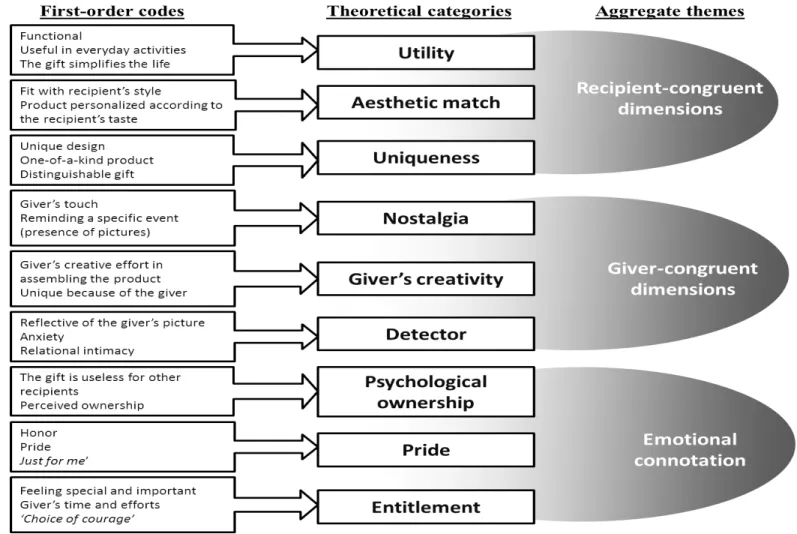
FIGURE 2.1 - DATA STRUCTURE ... 60 CHAPTER 3
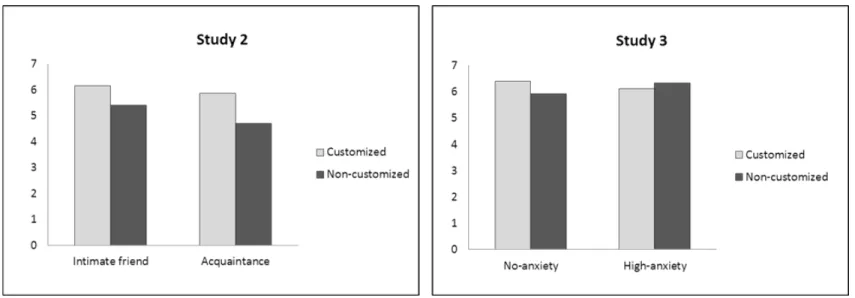
FIGURE 3.1 - GIFT APPRECIATION MEANS BETWEEN CONDITIONS OF STUDY 2 AND STUDY 3 ... 91 CHAPTER 4
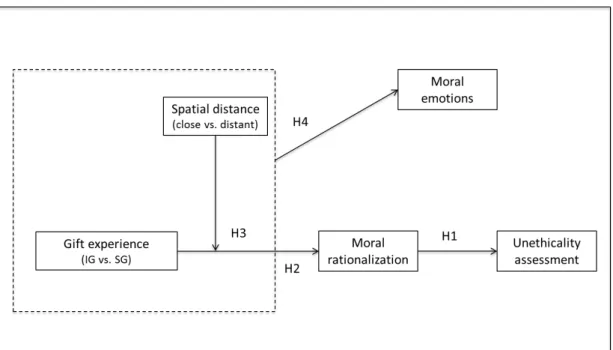
FIGURE 4.1 - RESEARCH MODEL ... 111 FIGURE 4.2 - STUDY 3: MODERATED MEDIATION ... 119 FIGURE 4.3 - STUDY 3: INTERACTION ON MORAL EMOTIONS ... 120 CHAPTER 5
FIGURE 5.1 - OVERVIEW OF THE STUDIES ... 132 CHAPTER 6
FIGURE 6.1 - CONCLUSIONS: GRAPHICAL REPRESENTATION ... 154
xiv
xv
List of tables
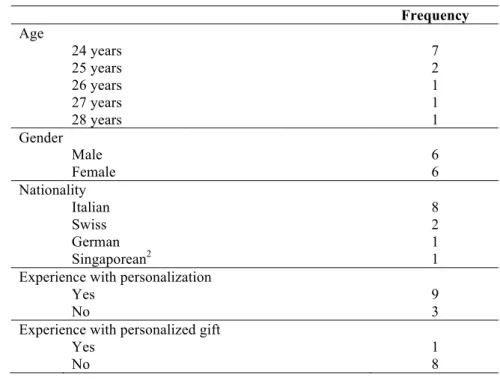
CHAPTER 1 TABLE 1.1 - SUMMARY OF THE APPROACHES OF THE GIFT EXCHANGE LITERATURE ... 42 CHAPTER 2TABLE 2.1 – SEMI-STRUCTURED INTERVIEW SAMPLE ... 54
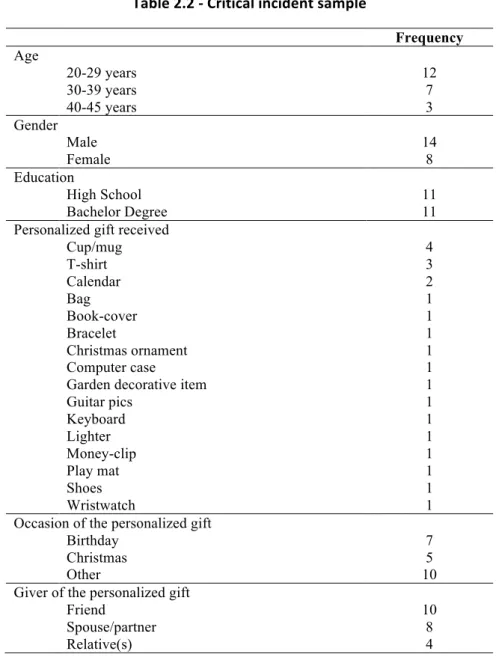
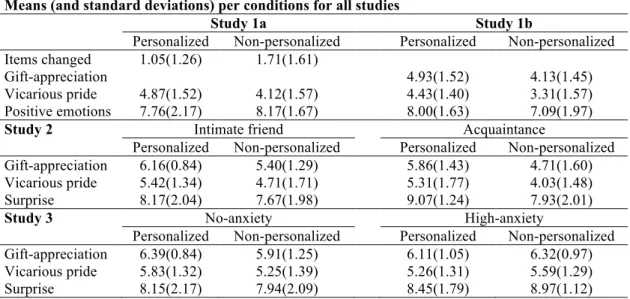
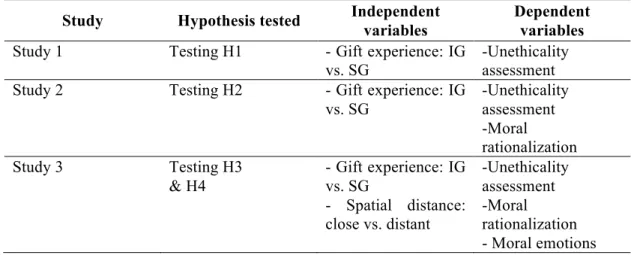
TABLE 2.2 - CRITICAL INCIDENT SAMPLE ... 57 CHAPTER 3 TABLE 3.1 - MAIN STATISTICS OF ALL STUDIES ... 88 CHAPTER 4 TABLE 4.1 - SUMMARY OF THE STUDY DESIGN ... 112 TABLE 4.2 - MAIN STATISTICS OF ALL STUDIES ... 114 CHAPTER 5 TABLE 5.1 - SUMMARY OF THE STUDY DESIGN ... 139 TABLE 5.2 - MAIN STATISTICS OF ALL STUDIES ... 140 APPENDIX A
TABLE A.1 - THE MAIN THEMES FROM THE REVIEW OF THE GIFT EXCHANGE LITERATURE ... 174 APPENDIX B
TABLE B.1 - SAMPLE OF SEMI-STRUCTURED INTERVIEWS ... 180 TABLE B.2 - SAMPLE OF THE CRITICAL INCIDENT SURVEY ... 180
APPENDIX C
TABLE C.1 - SCALES AND ITEMS EMPLOYED IN THE STUDIES OF CHAPTER 3 ... 182 TABLE C.2 - SCENARIOS EMPLOYED IN THE STUDIES OF CHAPTER 3 ... 184
TABLE C.3 - MEDIATION INDEXES ... 189
APPENDIX D
TABLE D.1 -SCALES AND ITEMS EMPLOYED IN THE STUDIES OF CHAPTER 4 ... 192
TABLE D.2 - SCENARIOS EMPLOYED IN THE STUDIES OF CHAPTER 4 ... 193 APPENDIX E
xvi
1
Introduction
I. Purpose of the ResearchScholars in a variety of disciplines have devoted considerable attention to the fascinating phenomenon of gift exchange (e.g., Belk, 1976, 1988, 2013; Mauss, 1925; Otnes, Lowrey and Kim, 1993; Ruth, Otnes and Brunel, 1999; Sherry, 1983; Schwartz, 1967; Waldfogel, 1993; Wooten, 2000). In addition to their economic worth, gifts have been found to have an integration function in society, in that they build or cement relationships (Belk, 1979; Schwartz, 1967) and generate a virtuous circle of reciprocity (Mauss, 1925). Gifts have also been associated with identity definition, such as the development of gender identity (Schwartz, 1967) or restoration of threatened identities (Klein, Lowrey and Otnes, 2015). Recently, scholars have argued that gift exchange affects how individuals evaluate products, showing asymmetries between givers and recipients (Baskin, Wakslak, Trope and Novemsky, 2014; Gino and Flynn, 2011) as well as cognitive biases (Lerouge and Warlop, 2006; Steffel and Leboeuf, 2014).
Traditionally, literature on gift exchange has emphasized the role of the giver, (Areni, Kiecker and Palan, 1998; Belk and Coon, 1993; Davies, Whelan, Foley and Walsh, 2010; Ruth et al., 1999), while the gift recipient has remained very much in the background. This is surprising if we consider that recipients not only are co-performers in the gift exchange (Schwartz, 1967) but also have the power to determine the success or failure of the gift, with important consequences from a relational standpoint (Ruth et al., 1999). It is even more surprising given that firms especially tailor their advertising messages to the needs and desires of recipients, who are seen as the real end consumers (Anton, Camarero and Gil, 2014). Research
2
focusing on the recipient has made great strides in understanding the drivers of gift appreciation, considering specific categories of gifts, such as money, experience, gold, or gift cards (Clarke, 2006, 2007, 2008; Ertimur and Sandikci, 2014; Tuten and Kiecker, 2009; Valentin and Allred, 2012), or features of the gifted product that affect appreciation (Flynn and Adams, 2009; Gino and Flynn, 2011; Paolacci, Straeter and de Hooge, 2015). Moreover a considerable number of studies have investigated how recipients handle disliked gifts (Adams, Flynn and Norton, 2012; Cruz-Cardenas, 2014; Ertimur, Munoz and Hutton, 2015; Shen, Wan and Wyer 2011; Sherry, McGrath and Levy, 1992; Swilley, Coward and Flynn, 2014) and the relational and reciprocity outcomes of gifts (Pieters and Robben, 1998; Roster, 2006; Ruth, Brunel and Otnes, 1999, 2004).
However, despite the unquestionable importance of understanding the relationships between gift characteristics and appreciation, the current theorizing has neglected to emphasize that gifts are a unique context for the analysis of goods and services consumption for reasons other than their relational and reciprocity connotations. Indeed, inherent characteristics of the gifting process make gifts, and consequently their consumption, different from any other form of consumption experience, both when they are gifted and when they are received. From the giver’s standpoint, the gift purchase is not meant for personal use, but rather to please someone else, increasing the constraints and the difficulties of the purchase process (Ward and Broniarczyck, 2011; Wooten, 2000). In this regard, several scholars have claimed that being in a gift-giving context activates a specific mindset, which influences the overall gift purchase experience. For instance, Baskin et al. (2014) suggest that the gift context generates psychological distance (i.e., the feeling of being far from an object or an event, which leads to an abstract mental representation of the same; Trope and Liberman 2010) while other scholars show how the mere fact of purchasing something for someone else activates specific cognitive processes,
3
namely egocentric bias and over-individuation (Epley et al., 2004; Flynn and Adams 2009; Steffel and Le Boeuf, 2014; Zhang and Epley, 2012).
If we focus on the recipient’s standpoint, the phenomenon is even more intriguing. Indeed, consuming a gift is essentially a no-other-choice option, given that the gift is pre-selected by the giver and thus the recipient has no other options to choose from. Moreover, gifts are forced consumptions, because recipients generally do not want to refuse the gift (Sherry et al., 1992) and do feel the imperative of displaying and publicly using the gift (Sherry, 1983). In addition, receiving a gift is essentially a non-voluntary and passive act: the end consumer (i.e., the recipient) is not the initiator of the process, given that he or she is basically passive while the giver purchases the gift. While passivity and constraints have been proven to significantly affect consumers’ choice and experience in general (e.g., Botti et al., 2008; Cooper-Martin and Holbrook, 1993; Hadi and Block, 2014; Weiner, 1986), less is known about how these characteristics affect gift receipt.
This dissertation addresses gift exchange from this latter perspective and aims to expand the current understanding of gift receipt. Specifically, the empirical studies here reported are intended to shed light on how gift receipt modifies the consumption experience. I argue that gift receipt reproduces – albeit in a modified way – the consumption experience consumers have when they personally purchase a product. For instance, evidences have been found regarding the psychological benefit a consumer acquires when he customizes a product – the “I designed it myself” effect (i.e., feeling of achievement and pride derived from self-designing a product; Franke, Schreier and Kaiser, 2010). Another example is that of the self-laundering properties of products associated with charity donations: Zemack-Rugar, Rabino, Cavanaugh and Fitzsimons (2015) demonstrated the ability of these products to reduce the guilt derived from hedonic consumption. However, when people receive a product from someone else such as a gift (rather than a product purchased by oneself), the extant literature does not offer guidance regarding the relevance of these benefits for gift
4
recipients. Do customized products or cause-related products offer the same benefit to a gift recipient? Does the gift receipt context amplify the benefits associated with a product? If such a product might deliver benefits to the recipient, what happens when the recipient does not feel comfortable with the gift? For instance, when consumers purchase a product that is in breach with their moral values, they morally justify it and consequently evaluate the product as less unethical. Does the same happen if such product is gifted rather than self-purchased?
The contribution of this dissertation is to offer an answer to these timely questions. In this regard, I suggest that the gift acts as a resonance box, a container in which a sound bounces and echoes, acquiring its own features. I propose that gifts allow for two types of resonance box experience. With a qualitative analysis (Chapter 2) and a set of experimental studies (Chapter 3), I show that gifts generate the mediated experience of emotions, namely pride. The second effect I demonstrate is how gifts amplify the consequences of the consumption of certain products. In two chapters, I respectively demonstrated that unethical gifts originate greater cognitive processing – that is, moral rationalization – while eliciting an emotional misalignment when gifted compared to when self-gifted (Chapter 4), and I show that the self-laundering process generated by cause-related gifts is greater for gift recipients than gift givers (Chapter 5).
The first part of the thesis offers a theoretical background in which the empirical studies are immersed. Specifically, a review of the extant literature on gift exchange in consumer behavior and related fields is provided and re-interpreted through the lenses of the main theoretical approaches applied to gift exchange research (Chapter 1). Two empirical parts follow, each comprising two research chapters wherein I investigate gift receipts employing qualitative and quantitative tools. In the following sections, I summarize the objective of this dissertation and provide a visual and verbal overview of the structure of the thesis.
5
II. Research objectives
This dissertation provides a conceptual and empirical analysis of gift receipt from a consumer behavior perspective. It consists of a collection of articles resulting from four individual research projects conducted at the Università della Svizzera italiana in Lugano (Switzerland) between 2012 and 2014 and at the Technical University of Munich (Germany) in 2015. All of the articles have been submitted for publication in peer-reviewed scientific journals or relevant international conferences in the field of consumer behavior. Each article addresses a distinct research question regarding product consumption in the gift context, while taken together the articles contribute to the main research objective of this dissertation: to investigate whether and how gift receipt acts as resonance box, wherein the effects of products are mediated or amplified.
The research chapters here presented are conceptually intertwined but empirically separated. With the main aim of offering insight on gift receipts, the empirical studies here reported answer specific research questions and investigate gift receipt from different angles, such as comparing different gifts, comparing interpersonal gifts to self-gifts, or examining similarities and divergences between gift receipts and experiences of giving gifts. In addition, I employed different types of gifts across studies (i.e., personalized gifts and gifts that involve ethical considerations), which, although they belong to distinct product categories, allow for a more nuanced understanding of the resonance power of gifts. The use of different products, indeed, offered the opportunity not only to investigate the gift resonance effect from different perspectives, but also to describe the different effects the resonance has, namely mediation and amplification. Moreover, the use of different product categories allows the thesis to contribute to the overall understanding of gift exchange, while contributing to the relevant streams of literature related to personalization and (un)ethical consumption. Therefore, the empirical part of this dissertation is
6
theoretically divided into two parts, one concerning personalization and the second concerning ethical consumption.
Personalization allows consumers to self-create the product by selecting product features from a set of options. Scholars who have investigated personalization agree that product personalization increases the fit between consumer’s desires and product features (Dellaert and Stremersch, 2005; Simonson, 2005; Wind and Rangaswamy, 2001), which in turn affects willingness to pay (Franke and Piller, 2004). Moreover, it appears that the efforts required from the consumer to design the product are rewarded by the uniqueness of the product (Franke and Schreier, 2007; Franke et al., 2010) and by the feeling of accomplishment (Fuchs, Prandelli and Schreier, 2010; Franke et al., 2010). Recently, it has been shown that personalization toolkits (e.g., platforms that allow consumer to self-configure products) are suitable sources of gifts (Moreau, Bonney and Herd, 2011). The infinite set of possible combinations alleviates the anxiety involved in choosing the right gift, making the gift creation even more enjoyable than personalizing products for oneself (Moreau et al., 2011). So far, researchers have typically investigated the personalization on the customizer’s side (e.g., the consumer who designed the product online), while less in known about its effect when the customizer is not also the user of the product, as is the case of the recipient of a personalized gift. In this dissertation, I aim to fill this literature gap by investigating whether, how and why personalized gifts are a viable way to please recipients.
Ethical consumption refers to all the consumption experiences of products that involve strong ethical considerations or implications for morality (Cooper-Martin and Holbrook, 1993). In this sense, investigating the consumption of products that involve ethical consideration means examining either products highly ethical or products highly unethical. Cooper-Martin and Holbrook (1993) have mapped the ethical space of consumption, defining it as a continuum from selfish products (e.g., drugs, products from various animal species like ivory) to selfless products (e.g.,
7
recyclable product or donations to charity). In this dissertation, I employed Cooper-Martin and Holbrook’s (1993) map to identify the products to investigate. Specifically, I used products from each extreme of the continuum (i.e., products obtained from the poaching of endangered species and donations) to investigate whether and how gift receipt modifies consumers’ reactions to such products.
III. Structure of the Thesis
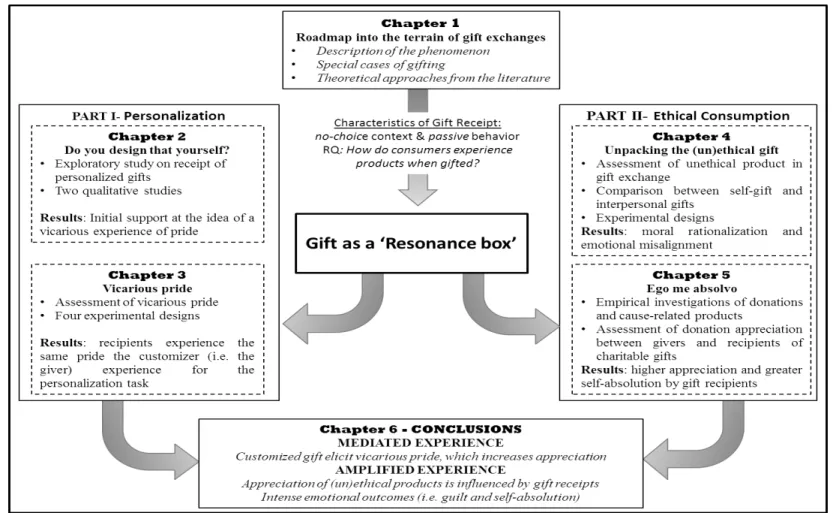
This thesis is structured into six chapters, which address its objectives and which are intertwined while empirically separated. The empirical studies aim at showing how gifts are a kind of resonance box, wherein benefits associated with products are mediated or amplified (see Figure I - Graphical Abstract).
Chapter 1, “A roadmap into the terrain of gift exchanges”, is intended to provide a comprehensive literature review on gift exchange in marketing and consumer behavior. In this chapter, the process of gift exchange is described, together with special cases of gifts relevant for the scope of this thesis (i.e., donations and self-gifts). The final section of this chapter re-interprets the main studies and findings through the lenses of the main approaches adopted to analyze gift exchange.
Empirical Part I - Personalization 1consists of two chapters, which describe a qualitative and a quantitative investigation of personalized gifts. Chapter 2, “Did you design that yourself? – And just for me? An exploratory analysis of personalized gift receiving”, presents two qualitative and exploratory studies on personalized gift acceptance. It provides initial empirical evidence that the feeling of pride the customizer feels while self-designing something translates from the giver (i.e., the customizer) to the recipient in a vicarious way. In this chapter, acceptance of
8
personalized gifts is analyzed from a holistic perspective, showing how these gifts are simultaneously giver- and recipient-congruent.
The third chapter, “Vicarious pride: When gift customization increases recipients’ appreciation of the gift”, is a more detailed examination of the mechanism of vicarious pride, which allows for a greater appreciation of personalized gifts. It demonstrates the existence of a vicarious experience of pride in personalized gift receipt: when receiving personalized gifts, recipients feel the same pride the customizer experiences after having self-created a product. The chapter presents four experiments testifying to the existence of vicarious pride and showing the moderating role of psychological closeness.
The next chapters belong to the second empirical part of this dissertation (Empirical Part II – Ethical Consumption) and also contribute to sub-streams of the gift exchange literature (i.e., self-gifts and donations). The third set of studies (Chapter 4, “Unpacking the (un)ethical gift: Psychological distance and emotional misalignment in unethical consumption”) investigates the effects of unethical gifts by comparing situations of gift receipts and self-gifts. A set of experimental designs demonstrates that recipients process the unethical gift by morally rationalizing it. This moral rationalization allows gift recipients to perceive the product as less unethical, but they feel guilt because of the gift. This suggests that in such situations, emotions and cognitions follow two dissociable paths: the moral conflict between the personal interest (i.e., to not offend the giver) and the moral value important to the recipient (i.e., not to take products that harm animals) is cognitively solved but emotionally unsettled.
The last research here presented (Chapter 5, “Ego me absolvo: Asymmetrical appreciation between givers and recipients and interpersonal guilt in charitable gifts”) investigates the effect of interpersonal guilt on donation in the context of gift exchange. Building on prior work on guilt as an antecedent for donations and on
9
asymmetrical evaluation of gifts by givers and recipients, we examine (i) how interpersonal guilt increases the appreciation of charitable gifts, (ii) whether such gifts are differently appreciated by givers and recipients, and (ii) whether charitable gifts allow for self-absolution, i.e. self-forgiveness for prior negligence. Across five experimental designs, we consistently found that recipients appreciate charitable gifts, in the form of both donation certificates and products associated with a charitable cause, more than givers do, especially when they feel interpersonal guilt. Furthermore, we provide evidence that recipients self-absolve more from interpersonal guilt thanks to the higher appreciation of charitable gifts. The findings provide further evidence of the impact of guilt on donations, add to the literature on the asymmetry between givers and recipients, and contribute to the existing knowledge on the benefits associated with donations.
The final chapter (Chapter 6, “Conclusions”) offers a summary of the contents and findings of the research, focusing on how the chapters contribute to the extant knowledge regarding gift exchange. I also elaborate and discuss the limitations of the present work, while proposing possible venues for future research on the topic.
10
Figure I – Graphical Abstract
11
Chapter 1
A Roadmap into the Terrain of Gift Exchange
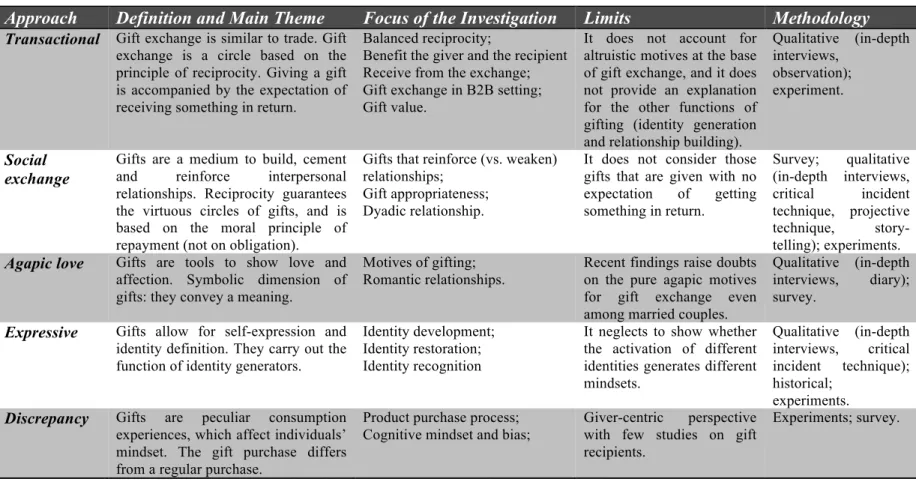
This first chapter is aimed at providing a comprehensive literature review of the studies conducted on the phenomenon of gift exchange. A complete description of the gift giving and receiving phenomenon is followed by a classification of the prior research in five approaches – transactional, social exchange, agapic love, expressive and discrepancy. Particular attention is devoted to highlighting the current knowledge gaps and to showing how this dissertation tries to fill them. This chapter is intended to be a roadmap, showing where the empirical studies included in this dissertation are positioned and how they can contribute to the extant knowledge.
12
1.1 Introduction
Gift exchange is a universal form of interpersonal communication across human societies (Areni et al., 1998; Belk, 1976; Cheal, 1988; Lotz, Soyeon and Gehrt, 2003). Since ancient times (Tourtellot and Sabloff, 1972), gift exchange has been used to celebrate key life events and to show gratitude and love, with the aim of building and cementing relationships (Schwartz 1967). Today, gifting rituals still play a central role in cultures around the world, which have adapted ancient and traditional ways of gifting to suit modern consumption practices (e.g., online shopping, online gift customization, experience gifts, frenzied holiday shopping, and self-gifts).
Gift exchange is also relevant to national economies and to practitioners. The relevance of the phenomenon in terms of retail sales is uncontestable; gifts account for about 10% of US family budgets (Unity Marketing, 2012), suggesting that gift purchases are still a routine activity despite the economic downturn. Indeed, several occasions require a gift purchase; in addition to ritualized occasions such as Christmas, Valentine’s Day, and Mother’s and Father’s Day, most people buy gifts for other occasions throughout the year.
Given its social integration function and relevance in consumption rituals, gift exchange has fascinated a great number of scholars within the social sciences, who have investigated the phenomenon through different disciplinary lenses, including anthropology, sociology, psychology, economics and marketing (Otnes and Beltrami, 1996). Anthropologists were among the first contributors to the topic, offering the first theories on the phenomenon, which have been developed across disciplines over the last 100 years.
Ethnographic studies of the beginning of the 20th century have documented gift exchange rituals handed down from one generation to the next in native or primitive populations, such as the potlatch among Native Americans and the Kula Ring in
13
Papua New Guinea (Malinowski, 1922; Barnett, 1938). The impetus to the study of the phenomenon was offered by the French anthropologist Marcel Mauss (1925) in his essay “The Gift”, wherein he defined gift exchange as a social event by means of which social relationships can be explained. Recently, his theory on gift exchange has been successfully used to explain more modern forms of exchange and sharing, like peer-to-peer and consumption communities (Giesler, 2006; Corciolani and Dalli, 2014), place attachment (Debenedetti, Oppewal and Arsel, 2014), social behaviors (Skågeby, 2010), and, more broadly, social solidarity (Komter, 2005).
While anthropologists have described gift exchange as a social process, evolutionary psychologists have sought to understand its relevance for human survival. Their theoretical assumption is that gift exchange is an adaptive mechanism based on altruism (Hamilton, 1964; Trivers, 1971) and mate selection (Trivers, 1972). They propose that gift exchange evolved from a form of food sharing into a male courtship strategy (Saad and Gill, 2003). A third position on gift exchange is offered by economists, who have a more disenchanted view of gift giving as a waste of resources. Famous to this stream of literature is the concept of “the deadweight loss of Christmas”, which refers to the disparity in dollar terms between the gifts given and gifts received, calculated around the 10% and 30% of loss (Waldfogel, 1993).
Marketing scholars have more recently analyzed the phenomenon in order to incorporate this knowledge from a managerial perspective. An early paper by Banks (1979) drew attention to gifts as drivers of purchase and consumption, given the self-perpetuating cycle of giving, receiving, and reciprocating. Over the last two decades, marketing researchers have begun to analyze gift purchase and consumption patterns. Early efforts have been focused on comparing gift purchases to regular purchases (Belk, 1982; Goodwin, Smith and Spiggle, 1990; Heeler, Francis, Okechuku and Reid, 1979), then on consumer characteristics and occasions (e.g. Caplow, 1982; Laroche, Saad, Browne, Cleveland and Kim, 2004). More recently, the research on
14
gifts has overcome the borders of western societies, widening the available knowledge by comparing the gift phenomenon across cultures (e.g. Jolibert and Fernandez-Moreno, 1983; Joy, 2001; Qian, Adbur, Kau and Keng, 2007).
The following sections provide a review of the relevant literature on gift exchange in consumer behavior and aim to show how this dissertation is positioned in relation to the existing literature. The first two sections deal with the definition of the phenomenon and the process of gifting, then I provide in-depth descriptions of the three elements of the gift exchange – the gift, the giver, and the recipient. In the sixth section of this chapter, I draw attention to two special categories of giving – namely self-gifting and donations, which are cases that sometimes depart from the mainstream literature – and, by including them, broaden the gift construct. In the conclusion sections, I critically debate the knowledge of older and more recent research on gift giving through the lens of theoretical approaches applied to the investigation of gift exchange, discussing main concepts and limitations of each approach. Table A.1 summarizing the main articles included in this literature review is provided in Appendix A.
1.2 Towards a definition of gift exchange
Gift exchange is conceptualized as the circulation of goods to nurture social bonds among individuals (Belk, 1979). Based on an in-depth investigation of rituals in primitive societies, Mauss (1925) suggested that the gift mechanism comprises giving, receiving and repaying and is based on the reciprocity principle. This principle identifies a self-perpetuating circular system of exchanges, summarized in three obligation imperatives:
1) the obligation to give; 2) the obligation to receive;
15
3) the obligation to repay.
The obligation to give is based on “moral and religious imperatives, the need to recognize and maintain a status hierarchy, the need to maintain peaceful relationship, or simply the expectation of reciprocal giving” (Belk, 1976, p. 155). The obligation to receive is based on the implicit rule that refusing a gift is an impolite or even hostile act (Sherry, McGrath and Levy, 1993). The acceptance of a gift is the recognition of being in debt to the giver (Godbout, 1998), and the social obligation to repay must be fulfilled in order to re-establish the symmetry between the donor and the recipient (Sahlins, 1972).
Differential emphasis has been placed upon the socialization function of gifts, which has been discussed in terms of its relevance for the development and maintenance of relationships or of identity. The effects of gifts on the giver-recipient dyad have been a major topic of marketing research (e.g. Ruth et al., 1999; Schiffman and Cohn, 2009; Sherry, 1983). Theoretically this literature relies on the assumption that gifts are a symbolic form of communication, “a language that employs objects instead of words as its lexical elements” (Caplow, 1984, p. 1320), by means of which givers convey relational and emotional meanings without the use of language (Areni et al., 1998; Belk, 1996). The gift is a medium to symbolically express the relationship between the giver and the recipient, to show the giver’s commitment and feelings toward the recipient (Belk, 1979; Belk and Coon, 1993; Wolfinbarger, 1990) and to help the giver to reinforce or affirm the relationship (Ruth et al., 1999). In addition, studies on heirlooms and family assets (e.g., money, bonds, property, etc.) provide evidence that families preserve their legacy and collective identity by means of the transfer of family-related items that are passed from one generation to another (Bradford, 2009; Curasi, Arnould and Price, 2004; Curasi, Price and Arnould, 2003).
16
The effect of gift giving, however, may also be detrimental for the relationship. In some instances, gifts harm the quality of the relationship between the giver and the recipient, weakening the perceived bond between them or even breaking the relationship (Ruth et al., 1999; Sherry, 1983; Sherry et al., 1993). In other instances, the gift does not meet the goal of reinforcing the relationship but has a minimal effect on the relationship overall quality (Ruth et al., 1999).
Gift giving has been also conceptualized as generator of identity (Schwartz, 1967). This function begins in early childhood with items related to gender identification. Toy soldiers and dolls are traditional masculine and feminine gifts, respectively, gifted to project images of a brave man or a dedicated mother. Also, kitchen supplies given to a woman, such as cooking appliances or tableware, implicitly convey the social role of a caring wife. Gifts carry out this function not only for the recipients but also for the givers, who can rebuild and protect social aspects of their identity by means of giving gifts (Klein et al., 2015; Segev, Shaham and Ruvio, 2012).
1.3 The gift exchange process
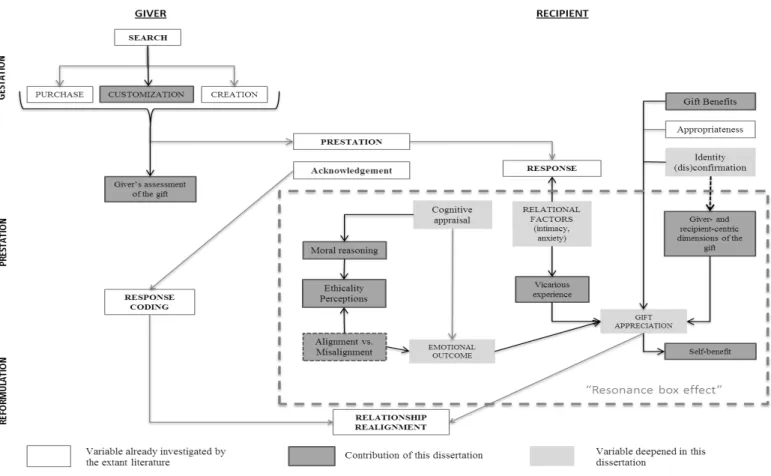
The gift exchange model consists of the selection of a product or service to be presented as a gift from individual “X” (the giver) to individual “Y” (the recipient) on a specific occasion. Thus, it concerns not only the actual giving, but also the giver’s choice process and the recipient’s pre- and post-exchange behaviors. An early conceptualization of this model was made by Banks (1979), who conceptualized it as a four-stage process: the purchase, the actual exchange, the consumption and the communication. Sherry (1983) further articulated the model, which consists of a dialectical cycle of reciprocity between the giver and the recipient. His model, which is currently the most akin to consumer behavior studies, comprises three stages: Gestation, Prestation and Reformulation.
17 Figure 1.1 -Sherry's model (1983) adapted with the main variables under investigation in this dissertation
18
Initially, the giver is involved in the Gestation phase, during which he or she searches for the product or service to give. The search can be conducted both internally (thinking about the recipient and his or her preferences) and externally (searching for the gift in the market environment). The gift can be purchased or created, as in the case of handmade or personalized gifts (Moreau et al., 2012). At this stage, the recipients are traditionally passive, although they can elicit the gift decision with direct requests or unintentional behaviors (Sherry, 1983). Today, however, recipients are becoming more and more active at this stage, such as by using gift registries to declare their preferences and reduce the risk of unwanted gifts (Gino and Flynn, 2011; Ward and Broniarczyk, 2011). Most of the extant theorizing on consumer gift exchange focuses on this stage. Cleveland, Babin, Laroche, Ward and Bergeron (2003), for instance, investigated gender differences in information acquisition during gift shopping behavior, while Heeler et al. (1979) studied the selection of brands for giving gifts.
The gift is offered in the Prestation stage (Sherry, 1983), when the actual gift exchange occurs. At this stage, contextual factors, such as the time and place of the gifting, and situational factors, such as ritual elements or the quality of the relationship, impact the value of the gift (Areni et al., 1998; Otnes et al., 1993). The Prestation stage consists of a series of feedbacks between the giver and the recipient, starting with the gift presentation and ending with the expressed gratitude of the recipient. If the giver is concerned about the success of the gift, it is necessary for the recipient to decode the meaning of the gift and then respond to the giver (Roster, 2006), who in turn must seek to understand the recipient’s response (Sherry, 1983). Focusing on this phase are Ruth’s (1995) study of psychological ambivalence and mixed emotions as well as Roster and Amann’s (2003) paper on impression management techniques used by recipients to disguise their disappointment with unwanted gifts. This dissertation also concerns this stage, taking into account antecedents and consequences of gift appreciation (see Figure 1.1).
19
Reformulation, the last stage of the model, consists of the disposition and consumption of the gift. In this stage, the giver-recipient bond is re-evaluated by both actors based on the gift success and interactions that occurred in the Prestation stage (Ruth et al., 1999; Ruth et al., 2004). As the outcome of the Reformulation stage, the relational bond can be strengthened, affirmed, weakened or damaged, while in some instances it has a negligible effect (Ruth et al., 1999). Relatively few studies have been devoted to analyzing this crucial phase and its effect on the relationship. Notable exceptions are the studies of Sherry et al. (1992) and Adams et al. (2012) on gift disposition and re-gifting as a social taboo, respectively.
Figure 1.1 depicts the Sherry’s model (1983) with a specific focus on the variables discussed and analyzed in this dissertation.
1.4 What is a gift?
According to most disciplines, gifts are goods or products voluntary given by one person or a group to someone else (Belk, 1979). The giving of a gift differs from other forms of exchange. The Polish anthropologist Malinowsky (1922) first suggested that gift exchange differs from barter and trade. Mauss (1925) supported and expanded this assumption, proposing that gifts differ from commodities in the realm of market exchange, because gifts acquire an immaterial connotation – the hau – that is the spiritual essence of the gift. Unlike regular commodities, the gift embodies the identity of the giver, meaning that in addition to receiving something material, the recipient receives a part of the giver. The hau of the gift increases the value of the product itself, making it inappropriate for the recipient to give it away (Sherry et al., 1993).
Research in the realm of consumer behavior supports the idea that gifts differ from other products because they symbolize the relationship with the giver, which bestows a quality of “sacredness” upon the gift (Areni et al., 1998; Belk, Wallendorf
20
and Sherry, 1989; Carrier, 1991). The sacredness and the hau of the gift lead recipients to believe that givers are somewhat entitled to determine the fate of the gift, which makes re-gifting the product uncomfortable, if not a social taboo (Adams et al., 2012). Belk (1988) supports this assumption, suggesting that gifts become part of the extended self, as other extended possessions, like collections, money or pets (Belk, 1988). Notably, gifts acquire a role in individuals’ extended self not only when received, but also when gifted (Wong, Hogg and Vanharanta, 2012). Indeed givers describe objects that they had given as gifts to close others as part of their own possessions (Wong et al., 2012).
Another perspective on this situation, however, suggests that the gift reveals the giver’s mental image of the recipient (Schwartz, 1967). The gift is a projection of the giver’s beliefs about the recipient – an objectification of the recipient’s identity through the eyes of the giver. This determines two consequences: the imposed identity may or may not be incongruent with the recipient’s self-identity; and accepting (or rejecting) a gift means confirming (or disconfirming) this identity (Sherry, 1983). Given that receiving a gift helps recipients to affirm and recognize their own identity (Ruth et al., 1999), receiving a gift that is incongruent with the recipient’s identity threatens his or her ego and may harm his or her relationship with the giver (Sherry, 1983).
Belk (1996) has investigated the characteristics of perfect gifts. Belk has identified six principles that a gift should meet to be considered ‘perfect’. Such a gift (i) requires an extraordinary sacrifice on the part of the giver and (ii) should be aimed only at pleasing the recipient, with no expectation of return. The notion and etymology of sacrifice are rooted in religion: sacrifices were fundamental in the majority of ancient civilizations’ rituals and typically consisted of the killing of an animal or person as an offering to a deity to obtain its benevolence. The classical usage of this concept has evolved in the centuries, although the meaning of ‘cost’ and ‘deprivation of something’ have remained. In the gift exchange literature, the
21
giver’s sacrifice has assumed the meaning of costs the giver must face to acquire the gift. Specifically, givers’ costs comprise three components: monetary, effort, and temporal sacrifice (Cheal, 1987; Wooten, 2000). Although valuable gifts are often assumed to be expensive, recipients prefer gifts that require a considerable amount of time and effort from the giver, and the economic value is secondary when the behavioral costs of a gift are high (Gino and Flynn, 2011; Robben and Verhallen, 1994). This aspect of sacrifice suggests that recipients recognize the “mental investment” a giver makes in giving a special gift (Areni et al., 1998). Often, the sacrifice is associated with crafting the item, such as in the case of handmade gifts (Belk, 1988) or careful planning of the gift exchange moment (Areni et al., 1998).
The perfect gift also (iii) should be a luxury and (iv) should delight the recipient, for whom the gift (v) should be distinctively appropriate. Finally, Belk (1996) stated that the perfect gift should (vi) surprise the recipient. Surprise seems to be the most valued characteristic of a gift and a central emotion in gift exchange, because it makes the gift memorable (Areni et al., 1998; Belk, 1996; Ruffle, 1999). Gifts elicit surprise because they are exchanged outside ritual occasions or because they are atypical gifts, such as those that are highly personalized (Areni et al., 1998). Gifts given as a surprise are “sacred” to their recipient (Belk et al., 1989) and are perceived as more spontaneous compared to requested gifts, such as gifts taken from a gift registry (Otnes and Lowrey, 1993).
Naturally, not all gifts achieve the goal of being perfect. To be successful, a gift only has to be appropriate. The traditional assumption regarding gift appropriateness says that gifts have to fit the recipient’s identity; however, in contrast to this expectation, the giver’s identity is the major predictor of gift selection (Belk, 1979; Belk and Coon, 1991). Extending this concept, recently it has been demonstrated that some incongruence with the recipient’s identity might actually be beneficial. Recipients, indeed, particularly appreciate those gifts that match the giver’s identity,
22
regardless of the gift’s congruence with their own identity (Paolacci et al., 2015). This is particularly true in the case of dating couples (Belk and Coon, 1993).
The first empirical study of this dissertation (Chapter 2) investigates how gift recipients appreciate gifts that are simultaneously giver- and recipient-congruent: gifts that portray both the giver’s and the recipient’s identity. The chapter focuses in particular on personalized gifts, which are analyzed by means of qualitative methods. The criteria for appropriateness evaluation are based on unwritten rules and defined according to the giver-recipient relationship, recipient’s or giver’s stage of life, or the occasion (Caplow, 1982). For example, money is an appropriate gift from a grandparent to a grandchild but may be problematic for romantic occasions. Humorous gifts that are good for a bachelor party may not be appropriate on Valentine’s Day (Belk and Coon, 1991). Adherence to such rules might enhance the chance of gift appreciation; however, inaccurate predictions jeopardize the gift success. Research consistently shows that many people are poor gift givers, and their recipients know it; about 50% of recipients expect to return or re-gift at least one gift each year during the holiday season (Gino and Flynn, 2011). The literature offers several examples of givers’ misinterpretation of recipients’ desires. For example, gift givers often opt for luxury or expensive products, mistakenly linking economic value to recipients’ appreciation. Conversely, recipients dislike gifts for which money substitutes for mental effort (Flynn and Adams, 2009). In addition, givers and recipients weigh gifts’ attributes differently. The asymmetry between givers’ choice and recipients’ preference might be due to cognitive biases, which lead givers to have an abstract mental representation of the recipient (Baskin et al., 2014), to over-project their personal preferences on the recipient (Lerouge and Warlop, 2006), or to over-individuate gifts (i.e., to select the gift that seems most appropriate for a given recipient relative to others but that may not be appropriate in an absolute sense; Steffel and LeBoeuf, 2014). Chapter 5 describes an empirical research that extends
23
the current literature on giver-recipient asymmetry and shows how gift givers and gift recipients differently appreciate charitable gifts.
1.5 The one who gives: The giver
Several taxonomies have been developed to explain the giver’s motives beyond gifts. These can be summarized in three macro-categories. Some gifts are purely altruistic, meaning that the giver’s goal is only to convey happiness to the recipient (Sherry, 1983; Goodwin et al., 1990; Wolfinbarger, 1990). These gifts are expressions of agapic love and are a means by which the relationship is celebrated (Belk and Coon, 1993). An agonistic motive is when the gift’s purpose is to enhance the giver’s personal interests (Sherry, 1983; Wolfinbarger, 1990). Givers driven by agonistic motives tend to see gifts as an investment and to consider gifting as an economic exchange (Belk and Coon, 1993). Apology gifts belong to this category, as the giver uses such gifts to encourage forgiveness. Gifts are also often exchanged with tactical motives in romantic relationships (Saad and Gill, 2003), ranging from starting the relationship to defining its social boundaries (Belk and Coon, 1993; Andrus, Silver and Johnson, 1986). In other instances, givers give gifts to comply with social norms, such as reciprocity or rituals (obligatory motive; Wolfinbarger, 1990). This view suggests that gifts are often not given voluntarily but rather due to a sense of indebtedness and reciprocity (Goodwin et al., 1990; Joy, 2001). However, these motives are not necessarily discrete; rather, more than one motive can lead givers to give, meaning that all three can be the reasons for a gift simultaneously (Beatty, Kahle and Homer, 1991).
Emotions are also antecedents of gift giving. Positive emotions exert a positive influence on gifting, encouraging gift exchange (de Hooge, 2014). Love, pride and gratitude, for instance, stimulate gift giving to show emotional states and express affection to the recipient (Belk and Coon, 1993; Cheal, 1988; Fisher and Arnold,
24
1990; Ruth, 1996). The same thing occurs when the giver experiences self-focused negative emotions (i.e. emotions generated by the evaluation of one’s own behavior, such as guilt and shame (Haidt, 2003). Self-focused negative emotions are a signal that the relationship needs to be improved, and gifts are used to achieve this goal (de Hooge, 2014). On the contrary, when negative emotions are other-focused (i.e., caused by other people, such as anger and fear), the giver is less motivated to give gifts (de Hooge, 2014).
Nguyen and Munch (2011) suggested that for half of the population gifting is more an obligation than a pleasure, even with romantic partners. The gift purchase process is a challenging activity for the giver, who has to take the perspective of the recipient and guess his or her tastes (Belk, 1982; Ward and Broniarczyk, 2011). For the same reason, buying a gift is more complex than buying something for oneself (Belk, 1982), although it may result in a more enjoyable process (Moreau et al., 2012). The inner tension between choosing something that is appropriate for the recipient while reflecting the giver and the relationship often causes anxiety (Wooten, 2000). More recently, identity research has shown that buying a gift may also threaten the giver’s self-identity (Ward and Broniarczyk, 2011). When searching for a gift, a giver sometimes faces the need to make a purchase that is inconsistent with, or even opposed to, his/her own identity, in order to meet the desires of the intended recipient. In such situation, the giver might cope with the identity-threat by purchasing the identity-incongruent product to please the friend but subsequently engaging in identity-reaffirming behaviors, such as buying an identity-expressive product in a subsequent purchase. However, giving gifts is not only a negative experience; in some situation, the giver might also benefit from the gift. Evidence suggests that givers experience several psychological benefits from gift exchange: they feel more effective, useful and generous (Langer, 2000; Shapiro, 1993) and can affirm their independence (Segev et al., 2012). In addition, Klein et al. (2015) recently provided insight on the importance of gift giving in self-regulating behavior
25
and in identity restoration. With an in-depth analysis into gifting behavior in identity-stripping contexts, the authors showed that gifts are meant for givers to re-establish their lost agency, autonomy and control and to reaffirm the sense of belonging to a family and, more broadly, to humanity.
The gift selection and the gift purchase experience are affected by the giver’s personal characteristics. For instance, gift-giving theories mention attitude toward shopping and bargains (Locander and Hermann, 1979; Otnes, 1990), self-esteem (Schaninger and Sciglimpaglia, 1981), and attitude towards Christmas (Laroche, Saad, Cleveland and Browne, 2000) as significant factors. The giver’s attachment style is particularly relevant in gift giving, because it shapes how individuals see themselves versus others (Nguyen and Munch, 2007). Individuals with high anxiety or a high avoidance attachment style do not experience gifting as a voluntary and pleasurable activity but rather feel forced and obliged to comply with the social norm of giving gifts (Nguyen and Munch, 2007). Gender appears to be one of the most important predictors of one’s gift-giving experience. Gifting is traditionally identified as a woman’s job (Caplow, 1982; Cheal, 1988, Fischer and Arnold, 1990): women appear to enjoy gift-giving more (Caplow, 1982; Fischer and Arnold, 1990), buy more expensive gifts (Saad and Gill, 2003), pay greater attention to the importance of buying something to suit the recipient’s taste or identity (Wolfinbarger and Gilly, 1996). Men, on the other hand, are less enthusiastic gift givers (Wolfinbarger and Gilly, 1996), are more concerned about price compared to women (Rucker, Freitas, and Dolstra, 1994), and tend to seek help from sales personnel when searching for the right gift (Laroche et al., 2000). Although there is a convergence among studies regarding the fact that gift giving is more enjoyable for women than for men, there is an ongoing debate regarding the reasons why women are more motivated to give gifts. Various physiological and personality-based explanations have been put forward for these gender differences, such as differences in information elaboration (Krugman, 1966; Meyers-Levy and Sternthal, 1991) or
26
cortical organization (Meyers-Levy, 1994). A cultural approach, however, suggests that girls receive specific training from their parents regarding gifts, because gifts are symbols of caring (Moschis, 1985); or, more broadly, women are socialized to be shoppers to a greater extent than men (Scanzoni, 1977).
Recipients’ characteristics also impact the gift-purchase process. Givers spontaneously classify recipients as “easy” or “difficult”. “Easy” recipients tend to be children or close friends, while “difficult” recipients tend to be older or more distant relatives or friends (Otnes et al., 1993). Affluent recipients – those who appear to have everything – are perceived as difficult to satisfy, and gift purchasing for them is a high-anxiety and time-consuming activity (Wooten, 2000). Givers adapt the gift-selection strategy according to the category to which the recipient belongs. The strategy may involve negotiating with the recipient or replicating the same gift year after year for difficult recipients, whereas givers are more eager to buy fun gifts for easy recipients (Otnes et al., 1993). Givers also seek to achieve different goals when selecting gifts (Otnes et al., 1993; Sprott and Miyazaki, 1995). Some givers prefer to please the recipient and buy products that the recipient would enjoy, while others try to maximize the utility of the gift by providing recipients with something useful (Otnes et al., 1993). In some cases, givers want to compensate a loss (material or otherwise) with a gift, while in other cases they use gifts such as books as learning agents (Otnes et al., 1993).
1.6 Gift end consumer: The recipient
The recipient is the ultimate consumer of the gift, and the giver’s experience partially depends on the recipient’s response (Sherry, 1983; Ruth, Brunel and Otnes, 2004). Thus, the recipient’s role is critical from the early phases of the gift exchange. Indeed, the recipient’s first act may have already taken place at the point of Gestation. At this stage, the recipient’s goal is to convey gift expectations (Wooten
27
and Wood, 2004), such as by offering hints or lists, while avoiding being labeled as a difficult recipient (Otnes et al., 1993). Today, the elicitation of a specific gift is simplified by the flourishing of online gift registries, which provide a list of products the recipient desires for an upcoming event. At the Prestation stage, the recipient’s goals are to open the package and to show appreciation (Wooten and Wood, 2004). The recipient’s last act is consumption during the Reformulation stage, where recipients are expected to demonstrate that they value the gift by using or displaying it (Sherry, 1983; Wooten and Wood, 2004).
A considerable part of the literature has focused on the emotions experienced by the recipient in the Prestation and Reformulation phases. Although receiving a gift is usually associated with a happy experience, it can elicits both positive feelings, such as gratitude (Tesser, Gatewood and Driver, 1968) or love (Belk and Coon, 1993; Fischer and Arnold, 1990), and negative ones, like indebtedness (Greenberg and Solomon, 1971; Greenberg and Westcott, 1983), fear and uneasiness (Schwartz, 1967), embarrassment (Sherry et al., 1993) or sadness (Belk, 1991; Mick and DeMoss, 1990). The emotions people experience when receiving a gift are based on a cognitive appraisal of the giver’s motives, the sacrifice required for the gift, the intrinsic value of the gift, and the reciprocity that is expected (Ruth, 1996). However, in gift receiving as well in any other interactions among humans, individuals rarely experience a single and discrete emotion. Specifically, in gift receiving, recipients experience multiple emotions, which are systematically associated with relational outcomes (Ruth et al., 2004). While it is evident that positive emotions (e.g. gladness, joy) naturally strengthen relationships, it is less obvious that even embarrassment and uneasiness may reinforce the relationship in the long term, depending on the coping strategies employed to face these negative emotions (Ruth et al., 2004). In this dissertation, I expand the current knowledge on emotions in gift exchanges, showing how gift receipts could generate vicarious emotional
28
experiences: specifically, Chapter 3 reports an empirical study that demonstrates how recipients feel vicariously proud of the personalizing effort made by the giver.
In the foundational paper on the gift-giving model, Sherry (1983) pointed out that recipients might react emotionally in two ways when receiving a gift: by showing genuine emotions or by dissimulating internal feelings. While genuine emotions are the natural consequences of an appreciated gift, recipients prefer to deceive when confronted with an inappropriate one. Showing no appreciation for a gift is seen as impolite and might even damage the recipient’s relationship with the giver (Roster, 2006). For this reason, recipients often use strategies to mask their disappointment with a gift, such as diverting attention from the gift (Roster and Amann, 2003). When a gift is unappreciated, it is easier for the recipient to be honest in the case of truly close relationship, but only when the giver does not appear to have made significant investments of time and money in searching for the gift (Roster and Amann, 2003). Showing gratitude and thanking the giver reduce the potential negative consequences of a gift failure, since givers see ingratitude as a severe social norm violation (Roster, 2006). Thus, the recipient’s need to offer immediate and positive feedback, coupled with the unconscious obligation to reciprocate, makes the recipient’s role less enjoyable than the giver’s (McGrath, 1995; Sherry et al., 1993).
Complicating the situation is the feeling of indebtedness resulting from the failure to comply with social norms, such as in the case of receiving a gift that cannot be reciprocated (Cialdini, 2001; Gouldner, 1960), or from asymmetry in the relationship with the giver. Whereas with close friends there is no obligation to reciprocate, the obligation norm is stronger when the gift comes from an acquaintance, generating more feelings of indebtedness (Joy, 2001; Shen et al., 2011). According to Godbout (1998), the feeling of being in debt is a normal and desirable state in gift exchange, which guarantees the fulfillment of the reciprocity principle. In Godbout’s terms (1998) gift exchange is a moral and “positive debt system voluntarily maintained by its partners” (p. 566), who sustain the cycle of gift