HAL Id: inserm-01145600
https://www.hal.inserm.fr/inserm-01145600
Submitted on 24 Apr 2015HAL is a multi-disciplinary open access archive for the deposit and dissemination of sci-entific research documents, whether they are pub-lished or not. The documents may come from teaching and research institutions in France or abroad, or from public or private research centers.
L’archive ouverte pluridisciplinaire HAL, est destinée au dépôt et à la diffusion de documents scientifiques de niveau recherche, publiés ou non, émanant des établissements d’enseignement et de recherche français ou étrangers, des laboratoires publics ou privés.
Distributed under a Creative Commons Attribution| 4.0 International License
Brainomics: Harnessing the CubicWeb semantic
framework to manage large neuromaging genetics shared
resources
David Goyard, Antoine Grigis, Dimitri Papadopoulos-Orfanos, Michel Vittot,
Vincent Frouin, Adrien Di Mascio
To cite this version:
David Goyard, Antoine Grigis, Dimitri Papadopoulos-Orfanos, Michel Vittot, Vincent Frouin, et al.. Brainomics: Harnessing the CubicWeb semantic framework to manage large neuromaging genetics shared resources. Journées RITS 2015, Mar 2015, Dourdan, France. p34-35 Section imagerie génétique. �inserm-01145600�
Actes des Journées Recherche en Imagerie et Technologies pour la Santé - RITS 2015 34
Brainomics: Harnessing the CubicWeb semantic framework to manage large
neuromaging genetics shared resources
D. Goyard
1, A. Grigis
1, D. Papadopoulos Orfanos
1, V. Michel
2, V. Frouin
1∗, A. Di Mascio
2 1 CEA DSV NeuroSpin, UNATI, 91 Gif sur Yvette, France.2 Logilab, Paris, France. ∗ [email protected].
Abstract - In neurosciences or psychiatry, large mul-ticentric population studies are being acquired and the corresponding data are made available to the acquisi-tion partners or the scientific community. The massive, heterogeneous and complex data from genetics, imag-ing, demographics or scores rely on ontologies for their definition, sharing and access. These data must be effi-ciently queriable by the end user and the database opera-tor. We present the tools based on the CubicWeb open-source framework that serve the data of the european projects IMAGEN and EU-AIMS.
Index Terms - Imaging Genetics, Magnetic Resonance Imaging, Medical Informatics.
I. INTRODUCTION
The recent wide availability of high-throughput genomic and neuroimaging devices makes it possible to study neu-rodegenerative diseases or psychiatric syndromes through Population Imaging studies (PIs) that comprise several thousands of subjects. Those studies like IMAGEN (impul-sivity in adolescents) [1] or EU-AIMS (autism) [2] aim to gather heterogeneous measurements like genotyping, MR neuroimaging, EEG, behaviour scores and neuropsycho-logical questionnaires. PIs are multicentric and the mas-sive, complex and heterogeneous datasets collected are in-tended to be shared. Classically those data flow is a three steps workflow that consists of (i) data collection, (ii) data alignment, quality control, and possibly high level image processing and (iii) data indexing and exposition. Several frameworks support one or several out of the three differ-ent steps listed above. For example the XNAT project un-derpins numerous neuroimaging databases, including some shared international resources [3]. Openclinica [4] is rec-ognized to ease the collection of electronic data like eCRF or questionnaires. Finally laboratory information manage-ment system were developed to collect genomic measure-ments like BaSE [5].
To the best of our knowledge no general framework ad-dresses the situations with very heterogeneous measure-ments. Specific adaptations of one existing software or be-spoke developments have to be performed. We participated in the Brainomics project (french ANR IA) which includes
one workpackage devoted to this issue. The package was twofolds: (i) to develop specific Python modules using the CubicWeb framework (Logilab, Paris) and (ii) to demon-strate feasibility and scalability of a fully featured server of a Shared Data Service (SDS). Our specifications retained the need for a web user interface to provide data entry forms, to browse the data or to upload/download datasets. We wished to uncouple quality control or processing from the SDS and we brought specific attention to the versatility and performance of the download. Finally we considered the query language was a central issue: we need to script the requests to the SDS for the processings, the same lan-guage must underpin the requests rendered via the web in-terface and finally this language should bring interoperable features.
II. MATERIALS AND METHODS
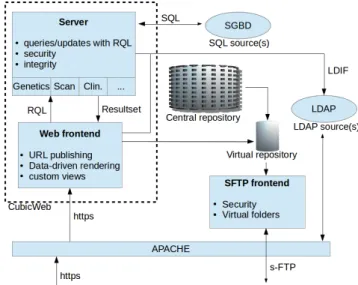
The CubicWeb framework. CubicWeb (CW) is a frame-work developed by Logilab that follows the semantic web approach: data are structured using ontologies for easier sharing, access, and processing. It also enables data fed-eration and enrichment of local information from external resources. In the Brainomics project, we leveraged CW, and defined domain specific modules denoted ”cubes” eas-ily connected to one another. CW is built upon well estab-lished core technologies: SQL, Python, web technologies (HTML5 and Javascript) and is developed under the LGPL license. CW defines its data model with Python classes and generates the underlying SQL tables. The queries are ex-pressed via the RQL language which is similar to W3C’s SPARQL. CW implements a mechanism to expose infor-mation in several ways called ”views”. Being defined in Python, the views are applied on query results, and can produce HTML pages or trigger external processings. The separation of queries and views holds major advantages: i) the same data selection may have several representa-tions, ii) data can be exported in several other formats (e.g. XCEDE or MAGE-ML) without modifying the underly-ing data storage. CW has a security system, coupled to the data model definition, that grants a fine-grained access to the data. CW may run as a standalone application or be smoothly integrated in an Apache platform with LDAP and SFTP (cf. Figure 1.).
35 Actes des Journées Recherche en Imagerie et Technologies pour la Santé - RITS 2015
Development of domain specific cubes. We developped one cube per data type. Each cube is connected to the oth-ers -if needed- in the final database schema. The medi-calexp cube contains the definition of general entities like Subject, Center, Assessment; the neuroimaging (resp. ge-netics) cube defines entities and relations like Scan, Scan-ner (resp. SnpVariant, Platform, GenotypeMeasurement). Each cubes implements the corresponding views (naviga-tion, download) triggers and access rights. Connected to-gether, those cubes and others are used to build the com-plete SDS for the IMAGEN and EU-AIMS projects. Development of upload/download cubes. Specific cubes for data transfers were developed for our local SDSs. A cube dedicated to data upload allows fast web-form gen-eration so that users can bundle data and meta-data during uploads. Big files are saved on a filesystem and their path and meta-data are indexed. A specific download cube con-verts the result of a query to a virtual entry in FUSE file system that in turn can be served through a SFTP server; convenient access rights are set by the cube. This cube avoids data compression or duplication and leverage SFTP clients for data transfer efficient mechanisms.
III. RESULTS
Logilab and Brainomics have set up 2 demonstra-tors of CW capabilities in terms of neuroimaging database: http://brainomics.cea.fr/localizer or clinical follow-up database: http://www.brainomics.net/demo/. Data collection. These specific cubes greatly expedited the construction of a complete collect database for EU-AIMS. The EU-AIMS cube is built upon a dozen of cubes like the ones presented previously. EU-AIMS SDS can han-dle any kind of data produced by the project: genetics, neuroimaging, clinical, EEG, and eye-tracking data com-ing from 10 centres across Europe. Each acquisition centre directly writes entities inside the database. This requires to set precise access permissions at the level of the entity to avoid data deletion or overwriting. Daily asynchronous procedures navigate the database to check all new entities and acknowledge or throw out the data.
Data exposition. IMAGEN database serves heterogeneous data for 2000 subjects: original Nifti scans (strtuctural, functional, diffusion weighted scans), genotyping, gene ex-pression, methylation, demographics and questionnaires. Data download is provided through a SFTP server: as soon as a subset of data is selected the user may save in the web interface and download the corresponding files using SFTP technology; the corresponding metadata are downloaded as spreadsheets.
IV. DISCUSSION-CONCLUSION
Using the CW framework we designed a set of specific cubes dedicated to shared data service. These cubes in-clude both the model of the data structure and the default
Figure 1: Architecture of the SDSs.
ways to render or export the results of a query. Those dif-ferent cubes may be arranged to serve data pertaining to different domains. The RQL language brings the possi-bility to script requests which is useful for the domestic QC/processing of the data. The RQL language enables to create rich views that render the complexity of the data: secondary views, facets. Finally, we will benefit from the RQL From clause to implement interoperability: the CW web front end may query concurrently several internet se-mantic web servers exposing genetics (for instance Entrez-Gene) or clinical meta-information [6].
ACKNOWLEDGMENTS This work was supported by ANR-10-BINF-04.
REFERENCES
[1] G Schumann and coll. The IMAGEN study: reinforcement-related behaviour in normal brain func-tion and psychopathology. Molecular psychiatry, 15 (12):1128–39, 2010.
[2] K Ashwood and coll. European clinical network: autism spectrum disorder assessments and patient characterisation. European child & adolescent psy-chiatry, 2014.
[3] D Marcus and coll. Human Connectome Project in-formatics: quality control, database services, and data visualization. NeuroImage, 80:202–19, 2013.
[4] https://docs.openclinica.com/ (8th january 2015). [5] L Saal and coll. BioArray Software Environment
(BASE): a platform for comprehensive management and analysis of microarray data. Genome Biology, 3 (8):1–6, 2002.
[6] Dan Hall, Michael F Huerta, Matthew J McAuliffe, and Gregory K Farber. Sharing heterogeneous data: the national database for autism research. Neuroin-formatics, 10(4):331–9, 2012.