HAL Id: hal-00301935
https://hal.archives-ouvertes.fr/hal-00301935
Submitted on 16 Nov 2005HAL is a multi-disciplinary open access
archive for the deposit and dissemination of sci-entific research documents, whether they are pub-lished or not. The documents may come from teaching and research institutions in France or abroad, or from public or private research centers.
L’archive ouverte pluridisciplinaire HAL, est destinée au dépôt et à la diffusion de documents scientifiques de niveau recherche, publiés ou non, émanant des établissements d’enseignement et de recherche français ou étrangers, des laboratoires publics ou privés.
Critical assessment of the current state of scientific
knowledge, terminology, and research needs concerning
the role of organic aerosols in the atmosphere, climate,
and global change
S. Fuzzi, M. O. Andreae, B. J. Huebert, M. Kulmala, T. C. Bond, M. Boy, S.
J. Doherty, A. Guenther, M. Kanakidou, K. Kawamura, et al.
To cite this version:
S. Fuzzi, M. O. Andreae, B. J. Huebert, M. Kulmala, T. C. Bond, et al.. Critical assessment of the current state of scientific knowledge, terminology, and research needs concerning the role of or-ganic aerosols in the atmosphere, climate, and global change. Atmospheric Chemistry and Physics Discussions, European Geosciences Union, 2005, 5 (6), pp.11729-11780. �hal-00301935�
ACPD
5, 11729–11780, 2005Organic aerosol: state of knowledge and research needs
S. Fuzzi et al. Title Page Abstract Introduction Conclusions References Tables Figures J I J I Back Close Full Screen / Esc
Print Version Interactive Discussion
EGU Atmos. Chem. Phys. Discuss., 5, 11729–11780, 2005
www.atmos-chem-phys.org/acpd/5/11729/ SRef-ID: 1680-7375/acpd/2005-5-11729 European Geosciences Union
Atmospheric Chemistry and Physics Discussions
Critical assessment of the current state of
scientific knowledge, terminology, and
research needs concerning the role of
organic aerosols in the atmosphere,
climate, and global change
S. Fuzzi1, M. O. Andreae2, B. J. Huebert3, M. Kulmala4, T. C. Bond5, M. Boy4, S. J. Doherty6, A. Guenther7, M. Kanakidou8, K. Kawamura9, V.-M. Kerminen10, U. Lohmann11, L. M. Russell12, and U. P ¨oschl2
1
Istituto di Scienze dell’Atmosfera e del Clima – Consiglio Nazionale delle Ricerche, 40129 Bologna, Italy
2
Biogeochemistry Department, Max Planck Institute for Chemistry, 55128 Mainz, Germany
3
Department of Oceanography, University of Hawaii, Honolulu, HI 96822, USA
4
Department of Physical Sciences, University of Helsinki, 00014 Helsinki, Finland
5
Department of Civil and Environmental Engineering, University of Illinois, Urbana, IL 61801, USA
6
IGAC Core Project Office, Seattle, WA 98115, USA
7
Atmospheric Chemistry Division, National Center for Atmospheric Research, Boulder, CO 80307-3000, USA
ACPD
5, 11729–11780, 2005Organic aerosol: state of knowledge and research needs
S. Fuzzi et al. Title Page Abstract Introduction Conclusions References Tables Figures J I J I Back Close Full Screen / Esc
Print Version Interactive Discussion
EGU 8
Environmental Chemical Processes Laboratory, Department of Chemistry, University of Crete, 71409 Heraklion, Greece
9
Institute of Low Temperature Science, Hokkaido University, Sapporo, Hokkaido 060-0819, Japan
10
Finnish Meteorological Institute, 00810 Helsinki, Finland
11
ETH, Institute for Atmospheric and Climate Science, 8093 Zurich, Switzerland
12
Scripps Institution of Oceanography, University of California, La Jolla, CA 92093-0221, USA Received: 29 September 2005 – Accepted: 3 October 2005 – Published: 16 November 2005 Correspondence to: S. Fuzzi ([email protected])
ACPD
5, 11729–11780, 2005Organic aerosol: state of knowledge and research needs
S. Fuzzi et al. Title Page Abstract Introduction Conclusions References Tables Figures J I J I Back Close Full Screen / Esc
Print Version Interactive Discussion
EGU Abstract
In spite of impressive advances in recent years, our present understanding of or-ganic aerosol (OA) composition, physical and chemical properties, sources and trans-formation characteristics is still rather limited, and their environmental effects remain highly uncertain. Therefore, the three atmosphere-related projects of the International
5
Geosphere Biosphere Programme (IGBP) – IGAC (International Global Atmospheric Chemistry Project), iLEAPS (Integrated Land Ecosystem Atmosphere Process Study) and SOLAS (Surface Ocean-Lower Atmosphere Study) – organised a workshop with the specific goal of discussing and prioritizing issues related to organic aerosol and their effects on atmospheric processes and climate, providing a basis for future
collab-10
orative activities at the international level. Four main topical areas were addressed: (a) sources of OA; (b) formation and transformation of OA; (c) physical and chemical state of OA; (d) atmospheric modelling of OA. Key questions and research priorities re-garding these four areas have been synthesized in this paper, and outstanding issues for future research are presented for each topical area. In addition, an effort is made
15
to formulate a basic set of consistent and universally applicable terms and definitions for coherent description of atmospheric OA across different scientific scales and disci-plines. In fact, the terminologies used in the past and present scientific literature are not always consistent, and this may lead to misunderstandings and confusion in the communication between specialists from different disciplines and potentially inhibit or
20
retard scientific progress.
1. Introduction
Organic aerosol (OA) components account for a large, sometimes even the domi-nant, fraction of air particulate matter. They influence the physical and chemical prop-erties of aerosol particles and thus have effects on the atmosphere and climate through
25
ACPD
5, 11729–11780, 2005Organic aerosol: state of knowledge and research needs
S. Fuzzi et al. Title Page Abstract Introduction Conclusions References Tables Figures J I J I Back Close Full Screen / Esc
Print Version Interactive Discussion
EGU Moreover, they influence the biosphere and human health through the spread of
re-productive materials and micro-organisms, impacts on respiratory and cardiovascular functions, and allergic diseases.
Organic aerosol particles and components originate from both direct emissions (pri-mary organic aerosol, POA) as well as chemical reactions and gas-to-particle
conver-5
sion in the atmosphere (secondary organic aerosol, SOA).
In addition, both POA and SOA components can be internally or externally mixed with other aerosol components and can be efficiently transformed upon interaction with reactive trace gases. In turn, the presence of organic components can affect the prop-erties and concentrations of other aerosol components. Atmospheric aging processes
10
can change the physical and chemical properties of these aerosol particles (such as their hygroscopicity) and influence their environmental effects.
At present our understanding of OA composition, physical and chemical properties, sources, and transformation characteristics are very limited, and estimates of their actual environmental effects are highly uncertain. In particular, potentially important
15
feedback loops such as biosphere-aerosol-cloud-climate interactions are not yet well understood. For example, changes in organic emissions will affect cloud condensation nuclei (CCN) concentrations and could thus significantly affect cloud properties and precipitation regimes, altering the biologic productivity, which in turn leads to further changes in emissions. However, the importance of such feedbacks is still speculative,
20
especially on a global scale. Reduction of these uncertainties will require a comprehen-sive characterisation and investigation of OA by laboratory and environmental chamber experiments, field measurements, remote sensing, and modelling studies. Moreover, to be effective these studies require efficient planning, coordination, and exchange of research activities and results within the international scientific community.
ACPD
5, 11729–11780, 2005Organic aerosol: state of knowledge and research needs
S. Fuzzi et al. Title Page Abstract Introduction Conclusions References Tables Figures J I J I Back Close Full Screen / Esc
Print Version Interactive Discussion
EGU
2. Terminology
In the current scientific literature and discussion of atmospheric aerosol properties, interactions, and effects, the terminologies of different studies and communities are not always consistent. For example, the attributes “primary” and “secondary” have been used with a range of different meanings for aerosol particles and their chemical
5
components, depending on the scientific approach, techniques, and focus.
The use of inconsistent terms can easily lead to misunderstandings and confusion in the communication between specialists from different (sub-)disciplines of atmospheric and climate research, and may thus potentially inhibit scientific progress. Here we attempt to compile and clarify a set of consistent and universally applicable basic terms
10
for the investigation, characterisation, and modelling of the sources, formation and transformation, properties, and effects of organic aerosols in the atmosphere.
The proposed definitions are largely consistent with the basic terminologies defined in earlier studies and monographs of atmospheric aerosol research (e.g., the Glossary of the 2001 IPCC Report; IPCC, 2001). They are, however, more explicit, detailed, and
15
comprehensive with respect to organic aerosols and their chemical components. 2.1. Aerosol particles and gas phase
In general, aerosols are defined as colloidal systems of liquid or solid particles sus-pended in a gas. Thus – in principle – the term “aerosol” comprises both the aerosol particles and the gas phase, in which the particles are suspended, and the term
20
“aerosol component” may refer to any particulate or gaseous substance in the col-loidal system. In atmospheric research, however, the terms “aerosol” and “aerosol component” usually refer to the particles (condensed phase). Only when gas-particle interactions are considered (new particle formation; gas-particle-partitioning; hetero-geneous or multiphase chemical reactions), it is customary to explicitly distinguish
be-25
ACPD
5, 11729–11780, 2005Organic aerosol: state of knowledge and research needs
S. Fuzzi et al. Title Page Abstract Introduction Conclusions References Tables Figures J I J I Back Close Full Screen / Esc
Print Version Interactive Discussion
EGU 2.2. Volatile, semi-volatile, and non-volatile aerosol components
Volatile components of atmospheric aerosols are not condensable under actual at-mospheric conditions and reside in or on the condensed phase only to the extent to which they can be absorbed (dissolved) in the particle bulk or adsorbed on the particle surface. Semi-volatile components can reside largely in the condensed phase or in
5
the gas phase, depending on atmospheric conditions. Non-volatile components reside essentially in the condensed phase (negligible vapor pressure).
2.3. Primary and secondary aerosol particles
Primary particles of atmospheric aerosols are formed within a source and directly emit-ted to the atmosphere, whereas secondary particles are formed in the atmosphere by
10
condensation (nucleation and growth) of gaseous precursors. These definitions and the discrimination of primary and secondary aerosol particles are fully compatible with and flexibly applicable for different approaches of scientific investigation and mathe-matical modelling of atmospheric aerosols at all scales (molecular processes to global atmosphere):
15
a) Detailed process studies (laboratory and field experiments; chemical and micro-physical box models): source = leaf/tree, engine/factory tailpipe, etc.; particles formed in a forest canopy or cooling exhaust plume considered as secondary (formed outside the source);
b) Simplified large scale studies (regional or global atmosphere and climate
mod-20
els): source= forest/ecosystem, urban area, etc.; particles formed in a vegetation canopy or street canyon considered as primary (formed inside the source). The formation of particles in emission or exhaust plumes outside a point source or source region (industrial and vehicle tailpipe; forest canopy, etc.) will generally de-pend on ambient temperature, radiation, and atmospheric composition (water vapour,
ACPD
5, 11729–11780, 2005Organic aerosol: state of knowledge and research needs
S. Fuzzi et al. Title Page Abstract Introduction Conclusions References Tables Figures J I J I Back Close Full Screen / Esc
Print Version Interactive Discussion
EGU other co-condensable vapours/gases, photo-oxidants, etc.). Thus identical
emis-sions/exhaust from identical sources (aircraft, ships, vehicles, ecosystems, plants, an-imals, soil, micro-organisms, etc.) can and will produce different amounts of particles under different conditions (day/night; summer/winter, tropical/polar). In accordance with the definitions outlined above, this can be explicitly resolved in detailed process
5
models or included in the emission parameterisations of simplified large-scale models. 2.4. Primary and secondary aerosol components
Primary components of atmospheric aerosols are substances formed within a source and directly emitted to the atmosphere, whereas secondary components are sub-stances formed in the atmosphere by chemical reaction of gaseous precursors.
Sec-10
ondary components can condense on primary particles, and primary components can contribute to the formation and growth of secondary particles (see Sects. 3 and 4). 2.5. Aged aerosol particles and components
Aged particles and components of atmospheric aerosols have undergone physical or chemical transformation in the atmosphere (coagulation; structural rearrangement;
15
phase transition; growth/shrinkage by condensation/evaporation of semi-volatile com-ponents; adsorption/absorption of volatile comcom-ponents; chemical reaction). Obviously, both primary and secondary particles and components can undergo physical and chemical atmospheric aging.
2.6. Organic, inorganic, and carbonaceous aerosols (aerosol particles)
20
In organic and inorganic atmospheric aerosols (aerosol particles), the chemical com-position and physical and chemical properties of the condensed phase are dominated by organic or inorganic chemical components, respectively. Carbonaceous aerosols (aerosol particles), are dominated by carbonaceous chemical components (organic compounds or black/elemental carbon). Traditionally the total carbon (TC) content of
ACPD
5, 11729–11780, 2005Organic aerosol: state of knowledge and research needs
S. Fuzzi et al. Title Page Abstract Introduction Conclusions References Tables Figures J I J I Back Close Full Screen / Esc
Print Version Interactive Discussion
EGU air particulate matter is defined as the sum of all carbon contained in the particles,
ex-cept in the form of inorganic carbonates. TC is usually determined by thermo-chemical oxidation and evolved gas analysis (CO2detection), and divided into an organic carbon (OC) fraction and a black carbon (BC) or elemental carbon (EC) fraction, respectively. Measurements of BC and EC are generally based on optical and thermo-chemical
5
techniques, and OC is operationally defined as the difference between TC and BC or EC, respectively (TC=BC+OC or TC=EC+OC). However, there is no real sharp cut but a continuous decrease of thermo-chemical refractiveness and specific optical absorp-tion going from graphite-like structures to non-refractive and colourless organic com-pounds, respectively. Both, BC and EC, comprise the carbon content of the
graphite-10
like material usually contained in soot (technically defined as the black product of in-complete hydrocarbon combustion) and other combustion aerosol particles, which can be pictured as more or less disordered stacks of graphene layers or large polycyclic aromatics. Depending on the applied optical or thermo-chemical methods (absorption wavelength, temperature gradient, etc.), however, BC and EC measurements also
in-15
clude variable amount of coloured and refractory organic compounds (“brown carbon”), which can lead to substantially different results and strongly limits the comparability and suitability of BC, EC, and OC data for the determination of mass balances and physic-ochemical properties of air particulate matter (Mayol-Bracero et al., 2002; Bond et al., 2004; Bond and Bergstrom, 2005; P ¨oschl, 2005). The term “brown carbon” reflects the
20
fact that a significant fraction of the light-absorbing carbon in aerosols is made up of organic compounds (often polymeric and resembling humic or fulvic acids) with a steep increase of absorption towards lower wavelengths, including the UV range (Kirchstetter et al., 2004; Hoffer et al., 2005; Andreae and Gelencs´er, 20051).
At first sight, some of the above definitions may appear trivial. A clear, precise, and
25
universally applicable distinction between the listed terms is, however, indispensable for efficient investigation and consistent description of atmospheric aerosol sources,
1
Andreae, M. O. and Gelencs ´er, A.: Black carbon or brown carbon? The nature of light-absorbing carbonaceous aerosols, Atmos. Chem. Phys. Discuss., in preparation, 2005.
ACPD
5, 11729–11780, 2005Organic aerosol: state of knowledge and research needs
S. Fuzzi et al. Title Page Abstract Introduction Conclusions References Tables Figures J I J I Back Close Full Screen / Esc
Print Version Interactive Discussion
EGU interactions, and effects as detailed below. The references given above and throughout
the rest of this manuscript are meant to support the scientific statements, but they do not provide a comprehensive overview of the large and rapidly growing body of scientific literature on organic aerosols, which would go beyond the scope of this article.
3. Sources of organic aerosols
5
Source strengths, transformations, and removal rates of organic aerosol must be rep-resented with reasonable accuracy in order to constrain the abundance of this aerosol. In addition, properties such as their water uptake characteristics, optical properties, and ability to serve as cloud or ice nuclei must be known in order to understand the behaviour of this aerosol in the atmosphere, as well as its climatic and health
im-10
pacts. This section will discuss how source-centered approaches can be improved to constrain organic aerosol regional and global burdens and atmospherically relevant properties.
Organic aerosol has been classified in two ways: by sources (e.g., anthropogenic vs. biogenic) and by properties (e.g., black carbon vs. organic carbon; hygroscopic
15
vs. hydrophilic, etc.). It remains to be established to what degree there is a one-to-one pairing between these two categories. Here we suggest a preliminary source classifi-cation (Table 1), within which aerosol properties can be determined. We recommend use of this set of source designations to facilitate integration and comparison of dis-parate OA measurements across the globe. In some cases there is consensus within
20
the OA community as to these source class definitions. However, further discussion is needed in defining the others, as discussed below.
Bottom-up estimates of organic aerosol sources will always be uncertain. It is there-fore necessary to use atmospheric measurements, which represent the real state of the atmosphere, to constrain estimates of source strength. Several general classes
25
of measurements can assist in this regard. We recommend a review of the literature available from the urban air-quality community, where much work has been done on
ACPD
5, 11729–11780, 2005Organic aerosol: state of knowledge and research needs
S. Fuzzi et al. Title Page Abstract Introduction Conclusions References Tables Figures J I J I Back Close Full Screen / Esc
Print Version Interactive Discussion
EGU constraining sources. Several intensive field studies have been conducted for this
pur-pose.
While we have recommended the use of source (rather than property) classifica-tion, we believe that classification by source, shown in Table 1, and classifications by climate-relevant properties should begin to converge. A defining theme of this
work-5
shop was the need to better represent the climate-relevant properties of OA, in addition to simply its mass loading. This is essential because these properties will allow for source attribution through “fingerprinting” (i.e., via the ‘Distinguishing characteristics’ in Table 1) and also for determining the climatic impact of OA, such as through their light-absorbing properties and activation properties as cloud condensation nuclei. Thus, the
10
source-oriented classifications discussed here need to be linked with the physical and chemical properties discussed in later sections.
3.1. Outstanding issues for future research
Outstanding questions are listed below, then approaches to answering these questions are discussed.
15
Q1. What source-related definitions of OA are clearest and most useful?
Q2. What are the uncertainties in “bottom-up” estimates, so that research efforts can be focused on the most important uncertainties?
Q3. What is the best suite of analytical methods to attribute measured OA to particular sources or processes?
20
Q4. How closely can near-source measurements constrain emission rates and climate-relevant properties of OA?
Q5. How can field measurements (intensive campaigns and continuous monitoring) best be used to assess model inputs and processes?
ACPD
5, 11729–11780, 2005Organic aerosol: state of knowledge and research needs
S. Fuzzi et al. Title Page Abstract Introduction Conclusions References Tables Figures J I J I Back Close Full Screen / Esc
Print Version Interactive Discussion
EGU Q1. Definitions
Two of the classes suggested in Table 1 (primary biogenic and ocean-generated OA) have received little attention, but preliminary evidence suggests that they could be im-portant for atmospheric processes (Andreae and Crutzen, 1997; O’Dowd et al., 2004; Monn, 2001; Randles et al., 2004). We recommend that literature reviews be
pre-5
pared on these topics to assess what is known about their magnitudes and potential importance.
Some of the classes listed in Table 1 require further community discussion to achieve consensus, with specific attention to two divisions:
(a) Primary vs secondary (POA vs. SOA). Some researchers restrict the term “pri-10
mary” to aerosol components that are emitted directly in the particulate phase, ex-cluding gases that would later condense without chemical modification. We choose to define primary components as those emitted at the source, whether in the gaseous or particulate phase. We have chosen this in part for practical reasons: in the absence of a defining chemical reaction, no molecular markers will be able to differentiate
compo-15
nents emitted as gases versus those emitted as particles.
(b) Classification of bio-fuel emissions. Historically (e.g., IPCC) bio-fuel has been
lumped with open biomass burning (i.e., Class 5 in Table 1) as a source. However, estimating bio-fuel emissions is similar to estimating fossil-fuel emissions because the two are burned for similar purposes. We recommend that bio-fuel emissions be
con-20
sidered with emissions from closed combustion (i.e., Classes 3 and 4 in Table 1), while acknowledging that this classification does not allow a clear separation between the an-thropogenic and open biomass categories that are based on isotopic measurements. Creating an individual classification for these emissions may also be necessary. Q2. Uncertainties in “bottom-up” estimates
25
A range of challenges are involved in “bottom-up” emissions estimates for each of the OA classes listed in Table 1. However, the modelling framework for each class
ACPD
5, 11729–11780, 2005Organic aerosol: state of knowledge and research needs
S. Fuzzi et al. Title Page Abstract Introduction Conclusions References Tables Figures J I J I Back Close Full Screen / Esc
Print Version Interactive Discussion
EGU is similar: some factor representing source quantities (e.g., leaf area index for some
biogenic emissions and fuel use for primary anthropogenic emissions) is multiplied by an emission factor (e.g., moles per m2leaf area per hour for some biogenic emissions). Each pathway has similar types of uncertainties, such as fuel quantity used or the question of the representativeness of any measured emission or yield factor.
5
Understanding the sources of variation in both proxies and emission factors is im-portant in two critical endeavours: (1) understanding whether emission characteristics measured in one region are transferable to another region; and (2) understanding how emissions will change under different climatic regimes. The “bottom-up” framework will allow us to address these questions, so the community needs to pursue this
represen-10
tation, although not exclusively.
The need to address the changing emissions and characteristics makes it clear that dynamic models, rather than static inventories, must and will become state-of-the-art. For example, in a dynamic model simulation of the global SBOA (secondary biogenic organic aerosol), emissions respond to temperature as shown in Fig. 2. Similarly,
py-15
rogenic emissions from closed combustion will grow as fuel consumption increases. Such feedbacks will be particularly important for investigating the net response of the earth system to global change. These models will require a judicious balance be-tween representations of the important physical mechanisms, while at the same time excluding unnecessary complexity such as tertiary processes that cannot be confirmed
20
empirically.
At present, only four of the six source classes shown in Table 1 (2 through 6) have at least some existing modelling framework, though there are large uncertainties as-sociated with each. In contrast, the two other classes (1 and 6) require preliminary investigations before model estimates can be generated. While a final prioritization of
25
research efforts to reduce these uncertainties should be based on model sensitivity studies, Table 2 provides a preliminary list of recommended strategies to pursue the largest uncertainties (from a bottom-up viewpoint) in each of the four classes for which there is currently a modelling framework.
ACPD
5, 11729–11780, 2005Organic aerosol: state of knowledge and research needs
S. Fuzzi et al. Title Page Abstract Introduction Conclusions References Tables Figures J I J I Back Close Full Screen / Esc
Print Version Interactive Discussion
EGU Q3. Attribution
The ability to physically and/or chemically distinguish different fractions of the OA is critical to constraining source estimates. Presently, poor comparisons between predic-tions and measurements of OA cannot be attributed to errors or uncertainties in any single source class, limiting the ability to confirm emission estimates in each class.
5
Development and widespread application of techniques to apportion OA among the different classes (i.e., source “fingerprinting”) should be given a high priority. A starting point for this activity is the “Distinguishing Characteristics” shown in Table 1. Emphasis should be on quantitative attribution to confirm emission predictions and on identifying source classes that need further study. Examples include, but are not limited to:
10
– Isotopic composition (14C) for differentiating between modern and fossil carbon. (If sources do not include bio-fuel, this method can distinguish anthropogenic from biogenic carbon).
– Further development of unique source and process markers.
– Application of source-apportionment techniques, including factor analysis.
15
– Exploration of techniques such as Aerosol Mass Spectrometry (AMS), including
soft-ionization, that provide size-resolved composition information.
Finally, these techniques should be used to constrain not only predictions, but also properties of OA mass.
Q4. Near-source measurements
20
Field campaigns near specific source types and under the simplest possible situations (i.e., minimizing other sources, transport and conversion time, removal, etc.) will have the greatest utility for testing the bottom-up approach to quantifying source emissions. Such measurements should be conducted in places where the source term is much
ACPD
5, 11729–11780, 2005Organic aerosol: state of knowledge and research needs
S. Fuzzi et al. Title Page Abstract Introduction Conclusions References Tables Figures J I J I Back Close Full Screen / Esc
Print Version Interactive Discussion
EGU larger than the loss and transformation terms, such as regions dominated by a
sin-gle source (e.g., biogenic emissions or biomass burning) or in plumes. Global models might be used to identify such regions, and regional models could test the detailed assumptions regarding the impacts of sources on concentrations at the measurement location. Careful integration of several measurement approaches will be needed to
5
provide the combination of spatial detail and time-resolution necessary to constrain the most important aerosol properties and distributions, including in vertical profiles. For example, one might make fast airborne in-situ measurements of proxies with instru-ments like the Aerodyne AMS. Lidar measureinstru-ments could then be used to scale those in-situ measurements over cross-plume sections. Slower, more specific measurements
10
from the surface, tethered balloons, or towers would also be needed to relate the proxy measurement to the actual species of interest. This could be done using detailed mea-surements such as scanning electron microscopy, molecular markers, functional group analyses, and other approaches. Flux measurements of biogenic emissions provide another example of integrating approaches: micrometeorological, mass balance, and
15
tracer ratio methods can be conducted on a variety of platforms including handheld, tower, blimp, and aircraft. We recommend that specific observational strategies aimed at source-model testing be incorporated into the megacity experiments that various IGBP programs and others are planning, such as IGAC’s Mega-cities Task, the ESSP Monsoon Asia Integrated Regional Study, and the MIRAGE Mexico City campaign.
20
In addition to constraining source mass emissions, measurements near sources can assist in the task of determining the climate-relevant properties of OA. Some properties are largely determined at or near the source, such as the abundance of light-absorbing soot particles. Other properties, such as particle hygroscopicity, are influenced by atmospheric history and processing. For example, pyrogenic aerosols can become
25
larger, more hygroscopic and more soluble as they age. The properties that can be constrained with near-source measurements should be identified, and field measure-ments should be designed to determine the relevance of near-source measuremeasure-ments to properties of OA throughout the atmosphere. If transformations of these properties
ACPD
5, 11729–11780, 2005Organic aerosol: state of knowledge and research needs
S. Fuzzi et al. Title Page Abstract Introduction Conclusions References Tables Figures J I J I Back Close Full Screen / Esc
Print Version Interactive Discussion
EGU occur rapidly, then the near-source properties need not be represented in models, and
representative properties would need to be obtained by another method. Aircraft stud-ies of plume aging processes (tracking an air parcel as it travels downwind of a source) are needed to quantify these transformations and characterize their time scales. This is true regardless of whether the plume is from a fire, a power plant stack or an isolated
5
forest.
Q5. Integrated measurements on a variety of scales
It is frequently useful to characterize concentration fields on several different spatial and time scales to gain a complete understanding of the processes controlling emissions from a particular source. Measurements on a range of spatial scales (from <1 km2
10
to the entire earth system) and time scales (from seconds to years) are desirable. Integrated measurement-modelling approaches, including inverse modelling and as-similation of satellite data, will also suggest areas in which source characterization can be improved.
Ultimately, we have to demonstrate that models integrating sources, transformation
15
processes, transport, and removal are consistent with atmospheric measurements. Because meteorology has a large impact on atmospheric concentrations, a statistically significant number of samples are needed for a large range of emission and mete-orological pairings. Thus time-series measurements combined with modelling studies lasting several years are needed to confirm their consistency. These time-series should
20
include markers and properties that can be related to specific source types. Associated measurements may include a combination of in-situ data and remote sensing.
Source strengths are one set of the many model inputs that can be varied to make models and observations agree, so specific attention should be paid to designing some of the models and time-series observations to isolate the impact of source changes
25
from that of changes in atmospheric processing, transport, etc. Examples might be seasonal changes in building heating or field burning, which could be detected in aerosol time-series observations and attributed to specific source changes. The
de-ACPD
5, 11729–11780, 2005Organic aerosol: state of knowledge and research needs
S. Fuzzi et al. Title Page Abstract Introduction Conclusions References Tables Figures J I J I Back Close Full Screen / Esc
Print Version Interactive Discussion
EGU sign of the time-series studies should also include explicit identification and testing of
other atmospheric processes.
4. Formation and transformation of organic aerosols
In addition to constraining source strengths and aerosol properties at the source, it is critical that we understand how organic aerosols and their precursors are transformed
5
in the atmosphere and the dependence of the transformation on the chemical and thermodynamic conditions of the ambient environment. This is needed for two main reasons: 1) in order to be able to accurately forecast how changing emissions will impact atmospheric organic aerosol concentrations and properties on the regional to global scale, and 2) to be able to connect atmospheric measurements with sources.
10
As noted above, a large (but as yet un-quantified) fraction of organic aerosol is formed in the atmosphere by precursor gases. While the basic mechanisms for aerosol for-mation are identified, the details of these processes are not. In addition, both primary and secondary organic aerosol interact with other gas and aerosol species in the atmo-sphere so that their properties (i.e., size, hygroscopicity, light absorption and scattering
15
efficiency) can change significantly with time and distance from their source.
Gaseous organic components can be transformed into aerosol and incorporated into existing particles by several pathways:
1. Partitioning of semi-volatile organic compounds (SVOC) from the gas phase into/onto pre-existing particles. Note that SVOC can be formed by atmospheric
20
oxidation of VOC or directly emitted into the atmosphere from biogenic or anthro-pogenic sources, such as vegetation and combustion emissions (e.g., aldehydes like nonanal, and polycyclic aromatic hydrocarbons like pyrene).
2. Participation of SVOC in the formation of new particles (nucleation).
3. Formation of low- or non-volatile organic compounds (NVOC) by heterogeneous
ACPD
5, 11729–11780, 2005Organic aerosol: state of knowledge and research needs
S. Fuzzi et al. Title Page Abstract Introduction Conclusions References Tables Figures J I J I Back Close Full Screen / Esc
Print Version Interactive Discussion
EGU or multiphase reactions of VOC or SVOC on the surface or in the bulk of aerosol
and cloud particles.
Until recently most studies of SOA formation had focused on the formation of SVOC by gas phase oxidation of biogenic and anthropogenic VOC (e.g., monoterpenes and benzene derivatives) and on their gas-to-particle conversion via pathways (a) or (b).
5
Several recent studies, however, indicate that pathway (c) may also play an important role in the atmosphere and enable aerosol formation from VOC which had previously been assumed not to contribute to organic aerosol formation (e.g., isoprene) (Gao et al., 2004; Claeys et al., 2004; Kalberer et al., 2004; Tolocka et al., 2004). These studies have shown that organic compounds with high molecular masses (oligomers/polymers,
10
humic-like substances (HULIS), mostly <500 Da) can be formed from VOC or SVOC by acid-catalysed or radical oligo- or polymerisation reactions involving photo-oxidants and sulphuric acid, dilute aqueous solutions, or freshly formed organic aerosol parti-cles.
The formation of new aerosol particles from gas phase molecules generally proceeds
15
via the nucleation of nanometre-sized molecular clusters and subsequent growth by condensation (Kulmala, 2003). Experimental evidence from field measurements and model calculations suggests that the formation of new organic particles in the atmo-sphere may be dominated by ternary nucleation of H2SO4-H2O-NH3 and subsequent condensation of organic vapours (SVOC) (Kulmala et al., 2004, 2005). Laboratory
20
experiments, on the other hand, indicate that SVOC might also play a role in the nucle-ation process if the concentrnucle-ations of condensable vapours are high enough.
Physical and chemical aging processes can efficiently change the properties and environmental effects of aerosols. Under atmospheric conditions, OA particle compo-nents (POA as well as SOA) can undergo a wide range of chemical reactions
(oxida-25
tion, nitration, hydrolysis, photolysis, polymerisation, etc.), and the interaction of OA components with inorganic ions/electric charge, water vapour and clouds can influ-ence the physical structure of aerosol particles (envelope shape and porosity, phase separation and transition, etc.; Mikhailov et al., 2004). Unfortunately, these
transfor-ACPD
5, 11729–11780, 2005Organic aerosol: state of knowledge and research needs
S. Fuzzi et al. Title Page Abstract Introduction Conclusions References Tables Figures J I J I Back Close Full Screen / Esc
Print Version Interactive Discussion
EGU mation processes occur not only in the atmosphere but also during aerosol sampling
and measurement, frequently leading to substantial analytical artefacts (up to 100% of measurement values; Schauer et al., 2003). Due to the inherent reactivity of organic compounds, OA components exposed to atmospheric photo-oxidants continuously un-dergo a cycle of formation, interaction and transformation.
5
The chemical aging of OA components essentially follows the generic reaction path-ways outlined in Fig. 3, and it tends to increase the oxidation state and water solubility of OC. In analogy to atmospheric gas phase photochemistry of VOC, oxidation, nitra-tion, hydrolysis, and photolysis transform hydrocarbons and derivatives with one or few functional groups into multifunctional hydrocarbon derivatives. The cleavage of organic
10
molecules and release of SVOC, VOC, CO or CO2 can also lead to a volatilization of OPM. On the other hand, oxidative modification and degradation of biopolymers may convert these into HULIS (analogous to the formation of humic substances in soil, surface water, and groundwater processes). Moreover, condensation reactions and radical-initiated oligo- or polymerization can decrease the volatility of OA
compo-15
nents and promote the formation of SOA particulate matter (SOA oligomers or HULIS, respectively). Oxidation and nitration reactions can also influence the toxicity and aller-genicity of air particulate matter (P ¨oschl, 2002; Bernstein et al., 2004; Schauer et al., 2004; Franze et al., 2005).
The actual reaction mechanisms and kinetics, however, have been elucidated and
20
fully characterized only for a small number of model reaction systems and components. So far, most progress has been made in the investigation and modeling of chemical reactions in cloud droplets. For the reasons outlined above, very few reliable and widely applicable kinetic parameters are available for organic reactions at the surface and in the bulk of liquid and solid aerosol particles.
25
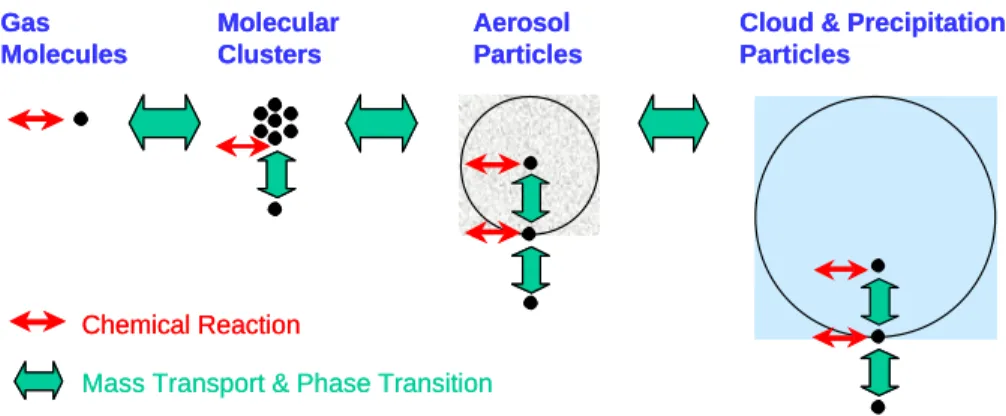
The formation and transformation of atmospheric aerosol particles and components generally proceeds via multiple steps of mass transport and chemical reaction in and between the gas phase, molecular clusters, aerosol, cloud, and precipitation particles (multiphase processes and heterogeneous reactions; Fig. 4). The combination of gas
ACPD
5, 11729–11780, 2005Organic aerosol: state of knowledge and research needs
S. Fuzzi et al. Title Page Abstract Introduction Conclusions References Tables Figures J I J I Back Close Full Screen / Esc
Print Version Interactive Discussion
EGU and liquid diffusion, reversible and competitive adsorption, and surface and bulk
reac-tions usually leads to non-linear concentration and time dependencies and limits the applicability of linear extrapolations and steady-state assumptions. For a reliable mech-anistic understanding and quantitative description of OA formation and transformation, the involved physicochemical processes have to be deconvoluted and characterised
5
by universally applicable formalisms and rate coefficients. A kinetic model framework for consistent and efficient description of aerosol and cloud surface chemistry and gas-particle interactions has recently been proposed by P ¨oschl et al. (2005). It builds on a simple double layer surface model and enables formal separation and – depending on the required level of detail and available information – flexible separation or convolution
10
of elementary molecular processes in the gas phase, at the gas-particle interface, and in the particle bulk (Fig. 5).
4.1. Outstanding issues for future research
For each of these transformational processes (SOA formation, new particle formation, and organic aerosol ageing) a specific set of open questions and research priorities
15
emerged from the workshop discussions. In some cases there is overlap, such as the need for more laboratory studies under atmospherically relevant conditions. The complexity of these processes and our current lack of understanding of them means that detailed studies in both laboratory and field environments are needed. At the same time, because there is a need to represent these processes in models there is
20
an emphasis on identifying the most important processes. In addition, it is critical that we identify areas where simplification is possible, such as through parameterizations or the grouping of similar species/processes.
Open questions on secondary organic aerosol (SOA) formation: 25
Q1: How important is SOA formation in the atmosphere (OA vs. inorganics; SOA vs. POA), and how does it influence the properties and environmental effects
ACPD
5, 11729–11780, 2005Organic aerosol: state of knowledge and research needs
S. Fuzzi et al. Title Page Abstract Introduction Conclusions References Tables Figures J I J I Back Close Full Screen / Esc
Print Version Interactive Discussion
EGU of atmospheric aerosols?
Q2: How important are the different SOA formation pathways relative to each other; in particular, how important are heterogeneous reactions on aerosols and multi-phase reactions in clouds relative to each other and relative to gas multi-phase oxida-tion followed by gas-to-particle conversion?
5
Q3: What are the molecular mechanisms and kinetics of the chemical and physical processes involved?
Q4: What are the most important precursors of SOA formation (VOC, SVOC; bio-genic/natural vs. anthropogenic)?
Q5: What are the most important products of SOA formation (organic acids,
10
oligomers/polymers, HULIS, etc.) and what are their physicochemical properties (functional groups, molecular mass, stability, volatility, solubility, hygroscopicity, optical absorption, etc.)?
Q6: How can SOA components be experimentally identified and quantified (discrimi-nation from POA and black/elemental carbon (BC/EC), positive and negative
sam-15
pling and measurement artefacts)?
Q7: What is the relative contribution of SOA components to organic carbon (OC) and particulate organic matter (POM, the total mass of organic matter including ele-ments besides carbon)? Is there an OC/POM conversion factor for SOA?
Q8: What are suitable SOA marker/tracer/model compounds and how can the
count-20
less individual SOA components be classified and lumped for efficient description of SOA formation and properties in atmospheric models?
Q9: Are SOA formation rates, temperature, CO2 concentration, photosynthesis, bio-genic VOC emission, and aerosol concentration coupled in an efficient climate feedback mechanism?
ACPD
5, 11729–11780, 2005Organic aerosol: state of knowledge and research needs
S. Fuzzi et al. Title Page Abstract Introduction Conclusions References Tables Figures J I J I Back Close Full Screen / Esc
Print Version Interactive Discussion
EGU
Research priorities for secondary organic aerosol (SOA) formation
R1: More laboratory and environmental chamber experiments under atmospherically relevant conditions are needed to elucidate SOA formation pathways, in particular heterogeneous and multiphase reaction pathways. The mechanism and kinetics of the involved physical and chemical processes need to be understood.
5
R2: Development and application of powerful and efficient analytical techniques for the identification and quantification of SOA components in laboratory experiments and field measurements. (e.g., online and single particle aerosol mass spectrom-etry, optical spectroscopy, chromatography, isotope analysis).
R3: Development of detailed process models and master chemical mechanisms
de-10
scribing organic trace gas and aerosol chemistry (VOC, SVOC, NVOC).
R4: Derivation of simplified parameterisations (lumping of species and processes) for atmospheric chemistry-transport models (regional and global).
R5: Sensitivity studies with detailed process models and simplified atmospheric mod-els are needed
15
Open questions on new particle formation:
Q1: Do organics participate in nucleation. If yes, how and to which extent?
Q2: Does the mechanism of new particle formation and the influence of organics de-pend on location, season, altitude, etc.? If yes, how and to which extent?
Q3: What is the effect of ions/electric charge on nucleation, growth and the influence
20
of organics?
Q4: Which organics are most important for the growth of new particles by condensa-tion, and which (if any) are important for nucleation?
ACPD
5, 11729–11780, 2005Organic aerosol: state of knowledge and research needs
S. Fuzzi et al. Title Page Abstract Introduction Conclusions References Tables Figures J I J I Back Close Full Screen / Esc
Print Version Interactive Discussion
EGU Q5: Are the organic compounds involved in new particle formation different than the
bulk of SOA components (i.e., those that either remain in the gas phase or that condense directly onto existing particles)?
Q6: How can the organics involved in new particle formation be determined in labora-tory experiments and field measurements?
5
Research priorities for new particle formation
R1: More field measurements of new particle formation with comprehensive physical and chemical analysis of particles, clusters, and ions as well as detailed meteo-rological data.
R2: Development and optimisation of physical and chemical measurement techniques
10
for nanometre-sized particles, clusters, and ions (ion spectrometer, single particle MS).
R3: Laboratory experiments to elucidate the mechanisms and kinetics of nucleation and growth of new particles and to gather thermodynamic data of SOA compo-nents as a function of temperature and composition (surface tensions, densities,
15
vapour pressures, activities).
R4: Development of detailed process models and simplified parameterisations for new particle formation, including nucleation, growth, aerosol dynamics, sulphur and organic chemistry as well as the role of ions/electric charge.
R5: Sensitivity studies with detailed process models and simplified atmospheric
mod-20
els.
Open questions of organic aerosol aging:
Q1: How do aging processes influence the physicochemical properties of OA compo-nents, in particular their volatility, solubility, hygroscopicity, and optical absorption (e.g., formation of light-absorbing and hygroscopic species)?
ACPD
5, 11729–11780, 2005Organic aerosol: state of knowledge and research needs
S. Fuzzi et al. Title Page Abstract Introduction Conclusions References Tables Figures J I J I Back Close Full Screen / Esc
Print Version Interactive Discussion
EGU Q2: How does the chemical transformation of OA by atmospheric photo-oxidants (air
pollutants) influence aerosol health effects? (e.g., the enhancement of mutagenic-ity and allergenicmutagenic-ity by nitration of polycyclic aromatic hydrocarbons in soot and proteins in bioparticles, respectively).
Q3: How do OA components and their aging influence the kinetics of aerosol particle
5
interactions with reactive trace gases, water vapour and clouds? (e.g., kinetic limi-tations to mass transport and phase transitions like particle deliquescence and ef-florescence, evaporation and adsorption/absorption of semi-volatile organics and inorganics, etc.)
Q4: What are the mechanisms and kinetics of OA aging processes (heterogeneous
10
and multiphase chemical reactions; mass transport and phase transitions; sur-face and bulk effects), and how can they be efficiently described in atmospheric models?
Q5: How do transformations upon sampling, storage, and measurement influence the chemical and physical analysis of OA? (e.g., filter reactions, gas-particle
partition-15
ing, shape transformation, etc.)
Q6: Can aging of OA by heterogeneous reactions followed by evaporation of smaller molecular weight products (Molina et al., 2004) be an important sink for OA and for atmospheric oxidants?
Research priorities for organic aerosol aging 20
R1: More laboratory and environmental chamber experiments under atmospherically relevant conditions to elucidate OA aging processes are needed. The mecha-nism and kinetics of the involved physical and chemical processes need to be understood.
R2: Development of detailed process models and master mechanisms describing
25
ACPD
5, 11729–11780, 2005Organic aerosol: state of knowledge and research needs
S. Fuzzi et al. Title Page Abstract Introduction Conclusions References Tables Figures J I J I Back Close Full Screen / Esc
Print Version Interactive Discussion
EGU aerosols and clouds. The use of consistent and universally applicable formalisms
and terminology is important in this context.
R3: Derivation of simplified parameterisations (lumping of species and processes) for atmospheric chemistry-transport models (regional and global).
R4: Sensitivity studies with detailed process models and simplified atmospheric
mod-5
els.
R5: Test and validation of laboratory, chamber and model results by Lagrangian field experiments.
5. Physical and chemical state of organic aerosols
Aerosol particles that contain organic compounds are characterized by diverse
chem-10
ical and physical properties. These properties control the role of organic particles in the atmosphere, affecting (1) their gas-particle partitioning, (2) their water uptake in sub-saturated conditions, (3) their water uptake in supersaturated conditions, (4) their nucleation of ice, and (5) their light scattering and absorption.
The measurement organic aerosol composition has involved a multifaceted
ap-15
proach, drawing on a number of complementary instruments. The instruments that exist today vary in the type of method used, ranging from approaches that quantify individual molecular species to ones that characterize only partial molecular fragments or bonds. Examples of speciated approaches include coupled liquid chromatography-mass spectrometry (LC-MS), whereas electron-impact (EI) and time-of-flight (TOF) MS
20
characterize fragments, and infrared (IR) spectroscopy measures absorption by bonds. Some of the techniques that have been applied to characterizing organic aerosol are listed in Table 3.
Since information on the complete molecular composition of organic particles is im-possible with existing techniques and is unlikely to be realized in the foreseeable future,
ACPD
5, 11729–11780, 2005Organic aerosol: state of knowledge and research needs
S. Fuzzi et al. Title Page Abstract Introduction Conclusions References Tables Figures J I J I Back Close Full Screen / Esc
Print Version Interactive Discussion
EGU current strategies need to include both improvements to existing instrumentation and
a method for characterizing organic aerosols using techniques that do not rely on full chemical speciation. Simultaneously, existing measurement techniques should be ex-ploited to characterize organic composition with property-based approaches. To this end, the use of model compounds which can simulate the chemical and physical
prop-5
erties of OA has been proposed (Fuzzi et al., 2001, 2002; Decesari et al., 2005) and should further be exploited.
A further issue is that organic aerosol measurements are often seriously affected by positive and negative artefacts during sampling, also limiting the accuracy to which we can fully characterise and understand aerosol organic composition. Various techniques
10
have been developed to overcome this problem but the issue of artefact aerosol organic carbon is far from being solved.
In addition, Evolved Gas Analysis (the basic type of analysis to separate EC and OC in atmospheric aerosol) suffers from many shortcomings. Uncertainties still remain un-acceptably large for organic aerosol characterisation and the distinction of the organic
15
and “elemental” fractions (see also Sect. 2.6 above).
The properties of organic compounds are important in determining the role of or-ganic particles in the atmosphere. Mechanisms controlled by the chemical and physi-cal properties of OA include a) their water uptake in sub-saturated conditions, b) their water uptake in supersaturated conditions, c) their ice nucleation ability, d) their light
20
scattering and absorption.
Water uptake in sub-saturated conditions is typically described as “hygroscopic growth” characterized by a diameter-based ratio of the change in particle size, where growth is either monotonic (simple exponential) or deliquescent (exponential, but with a very rapid increase in size around a given RH). Evidence exists suggesting that
25
particle-phase organic compounds enhance water uptake by atmospheric particles in some cases and inhibit or retard water uptake in other cases (Saxena and Hildemann, 1996), in particular affecting water uptake at low RH. For example, Marcolli et al. (2004) have noted that mixtures of organics can retain water and remain in the liquid phase
ACPD
5, 11729–11780, 2005Organic aerosol: state of knowledge and research needs
S. Fuzzi et al. Title Page Abstract Introduction Conclusions References Tables Figures J I J I Back Close Full Screen / Esc
Print Version Interactive Discussion
EGU even at very low RH. The presence of organics (particularly more soluble organics)
can also lower the RH at which deliquescence of the aerosol occurs (Kanakidou et al., 2005). While the ability of dissolved inorganic ions in aerosol particles to take up water is well understood theoretically and experimentally, little information exists about the hygroscopic behaviour of particles containing organic compounds. The mechanism of
5
water uptake by particles that contain organic species has been studied recently in sev-eral laboratory experiments, but most of these results describe the behaviour of pure organic compounds in water or of mixtures of organic compounds with an inorganic salt, whereas real atmospheric aerosol – particularly in polluted regions – is almost always a complex mixture of organic and inorganic aerosols, the latter of which may
in-10
clude soot and/or dust, as well as chemically active gas species. Complex mixtures of organic compounds have been characterized by semi-empirical thermodynamic mod-els of properties, but these model results need to be validated (Marcolli et al., 2005; Topping et al., 2005).
The phase of components in particles plays a key role in determining how particles
15
take up water. Compounds that are mixed in dry conditions will tend to stay mixed as they take up water. Compounds that are not mixed in dry solid or liquid particles will tend to take up water in separate stages, as required by the Gibbs Phase Rule. The behaviour of well-mixed liquids differs considerably from water uptake by components that are not mutually soluble in dry conditions.
20
Another important aspect of the behaviour of organic particles in the atmosphere is their ability to serve as condensation nuclei for cloud droplets in supersaturated con-ditions. This role is important in determining the microphysical properties of clouds as well as the deposition of particles in lungs. Classical theory for ideal solutions of dissociated inorganic ions shows that the Raoult effect competes with the Kelvin effect
25
in the water uptake process. The result is heterogeneous nucleation of droplets with sufficient energy from dissolution of ions to overcome the barrier created by the for-mation of an expanded air-water interface. This picture of cloud condensation nuclei depends nearly exclusively on the solubility and surface tension of organic compounds
ACPD
5, 11729–11780, 2005Organic aerosol: state of knowledge and research needs
S. Fuzzi et al. Title Page Abstract Introduction Conclusions References Tables Figures J I J I Back Close Full Screen / Esc
Print Version Interactive Discussion
EGU in particles (Nenes et al., 2002). Recent work suggests that a third property, surface
wettability, may also play a role in describing the non-ideal solution properties associ-ated with the complex mixtures present in organic particles in the atmosphere (K ¨ohler, 1936; Raymond and Pandis, 2002).
The influence of organic aerosol particles in changing the properties of ice-forming
5
nuclei in mixed-phase clouds is poorly understood, as is also their role in ice crystal formation within cirrus clouds. In one study it was noted that ice cloud particles prefer-entially contained sulphate (versus organic) aerosol, indicating that the organics were not as efficient as ice nuclei (Cziczo et al., 2004). This was explained by the relatively less efficient water uptake by the organic aerosol. Another study concluded that the
10
presence of organics will not have a significant impact on cirrus formation unless they comprise a very high fraction of the ambient aerosol (K ¨archer and Koop, 2004).
Organic aerosols also contribute to the optical properties of atmospheric particles (i.e., their light scattering efficiency and absorption efficiency) which are governed by hygroscopicity, absorption, phase and mixing, and other properties. Hygroscopic
15
growth plays an important role in the direct radiative effect of aerosol by enhancing light scattering, resulting in reductions in visibility and incoming solar radiation. Or-ganic particles will both absorb and scatter radiation. It is known that absorption by black carbon has an important effect on the atmospheric radiative balance, but the rel-ative and absolute roles of back carbon and light-absorbing organic aerosol (“brown
20
carbon”) in absorbing radiation is not well constrained. Quantifying light-absorbing car-bon, and the associated organic carbon that is typically mixed with soot-like emissions, requires careful measurements and multiple techniques. The few measurements of absorption by typical atmospheric organic compounds show very small absorption, but both particle phase and its associated shape have important impacts on the calculated
25
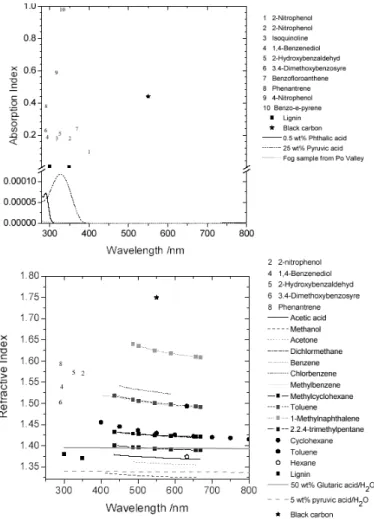
scattering and absorption of light in the atmosphere and individual organic components exhibit a wide range of scattering and absorption indices (Fig. 6). External and internal mixing of components may change the calculated optical effects significantly (Myhre and Nielsen, 2004; Jacobson, 2001).
ACPD
5, 11729–11780, 2005Organic aerosol: state of knowledge and research needs
S. Fuzzi et al. Title Page Abstract Introduction Conclusions References Tables Figures J I J I Back Close Full Screen / Esc
Print Version Interactive Discussion
EGU 5.1. Outstanding issues for future research
For the last decade, studies of molecular compositions of OA have been conducted extensively using GC/MS, LC/MS, IC, etc. Previous molecular approaches demon-strated that organic aerosols are composed of complex mixture of different organic species from less-polar organics (n-alkanes, polycyclic aromatic hydrocarbons, fatty
5
alcohols, fatty acids, etc.) to highly polar organics such as dicarboxylic acids and multi-functional organic acids. Studies employing FTIR spectroscopy and NEXAFS have demonstrated the presence of different functional groups such as ketonic and carboxylic groups in aerosol particles. Humic-like substances (HULIS) have been iden-tified in aerosols, although their contribution to organic carbon is not clear. Field
ob-10
servation and laboratory smog chamber studies demonstrated that oxidative reactions of biogenic and anthropogenic OA precursors in the gas phase produce low molecu-lar weight organic acids such as oxalic and other dicarboxylic acids, dicarbonyls and multi-functional organics. Oxidation reactions in the particle phase may also produce oxygenated species, including aldehydes, organic acids, and large molecules such as
15
HULIS. Despite this research progress, a significant fraction of atmospheric OA still remains poorly characterized.
Chemical evolution of particles in the atmosphere modifies distributions of functional groups, thus altering the chemical (e.g., water-solubility) and physical properties (e.g., hygroscopicity, ice nucleation capability). Small dicarboxylic acids can act as agents to
20
dissolve clay and carbonate minerals (dusts) and accelerate the release of metals into the liquid phase of aerosols and may thereby be linked to biogeochemical cycles of mi-cronutrients in the remote atmosphere and ocean. Laboratory studies on hygroscopic growth of different polar organic compounds have demonstrated that water-soluble or-ganics in the atmospheric aerosol could act as important cloud condensation nuclei or
25
ACPD
5, 11729–11780, 2005Organic aerosol: state of knowledge and research needs
S. Fuzzi et al. Title Page Abstract Introduction Conclusions References Tables Figures J I J I Back Close Full Screen / Esc
Print Version Interactive Discussion
EGU
Research priorities for constraining the physical and chemical state of organic aerosol
R1: Further improve artefact-free aerosol sampling for organic compounds and stan-dardize the BC/OC separation procedure through EGA.
R2: Understanding of organic compositions at the functional group or structural level is still an important subject of OA study in terms of bulk-, size-segregated and
5
individual aerosols. Developments of new methods and technologies are needed to better describe the chemical composition of OA.
R3: Spatial distributions of functional groups within an individual particle further need to be studied, because such chemical states determine the physical properties of aerosols.
10
R4: Studies on heterogeneous reactions that result in small and highly oxygenated species as well as large polymers (HULIS) need to be conducted with various organic precursors of biogenic and anthropogenic origin under laboratory and field conditions.
R5: The role of OA in nucleation processes (e.g., ice crystal formation) occurring in
15
clouds in the upper troposphere need to be clarified in both field and laboratory experiments.
6. Atmospheric modelling of organic aerosols
Using models, we can integrate knowledge on organic species’ sources, their trans-port, in-atmosphere aerosol formation, transformation, and properties (chemical,
phys-20
ical and optical) with the thermodynamics and meteorology of the ambient atmosphere in order to determine their effects on the biosphere and human health, their radiative impacts and, from that, their climate impacts. As has been discussed, field measure-ments have revealed a very large number of organic species in the atmosphere in
ACPD
5, 11729–11780, 2005Organic aerosol: state of knowledge and research needs
S. Fuzzi et al. Title Page Abstract Introduction Conclusions References Tables Figures J I J I Back Close Full Screen / Esc
Print Version Interactive Discussion
EGU both the gas and particulate phases. The behaviour of these species depends on their
mass fractions relative to one another and to inorganic species (such as SO2, nitrate, sulphate, and black carbon) as well as on temperature and humidity – all of which will likely evolve with time and the climate. The complexity of the processes controlling atmospheric aerosols can only be captured using small-scale, high resolution models
5
which are capable of simulating physical and chemical processes in great detail. These models can yield insight into how perturbations in atmospheric composition and climate might affect organic aerosol formation rates and properties (i.e., sensitivity studies) and the concomitant impacts on aerosol distribution as well as, for example, cloud droplet formation and wet and dry deposition of these aerosols. However this level of chemical
10
and microphysical detail cannot be extended to the global scale due to computational limitations, so radiative and climate impacts must be determined using a hierarchy of models from regional to global scale.
Discussions at this workshop mainly focused on what information and improvements are needed in order to reduce uncertainties in Chemical Transport Model (CTMs) and
15
Global Climate Model (GCM) representations of organic aerosols. Currently there is about a factor-of-three uncertainty in the direct plus indirect top-of the-atmosphere ra-diative effect of organic aerosols (IPCC, 2001), so these uncertainties are large. A sig-nificant part of this stems from a lack of understanding of secondary organic aerosol formation rates and their controlling factors, though source strengths (for both organic
20
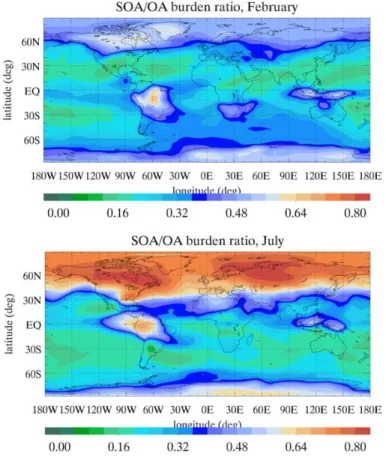
aerosols and precursor gases), transformation and removal processes, the aerosol op-tical properties, and organics’ effects on cloud formation and lifetime also remain highly uncertain. Depending on the aerosol sources, transport processes, and atmospheric conditions, the composition of OA can be dominated either by POA or by SOA. For ex-ample, recent studies have shown a high abundance of POA in tropical air masses that
25
are influenced by strong biomass burning (Artaxo et al., 2002; Formenti et al., 2003; Kirchstetter et al., 2003; Decesari et al., 2005). On the other hand, in extratropical air masses, influenced by anthropogenic or biogenic emissions of precursor volatile or-ganic compounds (VOC) and characterized by high photochemical activity, most of the
ACPD
5, 11729–11780, 2005Organic aerosol: state of knowledge and research needs
S. Fuzzi et al. Title Page Abstract Introduction Conclusions References Tables Figures J I J I Back Close Full Screen / Esc
Print Version Interactive Discussion
EGU aerosol is produced in the atmosphere from gaseous precursors (c.f. Kanakidou et al.,
2005, and Fig. 7).
In addition to basic knowledge about OA, there is a need to improve the representa-tion of the organic aerosol component in the models. Effort needs to focus on modelling (i) the size resolved multi-component aerosol, allowing consideration of internally mixed
5
aerosol; (ii) the formation of SOA, including mechanisms other than gas-to-particle par-titioning; and (iii) the impact of organics on aerosol optics, on water associated with the aerosol, on cloud formation, growth and properties (Kanakidou et al., 2005).
6.1. Outstanding issues for future research
To consider organic aerosols in CTMs and GCMs we need to identify which are the
10
critical parameters for controlling OA formation and fate under both pristine and polluted conditions and to identify suitable parameterisations of processes too complex to be included in full detail. This requires improvement of our understanding of the physical and chemical behaviour of OA such that we can simplify the system without missing critical information on the complex organic/inorganic mixtures of the different aerosol
15
types (marine, urban, rural, etc).
To properly include OA properties in models, we need to have better knowledge in the following critical areas:
(a) The total burden (mass and size distribution) and spatial variability of OA in the
atmosphere. This depends on sufficiently constrained knowledge of emissions, 20
physical and chemical transformation processes, and removal rates from the at-mosphere via dry deposition and precipitation. In particular, the simulation of the formation and occurrence of SOA in the troposphere requires the development of “clever” lumping methods, using a small number of species that represent the necessary properties for modelling and which are suitable for present-day and
25
pre-industrial conditions.