HAL Id: hal-00299323
https://hal.archives-ouvertes.fr/hal-00299323
Submitted on 14 Jun 2006
HAL is a multi-disciplinary open access
archive for the deposit and dissemination of
sci-entific research documents, whether they are
pub-lished or not. The documents may come from
teaching and research institutions in France or
abroad, or from public or private research centers.
L’archive ouverte pluridisciplinaire HAL, est
destinée au dépôt et à la diffusion de documents
scientifiques de niveau recherche, publiés ou non,
émanant des établissements d’enseignement et de
recherche français ou étrangers, des laboratoires
publics ou privés.
Softening and instability of natural slopes in highly
fissured plastic clay shales
L. Picarelli, G. Urciuoli, A. Mandolini, M. Ramondini
To cite this version:
L. Picarelli, G. Urciuoli, A. Mandolini, M. Ramondini. Softening and instability of natural slopes in
highly fissured plastic clay shales. Natural Hazards and Earth System Science, Copernicus Publications
on behalf of the European Geosciences Union, 2006, 6 (4), pp.529-539. �hal-00299323�
Nat. Hazards Earth Syst. Sci., 6, 529–539, 2006 www.nat-hazards-earth-syst-sci.net/6/529/2006/ © Author(s) 2006. This work is licensed under a Creative Commons License.
Natural Hazards
and Earth
System Sciences
Softening and instability of natural slopes in highly fissured plastic
clay shales
L. Picarelli1, G. Urciuoli2, A. Mandolini1, and M. Ramondini2
1Dipartimento di Ingegneria Civile, Seconda Universit`a di Napoli, Aversa, Italy 2Dipartimento di Ingegneria Geotecnica, Universit`a di Napoli Federico II, Napoli, Italy
Received: 5 December 2005 – Revised: 21 March 2006 – Accepted: 21 March 2006 – Published: 14 June 2006
Abstract. Softening is often considered to be the main cause
of first-time slides in OC clay, but so far the mechanics of softening has not been satisfactorily explained. Bearing on laboratory data and field observations about landslides in tec-tonized highly plastic clay shales of Italian Apennines, the paper describes a process of soil weakening that could ex-plain some failures of natural slopes.
1 Introduction
Geotechnical literature reports numerous well documented cases of first-time slides in OC clay, whose operative shear strength is lower than the peak measured on representative undisturbed samples. The contrast between the virtually available soil resistance, and the resistance that is really mo-bilised at failure, is usually justified by mechanical processes of soil weakening occurring prior to slope failure. Two fun-damental processes are generally invoked: i) strain softening (Bjerrum, 1967), that is caused by non uniform plastic shear strains leading beyond the peak, the average soil strength mobilised along a developing slip surface (progressive fail-ure); ii) softening (Terzaghi, 1936), that is generally associ-ated with volumetric strains induced by swelling, that cause a time-depending decrease in the available peak strength.
Softening, i.e. the decrease in peak strength prior to fail-ure, is the topic of this paper, that reports some observations on first-time slides in highly fissured plastic clay shales and data gathered in both laboratory and in situ tests.
2 Current ideas about softening
Softening is often invoked to justify slides in overconsoli-dated clay, but a general consensus about the mechanics of
Correspondence to: L. Picarelli
this phenomenon has not been achieved. Literally, softening is the result of water content increase due to a change of the state of stress.
Terzaghi (1936), first, observed that fissured OC clays can experience some shear strength decay as a consequence of swelling induced by unloading. Some English authors at-tributed to softening the delayed failure of cuttings in Lon-don Clay. In one of his latest paper on this subject, Skempton (1977) remarked that delayed failure is caused by dissipation of negative excess pore pressures triggered by excavation, a process that does not affect the shear strength parameters, but only the effective state of stress. However, he did not exclude that during the long-lasting phase of pore pressure equaliza-tion, some decay of the shear strength parameters can take place. In another important paper touching the same issue, Morgenstern (1985) outlined that swelling can provoke a de-crease in the dilative and brittle behaviour of clay, causing a decrease in the shear strength through a loss of its component associated with overconsolidation: therefore, the long-term strength, the so called fully-softened strength, could be very close to the critical value.
According to Terzaghi (1936), the mechanism of shear strength decrease in fissured stiff clays is due to opening of fissures, swelling of the adjacent clay under practically zero confining stress and reconsolidation of clay under its own weight. However, this mechanism does not apply to all cases, especially to slightly fissured clay. Similar considerations as those made by Terzaghi, were reported by Skempton (1970) tens of years after, but thinking to fissures induced, also in intact clay, by mechanisms of shear.
Just to test, under the umbrella of the Critical Strength Theory, the effects of swelling on shear strength, Calabresi and Scarpelli (1985) and Rampello (1987) performed CIU triaxial tests on some Italian non-fissured or slightly fis-sured OC clays, pre-swelled in the laboratory under a very low confining stress. They noticed that swelling can bring about some decrease in cohesion due to increase in the water
530 L. Picarelli et al.: Instability of slopes in fissured plastic clay shales
function of the profile of the slip surface (Fig. 3), i.e. of continuity, spacing, orientation and
shape of fissures.
Figure 1. Approximate representation of the geological history of the Apennines chain and
associated fabric of clay shales (from Picarelli et al., 1998)
For increasing confining stresses, the influence of this
angle of roughness is smaller and smaller, and the
resistance of clay can drop below the critical strength
measured on reconstituted soil, tending towards the
residual value (Picarelli et al., 2002).
Outcrops in tectonized clay shales are generally covered
by a softer and destructured clay generated by
weathering and swelling. A strong and fast increase of
water content can be also caused by cutting. As a result
of these phenomena, the system of fissures tends to
disappear, and the clay shale progressively turns into an
apparently non-fissured material. However results of
laboratory tests on samples taken from softened covers
suggest that fissures can be hidden, nevertheless affecting the shear strength.
Urciuoli (1990) reviewed the Italian literature on landslides in highly fissured tectonized clay
shales, showing that flow-like movements are most widespread than other types of landslide.
TECTO NIZED CLAY SH ALE: CONTINENTAL ENVIRO NM ENT
SOFTENED CLAY SHALE: CONTINENTAL ENVIRO NM ENT
NON-FISSURED BO NDED CLAY: M ARINE ENVIRO NM ENT
NON-FISSURED NON-BONDED N.C. CLAY: M ARINE ENVIRONMENT
SED IM ENTATIO N
DIA G EN ESIS A N D AG E ING
G E O L O G IC A L P R O C E S S E S F A B R IC A N D S T R U C T U R E E V O L U T IO N TEC TO N ISM
SO FTE NIN G A N D W EATHER ING
5 - 10 cm
S W L
S W L
SW L S W L
Figure 2. The highly fissured
tectonized Bisaccia clay shale
Fig. 1. Approximate representation of the geological history of the Apennines chain and associated fabric of clay shales (from Picarelli et
al., 1998).
content. However, cohesion does not completely vanish and the soil behaviour remains dilative due to overconsolidation. It is worth mentioning that softening, as described above, has some similarities with other phenomena that are respon-sible for time-depending decay of shear strength, such as weathering, slaking, i.e. soil destructuration caused by cy-cles of wetting-drying or of freezing-thawing (Botts, 1998; Graham and Au, 1985) and fatigue (Lacerda, 1989; Eigeng-brod et al., 1992). Through accumulated plastic strains, all these phenomena, generally concentrated in the most super-ficial soil layers, can determine a loss of that part of the shear strength that depends on interparticle bonding, causing a reduction in cohesion. Therefore, they affect only bonded clays. Leroueil and Vaughan (1990) and Hight et al. (2002) assume that even simple swelling can provoke destructura-tion of bonded clays. This idea has been recently resumed by Takahashi et al. (2005) bearing on the results of labora-tory tests on undisturbed specimens of London clay.
All mechanisms mentioned above show how complicated is the interpretation of slope instability in stiff overconsoli-dated clay and clay shale, since more than one of them can contemporaneously act in the same slope at same time. Fur-thermore, strain-softening (progressive failure) and rate ef-fects can play an additional and significant role. However, laboratory data and field observations on highly fissured plas-tic clay shales of Italian Apennines show that a decrease in the shear strength could be caused by chemical-physical pro-cesses provoked by exposure of soil to fresh water.
3 Fabric and instability mechanisms in tectonized clay shales in the Apennines chain, Italy
Tectonized clay shales are widespread in the Apennines chain, Italy. The chain is the result of orogenesis, and is con-stituted by a thrust sheet sequence of superimposed nappes of clay and competent rock. Figure 1 shows a schematic rep-resentation of possible effects of the geological history of the chain on the structure of fine-grained deposits of marine ori-gin.
Figure 2 shows a specimen of tectonized clay shale. It is highly fissured and sheared as a result of tectonism. Fis-sures are planar to curved, and polished to slickensided, thus their shear strength is certainly close to the residual value. Fissures are very small and closely spaced, intersecting each other: as a result, they subdivide the material into very small fragments (shear lenses, usually called “scales”) whose size is in the order of some millimetres to a few centimetres. However, superimposed persistent shear discontinuities are generally widespread in the soil mass.
As a result of this complex fabric, the mechanism of fail-ure of tectonized clay shales is characterized by localization of deformation and slipping of soil along a system of nearby and mutually intersecting discontinuities (fissures and/or per-sistent shears), as in Fig. 3. Therefore, the available peak strength is quite low, because it depends on the friction angle along fissures, that is closely around residual, and on a sort of “angle of roughness”, that is a function of the profile of the
L. Picarelli et al.: Instability of slopes in fissured plastic clay shales 531
slip surface (Fig. 3), i.e. of continuity, spacing, orientation and shape of fissures.
For increasing confining stresses, the influence of this an-gle of roughness is smaller and smaller, and the resistance of clay can drop below the critical strength measured on recon-stituted soil, tending towards the residual value (Picarelli et al., 2002).
Outcrops in tectonized clay shales are generally covered by a softer and destructured clay generated by weathering and swelling. A strong and fast increase in water content can be also caused by cutting. As a result of these phenomena, the system of fissures tends to disappear, and the clay shale progressively turns into an apparently non-fissured material. However results of laboratory tests on samples taken from softened covers suggest that fissures can be hidden, never-theless affecting the shear strength.
Urciuoli (1990) reviewed the Italian literature on land-slides in highly fissured tectonized clay shales, showing that flow-like movements are most widespread than other types of landslide.
This remark suggests that softening plays an important role on slope behaviour, since it normally favours the devel-opment of landslides of flow style. As a matter of fact, geo-morphological field inve-stigations indicate that slope failure can be followed by a fast increase of water content that goes on with a change of the movement style from slide to flow (Pellegrino et al., 2004).
4 Land evolution and slope instability in the Bisaccia area, Southern Apennines
The Bisaccia hill is sited about 100 km North to Naples (Fig. 4). It is elongated in the South-North direction and is constituted by a slab of slightly cemented conglomerates resting on tectonized highly plastic clay shales of marine origin (CF=60%÷70%; WL=110%÷190%) that extensively outcrop in a wide area around the hill.The hill is the result of erosion started some hundreds thousands of years ago along two parallel faults. Erosion dismantled the upper conglomer-ates, leaving the hill in the middle (Fig. 5). Today, the bed of the two valleys is located within the fine-grained formation. The uppermost part of hillslopes, in conglomerates, is quite steep, whereas the lowermost part, in clay shales, is much gentler. Further hills rising in the same area display similar features.
As a consequence of continuous stress change associated with still active erosion, clay shales experience continuing deformation. In particular, the bed of the two valleys is rising because of swelling, while the hill is sinking and spreading laterally due to squeezing out of underlying clay shales. As a result, the conglomerate slab is highly fractured. This de-formational process is accelerated by earthquakes, that have a return period ranging between thirty and fifty years. In particular, the strongest ones are responsible for post-seismic
function of the profile of the slip surface (Fig. 3), i.e. of continuity, spacing, orientation and
shape of fissures.
Figure 1. Approximate representation of the geological history of the Apennines chain and
associated fabric of clay shales (from Picarelli et al., 1998)
For increasing confining stresses, the influence of this
angle of roughness is smaller and smaller, and the
resistance of clay can drop below the critical strength
measured on reconstituted soil, tending towards the
residual value (Picarelli et al., 2002).
Outcrops in tectonized clay shales are generally covered
by a softer and destructured clay generated by
weathering and swelling. A strong and fast increase of
water content can be also caused by cutting. As a result
of these phenomena, the system of fissures tends to
disappear, and the clay shale progressively turns into an
apparently non-fissured material. However results of
laboratory tests on samples taken from softened covers
suggest that fissures can be hidden, nevertheless affecting the shear strength.
Urciuoli (1990) reviewed the Italian literature on landslides in highly fissured tectonized clay
shales, showing that flow-like movements are most widespread than other types of landslide.
TECTO NIZED CLAY SH ALE: CONTINENTAL ENVIRO NM ENT
SOFTENED CLAY SHALE: CONTINENTAL ENVIRO NM ENT
NON-FISSURED BO NDED CLAY: M ARINE ENVIRO NM ENT
NON-FISSURED NON-BONDED N.C. CLAY: M ARINE ENVIRONMENT
SED IM ENTATIO N
DIA G EN ESIS A N D AG E ING
G
E
O
L
O
G
IC
A
L
P
R
O
C
E
S
S
E
S
F
A
B
R
IC
A
N
D
S
T
R
U
C
T
U
R
E
E
V
O
L
U
T
IO
N
TEC TO N ISMSO FTE NIN G A N D W EATHER ING
5 - 10 cm
S W L
S W L
SW L S W L
Figure 2. The highly fissured
tectonized Bisaccia clay shale
Fig. 2. The highly fissured tectonized Bisaccia clay shale.
subsidence caused by dissipation of excess pore pressures in-duced by shaking (Di Nocera et al., 1995).
Geomorphological surveys and monitoring support the proposed model of land evolution. Deficient pore pressures, measured with vibrating wire piezometer installed in depth in the middle of the eastern valley, can be explained only by the effects of erosion, whose rate is faster than the rate of excess pore pressure dissipation. In contrast, monitoring of pore pressures in clay shales overlain by the hill, carried out after the strong Irpinia earthquake (1980), allowed to record positive excess pore pressures induced by seismic shaking. Numerical analyses bearing on extensive and careful labora-tory investigations support these considerations (Di Nocera et al., 1995; Lampitiello et al., 2001).
The high erodibility of Bisaccia clay shales is directly rec-ognizable in site by geomorphological investigations. In fact, running waters can rapidly excavate narrow and steep gullies: in a few years, these can attain depths of metres.
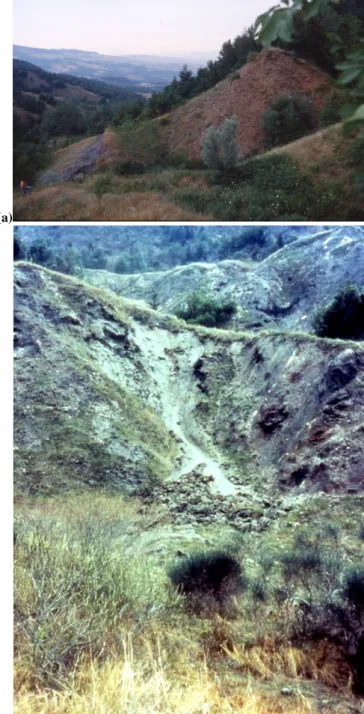
Steep slopes in clay shale are subjected to either deep slides or shallow mudslides. A couple of examples are shown in Fig. 6. The first photograph (Fig. 6a) shows quite a deep slide along a flank of the Bisaccia hill: the slide develops in grey clay shales, involving a brown conglomerate block. The second photograph (Fig. 6b) shows a shallow mudslide in grey clay shales.
532 L. Picarelli et al.: Instability of slopes in fissured plastic clay shales
Fissure
Sliding surface
Fissure
Shear lense
ϕ’ = arctg[tg(ϕ’b+ieff)] > < ϕ’ ϕ’cvFig. 3. Typical mechanism of failure of tectonized clay shales in triaxial test and factors governing the
friction angle ϕ’ (from Olivares and Picarelli, 1999); ϕ’b is the “basic” friction angle, i.e the friction
angle along a perfectly planar and polished surface; ieff is the “angle of roughness” and ϕ’cs is the
friction angle at critical state
Fig. 3. Typical mechanism of failure of tectonized clay shales in triaxial tests and factors governing the friction angle, ϕ0(from Olivares and Picarelli, 1999): ϕb0 is the “basic” friction angle along a perfectly planar and polished surface, ieffis the “angle of roughness” and ϕcs0 is the friction angle at critical state.
This remark suggests that softening plays an important role on slope behaviour, since it normally favours the development of landslides of flow style. As a matter of fact, geomorphological field inve-stigations indicate that slope failure can be followed by a fast increase of water content that goes on with a change of the movement style from slide to flow (Pellegrino et al., 2004).
4. Land evolution and slope instability in the Bisaccia area, Southern Apennines
The Bisaccia hill is sited about 100 km North to Naples (Fig. 4). It is elongated in the South-North direction and is constituted by a slab of slightly cemented conglomerates resting on tectonized highly plastic clay shales of marine origin (CF=60-70%; WL=110-190%) that extensively outcrop in a wide area around the hill.The hill is the result of erosion started some hundreds thousands of years ago along two parallel faults. Erosion dismantled the upper conglomerates, leaving the hill in the middle (Fig. 5). Today, the bed of the two valleys is located within the fine-grained formation. The uppermost part of hillslopes, Figure 3. Typical mechanism of failure of tectonized clay
shales in triaxial tests and factors governing the friction angle,Φ’ (from Olivares & Picarelli, 1999): ieff is the “angle
of roughness” and Φ’cs is the friction angle at critical state
φ
φ
φ
φ
φ
φ
φ
φ
Figure 4. The Bisaccia hill Fig. 4. The Bisaccia hill.
Accounting for the very low shear strength of soil in satu-rated conditions (ϕ0=15÷25◦, depending on effective normal stress), steep slopes in clay shale, that can locally reach an-gles of 40◦and more, can remain stable for long time only thanks to suction (Olivares, 1997). Swelling pressures mea-sured in the laboratory on superficial samples directly taken from outcrops, prove the existence of a high suction. In fact, values as high as 0.6 to 1 MPa have been measured in oe-dometer and isotropic compression tests that have been per-formed, as usual, in a bath of distilled water. Such high suctions are due to the effects of erosion (Picarelli and Ur-ciuoli, 1993), combined with the steepness of slopes and the low conductivity of clay, that govern hydraulic boundary conditions and capillary forces. In particular, in saturated
in conglomerates, is quite steep,
whereas the lowermost part, in clay
shales, is much gentler. Further hills
rising in the same area display
similar features.
As a consequence of continuous
stress change associated with still
active erosion, clay shales
experience continuing deformation.
In particular, the bed of the two
valleys is rising because of swelling,
while the hill is sinking and
spreading laterally due to squeezing
out of underlying clay shales. As a
result, the conglomerate slab is
highly fractured. This deformational
process is accelerated by
earthquakes, that have a return
period ranging between thirty and
fifty years. In particular, the strongest ones are responsible for post-seismic subsidence caused
by dissipation of excess pore pressures induced by shaking (Di Nocera et al., 1995).
Geomorphological surveys and monitoring support the proposed model of land evolution.
Deficient pore pressures, measured with vibrating wire piezometer installed in depth in the
middle of the eastern valley, can be explained only by the effects of erosion, whose rate is
faster than the rate of excess pore pressure dissipation. In contrast, monitoring of pore
pressures in clay shales overlain by the hill, carried out after the strong Irpinia earthquake
(1980), allowed to record positive excess pore pressures induced by seismic shaking.
Numerical analyses bearing on extensive and careful laboratory investigations support these
considerations (Di Nocera et al., 1995; Lampitiello et al., 2001).
The high erodibility of Bisaccia clay shales is directly recognizable in site by
geomorphological investigations. In fact, running waters can rapidly excavate narrow and
steep gullies: in a few years, these can attain depths of metres.
Figure 5. Geological history of the Bisaccia hill
according to Di Nocera et al. (1995)
Fig. 5. Geological history of the Bisaccia hill according to Di
No-cera et al. (1995).
L. Picarelli et al.: Instability of slopes in fissured plastic clay shales 533
(a)
Steep slopes in clay shale are subjected to either deep slides or shallow mudslides. A couple of examples are shown in Figure 6. The first photograph (Fig. 6a) shows quite a deep slide along a flank of the Bisaccia hill: the slide develops in grey clay shales, involving a brown conglomerate block,. The second photograph (Fig. 6b) shows a shallow mudslide in grey clay shales.
Figure 6. Landslides in clay shale along steep slopes: a) a deep slide affecting the hillslope; b) a mudslide
b
)(a)
(b)
Steep slopes in clay shale are subjected to either deep slides or shallow mudslides. A couple
of examples are shown in Figure 6. The first photograph (Fig. 6a) shows quite a deep slide
along a flank of the Bisaccia hill: the slide develops in grey clay shales, involving a brown
conglomerate block,. The second photograph (Fig. 6b) shows a shallow mudslide in grey clay
shales.
Figure 6. Landslides in clay shale along steep slopes:
a) a deep slide affecting the hillslope; b) a mudslide
(b)
a
)
Fig. 6. Landslides in clay shale along steep slopes: (a) a deep slide
affecting the hillslope; (b) a mudslide.
conditions the soil permeability is as low as a 10÷13 m/s. Prolonged rainfalls cause a decrease in suction and in the associated cohesion, leading to slope instability. The depth reached by the advancing wet front due to water infiltration depends on the duration of the event, on the slope of the ground surface and on soil permeability. Generally, land-slides have a very small thickness. As shown by Pellegrino et al. (2004), formation of mudslides, as in Fig. 6b, can be
Accounting for the very low shear strength of soil in saturated conditions (ϕ’=15-25°, depending on effective normal stress), steep slopes in clay shale, that can locally reach angles of 40° and more, can remain stable for long time only thanks to suction (Olivares L., 1997). Swelling pressures measured in the laboratory on superficial samples directly taken from outcrops, prove the existence of a high suction. In fact, values as high as 0.6 to 1 MPa have been measured in oedometer and isotropic compression tests that have been performed, as usual, in a bath of distilled water. Such high suctions are due to the effects of erosion (Picarelli & Urciuoli, 1993), combined with the steepness of slopes and the low conductivity of clay, that govern hydraulic boundary conditions and capillary forces. In particular, in saturated conditions the soil permeability is as low as a 10-13 m/sec. Prolonged rainfalls cause a decrease in suction and in the associated cohesion, leading to slope instability. The depth reached by the advancing wet front due to water infiltration depends on the duration of the event, on the slope of the ground surface and on soil permeability. Generally, landslides have a very small thickness. As shown by Pellegrino et al. (2004), formation of mudslides, as in Figure 6b, can be due to the rapidity of debris deposition at the toe of the slope, that cause a building up of excess pore pressure in the fine-grained debris under its own weigh.
Also deep slides occurring along the steep flanks of the hill, as in Figure 6a, are triggered by suction decrease. Possibly, the mechanism of failure is progressive, starting from the toe of
the slope, where suction decreases faster than in depth. Figure 7 shows some shallow landslides (either slides or flows) on a gentle slope. In these geomorphological conditions the water table is very close to the ground surface for a great part of the year; hence, suction does not seem to play an important role. Therefore, if the morphology of slope does not change with time, the minimum safety factor, attained in wet seasons, should remain more or less the same. In this case, instability seems to be a consequence of a time-depending process of shear strength decrease, here called softening, more than of pore pressure changes.
Figure 7. Landslides occurring on gentle slopes Fig. 7. Landslides occurring on gentle slopes.
due to the rapidity of debris deposition at the toe of the slope, that cause a building up of excess pore pressure in the fine-grained debris, under its own weigh.
Also deep slides occurring along the steep flanks of the hill, as in Fig. 6a, are triggered by suction decrease. Possibly, the mechanism of failure is progressive, starting from the toe of the slope, where suction decreases faster than in depth.
Figure 7 shows some shallow landslides (either slides or flows) on a gentle slope. In these geomorphological con-ditions the water table is very close to the ground surface for a great part of the year; hence, suction does not seem to play an important role. Therefore, if the morphology of slope does not change with time, the minimum safety fac-tor, attained in wet seasons, should remain more or less the same. In this case, instability seems to be a consequence of a time-depending process of shear strength decrease, here called softening, more than of pore pressure changes.
5 Likely effects of infiltration on the shear strength of Bisaccia clay shale
As shown above, the mechanism of failure and the shear strength of tectonized clay shales are strongly affected by fabric. In its “overconsolidation” range, the soil is dilative and slightly brittle. This is shown in Fig. 8a where are re-ported the results of conventional direct shear tests on the marine Bisaccia clay shale, run, as usual, in a bath of distilled water, under a normal stress less than the overconsolidation pressure. Figure 8b shows the results of further tests per-formed after a stage of swelling in the same shear box under a normal stress of 10 kPa, and a successive stage of consol-idation under the established normal stress, that falls in the same range of values as in the previous case. A compari-son between the two figures shows that pre-swelling deter-mines a radical change of soil behaviour, that becomes con-tractive and ductile, leading to a significant shear strength decrease: since in both cases the failure envelope is slightly
534 L. Picarelli et al.: Instability of slopes in fissured plastic clay shales
5. Likely effects of infiltration on the shear strength of Bisaccia clay shale
As shown above, the mechanism of failure and the shear strength of tectonized clay shales are
strongly affected by fabric. In its “overconsolidation” range, the soil is dilative and slightly
brittle. This is shown in Figure 8a where are reported the results of conventional direct shear
tests on the marine Bisaccia clay shale, run, as usual, in a bath of distilled water, under a
normal stress less than the overconsolidation pressure. Figure 8b shows the results of further
tests performed after a stage of swelling in the same shear box under a normal stress of 10
kPa, and a successive stage of consolidation under the established normal stress, that falls in
the same range of values as in previous case. A comparison between the two figures shows
that pre-swelling determines a radical change of soil behaviour, that becomes contractive and
ductile, leading to a significant shear strength decrease: since in both cases the failure
envelope is slightly non-linear, the linear fitting of data furnishes some cohesion, that is 11
kPa in the first case and 16 kPa in the second one, but the friction angle after pre-swelling
drops from 26° to only 11° (Cicolella & Picarelli, 1990). Such a low value of the friction
angle deserves some further comment.
Figure 8. Results of direct shear tests on the Bisaccia clay shale (from Cicolella & Picarelli,
1990): a) conventional; b) after a stage of swelling under a normal stress of 10 kPa
Fig. 8. Results of direct shear tests on the Bisaccia clay shale (from Cicolella and Picarelli, 1990): (a) conventional; (b) after a stage of
swelling under a normal stress of 10 kPa.
Figure 9 shows the results of further tests conducted under normal stresses lower than the swelling pressure (around 0.6 MPa). While a part of the specimens were allowed to swell, as usual, for 48 hours, others were sheared only after 10 to 100 days of swelling, during which they experienced high volumetric strains. The difference in shear strength is very clear. Once again, the parameters of shear strength are dramatically affected by the magnitude of swelling: in fact, the cohesion measured after a long stage of swelling falls from 11 to 9 kPa and the friction angle from 26° to 18°.
Figure 9. Results of direct shear tests on the Bisaccia clay shale for normal stresses lower than the swelling pressure (from Picarelli, 1991)
All these results show that swelling in distilled water (either primary or secondary) is responsible for a change of soil behaviour and shear strength. Starting from works carried out by Di Maio (1996a,b), Picarelli et al. (1998) assume that the peak strength decrease experienced by marine Bisaccia clay shale is caused by physical-chemical processes due to exposure to and absorption of distilled water, and consequent change of interparticle forces. An impressive idea about the susceptibility of marine Bisaccia clay shale to any change of pore liquid is shown in Figure 10, that shows the dependence of the liquidity limit on the molarity of a NaCl solution. Such a solution is probably more similar than distilled water to the natural pore liquid, in turn depending on the natural deep marine sedimentation environment. As shown, the liquidity limit obtained with distilled water is about two times the one obtained with NaCl solution, regardless its molarity.
Fig. 9. Results of direct shear tests on the Bisaccia clay shale for
normal stresses lower than the swelling pressure (from Picarelli, 1991).
non-linear, the linear fitting of data furnishes some cohesion, that is 11 kPa in the first case and 16 kPa in the second one, but the friction angle after pre-swelling drops from 26◦ to only 11◦(Cicolella and Picarelli, 1990). Such a low value of the friction angle deserves some further comment.
Figure 9 shows the results of further tests conducted un-der normal stresses lower than the swelling pressure (around 0.6 MPa). While a part of the specimens were allowed to
swell, as usual, for 48 h, others were sheared only after 10 to 100 days of swelling, during which they experienced high volumetric strains. The difference in shear strength is very clear. Once again, the parameters of shear strength are dra-matically affected by the magnitude of swelling: in fact, the cohesion measured after a long stage of swelling falls from 11 to 9 kPa and the friction angle from 26◦to 18◦.
All these results show that swelling in distilled water (ei-ther primary or secondary) is responsible for a change of soil behaviour and shear strength. Starting from works carried out by Di Maio (1996a, b), Picarelli et al. (1998) assume that the peak strength decrease experienced by marine Bisaccia clay shale is caused by physical-chemical processes due to exposure to and absorption of distilled water, and consequent change of interparticle forces.
An impressive idea about the susceptibility of marine Bisaccia clay shale to any change of pore liquid is shown in Fig. 10, that shows the dependence of the liquidity limit on the molarity of a NaCl solution. Such a solution is probably more similar than distilled water to the natural pore liquid, in turn depending on the natural deep marine sedimentation en-vironment. As shown, the liquidity limit obtained with dis-tilled water is about two times the one obtained with NaCl solution, regardless its molarity.
L. Picarelli et al.: Instability of slopes in fissured plastic clay shales 535
Figure 11 reports the results of triaxial
tests executed by Di Maio & Onorati
(2000) on reconstituted normally
consolidated specimens obtained by
mixing powdered clay with distilled
water and with a 1M NaCl solution. It
shows that the friction angle at constant
volume depends on the nature of pore
liquid. Similar results have been obtained
for the residual friction angle, that is 8.6°
in a NaCl solution and only 4° in
distilled water.
These data suggest that any variation of
the natural environment can cause a
change of the field soil behaviour. An
example of the possible effects of
infiltration of fresh water in a natural
deposit subjected to swelling is shown in
Figure 12, that reports the results of
oedometer tests carried out on two
couples of undisturbed specimens of
marine Bisaccia clay shale taken in the
middle of the western valley,
respectively at a depth of 2.5 and 21 m.
A specimen of each couple was tested in
a bath of distilled water; the other one
was tested in a 1M NaCl solution. The influence of the nature of the bath on soil behaviour
does not appear significant in the stage of compression, when the pore water is expelled from
the specimen, but becomes prominent in the following stage of swelling, when some liquid is
absorbed from the bath: in fact, the specimens tested in distilled water (and especially the one
taken at the greatest depth) display higher strains than those tested in the solution. A the end
Figure 10. Dependence of the liquidity limit
of the Bisaccia clay shale on the nature of
pore liquid (from Picarelli et al., 1998)
0 20 40 60 80 100 120 0 2 4 6
molarity of the pore solution (M)
liquid
lim
it w
L(%
)
Figure 11. Comparison of the failure envelopes
of reconstituted Bisaccia clay mixed with
distilled water and with a NaCl solution (from
Di Maio & Onorati, 1996)
0
100
200
300
400
0
200
400
600
p' (kPa)
q (
kPa
)
distilled
water
1 M NaCl
solution
Fig. 10. Dependence of the liquidity limit of the Bisaccia clay shale
on the nature of pore liquid (from Picarelli et al., 1998).
Figure 11 reports the results of triaxial tests executed by Di Maio and Onorati (2000) on reconstituted normally con-solidated specimens obtained by mixing powdered clay with distilled water and with a 1 M NaCl solution. It shows that the friction angle at constant volume depends on the nature of pore liquid. Similar results have been obtained for the resid-ual friction angle, that is 8.6◦in a NaCl solution and only 4◦ in distilled water (Di Maio, 1966b).
These data suggest that any variation of the natural envi-ronment can cause a change of the field soil behaviour. An example of the possible effects of infiltration of fresh water in a natural deposit subjected to swelling is shown in Fig. 12, that reports the results of oedometer tests carried out on two couples of undisturbed specimens of marine Bisaccia clay shale taken in the middle of the western valley, respectively at a depth of 2.5 and 21 m. A specimen of each couple was tested in a bath of distilled water; the other one was tested in 1 M NaCl solution. The influence of the nature of the bath on soil behaviour does not appear significant in the stage of compression, when the pore water is expelled from the specimen, but becomes prominent in the following stage of swelling, when some liquid is absorbed from the bath: in fact, the specimens tested in distilled water (and especially the one taken at the greatest depth) display higher strains than those tested in the solution. A the end of the tests performed in the NaCl solution, when the axial stress was 10 kPa, the solution was substituted with distilled water, giving immedi-ately rise to further strong soil swelling.
These observations can justify the results of direct shear tests presented at the beginning of this section: primary and secondary swelling in distilled water provokes a chemical ex-change between the distilled water and the natural pore liq-uid, an increase of the void ratio and a change of interparti-cle forces. As a consequence, also intrinsic soil properties,
Figure 11 reports the results of triaxial
tests executed by Di Maio & Onorati
(2000) on reconstituted normally
consolidated specimens obtained by
mixing powdered clay with distilled
water and with a 1M NaCl solution. It
shows that the friction angle at constant
volume depends on the nature of pore
liquid. Similar results have been obtained
for the residual friction angle, that is 8.6°
in a NaCl solution and only 4° in
distilled water.
These data suggest that any variation of
the natural environment can cause a
change of the field soil behaviour. An
example of the possible effects of
infiltration of fresh water in a natural
deposit subjected to swelling is shown in
Figure 12, that reports the results of
oedometer tests carried out on two
couples of undisturbed specimens of
marine Bisaccia clay shale taken in the
middle of the western valley,
respectively at a depth of 2.5 and 21 m.
A specimen of each couple was tested in
a bath of distilled water; the other one
was tested in a 1M NaCl solution. The influence of the nature of the bath on soil behaviour
does not appear significant in the stage of compression, when the pore water is expelled from
the specimen, but becomes prominent in the following stage of swelling, when some liquid is
absorbed from the bath: in fact, the specimens tested in distilled water (and especially the one
taken at the greatest depth) display higher strains than those tested in the solution. A the end
Figure 10. Dependence of the liquidity limit
of the Bisaccia clay shale on the nature of
pore liquid (from Picarelli et al., 1998)
0 20 40 60 80 100 120 0 2 4 6
molarity of the pore solution (M)
liquid
lim
it w
L
(%
)
Figure 11. Comparison of the failure envelopes
of reconstituted Bisaccia clay mixed with
distilled water and with a NaCl solution (from
Di Maio & Onorati, 1996)
0
100
200
300
400
0
200
400
600
p' (kPa)
q (
kPa
)
distilled
water
1 M NaCl
solution
Fig. 11. Comparison of the failure envelopes of reconstituted
Bisac-cia clay mixed with distilled water and with a NaCl solution (from Di Maio and Onorati, 2000).
as the indexes of compressibility and swelling or the criti-cal and residual friction angle of reconstituted soil, change. In addition, also the general soil behaviour, that turns from dilative into contractive, seems to change (Fig. 8). Both ef-fects contribute to a decrease in the shear strength.
According to these results, the high swelling index exhib-ited in oedometer tests by several American highly plastic clay shales and attributed to passive failure occurring dur-ing unloaddur-ing (Sdur-ingh et al., 1973) or to soil destructuration (Leroueil and Vaughan, 1990), could be simply an effect of osmotic swelling, as in Fig. 12a, giving rise to a progressive change of the composition of pore liquid.
Bearing on these results, it comes naturally to assume that shallow layers of marine OC clay subjected to swelling in-duced by erosion, may experience a time-depending shear strength decrease, usually called softening, due to infiltration of fresh rain water. This process is facilitated by opening of fissures, and leads to long-term slope failures.
It is worth mentioning that literature reports some cases in which similar physical-chemical phenomena seem to play a prominent role on slope behaviour (see for instance Hawkins, 1996). An interesting case of mudslide movement seemingly governed by changes of the chemistry of pore liquid has been described by Moore and Brunsden (1996). The authors find that the threshold of pore pressure required to reactivate the mudslide in wet seasons is lower than that required to stop movement. They associate this apparent inconsistency with changes of pore water chemistry occurring during dry peri-ods.
To further investigate the properties of Bisaccia clay shale, a campaign of in situ tests was carried out in the eastern valley. The upper part of this is occupied by a slow active mudslide whose thickness ranges between 3 and 6 m. In this area 18 CPTU tests and 6 environmental cone tests were per-formed; these last allowed to measure the pH of pore water. The tests were carried out through the mudslide body until the underlying parent stable formation.
536 L. Picarelli et al.: Instability of slopes in fissured plastic clay shales
of the tests performed in the NaCl solution, when the axial stress was 10 kPa, the solution was
substituted with distilled water, giving immediately rise to further strong soil deformation.
Figure 12. Results of oedometer tests on undisturbed specimens exposed to different liquids
(from Picarelli et al., 1998)
These observations can justify the results of direct shear tests presented at the beginning of
this section: primary and secondary swelling in distilled water provokes a chemical exchange
between the distilled water and the natural pore liquid, an increase of the void ratio and a
change of interparticle forces. As a consequence, also intrinsic soil properties, as the indexes
of compressibility and swelling or the critical and residual friction angle of reconstituted soil,
change. In addition, also the general soil behaviour, that turns from dilative into contractive,
seems to change (Fig. 8). Both effects contribute to a decrease of the shear strength.
According to these results, the high swelling index exhibited in oedometer tests by several
American highly plastic clay shales and attributed to passive failure occurring during
unloading (Singh et al., 1973) or to soil destructuration (Leroueil and Vaughan, 1990), could
be simply an effect of osmotic swelling, as in Figure 12a, giving rise to a progressive change
of the composition of pore liquid.
Bearing on these results, it comes naturally to assume that shallow layers of marine OC clay
subjected to swelling induced by erosion, may experience a time-depending shear strength
decrease, usually called softening, due to infiltration of fresh rain water. This process is
facilitated by opening of fissures, and leads to long-term slope failures.
0 1 2 3 4 5 1 10 100 1000 10000 σ'a (kPa) vo id r atio e C1 sol. 1 M NaCl C5bis sol. 1M NaCl
ex po su re to d is till ed wa te r
(b)
0,2 0,4 0,6 0,8 1 10 100σ' 1000 10000 a (kPa) voi d rat io e C1 distilled water C1 sol. 1 M NaCl C5bis sol. 1M NaCl C5bis distilled water(a)
Fig. 12. Results of oedometer tests on undisturbed specimens exposed to different liquids (from Picarelli et al., 1998).
Figure 13 shows some results of the tests performed in the experimental field. In both cases, the tip resistance in the mudslide body is extremely small and does not show any clear trend with depth, locally revealing more resistant zones probably due to the presence of rock fragments or of lithorelicts of the parent formation embedded in the de-bris. However, since the cone penetrates into the cover of the stable parent formation overlain by the mudslide body, the measured strength starts to increase with depth. Accord-ing to well known relationships between tip resistance and undrained cohesion, the minimum value of this last in the mudslide body can be assessed in the range between 10 and 20 kPa, while in the cover of the stable parent formation it reaches values of hundreds of kPa. The measurements made with the environmental cone show that the mudslide body is quite acid, having a pH less than 7, with minimum val-ues of 4÷5. However, differently from the tip resistance, the pH gradually increases with depth even in the mudslide body. In strong contrast with the features of the uppermost remoulded soils, the pH measured in the parent formation is always higher than 7.
The entire set of data gathered in the site investigation seem to confirm previous considerations about the effects of swelling on the mechanical behaviour of Bisaccia clay shale. In fact, infiltration of rain water, that can reach quite a great depth because of opening of cracks during movement, per-manently exposes the mudslide body to fresh water. Induced osmotic phenomena lead to a progressive variation of inter-particle forces and of mechanical soil properties. The lower pH of these soils, that is also affected by decomposition of organic matter, could be an indicator of such a process.
Infiltration of rain water below the mudslide body is less easy because of the lower soil permeability, of the decreasing density of opened cracks, and of the decreasing aperture of these last. This might explain the abrupt change of pH at the interface with the lower formation.
Such physical processes are likely to develop also in those fine-grained deposits that cover stable gentle slopes, caus-ing a slow time-dependcaus-ing shear strength decrease, usually called softening, and consequent long-term slope failures. Since these processes are also responsible for large increase of soil porosity, the development of flow-like landslides seems more likely than that of slides, because of the softer soil response that leads to large deformations of the landslide body and, mostly, to high positive excess pore pressures, if undrained conditions establish (Pellegrino et al., 2004).
Naturally, described phenomena are more likely in highly plastic clay shales of marine origin, whose susceptibility to exposure to fresh water is much higher than in other forma-tions.
6 Summary and conclusions
Geotechnical literature shows that the operative strength in first-time slides in OC clay is often less than the peak bulk strength measured in the laboratory. In the last seventy years, this fundamental observation intrigued very much re-searchers. The answer given so far to this question is not always satisfactory, probably because different mechanisms, often contemporaneously acting, can determine the same re-sult. According to one of the most favourite explanations, swelling due to stress decrease can determine a reduction of the peak shear strength. Despite experience supports this observation, the mechanics of this phenomenon is not com-pletely clear.
The paper shortly describes the features of landslides af-fecting natural slopes in tectonized highly fissured plastic clay shales of marine origin outcropping in a small area of Southern Italy. In particular, it has been observed that:
– slope failures affect either steep slopes or gentle slopes,
displaying slide-like or flow-like movement patterns;
L. Picarelli et al.: Instability of slopes in fissured plastic clay shales 537
Figure 13. Results of CPTU and environmental cone tests performed in the Bisaccia clay
shale
0 2 4 6 8 10 0 5 10 15 20 25 qc (MPa) de pt h ( m f rom gr o und sur fa ce ) 0 2 4 6 8 10 3 4 5 6 7 8 9 PH dep th ( m f rom gr ou nd s u rf ac e ) 0 2 4 6 8 10 0 5 10 15 20 25 qc (MPa) dept h ( m f rom gr oun d s u rf ace)CPTU 12 ENV 11 CPTU 14
538 L. Picarelli et al.: Instability of slopes in fissured plastic clay shales
– they are triggered by time-depending processes of shear
strength decrease;
– two different mechanisms of soil weakening, both
caused by rainfall, seem to prevail: suction decrease and reduction of the effective shear strength parameters;
– first mechanism, that is responsible for instability of
steep slopes, is due to a decrease in the cohesion as-sociated with suction;
– second mechanism, that typically triggers instability of
gentle slopes, is due to osmotic phenomena caused by exposure of clay shale to fresh water, and can govern the development of flow-like movements;
– similar phenomena of shear strength decrease due to
ex-posure to fresh water seem likely in other formations of highly plastic overconsolidated clays of marine origin.
Acknowledgements. The research has been funded by CIPE. Edited by: D. Calcaterra
Reviewed by: two referees
References
Bjerrum, L.: Progressive failure in slopes of overconsolidated plas-tic clays, Int. J. Soil Mechanics Engineering Division, ASCE, SM5, 1–49, 1967.
Botts, M. E.: Effects of slaking on the shear strength of clay shales: a critical approach, Proc. 2nd int. conf. on “The Geotechnics of Hard Soils – Soft Rocks”, edited by: Evangelista, A. and Pi-carelli, L., 1, 447–458, Balkema, Rotterdam, 1998.
Calabresi, G. and Scarpelli, G.: Effects of swelling caused by un-loading in overconsolidated clays, Proc. XI ICSMFE, San Fran-cisco, 2, 411–414, 1985.
Cicolella, A. and Picarelli, L.: Decadimento meccanico di una tipica argilla a scaglie di elevata plasticit`a, Rivista Italiana di Geotecnica, XXIV, 1, 5–23, 1990.
Di Maio, C.: Exposure of bentonite to salt solution: osmotic and mechanical effects, G´eotechnique, 46(4), 695–707, 1996a. Di Maio, C.: The influence of pore fluid composition on the residual
shear strength of some natural clayey soils, Proc. 7th Int. Symp. on Landslides, Trondheim, edited by: Senneset, K., 2, 1189– 1194, Balkema, Rotterdam, 1996b.
Di Maio, C. and Onorati, R.: Influence of pore liquid composition on the shear strength of an active clay, in: Proc. 8th Int. Symp. on Landslides, Cardiff, edited by: Bromhead, E., Dixon, N., and Ibsen, M. L., 1, 463–468, 2000.
Di Nocera, S., Fenelli, G. B., Iaccarino, G., Pellegrino, A., Pi-carelli, L., and Urciuoli, G.: An example of the geotechnical implications of geological history, in: Proc. 11th Europ. Conf. on Soil Mechanics and Foundation Engineering, “The interplay between Geotechnical Engineering and Engineering Geology”, Copenhagen, 8, 39–48, 1995.
Graham, J. and Au, V. C. S.: Effects of freeze-thaw and softening of a natural clay at low stresses, Can. Geotechnical J., 22, 69–78, 1985.
Eigenbrod, K. D., Graham, J., and Burak, J. P.: Influence of cyclic porewater pressures and principal stress ratios on drained defor-mations in clay, Can. Geotechnical J., 29, 326–333, 1992. Hawkins, A. B.: Observation and analysis of the ground conditions
in the Jurassic landslip terrain of Southern Britain, Proc. 7th int. symp. on Landslides, Trondheim, 1, 3–16, 1996.
Hight, D. W., McMillan, F., Powell, J. J. M., Jardine, R. J., and Al-lenou, C. P.: Some characterictics of London Clay, in: Proc. int. symp. on “Characterisation and Engineering Properties of Natu-ral Soils”, Singapore, edited by: Tan, T. S., Phoon, K. K., Hight, D. W., and Leroueil, S., 2, 851–908, 2002.
Lampitiello, S., Olivares, L., and Silvestri, F.: Numerical simulation of seismic and post-seismic response of Bisaccia hill, Proc. TC-4 satellite conf. on “Lesson Learned from Recent Strong Earth-quakes”, Istanbul, 2001.
Lacerda, W. A.: Fatigue of residual soils due to cyclic pore pres-sure variation, in: Proc. 12th Int. Conf. on Soil Mechanics and Foundation Engineering, Rio de Janeiro, edited by: Lacerda, W., 5, 3085–3087, Balkema, Rotterdam, 1989.
Leroueil, S. and Vaughan, P. R.: The general and congruent effects of structure of natural soils and weak rocks, G´eotechnique, 40, 467–488, 1990.
Morgenstern, N.: Geotechnical aspects of environmental control, Proc. 11th int. conf. on Soil Mechanics and Foundation Engi-neering, San Francisco, 1, 155–185, Balkema, Rotterdam, 1985. Moore, R. and Brunsden, D.: Physical-chemical effects on the be-haviour of a coastal mudslide, G´eotechnique, 46(2), 259–278, 1996.
Olivares, L.: Caratterizzazione dell’argilla di Bisaccia in condizioni monotone, cicliche e dinamiche e riflessi sul comportamento del “Colle” a seguito del fenomeno del 1980, PhD Thesis, Universit`a di Napoli Federico II, 1997.
Olivares, L. and Picarelli, L.: Discussion of the paper “A labo-ratory study of the shear strength of four stiff clays” by Bur-land, J. B., Rampello, S., Georgiannou, V. N., and Calabresi, G., G´eotechnique, 49, 276–279, 1999.
Pellegrino, A., Picarelli, L., and Urciuoli, G.: Experiences of mud-slides in Italy, Proc. Int. workshop on “Occurrence and Mecha-nisms of Flow-Like Landslides in Earthfills and Natural Slopes”, Sorrento, 191–206, edited by: Picarelli, L., Patron, Bologna, 2004.
Picarelli, L.: Discussion of the paper “The general and congruent effects of structure in natural soils and weak rocks” by Leroueil, S. and Vaughan, P. R., G´eotechnique, 3, 281–284, 1991. Picarelli, L., Di Maio, C., Olivares, L., and Urciuoli, G.: Properties
and behaviour of tectonized clay shales in Italy, in: Proc. int. conf. on “The Geotechnics of Hard Soils-Soft Rocks”, Napoli, edited by: Evangelista, A. and Picarelli, L., Balkema, Rotterdam, 3, 1211–1242, 1998.
Picarelli, L., Olivares, L., Di Maio, C., Silvestri., F., Di Nocera, S., and Urciuoli, G.: Structure, properties and mechanical behaviour of the highly plastic intensely fissured Bisaccia Clay Shale, Proc. int. symp. on “Characterisation and Engineering Properties of Natural Soils”, Singapore, edited by: Tan, T. S., Phoon, K. K., Hight, D. W., and Leroueil, S., 2, 947–962, 2002.
Picarelli, L. and Urciuoli, G.: Effetti dell’erosione in argilliti di alta plasticit`a, Rivista Italiana di Geotecnica, 17, 29–47, 1993. Rampello, S.: Some remarks on the mechanical behaviour of stiff
clays: the example of Todi clay, Proc. workshop
L. Picarelli et al.: Instability of slopes in fissured plastic clay shales 539
tal and modelling of soils and soft rocks”, Universit`a di Napoli Federico II, Istituto di Tecnica delle Fondazioni e Costruzioni in Terra, 131–190, 1990.
Singh. R., Henckel, D. J., and Sangrey, D. A.: Shear and K0
swelling of overconsolidated clay, Proc. 8th int. conf. on Soil Mechanics and Foundation Engineering, Moscow, 1.2, 367–376, 1973.
Skempton, A. W.: First-time slides in overconsolidated clays, G´eotechnique, 20, 320–324, 1970.
Skempton, A. W.: Slope stability of cuttings in brown London Clays, Proc. 9th int. conf. on Soil Mechanics and Foundation Engineering, Tokyo, 3, 261–270, 1977.
Takahashi, A., Fung, D. W. H., and Jardine, R. J.: Swelling effects on mechanical behaviour of natural London Clay, Proc. 16th int. conf. on Soil Mechanics and Foundation Engineering, Osaka, 2, 443–446, 2005.
Terzaghi, K.: Stability of slopes in natural clays, Proc. 1st Int. Conf. Soil Mechanics, Harvard, I, 161–165, 1936.
Urciuoli, G.: Contributo alla caratterizzazione geotecnica delle frane dell’Appennino, Quaderni dell’Istituto di Tecnica delle Fondazioni e Costruzioni in Terra, Universit`a di Napoli Federico II, n. 1, 1990.