HAL Id: hal-03010938
https://hal.archives-ouvertes.fr/hal-03010938
Submitted on 17 Nov 2020
HAL is a multi-disciplinary open access
archive for the deposit and dissemination of sci-entific research documents, whether they are pub-lished or not. The documents may come from teaching and research institutions in France or abroad, or from public or private research centers.
L’archive ouverte pluridisciplinaire HAL, est destinée au dépôt et à la diffusion de documents scientifiques de niveau recherche, publiés ou non, émanant des établissements d’enseignement et de recherche français ou étrangers, des laboratoires publics ou privés.
Martina Siena, Alberto Guadagnini, Arnaud Bouissonnié, Philippe Ackerer,
Damien Daval, Monica Riva
To cite this version:
Martina Siena, Alberto Guadagnini, Arnaud Bouissonnié, Philippe Ackerer, Damien Daval, et al.. Generalized Sub-Gaussian Processes: Theory and Application to Hydrogeological and Geochemical Data. Water Resources Research, American Geophysical Union, 2020, 56 (8), �10.1029/2020wr027436�. �hal-03010938�
Generalized Sub-Gaussian processes: theory and application to hydrogeological and
1
geochemical data
2
Martina Siena1, Alberto Guadagnini1, Arnaud Bouissonnié2, Philippe Ackerer2, Damien
3
Daval2, Monica Riva1
4
1Dipartimento di Ingegneria Civile e Ambientale, Politecnico di Milano, Piazza L. Da Vinci 32, 5
20133 Milano, Italy
6
2Université de Strasbourg-CNRS ENGEES/EOST, Laboratoire d’Hydrologie et de Géochimie de 7
Strasbourg, Strasbourg, France
8
Corresponding author: Martina Siena ([email protected])
9
Key Points: 10
We develop the theoretical formulation of the Generalized Sub-Gaussian (GSG) model
11
for a general distributional form of the subordinator.
12
The GSG formulations tested on laboratory- and field-scale data effectively capture the
13
observed scale dependence of increments’ statistics.
14
Our formulations can improve flexibility and accuracy of the GSG model, supporting its
15
applicability to a wide range of data.
16 17
Abstract 18
We start from the well-documented scale dependence displayed by the probability distribution and
19
associated statistical moments of a variety of hydrogeological and soil science variables and their
20
spatial or temporal increments. These features can be captured by a Generalized Sub-Gaussian
21
(GSG) model, according to which a given variable, Y, is subordinated to a (typically spatially
22
correlated) Gaussian random field, G, through a subordinator, U. This study extends the theoretical
23
framework originally proposed by Riva et al. (2015a) to include the possibility of selecting a
24
general form of the subordinator distribution, thus enhancing the flexibility of the GSG framework
25
for data interpretation and modeling. Analytical expressions for the GSG process associated with
26
(i) lognormal, (ii) Pareto, and (iii) Gamma subordinator distributions are then derived. We
27
demonstrate the ability of the GSG modeling framework to capture the way key features of the
28
statistics associated with two datasets transitiona cross scales. The latter correspond to variables
29
which are typical of a geochemical and a hydrogeological setting, i.e., (i) data characterizing the
30
micrometer-scale surface roughness of a crystal of calcite, collected within a laboratory-scale
31
setting under given environmental conditions inducing mineral dissolution; and (ii) a vertical
32
distribution of decimeter-scale porosity data, collected along a deep km-scale borehole within a
33
sandstone formation and typically used in hydrogeological and geophysical characterization of
34
aquifer systems.The theoretical developments and the successful applications of the approach we
35
propose provide a unique framework within which one can interpret a broad range of scaling
36
behaviors displayed by a variety of Earth and environmental variables in various scenarios.
37
Plain Language Summary 38
Characterization of hydrogeological and geochemical systems aims at assessing the heterogeneity
39
and scale dependency exhibited by their attributes and the associated key statistics. It has been
40
shown that complex scaling features documented for the statistics of a wide range of Earth,
41
environmental (and several other) variables and their spatial/temporal increments can be captured
42
through a Generalized Sub-Gaussian (GSG) model. The latter relies on the subordination of a
43
Gaussian random field through a subordinator. This study extends the theoretical framework
44
originally proposed for the GSG model to include multiple choices of the subordinator distribution.
45
We provide the theoretical formulation and discuss the main features of the GSG model resulting
46
from (i) a general form of the subordinator and (ii) three selected distributional forms. We show
the effectiveness of the GSG modeling framework for the interpretation of real data encompassing
48
a considerably wide range of scales by analyzing (i) a set of surface topography (roughness) data
49
collected on a calcite sample in a laboratory-scale geochemical setting; and (ii) a field-scale
50
distribution of porosity data, collected along a deep borehole within a sandstone formation.
51
1 Introduction 52
Geostatistical models adopted for the interpretation of key features of spatial heterogeneity
53
of quantities related to subsurface flow and transport processes consider available observations of
54
a variable of interest as samples from a random field with a given distribution. Analyses of a wide
55
collection of datasets of hydrogeological attributes, including, e.g., (log) hydraulic conductivity
56
and permeability (Liu & Molz, 1997; Meerschaert et al., 2004; Painter, 2001; Painter, 1996, Riva
57
et al., 2013a, 2013b; Siena et al., 2012, 2019), electrical resistivity (Painter, 2001), and neutron
58
porosity (Guadagnini et al., 2015; Riva et al., 2015a) observations, clearly document the
59
occurrence of distinct non-Gaussian features characterizing their distributions. Notably, it has been
60
shown that spatial increments, Y( )s Y(x s ) Y( )x , evaluated over separation distance (or lag) 61
s (x being a position vector) of a given quantity Y are characterized by distributions displaying 62
peaks that become sharper and tails that tend to become heavier with decreasing lag. A similar
63
behavior, corresponding to distributions transitioning from heavy tailed at small lags to
seemingly-64
Gaussian at increased lags, is documented by analyses of a variety of spatial and/or temporal
65
increments of environmental data, including sediment transport processes (e.g., Ganti et al., 2009)
66
and fully developed turbulence (Boffetta et al., 2008) as well as datasets of Earth, environmental
67
and several other variables (see Neuman et al., 2013 and references therein). Such a scale
68
dependence is directly imprinted to the associated (statistical) moments of increment distributions.
69
All of these evidences suggest that modeling the (spatially correlated) variability of Y
70
through a Gaussian model is not generally warranted. With specific reference to the spatial
71
variability of hydrogeologic quantities, a number of studies evidence that the heterogeneity of
72
natural aquifers is generally more complex than what can be captured through a Gaussian model
73
(e.g., among others, with reference to hydraulic conductivity, Gómez-Hernández & Wen, 1998;
74
Haslauer et al., 2012; Mariethoz et al., 2010; Xu & Gómez-Hernández, 2015 and references
75
therein).
In this context, it is also noted that attributes/properties of porous media that at some scale
77
can be considered as composed by distinct facies/regions, each corresponding to a given material
78
characterized by an internal degree of heterogeneity, could be represented through multi-modal
79
distributions (see, e.g., Desbarats, 1990; Lu & Zhang, 2002; Rubin, 1995; Russo, 2002, 2010;
80
Winter et al., 2003 and references therein). The latter are representative of a conceptual (and
81
mathematical) model that views the otherwise composite nature of the system as a unique
82
continuum at the given scale of observation, natural variability within each region being
83
characterized by a statistical behavior of the kind described above.
84
Riva et al. (2015a, b) show that the above illustrated scale-dependent behavior of the
85
probability density function (pdf) of Y can be captured through a Generalized Sub-Gaussian
86
(GSG) model. This theoretical framework relies on the idea that the spatial random field
87
( ) ( )
Y x Y Y x , Y and ( )Y x being respectively the ensemble mean and a local zero-mean
88
fluctuation, can be interpreted through the following model
89
Y x U x G x . (1)
90
Here, G x is a zero-mean, Gaussian random field and
U x is a so-called subordinator,
91
independent of G, consisting of statistically independent identically distributed (iid) non-negative
92
random variables. The underlying Gaussian random field generally (but not necessarily) displays
93
a multi-scale nature which can be captured, for example, through a geostatistical description based
94
on a Truncated Power Variogram model (e.g., Di Federico & Neuman, 1997; Neuman & Di
95
Federico, 2003).
96
As opposed to mathematical models based on multifractals (e.g., Boffetta et al., 2008; Frisch,
97
2016; Lovejoy & Schertzer, 1995; Mandelbrot, 1974; Monin & Yaglom, 1975; Veneziano et al.,
98
2006) or fractional Laplace approaches (e.g., Kozubowski et al., 2006; Kozubowski et al., 2013;
99
Meerschaert et al., 2004), which have been employed to mimic the above-mentioned pattern of
100
increment frequency distributions, the GSG model enables one to represent jointly within a unique
101
theoretical framework the documented behavior (as described by probability distributions and/or
102
moments) of a quantity and its incremental values.
103
Riva et al. (2015a) provide the first analytical formulation of the GSG model, illustrating
104
that the characteristic scaling behavior of the increments results from the decay of the correlation
105
function of the underlying Gaussian random field with increasing lag. Riva et al. (2015b) illustrate
an approach for the generation of unconditional random realizations of statistically isotropic or
107
anisotropic GSG fields in multiple dimensions. Panzeri et al. (2016) develop an algorithm for the
108
generation of GSG fields conditional to a given set of data. Siena et al. (2019) rely on the GSG
109
model for the interpretation of the spatial variability of a set of air permeability data collected
110
along a core of limestone. Guadagnini et al. (2018) present a 9-step procedure for the detection of
111
GSG signatures in a given dataset. Notably, theoretical developments and applications to date rest
112
solely on a lognormal distribution of U characterized by a single parameter, thus limiting the range
113
of possible applications of the GSG model.
114
The present study focuses on a generalization of the GSG framework by extending the
115
formulation of Riva et al. (2015a) to include a generic subordinator. This enables us to enhance
116
the flexibility of the model for data interpretation and modeling by taking into account specific
117
features exhibited by the way statistics of a given dataset transition across scales. We then
118
demonstrate the applicability of the general theoretical framework by considering a (i)
two-119
parameter lognormal; (ii) Pareto; and (iii) Gamma distributional form of U and developing the
120
ensuing analytical expressions for the GSG process. We analyze in this context two datasets
121
associated with differing processes and observation scales. The first application includes direct
122
observations of µm-scale surface topography (or roughness) of mm-scale calcite crystals resulting
123
from induced mineral dissolution. Calcite is a common mineral in the Earth’s crust and is
124
characterized by significant dynamics of its surface, depending on environmental conditions (e.g.
125
Fischer et al., 2012; Jordan & Rammensee, 1998; Noiriel et al., 2009, 2020). Acquisition of the
126
type of data we consider is subject to increased interest to characterize micro-scale geochemical
127
processes deriving from interactions taking place at fluid-rock interfaces (e.g., Bouissonnié et al.,
128
2018; Pollet-Villard et al., 2016a, b and references therein). While the possibility of acquiring
129
these direct observations is continuously enhanced through the use of modern atomic force
130
microscopy and vertical scanning interferometry, statistical analyses of available datasets are still
131
limited to standard variography (Pollet-Vilard et al., 2016a). As an additional test-bed, we analyze
132
a vertical profile of neutron porosity data, collected along a deep borehole in a sandstone formation
133
and encompassing a vertical depth of about 1 km at a 15-cm resolution (Dashtian et al., 2011). As
134
these types of data are routinely available in (hydro)geological and geophysical subsurface
135
exploration, they constitute a remarkable dataset to assess the applicability of our statistical scaling
136
framework at such scales.
The work is structured as follows. Section 2 illustrates the key features of the GSG model
138
and describes a moment-based method of inference of model parameters. The detailed original
139
analytical formulation of the GSG model associated with a generic subordinator and the ensuing
140
derivations for the three subordinators here considered are provided in Appendix A and B,
141
respectively. In Section 3 we compare the performance of these three alternative GSG models for
142
the interpretation of the two datasets illustrated above. Concluding remarks are provided in Section
143
4.
144
2 Generalized Sub-Gaussian model 145
2.1 Theoretical framework
146
Zero-mean fluctuations, Y, at two spatial locations, x1 and x2, can be expressed as
147
i
i i i i iY x U x G x Y U G, with i = 1, 2. (2)
148
The bivariate pdf of Y1 and Y2 is (Riva et al., 2015a)
149
1 2 1 2 1 2 1 2 2 1 , 1 2 1 2 1 2 2 1 0 0 , , Y Y U U G G y y du du f y y f u f u f u u u u
, (3) 150 where
i U if u is the pdf of Ui and fG G1 2 is the bivariate pdf of G1 and G2, given by
151 2 2 1 2 1 2 2 2 2 2 1 2 1 2 1 2 1 2 2 1 1 2 2 2 1 2 , 2 1 G G G y y y y u u u u G G G G y y e f u u , (4) 152 where, 2 G
is the variance of G and G is the correlation coefficient between G1 and G2, which
153
typically decreases as the separation distance (or lag)
s
x x
1 2 increases. Starting from Riva et154
al. (2015a), who developed the analytical framework for the specific case of a single-parameter
155
lognormal subordinator, we provide in Appendix A an original theoretical formulation of the GSG
156
model considering a generic distributional form of U. It is worth noting that, regardless the
157
distributional form of U, the variogram of Y' is always characterized by a nugget effect (see Eq.
158
A14), rendered by the product of the variance of G and the variance of U. This result implies that
159
nugget effects, which are typically considered to appear due to variability of Y' at scales smaller
160
than the sampling interval and/or to measurement errors, may in fact be (at least in part) considered
161
as a symptom of non-Gaussianity of the type embedded in the GSG theoretical framework.
The general framework introduced in Appendix A encompasses multiple possible
163
formulations of the GSG model: in this context, we evaluate three possible alternative models for
164
U, corresponding to a lognormal, Pareto, or Gamma distribution. Each of these models is
165
characterized by NP = 2 parameters, respectively controlling the shape (shape parameter) and the 166
spreading (scale parameter) of the pdfs of the ensuing GSG formulation for Y'. Hereinafter, we
167
denote the latter as LN-GSG, P-GSG, and Γ-GSG for the lognormal, Pareto, and Gamma
168
subordinator, respectively. The theoretical formulation of each of these GSG models is provided
169
in Appendix B.
170
Equations (A7) indicate that the pdfs fY of incremental values (Y) corresponding to
171
differing lags depend on (i) 2
G
and the NP parameters of U; and (ii) G. While the former 172
parameters are constant for all lags, the correlation function of G is lag-dependent, thus imprinting
173
a scaling behavior, i.e., an intrinsic variability with lag, to the shape of the pdf of incremental
174
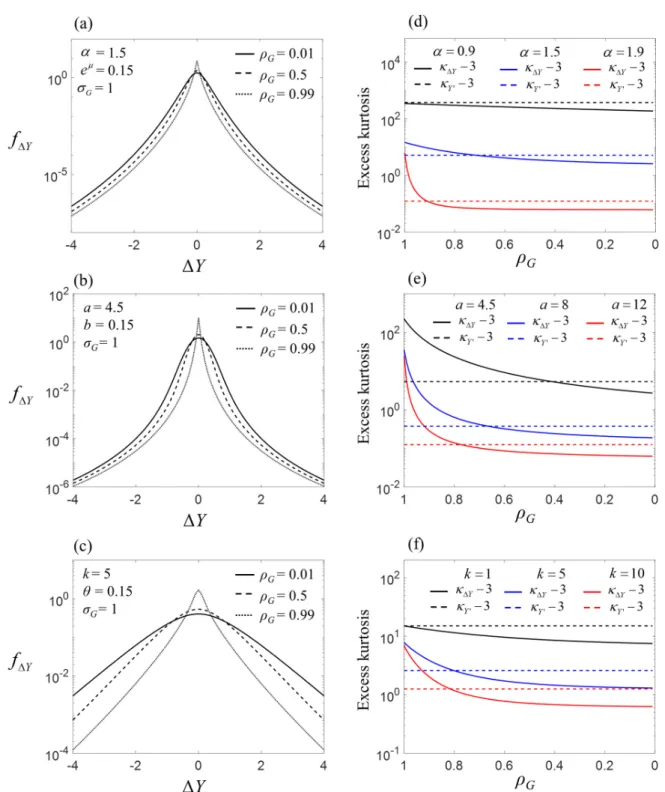
values of Y', independent of the GSG model considered. This feature is clearly illustrated in
175
Figures 1a-c, where we depict fY for selected values of the three GSG model parameters
176
(analytical expressions being collected in Eq. (B8)) and three values of G corresponding to short,
177
intermediate and large lags. The pattern associated with the behavior of peaks and tails of the pdfs
178
of Y' and Y can be described quantitatively by analyzing their standardized kurtosis,
Y (see179
Eq. (A6)) and
Y (see Eq. (A11)), respectively, deviations from Gaussianity being clearly180
revealed by the excess kurtosis,
Y3 and
Y3. As these quantities increase, the peak of the181
pdf of Y' or Y grows sharper and the associated tails become heavier. Figures 1d-f depict the
182
excess kurtosis of Y', as well as of Y, as a function of G for selected values of the shape
183
parameter
(for the LN-GSG model, Fig. 1d), a (for the P-GSG model, Fig. 1e), and k (for the Γ-184GSG model, Fig. 1f). Inspection of these figures, together with Eqs. (B7) and (B11), suggests that
185
for all GSG models (i)
Y'3 and
Y3 do not depend on the scale parameter of the subordinator186
and on the variance of G; (ii) for a given value of G,
Y3 and
Y3 increase as the shape187
parameter of U decreases; (iii) for a given value of the shape parameter,
Y3 increases as G188
increases (or, equivalently, as lag decreases), i.e., the pdfs of Y transition with lag. One can note
189
that, in all cases,
Y 3 exceeds zero by a significant margin at small lags (i.e., asG ), even 1for the largest values of the shape parameter of U considered. With reference to the LN-GSG
191
model, Figure 1d and Eqs. (B7) and (B11) highlight that there is a threshold value of the shape
192
parameter, corresponding to T 2 ln 3 0.95 , such that (i) for T , the pdfs of Y are
193
characterized by lower peaks and lighter tails than those of Y at all lags; while (ii) for T,
194
3
Y
is higher/lower than
Y'3 at small/large lags (see also Riva et al., 2015a). An analogous195
behavior is exhibited by the results associated with the Γ-GSG model (Fig. 1f), the threshold value,
196
T
k , of the shape parameter being equal to 1.0. Otherwise, one can demonstrate analytically (see
197
also Fig. 1e) that
Y 3 is always larger than
Y3 at small lags for the P-GSG model,198
regardless the value of the shape parameter a. Besides, the range of values of G for which (
199
3
Y
) > (
Y'3) (i.e., the range of lags where the pdfs of the increments display sharper peaks200
and heavier tails than the pdf of Y) tends to increase as a decreases.
201
2.2 Parameter estimation methods
202
The Method of Moment (MOM) is a straightforward way to infer model parameters from a
203
dataset. Here, we illustrate two approaches to estimate model parameters through MOM. These
204
are respectively based on (i) sample statistics of the parent variable (Method A) and (ii) sample
205
statistics of both the parent variable and the incremental data at multiple lags (Method B). Sections
206
2.2.1 and 2.2.2 examine merits and drawbacks of these methods.
207
2.2.1 Parameter estimation Method A
208
Method A (henceforth denoted as MOM_A) relies on the marginal frequency distribution
209
and associated moments of Y'. Estimates of GSG model parameters are obtained by replacing
210
2
Y and Y4 in Eqs. (A3) and (A6) with their sample counterparts, M2Y and 4
Y
M , inferred
211
from data. The shape parameter of U for the LN-GSG, P-GSG, and Γ-GSG models can be
212
estimated by making use of Eq. (B7) as
2 4 2 ' 2 4 2 ' 2 for LN-GSG fo , r P-GSG for , with 2 ( 2) , with 4 ( G w - SG 4) 3 4 6 1 ith 0 1 Y Y e M a a a a M k k k k
(5) 214Then, by making use of Eq. (B5), one can estimate the product between G and the scale
215
parameter of U (e.g., e, b, and , for LN-GSG, P- GSG and Γ-GSG model, respectively) as
216 2 2 2 2 2 2 Y G M e e for LN-GSG, (6) 217 2 2 2 2 Y G a b M a for P-GSG, (7) 218
2 2 2 1 Y G M k k for Γ-GSG. (8) 219It is noted that the analytical expressions of the marginal pdf (as well as its statistical
220
moments) of Y for all GSG models are characterized by the scale parameter of the subordinator
221
being always coupled with the scale parameter, G, of the underlying Gaussian process (see Eqs.
222
(B4) - (B6)). It then follows that the set of Eqs.(5)-(8) fully determines fY
y , i.e., it is not223
necessary to estimateG and the scale parameter of U independently to determine fY
y .As an224
additional remark, it is noted that one cannot estimate G with the methodology here implemented.
225
As such, its application, while straightforward, does not allow ascertaining the degree of spatial
226
correlation of the random field Y.
227
2.2.2 Parameter estimation Method B
228
Method B (henceforth denoted as MOM_B) yields estimates of GSG model parameters by
229
relying jointly on sample statistics of Y and Y. For any given lag, one replaces Y2 , Y2
230
and Y4 in Eqs. (A3), (A8), and (A9) by their sample counterparts M2Y, 2 Y M , and 4 Y M , 231
respectively. Making use of Eqs. (B5), (B9) and (B11), the resulting systems of equations are
2 2 2 2 2 2 2 ' 2 2 2 2 ' 2 2 2 2 2 4 2 2 2 2 2 1 3 1 2 1 1 2 Y G Y G Y Y Y G M = e e M = M e e e M e M for LN-GSG, (9) 233
' 2 2 2 2 ' 2 2 2 2 4 2 2 2 2 2 ( 2) 1 2 ( 1) 4 1 2 1 1 2 ( 4) ( 1)( 3) ( 2) ( 2) ( 1) 3 Y G Y G Y Y G G G Y a M = b a a a M = M a a M a a a a a a a M for P-GSG, (10) 234
2 2 2 2 2 2 4 2 2 2 1 1 2 1 1 2 2 1 3 1 1 Y G Y G Y Y G G Y G M = k k M = k M k k k k k M k M k k k for Γ-GSG. (11) 235Equations (9)-(11) allow estimating all parameters characterizing the joint pdf of Y, i.e.,
236
(i) the product of the scale parameters of G and U, (ii) the shape parameter of U, and (iii) the
237
correlation coefficient
G, which enables us to diagnose the dependence on lag of increment238
statistics. We further note that relying on the joint use of Y and Y data is recommended because
239
it leads to an (often considerably) augmented set of data upon which sample moments are
240
evaluated, thus improving the accuracy of the estimates. This approach yields a set of three
241
parameter estimates for each investigated lag. Riva et al. (2015a) document that MOM_B provides
242
results of similar quality to those one could obtain upon relying on parameter estimation through
243
analyzing incremental data at various lags via Maximum Likelihood (ML). This element, together
244
with the high computational demand associated with ML, leads us to rely on MOM_B for the
245
purpose of our analyses.
According to our theoretical framework (see Section 2.1), we expect that values of the shape
247
parameter and of the product between the scale parameters of U and G remain (approximately)
248
constant with lag. It then follows that an additional benefit of relying on MOM_B, as opposed to
249
MOM_A, is that it enables one to assess the consistency of the parameter estimation results with
250
these theoretical requirements. As already noted for the pdf of Y, the pdf of Y (as well as its
251
statistical moments) for all GSG models is also characterized by the scale parameter of U being
252
always coupled with G (see Eqs. (B8) - (B10)). Therefore, the inability to provide unique
253
estimates of the scale parameters of U and G (while only their product is estimated) does not
254
hamper the use of the results of the analysis for further applications, typically involving
255
generations of a collection of realizations of a given random field to be employed in the context of
256
studies on flow and transport processes in a Monte Carlo framework.
257
3 Application to laboratory- and field- scale datasets 258
The three alternative GSG models illustrated in Section 2 and in Appendix B are here
259
considered for the characterization of the spatial variability of two datasets. These are selected to
260
represent two differing observation scales, i.e., a laboratory- and a field- scale setting. Both
261
systems are characterized by the availability of a considerable amount of observations, which is
262
achievable with modern measurement techniques, and are therefore well suited for the analysis.
263
3.1 Micrometer-scale topography of a millimeter-scale calcite sample resulting from
264
mineral dissolution
265
The first dataset we consider (hereinafter denoted as Dataset 1) comprises direct observations
266
of surface topography collected on a (104) calcite cleavage plan. While calcite is the main
rock-267
forming mineral of limestones and has a key role in a variety of geological and biological systems,
268
its surface is characterized by remarkable dynamics when put in contact with aqueous fluid, which
269
are still not completely characterized, the (104) surface plane being very common in natural
270
settings. The sample consisted of a ~5mm-sized single crystal of calcite polished through a
multi-271
step abrasive sequence. The initial arithmetic roughness of the surface was on the order of 50 nm.
272
The sample was introduced in a mixed-flow reactor set-up. The crystal was subject to reaction for
273
8 days at room temperature and at a saturation index with respect to calcite of 0.8, corresponding
274
to conditions where dissolution occurs while the nucleation of etch pits is thermodynamically
impossible. Measurements of surface topography, ( , )x y being spatial coordinates in the horizontal
276
plane, are collected by means of a vertical scanning interferometer (Zygo NewView 7300) with a
277
vertical resolution of 3 nm, on a two-dimensional grid of N1 = 250×250 = 62500 cells, with lateral 278
resolution dl = 2.2 μm. Additional details of the experimental set-up and procedure are offered in
279
Bouissonnié et al. (2018). The surface is characterized by a slight curvature, resulting from the
280
preliminary polishing of the sample. Mean-removed topography data, Y, have been obtained by
281
subtracting the best-fitting quadratic surface from the measurements. Figure 2a depicts the spatial
282
distribution of Y, the sample standard deviation being equal to 2Y
M 0.21 μm.
283
3.2 Field-scale neutron porosity data
284
Dataset 2 is a collection of neutron porosity data sampled from a (km-scale) deep vertical
285
borehole in southwestern Iran. The data are part of a wider dataset comprising multiple wells, some
286
of which have been recently analyzed by Dashtian et al. (2011), Riva et al. (2015a), and
287
Guadagnini et al. (2015). The borehole considered here is drilled in the Ahwaz field (see Dashtian
288
et al., 2011), where oil and natural gas are produced from a sandstone formation. A large number
289
(N2 = 6949) of neutron porosity data collected at a uniform distance of dz = 15 cm is available. 290
The one-dimensional profile of mean-removed porosity data is depicted in Fig. 2b, the associated
291
sample standard deviation being equal to M2Y 8.35%.
292
3.3 Results and discussion
293
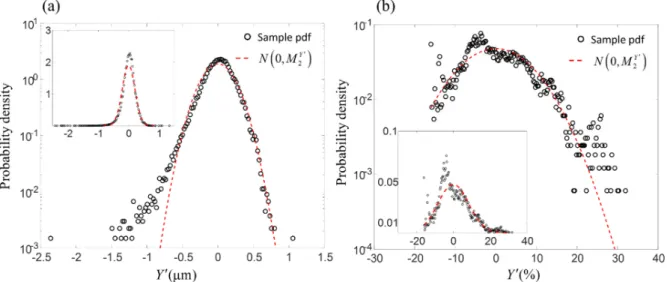
Figures 3a and 3b depict sample pdfs of Y' for Dataset 1 and 2, respectively. Depictions are
294
provided in linear and semi-logarithmic scales for ease of analysis. A slight bimodality and
295
asymmetry are exhibited by the pdf of porosity observations in Dataset 2, the pdf of surface
296
topography (Dataset 1) being left-skewed. A qualitative comparison (based on visual inspection)
297
between each of these sample pdfs and a normal distribution with the corresponding variance, M2Y
298
, (also included in the figures) suggests deviation from Gaussianity for both variables. This 299
qualitative result is also confirmed quantitatively by the outcomes of formal (Shapiro-Wilk,
300
Kolmogorov-Smirnov, and Anderson-Darling) tests performed on randomly-sampled subsets of
301
data, which reject the Gaussian model at a significance level of 0.05 for both datasets.
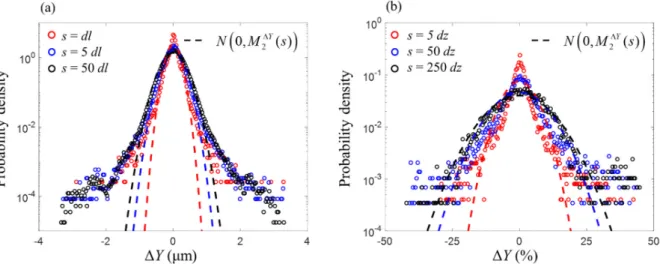
We compute sample statistics of incremental data, Y, evaluated (i) along all directions in
303
the x-y plane for Dataset 1 and (ii) along the z axis for Dataset 2. The pdfs of Y at three diverse
304
lags (s = 1, 5, and 50 dl for Dataset 1; and s = 5, 50, and 250 dz for Dataset 2) are depicted in Figs.
305
4a and 4b, respectively. As a term of comparison, corresponding normal distributions with the
306
same variance are juxtaposed to the increment pdfs. These results illustrate that sample pdfs of
307
increments (i) exhibit the characteristic scale dependence mentioned in Section 1; and (ii)
308
progressively tend to distributions with lower peaks and lighter tails, resembling the Gaussian
309
distribution as lag increases, this feature being particularly evident for Dataset 2.
310
Figures 5a and 5b depict the dependence of sample values of
Y 3 on lag for Dataset 1311
and Dataset 2, respectively, dashed horizontal lines denoting values of excess kurtosis of the parent
312
variable Y. For both sets, incremental data excess kurtosis is significantly larger than zero at small
313
lags. Excess kurtosis (EK) of (omnidirectional) incremental data associated with Dataset 1
314
decreases rapidly as lag increases and tends to attain a quite stable value of ≈ 3.5 at large lags.
315
Otherwise, values of EK for Dataset 2 tend to consistently decrease across the whole range of lags
316
considered, attaining values smaller than 1 (i.e., approaching a Gaussian distribution, consistent
317
with the qualitative result depicted in Fig. 4b) from s = 400 dz.
318
To provide an appraisal of the accuracy associated with the sample estimates of EK, we apply
319
a standard bootstrapping technique (Efron, 1992) to each set of incremental data. This procedure
320
relies on sampling (with replacement) from a collection of Y data related to a given lag a total
321
of m (here we set m = 10,000) sets, each characterized by the same number of elements of the
322
original collection of Y. The same procedure is then repeated for all lags considered. Figures 5a
323
and 5b depict the 95%-confidence intervals, CI, associated with the estimates of EK at four
324
representative lags. Uncertainties associated with EK estimates are (in general) negligible.
325
Threfore, we consider the observed overall decrease of EK with the lag to be significant for both
326
datasets. We note that
Y 3 >
Y3 at small lags for Dataset 1 (Fig. 5a), implying that327
frequency distributions of Y exhibit sharper peaks and heavier tails than does that of Y, whereas
328
the opposite behavior is documented at large lags. Otherwise,
Y3 >
Y3 over the whole329
range of lags considered for Dataset 2 (Fig. 5b). Considering the type of analyses documented in
330
Figs. 1d-f, the behavior observed for both datasets is consistent with our theoretical models for (i)
331
0.95 < α < 2 in the case of LN-GSG; (ii) a > 4 for P-GSG, and (iii) k > 1 for Γ-GSG.
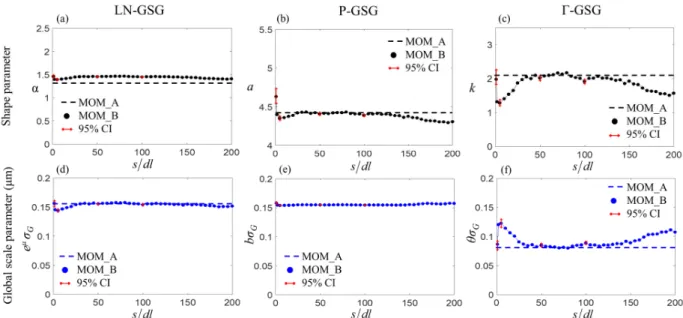
Estimates of (i) the shape parameter and (ii) the product of the scale parameters of U and G
333
(henceforth denoted only as global scale parameter for conciseness) obtained via MOM_A and
334
MOM_B for each GSG model formulation are depicted in Fig. 6 (Dataset 1) and Fig. 7 (Dataset
335
2) as a function of normalized lag. These results are complemented by Table 1 where we list
336
parameter estimates obtained via MOM_A, together with mean and coefficient of variation (cv)
337
evaluated over all lags of MOM_B estimates, obtained for all GSG model formulations and both
338
datasets.
339
Considering Dataset 1, results obtained via MOM_B for LN-GSG (i.e.,
in Fig. 6a and340
eG in Fig. 6d) and P-GSG (i.e., a in Fig. 6b and b
G in Fig. 6e) do not vary appreciably with341
lag (cv ≈ 2-3%), consistent with our theoretical framework. Otherwise, MOM_B estimates of k
342
and
G (Figs. 6c and 6f, respectively) associated with Γ-GSG are characterized by stronger343
oscillations around an average value, as indicated by larger values of the corresponding coefficient
344
of variation, as compared to the other models. Nevertheless, values of cv range between 18% (for
345
the shape parameter) and 22% (for the global scale parameter), which (also in view of ubiquitously
346
present experimental uncertainties) can still be considered as a good approximation of the
347
constraints associated with theoretical requirements. Figure 6 and Table 1 also document that
348
MOM_A estimates are consistent with their counterparts obtained via MOM_B for all models.
349
Results for Dataset 2 (Fig. 7) obtained through MOM_B generally reveal more pronounced
350
oscillations around a constant value and larger values of cv than those observed for Dataset 1, in
351
particular considering the Γ-GSG model. We remark that the two considered datasets are
352
associated with differing dimensionalities (Dataset 1 and Dataset 2 being two- and
one-353
dimensional, respectively) and considering that N1 / N2 9, statistics of incremental data for 354
Dataset 2 are evaluated on a much smaller sample of data as compared to Dataset 1. We regard
355
this as the main reason related to the (slightly) increased deviations from the expected theoretical
356
pattern.
357
We rely on the bootstrapping procedure mentioned above to evaluate the uncertainty
358
associated with the GSG parameter estimates obtained via MOM_B. Figures 6-7 include
359
depictions of the 95% CIs related to the GSG parameter estimates evaluated at four representative
360
lags. The width of these intervals is in general very limited. The results obtained via MOM_A (see
361
Table 1 and dashed lines in Fig. 7) tend to overestimate all parameters, as compared to their
MOM_B-based counterparts (except for
G in Fig. 7f), a notable discrepancy between the two363
estimation methods being observed for the shape parameters of P-GSG (Fig. 7b) and Γ-GSG (Fig.
364
7c).
365
Results collected in Table 1 also evidence that estimates of the shape parameter stemming
366
from the application of each GSG model to Dataset 1 are smaller than their counterparts related to
367
Dataset 2. This finding is indicative of a stronger non-Gaussian signature in the former data set, a
368
behavior that can also be inferred from the increased values of excess kurtosis exhibited by Dataset
369
1 (see Figs. 5a and 5b).
370
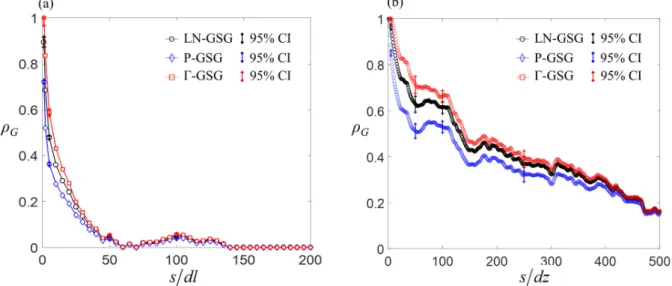
Figures 8a and 8b depict estimates of
G as a function of lag obtained for Dataset 1 and 2,371
respectively. These results show that the correlation function of the underlying Gaussian process
372
is quite insensitive to the choice of subordinator adopted in the GSG model, in particular
373
considering Dataset 1. Figure 8b suggests that the width of the 95% CIs for Dataset 2 is particularly
374
wide in the range of lags where the results associated with the three models do not overlap. This
375
observation suggests that differences observed between
G estimates obtained with the three GSG376
models may not be particularly significant in this dataset and can be related to effects of the limited
377
size of this sample. This result (i) is in agreement with the theoretical framework according to
378
which the subordinator should be statistically independent of G and (ii) suggests that the
379
correlation structure provided by the underlying Gaussian process can be considered as a
380
distinctive signature of the system.
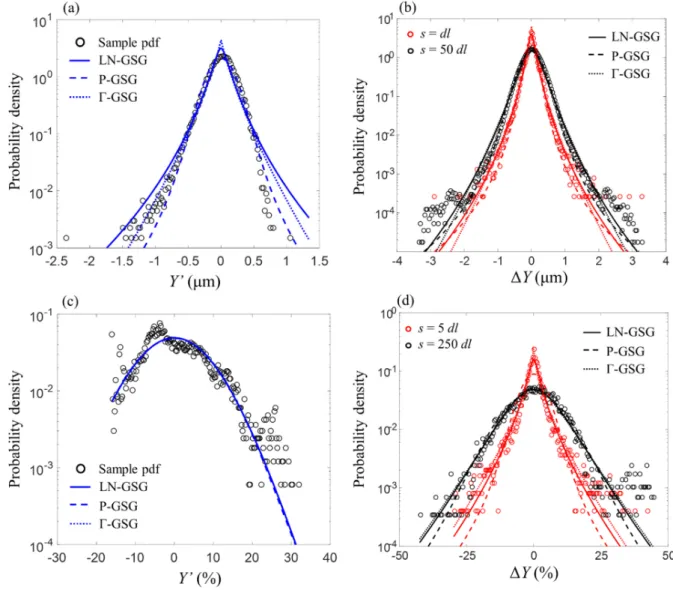
381
Figure 9 depicts sample pdfs of the parent variables (Figs. 9a, 9c) and their increments (Figs.
382
9b, 9d) corresponding to two separation lags included in Fig. 4 and presented here for the sake of
383
comparison against theoretical pdfs corresponding to the various GSG models considered. In these
384
plots, fY and fY associated with GSG models are evaluated respectively on the basis of (i)
385
parameters estimated via MOM_A and (ii) the mean values of shape and global scale parameters
386
obtained via MOM_B, fY also including the lag dependent parameter, , computed with G
387
MOM_B and depicted in Fig. 8. From a qualitative comparison between Figs. 9a-d and Figs. 3 and
388
4, it can be appreciated that all GSG models are generally in better agreement with the target
389
sample pdfs than the Gaussian model. The degree of similarity between sample and analytical pdfs
390
is quantified through the Kullback-Leibler (KL) divergence (Kullback & Leibler, 1951), DKL. The
391
latter is a measure of the information lost when a given distribution is used to approximate a target
one. As such, smaller values ofDKL are associated with reduced loss of information. Considering
393
the pdf of Y, (i) for Dataset 1 we obtain DKL = 0.048 (for LN-GSG), 0.013 (for P-GSG), and
394
0.071 (for -GSG), thus suggesting P-GSG as the best among the models considered; (ii)
395
0.068
KL
D for Dataset 2, regardless the subordinator employed. This latter outcome is consistent
396
with Fig. 9c, where all GSG pdf are virtually overlapping. Therefore, when considering Dataset 2
397
the sole analysis of the parent data population does not allow discriminating between alternative
398
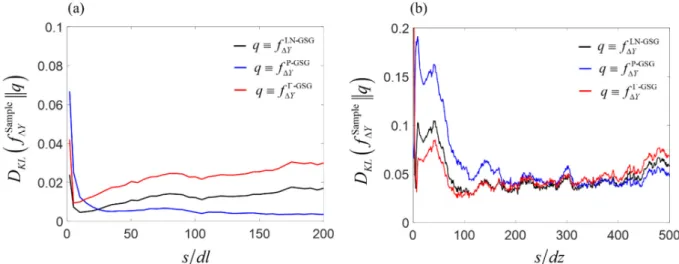
GSG models. We finally evaluate DKL between sample and theoretical pdfs of incremental data for 399
diverse lags. Figure 10a depicts DK L versus lag for Dataset 1, Fig. 10b showing a corresponding
400
depiction for Dataset 2. These results highlight that, considering Dataset 1, the P-GSG model
401
provides the highest degree of similarity between sample and theoretical pdfs of increments at
402
almost all lags (s > 25 dl), and is consistent with the results obtained for the parent variable as well
403
as with those collected in Table 1 and Fig. 6. Considering Dataset 2, Fig. 10b suggests that the
404
three models provide results of similar quality for lags s > 200 dz, a feature that can also be noted
405
from the almost overlapping analytical results depicted in Fig. 9d for s = 250 dz. Otherwise,
LN-406
GSG and Γ-GSG outperform P-SGS in the range 0 < s < 100 dz. This observation, in conjunction
407
with the analysis performed in Fig. 7 and Table 1, leads to favoring LN-GSG for Dataset 2.
408
Overall, our results support the ability of the GSG model to provide a theoretical
409
interpretation of characteristic features associated with the statistics of both investigated datasets.
410
We note that having at our disposal these tools forms the basis to achieve the overarching goal to
411
quantify the way one can transfer the key statistics of a variable (and its increments) across scales,
412
with direct implications on uncertainty quantification. With reference to the spatial distribution of
413
surface roughness, these results constitute an important step to bridge across characterizions of
414
reactive phenomena at microscopic and laboratory scales. In this context, there is documented and
415
growing interest in the application of statistical methods (Fischer et al., 2012; Lüttge et al., 2013;
416
Pollet-Villard et al., 2016; Trindade Pedrosa et al., 2019) to firmly ground the multiscale nature of
417
such processes on rigorous theoretical bases. The quality of our results is encouraging to promote
418
further studies targeting statistically-based descriptions of the temporal evolution of the surface
419
topography of calcite minerals subject to precipitation/dissolution processes acting at diverse
420
scales. We envision addressing this objective in the future by coupling our theoretical approach
421
with direct in situ observations through, e.g., time-lapse nanoscale imaging. In this context,
characterizing porosity of natural porous media has the clear potential to link geochemical
423
processes acting at small scales with descriptions of flow and transport at scales compatible with
424
a continuum description of the system. Hydraulic conductivity is intimately related to porosity. As
425
mentioned in the Introduction, statistics of its spatial increments have also been documented to
426
display a behavior consistent with what we have observed here for porosity. These concepts have
427
already been employed in the context of preliminary analytical and numerical studies of flow and
428
transport in porous media associated with such a statistical description by Riva et al. (2017) and
429
Libera et al. (2017).
430
4 Concluding remarks 431
We extend the Generalized Sub-Gaussian (GSG) stochastic model proposed by Riva et al.
432
(2015a) by providing theoretical formulations of the GSG for a generic subordinator U. Properties
433
of such an extended and more general model are analyzed and alternative formulations of the GSG
434
model, derived for three selected subordinator forms, are considered to interpret observations
435
associated with two datasets: (i) a set of observations characterizing the surface-roughness
436
resulting from the dissolution of a crystal of calcite, collected in a geochemical laboratory-scale
437
setting under given environmental conditions (Dataset 1); and (ii) a field-scale spatial distribution
438
of porosity data, collected along a deep borehole within a sandstone formation (Dataset 2). Our
439
study leads to the following key conclusions.
440
1. For any subordinator type associated with the GSG, the analytical formulation of
441
standardized kurtosis,
Y and
Y, governing the behavior of peaks and tails of the pdf of442
Y and Y, respectively, does not depend on scale parameters of U and G. Values of
Y'443
and
Y increase as the shape parameter of U decreases,
Y decreasing as the separation444
distance (or lag) at which increments are evaluated increases. Thus, GSG models are suitable
445
to capturing the extensively documented peculiar features of Earth and environmental
446
variable whose distributions transition from heavy tailed at small lags to seemingly-Gaussian
447
at increased lags.
448
2. The proposed theoretical framework successfully captures the main features of the
449
distributions of the variables analyzed as well as their spatial increments. Results of
450
statistical analyses performed on both datasets are consistent with theoretical expectations:
451
(i) estimates of shape and (global) scale parameters of the GSG models are nearly constant
with lag; (ii) the correlation coefficient (
G) of the underlying Gaussian process decreases453
as lag increases, according to a trend that is almost insensitive to the type of subordinator
454
considered. The latter results suggest that the correlation structure provided by the Gaussian
455
process underlying the GSG field can be considered as a distinctive signature of the system
456
behavior.
457
3. The Kullback-Leibler (KL) divergence is adopted to evaluate degree of similarity between
458
theoretical (i.e., based on the various GSG model formulations) and sample Y and Y pdfs
459
in each dataset. Our results indicate that the implementation of multiple subordinators within
460
the GSG framework can enhance the flexibility of the model and improve the accuracy of
461
the interpretation of statistical behavior of a given dataset.
462
The approach and theoretical developments we propose provide a unique framework within
463
which one can interpret a broad range of scaling behaviors displayed by a variety of Earth and
464
environmental variables in various settings. The successful demonstration we present imbues us
465
with confidence about research applications targeting hydrogeological and geochemical scenarios
466
upon leveraging on modern experimental investigation techniques leading to characterize natural
467
systems across a diverse range of scales. These include, for example, further experiments and
468
theoretical analyses devoted to the assessment of micro-scale reaction rates taking place at
rock-469
liquid interfaces.
470 471 472
473
Figure 1. Probability density function, fY, computed for three values of G according to Eq.
474
(B8) for the (a) LN-GSG; (b) P-GSG, and (c) Γ-GSG model, respectively. Excess kurtosis of (i)
475
Y (dashed lines) and (ii) Y as a function of G (solid curves) for three selected values of the
476
shape parameter (d)
, (e) a, and (f) k for the LN-GSG, P-GSG, and Γ-GSG model, respectively.478
Figure 2. Spatial distributions of zero-mean fluctuations, Y, of (a) (micrometer-scale) surface
479
topography data (Dataset 1); and (b) (decimeter-scale) neutron-porosity data (Dataset 2).
480 481
482
Figure 3. Sample pdf of Y data obtained for (a) Dataset 1 and (b) Dataset 2 on semi-logarithmic
483
and arithmetic (inset) scales. Gaussian pdfs with variance equal M2Y are also shown (dashed
484
curves).
486
Figure 4. Sample pdfs of incremental data, Y, at three lags: (a) s/dl = 1, 5, and 50 for Dataset 1
487
and (b) s/dz = 5, 50, and 250 for Dataset 2. Gaussian pdfs with variance equal to that of the data
488
sample are also shown (dashed curves).
489 490
491
Figure 5. Excess kurtosis of (i) Y (dashed horizontal lines); and (ii) Y (symbols) versus
492
(normalized) lag for (a) Dataset 1 and (b) Dataset 2; 95% CIs (evaluated through bootstrapping)
493
associated with EK estimates at four lags are reported in red.
494 495
496
Figure 6. Dataset 1: Estimates of shape (a, b, c) and global scale (d, e, f) parameters of the GSG 497
model formulations obtained via MOM_A (dashed horizontal lines) and MOM_B (symbols)
498
versus (normalized) lag; 95% CIs (evaluated through bootstrapping) associated with MOM_B
499
estimates at four lags are reported in red.
500
501
Figure 7. Dataset 2: Estimates of shape (a, b, c) and global scale (d, e, f) parameters of the GSG 502
model formulations obtained via MOM_A (dashed horizontal lines) and MOM_B (symbols)
503
versus (normalized) lag; 95% CIs (evaluated through bootstrapping) associated with MOM_B
504
estimates at four lags are reported in red.
505 506
Dataset 1 Dataset 2 LN-GSG P-GSG Γ-GSG LN-GSG P-GSG Γ-GSG Shape parameter MOM_A 1.34 4.14 2.10 1.86 9.05 46.12 MOM_B (mean) 1.43 4.36 1.76 1.56 4.96 3.96 MOM_B (cv) 0.02 0.02 0.18 0.04 0.06 0.48 Global scale parameter MOM_A 0.16 0.16 0.08 8.18 7.37 0.18 MOM_B (mean) 0.15 0.16 0.11 6.88 6.44 2.12 MOM_B (cv) 0.02 0.03 0.22 0.05 0.02 0.30
Table 1. Parameter estimates obtained via MOM_A; mean and coefficient of variation (cv) 507
evaluated over all lags of MOM_B estimates obtained for all tested GSG model formulations and
508
both datasets.
509 510
511
Figure 8. Estimates of obtained via MOM_B for all tested GSG model formulations versus G
512
(normalized) lag for (a) Dataset 1 and (b) Dataset 2; 95% CIs (evaluated through bootstrapping)
513
associated with estimates at four lags are also shown. G
514 515
516
Figure 9. Sample pdfs (symbols) of Y and of Y at two selected lags for Dataset 1 (a, b) and
517
Dataset 2 (c, d). Theoretical distributions fY and fY (Eqs. (B4) and (B8)) computed by using
518
model parameters estimated via MOM_A (a, c) and MOM_B (b, d) are also shown.
520
Figure 10. Kullback-Leibler divergence, DKL, between sample and analytical pdfs of Y versus
521
(normalized) lag for (a) Dataset 1 and (b) Dataset 2.
522 523 524
Appendix A: Analytical formulation of the GSG model for a general distributional form of 525
the subordinator 526
The theoretical framework of the GSG model is here presented considering a general
527
distributional form of the subordinator. We do so by deriving the analytical expressions of (i) pdf,
528
statistical moments and standardized kurtosis of the parent variable Y;(ii) pdf, statistical moments
529
and standardized kurtosis of increments, Y , aa a function of separation lag;(iii) covariance and
530
variogram functions as well as integral scale of Y. 531
Substituting Eq. (4) into Eq. (3) yields
532
2 2 1 2 1 2 2 2 2 2 1 2 1 2 1 2 1 2 1 2 2 1 2 1 , 1 2 2 2 1 2 2 1 0 0 1 , 2 1 G G G y y y y u u u u Y Y U U G G du du f y y f u f u e u u
. (A1) 533The marginal pdf of Y can then been obtained from Eq. (A1) as
534
2 2 2 1 2 1 2 , 1 2 1 0 1 , ' . 2 G y u Y Y Y U G du f y f y y y dy f u e u
(A2) 535All odd-order statistical moments of Y identically vanish, whereas variance, kurtosis and
536
(in general) q-th even order moments can be respectively expressed as
537
2 2 2 2 2 2 0 ' Y( ') ' G U G Y = y f y dy u f u du U
, (A3) 538
4 4 4 4 4 4 0 ' Y( ') ' 3 G U 3 G Y' = y f y dy u f u du U
, (A4) 539
2 02
1
'
( ') '
2
q q q q q q q Y G Uq
Y' = y f y dy
u f u du
G
U
. (A5) 540The standardized kurtosis of Y is then given by
541 4 4 2 2 2 2
3
YY'
U
Y'
U
(A6) 542and depends only on the subordinator (and not on G).
543
The pdf of incremental values, Y( )s Y(x s ) Y( )x , can be evaluated as 544
2 2 2 1 2 1 2 2 2 2 2 1 2 2 1 0 0 1 , , 2 G y r Y Y Y U U G e f y f y y y dy f u f u du du r
(A7) 545 with 2 2 1 2 2 G 1 2r u u u u . Odd-order moments of Y are identically zero, whereas variance,
546
kurtosis, and moments of even order q can be respectively expressed as
547
1 2 2 2 2 2 2 2 1 2 2 1 0 0 2 , G U U G G Y = r f u f u du du U U
(A8) 548
1 2 2 4 4 4 4 4 3 2 2 1 2 2 1 0 0 3 G U U 6 G 4 G 1 2 G , Y = r f u f u du du U U U U
(A9) 549
1 2 2 1 2 2 1 0 0 0 1 2 2 1 . q q q G q U U q q k k q k k q k k q Y r f u f u du du q U U G x G x s k
(A10) 550The standardized kurtosis of Y is derived from Eqs. (A8) and (A9) as
551
2 4 3 2 2 4 2 2 2 2 2 4 1 2 3 2 G G Y G U U U U Y Y U U , (A11) 552the latter depending on the subordinator and on the correlation coefficient
G (but not on 2G
).
553
The Covariance of Y' between two points x1 and x2 is
554
2
2 , , . Y G G C Y Y U U G G U U
1 2 1 2 1 2 1 1 2 1 2 x x x x x x x x x x x x (A12) 555From Eq. (A12), one derives
556
0 2 2 2 Y Y G C
U
,
0
2 2 Y G G C s U
. (A13) 557Note that according to Eq. (A13) the covariance CY of the Sub-Gaussian field is discontinuous at
558
the origin, i.e., at s = 0, thus exhibiting a nugget effect. The variogram of Y' can be evaluated from
559 Eq. (A8) as 560 2 2 2 2 2 2 2 2 2 2 2 2 Y G G G U G G U G Y U U U U U (A14) 561
and is characterized by a nugget effect, quantified by 2 2 G U , 2
1
G G G
and 2 U being the 562variogram of G and the variance of U, respectively.
563
The integral scale of Y' can be obtained by making use of Eq.(A12) as
564 2 2 2 2 2 Y G G U U U I I I U U , (A15) 565
so that one can recognize that 0IYIG, independent of the type of subordinator considered. An
566
increase of 2
U
results in a decrease of the (integral) correlation scale of Y'.
567 568
Appendix B: GSG formulation for lognormal, Pareto, and Gamma distribution of U 569
Here, we consider U1 and U2 to be described by (i) a lognormal distribution, 570
2
~ ln , 2
i
U N , (ii) a Pareto distribution, Ui ~ PD a b , and (iii) a Gamma distribution,
,571
~ , i U k ,i.e., 572
2 2 ln 2 2 2 2 i i u U i i e f u u with ; 2 ui
0,
(B1a) 573
1 i a U i a ab f u u with a > 0; b > 0; ui
b,
(B1b) 574
1 i i u k i U i k u e f u k with k > 0; > 0; ui
0,
;
1 0 k x k x e dx
(B1c) 575here, i = 1, 2; , a, and k are shape parameters, while e , b, and are scale parameters. Note that
576
the exponential distribution can be obtained from Eq. (B1c) by setting k = 1.
577
The q-th order raw moment of U is