
HAL Id: hal-02984980
https://hal.archives-ouvertes.fr/hal-02984980
Submitted on 1 Nov 2020
HAL is a multi-disciplinary open access
archive for the deposit and dissemination of
sci-entific research documents, whether they are
pub-lished or not. The documents may come from
teaching and research institutions in France or
abroad, or from public or private research centers.
L’archive ouverte pluridisciplinaire HAL, est
destinée au dépôt et à la diffusion de documents
scientifiques de niveau recherche, publiés ou non,
émanant des établissements d’enseignement et de
recherche français ou étrangers, des laboratoires
publics ou privés.
Globular Clusters in the Sagittarius stream Revising
members and candidates with Gaia DR2
M. Bellazzini, R. Ibata, K. Malhan, N. Martin, Benoit Famaey, G. Thomas
To cite this version:
M. Bellazzini, R. Ibata, K. Malhan, N. Martin, Benoit Famaey, et al.. Globular Clusters in the
Sagittarius stream Revising members and candidates with Gaia DR2. Astronomy and Astrophysics
-A&A, EDP Sciences, 2020, 636, pp.A107. �10.1051/0004-6361/202037621�. �hal-02984980�
Astronomy & Astrophysics manuscript no. GCpaper˙revised ESO 2020c March 19, 2020
Globular Clusters in the Sagittarius stream
Revising members and candidates with Gaia DR2
M. Bellazzini
1, R. Ibata
2, K. Malhan
3, N. Martin
2,5, B. Famaey
2, G. Thomas
41 INAF - Osservatorio di Astrofisica e Scienza dello Spazio di Bologna, Via Gobetti 93/3, 40129 Bologna, Italy
e-mail: [email protected]
2 Observatoire Astronomique, Universit´e de Strasbourg, CNRS, 11, rue de l’Universit´e, F-67000 Strasbourg, France 3 The Oskar Klein Centre, Department of Physics, Stockholm University, AlbaNova, SE-10691 Stockholm, Sweden 4 NRC Herzberg Astronomy and Astrophysics, 5071 West Saanich Road, Victoria, BC V9E 2E7, Canada
5 Max-Planck-Institut f¨ur Astronomie, K¨onigstuhl 17, D-69117, Heidelberg, Germany
for publication on A&A,
ABSTRACT
We reconsider the case for the association of Galactic globular clusters (GCs) to the tidal stream of the Sagittarius dwarf spheroidal galaxy (Sgr dSph), using Gaia DR2 data. We use RR Lyrae to trace the stream in 6D and we select clusters matching the observed stream in position and velocity. In addition to the clusters residing in the main body of the galaxy (M 54, Ter 8, Ter 7, Arp 2) we confirm the membership of Pal 12 and Whiting 1 to the portion of the trailing arm populated by stars lost during recent perigalactic passages. NGC 2419, NGC 5634 and NGC 4147 are very interesting candidates, possibly associated to more ancient wraps of the stream. We note that all these clusters, with the exception of M 54, that lies within the stellar nucleus of the galaxy, are found in the trailing arm of the stream. The selected clusters are fully consistent with the [Fe/H] vs. [Mg/Fe], [Ca/Fe] patterns and the age-metallicity relation displayed by field stars in the main body of Sgr dSph.
Key words.globular clusters — galaxies: individual: Sgr dSph — galaxies: dwarf — Galaxy: formation — Galaxy: stellar content
1. Introduction
The ongoing disruption of the Sagittarius dwarf spheroidal galaxy (Sgr dSph, Ibata et al. 1994) provides a formidable case study of the ingestion of a dwarf satellite, a process that is gener-ally considered as a main driver for the formation of large galax-ies (see, e.g. Freeman & Bland-Hawthorn 2002, and references therein). Sgr dSph is populating the Milky Way halo with the stars (and, presumably, the dark matter particles) that are lost along two huge tidal tails (Sgr stream) that have been traced with various techniques over a huge range of distances (10-100 kpc, see, e.g. Ibata et al. 2001a, Newberg et al. 2002, Majewski et al. 2003, Belokurov et al. 2006, Newberg et al. 2007, Niederste-Ostholt et al. 2010, Correnti et al. 2010, Belokurov et al. 2014, and references therein).
The Sgr dSph hosts four globular clusters (GCs) in its main body that, before the discovery of the satellite, were believed to belong to the GC system of the Milky Way (M54, Arp 2, Ter 7, and Ter 8). By analogy, additional Sgr GCs may have been lost in the disruption process and may lie immersed in the Sgr stream. Indeed the association of GCs to the Sgr stream was proposed long ago (Fusi Pecci et al. 1995, Irwin 1999, Palma et al. 2002), and then observationally supported (Bellazzini et al. 2003a, Law & Majewski 2010b), at least on a statistical basis (see also, e.g., Bellazzini et al. 2003b, Carraro et al. 2007, Paust, Wilson & van Belle 2015, Carballo-Bello et al. 2017, Sollima et al. 2018, and references therein). In particular Law & Majewski (2010b) dis-cussed in detail the case for the membership or non-membership of new and previously proposed candidates based on their corre-lation in 3D position and radial velocity with a state-of-the art
N-Send offprint requests to: M. Bellazzini
body model of the disruption of the Sgr dSph (Law & Majewski 2010a, LM10 hereafter). Ten years later the LM10 model re-mains a reference model for the Sgr system.
The main limitation of these analyses was the lack of proper motions (PM) of sufficient precision (a) to test the full 3-D mo-tion of the stream, and (b) to verify the coincidence of can-didate GC members with stream stars in the 6D phase space. The exquisite astrometric precision achievable with the Hubble Space Telescope (Sohn et al. 2018) and, especially, with the sec-ond data release of the ESA/Gaia mission (Gaia DR2, Brown et al. 2018, Helmi et al. 2018) has completely changed the scene. Mean PM are now available for the majority of Galactic GCs with typical uncertainties ≤ 0.1 mas yr−1, corresponding to ≤ 5.0(24.0) km s−1 for D=10.0(50.0) kpc (Helmi et al. 2018,
Vasiliev 2019, Baumgardt et al. 2019). Direct detection and mea-sure of the 3-D motion of Sgr stream stars can be obtained over the whole extension of the Galaxy (Hayes et al. 2019, Ibata et al. 2020, I20 hereafter).
Sohn et al. (2018) checked the membership of GCs in their sample by comparing with the prediction in the LM10 model in 6D. This model is known to provide a reasonably good descrip-tion of the posidescrip-tion and kinematics of the stars lost more recently by the Sgr galaxy, in particular up to three perigalactic passages before the present one (Pcol≤ 3; Hayes et al. 2019, I20)1, but
1 Pcol is a parameter associated to each particle of the LM10 model,
tagging them according to the perigalactic passage when they were stripped from the parent galaxy. Pcol=0 is the current perigalactic sage, while Pcol=1,2,...,8 refers to one, two up to eight perigalactic pas-sages ago. Particles with Pcol=-1 are still gravitationally bound to the main body of the galaxy. The mean orbital period of the Sgr galaxy in the model is P= 0.93 Gyr (Law & Majewski 2010a).
M. Bellazzini et al.: Globular clusters in the Sagittarius stream
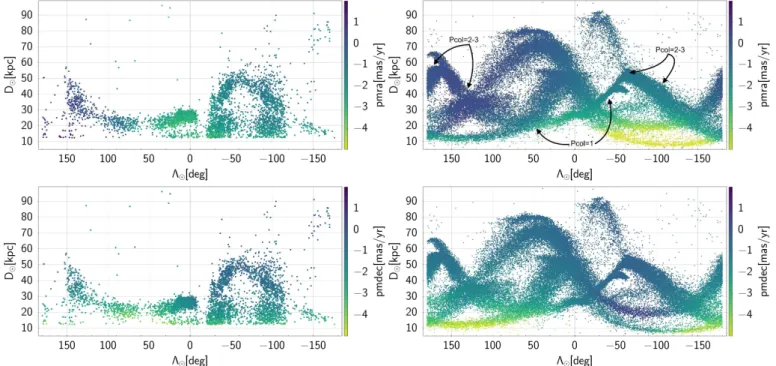
Fig. 1. Maps of the Sgr stream in the heliocentric distance vsΛ plane. Left panels: RR Lyrae from the DR2 4S. Right panels: particles of the LM10 model. Distances in the LM10 model have been rescaled by a factor of 0.94 to make the embedded distance scale more consistent with observations. In the upper panels the points are color coded according to their pmra values, in the lower panels according to their pmdec. In the upper right panel we indicated, as a reference, the approximate location of the transitions between portions of the stream dominated by Pcol=0 (in the immediate surroundings of the main body), Pcol=1, and Pcol=2-3 particles (see also Fig. 5).
it is unlikely to provide adequate predictions for more ancient arms of the Sgr stream, hence this technique of investigation is limited to the most recently lost clusters. In fact, the orbit of the progenitor of the Sgr system may have significantly evolved in the distant past (Belokurov et al. 2014), while the LM10 model adopts a static Galactic potential and does not include the ef-fects of dynamical friction. In addition to the clusters in the main body, Sohn et al. (2018) indicates as likely members Pal 12 and NGC 2419 (see also Massari et al. 2017). Vasiliev (2019), look-ing for clusterlook-ing in the action-angle space finds that Pal 12 and Whiting 1 (Carraro et al. 2007) are tightly grouped together with the main body clusters in that space. Massari, Koppelman, &, Helmi (2019), in an attempt to classify all the Galactic globu-lars according to their birth site using their orbital parameters, in addition to the main body clusters attributed to the Sgr system also propose Pal 12, Whiting 1, NGC 2419 and NGC 5824. Just before the submission of this manuscript Antoja et al. (2020) presented a new analysis tracing the stream with Gaia proper motions, detecting several globulars possibly associated. In ad-dition to the four main-body clusters they explicitly confirm as members also Pal 12 and NGC 2419.
The approach adopted here is somewhat complementary to the analyses described above, and it is intended to provide a glance also to more ancient arms of the Stream. The aim is not only to confirm candidates but also to find out the most promis-ing, albeit still uncertain members, for further follow up. In par-ticular, following I20, we trace the Sgr stream using RR Lyrae variables from Gaia DR2 (Clementini et al. 2019, Holl et al. 2018), and we look for clusters lying within and sharing the same space motion with the observed stream. We will use the LM10 model only as a useful guideline for the interpretation of the observations (similar to Hayes et al. 2019, and I20).
All the magnitudes used in this paper have been corrected for interstellar extinction in the same way as described in I20, using reddening values obtained from the Schlegel et al. (1998) maps and re-calibrated according to (Schlafly & Finkbeiner 2011). The magnitudes of RR Ly used in this work are intensity aver-aged mean magnitudes (Clementini et al. 2019). The proper mo-tions in equatorial coordinates, as extracted from the Gaia DR2 dataset, are denoted as pmra and pmdec, the correction for the cos(δ) factor being already included in pmra. In contrast with Law & Majewski (2010b), who considered also the association of dwarf galaxies to the Sgr system, here we limit our analysis to star clusters (see, e.g., Longeard et al. 2020, for the possible association of the faint dwarf Sgr II).
2. The adopted samples
I20 reported on the use of the STREAMFINDER code (Malhan & Ibata 2018, Malhan, Ibata & Martin 2018, Ibata, Malhan & Martin 2019) to trace the Sgr stream in the entire Gaia DR2 dataset (but limited to G < 19.5). The stream was detected at very high significance and its observed properties were used to define simple criteria aimed at selecting high-purity samples of stream stars. In particular, these criteria were used to select, from the gaiadr2.vari rrlyrae catalog (Clementini et al. 2019), a sample of stream RR Lyrae providing an independent validation of the STREAMFINDER distance scale. The distance to these RR Lyrae variables was computed using the MG−[Fe/H] relation by
Muraveva et al. (2018) and adopting the mean metallicity of the subset having metallicity estimates from Fourier coefficients of their light curves (see Clementini et al. 2019), [Fe/H]= −1.3. We adopt the same distances here, and, in general we follow the same choices made in I20, if not otherwise stated. In the follow-ing we will use the Heliocentric Sagittarius coordinatesΛ , B
M. Bellazzini et al.: Globular clusters in the Sagittarius stream
as defined by Majewski et al. (2003) and revised by Koposov et al. (2012), whereΛ is the angle from the center of Sgr along the orbital plane, with the leading arm of the stream at negative Λ and the trailing arm at positive Λ , and B is the angular distance in the direction perpendicular to the orbital plane.
We select our RR Lyrae sample tracing the Sgr stream adopt-ing three of the four selection criteria adopted by I20 :
1. −20.0◦< B < +15.0◦, i.e. stars near the Sgr orbital plane 2. −0.75 mas/yr < µB + µB,re f lex < 1.25 mas/yr, where µB is
the proper motion in the B direction and adding µB,re f lex
corrects for the reflex motion of the Sun in the same direc-tion, to remove stars having large motions perpendicular to the orbital plane
3. |µΛ− muΛ, f it| < 0.8 mas/yr, where muΛ, f it is a polynomial tracing the mean PM of the stream as a function ofΛ . See I20 for the form and coefficients of the polynomial and for additional details and discussion on the above criteria. The 5385 RR Lyrae from the gaiadr2.vari rrlyrae catalog sat-isfying these conditions constitute our reference sample, that we name the Sagittarius Stream Selected Sample, hereafter 4S, for brevity. We dropped the fourth criterion by I20, that is similar to point 3, above, but concerns the mean motion in µBas a function
ofΛ , because, while it was useful to select the purest sample tracing the stars most recently lost from the Sgr dSph (within < 3Gyr), it turns out to be excessively restrictive for the present application. In fact, the adoption of this additional selection cut to the GCs sample leaves us with just the four main body clus-ters, while, for instance, the membership of Pal 12 to the trail-ing arm is confirmed both by the matchtrail-ing of the orbit, by the detection of Stream stars in the surroundings, and by chemical tagging (see, e.g. Sohn et al. 2018, Vasiliev 2019, Musella et al. 2018, Cohen 2004, and references therein). The set of cri-teria adopted here allows us to trace very clearly the youngest stream arms while leaving open the possibility for the tentative detection of older structures. On the other hand, the adopted lim-its are convenient but somehow arbitrary and they can still be too restrictive to include all the present and past members of the Sgr system. Hence our census of clusters related to the stream may not be complete. To minimise the contamination from rela-tively nearby Galactic stars (especially from the bulge) that may creep in our selection window, we excluded all the stars having D ≤ 12.0 Kpc.
In Fig. 1 we display the distribution of the 4S RR Ly in the heliocentric distance vsΛ plane, and we compare it with the LM10 model, including PMs in the comparison2. The trailing arm is clearly seen to emerge from the main body (at Λ = 0◦ and D ' 25 kpc) and is traced up to Λ = +150◦ and D ' 35 kpc, with a relatively mild arching to D ' 20 kpc at Λ = +80◦. The discontinuities atΛ ∼ +60◦andΛ ∼ +120◦
(as well as the one aroundΛ ∼ −120◦, in the leading arm) are artefacts due to incompleteness in the original catalog, related to the scanning law of Gaia (Clementini et al. 2019). The leading arm is seen to emerge from the Galactic disc atΛ ' −30◦and
D ' 30 kpc, tipping at Λ = −60◦and D ' 50 kpc, and then declining more gently toΛ = −180◦and D ' 15 kpc. These
2 We have multiplied the distances of the LM10 model by a factor of
0.94 to make the distance scale of the model more consistent with obser-vations. This factor rescales the high value of the distance to the center of Sgr dSph adopted in the LM10 model (D = 28.0 kpc) to a more generally accepted value (D = 26.3 kpc, after Monaco et al. 2004), in excellent agreement with the recent estimate obtained by Ferguson & Strigari (2019) using Gaia DR2 RR Lyrae.
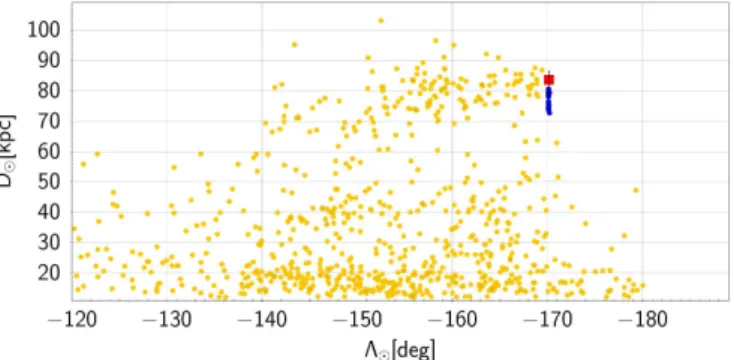
Fig. 2. Map of the Gaia RR Lyrae stars satisfying the selection criteria 1 and 2, zoomed on the stream arm around the globular cluster NGC 2419. The RR Lyrae belonging to the cluster are highlighted in blue. The red square indicates the mean distance of these RR Lyrae if the metallicity of the cluster is assumed ([Fe/H]=-2.09, after Mucciarelli et al. 2017), instead of the mean metallicity in the stream, [Fe/H]=-1.3.
are the most recent arms of the stream and are well matched by their counterparts in the LM10 model (also in radial velocity, see I20).
There are other features that are seen in the 4S sample and may have an identifiable counterpart in the LM10 model. First, the sparsely populated but clear arm at −170◦ <
∼ Λ <∼ −140◦ and 65 kpc<∼ D <∼90 kpc, which encloses the cluster NGC 2419 (see below), likely the counterpart of the distant portion of the leading arm identified by Belokurov et al. (2014) with blue hor-izontal branch stars. The LM10 model has an handful of particles in that position, all of them with Pcol=8, i.e. stripped during the most ancient perigalactic passage included in the model3.
Second, according to the model, in the range −100◦<
∼Λ <∼ −50◦, four arms of the stream are crossed by the line of sight, at D ∼10 kpc (hence not included in the 4S), at D ∼20-25 kpc, at D ∼35 kpc, and, finally, the recent arm of the trailing arm described above, at D ∼50 kpc. The sparse and old arms at 25 and 35 kpc have been confirmed observationally (see, e.g., Correnti et al. 2010, and references therein) and seem to have a counterpart also in the 4S sample, albeit the nearest one has a significantly different mean PM with respect to the model pre-dictions.
We applied the same selection criteria used to derive the 4S to the catalogue of globular clusters by Vasiliev (2019). This led to the selection of 10 candidate members, namely, the four clusters in the main body plus Pal 12, Whiting 1, NGC 5634, NGC 4147, Pal 2, NGC 6284. Except the latter, all of them have been previously proposed as candidate members of the Sgr sys-tem (see, e.g., Irwin 1999, Palma et al. 2002, Bellazzini et al. 2002, 2003a, Carraro et al. 2007, Law & Majewski 2010b, Sohn et al. 2018, Vasiliev 2019, and references therein).
To this selected sample we added NGC 2419 because, al-though it does not pass all our selection criteria, it is clearly immersed in (and has PM compatible with) the distant arm de-scribed above (see also Belokurov et al. 2014, Massari et al. 2017). The point is clearly illustrated in Fig. 2, where we zoom on the stream arm near the cluster. Here we consider the sample of RR Ly satisfying only the first two selection criteria displayed above, as it traces the same structures but preserves a larger num-ber of stars associated with the cluster. AtΛ = −170.1◦,
corre-3 Note, however, that this specific match between the LM10 model
and the 4S stars may be due to mere chance, as the predictions of the model for such ancient wraps of the stream are highly uncertain.
M. Bellazzini et al.: Globular clusters in the Sagittarius stream
Fig. 3. Globular clusters selected as candidate members of the Sgr stream by their position and proper motion (red filled circles) are over-plotted on the map of RR Lyrae from the DR2 4S.
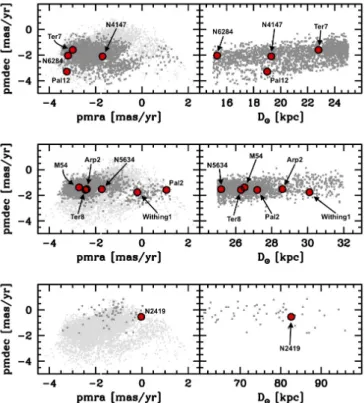
Fig. 4. Mean PM of candidate stream member GCs (red filled circles) are compared to the distribution of the 4S RR Lyrae (grey dots). The comparison is performed in the pmdec vs. pmra (left panels) and in the pmdec vs. heliocentric distance (right panels) planes in three different ranges of distance: 15.0 kpc< D <25.0 kpc (upper panels), 25.0 kpc< D <32.0 kpc (mid-dle panels), and 60.0 kpc< D <100.0 kpc (lower panels). The 4S RR Ly lying in the proper range of distance are plotted in dark grey, while the whole sample is plotted in pale grey in the lefthand panels.
sponding to the position of the cluster, there is a tightly packed set of 22 RR Lyrae all aligned in the direction of the distance, highlighted in blue. This is the typical signature of a compact stellar system in this kind of diagram, especially at large dis-tances. Other clusters display similar features and the Sculptor dSph is seen as a conspicuous vertical string, more extended than the one seen here. The blue dots in Fig. 2 are clearly RR Ly asso-ciated with NGC2419. Their mean, reddening corrected G mag-nitude is G0 = 20.12 with standard deviation σG0 = 0.07 mag.
Using this mean magnitude and the appropriate metallicity for the cluster ([Fe/H]=-2.09, after Mucciarelli et al. 2017) the ap-parent mismatch in distance between the distant arm of the stream and the cluster is completely recovered. We note that four of the RR Ly associated with the cluster have metallicity estimates from Fourier coefficients, albeit with large errors. The resulting mean metallicity (±1σ) is h[Fe/H]i = −2.07 ± 0.60, supporting the idea that they belong to a population more metal-poor than the surrounding stream; for the stars in Fig. 2 enclosed within −170◦ < Λ <∼ −150◦ and 70.0 kpc≤ D ≤ 90 kpc
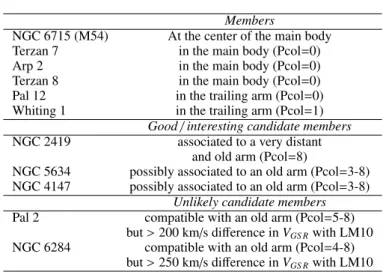
we find h[Fe/H]i = −1.40 ± 0.66 from 36 stars with metallic-ity estimates. Our final list of GCs candidate members of the Sgr system is displayed in Table 1, where clusters are ranked accord-ing to the reliability of their association to the stream, accordaccord-ing to the following analysis.
3. Star clusters in the Sgr stream
In Fig. 3 we compare the position of the selected clusters with the distribution of 4S RR Ly in the distance vsΛ plane. It is important to note that the match between all the selected clus-ters and the stream arms in distance is not trivial, since none of the adopted selection criteria includes constraints on the dis-tance (except for the case of NGC 2419). On the other hand, it provides further support to the membership of these clusters to the Sgr system. Obviously not all the matches provide the same amount of support to membership, depending on the distance
M. Bellazzini et al.: Globular clusters in the Sagittarius stream
and/or the associations to portions of the stream that are more clearly characterised and successfully modelled.
In Fig. 4 we show that all the selected clusters have mean proper motions in the range spanned by 4S RR Ly in the same range of distances, with a high degree of correlation. The only additional phase space parameter for which the match remains to be checked is the radial velocity. To do this last comparison we rely on the LM10 model. It has been demonstrated that this model provides a reasonable description of the radial velocity trend withΛ for the most recent portions of both the leading and the trailing arms (Hayes et al. 2019, I20). The radial veloc-ity along more ancient arms is poorly known and, in these cases, LM10 provides, at least, a reference, albeit uncertain. To be ho-mogeneous with the model we transformed the cluster heliocen-tric radial velocities into radial velocity in the galacto-cenheliocen-tric reference frame (VGS R) adopting the same solar motion adopted
by LM10.
The comparison in VGS Ris presented in the lower panel of
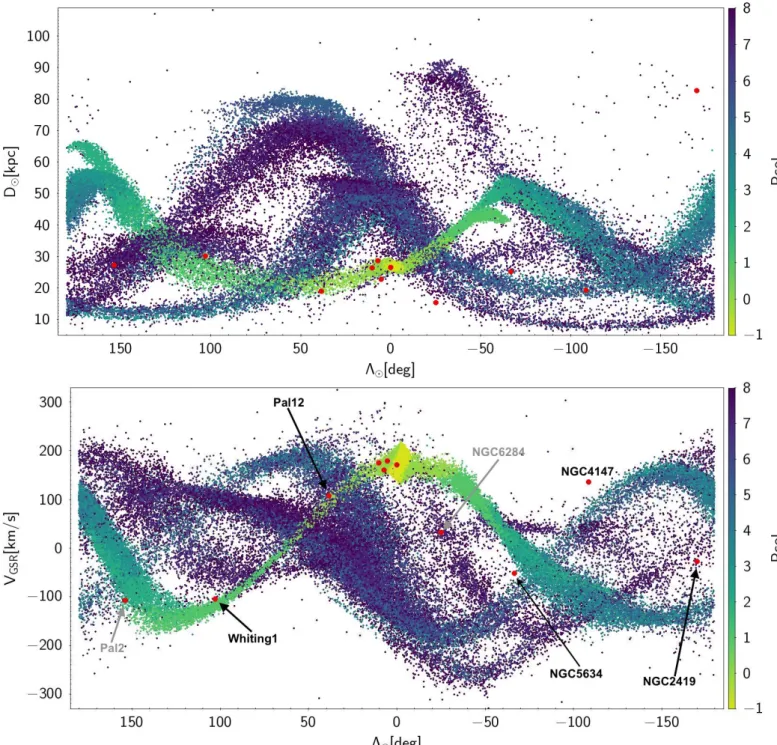
Fig. 5. In the upper panel of the same figure we plot the compar-ison in the usual distance vsΛ plane, for reference. The LM10 particles are color coded according to Pcol, thus providing a ref-erence for the timescale of tidal stripping.
All the clusters match, more or less closely, some branch of the stream also in the VGS Rvs.Λ plane. However, in some
cases, the match is only apparent, as the branch in which they are immersed is not the same that is matched in velocity. An exam-ple that can be clearly identified in Fig. 5 is Pal 2, that is located within an ancient portion of the Stream (Pcol=5-8) and matches in VGS R a recent branch (Pcol=2-3) that is located at much
larger distance. The LM10 model predicts VGS R ' +120 km/s
for the stream particles surrounding Pal 2, while the cluster has VGS R = −107.1 km/s. The case of NGC 6284 is even more
ex-treme: the cluster is located in a branch at VGS R ' −250 km/s
while it has VGS R = +32.5 km/s. On the other hand, the branch
in which NGC 4147 is immersed is the one having VGS R more
similar to that of the cluster, at theΛ of the cluster. This branch has a mean velocity of VGS R ' +60 km/s but the overall
ve-locity distribution reaches VGS R ' +100 km/s, while the
clus-ter has VGS R = +136.2 km/s, a moderate mismatch. Similarly,
NGC 5634 has VGS R= −51.6 km/s and lies in the vicinity of an
ancient portion of the stream having mean VGS R ' −100 km/s,
but reaching VGS R ' −65 km/s, a negligible difference, given
the uncertainties. The radial velocity of NGC 2419, VGS R =
−27.1 km/s is within the range of the LM10 particles around, it −57 km/s<∼ VGS R<∼+62 km/s.
All the other selected clusters match very well the radial ve-locity predicted by the LM10 model for the part of the Sgr sys-tem they are associated to. It is important to recall here that we can provide a safe confirmation only for clusters lying in the most recent wraps of the Stream (Pcol<∼ 3), where the radial velocity pattern predicted by LM10 broadly matches the obser-vations. The predictions for more ancient wraps are more un-certain and must be considered with caution. As a consequence, the association of clusters with the old wraps are model depen-dent, at least concerning the radial component of the velocity. Spectroscopic follow up of candidate Stream stars in the ancient wraps is required for a final confirmation or rejection of these candidates.
According to Fig. 5, the clusters NGC 2419, NGC 5634, NGC 4147, Pal 2, and NGC 6284, if they are actually members, should have been lost by Sgr long ago, more than ∼ 3 − 5 Gyr ago. On the other hand Pal 12 have been lost during the current perigalactic passage, and Whiting 1 during the previous one. It is interesting to note that the LM10 particles co-located, in phase
space, with Arp 2, Ter 7 and Ter 8 have become unbound during the current perigalactic, suggesting that also these ”main body” clusters are being stripped. The density map of the main body shown in Fig. 6 shows that, indeed, they are all located in prox-imity of the apparent onset of the trailing tail, about b ' −27◦, hence their ongoing stripping from the main body is not unlikely. The position of these three clusters hints to an intriguing asymmetry in the distribution of globular clusters within the Sgr system: all the confirmed members (except for the nuclear clus-ter M54), as well as the best candidates4 are associated to the
trailing arm and none to the leading arm of the Stream. While the initial ∼ 10◦of the leading arm lies behind the densest part of the Galactic Bulge and Disc, where, e.g., extreme interstellar extinction, in principle, may hide one or two unknown clusters, it is hard to imagine that clusters in the rangeΛ <∼ −20◦ may
have escaped detection, if they are similar to or brighter than Whiting 1 (MV = −2.55 ± 0.44, Mu˜noz et al. 2018), even taking
into account that this part of the leading arm is more distant, on average, than the trailing arm in the same range of Pcol. Note, however, that the two faint clusters Koposov 1 and Koposov 2 (MV = −1.04 ± 0.69, and MV = −0.92 ± 0.81, respectively,
Mu˜noz et al. 2018), are not included in this analysis as they lack estimates of both PM and radial velocity but are proposed as probable members of the stream based on their position (Paust, Wilson & van Belle 2015), and both lie, in projection, on the leading arm. Also the cluster NGC 5824, proposed as a member of the system by Massari, Koppelman, &, Helmi (2019), would lie in the leading arm (atΛ = −45.2◦, D = 32.1 kpc) but it is excluded from our selection by all the three adopted criteria. The study of the significance and of the possible origin of this asym-metry is beyond the scope of this paper, but the case is worth noting and it may deserve further analysis.
3.1. Discussion on individual clusters
In the following we will discuss the membership of each indi-vidual cluster, in order of likelihood, based on the evidence pre-sented in this analysis as well as in past literature.
3.1.1. Main body clusters
There has been little doubt of the membership of the four main body clusters since the very discovery of Sgr dSph (Ibata et al. 1994, Da Costa & Armandroff 1995), due to the coincidence in position and radial velocity with the galaxy. In particular, M 54 sits at the very center of the galaxy, within the stellar nucleus (Bellazzini et al. 2008, Alfaro-Cuello et al. 2019). Now their membership has been fully confirmed also with proper motions (see, e.g., Vasiliev 2019, and references therein).
3.1.2. Palomar 12
Pal 12 was first proposed as a possible member of the stream by Irwin (1999). Independent detection of stream stars in its sur-rounding were provided by Martinez-Delgado et al. (2002) and Bellazzini et al. (2003b). Cohen (2004) showed that its chemi-cal composition is anomalous for a Galactic halo cluster but it is fully compatible with the abundance pattern observed in the Sgr galaxy (see, e.g., Sbordone et al. 2015). Both Bellazzini et al. (2003a) and Law & Majewski (2010b) proposed it as a highly probable member of the stream, Sohn et al. (2018), Vasiliev (2019) and Massari, Koppelman, &, Helmi (2019) confirmed
M. Bellazzini et al.: Globular clusters in the Sagittarius stream
Fig. 5. Position (upper panel) and line of sight velocity in the Galactic Standard of Rest (VGS R) of candidate stream member GCs (red
filled circles) are compared to the predictions of the LM10 model. The model particles are color coded according the perigalactic passage when they were stripped from the Sgr galaxy (Pcol). Pcol=0 is the current perigalactic passage, while Pcol=1,2,...,8 refers to one, two up to eight perigalactic passages ago. Particles with Pcol=-1 are still gravitationally bound to the main body of the galaxy. Candidate clusters having VGS Rvery different from the mean VGS Rof the stream arm they are immersed in are labelled in
grey.
their conclusion based on 6D space motion. Here we provide the additional support of the simultaneous 6D match with the observedstream, as traced by 4S RR Ly.
3.1.3. Whiting 1
The cluster was firstly proposed as a member by Carraro et al. (2007), confirmed by Law & Majewski (2010b) and subse-quently by Vasiliev (2019) and Massari, Koppelman, &, Helmi
(2019). Its high metallicity and young age also support an extra-Galactic origin. We also confirm its membership to the young trailing arm.
3.1.4. NGC 2419
The massive and remote cluster NGC 2419 was suggested as possibly associated to the Sgr system as early as twenty years ago (Irwin 1999). The proximity with the orbital plane was noted
M. Bellazzini et al.: Globular clusters in the Sagittarius stream
Fig. 6. Density map of the region at positive Galactic longitude around the Sgr galaxy, for Gaia DR2 stars having PM within 0.5 mas/yr from the mean PM of the galaxy (taken from Helmi et al. 2018) and having color and magnitude compatible with being members of the Sgr dSph. The clusters associated to the main body are indicated as filled black circles and are labelled.
also by Newberg et al. (2003) but Law & Majewski (2010b) classified it as unlikely to be member. The possible connec-tion with the stream, as traced by blue horizontal branch stars was noted by Ruhland et al. (2011), and the membership was strongly supported by Sohn et al. (2018) and Massari et al. (2017), Massari, Koppelman, &, Helmi (2019), based on space motion. Belokurov et al. (2014) traced the stream out to the po-sition of the cluster, finding also a match in radial velocity. We fully confirm these conclusions: NGC 2419 is associated with the distant branch of the stream traced by 4S stars. Perhaps, it may still be possible that this branch is not associated to the Sgr Stream, but this seems quite unlikely.
3.1.5. NGC 5634
NGC 5634 was first proposed to be associated to an ancient wrap of the stream by Bellazzini et al. (2002) and Bellazzini et al. (2003a). Later Law & Majewski (2010b) and Carretta et al. (2017) confirmed it as a good candidate. In the metal-poor regime the abundance patterns of the Milky Way and of Sgr dSphs are very similar. Still Sbordone et al. (2015), based on detailed abundances of several elements in one cluster star, concludes that an origin in Sgr is more likely. A similar conclu-sion was reached also by Carretta et al. (2017), from independent abundance analysis of a larger sample of cluster stars.
Here we find that the cluster has position and proper mo-tion compatible with associamo-tion with the ancient arm at D ∼ 20−25 kpc already found by Correnti et al. (2010). It is still to be checked observationally if the match extends to radial velocity. In this sense, the agreement with the LM10 model is not particu-larly meaningful, since the model predicts a very different proper motion for this branch with respect to 4S RR Ly. However con-tamination by unrelated MW stars may be non negligible in this region and the detection of this branch in the 4S must be con-firmed with additional data (e.g., future data releases of Gaia, providing more complete samples of RR Lyrae). Taking all the
Table 1. Globular clusters matching position and PM of the Sgr dSph and stream as traced by Gaia DR2 4S RR Lyrae.
Name Comment
Members
NGC 6715 (M54) At the center of the main body Terzan 7 in the main body (Pcol=0) Arp 2 in the main body (Pcol=0) Terzan 8 in the main body (Pcol=0) Pal 12 in the trailing arm (Pcol=0) Whiting 1 in the trailing arm (Pcol=1)
Good/ interesting candidate members NGC 2419 associated to a very distant
and old arm (Pcol=8)
NGC 5634 possibly associated to an old arm (Pcol=3-8) NGC 4147 possibly associated to an old arm (Pcol=3-8)
Unlikely candidate members Pal 2 compatible with an old arm (Pcol=5-8)
but > 200 km/s difference in VGS Rwith LM10
NGC 6284 compatible with an old arm (Pcol=4-8) but > 250 km/s difference in VGS Rwith LM10
Notes. The reported Pcol values indicate the Pcol range spanned by of the particles of the LM10 model in the surroundings of the cluster.
above into account we conclude that NGC 5634 remains a good candidate, to be confirmed with spectroscopic follow-up of the stream stars in its surroundings.
3.1.6. NGC 4147
The cluster was included in the list of possible candidates by Bellazzini et al. (2003a) and the stream was detected in its sur-roundings by Bellazzini et al. (2003b). Law & Majewski (2010b) classified it as an attractive but weak candidate, while Sohn et al. (2018) rejects it based on the mismatch in PM with the LM10 model. If the 4S RR Ly in which the cluster is embedded are dominated by genuine members of the D ∼ 20 − 25 kpc wrap of the stream, then NGC 4147 is an interesting candidate, worth attempting a spectroscopic confirmation.
3.1.7. Palomar 2
Pal 2 was suggested as candidate member by Bellazzini et al. (2003b) and judged as a weak candidate by Law & Majewski (2010b). The mismatch with the LM10 model is significant in all the three components of the velocity vector, however (as NGC 2419, NGC 5634, NGC 4147 and NGC 6284) the possible association is with an ancient wrap of the stream, where the pre-dictions of the model lack observational verification. The match with the 4S stars around it is good.
3.1.8. NGC 6284
NGC 6284 was never suggested before as a possible member because of the careful cuts in galactocentric distance adopted by both Bellazzini et al. (2003b) and Law & Majewski (2010b) to avoid contamination by clusters near the center of the Galaxy that are necessarily close to the orbital plane of Sgr. In principle, the case is analogous to Pal 2 but we consider it a more unlikely candidate as it may have been selected only because the distance cut adopted here was too liberal.
M. Bellazzini et al.: Globular clusters in the Sagittarius stream
Fig. 7. [Mg/Fe] (upper panel) and [Ca/Fe] (middle panel) abun-dance ratios, and age (lower panel) as a function of [Fe/H] for main body clusters (turquoise filled circles ), confirmed mem-bers (yellow filled hexagons), and good/interesting candidate members (brown filled squares), from Tab. 1. In the upper and middle panels we plotted in grey field stars in the central region of Sgr dSph (including M54, from Mucciarelli et al. 2017), and in the lower panel we plotted as orange filled triangles the age and metallicity of the two main components of the Sgr field stars in the nuclear region (from Tab. 1 of Alfaro-Cuello et al. 2019), for comparison.
4. Summary and conclusions
We have used the criteria developed by I20 to select a sample of Galactic globular clusters that lie within and have spatial motion compatible with the Sgr tidal stream, as traced by RR Lyrae in the Gaia DR2 catalog. The membership of the clusters residing in the main body of the galaxy (M 54, Ter 8, Ter 7, Arp 2) and in the most recent wraps of the stream (Pal 12, Whiting 1) is confirmed beyond any reasonable doubt, while other candidates require additional observations and/or more refined modelling of the stream to be ultimately confirmed. NGC 2419, NGC 5634, and NGC 4147 may be immersed in more ancient wraps of the stream and they appear as particularly promising candidates.
Having considered all the available data to check the match in 6D phase space, the next step would be to look for consistency in the chemical composition and in the age-metallicity relation (see, e.g., Carretta et al. 2017, Massari, Koppelman, &, Helmi 2019). While these factors already entered in the discussion of individual cases, above, in Fig. 7 we attempt to provide a more global view of the α-elements vs. iron chemical pattern and the age-metallicity relation of the clusters in comparison with the available data on field stars of Sgr dSph.
For the clusters, we take ages from Dotter et al. (2010) for all the clusters listed in this source. The exception and the alterna-tive sources are M 54 (Siegel et al. 2007), Whiting 1 (Carraro et al. 2007), and NGC 5634 (Bellazzini et al. 2002). For the
chem-ical abundances we privileged the most recent studies based on high resolution spectroscopy. In particular: M 54 (Carretta et al. 2010), Ter 7 (Sbordone et al. 2005), Ter 8 (Carretta et al. 2014), Pal 12 (Cohen 2004), NGC 2419 (weighted mean of the individual abundances by Cohen et al. 2011, limited to the six stars of the Mg-rich popuation, i.e the one reflecting the original composition of the cluster), NGC 5634 (Carretta et al. 2017), NGC 4147 (Villanova et al. 2016), Whiting 1 (Carraro et al. 2007, no abundance ratio, only metallicity). In examining Fig. 7, it is important to bear in mind that non negligible systematic dif-ferences between the abundance and age scales of different au-thors may affect the comparison between the various clusters as well as with the tracers of the field population included in the diagrams for reference (Mucciarelli et al. 2017, Alfaro-Cuello et al. 2019). Moreover, the field population is sampled only in the central region of the main body of the Sgr dSph, while the clusters (except M 54) populate/populated the outskirts.
With these caveats in mind, the result of Fig. 7, taken at face value, is that the consistency between the selected clusters and the field population of the Sgr dSph is excellent. In particular the field population of the Milky Way lies above the Sgr branch in the [Fe/H] vs [Mg/Fe], [Ca/Fe] diagrams for [Fe/H]> −1.0, hence, in this regime, the abundance of the clusters is discrim-inant and provides strong support to their membership to the Sgr system. It is also very intriguing that the only field star with [Fe/H]< −2.0 in Fig. 7 lies exactly between Ter 8 and NGC 2419, with very similar [Mg/Fe] and [Ca/Fe], at a value that does not match the extrapolation of the main branch of metal-poor stars to that metallicity. It is possible that a signif-icant step in this context can be achieved when fully homoge-neous ages and abundances will be available for both the clusters and the field, and the very metal poor population of the galaxy will be adequately sampled, while extending the comparison to more chemical elements (as done, e.g., by Carretta et al. 2017, for NGC 5634).
Acknowledgements. MB acknowledges the financial support to this research by INAF, through the Mainstream Grant 1.05.01.86.22 assigned to the project “Chemo-dynamics of globular clusters: the Gaia revolution” (P.I. E. Pancino). RI, NM, BF and AS acknowledge funding from the Agence Nationale de la Recherche (ANR project 18-CE31-0006, 18-CE31-0017, and ANR-19-CE31-0017), from CNRS/INSU through the Programme National Galaxies et Cosmologie, and from the European Research Council (ERC) under the European Unions Horizon 2020 research and innovation programme (grant agreement No. 834148).
We are grateful to G. Clementini and T. Muraveva for their advice on the RR Ly sample and to Denis Erkal and Antonio Sollima for useful discussions.
This work has made use of data from the European Space Agency (ESA) mission Gaia (http://www.cosmos.esa.int/gaia), pro-cessed by the Gaia Data Processing and Analysis Consortium (DPAC, http://www.cosmos.esa.int/web/gaia/dpac/consortium). Funding for the DPAC has been provided by national institutions, in particular the institutions participating in the Gaia Multilateral Agreement.
This research has made use of the SIMBAD database, operated at CDS, Strasbourg, France. This research has made use of the NASA/IPAC Extragalactic Database (NED) which is operated by the Jet Propulsion Laboratory, California Institute of Technology, under contract with the National Aeronautics and Space Administration. This research has made use of NASA’s Astrophysics Data System.
References
Antoja, T., Ramos, P., Mateu, C., Helmi, A., Anders, C., Jordi, C., Carballo-Bello, J.A., 2020, A&A, in press (arXiv:2001.10012)
Alfaro-Cuello, M., Kacharov, N., Neumayer, N., et al., 2019, ApJ, 886, 57 Baumgardt, H., Hilker, M., Sollima, A., Bellini, A., 2019, MNRAS, 482, 5138 Bellazzini, M., Ferraro, F. R.,& Ibata, R. 2002,AJ, 124, 915
Bellazzini, M., Ferraro, F. R.,& Ibata, R. 2003a,AJ, 125, 188
M. Bellazzini et al.: Globular clusters in the Sagittarius stream
Bellazzini, M., Ibata, R. A., Chapman, S. C., Mackey, A. D., Monaco, L., Irwin, M. J., Martin, N. F., Lewis, G. F., Dalessandro, E., 2008, AJ, 136, 1147 Belokurov, V., et al. 2006, ApJ, 642, L137
Belokurov, V., Koposov, S. E., Evans, N. W, et al., 2014, MNRAS, 437, 116 Carballo-Bello, J. A., Corral-Santana, J. M., Mart´ınez-Delgado, D., 2017,
MNRAS, 467, L91
Carraro, G., Zinn, R., Moni Bidin, C., A&A, 466, 181 Carretta, E., et al., 2010, A&A, 520, A95
Carretta et al. 2014, A&A, 561, A87
Carretta, E., Bragaglia, A., Lucatello, S., et al., 2017, A&A, 600, 118 Clementini, G., Ripepi, V., Molinaro, R., et al., 2019, A&A, 622, A60 Cohen, J.G., 2004, AJ, 127, 1545
Cohen, J.G., Huang, W., Kirby, E.N., 2011, ApJ, 740, 60
Correnti, M., Bellazzini, M., Ibata, R.A., Ferraro, F.R., Varghese, A., 2010, ApJ, 721, 329 (C10)
Da Costa, G.S., Armandroff, T.E., 1995, AJ, 109, 2533
Dotter, A., Sarajedini, A., Anderson, J., et al., 2010, ApJ, 708, 698 Ferguson, P.S., Strigari, L.E., 2019, MNRAS, in press (arXiv:1909.11103) Freeman, K.C., Bland-Hawthorn, J., 2002, ARA&A, 40, 487
Fusi Pecci, F., Bellazzini, M., Cacciari, C., Ferraro, F.R., 1995, AJ, 110, 1664 Gaia Collaboration, Brown, A., et al., 2018, A&A, 616, A1
Gaia Collaboration, Helmi, A., et al., 2018, A&A, 616, A12
Hayes, C.R., Majewski, S.R., Hasselquist, S., et al., 2020, ApJ, in press (arXiv:1912.06707)
Holl, B., et al., 2018, A&A, 618, A30
Ibata, R. A., Gilmore, G.,& Irwin, M. J. 1994, Nature, 370, 194 Ibata, R. A., Irwin, M., Lewis, G. F., Stolte, A. 2001a, ApJ, 547, L133 Ibata, R. A., Malhan, K., Martin, N., 2019, ApJ, 872, 152
Ibata, R.A., Bellazzini, M., Thomas, G., Malhan, K., Martin, N., Famaey, B., Siebert, A., 2020, ApJ, 491, L19
Irwin, M. J. 1999, in IAU Symp. 192, The Stellar Content of Local Group Galaxies, ed. P. A.Whitelock & R. D Cannon (San Francisco: ASP), 409 Koposov, S. E., Belokurov, V., Evans, N. W., et al. 2012, ApJ, 750, 80, Law, D. R.,& Majewski, S. R. 2010a, ApJ, 714, 229 (LM10) Law, D. R.,& Majewski, S. R. 2010b, ApJ, 718, 1128 Lindegren, L., et al., 2018, A&A, 616, A2
Longeard, N., Martin, N., Starkenburg, E., et al., 2020, MNRAS, 491, 356 Majewski, S. R., Skrutskie, M. F., Weinberg, M. D., & Ostheimer, J. C. 2003,
ApJ, 599, 1082
Malhan, K., Ibata, R.A., 2018, MNRAS, 477, 4063
Malhan, K., Ibata, R.A., Martin, N., 2018, MNRAS, 481, 3442 Martinez-Delgado, D., Zinn, R., Carrera, R., Gallart, C., ApJ, 573, L19 Massari, D., Posti, L., Helmi, A., Fiorentino, G., Tolstoy, E., 2017, A&A, 598,
L9
Massari, D., Koppelman, H.H., Helmi, A., 2019, A&A, 630, L4
Monaco, L., Bellazzini, M., Ferraro, F. R., & Pancino, E. 2004, MNRAS, 353, 874
Mottini, M., Wallerstein, G., McWilliam, A., 2008, AJ, 136, 614
Mucciarelli, A.; Bellazzini, M.; Ibata, R.; Romano, D.; Chapman, S. C.; Monaco, L.
Mu˜noz, R.R., Cˆot´e, P., Santana, F.A., Geha, M., Simon, J.D., Oyarz´un, G.A., Stetson, P.B., Djorgovski, S.G., 2018, ApJ, 860, 66
Muraveva, T., Delgado, H.E., Clementini, G., Sarro, L.M., Garofalo, A., 2018, MNRAS, 481, 1195
Newberg, H. J., Yanny, B., Rockosi, C., et al. 2002, ApJ, 569, 245
Musella, I., Di Criscienzo, M., Marconi, M., et al., 2018, MNRAS, 473, 3062 Newberg, H. J., et al., 2003, ApJ, 596, L191
Newberg, H. J., Yanny, B., Cole, N., Beers, T. C., Re Fiorentin, P., Schneider, D. P., & Wilhelm, R., 2007, ApJ, 668, 221
Niederste-Ostholt, M., Belokurov, V., Evans, N. W., & Penarrubia, J. 2010, ApJ, 712, 516
Paust, N., Wilson, D., van Belle, G., 2015, AJ, 148, 19 Palma, C., Majewski, S.R., Johnston, K.V., 2002, ApJ, 564, 736 Ruhland, C., Bell, E.F., Rix, H.-W., Xue, X.-X., 2011, ApJ, 731, 119 Sbordone et al. 2005, A&A, 437, 905
Sbordone, L., Monaco, L., Moni Bidin, C., et al., 2015, A&A, 579, A104 Schlafly, E.F. & Finkbeiner, D.P., 2011, ApJ, 737, 103
Schlegel, D. J., Finkbeiner, D. P., & Davis, M. 1998, ApJ, 500, 525 Siegel, M.H., Dotter, A., Majewski, S.R., et al., 2007, ApJ, 667, L57 Sohn, S.T., Watkins, L., Fardal, M., et al., 2018, ApJ, 862, 52
Sollima, A., Mart´ınez Delgado, D.; Mu˜noz, R. R, et al., 2018, MNRAS, 476, 481 Taylor, M.B., 2005, in Astronomical Data Analysis Software and Systems XIV, ASP Conference Series, Vol. 347, P. Shopbell, M. Britton, and R. Ebert Eds. San Francisco: Astronomical Society of the Pacific, p.29
Vasiliev, E., 2019, MNRAS, 484, 2832
Villanova, S., Monaco, L., Moni Bidin, C., Assman, P., 2016, MNRAS, 460, 2351
![Fig. 7. [Mg / Fe] (upper panel) and [Ca / Fe] (middle panel) abun- abun-dance ratios, and age (lower panel) as a function of [Fe / H] for main body clusters (turquoise filled circles ), confirmed mem-bers (yellow filled hexagons), and good / interesting c](https://thumb-eu.123doks.com/thumbv2/123doknet/14792747.602142/9.892.72.440.85.483/middle-function-clusters-turquoise-circles-confirmed-hexagons-interesting.webp)
