HAL Id: hal-00327840
https://hal.archives-ouvertes.fr/hal-00327840
Submitted on 5 Feb 2004HAL is a multi-disciplinary open access
archive for the deposit and dissemination of sci-entific research documents, whether they are pub-lished or not. The documents may come from teaching and research institutions in France or abroad, or from public or private research centers.
L’archive ouverte pluridisciplinaire HAL, est destinée au dépôt et à la diffusion de documents scientifiques de niveau recherche, publiés ou non, émanant des établissements d’enseignement et de recherche français ou étrangers, des laboratoires publics ou privés.
Cloud chemistry at the Puy de Dôme: variability and
relationships with environmental factors
A. Marinoni, Paolo Laj, K. Sellegri, Gilles Mailhot
To cite this version:
A. Marinoni, Paolo Laj, K. Sellegri, Gilles Mailhot. Cloud chemistry at the Puy de Dôme: variabil-ity and relationships with environmental factors. Atmospheric Chemistry and Physics Discussions, European Geosciences Union, 2004, 4 (1), pp.849-886. �hal-00327840�
ACPD
4, 849–886, 2004
Cloud chemistry at the Puy de D ˆome
A. Marinoni et al. Title Page Abstract Introduction Conclusions References Tables Figures J I J I Back Close Full Screen / Esc
Print Version Interactive Discussion
© EGU 2004
Atmos. Chem. Phys. Discuss., 4, 849–886, 2004 www.atmos-chem-phys.org/acpd/4/849/
SRef-ID: 1680-7375/acpd/2004-4-849 © European Geosciences Union 2004
Atmospheric Chemistry and Physics Discussions
Cloud chemistry at the Puy de D ˆ
ome:
variability and relationships with
environmental factors
A. Marinoni1, 2, P. Laj1, K. Sellegri1, and G. Mailhot3
1
Laboratoire de M ´et ´eorologie Physique, Universit ´e Blaise Pascal, OPGC/CNRS, Clermont-Ferrand, France
2
Dipartimento di Scienze dell’Ambiente e del Territorio, Universit `a degli Studi di Milano Bicocca, Italy
3
Laboratoire de Photochimie Mol ´eculaire et Macromol ´eculaire, Universit ´e Blaise Pascal, UMR CNRS 6505, Clermont-Ferrand, France)
Received: 18 November 2003 – Accepted: 27 January 2004 – Published: 5 February 2004 Correspondence to: A. Marinoni ([email protected])
ACPD
4, 849–886, 2004
Cloud chemistry at the Puy de D ˆome
A. Marinoni et al. Title Page Abstract Introduction Conclusions References Tables Figures J I J I Back Close Full Screen / Esc
Print Version Interactive Discussion
© EGU 2004
Abstract
The chemical composition of cloud water was investigated during the winter-spring months of 2001 and 2002 at the Puy de D ˆome station (1465 m above sea level, 45◦4602200N, 2◦5704300E) in an effort to characterize clouds in the continental free tro-posphere. Cloud droplets were sampled with single-stage cloud collectors (cut-off
di-5
ameter approximately 7 µm) and analyzed for inorganic and organic ions, as well as total dissolved organic carbon. Results show a very large variability in chemical com-position and total solute concentration of cloud droplets, ranging from a few mg l−1 to more than 150 mg l−1. Samplings can be classified in three different categories with respect to their total ionic content and relative chemical composition: background
10
continental (BG, total solute content lower than 18 mg l−1), anthropogenic continental (ANT, total solute content from 18 to 50 mg l−1), and special events (SpE, total solute content higher than 50 mg l−1). The relative chemical composition shows an increase in anthropogenic-derived species (NO−3, SO2−4 and NH+4) from BG to SpE, and a de-crease in dissolved organic compounds (ionic and non-ionic) that are associated with
15
the anthropogenic character of air masses.
We observed a high contribution of solute in cloud water derived from the dissolution of gas phase species in all cloud events. This was evident from large solute fractions of nitrate, ammonium and mono-carboxylic acids in cloud water, relative to their abun-dance in the aerosol phase. The comparison between droplet and aerosol composition
20
clearly shows the limited ability of organic aerosols to act as cloud condensation nu-clei. The strong contribution of gas-phase species limits the establishment of direct relationships between cloud water solute concentration and LWC that are expected from nucleation scavenging.
ACPD
4, 849–886, 2004
Cloud chemistry at the Puy de D ˆome
A. Marinoni et al. Title Page Abstract Introduction Conclusions References Tables Figures J I J I Back Close Full Screen / Esc
Print Version Interactive Discussion
© EGU 2004
1. Introduction
The fundamental role of cloud droplets as media for chemical reactions has long been recognized (Jacob et al., 1986; Chameides and Davis, 1983; Calvert et al., 1986; Liang and Jacobson, 1999; Laj et al., 1997a; M ¨oller et al., 1996; Collett et al., 1999). Chemi-cal and physiChemi-cal processes in multiphase systems significantly influence the transport,
5
vertical redistribution, chemical transformation, and removal of chemical species from the atmosphere, and hence impact on the lifetime of both aerosols and gases. As many of the existing chemical species formed in the gas phase can dissolve and react efficiently in the liquid phase, aqueous-phase reactions potentially act either as a sink or source for atmospheric trace compounds, depending on the physical and chemical
10
characteristics of cloud droplets (Warneck, 1986). In addition, due to their high con-centration of solutes, fogs and clouds play a crucial role in the deposition of pollutants. Clouds and fogs can significantly affect terrestrial and aquatic ecosystems, acting on a regional scale as a primary source of nutrients to ecosystems and as a potential source of toxic chemicals (Glotfelty et al., 1987).
15
The chemical composition of cloud droplets is determined by chemical and physical processes that include (i) the dynamics of cloud formation, (ii) the composition and concentration of aerosols that are dissolved in the droplets from both nucleation and impaction scavenging, (iii) the transfer of volatile species across the air/water interface during the lifetime of the cloud, and (iv) the chemical reactions that can take place
20
in the liquid phase. Since each of these processes can modify the original solute concentration of cloud droplets, the chemical composition of cloud droplets results from a combination of all three major processes.
Assessing the importance of multiphase chemical processes in the global atmo-spheric chemical cycle is rather complicated, given the variety of condensed
mat-25
ter and gaseous species that can participate in such reactions. For example, liquid phase mechanisms linked to the process of acidification of precipitation are well under-stood, especially for sulphur and nitrogen compounds (Warneck, 1986; Jaeschke,1986;
ACPD
4, 849–886, 2004
Cloud chemistry at the Puy de D ˆome
A. Marinoni et al. Title Page Abstract Introduction Conclusions References Tables Figures J I J I Back Close Full Screen / Esc
Print Version Interactive Discussion
© EGU 2004
Lelieveld and Crutzen, 1991). On the contrary, it is only recently that attention has focused on the central role of clouds in the alteration of the oxidizing capacity of the at-mosphere, through reactions involving both free radicals (Lelieveld and Crutzen, 1991; Lawrence and Crutzen, 1998) and/or organic species (Aneja, 1993; Khwaja et al., 1995; Fuzzi and Zappoli, 1996; Krivacsy et al., 2000; Hitzenberger et al., 2000).
5
The inorganic fraction of cloud composition has been studied extensively (Chandler et al., 1988a; Chandler et al., 1988b; Collett et al., 1993; Collett et al., 1995; Erel et al., 1993; Fuzzi et al., 1992, 1998; Hegg and Hobbs, 1986). While data on the organic content are sparse, it is clear that organic content can constitute a significant fraction of the solute mass (Aneja, 1993; Fuzzi and Zappoli, 1996; Novakov and Penner, 1993;
10
Hadi et al., 1995). The nature of the organic compounds present in cloud droplets is highly variable, and the number of chemical species that have been identified at present is extremely high (Herckes et al., 2002; Decesari et al., 2001; Cappiello et al., 2003).
Given the dispersed nature of aerosol particles, gases, and the environmental
con-15
ditions leading to the formation of clouds, it is not surprising that the chemical com-position of clouds and fogs is highly variable in the atmosphere. The Liquid Water Content (LWC) of clouds and fogs is one of the major factors that control the concen-tration of constituents in the liquid phase (Junge, 1963; Elbert et al., 2000; M ¨oller et al., 1996). On the contrary, the initial chemical composition of cloud water appears to be
20
driven largely by the composition of the aerosol particles that serve as Cloud Conden-sation Nuclei (CCN). Finally, the contribution of ambient soluble gases can significantly change the chemical composition of droplets (Jacob et al., 1986; Jacob et al., 1987).
The chemical composition of fogs and clouds often shows variation within a single cloud event due to advection of chemical substances, and variation in LWC during the
25
lifetime of the cloud (Elbert et al., 2000). As expected, concentrations of dissolved species often display an inverse relationship with LWC (Pili ´e et al., 1975; Munger et al., 1983; Jacob, 1984; F ¨uhrer, 1986; Fuzzi, 1986; Gervat et al., 1984; Aneja et al., 1990), but other parameters can locally complicate the relationship between droplet
ACPD
4, 849–886, 2004
Cloud chemistry at the Puy de D ˆome
A. Marinoni et al. Title Page Abstract Introduction Conclusions References Tables Figures J I J I Back Close Full Screen / Esc
Print Version Interactive Discussion
© EGU 2004
concentrations and cloud microphysics. These factors are not adequately treated in present-day atmospheric models, where solute concentration is simply computed on the basis of scavenging efficiency and Henry’s law of equilibrium.
A better knowledge of relationships that relate solute concentration in cloud water to environmental parameters, as well as more data on the temporal variation of
chemi-5
cal concentration of cloud water, would clearly contribute to the construction of cloud chemistry models that possess better constraints. The goal of this paper is to provide information on atmospheric chemistry in the liquid phase in relation to the chemical and physical properties of aerosol particles and to the microphysics of clouds. We in-vestigate a regional cloud chemistry climatology and present statistics that are based
10
on the monitoring of sixteen cloud events during a period of two years. The chemical investigation includes measurements of inorganic compounds, as well as dissolved to-tal organic carbon that includes speciation of organic carbon for many carboxylic acids. These measurements can provide the requisite data-set for the construction of models concerning cloud effects in the arena of tropospheric chemistry.
15
2. Experimental
2.1. Study area and experimental set-up
Experimental studies were carried out at the Puy de D ˆome (PDD) station (48◦N, 2◦E; 1465 m a.s.l.), in the Massif Central Region (France). It is a strategic point from which to observe warm and mixed clouds that are present 50% of the time between November
20
and March. Clouds are frequently formed at the top of the site, either during advection of frontal systems or by the orographic rising of moist air. During the winter/spring months, the station lies in the free troposphere and air masses are usually exempt from the influence of local pollution. Road access to the site was restricted to authorized personnel during all sampling periods; cars were stopped 5 km before the summit at
25
ACPD
4, 849–886, 2004
Cloud chemistry at the Puy de D ˆome
A. Marinoni et al. Title Page Abstract Introduction Conclusions References Tables Figures J I J I Back Close Full Screen / Esc
Print Version Interactive Discussion
© EGU 2004
of the station, but fuel combustibles are limited exclusively to winter storm events. Meteorological parameters are monitored at the station and include wind speed and direction, temperature, pressure, and relative humidity (RH). In addition, monitoring of a variety of atmospheric gas concentrations (O3, NOx, SO2, CO2), black carbon (BC, measured by a Magee Scientific æthalometer, AE1-series), and total particle number
5
concentrations (NCPC, measured in the range from 10 nm to 3 µm by a Condensation Particle Counter Model 3010, product by TSI) occurs throughout the year. The station is equipped for cloud microphysical measurements. However, in this study we only have measurements of LWC and effective radius (Re) of droplets as obtained with a Gerber PVM-100 probe. An overall description of measurements performed at the station can
10
be found athttp://www.obs.univ-bpclermont.fr/observ/chimie/pdd listedata.html. 2.2. Cloud droplets and aerosol particle sampling
Cloud sampling was performed between 8 February and 6 April in 2001 (68 samples during 8 different events), and between 14 February and 12 May in 2002 (10 samples during 8 different events) (see Table 1). The sampling periods included both warm and
15
super-cooled conditions for cloud droplets. Sampling was restricted to non-precipitating clouds.
Cloud droplets were sampled with single-stage cloud collector similar to that de-scribed by Kruisz et al. (1993). Droplets are sampled at a flow rate of approximately 80 m3h−1and collected by impaction onto a 10 cm2rectangular plate. The cloud droplets
20
either freeze upon impact (super-cooled conditions) or are collected directly in the liq-uid phase. The droplet sampling efficiency is enhanced with the utilization of a large stagnation plate close to the collector inlet. Laboratory tests have shown that the cut-off diameter of the collector is approximately 7 µm. Averaged droplet size distributions measured by a Forward Scattering Spectrometer Probe show that this cut-off is
suffi-25
cient to collect more than 80% of the cloud liquid water mass (Dupuy et al., 2002). The sampling intervals (40 min up to 2 h) varied and were dependent on the LWC. Previous experiments have shown that the LWC is measured with a precision of approximately
ACPD
4, 849–886, 2004
Cloud chemistry at the Puy de D ˆome
A. Marinoni et al. Title Page Abstract Introduction Conclusions References Tables Figures J I J I Back Close Full Screen / Esc
Print Version Interactive Discussion
© EGU 2004
20% (Mertes et al., 2001).
We concurrently used two different collectors for sample analysis by ion chromatog-raphy and carbon. The difference between the samplers is in the material used for the impaction plates and the liquid water collectors, as well as the cleaning procedures.
The sampler used for ion chromatography analysis and pH measurements was made
5
of aluminium. The second sampler, used for total carbon (TC) and organic carbon (OC) analyses, was made of stainless-steel. Cleaning procedures were similar to those described by Sellegri et al. (2003b).
The samples for ion chromatography and carbon analyses were frozen immediately after collection, stored in glass bottles (Schott), and thawed in a clean room just before
10
the analysis. IC and TC/OC measurements were performed within three days after collection.
Aerosol particle sampling was performed in 2001 and 2002 (Table 2) with the method described by Sellegri et al. (2003a).
2.3. Chemical analyses
15
Aerosol and cloud samples were analysed for the determination of major ionic com-pounds, as well as total organic carbon concentrations. The preparation and analy-ses of the cloud and aerosol samples were performed under a class 100 laminar flow bench to minimize possibility of contamination from external sources. Data quality was controlled utilizing two field blanks for each cloud event and one blank filter for every
20
impactor.
2.3.1. Ion chromatography
Ion chromatographic analyses were performed in a clean room (class 10000). Cloud water was injected directly without filtration to avoid further contamination. Working conditions are similar to those detailed by Jaffrezo et al. (1998), who employed a
25
ACPD
4, 849–886, 2004
Cloud chemistry at the Puy de D ˆome
A. Marinoni et al. Title Page Abstract Introduction Conclusions References Tables Figures J I J I Back Close Full Screen / Esc
Print Version Interactive Discussion
© EGU 2004
DIONEX 500 with an AS11 column for the anions. CH3COO−, HCOO−, Cl−, NO−3, SO2−4 , C2O2−4 , Na+, NH+4, K+, Mg2+ and Ca2+ are the ions analysed in 2001. In 2002, additional mono and di-carboxylic acids were measured: lactic, glycolic, propionic, gly-oxylic, glutaric, succinic, maleic, malonic and tartaric. Detection limits were calculated from a mean blank plus one standard deviation. The accuracy of ion chromatographic
5
analyses is typically 10% for samples 10 times the detection limit, and approximately 50% for samples twice the detection limit.
2.3.2. Total and organic carbon
Total Organic Carbon (TOC) measurements in the liquid phase were obtained with a TOC analyzer Shimadzu model TOC-5O5OA. The Shimadzu TOC-5O5OA is capable
10
of performing Total Carbon (TC) analyses by combustion and Inorganic Carbon (IC) analyses by oxidation. TOC measurements were obtained by calculating the difference between TC and IC measurements.
The instrument works with a TC combustion tube, which is filled with a TC catalyst and heated to 680◦C. When the cloud water sample is introduced into the TC
combus-15
tion tube, the carbon is combusted / oxidized to form CO2. The carrier gas (purified air) and the combustion product (CO2) pass through a sample cell of the Non-Dispersive Infrared Detector (NDIR), where CO2 is detected. For IC measurements, the sample is introduced into the IC reaction vessel (containing H3PO4 25%), through which the carrier gas flows in the form of tiny bubbles. Only the IC component in the sample is
20
decomposed to form CO2,which is detected upon reaching the NDIR. Carbon in the form of carbonates and hydrogen carbonates are measured as IC. Calibration curves within the range 0–15 mg l−1 were obtained by using potassium hydrogen phthalate and sodium hydrogen carbonate as representatives of organic and inorganic carbon respectively.
ACPD
4, 849–886, 2004
Cloud chemistry at the Puy de D ˆome
A. Marinoni et al. Title Page Abstract Introduction Conclusions References Tables Figures J I J I Back Close Full Screen / Esc
Print Version Interactive Discussion
© EGU 2004
3. Results
3.1. Chemical composition of the liquid phase 3.1.1. Inorganic substances
The chemical analyses and microphysics data are reported in Table 3 and their cross-correlation is given in Table 4. We found large differences in the chemical composition
5
of cloud water between events, both in relative composition and in total ionic content. Concentration differences exceeded a factor of 100 for some compounds when com-paring minimum and maximum values. This is not seen, however, within a single cloud event: half of the events are composed of more than one sample (Table 3) and no significant variation in solute concentration is observed amongst samples of a same
10
event.
The variations in solute concentrations are not due to variations in LWC (R2TIC/LWC = 0.09). Because of limited variation of LWC, the cloud water loading (CWL) shows a similar behaviour to that of total ionic content (TIC).
The total ionic content (TIC) ranged from 0.7 to 199 mg l−1, with an average of 18 mg
15
l−1and a standard deviation of 27 mg l−1. The frequency distribution of total ionic con-tent is shown in Fig. 1. The TIC average is driven by a few highly concentrated samples and reaches 200 mg l−1, while the majority of events have a TIC content lower than 10 mg l−1. These low concentrations are characteristic of European high-altitude sites, far from local pollution sources, such as Sonnblick (3106 m a.s.l., Austria, Hitzenberger et
20
al., 2000; Kasper-Giebl et al., 2000) and Jungfraujoch (3450 m a.s.l, Switzerland, Bal-tensperger et al., 1998). Most cloud events with low concentration were sampled during winter (January–February) and showed a strong decoupling between free-tropospheric and boundary layer air masses, even at the relatively low altitude of PDD.
A fraction of cloud samples have consistent solute concentrations between 15 and
25
40 mg l−1. These concentrations are slightly lower than ionic concentrations measured at mountain sites under the influence of medium range pollution, such as Great Dun
ACPD
4, 849–886, 2004
Cloud chemistry at the Puy de D ˆome
A. Marinoni et al. Title Page Abstract Introduction Conclusions References Tables Figures J I J I Back Close Full Screen / Esc
Print Version Interactive Discussion
© EGU 2004
Fell (23 mg l−1just for sulphate, Laj et al., 1997b), Aubure in the Vosges Mountains (eastern France; 66 mg l−1measured by Herckes et al., 2002), Whiteface Mountain (60 mg l−1Khwaja et al., 1995) and the eastern part of United States (Weathers al., 1988). This also corresponds to the range of concentrations found during the CIME campaign, and to levels measured by Voisin et al. (2000) at PDD. The long-range transport of
5
atmospheric pollutants, mostly from northern Europe, can have a substantial impact on the chemistry of clouds during several events.
Finally, the presence of highly concentrated samples is surprising for such a non-industrialized area. These concentrations are in fact similar to those found in the much polluted regions of the Po Valley (211 mg l−1,Fuzzi et al., 1988) and the Czech Krusne
10
Hory plateau (120 mg l−1, Bridges et al., 2002). Similar elevated levels were already encountered at PDD during a cloud event of the CIME campaign (59 mg l−1, Floss-mann, 2000).
Variation of cloud TIC is paralleled with variation in the concentration of the relative chemical components of cloud water. Statistical information for all species is shown in
15
Table 3. Note that we did not take into account event #14 due to the strong influence of these samples on the statistical outcome. As expected, nitrate, sulphate and am-monium are the most abundant ions in cloud water at the PDD site. NO−3 is the most important anion with an average contribution to the TIC of 37%; concentrations range from 0.2 mg l−1to 27 mg l−1, with an average of 5 mg l−1(42 mg l−1in event #14). The
20
second most abundant anion is SO2−4 (22%, ranging from 0.2 mg l−1to 8.3 mg l−1with an average of 3 mg l−1), followed by chloride (9%, ranging from 0.02 mg l−1 to 10 mg l−1 with an average of 1.2 mg l−1) and organic acids (9%, ranging from 0.1 mg l−1 to 5.3 mg l−1 with an average of 1.1 mg l−1). NH+4 is the most abundant cation (13%, ranging from 0.1 mg l−1to 6.2 mg l−1with an average of 1.8 mg l1), followed by sodium
25
(4%, ranging from 0.01 mg l−1 to 6.4 mg l−1 with an average of 0.6 mg l−1) and minor contributions from the others cations.
A striking difference between the cloud chemistry measured at PDD and that of previous studies at other locations is the predominant contribution of nitrate to the TIC.
ACPD
4, 849–886, 2004
Cloud chemistry at the Puy de D ˆome
A. Marinoni et al. Title Page Abstract Introduction Conclusions References Tables Figures J I J I Back Close Full Screen / Esc
Print Version Interactive Discussion
© EGU 2004
For example, sulphate is on average 32 times more concentrated in the Po Valley than at PDD, while nitrate is just 12 times more concentrated, despite the presence of important nitrogen emissions. The remoteness from local sources and the efficient oxidation of reduced nitrogen make nitrate a key substance that drives the chemistry of clouds at the PDD site.
5
Consequently, the acidity of cloud water is controlled by both nitrate and sulphate. The pH of cloud water was not measured in every sample, but it can be estimated by the ionic balance. The liquid phase often shows cation-to-anion ratios that are be-low unity, indicating that these samples are quite acidic. The average ratio is 0.87 (in equivalents), with lowest values occurring in the most concentrated events: #3 (0.65),
10
#14 (0.69) and #5 (0.74), with two samples of the latter also having the lowest mea-sured pH values (4.1 in event #3 and 4.8 in event #5). In contrast, in samples at low concentrations NH+4 present in solution is sufficient to neutralize the acidity from both HNO3and H2SO4. The presence of relatively high ammonium concentrations appears consistently at PDD, even during wintertime. A large fraction of NH+4 arises from the
15
dissolution of gaseous NH3(Sellegri et al., 2003c; Laj et al., 2001). The acidity of cloud water in the background continental free troposphere is influenced by emissions from agricultural activities on the regional scale. Background NH3levels are not sufficient to neutralize cloud water during advection of anthropogenic air masses.
The progressive decrease of the contribution of NH+4 to TIC as a function of the
an-20
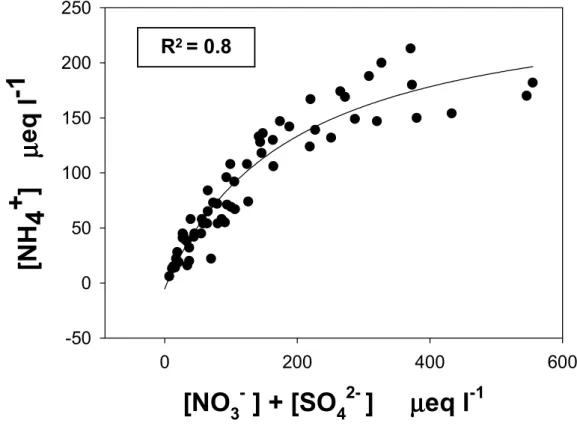
thropogenic character of air-masses (SO2−4 + NO−3) is illustrated in Fig. 2. Nitrate and sulphate are significantly correlated with NH+4 (R2=0.80), but the acidic behaviour of air masses is controlled by NO−3. The average nitrate to sulphate equivalent ratio is 1.28, and is higher than ratios obtained for cloud water samples collected at Whiteface Mountain (Khwaja et al., 1995) or at various sites in the United States (Weathers et
25
al., 1988), where the ratio ranged from 0.13 to 0.53. However, a similar ratio of 1.1 was found by L ¨oflund et al. (2002) at Mount Rax (Austria, 1400 m a.s.l.). The nitrate to sulphate ratio has been used as an indicator of the remoteness of a site by Weath-ers et al. (1988); indeed a value of 0.53 was found in the Czech Krusne Hory plateau
ACPD
4, 849–886, 2004
Cloud chemistry at the Puy de D ˆome
A. Marinoni et al. Title Page Abstract Introduction Conclusions References Tables Figures J I J I Back Close Full Screen / Esc
Print Version Interactive Discussion
© EGU 2004
(Bridges et al., 2002), 0.6 in the Vosges Mountains (Herckes et al., 2002) and 0.72 at Jungfraujoch (Baltensperger et al., 1998): the nitrate to sulphate ratio clearly in-creases with remoteness of the sampling site. This is not the case at PDD, where high nitrate fractions are associated with anthropogenic air masses. Sellegri et al. (2003a) reached similar conclusions from the aerosol composition at PDD. A ratio of 0.94 was
5
also measured by the CIME experiment during a highly polluted episode (Flossmann., 2000). The predominance of nitrate over sulphate in the acidification of aerosols has already been observed over Europe (Schaap et al., 2002), and might indicate an evo-lution of the sources of polevo-lution. The data considered from Europe are more recent than that from the USA, and may indicate both a change in emission characteristics
10
and differences in rate of emissions between Europe and the USA. 3.1.2. Organic species
Dissolved Organic Carbon (DOC) was measured on 7 samples in 2001 and 10 samples in 2002. The concentration of DOC ranges from 1.2 mg l−1to 8.9 mg l−1(15.4 mg l−1for event #14), with an average of 3.7 mg l−1. These values are similar to levels measured
15
in clouds at Mount Rax (L ¨oflund et al., 2002). The correlation between DOC and TIC is significant (R2= 0.78), although the relationship is characterized by significant scattering. Among the three major ionic species, the strongest correlation (R2= 0.86) is found with NH+4, that derives from both anthropogenic and natural emissions, the weakest correlation occurs with NO−3 (R2= 0.73). However, no significant correlation is
20
found with BC, a tracer for anthropogenic air masses; this is contrary to the findings of L ¨oflund et al. (2002) who found that an increase in BC concentrations coincided with elevated organic acid concentrations of various acids, especially during several events. On the other hand, very high levels of DOC can be found in clouds in the presence of polluted air masses, accompanied by a characteristic high TIC (up to 15 mg l−1)
25
and high levels of NCPC. These results may indicate that a fraction of the DOC is not associated with the long-range transport of anthropogenic air masses, but rather with non-urban sources that are possibly biogenic or agricultural in origin. We estimate this
ACPD
4, 849–886, 2004
Cloud chemistry at the Puy de D ˆome
A. Marinoni et al. Title Page Abstract Introduction Conclusions References Tables Figures J I J I Back Close Full Screen / Esc
Print Version Interactive Discussion
© EGU 2004
background level at the PDD to be between 2 and 3 mg l−1, and it is quite constant in all low concentrated clouds. In the case of polluted events, a further anthropogenic source of organic carbon can be superimposed on the background level. This is confirmed by a higher correlation between BC and NCPC(significantly correlated with DOC) in polluted air masses (R2=0.8 during event #14). Unfortunately, data correlating BC and DOC
5
have not been available for polluted air masses for some time.
A significant fraction of the DOC is measured with ion chromatography. Figure 3 shows that the contribution of carboxylic acids (CA) to DOC ranged from 18% to 71%, with an average of 36%. Khwaja et al. (1995) attributed 7-15% of the DOC to acetic, formic, oxalic, malonic and pyruvic acids in cloud water on Whiteface Mountain. The
10
study of Facchini et al. (2000) revealed that 37% of Water Soluble Organic Carbon (WSOC) in an urban fog sample was attributed to mono- and di- carboxylic acids. Their finding was based on the fractionation analysis of a single sample.
A large fraction of the CA are monocarboxylic acids: the mono-carboxylic acids (MCA: formic, acetic, lactic, glycolic, glyoxylic, propionic) are present in larger
con-15
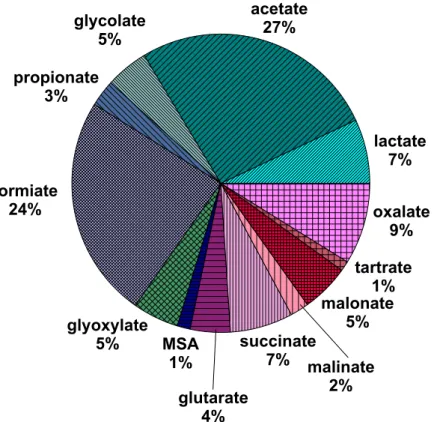
centrations (71% of the CA concentration) than the dicarboxylic acids (DCA: oxalic, glutaric, succinic, maleic, malonic and tartaric) (29% of the CA concentration). The oxalic acid (9%) is the most abundant DCA. As shown in Fig. 3, the most abundant carboxylic acids are acetic (27%) and formic (24%). This is in agreement with Chebbi and Carlier (1996) who showed that formic and acetic acids are the predominant CA in
20
the tropospheric aqueous phase.
However, the contribution of organic acids remains low compared to the contribution of major ions, varying from 2% to 25% and showing an average of 10%. This corre-sponds to concentrations ranging from 0.1 mg l−1to 5.3 mg l−1, with an average of 1.1 mg l−1and a noteworthy maximum concentration in event #14 of 11 mg l−1. The acetic,
25
formic and oxalic acid concentrations are twice those measured at PDD by Voisin et al. (2000), but in the same range as those recorded at Mount Rax (L ¨oflund et al., 2002) and Mount Sonnblick (Brantner et al., 1994; Limbeck and Puxbaum, 2000).
ACPD
4, 849–886, 2004
Cloud chemistry at the Puy de D ˆome
A. Marinoni et al. Title Page Abstract Introduction Conclusions References Tables Figures J I J I Back Close Full Screen / Esc
Print Version Interactive Discussion
© EGU 2004
the anthropogenic character of the air mass. It varies from more than 20% in samples with TIC < 15 mg l−1to less than 5% for heavily concentrated samples. The CA have pKavalues that fall within typical pH values for cloud water (acetic acid 4.75), and thus their dissolution, depending upon pH, can be reduced by low pH during polluted events. This is in contrast to the dissolution of NH3which is not pH dependent when pH values
5
are below 9 units. Although we cannot exclude, at this point, that low concentrations of CA are regulated by weaker solubilisation of CA at low pH, we propose that similarities between CA and NH+4 indicate that a large fraction of both species originates from non-urban sources. In addition, contrary to the findings of L ¨oflund et al. (2002) at Mount Rax, a good correlation (R2=0.87) between DOC and the sum of organic acids
10
is found at PDD. We can conclude that background CA levels in the continental free troposphere most likely originate from biogenic sources and they may be used as tracer components for the DOC in cloud water, and vice versa.
Several samples were taken during night-time. An interesting feature of the cloud chemistry is that the HCOO−/SO2−4 , CH3COO−/SO2−4 and C2O2−4 /SO2−4 ratios appear
15
consistently higher during the daytime than the night-time (Table 5). The daytime/night-time difference is significant at the 95% confidence level. This leads to the conclusion that a fraction of the carboxylic acids, including oxalate, are produced via photochem-ical reactions, either in the gas or liquid phase of clouds, as proposed by Chebbi and Carlier (1996).
20
3.2. Composition of clouds in the continental free troposphere
Following the approach of Sellegri et al. (2003a), we have attempted a classification of clouds on the basis of their TIC to differentiate solute chemical composition for background continental (BG), anthropogenic-influenced (ANT) and polluted conditions (SpE). We have arbitrarily set the TIC threshold for background continental conditions
25
to 15 mg l−1, based on comparisons with previous studies performed in remote con-ditions and on the shape of the frequency distribution of Fig. 1. Based on the same arguments, the TIC threshold for anthropogenic-influenced cloud composition is set to
ACPD
4, 849–886, 2004
Cloud chemistry at the Puy de D ˆome
A. Marinoni et al. Title Page Abstract Introduction Conclusions References Tables Figures J I J I Back Close Full Screen / Esc
Print Version Interactive Discussion
© EGU 2004
40 mg l−1.
Taking into account the organic fraction of dissolved material, the concentration thresholds for the different categories are:
– Background continental free troposphere: solute concentration < 18 mg l−1 – Anthropogenic-influenced : 18 mg l−1< solute concentration < 50 mg l−1
5
– Polluted : solute concentration > 50 mg l−1
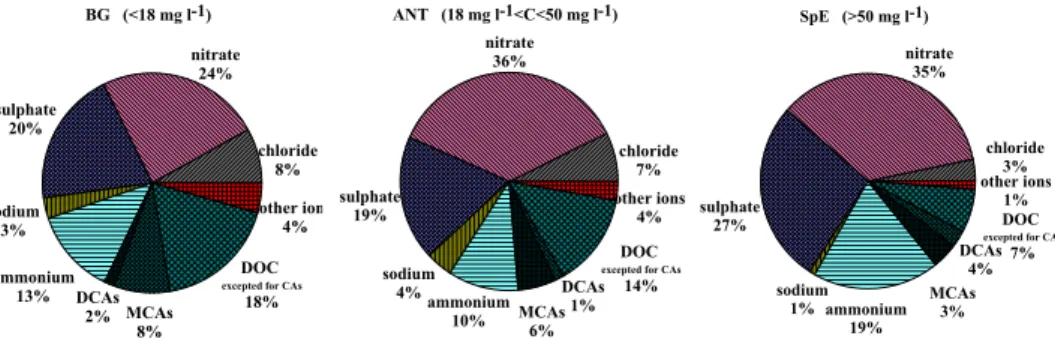
The overall composition comparison between the three cloud types leads to an average composition of cloud water for the three different air mass categories, as shown in Fig. 4.
The major difference between the three categories is due to the decrease in the
con-10
tribution of DOC to the solute concentration: 28% for background conditions, 21% for anthropogenic-influenced air masses, and 13% for polluted cases. The CA contribu-tion to DOC also decreases as the anthropogenic influence increases. Marine species (Na+ and Cl−) show the same behaviour as the organic compounds: they account for 11% in background conditions and decrease to only 4% in polluted cases. This is
par-15
alleled with an increase in the NO−3 contribution, from 24% in background conditions up to 35% for both polluted and anthropogenic influenced conditions. The high lev-els of NH+4 during polluted cases show that these events are associated with strong transport from the boundary layer where NH3emissions take place. Regardless of the conditions, the contribution of SO2−4 remains lower than that of NO−3 and never exceeds
20
20%, except for the polluted event #14 where it reached 27%. The changes in chemi-cal composition are followed by changes in cloud acidity, with a decrease in pH from a value of 5.5 during background periods to a value of 5.1 for anthropogenic-influenced cases. The pH difference between polluted episodes and anthropogenic-influenced air masses is of the order of 0.4 pH units, and is primarily due to the addition of HNO3.
25
ACPD
4, 849–886, 2004
Cloud chemistry at the Puy de D ˆome
A. Marinoni et al. Title Page Abstract Introduction Conclusions References Tables Figures J I J I Back Close Full Screen / Esc
Print Version Interactive Discussion
© EGU 2004
the pH remains fairly high (pH=5.9), suggesting the efficient neutralization of acidity by large amounts of ammonium from the gas phase.
Such chemical changes in the liquid phase chemistry of clouds are of obvious im-portance for the dissolution and reaction rates of many chemical species.
3.3. Relationship with the chemical composition of aerosol particles
5
Sellegri et al. (2003a) have proposed a classification of the different aerosol types at PDD, giving an average aerosol composition for the three air mass types through the analysis of aerosol chemistry. Here, we have compared the relative composition of clouds and aerosols for the different air mass conditions. As aerosols and clouds are not always sampled simultaneously (the time integration of aerosol samples is
10
much longer than that for clouds, and can take place during clear sky conditions), a comparison of average composition is not straightforward.
However, both classifications are performed on the basis of the ionic content of either cloud water or aerosols. We can check the consistency of the 2 classifications by converting the liquid phase concentration into an atmospheric concentration (Cloud
15
Water Load, CWL). This is simply computed using the average concentration of cloud water (LWC) as measured by the PVM probe:
[CWL]µg m−3= [TIC]mg l−1· LWCg m−3
The results of the comparison between the 2 classifications are shown in Table 6. Un-der the assumption that aerosol and cloud classes are referring to the same air masses
20
(this is verified when cloud and aerosols are sampled simultaneously), it is clear that atmospheric concentration derived from cloud water is higher than the corresponding aerosol concentration. On average, the concentration in cloud is three times higher than that observed in the aerosol phase. This can result from (i) the shorter time inte-gration for cloud sampling with respect to aerosol sampling, (ii) the limited sampling of
25
the largest and less concentrated droplets that account for a non negligible fraction of the LWC, and (iii) the significant contribution from soluble gaseous compounds.
ACPD
4, 849–886, 2004
Cloud chemistry at the Puy de D ˆome
A. Marinoni et al. Title Page Abstract Introduction Conclusions References Tables Figures J I J I Back Close Full Screen / Esc
Print Version Interactive Discussion
© EGU 2004
This last hypothesis is supported by a comparison of the average composition of cloud water and aerosol particles as shown in Fig. 5. The aerosol composition in this figure is derived from the results of Sellegri et al. (2003a). The most striking di ffer-ence between aerosol and cloud compositions concerns the much larger contribution of organic carbon to the aerosol phase. On average, OC (including non-soluble OC)
5
represents 45% of the total mass in the aerosol phase, while it accounts for just 23% in the aqueous phase. This difference is confirmed for the three air mass categories. As shown by Sellegri et al. (2003b), the OC fraction of the aerosol is not scavenged efficiently by clouds. Moreover, both aerosol and cloud phases show a decrease in OC contribution with an increase in the degree of air mass pollution.
10
Another indication of the reduced CCN properties of organic aerosols is the fact that the OC contribution in the liquid phase is dominated by carboxylic acids, accounting for 36% of DOC. However, carboxylic acids account for less than 3% of OC in the aerosol phase, which corresponds to 8% of the total solute concentration in droplets and 1.2% of the total mass in the aerosol phase.
15
Among organic acids, oxalic acid is the most abundant in the aerosol phase (22 ng m−3, 52% of total CA), followed by formic (11 ng m−3) and acetic (2 ng m−3), while formic and acetic acids are dominant in the cloud phase. Clearly, gas-phase CA con-tribute to a large fraction of the OC present in the droplets.
Similarly, marine species are more concentrated in the liquid phase (11% of the TIC)
20
than in the aerosol phase (less than 5% of ionic mass). The high correlation coefficient between Na+ and Cl−(R2=0.98) confirms the marine origin of these species, while the major difference between the 2 reservoirs may be due to the presence of dissolved HCl in droplets.
Finally, as expected for species present in both the gas and aerosol phases, the
con-25
tribution of NO−3 is higher in clouds (32%) than in aerosols (13%). An interesting feature is the fact that the contribution of gas-phase NO−3 to cloud water appears to be relatively higher for background samples than for anthropogenic samples. NO−3 cloud/NO−3 aerosol decreases gradually from 2.9 in background conditions to 1.7 in anthropogenic
sam-ACPD
4, 849–886, 2004
Cloud chemistry at the Puy de D ˆome
A. Marinoni et al. Title Page Abstract Introduction Conclusions References Tables Figures J I J I Back Close Full Screen / Esc
Print Version Interactive Discussion
© EGU 2004
ples, and to 1.0 in special events. The same trend from BG to ANT is exhibited for species that have a large gas phase fraction (NH+4 from 3 to 1.4; SO2−4 from 1.4 to 0.7; CA vary less widely from 3 in BG, 2.8 in ANT, and 2.7 in SpE), while the sum of the other ions display an inverse trend (from 1.2 in BG to 1.6 in ANT and SpE).
3.4. Relationship with cloud microphysics
5
M ¨oller et al. (1996), Elbert et al. (2000) and Kasper-Giebl et al. (2000) provided exper-imental support for early theoretical considerations concerning an inverse relationship between ionic content in cloud or fog water and the respective LWC (Junge, 1963). This does not appear to be the case in our study of cloud climatology. The cloud LWC at PDD does not show significant fluctuation, either within a single cloud event or
be-10
tween events. Overall LWC values range from 0.06 to 0.58 g m−3, with 50% of the values being in the range 0.19 to 0.32 g m−3. This variability is much less important than that measured by previous authors, who reported inverse correlation (still weak, R2=0.52 in M¨oller et al., 1996) that were driven mostly by events with very low and very high LWC.
15
The very high contribution of gas-phase species in PDD clouds limits the correlation between cloud water solute concentration and LWC that is expected from nucleation scavenging. To some degree, a weak relationship exists between total aerosol num-ber measured by CPC (NCPC) and TIC (in µeq l−1) (R2=0.30) or CWL (R2=0.52). The chemical species that drives this correlation is sulphate, displaying the highest coe
ffi-20
cient of correlation (R2=0.69). Higher NCPC leads to more, but smaller droplets, with the droplet radius being inversely proportional to the NCPC (R2=0.68).
The NCPC correlations are somewhat concordant with the findings of Elbert et al. (2000), who proposed the use of CWL, rather than TIC, as a diagnostic parameter for (i) the characterization of the local and regional degree of anthropogenic pollution,
25
and (ii) the large-scale comparison of chemical components in cloudy environments. However, the weakness of the correlations within the measured range of LWC values results in a very high uncertainty associated with estimations of CWL (or TIC) that are
ACPD
4, 849–886, 2004
Cloud chemistry at the Puy de D ˆome
A. Marinoni et al. Title Page Abstract Introduction Conclusions References Tables Figures J I J I Back Close Full Screen / Esc
Print Version Interactive Discussion
© EGU 2004
only derived from aerosol parameters.
Instead, the liquid concentration is a power function of droplet radius (Re), with a correlation of R2=0.29; among the solutes, NH+4 has the highest correlation with Re (R2=0.43), followed by NO−3 (R2=0.33) (see Fig. 6). It is interesting to note that atmo-spheric concentrations are driven particularly by aerosol particle concentration, while
5
liquid concentrations are affected by the droplet dimension due to the stronger effi-ciency of gas transfer with the higher surface-to-volume ratio. In fact, NH+4 in cloud water originates predominantly from the gas phase, while the contribution of SO2−4 is highest from aerosol particles (Sellegri et al., 2003c).
4. Conclusions
10
We have derived a climatology for the chemical composition of clouds at PDD. Three different kinds of clouds were recognized and classified in the free continental tropo-sphere: background continental (BG), anthropogenic influenced (ANT), and special events (SpE). This classification is consistent with the aerosol classification proposed by Sellegri et al. (2003a), whilst acknowledging that the Saharan events detailed in the
15
aforementioned study were not sampled during our sampling period.
– BG samples are characterized by low TIC (<15 mg l−1); these concentrations are similar to those of European altitude sites that are far from local sources of pollu-tion. The contribution of nitrate and sulphate to the TIC (44%) is relatively limited, and does not confer a strong acidic character to cloud water. The contribution of
20
Dissolved Organic Carbon to the solute concentration is surprisingly high (28%), due mostly to the presence of mono-carboxylic acids (9%). This kind of cloud is the most common during the wintertime.
– ANT samples have TIC values ranging from 15 mg l−1to 40 mg l−1; these concen-trations are slightly lower than ionic concenconcen-trations measured at mountain sites
ACPD
4, 849–886, 2004
Cloud chemistry at the Puy de D ˆome
A. Marinoni et al. Title Page Abstract Introduction Conclusions References Tables Figures J I J I Back Close Full Screen / Esc
Print Version Interactive Discussion
© EGU 2004
under the influence of medium range pollution, such as Great Dun Fell, Aubure in the Vosges Mountains, Whiteface Mountain, and in the eastern part of the United States. These samples are more acidic than BG samples, due mainly to the higher levels of nitrate (36%). The presence of high levels of nitrate is also observed in the aerosol phase (Sellegri at al., 2003a). The contribution of DOC
5
(21%) to solute concentration decreases from BG to ANT due to a decrease in the contribution of both DOC and carboxylic acids. The long-range transport of atmospheric pollutants, mostly from northern Europe, has a substantial impact on the chemistry of continental clouds.
– SpE samples are infrequent, but they are found consistently at PDD. They are
10
characterized by very high concentrations, and exhibit TIC values up to 160 mg l−1. These very high concentrations are similar to those found in the much polluted regions of the Po Valley and the Czech Krusne Hory plateau, and are unexpected for samplings from a non-industrialized area. They are characterized not only by very high contributions of nitrate and sulphate (63% overall), but also of
ammo-15
nium (19%), which keeps the pH close to ANT levels (4.5–5.5). The contribution of DOC in SpE samples is limited to 13% of the solute concentration. These find-ings may be attributed to the long-range transport of polluted air masses coupled with strong vertical mixing from the boundary layer, where NH3 emissions take place in the area of PDD.
20
Our results confirm the limited ability of organic compounds other than carboxylic acids to act as CCN. In addition, all cloud events are characterized by very high contributions from the gas phase to the liquid phase in cloud. This is evidenced by the larger con-tributions of nitrate, ammonium and mono-carboxylic acids to the solute content of cloud water relative to their contribution to the aerosol phase. The strong
contribu-25
tion of gases limits the establishment of the correlation between cloud water solute concentration and cloud microphysics (in particular LWC) that is expected from pure nucleation scavenging. This is contrary to the conclusions of M ¨oller et al. (1996),
El-ACPD
4, 849–886, 2004
Cloud chemistry at the Puy de D ˆome
A. Marinoni et al. Title Page Abstract Introduction Conclusions References Tables Figures J I J I Back Close Full Screen / Esc
Print Version Interactive Discussion
© EGU 2004
bert et al. (2000) and Kasper-Giebl et al. (2000), though these authors did consider a larger range of LWC values. Regardless, the correlations of TIC and CWL with NCPC in the present study confirm that CWL can be used (i) as a diagnostic parameter for the characterization of the local and regional degree of anthropogenic pollution, and (ii) for large-scale comparison of chemical components in cloudy environments. Such
5
a proposal is supported by the research of Elbert et al. (2000).
Acknowledgements. This work was supported by CNRS-INSU under the National Program
for Atmospheric Research (PNCA) and by the Minist `ere de la Recherche under ACI-Jeune Chercheur to PL. Authors acknowledge additional financial support from the scientific council of region Auvergne and from Observatoire de Physique du globe de Clermont-Ferrand (OPGC).
10
A. Marinoni acknowledges the financial support of Consiglio Nazionale delle Ricerche.
References
Aneja, V. P., Claiborn, C. S., Bradow, R. L., Paur, R. J., and Baumgardner, R. E.: Dynamic chemical characterisation of montain clouds, Atmos. Environ., 24A, 563–572, 1990.
Aneja, V. P.: Organic Compounds in Cloud Water and their Deposition at a Remote Continental
15
Site, Air & Waste, 43, 1239–1244, 1993.
Baltensperger, U., Schwikowski M., Jost D. T., Nyeki S., G ¨aggeler H. W., and Poulida O.: Scav-enging of atmospheric constituents in mixed phase clouds at the high-alpine site Jungfrau-joch. Part I: Basic concept and aerosol scavenging by clouds, Atmos. Environ., 32, 3975– 3983, 1998.
20
Brantner, B., Fierlinger, H., and Puxbaum, H.: Cloud water chemistry in the subcooled droplet regime at Mount Sonnblich (3106 m a.s.l., Salzburg, Austria), Water, Air and Soil Pollution, 74, 363–384, 1994.
Bridges, K. S., Jickells T. D., Davies, T. D., Zeman, Z., and Hunova I.: Aerosol, precipitation and cloud water chemistry observations on the Czech Krusne Hory plateau adjacent to a heavily
25
industrialised valley, Atmos. Environ., 36, 353–360, 2002.
Calvert, J. G., Lazrus, A. L., Kok, G. L., Heikes, B. G., Walega, J. G., Lind, J., and Cantrell, C. A.: Chemical mechanisms of acid generation in troposphere, Nature, 317, 6032, 27–35, 1986.
ACPD
4, 849–886, 2004
Cloud chemistry at the Puy de D ˆome
A. Marinoni et al. Title Page Abstract Introduction Conclusions References Tables Figures J I J I Back Close Full Screen / Esc
Print Version Interactive Discussion
© EGU 2004
Cappiello, A., De Simoni, E., Fiorucci, C., Mangani, F., Palma, P., Trufelli, H., Decesari, S., Facchini, M. C., and Fuzzi, S. : Molecular Characterization of the Water-Soluble Organic Compounds in Fogwater by ESIMS/M,. Environ. Sci. Technol., 37, 7, 1229–1240, 2003. Chameides, W. L. and Davis D. D.: Aqueous phase source of formic acid in clouds, Nature,
304, 427–429, 1983.
5
Chandler A. S., Choularton, T. W., Dollard, G. J., Gay, M. J., Hill, T. A., Jones, A., Jones B. M. R., Morse, A. P., Penkett, S. A., and Tyler, B. J.: A field study of the cloud chemistry and cloud microphysics at Great Dun Fell, Atmos. Environ., 22, 683–694, 1988a.
Chandler A. S., Choularton, T. W., Dollard G. J., Eggleton, A. E. J., Gay, M. J., Hill, T.A., Jones B. M. R., Tyler, B. A., Bandy, B. J., and Penkett, S. A.: Measurements of H2O2 and SO2 in
10
cloud and estimates of their reaction rate, Nature 336, 562–565, 1988b.
Chebbi, A. and Carlier P.: Carboxylic acids in troposphere, occurrence, sources and sinks: a review, Atmos. Environ., 23, 999–1007. 1996.
Collett, J., Oberheolzer, B., and Staehlin, J.: Cloud chemistry at Mt. Rigi, Switzerland: depen-dence on drop size and relationship to precipitation chemistry, Atmos. Environ., 27A, 33–42,
15
1993.
Collett, J., Iovinelli, R., and Demoz, B.: A three-stage cloud impactor for size resolved mea-surement of cloud drop chemistry, Atmos. Environ., 29, 10, 1145–1154, 1995.
Collett, J. L., Hoag, K. J., Rao, X., and Pandis, S. N.: Internal acid buffering in San Joaquin Valley fog drops and its influence on aerosol processing, Atmos. Environ., 33, 29, 4833–
20
4847, 1999.
Decesari, S., Facchini, M. C., Matta, E., Lettini, F., Mirccea, M., Fuzzi, S., Tagliavini, E., and Putaud, J.-P.: Chemical features and seasonal variation of fine aerosol water-soluble organic compounds in the Po Valley, Italy, Atmos. Environ., 35, 3691–3699, 2001.
Dupuy, R., Sellegri, K., and Laj, P.: Empirical relationship between aerosol number and cloud
25
microphysical properties, in Atmospheric Chemistry within the Earth System: from regional pollution to global change, 7th Conference of the IGAC Heraklion, Crete, 18–25 September 2002.
Elbert, W., Hoffmann M. R., Kr¨amer M., Schmitt, G., and Andreae M. O.: Control of solute concentrations in cloud and fog water by liquid water content, Atmos. Environ., 34, 1109–
30
1122, 2000.
Erel, Y., Pehkonen, S. O., and Hoffmann, M. R.: Redox chemistry of iron in fog and stratus clouds. J. Geophys. Res., 98, D10, 18 423–18 434, 1993.
ACPD
4, 849–886, 2004
Cloud chemistry at the Puy de D ˆome
A. Marinoni et al. Title Page Abstract Introduction Conclusions References Tables Figures J I J I Back Close Full Screen / Esc
Print Version Interactive Discussion
© EGU 2004
Facchini, M. C., Decesari, S., Mircea, M., Fuzzi, S., and Loglio, G.: Surface tension of atmo-spheric wet aerosol and cloud/fog droplets in relation to their organic carbon content and chemical composition, Atmos. Environ., 34, 4853–4857, 2000.
Flossmann, A. I.: Cloud Ice Mountain Experiment (CIME), Final report of CEE, contract ENV4-CT95-0012, Aubi `ere, France Laboratoire de M ´et ´eorologie Physique, 112, 2000.
5
Fhrer, J.: Chemistry of fogwater and estimated rates of occult deposition in an agricultural area of Central Switzerland, Agric. Ecosyst. Environ., 1986.
Fuzzi, S.: Radiation fogchemistry and microphysics, in Chemistry of Multiphase Atmospheric Systems, edited by Jaeschke, W., 213–226, Springer, Berlin, 1986.
Fuzzi, S., Orsi, G., Nardini, G., Facchini, M.C., McLaren, S., McLaren, E., and Mariotti, M.:
10
Heterogeneus processes in the Po Valley radiation fog, J. Geophys. Res., 93, D9, 11 141– 11 151, 1988.
Fuzzi, S., Facchini, M. C., Orsi, G., Lind, J. A., Wobrok, W. Kessel, M., Maser, R., Jaeschke, W., Enderle, K. H., Arends, B. G., Berner, A., Solly, I., Kruisz, C., Reischl, G., Pahl, S., Kaminski, U., Winkler, P., Ogren, J. A., Noone, K., Hallberg, A., Grieser, J., Fierlinger-Oberlinninger,
15
H., Puxbaum, H., Marzorati, A., Hansson, H. C., Wiedensohler, A., Svenningsson, I. B., Martinsson, B. G., Schell, D., and Georgii, H. W.: The Po Valley Fog Experiment 1989, an overview, Tellus, 44B, 545–555, 1992.
Fuzzi, S. and Zappoli, S.: The organic component of fog droplets, in 12th International Confer-ence on Clouds and Precipitation, 1996.
20
Fuzzi, S., Laj, P., Facchini, M. C., Ricci, L., and Berner, A.: Size-dependant chemistry of fog and cloud droplets, in First International conference on fog and fog collection, Vancouver, Canada, edited by Schemenauer R. S. and Bridgam H., 1998.
Gervat, G. P., Kallend, A. S., and Marsh, A. R. W.: Composition and origin of cloudwater solutes, in: Physico-Chemical behaviour of Atmospheric Pollutants, edited by Versino, B.
25
and Angeletti, G., Reidel, Dordrecht, 506–516, 1984.
Glotfelty, D. E., Seiber, J. N., and Liljedahl, L. A.: Pesticides in fog, Nature, 325, 602–605, 1987. Hadi, D. A., Crossley, A., and Cape, J. N.: Particulate and Dissolved Organic Carbon in cloud
water in Southern Scotland, Environ. Pollut., 88, 299–306, 1995.
Hegg, D. A. and Hobbs P. V.: Sulphate and nitrate chemistry in cumuliform clouds, Atmos.
30
Environ., 20, 901–909, 1986.
Herckes, P., Mirabel, P., and Wortham, H.: Cloud water deposition at high-elevation site in the Vosges Mountains (France), Sci. Total Environ., 296 59–75, 2002.
ACPD
4, 849–886, 2004
Cloud chemistry at the Puy de D ˆome
A. Marinoni et al. Title Page Abstract Introduction Conclusions References Tables Figures J I J I Back Close Full Screen / Esc
Print Version Interactive Discussion
© EGU 2004
Herckes, P., Hannigan, M. P., Trenary, L., Lee, T., and Collett, Jr., J. L.: The organic composition of radiation fogs in Davis (California), Atmos. Res. 64, 99–108, 2002.
Hitzenberger, R., Berner, A., Kromp, R., Kasper-Giebl, A., Limbeck A., Tscherwenka W., and Puxbaum H.: Black carbon and other species at a high-elevation European site (Mount Sonnblick, 3106 m, Austria): Concentrations and scavenging efficiencies, J. Geophys. Res.,
5
105, D20, 24 637–24 645, 2000.
Jacob, D. J.: Fogwater collector design and characterization, Environ. Sci. Technol., 18, 827– 833, 1984.
Jacob, D. J., Munger, J. W., Waldman, J. M., and Hoffmann, M. R.: The H2SO4, HNO3, NH3 system at high humidities and in fogs: I. Spatial and temporal patterns in San Joaquin Valley
10
of California, J. Geophys. Res., 91, 1073–1088, 1986.
Jacob, D. J., Shair, F. H., Waldman, J. M., Munger, J. W., and Hoffmann M. R.: Transport and oxidation of SO2in a stagnant foggy valley, Atmos. Environ., 21, 1305–1315, 1987.
Jaeschke, W.: Chemistry of Multiphase Atmospheric Systems, Springer, Berlin, 1986.
Jaffrezo, J.-L., Calas, N., and Bouchet, M.: Carboxylic acid measurements with ionic
chro-15
matography, Atmos. Environ., 32, 2705–2708, 1998.
Junge, C. E.: Air Chemistry and Radioactivity, Academic Press, New York/London, 1963. Kasper-Giebl, A., Koch, A., Heitzemberg, R., and Puxbaum H.: Scavenging efficiency of
’aerosol carbon’ and sulphate in super cooled clouds at Mount Sonnblick (3106 m a.s.l., Austria), J. Atmos. Chem., 35, 33–46, 2000.
20
Khwaja, H. A., Brudnoy, S., and Husain, L.: Chemical characterisation of three summer cloud episodes ay Witheface Mountain, Chemosphere, 31, 5, 3357–3381, 1995.
Krivacsy, Z., Kiss, G., Varga, B., Galambos, I., Sarvari, Z., Gelencser, A., Molnar, A., Fuzzi, S., Facchini, M.C., Zappoli, S., Andracchio, A., Alsberg, T., Hansson, H.-C., and Persson, L.: Study of humic-like substances in fog and interstitial aerosol by size-exclusion
chromatogra-25
phy and capillary electrophoresis, Atmos. Environ., 34, 4273–4281, 2000.
Kruisz, C., Berner, A., and Brantner, B.: A cloud water sampler for high wind speeds. Proceed-ings of the EUROTRAC Symposium 1992, edited by Borrell, P. M., 523–525, SPB Acad., The Hague, The Netherlands, 1993.
Laj, P., Fuzzi, S., Facchini, M.C., Orsi, G., Berner, A., Kruisz, C., Wobrock, W., Beswick, K.M.,
30
Gallagher, M.W., Colvile, R.N., Choularton, T.W., Nason, P., and Jones, B.: Experimental evidences for in-cloud production of aerosol sulphate, Atmos. Environ., 31, 16, 2503–2514, 1997a.
ACPD
4, 849–886, 2004
Cloud chemistry at the Puy de D ˆome
A. Marinoni et al. Title Page Abstract Introduction Conclusions References Tables Figures J I J I Back Close Full Screen / Esc
Print Version Interactive Discussion
© EGU 2004
Laj, P., Fuzzi, S., Facchini, Lind, J. A., Orsi, G., Preiss, M., Maser, R., Jaeschke, W., Seyffer, E., Arends, B. G., M ¨olls, J. J., Acker, K., Wieprecht, W., M ¨oller, D., Colville, R. N., Gallagher, M. W., Beswick, K. M., Hargreaves, K. J., Storeton-West, R. L., and Sutton, M. A.: Cloud processing of soluble gas, Atmos. Environ., 31, 2589–2592, 1997b.
Laj, P., Flossman, A. I., Wobrock, W., Fuzzi, S., Orsi, G., Ricci, L., Mertes, S., Swarzenbock,
5
A., Heitzenberg, J., and Ten Brink, H.: Behaviour of H2O2, NH3, and black carbon in mixed-phase clouds during CIME, Atmos Res., 58, 315–336, 2001.
Lanquette, A.-M., Pichon, J.-M., and Pointin, Y.: Physical-chemistry data of the Puy de D ˆome top station,http://www.obs.univ-bpclermont.fr/observ/chimie/pdd listedata.html, 2002. Lawrence, M. G. and Crutzen P. J.: The impact of cloud particle gravitational settling on soluble
10
trace gas distribution, Tellus, 50B, 3, 263–289,1998.
Lelieveld, J. and Crutzen, P. J.: The role of clouds in tropospheric photochemistry, J. Atmos. Chem., 12, 229–267, 1991.
Liang, J. and Jacobson, M. Z.: A study of sulphur oxidation pathways over a range of liquid water contents, pH values and temperature, J. Geophys. Res., 104, 13 749–13 769, 1999.
15
Limbeck, A. and Puxbaum, H.: Dependence of in-cloud scavenging of polar organic aerosol compounds on the water solubility, J. Geophys. Res., 105, 19 857–19 867, 2000.
L ¨oflund, M., Kasper-Giebl, A., Schuster, B., Giebl, H., Heitzemberg, R., and Puxbaum, H.: Formic, Acetic, Oxalic, Malonic and Succinic Acid Concentrations and their Contribution to Organic Carbon in Cloud Water, Atmos. Environ., 36, 9, 1553–1558, 2002.
20
Mertes, S., Schwarzenbck, A., Laj, P., Wobrock, W., Pichon, J. M., Orsi, G., and Heintzen-berg, J.: Changes of cloud microphysical properties during the transition from supercooled to mixed-phase conditions during CIME, Atmos. Res., 58, 4, 267–294, 2001.
M ¨oller D., Acker, K., and Wieprecht, W.: A relationship between liquid water content and chem-ical composition in clouds, Atmos. Res., 41, 321–335, 1996.
25
Munger, J. W., Jacob, D. J., Waldman, J. M., and Hoffmann, M. R.: Fogwater chemistry in a urban atmosphere, J. Geophys. Res., 88: 5109–5121, 1983.
Novakov, T. and Penner, J. E.: Large Contribution of Organic Aerosols to Cloud- Condensation-Nuclei Concentrations, Nature, 365, 823–826, 1993.
Pili ´e, R. J., Mack, E. J., Koemond, W. C., Eadie, W. J., and Rogers, C. W.: The life cycles of
30
valley fog, Part II: Fog microphysics, J. Appl. Meteorol., 14, 364–374, 1975.
Poulida, O., Schwikowski, M., Baltensperger, U., Staehelin, J., and Gaeggeler, H. W.: Scaveng-ing of atmospheric constituents in mixed phase clouds at the high alpine site
Jungfraujoch-ACPD
4, 849–886, 2004
Cloud chemistry at the Puy de D ˆome
A. Marinoni et al. Title Page Abstract Introduction Conclusions References Tables Figures J I J I Back Close Full Screen / Esc
Print Version Interactive Discussion
© EGU 2004
Part II: influence of riming on the scavenging of particulate and gaseous chemical species, Atmos. Environ., 32, 23, 3985–4000, 1998.
Pruppacher, H. R. and Jaenicke, R.: The processing of water vapour and aerosols by atmo-spheric clouds, a global estimate, Atmos. Res., 38, 283–295, 1995.
Schaap, M., M ¨uller, K., and Ten Brink, H. M.: Constructing the European aerosol nitrate
con-5
centration field from quality analysed data, Atmos. Environ., 36, 8, 1323–1335, 2002. Sellegri, K., Laj, P., Peron, F., Dupuy, R., Legrand, M., Preunkert, S., Putaud, J.-P., Cachier, H.,
and Ghermandi, G.: Mass balance of free tropospheric aerosol at the Puy de D ˆome (France) in winter, J. Geophys. Res., 108, D11, 4333, AAC2-1–AAC2-17, 2003a.
Sellegri, K., Laj, P., Dupuy, R., Legrand, M., Preunkert, S., and Putaud, J.-P.: Size-dependent
10
scavenging efficiencies of multi-component atmospheric aerosols in clouds, J. Geophys. Res., 108, D11, 4334, AAC3-1–AAC3–15, 2003b.
Sellegri, K., Laj, P., Marinoni, A., Dupuy, R., Legrand, M., and Preunkert, S.: Contribution of gaseous and particulate species to droplet solute composition and concentration, Atmos. Chem. Phys., 3, 479–519, 2003c.
15
Voisin, D., Legrand, M., and Chaumerliac, N.: Scavenging of acidic gases (HCOOH, CH3COOH, HNO3, HCl, and SO2) and ammonia in mixed liquid-solid water clouds at the Puy de D ˆome mountain, J. Geophys. Res., 105, D5, 6817–6836, 2000.
Warneck, P.: The equilibrium distribution if atmospheric gases between the two phases of liquid water clouds, in Chemistry of the Multiphasic Atmospheric Systems, NATO ASI Series, Vol.
20
G6, edited by Jaeschke Springer, Berlin, 1986.
Weathers, K. C., Likens, G. E., Bormann, F. H., Bicknell, S. H., Bormann, B. T., Daube, B. C., Eaton, J. S., Galloway, J. N., Keene, W. C., Kimball, K. D., McDowell, W. H., Siccama, T. G., Smiley, D., and Tarrant, R. A.: Cloudwater Chemistry from Ten Sites in North America, Environ. Sci. Technol., 22, 1018–1026, 1988.
25
Wobrock, W., Schell, D., Maser, R., Jaeschke, W., Georgii, H.-W., Wieprecht, W., Arends, B. G., M ¨ols, J. J., Kos, G. P. A., Fuzzi, S., Facchini, M. C., Orsi, G., Berner, A., Solly, I., Kruisz, C., Svenningsson, I. B., Wiedensohler, A., Hansson, H.-C., Ogren, J. A., Noone, K. J., Hallberg, A., Pahl, S., Schneider, T., Winkler, P., Winiwarter, W., Colvile, R. N., Choularton, T. W., Flossmann, A. I., and Borrmann, S.: The Kleiner Feldberg Cloud Experiment 1990, An
30
ACPD
4, 849–886, 2004
Cloud chemistry at the Puy de D ˆome
A. Marinoni et al. Title Page Abstract Introduction Conclusions References Tables Figures J I J I Back Close Full Screen / Esc
Print Version Interactive Discussion
© EGU 2004
Table 1. Cloud events sampled at PDD during winter 2001 and winter-spring 2002.
Event Start End Number of samples
1 08 February 2001 09 February 2001 6 2 12 February 2001 14 February 2001 9 3 17 February 2001 18 February 2001 11 4 22 February 2001 24 February 2001 18 5 28 February 2001 01 March 2001 13 6 02 March 2001 03 March 2001 8 7 08 March 2001 08 March 2001 2 8 05 April 2001 06 April 2001 1 9 14 February 2002 15 February 2002 1 10 22 February 2002 22 February 2002 1 11 27 February 2002 27 February 2002 1 12 28 February 2002 28 February 2002 1 13 07 March 2002 07 March 2002 1 14 13 April 2002 14 April 2002 3 15 03 May 2002 05 May 2002 1 16 11 May 2002 12 May 2002 1
ACPD
4, 849–886, 2004
Cloud chemistry at the Puy de D ˆome
A. Marinoni et al. Title Page Abstract Introduction Conclusions References Tables Figures J I J I Back Close Full Screen / Esc
Print Version Interactive Discussion
© EGU 2004
Table 2. Aerosol samples at PDD during winter 2001 and winter-spring 2002.
Sample Start End Volume (m3)
1 12 February 2001 14 February 2001 14.9 2 17 February 2001 18 February 2001 18.3 3 22 February 2001 23 February 2001 18.2 4 23 February 2001 24 February 2001 7.1 5 28 February 2001 01 March 2001 20.3 6 14 February 2002 22 February 2002 157 7 22 February 2002 01 March 2002 124 8 01 March 2002 07 March 2002 123 9 07 March 2002 14 March 2002 139 10 14 March 2002 22 March 2002 138 11 04 April 2002 11 April 2002 287 12 11 April 2002 19 April 2002 310 13 19 April 2002 25 April 2002 307 14 25 April 2002 02 May 2002 365 15 02 May 2002 09 May 2002 318 16 09 May 2002 16 May 2002 317
ACPD
4, 849–886, 2004
Cloud chemistry at the Puy de D ˆome
A. Marinoni et al. Title Page Abstract Introduction Conclusions References Tables Figures J I J I Back Close Full Screen / Esc
Print Version Interactive Discussion
© EGU 2004
Table 3. Minimum, 25 percentile, average, 75 percentile, and maximum of the chemical,
phys-ical and microphysphys-ical parameters measured at PDD station.
MINIMUM 25◦centile AVERAGE 75◦centile MAXIMUM No. samples
Fluorure (µg l−1) 2 6 9 9 31 15 Lactate (µg l−1) 20 59 129 156 514 15 Acetate (µg l−1) 37 186 494 591 2873 78 Glycolate (µg l−1) <DL 26 86 102 753 78 Propionate (µg l−1) <DL 18 54 53 600 78 Formate (µg l−1) 37 151 447 464 3213 78 Glyoxylate (µg l−1) <DL 3.6 93 24 638 15 MSA (µg l−1) <DL 9.0 26 34 133 68 Chloride (µg l−1) 17 232 2108 1497 69 088 78 Nitrite (µg l−1) 1 11 28 44 128 78 Nitrate (µg l−1) 209 1375 6416 7457 47 539 78 Glutarate (µg l−1) 7 16 81 63 337 15 Succinate (µg l−1) 7 24 127 122 473 15 Maleate (µg l−1) <DL 6 37 36 180 15 Malonate (µg l−1) <DL 17 97 113 405 15 Tartrate (µg l−1) <DL 2 20 15 122 15 Sulphate (µg l−1) 187 1107 4083 4863 35 499 78 Oxalate (µg l−1) 8 65 164 164 1529 78 Sodium (µg l−1) <DL 115 659 691 6447 78 Ammonium (µg l−1) 113 853 2652 2676 32 413 78 Potassium (µg l−1) 5 51 176 142 4847 78 Magnesium (µg l−1) 5 24 140 151 1109 78 Calcium (µg l−1) 12 66 292 254 2994 78 DOC (µg l−1) 1200 2100 5784 7680 15 460 17 pH (pH units) 3.90 4.99 5.29 5.67 7.00 32 T (◦C) −5.96 −5.17 −2.02 −0.59 8.90 73 LWC (g m−3) 0.06 0.19 0.27 0.32 0.58 68 NCPC(# cm −3 ) 409 649 1387 1602 4193 40 Re (µm) 0.9 3.3 3.9 4.5 7.0 68
ACPD
4, 849–886, 2004
Cloud chemistry at the Puy de D ˆome
A. Marinoni et al. Title Page Abstract Introduction Conclusions References Tables Figures J I J I Back Close Full Screen / Esc
Print Version Interactive Discussion
© EGU 2004
Table 4. Correlation matrix of chemical, physical and microphysical parameters of cloud at
PDD station; the most significant correlations (R2>0.7) are indicating in bold character.
Cl− NO−2 NO−3 SO2−4 Na+ NH4+ K+ Mg2+ Ca2+ OA DOC LWC NCPC Reff BC TIC Cl− 1.00 NO−2 0.75 1.00 NO−3 0.69 0.86 1.00 SO2−4 0.81 0.59 0.78 1.00 Na+ 0.98 0.55 0.52 0.79 1.00 NH+4 0.70 0.60 0.84 0.85 0.68 1.00 K+ 0.61 0.60 0.62 0.53 0.48 0.48 1.00 Mg2+ 0.40 0.16 0.50 0.73 0.47 0.73 0.28 1.00 Ca2+ 0.28 0.11 0.51 0.63 0.32 0.77 0.31 0.83 1.00 OA 0.04 0.24 0.20 0.23 0.23 0.55 0.33 0.11 0.30 1.00 DOC 0.03 0.00 0.73 0.81 0.07 0.86 0.06 0.07 0.41 0.87 1.00 LWC 0.26 0.02 0.14 0.27 0.30 0.18 0.09 0.07 0.22 0.08 0.05 1.00 NCPC 0.62 0.52 0.70 0.69 0.55 0.70 0.48 0.44 0.61 0.48 0.37 0.10 1.00 Reff 0.49 0.23 0.33 0.53 0.56 0.43 0.12 0.22 0.18 0.32 0.61 0.02 0.68 1.00 BC 0.01 0.05 0.32 0.36 0.03 0.06 0.01 0.09 0.01 0.03 0.08 0.13 0.50 n.d. 1.00 TIC 0.19 0.48 0.73 0.77 0.35 0.76 0.37 0.02 0.10 0.35 0.78 0.09 0.66 0.29 0.25 1.00