HAL Id: hal-00317832
https://hal.archives-ouvertes.fr/hal-00317832
Submitted on 28 Jul 2005
HAL is a multi-disciplinary open access
archive for the deposit and dissemination of
sci-entific research documents, whether they are
pub-lished or not. The documents may come from
teaching and research institutions in France or
L’archive ouverte pluridisciplinaire HAL, est
destinée au dépôt et à la diffusion de documents
scientifiques de niveau recherche, publiés ou non,
émanant des établissements d’enseignement et de
recherche français ou étrangers, des laboratoires
of the omega bands/Ps6 pulsations and an auroral torch
in the late morning hours: a case study
V. Safargaleev, T. Sergienko, Hans Nilsson, A. Kozlovsky, S. Massetti, S.
Osipenko, A. Kotikov
To cite this version:
V. Safargaleev, T. Sergienko, Hans Nilsson, A. Kozlovsky, S. Massetti, et al.. Combined optical,
EISCAT and magnetic observations of the omega bands/Ps6 pulsations and an auroral torch in the
late morning hours: a case study. Annales Geophysicae, European Geosciences Union, 2005, 23 (5),
pp.1821-1838. �hal-00317832�
SRef-ID: 1432-0576/ag/2005-23-1821 © European Geosciences Union 2005
Annales
Geophysicae
Combined optical, EISCAT and magnetic observations of the omega
bands/Ps6 pulsations and an auroral torch in the late morning
hours: a case study
V. Safargaleev1,2, T. Sergienko2, H. Nilsson2, A. Kozlovsky3,4, S. Massetti5, S. Osipenko1, and A. Kotikov6
1Polar Geophysical Institute, Apatity, 184200, Russia
2Swedish Institute of Space Physics, S-981 28, Kiruna, Sweden
3Department of Physical Science, University of Oulu, Oulu, FIN-90014, Finland 4Sodankyl¨a Geophysical Observatory, Sodankyl¨a, FIN-99600, Finland
5Instituto di Fisica dello Spazio Interplanetario, 00133, Rome, Italy
6Institute of Physics, St.Petersburg State University, St. Petersburg, 198504, Russia
Received: 15 September 2004 – Revised: 24 March 2005 – Accepted: 5 April 2005 – Published: 28 July 2005
Abstract. We present here the results of multi-instrument observations of auroral torch and Ps6 magnetic pulsations, which are assumed to be the magnetic signature of the spa-tially periodic optical auroras known as omega bands. Data from TV and ASC cameras in Barentsburg and Ny ˚Alesund, EISCAT radars in Longyearbyen and Tromsø, as well as IMAGE network were used in this study. The auroral phe-nomenon which was considered differed from that previously discussed, as it occurred both in an unusual place (high lati-tudes) and at an unusual time (late morning hours). We show that this might occur due to specific conditions in the inter-planetary medium, causing the appropriate deformation of the magnetosphere. In such a case, the IMF turned out to be an additional factor in driving the regime of Ps6/omega bands, namely, only by acting together could a substorm on-set in the night sector and Bzvariations result in their
gen-eration. Since the presumable source of Ps6/omega bands does not co-locate with convection reversal boundaries, we suggest the interpretation of the phenomena in the frame of the interchange instability instead of the Kelvin-Helmholtz instability that is widely discussed in the literature in con-nection with omega auroras. Some numerical characteristics of the auroral torch were obtained. We also emphasize to the dark hole in the background luminosity and the short-lived azimuthally-restricted auroral arc, since their appear-ance could initiate the auroral torch development.
Keywords. Magnetospheric physics (Auroral phenomena; Plasma convection; Solar wind-magnetosphere interaction)
Correspondence to: V. Safargaleev
1 Introduction
Among others, one remarkable auroral form allowing the in-vestigation of magnetospheric phenomena via the visible fea-tures is the large-scale (up to 1000 km in azimuthal direction) luminosity undulations of the poleward boundary of diffuse auroras first described by Akasofu and Kimball (1964) and named “omega bands” due to their similarity with an inverted (open to the pole) Greek letter . In contrast to auroral arcs, which are indeed the predominant form of auroras, the omega bands are rather rare observational phenomena, probably due to the small extension in the NS direction that creates a diffi-culty for a ground observer to distinguish them on the all-sky images from a dished auroral arc. For this reason relatively little attention has been paid to omega bands and only a lim-ited number of publications devoted to this kind of auroral activity can be found. So the main morphological features of the -bands do not seem to be well established, nor has a complete understanding of their nature been achieved. To prove this, we review briefly the main results of the past stud-ies, emphasizing the differences introduced by the more re-cent investigations.
Using the DMSP-2 photographs, Akasofu (1974) found that the poleward boundary of diffuse auroras tends to de-velop a well-defined wavy structure (i.e. omega bands) most often in the morning sector and sometimes in the midnight sector. Recently, several cases of similar optical phenomena have also been reported in the evening sector (Solovyev et al., 1999).
The -band formation was connected traditionally with the preceding substorm activity (Akasofu, 1974), namely the substorm recovery phase (Opgenoorth et al., 1994). However several cases have been presented showing that these auro-ras seem to be a typical feature of steady magnetospheric
convection events (see Solovyev et al., 1999 and references therein).
A sequence of localized field-aligned currents with alter-nating directions can be associated with the omega bands. These currents in combination with ionospheric currents form a stationary (in time) current system that travels in the azimuthal direction, creating magnetic pulsations on the ground (Kawasaki and Rostoker, 1979) which were reported earlier by Saito (1978) as a subclass of Pi3 pulsations. These pulsations, nominated as Ps6, occurred predominantly in the declination among the three components and had periods of 5–40 min. Saito pointed out the possible connection between the Ps6 and some kinds of spatially periodic auroral forms: substorm surges, auroral arc loops and -bands observed in the same local time sector as the Ps6. However, he could not present a simultaneous observation of both (optical and magnetic) phenomena. Later, on the basis of results obtained with simultaneous multi-instrument observations, Andr´e and Baumjohann (1982), Opgenoorth et al. (1983), and Steen et al. (1988) showed that the -bands and the positive spikes in the D- or Y-component (Ps6 pulsations) may be regarded as the same phenomenon seen by different instruments. This led some investigators to identify -bands by means of ground-based magnetometer data, even when optical images were not available (L¨uhr and Schlegel, 1994; Jorgensen et al., 1999; Wild et al., 2000) or have too a low spatial resolu-tion as a result of being taken from high altitudes (Connors and Rostoker, 1993). In accordance with early results, one of the morphological features of the Ps6 is their association with magnetospheric substorms (Saito, 1978). Connors et al. (2003) recently claimed that Ps6 disturbances should not be viewed primarily as phenomena related to the substorm recovery phase. In general, this finding hinders the use of the Ps6 as a tool for omega band diagnostics, which are predom-inantly the recovery phase phenomena.
Signatures of omega bands have also been identified in the magnetosphere. Steen et al. (1988) discussed a modu-lation of the high-energy particle intensity at the geostation-ary orbit as a magnetosphere signature of omega bands. Us-ing one of the Tsyganenko magnetic field models, Tagirov (1993) has shown that the auroral torches are magnetically linked to the equatorial plane of the magnetosphere to a dis-tance of 5–6 RE, which is consistent with the result derived
by Steen et al. (1988). Jorgensen et al. (1999) also concluded that omega bands are the electrodynamic signature of a corru-gated inner edge of a current sheet in the near-Earth (geosta-tionary) magnetosphere. A different location of the -band and source in the magnetosphere was reported by Pulkkinen et al. (1991). Using the Tsyganenko model, they showed that the omega bands and Ps6 events are mapped to the current sheet region between 6 and 13 RE.
Akasofu (1974) suggested that in very active situations
usually observed to drift eastward at a velocity of 0.4–2 km/s (Opgenoorth et al., 1983; Steen et al., 1988), retaining their shape for several minutes. Oguti et al. (1981) showed that torches may have a spatial structure consisting of a nonpul-sating periphery and a pulnonpul-sating core. By comparing simul-taneous photographs of auroras from two stations, Opgen-hoorth et al. (1983) has found the altitude of the torch to be 100 km. In accordance with Tagirov (1993), the altitude of the poleward boundary of nonpulsating periphery of the torch is less than 100 km, which indicates that it is formed by particles with a characteristic energy of more than 10 keV.
For lack of observational results, at present there is no commonly accepted understanding of the formation mech-anism of omega bands, as well as the torch-like structures. At least three kinds of plasma instabilities are discussed as a candidate magnetospheric generator of the spatial lumi-nosity undulations in the ionosphere. Rostoker and Sam-son (1984) suggested that the Kelvin-Helmholtz instability (KHI) leads to generation of omega bands. The instability should develop at the boundary between the boundary layer plasma sheet and the central plasma sheet where a flow shear took place. Yamamoto et al. (1997 and references therein) connected the -band and the torch formation with an in-stability quite similar to the Rayleigh-Taylor (“interchange”) instability developing on the outer boundary of hot plasma torus. This boundary was assumed to appear during the sub-storm recovery phase. The instability of the magnetosphere-ionosphere system, which also resulted in the omega-like structures, was discussed theoretically by Lyatsky and Malt-sev (1984) (see also Tagirov, 1993), while numerical model-ing was performed by Janhunen and Huuskonen (1993). Also worth mentioning is a mechanism described by Jorgensen et al. (1999), who assumed that the waves excited on the inner edge of the current sheet are responsible for optical omega-band generation via the production of the field-aligned elec-tric fields causing spatially-periodic electron precipitations.
In this paper we discuss a case of coordinated EISCAT and TV observations of an auroral torch formation. Since the torch was observed in the late morning sector (∼09:00 MLT) and at high latitudes (∼75◦corrected geomagnetic latitude, CGMLAT), which is non-typical for such auroras, one of the aims of this paper was to extend the statistics on the mor-phology and dynamics of omega auroras. Unfortunately, the bad weather conditions southward of the observational point prevented a detailed study of the omega band from which the torch originated, and we had to limit ourselves to a de-tailed analysis of the torch itself, namely by combining the optical and radar measurements, we tried to understand the reasons which cause the poleward stretching of one of the bright -band and tongues.
30
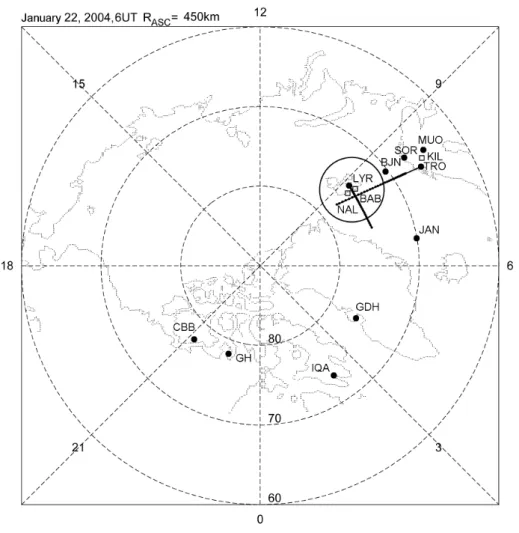
Fig.1. Location of observational points. Black circles indicate magnetic observatories, open
squares show the location of optical instruments, large circle is the BAB TV camera filed
of view, the EISCAT Svalbard and the EISCAT UHF beams are shown with bold lines.
Fig. 1. Location of observational points. Black circles indicate magnetic observatories, open squares show the location of optical instruments, large circle is the BAB TV camera field of view, the EISCAT Svalbard and the EISCAT UHF beams are shown with bold lines.
Oulu (Finland), in cooperation with the Polar Geophysical Institute (PGI, Russia) on 19–27 January 2004 in the Spits-bergen archipelago. The aim of the campaign was to inves-tigate the dynamics of dayside auroras through coordinated radar and optical measurements.
The ionospheric plasma flow was monitored by the EISCAT Svalbard radar (the ESR) located near Longyear-byen (LYR) and the mainland EISCAT UHF radar located close to the city of Tromsø (TRO). The ESR radar system consists of two antennas; the 32-m steerable dish which can be pointed in any direction and the 42-m dish which is fixed along the magnetic field-line direction. The ESR-32-m an-tenna was pointed west at a 45◦elevation, which allowed us
to measure the ionospheric plasma flow along the east-west direction in the F-region (above 200 km). The mainland UHF radar was pointed the north at a low elevation (20◦), which al-lowed for observations of the north-south ionospheric plasma flow along the geomagnetic meridian. At the latitude of the Svalbard site, the UHF radar was measuring at heights of the order of 400 km. The key optical instrument of this study was the TV camera from the Polar Geophysical Institute (Rus-sia) installed ∼40 km west of the Svalbard radar site, at the
village of Barentsburg (BAB). This camera provided high-resolution optical measurements of auroras in white light. The field of view of this camera is shown in Fig. 1 by a circle while the two solid lines indicate the Svalbard and Tromsø radar beams.
For monitoring the auroral activity both poleward and equatorward of Barentsburg, the data of the ASC cameras of the Finnish Meteorological Institute (Finland) running at Kilpisjarvi (KIL) and of the Istituto di Fisica dello Spazio Interplanetario (Italy) running at Ny ˚Alesund (NAL) were also used. Several appropriately located magnetic observa-tories of the International Real-time Magnetic Observatory Network (INTERMAGNET) and the Magnetometer Array for Cusp and Cleft Studies (MACCS) supplied the informa-tion about substorm activity in the night sector (west–east chain). The meridional distribution of Ps6 pulsations was in-ferred from the northern part of the IMAGE network (north– south chain). The standard set of IMAGE stations (NUR– NAL chain) was used to reconstruct the meridional distribu-tion of ionospheric equivalent currents. Geographic and ge-omagnetic coordinates of the observatories, as well as MLT midnight, are presented in Table 1. In Fig. 1 the magnetic
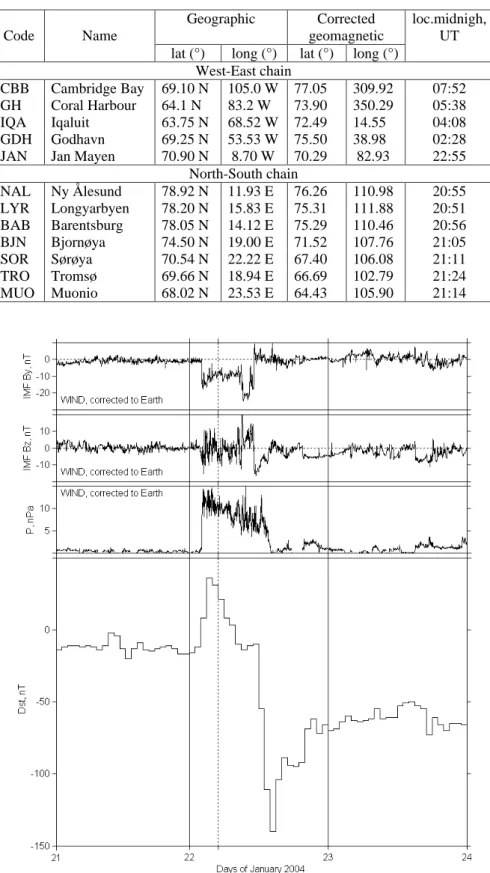
Table 1. List of observatories.
1 Table 1. List of observatories
Geographic Corrected geomagnetic
Code Name
lat (°) long (°) lat (°) long (°)
loc.midnigh, UT West-East chain CBB Cambridge Bay 69.10 N 105.0 W 77.05 309.92 07:52 GH Coral Harbour 64.1 N 83.2 W 73.90 350.29 05:38 IQA Iqaluit 63.75 N 68.52 W 72.49 14.55 04:08 GDH Godhavn 69.25 N 53.53 W 75.50 38.98 02:28 JAN Jan Mayen 70.90 N 8.70 W 70.29 82.93 22:55
North-South chain NAL Ny Ålesund 78.92 N 11.93 E 76.26 110.98 20:55 LYR Longyarbyen 78.20 N 15.83 E 75.31 111.88 20:51 BAB Barentsburg 78.05 N 14.12 E 75.29 110.46 20:56 BJN Bjornøya 74.50 N 19.00 E 71.52 107.76 21:05 SOR Sørøya 70.54 N 22.22 E 67.40 106.08 21:11 TRO Tromsø 69.66 N 18.94 E 66.69 102.79 21:24 MUO Muonio 68.02 N 23.53 E 64.43 105.90 21:14
Fig.2. The signatures of the magnetic cloud in space (three top plots) and on the ground.
The time of torch observation is indicated with a vertical dashed line.
Fig. 2. The signatures of the magnetic cloud in space (three top plots) and on the ground. The time of torch observation is indicated with a vertical dashed line at 06:03 UT.
stations of both W–E and N–S chains are shown with black circles, while open squares indicate the position of the opti-cal instruments. The data on the interplanetary medium were taken from the WIND satellite.
3 Development of omega auroras and an auroral torch on 22 January 2004
3.1 Geomagnetic background
On 22 January 2004 a magnetic cloud passed by the Earth and initiated a magnetic storm of about 150-nT intensity as measured by the Dst index (Fig. 2). The leading front of
the cloud reached the Earth at ∼01:37 UT, indicated by a step-like increase of the magnetic horizontal component at the low-latitude station Kakioka (sudden impulse, SI). Thirty minutes later a sudden increase in the solar wind dynamic pressure of about ∼10 nPa was detected by the WIND satel-lite probing the solar wind at the evening flank of the dis-tant magnetotail (x=–210 RE, y=42 RE, z=4 RE). This time
delay is ∼8 min less than the expected propagation time of the solar wind irregularity estimated as 1t =x/VSW, where
VSW=630 km/s is the x-component of solar wind velocity and
xis the distance between the satellite and the subsolar point on the magnetopause. Therefore, the WIND data presented in the paper have been shifted by 35 min in time.
The magnetosphere compression was accompanied by a positive Dst variation and a large value of the planetary Kp
index (Kp=5). The torch was observed four hours after the
Dst enhancement and six hours before the Dst negative bay
(magnetic storm). In Fig. 2 this time is indicated with a ver-tical dashed line. This would imply that neither the SI nor the magnetic storm onset might be regarded as an immediate “trigger” of the auroral torch.
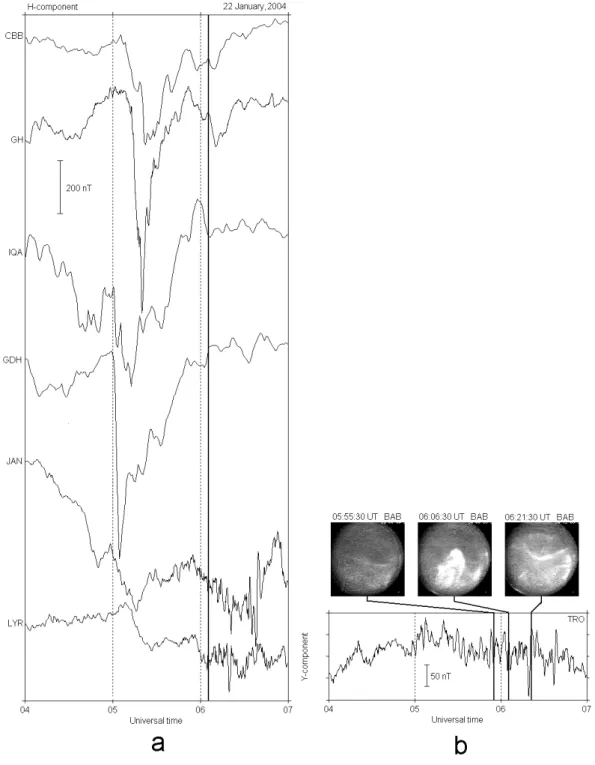
As might be inferred from INTERMAGNET and MACCS magnetic data, at least two substorms took place in the night sector in response to the magnetic cloud pass. The onset clos-est to the moment of interclos-est started near 05:00 UT. The vari-ations in the magnetic H-component at observatories located approximately along the CGMLAT of the BAB are shown in Fig. 3a, with the most westward one at the top. The onset sig-nature (negative H-bay) has its largest magnitude at GH and GDH stations located poleward of IQA and JAN. This fact, as well as the time delay between the bay onset at the GH and LYR with respect to GDH, indicates that the substorm current wedge developed from the distant magnetotail in the post-midnight-early morning sector. One more negative bay was also seen at lower latitudes (IQA and JAN) ten minutes before the onset, which on the high latitude stations (GDH and GH) looked like the signature of a substorm preliminary phase. The onset near 05:00 UT was accompanied by the Ps6 disturbances in the late morning sector, as observed by the IMAGE network. Figure 3b emphasizes this by plotting the perturbations in the Y-component from the TRO observa-tory. The torch was observed at the end of the recovery phase (vertical solid line in Fig. 3a).
As we are dealing with the dayside phenomenon, gener-ally well correlated to the incoming solar wind conditions, it would also be reasonable to try to associate the auroral torch with the interplanetary parameters. Trondsen et al. (1999) reported that strong undulations in the poleward boundary of the dayside part of the auroral oval may take place if the IMFBycomponent is largely positive. However, the IMF By
component was large and negative during our event. There were several northward turnings of the IMF Bz component
during a 30-min interval preceding the torch observation. The possible role of those variations on the omega bands gen-eration will be discussed in Sects. 3.3.1 and 4.2.
3.2 Optical observations
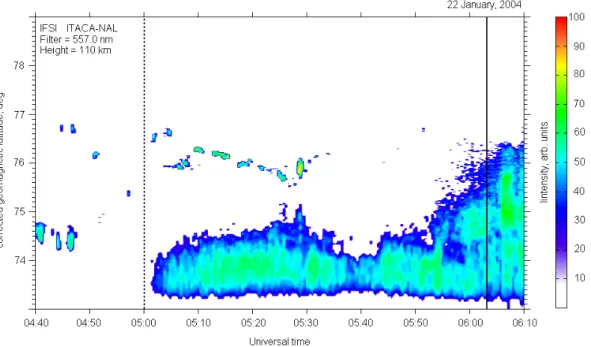
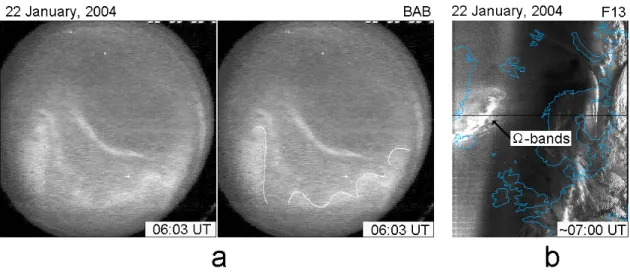
On 22 January 2004 the TV observation at BAB started at 05:30 UT. So, for monitoring of the auroral activity we used data from a digital all-sky camera (NAL) running ∼100 km north of Svalbard EISCAT site. The aurora dynamics for the 1.5-h interval preceding the torch formation are presented in Fig. 4 in the form of keograms and, in general, might be de-scribed as follows. Ten minutes before the substorm onset no significant auroras were seen in green emission. A few min-utes after onset two kinds of green auroras appeared in the ASC field of view. The first was characterised by bright mul-tiple arcs near zenith. These arcs might be identified with “Sun-aligned” arcs (Shiokawa et al., 1997), which are as-sumed to be the azimuthal extension to the dawn of the sub-storm nightside auroras (Safargaleev et al., 2003). The sec-ond was the wide band of rather faint multiple diffuse arcs (as was inferred later from the BAB TV data), the appearance of which on the southern horizon near 05:03 UT coincided with the beginning of a negative H-bay at GDH. At 05:55 UT the intensity of the auroras started to increase in the southern half of the BAB TV camera’s field of view, except for a small area south-west of the BAB zenith, and the wave-like structures (the -bands) became discernible on the southern horizon at 06:01:50 UT. Approximately 2 min later the formation of the auroral torch began. In Fig. 5 we present a sequence of TV images showing the west-east propagation of the torch. The second (from the top) series illustrates the presence of a core of the torch whose intensity varies in time. The TV registra-tion allowed for the estimaregistra-tion of a quasi-period of core pul-sation as a few tens of seconds. Such spatial structure (pul-sating core and non-pul(pul-sating periphery) is one of the charac-teristics of this kind of aurora (Oguti et al., 1981). After the torch passage the rayed multiple arcs appeared to be shifted poleward of the BAB zenith (bottom series of images). Be-low we describe the auroral activity around the torch forma-tion in more detail, pointing out the more important features. We suggest that the omega bands were developed between Bear Island (BJN) and the Scandinavia peninsula. In the BAB TV data, shown in Fig. 6a, the omega bands are seen as wave-like structures on the southern horizon. For better visu-alization of the structures, we emphasized their border with a thin white curve (image on the right). Although the clouds above northern Scandinavia hindered the observations of the
Fig.3 (a) Substorm activity in the night
side. Vertical bold line corresponds to
the time of torch appearance.
(b) Omega band-associated magnetic
disturbances in the morning sector. The
auroral torch (central image) and
aurora activity before and after torch
passage above BAB are also shown.
32
Fig.3 (a) Substorm activity in the night
side. Vertical bold line corresponds to
the time of torch appearance.
(b) Omega band-associated magnetic
disturbances in the morning sector. The
auroral torch (central image) and
aurora activity before and after torch
passage above BAB are also shown.
Fig. 3. (a) Substorm activity in the night side. Vertical bold line at 06:03 UT corresponds to the time of torch appearance. (b) Omega band-associated magnetic disturbances in the morning sector. The auroral torch (central image) and aurora activity before and after torch passage above BAB are also shown.
-bands by the optical instruments located there, the mag-netic signature of this kind of aurora (Ps6 pulsations) is seen at ∼ 67◦CGMLAT in the data of the IMAGE magnetometer
network. The series of images in Fig. 3b shows that Ps6 (and, hence, the omega bands) started one hour before the torch appearance and lasted much longer than the interval of torch observation. The latter assessment may also be confirmed by
the photograph from the DMSP F13 satellite in Fig. 6b, taken at 07:00 UT.
The development of the torch began near 06:03 UT, as a poleward stretching of one of the bright tongues forming the omega bands (the most western undulation in the Fig. 6a). Beginning at 05:59 UT, one can distinguish a dark “hole” in the enhancing background luminosity, exactly at the place
33
Fig.4. Auroral activity above Spitsbergen as seen by ASC camera in Ny Ålesund. Dashed
line indicate the substorm onset, bold line refers to the moment of torch appearance.
Fig. 4. Auroral activity above Spitsbergen as seen by ASC camera in Ny ˚Alesund. Dashed line indicate the substorm onset, bold line at 06:03 UT refers to the moment of torch appearance.
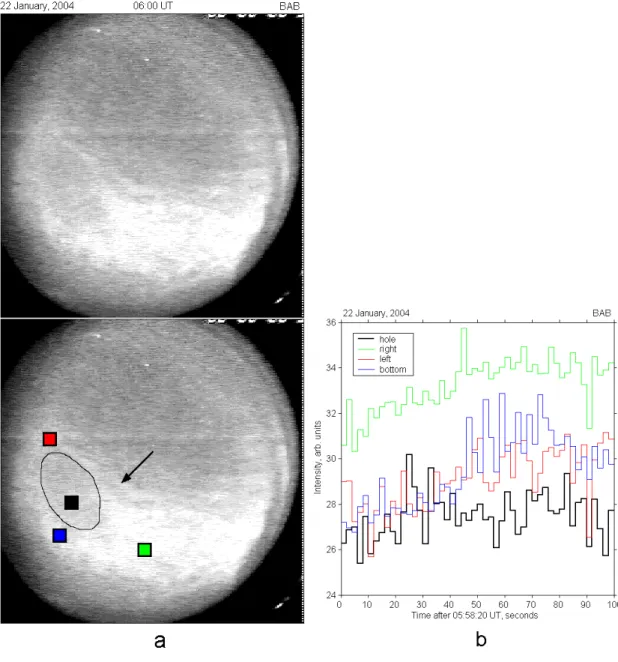
where the torch would appear a few minutes later. In the bot-tom image of Fig. 7a the border of the dark hole is empha-sized with a thin black curve. Also shown are four squares: westward (red), eastward (green) and southward (blue) of the hole, as well as inside the hole (black square). The tem-poral variations of the sky luminosity averaged over these square areas are presented in Fig. 7b, showing that the aurora brightness inside the hole stopped increasing at ∼05:59 UT. We think that the dark area in the auroral background cor-responded to the downward field-aligned current, whereas an upward current was associated with the faint arc seen in Fig. 7a, just poleward of the area occupied by brighter auro-ral forms.
At 06:02:30 UT the intensity of this arc started to increase. The use of two cameras separated by ∼40 km (BAB and LYR) allowed us to calculate the height of the arc. Before activation the arc was located at ∼160 km, whereas at the moment of maximum intensity the altitude of the arc dipped to ∼140 km. This indicated that the arc intensification was accompanied by electron acceleration. The height of the au-roras corresponded to soft (∼300 eV) electrons coming, most probably, from the dayside extension of the boundary plasma sheet, BPS (Newell and Meng, 1992). The arc brighten-ing was accompanied, as well, with its slight poleward dis-placement and with stretching, also poleward, of one of the -bands tongues into the torch (upper series of images in Fig. 5). It is worth mentioning that one more torch-like form might be associated with the bright spot seen on the south-east edge of the TV frames. However, the north-south ex-tension of this spot is rather small. This might be inferred from the comparison of two frames taken at 06:04:22 and 06:10:50 UT, seeing that in the latter the torch reached the
same place on the sky as the spot on the former but its size in the NS direction is larger than the spot size. So we think that the spot was one of the undulations forming the omega auroras, rather than the torch, and that after 06:02:40 UT we observed, indeed, the formation of a single torch. At 06:06:20 UT (when the torch had been shaped) we calcu-lated the height of its most poleward point to be in the range of 100–105 km, by means of triangulation between the BAB and NAL cameras. In this case, the height of the auroras cor-responded to high-energy (∼5 keV) electron precipitation. This is consistent with either a central plasma sheet source (Newell and Meng, 1992) or a significant field-aligned ac-celeration of the colder plasma of boundary plasma sheet origin. No auroras were seen poleward of the torch while it moved through the camera’s field of view. The above-listed features of auroral activity allow us to suggest that the auroral torch was associated with an azimuthally-restricted ionospheric plasma tongue which originated initially inside the CPS or BPS projection and expanded then poleward to the polar cap boundary. In the magnetosphere this plasma tongue may correspond to the flux tube moving outward from the Earth.
After the torch passage the rayed multiple arcs appeared on the sky (bottom series of images in Fig. 5). At ap-proximately 06:14:35 UT one more auroral torch started to develop equatorward of these arcs. In the frame taken at 06:15:40 UT the main signature of the torch – a periphery and a core – may be distinguished. As in the situation dis-cussed above, the small arc appeared poleward of the torch just before its formation (bottom left image in Fig. 5). But in contrast to the previous case, this torch was not so clearly manifested.
Fig.5. Series of TV images showing the dynamics of auroras around the torch event. North
(geomagnetic) is on the top, East is on the right.
35
Fig.6. Omega auroras before the torch passage as seen by the ground based TV camera (a)
and after torch passage as seen from the DMSP satellite (b).
Fig. 6. Omega auroras before the torch passage as seen by the ground based TV camera (a) and after torch passage as seen from the DMSP satellite (b).
3.3 EISCAT and IMAGE observations
3.3.1 The dynamics of the convection reversal boundary and auroral electrojet during Ps6 events as inferred from ESR-32-m and IMAGE network measurements In general, the interval preceding the torch observation is characterized by poleward displacement of the convection re-versal boundary in the vicinity of the observational points. This can be seen from a comparison of the ESR-32 data on the ion velocity (Fig. 8, upper panel) and the ionospheric cur-rents calculated from the IMAGE data. The ESR radar in LYR measured the line-of-sight (l-o-s) convection velocity along the latitude (see Fig. 1). The algorithm of the iono-spheric current reconstruction assumed that the currents flow predominantly along the geomagnetic latitude (Kotikov et al., 1991). In our case this is a valid assumption, since at 05:00 UT the IMAGE magnetometer chain is still located away from the place where the convection turns to the pole. Thus, as in the keogram, the contour map presented in Fig. 8 (bottom panel) in the “latitude-time” frame shows the dy-namics of auroral electrojets along the meridian.
There are three intervals of positive (directed to the radar) l-o-s velocity in the radar data. The first one is between 04:40 and 05:00 UT, that is before the substorm onset, whereas two others – after 05:10 UT and before 05:40 UT – are related to the substorm recovery phase. Therefore, there is no reason to connect the appearance of the positive plasma flows (PPF) in the radar data with substorm activity directly, although the sign of velocity may mean that the ionospheric plasma en-tered from the nightside sector. As the flow of opposite di-rection followed the PPF, we suppose that the radar observed the N-S displacement of the convection reversal boundary which occurred in response to short-lived reductions of the polar cap, which were caused by the IMF Bz northward
ex-cursions (top plot in Fig. 8). The intensity of the PPF, as well as the PPF duration, increased from interval to interval
and seems not to depend on the duration and amplitude of positive IMF Bzexcursions. Such a feature of PPF may be
explained by assuming that the convection boundary moved poleward approaching the radar beam from lower latitudes. The dynamics of the ionospheric Hall currents presented in Fig. 8 (bottom panel) support this assumption. Since the ions moved in the opposite direction to the Hall current, the zero line separating the eastward (blue contours) and westward (red contours) currents at the top of the map may be as-sociated with the convection reversal boundary seen by the westward-directed antenna of the Svalbard radar at approxi-mately the same CGMLAT. Some discrepancy is due to the poor coverage of the IMAGE observatories poleward of the Scandinavia coastline. Indeed, this boundary moved pole-ward and at the time corresponding to the intervals of PPF in radar data the westward electrojet underwent a momen-tary declination toward the radar beam, the position of which coincides on the map with the latitude of LYR.
The Ps6 disturbances started just after substorm onset at 05:00 UT and may also be associated with the formation of the equatorward boundary of the electrojet, as no pulsations were seen before that. The appearance of this boundary ac-companied the pre-onset negative bays at IQA and JAN (or H-component enhancement at GDH and GH, which looked like the preliminary phase signature). Although this is im-portant for understanding the reasons for omega band gener-ation, the question of the electrojet formation refers more to the substorm morphology and its detailed analysis is beyond the scope of our study.
In Fig. 8 the Ps6 activity has the form of several trains. There is an apparent correlation between them and the N-S displacement of the electrojet and convection reversal bound-aries. The maximum of the pulsation was observed dur-ing the southward shift of both the electrojet boundaries, whereas the beginning of Ps6 may be associated with max-imum northward displacement of the electrojet equatorial
Fig.7. The dark hole (outlined, in
the lower image) in the enhancing
diffuse auroras (a) and the sky
luminosity variations in the square
areas indicated in the lower image
of the upper panel (b). Black arrow
indicates on the faint arc discussed
in the text.
36
Fig.7. The dark hole (outlined, in
the lower image) in the enhancing
diffuse auroras (a) and the sky
luminosity variations in the square
areas indicated in the lower image
of the upper panel (b). Black arrow
indicates on the faint arc discussed
in the text.
Fig. 7. The dark hole (outlined, in the lower image) in the enhancing diffuse auroras (a) and the sky luminosity variations in the square areas indicated in the lower image of the upper panel (b). Black arrow indicates on the faint arc discussed in the text.
boundary that was closer to the SOR where the pulsations were the most manifested. Note that the Ps6 trains were also accompanied by electrojet intensifications (darker areas in-side the electrojet on the contour map in Fig. 8). We re-gard these as one more manifestation of the omega auroras since the closing of the field-aligned currents associated with the omega bands in the ionosphere should enhance the iono-spheric Hall currents (see Amm, 1996, for example). 3.3.2 The ULF and convection features accompanying the
torch development
In this section we concentrate on BJN magnetic data since the amplitude of torch-associated disturbances was the largest for that station (Fig. 8, top panel). Andr´e and Baumjohann
(1982) first presented coordinated optical and magnetic mea-surements during the passage of several wave-like auroral forms which they assumed to be the -bands. In particu-lar, they showed that this optical phenomenon was accom-panied with positive variation in the east-west component of the geomagnetic field (see Fig. 3 in their paper). After that, the omega bands were commonly thought to be associated with a series of positive D-spikes (similar to that seen on the BJN magnetogram in Fig. 8 from 05:48 to 05:52 UT), even in absence of optical observations. In the case con-sidered here, the torch was preceded by the D-component reduction at 05:59 UT which also looked like a spike and makes it unclear as to whether the torch passage was ac-companied by positive or negative variations. This negative
37
Fig.8. Top panel: the azimuthal plasma flow and Ps6 activity are compared with the IMF Bz
variations; the dashed line indicate the substorm onset, while the bold line refers to the
moment of torch appearance, positive values of the velocity correspond to the plasma
movement toward the radar. Bottom panel: dynamics of auroral electrojet; the red (blue)
contours correspond to westward (eastward) Hall current, the darker areas indicate current
enhancements.
Fig. 8. Top panel: the azimuthal plasma flow and Ps6 activity are compared with the IMF Bzvariations; the dashed line indicate the substorm
onset, while the bold line refers to the moment of torch appearance, positive values of the velocity correspond to the plasma movement toward the radar. Bottom panel: dynamics of auroral electrojet; the red (blue) contours correspond to westward (eastward) Hall current, the darker areas indicate current enhancements.
38
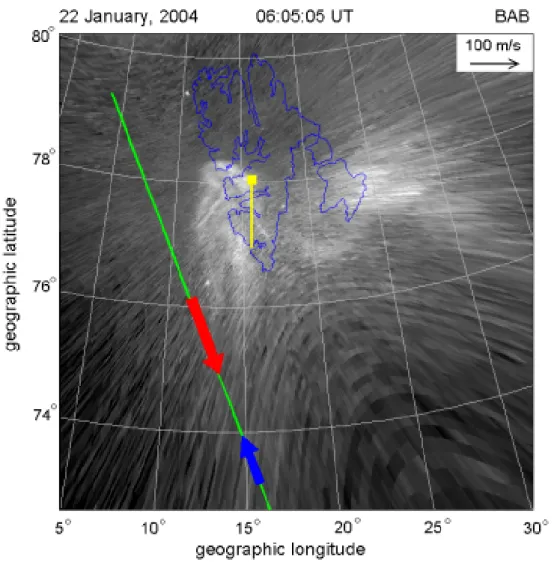
Fig.9. Location of the EISCAT UHF beam (green line) and EISCAT Svalbard field aligned
beam (yellow line) with respect to the auroral torch. The colored arrows are the
line-of-sight velocities measured at 09:05 UT (see Fig.10). The yellow square corresponds to the
measurement point at altitude 115 km.
Fig. 9. Location of the EISCAT UHF beam (green line) and EISCAT Svalbard field aligned beam (yellow line) with respect to the auroral torch. The colored arrows are the line-of-sight velocities measured at 09:05 UT (see Fig. 10). The yellow square corresponds to the measurement point at altitude 115 km.
Fig.10. (a) EISCAT UHF measurements of line-of-sight velocity in the vicinity of the
westward torch border. Positive values correspond to a velocity toward the radar. (b)
Distribution of l-o-s velocity along radar beam. The velocities plotted in Fig.9 are here
indicated with squares of the corresponding color.
Fig. 10. (a) EISCAT UHF measurements of line-of-sight velocity in the vicinity of the westward torch border. Positive values correspond to a velocity toward the radar. (b) Distribution of l-o-s velocity along radar beam. The velocities plotted in Fig. 9 are here indicated with squares of the corresponding color.
spike-like variation coincided with the appearance of a dark hole in the background luminosity in Fig. 7b: a fact that is consistent with the findings of Opgenoorth et al. (1983), who showed the connection of northward equivalent ionospheric currents, causing the negative variation in the D-component, with downward field-aligned currents in dark areas of omega bands. A similar behavior – the increase a few minutes be-fore the torch observation – demonstrated the D-component in the case on 21–22 October 1979 discussed by Opgenoorth et al. (1983) and Tagirov (1993) (Figs. 4 and 5, respectively). Consequently, we think that the enhancement of the down-ward FAC (manifested as the appearance of a dark hole in the background luminosity) may be considered as one of the precursors of torch development. We should note that this ef-fect was not seen in the data presented by Steen et al. (1998). However, they dealt with the case of very intense Ps6 distur-bances, which were at least five times larger than the ones discussed by Opgenoorth and in this paper. For this reason, this detail might be missed in their analysis.
Another observational result that provided useful insights into the mechanism of generation of the auroral torch was the feature of ionospheric convection near the torch border inferred from UHF radar measurements. The appropriate ori-entation of EISCAT antenna in Tromsø allowed the measure-ments of the ion’s l-o-s velocity, which in our case was nearly the meridional (geomagnetic) component of the convection velocity, in several points inside the TV camera’s field of view (see Fig. 1). Beginning at ∼06:03 UT, it measured the convection in the vicinity of the westward border of the de-veloping torch. The location of the radar beam with respect to the torch is shown in Fig. 9, while the results of measure-ments are presented in Fig. 10. Since only the value of the velocity (inferred from the raw data with an error smaller than 30%) was taken into account, we removed the measure-ments done further than 900 km from Tromsø. The interval from 06:02 to 06:04 UT is characterized by numerous data gaps that occurred, probably, due to the high level of turbu-lence accompanying the torch development or low plasma density in the F region associated with the above-mentioned dark hole in the auroras. At 06:04 UT, the opposite plasma flows have formed in the vicinity of the westward border of the torch, namely at the points close to the radar site the ions moved northward, whereas at large distances the plasma flowed southward. This is well visible in Fig. 10b, where the distribution of the l-o-s velocity along the radar beam is shown for the temporal interval, when there were no data gaps in the radar data, and the torch border had been almost shaped. The plasma velocity at two measurement points lo-cated at distances 513 km and 864 km from the radar site is presented in Fig. 9 (blue and red arrows, respectively), together with the torch image projected on the ionosphere. The latest point lies outside the torch. The position of the former with respect to the torch is not so clear due to the clouds hiding the auroras at the south horizon and the pro-jecting procedure also decreasing the aurora intensity toward the edge of image. However, if one produces in the mind’s eye the torch’s borders southward and takes into account the
probable location of the omega auroras at the moment con-sidered (see Sect. 3.2), it may be concluded that the blue ar-row refers to the torch pedestal. In this place plasma moved poleward at a velocity 100±10 m/s, outside the torch plasma moved southward at a velocity 300±20 m/s. The point at 614 km seems to lie at the torch border (not shown in the fig-ure). The drift velocity is also poleward here and has a larger value (200±20 m/s) than inside the torch.
4 Discussion
4.1 Brief summary on geomagnetic background
In this study we focus on an event that occurred on 22 Jan-uary 2004 in the late morning hours (∼09:00 MLT) at high latitudes (L ∼16) during the pass of the Earth over the mag-netic cloud. At that time Kpwas 5, Dstwas largely positive
in response to a strong solar wind dynamic pressure (10 nPa), and IMF By was largely negative (–10 nT). Meng (1984)
showed that during large negative Dst (i.e. during magnetic
storms) both the cusp and poleward boundary of the nightside auroral oval are shifted equatorward, causing the polar cap expansion to lower latitudes. It is reasonable to assume that during large positive Dst an opposite effect – polar cap
con-striction and auroral oval shift poleward – should take place. In addition, the model simulations by Guzdar et al. (2001) also predict the reduction of the radius of the tail lobe cross section during periods characterized by high solar wind ve-locity, which is the condition existing in our case. Note also that high solar wind pressure should enhance the effective-ness of the interaction of the IMF with the magnetosphere (Newell and Meng, 1994), which could result in the fast and appreciable response of the polar cap dimension to Bz
vari-ations. A large negative By component would lead to the
duskward displacement of the polar cap (Elphinstone et al., 1993) and to the twist of the magnetotail in the opposite di-rection. In the present case, the latter effect may be traced by the ground-based observations showing the maximum of substorm-associated H-bay at the GDH observatory, which was in the early morning sector (∼03:00 MLT) at that time. Probably due to all of these reasons, we were able to achieve an unusual observation of both the omega bands and an auro-ral torch, the source of which is usually attributed to the in-ner magnetosphere (L∼6–10) and which is typical of earlier MLT hours. Below we summarize the observations and dis-cuss the possible generation mechanism for both the omega bands and the auroral torches.
4.2 Possible scenario for formation of omega auroras The observations suggest that the -bands were located somewhere between the Spitsbergen archipelago and the Scandinavian peninsula. Although these auroras were distin-guishable on the DMSP F13 image, as well as on the frames of the TV camera running in Barentsburg, their detailed in-vestigation was partially hindered by the poor weather con-ditions, and our conclusions are based mainly on analysis of
Fig.11. Model of auroral oval at the beginning of Ps6 activity in local time – latitude
(geographic) coordinates.
Fig. 11. Model of auroral oval at the beginning of Ps6 activity in local time–latitude (geographic) coordinates.
the disturbances in the geomagnetic Y-component (Ps6 mag-netic pulsations) associated with the -bands.
A substorm expansion phase onset at ∼05:00 UT on 22 January took place in the post-midnight-early morning sec-tor. Simultaneously, large Ps6 disturbances started in the late morning sector, as observed by the IMAGE array tions in Scandinavia. The analysis of the data from these sta-tions also indicates the appearance of the equatorial bound-ary of the westward electrojet between Tromsø and Muo-nio a few minutes before the substorm onset in the night-side. In Fig. 11 we present the location of the auroral oval calculated within the framework of the OVATION project (see description of the project at http://sd-www.jhuapl.edu/ Aurora/ovation/index.html). Both poleward and equatorward borders of the oval coincide with the electrojet boundaries shown in Fig. 8 with an accuracy of ±1◦CGLAT. One might connect the Ps6 with a Kelvin-Helmholtz instability which may develop at the electrojet borders associated with a shear flow. However, there are several details which argue against
such an association, allowing for the interpretation of the phenomena within the framework of another kind of instabil-ity, the interchange instabilinstabil-ity, which has also been discussed in the literature in connection with omega auroras (Tagirov, 1993; Yamamoto et al., 1997; Sazykin et al., 2002). They are the following:
(1) No pulsations were measured at the LYR observa-tory, the observatory nearest to the convection reversal boundary in Fig.8, bottom, and the poleward edge of the auroral oval in Fig. 11, and this is not consistent with the idea of the omega bands being located near the bound-ary between BPS and CPS, as proposed by Rostoker and Samson (1984), or near the poleward boundary of the auroral oval, as proposed by Wild et al. (2000).
(2) Pulsations in the Ps6 range were more manifested near the equatorial boundary of the westward electrojet, but we have no direct (EISCAT) measurements proving the presence of opposite plasma flows there. From Fig. 8
we see that, close to 06:00 UT, the maximum of Ps6 shifted toward BJN, whereas the equatorward boundary of the westward electojet did not show any significant movement to the north. So the -bands do not seem to be collocated with the opposite plasma flows near either the poleward or the equatorward boundaries of the auro-ral oval. Note that Connors et al. (2003) reported a case when the causative currents for Ps6 could be located inside the auroral oval and L¨uhr and Schlegel (1994) found that -bands were embedded in a strong west-ward electrojet. Most probably, in our case the source of the Ps6/omega bands was inside the plasma sheet, away from its edges. The presence of auroras up to the latitude 74.5◦ during the Ps6 event also supports this conclusion (see keogram in Fig. 4).
(3) The Ps6 activity had a form of several trains coincid-ing in time with intervals of north-south movement of both the convection reversal boundary seen by the ESR at ∼75◦ CGMLAT and the westward auroral electro-jet constructed from the IMAGE data. This means that the formation of convection reversal boundary alone did not result in the development of the instability responsi-ble for the omega band generation (as should be in the case of K-H instability). There were some other factors which were manifested as the plasma sheet movement and did magnetospheric plasma unstable.
Although the earthward part of the plasma sheet is usually stable with respect to interchange motion, it has been long known that, under appropriate conditions, interchange-like instabilities are possible even in the ideal MHD approxima-tions. Kadomtsev (1963) showed that the instability is devel-oped if the plasma pressure has a steeper profile than L−7.
Safargaleev and Maltsev (1986) noted that interchange-like disturbances can arise even if there is no sharp boundary be-tween areas with different plasma content. Taking into ac-count that the considered optical phenomena were observed inside the auroral oval and that two other mentioned mecha-nisms (Lyatsky and Maltsev, 1984 and Jorgensen et al., 1999) imply the presence of a plasma boundary in the magneto-sphere, we think that the interchange instability is more likely the reason for generation of omega auroras.
In accordance with Lui and Hamilton (1992), the radial profile of the quiet-time plasma pressure in the magnetotail exhibits a peak at L=3–4 and then decreases monotonically from L=4 and L=9. During magnetic storms, the advanta-geous pressure gradient is emphasized by the strong main-phase ring current injection (Sazykin et al., 2002). We think that the plasma injection accompanying the substorm onset also leads to a similar result.
In the dayside magnetospheric plasma, the necessary pres-sure gradient driving the interchange instability may take place, for example: i) during the periodic magnetopause os-cillation that could lead to the formation of the gap between the central plasma sheet and the low-latitude boundary layer, as is frequently seen in the DMSP data (Newell and Meng, 1992, 1994); ii) during the periods of northward IMF Bz,
when the magnetosheath plasma penetrates into the dayside magnetosphere via the reconnection process (Song and Rus-sell, 1992). These possibilities were previously discussed by Lyatsky and Sibeck (1997) and Kozlovsky et al. (2003) in connection with the problem of the generation of different kinds of dayside auroras. Our data presented in Fig. 8 show that both the above-mentioned reasons for the development of an adequate plasma pressure gradient, somewhere inside the plasma sheet, could exist in our case. Indeed, the IMF Bz
experienced the appreciable positive variations through the interval of interest. On the one hand, this might lead to the magnitopause oscillation and penetration of the magne-tosheath plasma to the dayside magnetosphere. On the other hand, one can regard the trains of Ps6 in Fig. 8 as occurring (with certain delay) in response to the IMF Bzpositive
vari-ations, since their appearance seems to be connected (both in time and in space) to the poleward displacement of the equatorial boundary of the electrojet following the northward turning Bz.
In the present case, we suggest that the substorm activity created favorable conditions for an instability development through the earthward injection of hot plasma. Then, these conditions were emphasized by IMF Bz positive variations,
which finally led to a “triggering” of the Ps6/omega bands. We believe that the two above-mentioned effects could not produce Ps6/omega bands when acting separately. In the next section we will suggest a mechanism for torch formation also based on the interchange instability.
4.3 Possible scenario for torch formation
For 1 h after the substorm onset the electrojet expanded pole-ward, and the maximum of the pulsations also shifted to the north, moving from SOR to BJN. Then, near 06:00 UT the omega bands became visible to the TV camera running in Barentsburg, as some aurora undulations on the southern edge of the camera’s field of view (see Fig. 6a). At approx-imately 06:03 UT, one of the bright tongues expanded pole-ward and evolved into a torch structure. For the next 7 min, the torch moved eastward and crossed the beam of the EIS-CAT radar in Tromsø. This allowed for measurements of the convection velocity close to one of the torch borders (the western border), which was finally shaped up at that time. At lower latitudes (inside the torch pedestal) the plasma flowed poleward, whereas an opposite flow was detected at higher latitudes (outside the torch), see Figs. 9 and 10. Such con-vection features partake of the interchange instability when the plasma tubes with higher β (the ratio of plasma pressure to magnetic pressure) move outward from the Earth and are replaced by plasma tubes with lower β, moving in opposite directions, respectively. The question is why do the relatively stable auroral forms – -bands – become unstable?
It is well known that the highly conductive ionosphere suppresses the development of the interchange instability through the “frozen-in” conditions for the magnetic field lines (Swift, 1967). However, the field-aligned potential difference, φ||, can decouple the magnetosphere from the
ionosphere (Atkinson, 2001), and this, in principle, would allow for the instability to rise. The numerical simulations of omega bands carried out by Janhunen and Huuskonen (1993) supported this idea by showing a faster instability develop-ment when the field-aligned potential drop was included in the model. In our case the brightening of the small arc just before the torch formation indicated an increase in the arc-associated field-aligned current. Under appropriate condi-tions the increase of the current can result in the develop-ment of an anomalous resistivity region and field-aligned po-tential drop. The latter is supported by optical observations showing the decrease of the altitude of the brightening arc. So, just before the torch formation the magnetosphere be-came decoupled from the ionosphere in a limited area. That area is thought to also include the associated downward field-aligned current, the ionospheric signature of which – a dark hole in the background luminosity – we observed exactly in the place where the torch appeared a few minutes later (see Fig. 7). Recently, Aikio et al. (2004) presented a case study on the accelerated upward electrons above the “black auroras” observed by CLUSTER in response to auroral arc brightening (pseudobreakup event). They assumed that φ||
developed there as a result of an ionospheric feedback. In addition, the small ionospheric conductance in the dark area should also improve the conditions for the development of an instability.
Note that the local enhancement of discrete auroras pole-ward of the observation point was mentioned by Oguti et al. (1981) and Tagirov (1993) as characteristic pre-torch phe-nomena. We also observed a similar auroral feature before the second torch appearance at 06:14:35 UT. However, the second torch started deep inside the auroral oval, as one can conclude from the presence of discrete auroras northward of the torch (bottom series of images in Fig. 5). Such a sit-uation occurred because of the displacement of the auroral oval poleward boundary, which was manifested as a grad-ual expansion of the auroral electrojet (Fig. 8, bottom panel) toward the north. Probably the location of the pre-existing arc further from the polar cap border hindered the instability development and the torch was not as impressive.
4.4 Brief comments concerning the similarity of the torch and breakup auroras
In fact, there is some similarity between auroral torches and substorm-related large-scale auroras – auroral bulge/surge. Both the torch and bulge are the result of a fast expansion of pre-existing auroras poleward. The shape of the auroral torch resembles the shape of the auroral bulge, but the azimuthal size of the former is smaller. By comparing the IMF con-ditions for substorms and omega auroras, Steen et al. (1988) supposed that both occurred during periods of enhanced
con-location of the magnetospheric source of -bands has un-dergone a similar earthward motion as the presumed loca-tion of substorm onsets”. We can extend the analogy of the torch with substorm activity by noting the following: 1) both are preceded by a short-lived brightening of discrete auroras: azimuthally-extended auroral arcs in the case of substorm onset (the so-called pseudo-breakup event) and azimuthally-restricted arc-like forms in the case of torch formation; 2) we connected the torch formation with the interchange instabil-ity arising due to the magnetosphere-ionosphere decoupling. Some investigators suggest this kind of instability as an ex-planation of the substorm onset, also pointing out the particu-lar role of the field-aligned potential drop in its development (Stepanova et al., 2004).
5 Conclusions
We have presented here the results of multi-instrument obser-vations of an auroral torch and Ps6 magnetic pulsations. Data from TV and ASC cameras in Barentsburg and Ny ˚Alesund, from EISCAT radars in Longyearbyen and Tromsø, as well as from the IMAGE network, have been used in this study. The auroral phenomenon we have considered differed from those discussed previously, as it occurred in an unusual place (high latitudes) and at an unusual time (late morning hours). The torch developed from one of the bright tongues of the omega bands, the presence and presumed location of which was inferred mainly from the Ps6 magnetic pulsations (series of positive spikes in the geomagnetic Y-component), since the cloudy conditions above northern Scandinavia hindered optical observations southward of Spitsbergen.
The following are the main results of our investigation: 1. Under suitable conditions in the interplanetary medium,
magnetosphere deformation makes it possible to ob-serve early-morning auroral zone phenomena (such as omega bands and auroral torches) at high latitudes and close to the noon.
2. In such a case, the IMF might be one more factor that in-fluences the regime of the Ps6/omega bands. The above-discussed case study confirms this assumption, show-ing that only when actshow-ing together do substorm onset in the night sector and IMF Bz variations give rise to
Ps6/omega-band generation.
3. In the event discussed here, the presumable source of Ps6/omega bands did not co-locate with convection re-versal boundaries. This prevents us from interpret-ing the phenomena in the framework of the Kelvin-Helmholtz instability. We assume that the interchange instability is responsible for both the omega bands and
a velocity of ∼600 m/s, very close to the direction and the velocity of the background ionospheric convection (measured 400 km west of the observational point). In-side the torch plasma moved poleward at a velocity of 100–200 m/s (the latter value refers to torch bright bor-der), whereas outside the west border of the torch the plasma flowed in the opposite direction at a velocity of ∼300 m/s. Since we were able to measure only the line-of-sight component, the velocities mentioned are the (geomagnetic) azimuthal and meridional components of convection velocity. The height of the most poleward point of the torch was slightly higher than previously reported for early morning torches, but lower than that typical for the dayside auroras.
5. We emphasized the dark hole in the background lu-minosity and short-lived azimuthally-restricted auroral arcs as possible precursors of the auroral torch. We think that these auroral features should be further stud-ied because they can provide useful insights into the mechanism of auroral torch generation.
Acknowledgements. We thank for cooperation of Kakioka (JMA), Honolulu and San Juan (USGS), Hermanus (RSA), Alibag (IIG) and CRL, INTERMAGNET and many others to make QL-Dst in
near real time. We acknowledge the geomagnetic observatories CBB, IQA, GH (Geological Survey of Canada), GDH (Danish Me-teorological Institute), JAN (Tromsø Geophysical Observatory) for magnetic data. The solar wind and IMF data from the WIND satel-lite were obtained from the CDAWeb ISTP Key Parameter database (data providers are K. Olgivie and R. Lepping at NASA). Work on OVATION has been conducted by scientists at The Johns Hopkins University Applied Physics Laboratory, at the University of Alaska, Fairbanks, and at the Air Force Research Laboratory. We thank B. Holmeslet (University of Tromsø), O. Rasmussen (Danish Mete-orological Institute), W. Glegolski (Institute of Geophysics of Polish Academy of Sciences) and J. Posch (Augsburg College) for supply-ing us near-real time magnetic data, as well as K. Kauristie (FMI) for providing LYR and KIL ASC images for selected intervals. We are indebted to the Director and staff of EISCAT for operating the facility and supplying the data. EISCAT is an International Associ-ation supported by Finland (SA), France (CNRS), the Federal Re-public of Germany (MPG), Japan (NIPR), Norway (NFR), Sweden (NFR) and the United Kingdom (PPARC). We thank R. Kuula at Space Research Group of the Oulu University for the EISCAT data analysis. The work of V. Safargaleev was supported by Svenska In-stitutet (VISBY Programme stipend). The work of A. Kozlovsky was funded by the Academy of Finland. The work of A. Kotikov was supported by Kungliga Vetenskapsakademin.
Topical Editor T. Pulkkinen thanks T. S. Trondsen and another referee for their help in evaluating this paper.
References
Aikio, A., Mursula, K., Buchert, S., Forme, F., Amm, O., Marklund, G., Dunlop, M., Fontain, D., Vaivadas, A., and Fazakerly, A.: Temporal evolution of auroral arcs as measured by the CLUS-TER satellites and coordinated ground-based instruments, Ann. Geophys., 22, 4089-4101, 2004,
SRef-ID: 1432-0576/ag/2004-22-4089.
Akasofu, S.-I. and Kimball, D. S.: The dynamics of aurora, 1, In-stabilities of aurora, J. Atmos. Terr. Phys., 28, 205–211, 1964. Akasofu, S.-I.: A study of auroral displays photographed from
DMSP-2 satellite and from the Alaska meridian chain of stations, Space Sci. Rev., 16, 617–725, 1974.
Amm, O.: Improved electrodynamic modeling of an omega band and analysis of its current system J. Geophys. Res., 101, no. A2, 2677-2684, 1996.
Andr´e, D. and Baumjohann, W.: Joint two-dimensional observa-tions of ground magnetic and ionospheric electric fields asso-ciated with auroral currents. 5. Current system assoasso-ciated with eastward drifting omega bands, J. Geophysics, 50, 194–201, 1982.
Atkinson, G.: Decoupling of convection in the magnetosphere from the ionosphere by parallel electric fields, AGU Fall Meeting 2001, abstract No SM51A-0784, AGU, 2001.
Connors, M. and Rostoker, G.: Source mechanisms for morning auroral features, Geophys. Res. Lett., 20, 1535–1538, 1993. Connors, M., Rostoker, G., Sofko, G., McPherron, R. L.,
Hender-son, M. G.: Ps6 disturbances: relation to substorms and the au-roral oval, Ann. Geophys., 21, 493–508, 2003,
SRef-ID: 1432-0576/ag/2003-21-493.
Elphinstone, R. D., Hearn, D. J., Murphree, J. S., Cogger, L. L., Jonson, M. L., and Vo, H. B.: Some UV dayside auroral mor-phologies, in: Auroral Plasma Dynamics, Geophys. Monogr., 80, AGU, Washington, D.C., 13–45, 1993.
Guzdar, P. N., Shao, X., Goodrich, C. C., Papadopoulos, K., Wilt-berger, M. J.,and Lyon, J. S.: Three-dimensional MHD simu-lations of the steady state magnetosphere with northward inter-planetary magnetic field, J. Geophys. Res., 106, 257–288, 2001. Janhunen, P. and Huuskonen, A.: A numerical
ionosphere-magnetosphere coupling model with variable conductivities, J. Geophys. Res., 98, 9515–9530, 1993.
Jorgensen, A. M., Spence, H. E., Huges, T. J., and McDiarmid, D.: A study of omega bands and Ps6 pulsations on the ground, at low altitude and at geostationary orbit, J. Geophys. Res., 104, 14 705–14 715, 1999.
Kadomtsev, B. B.: Stability of plasma. In: Problems of the theory of plasma, edited by: Leonovich, M. A., 2, 132–176, 1963. Kawasaki, K. and Rostoker, G.: Perturbation magnetic fields and
current systems associated with eastward drifting auroral struc-tures, J. Geophys. Res., 84, 1464–1480, 1979.
Kotikov, A. L., Bolotenskaia, B. D., Gizler, V. A., Troshichev, O. A., and Pashin, A. B.: Structure of auroral zone phenomena from the data of meridional chains of stations: magnetic disturbances in the nighttime auroral zone and auroras, J. Atmos. Terr. Phys., 51, 265–274, 1991.
Kozlovsky A., Safargaleev, V., Jussila, J., and Koustov, A.: Pre-noon high-latitude auroral arcs as a manifestation of the inter-change instability, Ann. Geophys., 21, 2303–2314, 2003. Lyatsky, W. B. and Maltsev, Yu. P.: Origin of the auroral bulge
(Engl. transl.), Geomagn. Aeron., 24, 71–75, 1984.
Lyatsky, W. and Sibeck, D.: Central plasma sheet disruption and the formation of dayside poleward moving auroral events, J. Geo-phys. Res., 102, 17 625–17 630, 1997.
Lui, A. T. Y. and Hamilton, D. C.: Radial profiles of quit time mag-netospheric parameters, J. Geophys. Res., 97, 19 325–19 332, 1992.
L¨uhr, H. and Schlegel, K.: Combined measurements of EISCAT and the EISCAT magnetometer cross to study -bands, J. Geo-phys. Res., 99, 8951–8959, 1994.
re-sponse of Dst index to the change of the solar wind dynamic pressure (Engl. transl.), Geomagn. Aeron., 42, 175–178, 2002. Meng, C.-I.: Dynamic variation of the auroral oval during intense
magnetic storm, J. Geophys. Res., 89, 227–235, 1984.
Newell, P. T. and Meng, C.-I.: Mapping the dayside ionosphere to the magnetosphere according to particle precipitation character-istics, Geophys. Res. Lett., 19, 609–612, 1992.
Newell, P. T. and Meng, C.-I.: Ionospheric projections of magne-tospheric regions under low and high solar wind pressure condi-tions, J. Geophys. Res., 99, 273–286, 1994.
Oguti, T., Kokubun, S., Hayashi, K., Tsuruda, K., Machida, S., Ki-tamura, T., Saka, O., Watanabe, T.: An auroral torch structure as an active center of pulsating auroras, Can. J. Phys., 59, 1056– 1062, 1981.
Opgenoorth, H. J., Oksman, J., Kaila, K. U., Nielsen, E., and Baumjohann, W.: Characteristic of eastward drifting omega bands in the morning sector, J. Geophys. Res., 88, 9171–9185, 1983.
Opgenoorth, H. J., Persson, M. A. L., Pulkinen, T. J., and Pelli-nen, R. J.: Recovery phase of magnetospheric substorms and its association with morning sector aurora, J. Geophys. Res., 99, 4115–4129, 1994.
Pulkkinen, T. I., Pellinen, R. J., Koskinen, H. E. J., Opgenoorth, H. J., Murphree, J. S., Petrov, V., Zaitsev, A., and Friis-Christensen, E.: Auroral signatures of substorm recovery phase: A case study, in: Magnetospheric Substorms, edited by: Kan, J. R., Potemra, T. A., Kokubun, S., and Iijima, T., Geophys. Monogr. Ser., vol. 64, AGU, Washington, D.C., 333–342, 1991.
Rostoker, G. and Samson, J. S.: Can substorm expansive phase ef-fects and low frequency Pc magnetic pulsations be attributed to the same source mechanism? Geophys. Res. Lett., 11, 271–274, 1984.
Saito, T.: Long-period irregular micropulsations, Pi3, Space Sci. Rev., 21, 427–467, 1978.
Safargaleev, V. V. and Maltsev, Yu. P.: Internal “gravity” waves in the plasma sheet (Engl. transl.), Geomagn. Aeronomy, 26, 220– 224, 1986.
Safargaleev, V. V., Kozlovsky, A. E., Osipenko, S. V., and Tagirov, V. R.: Azimuthal expansion of high latitude auroral arcs, Ann. Geophys., 21, 1793–1805, 2003,
SRef-ID: 1432-0576/ag/2003-21-1793.
Sazykin, S., Wolf, R. A., Spiro, R. W., Gombosi, T. I., De Zeeuw, D. L., and Thomsen, M. E.: Interchange insta-bility in the inner magnetosphere associated with geosyn-chronous particle flux decreases, Geophys. Res. Lett., 29, 81–1, doi:10.1029/2001GL014416, 2002.
Shiokawa, K. T., Ogino, T., Hayashi, K., and McEven, D. J.: Quasi-periodic poleward motion of morningside sun-aligned arcs: A multievent study, J. Geophys. Res., 102, 24 325–24 332, 1997. Solovyev, S. I., Baishev, D. G., Barkova, E. S., Engebretson, M.
J., Posh, J. L., Huges, W. J., Yumoto, K., and Pilipenko, V. A.: Structure of disturbances in the dayside and nighside ionosphere during periods of negative interplanetary magnetic field Bz, J. Geophys. Res., 104, 28 019–28 039, 1999.
Song, P. and Russell, C. T.: Model of the formation of the low-latitude boundary layer for strongly northward interplanetary magnetic field, J. Geophys. Res., 97, 1411–1420, 1992. Steen, A., Collis, P. N., Evans, D., Kremser, G., Capelle, S., Rees,
D., and Tsurutani, B. T.: Observation of a gradual transition be-tween Ps6 activity within auroral torches and surgelike pulsa-tions during strong geomagnetic disturbances, J. Geophys. Res., 93, 8713–8733, 1988.
Stepanova, M. V., Antonova, E. E., Bosqued, J. M., and Kovrazhkin, R.: Radial plasma pressure gradients in the high latitude magne-tosphere as sources of instabilities leading to the substorm onset, Adv. Space Res., 33, 761–768, 2004.
Swift, D. W.: The possible relationship between the auroral breakup and the interchange instability of the ring current, Planet. Space Sci., 15, 1225–1238, 1967.
Tagirov, V.: Auroral torches: results of optical observations, J. At-mos. Terr. Phys., 55, 1775–1787, 1993.
Trondsen, T. S., Lyatsky, W., Cogger, L. L., and Murphree, J. S.: In-terplanetary magnetic field control of dayside auroras, J. Atmos. Terr. Phys., 61, 829–840, 1999.
Wild, J. A., Yeoman, T. K., Eglitis, P., and Opgenoorth, H. J.: Multi-instrument observations of the electric and magnetic field struc-ture of omega bands, Ann. Geophys., 18, 99–110, 2000, SRef-ID: 1432-0576/ag/2000-18-99.
Yamamoto, T., Inoe, S., and Meng, C.-I.: Formation of auroral omega bands in the paired region 1 and region 2 field-aligned current system, J. Geophys. Res., 102, 2531–2544, 1997.