HAL Id: hal-01763489
https://hal.univ-lorraine.fr/hal-01763489
Submitted on 19 Nov 2019HAL is a multi-disciplinary open access
archive for the deposit and dissemination of sci-entific research documents, whether they are pub-lished or not. The documents may come from teaching and research institutions in France or abroad, or from public or private research centers.
L’archive ouverte pluridisciplinaire HAL, est destinée au dépôt et à la diffusion de documents scientifiques de niveau recherche, publiés ou non, émanant des établissements d’enseignement et de recherche français ou étrangers, des laboratoires publics ou privés.
Increasing chemical weathering in the Himalayan system
since the Last Glacial Maximum
Maarten Lupker, Christian France-Lanord, Valier Galy, Jérôme Lavé,
Hermann Kudrass
To cite this version:
Maarten Lupker, Christian France-Lanord, Valier Galy, Jérôme Lavé, Hermann Kudrass. Increasing chemical weathering in the Himalayan system since the Last Glacial Maximum. Earth and Planetary Science Letters, Elsevier, 2013, 365, pp.243 - 252. �10.1016/j.epsl.2013.01.038�. �hal-01763489�
Increasing chemical weathering in the Himalayan system
since the Last Glacial Maximum
Maarten LUPKER1 *, Christian FRANCE-LANORD1, Valier GALY2, Jérôme LAVÉ1,
Hermann KUDRASS3
1 Centre de Recherches Pétrographiques et Géochimiques (CRPG), UMR 7358,
CNRS-Université de Lorraine, 15 rue Notre Dame des Pauvres, 54501 Vandoeuvre les Nancy, Cedex, France.
2 Woods Hole Oceanographic Institution (WHOI) – Department of Marine Chemistry and
Geochemistry, 360 Woods Hole Rd., Woods Hole, MA 02543, USA.
3 MARUM zentrum für Marine Umweltwissenschaften, Bremen, Germany.
*Corresponding author: Maarten Lupker
IGP-ETHZ - NW C 85 - Clausiusstrasse 25, 8092 Zürich - Switzerland +41 446329383
ABSTRACT:
1
Continental chemical weathering is central in Earth’s surface biogeochemical
2
cycles as it redistributes elements across reservoirs such as the crust and the oceans.
3
However the evolution of weathering through time and its response to external forcing
4
such as changes in climate remain poorly constrained. In this work, a composite
5
sediment record from the Bay of Bengal is used to document the evolution of chemical
6
weathering in the Himalayan system (Himalayan range and Indo-Gangetic floodplain),
7
the world largest sediment conveyor to the oceans, since the Last Glacial Maximum
8
(LGM). The degree of weathering of the sediments is documented using mobile to
9
immobile ratios such as K/Si and H2O+/Si as well as detrital calcite abundance. Robust
10
weathering proxies are derived by correcting the chemical composition of sediment for
11
sorting effects that occur during transport and deposition. The Bay of Bengal record is
12
also further compared to the chemical composition of modern river sediments from the
13
Ganga & Brahmaputra basin. Weathering proxies all indicate that the sediments
14
exported by the Ganga & Brahmaputra Rivers became increasingly weathered over the
15
past ~21 kyr, whereas, Sr, Nd and major elements suggest a constant sediment
16
provenance in the system over the last 21 kyr. These changes in the degree of weathering
17
of the sediments show that the weathering flux exported by the system to the Indian
18
Ocean during the LGM was significantly lower than at present and demonstrate that
19
chemical weathering in continental scale basins such as the Ganga & Brahmaputra
20
responds to Late Quaternary climate changes.
1. Introduction:
22 23
Chemical weathering of continental rocks is the main source of soluble elements to the 24
oceans and therefore exerts a first order control on oceanic bio-geochemical cycles. Over 25
geologic time scales, silicate weathering and subsequent carbonate precipitation also draws 26
down atmospheric CO2 thereby stabilizing the earth’s climate (Walker et al., 1981).
27
Continental weathering fluxes are a function of continent lithology, tectonic activity and 28
climate but the mechanisms and feedbacks linking silicate weathering to the earth’s climate 29
remain debated (France-Lanord and Derry, 1997; Willenbring and von Blanckenburg, 2011). 30
A better understanding of these complex climate-weathering couplings can be gained by 31
studying the response of continents to climatic transitions in the past. 32
The role of the Himalayan orogeny in the long-term forcing of oceanic cycles and the 33
global climate has retained much attention (France-Lanord and Derry, 1997; Raymo et al., 34
1988). However, the temporal variability of and controls on the evolution of weathering 35
fluxes exported by large basins remains poorly constrained and is often difficult to reconstruct 36
(Limmer et al., 2012). In particular, direct characterization of the response of chemical 37
weathering to abrupt climate perturbations has heretofore remained a challenge. We present a 38
record of chemical weathering intensity in the Himalayan system since the LGM. The 39
Himalayan system is defined here as the Himalayan range and the downstream Indo-Gangetic 40
floodplain drained by Ganga and Brahmaputra Rivers. No major change in tectonic forcing of 41
the Himalayan orogeny has been documented so far over the last glacial-interglacial period, 42
which enables us to discuss variations in sediment weathering as a response to climate 43
change. 44
45
2. Setting and methods:
47
The central part of the Himalayan range is drained by two major rivers, the Ganga and 48
Brahmaputra (Figure 1). Currently, the Ganga & Brahmaputra transfers ca. 1.109 Mt of
49
sediments to the Bay of Bengal, of which 90% is transported during the monsoon (RSP, 50
1996). River sediments were sampled mainly during monsoon seasons, in 2002, 2004, 2005, 51
2007, 2008 and 2010 across the Indo-Gangetic floodplain. Sampling locations mainly 52
included the front of the Himalayan range for the main trans-Himalayan Rivers of the Ganga 53
& Brahmaputra system, the outlet of the Ganga and the Brahmaputra as well as their 54
confluence - the lower Meghna - which integrates the entire sediment load exported from the 55
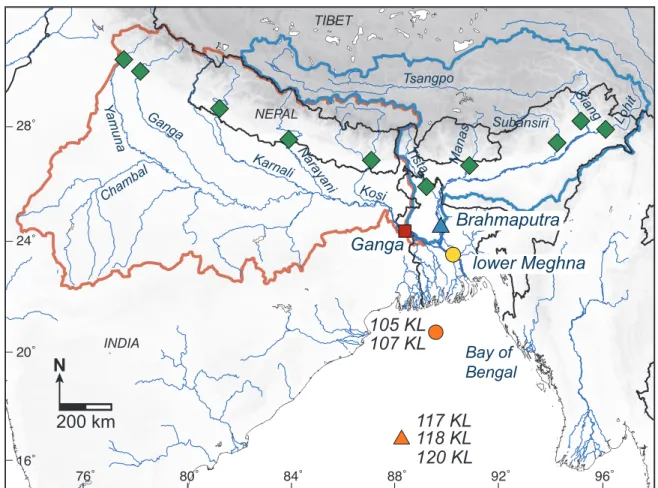
Ganga & Brahmaputra basin (Figure 1). When possible, sediments were sampled along 56
vertical depth profiles through the water column in order to capture the full variability of the 57
sediment load. These profiles were complemented by bedload samples dredged from the 58
active channel of the rivers and freshly exposed bar sediments. Details on the sampling 59
procedure are described in Lupker et al. (2011). 60
Sediment cores were retrieved during RV Sonne cruise SO93 in 1994 from the shelf 61
(105KL and 107KL) and the active channel levee system of the middle fan (117KL, 118KL 62
and 120KL) (Ittekkot et al., 2003). The chronology of the cores is provided by re-calibrated 63
(Reimer et al., 2009) 14C ages on planktonic foraminifers (Weber et al., 1997) as well as
64
137Cs, 210Pb and 228Ra gamma spectrometry (Michels et al., 1998). Scarce hemipelagic layers
65
were excluded from the study in order to focus on turbiditic sediments representing the Ganga 66
& Brahmaputra detrital signal (Pierson-Wickmann et al., 2001; Weber et al., 1997). We 67
interpret our data by constructing a composite Log from the shelf and levees core following 68
the approach detailed in Galy et al. (2008). 69
River suspended river sediments were filtered through 0.22 µm PES membrane filters 70
within 24 h of sampling and dried in the lab. Major element concentration was determined by 71
ICP-OES after LiBO2 fusion at SARM, Nancy – France (Carignan et al., 2001). Core samples
72
were repeatedly rinsed with water in order to remove salt contributions. Nevertheless, Na was 73
not considered in this study due to seawater contamination even after these rinsing steps. 74
Carbonate contents were measured manometrically from the CO2 released after reaction with
75
H3PO4 and the evolved CO2 was subsequently analyzed for C and O isotopic composition
76
(Galy et al., 1999). Sr and Nd isotopic compositions were measured on the acid leached, 77
silicate fraction of the river and core sediments by TIMS after classical separation and 78
purification by ion exchange resins. Sediment hydration [H2O+] and isotopic composition
dD-79
SMOW was measured by EA-IRMS after degassing the samples to remove adsorbed free-80
water (Lupker et al., 2012b). The long-term reproducibility is better than 0.1 H2O+ wt % and 2
81
‰ dD-SMOW. 82
83
3. Sediment sorting effects on the chemical composition of detrital sediments:
84
3.1 Hydrodynamic control of sediment sorting
85 86
The chemical composition of river sediments has to be interpreted carefully. Sediment 87
vertical depth profiles recovered from the water column of large rivers show a strong 88
heterogeneity in terms of concentration and chemical composition. These heterogeneities are 89
the result of the hydrodynamic sorting of sediments, based on grain-size, shape and density, 90
which induce mineralogical and thus chemical differentiation of sediments within the water 91
column (Bouchez et al., 2011a; Bouchez et al., 2011b; Garzanti et al., 2011; Lupker et al., 92
2011; Singh and France-Lanord, 2002a). The mineralogy of sediments from the Himalayan 93
system is dominated by quartz, micas and feldspar, with occurrences of other phyllosilicates, 94
clay assemblages and hydroxides in the finer fraction (Garzanti et al., 2011; Garzanti et al., 95
2010). These minerals are segregated during sediment transport: coarse-grained quartz is 96
enriched in the bedload and at the bottom of the water column while phyllosilicates such as 97
micas and clays are comparatively enriched in the shallow surface waters of the river, leading 98
to a strong contrast in chemical composition between samples of a single reach. This is best 99
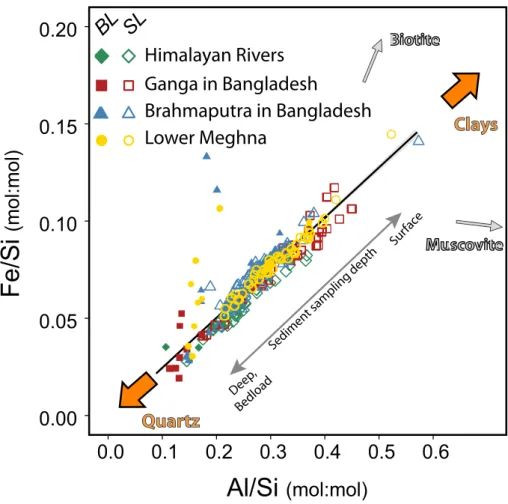
illustrated using the immobile element ratios Fe/Si and Al/Si (Figure 2). Fe, Al and Si are, to 100
a first order, immobile elements during Himalayan erosion and are thus not notably affected 101
by chemical weathering (Galy and France-Lanord, 2001). The sediments sampled across the 102
Indo-Gangetic plain form a unique mixing trend (to the exception of a few bedload samples 103
that are enriched in Fe due to heavy mineral placer effects) between quartz rich (low Al/Si 104
and Fe/Si) bottom sediments and clay rich (high Al/Si and Fe/Si) surface sediments. Al/Si and 105
Fe/Si are directly correlated to the bulk sediment grain-size and are a proxy of mineral sorting 106
(Bouchez et al., 2011a; Lupker et al., 2011). A single sediment sample from a given river 107
reach can therefore not be considered, a priori, as representative of the whole sediment load, 108
its chemical composition being dependent on river hydrodynamics at the moment of 109
sampling. 110
111
3.2 Weathering proxies in modern river sediments
112 113
The degree of chemical weathering experienced by sediments in the Himalayan 114
system can be traced from detrital sediments by using the mobile to immobile elemental ratios 115
of river sediments such as K/Si and H2O+/Si. The structural hydroxyl content of sediments,
116
H2O+, is a proxy of chemical weathering that traces mineral hydrolysis and secondary
neo-117
formations (Lupker et al., 2012b). Sediment sorting effects also apply to mobile elements 118
such as K and H2O+. The K/Si and H2O+/Si ratios are dominantly controlled by the grain size
119
of the sediments, i.e. clay to quartz mixing (Lupker et al., 2012b) and are, to a first order, 120
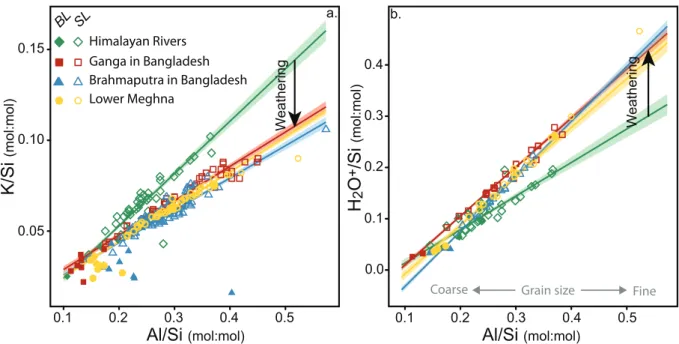
linearly correlated to their Al/Si ratio as shown by Figure 3, where these ratios are plotted for 121
sediments from the modern Himalayan system. By using a sediment depth profile sampling 122
approach on modern rivers, we characterize these sorting effects as this method allows 123
sampling a full set of sediments covering a wide range of grain sizes. The degree of chemical 124
weathering can then be assessed based on the trend formed by the chemical composition of 125
the sediments in diagrams such as Figure 3, this trend being representative of the entire 126
sediment load exported by the considered river. 127
In addition to silicate weathering proxies, we determined the calcite content and the 128
Ca/Si ratio in Bay of Bengal sediments that reflects the carbonate weathering intensity in the 129
Himalayan system. Carbonates, including calcite, account for over 80 % of the bulk Ca and 130
Ca/Si therefore mainly reflects carbonate content. Both carbonates and Ca content are not 131
grain size dependent (Lupker et al., 2011) and are therefore not corrected for sediment 132
sorting. 133
134
3.3 Accounting for sediment sorting effects in detrital records
135 136
For detrital records such as the Bay of Bengal cores, changes in sediment transport and 137
deposition patterns induce changes in the grain size of deposited sediments that, in turn, affect 138
the chemical composition of the record. Hence, sediment sorting also has to be taken into 139
account in order to compare the degree of weathering of samples with variable grain-sizes 140
(variable Al/Si ratios). However, unlike for modern rivers, it is not possible for a given age 141
interval of the record to recover a set of sediment samples spanning different grain sizes that 142
would fully describe the sediment weathering trend. By considering that each sample of the 143
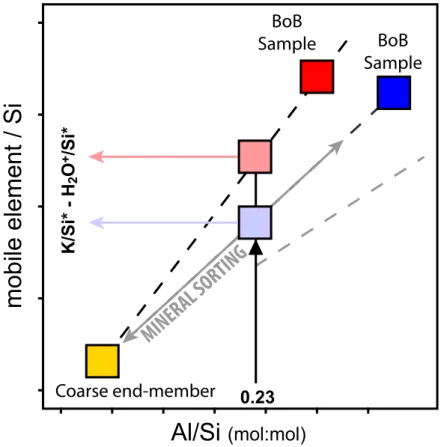
Bay of Bengal record is the result of the mixing between a coarse-grained end-member, 144
similar to bedload material and a fine-grained, clay rich sediment, it is nevertheless possible 145
to normalize mobile to immobile ratios (X/Si) to a common Al/Si composition as illustrated 146
in Figure 4 and equation 1: 147
(1) 148
where A and B are respectively the slope and intercept of the linear regression through the 149
sample and coarse grained end-member composition (Figure 4). Such normalized ratios allow 150
comparing the chemical composition of sediments that have contrasted grain sizes, while 151
properly accounting for sorting effects. Doing so, we assume that a unique coarse-grained 152
end-member composition can be assigned to the low Al/Si mixing end-member and that the 153
weathering signature is mainly carried by the small grain size, clay fraction of the sediment 154
load. This is a reasonable approximation as: 1) contrary to the fine grained suspended load, no 155
systematic evolution of K/Si and H2O+/Si ratios of modern bedloads in the Ganga basin is
156
detected from up to downstream (Lupker et al., 2012b), suggesting that the effect of chemical 157
weathering during transfer in the floodplain is negligible for the coarse fraction of the 158
transported sediments, and 2) the transfer time of bedload material is thought to be an order of 159
magnitude longer than that of fine-grained suspended load (Granet et al., 2010), which makes 160
it less sensitive than the suspended load to short-term upstream variations. 161
All corrected ratios presented here were normalized to a common Al/Si value of 0.23. 162
They are referred to as X/Si* and are listed in the supplementary information along with the 163
composition of the coarse grained end-member used in the calculations. The Al/Si value of 164
0.23 was chosen as the average composition of the sediments exported by the modern Ganga, 165
which was determined by modeling the chemical composition of sediments as a function of 166
the river’s hydrological conditions and integrated over a 25-year average hydrograph (Lupker 167
et al., 2011). This composition is also close to the composition of the Himalayan crust eroded 168
in the Ganga basin (Lupker et al., 2011). It should be noted that the choice of the Al/Si ratio 169 X Si * = Al Si A + B
and H2O+/Si* but has no influence on the general trends observed for Bay of Bengal
171
sediments. 172
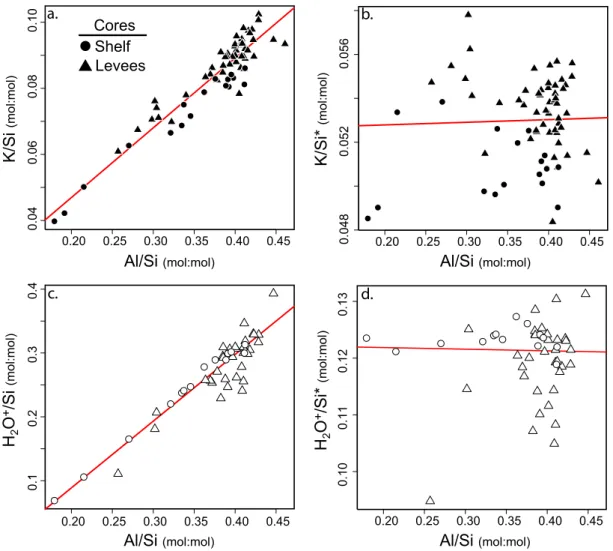
Before normalization, the raw K/Si and H2O+/Si ratios of sediments from the Bay of
173
Bengal cores are correlated to Al/Si (Figure 5), which supports that K/Si and H2O+/Si are
174
dominantly controlled by grain size and sorting effects. However the normalized K/Si* and 175
H2O+/Si* ratios show no correlation with Al/Si, which suggests that our normalization
176
properly accounts for sediment sorting. 177
178
3.4 Comparison with modern river sediments
179 180
In order to compare the weathering degree of the Bay of Bengal sediment record to 181
modern river sediments we applied a similar normalization to the river sediments. The 182
average compositions of modern river sediments for elements prone to sorting effects (K/Si*, 183
H2O+/Si*), reported in Figure 5, were determined by evaluating the regression through all
184
available data of each river reach and a coarse-grained end-member at Al/Si = 0.23. The 185
Himalayan front end-member was reconstructed from the river sediments sampled at the 186
Himalayan front in the Ganga basin and the Brahmaputra basin separately assuming that ca. 187
60% of the total sediment flux exported to the Bay of Bengal come from the Brahmaputra and 188
the remaining 40 % come from the Ganga basin (RSP, 1996). For compositions that are not 189
affected by sorting effects (calcite, Ca/Si, 87Sr/86Sr, εNd, d18O and d13C), a simple average for
190
the Ganga, Brahmaputra and lower Meghna and a weighted mean for the Himalayan front 191
were considered (details can be found in supplementary information and Table S2). 192
193
4. Weathering in the Himalayan system:
194
4.1 Weathering in the modern system
196
Chemical weathering is marked by a change in the mobile to immobile ratio at 197
constant Al/Si ratio. This mobile element depletion is highest for fine-grained (high Al/Si) 198
sediments (Figure 3). Modern Himalayan rivers sediments, sampled at the front of the range 199
show high K/Si ratios and low H2O+/Si ratios compared to the sediments sampled at the outlet
200
of the Ganga & Brahmaputra basins and their confluence, the lower Meghna (Figure 3). The 201
loss of K and gain in hydration during floodplain transfer marks the weathering of the 202
sediments within the floodplain. Even if part of this weathering signal may stem from the 203
sediment contribution of the southern (Ganga) and eastern (Brahmaputra) tributaries, their 204
sediment fluxes remain small compared to that of Himalayan tributaries (Lupker et al., 2012b; 205
Singh and France-Lanord, 2002a). Calcite weathering in the modern floodplain is significant 206
and leads to almost complete dissolution in Brahmaputra sediments in Bangladesh (Singh and 207
France-Lanord, 2002a; Singh et al., 2005) while modern Ganga sediments in Bangladesh 208
display a low calcite content of ca. 3 wt% (Lupker et al., 2012b). 209
It has been shown that in the modern Ganga basin, weathering within the floodplain 210
outweighs weathering within the Himalayan range (Lupker et al., 2012b; West et al., 2002). 211
Significant K depletion and H2O+ gain is only recorded when sediments transit through the
212
floodplain (Lupker et al., 2012b), which is attributed to the longer residence time of sediments 213
in the floodplain than in the Himalayan range. Overall, these observations emphasize the 214
strong floodplain control on weathering in the Himalayan system. 215
216
4.2 Weathering record of the Bay of Bengal:
217 218
The normalized weathering indexes (K/Si* and H2O+/Si*) are not biased by sorting
219
effects and can thus be applied to the Bay of Bengal record to reconstruct temporal variations 220
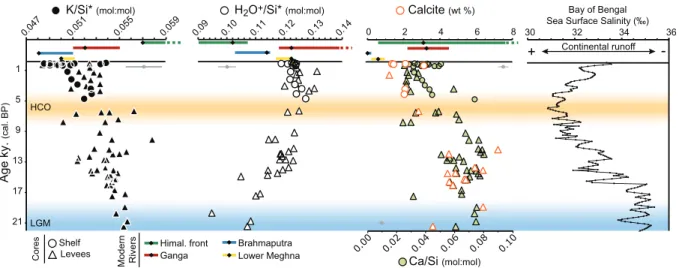
in chemical weathering. Composite logs of K/Si* and H2O+/Si* (Figure 6) show a progressive
221
evolution towards lower K/Si* and higher H2O+/Si* ratios from the LGM to present. Both
222
weathering proxies suggest that during the LGM, sediments exported to the Bay of Bengal 223
were less weathered than recent Bay of Bengal and modern lower-Meghna sediments. It 224
should also be noted that the chemical composition of sediments from the most recent part of 225
the Bay of Bengal record agrees well with that of the sediments currently exported by the 226
lower Meghna (Figure 6). 227
Calcite content and Ca/Si ratios also decrease from LGM to present (Figure 6). Calcite 228
in sediments from the Bay of Bengal is of detrital origin as demonstrated by their isotopic 229
composition (d18O
PDB ranging from -15 to -6 ‰, see electronic appendix), much lower than
230
marine biogenic calcite (Hoehndorf et al., 2003) and within the range of composition of 231
detrital Himalayan river calcite (Lupker et al., 2012b). The decrease in calcite concentration 232
and Ca/Si ratios since the last glacial maximum supplement the K/Si* and H2O+/Si* records,
233
further reinforcing the conclusion that sediment weathering increased during the studied 234
period. 235
Estuarine and early digenetic reactions such as weathering and reverse weathering 236
may affect the composition of deposited sediments (Jones et al., 2012; Michalopoulos and 237
Aller, 1995; Michalopoulos and Aller, 2004; Wallmann et al., 2008). The close agreement 238
between the chemical composition of modern lower Meghna sediments and the recent part of 239
the record, both from the shelf and the levee, suggests that estuarine processes do not alter 240
significantly the composition of river sediments delivered to the Bay of Bengal. The chemical 241
weathering of sediments after deposition cannot explain the trends observed in the Bay of 242
Bengal record either. Indeed, post-depositional weathering would lead to down-core increase 243
in the weathering intensity which is opposite to the observed trend. Reverse weathering leads 244
to an uptake of K and to an overall decrease in structural OH radicals of the sediments 245
(Michalopoulos and Aller, 1995) but cannot explain the observed down-core increase in 246
detrital carbonate content. Furthermore, during reverse weathering reactions, the newly 247
formed minerals will form in equilibrium with seawater so that the D/H isotopic composition 248
of their hydroxyls groups should become heavier as reverse weathering reactions proceed. 249
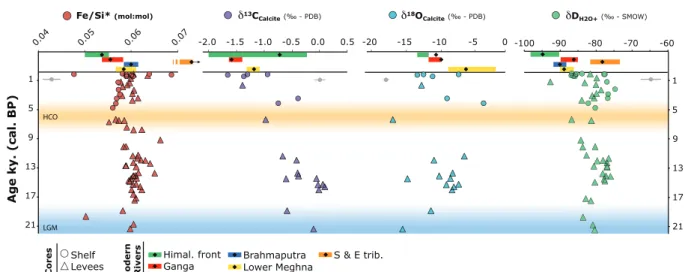
However no systematic down-core increase in dDH2O+ is observed (supplementary
250
information, Figure S1). 251
252
5. Sediment provenance since the LGM:
253 254
Potential sediment source effects on the chemical composition of Bay of Bengal 255
sediments since the LGM must be taken into account as changes in precipitation and erosion 256
patterns within and across the Himalayan range may have affected the sedimentary record. 257
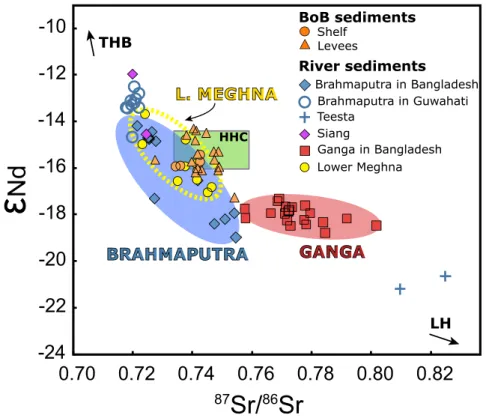
The Sr and Nd isotopic signatures of river sediments in the Himalayan range are a first order 258
indicator of the erosion balance between the Lesser Himalaya (LH) and High Himalaya 259
(HHC) (and Transhimalayan formations – THB – for Brahmaputra) as these units have 260
contrasted isotopic compositions (France-Lanord et al., 1993; Singh and France-Lanord, 261
2002a). Sediments from the Ganga and Brahmaputra basins also show distinctive Sr and Nd 262
isotopic compositions so that changes in the balance of sediment supply from both basins 263
would be detected (Figure 7). 264
Previous studies have shown contrasting changes in the balance between sediments 265
from the LH and HHC in the Indus basin (Clift et al., 2008) and the western part of the Ganga 266
basin (Rahaman et al., 2009; Rahaman et al., 2010; Srivastava and Shukla, 2010) since 267
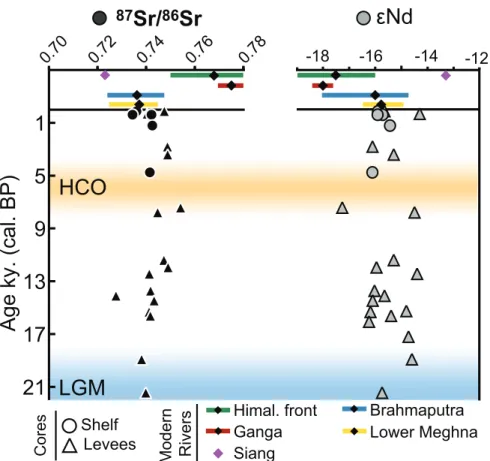
deglaciation. However, both Sr and Nd isotopic compositions of Bay of Bengal sediments 268
appear constant, implying that there is no evidence for major changes in the distribution of 269
erosion within the Himalayan range at this scale (Figure 7). The Sr and Nd record also 270
suggests that the balance between the Brahmaputra and Ganga has remained roughly constant 271
over the last 20 kyrs. A significant change in the sediment balance between Ganga and 272
Brahmaputra would furthermore result in a correlated evolution of K/Si* and H2O+/Si*,
273
whereas these ratios are actually anti-correlated since the LGM (Figure 6), demonstrating that 274
the weathering signal overprints any potential change in sediment source. 275
An increase in sediments from the Siwalik or from southern tributaries through time is 276
also very unlikely. Siwalik rocks and sediments are characterized by high carbonate content 277
and low d13C compositions (Lupker et al., 2012b; Sanyal et al., 2005). Thus, the concomitant
278
decrease of both carbonate content and d13C values observed in the Bay of Bengal sediments
279
is not compatible with an increase of sediment supply from the Siwaliks. In addition, 280
sediments from the Chambal River in the Ganga basin and the Eastern tributaries of the 281
Brahmaputra basin (Lohit and Dibang) have distinctively higher Fe/Si ratios and unradiogenic 282
Sr and Nd signatures (Lupker et al., 2012b; Singh and France-Lanord, 2002a; Singh et al., 283
2008) that are not identified in our record (see supplementary information, Figure S1). 284
285
Altogether, the observed changes in Bay of Bengal sediment mobile elements 286
composition since the LGM can thus be primarily attributed to changes in the chemical 287
weathering intensity in the Ganga & Brahmaputra basin. 288
289
6. Discussion:
290
6.1 Climatic forcing of Himalayan chemical weathering
291 292
During the last 21 kyrs, climate has been the main external forcing of Himalayan 293
erosion that could have affected the Bay of Bengal weathering signal. Paleo-temperature 294
reconstructions over the Himalayan system are scarce but indicate a ca. 2 °C colder LGM sea 295
surface temperature (SST) in the Bay of Bengal (Kudrass et al., 2001). Hydrological changes 296
were significant with strongly reduced monsoon and therefore a lower continental runoff 297
during the last glacial (Cullen, 1981; Duplessy, 1982; Herzschuh, 2006; Kudrass et al., 2001), 298
which reduced the sediment supply to the Bay of Bengal (Goodbred, 2003; Weber et al., 299
1997). Precipitation and temperature directly control the weathering rate of minerals (White 300
and Blum, 1995), and the conditions during the LGM where therefore less favorable for 301
intense weathering in the floodplain. These changes in floodplain weathering are confirmed 302
by the evolution of clay assemblages in the southern part of the basin that suggests an 303
increase in weathering intensity from at least 10 kyr to present (Heroy et al., 2003). 304
Additional, independent processes should not be excluded (Blum and Tornqvist, 305
2000). The lower base level and a reduced sediment supply during the LGM could have lead 306
to channel incision and a narrower active floodplain (Goodbred, 2003; Heroy et al., 2003), 307
which would reduce channel – floodplain interactions and limit the supply of weathered 308
floodplain sediments to the Bay of Bengal. A complete abandonment of the floodplain during 309
the LGM is nevertheless unlikely as floodplain derived organic material is persistent in the 310
Bay of Bengal cores throughout the deglaciation (Galy et al., 2008) but changes in the 311
sediment locus and volume being mobilized should not be excluded (Dosseto et al., 2010). 312
The weathering degree of sediments does, however, not show any clear change in 313
response to the decrease of monsoon intensity after the Holocene Climatic Optimum (HCO) 314
(Kudrass et al., 2001). The sediment fluxes during the HCO were up to double modern fluxes 315
as indicated by sediment volume reconstructions (Goodbred, 2003). These high sediment 316
fluxes may have obliterated the intense weathering conditions prevailing at that time. It can 317
also not be ruled out that modern sediments reflect the export of material weathered during 318
the HCO owing to a long-sediment transfer time so that the post-HCO decrease in 319
precipitation is not yet recorded in the Bay of Bengal. The impact of anthropogenic activity in 320
the Indo-Gangetic floodplain should also be considered as intense land use changes, certainly 321
significant more than 3 centuries ago (Ramankutty and Foley, 1999), may overprint the 322
climatic forcing of the weathering degree in the recent part of the record if already significant 323
thousands of years ago (Bayon et al., 2012). 324
325
The sediment transfer time through the Himalayan system has to be considered as 326
well, as a long transfer time would induce a temporal offset between the suggested climatic 327
forcing of weathering in the Ganga & Brahmaputra basin and its recording in the sediment 328
record of the Bay of Bengal. The sediment transfer time in large continental basins remains 329
difficult to constrain. U-series disequilibrium studies on Ganga sediments suggest that the 330
transfer time of coarse sediments may reach several 100 kyrs while fine grained suspended 331
material travel in less than 25 kyrs (Chabaux et al., 2009; Chabaux et al., 2006; Granet et al., 332
2010; Granet et al., 2007). However, simple mass balance considerations based on the volume 333
of the active floodplain and grain size along with modern sediment fluxes suggest shorter 334
transfer time scales of 1 kyrs for fine (<100 µm) sediments along the Ganga floodplain 335
(Lupker et al., 2012a) and most probably even shorter transfer time along the narrower 336
Brahmaputra floodplain. In addition, short term variability of the chemical composition of 337
Ganga sediments observed in Bangladesh and attributed to the variable input of a > 1000 km 338
distant, upstream tributary suggests that for fine-grained suspended sediment the transfer time 339
can be of the order of the season (Lupker et al., 2012b). Finally, a relatively short transfer 340
time is also supported by the organic carbon Bay of Bengal record, which shows a change in 341
vegetation photosynthetic type over the Ganga & Brahmaputra basin from the last glacial to 342
present (Galy et al., 2008). This vegetation change follows the model predictions and would 343
not be recorded if the sediment transfer time exceeded glacial – interglacial time scales. 344
Although the transfer time of sediments is probably significant and remains difficult to 345
quantify, a network of evidences suggests that it is lower than glacial-interglacial time scales 346
for fine sediments such as those composing the Bay of Bengal record (high Al/Si ratios). 347
Thus, the observed weathering trends most likely results from the direct or indirect climatic 348
forcing of weathering in the Ganga & Brahmaputra basin. 349
350
6.2 Towards a quantitative weathering budget
351 352
Changes in the net weathering flux or dissolved flux (φX) can be estimated by
353
considering that, at steady state, the weathering flux exported as solutes to the oceans is the 354
product of the mobile element depletion of sediments (ΔX) and the sediment flux (Fsed)
355
(Lupker et al., 2012b): 356
(2)
357
Where is the average mobile to immobile ratio of the source and sink sediments and 358
the average Si concentration of the sediments. A high-resolution reconstruction of 359
weathering fluxes is pointless, as the steady state hypothesis is likely not fully satisfied over 360
short time-scales because of late Holocene climatic variations and anthropogenic imprints 361
(possibly acting over timescales shorter than the sediment residence time in the floodplain). A 362
first order estimate can nevertheless be made by comparing the loss of K, and gain in H2O+,
363
relative to Himalayan front sediments for the LGM (19 – 22 kyr) and the modern (0 – 2 kyr) 364
part of the record. 365
The average and ratios of the exported sediment flux can be 366
estimated based on the average Al/Si ratio of the sediments, as Al/Si is relatively insensitive 367
to chemical weathering. The average Al/Si ratio of sediments was estimated to be 0.23 for the 368 X = Fsed X = Fsed X SiSource Si
[ ]
Source X SiSink Si[ ]
Sink X / Si Si[ ]
K / Si H2O+/ Siapproximated by and , as for these ratios the composition of the sediment 370
is normalized to an Al/Si ratio of 0.23. 371
Because the effect of weathering in the Himalayan range is not detected on the K/Si 372
and H2O+/Si composition of modern river sediments sampled at the front of the Himalayan
373
range (Lupker et al., 2012b), we conclude that the composition of these sediments is a good 374
approximation of the average composition of the sediment source. This observation also 375
excludes the possibility of a significantly lower degree of sediment weathering within the 376
Himalayan range during the LGM, as weathering for K and H2O+ is already limited at present.
377
We therefore consider that the Himalayan front end-member (as constrained from the mixture 378
of 60 % of sediments from the Himalayan front in the Brahmaputra basin and 40 % in the 379
Ganga basin) is a good first order approximation of the sediment source composition, both in 380
the modern day system and during the LGM. The modern dissolved flux of Si is negligible 381
compared to the solid Si fluxes (Galy and France-Lanord, 2001) and this was most likely also 382
the case during the LGM as the chemical weathering intensity was even lower than at present. 383
Furthermore the Si concentration of the exported sediments is only slightly affected by 384
sequestration of Si-rich bedload sediments in the modern floodplain (Lupker et al., 2012b) 385
and we make the assumption that this has been true during the last 21 kyrs. Hence, we 386
consider constant during the time span of our record. 387
The change in the weathering flux (RφX) of mobile element X from LGM to present
388
relative to the modern fluxes can therefore be written as: 389 (3) 390 K / Si * H2O+/ Si * Si
[ ]
R X = X Modern X LGM X Modern = FSedModern X Si*HimalFront Modern X Si*BoB Modern FSedLGM X Si*HimalFront LGM X Si*BoB LGM FSed XSi* HimalFront Modern X Si*BoB Modern ModernIn order to estimate RφXfrom eq. 3, the sediment flux (Fsed) has to be estimated at present and
391
during the LGM. Based on extensive gauging data the combined modern flux of the Ganga & 392
Brahmaputra in Bangladesh is estimated to be ca. 1.109 t.yr-1 (RSP, 1996). The past sediment
393
flux exported by the Ganga & Brahmaputra is largely unknown. However, qualitatively, the 394
sediment flux was most probably lower during the LGM than at present. A weakened 395
monsoon during the LGM (Kudrass et al., 2001; Sharma et al., 2004) may have limited 396
physical erosion in the Himalayan range and lowered the transport capacity of the rivers, 397
leading to a lower sediment flux to the Bay of Bengal (Weber et al., 1997; Goodbred, 2003). 398
A very conservative estimate of the minimum value of RφX can therefore be made assuming a
399
constant sediment flux over the period. By doing so we also isolate the effect of the change in 400
the chemical composition of sediments only. 401
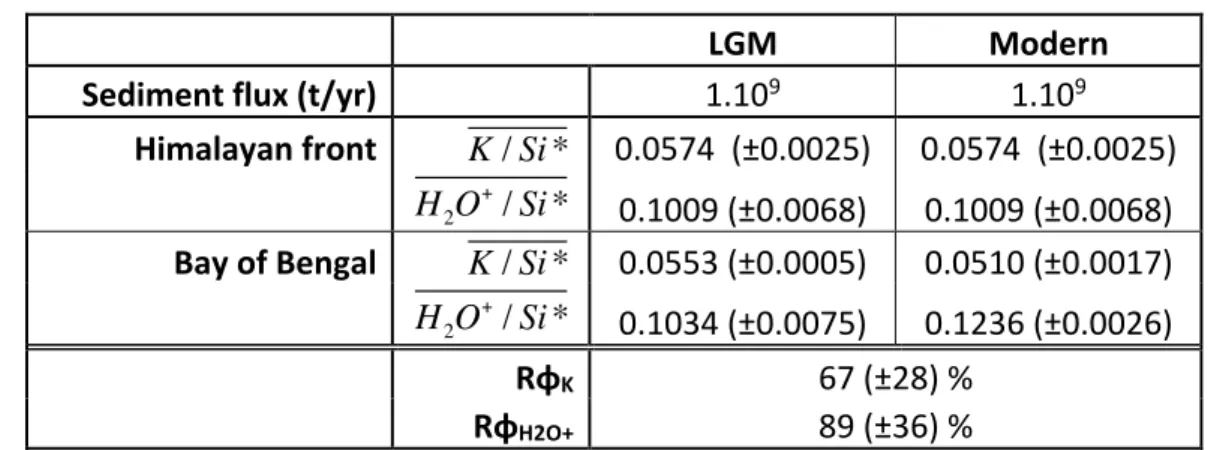
Rφ was computed using eq. 3 for K and H2O+ and is summarized in Table 1.
402
Uncertainties on the K/Si* and H2O+/Si* ratios of individual samples are ca 3%
403
(supplementary information S3). This is of the same order as the variability of K/Si* and 404
H2O+/Si* ratios over the 0 – 2 and 19-22 kyr intervals or of the uncertainties on the regression
405
through the data for the Himalayan front sediments. These uncertainties were propagated 406
through the calculations of RφX and reported in Table 1. The sensitivity of the weathering
407
budget to the average Al/Si ratio of sediments is lower than the uncertainty propagated from 408
the variability of K/Si* and H2O+/Si* ratios (see supplementary information S3). This first
409
order estimation shows that the weathering flux during the LGM was at least 67 (±28) and 89 410
(±36) % lower (for K and H2O+, respectively) than for the modern period (0-2 kyrs) for a
411
constant sediment flux. The main uncertainty on these estimates comes from the uncertainty 412
on the sediment Ganga and Brahmaputra sediment flux during the LGM. A sediment flux 413
during the LGM of half the present day sediment flux would induce a 83 and 95 % lower 414
weathering flux during the LGM compared to present for K and H2O+, respectively.
416
The loss of K in the Himalayan system is mainly attributed to the weathering of biotite 417
while the gain in hydration also depends on clay secondary mineral formation (Lupker et al., 418
2012). Because the reaction mechanisms in both cases are different, their sensitivity to 419
changes in precipitation and temperature is also most probably different. Despite our 420
estimates for both proxies being similar within uncertainty, it would not be surprising that the 421
relative changes in weathering fluxes recorded by K and H2O+ could be different. It is not
422
possible to estimate the relative change in calcite weathering using a similar approach, 423
because for calcite the Himalayan source composition cannot be reliably estimated. Indeed, 424
significant carbonate dissolution has been documented within the Himalayan range (Galy and 425
France-Lanord, 1999), hence, Himalayan front river sediments cannot accurately represent the 426
eroded source. In addition, no direct estimation of the average calcite content of Himalayan 427
rocks is available. 428
Our quantification of the change in the net weathering flux from LGM to present 429
should only be considered as a rough estimate. In particular, it should be kept in mind that 430
these estimates somewhat depend upon the assumption of a transition between two steady 431
state weathering stages. Nevertheless, our estimates suggest that changes in weathering fluxes 432
exported by the Himalayan system have been significant over short time scales of ca. 20 kyrs. 433
The magnitude of the variations in weathering fluxes reconstructed here exceeds previous 434
estimates (Foster and Vance, 2006). This may be attributed in part to the very high weathering 435
rates of glacial outwash during the very early stage of an interglacial, as proposed earlier 436
(Foster and Vance, 2006; Vance et al., 2009) combined to the short time span of our record. 437
However, for the Himalayan system the weathering intensity in the modern floodplain 438
(Lupker et al., 2012b; West et al., 2002) supports the dominant role of the floodplain in 439
modulating glacial to interglacial weathering fluxes. This study further emphasizes that 440
present day weathering rates are likely higher than long-term averages, which supports the 441
idea that the imbalance of oceanic geochemical cycles may at least partially derive from the 442
over-estimation of Quaternary riverine fluxes to the oceans (Vance et al., 2009). 443
444
7. Conclusions:
445 446
The geochemistry of detrital sediment records holds valuable information on the 447
weathering regime these sediments have undergone during their transit from sediment 448
producing areas to their deposition in sedimentary basins. The chemical composition of these 449
sediments is primarily controlled by sediment sorting effects that occur during transport and 450
deposition. Nevertheless weathering signals can be extracted from the sediment chemical 451
composition if sorting is properly taken into account by comparing sediment records to 452
modern river systems. 453
The detrital record presented here shows that the degree of chemical weathering 454
experienced by sediments exported by the Himalayan system, drained by the Ganga and 455
Brahmaputra Rivers, has changed significantly since the LGM. An overall decrease in 456
potassium and detrital calcite content along with an increase in sediment hydration all point 457
towards a steady increase in the weathering degree of sediments over the last 21 kyrs, while 458
the sediment provenance has remained unchanged. These changes in the weathering regime 459
are attributed to the direct climatic forcing of chemical weathering in the floodplain, as 460
increasing precipitation and temperatures after the deglaciation favored mineral weathering 461
kinetics. Additional hydrological changes in response to increasing runoff and rising base 462
level might also have impacted weathering through enhanced channel-floodplain interactions. 463
A first order estimation of changes in the weathering flux delivered to the oceans can 464
be made using the detrital record and conservatively assuming a steady sediment flux. It 465
shows that weathering fluxes from the Himalayan system could have been reduced by 90 % 466
during the LGM. This supports previous evidence that current dissolved fluxes are likely 467
higher than average Quaternary estimates. These drastic changes in solute supply to the 468
oceans on glacial-interglacial time scales have to be accounted for to reconstruct global 469
oceanic biogeochemical cycles. 470
471
Acknowledgments:
472
This work was supported by French INSU program “Relief de la Terre” and ANR 473
Calimero. V.G. was supported by the U.S. National Science Fundation (Grant OCE-0851015, 474
OCE-0928582). We thank C. Guilmette for assistance in the lab. H. Schopka and two 475
anonymous reviewers are also thanked for their constructive comments that helped to improve 476
the manuscript. T.M. Harrison is acknowledged for the very efficient handling of the 477
manuscript. 478
References :
479
Bayon, G., Dennielou, B., Etoubleau, J., Ponzevera, E., Toucanne, S., Bermell, S., 2012.
480
Intensifying Weathering and Land Use in Iron Age Central Africa. Science 335,
1219-481
1222. 10.1126/science.1215400
482
Blum, M.D., Tornqvist, T.E., 2000. Fluvial responses to climate and sea-level change: a
483
review and look forward. Sedimentology 47, 2-48.
484
Bouchez, J., Gaillardet, J., France-Lanord, C., Maurice, L., Dutra-Maia, P., 2011a.
485
Grain size control of river suspended sediment geochemistry: Clues from Amazon River
486
depth profiles. Geochem. Geophys. Geosyst. 12, Q03008. 10.1029/2010gc003380
487
Bouchez, J., Lupker, M., Gaillardet, J., France-Lanord, C., Maurice, L., 2011b. How
488
important is it to integrate riverine suspended sediment chemical composition with
489
depth? Clues from Amazon River depth-profiles. Geochimica Et Cosmochimica Acta 75,
490
6955-6970. 10.1016/j.gca.2011.08.038
491
Carignan, J., Hild, P., Mevelle, G., Morel, J., Yeghicheyan, D., 2001. Routine analyses of
492
trace elements in geological samples using flow injection and low pressure on-line liquid
493
chromatography coupled to ICP-MS: A study of geochemical reference materials BR,
494
DR-N, UB-N, AN-G and GH. Geostandards Newsletter-the Journal of Geostandards
495
and Geoanalysis 25, 187-198.
496
Chabaux, F., Granet, M., Blaes, E., Dosseto, A., France-Lanord, C., Valier, V., 2009.
497
Determination of source and transfer-time of river sediments in alluvial plain from
U-498
series nuclides: Evidence from the Ganges River System. Geochimica Et Cosmochimica
499
Acta 73, A203-A203.
500
Chabaux, F., Granet, M., France-Lanord, C., Stille, P., 2006. U-series in Himalayan
501
rivers: Timescale of sedimentary transfer. Geochimica Et Cosmochimica Acta 70,
A92-502
A92. 10.1016/j.gca.2006.06.097|ISSN 0016-7037
503
Clift, P.D., Giosan, L., Biusztajn, J., Campbell, I.H., Allen, C., Pringle, M., Tabrez, A.R.,
504
Danish, M., Rabbani, M.M., Alizai, A., Carter, A., Lueckge, A., 2008. Holocene erosion
505
of the Lesser Himalaya triggered by intensified summer monsoon. Geology 36, 79-82.
506
10.1130/g24315a.1|issn 0091-7613
507
Cullen, J.L., 1981. Microfossil evidence for changing salinity patterns in the Bay of
508
Bengal over the last 20000 years. Palaeogeography Palaeoclimatology Palaeoecology 35,
509
315-356.
510
Dosseto, A., Hesse, P.P., Maher, K., Fryirs, K., Turner, S., 2010. Climatic and vegetation
511
control on sediment dynamics during the last glacial cycle. Geology 38, 395-398.
512
10.1130/g30708.1
513
Duplessy, J.C., 1982. Glacial to interglacial contrasts in the northern Indian Ocean, .
514
Nature 295, 494-498.
515
Foster, G.L., Vance, D., 2006. Negligible glacial-interglacial variation in continental
516
chemical weathering rates. Nature 444, 918-921. 10.1038/nature05365
517
France-Lanord, C., Derry, L., 1997. Organic carbon burial forcing of the carbon cycle
518
from Himalayan erosion. Nature 390, 65-66.
519
France-Lanord, C., Derry, L., Michard, A., 1993. Evolution of the Himalaya since
520
Miocene time: isotopic and sedimentologic evidence from the Bengal Fan, in: Treloar,
521
P.J., Searle, M. (Eds.), Himalayan Tectonics. Geol. Soc. Lond., London, pp. 603-621.
522
Galy, A., France-Lanord, C., 2001. Higher erosion rates in the Himalaya: Geochemical
523
constraints on riverine fluxes. Geology 29, 23-26.
524
Galy, A., France-Lanord, C., Derry, L.A., 1999. The strontium isotopic budget of
525
Himalayan Rivers in Nepal and Bangladesh. Geochimica Et Cosmochimica Acta 63,
526
1905-1925.
Galy, V., François, L., France-Lanord, C., Faure, P., Kudrass, H., Palhol, F., Singh, S.,
528
2008. C4 plants decline in the Himalayan basin since the Last Glacial Maximum.
529
Quaternary Science Reviews 27, 1396-1409. doi:10.1016/j.quascirev.2008.04.005
530
Garzanti, E., Ando, S., France-Lanord, C., Censi, P., Vignola, P., Galy, V., Lupker, M.,
531
2011. Mineralogical and chemical variability of fluvial sediments 2. Suspended-load silt
532
(Ganga-Brahmaputra, Bangladesh). Earth and Planetary Science Letters 302, 107-120.
533
10.1016/j.epsl.2010.11.043
534
Garzanti, E., Ando, S., France-Lanord, C., Vezzoli, G., Censi, P., Galy, V., Najman, Y.,
535
2010. Mineralogical and chemical variability of fluvial sediments 1. Bedload sand
536
(Ganga-Brahmaputra, Bangladesh). Earth and Planetary Science Letters 299, 368-381.
537
10.1016/j.epsl.2010.09.017
538
Goodbred, S.L., 2003. Response of the Ganges dispersal system to climate change: a
539
source-to-sink view since the last interstade. Sedimentary Geology 162, 83-104.
540
Granet, M., Chabaux, F., Stille, P., Dosseto, A., France-Lanord, C., Blaes, E., 2010.
U-541
series disequilibria in suspended river sediments and implication for sediment transfer
542
time in alluvial plains: The case of the Himalayan rivers. Geochimica Et Cosmochimica
543
Acta 74, 2851-2865. 10.1016/j.gca.2010.02.016
544
Granet, M., Chabaux, F., Stille, P., France-Lanord, C., Pelt, E., 2007. Time-scales of
545
sedimentary transfer and weathering processes from U-series nuclides: Clues from the
546
Himalayan rivers. Earth and Planetary Science Letters 261, 389-406.
547
10.1016/j.epsl.2007.07.012|ISSN 0012-821X
548
Heroy, D., Kuehl, S., Goodbred, S., 2003. Mineralogy of the Ganges and Brahmaputra
549
rivers: Implications for river switching and Late Quaternary climate change.
550
Sedimentary Geology 155, 343-359.
551
Herzschuh, U., 2006. Palaeo-moisture evolution in monsoonal Central Asia during the
552
last 50,000 years. Quaternary Science Reviews 25, 163-178.
553
Hoehndorf, A., Kudrass, H.R., France-Lanord, C., 2003. Transfer of the Sr isotopic
554
signature of the Himalayas to the Bay of Bengal. Deep-Sea Research Part Ii-Topical
555
Studies in Oceanography 50, 951-960. 10.1016/s0967-0645(02)00614-8|issn 0967-0645
556
Ittekkot, V., Kudrass, H.R., Quadfasel, D., Unger, D., 2003. The Bay of Bengal--An
557
Introduction. Deep Sea Research Part II: Topical Studies in Oceanography 50, 853-854.
558
Jones, M.T., Pearce, C.R., Oelkers, E.H., 2012. An experimental study of the interaction
559
of basaltic riverine particulate material and seawater. Geochimica Et Cosmochimica
560
Acta 77, 108-120. 10.1016/j.gca.2011.10.044
561
Kudrass, H., Hofmann, A., Doose, H., Emeis, K., Erlenkeuser, H., 2001. Modulation and
562
amplification of climatic changes in the Northern Hemisphere by the Indian summer
563
monsoon during the past 80 k.y. Geology 29, 63-66.
564
Limmer, D.R., Bˆning, P., Giosan, L., Ponton, C., Kˆhler, C.M., Cooper, M.J., Tabrez,
565
A.R., Clift, P.D., 2012. Geochemical record of Holocene to Recent sedimentation on the
566
Western Indus continental shelf, Arabian Sea. Geochem. Geophys. Geosyst. 13, Q01008.
567
10.1029/2011gc003845
568
Lupker, M., Blard, P.-H., Lavé, J., France-Lanord, C., Leanni, L., Puchol, N., Charreau,
569
J., Bourlès, D., 2012a. 10Be-derived Himalayan denudation rates and sediment budgets
570
in the Ganga basin. Earth and Planetary Science Letters 333–334, 146-156.
571
10.1016/j.epsl.2012.04.020
572
Lupker, M., France-Lanord, C., Galy, V., Lave, J., Gaillardet, J., Gajurel, A.P.,
573
Guilmette, C., Rahman, M., Singh, S.K., Sinha, R., 2012b. Predominant floodplain over
574
mountain weathering of Himalayan sediments (Ganga basin). Geochimica Et
575
Cosmochimica Acta 84, 410-432. 10.1016/j.gca.2012.02.001
Lupker, M., France-Lanord, C., LavÈ, J., Bouchez, J., Galy, V., MÈtivier, F.,
577
Gaillardet, J., Lartiges, B., Mugnier, J.-L., 2011. A Rouse-based method to integrate the
578
chemical composition of river sediments: Application to the Ganga basin. J. Geophys.
579
Res. 116, F04012. 10.1029/2010jf001947
580
Michalopoulos, P., Aller, R.C., 1995. Rapid Clay Mineral Formation in Amazon Delta
581
Sediments: Reverse Weathering and Oceanic Elemental Cycles. Science 270, 614.
582
Michalopoulos, P., Aller, R.C., 2004. Early diagenesis of biogenic silica in the Amazon
583
delta: alteration, authigenic clay formation, and storage. Geochimica Et Cosmochimica
584
Acta 68, 1061-1085. 10.1016/j.gca.2003.07.018
585
Michels, K.H., Kudrass, H.R., H¸bscher, C., Suckow, A., Wiedicke, M., 1998. The
586
submarine delta of the Ganges-Brahmaputra: cyclone-dominated sedimentation
587
patterns. Marine Geology 149, 133-154.
588
Pierson-Wickmann, A.-C., Reisberg, L., France-Lanord, C., Kudrass, H., 2001.
Os-Sr-589
Nd results from sediments in the Bay of Bengal: Implications for sediment transport and
590
the marine Os record. Paleoceanography 16, 435-444.
591
Rahaman, W., Singh, S.K., Sinha, R., Tandon, S.K., 2009. Climate control on erosion
592
distribution over the Himalaya during the past ~100 ka. Geology 37, 559-562.
593
10.1130/g25425a.1
594
Rahaman, W., Singh, S.K., Sinha, R., Tandon, S.K., 2010. Climate control on erosion
595
distribution over the Himalaya during the past similar to 100 ka: REPLY. Geology 38,
596
E217-E217. 10.1130/g31119y.1
597
Ramankutty, N., Foley, J.A., 1999. Estimating historical changes in global land cover:
598
Croplands from 1700 to 1992. Global Biogeochem. Cycles 13, 997-1027.
599
10.1029/1999gb900046
600
Raymo, M., Ruddiman, W., Froelich, P., 1988. Influence of late Cenozoic mountain
601
building on ocean geochemical cycles. Geology 16, 649.
602
Reimer, P.J., Baillie, M.G.L., Bard, E., Bayliss, A., Beck, J.W., Blackwell, P.G., Ramsey,
603
C.B., Buck, C.E., Burr, G.S., Edwards, R.L., Friedrich, M., Grootes, P.M., Guilderson,
604
T.P., Hajdas, I., Heaton, T.J., Hogg, A.G., Hughen, K.A., Kaiser, K.F., Kromer, B.,
605
McCormac, F.G., Manning, S.W., Reimer, R.W., Richards, D.A., Southon, J.R., Talamo,
606
S., Turney, C.S.M., van der Plicht, J., Weyhenmeye, C.E., 2009. Intcal09 and Marine09
607
Radiocarbon Age Calibration Curves, 0-50,000 Years Cal Bp. Radiocarbon 51,
1111-608
1150.
609
RSP, 1996. River Survey Project, Flood Action Plan (FAP) final report. Delft Hydraulics
610
and DHI.
611
Sanyal, P., Bhattacharya, S.K., Prasad, M., 2005. Chemical diagenesis of Siwalik
612
sandstone: Isotopic and mineralogical proxies from Surai Khola section, Nepal.
613
Sedimentary Geology 180, 57-74.
614
Sharma, S., Joachimski, M., Sharma, M., Tobschall, H.J., Singh, I.B., Sharma, C.,
615
Chauhan, M.S., Morgenroth, G., 2004. Lateglacial and Holocene environmental changes
616
in Ganga plain, Northern India. Quaternary Science Reviews 23, 145-159.
617
Singh, S., France-Lanord, C., 2002a. Tracing the distribution of erosion in the
618
Brahmaputra watershed from isotopic compositions of stream sediments. Earth and
619
Planetary Science Letters 252, 645-662.
620
Singh, S.K., France-Lanord, C., 2002b. Erosion distribution in the Eastern Himalaya
621
traced by Sr-Nd isotopic compositions of river sediments. Geochimica Et Cosmochimica
622
Acta 66, A720-A720.
623
Singh, S.K., Rai, S.K., Krishnaswami, S., 2008. Sr and Nd isotopes in river sediments
624
from the Ganga Basin: Sediment provenance and spatial variability in physical erosion.
625
J. Geophys. Res. 113, F03006. 10.1029/2007jf000909
Singh, S.K., Sarin, M.M., France-Lanord, C., 2005. Chemical erosion in the eastern
627
Himalaya: Major ion composition of the Brahmaputra and delta C-13 of dissolved
628
inorganic carbon. Geochimica Et Cosmochimica Acta 69, 3573-3588.
629
10.1016/j.gca.2005.02.033|ISSN 0016-7037
630
Srivastava, P., Shukla, U.K., 2010. Climate control on erosion distribution over the
631
Himalaya during past similar to 100 ka: COMMENT. Geology 38, E216-E216.
632
10.1130/g30838c.1
633
Vance, D., Teagle, D.A.H., Foster, G.L., 2009. Variable Quaternary chemical weathering
634
fluxes and imbalances in marine geochemical budgets. Nature 458, 493-496.
635
10.1038/nature07828
636
Walker, J., Hays, P., Kasting, J., 1981. A negative feedback mechanism for the
long-637
term stabilization of the Earth's surface temperature. Journal of Geophysical Research
638
86, 9776-9782.
639
Wallmann, K., Aloisi, G., Haeckel, M., Tishchenko, P., Pavlova, G., Greinert, J.,
640
Kutterolf, S., Eisenhauer, A., 2008. Silicate weathering in anoxic marine sediments.
641
Geochimica Et Cosmochimica Acta 72, 2895-2918.
642
Weber, M.E., Wiedicke, M.H., Kudrass, H.R., Hübscher, C., Erlenkeuser, H., 1997.
643
Active growth of the bengal Fan during sea-level rise and highstand. Geology 25,
315-644
318.
645
West, A.J., Bickle, M.J., Collins, R., Brasington, J., 2002. Small-catchment perspective
646
on Himalayan weathering fluxes. Geology 30, 355-358.
10.1130/0091-647
7613(2002)030<0355:scpohw>2.0.co;2
648
White, A.F., Blum, A.E., 1995. Effects of climate on chemical weathering in watersheds.
649
Geochimica et Cosmochimica Acta 59.
650
Willenbring, J.K., von Blanckenburg, F., 2011. Long-term stability of global erosion
651
rates and weathering during late-Cenozoic cooling. Nature 465, 211-214.
652 10.1038/nature09044 653 654 655 656
Figures:
657
658
Figure 1: Geographical setting of the Himalayan system. Modern river sediments were
659
sampled in the Ganga & Brahmaputra basin at the Himalayan front (green diamonds), 660
at the outlet of the Ganga basin (red square) and the Brahmaputra basin (blue triangle) 661
and finally after their confluence in the lower Meghna (yellow circle). These 662
sediments were compared to the sediment record of the Bay of Bengal that represents 663
a composite record from proximal shelf sediments (105KL and 107KL) and from the 664
middle fan channel levees (117KL, 118KL and 120KL). 665 666 76˚ 80˚ 84˚ 88˚ 92˚ 96˚ 16˚ 20˚ 24˚ 28˚ Chambal Siang Tsangpo Lohit Kosi Narayani Karnali Ganga Yamu na Tista Manas Subansiri 105 KL 107 KL 120 KL 117 KL 118 KL Bay of Bengal N 200 km Ganga Brahmaputra lower Meghna INDIA NEPAL TIBET
667
Figure 2: Hydraulic sorting effect on the Si-Al-Fe chemical composition of sediments.
668
Suspended sediments are the result of the mixing between a low Al/Si and Fe/Si 669
quartz-rich coarse-grained member and a high Al/Si and Fe/Si surface end-670
member relatively enriched in phylosilicates. 671 672 0.00 0.05 0.10 0.15 0.20 0.0 0.1 0.2 0.3 0.4 0.5 0.6 Clays Quartz Biotite Biotite Muscovite Muscovite Sedim ent s ampli ng de pth Deep , Bedload Surfac e
Al/Si
(mol:mol)Fe/Si
(mol:mol) BL SL Himalayan Rivers Ganga in Bangladesh Brahmaputra in Bangladesh Lower Meghna673
Figure 3: Evolution of K/Si (a) and H2O+/Si (b) in the modern Himalayan system for river
674
suspended load (SL) and bedload or bar sediments (BL). The transfer of sediments 675
from the Himalayan front Rivers (green) to the outlet of the Ganga (red) and 676
Brahmaputra (blue), as well as their confluence the lower-Meghna (yellow) results in 677
a loss of K and an increase in H2O+ as weathering proceeds. Envelopes represent 0.95
678
confidence level on the linear regression. 679 0.0 0.1 0.2 0.3 0.4 0.1 0.2 0.3 0.4 0.5 0.05 0.10 0.15 0.1 0.2 0.3 0.4 0.5 BL SL Himalayan Rivers Ganga in Bangladesh Brahmaputra in Bangladesh Lower Meghna K/Si (mol:mol) H2 O +/Si (mol:mol)
Al/Si (mol:mol) Al/Si (mol:mol)
a. b. We at he rin g We at he rin g Fine
680
Figure 4: Normalization of the chemical composition of sediments in of the Bay of Bengal
681
record for hydraulic sorting effects. The K/Si and H2O+/Si ratios of the sample are
682
normalized to a common Al/Si ratio of 0.23 assuming that the sediment sorting line 683
passes through a unique coarse-grained end-member with a composition close to river 684
bedloads (given in the supplementary information, Table S1). 685 0.23 Coarse end-member
MIN
ERA
L S
OR
TIN
G
BoB Sample BoB Sample K/Si* - H 2 O +/Si*Al/Si
(mol:mol)mobile
element
/ Si
686
Figure 5: K/Si and H2O+/Si in Bay of Bengal core sediments are strongly correlated to Al/Si,
687
which is a proxy for grain size (Bouchez et al., 2011a; Lupker et al., 2011). Correction 688
for hydraulic mineral sorting yields unbiased weathering indicators (K/Si* and 689 H2O+/Si*). 690 691 0.20 0.25 0.30 0.35 0.40 0.45 0.04 0.06 0.08 0.10 0.20 0.25 0.30 0.35 0.40 0.45 0.048 0.052 0.056 0.20 0.25 0.30 0.35 0.40 0.45 0.1 0.2 0.3 0.4 0.20 0.25 0.30 0.35 0.40 0.45 0.10 0.11 0.12 0.13 a. b. c. d. K/Si (mol:mol) Al/Si (mol:mol) Al/Si (mol:mol) K/Si* (mol:mol) H2 O +/Si (mol:mol) Al/Si (mol:mol) Al/Si (mol:mol) H2 O +/Si* (mol:mol) Shelf Levees Cores
692
Figure 6: Evolution of K/Si*, H2O+/Si*, Ca/Si and calcite content of sediments in the
693
composite Bay of Bengal record since the last ca. 21 kyr. The composition of river 694
sediments from the modern Himalayan system (average and 1st - 3rd quartile range) is
695
also plotted for comparison with the sediment record. The Bay of Bengal sea surface 696
salinity (Kudrass et al., 2001) is shown as a proxy for the Ganga & Brahmaputra 697
continental runoff. The average, 1σ uncertainty on the elemental ratios is indicated by 698
light grey horizontal error bars. 699 700 0.00 0.02 0.04 0.06 0.08 0.10 Ca/Si (mol:mol) 1 5 9 13 17 21 0.047 0.051 0.055 0.09 0.10 0.11 0 2 4 6 8 30 32 34 36
K/Si* (mol:mol) H2O+/Si* (mol:mol) Calcite (wt %) Bay of Bengal Sea Surface Salinity (‰)
Age ky. (cal. BP) Modern Rivers Himal. front Ganga Brahmaputra Lower Meghna 0.059 0.12 0.13 0.14 Continental runoff + -LGM HCO Cores Shelf Levees
701
Figure 7: Sr and Nd isotopic composition of the sediments from the Bay of Bengal.
702
The modern river sediments of the Ganga in Bangladesh, the Brahmaputra in Bangladesh 703
(along with samples from the Siang, the Brahmaputra in Guwahati and the Teesta, Rivers 704
from Singh and France-Lanord, 2002) and the lower Meghna are represented for comparison. 705
The Sr and Nd isotopic data set of the Brahmaputra in Bangladesh has partly been acquired in 706
order to test sediment source effects in the Brahmaputra basin by selecting samples that 707
covered a large span of chemical compositions. This sample choice may have introduced a 708
bias towards samples that recorded a large input from the Teesta upstream right-bank 709
tributary. We therefore suspect the average Sr and Nd isotopic composition of the 710
Brahmaputra to be closer to the Brahmaputra in Guwahati and the Siang than our dataset 711
suggests (see supplementary information). The isotopic composition of the Lesser Himalaya 712
(LH), Higher Himalaya Cristalines (HHC) and Trans Himalayan Batholith (THB) are from 713
Galy and France-Lanord (2001) and references therein. 714 BoB sediments LH THB GANGA GANGA BRAHMAPUTRA BRAHMAPUTRA L. MEGHNA L. MEGHNA HHC Shelf Levees
ε
Nd
87Sr/
86Sr
River sediments Brahmaputra in Bangladesh Brahmaputra in Guwahati Teesta Ganga in Bangladesh Lower Meghna Siang -24 -22 -20 -18 -16 -14 -12 -10 0.70 0.72 0.74 0.76 0.78 0.80 0.82715
Figure 8: Sr and Nd isotopic composition of the silicate fraction of Bay of Bengal sediments
716
(Pierson-Wickmann et al., 1998; Galy et al., 2008 and this study) along with the 717
modern river sediments composition of the Himalayan front, the Ganga, the 718
Brahmaputra and the lower Meghna (average and 1st - 3rd quartile range). The isotopic
719
composition of sediments from the modern Siang River (Singh and France-Lanord, 720
2002b) is also plotted. The Siang delivers ca. 50 % of the sediment load of the 721
Brahmaputra (Singh and France-Lanord, 2002b), contributing disproportionally to the 722
final isotopic signature of the modern Brahmaputra. 723 724 0.70 0.72 0.74 0.76 0.78
1
5
9
13
17
21
Age
ky.
(cal.
BP)
87Sr/
86Sr
-14 -12εNd
LGM
HCO
-16 -18 Cores Shelf Levees Modern Rivers Himal. frontGanga BrahmaputraLower Meghna Siang