Res. Chem. lntermed, Vol. 23, No. 8, pp. 735-753 (1997) 9 VSP 1997
I N T E R A C T I O N
OF CO2 W I T H S M A L L R U T I L E
C R Y S T A L L I T E S - A N E H M O S T U D Y
I. K A M B E R
Paul Scherrer Inslilute, CH-5232 Villigen PSI, Switzerland
Received 10 March 1997; accepted 11 April 1997
Abstract-Several possible adsorption sites and adsorption geometries of CO2 on small rutile fragments were studied by Extended Hiackel Molecular Orbital (EHMO) calculations. The parameters for the rutile part were optimised to reproduce the experimental rutile bulk structure and were tested in several small clusters up to [(TiO2)~dOH)32] 32 .6H20, a 175 atoms cluster. It was found that the average experimental bond legth can be reproduced with good accuracy. However the slight distortion of the TiQ octahedra is calculated with the wrong sign (four long and two short Ti-O bonds). The agreement for the angle C~o_~ is less satisfactory. The study shows that CO 2 can adsorb on fivefold coordinated surface titanium sites as well as surface oxygen sites. This means that CO2 can act as either Lewis base or acid. In the case of binding as a Lewis base, CO2 can adsorb linearly forming a single Ti-OCO bond, or interact with two neighboring Ti 4+ sites. A chelating structure forming two Ti-O bonds was found to be weakly stable at the most. When CO: behaves as a Lewis acid, a carbonate-like structure is formed by interaction with either terminal oxygen ions or bridging oxygen centers.
I N T R O D U C T I O N
T i O 2 has been widely used as photocatalyst for a long t i m e by n o w [1-5]. It can be applied in photooxidations as well as photoreductions, often with the long term goal to use solar radiation to drive the process. P r o b a b l y the o n l y solar driven process e m p l o y i n g T i O 2 that is at the edge o f being c o m m e r c i a l i s e d at present is p h o t o d e t o x i f i c a t i o n i.e. photooxidation o f organic pollutants. On the other hand, photoreduction reactions would be excellent for the p h o t o c h e m i c a l t r a n s f o r m a t i o n and storage o f solar energy by synthesising "solar fuels". T h e y are h o w e v e r still far f r o m being c o m m e r c i a l i s e d b e c a u s e they generally suffer f r o m v e r y low yields. M o s t o f the efforts in the field o f "solar fuel" synthesis are c o n c e r n e d with the p h o t o c h e m i c a l w a t e r splitting. T h e y were p r o b a b l y all triggered by the f a m o u s p a p e r b y Fujishima and H o n d a [6] that showed for the first t i m e the p h o t o c h e m i c a l splitting o f w a t e r although under applied bias. Despite o f the various efforts e v e n at p r e s e n t the splitting o f w a t e r into m o l e c u l a r h y d r o g e n and o x y g e n is still considered as one o f the " H o l y Grafts" in c h e m i s t r y [7].
736 L Kamber
A conceptually interesting reaction for solar fuel synthesis is the photoreduction of CO2. If performed with H20 as reductant, oxygen and small hydrocarbon molecules [8-13] are the expected products. Up to now free oxygen has never be detected and the reaction is very inefficient, meaning that it proceeds with a low quantum yield. If this reaction would occur with a reasonable efficiency "solar fuels" could be synthesised in a closed carbon cycle. As this reaction consists of the photoreduction o f CO2 on a semiconductor with a low lying valence band thus exhibiting a potential for photooxidations, care has to be taken that the products are not reoxidised immediately. Earlier results [12,13] showed that CO2 can be reduced at TiO2 (Degussa P25) from the gas phase in the presence o f H20 with CO, H2, CH4 and traces o f higher hydrocarbons as products. An important point for the understanding of this reaction is the ground state interaction o f the educt COs with the photocatalyst. Adsorption sites and preferential adsorption geometries can influence the reaction path and can therefore determine the observed products. The aim of this paper is to understand such an interaction on the basis of the interaction of the molecular orbitals of carbon dioxide with those of rutile. Rutile was chosen in this study solely because its unit cell consists o f fewer atoms than the photochemically more active anatase. This allows for the calculation o f fragments that consist o f a larger number of unit cells as compared to anatase.
Quite a large number of calculations employing different methods, are already available for the rutile system. They were used to described the bulk properties [ 14,15], surface properties [ 16], adsorption properties [ 17-19] or defect properties [20], only to mention a few. An overview over the surface properties o f rutile can be found in [21] and certain aspects also in [22].
The structure of futile (space group P42/mnm, a = 4.5941 ,&, b = 2.9589 A) is built from slightly distorted T i O 6 octahedra of D4, symmetry with two long and four short Ti-O bonds. They form infinite linear chains of edge-sharing octahedra. The angles between the four short Ti-O bonds does deviate from the ideal case where we would expect them to be all equal to 90 ~ The Ti-O angles pointing to the shared edge are only 81.12 ~ The chains formed in this way, every other rotated by 90 ~ around the chain axis, run in parallel forming layers. These are stacked, offset horizontally by one octahedron. The building principle is illustrated in Figure 1. Note that in this figure the crystallographic axis do not run parallel to l and n. However m is parallel to the c axis.
Generally the small TiO 2 (rutile) fragments described in this paper are fully hydroxylated. This means that they are charged and do not show low coordinated Ti atoms at the surface. They can be described by the formula:
Interaction o f C O 2 with Small Rutile Crystallites - A n E H M O Study 737
3
Figure 1. Definition of indices l, m, n and structure of small rutile fragments. Shown in the figure is a 4,3,3 fragment.
[(zio 2)
x ( o / 4 ) y ] y- 9zH20
( 1 ) with x = l ( 2 m n - m + n ) - [~--~-] (2a) y : m ( / - l ) + 2 n ( m + 2 / ) - 2 ( / + [ ~ - ~ ] ) (2b) z : 2 l(2c)
/ + 1[ : ~ - ] denotes an integer division such as [3/2] = 1. The definition o f the indices l , m , n can be seen from Figure 1. m is parallel to <001> while l and n are parallel to <110>. The boundaries o f the fragments consist o f four (110) and two (001) surfaces.
738 L Kamber C O M P U T A T I O N A L P R O C E D U R E
The Extended Hiickel Molecular Orbital method (EHMO) as implemented in INPUTC/ICONC [23] was used for the calculations. This code is based on the program ICON8 [24] but has a variety of new features implemented. Concerning this paper, two modifications of the initial theory are worth mentioning. First a two-body repulsive electrostatic interaction term as was initially proposed in [25] and further developed and generalised in [26] is employed. This allows for the calculation of reasonable geometries by EHMO. Furthermore a distance dependent Htickel constant [26].
K ( r ) = 1 + K e x p ( - 6 ( r - do)), (3)
is implemented. K and 6 are empirical parameters, do denotes tile sum of the orbital radii o f the involved atomic orbitals and r is the distance between the centers. This modification significantly improves the quality of the equilibrium geometries obtained by this method. Specific values for K and 6 covering a wide range of similar compounds are easily found [27]. At the equilibrium geometry, where r do the distance dependent Htickel constant coincides with the standard Htickel constant.
K ( r = do) = 1 + K. (4)
Single-( slater-type wave functions [28] were used for C, H, and O, while double-( functions [16] were used for Ti. The wave functions in [16] are slightly more diffuse than the ones used in [l 5] thus reproducing the experimental Ti-O bond lengths with a more reasonable value of ~:. The final parameters used for the calculations are listed in Table 1. In some cases, a charge iteration procedure was applied using parameters published in [29,30] and using the H,'s in Table 1 as starting values. The coulomb integrals H, of Ti, O and H were previously determined by charge iteration at the uncharged, hypothetical complex Ti(OH)4 o f Td symmetry. The more obvious choice of octahedral Ti(OH)62- leads to a wrong result due to its negative charge. The resulting values are similar to those used in previous studies on rutile [ 15,16]. The value of n in the distance dependent Htickel constant was chosen to reproduce the Ti-O bond length in Ti(OH)62 while 6 was left at its default value o f 0.35.
To keep the results for the various adsorption geometries comparable no charge iteration at CO2 was performed. However t h e / / , for CO2 were previously
Interaction of CO: with Small Rutile Crystallites - An EHMO Study 739 Table 1
Slater exponents ~, and Coulomb integrals H, of the rutile part used in the calculations. I+K = 1.6, 6 = 0.35. The starred oxygen Hji's were used in CO2 where 1+I< = 2.0.
Element Orbital ~, (q) lt~, (eV)
Yi 4s 1.5 -9.72 4p 1.5 -5.46 3d 4.55 (0.42061) -11.12 1.40 (0.78391) O 2s 2.575 -28.80 -29.89* 2p 2.275 -12.14 -13.81" H ls 1.3 -15.82 C 2s 1.71 -23.39 2p 1.625 -13.99
determined by charge iteration at the free CO2 molecule in its equilibrium geometry (to = 1.17 - ,~). They are indicated with a star in Table 1. A Mulliken population analysis was performed yielding quantities such as net charges, reduced overlap populations . . . . Density o f States (DOS) were calculated by convolution o f the weighted energy spectrum with a gaussian o f 0.2 eV width. For the total DOS each energy level has a weight wi = 2.0 while for the DOS o f an individual center j each level has a weight w!/= R~/. Ri/denotes the reduced charge matrix element o f center j and level i. These weight factors ensure a proper normalisation. To visualise the results o f the calculations ICON_UTILS [31 ] together with G E O M V I E W [32] was used to analyse and visualise the E H M O output.
R E S U L T S AND D I S C U S S I O N
S m a l l R u t i l e F r a g m e n t s
A series o f small fully hydroxylated TiO2 fragments with rutile structure was calculated to test the parameters and the general quality o f the calculations. The results are summarised in Table 2. In all cases the Ti-OH bonds were treated the same as their bulk Ti-O counterparts. This means that they were treated as belonging to the "long" or "short" set depending on their position within a T i Q
o
740 L Kamber
Table 2
Summarized results of small rutile fragments.
l, m, n Egap [eV] rvi-o [A] equatorial/axial @O-Ti-O
l, 1, l 2.29 1.93/1.93 90.0 1,2,1 2.01 1.84/1.99 87.5 2,1,2 1.79 1.95/1.98 90.5 2,2,2 1.67 1.92/2.02 90.0 2,3,2 1.59 1.88/2.06 89.5 3,1,2 1.76 1.98/1.96 91.0 3,2,2 1.61 1.92/2.00 90.5 3,3,2 1.55 1.92/2.04 90.0 oo,~,oo* 3.1 1.982/1.947 81.12
*Experimental bulk values from [33].
in Ti(OH)62".
While keeping the angle c%m.o at the experimental value o f 81.12 ~ the two axial and the four equatorial Ti-O bonds (rT~.o) were optimised independently. With a suitable value of K and 6 the calculated bond lengths are in close agreement with the experimental values of 1.982 ,~ (axial) and 1.947 ,~ (equatorial). However, instead ofoctahedra with slightly longer axial Ti-O bonds as found experimentally in bulk rutile, an exactly opposite distortion with short axial bonds is found. The same discrepancy was described in an earlier study [15]. The deviation of the calculated distortion increases with increasing size of the fragment while the average Ti-O bond lengths remains in close agreement with the experimental values.
%-T~-o was optimised while keeping the values for rT~.o at the experimental values of 1.982 ~, (axial) and 1.947 ,~ (equatorial). Values close to 90 ~ were generally obtained. These values deviate considerably from the experimental value of 81.12 ~ There is no clear trend visible for %m-o for increasing fragment size. A too large %-T~-o originates either from a too strong repulsion o f the two oxygen centers facing each other on the shared edge of two TiO6 octahedra (see Figure 6 ) or a too weak repulsion of the two Ti atoms sitting on each side of the edge. The fact that K had to be reduced to a value of 0.6 to avoid unreasonably short Ti-O bonds seems to indicate that the wave functions for Ti are probably not diffuse enough, thus underestimating the Ti-Ti interaction. This would favour the second explanation for the overestimation of aO-Ti-O.
At the calculated equilibrium geometries band gap energies Egap were obtained. The values are generally smaller than the experimental value o f 3.1 eV [33]. A strong dependence of E~,~p on the size of the fragments is also observed. This is an manifestation of the quantum size effect (see for example [34]) predicting an increase of band gap energy for small crystallites as compared to the bulk
Interaction o f C02 with Small Rutile Crystallites - An EHMO Study 741 semiconductor.
As an example for the calculations of small rutile clusters the 3,3,2 fragment [(TiO2)31(OH)32] 32" 9 6H20 has been selected. The DOS of the 175 atom fragment is shown in Figure 2. The highest occupied molecular orbital (HOMO) is found at -12.0 eV while the lowest unoccupied molecular orbital (LUMO)is at-10.5 eV. This leads to a bandgap energy
E~,p
of about 1.5 eV that is off the experimental value by a factor of two. The total DOS can be decomposed into parts associated with the different ions in the cluster. The associated partial DOS of the Ti 4+ ions, the 02. ions and the surface hydroxyl groups are also indicated in Figure 2.DOS [A.U.]
>
>.,
E
I.IJ
-5.0
-10.0
-15.0
r~ L U M O
HOMOFigure 2. Density of states of the 3,3,2 fragment [(TiOz).~](OH)32] 32- 9 6H20. Thick solid: total DOS; thin solid: localized on Ti; short dashed: localized on O; long dashed: localized on OH.
The orbitals giving rise to the different bands can be classified according to the local symmetry of the Ti atom ( Q is chosen over
D4~,
for simplicity reasons) and according to the type of bonding characteristic. This leads to the following interpretation of the part of the DOS shown in Figure 2. Centered around -5 eV lies a broad band of levels of localEg
symmetry that originate from d*2 and742 1. K a m b e r
d*~ _y2 9 They are mainly centered on the Ti 4§ ions and are of Ti-O" nature. Below at -10 eV lies the conduction band. It consists of orbitals of local
T2g
symmetry. They mainly consist of ds dy; and d~ again with only a slight oxygen contribution. They are classified as Ti-O*. The main contributions to the valence band at about -12 eV arise from oxygen atoms. At the top o f the valence band, crammed into a small energy interval, we find oxygen lone pair levels that are localised on the surface hydroxyl groups. They are followed by levels that are interpreted as bulk oxygen lone pairs generally of localTlg
symmetry. At the bottom of the valence band Ti-O bonding orbitals most with localTeg
symmetry are found. Finally O-H bonding orbitals are found at - 15 eV. They show also a small contribution from titanium centers. Ti-O bonding orbitals with local Eg symmetry are situated at much lower energy. From Figure 2 one readily identifies the well known"T2g
aboveEg"
picture of the splitting ofd-orbitals in Oh symmetry. Thus EHMO predicts rutile to have a forbidden band gap transition of~g "-- Tjg
type. This result is in qualitative agreement with the experimental band structure of rutile [33] as well as with calculated band structures [35,36]. Interestingly there still exists the discussion whether the transition is direct or not [33]. A didactically very nice description of a EHMO band structure calculation of rutile, that shows the same behavior, can be found in [35].In Figure 3 the net charges on the centers of the 3,3,2 fragment resulting from a Mulliken population analysis are presented. To simplify the picture only one eighth of the cluster is shown. Its boundaries are indicated as a box. The central Ti 4+ ion is situated at the lower left of the figure facing the observer. The m direction
Figure 3. Net charges on the [(TiO2)31(OH)32] 32" 9 6 H 2 0 cluster (3,3,2 fragment). The diameter of the
spheres is proportional to the charge on a center. Light: positive charge, dark: negative charge. Only one octant of the fragment is shown.
Interaction of C02 with Small Rutile Crystallites - An EHMO Study 743
goes to the right, while l and n directions go up and into the paper plane respectively. The radii of the indicated spheres are proportional to the charge attributed to the center. Charges smaller than +0.1 electrons per center are omitted. Therefore no charges are indicated at the hydrogen atoms. The charge on the oxygen ions is generally about -0.5 electrons. The surface Ti-O-Ti bridging oxygens are charged almost twice as much. They thus represent Lewis base centers. Titanium centers exhibit a charge of about +1 electron. Titanium centers residing closer to the surface exhibit a slightly lower charge. The more they are coordinated by hydroxyl groups the lower is their charge.
The 3,3,2 fragment [(YiOz)31(OH)3z] 32 9 6H20 is the smallest fragment that contains a TiO6 octahedron that is coordinated exclusively by further TiO 6 octahedra. It is therefore the smallest fragment exhibiting a bulk titanium atom. In order to test the coulomb integrals//~i used in the calculations, charge iteration was performed on the central Ti 4§ ion in this fragments. The obtained values deviate only marginally from the values in Table 1 thus confirming the initial choice.
C02 Adsorption
Having established a feeling for the quality that can be expected from the EHMO calculations, we now proceed to describe the adsorption o f a CO2 molecule on the surface o f a rutile crystallite. Oxide surfaces such as rutile show Lewis base sites (oxygen lone pairs) as well as Lewis acid sites (low coordinated surface titanium ions). This allows for several different adsorption geometries of carbon dioxide at a rutile. The ones that will now be treated in more detail are schematically indicated in Figure 4. They are very similar to the ones proposed in [37,38] to interpret FTIR spectra of CO2 adsorbed on futile. In this Figure 4 the rutile crystallite is indicated by a shaded rectangle and only the coordinating centers are indicated. Thus surface hydroxyls are not indicated. The actual model used for the rutile parte is shown in Figure 6. In situation i, ii and iii of Figure 4 CO2 acts as a Lewis base while in situation iv it acts as a Lewis acid. To model situation i and ii Ti(OH)5, a quadratic pyramid of C4v symmetry was chosen to represent the rutile surface. For situation
iii and iv [(TiOz)z(OH)z] z 9 2H20 and [(YiO2)2(OH)4] 4 9 2H20 were chosen respectively. They all represent a minimal model of the rutile part and were chosen solely in favor of faster computations. In the rutile part the geometry was kept fixed at its experimental value.
C @ as Lewis Base: Situations i, ii a n d iii. An energy hypersurface was calculated
for the system Ti(OH)5-OCO representing situation i in Figure 4 by independently varying the Ti-OCO and the central TiO-CO bond length while keeping the
7 4 4 1. K a m b e r
I
T i mI
O ~ C = O o Ti C1
0//
I
T i / 0 C//
Ti ~ 0_ _ 1
iii ivFigure 4. Different adsorption sites and geometries for CO2 at futile, i and ii were modeled by Ti(OH)s, iii by [(TiO2)2(OH)2] 2- 9 2H20 and iv by [(TiO2)2(OH)4] 4 9 2H20.
geometry of Ti(OH)5 constant. The terminal C-O bond was also kept constant at 1.17 ,~, the equilibrium bond length of the free carbon dioxide molecule. A minimum on the energy hypersurface was found at r>oco = 2.0/~ and rrio_co = 1.15 /~ with a stabilisation energy of 0.81 eV. The calculated equilibrium geometry corresponds closely to an undisturbed CO2 molecule at a distance of 2.0/~ away from the Ti center. This distance coincides within the accuracy of the calculation with the average Ti-O bond length earlier found for various rutile fragments. The small stabilization energy together with the almost undisturbed CO2 molecule at the distance of an average Ti-O bond are indications that a weak adsorption of CO2 at rutile is to be expected.
After having established the equilibrium geometry of the model system Ti(OH)5-OCO the interaction between the two parts is now analyzed in more details. In Figure 5, a correlation diagram describing the main interactions is shown. There are only minor interactions of occupied levels that contribute to the adsorption of carbon dioxide. The most prominent interaction involves the LUMO of CO2 (n* with E symmetry in Day) and the LUMO of Yi(OH)5 ( dx~, dy; ). As these are unoccupied levels they will not contribute to any bonding interaction between CO2 and rutile. The adsorption of CO2 at Ti(OH)s causes a minimal charge transfer of about 0.2 electrons from CO2 onto Ti(OH)5. A reduced overlap population of 0.2251 between Ti and O is found supporting the interpretation of a weak interaction of CO= with rutile.
Interaction
of C02 with Small Rutile Crystallites - An EHMO Study 745 O . O m - 1 0 0 - - m -20.0 ~ - -30.0 _ ~ -40.0 _~- Rutile Adsorbed CO 2Figure 5. Correlation diagram of CO2 interaction with Ti(OH)5- for CO2 perpendicular to the surface. Unoccupied levels are represented by dotted lines.
If the same calculation is performed with charge iteration at CO2 the outcome is quite different. The ~i's o f the carbon dioxide molecule are lowered considerably and therefore the interaction of r~* orbital with the
d~,y:
is enhanced to an extent that the bonding combination is stabilized so strongly that it becomes occupied. This leads to a charge transfer of two electrons from the the Ti(OH)( part to the CO2 molecule. This would imply that TiOz is able to reduce CO2, a situation that is not observed experimentally. This is however a well known problem that occurs when charge iteration within the EHMO framework is applied to weakly bound systems.To find out whether an additional stabilization of CO2 bound to Ti(OH)s could be achieved by allowing for the interaction of the carbon atom with a oxygen atom o f a hydroxyl group at Ti(OH);, both angles qb and qJ (see Figure 6) were independently varied. A rather shallow minimum is found for both angles being 180 ~ This does suggest that CO2 remains linear and is only coordinated to the titanium center. To allow for a possible interaction of the carbon atom with a
746 I. Kamber
iO
3o
H
Figure 6. Definition of angles qb, q~ and y in Ti(OH);-OCO and [(TiO2)2(OH)20 ]- 9 2H20-OCO [39].
hydroxyl group of a neighboring TiO6 octahedron, [(TiO2)2(OH)20]- 9 2H2 O, a 1,2,1 fragment consisting of two edge-shearing Yi(OH)6 octahedra where one octahedron is only fivefold coordinated and a neighboring hydroxyl group on the other octahedra is replaced by an 02. ion, was chosen, y and qb' as defined in Figure 6 were varied, but again no deviation from the linear geometry of CO2 was found. This is in contrast to [37] who also proposes an oxygen-coordinated bent CO2 species.
Situation ii of Figure 4 models the possibility of carbon dioxide adsorbing parallel to the surface on a single Ti 4+ center. This corresponds to situation 1V and VI o f [37]. Ti(OH)5 was chosen as model for the rutile surface. CO2 was turned by 45 ~ around the C4 axis of Ti(OH); to minimize the repulsion between the hydroxyl groups and the oxygen atoms of CO2. The resulting complex has C2,, symmetry. The distance rri.c and the bending angle qb at CO2 were varied independently. The geometry o f Ti(OH); and the bond length in CO2 were both kept constant at their respective equilibrium values. No charge iteration was performed in this calculation. A minimum was found for r.~.c = 1.8 A and qb = 1600 with a slightly smaller stabilization energy (0.65 eV) than for the linearly coordinated case i discussed above. The carbon dioxide molecule is slightly bent towards Ti(OH); at the minimum o f the energy hypersurface thus acting as a bidentate ligand.
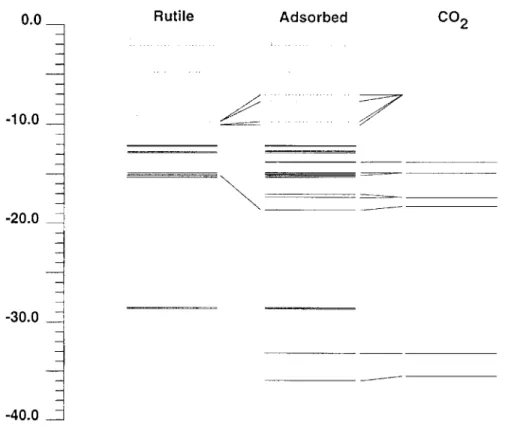
Interaction of C02 with Small Rutile Crystallites - An EHMO Study 747 Therefore a chelating structure seems more stable than one where a Ti-C bond has been formed. In Figure 7, a correlation diagram at the minimum o f the energy hypersurface is shown. The splitting o f the degenerate energy level o f CO2 upon adsorption due to symmetry reduction from D~h ~ C2~, is clearly visible. Most o f the correlation diagram in Figure 7 can be interpreted in terms of a Walsh diagram for the bending motion of carbon dioxide. The only strong interaction between carbon dioxide and Ti(OH)5 is found in the non-bonding regime between the
AI
component o f the re* LUMO o f CO2 and the d* _2 andthedx:,y:
* orbitals o f Ti(OH)f.0 . 0 m - 1 0 . 0 - - - 2 0 . 0 - - - 3 0 . 0 _~- - 4 0 . 0 - - R u t i l e A d s o r b e d C O 2 J
Figure 7. Correlation diagram of CO 2 interaction with Ti(OH)5 for C O 2 parallel to the surface. Interaction with one Ti 4+ center. Unoccupied levels are represented by dotted lines.
A marginal charge transfer o f 0.1 electrons from Ti(OH)f onto carbon dioxide was found from a Mulliken population analysis. This values is smaller and o f opposite sign than in the case o f linear coordination of CO2 to Ti(OH)5. The reduced overlap population between the carbon atom and the Ti atom is found to be -0.25 while the one between the oxygen atom of CO2 and the Ti atom is -0.07. This
748 I. Kamber
does not confirm the hypothesis that CO2 can act as a chelating ligand at the rutile surface. The binding o f carbon dioxide to Ti(OH)d is therefore very weak and mostly due to the stabilization occurring in CO2 caused by the bending of the molecule and the interaction of the CO2 oxygen atoms with o-bonding orbitals of the hydroxyl groups. As seen from a Walsh diagram, only the neutral CO2 can be expected to be linear. Adding or removing charge from the molecule will favour a slightly bent C2v configuration. As discussed above there is a small charge transfer from CO2 to the Ti 4+ center thus a slightly bent configuration can be expected. If the calculation is performed with charge iteration at carbon dioxide no adsorption at all is found. To summarize, the net stabilization in this case is only about 75% of case i. This is mostly due to the weak interaction of CO2 with the hydroxyl groups leading to a small charge transfer and a bent CO2. The fact that upon charge iteration at CO2 no bound complex could be found, shows that the adsorption in this geometry, ifoccuring at all, must be very weak.
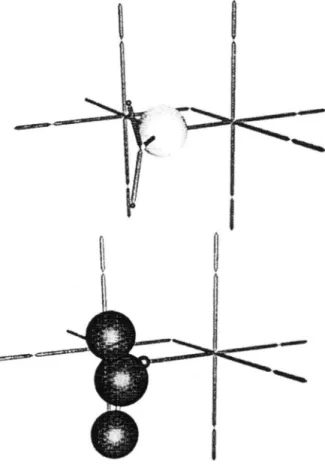
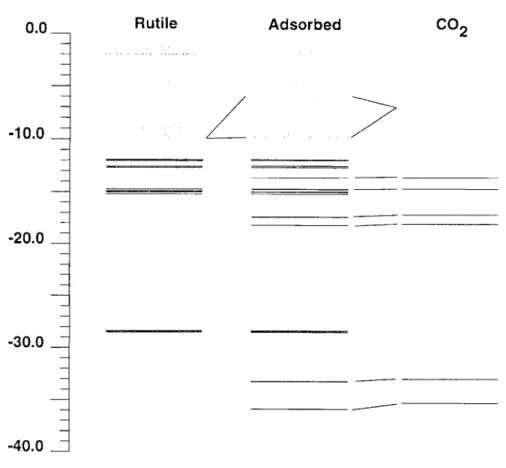
Comparing the Ti-Ti distance of 2.96 ~, in the 1,2,1 fragment [(YiOz)2(OH)2] 2- 9 2HzO with the O-O distance of 2.34/~, in carbon dioxide it can be imagined that CO2 binds to two neighboring Yi 4+ sites. This corresponds to situation iii in Figure 4 where a Ti-O-C-O-Ti five-ring is formed. The geometry of the rutile part and the C-O bonds of carbon dioxide were kept fixed at their equilibrium geometries while the distance d between the carbon atom and the rutile surface and the bending angle dO at CO2 were varied. A minimum on the energy hypersurface was found at d = 2.3/~ and dO = 155% with CO2 bent towards the surface. This corresponds to a Ti-O distance of 2.07 ,&. Figure 8 shows a correlation diagram describing the main interactions at the minimum energy. The situation is very similar to the one already reported for situation i (see Figure 5). This has to be expected as both situations basically comprise an interaction of a oxygen center of CO/with a fivefold coordinated Ti 4+ ion. Thus, again the interaction of the d-orbitals belonging to local Eg symmetry with the Ou + orbital dominates. The corresponding molecular orbital is depicted in Figure 9. Because two Ti-O interactions are involved in situation iii the stabilization of the energy level at 18.98 eV is stronger. This results in a net stabilization energy of 1.45 eV which is about twice as much as in situation i. A reduced overlap population of 0.10 is found between the Ti center and the coordinating oxygen center of CO2. In this geometry a charge transfer of 0.22 electrons from the carbon dioxide molecule to the rutile is found.
C02 as Lewis Acid." Situation iv. We now discuss situation iv of Figure 4 as an example o f CO2 acting as an Lewis acid. The rutile part was modeled by [ ( T i O z ) z ( O H ) 4 ] 4 " 2H20. In Figure 4 CO2 interacts with the oxygen atom belonging to an Ti-O-Ti bridge at the surface o f the crystallite. The same general conclusion
Interaction of CO2 with Small Rutile Crystallites - An EHMO Study 7 4 9 0 , 0 m - 1 0 . 0 - - - 2 0 . 0 ~ - - 3 0 . 0 - - - 4 0 . 0 ~ - R u t i l e A d s o r b e d C O 2
Figure 8. Correlation diagram of CO2 interaction with [(TiO2)2(OH)2] 2- 9 2H20. Interaction with two Ti 4+ centers. Unoccupied levels are represented by dotted lines.
Figure 9. Molecular orbital showing the bonding interaction of ]~u + with the Ee d-orbitals of the Ti 4+ center. This orbital is mainly responsible for a bonding interaction.
750 I. K a m b e r
however can be drawn if one considers the interaction o f CO2 with a terminal oxygen atom in the rutile structure instead. The carbon dioxide molecule was rotated 900 out of the Ti-O-Ti plane to minimize repulsion by neighboring hydroxyl groups. The energy hypersurface was determined by independently varying the distance
dc-obridge
and the bond angle dO at CO2. For the rutile part and the C-O bond length experimental values were used and kept fixed. Additionally a value I+K -- 2.0 of the Htickel constant was used for theC'O~mge
interaction to avoid an unreasonable length of the C-Obrjjge bond. An energy minimum on the hypersurface was found fordc-o
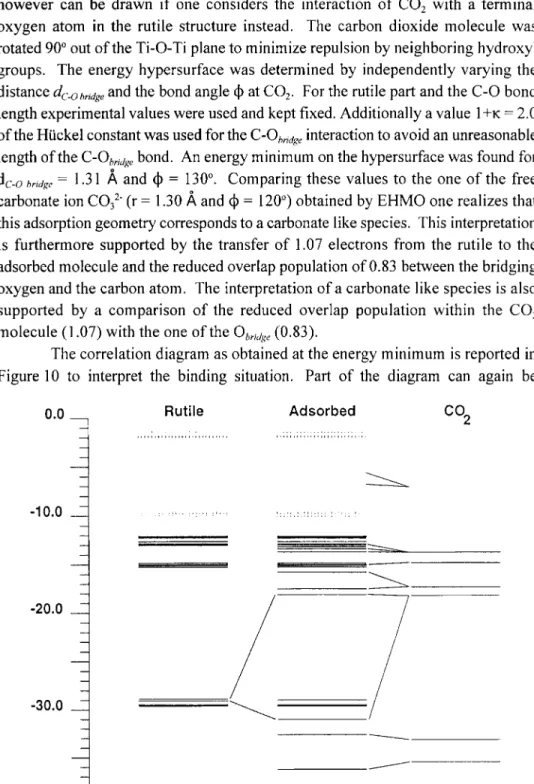
~rJJg~ = 1.31 ~, and do = 130 ~ Comparing these values to the one o f the free carbonate ion CO32 (r = 1.30 ~, and do = 120 ~ obtained by EHMO one realizes that this adsorption geometry corresponds to a carbonate like species. This interpretation is furthermore supported by the transfer of 1.07 electrons from the rutile to the adsorbed molecule and the reduced overlap population of 0.83 between the bridging oxygen and the carbon atom. The interpretation of a carbonate like species is also supported by a comparison of the reduced overlap population within the CO2 molecule (1.07) with the one of the Ob,jg~, (0.83).The correlation diagram as obtained at the energy minimum is reported in Figure 10 to interpret the binding situation. Part of the diagram can again be
O , O m - 1 0 . 0 - - - 2 0 . 0 - - - 3 0 . 0 - - - 4 0 . 0 - - R u t i l e A d s o r b e d C O 2
y /I
/
Figure 10. Correlation diagram of carbonate-like C02. Unoccupied levels are represented by dotted lines.
Interaction o f C02 with Small Rutile Crystallites - An E H M O Study 75 1
explained by the bending o f the molecule upon adsorption. They compensate each other quite well thus they do not contribute to the bending. However two additional strong interactions responsible for the binding are identified. The corresponding MO's are illustrated in Figure 11. We see that two I]g + orbitals of CO2 interact strongly with the rutile bridging atom. These two interactions are therefore responsible for the binding of CO2 to the bridging oxygen atom.
t
1 84
1
I
Figure l 1. Molecular orbitals mainly responsible for the stability of carbonate-like CO>
C O N C L U S I O N S
The EHMO method as introduced in Section II is suitable to describe qualitatively the bulk equilibrium geometry and the electronic structure of rutile. The ordering and the type o f the bands agree quite well with experimental and theoretical data and the experimental bond lengths were reproduced with astonishing precision. The
752 I. Kamber
distortion o f the TiO6 octahedra, however, was found opposite to the experimental one. Bond angles could not be reproduced well. The absolute energies obtained do also not agree with the experimental values which is a well known deficiency o f the method. Furthermore it was shown that CO2 adsorbs at Lewis acid as well as Lewis base sites. For Lewis acid sites (fivefold coordinated surface TP + ions), an adsorption geometry with CO2 perpendicular to the surface or the adsorption at two neighboring Ti 4+ sites is stable. The possibility of carbon dioxide acting as a bidentate ligand or adsorbing by the formation of a Ti-C bond is not stable. The formation o f a carbonate-like species is identified upon the adsorption of CO2 at a surface oxygen ion. In this case carbon dioxide acts as a Lewis acid.
Acknowledgements
This work has been supported by the Swiss Federal Office of Energy.
R E F E R E N C E S |. 2. 3. 4. 5. 6. 7. 8. 9. I0. 11. 12. 13. 14. 15. 16. 17. 18. 19. 20. 21. 22. 23. 24.
M. Anpo and Y. Kubokawa, Res. Chem. Intermed. 8 105 (1987). M. Anpo, Res. Chem. Intermed. 11, 67 (1989).
M. Anpo et al., Bull. Chem. Soc. Jpn. 64, 543 (1991).
N. Serpone, R. Terzian, D. Lawless, and J.-M. Herrmann, Adv. Electron Transfer Chemistry 3, 33 (1993).
A.L. Linsebigler, G. Lu, and J.T. Yates, Jr., Chem. Rev. 95, 735 (1995). A. Fujishima and K. Honda, Nature 238, 37 (1972).
A.J. Bard and M.A. Fox, Acc. Chem. Res. 28, 141 (1995). M. Anpo and K. Chiba, J. Mol. Catal. 74, 207 (1992).
K. Ogura, M. Kawano, J. Yano, and Y. Sakata, J. Photochem. Photobiol. A: Chem. 66, 91 (1992).
H. Yamashita, N. Kamada, H. He, K. Tanaka, and M. Anpo, Chem. Lett. 855 (1994). H. Yamashita et al., Energy Convers. Mgmt 36, 617 (1995).
F. Saladin, L. Forss, and I. Kamber, J. Chem. 5oc., Chem. Commun. 533 (1995). F. Saladin, A. Meier, and I. Kamber, Rev. Sci. Instrum 67, 2406 (1996). T. Bredow and K. Jug, Chem. Phys. Lett. 223, 89 (1994).
J. Burdett, Inorg. Chem. 24, 2244 (1985).
C.-R. Wang and Y.-S. Xu, Surf Sci. 219, L537 (1989).
B. Viswanathan and T. Lakshmi, Indian J. Chem. A 32, 937 (1993). T. Bredow and K. Jug, Surf Sci. 327, 398 (1995).
H. Takaba et al., Energy Convers. Mgmt 36, 439 (1995).
D.C. Sayle, R.A. Catlow, M.-A. Perrin, and P. Nortier, J. Phys. Chem. Solids 56, 799 (1995). V.E. Henrich and P.A. Cox, The Surface Science of Metal Oxides, Cambridge University Press, UK, 1994.
R.J.D. Miller et al., Surface Electron Transfer Processes, VCH Publishers, New York, 1995. G. Calzaferri and M. Br~indle, QCMP Bull. 12 (1992), update May 1993.
Interaction of C02 with Small Rutile CrystaIlites - An EHMO Study 753 25. 26. 27 28. 29. 30. 31. 32. 33. 34. 35. 36. 37. 38. 39.
calculation, QCPE No. 344, 1978.
A.B. Anderson and R. Hoffmann, J. Phys. Chem. 60, 4271 (1974). G. Calzaferri, L. Forss, and I. Kamber, J. Phys. Chem. 93, 5366 (1989). F. Savary, J. Weber, and G. Calzaferri, 3~ Phys. Chem. 97, 3722 (1993). N. Fitzpatrick and G. Murphy, Inorg. Chem. Acta 87, 41 (1984).
H. Basch, A. Viste, and H. Gray, Theoret. Chim. Acta (Berl.) 3, 458 (1965). H. Basch and H. Gray, Theoret. Chim. Acta (Berl.) 4, 367 (1966).
I. Kamber, ICON-UTILS -- A Collection of Utilities to Visualize the Output o f EHMO
Calculations, 1996.
Geomview, Version 1.5, Software Development Group, Geometry Center, Minneapolis, US,
1994, availabe for free at geom.umn.edu.
Goodenough and Hamnett, Landolt-BOrnstein, New Series III 17g.
Y. Wang. In: Photophysieal and Photochemical Processes o f Semiconductor Nanoclusters, Vol. 19 of Adv. Photochem., D.C. Neckers, D.H. Volman, and G. von Briinau (Eds.), John Wiley & Sons, Inc., New York, 1995, pp. 179-234.
R. Hoffmann, Solids and Surfaces. A Chemist's View of Bonding in Extended Structures, VCH Verlagsgesellschaft mbH, Weinheim, 1988.
B. Poumellec, P.. Durham, and G.Y. Guo, 3~ Phys.: Condens. Matter. 3, 8195 (1993). G. Ramis, G. Busca, and V. Lorenzelli, Mater. Chem. Phys. 29, 425 (1991). J. Rask6 and F. Solymosi, J. Phys. Chem. 98, 7147 (1994).
M.N. Bumett and C.K. Johnson. ORTEP-III: Oak Ridge Thermal Ellipsoid Plot Program for

32] 32- 9 6H20. Thick solid: total DOS;](https://thumb-eu.123doks.com/thumbv2/123doknet/14873047.640793/7.682.112.538.361.753/figure-density-states-fragment-tioz-thick-solid-total.webp)
![Figure 3. Net charges on the [(TiO2)31(OH)32] 32" 9 6 H 2 0 cluster (3,3,2 fragment)](https://thumb-eu.123doks.com/thumbv2/123doknet/14873047.640793/8.682.205.464.639.878/figure-net-charges-tio-oh-h-cluster-fragment.webp)
![Figure 4. Different adsorption sites and geometries for CO2 at futile, i and ii were modeled by Ti(OH)s, iii by [(TiO2)2(OH)2] 2- 9 2H20 and iv by [(TiO2)2(OH)4] 4 9 2H20](https://thumb-eu.123doks.com/thumbv2/123doknet/14873047.640793/10.682.134.556.84.423/figure-different-adsorption-sites-geometries-futile-modeled-tio.webp)
![Figure 6. Definition of angles qb, q~ and y in Ti(OH);-OCO and [(TiO2)2(OH)20 ]- 9 2H20-OCO [39]](https://thumb-eu.123doks.com/thumbv2/123doknet/14873047.640793/12.682.169.515.105.472/figure-definition-angles-ti-oh-oco-tio-oco.webp)
![Figure 8. Correlation diagram of CO2 interaction with [(TiO2)2(OH)2] 2- 9 2H20. Interaction with two Ti 4+ centers](https://thumb-eu.123doks.com/thumbv2/123doknet/14873047.640793/15.682.86.583.113.569/figure-correlation-diagram-co-interaction-tio-interaction-centers.webp)