European Journal of Orthodontics 35 (2013) 82–86 doi:10.1093/ejo/cjr048
Advance Access publication 4 April 2011
© The Author 2011. Published by Oxford University Press on behalf of the European Orthodontic Society. All rights reserved. For permissions, please email: [email protected] European Journal of Orthodontics 1 of 5 © The Author 2011. Published by Oxford University Press on behalf of the European Orthodontic Society.
doi:10.1093/ejo/cjr048 All rights reserved. For permissions, please email: [email protected]
Introduction
The patients ’ interest in a esthetically pleasing orthodontic appliances has risen during the last decades and the appliances offering this advantage are preferred, especially among adult patients. The scienti c evidence in this eld has become stronger in recent years, although not in an analogous way to the demand for these appliances. The removable transparent appliances still have some limitations in the spectrum of dental movements: bodily tooth movement required in premolar extraction patients is dif cult to achieve and the degree of accomplished extrusion or rotation could not be accurately predicted ( Baldwin et
al. , 2008 ; Kravitz et al. , 2009 ). A lingual appliance is a
treatment alternative, which was formerly associated with higher bracket failure rate, complex bonding technique, adaptation dif culties of the patient to the appliance , and longer treatment duration ( Kurz and Romano, 1998 ). Nowadays, the bonding accuracy does not seem to differ between lingual and labial systems ( Shpack et al. , 2007 ), whereas recently developed lingual systems ( Wiechmann et
al. , 2003 ) offer fully customized appliances with more
built-in information. These brackets have an extended base for greater bond strength and a lower pro le, a fact that enhances patient comfort in comparison with prefabricated lingual braces ( Stamm et al. , 2005 ).
A comparative assessment of forces and moments generated by
lingual and conventional brackets
Iosif Sifakakis * , Nikolaos Pandis **
,*** , Margarita Makou * , Christos Katsaros *** ,
Theodore Eliades **** and Christoph Bourauel *****
* Department of Orthodontics, School of Dentistry, University of Athens , ** Private Practice, Corfu, Greece ,
*** Department of Orthodontics and Dentofacial Orthopedics, School of Dentistry, University of Bern, Switzerland , **** Department of Orthodontics, School of Dentistry, Aristotle University of Thessaloniki, Greece and ***** School of Dentistry, University of Bonn , Germany
Correspondence to: Theodore Eliades, 57 Agnoston Hiroon, Nea Ionia 14231, Greece. E-mail: [email protected]
SUMMARY The aim of this study was to assess the effect of bracket type on the labio palatal forces
and moments generated in the sagittal plane. Incognito ™ lingual brackets (3M Unitek), STb ™ lingual
brackets (Light Lingual System ; ORMCO) , and conventional 0.018 inch slot brackets (Gemini ; 3M Unitek) were bonded on three identical maxillary acrylic resin models, with a palatally displaced right lateral incisor . The transfer trays for the indirect bonding of the lingual brackets were constructed in certifi ed laboratories. Each model was mounted on the orthodontic measurement and simulation system and ten 0.013 inch CuNiTi wires were used for each bracket type. The wire was ligated with elastomerics and each measurement was repeated once after re-ligation. The labio palatal forces and the moments in the sagittal plane were recorded on the right lateral incisor. One-way analysis of variance and post hoc Scheffe pairwise comparisons were used to assess the effect on bracket type on the generated forces and moments . The magnitude of forces ranged from 1.62, 1.27, and 1.81 N for the STb, conventional , and Incognito brackets, respectively; the corresponding moments were 2.01, 1.45, and 2.19 N mm , respectively . Bracket type was a signifi cant predictor of the generated forces ( P < 0.001) and moments ( P < 0.001). The produced forces were different among all three bracket types, whereas the generated moments differed between conventional and lingual brackets but not between lingual brackets.
The labial and lingual orthodontic approaches are quite different in their biomechanical principles. The decrease in the interbracket distance at the anterior region in lingual appliances increases the relative stiffness of an archwire three times for rst- and second-order bends and 1 . 5 times as for third order ( Moran, 1987 ). High stiffness provides forces of higher magnitude, a less constant force over time as the appliance experiences deactivation, and a relatively dif culty in accurately applying a given force ( Kapila and Sachdeva, 1989 ). Additionally, the point of force application and the line of force relative to the centre of resistance are different in lingual and labial orthodontics, a fact that could substantially in uence tooth movements ( Geron et al. , 2004 ).
The aim of this study was to assess the effect of bracket type between lingual and conventional appliances on the labio palatal forces and the moments generated in the sagittal plane.
Materials and methods Experimental apparatus
The orthodontic measurement and simulation system (OMSS) was used for the ex vivo evaluation of the different brackets ( Bourauel et al. , 1992 ). This experimental
I. SIFAKAKIS ET AL.
2 of 5
apparatus allows the measurement of the force systems acting in two different regions three dimensionally ( Drescher et al. , 1991 ). Two force/moment sensors appropriately connected with the regions in question, receive the signal , and transduce it to a personal computer, which calculates the tooth movement with the aid of a mathematical model. Two motorized positioning tables, adjustable in six axes, are connected with the computer and consequently execute the calculated movement. The force system could be measured at the initial position, as well as during the simulation movement.
Con guration and materials
Three different bracket types were evaluated: Incognito ™ lingual brackets (3M Unitek , Monrovia, Minnesota, USA ), STb ™ lingual brackets (Light Lingual System, ORMCO) , and conventional stainless steel 0.018 inch slot brackets (Gemini, 3M Unitek). Polyvinylsiloxane impressions of the initial malocclusion with a palatally displaced right lateral incisor ( Figure 1 ) were sent to certi ed laboratories in order to construct the transfer trays for the indirect bonding of the lingual brackets (Incognito Laboratory, Bad Essen, Germany and AOA Orthodontic Laboratory, Sturtevant , W isconsin , USA). Additionally, three identical maxillary models of the initial malocclusion were constructed from acrylic resin. Each model was bonded with brackets up to the rst/second premolars from each bracket type. Both lingual bracket types had a 0.018 inch slot. The Incognito brackets had a vertical slot at the anterior region ( Wiechmann et al. , 2003 ), in contrast with the STb brackets, whose slots were horizontal. The latter bracket system had 0 degree angulation, high torque at the anterior region (+55 degrees ) , and standard torque (+11 degrees ) at the premolars. The conventional brackets were bonded on the centre of each tooth mesio-distally and at the suggested height with the aid of a Unitek bracket positioning gauge (3M Unitek ). The speci cations of the conventional brackets were the following: upper central incisor torque 0 degree and
angulation 10 degrees , upper lateral incisor torque 7 degrees and angulation 8 degrees , upper cuspid torque 14 degrees and angulation 5 degrees, and upper bicuspid torque − 7 degrees and angulation 0 degree .
At the initial malocclusion, a passive 0.018 × 0.025 inch archwire was constructed for each of the models. The palatally displaced right lateral incisor was consolidated and each one of these two model segments was mounted on the positioning tables of the OMSS with an appropriate adaptor. The initial position of the segments was ensured transferred during the OMSS mounting with the passive 0.018 × 0.025 inch archwire. At this point, an adjustment of the system was conducted with the passive wire in place and all forces/moments generated were nulli ed.
Ten specimens of 0.013 CuNiTi (STb Social 6 Optimal Force ; ORMCO) were used for each bracket type. The archwire was ligated with 0.120 inch (Short Sticks ; ORMCO) elastomeric ligatures into the STb and conventional brackets and with German overties with one element of a power chain (Power Chain I ; ORMCO) in Incognito brackets ( Figure 2 ). The reverse double overties (German overties) provide for almost complete insertion by nearly fully engaging the archwire into the bracket slots ( Fuck et al. , 2005 ). Each measurement was repeated once after re-ligation. The labio palatal forces and the moments in the sagittal plane were recorded on the right lateral incisor. The OMSS during the measurement cycles was installed in a temperature- controlled chamber (VEM 03/400, Vötsch Her a eus, Germany ) at a constant temperature of 37°C, which reasonably approximates the intra-oral temperature ( Moore et al. , 1999 ).
Statistical analysis
For each specimen , the mean of the two repeated
measurements was calculated and used for the analysis of
Figure 1 The initial malocclusion with a palatally displaced right lateral
incisor. Figure 2 The acrylic resin model mounted to the positioning tables of the orthodontic measurement and simulation system. I. SIFAKAKIS ET AL.
2 of 5
apparatus allows the measurement of the force systems acting in two different regions three dimensionally ( Drescher et al. , 1991 ). Two force/moment sensors appropriately connected with the regions in question, receive the signal , and transduce it to a personal computer, which calculates the tooth movement with the aid of a mathematical model. Two motorized positioning tables, adjustable in six axes, are connected with the computer and consequently execute the calculated movement. The force system could be measured at the initial position, as well as during the simulation movement.
Con guration and materials
Three different bracket types were evaluated: Incognito ™ lingual brackets (3M Unitek , Monrovia, Minnesota, USA ), STb ™ lingual brackets (Light Lingual System, ORMCO) , and conventional stainless steel 0.018 inch slot brackets (Gemini, 3M Unitek). Polyvinylsiloxane impressions of the initial malocclusion with a palatally displaced right lateral incisor ( Figure 1 ) were sent to certi ed laboratories in order to construct the transfer trays for the indirect bonding of the lingual brackets (Incognito Laboratory, Bad Essen, Germany and AOA Orthodontic Laboratory, Sturtevant , W isconsin , USA). Additionally, three identical maxillary models of the initial malocclusion were constructed from acrylic resin. Each model was bonded with brackets up to the rst/second premolars from each bracket type. Both lingual bracket types had a 0.018 inch slot. The Incognito brackets had a vertical slot at the anterior region ( Wiechmann et al. , 2003 ), in contrast with the STb brackets, whose slots were horizontal. The latter bracket system had 0 degree angulation, high torque at the anterior region (+55 degrees ) , and standard torque (+11 degrees ) at the premolars. The conventional brackets were bonded on the centre of each tooth mesio-distally and at the suggested height with the aid of a Unitek bracket positioning gauge (3M Unitek ). The speci cations of the conventional brackets were the following: upper central incisor torque 0 degree and
angulation 10 degrees , upper lateral incisor torque 7 degrees and angulation 8 degrees , upper cuspid torque 14 degrees and angulation 5 degrees, and upper bicuspid torque − 7 degrees and angulation 0 degree .
At the initial malocclusion, a passive 0.018 × 0.025 inch archwire was constructed for each of the models. The palatally displaced right lateral incisor was consolidated and each one of these two model segments was mounted on the positioning tables of the OMSS with an appropriate adaptor. The initial position of the segments was ensured transferred during the OMSS mounting with the passive 0.018 × 0.025 inch archwire. At this point, an adjustment of the system was conducted with the passive wire in place and all forces/moments generated were nulli ed.
Ten specimens of 0.013 CuNiTi (STb Social 6 Optimal Force ; ORMCO) were used for each bracket type. The archwire was ligated with 0.120 inch (Short Sticks ; ORMCO) elastomeric ligatures into the STb and conventional brackets and with German overties with one element of a power chain (Power Chain I ; ORMCO) in Incognito brackets ( Figure 2 ). The reverse double overties (German overties) provide for almost complete insertion by nearly fully engaging the archwire into the bracket slots ( Fuck et al. , 2005 ). Each measurement was repeated once after re-ligation. The labio palatal forces and the moments in the sagittal plane were recorded on the right lateral incisor. The OMSS during the measurement cycles was installed in a temperature- controlled chamber (VEM 03/400, Vötsch Her a eus, Germany ) at a constant temperature of 37°C, which reasonably approximates the intra-oral temperature ( Moore et al. , 1999 ).
Statistical analysis
For each specimen , the mean of the two repeated
measurements was calculated and used for the analysis of
Figure 1 The initial malocclusion with a palatally displaced right lateral
FORCES WITH LINGUAL BRACKETS 83 European Journal of Orthodontics 1 of 5 © The Author 2011. Published by Oxford University Press on behalf of the European Orthodontic Society.
doi:10.1093/ejo/cjr048 All rights reserved. For permissions, please email: [email protected]
Introduction
The patients ’ interest in a esthetically pleasing orthodontic appliances has risen during the last decades and the appliances offering this advantage are preferred, especially among adult patients. The scienti c evidence in this eld has become stronger in recent years, although not in an analogous way to the demand for these appliances. The removable transparent appliances still have some limitations in the spectrum of dental movements: bodily tooth movement required in premolar extraction patients is dif cult to achieve and the degree of accomplished extrusion or rotation could not be accurately predicted ( Baldwin et
al. , 2008 ; Kravitz et al. , 2009 ). A lingual appliance is a
treatment alternative, which was formerly associated with higher bracket failure rate, complex bonding technique, adaptation dif culties of the patient to the appliance , and longer treatment duration ( Kurz and Romano, 1998 ). Nowadays, the bonding accuracy does not seem to differ between lingual and labial systems ( Shpack et al. , 2007 ), whereas recently developed lingual systems ( Wiechmann et
al. , 2003 ) offer fully customized appliances with more
built-in information. These brackets have an extended base for greater bond strength and a lower pro le, a fact that enhances patient comfort in comparison with prefabricated lingual braces ( Stamm et al. , 2005 ).
A comparative assessment of forces and moments generated by
lingual and conventional brackets
Iosif Sifakakis * , Nikolaos Pandis **
,*** , Margarita Makou * , Christos Katsaros *** ,
Theodore Eliades **** and Christoph Bourauel *****
* Department of Orthodontics, School of Dentistry, University of Athens , ** Private Practice, Corfu, Greece ,
*** Department of Orthodontics and Dentofacial Orthopedics, School of Dentistry, University of Bern, Switzerland , **** Department of Orthodontics, School of Dentistry, Aristotle University of Thessaloniki, Greece and ***** School of Dentistry, University of Bonn , Germany
Correspondence to: Theodore Eliades, 57 Agnoston Hiroon, Nea Ionia 14231, Greece. E-mail: [email protected]
SUMMARY The aim of this study was to assess the effect of bracket type on the labio palatal forces
and moments generated in the sagittal plane. Incognito ™ lingual brackets (3M Unitek), STb ™ lingual
brackets (Light Lingual System ; ORMCO) , and conventional 0.018 inch slot brackets (Gemini ; 3M Unitek) were bonded on three identical maxillary acrylic resin models, with a palatally displaced right lateral incisor . The transfer trays for the indirect bonding of the lingual brackets were constructed in certifi ed laboratories. Each model was mounted on the orthodontic measurement and simulation system and ten 0.013 inch CuNiTi wires were used for each bracket type. The wire was ligated with elastomerics and each measurement was repeated once after re-ligation. The labio palatal forces and the moments in the sagittal plane were recorded on the right lateral incisor. One-way analysis of variance and post hoc Scheffe pairwise comparisons were used to assess the effect on bracket type on the generated forces and moments . The magnitude of forces ranged from 1.62, 1.27, and 1.81 N for the STb, conventional , and Incognito brackets, respectively; the corresponding moments were 2.01, 1.45, and 2.19 N mm , respectively . Bracket type was a signifi cant predictor of the generated forces ( P < 0.001) and moments ( P < 0.001). The produced forces were different among all three bracket types, whereas the generated moments differed between conventional and lingual brackets but not between lingual brackets.
The labial and lingual orthodontic approaches are quite different in their biomechanical principles. The decrease in the interbracket distance at the anterior region in lingual appliances increases the relative stiffness of an archwire three times for rst- and second-order bends and 1 . 5 times as for third order ( Moran, 1987 ). High stiffness provides forces of higher magnitude, a less constant force over time as the appliance experiences deactivation, and a relatively dif culty in accurately applying a given force ( Kapila and Sachdeva, 1989 ). Additionally, the point of force application and the line of force relative to the centre of resistance are different in lingual and labial orthodontics, a fact that could substantially in uence tooth movements ( Geron et al. , 2004 ).
The aim of this study was to assess the effect of bracket type between lingual and conventional appliances on the labio palatal forces and the moments generated in the sagittal plane.
Materials and methods Experimental apparatus
The orthodontic measurement and simulation system (OMSS) was used for the ex vivo evaluation of the different brackets ( Bourauel et al. , 1992 ). This experimental
I. SIFAKAKIS ET AL.
2 of 5
apparatus allows the measurement of the force systems acting in two different regions three dimensionally ( Drescher et al. , 1991 ). Two force/moment sensors appropriately connected with the regions in question, receive the signal , and transduce it to a personal computer, which calculates the tooth movement with the aid of a mathematical model. Two motorized positioning tables, adjustable in six axes, are connected with the computer and consequently execute the calculated movement. The force system could be measured at the initial position, as well as during the simulation movement.
Con guration and materials
Three different bracket types were evaluated: Incognito ™ lingual brackets (3M Unitek , Monrovia, Minnesota, USA ), STb ™ lingual brackets (Light Lingual System, ORMCO) , and conventional stainless steel 0.018 inch slot brackets (Gemini, 3M Unitek). Polyvinylsiloxane impressions of the initial malocclusion with a palatally displaced right lateral incisor ( Figure 1 ) were sent to certi ed laboratories in order to construct the transfer trays for the indirect bonding of the lingual brackets (Incognito Laboratory, Bad Essen, Germany and AOA Orthodontic Laboratory, Sturtevant , W isconsin , USA). Additionally, three identical maxillary models of the initial malocclusion were constructed from acrylic resin. Each model was bonded with brackets up to the rst/second premolars from each bracket type. Both lingual bracket types had a 0.018 inch slot. The Incognito brackets had a vertical slot at the anterior region ( Wiechmann et al. , 2003 ), in contrast with the STb brackets, whose slots were horizontal. The latter bracket system had 0 degree angulation, high torque at the anterior region (+55 degrees ) , and standard torque (+11 degrees ) at the premolars. The conventional brackets were bonded on the centre of each tooth mesio-distally and at the suggested height with the aid of a Unitek bracket positioning gauge (3M Unitek ). The speci cations of the conventional brackets were the following: upper central incisor torque 0 degree and
angulation 10 degrees , upper lateral incisor torque 7 degrees and angulation 8 degrees , upper cuspid torque 14 degrees and angulation 5 degrees, and upper bicuspid torque − 7 degrees and angulation 0 degree .
At the initial malocclusion, a passive 0.018 × 0.025 inch archwire was constructed for each of the models. The palatally displaced right lateral incisor was consolidated and each one of these two model segments was mounted on the positioning tables of the OMSS with an appropriate adaptor. The initial position of the segments was ensured transferred during the OMSS mounting with the passive 0.018 × 0.025 inch archwire. At this point, an adjustment of the system was conducted with the passive wire in place and all forces/moments generated were nulli ed.
Ten specimens of 0.013 CuNiTi (STb Social 6 Optimal Force ; ORMCO) were used for each bracket type. The archwire was ligated with 0.120 inch (Short Sticks ; ORMCO) elastomeric ligatures into the STb and conventional brackets and with German overties with one element of a power chain (Power Chain I ; ORMCO) in Incognito brackets ( Figure 2 ). The reverse double overties (German overties) provide for almost complete insertion by nearly fully engaging the archwire into the bracket slots ( Fuck et al. , 2005 ). Each measurement was repeated once after re-ligation. The labio palatal forces and the moments in the sagittal plane were recorded on the right lateral incisor. The OMSS during the measurement cycles was installed in a temperature- controlled chamber (VEM 03/400, Vötsch Her a eus, Germany ) at a constant temperature of 37°C, which reasonably approximates the intra-oral temperature ( Moore et al. , 1999 ).
Statistical analysis
For each specimen , the mean of the two repeated
measurements was calculated and used for the analysis of
Figure 1 The initial malocclusion with a palatally displaced right lateral
incisor. Figure 2 The acrylic resin model mounted to the positioning tables of the orthodontic measurement and simulation system. I. SIFAKAKIS ET AL.
2 of 5
apparatus allows the measurement of the force systems acting in two different regions three dimensionally ( Drescher et al. , 1991 ). Two force/moment sensors appropriately connected with the regions in question, receive the signal , and transduce it to a personal computer, which calculates the tooth movement with the aid of a mathematical model. Two motorized positioning tables, adjustable in six axes, are connected with the computer and consequently execute the calculated movement. The force system could be measured at the initial position, as well as during the simulation movement.
Con guration and materials
Three different bracket types were evaluated: Incognito ™ lingual brackets (3M Unitek , Monrovia, Minnesota, USA ), STb ™ lingual brackets (Light Lingual System, ORMCO) , and conventional stainless steel 0.018 inch slot brackets (Gemini, 3M Unitek). Polyvinylsiloxane impressions of the initial malocclusion with a palatally displaced right lateral incisor ( Figure 1 ) were sent to certi ed laboratories in order to construct the transfer trays for the indirect bonding of the lingual brackets (Incognito Laboratory, Bad Essen, Germany and AOA Orthodontic Laboratory, Sturtevant , W isconsin , USA). Additionally, three identical maxillary models of the initial malocclusion were constructed from acrylic resin. Each model was bonded with brackets up to the rst/second premolars from each bracket type. Both lingual bracket types had a 0.018 inch slot. The Incognito brackets had a vertical slot at the anterior region ( Wiechmann et al. , 2003 ), in contrast with the STb brackets, whose slots were horizontal. The latter bracket system had 0 degree angulation, high torque at the anterior region (+55 degrees ) , and standard torque (+11 degrees ) at the premolars. The conventional brackets were bonded on the centre of each tooth mesio-distally and at the suggested height with the aid of a Unitek bracket positioning gauge (3M Unitek ). The speci cations of the conventional brackets were the following: upper central incisor torque 0 degree and
angulation 10 degrees , upper lateral incisor torque 7 degrees and angulation 8 degrees , upper cuspid torque 14 degrees and angulation 5 degrees, and upper bicuspid torque − 7 degrees and angulation 0 degree .
At the initial malocclusion, a passive 0.018 × 0.025 inch archwire was constructed for each of the models. The palatally displaced right lateral incisor was consolidated and each one of these two model segments was mounted on the positioning tables of the OMSS with an appropriate adaptor. The initial position of the segments was ensured transferred during the OMSS mounting with the passive 0.018 × 0.025 inch archwire. At this point, an adjustment of the system was conducted with the passive wire in place and all forces/moments generated were nulli ed.
Ten specimens of 0.013 CuNiTi (STb Social 6 Optimal Force ; ORMCO) were used for each bracket type. The archwire was ligated with 0.120 inch (Short Sticks ; ORMCO) elastomeric ligatures into the STb and conventional brackets and with German overties with one element of a power chain (Power Chain I ; ORMCO) in Incognito brackets ( Figure 2 ). The reverse double overties (German overties) provide for almost complete insertion by nearly fully engaging the archwire into the bracket slots ( Fuck et al. , 2005 ). Each measurement was repeated once after re-ligation. The labio palatal forces and the moments in the sagittal plane were recorded on the right lateral incisor. The OMSS during the measurement cycles was installed in a temperature- controlled chamber (VEM 03/400, Vötsch Her a eus, Germany ) at a constant temperature of 37°C, which reasonably approximates the intra-oral temperature ( Moore et al. , 1999 ).
Statistical analysis
For each specimen , the mean of the two repeated
measurements was calculated and used for the analysis of
Figure 1 The initial malocclusion with a palatally displaced right lateral
incisor. Figure 2 The acrylic resin model mounted to the positioning tables of the orthodontic measurement and simulation system. I. SIFAKAKIS ET AL.
2 of 5
apparatus allows the measurement of the force systems acting in two different regions three dimensionally ( Drescher et al. , 1991 ). Two force/moment sensors appropriately connected with the regions in question, receive the signal , and transduce it to a personal computer, which calculates the tooth movement with the aid of a mathematical model. Two motorized positioning tables, adjustable in six axes, are connected with the computer and consequently execute the calculated movement. The force system could be measured at the initial position, as well as during the simulation movement.
Con guration and materials
Three different bracket types were evaluated: Incognito ™ lingual brackets (3M Unitek , Monrovia, Minnesota, USA ), STb ™ lingual brackets (Light Lingual System, ORMCO) , and conventional stainless steel 0.018 inch slot brackets (Gemini, 3M Unitek). Polyvinylsiloxane impressions of the initial malocclusion with a palatally displaced right lateral incisor ( Figure 1 ) were sent to certi ed laboratories in order to construct the transfer trays for the indirect bonding of the lingual brackets (Incognito Laboratory, Bad Essen, Germany and AOA Orthodontic Laboratory, Sturtevant , W isconsin , USA). Additionally, three identical maxillary models of the initial malocclusion were constructed from acrylic resin. Each model was bonded with brackets up to the rst/second premolars from each bracket type. Both lingual bracket types had a 0.018 inch slot. The Incognito brackets had a vertical slot at the anterior region ( Wiechmann et al. , 2003 ), in contrast with the STb brackets, whose slots were horizontal. The latter bracket system had 0 degree angulation, high torque at the anterior region (+55 degrees ) , and standard torque (+11 degrees ) at the premolars. The conventional brackets were bonded on the centre of each tooth mesio-distally and at the suggested height with the aid of a Unitek bracket positioning gauge (3M Unitek ). The speci cations of the conventional brackets were the following: upper central incisor torque 0 degree and
angulation 10 degrees , upper lateral incisor torque 7 degrees and angulation 8 degrees , upper cuspid torque 14 degrees and angulation 5 degrees, and upper bicuspid torque − 7 degrees and angulation 0 degree .
At the initial malocclusion, a passive 0.018 × 0.025 inch archwire was constructed for each of the models. The palatally displaced right lateral incisor was consolidated and each one of these two model segments was mounted on the positioning tables of the OMSS with an appropriate adaptor. The initial position of the segments was ensured transferred during the OMSS mounting with the passive 0.018 × 0.025 inch archwire. At this point, an adjustment of the system was conducted with the passive wire in place and all forces/moments generated were nulli ed.
Ten specimens of 0.013 CuNiTi (STb Social 6 Optimal Force ; ORMCO) were used for each bracket type. The archwire was ligated with 0.120 inch (Short Sticks ; ORMCO) elastomeric ligatures into the STb and conventional brackets and with German overties with one element of a power chain (Power Chain I ; ORMCO) in Incognito brackets ( Figure 2 ). The reverse double overties (German overties) provide for almost complete insertion by nearly fully engaging the archwire into the bracket slots ( Fuck et al. , 2005 ). Each measurement was repeated once after re-ligation. The labio palatal forces and the moments in the sagittal plane were recorded on the right lateral incisor. The OMSS during the measurement cycles was installed in a temperature- controlled chamber (VEM 03/400, Vötsch Her a eus, Germany ) at a constant temperature of 37°C, which reasonably approximates the intra-oral temperature ( Moore et al. , 1999 ).
Statistical analysis
For each specimen , the mean of the two repeated
measurements was calculated and used for the analysis of
Figure 1 The initial malocclusion with a palatally displaced right lateral
incisor. Figure 2 The acrylic resin model mounted to the positioning tables of the orthodontic measurement and simulation system. I. SIFAKAKIS ET AL.
2 of 5
apparatus allows the measurement of the force systems acting in two different regions three dimensionally ( Drescher et al. , 1991 ). Two force/moment sensors appropriately connected with the regions in question, receive the signal , and transduce it to a personal computer, which calculates the tooth movement with the aid of a mathematical model. Two motorized positioning tables, adjustable in six axes, are connected with the computer and consequently execute the calculated movement. The force system could be measured at the initial position, as well as during the simulation movement.
Con guration and materials
Three different bracket types were evaluated: Incognito ™ lingual brackets (3M Unitek , Monrovia, Minnesota, USA ), STb ™ lingual brackets (Light Lingual System, ORMCO) , and conventional stainless steel 0.018 inch slot brackets (Gemini, 3M Unitek). Polyvinylsiloxane impressions of the initial malocclusion with a palatally displaced right lateral incisor ( Figure 1 ) were sent to certi ed laboratories in order to construct the transfer trays for the indirect bonding of the lingual brackets (Incognito Laboratory, Bad Essen, Germany and AOA Orthodontic Laboratory, Sturtevant , W isconsin , USA). Additionally, three identical maxillary models of the initial malocclusion were constructed from acrylic resin. Each model was bonded with brackets up to the rst/second premolars from each bracket type. Both lingual bracket types had a 0.018 inch slot. The Incognito brackets had a vertical slot at the anterior region ( Wiechmann et al. , 2003 ), in contrast with the STb brackets, whose slots were horizontal. The latter bracket system had 0 degree angulation, high torque at the anterior region (+55 degrees ) , and standard torque (+11 degrees ) at the premolars. The conventional brackets were bonded on the centre of each tooth mesio-distally and at the suggested height with the aid of a Unitek bracket positioning gauge (3M Unitek ). The speci cations of the conventional brackets were the following: upper central incisor torque 0 degree and
angulation 10 degrees , upper lateral incisor torque 7 degrees and angulation 8 degrees , upper cuspid torque 14 degrees and angulation 5 degrees, and upper bicuspid torque − 7 degrees and angulation 0 degree .
At the initial malocclusion, a passive 0.018 × 0.025 inch archwire was constructed for each of the models. The palatally displaced right lateral incisor was consolidated and each one of these two model segments was mounted on the positioning tables of the OMSS with an appropriate adaptor. The initial position of the segments was ensured transferred during the OMSS mounting with the passive 0.018 × 0.025 inch archwire. At this point, an adjustment of the system was conducted with the passive wire in place and all forces/moments generated were nulli ed.
Ten specimens of 0.013 CuNiTi (STb Social 6 Optimal Force ; ORMCO) were used for each bracket type. The archwire was ligated with 0.120 inch (Short Sticks ; ORMCO) elastomeric ligatures into the STb and conventional brackets and with German overties with one element of a power chain (Power Chain I ; ORMCO) in Incognito brackets ( Figure 2 ). The reverse double overties (German overties) provide for almost complete insertion by nearly fully engaging the archwire into the bracket slots ( Fuck et al. , 2005 ). Each measurement was repeated once after re-ligation. The labio palatal forces and the moments in the sagittal plane were recorded on the right lateral incisor. The OMSS during the measurement cycles was installed in a temperature- controlled chamber (VEM 03/400, Vötsch Her a eus, Germany ) at a constant temperature of 37°C, which reasonably approximates the intra-oral temperature ( Moore et al. , 1999 ).
Statistical analysis
For each specimen , the mean of the two repeated
measurements was calculated and used for the analysis of
Figure 1 The initial malocclusion with a palatally displaced right lateral
84 I. SIFAKAKIS ET AL.3 of 5 FORCES WITH LINGUAL BRACKETS
the data. Mean values and standard deviations of the forces and moments generated were calculated per bracket type. One-way analysis of variance ( ANOVA ) and post hoc Scheffe pairwise comparisons were conducted to assess the effect of bracket type on the generated forces and moments. All statistical analyses were performed with the Stata 11 (Stata Corp . , College Station, Texas, USA).
Results
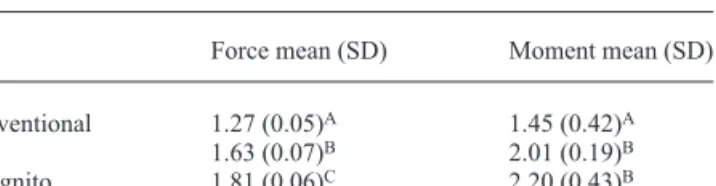
The mean (standard deviations) generated forces for STb, conventional, and Incognito brackets were 1.62 (0.07), 1.27 (0.05), and 1.81 (0.06) N, respectively. The corresponding moments were 2.01 (0.19), 1.45 (0.42), and 2.19 (0.43) Nmm ( Table 1 ). From the ANOVA tables ( Tables 2 and 3 ) , it is obvious that bracket type was a signi cant predictor of the generated forces ( F = 212.67, P < 0.001, adjusted R 2 = 0.94) and moments ( F = 11.20, P < 0.001, adjusted R 2 = 0.41).
The post hoc Scheffe pairwise comparisons ( Table 1 ) have indicated that the produced forces were different
Table 1 Mean values and standard deviation (SD) of the labiopalatal force (Newton) and sagittal moment (nanomillimetre) on the displaced lateral incisor between the different bracket systems.
Force mean (SD) Moment mean (SD) Conventional 1.27 (0.05) A 1.45 (0.42) A STb 1.63 (0.07) B 2.01 (0.19) B Incognito 1.81 (0.06) C 2.20 (0.43) B Means with same letters are not signi cantly different at the 0.05 level .
Table 2 Analysis of variance table for the effect of bracket type on the generated labiopalatal forces on the displaced lateral incisor.
Source Partial sum
of squares Degrees of freedom Mean square F Probability > F Model 1.5099 2 0.7549 212.67 0.0000 Bracket 1.5099 2 0.7549 212.67 0.0000 Residual 0.9585 27 0.0035
Total 1.6057 29 0.0553
Table 3 Analysis of variance table for the effect of bracket type on the generated moments in the sagittal plane on the displaced lateral incisor.
Source Partial sum
of squares Degrees of freedom Mean square F Probability > F Model 2.9644 2 1.482 11.20 0.0003 Bracket 2.9644 2 1.482 11.20 0.0003 Residual 3,574 27 0.133
Total 6.539 29 0.2254
among all three bracket types, whereas the generated moments differed between conventional and lingual brackets but not between lingual brackets.
Discussion
The experimental investigations of the initial force system produced by lingual appliances are scarce. Regarding the force magnitude, it is anticipated that an archwire of the same dimension and composition would exert higher forces at the anterior region if ligated lingually since the wire stiffness is increased ( Moran, 1987 ). The bending stiffness of a beam is inversely proportional to the cube of length and the torsional stiffness is inversely proportional to length ( Thurow, 1982 ). Moreover, the decrease in stiffness for bending is proportional to the cube of interbracket width increase ( Creekmore, 1976 ). In the present experiment, the forces measured on the lateral incisor for the STb and Incognito brackets were 23 and 38 per cent higher relative to conventional brackets, respectively. It is more dif cult to apply light optimal forces with lingual brackets since the load/de ection rate is increased in comparison with conventional appliances ( Moran, 1987 ; Geron et al. , 2004 ). The difference between the two lingual systems could be attributed to the interaction of the ligation mode with the different slot designs. In case of the Incognito lingual brackets, the archwire was ligated with German overties, which provide maximum seating force, and the vertical walls of the slot provided additional stabilization to the archwire in the horizontal plane. The effect of the German overties onto the archwire stabilization is expected to be less pronounced in thinner archwires and minor tooth displacements since in these cases , the seating force for the wire is expected to be lower.
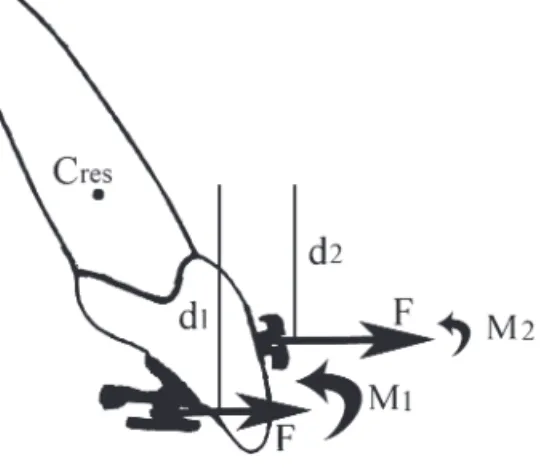
The moment created from a force applied lingually may produce a tooth movement much more complicated and unpredictable. Theoretically, the moments created from a horizontal force could be the same between the two bracket systems if force magnitude remains the same and if the vector of the force remains on the same horizontal plane and consequently on the same distance from the centre of resistance. This explains the similar patterns of tooth displacement at horizontal loadings observed between labial and lingual systems in a three-dimensional nite element model of an upper incisor ( Jost-Brinkmann et al. , 1993 ). In the present experimental set-up, the alteration in the point of force application, labial or lingual, and the differences in force magnitude have additive actions on the magnitude of the initial moments in the sagittal plane. As a result, these moments were higher in both lingual appliances ( Figure 3 ). The difference in force magnitude between the two lingual appliances was not capable to establish a statistically signi cant difference between the moments measured from these appliances. This implies that the distance between the force vector and the centre of resistance
I. SIFAKAKIS ET AL.
4 of 5
in Incognito brackets was smaller in comparison to the STb brackets.
By contrast to the horizontal forces, vertical forces of the same magnitude produce moments that differ signi cantly between the two bracket systems due to the differences in the distances of the force vectors from the centre of resistance. These moments are always smaller as compared with a labial bracket. In extreme cases, such as in a retroclined maxillary incisor, the resulting moment is in an opposite direction. In this case, an intrusion force applied lingually could aggravate the inclination of that tooth ( Geron et al. , 2004 ).
The last component of the force system at the bracket is the couple created from a rectangular archwire. The rotational tendency by the moment of this couple at the lingual brackets manifests irrespective of the location of the bracket on the tooth ( Isaacson et al. , 1993 ) and was not encountered in the present experimental set- up.
The force magnitude for tipping movement should not exceed 0.36 N for an anterior or 0.72 N for a posterior tooth and similar values are required for extrusion or rotation; twice as much force would be required for bodily tooth movement ( Prof t and Fields, 2000 ). Although higher forces were used in certain experimental protocols in humans ( Ren et al. , 2003 ), effective tooth movement can be produced with lower forces too with the bene t of reduction in the volume of root resorption ( Iwasaki et al. , 2000 ; Paetyangkul et al. , 2009 ). In the light of this evidence, the magnitude of the forces measured in this experiment could skeptically be considered as biologically acceptable. The initial magnitude of this force is expected to decrease rapidly during tooth movement but even in case of the labial brackets, the mean force on the displaced lateral incisor was 1.27 N. At least for the Incognito System, the clinician has the choice to use a thinner customized 0.012 inch superelastic (SE) Niti for the rst archwire . This wire is thermally reprogrammed during the bending process
Figure 3 The alteration in the point of force application — labial or
lingual could in uence the magnitude of the moments in the sagittal plane.
( Wiechmann et al. , 2003 ). After this treatment, it is certainly not as stiff as a normal, over the counter, 0.012 inch SE Niti. A recent experimental investigation evaluated the force system generated by the Incognito system in comparison with a conventional labial system ( Fuck et al. , 2005 ). This comparison revealed that the lingual system generated similar forces at the anterior region but higher forces at molars, smaller moments at the frontal plane and higher moments at the horizontal plane. A relative wide conventional bracket was used for his comparison since it left 55 per cent of the wire length free between the brackets. The free length of the archwire that was left between the rather narrow Incognito brackets was 76 per cent.
The OMSS model resembles very closely the clinical situation but conclusions regarding clinical performance should be drawn with skepticism. Factors, such as intra - oral ag e ing and saliva, which in uence the resulting force system, are disregarded by the machine. Furthermore, it has not yet been possible to predict accurately the centre of resistance in every tooth and the force systems measured at the bracket cannot be used directly to predict future movement of teeth since various factors affect the transfer of the bracket force system to the centre of resistance ( Halazonetis, 1998 ). Consequently, the movement of teeth should be carefully monitored to avoid side effects. Further research should focus on the reduction of the force magnitude of the initial archwires, especially in lingual bracket systems. Additionally, it would be clinically interesting to evaluate more archwire types regarding the generated force system as well as in malpositions in the vertical plane.
Conclusions
A 0.013 inch CuNiTi archwire generated high initial forces in the horizontal plane on a displaced lateral incisor; higher force magnitude was found for the lingual brackets. Between the two lingual systems, the lowest force was recorded at the brackets with the horizontal slot and the highest for the system tied with German overties.
The lowest moment measured in the sagittal plane was recorded at the conventional brackets, where no difference was found between the two types of lingual brackets . References
Baldwin D K , King G , Ramsay D S , Huang G , Bollen A M 2008 Activation time and material stiffness of sequential removable orthodontic appliances. Part 3: premolar extraction patients . American Journal of Orthodontics and Dentofacial Orthopedics 133 : 837 – 845
Bourauel C , Drescher D , Thier M 1992 An experimental apparatus for the simulation of three-dimensional movements in orthodontics . Journal of Biomedical Engineering 14 : 371 – 378
Creekmore T D 1976 The importance of interbracket width in orthodontic tooth movement . Journal of Clinical Orthodontics 10 : 530 – 534 Drescher D , Bourauel C , Thier M 1991 Application of the orthodontic
measurement and simulation system (OMSS) in orthodontics . European Journal of Orthodontics 13 : 169 – 178
FORCES WITH LINGUAL BRACKETS 85 3 of 5
FORCES WITH LINGUAL BRACKETS
the data. Mean values and standard deviations of the forces and moments generated were calculated per bracket type. One-way analysis of variance ( ANOVA ) and post hoc Scheffe pairwise comparisons were conducted to assess the effect of bracket type on the generated forces and moments. All statistical analyses were performed with the Stata 11 (Stata Corp . , College Station, Texas, USA).
Results
The mean (standard deviations) generated forces for STb, conventional, and Incognito brackets were 1.62 (0.07), 1.27 (0.05), and 1.81 (0.06) N, respectively. The corresponding moments were 2.01 (0.19), 1.45 (0.42), and 2.19 (0.43) Nmm ( Table 1 ). From the ANOVA tables ( Tables 2 and 3 ) , it is obvious that bracket type was a signi cant predictor of the generated forces ( F = 212.67, P < 0.001, adjusted R 2 = 0.94) and moments ( F = 11.20, P < 0.001, adjusted R 2 = 0.41).
The post hoc Scheffe pairwise comparisons ( Table 1 ) have indicated that the produced forces were different
Table 1 Mean values and standard deviation (SD) of the labiopalatal force (Newton) and sagittal moment (nanomillimetre) on the displaced lateral incisor between the different bracket systems.
Force mean (SD) Moment mean (SD) Conventional 1.27 (0.05) A 1.45 (0.42) A STb 1.63 (0.07) B 2.01 (0.19) B Incognito 1.81 (0.06) C 2.20 (0.43) B Means with same letters are not signi cantly different at the 0.05 level .
Table 2 Analysis of variance table for the effect of bracket type on the generated labiopalatal forces on the displaced lateral incisor.
Source Partial sum
of squares Degrees of freedom Mean square F Probability > F Model 1.5099 2 0.7549 212.67 0.0000 Bracket 1.5099 2 0.7549 212.67 0.0000 Residual 0.9585 27 0.0035
Total 1.6057 29 0.0553
Table 3 Analysis of variance table for the effect of bracket type on the generated moments in the sagittal plane on the displaced lateral incisor.
Source Partial sum
of squares Degrees of freedom Mean square F Probability > F Model 2.9644 2 1.482 11.20 0.0003 Bracket 2.9644 2 1.482 11.20 0.0003 Residual 3,574 27 0.133
Total 6.539 29 0.2254
among all three bracket types, whereas the generated moments differed between conventional and lingual brackets but not between lingual brackets.
Discussion
The experimental investigations of the initial force system produced by lingual appliances are scarce. Regarding the force magnitude, it is anticipated that an archwire of the same dimension and composition would exert higher forces at the anterior region if ligated lingually since the wire stiffness is increased ( Moran, 1987 ). The bending stiffness of a beam is inversely proportional to the cube of length and the torsional stiffness is inversely proportional to length ( Thurow, 1982 ). Moreover, the decrease in stiffness for bending is proportional to the cube of interbracket width increase ( Creekmore, 1976 ). In the present experiment, the forces measured on the lateral incisor for the STb and Incognito brackets were 23 and 38 per cent higher relative to conventional brackets, respectively. It is more dif cult to apply light optimal forces with lingual brackets since the load/de ection rate is increased in comparison with conventional appliances ( Moran, 1987 ; Geron et al. , 2004 ). The difference between the two lingual systems could be attributed to the interaction of the ligation mode with the different slot designs. In case of the Incognito lingual brackets, the archwire was ligated with German overties, which provide maximum seating force, and the vertical walls of the slot provided additional stabilization to the archwire in the horizontal plane. The effect of the German overties onto the archwire stabilization is expected to be less pronounced in thinner archwires and minor tooth displacements since in these cases , the seating force for the wire is expected to be lower.
The moment created from a force applied lingually may produce a tooth movement much more complicated and unpredictable. Theoretically, the moments created from a horizontal force could be the same between the two bracket systems if force magnitude remains the same and if the vector of the force remains on the same horizontal plane and consequently on the same distance from the centre of resistance. This explains the similar patterns of tooth displacement at horizontal loadings observed between labial and lingual systems in a three-dimensional nite element model of an upper incisor ( Jost-Brinkmann et al. , 1993 ). In the present experimental set-up, the alteration in the point of force application, labial or lingual, and the differences in force magnitude have additive actions on the magnitude of the initial moments in the sagittal plane. As a result, these moments were higher in both lingual appliances ( Figure 3 ). The difference in force magnitude between the two lingual appliances was not capable to establish a statistically signi cant difference between the moments measured from these appliances. This implies that the distance between the force vector and the centre of resistance
I. SIFAKAKIS ET AL.
4 of 5
in Incognito brackets was smaller in comparison to the STb brackets.
By contrast to the horizontal forces, vertical forces of the same magnitude produce moments that differ signi cantly between the two bracket systems due to the differences in the distances of the force vectors from the centre of resistance. These moments are always smaller as compared with a labial bracket. In extreme cases, such as in a retroclined maxillary incisor, the resulting moment is in an opposite direction. In this case, an intrusion force applied lingually could aggravate the inclination of that tooth ( Geron et al. , 2004 ).
The last component of the force system at the bracket is the couple created from a rectangular archwire. The rotational tendency by the moment of this couple at the lingual brackets manifests irrespective of the location of the bracket on the tooth ( Isaacson et al. , 1993 ) and was not encountered in the present experimental set- up.
The force magnitude for tipping movement should not exceed 0.36 N for an anterior or 0.72 N for a posterior tooth and similar values are required for extrusion or rotation; twice as much force would be required for bodily tooth movement ( Prof t and Fields, 2000 ). Although higher forces were used in certain experimental protocols in humans ( Ren et al. , 2003 ), effective tooth movement can be produced with lower forces too with the bene t of reduction in the volume of root resorption ( Iwasaki et al. , 2000 ; Paetyangkul et al. , 2009 ). In the light of this evidence, the magnitude of the forces measured in this experiment could skeptically be considered as biologically acceptable. The initial magnitude of this force is expected to decrease rapidly during tooth movement but even in case of the labial brackets, the mean force on the displaced lateral incisor was 1.27 N. At least for the Incognito System, the clinician has the choice to use a thinner customized 0.012 inch superelastic (SE) Niti for the rst archwire . This wire is thermally reprogrammed during the bending process
Figure 3 The alteration in the point of force application — labial or
lingual could in uence the magnitude of the moments in the sagittal plane.
( Wiechmann et al. , 2003 ). After this treatment, it is certainly not as stiff as a normal, over the counter, 0.012 inch SE Niti. A recent experimental investigation evaluated the force system generated by the Incognito system in comparison with a conventional labial system ( Fuck et al. , 2005 ). This comparison revealed that the lingual system generated similar forces at the anterior region but higher forces at molars, smaller moments at the frontal plane and higher moments at the horizontal plane. A relative wide conventional bracket was used for his comparison since it left 55 per cent of the wire length free between the brackets. The free length of the archwire that was left between the rather narrow Incognito brackets was 76 per cent.
The OMSS model resembles very closely the clinical situation but conclusions regarding clinical performance should be drawn with skepticism. Factors, such as intra - oral ag e ing and saliva, which in uence the resulting force system, are disregarded by the machine. Furthermore, it has not yet been possible to predict accurately the centre of resistance in every tooth and the force systems measured at the bracket cannot be used directly to predict future movement of teeth since various factors affect the transfer of the bracket force system to the centre of resistance ( Halazonetis, 1998 ). Consequently, the movement of teeth should be carefully monitored to avoid side effects. Further research should focus on the reduction of the force magnitude of the initial archwires, especially in lingual bracket systems. Additionally, it would be clinically interesting to evaluate more archwire types regarding the generated force system as well as in malpositions in the vertical plane.
Conclusions
A 0.013 inch CuNiTi archwire generated high initial forces in the horizontal plane on a displaced lateral incisor; higher force magnitude was found for the lingual brackets. Between the two lingual systems, the lowest force was recorded at the brackets with the horizontal slot and the highest for the system tied with German overties.
The lowest moment measured in the sagittal plane was recorded at the conventional brackets, where no difference was found between the two types of lingual brackets . References
Baldwin D K , King G , Ramsay D S , Huang G , Bollen A M 2008 Activation time and material stiffness of sequential removable orthodontic appliances. Part 3: premolar extraction patients . American Journal of Orthodontics and Dentofacial Orthopedics 133 : 837 – 845
Bourauel C , Drescher D , Thier M 1992 An experimental apparatus for the simulation of three-dimensional movements in orthodontics . Journal of Biomedical Engineering 14 : 371 – 378
Creekmore T D 1976 The importance of interbracket width in orthodontic tooth movement . Journal of Clinical Orthodontics 10 : 530 – 534 Drescher D , Bourauel C , Thier M 1991 Application of the orthodontic
measurement and simulation system (OMSS) in orthodontics . European Journal of Orthodontics 13 : 169 – 178
86 I. SIFAKAKIS ET AL.5 of 5 FORCES WITH LINGUAL BRACKETS
Fuck L M , Wiechmann D , Drescher D 2005 Comparison of the initial orthodontic force systems produced by a new lingual bracket system and a straight-wire appliance . Journal of Orofacial Orthopedics 66 : 363 – 376 Geron S , Romano R , Brosh T 2004 Vertical forces in labial and lingual orthodontics applied on maxillary incisors — a theoretical approach . Angle Orthodontist 74 : 195 – 201
Halazonetis D J 1998 Ideal arch force systems: a center-of-resistance perspective . American Journal of Orthodontics and Dentofacial Orthopedics 114 : 256 – 264
Isaacson R J , Lindauer S J , Rubenstein L K 1993 Activating a 2x4 appliance . Angle Orthodontist 63 : 17 – 24
Iwasaki L R , Haack J E , Nickel J C , Morton J 2000 Human tooth movement in response to continuous stress of low magnitude . American Journal of Orthodontics and Dentofacial Orthopedics 117 : 175 – 183
Jost-Brinkmann P G , Tanne K , Sakuda M , Miethke R R 1993 [A FEM study for the biomechanical comparison of labial and palatal force application on the upper incisors. Finite element method] . Fortschritte der Kieferorthopädie 54 : 76 – 82
Kapila S , Sachdeva R 1989 Mechanical properties and clinical applications of orthodontic wires . American Journal of Orthodontics and Dentofacial Orthopedics 96 : 100 – 109
Kravitz N D , Kusnoto B , BeGole E , Obrez A , Agran B 2009 How well does Invisalign work? A prospective clinical study evaluating the ef cacy of tooth movement with Invisalign . American Journal of Orthodontics and Dentofacial Orthopedics 135 : 27 – 35
Kurz C , Romano R 1998 Lingual orthodontics: historical perspective . In: Romano R (ed.). Lingual orthodontics. BC Decker , Hamilton , pp. 3 – 20
Moore R J , Watts J T , Hood J A , Burritt D J 1999 Intra-oral temperature variation over 24 hours . European Journal of Orthodontics 21 : 249 – 261
Moran K I 1987 Relative wire stiffness due to lingual versus labial interbracket distance . American Journal of Orthodontics and Dentofacial Orthopedics 92 : 24 – 32
Paetyangkul A , Türk T , Elekda ğ -Türk S , Jones A S , Petocz P , Darendeliler M A 2009 Physical properties of root cementum: part 14. The amount of root resorption after force application for 12 weeks on maxillary and mandibular premolars: a microcomputed-tomography study . American Journal of Orthodontics and Dentofacial Orthopedics 136 : 492.e1 – 492.e9
Prof t W R , Fields H W 2000 Contemporary orthodontics , 3rd edn . Mosby , St Louis , pp. 304
Ren Y , Maltha J C , Kuijpers-Jagtman A M 2003 Optimum force magnitude for orthodontic tooth movement: a systematic literature review . Angle Orthodontist 73 : 86 – 92
Shpack N , Geron S , Floris I , Davidovitch M , Brosh T , Vardimon A D 2007 Bracket placement in lingual vs labial systems and direct vs indirect bonding . Angle Orthodontist 77 : 509 – 517
Stamm T , Hohoff A , Ehmer U 2005 A subjective comparison of two lingual bracket systems . European Journal of Orthodontics 27 : 420 – 426 Thurow R C 1982 Edgewise orthodontics , 4th edn . Mosby , St Louis , pp. 17 Wiechmann D , Rummel V , Thalheim A , Simon J S , Wiechmann L 2003 Customized brackets and archwires for lingual orthodontic treatment . American Journal of Orthodontics and Dentofacial Orthopedics 124 : 593 – 599