© International Epidemiological Association 1996 Printed in Great Britain
Risk Factors for Invasive Haemophilus
influenzae Disease among Children
2-16 Years of Age in the Vaccine Era,
Switzerland 1991-1993
KATHRIN MUHLEMANN,* E RUSSELL ALEXANDER," NOEL S WEISS," MARGARET PEPE,* KURT SCHOPFER* AND THE SWISS H.INFLUENZAE STUDY GROUP
Miihlemann K (Institute of Medical Microbiology, Friedbuhlstrasse 51, University of Berne, CH-3010 Berne, Switzerland), Alexander E R, Weiss N S, Pepe M, Schopfer K and the Swiss H.Influenzae Study Group. Risk factors for invasive Haemophilus influenzae disease among children aged 2-16 years of age in the vaccine era, Switzerland 1991-1993.
International Journal of Epidemiology 1996; 25: 1280-1285.
Background. Continued surveillance, and detailed investigation of direct and indirect effects of conjugated vaccines and risk factors for invasive H.influenzae serotype b (Hib) disease in the vaccine era are important.
Methods. 143 cases with invasive disease between 1991 and 1993 aged 2-16 years were selected retrospectively from a large incidence trend study. Controls (n = 336) were recruited from local vital registries and matched to cases for age, gender, and residence. Hib vaccination histories among study subjects and their siblings and other sociodemographic variables were obtained by questionnaires completed by the parents of these children. Adjusted odds ratio (OR) estimates were calculated by conditional logistic regression analysis.
Results. Most vaccinated subjects had received the Polysaccharide-Diphtheria Toxoid vaccine and estimated vaccine efficacy was high (95%; 95% confidence interval [Cl] 60-99%). Also, the results suggested that protection afforded by vaccination against Hib extended to the family members of vaccinated children. School attendance was found to be protective against invasive Hib disease (OR : 0.33; C l : 0.14-0.75). Cases more often than controls reported sufferring from asthma and allergies (OR : 4.8; Cl : 1.2-19.4).
Conclusions. Post-licensure vaccine efficacy is high among children s=2 years of age. The observed association between asthma and epiglottitis is novel and deserves further investigation.
Keywords: Haemophilus influenzae, vaccine, vaccine efficacy, risk factors, asthma
Haemophilus influenzae type b (Hib) has been a leading
cause of life threatening invasive disease among children worldwide until vaccines became available in the mid to late 1980s.1
In the prevaccine era the epidemiology of invasive Hib disease in Switzerland was comparable to that of other Western European countries.2 For example, meningitis occurred at an annual incidence rate of 25 cases per 100 000 children < 5 years of age.2 The average age at disease was 29 months, higher than, for instance, in the US. Epiglottitis was as frequent as meningitis (annual incidence: 25 cases per 100 000 children < 5 years old).
* Institute of Medical Microbiology. Friedbiihlstrasse 51, University of Berne, CH-3010 Berne, Switzerland.
** Department of Epidemiology, School of Public Health, University of Washington, Seattle. WA 98195, USA.
f Department of Biostatistics, School of Public Health, University of
Washington, Seattle, WA 98195, USA.
The first conjugate vaccine Polysaccharide-Diphtheria Toxoid (PRP-D) was licensed in May 1990 and it was recommended to vaccinate all infants (at age 4, 6 and 15-18 months). As reported from several other countries, disease rates declined rapidly after the initia-tion of vaccinainitia-tion.2"6 For example, among children < 5 years of age incidence rates fell by 80% until the year 1993.2 The average age at disease increased to 35 months.
However, cases of invasive Hib disease continue to be diagnosed in our country. Continued surveillance, detailed investigation of direct and indirect vaccine effects and risk factors for invasive Hib disease in the vaccine era are therefore important.
METHODS
We conducted a population based case-control study among Swiss children aged 2-16 years of age for the time period 1991-1993 to investigate post-licensure 1280
vaccine efficacy and risk factors for invasive H.influenzae disease. The study protocol was approved by the ethical board of the University of Berne and the 26 state physi-cians of Switzerland. In addition, consent was obtained from designated people for data protection upon request by the state physicians.
Cases were selected from a retrospective study2 on
the incidence of invasive H.influenzae disease among children 0-16 years of age and residing in Switzerland between 1980 and 1993. Data had been collected from hospital statistics and by chart review for patients, who were diagnosed in any of 39 participating Swiss paedi-atric clinics with culture proven meningitis, epiglottitis, arthritis, cellulitis, or bacteraemia. In addition, clinic-ally diagnosed epiglottitis cases were included.
Eligible for the current case-control study were pa-tients who were hospitalized between 1 January 1991 and 31 December 1993 and had survived their disease. Cases had to be 3=2 years of age in 1991, 2=3 years old in 1992 and 3=4 years old in 1993. Age restriction had the purpose of increasing the probability that a case was not vaccinated (born before 1990), but had younger siblings eligible for vaccination. Cases had to be of Swiss or Italian nationality (residing in Switzerland).
The eligibility criteria were met by 143 cases. Seventy-nine (55.2%) cases contracted the disease in 1991. The corresponding numbers for 1992 and 1993 were 44 (30.8%) and 20 (14%) cases, respectively. Forty-four (30.8%) had meningitis, 91 (63.6%) had epiglot-titis, and 8 (5.9%) arthritis (n = 1), cellulitis (n = 1), bacteraemia (n = 2), or pneumonia (n = 3). Among epiglottitis cases the diagnosis was culture confirmed in 67 (73.6%) patients.
Controls were selected from vital statistics registries and were matched to cases by age (±0.5 years), gender, and the political community in which the case lived at disease onset. Five controls per case were recruited randomly if a community had five or more eligible children; otherwise, all eligibles were included. Out of 120 vital registries contacted, 109 (91%) participated in control selection and provided the names and addresses of 542 controls.
A self-administered questionnaire in German, French or Italian was sent to case and control families. Questionnaires were accompanied by a letter asking for participation. A second and third reminding letter and questionnaire were sent after 4 and 8 weeks, if no response was obtained. One hundred and thirty-nine (97%) of 143 case families and 539 (99%) of 542 con-trol families for whom a current address was available, were contacted. Overall, questionnaires were returned by 121 (87.0%) cases and 399 (74.0%) controls within 12 weeks. Eight (6.7%) cases had one matched control,
20 (19.6%) cases had two controls, 24 (20%) cases had three controls, 31 (25.8%) cases had four controls, and 19 (15.8%) cases had five controls. Nineteen (15.8%) cases and 19 (15.8%) controls had no matching control or case, respectively. Therefore, 102 cases and 336 controls who had at least one matched control or case remained for further analysis.
The questionnaire asked about a) the family struc-ture, b) the history of Hib vaccination on all children in the household as listed in the vaccine booklet, c) day care, kindergarden or school attendance and the number of children sharing a bedroom during the year of dis-ease or reference date, d) chronic disdis-ease in any of the children, e) a history of meningitis or epiglottitis in any family member, and f) the number of smokers in the family. Only the question on chronic diseases was open ended and asked for: 'any chronic disease in a child living in the household, e.g. cancer or asthma'. Also, parents were asked for permission to contact their family physician for further completion of vaccination histories if necessary. Vaccine history was obtained from the family physician for five controls, but for none of four cases for whom data were missing in the questionnaire.
A reference date was chosen as the day when the case had been hospitalized with invasive H.influenzae disease. Cases and controls were considered vaccinated against Hib if they had received at least one dose of a conjugated vaccine more than 14 days before the hospitalization or reference date.
Statistical associations between categories were evaluated by the %2 t e s t w^ Yates' correction or
Fisher's exact test. Crude and adjusted odd ratios (OR) were estimated in a conditional logistic regression model using EGRET.8 Vaccine efficacy was calculated
as (1-OR) x 100%, where OR estimates the relative risk of disease comparing vaccinated to non-vaccinated children. The following variables were evaluated as confounders: family size, the number of siblings, the number of siblings sharing a bedroom with the case/ control, the number of adult household members, day care, kindergarden or school attendance, the number of smokers in the family, and the presence of chronic diseases.
RESULTS
Data obtained from chart review during the incidence study of invasive H.influenzae disease in Switzerland2
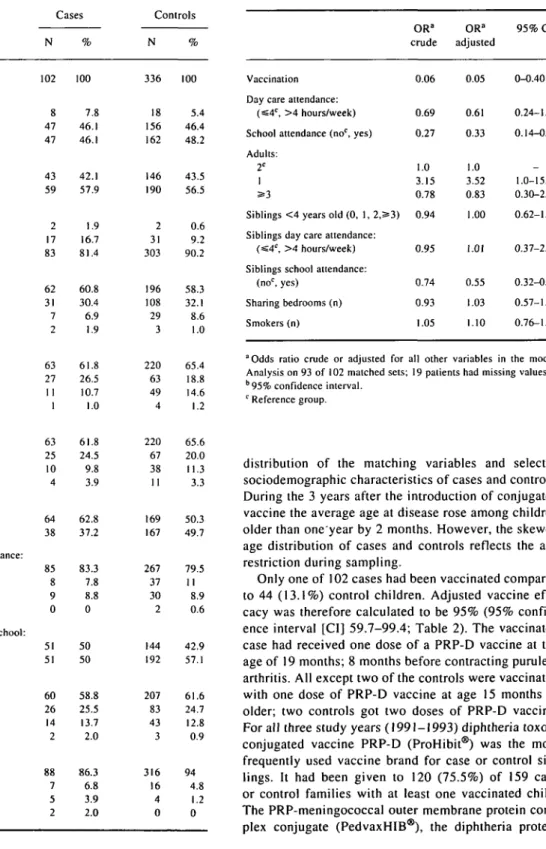
showed that there was little difference in the clinical and sociodemographic characteristics of the cases that were included in the analysis (n = 102) and those that were not (n = 41) (data not shown). Table 1 presents the
TABLE 1 Sociodemographic and clinical characteristics of 102
cases and 336 matched controls, Switzerland 1991-1993
TABLE 2 Conditional logistic regression analysis for risk factors
of invasive H.influenzae disease among children 2-16 years of age, Switzerland, 1991-1993 Cases Controls Total 102 100 336 100 Age: 2 8 7.8 18 5.4 3-4 47 46.1 156 46.4 3=5 47 46.1 162 48.2 Gender: Female 43 42.1 146 43.5 Male 59 57.9 190 56.5 Family size: 2 2 1.9 2 0.6 3 17 16.7 31 9.2 2=4 83 81.4 303 90.2 Sharing bedroom: No 62 60.8 196 58.3 1 sibling 31 30.4 108 32.1 2=2 siblings 7 6.9 29 8.6 Missing 2 1.9 3 1.0 Day care attendance:
No 63 61.8 220 65.4 1-4 hours/week 27 26.5 63 18.8 > 4 hours/week 11 10.7 49 14.6 Missing 1 1.0 4 1.2 Day care group size:
0 63 61.8 220 65.6 < 1 0 25 24.5 67 20.0 2=10 10 9.8 38 11.3 Missing 4 3.9 11 3.3 Kindergarden/school: No 64 62.8 169 50.3 Yes 38 37.2 167 49.7 Siblings day care attendance:
No 85 83.3 267 79.5 1-4 hours/week 8 7.8 37 11 > 4 hours/week 9 8.8 30 8.9 Missing 0 0 2 0.6 Siblings kindergarden/school: No 51 50 144 42.9 Yes 51 50 192 57.1 Smokers: 0 60 58.8 207 61.6 1 26 25.5 83 24.7 2=2 14 13.7 43 12.8 Missing 2 2.0 3 0.9 Chronic disease: No 88 86.3 316 94 Asthma 7 6.8 16 4.8 Allergy 5 3.9 4 1.2 Other 2 2.0 0 0 ORa OR" crude adjusted 9 5 % C Ib Vaccination 0.06 Day care attendance:
(S4C, > 4 hours/week) 0.69 School attendance (noc, yes) 0.27
Adults:
2C 1.0
1 3.15 3=3 0.78 Siblings < 4 years old (0, 1, 2,5=3) 0.94 Siblings day care attendance:
(S4C, > 4 hours/week)
Siblings school attendance: (noc, yes) Sharing bedrooms (n) Smokers (n) 0.95 0.74 0.93 1.05 0.05 0.61 0.33 1.0 3.52 0.83 1.00 1.01 0.55 1.03 1.10 0-0.40 0.24-1.52 0.14-0.75 1.0-15.37 0.30-2.27 0.62-1.64 0.37-2.95 0.32-0.99 0.57-1.89 0.76-1.57
aOdds ratio crude or adjusted for all other variables in the model.
Analysis on 93 of 102 matched sets; 19 patients had missing values.
b9 5 % confidence interval.
c Reference group.
distribution of the matching variables and selected sociodemographic characteristics of cases and controls. During the 3 years after the introduction of conjugated vaccine the average age at disease rose among children older than one'year by 2 months. However, the skewed age distribution of cases and controls reflects the age restriction during sampling.
Only one of 102 cases had been vaccinated compared to 44 (13.1%) control children. Adjusted vaccine effi-cacy was therefore calculated to be 95% (95% confid-ence interval [CI] 59.7-99.4; Table 2). The vaccinated case had received one dose of a PRP-D vaccine at the age of 19 months; 8 months before contracting purulent arthritis. All except two of the controls were vaccinated with one dose of PRP-D vaccine at age 15 months or older; two controls got two doses of PRP-D vaccine. For all three study years (1991-1993) diphtheria toxoid conjugated vaccine PRP-D (ProHibit®) was the most frequently used vaccine brand for case or control sib-lings. It had been given to 120 (75.5%) of 159 case or control families with at least one vaccinated child. The PRP-meningococcal outer membrane protein com-plex conjugate (PedvaxHIB®), the diphtheria protein
TABLE 3 The influence of asthma and allergies on the risk of
invasive H.influenzae disease in non-vaccinated children 2-16 years of age, Switzerland, 1991-1993
Cases Controls OR" ORa 95% CIb
N N crude restricted
TABLE 4 The influence of vaccination of siblings on the risk of
invasive H.influenzae disease in non-vaccinated children 2—16 years of age, Switzerland 1991-1993
Cases Controls ORa ORa 95% CIb N N crude adjusted Epiglottitis: Asthma/Allergies No' Yes Meningitis: Asthma/Allergies Noc Yes 56 (37) 9(7) 26 (25) 2(2) 214(186) 10(6) 81 (72) 8(7) 1.0 3.30 1.0 1.15 1.0 4.80 1.0 0.87 1.18-19.44 0.16-4.72 Siblings vaccinated: 0 23 48 1 6 11 2 0 4 0.30 0.16 0.01-1.56
aOdds ratio crude or restricted to non-vaccinated cases and controls
and to culture proven epiglottitis cases. The figures in parentheses indicate the number of cases and controls after restriction.
b95% confidence interval.
c Reference group; cases and controls with a chronic disease other than
asthma or allergies are excluded.
CRM197 conjugate (Hib TITER®) and the tetanus tox-oid conjugate PRP-T (ActHIB®) had been administered in 18 (11.3%), 9 (5.7%) and 1 (0.6%) families. Among control siblings up to 2 years of age at the reference date 76.3% (58 of 76) had received at least one dose of a conjugated vaccine. This percentage vaccinated increased slightly from 71.4% in 1991, to 84.0% and 77.8% in 1992 and 1993, respectively.
Adjusting for vaccination history, day care, kinder-garden or school attendance, and smoking there was no increased risk associated with the number of children in a family (OR : 0.86; 95% CI : 0.61-1.20; test for trend:
P = 0.36), the number of siblings < 4 years of age
(OR: 1.0, 95% CI : 0.62-1.61), or having siblings 4-16 years of age (OR: 1.11, 95% CI : 0.59-2.08). Also, sharing a bedroom with siblings was not a risk factor (OR : 1.03; 95% CI : 0.57-1.89). In six case and six control families the mother was the only adult (Table 1). Having only one adult household member seemed to be associated with an increased risk of invasive
H.influenzae disease (OR : 3.57, 95% CI : 1.0-12.86)
(Table 2).
Only 11% of cases and 15% of controls attended day care for more than 4 hours a week (Table 2). Children with regular day care attendance seemed to have a relatively lower risk of invasive H.influenzae disease (adjusted O R : 0.61, 95% CI : 0.24-1.52) (Table 3). Also, a smaller proportion of cases attended school than their matched controls (OR : 0.33, 95% CI : 0.14-0.75) and they less often had siblings who attended school
" Odds ratio restricted to non-vaccinated cases and controls with at least
I sibling <4 years of age and not attending day care >4 hours/week, kindergarden or school. Adjusted for the number of siblings and day care, kindergarden or school attendance of siblings.
b95% confidence interval. Test for trend: P - 0.16.
(OR : 0.65, 95% CI : 0.44-0.97) (Table 3). Restricting the analysis to cases and controls < 6 years of age did not appreciably influence the OR estimate (data not presented).
The presence of smokers in a family did not increase the risk of invasive H.influenzae disease in this study population (OR : 1.05, 95% CI : 0.76-1.57).
Seven cases and 16 controls had a history of asthma and four cases and four controls had an 'allergy'. Only three cases and three controls specified their disease as allergic asthma or allergic rhinitis. The proportion of case and control families who mentioned a sibling with a chronic disease were similar, namely 4% and 6% (Table 1). One case had epilepsy and another case suf-fered from Crohn's disease. Asthma and allergies taken together were associated with an increased risk of culture proven epiglottitis among non-vaccinated cases and controls (OR : 4.8, C I : 1.2-19.4) (Table 3). Analysed separately, the OR estimate associated with asthma was 5.5 (95% CI : 1.0-29.7) and for allergies the OR was 3.3 (95% CI : 0.2-40.0). However, a history of asthma and allergies did not increase the risk for
H.influenzae meningitis (Table 3).
In order to evaluate if Hib vaccination of siblings conferred indirect protection on other family members, the study population was restricted to 29 cases and 63 controls who were not vaccinated, had at least one sibling 4 years of age or younger and did not attend day care (more than 4 hours a week), kindergarden or school. Fifteen controls (25.6%) had at least one vac-cinated sibling in contrast to six (20.7%) cases. The relative risk associated with having vaccinated siblings was 0.16 (95% C I : 0.01-1.56, test for trend: /> = 0.I2) (Table 4).
DISCUSSION
This case-control study evaluated risk factors of invasive H.influeniae disease among children 2-16 years of age during a 3-year period after the licensure of conjugate vaccines in Switzerland. Vaccination was found to be highly protective against invasive Hib dis-ease in this study population where the PRP-D was the most frequently administered vaccine brand. This ob-servation agrees also with the rapid decline of invasive Hib disease in Switzerland soon after the initiation of the vaccine programme.2 However, the PRP-D vaccine
has been found to be less immunogenic9 and it may be
less protective.9'10
Some limitations may be considered when interpret-ing our study results. While the possibility of confound-ing is present in every non-randomized study of treatment efficacy, we feel that confounding is unlikely to have been responsible for the whole of the observed association. Within the Swiss population there is no reason to suggest that the decision to give/receive the vaccine is related to the disease," and in any event the association with vaccination per se was adjusted for a variety of characteristics. Also, in Switzerland socio-economic standard is uniformly high and school attend-ance is obligatory. The incidence study from which cases were recruited also included disease caused by non-serotype b strains. This should not have had an important influence on the study result, since over 98% of disease events were due to serotype b strains.
Recently, Barbour et al.n observed a reduced rate of
nasopharyngeal colonization with Hib among older, non-vaccinated siblings of vaccinated children. Our study suggests that vaccination of children also confers indirect protection from invasive H.influenzae disease to their older siblings.
Day care attendance has been found to increase the risk of invasive H.influenzae disease.13"17 However, in
our study control children attended day care more often than cases. In Switzerland, vaccination is not required for day care or school attendance. The reason for the observed association may have been that we studied children over 2 years of age. Three previous invest-igations had shown that the risk associated with day care was highest under the age of 2 years and waned there-after.1 3 1 5 1 6 Redmond and Picchichero13 hypothesized
that longer duration of day care may lead to greater iso-immunization (i.e. exposure to cross reactive antigens carried by other bacteria) and protection from disease. This may also explain why in our study school attend-ance among the study subjects and their siblings was found to be protective.
Recently, Jafari el a/.17 reported that having a single
mother was a risk factor for invasive Hib disease and
delay of vaccination in a post-licensure case-control study among children 2-18 months of age. Our results suggested a similar association. However, small num-bers did not allow us to explore this relationship further. An interesting observation was that a higher pro-portion of epiglottitis cases reported a history of asthma or allergies than did control children. We did not have more detailed information on the nature of reported allergies or documentation of asthma. Also, we cannot exclude that case families were more aware of allergies or asthma and reported them more often. To our know-ledge no other study has investigated asthma as a risk factor for invasive H.influenzae disease. In fact most of the earlier studies on risk factors have been conducted in the US where epiglottitis is a rare manifestation of invasive Hib disease which is itself uncommon in children of the age group addressed in this study. How-ever, several observations indicate that damage to the respiratory mucosa e.g. through other infections or exposure to smoke may increase the risk of invasive
H.influenzae disease.18"21 Similarly, chronic
inflamma-tion of the respiratory mucosa in asthma patients may help the bacterium to invade its host. H.influenzae is able to synthesize histamine and it has been suggested that the increase in bronchial permeability induced by histamine may be used by the bacterium to acquire necessary growth factors from the circulation.22"24
Histamine is also present in high concentrations in respiratory secretions of asthma patients and may favour colonization or invasion by H.influenzae. In this study, asthma was only a risk factor for epiglottitis but not for meningitis. This may be a consequence of the relatively high average age of the study population or it may indicate the role of a local event in the respiratory tract. The rapidly decreasing incidence of invasive Hib disease in the vaccine period will make it difficult to study this question further. However, mucosal damage through viral infections or smoking has also been found to increase the risk of invasive infection with Neisseria
meningitidis25 and Streptococcus pneumoniae,26 and the
prevalence of asthma is believed to have been increas-ing in the last decades.2728 Therefore, the role of asthma
for the pathogenesis of invasive H.influenzae disease and other bacterial infections deserves further study.
REFERENCES
1 Makela H P, Takala A K, Peltola H, Eskola J. Epidemiology of invasive Haemophilus influenzae Type b disease. J Infect
Dis 1992; 165 (Suppl. 1): 2-6.
2Miihlemann K, Alexander E R, Pepe M, Schopfer K. Invasive Haemophilus influenza disease among Swiss children
1980-1993: Evidence for herd immunity among older age groups? ScandJ Infect Dis (In press), 1996.
3 Adams W, Deaver K A, Cochi S L « at. Decline of childhood Haemophilus influenzae Type b (Hib) disease in the Hib
vaccine era. JAMA 1993; 269: 221-26.
4 Broadhurst L E, Erickson R L, Kelley P W. Decreases in invas-ive Haemophilus influenzae diseases in US Army children, 1984 through 1991. JAMA 1993; 269: 227-31.
5 Murphy T V, White K E, Pastor P et al. Declining incidence of Haemophilus influenzae Type b disease since introduction
of vaccination. JAMA 1993; 269: 246-48.
6 Peltola H, Kilpi T, Anttila M. Rapid disappearance of Haemo-philus influenzae type b meningitis after routine childhood
immunisation with conjugate vaccines. Lancet 1992; 340: 592-94.
7 Van Alphen L, Spanjaard L, van der Erde A, Dankert J. Predicted disappearance of Haemophilus influenzae type b meningitis in Netherlands. Lancet 1994; 344: 195. 8 Breslow N E, Day N E. Statistical Methods in Cancer Research.
Volume 1: The analysis of case-control studies. Lyon:
IARC Scientific Publications, 1980.
9 Zangwill K, Wenger J D, Sutter R W, Hadler S C. Recommenda-tions for use of Haemophilus b conjugate vaccines and a combined diphtheria, tetanus, pertussis, and Haemophilus b vaccine. Morb Mortal Wkly Rep 1993; 42 (RR-13): 1-15. 10 Ward J, Brenneman G, Letson G W, Heyward W L. Limited efficacy of Haemophilus influenzae Type b conjugate vaccine in Alaska Native infants. N Engl J Med 1990; 323: 1393-1401.
"Schorr D M, Von Kanel S, Kiirsteiner W, Schwemmer C. Durchimpfung bei 210 zufallig ausgelesenen Kindern im dritten Lebensjahr im Sommer 1992 im Kanton Basel-Landschaft. Bull BAG/OFSP 1993; 34: 616-20.
12 Barbour M L, Booy R, Crook D W M et al. Haemophilus influ-enzae type b carriage and immunity four years after
receiv-ing the Haemophilus influenzae oligosaccharides-CRM 197 (HbOC) conjugate vaccine. Pediatr Infect Dis J 1993; 12: 478-84.
13 Redmond S R, Pichichero M E. Haemophilus influenzae Type b Disease. JAMA 1986; 252: 2581-84.
14 Istre G R, Conner J S, Broome C V, Hightower A, Hopkins R S. Risk factors for primary invasive Haemophilus influenzae disease: Increased risk from day care attendance and school-aged household members. J Pediatr 1985; 106:
190-95.
15Cochi S L, Fleming D W, Hightower A W J I al. Primary invas-ive Haemophilus influenzae Type b disease: A population-based assessment of risk factors. J Pediatr 1986; 108: 887-96.
l6Takala A K, Eskola J, Palmgren J et al. Risk factors of invasive Haemophilus influenzae type b disease among children in
Finland. J Pediatr 1989; 115: 694-701.
17 Jafari H, Adams W, Deaver K, Plikaytis B, Wenger J. Efficacy of Haemophilus influenzae type b (Hib) conjugate vaccines, risk factors for invasive Hib disease and under-vaccination in the United States. In: Program and abstracts
of the 35th Interscience Conference on Antimicrobial Agents and Chemotherapy. San Francisco, CA: American
Society for Microbiology. 1995, pp. 160.
l8Takala A K, Muerman O, Kleemola M et al. Preceding respir-atory infection predisposing for primary and secondary invasive Haemophilus influenzae type b disease. Pediat
Infect Dis J 1993; 12: 189-95.
19 Kaplan S, Taber L H, Frank A L, Feigin R D. Nasopharyngeal viral isolates in children with Haemophilus influenzae type B meningitis. J Pediatr 1981; 99: 591-93.
2 0 Vadheim C M, Greenberg D P, Bordenave N et al. Risk factors
for invasive Haemophilus influenzae Type b in Los Angeles County children 1 8 - 6 0 months of age. Am J Epidemiol 1992; 136: 2 2 1 - 3 5 .
21 Wilson R, Read R, C o l e P . Interaction of Haemophilus influenzae with Mucus, Cilia and Respiratory Epithelium. J Infect Dis 1992; 165 (Suppl. 1): 100-2.
2 2 Read R C , W i l s o n R, R u t m a n A et al. Interaction of n o n t y p a b l e
Haemophilus influenzae with human respiratory mucosa in
vitro. J Infect Dis 1991; 163: 549-58.
23Sheinman B D, Devalia J L, Davies R J, Crook S J, Tabaquali S. Synthesis of histamine by Haemophilus influenzae. Br Med J 1986; 292: 857-8.
24Moxon, Wilson R. The Role of Haemophilus influenzae in the Pathogenesis of Pneumonia. Rev Infect Dis 1991; 13 (Suppl. 6): 518-27.
" H a r r i s o n L H, Armstrong C W, Jenkins S R « al. A cluster of meningococcal disease on a school bus following epidemic influenza. Arch Intern Med 1991; 151: 1005-09.
26 Hakansson A, Kidd A, Wadell G, Sabharwal H, Svanborg C. Adenovirus infection enhances in vitro adherenence of
Streptococcuspneumoniae. Infect Immun 1994; 62: 2707-14.
"CDC. Asthma—United States, 1982-1992. Morb Mortal Wkly
Rep 1995; 43: 952-55.
28 Anderson H R, Butland B K, Strachan D P. Trends in the prevalence and severity of childhood asthma. Br Med J 1994; 308: 1600-01.
(Revised version received May 1996)
APPENDIX
Members of the Swiss Haemophilus influenzae study group
K Baerlocher, (St Gallen), J-P Bossi (Martigny), L G Buetti (Locarno), U Biihlmann and H Bucher (Zurich), O Carrel (Vevey), D Chessex (Pompaples), J-M Choffat (Morges), V D'Appuzzo (Mendrisio), H de Crousaz (Lausanne), G De"leze (Sion), P Diebold (Monthey), P Dolivo and K Eggenberger (Yverdon), A Fanconi, U Lips and D Nadal (Zurich), R Favre (La Chaux-de-Fonds), H Fricker, (Chur), B Friolet (Delemont), H Gaze (Neuchatel), M Gianinazi (Lugano), H-P Gnehm (Aarau), E Gugler (Bern), R M Haller (Munsterlingen), U Hunziker (Winterthur), F Lattion (Payerne), D Lauffer (Nyon), J Lutschg (Bruderholz), J-R Panchaud (Clarens), F Renevey and F Besson (Fribourg), H Roten, (Visp), G Schubiger (Luzern), H Schwester-mann (Brig), P Sigg (Zurich), S Suter and A Gervaix (Genf), F Taminelli (Bellinzona), A Tschumi (Schaff-hausen), R P Zurbriigg and A Blumberg (Biel).