Eclogite Fades Regional Metamorphism of
Hydrous Mafic Rocks in the
Central Alpine Adula Nappe
by CHRISTOPH A. HEINRICH*
Departement fur Erdwissenschaften, Eidgenossische Technische Hochschule, Zurich, CH-8092, Switzerland
{Received 9 November 1984; revised typescript accepted 19 June 1985)
ABSTRACT
The Adula Nappe is a slice of Pre-Mesozoic continental basement affected by Early Alpine (Mesozoic or Lower Tertiary) high-pressure metamorphism. Mineral compositions in mafic rocks containing omphacite -I- garnet + quartz record a continuous regional trend of increasing recrystalliza-tion temperatures and pressures that can be ascribed to this regional high-pressure metamorphic event.
P-T estimates derived from mineral compositions grade from about 12 kb and 500 °C or less in the
north of the nappe to more than 20 kb/800 °C in the south.
The regional P-T trend is associated with a mineralogical transition from assemblages containing additional albite and abundant amphiboles, epidote minerals, and white micas in the north (omphacite-garnet amphibolites) to kyanite eclogites containing smaller amounts of hornblende and zoisite in the south. Textures and mineral compositional data show that these hydrous and anhydrous silicates associated with omphacite + garnet-I-quartz are primary parts of the high-pressure assem-blages. Observed phase relations between these primary silicates, theoretical Schreinemakers analysis, and the thermobarometric results, together indicate that the regional transition from omphacite amphibolites to kyanite eclogites can be described by two simplified reactions:
alb + epi + hbl = omp + kya -I- qtz + par (H2O-conserving) (15)
par + epi + hbl + qtz = omp + kya + H2O (dehydration) (12)
which have the character of isograd reactions.
Local variations of water activity (aH2<3) as indicated by isofacial mineral assemblages, and the
H2O-conserving character of the reaction (15), are interpreted to reflect largely H2O-undersaturated
and predominantly fluid-absent high-pressure metamorphism within the northern part of the nappe. The omphacite amphibolites and paragonite eclogites in this area are thought to have formed by H2O-conserving reactions from Pre-Mesozoic high-grade amphibolites, i.e. from protoliths of similar
bulk H2O-content.
The second 'isograd' (12) is interpreted to mark the regional transition from largely fluid-absent metamorphism in the north to fluid-present metamorphism in the south, where metamorphic pressures and temperatures in excess of 12-15 kb and 500-600 °C were sufficient for prograde in-situ dehydration of similar hydrous protoliths to kyanite eclogites. The observation of abundant veins, filled with quartz + kyanite + omphacite, suggests that a free fluid coexisted locally with the kyanite eclogites of the southern Adula Nappe at some time during progressive dehydration.
I N T R O D U C T I O N
Dehydration of hydrous mafic rocks and associated metasediments to eclogitic rocks during subduction of oceanic crust is believed to be an important factor in the formation of partial melts in the descending slab, the overlying mantle, or the lower crust, giving rise to
• Present address: Bureau of Mineral Resources, Geology and Geophysics, Division of Petrology and Geochemistry, GPO Box 378, Canberra, ACT 2601, Australia.
124 C. A. H E I N R I C H
calc-alkaline orogenic magmatism (e.g. Green & Ringwood, 1968; Wyllie, 1971, p. 208). Evidence for high-pressure dehydration of mafic rocks to eclogites has been established by experiments concentrating mainly on dehydration-melting relationships at relatively high temperatures (e.g. Lambert & Wyllie, 1972). However, little is yet known about which subsolidus mineral reactions are important under the lower-temperature conditions likely to prevail in the thermally disturbed realm of a subduction or continental collision zone (Anderson et al, 1978; England & Thompson, 1984; Rubie, 1984).
Eclogites currently found in crustal metamorphic terrains often contain assemblages indicating high pressures and low to moderate temperatures, and many authors have therefore interpreted eclogite occurrences as evidence for earlier crustal subduction (e.g. Krogh, 1977; Evans & Trommsdorff, 1978; Evans et al., 1979; Ernst & Dal Piaz, 1978; Rubie, 1984). However, it is not clear whether any of these 'crustal' eclogites have indeed formed by dehydration of more hydrous mafic precursors, or whether they have crystallized under H2O-undersaturated conditions from primarily anhydrous protoliths. The latter
possibility was first suggested by Bearth (1959) for nearly anhydrous eclogitic pillow metabasalts embedded in glaucophane-rich metahyaloclastites in the Western Alps. The concept that eclogites found in metamorphic terrains represent the H2O-undersaturated
equivalents of blueschist or amphibolite assemblages, forming at the same P-T conditions but higher H2O activity, has been supported more generally by Fry & Fyfe (1969), Newton &
Fyfe (1976) and in many textbooks (e.g. Miyashiro, 1973, p. 318; Winkler, 1974, p. 274). Other authors have stressed the observation of eclogitic veins and primary hydrous silicates as evidence for the presence of a fluid and high H2O activity during the formation of some
eclogites (Essene & Fyfe, 1967; Holland, 1979a; Brown & Bradshaw, 1979).
Eclogites from various terrains are mineralogically diverse (Smulikowski, 1964; Coleman
et al., 1965) and have probably formed under a wide range of P- T-aHlO conditions. However,
comparison between eclogites and a more general interpretation of their genesis is hampered by the structural incoherence typical of most terrains, which rarely show regular regional distribution patterns of eclogitic assemblages. The few known exceptions are from SW Norway (Krogh, 1977; Griffin et al, 1984), New Caledonia (Black, 1977), the Adula Nappe (Heinrich, 1982), and from Venezuela, where Maresch (1983) first reported a field example indicating progressive in-situ dehydration of amphibolite to eclogite. Recently, Takasu (1984) presented textural evidence for the transformation of epidote amphibolite to hydrous eclogite, which he ascribed to prograde dehydration metamorphism.
The Central Alpine Adula Nappe (Switzerland) displays a regionally systematic sequence of high-pressure assemblage in mafic rocks, grading from hydrosilicate-rich garnet + omphacite + bearing amphibolites, blueschists and eclogites in the north, to quartz-kyanite eclogites containing only minor hornblende and zoisite in the south (Heinrich, 1982, 1983). The southernmost occurrences are associated with garnet metaperidotites (Ernst, 1977, 1978; Evans & Trommsdorff, 1978; Evans et al., 1979). This suite of hydrous mafic rocks has been chosen for a petrological study, to define some of the mineral reactions that are likely to control the formation of different omphacite + garnet + quartz-bearing assem-blages, and to place some constraints on the conditions under which hydrous mafic protoliths may undergo prograde dehydration to hydrate-poor eclogites.
REGIONAL GEOLOGY AND STRUCTURAL RELATIONS
Structure and lithology of Adula Nappe
The Adula Nappe is an east- to southward dipping sheet-like body with an estimated thickness of 2-4 km, continuously exposed along a north-south profile of 50 km. It consists
ECLOGITE METAMORPHISM IN THE ADULA NAPPE 12S 10 km VALS Olivone • Hinterrhein Son Bernardino CONFIN TRESCOLMEN DURIA • Bellinzona
Lithological units of Adula Nappe basement | metagranitoid gneisses predominant
;-.;-,] (semi-)pelitic schists and gneisses with mafic lenses predominant Mineral assemblages in quartz - bearing mafic rocks
A albite + hornblende + epidote ( t o m p , white micas) A omphacite + epidote + porogonite (± amp, phengite)
§
kyonite + omphacite + paragonite (± amp, phengite)kyonite + omphacite (± amp, epi, white micas)
FIG. 1. Geological map showing the outline and internal structure of the Adula Nappe in southern Switzerland (simplified from Heinnch, 1983, plate 1). The metascdimentary units of the Adula Nappe host mafic lenses containing high-pressure assemblages. Occurrences of diagnostic quartz-bearing assemblages are indicated by
specific symbols, including some data by Baumgartner (1981).
predominantly of metagranitic and metapelitic gneisses and schists of a Pre-Mesozoic continental basement, which has been affected first by Mesozoic or lower Tertiary high-pressure metamorphism, followed by Oligocene Barrovian-style metamorphism. The two main rock types are interlayered on a kilometre scale grossly parallel to the nappe structure (Fig. 1). High-pressure assemblages are mainly preserved in mafic lenses within the metasedimentary layers (Heinrich, 1982; including additional references).
126 C. A. H E I N R I C H
Carboniferous Rb/Sr age data indicating an event of Pre-Alpine high-grade meta-morphism are preserved in some white micas from the northern Adula Nappe (Frey et al, 1976). Rb/Sr whole rock data suggest a Variscan (Late Carboniferous) origin for migmatites in the southern Adula Nappe, with local remobilization during Tertiary amphibolite facies metamorphism (Hanny et al, 1975). Some mafic high-pressure assemblages in the northern part of the nappe can be shown to derive from earlier high-grade amphibolites on the basis of locally preserved relict textures, in which glaucophane rims and sphene precipitates have partly replaced coarse-grained, formerly Ti-rich hornblendes with an earlier parallel alignment (Plas, 1959, p. 526; Heinrich, 1983, p. 78). Since the metasedimentary layers enclosing the mafic rocks extend over most of the length of the nappe, a similar amphibolitic origin is likely for the majority of the eclogitic rocks described in this paper. As in mafic rocks from other units of Variscan continental basement in the Alps, which are less affected by Alpine metamorphism (e.g. Buletti, 1983), trace element geochemistry indicates an ultimate origin from oceanic basalts for at least some of the Adula (Evans et al., 1979, 1981; Aurisicchio et al, 1982).
Mesozoic carbonate-rich to pelitic metasediments and minor metabasites separate the Adula Nappe from over- and underlying basement nappes. Some of this material has been imbricated at least into the frontal (northern) part of the Adula Nappe prior to all recognized stages of Alpine metamorphism and deformation (Jenny et al, 1923; Plas, 1959; Egli, 1966; Baumgartner & Low, 1983). Nevertheless, Mesozoic rocks comprise at most a few volume per cent of the present Adula Nappe.
The time of eclogite facies metamorphism has not been dated radiometrically, but geological evidence constrains it to the interval between Late Jurassic and Early Tertiary (Heinrich, 1982; 1983, p. 175).
Post-eclogite facies deformation and overprinting
Rocks containing garnet + omphacite + quartz (referred to as eclogitic assemblages sensu lato) are distributed over most of the Adula Nappe. They usually occur as relicts in cores of mafic lenses, where they escaped later deformation and hydration to lower-pressure greenschist and amphibolite assemblages. Heinrich (1982) described some key exposures which show that eclogite facies metamorphism was shared by the (semi-)pelitic country rocks. In most places, however, high-pressure assemblages were preserved in mafic rocks only. The phengite- and paragonite-rich high-pressure assemblages of the pelitic rocks were usually completely overprinted by prograde, biotite + feldspar-forming dehydration reactions, which occurred during later amphibolite facies metamorphism (Heinrich, 1982).
Post-eclogite deformation of schists and gneisses included isoclinal folding which reaches the scale of kilometres in the southern part of the nappe (Jenny et al, 1923; Egli, 1966; Codoni, 1981). This deformation probably occurred before and during nappe emplacement and Oligocene Barrovian-type metamorphism, but after regional eclogite facies meta-morphism. No original length scale can therefore be attributed to the still regular, but certainly distorted and blurred, exposed distribution pattern of eclogitic assemblages.
P E T R O G R A P H Y OF ECLOGITIC ASSEMBLAGES
Mineral textures in thin section, combined with structural observations in zoned mafic lenses, allow a clear distinction of assemblages produced by post-eclogite overprinting from earlier eclogite facies assemblages. Overprinting to amphibolite or greenschist invariably proceeded via a texturally distinctive intermediate stage, involving symplectite
pseudo-ECLOGITE METAMORPHISM IN THE ADULA NAPPE 127
TABLE 1
Primary assemblages and visually estimated modal composition of rocks studied by electron microprobe Vals Ad42-9-14* VA30 Ad41-9-20 Ad65-O-8* Confin Ad48-9-5* E5-10 E5-6 Ad51-9-12 Ad51-9-17 Trescolmen Ad2 5-9-3* Ad61-9-l* Gagnont CH271* Mgl63K Mgl63-*-8 E2-2 Araml Mg9-5-12c« gar 15 20 5 10 35 20 35 10 30 20 35 35 35 20 40 cpx 15 20 20 5 30 30 35 45 20 40 15 35 35 35 30 45 kya 5 10 10 10 5 qt: 5 X 10 X 5 10 10 X X X 30 10 15 20 X X amp 20 hbl 40 hbl 5 hbl 60glc 15 hbl 20 bar 5 hbl 15 hW 20 act 10 hbl 15glc 10 hbl 10 hbl 20 hbl 30 hbl 5 hbl ZOl 15 25 15 X X 20 5 5 clz-epi 10 X 10 10 5 10 par 5 5 5 5 phe 15 X 5 5 X 10 5 additional phases
20 alb; pyr, rut pyr, rut; clc pyr; sph; gra pyr, sph pyr; rut pyr; rut rut pyr, nit; sph 50 dol; dc; pyr; sph rut
5 tic; pyr; rut rut; iLm rot; llm rut rut rot; llm
Numbers refer to volume per cent, x = 2-5 per cent * denotes samples for which silicate analyses are given in Tables 2 and 3 Exact sampling localities and some petrographic observations are listed in Appendix 1.
The following abbreviations for mineral phases are used throughout act = actinolite, alb = albite, amp = amphibole, bar = barroisite, clc = calcite, d z = clinozosile, cpx = clinopyroxenc, dol = dolomite, epi = epidole, gar — garnet, gle — glauco-phane, gra = graphite, hbl = hornblende, llm = ilmenite, jad — jadeite, kya = kyanite, mus = muscovite, omp — omphacite, par = paragonite, phe = phengite, pyr = pyroxene, pig - pl»giodase, qtz = quartz, rut = ralile, sph = sphene, t k = talc, zoi = zoisite.
morphs and thin reaction rims along grain boundaries (Heinrich, 1982). By contrast, the minerals here considered to be part of a 'primary eclogitic assemblage', which are the subject of this study, are characterized texturally by sharp mutual grain boundaries, and by grains comparable or larger in size than omphacite and quartz (Table 1, Appendix 1, Fig. 2). Many of the assemblages so defined show equigranular textures with or without a linear or planar parallel orientation shared by a variety of anhydrous and hydrous silicates. Some minerals can occur as euhedral (garnet) or anhedral-poikilitic (hornblende, kyanite, primary albite) porphyroblasts. Amphibole poikiloblasts appear to overgrow the aligned fabric in the matrix of some eclogites, but mutual inclusions involving minerals of similar composition, such as hornblende + garnet + omphacite + quartz inclusions in kyanite next to kyanite + garnet + omphacite + quartz inclusions in hornblende (e.g. CH271, Ad25-9-3), indicate a largely contemporaneous crystallization of hydrous and anhydrous 'primary' silicates. Even the highest-grade kyanite eclogites (see below) from the Arami eclogite-garnet meta-peridotite complex contain zoisite and hornblende in parallel alignment with equigranular garnet + omphacite + kyanite + quartz, and homogeneous garnet grains contain inclusions of hornblende of the same composition as the matrix. Despite extensive overprinting by texturally later and chemically different amphibole assemblages, there is little evidence to suggest (cf. Ernst, 1977, p. 377) that all hydrous phases formed at the expense of an earlier, completely anhydrous eclogite assemblage.
In the porphyroblastic eclogite textures, chemical equilibrium was probably approached at least at contacting grain boundaries, but rarely attained throughout a whole rock even at
C. A HEINRICH JOOym 1
P
H- Jq t Z alb alb cpx , yFIG. 2. Typical mineral textures of primary high-pressure assemblages, (left) Amphibolite Ad42-9-14 from Vals, with coexisting omphacite + albite +quartz + garnet + hydrous silicates, (right) Quartz-kyanite ecloghe Ad25-9-3
from Trescolmen, with primary hornblende, zoisite and phengite. See Table 1 for mineral abbreviations.
the scale of a thin section. This is shown by the chemical zoning of larger mineral grains, indicated by arrows in Figs. 3, 8, 9 and 10, and discussed below. Deviation from complete equilibration is particularly obvious in chemically and texturally zoned garnet porphyro-blasts, which in their Fe- and Ca-enriched core contain inclusions of biotite, sphene and rarely plagioclase (phases that do not occur in the eclogite matrix) and of dark green amphibole, which has a highly aluminous composition different from the pale bluish to brown matrix amphiboles. These inclusions could represent armoured relics of Pre-Alpine amphibolite assemblages, but the presence of omphacite and epidote as additional inclusion minerals indicates that the inclusion assemblages probably record an early (omphacite-epidote amphibolite?) stage in the Alpine high-pressure metamorphic history of eclogite formation (see below).
Many kyanite eclogites, especially in the Trescolmen area (Fig. 1), contain irregular veins 10-100 mm in width and less than a metre in length. The veins are filled with quartz, minor omphacite, sometimes apatite, and euhedral kyanite crystals up to several centimetres in size. In many cases they cut eclogite schistosity and banding. Vein walls show no obvious mineralogical zonation or alteration of the adjacent host eclogite. All matrix minerals of the host eclogite occur at the vein contact, with omphacite sometimes growing as needles into the vein. Although quartz has recrystallized to polygonal grains, the textural relations indicate that all vein minerals crystallized from a vein fluid which was probably in local equilibrium with the immediately adjacent kyanite eclogite.
Quartz and kyanite contain fluid inclusions up to 20 /mi in size. Most inclusions are H2O-rich with a small gas bubble, but highly saline inclusions with cubic ?NaCl daughter
crystals have also been observed. No microthermometric studies have been performed so far, because most fluid inclusions are clearly secondary. At least the high-salinity inclusions have probably formed during amphibolite fades overprinting. This is indicated by their arrangement along healed fractures in the extension of hairline veins in the adjacent eclogite, along which omphadte and garnet are replaced by dark green hornblende, diopside, and plagioclase. These later veins or joints occur even in the freshest eclogites and represent an initial stage of post-eclogite facies overprinting controlled by the access of external fluids (cf. Heinrich, 1982, p. 33).
From a total of about 200 samples studied in thin section, 2 to 6 omphacite + quartz-bearing rocks from 4 areas of less than 1 km2 each (Gagnone, Trescolmen, Confin and Vals;
Fig. 1), plus a few additional samples from other localities in the Adula Nappe, were chosen for electron microprobe investigation. They were selected on the basis of their showing relatively simple textures among 'primary' hydrous and anhydrous silicates, with no or
E C L O G I T E M E T A M O R P H I S M IN T H E A D U L A N A P P E Mg A Gagnone, Arami O Confin.Trescolmen • Vals 129 30 Fe + Mn di + hd + Cats
FIG. 3. (a, above) Composition of eclogitic garnets, with arrows indicating trends from core to ran of zoned porphyroblasts. Empirical boundaries for mole per cent pyrope (py30 and py}5) separating type-A, -B, and -C
eclogites are from Coleman el ai. (1965). (b, below) Composition of Adula clinopyroxenes in the triangle di + hd + CaAI2SiO6 (Cats) = Ca, jd = Na-Fe3 + , and ac = Fe3 + , after Essene & Fyfe (1967).
only traces of incipient retrogression to amphibolitic symplectite textures (Table 1). Representative point analyses are given in Tables 2 and 3 together with analytical and recalculation procedures.
P-TESTIMATES FROM MINERAL CHEMISTRY OF GARNETS AND PYROXENES
The composition of the anhydrous eclogite minerals, garnet and clinopyroxene (Fig. 3), constrains the pressure-temperature conditions of the formation of quartz-bearing eclogites, independent of the presence of additional hydrous phases.
130 C. A. H E I N R I C H
Fe2 + /Mg fractionation between garnet and clinopyroxene The temperature-dependent exchange equilibrium
(1) (vector notation after Thompson, 1981; Thompson et ai, 1982) is relatively pressure insensitive, and can be used to estimate the formation temperature of eclogitic assemblages. Fig. 4a is a log-log plot showing the Fe2+/Mg distribution data from the Adula Nappe
according to equilibrium (1). Contours for constant distribution coefficients KD = 65 and
KD = 17, where
Fe
separate empirical KD ranges for garnet-omphacite pairs from different geological settings as
suggested by Banno & Matsui (1965) and Lovering & White (1969). Largely because of changing garnet compositions (Fig. 3a), KD values from the northern and southern part of the Adula Nappe plot in clearly different fields, in general agreement with their present metamorphic environment. Ellis & Green (1979) have calibrated equilibrium (1) as a function of temperature, pressure, and the Ca-content of the system, expressed by the grossular content (Xf?,r). Their equation (9) can be rearranged to
_Fe_Var_ll48 / F e Vp i /1316 4-72 FN
The left hand term of equation (2) may formally be considered as a garnet composition term, empirically corrected for the non-ideality in garnet. A first approximation for T of 773, 873, 973 and 1073 K for Vals, Confin, Trescolmen and Gagnone/Duria/Arami was used for the correction, which is only weakly dependent on the T values. The garnet composition data thus corrected are shown as a function of log(Fe2+/Mg)cpi in Fig. 4b. The 'Ca-corrected
distribution coefficient', Kg, is plotted in Figs. 4b, 5 and as a function of temperature and pressure in Fig. 6, where:
l o g K g = l o g KD- ^ J r £r. (3)
Fig. 4b shows that Ellis & Green's calibration corrects for all compositional effects among the samples from the northern and southern Adula localities, indicating a trend in Kg such that:
Kg(Arami,Duria) < Kg(Gagnone) < Kg (Vals).
The distribution coefficients for the intermediate Confin and Trescolmen localities vary considerably even after correction for Xf£. Kg tends to decrease with increasing jadeite content of the particularly sodic omphacites from each of these two localities (Fig. 5). A similar effect has been found for jadeitic pyroxenes of the Western Alps, where Koons (1984) proposed preferential ordering of Fe relative to Mg into the M2-site of clinopyroxene (solid solution towards clinoferrosilite) as a likely cause for this effect. Koons (1984) suggested that, as the total Fe + Mg in Ml is high (as in the jadeite-poor pyroxenes used in Ellis & Green's experiments), ordering of relatively minor Fe in M2 has no strong effect on the bulk Fe/Mg ratio of the pyroxene. However, the preference of Fe2 + for the slightly larger M2 site becomes
relatively more important with increasing jadeite content (and hence decreasing total Fe + Mg content) of very sodic omphacites. The shape of the dashed curves in Fig. 5 is calculated to represent the maximum estimated effect of M1, M2 ordering on Kg. They were
ECLOGITE METAMORPHISM IN THE ADULA NAPPE 131 10 0.5 0.0 -0.5 0 5 -0.5 |log(Fe/Mg)g a r •
o
A A O Vals Confin Trescolmen Gagnone Arami, Duriac
'glaucophane schist terrains" "amphibollte-^ granulite -t e r r a i n s / ' ' "kimberli-te pipes" KD=17 D 6.5 A log(Fe2+/Mg)cpx 2+ CDX log(Fe / M g )p -1.5 -1.0 -0.5FIG 4. (a, above) Logarithmic distribution diagram of Fe2 +/Mg between garnets and clinopyroxenes from the
Adula Nappe. Fe2+(cpx) is estimated from cation normalized stoichiometry (see Table 2), while for garnet
Fe(gar) = Fe"" was plotted neglecting minor fernc iron. Empirical boundaries of KD = 6-5 and 17 separating
type-A, -B and -C cclogites are from Lovering & White (1969). (b, below) The same data as in (a\ except that the garnet composition term (vertical axis) is corrected for Xf£ after Ellis & Green (1979) (eqn. (2\ text). The Ca-corrected distribution coefficient Kg, indicated by the 45° contours, is constant for the mineral pairs from each of the localities Vals, Gagnone and Arami/Duria, but widely variable for pairs from Trescolmen and Confin
132 C. A. HEINRICH
TABLE 2
Electron microprobe analyses of clinopyroxenes and garnets
Chnopyroxene SlO2 TiO2 A12O3 FeO(tot) MnO MgO CaO N a2O Total Cations normalized to Si Ti Al(tet) Al(oct) Cr Fe3 + Fe2 + Mn Mg Ca Na Garnet SiO2 TiO2 A12O3 C r2O3 FeO(tot) MnO MgO CaO Total Cations norn Si Ti Al Cr Fe Mn Mg Ca Ad42-9-14 55-17 022 1113 OOO 4-99 008 8O0 13-24 6-81 99-65 £<cations) = 6 1-97 001 003 044 OOO 005 010 OOO 043 051 047 Ad42-9-l4 Ad65-0-8 rim 38-65 O i l 21-85 OOO 27-35 066 3-35 9-81 101-79 lalized to 2-99 001 1 99 OOO 1-77 OO4 039 O8I run 37 55 012 2099 OOO 27-64 096 1 54 1097 99 77 Locations) = 8 300 001 1-97 OOO 1-85 007 018 094 Ad65-0S 55-20 012 11-61 OOO 8O1 005 5-43 1015 8-53 99O9 1-99 OOO 001 048 OOO 013 012 OOO 029 039 060 Ad48-9-5 run 38 76 1 10 21 81 006 2141 026 7-83 8-67 99-90 2-96 006 1-97 OOO 1 37 O02 089 071 Ad48-9-5 55-80 OOO 11-12 0 0 5 2-81 OOO 8-91 13-55 6-86 9910 1-99 OOO OOI 0-45 OOO 003 005 OOO 0-47 0-52 0-47 Ad48-9-5 core 38 61 0 0 9 21 66 OOO 21O4 1 50 529 10-70 98 87 3 01 0-01 1 99 OOO 1-37 0-10 0-62 O89 Ad25-9-3 5514 007 IO08 O07 2-41 OOO 1O43 15-60 5-47 99-27 1-97 OOO 003 039 000 001 006 OOO 056 060 038 Ad25-9-3 rim 4O05 004 22-56 000 19-39 043 11-17 6-90 10O55 2-99 OOO 1-99 OOO 1-21 003 124 055 Ad6l-9-l 57-93 006 1785 003 2 62 OOO 4 79 684 1072 10O84 199 OOO 001 071 OOO 001 007 OOO 025 025 071 Ad61-9-l run 39 29 003 22 82 OOO 22 95 OOO 1025 507 10O4I 2-97 OOO 2O3 OOO 1-45 OOO 115 041 CH271 run 39-12 OOO 22 25 OOO 22 87 051 9-89 5 88 I0O52 2 97 OOO 1-99 OOO 145 003 1 12 048 CH27I 56-10 006 1262 OOO 2 59 OOO 8 38 1307 7 23 10O04 1-97 OOO 003 050 OOO 002 006 OOO 044 049 049 CH271 core 39-51 015 22O0 OOO 21-40 053 9OI 8-31 I0O92 2-99 OOI 196 OOO 1 35 003 101 067 Mg9-5-12c 55-33 012 11-36 OOO 3O7 004 9-27 14-44 6-33 99-97 1-96 OOO 004 043 OOO 004 005 OOO 049 055 044 Mg9-5-12c rim 39-19 006 21-89 000 18-53 047 7-81 11-94 99 90 299 OOO 1-98 000 118 003 089 098 Single representative point analyses of contacting mineral grams are listed above and in Table 3. Unless indicated otherwise, rim or plateau compositions are given See Table 1 and Appendix 1 for sample description
Analytical conditions: Wave-length dispersive spectrometers on automated ARL-SEMQ microprobe; 15 kV acceleration voltage,
20 nA reference sample current on brass, 20 sec counting time; 10 //m defocujsed beam for micas to prevent alkali loss. Simple natural silicate and oxide standards. ZAF-correction, including fixed amounts of H2O for hydrosilicates (Table 3), using program EMMA
(J Sommcraucr and R. Gubser, ETH Zurich). Normalization of clinopyroxene analyses to 6 cations (Laird & Albee, 1981, appendix I) nearly always resulted in fully charge-balanced formulae of ideal site occupancy with slightly less than 200 Si per 6 cations, thus illowing unique assignment of F e2 + aiid Fe3 +
calculated for (in atoms per 6 cations): Fe2 +(M2) = 004, Mg(M2) = 0, Fe2 +/Mg(M 1) = 0-1.
Assuming maximum possible site preference, these values could be representative for the analysed Na-rich omphacites (Ad61-9-l, E5-10; Table 2), indicating that the ordering mechanism proposed by Koons (1984) has the right magnitude to explain the compositional
ECLOGITE METAMORPHISM IN THE ADULA NAPPE 133 1.2 0.8 0.4 flog KQ (gar/cpx)
-
-f-Trescolmen . N ac p x Ql 0.2 0.3 0.4 0.5 0 6 0.7FIG. 5. The compositional dependence of the garnet-clinopyroxene Fe/Mg distribution coefficient remaining after application of the correction for Kg by Ellis & Green (1979). Log Kg (see eqn. (3), text) tends to decrease with increasing Na-content of the relatively jadeite-rich omphacites from each of the areas Confin (circles) and Trescolmen (tnangles). The dashed lines (at arbitrary vertical position) are theoretically calculated to show the maximum effect which preferential F e2 + ordering in the clinopyroxene M2-site is expected to have on log Kf,
((Coons, 1984)
dependence of log K& observed in the Adula assemblages. Unfortunately the analytical observations scatter too much to place any quantitative limits on this ordering model.
Excluding omphacites with Xjd > 06, where cation ordering is more likely to cause
systematic errors in temperature estimation, the largest uncertainty in applying Ellis & Green's thermometer to Adula eclogites is probably mineral inhomogeneity. Error bars in Figs. 4 and 5 represent the total variation of 5-20 point analyses of several adjacent garnet and pyroxene grains, excluding only the Ca-Fe-rich compositions of inclusion-rich cores of texturally zoned garnet porphyroblasts. The apparent uncertainty could have been reduced by selecting only analyses of rims in immediate contact, a procedure which generally yields the lowest values for Kj> However, such a selection could introduce a systematic error, because of the possibility of local post-eclogite Fe/Mg exchange along grain boundaries during amphibolite facies overprinting. With the wider error bars shown in Fig. 4, the total uncertainty due to incomplete chemical equilibrium probably outweighs the errors resulting from stoichiometric estimation of F e2 +/ F e3 + in pyroxene, because normalization to 6
cations allowed a unique assignment of cation occupancies to an ideal charge-balanced pyroxene stoichiometry in most cases. Possible exceptions are some clinopyroxenes with very low total Fe/Mg, notably ultramafic garnet peridotites where uncertainties due to stoichiometric F e2 +/ F e3 + estimation may be larger than in mafic eclogites (e.g. the point in
the lower left corner of Fig. 4 representing the analyses from the Gagnone peridotite given by Evans & Trommsdorff, 1978).
Jadeite content (Xj(i) of clinopyroxene coexisting with quartz
In combination with Fe-Mg exchange thermometry, the net-transfer equilibrium NaAlSi2O6(cpx) = NaAlSi3O8(plg)-l-SiOj(qtz) (4)
places limits on the formation pressure of omphacite +quartz ±albite, but uncertainties due to ordering in omphacite restrict its application to natural assemblages.
Site ordering of Na,Al and Ca,Mg + Fe causes preferential stabilization of clinopyroxenes with compositions close to jadeite: diopside + hedenbergite = 1:1, which leads to two miscibility gaps in the system NaAlSi2O6-Ca(Mg,Fe)Si2O6 at low temperatures (Clark &
Papike, 1968; Carpenter, 1980). Ordering can occur during cooling of originally disordered high-temperature omphacites. Alternatively it may be primary in lower-temperature omphacites from blueschist terrains, in which case it is often reflected by gaps in
134 C A. HE1NRICH
10
-4 0 0 5 0 0 600 7 0 0 8 0 0 9 0 0
FIG. 6. P T locations of some experimentally determined equilibria, and likely conditions of crystallization of the quartz + omphacite + garnet assemblages (shaded areas) from Vals (V), Confin (C), Trescolmen (T), Gagnone (G) and Arami/Duria (A). Contours of ACg refer to the Ca-corrected distribution coefficient of Fe2 +/Mg between garnet
and clinopyroxene (eqn. (3), text), after Ellis & Green (1979). Isopleths of jadeite (jd, mole per cent) in omphacite according to equilibrium (4) after Gasparik & Lindsley (1980). The preferred stabilization of ordered P2/n omphacites to pressures below the dashed jd5 0 contour (P2/n-C2/c boundary) is schematic only (cf. Holland, 1983).
Dashed contours 1-7, 1-8 and 21 are for the Al-contents of orthopyroxenes in garnet lherzolites from Gagnone, Arami and Duna, respectively, from data given by Evans & Trommsdorff (1978), recalculated using the new calibration of Harley & Green (1982). Other curves ( PH l 0 = P) are from Chatterjee & Johannes (1974) for
mus + qtz = Al2SiO5 + H2O, from Thompson & Tracy (1979) for the minimum melting of muscovite + quartz, from
Chatterjee (1972) and Holland (19796) for the reactions involving paragonite, and from Holdaway (1971) for the stability field of kyanite.
compositional plots such as Fig. 3b (cf. Carpenter, 1980, fig. 1b). Completely ordered omphacites have not been synthesized in laboratory experiments, but Holland (1983) measured at 600 °C the effect of partial ordering on extending the stability field of intermediate omphacite compositions ( +quartz) relative to albite. Gasparik & Lindsley (1980) used part of these data to fit the P-Tdependence of the mole fraction of NaAlSi2O6
(Xjd) in disordered and partly ordered clinopyroxenes coexisting with albite + quartz.
E C L O G I T E M E T A M O R P H I S M IN THE ADULA N A P P E 135
The omphacites from Confin, Trescolmen and Gagnone are acmite-poor and cover the whole compositional range from diopside-hedenbergite to more than 70 mol per cent jadeite (Fig. 3b). The absence of any compositional gaps suggests that at least those clinopyroxenes with compositions outside Xjd = 0-5 ±0-1 have originally crystallized in the
disordered C2/c state (cf. Carpenter, 1980, fig. la). This suggestion is in agreement with the relatively higher equilibration temperatures indicated for the southern parts of the nappe by the Fe/Mg distribution data. The contours for equation (4) according to Gasparik and Lindsley (1980) therefore allow a realistic estimation of the minimum pressures required to stabilize the plagioclase-free eclogites from Confin, Trescolmen and the southern Adula Nappe (Fig. 6).
By contrast, all omphacites from the northern Adula Vals locality plot in a small wedge-shaped field in Fig. 3b (dashed lines) with its apex near Xjd = 0-5. Comparison with
fig. 1b of Carpenter (1980) suggests primary crystallization of the Vals pyroxenes in the ordered P2/n omphacite structure, in agreement with a relatively low crystallization temperature. Because of the unknown effect of complete ordering on stabilizing low-temperature omphacites, the extrapolated j dJ 0 isopleth (Fig. 6) after Gasparik & Lindsley
probably provides an upper limit for the formation of the omphacite + quartz + albite assemblages from Vals. The true crystallization pressure may be a few kilobars lower, as sketched in Fig. 6 by the qualitative curve jd(omp) + qtz = alb and the shaded area 'V. Any errors in pressure estimation due to ordering in omphacite would be accentuated if extra-polation of Ellis & Green's Fe/Mg geothermometer caused any over-estimation of crystalliza-tion temperatures due to ordering or other non-ideality effects in omphacite and garnet solid solutions. The P-T limits for the Vals area are therefore subject to the largest uncertainty.
Al-content of orthopyroxene
Eclogite formation pressures can be further constrained from published Al-contents of orthopyroxenes in garnet Iherzolites from Gagnone, Arami and Duria, if it is assumed that these rocks formed at the same metamorphic conditions as the associated eclogites. This assumption is debated (Ernst, 1978; Evans & Trommsdorff, 1978) but compatible with the data of Evans et al. (1979) and the present eclogite data (Fig. 6). Orthopyroxene from a single occurrence of 2-pyroxene eclogite at Trescolmen has an Al-content below 0-01 atoms per 4 cations, which indicates a lower temperature than for the crystallization of the southern Adula peridotites, but which is too low to sensitively constrain equilibration pressure (Harley & Green, 1982).
Conclusions from thermobarometry
The estimation of absolute values delimiting crystallization conditions of the Adula eclogites involves errors which may be systematic and which are probably larger than commonly assumed. Despite this, the mineral compositions of anhydrous eclogite matrix minerals show a systematic trend of regional increase in recorded temperatures and pressures from north to south through the present Adula Nappe. Combining all available data, the following values are considered to be the most likely P-T brackets for the matrix recrystallization of eclogitic rocks from different areas of the Adula Nappe:
North South Vals Confin Trescolmen Gagnone Arami, Duria 450-550 450-550 550-650 600-700 750-900 °C °C °C °C °C 10-13 12-22 15-22 15-25 18-35 kb kb kb kb kb
TABLE 3
Electron microprobe analyses of primary hydrous silicates and albite
Amphibole Ad42-9-14 Ad65-0S Ad48-9-5 Ad25-9-3 Ad61-9-1 CH27I Mg9-5-12c
SiO2 TiO2 A12O3 Cr2O3 FeO(tot) MnO MgO CaO Na2O K2O H2O * 45-04 061 1412 0-00 12-26 O09 11-32 8-76 4-02 0-49 2-50 54-67 008 11-18 OOO 13-69 0-08 8 91 2-15 6-20 O05 2-50 47-70 0-27 12-75 0-05 8-26 OOO 14-70 901 3-41 0-32 2 50 49-42 023 12-43 0-05 5-68 OOO 16-26 8-90 3-34 O32 2-50 58-21 O10 13-82 OOO 3-65 OOO 13-59 1-36 706 0-15 2-50 4<5-29 0-56 16-35 OOO 6-50 004 14-30 7-20 5-20 0-75 2-50 43O8 089 15-64 007 8-04 006 14-67 1073 3-74 0O6 2-50 O > X
z
O •T" Tola! 99-21 99-52Cations normalized to E(cations) — Ca — Na — K. = 13 Si 6-55 7-67 Ti 0O7 O01 Al(tet) 1-45 033 Al(oct) 097 1-51 Cr OOO OOO F e3 + 039 046 Fe2 + 111 1-15 Mn 001 O01 Mg 2-46 1-86 Ca 1-36 O32 Na(M4) 064 1-68 Na(A) 050 OOI K 0O9 OOI 98-97 9913 100 44 99-67 99-46 6-76 0O3 1-24 088 OOI 057 041 000 310 1-37 063 O30 006 6-89 O02 111 093 OOI 051 015 OOO 3-38 1-33 067 023 006 7-73 001 027 1 89 OOO 012 028 OOO 2-69 019 1 -81 OOI 003 6-49 006 151 119 OOO 050 026 OOO 2-99 108 092 049 013 616 009 1-84 080 OOI 050 046 OOO 313 1-65 036 068 OOI
Albite, epidote-yroup minerals and sheet SiO2 TiOj A12O3 C r2O3 FeO(tot)t MnO MgO CaO NajO K j O H2O* Total Cations Si Ti Al Cr Fe Mn Mg Ca Na K alb AA42-9-14 68-21 0-00 20-01 OOO 015 0-00 000 078 11-35 004 OOO 100-54 2-97 OOO 103 000 001 OOO OOO 004 096 OOO clz Ad42-9-14 38 79 014 28-21 OOO 7-35 OOO 014 23-46 OOO OOO 1-80 99-89 2-99 001 2-57 OOO 047 OOO 002 1-94 OOO OOO silicates epi Ad65-0S 37-68 Oil 2616 OOO 9-65 Oil OOO 23-61 000 OOO 180 9913 2-95 001 2-42 OOO 063 001 OOO 1 98 OOO 000 clz Ad48-9-5 39-18 025 29-61 003 4-59 000 012 24-62 OOO 002 1-80 10O21 2-99 OOO 2-67 OOO O29 OOO 001 202 OOO OOO ZOI Ad25-9-3 39-84 005 32-35 OOO 1O9 005 009 23-87 004 OOO 1-80 99-18 3-04 OOO 2-91 OOO 007 OOO 001 1-95 001 OOO zoi Mg9-5-12c 39-24 006 32-71 004 1-27 OOO 009 23-84 003 OOO 1-80 99 07 300 OOO 2 95 OOO 008 OOO 001 1 95 000 OOO phe Ad42-9-14 4917 052 29-52 OOO 2-39 OOO 2-91 001 1-31 9-44 4-50 99-76 3-25 003 2-30 OOO 013 OOO 029 OOO 017 080 phe Ad25-9-S 51-83 033 26-21 OOO 098 OOO 4-63 002 045 1021 4-50 9916 3-43 002 2O4 OOO 005 OOO 046 OOO 006 086 phe Ad48-9-5 4917 041 28-88 005 1 32 OOO 318 005 102 9-65 4-50 98-22 3-30 O02 2-29 OOO 007 OOO 032 OOO 013 083 par Ad48-9-5 45-45 013 38-82 003 O46 OOO 024 0 53 6-97 O98 4-50 98O9 2-96 001 2-98 OOO 003 OOO 002 004 088 008 par Ad61-9-l 46-61 Oil 39-81 OOO OOO OOO 017 OOO 7-73 O18 4-50 9910 2-98 001 300 OOO 000 OOO 002 OOO 096 002 talc Ad61-9-l 6114 OOO 055 OOO 6-95 OOO 26-95 OOO 009 002 4-50 100 20 3-96 OOO 004 OOO 038 OOO 2-61 OOO 001 OOO
n
r-u
Ct H m -i > 2o
"0 X 2 _z
H X m > Oc
Representative analyses of grains in immediate contact with garnet + omphacite (for analyses see Table 2) +quartz ±kyanite (Table 1; Appendix 1) are given. Amphibole analyses were normalized to a cation sum £(cations) — Ca — Na — K = 13. Site allotment and estimation of F e2 +/ F e3 + using the assumption ( M & F e J ^ ^ O (no
anthophyllite-type exchange) mostly resulted in charge-balanced amphibole formulae, in contrast to other possible assumptions (normalization 3 of Laird & Albee, 1981, Appendix 1). The other analyses were normalized to locations) = 5 for albite; locations) = 8 for epidotegroup minerals, epidote, clinozoisite, and zoisite; locations) -Ca —Na —K -= 6 for the sheet silicates, phengite, paragonite, and talc.
* Assumed for ZAF correction. f As Fe2O3(tot) in epidote-group mineral analyses.
-o -o m
138 C A. H E I N R I C H
In addition to this regional trend, incomplete equilibration as recorded by garnet zoning from Fe-rich cores to Mg-rich rims (Fig. 3a) indicates a segment of increasing temperature along the P-T path towards crystallization of the matrix assemblage of individual eclogites. MINERAL CHEMISTRY OF PRIMARY ECLOGITIC HYDROSILICATES
Paragonite has been identified by microprobe in eclogites of the northern and central
Adula Nappe, usually occurring together with phengite. Its composition is displaced only slightly from the end-member NaAl3Si3O10(OH)2 by about 01 atom units of KNa_,
towards muscovite and an equal displacement along the (negative) Tschermak's vector — Al2(Mg,Fe)_1Si_1. It is often associated with relatively jadeitic omphacites, and its
even-grained textural alignment with omphacite clearly shows it to be a primary eclogitic hydrosilicate. The occurrence of coexisting paragonite + omphacite(ArJd = 0-6-0-7) +
kyanite according to the equilibrium
NaAl3Si3Oi0(OH)2 = NaAlSi2O6(cpx) + Al2SiO5 + H2O (5)
provides an upper limit for the load pressure of eclogite formation in the Confin and Trescolmen areas (Fig. 6; Holland, 1979b), irrespective of the presence of any fluid phase.
Phengite, the only potassic mica found as primary constituent in Adula eclogites, is
displaced from muscovite towards celadonite by 0-35-0-55 units of — Al2(Mg,Fe)_!Si_,.
This exchange is inversely correlated with a 0-2 to 0-1 unit exchange of K N a _( towards
paragonite. The Fe2 + Mg_, exchange equilibrium between phengite and garnet has been
studied experimentally by Krogh & Raheim (1978) and by Green & Hellman (1982) under reducing conditions where F e2 + = Feto1 could be assumed. Natural phengites allow
considerable exchange along Fe3 + Al _,, but since some displacement towards tri-octahedral
micas is possible as well, no unambiguous estimation of F e2 +/ F e3 + from microprobe
analysis is possible. Fetot/Mg is plotted in Fig. 7, which shows the tendency of
to be lower for Trescolmen and Confin than for the Vals samples. This qualitatively indicates a lower equilibration temperature for the latter locality, in general agreement with the regional trend of increasing temperature recorded by garnet-clinopyroxene geothermometry. Absolute temperatures derived from Green & Hellman's calibration of K$rlpbe(P,T),
however, are about 100 °C higher than those estimated with the garnet-pyroxene equilibrium (1). This probably indicates that a considerable part of the iron in the Adula phengites is ferric.
Epidote group minerals (zoisite, clinozoisite, epidote) are widespread as a primary phase in
eclogite assemblages throughout the Adula Nappe. Their compositions do not show any simple regional distribution pattern. Garnet amphibolites in the North usually contain Fe-rich clinozoisite, whereas kyanite eclogites at Trescolmen and further south more often contain Fe-poor zoisite. However, more Fe-rich clinozoisite occurs in Ca-enriched metarodingitic eclogites at Gagnone (Evans el al, 1979) and Duria (Heinrich, 1983), indicating that the type of epidote group phase is mainly determined by bulk rock composition. In all areas except Arami and Duria, apparently coexisting pairs of zoisite and more Fe-rich clinozoisite have been observed. Eclogites at Arami contain zoisite as the only primary epidote group mineral.
Fe3 + Al_, exchange in epidote group minerals is roughly correlated with that in
ECLOGITE METAMORPHISM IN THE ADULA NAPPE 139
to the Fe2 +/ F e3 + estimation procedure used for omphacite. No such correlation has been
found for stoichiometrically estimated F e2 + and F e3 + contents of the eclogitic amphiboles
which are therefore considered to be very uncertain.
1.0 0.5 0.0 log
0
• A-/
(Fe/Mg)9ar Vals Confin Trescolmen > /'A
A'/-A/ :
_
log (Fe/Mg)phe
-1.0 -0.5 0.0
FIG. 7. Logarithmic distribution plot of Fe'^/Mg between garnet and primary phengitic white micas from Vals, Confin and Trescolmen. The open triangle with the highest Fe/Mg value represents the garnet and phengite core of
the eclogite fades metapelite from Trescolmen discussed by Heinrich (1982, table 2, sample Ad85).
Amphibole, as a primary eclogitic phase, shows a wide compositional variation, ranging
(after Leake, 1978) from impure actinolite in a metadolomite through hornblende, tschermakitic hornblende and barroisite nearly to end-member Mg-glaucophane. The amphibole in most of the mafic quartz eclogites is common hornblende with a ratio of tetrahedral Al to the total octahedral occupancy of Al + F e3 ++ C r3 ++ T i4 + close to one
(Fig. 8a). Taken alone, the compositions of the texturally primary eclogitic amphiboles from the Adula Nappe are thus not very different from those of high to intermediate pressure facies series amphibolites (e.g. Laird & Albee, 1981). This observation is in contrast to omphacite assemblages from the Western Alpine Sesia Zone, where amphiboles strongly displaced from glaucophane are restricted to quartz-undersaturated assemblages (Koons,
19826).
Amphibole composition in the Adula eclogites is clearly correlated with the jadeite content of the associated omphacite by the coupled exchange Na(AJ,Fe3+)Ca_ ,(Mg,Fe2 +)_,,
the jadeite or glaucophane exchange vector (Fig. Sb; Heinrich, 1983, figs. 7.3, 7.4). Bulk rock composition is certainly one major control on amphibole and pyroxene composition, but in addition systematic regional differences in mineral compositions are apparent from tie-line rotations such as those shown in Fig. 9. At a given jadeite content of clinopyroxene, the total NaAl-content of the coexisting primary amphibole tends to increase going from the northern to the southern Adula Nappe.
This can be explained by a regional shift in the continuous net-transfer reaction
NaAlSi2O6(cpx) = + 3 SiO2 (7) jadatc component in dinopyroieoe edenile exchange ID amphibole quartz
140 C. A. HEINRICH d.U i 1.5 1.0 0.5 no* glaucophane
toct
3 + 4 + Fcpx tremolite tsch'ermakite / / 12-2 amp edenite I.O 0.5 0.0f
(D M51-17 0.5 0.0 0.0 0.5 1.0 1.0 0.8 0.6 0.4 0.2 1.0 0.8 0.6 0.4 0.2 1.0 0.8 glaucophane t(Na/Na+Ca)M Gagnone, Arami cpx amp CH271tremolite E2-2 edemte
Confin.Trescolmen E5-10 E5-6 M25 ' M4S M51-12 Ad51-17 Vals Ad42 0.2 1.5 2.0 0.0 0.2 0.4 0.6 0.8 1.0
FIG. 8. Mineral composition (in atoms per formula unit, Tables 2 and 3) of primary amphiboles (open symbols) and coexisting clinopyroxenes (full symbols and black bars) in quartz-beanng mafic rocks. Each symbol outlines the full composition range of between 5 and 20 point analyses per mineral and per sample. Arrows indicate zonation trends from grain core to rim. The positions of some important NCMASH end-members of amphibole are indicated for comparison, (a, left column) Total octahedral occupancy, O d3 + 4 + = A l ^ + Fe3"1" + C r3 + + T i *+, versus
tetra-hedrally coordinated Al. (fc, right column) Plots of (Na/Na + Ca)*" and (Na/Na + Ca)*" of coexisting amphiboles and clinopyroxenes, respectively, on the vertical axjs (measuring the jadeite or glaucophane exchange vector, Na(AlFe3 + )Ca_,(Mg,Fe?.^), versus NaA in amphibole on the horizontal axis (edenite exchange, NaAlD_,Si_,).
ECLOGITE METAMORPHISM IN THE ADULA NAPPE A + N, 141 C + 2N Ad«1 M2S Trescolmen E5-10 Confin M42 VAJO Vals
FIG. 9 Coexisting amphibolcs (open symbols) and clinopyroxenes (full symbols) in the 'ACF-deluxe diagram of Thompson (1981, fig. 28). The coordinates
A + N = AljO3 + Fe2O3 + C r2O3 + TiO2 + (Na2O + K2O) C + 2N = CaO + 2(Na2O + K2O)
M = MgO + FeO + MnO
correspond to a projection along the exchange vector NaSiCa_,Al_, (plagioclase vector). Amphiboles from the southern Adula Nappe (Gagnone) coexisting with a clinopyroxene of a given jadeite content tend to be more NaAI-rich than those in the central and northern part of the nappe (notably Confin). In addition to this regional trend, a similar tie-line rotation is also recorded by grain zonations in individual eclogite samples (e.g. Ad25-9-3
142 C. A. H E I N R I C H
0
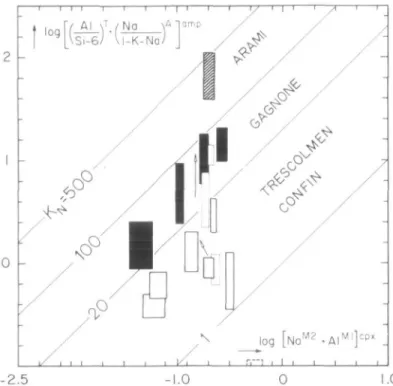
FIG. 10. Log-log diagram for the net-transfer equilibrium (7) showing analytical data of coexisting clinopyroxenes and amphiboles from quartz-saturated assemblages. Equilibrium (7) controls the edenite exchange in amphiboles (NaAln_,Si_,, vertical axis) as a function of the jadeite content of the coexisting clinopyroxene (horizontal). Glaucophane Ad61-9-l plots below the diagram because its very low Allel and NaA is not well constrained by the
analysis. The systematic regional differences in KN probably reflect a regional increase in temperature from north to
south recorded by the hydrous eclogite assemblages (see text).
(where • denotes a vacancy in the A-site of the amphibole). The logarithmic mass-action constant
aN a
(8) aAlSi,O,
can be approximated for analysed pairs of amphiboles and clinopyroxenes (coexisting with excess quartz) by
l o g KN~ l o g ' i —6
[(NaM 2AlM 1)]c p (9)
where the element symbols refer to atoms per formula unit in the crystallographic site indicated by the superscript (cf. Tables 2, 3). In Fig. 10, numerator us. denominator of this expression are plotted logarithmically, with contours of constant KN indicated by the
diagonal lines. Alternative ways could be used to express Ks for a given pair of analyses, but
the diagram shows qualitatively the regional shift of equilibrium (7) from more jadeitic clinopyroxenes in the northern and central parts of the Adula Nappe (Confin, Trescolmen) to more edenitic amphiboles in the south (Gagnone and Arami).
E C L O G I T E M E T A M O R P H I S M IN T H E ADULA N A P P E 143
seem to be effectively controlled by the composition of the coexisting clinopyroxene, probably because the latter is fixed near jd5 0 by preferential stabilization due to ordering (see
Fig. 36).
Equilibrium (7) is the high-pressure equivalent of the equilibrium
NaAlSi3O8(plg) = NaAln^1Si_1(amp)+4 SiO2 (10)
tlbite component edcnilc cichangc quartz ID pligiodase in ampbibole
which controls the edenite exchange in amphiboles of quartz-bearing amphibolites at pressures below the breakdown of plagioclase to pyroxene. Laird (1980) and Spear (1981) observed that N a A l D ^ S i . ! increases in plagioclase-quartz-amphibole assemblages with increasing metamorphic temperature. From this and the small volume change associated with reaction (7) (Au°(7) = - 1 0 8 J b a r "1 mole"1; using data from Helgeson et al., 1978) it
can be predicted that the high-pressure equilibrium (7) is essentially temperature-sensitive only, shifting to the right with increasing temperature. The systematic regional change in the reaction coefficient XN of reaction (7) indicated by Fig. 10 is therefore in good agreement with
the regional gradient in temperature recorded by Fe/Mg exchange between garnet and clinopyroxene.
Where large hornblende poikiloblasts are compositionally zoned, this always involves an increase in tetrahedrally coordinated Al and the ratio NaA/NaM4 from core to rim (Fig. 8).
This indicates a trend of increasing XN (7) (and therefore probably an increase in
temperature) during their growth.
Conclusions from mineral chemistry
Comparison of the compositional variations in texturally 'primary' eclogitic hydrosilicates and associated garnets and clinopyroxenes has shown:
(a) a general correlation between the compositions of hydrous and anhydrous minerals in rock suites from small areas of the Adula Nappe, indicating bulk rock compositional control in isofacial, often high-variance assemblages;
(b) regional shifts in continuous solid-solid equilibria involving 'primary' hydrosilicates, which qualitatively agree with regional differences in crystallization temperatures and pressures recorded by mineral equilibria among the anhydrous eclogite minerals;
(c) zoning patterns in 'primary' amphiboles which are compatible with zoning in garnet, both probably recording a path segment of increasing temperature during recrystallization of individual eclogites.
In support of the textural evidence, the mineral chemistry indicates that the crystallization of the 'primary' hydrosilicates is closely linked, and grossly coeval, with the crystallization of the anhydrous eclogite phases.
PHASE RELATIONS IN HYDROUS QUARTZ ECLOGITES
Analysis of phase relations and accurate deduction of mineral reactions between hydrous eclogitic assemblages requires at least ten system components: SiO2, TiO2, A12O3, Fe2O3,
FeO, MgO, CaO, K2O, Na2O, and H2O; neglecting minor MnO, C r2O3 and trace elements.
Quartz and rutile are the only two phases which are in excess in all the studied samples, and which therefore allow a thermodynamically valid projection in the sense of Greenwood (1967,1975). For the Adula eclogites, K2O can be neglected, because its amount in the rock is
144 C. A HEINRICH
amphibole and paragonite is neglected. Further reduction of components can be achieved by combination of components or condensation along exchange vectors (Thompson et al., 1982). Condensation of FeO + MgO corresponds to a projection along the exchange vector FeMg_ t, but this is a thermodynamically valid projection only if the two components do not
preferentially fractionate between the phases under discussion, i.e. if they in fact behave like a single component. Although approximately true in the case of the FeMg_! exchange between clinopyroxene and amphibole, this prerequisite obviously does not hold for garnet which is preferentially enriched in Fe and has therefore been excluded from the analysis. This omission may be the most serious limitation in a more general application of the Schreinemakers analysis developed below, but it will not affect the main conclusions.
For a graphical representation of the phase relations in the condensed NCMASH model system (Thompson et al., 1982), two additional projections are necessary. The approach used here is to project tentatively from H2O and along the Fe3 +Al_ [ vector into the tetrahedron
NCMA, where
N = Na2O + K2O
C = CaO M = MgO + FeO
A = Al203 + Fe2O3 (Fig. 11).
As a consequence, any reaction relationships apparent from NCMA chemographies of observed assemblages (Fig. 12) will have to be discussed in terms of differences in temperature and pressure, as well as the level of the activities (a) or chemical potentials (n) of H2O and F e3 +A l _ j . projection from qfz H20 CaO Na2O MgO + FeO
FIG. 11. Perspective representation of primary minerals of Adula quartz eclogjtes in the NCMA tetrahedron. In addition to projection from quartz and condensation along the exchange vectors FeI + Mg_, and Fe3 + Al_,, the tetrahedron involves projection from H2O, despite the indication from phase relations that the activity of H2O is
not externally controlled in the Adula assemblages, as discussed in the text. The internal tetrahedron hbl-epi-alb-omp represents the common amphibolite assemblage in the Vals area of the northern Adula Nappe. Glc + epi (dashed line intersecting the plane hbl + alb + omp) occurs as an alternative assemblage in the same area,
ECLOGITE METAMORPHISM IN THE ADULA NAPPE 145 Topological constraints from Schreinemakers analysis
Disregarding initially the compositional variations along Fe3 + Al_,, and neglecting
complications which may arise from miscibility gaps in pyroxenes and possibly other phases at low temperature, the condensed NCMASH-species hornblende, omphacite, epidote (including zoisite/clinozoisite), paragonite, albite, kyanite, quartz and H2O are related by six
reactions. The stoichiometry of these reactions is given in Table 4 for a set of representative condensed phase compositions. Stoichiometric coefficients vary somewhat according to amphibole and omphacite compositions. However, their sign, and hence the topology of the deduced Schreinemakers grid (Fig. 12), does not change within the full range of phase com-positions observed in the quartz-bearing assemblages of the Adula Nappe. Among the six reactions only the degenerate reaction
par + qtz = alb + kya + H2O [omp, hbl, epi] (11)
in the NASH-subsystem has been tested experimentally by Chatterjee (1972) and constrained at higher pressures by the experiments of Holland (1979b). Due to a lack of thermodynamic data and the complexity of the amphibole solid solution (Heinrich, 1983, p. 130) the reactions involving hornblende cannot be estimated. Only the sign of their slopes can be realistically inferred by combining the principles of Schreinemakers (e.g. Zen, 1966), approximate calculations of reaction volumes (Table 4), and the assumption that reaction entropies are dominated by H20-liberation and (for the H2O-conserving reaction) by the octahedral to
tetrahedral coordination change of Al (cf. Holland & Richardson, 1979). Fig. 12 shows possible relative positions of the six reactions as heavy lines in a P-T diagram.
Unless aHjO is fixed externally (e.g. by the presence of a hydrous fluid), only the reaction
[H2O] is univariant (and hence truly discontinuous in the 6-component model system
NCMASH), because it involves 7 solid phases. These minerals uniquely fix /IH2O and all
mineral compositions at any given point along the line [ H2O ] . The variation of these
parameters along the line [H2O] is exemplified by its intersection with contours for constant aHlO as fixed by the equilibrium par + qtz = alb + kya + H2O (fine broken lines), and with
contours for constant Xjd in omphacite as fixed by the equilibrium alb = jad + qtz (fine full
lines). Note that the increase of Xid along [H2O] with falling temperature suggested by the
intersecting contours is arbitrary; [H2O] could equally well have a steeper slope than the
jadeite-contours, in which case the variation would be reversed.
The other five H2O-involving reactions [alb], [kya], [qtz], [par] and [omp, hbl, epi] are
divariant bands even in the NCMASH model system, unless aHl0 is given a specified value.
Correspondingly, the point I will shift to lower temperatures along the line [ H2O ] as aH2O is
lowered. In Fig. 12 the point I and the H2O-involving NCMASH-reactions are placed
arbitrarily to represent positions which would be compatible with aHlO ~ 0 5 . Comparison with natural assemblages
The derived Schreinemakers topology is in agreement with the phase assemblages observed in the four areas Gagnone, Trescolmen, Confin and Vals (shown as the tetrahedral insets in Fig. 12), as well as with the thermobarometric results (indicated by V, C, T, G; cf. Fig. 6). Except for minor tie-line rotations reflecting regional shifts in continuous reactions, the chemographies for Gagnone and Trescolmen are similar, with kyanite occurring in sufficiently aluminous rocks. An additional epidote phase (usually zoisite) is common in both areas in relatively calcic, typically mafic rock compositions, coexisting with an aluminous hornblende. In more sodic compositions, kyanite + omphacite + quartz coexist with paragonite and glaucophane in the Trescolmen area. The latter minerals have
146 C. A H E I N R I C H TABLE 4
Reactions between hydrous and anhydrous phases of mafic quartz eclogites in the condensed NCMASH system Phase qtz kya alb omp epi par hbl V NCMASH-condensed composition SiO2 Al2SiO2 NaAlSi3O, (low-alb) N a3C a3A l3M g3S i2O6 Ca2Al3Si3O12(OH)(zoi) NaAl3Si3O10(OH)2 • 3NaCa, 3Mg3 5AI3Si6 ,O2 2(OH)2 H2O
estimated volume change Av" (J bar"1
(Jbar~') 2 27 441 1001 6 32 13 59 1320 26-91 1-85 ) Reference (R) (R) (R) (R) (He) (Ho) (He,K) (DH) Sloichiometrlc coefficients [omp) Lepi] _ 1 + 1 + 1 - 1 + 1 0-80 [kya] -6 + 10 - 1 4 + 2 - 5 + 2 + 2 + 16-7 [W2O] + 4 + 2 - 8 + 14 - 2 + 3 - 2 - 1 5 1 In reactions (Fig [alb] - 4 + 10 + 14 - 2 - 5 - 2 + 8 - 8 6 [par] + 1 + 5 - 5 + 14 - 2 - 2 + 3 - 1 2 7 12) [««] + 6 - 4 + 14 - 2 - 1 - 2 + 4 - 1 1 9
Omphacite composition in all Adula rocks containing a calcic (hornblende, epidote) plus a sodic/aluminous phase (albite, kyanite, paragonite) is close to jadeite30diopside30. Amphibole has been idealized to a hornblende formula hbl =0-5 tremolite + 0-5
pargasite + 0-5 NaAICa_ , M g _ , + 0 - 5 Al2Mg_,Si_!, which closely approaches the condensed composition of hornblendes
co-existing with jadeite50-omphacites.
Molar volumes have been estimated using data from (He) = Helgeson et al. (1978), (R) — Robie et at (1979), (Ho) = Holland (1979b) and (K) = Koons (1982a), neglecting non-ideal mixing in omphacite and amphibole. The volume for H2O is taken from
DH = Delany & Helgeson (1978) at the somewhat arbitrary conditions of 12 kb/700°C, but variation of p°(H2O) within the range of
equilibration conditions of the Adula Nappe has only a small influence on AD° of the reactions
not been found in Gagnone, although they would be compatible with the observed topology, and also with the estimated P~T conditions and the experimental stability of glaucophane + paragonite (Koons, 1982a). Their absence is more likely a consequence of selective overprinting of these assemblages during subsequent amphibolite facies metamorphism (Heinrich, 1982), rather than a reflection of the differences in original eclogite facies P-T conditions between the two areas.
Among the assemblages from Confin, a reaction relationship
par + epi + hbl+qtz = omp + kya + H2O [alb] (12) (Ad48-9-5) (E5-10)
is evident from tetrahedron ' C (Fig. 12), which must involve H2O to be balanced. Since the
two incompatible assemblages occur in the same eclogite lens, sharing a pronounced mineral lineation, crystallization under different conditions of P and T is unlikely. Amphibole and omphacite in the two samples have similar and low total Fe-contents, and therefore bulk compositional differences with regard to Fe2 + Mg_L and Fe3 + Al_] are an equally unlikely
explanation for the different assemblages. Most probably the two assemblages indicate local differences in the activity of H2O. The assemblages from Confin are represented in Fig. 12 by
the Schreinemakers sector [alb, H2O], whereby the assemblage omp + kya is stabilized
relative to par + epi + hbl + qtz by a shift of reaction [alb] due to a lower level of aHiO.
The northern Adula Nappe, including Vals, is known for its occurrences of mafic rocks with glaucophane. Throughout this area, glaucophane is invariably associated with Fe-rich, true epidote (e.g. Ad65-0-8, Table 3; Gansser, 1937; Plas, 1959; Oberhansli, 1978). Wherever present, coexisting omphacite is distinctly apple green in thin section indicating a high acmite content (Table 2). The coexistence of glaucophane and a pure CaAl-phase like zoisite or lawsonite, considered diagnostic of the blueschist facies and common in mafics from the
E C L O G I T E M E T A M O R P H I S M IN T H E A D U L A N A P P E 147
FIG. 12. Partly schematic P - T diagram showing the relative position of some equilibria among NCMASH-condensed minerals of quartz-bearing hydrous mafic rocks (heavy lines; see Table 4 for stoichiometry), in comparison with observed mineral assemblages (tetrahedral chemographies in the projection of Fig. 11) and their approximate crystallization conditions derived from mineral compositions for the localities Vals (V), Confin (Q, Trescolmen (T) and Gagnone (G) (Fig. 6). Full fine lines = contours of constant jadeite content (100 Xjd) for all
assemblages containing albite + omphacite; equilibrium (4). Broken lines = constant aHlO in assemblages containing
paragonite + albite + kyanite +quartz; equilibrium (11) Stippled lines = contours for constant product (100
X^ • alllO) for assemblages containing par + omp + kya; equilibrium (5). H2O activites refer to a standard state with
flHio = ' f°r t n e Pu r e aqueous fluid, irrespective of the physical state of the component H2O.
Sesia zone (Western Alps; Koons, 1982b) or in the Franciscan terrain (California; Brown & Bradshaw, 1979), has never been observed in the Adula Nappe.
Glaucophane-epidote rocks in Vals are relatively subordinate to the more common (±omphacite-bearing) garnet-epidote-albite amphibolites in this area. In condensed NCM ASH space, the glaucophane and amphibolite assemblages appear to overlap (Fig. 11), linked by the reaction
glc + epi = alb + omp + hbl + qtz + H2O. (13)
148 C. A H E I N R I C H
cofacial rocks. However, Fe3 + Al_! strongly fractionates between these minerals, with the
sequence
FeAL,(epi) » FeAl_,(hbl) ^ FeAl.^omp) ~ FeAl_,(glc) » FeAl-^alb)
estimated from microprobe analyses. Using non-condensed mineral compositions from the representative samples Ad42-9-14 and Ad65-0-8 (Tables 2, 3), a numerical test of reaction (13) using the method of Greenwood (1967,1975) has shown that the two assemblages do not have overlapping phase polyhedra in multicomponent space also including Fe2O3.
Glaucophane-epidote assemblages in northern Adula Nappe thus reflect relatively Fe3 +
-rich bulk compositions, and therefore not necessarily different P-T-aHlO conditions,
compared to the more common epidote-albite amphibolite assemblages in the same area. Glaucophane ( + epidote) assemblages are not considered explicitly in the following discussion, but the inclusion of this amphibole with 'hbP would not alter the topology of Fig. 12.
In contrast, the association paragonite + omphacite found in the impure dolomite Ad41-9-20 from Vals is related to the more common epidote-amphibolite assemblages in this area by
omp + par + qtz = alb + hbl+epi + H2O [kya].
(Ad41-9-20) (Ad42-9-14) " V
This relation was also tested numerically, including garnet approximating the analysed compositions. The result showed a small amount of garnet to be involved on the left side of the reaction, but the sign of H2O and the other solid did not change. Since all phases have
very similar compositions in the two samples Ad41-9-20 and Ad42-9-14, the relation (14) indicates local differences in aHlO as the most likely cause for the different mineral
assemblages. Note that the typical assemblage of the carbonate-poor or carbonate-free amphibolites from Vals indicates the lower level of H2O activity, whereas the dolomite- and
calcite-rich schist Ad41-9-20 contains the assemblage indicating the higher H2O activity.
This is in agreement with the interpretation discussed below, that a mechanism other than fluid dilution by CO2 was the main cause for local variations in /iH2O during high-pressure
metamorphism of the northern Adula Nappe.
In the Schreinemakers grid of Fig. 12, the Vals assemblages are compatible with the sector [kya, H2O ] , provided that the less hydrous assemblage alb + epi + hbl is stabilized relative to
omp + par by a shift of reaction [kya] (14) due to a lower level of H2O activity.
It is interesting to conclude that among probably isofacial samples from Vals, which have a mineralogical range transitional between epidote amphibolite and eclogite facies, the 'eclogitic' assemblage omphacite + paragonite ( +garnet) is stabilized, not destabilized as perhaps expected, by increased H2O activity relative to the typical amphibolite assemblage
alb + hbl + epi. A similar conclusion has been reached by Brown & Bradshaw (1979) for omphacite in hydrous rocks transitional between lawsonite-blueschist and low-temperature eclogite facies in California.
Isograds of high-pressure metamorphism
The general compatibility of the observed phase topologies with the theoretical Schreinemakers analysis and the thermobarometric results shows that the reactions [alb] and [ H2O ] have the character of isograds of high-pressure regional metamorphism. The fact
that these 'isograds' are not separated by sharply defined geographic boundaries is a direct consequence of the variations in water activity indicated by isofacial assemblages from Vals
E C L O G U E M E T A M O R P H I S M IN T H E ADULA N A P P E 149
and Confin, but it probably also reflects the low sampling density and the complications by post-eclogite fades deformation. The following interpretation of the geological meaning of these 'isograds' and the physical significance of the reduced water activities in Adula high-pressure metamorphism is therefore tentative.
FLUID PRESENCE AND FLUID ABSENCE IN ADULA HIGH-PRESSURE METAMORPHISM
Metamorphism is often assumed to be a process involving the ubiquitous presence of a free phase. In prindple, local and large-scale differences in fluid composition could be invoked to explain the local and regional differences in eclogite mineralogy observed in the Adula Nappe. However, the combined geological, textural, and mineralogical information is explained more easily by a process involving a regional change from fluid-absent to fluid-present high-pressure metamorphism, in response to different P-T paths experienced by different parts of the present Adula Nappe.
The majority of the mafic high-pressure assemblages in the northern part of the Adula Nappe (Vals to Confin) formed from high-grade amphibolites, i.e. from hydrous protoliths which had already been dehydrated to some extent by Pre-Alpine metamorphism. As a consequence, high-pressure metamorphism was probably dominated by H2O-conserving
reactions forming garnet + omphacite-bearing epidote-albite amphibolites and hydrate-rich eclogites. Their high-pressure mineralogy was in part determined by the bulk hydrate content of the original protolith, in the way generally discussed by Thompson (1955, p. 99). Large-scale differences in recorded P-T conditions within this region of H2O-conserving
metamorphism are now reflected by the geographic distribution of mineral assemblages which are regionally separated by a H2O-conserving 'isograd' reaction:
alb + epi + hbl = omp + kya + par + qtz [ H2O ] . (15)
As a consequence of largely H2O-conserving mineral reactions among H2O-undersaturated
assemblages, high-pressure metamorphism for the majority of the mafic rocks in the northern Adula nappe probably occurred without saturation of the grain boundaries with a free fluid phase. The predominance offluid-absent metamorphism (in the sense of Thompson, 1983), inferred for the northern Adula Nappe, not only explains aH2O gradients over small
distances, but is compatible with the often incomplete recrystallization and generally fine grain size of most pressure assemblages in this area. Fluid presence during high-pressure metamorphism of the northern Adula Nappe was probably restricted to the subordinate Mesozoic metasediments (such as the paragonite- and omphacite-bearing carbonate schist Ad41-9-20, see above) which had not been metamorphosed previously, and to localized veins crosscutting some of the older rocks.
In contrast to the water-conserving isograd within the northern Adula Nappe, the reaction separating the phase topology of Confin from that of the southern Adula Nappe (e.g. Trescolmen, Gagnone) involves major dehydration:
par + epi + hbl + qtz = omp + kya + H20 . (12)
This dehydration 'isograd' is interpreted to mark the transition from an area of dominantly H2O-conserving metamorphism in the north to an area further south, where a similar suite
of hydrous mafic protoliths reacted by prograde dehydration metamorphism to kyanite eclogites, which still contain some primary hydrosilicates but in lower modal abundance. The absence of mineralogical indications for local differences in aH3O between cofadal eclogites