Ministry of Higher Education and Scientific Research
UNIVERSITY OF 8 MAY 1945-GUELMA ةملاق/1945 يام8 ةعماج
FACULTY OF LETTERS AND LANGUAGES تاغللا و بادلآا ةيلك
DEPARTMENT OF ENGLISH ةيزلجنلاا ةغللا و بادلاا مسق
OPTION: LINGUISTICS
A dissertation Submitted to the Department of Letters and English Language in Partial Fulfilment of the Requirements for the Master Degree in Language and Culture
Submitted by: Supervised by:
Nouara SAIDI Mrs. Amina BOUDRAA Khawla LEBNAGRIA
Board of Examiners
Chairwoman: Ms. Naziha BENKAMOUCHE (MA/A) University of 8 Mai 1945-Guelma Supervisor: Mrs. Amina BOUDRAA (MA/B) University of 8 Mai 1945-Guelma Examiner: Mrs. Mounya ABDAOUI (MA/A) University of 8 Mai 1945-Guelma
2019-2020
The Effect of Extraversion-Introversion on Learners’ Reading Comprehension: The Case of Second Year Master Students of English at the University of 8 Mai
Dedication I dedicate this work;
To the “Queen” and the “King” of my kingdom
My beloved mother “Ouassila” and my greatest father “Houcine”
For their endless love, care, and support in times of hardship before happiness
To my beautiful and lovely sisters “Sihem”, “Samira”, and “Houria”
To my dear brothers “Choukri” and “Djahid”, and their pretty wives, especially “Manel”
To my heart “Yazen”, and my little niece and nephew “Assil” and “Mousaab”
To my closest friends who offered me unforgotten memories and who were by my side, step after step, through this exhaustive journey
“Amel”, “Romaissa”, “Nessrin”, “Maroua”, “Nousseiba”, and “Asma”
To my dear childhood friends “Aya”, “Bouchra”, “Shafia”, “Youssra”, and “Lina”
To my dearest friend and my deepest love,
To the very best of me, my prince and cherished fiance “Rami”
To all those who believed in me,
And to myself
Dedication
I would dedicate this modest work to
My everything, my hero, “the greatest” father in the world “Mr. Mohammed”, who had always believed in me, and to whom I would be forever indebted. His lost was the most
painful event I have ever been through. May your soul rest in peace.
My “Queen”, Mrs. Lebnagria Sonia. The women whom I would not live without, may God bless you and protect you.
My warmhearted step-mother, Bekakera Om Hani.
My sweet sisters: Karima, Asma, and Sabah.
My treasured brothers, Farid, Halim, Abdou, Lahcen.
To my beloved husband “Messaadia Ahmed”,
My father, mother, and brother in law.
My best friends, Abir, Touta, Didou, Roma,Toma, Selma, Rahma, and Nouha,
To all my family, especially Hiba.
To all those who have been on my side, supporting me especially in hard times
Acknowledgements
Above all, my ultimate gratitude is to “ALMIGHTY ALLAH”, the Most Compassionate and the Most Merciful, who helped and granted me the strength and the patience to
accomplish this humble work.
I would like to owe my deepest gratitude to my dear supervisor Mrs. Amina BOUDRAA, who honored me with her supervision and for her support, tenacious assistance, valuable advice, and constructive comments through the completion of this modest dissertation.
Special thanks go to the members of the jury: Mrs. Mounya ABDAOUI and Ms. Naziha BENKAMOUCHE for devoting their time and effort to review and evaluate this dissertation; without forgetting to express my sincere gratitude and respect to Mrs. ABDAOUI for her cooperative spirit and precious aid without any procrastination.
I am also grateful to all second-year Master students who kindly took part to fulfill my questionnaire and who sincerely collaborated in conducting this study. Without their participation, this research would never have been completed.
I would not be who I am today without my beloved PARENTS’ unlimited support and endless encouragement. Hence, I am extremely thankful for their precious presence in my life.
In the end, I would like to thank everyone who cheered me up through this tiring journey, especially to those who positively believed in me and supported me by a prayer, a word, or any other gesture in achieving my valuable goal.
Abstract
Identifying learners' personalities is seen as an indispensable step towards granting a fruitful experience for both learners and teachers. Believing that the differences lying between extraversion and introversion can affect learners' overall language proficiency, in general, it seems to influence their reading comprehension in specific. To this end, this present study sought to unveil the different attitudes EFL learners bear towards the relationship between extraversion-introversion and reading comprehension, whether positive or negative. In an attempt to reach a clear answer; a case study takes place at the Department of English, University of 8 mai 1945-Guelma, with the participation of second-year Master students (N=62). The research utilizes the descriptive method that includes a structured questionnaire directed to the same students, as a quantitative and qualitative tool, to collect the required data. The compiled data refuted the research's main hypothesis, which indicates that introverts have positive attitudes towards the effect of extraversion-introversion trait on reading comprehension. Therefore, unexpectedly, the analysis of the research's tool displayed that extraverts outperform introverts in comprehending reading materials. Lastly, the research offers some implications and suggestions for further studies.
List of Abbreviations ARAS: Ascending Reticular Activating System
D: Decoding
EFL: English as a Foreign Language E-I: Extraversion-Introversion
EPIQ: Eysenck Personality Inventory Questionnaire FL: Foreign Language Learning
IDs: Individual Differences LC: Linguistic Comprehension MCQs: Multiple-choice Questions
NAEP: National Assessment of Educational Progress NRP: National Reading Panel
OPT: Oxford Placement Test PF: Personality Factors RC: Reading Comprehension SL: Second Language Learning SVR: The Simple View of Reading TL: Target Language
List of Tables
Table 1.1: List of reading strategies……….29
Table 2.1: Taxonomies of individual learner differences………..…………..39
Table 2.2: Three views of motivation ….………41
Table 2.3: Characteristics of extroverts versus introverts ….………..57
Table 3.1: Students’ gender……….………….67
Table 3.2: Students’ choice of English language study…….……….……….68
Table 3.3: Considerations of studying English………...……….………68
Table 3.4: Students’ appreciation of their level in English…….…….………69
Table 3.5: Students’ appreciation of reading……….………..70
Table 3.6: Frequency of reading………..………71
Table 3.7: Students’ appreciation of their reading comprehension……….……….72
Table 3.8: Teachers' support for reading……….…….………73
Table 3.9: Teachers’ assessment of students’ reading comprehension………74
Table 3.10: The main methods/procedures teachers use for assessing comprehension……...75
Table 3.11: The students’ attitudes towards the efficacy of the assessing methods/procedures………..……76
Table 3.12: The purpose behind reading………..78
Table 3.13: The kind of competence students target the most……….………79
Table 3.14: Students’ attitudes towards reading……….……….………80
Table 3.15: The main difficulties of reading……….………...………81
Table 3.16: Students’ use of reading strategies………..………..…………83
Table 3.17: The main strategies students use………..…….84
Table 3.19: Teachers’ attention to students’ individual differences……..……….86
Table 3.20: Individual differences influence on learning……….……….………..87
Table 3.22: The most influential individual differences in EFL learning………..…………..89
Table 3.24: Students’ personality type……….91
Table 3.25: Students’ ways of participation………..………...…91
Table 3.26: Students’ feelings while reading……….………..………92
Table 3.27: Students’ reactions when facing difficulties, while reading……….93
Table 3.28: Students’ behaviors during comprehension discussions………...…..……93
Table 3.29: The effect of Extraversion/Introversion on academic achievement…………..…94
Table 3.30: Extraversion/Introversion importance in reading comprehension……..…..……95
Table 3.31: Which personality pillar is the most advantageous in reading Comprehension...96
List of Figures
Figure 1.1: A heuristic for thinking about reading comprehension………...15
Figure 1.2: A diagrammatic representation of the SVR………...16
Figure 1.3: Data-driven or Bottom-up model………...…….…..20
Figure 1.4: Hypothesis Test or Top-down model……….……….…..21
Figure 1.5: Interactive model……….……….….22
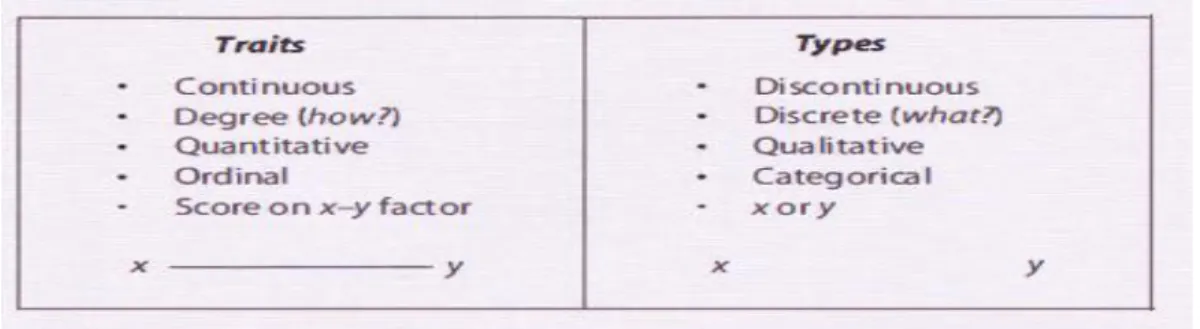
Figure 2.1: Dispositional approaches to personality: Traits and types……….….………..…51
Contents
Dediction ………..………..i
Acknowledgments……….….……….………...iii
Abstract…....………...……….………....iv
List of acronyms and abbreviations ….…………...……...….………...v
List of tables………..………...………...………..…vi
List of figures………..………...…………..………...…viii
Contents……….………...………ix
GENERAL INTRODUCTION ………..…………...1
1. Statement of the Problem ………...…...………....2
2. Aims of the Study………..…………...……….3
3. Research Hypotheses ………...………...3
4. Research Method………....4
5. Population of the Study…..……….………..……….4
6. Structure of the Dissertation…………...………...………4
CHAPTER ONE: Reading Comprehension Introduction……….………6
1.1. Definition of Reading………...………6
1.2. The Importance of Reading……….…….8
1.3. Purpose of Reading………..9 1.4. Types of Reading………...…10 1.4.1. Intensive Reading……….…..10 1.4.2. Extensive Reading……...………...11 1.5. Reading Comprehension………13 1.5.1. Definition of Comprehension………...13
1.5.2. Definition of Reading Comprehension………..14
1.6. Levels of Reading Comprehension………17
1.6.1. Literal Comprehension………...17
1.6.2. Inferential Comprehension……….17
1.6.3. Critical Comprehension……….18
1.7. Models/Processes of Reading Comprehension………..19
1.7.1. Bottom-Up Process………19
1.7.2. Top-Down Process……….20
1.7.3. Interactive Process……….…22
1.8. Reading Comprehension Strategies………...23
1.8.1. Skimming………...23
1.8.2. Scanning………..………...24
1.8.3. Predicting………...25
1.8.4. Activating Background Knowledge………...26
1.8.5. Questioning………27
1.8.6. Summarizing………..28
1.9. Assessing Reading Comprehension………...30
1.9.1. Open-Ended Questions………..31
1.9.2. True/False Responses……….31
1.9.3. Multiple-Choice Responses………...32
1.9.4. Cloze Tasks………33
Conclusion………34
CHAPTER TWO: Extraversion/Introversion Introduction………...…………...36
2.2. Taxonomies of Individual Differences………..40 2.2.1. Motivation…….…....……….……...40 2.2.2. Intelligence ……….……....……….………...……….41 2.2.3. Aptitude....…….………..………...42 2.2.4. Learning Styles………….………..………...43 2.2.5. Learning Strategies………..…..………....…44
2.2.6. Personality of the Learner…..………...45
2.3. Approaches to Personality……….…47 2.3.1. Biological Approach ……….47 2.3.2. Psychoanalytic Approach ……….……….47 2.3.3. Humanistic Approach………...……….48 2.3.4. Cognitive Approach………..……….49 2.3.5. Dispositional Approach……….………….50 2.4. Personality Traits………..……….51 2.4.1. Definition of Traits……….………51 2.4.2. Trait Models……….………..52 2.4.2.1. Allport’s Model……….52 2.4.2.2. Cattell’s Model ………..53 2.4.2.3. Eysenck’s Model……….………..54
2.4.2.4. McCrae and Costa’s Model………...………54
2.5. Definition of Extraversion/Introversion……..………...………...…….56
2.6. The Psychology of Extraversion-Introversion………...………57
2.6.1. Extraversion-Introversion and Arousibility……….………..57
2.6.2. Extraversion-Introversion and Memory……….58
2.8. Previous Studies about the effect of Extraversion/Introversion on Reading
Comprehension………...6
Conclusion………..………..………63
CHAPTER THREE: Field Investigation Introduction………...………64
3.1. Students’ Questionnaire ………...……….64
3.1.1. Aims of Students’ Questionnaire………...64
3.1.2. Population and Sample of the Study………….………...………..65
3.1.3. Description of Students’ Questionnaire ………...……….65
3.1.4. Administration of Students’ Questionnaire ………...66
3.2. Data Analysis and Interpretation……….………...67
3.2.1. Analysis of Results and Findings from Students’ Questionnaire…………...…...67
3.2.2. Summary of Results and Findings from Students’ Questionnaire …….………….98
Conclusion………..………....101
GENERAL CONCLUSION 1. Concluding Remarks………...……102
2. Pedagogical Implications ………...………104
2.1. For Reading Comprehension……….…….104
2.1. For Extraversion-Introversion Trait………...……….105
3. Limitations and Suggestions for Further Research ……….………...106
References……….………….109 Appendices
Appendix: Students’ Questionnaire Arabic Summary
GENERAL INTRODUCTION
Reading is of a paramount importance in attaining English language proficiency. It is a skill that helps in both enhancing the process of language acquisition and improving learners’ reading ability for variety of purposes; whereby their interaction with the text would enlarge their knowledge and enable them to fulfill their academic activities. Furthermore, for learners to be good readers they have to possess good reading strategies and skills while reading a given material. Evidently, skilled readers have many good qualities such as being goal oriented, critical thinkers, and actively engaged when reading; only to name few. Besides of having interest toward any book they read even if it is not among their preferences. Equally important, it is their passion towards reading itself what paves the way for their personal and educational development. Unlike successful readers, bad readers are those who have poor abilities, strategies, skills, and passively engaged with texts. More precisely, the core difference between good readers and bad ones lies in their ability to understand and comprehend the reading material. On this basis, EFL learners are required not only to be able to read a given text with a correct spelling and pronunciation but also to be able to decode, understand and comprehend its meaning. Thus, learners must develop their reading
comprehension as it is the gist of the reading process.
In the learning process, no one can deny that students in the academic context – in a way or another- do not learn the English language in the same way despite the mutual treatment they receive from their teachers. This variation may refer back to their different personal characteristics, especially, in terms of their different personality types. Undoubtedly, students’ personality variation as being an extraverted or introverted learner would affect their performance in education in general and language learning in particular. Henceforth, the focus
of this research is to highlight, more specifically, the effect of extraversion-introversion on learners’ reading comprehension
1. Statement of the Problem
Reading is an essential skill that plays a central role in the development of learners’ language proficiency. Thus, its importance in learning English as a Foreign Language can never be underestimated. Despite the countless advantages of reading, to name few, as enriching the students’ linguistic depository and enlarging their knowledge for different purposes, it was placed on a back burner for many years; where most of EFL learners, more specifically Algerian learners, do not take it seriously in comparison with the other language skills. As a result, they encounter many problems reading a given material; where
comprehension is the major barrier the students face when reading.
Putting in mind that, being able to read a given written material in fluent and accurate way does not necessitate being able to comprehend what has been read and vice versa. Even with the same teaching strategies and instructions given by the EFL teachers among all the students about certain reading materials; distinct levels of comprehension are detected within the same classroom. This would refer back to the learners’ individual differences, mainly in terms of their personality types and their effect on the way they perceive information. Thus, most EFL learners at the Department of Letters and English Language- University of Guelma find it hard to overcome their weaknesses and their reading comprehension deficiency probably because of their personality traits, mainly extraversion/ introversion. Hence, the following questions are designed to direct this study:
• To what extent extraversion/introversion affects learners’ reading comprehension? • Who has better reading comprehension, introverted or extraverted learners?
2. Aims of the Study
The awareness about learners’ extraversion or introversion towards learning the English language in general and reading comprehension in particular, is crucial for both students and their teachers; so that improving the students’ reading comprehension. Evidently, this will help both learners and teachers in identifying the appropriate strategies to use when reading according to each type needs, and in indicating the students’ weaknesses and strengths concerning the same matter. For that reason, the aim of this study is threefold:
• Identifying EFL learners’ attitudes towards the impact of extraversion-introversion on reading comprehension.
• Raising both teachers and learners’ awareness about the extraversion/ introversion dimensions.
• Enhancing EFL learners’ reading comprehension.
3. Research Hypothesis
In the light of the aforementioned research aims concerning the investigation of the impact of extraversion-introversion on EFL students’ reading comprehension, it is assumed that being aware about the differences residing among extraversion-introversion personalities has a remarkable progress on learners’ reading comprehension. Hence, it is hypothesized that:
H1: Introverts would have better reading comprehension than extraverts.
The null hypothesis entails that no relation exists between extraversion/ introversion variation and reading comprehension performance, thus it is hypothesized that:
4. Research Method
In order to test the research’s hypothesis and to reach reliable and accurate results, this study makes use of quantitative- descriptive method using students’ questionnaire as the primary tool for gathering data to investigate their different perspectives and attitudes about both the effect and the role of extraversion-introversion in learners’ reading comprehension.
5. Population of the Study
The population of this study is chosen randomly from second-year Master students of English Department at University of 8 Mai 1945- Guelma for the academic year 2019-2020. The targeted population is intentionally selected for two reasons. While the first one is due to their sufficient experience with the English language for about five years at university, the second refers to their need to intensively and extensively read to accomplish their academic activities, presentations and assignments, or even to understand lectures and proceed in exams. Accordingly, they are expected to autonomously read different materials, quantitatively and qualitatively, using a set of strategies and styles to accomplish a wide range of academic activities as well as to gain the needed information or to further their overall knowledge. In addition to their awareness, to a certain degree, of their personality types and its requirements. Hence, the students’ questionnaire has been randomly distributed to 62 informants out of 137, wherein this sample is expected to be adequate to permit the researcher to generalize the results to the whole population.
6. Structure of the Dissertation
This research is divided into three main chapters, in addition to the general introduction and the general conclusion. The first and the second chapters are going to deal with the
theoretical framework of the research; whereas, the third chapter is completely dedicated to the analytical part.
The first chapter covers the definition of reading as a language skill, its types, its importance, and its purposes, with more focus on the definition of reading comprehension, its levels, its models, its difficulties, and the main strategies learners should perform to deepen their comprehension. Furthermore, it is concluded with the most popular procedures teachers use in assessing learners’ reading comprehension as a way to figure out both of their weaknesses and strengths so that finding remedial solutions. The second chapter is devoted to cover the notion of individual differences, their most influential classsifications in general, and introversion variation as personality trait in specific. It tackles extraversion-introversion various definitions by scholars, the characteristics of each dimension, the extraversion-introversion psychology concerning learners’ level of arousal and memory, and its relationship with second/foreign language in general and reading comprehension in particular.
The third chapter is dedicated for the field of investigation that provides the results of the students’ questionnaire, as a tool to conduct this study, along with detailed analysis and interpretation of the findings. Finally, it is concluded with a set of pedagogical implications and some recommendations and suggestions for future research.
CHAPTER ONE
READING COMPREHENSION
Introduction
Reading is one of the most crucial language skills for success in all educational environments, especially in the EFL context. Undoubtedly, it is the cornerstone to promote all other skills writing, listening, and speaking. Also, it has a significant role in both accomplishing the EFL learners' academic activities and broadening their overall knowledge.
It is no secret that most learners can read any material despite what their purposes are, either for information or pleasure. Yet, they often encounter the same obstacle, which is the lack of comprehension. On this basis, this chapter is an attempt to provide a comprehensive vision about reading in general and reading comprehension in particular. It starts with presenting a bunch of definitions for reading besides its importance, purpose, and types. Then, it highlights different definitions of the concept of comprehension followed by another collection of definitions regarding the notion of reading comprehension as a whole. After that, it covers the levels of the readers' comprehension and the models through which they process the text's information. Further, it discusses the effective strategies used by readers to improve their comprehension. Above all else, it concludes with the most common testing procedures of the reading comprehension.
1.1. Definition of Reading
Acknowledged that reading is an essential language skill the students must develop, it received several attempts from many linguists and scholars for defining it. Yet, there is no precise definition for reading due to its complexity (Grabe, 2009, p. 14). Therefore, numerous definitions were provided by researchers, all of which, according to their perspectives and
views. Accordingly, some researchers considered reading as the mere ability to extract meaning from a printed or written material (Day & Bamford, 1998, p. 12; Widdowson, 1984, p. 44). Agreeing upon this idea, Longman Online Dictionary also stated that "reading is the processes by which the meaning of a written text is understood".
However, other scholars provided a more complicated meaning of reading. For instance, Birch (2007) believes that reading is an intricate process because it is not only about associating words together but also applying appropriate knowledge and effective strategies to get accurate information. This view indicates that reading is a mental process where readers have to possess adequate knowledge about the text in their hands and to practice certain processing strategies until they become unconscious (p. 2). Additionally, the National Assessment of Educational Progress, NAEP Reading Framework, identified reading as "an active process that requires readers to comprehend the written material, to develop and interpret its meaning, and to appropriate this meaning to the text’s type, purpose, and situation" (2005, p. 2). Meaning that, reading is an active process, wherein readers have to understand and evaluate the text’s meaning according to its type, aim, and context. Moreover, Widdowson (1979) viewed that reading can take place whenever there is an interaction between the writer and the reader through the provided text (p. 169), leading to automaticity or reading fluency (Alyousef, 2006. p. 64). In which the latter - the reader - can both decode the text’s words and comprehend its language (Oakhill, Cain, & Elbro, 2015, p. 2).
Thus, when examining reading in all its details, the combination of the following processes must provide a more comprehensive definition for reading as being a rapid, an efficient, a comprehending, an interactive, a strategic, a flexible, a purposeful, an evaluative, a learning,
As a result of the above-stated definitions, it is evident that reading is more than decoding and combining words in a given text. Hence, it is an ongoing mental process that demands both direct and indirect engagement with the written material by applying appropriate knowledge and some processes to understand and interpret its essence. In other words, reading is a multi-faceted process in which readers are no longer passive receivers but active constructors and interpreters of the text’s meaning.
1.2.The Importance of Reading
Being an indispensable part of learning English as a foreign language, reading is seen as a crucial skill for success in all academic contexts (Brown, 2004, p. 185). Thus, it is said to be
important because of the following reasons:
• Reading helps students to read a wide range of texts in English.
• It builds knowledge of the language.
• It constructs schematic knowledge.
• It assists learners in matching the reading style according to the reading purpose. • It develops the students' awareness of the structure of written texts in English.
• It fosters the learners' critical ability to the contents of the text. (Hedge, 2003, as cited
in Alyousef, 2006, p. 67)
Additionaly, Sangia (2018) confirmed the vital role of reading in EFL learning since it helps in understanding the materials taught, obtaining a large amount of data (p. 1), reinforcing communication, and developing the learners’ knowledge and skills (p. 2). As the focus is on the value of reading in academic contexts, Fairbairn and Fairbairn (2001) claimed that reading is an essential activity in which the students will have to engage. For them, it supports the learners' academic work in terms of being aware of their subjects, keeping their
knowledge and understanding up to date, exchanging their ideas with their classmates (p. 3), and boosting their discovery and understanding. Therefore, developing a thoughtful, directed, thorough, and efficient performance (p. 4).
Along with what has been mentioned, reading -also- paves the way for teaching writing, speaking, and other aspects of language such as vocabulary, grammar, and spelling. Besides this, no one can deny that reading provides a deep understanding of both the world and the learners themselves through developing appreciation and interests (Al-Mansour & Al- Shorman, 2011, p. 69). Simply said, reading is the first and the last source for variety of input.
1.3. Puropse of Reading
It is a common sense that all readers, not only EFL learners, when engaging in the reading activity, they proceed it very differently depending on their needs and interests. According to Klingner, Vaughn, and Boardman (2007) "Reading is an activity that has a purpose" (p. 104) wherein readers read differently on different texts in different ways for different purposes. On this basis, there are multitudinous reasons why readers should strive to read.
However, the two main ones are reading for pleasure and reading for information (Grellet, 1981, p. 4). Generally speaking, the former division stems from the readers' will for enjoyment and fun like reading riddles, poems, stories, narrative or fiction texts. While, the latter is set for obtaining knowledge and data involving reading letters, notes, articles, and books; or for instrumental purposes like achieving clear goals such as reading instructions in manuals or road signs for directions (Knutson, 1997, p.49; Harmer, 2001, p. 200).
Noticeably from the above-explained purposes, the readers seem to be fully aware and conscious about the reasons lying behind each type of reading. However, it is not always the case. For clarifying this, Grabe (2009) stated that "we read different types of texts, some that
we consciously intend to read, and some that we just seem to pick up or encounter" (p. 5). Thus, in some instances, people read some expressions or texts without a pre-determined purpose or intention for reading them. For example, reading an advertisement in the street, a headline in a newspaper, or a fashion-magazine in a beauty salon.
It is worth mentioning that, having a purpose in mind before reading is of great importance in paving the way for successful and more comprehensible reading (Hudson, 2007, as cited in Cheon & Ma, 2014, p. 55).
1.4. Types of Reading
Reading a particular type of text rather than another is primarily related to the readers’ needs and purposes. For example, picking up a literary book instead of a scientific one is often originated from the readers' conscious decision and interest. Hence, readers are mostly required to choose the most appropriate kind of reading that suits their purpose.
Onward from this brief explanation, the focus relies more on the two major known categories of reading, the extensive reading and the intensive reading.
1.4.1. Intensive Reading
In EFL learning, students typically expected to read different texts of different types where the main objective is the mastery of the target language. In this turn, Brown (2000) identified intensive reading as a classroom-based activity that demands the teachers' guidance. He, further, resembled it to a zoom lens strategy (p. 312) wherein readers have to look for particular information in shorter texts (Solak & Altay, 2014, p. 80). Also, Mart (2015) confirmed that intensive reading primarily focuses on the language's accuracy than fluency through a detailed study of its aspects (p. 85) such as vocabulary, word spelling, grammar, and information structure. Simply it is language-focused learning (Nation, 2009, pp. 27-28).
Moreover, Carrell and Carson stated that intensive reading is a slow activity, unlike extensive reading, as the readers' task is to examine every single detail in the text (2007, p. 49). Hence, due to its detailed nature and slow speed, the intensive reading helps the learners to improve their academic achievement in general and their language proficiency in particular (Mart, 2015, p. 85). In line with this, Patel and Jain (2008, p. 219) stated some characteristics regarding intensive reading as follows:
• Intensive reading is a guided activity by the teacher. • It is a direct way of acquiring an active vocabulary.
• It enables the readers to identify the text's linguistic items. • It promotes the learners' active use of language.
• It develops good reading habits.
• It is a way of learning different features of language (accent, stress, intonation, and rhythm).
1.4.2. Extensive Reading
Usually, the label "extensive reading" refers to both reading in quantity and reading outside the classroom, wherein the students read long-stretched materials for gaining a general comprehension rather than focusing on each detail. On this basis, whenever the purpose is looking for a global understanding from long texts - albeit literary, scientific, or professional texts- it is extensive reading (Aliponga, 2013, p.73; Brown, 2000, p. 313). Further definition by Sarsody, Bencze, Poor, and Vadnay (2006) proposed that extensive reading is similar to pleasurable reading (p. 54), in which the success of the former depends on the later as long as it conforms to the learners' interests.
Moreover, Broughton, Brumfit, Flavell, Hill, and Pincas (1980, pp. 92-93) viewed extensive reading as a rapid activity because it aims "to cover the greatest possible amount of information in the shortest possible of time". Broughton et al. (1980) added that in such activity, an almost low level for understanding is entirely sufficient. The researchers also stressed the significance of performing an appropriate practice for extensive reading along with the right selection of its materials, so that paving the way for teaching the EFL learners the language they want to learn through reading it (pp. 92-93). In this respect, Patel and Jain (2008, p. 120) set a few characteristics of extensive reading as follows:
• Extensive reading is a silent reading.
• It enables the learners to, indirectly, develop an active vocabulary. • It emphasizes the subject matter.
• It helps in expanding the content of the text.
• It is an individual activity done by the learners themselves.
• It is an entree to a new world by enhancing the learners' knowledge and understanding.
• It helps in developing positive attitudes towards reading.
Briefly said, the distinction between both types of reading, intensive and extensive, can be summed up into two differences, the amount of materials the learners required to read and the purposes lying behind the selection of these materials concerning each reading. Therefore, intensive reading demands learners to read short texts to provide a detailed study of the target language. While in extensive reading learners are expected to read a large quantity of materials for general comprehension and few or none tasks to perform.
1.5. Reading Comprehension
There is no doubt that when reading, readers face new words or even familiar ones but used in unusual contexts. Evidently, encountering this problem deters the readers' comprehension as long as the unknown words are the key elements in the presented material. If it is the case for native readers, then it is guaranteed for foreign language learners.
Consequently, readers have to comprehend the text in hand since comprehension is the essence of the reading activity. Thus, identifying the concept of comprehension in separation is needed for a better understanding of the notion of reading comprehension as a whole.
1.5.1. Definition of Comprehension
In an attempt to find an adequate explanation of comprehension, the gist of reading (Pokharel, 2018, p. 75), many specialists and educators used the term in different ways. For example, some of them agreed upon the view that sees comprehension as the mere ability to construct meaning from reading the text in hand (Henderson & Buskist, 2011, p. 32; Cecil, Baker & Lozano, 2015, p. 250). Meaning that comprehension would take place if the readers can both understand and establish connections with the text's ideas.
However, for other researchers, this is not enough because the readers' different backgrounds also influence the significance of these ideas (Kucer, 2014, p. 183); which in turn affect their way of comprehending the whole material. Further, Allen and Landakar (2005) affirmed this idea by stating that "Comprehension is predicated on significant background knowledge" (p. 30). In line with this, achieving a better understanding requires the learners to appropriately relate the information conveyed in the text with their previous knowledge. Similarly, Harvey and Goudvis (2007) stressed that the efficient way for readers
to be good comprehenders is to look beyond the literal meaning of the text (p. 38) and to construct mental representations of its message (Perfetti, Landi, & Oakhill, 2005, p. 228).
In other words, during the comprehension process, readers are expected to link the visual information presented in the text with the non-visual information stored in their minds to monitor and develop their understanding as well as acquire and actively use knowledge. Accordingly, Moore, McClelland, Alef, and Vogel (2016) asserted that:
Although there are many different definitions of comprehension, there seems to be a common theme in each –comprehension consists of students being active readers, processing what they read, forming a mental image, summarizing, and drawing conclusions. These actions guide the reader to understanding and connecting with the text while assisting the reader in gathering details and making meaning of the text. (p. 21) 1.5.2. Definition of Reading Comprehension
Considering that the widespread goal of success in education, especially at university, is to gain comprehension from the reading materials, learners often make countless attempts to develop their reading comprehension.
In its general sense, reading comprehension is what Zoghi, Mustapha, and Maasum (2010) viewed as the ability to make meaning from the written text (p. 439); wherein readers during the reading activity strive to figure out the message behind the text being read. In the same line, another definition by Woolley (2011, p. 15) proposed that for better comprehension, learners have to pay more attention to gain an overall understanding of the whole text rather than getting meaning from isolated words or sentences. Moreover, Burns and Kidd (2010), in their definition, emphasized the interactive nature of the reading comprehension process, reflecting the reciprocal relation between the reader's views and the text's message (p. 397).
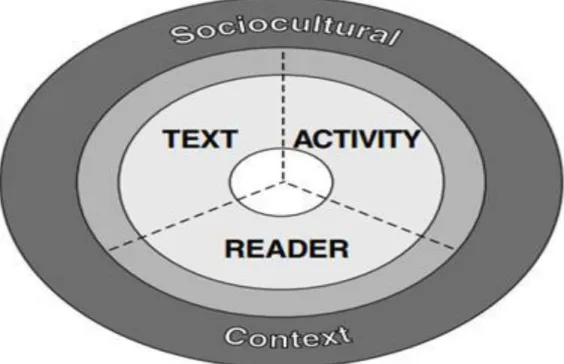
As a complementary definition, Snow (2002, p. 11) identified reading comprehension as "the process of simultaneously extracting and constructing meaning through interaction and involvement with written language"; emphasizing the direct exchange between the reader and the text as the former creates meaning for and through the later. Unlike Burns and Kidd, Snow's model made it clear that reading comprehension depends on the interaction of three factors, the reader, the text, and the activity- all defined within a sociocultural context (Figure 1.1). For her, the reader refers to the set of capacities, experiences, and knowledge s/he brings to the text. Whereas the text is the material to be read either printed or digital. And concerning the activity, it is related to the readers' purposes behind reading, the processes they are functioning while reading, and the consequences they are willing to achieve from reading.
Figure 1.1. A Heuristic for Thinking about Reading Comprehension
Adapted from: Snow, 2002, p. 12.
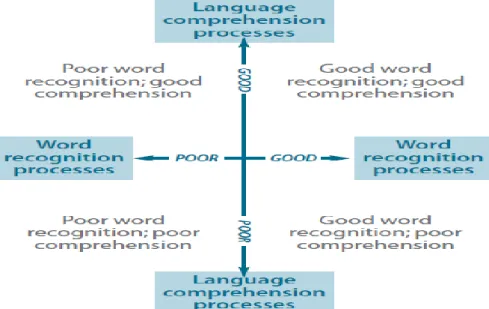
Furthermore, Braze et al. (2015), based on The simple view of reading (SVR) of Gough and Tunmer (1986), re-explained that reading comprehension (RC) is the result of two main
components (Figure 1.2). The first is linguistic comprehension (LC), which refers simply to the ability to comprehend the language in its both forms printed and oral. While the second is decoding (D), which refers to the ability to recognize or decode written words. According to this view, the stronger each component (LC) and (D), the successful reading comprehension will be achieved. Consequently, reading comprehension equates linguistic comprehension multiplied decoding ability (RC= LC×D). Therefore, if one of the components equals zero, reading comprehension will fail (p. 436).
Figure 1. 2. A diagrammatic representation of the SVR
Adapted from: Rose, 2006, p. 40.
As a result of the above discussion, reading comprehension is a complex and multi-component process that demands not only the readers' reactions to the text but also many interactions through identifying meaningful relations between the different parts of the text and their background knowledge (Klingner, Vaughn & Boardman, 2007, p.8).
1.6. Levels of Reading Comprehension
It is no longer new that reading comprehension is a complex task that comprises different abilities, processes, and skills including, decoding words, recognizing and developing vocabulary, setting goals, monitoring comprehension, and interpreting the text's meaning in relation to the readers' knowledge. Consequently, the combination of these functions inevitably enables the readers to deepen their comprehension to the required level (Grabe, 2014, p. 8). Accordingly, Westwood (2008) declared that reading comprehension primarily functions at three different levels of sophistication namely literal, inferential, and critical (p. 32). These levels of comprehension are stated below from the least to the most complicated.
1.6.1. Literal Comprehension
It is a shallow comprehension (King, 2007, p. 268) in which readers clearly understand the basic facts presented in the reading material (Westwood, 2001, p. 21). That is, comprehension, at this level, is explicitly stated involving surface meanings and direct connections. According to Alptekin and Ercetin, literal comprehension "essentially captures surface code features and text base meanings explicitly stated in the text as well as the connecting devices that bind these text constituents locally" (2011, p. 242). For instance, readers can easily answer literal questions -like the main character's name or his/her job- at a particular page or through integrating information from different parts of the passage since they are explicitly stated (Moreillon, 2007, p. 62; Westwood, 2008, p. 32).
1.6.2. Inferential Comprehension
Inferential comprehension is what Alonzo, Basaraba, Tindal, and Carriveau (2009) described as stepping away from the concrete (p. 35). In contrast to the literal comprehension, it is a deep comprehension that requires readers to go beyond explicit understanding, looking
for hidden meanings and implied thoughts. At this level, readers have to read the text carefully to interpret its meaning (Liu, 2010, p. 153). Further, King (2007) pointed out that readers achieve deep comprehension when they are successfully able to consolidate their prior knowledge with the explicit information (the literal meaning) presented in the text (p. 268).
In other words, determining inferential meanings requires learners to think about the text in which the unstated information can be identified through drawing conclusions, eliciting cause-effect relationships, and future predictions about the text's purposes and details as well as the author's intent and motives. Hence, compared to literal comprehension, it is more difficult and complicated (Hansen & Pearson, 1983, p. 821).
1.6.3. Critical Comprehension
The most demanding and complicated level. It is also known as evaluative comprehension. According to Alonzo, Basaraba, Tindal, and Carriveau (2009), critical comprehension is "taking the leap between the text and the world beyond" (p. 35). At this level, readers have to integrate the two first types of comprehension -literal and inferential- to go beyond both the text they just read and their knowledge about the world as a whole. In other words, evaluative comprehension allows readers to critically interpret and judge the different aspects of the text in hand. On one hand, to evaluate the text in terms of its transparency, efficiency, and inclination (Westwood, 2001, p. 21). And on the other hand, to appraise the authors' work and appreciate his product, the text, so that invoking valued responses from the passage as emotions, satisfaction, or disagreement (Liu, 2010, p. 153). Thus, developing critical comprehension requires proficient readers with high-level abilities and skills to enable them in making judgments and opinions about the text and the author.
It is worth noting that, although the provided material satisfies the readers' level of understanding, they have to apply orderly the three mentioned levels- literal, inferential, and
critical. Clearly, then, for developing successful comprehension, readers must move beyond the surface meaning and not only think about explicit information but rather look deep to infer and critically judge the different aspects of the text in hand.
1.7. Models/ Processes of Reading Comprehension
Undoubtedly, reading as a source of input, a large amount of information is communicated to readers. During this activity, understanding the text's meanings and implications is uniquely processed. According to Alderson (2000), the process is "the interaction between a reader and the text" (p. 3), in which s/ he relies not only on decoding isolated words but also engaging her/ his knowledge and experiences when dealing with the text in hand.
To put it differently, when reading any given passage, many different things can be happening, either consciously or unconsciously. Thus, in an attempt to explain the reading behavior and how comprehension is carried out, many researchers agreed upon three main models/ processes including, Bottom-up, Top-down, and Interactive model.
1.7.1. Bottom-Up Process
It is presumed to be data-driven (Alderson, 2000, p.18) or text-driven processing (Manzo & Manzo, 1995, p. 15), which allows readers to make meaning from the printed text.
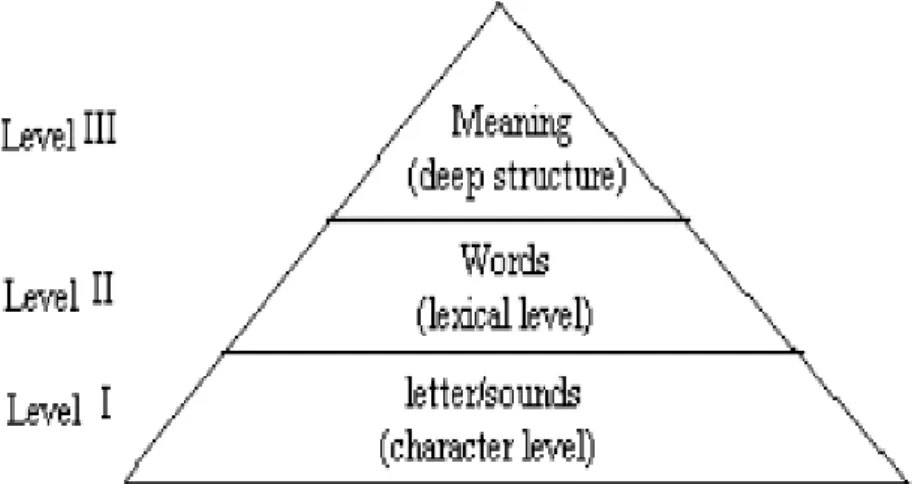
According to Grabe (2009), in this model, the existing information is gradually translated with little assistance from the reader's background knowledge (p. 89). That is, the reader firstly decodes the small units phonemes, letters, and words then moves to the large ones -phrases, sentences, and passages (Gilakjani & Sabouri, 2016, p. 232). In other words, for comprehension to take place, readers have to follow a specific order or sequential recognition of letters, sounds, words, sentences, and so on (Figure 1. 3). Thus, an accurate recognition of any item primarily relies on the accuracy of its precedent. However, Eskey (1998) criticized
the bottom-up process since it focuses only on decoding the linguistic units and neglects the reader's contributions to the text (as cited in González, 2017, p. 162).
Figure 1.3. Data-driven or Bottom-up Model
Adapted from: Liu, 2010, p. 156.
1.7.2. Top-Down Process
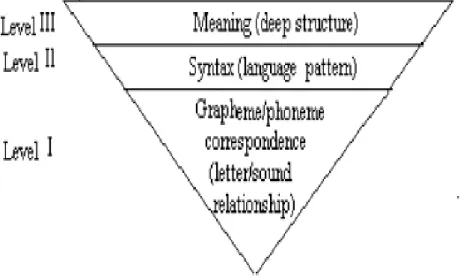
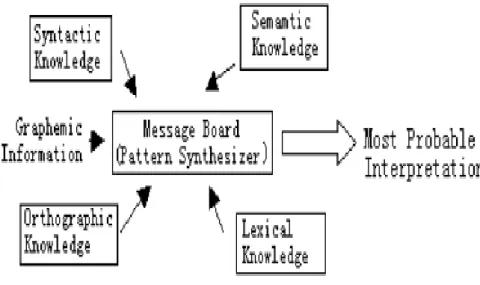
In contrast, the top-down model tends to be a meaning-driven or concept-driven processing (Liu, 2010, p. 154), in which readers conceive the text from whole to part. According to Birch (2002, p. 2), constructing meaning, in this model, starts from interpreting large units like sentences, paragraphs, and stories through the use of the reader's prior knowledge alongside other cognitive strategies-semantic and syntactic (Figure 1.4). Yet, the readers' goals and expectations are what actively control the comprehension process. That is, to guess the text's meaning, readers rely much more on their prior knowledge than on the presented information before their eyes.
Grabe and Stoller (2011) stated that the top-down process allows readers to sample the text's information and form hypotheses about the upcoming words and their meaning to either confirm or reject these expectations (p. 26). For instance, "what the text is going to be like,
inferences about the motivations of the characters, decisions about how certain events are related in the reading, and the like" (Birch, 2002, p. 2). However, only few scholars support top-down processing basically for two reasons. Because, on one hand, it does not give a clear explanation of what is exactly happening when making meaning from the text. And, on the other hand, it does not provide new information for the reader since s/he is the one who directs the comprehension process (Grabe, 2009, p. 89).
Figure 1.4. Hypothesis Test or Top-down Model
Adapted from: Liu, 2010, p. 157.
1.7.3. Interactive Process
According to Manzo and Manzo (1995, p. 16), the interactive model is likely to resemble the top-down process more than the bottom-up. But in fact, it is a compilation of the two types. The simple idea behind proposing this process is to find a compromise to resolve the inconsistencies between the researchers' different views.
However, even this model did not spare from these contradictions. While Manzo and Manzo (1995) claimed that the only definition for the word interactive would refer to "the
reader's inner dialogue with him or herself" (p. 16). That is, there is no other interference neither of the author nor the text itself, it is just about the reader and his knowledge and expectations. Birch (2007), disagreeing with the former view, assumed that reading as an interactive process is attributed to three features. First, the interaction between both bottom-up and top-down processes with the readers' knowledge. Second, the interaction between the readers' minds/ knowledge and the written text. Third, the indirect interaction between the reader and the writer's text (p. 4).
Briefly said, in this model, all these processing strategies work together in a parallel and simultaneous way, either higher up or lower down processes (Figure 1. 5). For example, since the recognition of letters and words results in constructing meaning, also contextual information, inferences, and world knowledge affect the processing strategies at lower levels- syntactic, lexical, and the like (Birch, 2002, p. 3).
Figure 1.5. Interactive Model
To conclude, the success of the reading comprehension process depends basically on successful word recognition, which is a prerequisite for an appropriate comprehension. In other words, readers must make use of both top-down and bottom-up processes to achieve this purpose- the application of the interactive process.
1.8. Reading Comprehension Strategies
Generally said, the ability to perceive and decode words is often assumed to be the prerequisite of the reading act. Seemingly, readers can make meaning of words and even sentences but, unfortunately, not of the whole text. For this reason, educators and teachers attempted to deepen the readers' comprehension through the integration of several strategies (Table 1. 1) that "are, above all, tools for building knowledge and understanding about ourselves, the text, and the world" (Harvey & Goudvis, 2017, p. 156). According to Abbott (2006), reading comprehension strategies are mental operations or comprehension processes, in which the readers use to attain meaning from the reading material (p. 637). Besides, Graesser (2007) defined these strategies as cognitive or behavioral actions that readers consciously implement as a means to improve their reading comprehension (p. 6).
Therefore, reading comprehension strategies are significant ways to develop the readers' understanding of any printed text. Examples of some commonly used strategies include skimming, scanning, predicting, activating background knowledge, questioning, and summarizing.
1.8.1. Skimming
As the first step of reading academically, is to get a general overview of the reading material, skimming is the most effective strategy to use. Wilhelm et al. (2007) considered it as a rapid or quick reading to find the general idea -or the gist- of the text in hand (p. 6). Also,
skimming is "the key to make time not wasted" (Fauzi, 2018, p. 84). Accordingly, readers do not have to read the whole material (book, chapter, or section) but rather take a quick look at its main ideas with minimum effort and time. At this point, they only use fast movements of their eyes over the text to determine its type, the topic, and whether this information meets their purpose for reading (Eagleton & Dobler, 2007, p. 39).
Mikulecky and Jeffries (2007) estimated that, while skimming, readers often have general questions in mind about the text's central idea, the usefulness of its information, or the writer's opinion (p. 170). For the researchers, the answers to such questions are generally found at the beginning and the end of each paragraph in the text (Mikulecky & Jeffries, 2007, p. 170).
At last, Fairbairn and Winch (2011) confirmed the importance of skimming since it helps readers to skip unnecessary or intricate details as well as to make reasonable decisions about both what is worth reading in detail and where detailed reading should start (p. 30).
1.8.2. Scanning
On the other hand, scanning is a rapid reading, just like skimming or even more. Yet, it is a "quickly searching for some particular piece or pieces of information in a text" ( Brown, 2000, p. 308) and not for its general meaning. That is, readers following this strategy have to look carefully through the text for specific information or items.
For Nation (2009), scanning requires readers to locate particular details including, names, dates, numbers, words (p. 70), headings, or other information that meets the reader's purpose of reading (Eagleton & Dobler, 2007 p .39). Similarily, Bojovic (2010) asserted that while scanning readers do not have to read the whole material, but rather intentionally select what satisfies their specific needs and goals (p. 2). For instance, they scan a newspaper to know the movie showtime or encyclopedia for data to include in a school project (Wilhelm et al., 2007,
p. 6). Therefore, scanning is an easy and effective way for learners to extract the needed information or details to answer the questions in exams and tests in a short time (Fauzi, 2018, p. 81).
1.8.3. Predicting
Undoubtedly when reading, readers often feel uncertain about some aspects of the text. At this point, readers start predicting to reduce these ambiguities to likely alternatives (Smith, 2004, p. 25). According to Duffy (2009), predicting refers to the readers' ability to make initial guesses about what is going to happen as well as their readiness to change or alter these predictions as they read the text in hand (p. 101). Moreover, the researcher stated that readers make predictions primarily based on their reading purpose, the text's type, and the topic clues alongside with the use of their prior knowledge (Duffy, 2009, p. 14).
Similarly, Gunning (2010) asserted that "predictions aren’t just guesses, students should base their predictions on clues provided by titles, headings, illustrations, and whatever text they have read. They should also use their background knowledge to make predictions" (p. 194). Meaning that predictions are "educated guesses" (Moreillon, 2007, p. 76) wherein readers make use of both the text's clues and their schema, especially if the topic is familiar, to comprehend the text accurately. In line with this, predicting strategy is sometimes known as forward inferencing (Woolley, 2011, p. 108) in that readers infer their answers through the use of the text's illustrations or clues plus their background knowledge to draw new conclusions or confirm their predictions.
Finally, the most important about predicting is not its accuracy but rather the readers' active engagement within the text (Wilhelm et al., 2007, p. 10).
1.8.4. Activating Background Knowledge
In its broader sense, prior knowledge refers to what people or learners already have and know about the surrounding environment/ world including their experiences, acquaintances, information, and alike. Also, it can be known as background or schematic knowledge.
Based on schema theory, the National Reading Panel (NRP) report (2000) indicated that the readers' comprehension heavily depends on their ability to use their previous knowledge along with the new information found in the text (p. 83). In other words, reading comprehension is an interactive process whereby "Networks of information stored in the brain ... act as filters for incoming information" (Alderson, 2000, p. 17). Meaning that it is the readers' schema that organizes their previous knowledge and helps them to interpret the new information they encounter in the text.
However, if readers cannot activate their background knowledge, they are likely to fail to retrieve it later (NRP, 2000, p. 83). Consequently, the Panel distinguished three strategies for prior knowledge activation, notably question elaboration, generation, and answering alongside other forms of instruction relevant to the text's content like teacher lectures or discussions before reading (p. 42). Moreover, Moreillon (2007, p. 19) went further to emphasize an important point concerning the uniqueness of what each reader brings to the text, having different interpretations and understanding. At this point, the teacher's role is to assist readers in connecting what they know (experiences/ old information) and what they read (textual clues/ new information) by using several strategies as thinking-aloud or compare/ contrast (Eagleton & Dobler 2007, p. 204). Thus, activating the readers' prior knowledge relies primarily on the transaction between their previous information and the text's information as well as the teacher's assistance via using different instructions.
1.8.5. Questioning
Naturally, people in whatever situation ask and answer questions, each according to his or her needs and purposes. Likewise, learners generate questions, as part of their thinking process, to understand the material they need. Blachowicz and Ogle (2008) stated that questioning is an ongoing process used by both teachers and learners. While the former uses questions to guide the students' comprehension and what they know, the latter actively generates them to make meaning from the print before their eyes (p. 124). For this reason, Richardson, Morgan, and Fleener (2009) affirmed that students have to learn questioning strategies to promote their reading comprehension and teachers, also, to attract the learners' attention and engage them more in the learning process (p. 133).
Moreover, Anthony and Raphael (2004) classified the readers' ability to formulate questions into three phases before, during, and after reading (p. 318). At first, readers use pre-reading questions to activate and develop knowledge as well as to preview the text's main ideas and to set their reading purposes (p. 313). Then, during reading, readers and teachers equally use questions to understand the text's content and organization alongside with confirming or rejecting the students' early predictions. At last, learners and instructors formulate questions to test the overall comprehension through synthesizing the readers' prior knowledge and the textual information (p. 316). In this respect, Moreillon (2007, p. 59) distinguished three types of questions wherein readers can find their answers in the text, beyond the lines, or sometimes there is no answer.
Eventually, it is worth noting that an adequate ability to generate questions, certainly, helps readers to develop their reading comprehension as well as to become successful problem-solvers, critical thinkers, and decision-makers (Macceca, 2014, p.148).
1.8.6. Summarizing
Learning to summarize what one's read is another way to enhance his or her reading comprehension as a whole. According to Dole, Duffy, Roehler, and Pearson summarizing is:
A broader, more synthetic activity for which determining importance is a necessary, but not sufficient, condition. The ability to summarize information requires readers to sift through large units of text, differentiate important from unimportant ideas, and then synthesize those ideas and create a new coherent text that stands for, by substantive criteria, the original. (1991, p. 244)
Given this definition, summarizing is a challenging task wherein readers have to read the entire text and distinguish between what is essential and what is not, therefore, to produce an efficient summary. Additionally, readers, when summarizing, exhibit the extent and the depth of what they understood from the printed text as well as their ability to interpret and discriminate main details and key concepts (Shea & Roberts, 2016, p. 10). Moreover, Jeffries and Mikulecky (2007) provided a similar definition, in which readers have to rewrite and recapitulate only the text's leading information in a shorter form (p. 200) with "a modicum of inference or none at all" (Shea & Roberts, 2016, p. 117).
In terms of its significance, Jeffries and Mikulecky (2007) claimed that summarizing strategies are useful because they help readers to review and memorize information for tests and assignments as well as to collect and prepare data for projects and research papers. However, readers often fail to organize their ideas; and instead of producing a coherent summary, they either retell the passage or make a random listing of what they understood (Gunning, 2010, p. 113).
Table 1.1.
List of Reading Strategies
Reading Strategies Description Predicting Helps activate prior knowledge.
Based on clues in text (pictures, subtitles, etc.). Connecting Connecting prior knowledge to new information.
Comparing Thinking more specifically about connections they are making, e.g. How is this different to...?
Inferring Taking information from a text and creating their own interpretation beyond the literal level.
Synthesising Piecing information together as students read a text, to keep track of what is happening.
Creating Images Creating sensory images to assist with overall comprehension of a text.
Self-questioning Providing a framework for active learning as students engage with the text to find answers.
Skimming Glancing quickly through material to gain an overall view of text.
Scanning Glancing through a text to locate specific details, e.g. names, dates, etc.
Determinning Importance Prioritizing most important information from phrase, sentence, paragraph, chapter or whole text.
Summarizing and Reducing larger texts to focus on important elements. Praphrasing Re-stating/ re-writing text in own words using key words to capture main focus.
Re-Reading Creating opportunities for deeper understanding, word identification and developing fluency.
Reading On Skipping unfamiliar word (s) and reading on to provide sufficient context to determine unknown word/ phrase. Continued
Continuation
Sounding Out Using knowledge of letter-sound relationship to decode unknown words.
Chunking Breaking multi-syllabic words into units larger that individual phonemes.
Using Analogy Transferring what they know about familiar words to help them identify unfamiliar words.
Consulting a Reference Using a dictionary, thesaurus, reference chart or glossary to help find word meanings/ pronunciations.
Note, adapted from: Pokharel, 2018, p. 78.
1.9. Assessment of Reading Comprehension
Unquestionably, as teachers and educators, recognizing those who are proficient readers and those who are not is easy to discern. Yet, identifying what exact struggles the latter suffer from is much complex than what might seem to be, because reading comprehension "is not an overt process that can be directly observed" (Fletcher 2006, p. 324). Consequently, a great variety of assessment and testing procedures appeared to examine this issue.
According to Nation (2009, p. 75), for teachers to design an accurate assessment, they have to fulfill particular criteria, namely reliability, validity, and practicality. That is, the test has to be, firstly, consistent, stable, and dependable. Secondly, truly measures what it intends to measure. Thirdly, it needs to be clear, time-efficient, and easy-making. Besides their significance in evaluating the readers' comprehension, these tests are also useful to promote students' learning, monitor progress, provide feedback, diagnose problems, and measure proficiency (Nation, 2009, p. 75).