226 Canadian Journal of Counselling/Revue Canadienne de Counseling, 1988, Vol. 22:4
C o n t r o l l i n g Stress: A C o n c e p t u a l U p d a t e Bryan Hiebert
University of Calgary
Abstract
This paper presents an update of an earlier framework for controlling stress. A contemporary interactional conceptualization of stress is presented and some inadequacies of earlier perspectives are outlined. This is followed by a model for stress control that includes con-trolling stress by acquiring better skills for dealing with environmental demands. Resumé
Cet article présente une mise à jour d'un cadre de référence, élaboré il y a quelque temps, sur le contrôle du stress. Une conceptualisation interactionnelle contemporaine du stress est présentée et de plus, certaines notions qui ne s'appliqueraient plus sont soulignées. Cette section est suivie par un modèle sur le contrôle du stress qui inclut le contrôle du stress par l'acquisition de meilleures habiletés pour un meilleur contrôle des demandes de l'environne-ment.
The body of literature pertaining to stress and stress control has bur-geoned over the past five years. The resulting growth in conceptual knowledge and empirical evidence has shown that many earlier concep-tions about stress are inadequate or incorrect. Further, the pool of stress control interventions for which there is empirical or theoretical support has expanded considerably. The result is a need to update frequently the theoretical perspective and treatment alternatives that counsellors bring to bear on stress related problems.
The purpose of this paper is to update my earlier framework (Hiebert, 1983) and incorporate the expanded information base referred to above. The paper begins with a brief exposition of the nature of stress, pointing out the major shortcomings of earlier conceptualizations and highlight-ing the major components of a more current and comprehensive model. The focus then turns to treatment implications arising from this expanded model.
WHAT IS STRESS?
The overwhelming majority of current empirical and theoretical
evi-dence supports an interactional conceptualization of stress (Torestad, Olah, & Magnusson, 1985). From this perspective stress is seen as an integrated, multidimensional response, involving at least the physiologi-cal, cognitive, and behavioural systems, occurring when people perceive the demands of a situation to exceed their coping resources (Hiebert, 1985; Hiebert, 1987; Hiebert & Basserman, 1986; Kasl, 1984; Magnus-son, 1982; Lazarus, 1974; Lazarus & Folkman, 1984). Stressisthoughtto result not from demands per se, but from a perceived imbalance between
demands and peoples' resources for handling the demands satisfactorily. The demands can be quite intense, but as long as people believe they can handle (or are handling) the situation satisfactorily, relatively little stress will be experienced. Conversely, demands can be quite trivial, but if people think they are unable to handle the demand, and especially if not handling the demand is perceived to have rather severe conse-quences, then stress levels can be quite high. The important ingredient is the person's perception of the situation, and his or her coping resources.
Perception plays a central role in the above process. The objective assessment of demand intensity and coping adequacy is less important than the personal assessment of those factors in determining how stressed a person will feel. We all probably know people who are facing heavy demands and handling them satisfactorily (in our opinion), but are feeling stressed because they think they are not doing well enough. Conversely, we also know people who are coping abysmally but who are feeling little stress because they think they are doing just fine. The key is peoples' perception of the adequacy with which they are handling the demand characteristics of the situation.
Contrast With Environmental Perspectives
Interactional perspectives differ from earlier environmental conceptual-izations in which stress and demand were synonymous (cf. Holmes & Rahe, 1967). From such perspectives, people were more or less passive victims of stress when they encountered certain situations like writing exams, speaking in public, or dealing with student misbehaviour. To assess a person's stress level, one only had to complete some form of "Life Events Scale" (see Holmes & Rahe, 1967; Der, 1984).
Equating stress with environmental demand results in several prob-lems. First, there is a logical contradiction. If stress is inherent in situations, then different people should experience similar stress levels when they encounter the same situation. However, this is seldom the case (see Hiebert, 1985; Greenspoon & Olson, 1986). Moreover, if stress was an integral part of a situation, then the same situation at least should affect the same person in a similar way on different occasions. However, this also is seldom the case. Environmental perspectives do not account for such differences.
Second, equating stress and demand precludes as treatment options many stress control procedures that have been shown to work. If stress were a part of situations, a situation would have to change before people could feel less stressed. However, there is abundant evidence that various procedures can lower stress to minuscule levels, even though the demand-ing situation remains relatively unchanged. Only if people's individual coping abilities are conceptualized as an integral part of stress can such treatment outcomes be expalined adequately.
228 Bryan Hiebert
Vestiges of environmental perspectives still persist in common speech (e.g., "I'm under stress," "That situation causes me stress," or "Exams are stressful"), however, there is little evidence to support such perspec-tives. From an interactional perspective, no environmental situation would be inherently stressful. It is true that some situations tend to overtax almost everyone's coping abilities (e.g., death of a loved one). However, even in these cases it is a person's inability to cope with the situation that is responsible for precipitating the stress. Hiebert (1983) makes passing comment on the inadequacies of early conceptualizations of stress, however he is somewhat tentative in his criticism. The over-whelming consensual support for an interactional conceptualization suggests that a stronger statement now can be made.
Interactional Models And Cognition
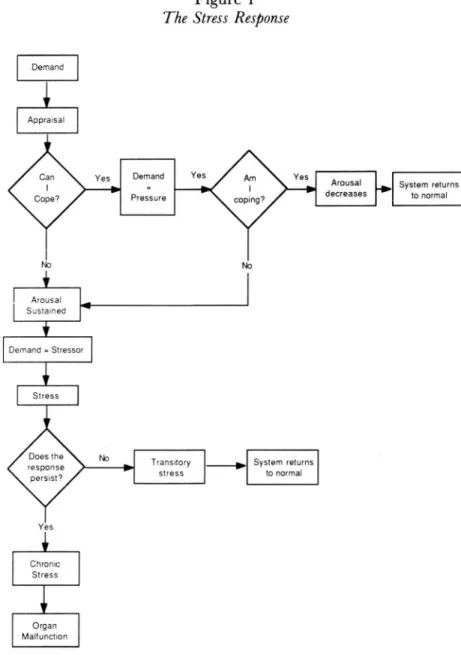
Cognitive appraisal plays a central role in intractional perspectives. Therefore the Figure used by Hiebert (1983) to explain the stress response must be revised. (See Figure 1)
When people engage in a situation there is an initial appraisal, or in some cases mis-appraisal, of the demand characteristics of the situation, the individual's resources for coping with the demand, and the con-sequences likely to result from the way the situation is handled. As the individual remains engaged in the situation, there is subsequent ongoing appraisal regarding the continuing nature of the demand and the adequacy of the individual's coping attempts (see Lazarus & Folkman,
1984). Regardless of the accuracy of the person's appraisal of the situation and the coping resources available, a perceived inequity between demand and coping resources produces an increase in stress level.
Typically, as stress levels increase, there is increasing interference with people's abilities to engage in accurate cognitive appraisal. Thus when people feel stressed, they tend to exaggerate the nature or intensity of the demands they face, catastrophize about the consequences of not responding optimally in that situation, and denigrate their coping abilities. This unproductive thinking often is accompanied by excessive ruminative thinking (going over, and over, and over a particular event in one's mind) and cognitive self-flagellation (putting yourself down and then proceeding to kick yourself after you are down). This type of cognitive activity tends to interfere with performance and the resulting less-than-optimal performance tends to spark further exaggeration, catastrophization, and self-denigration.
Transitory And Chronic Stress. Usually people's stress reactions are transitory in nature: the person encounters a demand, reacts, perceives the coping attempts as beginning to work, or the demand characteristics as abating, and the system returns to normal with very little harm done
to the person's body (see Figure 1). However, if the demand persists, and/or if the person's coping attempts are perceived to be inadequate and continue to be perceived as inadequate, a chronic stress reaction develops. Chronic stress develops when individuals are in intensely demanding situations for prolonged periods of time or if there is repeated activation of the stress response. Prolonged periods of intense demand make it more likely that people's coping resources will be overtaxed. This is somewhat akin to setting up the furnace thermostat to
Figure 1 The Stress Response
Appraisa No System returns to normal Organ Malfunction
230 Bryan Hiebert
a higher level while keeping all the windows open. The furnace con-tinues to work to reach the preset temperature, but never quite makes it. Chronic stress is characterized by sustained hyperarousal, a prepon-derance of dysfunctional cognitive activity, a variety of inappropriate behaviour patterns, and a multitude of medical disorders. Medical evidence linking stress to various disorders refers to a link between the disorders and chronic stress (Albrecht, 1979; Kasl, 1984).
Summary
This section presented an update of the model offered previously by
Hiebert (1983) emphasizing stress as a multidimensional, integrated response occurring when there is a perceived imbalance between the demands of a situation and an individual's resources for dealing with those demands. The central role played by perception in this concep-tualization has been emphasized, and several implications about the nature of stress have been outlined. This conceptualization necessitates extending Hiebert's (1983) framework for stress control.
CONTROLLING STRESS
If stress results from an interaction between people and situations, it follows that stress control can be approached from two main perspec-tives, one focusing on reducing the inequity between demands and people's ability to deal with demands, and the other focusing on tempering people's physiological, cognitive, or behavioural reactions in situations where their capabilities are overtaxed. Procedures aimed at reducing a demand-coping imbalance are called stressor management. Procedures that focus on calming people's physiological, cognitive, or physiological reactions are called stress management. (See Figure 2)
Stress management procedures have been the focus of numerous previous treatises on controlling stress (e.g., Hiebert, 1983; Lamott, 1975; Mason, 1980) and most counsellors receive training in a variety of stress management procedures. However, stressor management ap-proaches do not receive much attention in the counselling literature dealing with stress control. This is surprising, considering many of the skill-training interventions that counsellors are familiar with have the effect of helping clients cope more effectively with the demands they face, thereby helping to reduce client stress levels. Further, Figure 2 provides a more complete treatment of stressor management than the earlier framework (Hiebert, 1983). For these reasons, the following discussion focuses on stressor management.
Stressor Management
Stressor management procedures refer to attempts to reduce the mis-match between the demand characteristics of a situation, and people's
resources for dealing with those demands satisfactorily. Typically this goal is accomplished by either trying to alter the situation thereby reducing the demand, or trying to learn new and more effective ways to deal with the demands of the situation, or both.
Reduce demand. A sensible place to begin controlling stress is to examine ways to reduce the demand characteristics of the situation so that they will lie within a person's coping repertoire. For example, students anxious about writing exams frequently register in courses with no exams. Students who have difficulty focusing on study material remove
Figure 2
Framework for Stress Control Do I Want To Feel Less Stressed?
Yes Possible Health Risk
Change The Situation?
Reduce Imbalance Calm Reaction Stressor Management
A
Reduce Increase Demand Coping Ski||s
2.12 Bryan Hiebert
distractions from their study environments. People who find their jobs unduly demanding request a transfer or reassignment, or even change employers. Sometimes it is possible to reduce demands in the work place by improving lighting, or reducing background noise.
Some demands stem from ambiguity about performance expecta-tions. In these cases, reducing uncertainty helps make the situation less demanding. For example, when professors set specific criteria for marking term papers (or when students lobby for these criteria to be set) the term paper usually becomes a less demanding task. When the content areas of an exam, and other factors like the length, question format, raw score cut-offs for letter grades, are specified ahead of time, some of the demand involved in writing the exam is reduced. Similarly, when the criteria used to evaluate job performance are made explicit, some of the demand characteristics of being evaluated are removed. Usually, when performance expectations are made more explicit, situa-tions become less ambiguous and people being evaluated find it easier to handle the demand, and therefore experience less stress.
The central theme in the above discussion is that it is sensible to approach stress control first by examining the nature of the demands in situations where stress is experienced and by exploring ways to make the situations less demanding. If a situation can be made less demanding, there is a better chance that the individual's coping resources will be adequate to handle the situation. By analogy, when a person has a sliver in a finger a usual first step is to try to remove the sliver, rather than learn to control the pain.
Increase coping resources. Sometimes, it is not possible to make a situation less demanding, or a person might not want to spend the energy it would take to effect a change in the situation. In these cases it often is possible to learn new or more effective ways for dealing with the demand and thus reduce the likelihood of a demand-coping imbalance. This is usually accomplished by learning new skills, or developing other resources, for dealing with the demands.
In this paper coping refers to people's attempts to deal with the demands they face. The phrase "coping resources" is used because often people enlist the assistance of others to help deal with situations more effectively (Pearlin & Schooler, 1978). For example, in a recent survey of women school teachers in Ontario (Earl, 1986), "hiring a house keeper" was one strategy frequently used to help cope with the competing demands of work and home. It seemed that the peace of mind resulting from having someone else look after routine household demands more than compensated for the expense of hiring a housekeeper. The house keeping demands remained unchanged, however now there were addi-tional resources for meeting those demands. Such solutions represent legitimate stress control approaches. When people acquire new or better resources for dealing with situational demands, even though the
de-mands might remain relatively unchanged the person will feel less stressed because the situation is being dealt with more effectively.
Many of the skill-training programs that counsellors are familiar with make excellent stressor management strategies. For example teachers find that acquiring a good repertoire of instructional skills reduces anxiety (Coates & Thoresen, 1976), probably because they feel more capable of delivering instruction to students. In a similar vein, learning classroom management skills can be a good stressor management strategy for teachers. Many studies report student misbehaviour as the most common teacher stressor (see Hiebert & Färber, 1984 for a review). Frequently it might be more advantageous to deal with this stressor by learning more effective ways to establish and maintain a co-operative working relationship with students rather than learning self-hypnosis or some other way of remaining calm in the midst of bedlam. A parallel case can be made for teaching parenting skills to parents who identify interactions with their children as a stressor (see Zeitlan, Williamson, & Rosenblatt, 1987 for a model directed at parents of handicapped children) or teaching supervisory skills to supervisors who experience stress when interacting with their supervisees.
Time-management skills are another useful stressor management strategy. For example, time constraints are a frequently occuring stressor for teachers (see Hiebert, 1985; Hiebert & Färber, 1984; Klas, 1984) and other occupational groups. When people learn to use their time more effectively they experience fewer time demands. Thus general time management programs (cf. Ferner, 1980; Lakein, 1973), or more focused programs like those (Preston & Botel, 1974) aimed at improving use of study time, have great potential for controlling stress.
The above examples illustrate how stressors can be reduced or eliminated when people acquire more effective skills for dealing with the demands they face.The scope of skill training programs with potential for stress control is vast. Other examples include: assertiveness training or communication skills for dealing with interpersonal stressors, study skills and/or test-taking skills for averting exam anxiety, budget planning to help deal with financial stressors, and job search skills to reduce apprehension regarding entering the work force. The key is to develop a repertoire of coping resources that will be adequate to meet the demands a person faces. Pearlin and Schooler (1978) point out that no coping mechanism is so powerful to be sufficient by itself, therefore people should have varied coping repertoires. Folkman and Lazarus (1980) substantiate that point, finding that successful coping is largely situa-tionally determined and somewhat idiosyncratic. What works for one person in a given situation often does not work for someone else, and what works in one situation for a person often does not work in a different situation. Therefore, counsellors should promote the develop-ment of personalized client strategies for dealing with demands and
234 Bryan Hiebert
encourage clients to expand the scope of their skill repertoires to be adequate to meet the varied demands the clients are facing.
Additional stressor management procedures. Some procedures fall logically in the stressor management side of Figure 2 because they reduce the likelihood of an imbalance between demand and coping resources. However, it is uncertain whether these "reduce demands" or "increase coping resources" work directly to help reduce potential imbalances between the two. Hiebert (1983) mentions two such procedures, exercise and nutrition. The increased aerobic capacity resulting from regular exercise speeds up the rate at which homeostasis is restored after people experience stress (Evans, Cox & Jamieson, 1977; Ledwidge, 1980; see Edwards, 1984 for a review). Thus, people who "get over i t " more quickly will be less likely to be overtaxed by subsequent demands. Similarly, reducing the consumption of refined sugar or increasing one's level of vitamin B has the potential for helping people recover normal baseline arousal levels after stressful episodes. (See Mason, 1980.)
Two more considerations should be added, namely social support and sleep. There is a growing body of literature suggesting that support groups buffer the effects of exposure to demanding situations (e.g., Berkman, 1984; Billings & Moos, 1981; House, 1981; Folkman & Lazarus, 1980; Lamott, 1975; Lazarus & Folkman, 1984). The size of the support group does not seem to be critical, for having a supportive relationship with one other person is sufficient to temper stress levels (House, 1981). How frequently the support group meets does not seem to be important as long as the individual perceives the group as being available if needed (Phillips & Fischer, 1981). It is important not to equate being supportive with being nice. Naïve efforts to be nice, and well-intentioned efforts to sympathize with people in distress, often do more harm than good (House, 1981). However, groups that have a positive (i.e., no complaining) and a success-sharing, problem-solving focus (i.e., not sympathy-giving) seem to have a positive effect (House,
1981). Some teacher organizations have recognized this fact and or-ganized peer support groups who meet regularly, especially in times of high demand (see Hiebert, 1985).
The mechanisms by which social support moderates the effects of high demand are not understood clearly at present. It may be that a positive group focus helps remind people of the adequacy of their coping resources, or it may be that a problem-solving group focus helps people discover new coping alternatives. However, there is clear evidence that social support helps prevent an imbalance between people's coping resources and the demands they face, thus reducing the likelihood of feeling overwhelmed by the demands.
O n a more mundane level, it is important to mention the role that sleep plays in preparing people to cope with demands. Although empirical data on this subject is sparse, most people acknowledge how
much more difficult it is to cope with the general demands they encounter when they have had 1 or 2 nights of interrupted sleep, and how much more patient and tolerant they are when well rested. It seems that getting as much sleep as one needs, not substantially more or less, helps reduce the chances of being overtaxed by the demands one faces.
Finally, the potential role in stressor management of accurate cogni-tive appraisal deserves mention. Most often, cognicogni-tive interventions are aimed at altering on-going self-talk patterns, or underlying personal belief systems so that people are able to remain more calm in demanding situations. However, to the extent that a perceived demand-coping imbalance is a result of misappraisal of either the demand characteristics of a situation or the person's coping capabilities, then cognitive training aimed at correcting these appraisal errors would have a positive effect (see Cullen, 1985; Lazarus & Folkman, 1984). To date, few studies have examined this use of cognitive interventions, however, it follows logi-cally from the model presented in this paper, and might well be the focus of greater research interest in the future.
Stress Management
In cases where it is not feasible or desirable to alter a demand-coping skills imbalance, stress-management strategies can help people remain more calm in situations where their coping resources are overtaxed. It may be the case that the situation will remain equally demanding, and that the person's coping attempts will remain unsuccessful. However, even in these cases, it is possible for people to learn to control the physiological, cognitive, and behavioural components of the stress response. Because stress-management procedures have been dealt with extensively elsewhere in the literature (e.g., Everly & Rosenfeld, 1981; Greenberg, 1984; Hiebert, 1983; Mason, 1980; Shaffer, 1982) and such procedures are a common part of most counsellor education programs, they will be reviewed only briefly here. Readers wishing a more comprehensive treatment are referred to the above sources.
Physiological approaches. Controlling one's physiological reaction to stressors typically involves learning a method for producing a relaxation response. Benson (1975) identified four necessary ingredients for pro-ducing a relaxation response: a quiet place, a comfortable posture, some way to focus attention (Benson called this a mental device), and an objective/passive atittude. Common procedures that embody these ingredients and have an empirical heritage attesting to their efficacy are: progressive relaxation, autogenic training, self-hypnosis, therapist-induced hypnosis (provided that suggestions for relaxation are given), meditation (e.g., Transcendental Meditation or Yoga Shavasan), Ben-son's relaxation response, and biofeedback training. These procedures are best viewed as alternative ways to produce a similar body state.
236 Bryan Hiebert
Which one works best is mostly a matter of personal choice. Regular daily practice with any one of these procedures over a 6-8 week period is sufficient for most people to begin acquiring skill in wilfully placing their bodies in a state of deep relaxation. This skill then can be applied to such analogue techniques as cue-controlled relaxation or differential relaxa-tion, or be used on a regular daily basis to maintain a generally lower level of tonic arousal (see King, 1980 for a review). For people wanting some objective evidence of physiological change during relaxation, Hiebert, Dumka, and Cardinal (1984) offer easy-to-follow guidelines for taking inexpensive and trustworthy physiological measures to assess the effects of relaxation.
Cognitive approaches. The central role of cognitive processing in initi-ating and sustaining stress responses has been elaborated earlier in this paper. Readers will recall that the predominant cognitive symptoms associated with stress are exaggeration of the demand, catastrophization about consequences, and self-denigration of one's coping abilities, coupled with excessive rumination. Therefore, procedures that promote self-supportive and self-encouraging cognitions show promise for stress management. Cognitive approaches aimed at changing a person's on-going self-dialogue (e.g., stress inoculation training, Meichenbaum, 1985) or underlying belief system (e.g., rational emotive approaches, Ellis, 1973) have a substantial empirical base to attest to their effective-ness in reducing stress-related cognitive activity.
Behavioural approaches. Behavioural stress management strategies at-tempt to interrupt the "Hurry-up" behaviour accompanying hyper-arousal of the motor system, replace chronic Type A habits with more Type B behaviours, or provide a positive outlet for excess arousal. One common intervention is physical exercise. Many people find that jogging, swimming, or some form of sustained physical activity has a soothing effect. The physical activity helps disperse excess arousal, provides respite from the demands of the day, and leaves people feeling more calm (Bahrke & Morgan, 1978; Folkins & Sime, 1981). This is in addition to the aerobic effects described earlier. There is a growing body of literature suggesting that regular exercise can have a tranquilizing physiological effect (cf. deVries, 1981; deVries, Wiswell, Bulbulian & Moritani, 1981) and a calming psychological effect (Edwards, 1984). In addition, regular exercise may be instrumental in reducing Type A behaviour (Blumenthal, Sanders, Williams & Wallace, 1980).
Other behaviour change techniques like Anxiety Management Train-ing (Suinn, 1975) or extensive behaviour change programs aimed at altering habitual Type A behaviour patterns (cf. Thoresen & Eagleston,
1984) show strong positive effects and can be mainstays in the strategic repertoires of counsellors working in the area of stress control. Such strategies have the effect of helping clients slow down and adopt a more sequential approach to life, thereby interrupting the polyphasic
ten-dency to try to do as many things as possible, all at the same time. Interrupting these Type A polyphasic behaviours typically helps clients feel more calm and less stressed. Sometimes it is helpful to replace the old adage "The hurrier I go, the behinder I get" with "Slow and steady wins the race," especially on busy days.
Summary
Figure 2 can serve simultaneously as a diagnostic and a guide for planning stress control interventions. The first step is to determine whether a client really wants to feel less stressed and will acknowledge the role he or she plays in the stressful experience. Frequently clients believe that stress and the resulting medical symptoms are "part of the territory" associated with particular jobs or positions within organiza-tion (see Hiebert, 1986). When working with such clients a necessary first step is to arrive at the point where the answer to the question, "Do I want to feel less stress?" is a definite "Yes!" The next step is to address the question "Is it possible or feasible to reduce the demand-coping imbalance?" It is a good preventive approach to focus first on the situation and the client's abilities for dealing with the demands the situation contains. Ifattempts to alter the demand-coping inequity have been exhausted, or when they prove not feasible, then the focus can shift to altering the client's stress response. The question to ask here is "What does the client need to learn to reduce the physiological, cognitive or behavioural reactions experienced in the situation?" An example will help to clarify this procedure.
Test Anxiety: An Integrated Illustration. Stress associated with testing situations is a common experience and one in which intervention planning can be approached from the framework depicted in Figure 2. First, it is imortant to determine that there is no functional benefit or secondary gain accruing from the test anxiety, and that the person does in fact want to be more calm when writing exams. The next step is to investigate potential ways to reduce the demand-characteristics associ-ated with writing exams. This involves1 checking out objective reasons for the person to be anxious when writing exams (the left-most branch in Figure 2). It is important to determine that the person has been attending classes, focusing on the content of the classes and not day-dreaming, has a suitable space to study, has in fact been studying the material that will be on the exam, and so on. If these factors are not being addressed satisfactorily, there is likely good reason for the person to be anxious about the outcome of the exam. Moreover, it is unlikely that other attempts to reduce test anxiety will be successful if these factors are allowed to continue uncorrected.
Once it is certain that the situational variables are in good order, the next step is to make sure that the person has the necessary skills to do well
238 Bryan Hiebert
on exams (the second branch on the left side of Figure 2). It is important to obtain evidence that the person has appropriate skills in such areas as: note taking, studying, exam writing, and time management. Often when people acquire the skills necessary to master the material on the test, and develop a strategy for getting that knowledge onto the test paper, the test anxiety disappears (see Hunter, 1985; Kirkland & Hollandsworth, 1980).
One procedural comment is in order. It is important to determine that the person has structured the physical situation in a way that makes it possible to do well on the exam, and has the skills necessary to achieve a satisfactory grade as the first step in approaching exam anxiety. Frequently, it is a skill deficit, rather than performance interference, that is central to the experience of test anxiety. Certainly it makes little sense to teach people to be more calm when writing exams if they have not mastered the material, and generally are ill-prepared to write the exam.
If a person has the necessary skills to perform well on the exam and has mastered the material to be examined, but still feels anxious about writing the exam, it is appropriate to look at the person's stress response (the right side of Figure 2). Usually, this is approached by assessing which of the physiological, cognitive, or behavioural response systems are most active in test-taking situations, and then tailoring the interven-tion to address the most aberrant response system. The most common procedures are to focus on the person's physiological or cognitive reactions, or both. Most people experience both physiological and cognitive symptoms. However, intervention aimed at one response system usually generalizes to the other. For example, when people use cue-controlled relaxation to maintain a more calm physiology during exams, their self-talk tends to become more positive as well. Conversely, when people build more positive self-talk habits, they find their physi-ology is more relaxed. It is interesting to note that although this phenomenon is observed clinically with high frequency there is little empirical evidence supporting its existence, probably because cognitive interventions typically measure cognitive change, and physiological interventions measure physiological change. Therefore, some coun-sellors intervene at both levels to ensure that both physiology and cognitions are in a state that promotes optimum exam performance. (Counsellors wanting instructional programs for test anxiety are re-ferred to Merrick, 1984 and Wallace, 1984, and Haynes, Marx, Martin, Wallace, Merrick & Einarson, 1983 for a field test of those programs.)
SUMMARY
Although much of the initial band wagon interest in stress seems to have abated of late, stress-related problems continue to occupy a large
proportion of counsellor case loads. Therefore it is important for counsellors to keep abreast of new developments in the area of stress and stress control. This paper has been an attempt to update an earlier framework, and provide counsellors with an expanded guide for planning stress control interventions. The above example illustrates how the problem of test anxiety can be approached from an interactional perspective that includes all the major factors impacting test anxiety. Such encompassing programs have an excellent prognosis for success in reducing or eliminating test anxiety. The key underlying ingredient in approaching stress control from an interactional perspective is to address both situational and personal factors when planning interventions. I have suggested that it is sensible to address situational factors first in an attempt to reduce a demand-coping inequity thereby avoiding a stress-ful reaction, and to address physiological, cognitive, and behavioural personal factors after any response deficits have been corrected. Other counsellors and clients no doubt will prefer to address the personal factors first. However, regardless of where intervention is begun, both factors need to be addressed before counselling can be considered finished. When such an encompassing approach is adopted, the prime benefactors will be our clients.
References
Albrecht, K. (1979). Stress and the manager: Making it work for you. Englewood Cliffs: Prentice-Hall.
Bahrke, M. S., & Morgan, W. P. (1978). Anxiety reduction following exercise and medita-tion. Cognitive Therapy and Research, 2, 323.
Benson, H. (1975). The relaxation response. New York: Morrow.
Berkman, L. F. (1984). Assessing the physical health effects of social networks. In L. Breslow, J. E. Fielding, & L. B. Lave (Eds.), Annual review of public health (vol. 5) (pp. 413-32). Palo
Alto, CA: Annual Reviews Inc.
Billings, A. G., & Moos, R. H. (1981). The role of coping resources and social resources in attenuating the stress of life events. Journal of Behavioral Medicine, 4, 139-57.
Blumenthal, J. A., Sanders, W., Williams, R., & Wa"ace> A. (1980). Effectsofexerciseon the Type A (coronary prone) behavior pattern. Psychosomatic Medicine, 42, 289.
Coates, T., & Thoresen, C. (1976). Teacher anxiety: A review with recommendations. Review of Educational Research, 46, 159-84.
Cullen, J. L. (1985). Children's ability to cope with failure: Implicationsofametacognitive approach for the classroom. In D. L. Forrest-Pressley, G. E. MacKinnon, & T. G. Walker (Eds.), Metacognition, cognition, and human performance (vol. 2) (pp. 267-300). New York: Academic.
Der, D. F. (1984). The stress of rural school teachers. B.C. Counsellor, 6 (2), 25-36. deVries, H. A. (1981). Tranquilizer effect on exercise: A critical review. Physical Sports
Medicine, 9, 47.
deVries, H.A., Wiswell, R. A. Bulbulian, R., & Moritani, T. (1981). Tranquilizereflect of exercise: acute effects of moderate aerobic exercise on spinal reflex activation level. American Journal of Physical Medicine, 60, 57.
240 Bryan Hiebert
Earl, L. M. (1986). Occupational stress and functioning among women elementary school teachers: A model including personality traits, coping, social support and life stress. Unpublished doctoral dissertation, Dept. of Epicemiology and Bistatistics, University of Western Ontario, London, Ont.
Edwards, M. A. (1984). Physical activity and stress reduction: A review of selected literature. In F.J. McGuigan, W. E. Sime, &J. Macdonald-Wallace (Eds.), Stress and tension control (pp. 373-86). New York: Plenum.
Ellis, A. (1973). Humanistic psychology: The rational emotive approach. New York: Julian. Evans, J. F., Cox, J. P., & Jamieson, J. L. (1977, June). Aerobic capacity and recovery from
psychological stress. Paper presented to the annual meeting of the Canadian Psychological Association, Vancouver, B.C.
Everly, G. S., & Rosenfeld, R. (1981). The nature and treatment of the stress response: A Practical guide for clinicians. New York: Plenum.
Ferner, J. D. (1980). Successful time management: A self-teachingguide. New York: John Wiley & Sons.
Folkins, C. H., & Sime, W. E. (1981). Physical fitness training and mental health. American Psychologist, 36, 373-89.
Folkman, S., & Lazarus, R. S. (1980). An analysis of coping in a middle-aged community sample. Journal of Health and Social Behavior, 21, 219-39.
Greenberg, J. S. (1984). Managing stress: A personal guide. Dubuque: Wm. C. Brown. Greenspoon, J., & Olson, J. (1986). Stress management and biofeedback. Clinical biofeedback
and Health: An International Journal, 9, 65-80.
Haynes, C R., Marx, R. W., Martin1J., Wallace, L., Merrick, R., & Einarson, T. (1983). Rational-emotive counselling and self-instruction training for test anxious high school students. Canadian Counsellor, 18, 31-38.
Hiebert B. (1983). A framework for planning stress control interventions. Canadian Counsellor, 17, 51-61.
. (1985). Stress and teachers: The Canadian scene. Toronto: CanadianEducationAssociation. . (1986). Sorting our stress control. Guidance & Counselling, 2 (1), 42-49.
. (1987). Refining understandings about stressors, stress, and coping. Canadian School Executive, 6 (10), 12-17.
Hiebert B., & Basserman, D. ( 1986). Coping with job demands and avoiding stress: A gram of prevention. The Canadian Administrator, 26 (1), 1-6.
Hieben B., Dumka, L., & Cardinal, J. (1984). Self-monitored indices of relaxation. Canadian Counsellor, 18, 47-48.
Hiebert B., & Farber, I. (1984). Teacher stress: A literature survey with a few surprises. Canadian Journal of Education, 9, 14-27.
Holmes, T. H., & Rahe, R. H. (1967). The social readjustment rating scale. Journal of Psychomatic Research, 11, 213-18.
House, J. S. (1981). Work stress and social support. Reading, MA: Addisson-Wesley.
Hunter, W. J. (1985). Getting wise to test anxiety. The School Guidance Worker, 40 (4), 12-16. Kasl, S. V. (1984). Stress and health. In L. Breslow, J. E. Fielding, & L. B. Lave (Eds.). Annual
review of public health (Vol. 5, pp. 319-42). Palo Alto: Annual Reviews Inc.
King, N. J. (1980). The therapeutic utility of abbreviated progressive relaxation: A critical review with implications for clinical practice. In M. Hersen, R. N. Eisler, & P. M. Miller (Eds.), Progress in behavior modification (Vol. 10, pp. 147-82). New York: Academic. Kirkland, K., & Hollandsworth, J. (1980). Effective test taking: Skills-acquisition versus
anxiety-reduction techniques. Journal of Consulting and Clinical Psychology, 48, 4331-439. Klas, L. D. ( 1984, September), time management: The most significant stressor for teachers?
Lakein, A. (1973). How to get control of your time and your life. New York: Signet. Lamott, K. (1975). Escape from stress. New York: Putnam.
Lazarus, R. R. (1974). Cognitive and coping processes in emotion. In B. Weiner (Ed.), cogmtivie views of human motivation (pp. 21-32). New York: Academic.
Lazarus, R. R., & Folkman, S. (1984). Stress, appraisal, and coping. New York: Springer. Ledwidge, B. (1980). Run for Your Mind: Aerobic Exercise as a Means for Alleviating
Anxiety and Depression, Canadian Journal of Behavioural Science, 12, 126-40.
Magnusson, D. (1982). Situational determinants of stress: An interactional perspective. In L. Goldberger & S. Breznitz (Eds.), Handbook of stress: Theoretical and clinical aspects. New York: The Free Press.
Mason, L. J. (1980). Guide to stress reduction. Culver City: Peace Press. Meichenbaum, D. (1985). Stress inoculation training. New York: Pergamon.
Merrick, R. (1984). An instructional counselling manual for the reduction of lest anxiety in secondary school students. (IPRG Development Report No. 85-2) Simon Fraser University, Burnaby, B.C.: Instructional Psychological Research Group.
Pearlin, L. I., & Schooler, C. (1978). The structure of coping. Journal of Health and Social Behavior, 19,2-21.
Phillips, S. L., & Fischer, C. S. (1981). Measuring social support networks in general populations. In B. S. Dohrenwend & B. P. Dohrenwend (Eds.). Slressfullifeeventsandtheir contexts. New York: Prodist.
Preston, R. C1 & Botel, M. (1974). How to study. Chicago, IL: Science Research Associates. Shaffer, M. (1982). Life after stress. New York: Plenum.
Suinn, R. M. (1975). Anxiety management training for general anxiety. In R. M. Suinn & R. R. C. Weigel (Eds.). The innovative psychological therapies (pp. 66-70). New York: Harper & Row.
Thoresen, C. E., & Eagleston, J. R. (1984). Counseling, health, and psychology. In S. D. Brown & R. W. Lent (Eds.), Handbook of counseling psychology (pp. 930-55). New York: John Wiley & Sons.
Torestad, B., Olah, A., & Magnusson, D. (1986). Coping, control, and experience of stress: An interactional perspective. Reports from the Department of Psychology (No. 643), The University of Stockholm.
Wallace, L. (1984). The development of self-instructional training manual for the treatment of lest anxiety in high school students. (IPRG Development Report No. 85-1) Simon Fraser University, Burnaby, B.C.: Instructional Psychological Research Group.
Zeitlin, S., Williamson, G. G., & Rosenblatt, W. P. (1987). Thecopingwithstress model: A counseling approach for families with a handicapped child. Journal of Counseling and Development, 65, 443-46.
About the Author
Bryan Hiebert, Ph.D., is an Associate Professor of Counselling Psychology in the Department of Educational Psychology at the University of Calgary. His primary writing and research endeavours lie in the areas of counsellor education and various applications of stress control. Address correspondence to Dr. Bryan Hiebert, Department of Educational Psychology, University of Calgary, 2500 University Drive N.W., Calgary, Alberta, T2N 1N4.