133
Image & Narrative, Vol 11, No 2 (2010)
Dancing Across-Cultures in Eitan Anner’s Half Russian Story Klarina Priborkin
Abstract (E): Common to all human cultures, art serves as a vehicle of human thought and emotion; it crosses both personal and cultural boundaries, appealing to our common cognitive makeup and enabling humans to understand each other both within and across cultures. Since the cognitive accessibility of the visual media appeals to all human beings regardless of their cultural affiliation, it is more apt to convey cross-cultural messages than other media. Eitan Anner's Half Russian Story evokes common emotional and sensory responses to dancing and romantic plots in order to bridge between the Israeli mainstream culture and the Russian immigrant minority in Israel.
Abstract (F): Dans la mesure où il est commun à toutes les cultures du monde, l‟art fonctionne comme un support de pensée et d‟émotion humaines. Il permet de franchir des limites à la fois personnelles et culturelles, faisant appel à nos structures cognitives communes et permettant aux hommes de se comprendre tant à l‟intérieur d‟une culture qu‟à travers leurs différences. Puisque l‟accessibilité cognitive des médias visuels les ouvre à tous les êtres humains quelle que soit leur appartenance culturelle, ces médias sont plus aptes à communiquer des messages interculturels que d‟autres médias. Le film d‟Eitan Anner, Half Russian Story, décrit comment des personnes très différentes peuvent répondre physiquement et émotionnellement aux mêmes sujets (en l‟occurrence la danse et les sujets mélodramatiques) afin de jeter des ponts entre la culture israélienne dominante et la culture dominée des immigrants russes en Israël.
Keywords: Intercultural Communication, Russian-Israelis, Literary Universals, Visual Media, Dancing, Romantic Plots
Article
The extensive inter-disciplinary research on cross-cultural or intercultural communication in the past thirty years has produced a plethora of literature arguing the importance of acknowledging the difference of the other. While recognizing each other's differences, we have often failed to emphasize the commonality in our experiences as human beings. Common to all human cultures, art serves as a vehicle of human thought and emotion; it crosses both personal and cultural boundaries, appealing to our common cognitive makeup and enabling humans to understand each other both within and across cultures.
Not all forms of art are equally effective in encouraging cross-cultural communication. While such media as painting and music are more readily accessible to audiences from various cultures, written and spoken medias usually require linguistic and cultural translation and are, therefore, more culture-specific. As David Bordwell suggests in Poetics of Cinema, "all nonlinguistic arts […] are among the best candidates we have for wired-in responses" (63). In other words, our reaction to certain sensory stimuli is predisposed by our biology or by our cognitive architecture. Contrasts of tonality and texture in the pictorial arts, scale and volume in sculpture as
134
Image & Narrative, Vol 11, No 2 (2010)
well as rhythm and loudness in music are shown by Bordwell as examples of sensory triggers that stimulate our bodies' automatic responses. Integrating the actors' oral performance with visual motion pictures and music, films engage most of our senses, conveying the spoken, culture-specific messages along with musical and visual cross-cultural messages.
According to Noel Carroll, film is an international medium of communication that combines multiple media accessible to intercultural audiences. Carroll bases his argument on psychological research by Julian Hochberg and Virginia Brooks, according to which a child who was never deliberately instructed to associate words with pictures until the age of two was nevertheless able to identify the pictures of objects with which he was familiar from real life. Thus, Carroll concludes that "picture comprehension, including motion picture comprehension, requires no special process of learning instruction" (18). Since the cognitive accessibility of the visual media appeals to all human beings regardless of their cultural affiliation, it is more apt to convey cross-cultural messages and create bridges between diverse audiences.
Eitan Anner's Half Russian Story is a wonderful example of a film that employs both our cognitive responses to visual media and universal narrative plots in order to evoke common emotional responses in the film's culturally diverse audiences. Dancing, on the one hand, and romantic plots, on the other hand, are wisely used in the film to evoke common sensory and emotional responses in order to achieve cross-cultural bridging between the Israeli mainstream culture and the Russian-Israelii minority. According to Patrick Colm Hogan's theory of literary universals, "the romantic narrative prototype is one of the narrative structures that recur across cultures with remarkable consistency" (Understanding 15). Since narratives about romantic relationships between men and women are an integral part of many cultures, they are effective in reaching diverse cultural audiences. Empathizing with the characters on the screen, both the Russian and native Israeli audiences realize their similarities as human beings in spite of their cultural differences.
Russian-Israeli Culture Clash
Numbering more than one-sixth of the Israeli population, the Russian immigrants who have arrived in Israel since the 90's have made only feeble attempts at assimilating in the Israeli mainstream. Instead, they have established separate newspapers, radio stations, food and book stores, and later a TV channel, thus creating a Russian-Israeli sub-culture in which the Russian-Jews integrate their culture of origin with the culture of their new homeland. The Israeli society, which was often hostile to the Russian immigrants in the early 90's, is gradually accepting the diversity of the growing Russian-Israeli community, acknowledging its economic and political power. According to Larissa Remennick's sociological study Russian Israelis "as the largest cultural and linguistic Jewish minority in the country, could afford to cross the bridge to Israel slowly and on their own terms" (166). By selecting certain aspects of the new Israeli identity and rejecting other parts of their old Russian-Jewish selves the Russian-Israelis construct their bi-cultural and transnational identities, enabling them to be "incorporat[ed] into all Israeli institutions without actually adopting Israeli culture" (Remennick 109).
In spite of the relatively successful, if partial, socio-political integration, the Russian community remains culturally separate from the Israeli majority culture.ii Especially prominent among the middle-aged and elderly immigrants, many of whom gave up on learning Hebrew, cultural separation is enhanced by the availability of the
135
Image & Narrative, Vol 11, No 2 (2010)
Russian cultural events, newspapers, books, and TV channels on cable television. Nonetheless, even the most non-integrated Russian immigrants, who consume mostly Russian media and culture, use Hebrew words to refer to the Israeli realities such as weather and security problems. Traveling to Russia, these people are often surprised to discover that they are immediately identified as foreigners not only by their appearance and clothes, but also by their manners and even the look in their eyes.
In contrast to the middle-aged or elderly immigrants, the younger generation of Russian-immigrants, who arrived in Israel as children and teenagers, is much more involved in the Israeli cultural world both due to their impeccable knowledge of Hebrew (most of them speak Hebrew with only weak traces of a Russian accent) and their acceptance of the Israeli cultural codes.iii Educated in Israeli schools, these children often switch to Hebrew at home, thus constantly improving their parents' fluency. When school-age children speak Russian, they often use Hebrew word-order and idioms, suggesting inverse translation from Russian (Remennick 98). Most Russian-Israeli families mix Russian and Hebrew in their speech, often starting a phrase in Russian and finishing it Hebrew, or using Russian sentence templates and Russifying the Hebrew words.iv Gradually Russian is also becoming more acceptable in the public sphere and most Russian speakers do not hesitate to speak with their peers in their mother tongue. Nonetheless, Hebrew is still associated with social acceptability and mobility. The integration of the Russian speaking immigrants depends on such variables as age, fluency in Hebrew, employment, participation in social circles, media consumption etc, and every immigrant negotiates the balance between the Russian and the Israeli parts of her/his identity in the way that suits her/his needs and abilities.v
This process of cultural integration and communication is complicated, however, due to mutual Israeli and Russian prejudices towards each other as well as the difficulty each cultural group experiences in terms of acknowledging and accepting the other's values. In The Pilgrim Soul Elana Gomel suggests that the continuous cultural misunderstandings between the Russian immigrants and Israelis derive, among other things, from their differing views on culture itself. For former USSR citizens "culture is an absolute and supreme value that overrides all others. The difference is between pulp fiction and literature, between craftsmanship and art, between a writer and a genius. Culture is not a product of society, relative to a particular kind of mental and social organization. Culture is God" (Gomel 85). Culture was indeed revered in the former USSR. Forbidding religion, the communists worshiped the limited, censored version of cultural expression that was not a threat to the regime. It is important to note, however, that the Russian-Jews did not necessarily obey the Communist restriction on their creative and cultural needs as thinking individuals. Many Jews secretly listened to American and Israeli radio stations, smuggled forbidden books and published censored materials through Samizdat.vi The Russian Israelis thus, do not worship the former Soviet culture, but, rather, culture and intelligence in general.
The Israelis, on the contrary, as Gomel explains, "do not worship the god of culture. [Some Russian-Israelis] often see the native Israelis like the Europeans see the Americans: as the barbarians at the gate, who do not even have the grace to recognize themselves as barbarians" (83). While, I cannot testify to the way many Europeans perceive Americans, I recognize that Gomel's description is accurate especially when it comes to the way the older (more culturally secluded) generation of Russian immigrants views the Israeli mainstream. This condescending, usually unjustified approach derives from some immigrants' limited exposure to Israeli
136
Image & Narrative, Vol 11, No 2 (2010)
culture,vii and is augmented by rejection and disrespect the Russian-immigrant culture is often viewed by the Israeli street and popular media.
Half Russian Story - Bridging Cultures through Identification
Although Anner's film shows the prejudices and stereotypes through which the Russian immigrants and the Israelis usually view each other, it also challenges the binary oppositions that distance these cultural groups by showing how deeply the two cultures have already become immersed in one another. The film's setting continuously features bi-lingual Russian/Hebrew shop banners and advertisements that testify to the dominance of the Russian-immigrant culture in the Israeli public sphere. Moreover, by using both Russian and Hebrew subtitles the production has made the film equally accessible to both audiences, thus legitimizing Russian as a public language and an accepted language of Israeli cultural expression. Portraying the Russian-immigrant community as an integral part of the Israeli reality, Anner emphasizes its contribution to the Israeli society and welcomes the Russian-Israelis to join the Israeli cultural mainstream. The film encourages both cultures to benefit from each other's cultural productions, thus mutually enriching and developing the other.
The cross-cultural interaction between the audiences is achieved in the film though the audiences' identification with the film's romantic hero -- the half-Russian, half-Israeli teenage protagonist, whose name (roughly translated from Hebrew as beauty) is symbolic of his refined and gentle nature. Since Chen belongs to both cultures, his character serves as a cross-cultural bridge through which the audience is able to accept the behaviors and traits of the other. Chen, however, is also an outsider both to the Russian and the Israeli cultures, and this ambiguous status allows the director to estrange each audience from its own cultural background and start viewing it from a more critical point of view.
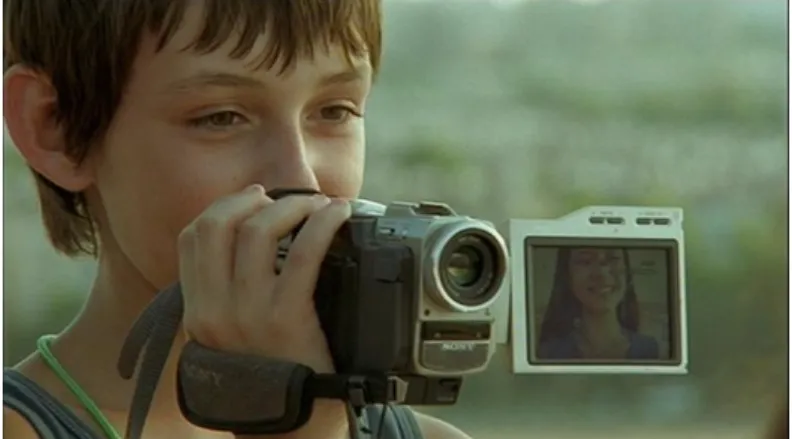
The protagonist's role in cross-cultural identification is established through numerous close-ups. Especially interesting are the shots in which Chen is shown observing other characters, sometimes even through his video camera. Whenever the protagonist is shown filming, the camera closes up on the boy, thus conveying his feelings mostly through his facial expressions. The director assumes that the culturally varied audience of the film will be able to interpret Chen's reactions to the events he observes. Indeed, our ability to interpret the facial expressions of the other is universal. Cognitive psychologists claim that human beings possess an inherent capacity to make assumptions regarding other people‟s thoughts and feelings, based on the paralinguistic clues that they receive (Zunshine 6). This ability, referred to as Theory of Mind or mind-reading, "involves psychological theorizing about our ordinary, intuitive, 'folk' understanding of the mind" (Gopnik 838). Although our ability to interpret paralinguistic signals is universal, our interpretation of these signals may be culture specific. The same gesture or action can be interpreted differently by various cultural groups. Being aware of his culturally diverse audience, Anner guides our attentional focus. According to Parick Colm Hogan, since we cannot processes all the information we receive from our environment we concentrate on specific details at any given moment (Understanding 103). This attentional focus is influenced by (among other factors) the salience or intensity of our emotional exposure to the particular external stimuli (Understanding 103).
137
Image & Narrative, Vol 11, No 2 (2010)
Figure 1 Chen Close UP
Half Russian Story focuses our attention on the personal perspective through which the protagonist experiences his interactions with other characters. This is achieved by showing the events Chen finds significant through his video camera. Once Chen pushes the recording button, it is as if the starts remembering the scene shown in the film, which contributes to its significance. By repeatedly exposing the audience to Chen's perspective as well as to his reactions to the observed events, the audience is trained to direct its attentional focus upon the protagonist, thus empathizing with his feelings. The audience participates in the construction of the boy's identity through the autobiographical memories he records in his camera. The more we are exposed to Chen's mind through his autobiographical memories, the more we become familiar with his character, and the stronger we feel about this character's success.
Learning to pay attention to Chen, both the Israeli and Russian audiences are more prone to attribute positive feelings to the "other." When we are not familiar or afraid of another culture, we tend to ignore or become hostile towards it. Anner's film, however, brings this otherness forward and makes us look at these others by capturing our attention though the art of filmmaking. In real life we might attribute negative feelings to the cultural others without being aware of it. Referring to this psychological process as "causal attribution" Colm Hogan explains that when we feel something we "immediately and tacitly blame or praise some putative cause for [our] feeling…Those innate propensities are often elaborated culturally into prototypes" (103). It's easier to be angry at the "others" and blame them for our negative feelings even though the real, while subconscious reasons for our anger may lie elsewhere. The initial empathy towards Chen evolves into a tighter cross-cultural interaction with other characters, whose cultural difference is made vivid through their language and behavior. Chen's position as partaker of both cultural groups, prepares the viewers to accept the cultural others that in real life may remain inaccessible and opaque.
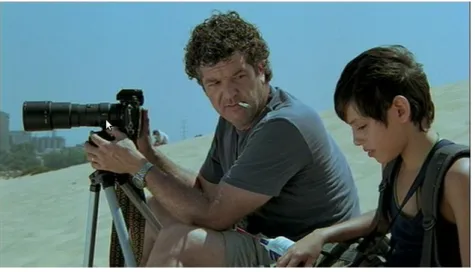
The difficulty to negotiate the socio-cultural differences between the Israeli and Russian cultures is symbolically represented in the continuous clashes between Chen's Russian-born mother and his Israeli father. Unable to agree on their son's cultural upbringing, the parents force the boy to choose between two conflicting worlds. While the father, Rami, a coarse, hard-working wedding photographer, featuring what the film perceives as a typical Israeli macho, insists on raising his son as a confident Israeli man, who can protect himself, the mother wants her son to become a gentleman who speaks Russian and has good manners. The frictions between the Russian and the Israeli parts of Chen's identity are intensified when the
138
Image & Narrative, Vol 11, No 2 (2010)
father makes it clear that he expects his son to disown the Russian part of himself, because it will not contribute to his success in life:
-You also probably heard that Russians, like all our neighbors and most of our clients, think they invented God, that every one of them was born a poet and a doctor, when, in reality , they're security guards and cashiers . But l have different plans for you. Or would you rather be an unemployed waitress like your mother?
- But I'm half Russian.
- But you're more than half not-Russian, right? How many half-kids do I have? -Two.
-And which of them do I love most? -I don't know.
-Kid, from the day you were born, you've been my boy. Between your mom and me, you never can tell. But you and me, however they might cut the cake, we'll both end up on the same slice. True or not? True or not?
-True.
Figure 2 Father/Son
The father's attitude towards the Russian immigrants reflects a certain kind of stereotypical approach which the film shows as prominent in Israeli mainstream. The discrepancy between the superiority with which the Russian immigrants perceive in their culture and their low socio-economic status in Israeli society causes the father, who is a practical man, to reject his wife's culture. Oblivious to the contribution of the Russian culture to Chen's character, the father disregards it as irrelevant and even harmful to his son in the circumstances of the Israeli reality.
While the father is convinced that he and his son share the same worldview and values, Chen chooses to embrace the Russian side of his identity, which is associated in the film with the mother's romantic nature, Russian-Israeli culture and ballroom dancing. The protagonist's loneliness and estrangement from the mainstream is shown in the film through an engaging shot depicting two intersecting corridors of the local club. The camera is positioned in the empty corridor from which a small part of the other corridor is seen. In the scene, a group of running, excited children, who have just finished their judo lesson, quickly passes in the open space seen between the two walls of the intersecting corridor. A few moments later we see Chen walking slowly and indifferently behind them. At first Chen walks away with the other
139
Image & Narrative, Vol 11, No 2 (2010)
children, but a moment later we see him walking into the corridor where the camera is placed first towards and then away from the audience. This movement is symbolic of the boy's choosing of a different path in life, which brings him closer to the Russian culture, while distancing from what the father perceives as the Israeli cultural milieu. Romantic Plots and Dancing in Service of Cultural Dialogue
Throughout the film, the protagonist is characterized by his urge to rescue the women or the girls in his life from the destructive relationships in which they are entrapped. Already in the opening shots of the film Chen secretly witnesses a fight between a newly wedded bride and her groom in which the bride attempts to kill her husband for cheating on her with her own sister. After the fight, the bride is shown walking into the sea intending to commit a suicide, and Chen runs into the water to save her. Meanwhile the other wedding guests come to the bride's rescue, and Chen is left alone on the beach shivering from the cold sea water. This scene establishes Chen as a lonely, romantic hero, who perceives himself as much stronger than he really is.
As the film proceeds, Chen attempts to save not only the bride, but also his mother and later on a girl with whom he falls in love. When Chen's mother tells her son that his father forgot their twelfth wedding anniversary, Chen volunteers to accompany her to dancing lessons at the local club. At first Chen is indifferent to dancing. Instead, he is encouraged by his father to attend judo classes, associated in the film with masculinity and toughness, often reified by Israeli men. Yet, waiting for his mother to finish her dancing lesson, Chen comes across a mysterious Russian ballroom dancer, Natalie. Always carrying a camera in his bag, Chen secretly films the dancing girl. Fascinated by Natalie's elegant movements, he decides to learn ballroom dancing in order to become her partner, and even to participate in a national championship with her.
This, however, proves to be a difficult process during which Chen learns about partnership and relationships between men and women. When he enters the dancing class for the first time, he is noticed by a diligent girl, named Sharon, who has danced without a partner for several years. She makes Chen join her in dancing and starts teaching him the steps. Although Chen is focused on observing Natalie for most of the lesson, he manages to learn a few moves and Sharon tells him that he can come to the next lesson, if he wishes. In the first lesson Chen sharply differs from the other young, yet almost professional dancers in the class. He still wears his judo outfit and dances awkwardly and clumsily causing other students to laugh at him. At first Chen himself does not wish to admit his attraction to dancing and tells the teacher, Julia, that he came to the class in order to shoot a documentary about ballroom dancing. Although Chen introduces himself as a mere observer, Julia does not allow him to assume the role of a filmmaker or a camera man so familiar to him. Informing Chen that she and her partner already have a film about their studio, the teacher hands Chen a video cassette featuring her and her husband, Roman, teaching the steps of ballroom dancing. Forced to transform from an observer into an active participant, Chen starts learning the steps using Julia's cassette.
This transformation is symbolic of the change in Chen's perspective and emotional involvement with ballroom dancing and consequently with the Russian-Israeli culture. In spite of the apparent cultural segregation between the native and the Russian Israelis, cultural interaction is shown to be possible through ballroom dancing. Julia and Roman's professionalism attracts not only the Russian, but also the Israeli-born children. While Julia loves teaching dancing and work with children,
140
Image & Narrative, Vol 11, No 2 (2010)
Roman dreams about an international career, which they have abandoned after immigrating to Israel. While Julia is fluent in Hebrew, Roman's inarticulate language prevents him from interacting with their students. When he tries to teach Chen about the role of a gentleman in dancing, the boy is capable of understanding him only with the help of his Hebrew speaking partner.
Interestingly, although Sharon was not born to Russian speaking parents she has got so accustomed to Roman's terminology that she is able to translate his Hebrew to Chen. Later on, when Sharon and Chen practice together, Sharon counts in Russian and teaches Chen the steps using the language she has heard from Roman. The successful cross-cultural communication between the Russian speaking teachers and their Hebrew speaking students is an example of how by cooperating in cultural production human beings connect and relate to each other. Through Sharon and other native Israeli ballroom dancers, who are ready to learn from the Russian culture, Anner challenges the prejudices the Russian-Israelis hold against the natives according to which the later disregard the Russian culture as inferior and unworthy of their attention and acknowledgment. As Shirley Brice Heath suggests "art seems ultimately to be about playing as if we as humans could step outside the bounds of our physical limitations by opening the imagination to take on the role of seeing and being others" (133). Art, therefore, enables us to imagine or pretend being the other and, thus, empathize with and connect to the other.
This argument is particularly interesting if we consider it in light of the recent cognitive and neurological research according to which human beings possess a mirror matching system that enables us to reproduce the observed actions of others "as if we were executing that very same action that we are observing" (Gallese 37). This occurs due to a special set of neurons designated as the "mirror neurons," which are activated both when we execute certain actions and when we observe a similar action performed by another individual. Our cognitive architecture is, therefore, designed to enable us to empathize with others by imagining ourselves in their situation.
Since most sighted human beings are capable of responding to the movements they observe on the screen, dance is a particularly well suited art form with which to trigger common sensory responses in the diverse audiences of the film. When we watch a film, our mirror neurons are activated by the actors' movements, evoking both physical and emotional responses. As Vittorio Gallese suggests,
"whenever we are looking at someone performing an action, beside the activation of various visual areas there is a concurrent activation of the motor circuits that are recruited when we ourselves perform that action. Although we do not overtly reproduce the observed action, nevertheless our motor system becomes active as if we were executing that very same action that we are observing. [In other words,] action observation implies action simulation" (37).
Sharing our cognitive responses to the dancers' movement with other people in the audience, we experience mutuality with the same people we might have experienced as others prior to watching the film. Half Russian Story enhances cultural rapprochement through what Gallese refers to as "action simulation." By activating the audience's mirror matching system, Anner joins his culturally diverse audience in mutual cognitive responses to observed actions performed by of the film's characters. By appealing to the audience's subconscious cognitive responses, the film has better chances to bridge cultural gaps and show the universality of human experience.
141
Image & Narrative, Vol 11, No 2 (2010)
In addition to engaging his audience's cognitive framework in cross-cultural communication, Anner also evokes the prototypical love plot of Shakespeare's Romeo and Juliet, which demonstrates cultural similarity between the Russian and native Israeli cultures. Reverberating with the Shakespearean tragedy, the names of the dance teachers, Roman and Julia Rabinovich, reassert the cultural universality of romance and dancing. Well-known to both the Israeli and the Russian audiences, the tragedy of Romeo and Juliet represents a kind of mediating third party to which both cultures can refer in order to establish a similar definition of a romantic relationship between a man and a woman. According to Patrick Colm Hogan, "the most common plot structure across different traditions is almost certainly romantic tragi-comedy, the story of the union, separation, and ultimate reunion of lovers," which as Hogan later explains is also the "most universal literary topic" (The Mind and Its Stories 101). Chen's romantic engagement with Natalie, however, only partially follows the prototypical pattern of romantic tragic-comedy. While the generic convention the story of the lovers' union is followed by separation and ultimate reunion (The Mind and Its Stories 101), in Chen's case, the ultimate reunion with Natalie never occurs. Instead, he falls in love with Sharon while dancing at the national ballroom dancing competition. Chen's disappointment with his initial falling in love with Natalie is symbolic of Anner's undermining the reliability of stereotypical love stories by showing dysfunctional marriages and relationships.
Even the relationship of the supposedly ultimate couple, the exemplary lovers, Roman and Julia, turns out to be a disappointment. Dramatizing their own romantic relationship through ballroom dancing, Roman and Julia teach other people not only how to dance well, but also how to represent their feelings through the dance movements. While Chen believes that a dance should reflect the real feelings of the dancers, Julia explains to her young student that this is not necessarily so: "What's wrong with lying, sir. Only animals don't lie. That's why animals don't have manners, or theater. Animals don't get married. Animals don't dance. Have you ever seen a donkey dance the English Waltz?" Since art involves pretense and representation of reality, the teacher interprets lying as an integral part of the human condition necessary for our cultural and spiritual development.
Julia's attitude represents complete disillusionment with romance and pure love because her relationship with Roman is based on lies; he continuously cheats on her with other women and she either represses or ignores it. The protagonist's honesty and romanticism conflicts with the kinds of relationships he observes among the adults. The suicidal bride in the opening scenes, Chen's mother, Julia and even Natalie, the girl with which Chen initially falls in love at the beginning of the movie, are all engaged in destructive and dysfunctional relationships that lack mutuality and open communication. While Chen is unable to help the adult women he observes through his camera, he is determined to help Natalie leave her dance partner, Artur, who humiliates and curses her.viii Having a very low self-esteem Natalie is determined to attain the recognition of others by wining the national championship in ballroom dancing. Natalie tells Chen that she cannot feel her face, and even when she looks at it in the mirror, she sees her face differently each time. The girl is convinced, however, that when everybody sees her face on T.V. and recognizes her on the street, she will know that her face is real. Natalie is unable to construct a stable, unified self because there is no one to recognize her beauty and talent.
According to Jessica Benjamin's theory of Intersubjectivity, we indeed need the other in order to construct our identities. Engaging in a creative dialogue with the other, we acknowledge the other as a separate individual capable of recognizing us
142
Image & Narrative, Vol 11, No 2 (2010)
back, and thus enabling us to construct our identities in relation to the other (Benjamin 37). Natalie's extreme need for recognition almost leads her to suicide. Succeeding at stopping Natalie from jumping to her death from the roof of her house, Chen films the dancing girl on his video camera and shows her how pretty she is. The protagonist uses his camera to connect with Natalie by acknowledging her as a worthy and unique person. This boosts Natalie's self-confidence, yet seeking public recognition and threatened by her violent dance partner, Artur, the girl refuses to dance with Chen at the competition. Chen is disappointed to discover that Natalie prefers a relationship based on lies and humiliation just because it might make her famous.
Figure 3 Chen filming
Chen's attention is not sufficient to enable the construction of Natalie's identity because the girl craves not only personal but mainly public recognition by the Israeli public and mass media. Being a part of the Russian Israeli minority and receiving little emotional support from her family or social environment, Natalie needs the massive, visible recognition of the mainstream culture in order to develop a positive image of her self. Just like Natalie, the Russian Israeli culture and community are rarely recognized by the Israeli mainstream, which complicates the construction of Russian Israeli identity. According to Charles Taylor‟s “Politics of Recognition,” “nonrecognition or misrecognition can inflict harm, can be a form of oppression, imprisoning someone in false, distorted, and reduced mode of being” (75). Taylor further suggests that “recognition is not just a courtesy we owe to people. It is a vital human need” (76). Thus, when a majority culture withholds recognition from minorities, it not only harms the people‟s self-esteem but also makes them internalize a distorted “picture of their own inferiority” that the majority culture inflicts upon them. Just as Natalie has internalized the distorted image of her face and personality, so the Russian Israeli minority often experiences itself as inferior and humiliated by the Israeli mainstream.
Similarly to Natalie who experiences a difficulty to create her bi-cultural identity in the context of the Israeli mainstream, Chen's mother, Lena, fails to create
143
Image & Narrative, Vol 11, No 2 (2010)
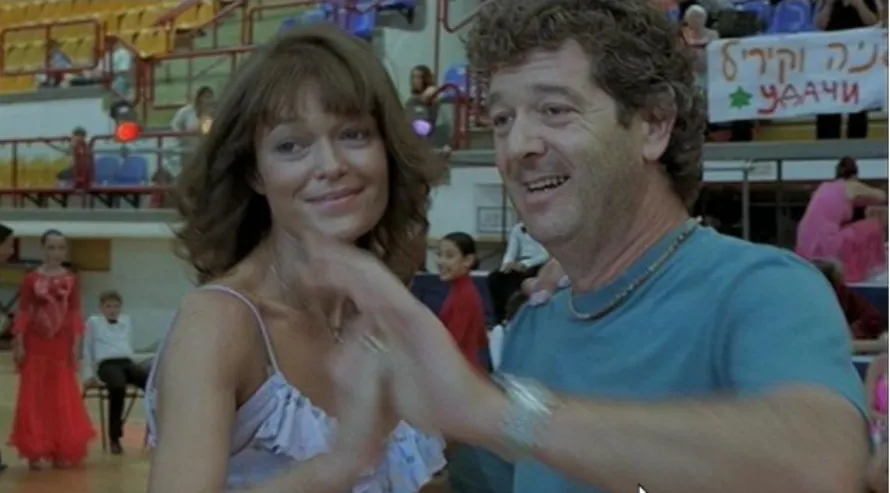
her identity as the wife of an Israeli-born man. Just like Natalie, Lena is engaged in a relationship that undermines her self. While Natalie's talent and beauty are disregarded by her dance partner, the mother's cultural difference is unrecognized by Chen's father. The rupture in the parents' relationship is introduced already in the beginning of the movie when Chen's father is hired to film a wedding celebrated at the restaurant in which Lena works as a waitress. Since Chen helps his father with the filming, the whole family can spend some time together and the mother uses this opportunity to enjoy the evening at work. She starts dancing with Chen, and only when the father sees that a strange man flirts with her, does he join his son and wife on the dancing floor and even dances with Lena for a while.
Interestingly, these opening scenes establish the correlation between the lack of romance, expressed through the father's refusal to dance, and cultural misunderstandings. When the parents dance, the mother calls her husband "papochka," daddy in Russian, saying he dances like a circus bear. Using both a Russian word and an image that is readily associated with the Russian cultural context, the mother attempts to establish an emotional connection with her husband. The father, however, rejects his wife's outreaching.ix Concerned that his wife might lose her job for dancing with her husband instead of working, he assumes the position of her boss. Rudely turning her around he shoves her back to work using Russian words: "davai, davai" (come on, come on). While the mother uses her mother tongue to reconnect to her husband, the father uses Russian to estrange himself from his wife and assume his social superiority as a native Israeli.
Closing up on Chen's insulted and disappointed mother putting out a candle that decorates one of the restaurant tables, the film's director focuses the attention of the Israeli audience on the feelings of the cultural other. The mother's facial expressions and body language testify to the father's failure to acknowledge his wife's yearning for romance. While the mother is disappointed at her husband's failure to behave as a gentleman, Rami remains unwilling to learn what he considers as pompous and excessive behavior. The cultural gap between the parents not only undermines their romantic relationship, but also reflects the larger cultural misunderstandings between the native and the Russian Israelis.
Migrating Sands or How Israelis Cross Cultures
Although in the beginning of the film the father is shown as a bossy, tough man who is largely concerned with the family's income, as the film's plot develops, the father's stereotypical portrayal as the Israeli macho is complicated. This occurs when he is shown as a frustrated artist, who photographs the migrating sands or the dunes typical of the Israeli landscape. An integral part of the Mediterranean scenery, the sands represent both the native Israeli culture and the migrating nature of the Jewish people. The prism of the father's camera is capable of catching the uniqueness of the seemingly mundane dunes. Although the father's photographs clearly have deep sensitivity and understanding of the landscape, he is misunderstood by the curators of art exhibits. Just as the father, is rejected by the snobbish art critics, so he is misunderstood by his Russian-Israeli wife and perhaps, at first, by Russian immigrant audience of the film.
144
Image & Narrative, Vol 11, No 2 (2010)
The cultural gap that divides between Chen's Israeli father and Russian mother is bridged through the artistic representation of the migrating sands. Anner's film, just like the father's camera, captures the uniqueness in the ordinary. Rami tells his son that he loves the dunes for changing all the time: "today they're here; tomorrow they're gone." On the one hand, the migrating sands represent uprootedness, constant change and movement, so characteristic of the immigrant experience. On the other hand, however, they also stand for the father's connection to the soil of his homeland. The father's love for the migrating sands is symbolic of his love for his Russian-born wife, whose artistic and refined nature both agitates and attracts him. The ambiguous symbolism of the migrating sands implies that immigration is if fact an inherently Israeli experience. Since most Israeli Jews have sooner or later immigrated to Israel, by comparing the immigrants to something as Israeli as the migrating sands, the film encourages the audience to view the Russian Israelis as an integral part of the Israeli experience and landscape, rather than as outsiders.
Dancing and the Birth of True Love and Identity
The personal and cultural tension between Chen's parents reaches its peak towards the end of the movie when the mother comes very close to committing adultery. Standing on the street Chen accidentally zooms in his video camera on the widow of the local club, and spots his mother in an intimate dance with her teacher. Realizing that even for his mother dancing and romance are not based on true feelings, Chen runs to Julia and tells her that he will never dance again because her dancing steps are based on lies. Chen's disappointment with reality initiates his maturation and identity formation. When he arrives home he discovers his parents fighting; fearing for his mother's safety he first speaks to the father in Hebrew, and failing to distract him from the argument he speaks to his mother in Russian urging her to get away. Switching between Russian and Hebrew Chen attempts to negotiate between his parents' cultures addressing to each in his mother tongue. Yet when Chen speaks Russian to his mother, he actually estranges himself from the father, who reacts by pushing his son to the other side of the room, thus creating not only physical but also emotional detachment between Chen and himself. Pronouncing that their marriage is over, the mother leaves for a few arrangements and warns her husband not to touch their son. Rami, however, packs Chen's clothes and attempts to take his son away in his car, but the boy escapes in the last moment. Running away from both parents and symbolically from both cultures, Chen spends the night on the migrating sands, which he and his father used to photograph. Functioning as a symbol of both the Israeli and the immigrant cultures, the dunes provide Chen with the intermediate, neutral territory where he eventually negotiates the Russian and Israeli parts of his identity.
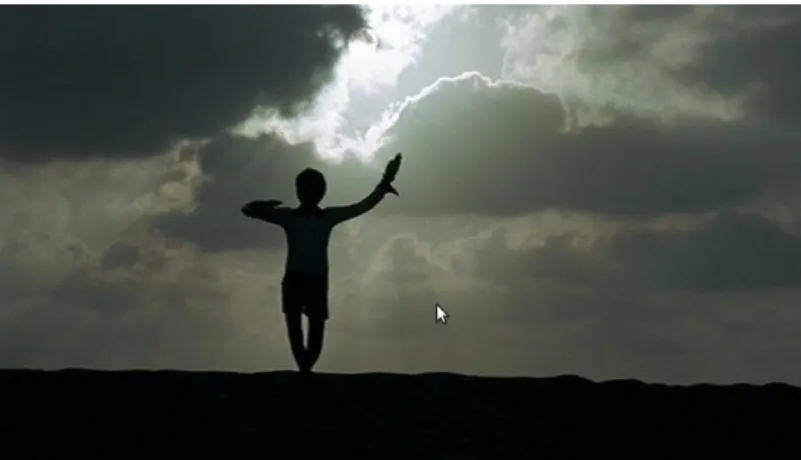
Waking with sunrise Chen remembers that his dancing outfit is still in his bag; he puts the clothes on and starts dancing on the dunes as in the background a few rays of the rising sun make their way through the milky-grey clouds. This emotionally charged scene depicts the protagonist's self-defining moment in which he constructs both his personal identity as an artist and his bicultural identity as a Russian-Israeli. Chen's engagement with dancing enables him to negotiate and redefine the Russian and the Israeli parts of his identity. On the one hand, he accepts his mother's romanticism and attraction to ballroom dancing, but he also dances on the migrating sands that his father admires so much. By combining between his parents' artistry Chen succeeds in defining himself in relation to both cultures because he focuses on what unites, rather than what separates the two.
145
Image & Narrative, Vol 11, No 2 (2010)
Figure 4 Practicing
The cross-cultural communication is further developed the final scenes of the film, in which Chen is shown participating in the national ballroom dancing competition. Although Chen cannot dance with Natalie, committed to his dancing partner, Sharon, he nevertheless shows up for the competition. When they start dancing, Chen's father enters the gymnasium and glances disapprovingly at his son. Noticing him, Chen freezes is his place, yet Sharon urges her partner to focus on her face, which enables Chen to continue dancing. Finding a refugee from his father's disapproval in Sharon's eyes, Chen falls in love with the girl when dancing Rumba, the dance of love. The reciprocity between Sharon and Chen complement the protagonist's identity formation as a romantic, who is convinced in the possibility of true love and sincere feelings between a man and a woman.
Observing the harmony and deep feeling between Chen and Sharon, Julia, Chen's dancing teacher, asks one of the competition judges to dance with her. Although this is against the rules, the judge agrees and Julia invites her other students to join the dancing thus transforming the competition into a celebration of emotion and passion for ballroom dancing. When Julia calls her students' to join the dancing, the audience hears both Russian and native Israeli names, thus realizing that ballroom dancing does not necessarily belong to the Russian-Israelis.
146
Image & Narrative, Vol 11, No 2 (2010)
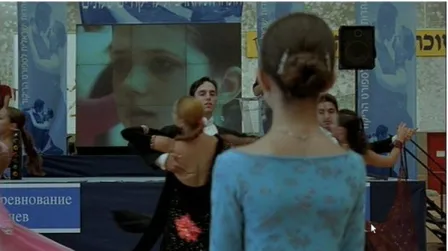
The excitement and joy the common public dancing generates, makes the competition between the young dancers somewhat irrelevant. When Artur, Natalie's partner realizes this he deserts her in the middle of the dance and Natalie is shown standing along the middle of the gymnasium, crying. At this moment, the broadcasting television camera closes up on Natalie's face and she finally sees it on the big screen, which displays the competition. This defining moment of Natalie's identity formation situates her as the individual artist on her own right. When Julia takes Natalie's hand and swirls with her in the dancing crowd, the girl is finally dancing for the sake of the dance, rather than in order to make an impression. Receiving the acknowledgement that she has been craving for, Natalie is finally capable of joining the community of dancers in relation to which she can define herself in a constructive way.
Figure 6 Finale Natalie
The harmony and truthfulness between Chen and Sharon cause the adults to reconsider their relationships. Julia, who was about to leave to Stockholm with her unfaithful husband in order to resume their dancing career, renounces her plans. Comparing her relationship with Roman to practicing the steps instead of dancing with feeling, Julia reconsiders her cynical perception of dancing, partnership and marriage as social phenomena normally based on lies. Chen's devotion to dancing causes not only Julia, but his parents, too, to reconsider their relationship and worldview. The filmic techniques used in the portrayal of the parents' final rapprochement testify for the process the father undergoes in accepting his wife's cultural background. At first the parents are shown in the same frame watching their son dancing. Even though they are sitting very close by, the spouses fail to notice each other because of the transparent glass partition that separates between the two galleries they occupy. The visual representation of the cultural gap that separates the parents also conveys the true insignificance of the cultural differences that have almost caused the destruction of Chen's family. When the father finally sees his wife though the glass wall, he approaches her, and for the first time addresses her in Russian. The single word "potanzuem," roughly translated into English as "shall we dance," demonstrates the father's readiness to change his behavior towards his wife and acknowledge her as an equal partner in their marriage.
The film's plot makes a full circle, as the finale reverberates with the opening scenes, in which the father unwillingly dances with the mother and later
147
Image & Narrative, Vol 11, No 2 (2010)
condescendingly shoves her back to work. Similarly to the father, the Israeli audience undergoes the processes of cultural integration in relation to the Russian-Israeli audience. Speaking to his wife in Russian and agreeing to accept the cultural codes of a romantic gentleman who asks his beloved for a dance the father demonstrates the possibility of cross-cultural interaction between the film's culturally diverse audiences. The final scene of familial and communal harmony in dancing suggests for the possibility of cross-cultural communication and multi-cultural dialogue by means of artistic expression. Since dancing does not require words, it is capable of producing unspoken physical and mental synchronization between the dancers, drawing them into musical and rhythmic collaboration. Dancing is used in the film as a cognitive tool to bridge between characters as well as between the Russian and Israeli audiences that grow to be more capable of accepting each other as complex individuals with common emotional and cognitive constitutions.
Figure 7 Finale Parents
The multiple romantic plots in Half Russian Story intertwine with plots involving ballroom dancing, and both function as cross-cultural bridges between the Russian and native Israeli characters. Explicating the romantic relationships between the male and female characters through ballroom dancing, Anner draws a parallel between the ways the romantic couples dance and the relationships they create. Coordinating their movements in dancing, a man and a woman are joined both physically and emotionally, gradually understanding the depth of their relationships and the role they play in them. Similarly, observing the characters' dance movements, the culturally varied viewers that comprise the film‟s audience experiences common bodily responses that evoke shared emotional reactions. Just as the characters from different cultures experience emotional closeness when they observe other characters' dancing, so the Russian-immigrant and the Israeli audiences, sharing similar cognitive frameworks, are capable of accepting each other as complex human beings that share similar experiences and feelings.
148
Image & Narrative, Vol 11, No 2 (2010)
References
Anner, Eitan, dir. Half Russian Story. July August Productions and Bleiberg Entertainment, 2006.
Benjamin, Jessica. The Bonds of Love: Psychoanalysis, Feminism and the Problem of Domination. New York: Pantheon Books, 1988.
Bordwell, David. Poetics of Cinema. New York and London: Routledge, 2007.
Brice, Shirley Heath. "Dynamics of Completion." The Artful Mind: Cognitive Science and the Riddle of Human Creativity. Ed. Mark Turner. New York: Oxford UP, 2006.
Caroll, Noel. Engaging the Moving Image. New Haven and London: Yale UP, 2003. Colm Hogan, Patrick. The Mind and Its Stories: Narrative Universals and Human
Emotion. Cambridge: Cambridge UP, 2003.
---. Understanding Indian Movies: Culture Cognition and Cinematic Imagination. Austin: Texas UP, 2008.
Gallese Vittorio. “The „Shared Manifold‟ Hypothesis: From Mirror Neurons to Empathy.” Journal of Consciousness Studies 8. 5-7 (2001): 33-50.
Gomel, Elana. The Pilgrim Soul: Being Russian in Israel. Amherest, New York Cambria Press, 2009.
Gopnik, Alison. “Theory of Mind.” The MIT Encyclopedia of the Cognitive Sciences. Eds. Robert A. Wilson and Frank C. Keil. Cambridge: The MIT Press, 1999. 838-41.
Taylor, Charles. "Politics of Recognition." Multiculturalism: A Critical Reader. Ed. David Theo Goldberg. Cambridge: Blackwell, 1994.
Remennick, Lraissa. Russian Jews on Three Continents: Identity Integration and Conflict. New Brunswick and London: Transaction Publishers, 2007.
Zunshine, Lisa. Why We Read Fiction: Theory of Mind and the Novel. Columbus, Ohio: State UP, 2006.
Klarina Priborkin received her PhD from Bar Ilan University. She is interested in cross-cultural communication, literature by immigrant/ethnic minorities and cognitive theory. Her recent article "Mother‟s Dreams, Father‟s Stories" appeared in South Asian Review 29.2, 2008. Priborkin is currently teaching American Literature, Drama and Creative Writing in Givat Washington Academic College of Education.
149
Image & Narrative, Vol 11, No 2 (2010)
i In this essay I refer to the Russian speaking Jews who immigrated to Israel as Russian-Israelis since, as Larissa Remennick's sociological study suggests, they managed to "preserve their old identity or to invent a new, hyphenated one of Russian Israeli," thus creating a unique bi-national and transcultural self definition (161). Remennick discusses identity formation "in relation to the host society rather than ethnicity," and; therefore, excludes such categories of self definition as Jewish or Russian Jewish (97). Following Remennick, I will focus on cultural and national rather than on religious and ethnic identity construction.
ii Although Israeli mainstream is ethnically heterogeneous, it nevertheless shares certain cultural characteristics specific to people who were born or at least spent most of their lives in Israel. The Israeli mainstream also enjoys certain economic stability, which the immigrants often fail to achieve.
iiiEven though the younger Russian-Israelis grew up in Israel, have been educated in the Israeli school system and served in the army, they often cannot escape experiencing themselves as "others" in a country they have largely accepted as their own. This paradox derives mainly from the education these people received at home. Raised by parents whose values are rooted in the culture of the former USSR, these children have to negotiate the clash between the Russian-immigrant and the Israeli mindsets. For further details, see Remennick 139.
iv Remennick 99. v Remennick 72.
vi Private, illegal printing houses.
vii Recently, many contemporary masterpieces of Hebrew literature have been translated into Russian, which allowed the older generation of immigrants to get a glimpse into the Israeli literature. Moreover, most Hebrew bookstores, especially the countywide chains, have started to appeal to the Russian reading audience. By dedicating a section to Russian books, these bookstores have started the task of integrating the immigrants into the larger Israeli reading audience. Moreover, these sections bring the Russian readers closer to the Israeli general audience and to the variety of literature published in Hebrew.
viii Artur's character complicates the binary that the film itself creates, according to which Russian-Israelis have refined manners and romantic soul, while the native Israelis are rude, coarse and practical people. Artur's violence and cruelty towards Natalie shows that dancing as a gentleman does not suggest having the nature of one. Conversely, Chen's seemingly unsophisticated father is also shown as an artist whose romanticism and gentleness remains hidden until he realizes that this introvert character might cost him his family.
ix It is possible that Rami has shoved his wife back to work because he is offended by being called a circus bear, yet it seems to me that Lena's joking tone alleviates the implied insult in her words. Lena is ready to accept her husband's clumsiness and enjoys dancing with him, yet her remark also reflects the judgmental attitude some Russian immigrants may have towards the native Israelis.