HAL Id: hal-00437003
https://hal.archives-ouvertes.fr/hal-00437003
Submitted on 4 Sep 2015
HAL is a multi-disciplinary open access
archive for the deposit and dissemination of
sci-entific research documents, whether they are
pub-lished or not. The documents may come from
teaching and research institutions in France or
abroad, or from public or private research centers.
L’archive ouverte pluridisciplinaire HAL, est
destinée au dépôt et à la diffusion de documents
scientifiques de niveau recherche, publiés ou non,
émanant des établissements d’enseignement et de
recherche français ou étrangers, des laboratoires
publics ou privés.
Technical note: Scintillations of the double star α Cru
observed by GOMOS/Envisat
Viktoria F. Sofieva, Francis Dalaudier, Valery Kan, Alexandre S. Gurvich
To cite this version:
Viktoria F. Sofieva, Francis Dalaudier, Valery Kan, Alexandre S. Gurvich. Technical note:
Scintilla-tions of the double star α Cru observed by GOMOS/Envisat. Atmospheric Chemistry and Physics,
European Geosciences Union, 2009, 9 (22), pp.8967-8973. �10.5194/acp-9-8967-2009�. �hal-00437003�
www.atmos-chem-phys.net/9/8967/2009/ © Author(s) 2009. This work is distributed under the Creative Commons Attribution 3.0 License.
Chemistry
and Physics
Technical note:
Scintillations of the double star α Cru observed by GOMOS/Envisat
V. F. Sofieva1, F. Dalaudier2, V. Kan3, and A. S. Gurvich31Earth observation, Finnish Meteorological Institute, Helsinki, Finland
2LATMOS, Universit´e Versailles Saint-Quentin; CNRS/INSU, Verri`eres-le-Buisson, France
3Organization of Russian Academy of Sciences A. M. Obukhov Institute of Atmospheric Physics RAS, Moscow, Russia
Received: 14 July 2009 – Published in Atmos. Chem. Phys. Discuss.: 2 September 2009 Revised: 12 November 2009 – Accepted: 14 November 2009 – Published: 27 November 2009
Abstract. In this paper, we discuss scintillation time-spectra of the double star α Cru, which were measured by the GO-MOS/Envisat photometer. The components of α Cru are not resolved by the angular field of view of the detector. The double structure of the light source reveals itself in the mod-ulation of the observed scintillation spectra; this modmod-ulation is caused by anisotropic irregularities of the stratospheric air density. We present a qualitative and quantitative explanation of the properties of the double-star scintillation spectra. Pos-sibilities of using double star scintillations for studying at-mospheric air density irregularities are also discussed in the paper.
1 Introduction
Statistical properties of scintillation (i.e. fluctuations in in-tensity when a light source is observed through the atmo-sphere) are defined by the structure of air density in the at-mosphere, and by the spatial structure of the light source. Scintillations measured during star occultations have a broad application for carrying out research on the atmospheres of planets and their satellites (Hubbard et al., 1988; Raynaud et al., 2004), and they had been used actively during the last decade for satellite sounding of Earth air density irregular-ities (Gurvich and Kan, 2003a, b; Sofieva et al., 2007a, b). For the Earth’s atmosphere, photometers with an effective aperture of ∼20 cm can register stellar scintillations in the altitude range ∼10-60 km with a vertical resolution down
Correspondence to: V. F. Sofieva
to meters/fraction of a meter. The theory of weak lation (Tatarskii, 1961, 1971) allows the analysis of scintil-lations measured aboard low-orbiting satellites for altitudes above ∼25–30 km (Gurvich and Kan, 2003a, b; Sofieva et al., 2007a, b).
Scintillations data with global coverage became available with the launch of the GOMOS (Global Ozone Monitoring by Occultation of Stars) instruments on board the Envisat satellite (Kyr¨ol¨a et al., 2004). GOMOS is equipped with two fast photometers, which record the stellar flux synchronously in the blue (473–527 nm, λB≈500 nm) and red (646–698 nm,
λR≈672 nm) wavelength ranges with a sampling frequency
of 1 kHz, as a star sets behind the Earth limb (for illustra-tion of the occultaillustra-tion geometry, see Fig. 1 in Kyr¨ol¨a et al., 2004). The scintillation measurements are used for the cor-rection of scintillations in the spectrometer data to achieve a better accuracy of trace gases retrievals (Dalaudier et al., 2001; Sofieva et al., 2009b), for temperature profiling with a high vertical resolution (Dalaudier et al., 2006), and for studying small-scale processes in the stratosphere (Gurvich et al., 2005, 2007; Sofieva et al., 2007a, b; 2009a).
Recently, the algorithm for the reconstruction of gravity wave (GW) and turbulence spectra parameters was devel-oped (Sofieva et al., 2007b). During the data analyses, we have noticed that the scintillation spectra of α Cru are often radically different from those of other stars. This is illus-trated in Fig. 1, which shows the scintillation spectra for the mean altitude of 35 km. The left panel a shows the “stan-dard” scintillation spectrum from occultations of Canopus. The majority of scintillation spectra of α Cru are quite differ-ent: a deep quasi-harmonic modulation of scintillation spec-tra is clearly observed (as in Fig. 1b). However, sometimes scintillation spectra of α Cru look normal (Fig. 1c).
8968 V. F. Sofieva et al.: Scintillations of the double star α Cru observed by GOMOS/Envisat 0 100 200 300 400 500 0 0.5 1 1.5 2 2.5 3 3.5x 10 −3 frequency, Hz psd 0 100 200 300 400 500 0 0.2 0.4 0.6 0.8 1 1.2 1.4 1.6 1.8 2x 10 −3 frequency, Hz psd 0 100 200 300 400 500 0 0.2 0.4 0.6 0.8 1 1.2 1.4 1.6 1.8x 10 −3 frequency, Hz psd a b c Canopus 5 Dec 2002, ~28° N α Cru 21−22 Jan 2003, ~ 2°N α Cru 14−15 Nov 2002, ~ 25°S
Fig. 1. (a): “standard” scintillation spectra (from occultations of Canopus); (b): scintillations spectra from several occultations of α Cru
carried out on 21–22 January 2003; (c): scintillation spectra of α Cru on 14–15 November 2002 (usual spectra). Red lines: individual scintillation spectra estimations, black line: mean spectra, for altitude 35 km. GOMOS successive occultations of each star are performed nearly at the same latitude and at nearly the same local time. Locations of the selected night-time occultations are indicated in the figure. Scintillation spectra are presented on a linear scale.
These features of the α Cru scintillation spectra are be-cause α Cru is a multiple (triple) star. Only two compo-nents of α Cru, which are separated by θ0=4.4 arcsec, are
visually distinguishable. They have comparable visual mag-nitudes mv1=1.4 and mv2=2.09. The GOMOS field of view
is 138.4×49.4 arcsec (the larger angle is in the vertical di-rection), thus the components of α Cru are not resolved by the detector. The intensity fields from the two components of α Cru, which are shifted with respect to each other, are registered simultaneously by GOMOS.
In this paper, we explain qualitatively and quantitatively the specific features and time evolution of scintillation spec-tra of double unresolved stars. The paper is organized as follows. Properties of scintillation spectra of double unre-solved stars are explained in Sect. 2. Section 3 is dedicated to the comparison of experimental scintillation spectra with that computed using a two-component spectral model of air den-sity irregularities. A discussion of the possible use of double star scintillations for studying atmospheric air density irreg-ularities and a short summary conclude the paper.
2 Scintillation spectra of double unresolved stars Satellite stellar scintillation measurements in the occultation geometry have been discussed in many papers (e.g. Gurvich, 1984; Dalaudier et al., 2001). We will use the phase screen approximation for the description of light wave propagation through the atmosphere (Little and Hewish, 1966). This means that the influence of the atmosphere is replaced by a plane screen that produces the same phase modulation of the propagated light waves. Such screen is placed in the plane, which is perpendicular to the incident light rays and contains the Earth’s centre. For calculations of scintillation spectra
of a double star with the components unresolved by a detec-tor, let us take into account (Tatarskii, 1971, §42 and §54) that the components create distributions of intensity I01I1(r)
and I02I2(r) in the observation plane. Here r is the vector
in this plane, I01 and I02 are spatially constant intensities
without refractivity fluctuations, and I1(r) and I2(r) are
ran-dom functions with mean value 1. Provided the angular dis-tance θ0between the components is small θ0 1, we can
con-sider I2(r)=I1(r+ρ) (Little and Hewish, 1966; Cohen et al.,
1967; Ishimaru, 1978), where the components of the vector
ρ=θ D are ρz=Dθ0,z/q,ρy=Dθ0,y, q is the refractive
dilu-tion (Dalaudier et al., 2001), D is the distance between obser-vation plane and the phase screen. In other words, the fields of relative intensity fluctuations corresponding to the com-ponents of a double star are only shifted with respect to each other. Then the 2-D spatial spectrum F6(κ) of the sum of
the signals 6=I01I1(r)+I02I2(r) registered by the detector
is equal to (the shifting theorem for the Fourier transform)
F6(κ)=
I012+I022+2I01I02cos(κρ)
(I01+I02)2
FI(κ), (1)
where FI(κ), κ=(κz,κy) is the 2-D scintillation
spec-trum of a single star discussed in detail in (Gurvich and Brekhovskikh, 2001; Gurvich and Kan, 2003a; Sofieva et al., 2007b).
In occultation experiments, we obtain estimates of a 1-D scintillation spectrum along the occultation trajectory with an angle γ to the local vertical (Gurvich and Brekhovskikh, 2001; Gurvich and Kan, 2003a):
V6(ks,γ )= +∞
Z
−∞
dkF6(−ksinγ +kscosγ , k cosγ +kssinγ ).(2)
The angle γ =0 corresponds to a vertical spectrum (and to a vertical, in-orbital-plane occultation). Therefore, the ad-ditional parameters that define properties of the scintillation spectra of double unresolved stars are: the ratio of intensities
I01/I02 of the star components, the angular θ0(or spatial ρ)
separation, and the angle β between ρ and the local vertical. As follows from (1), the scintillation variance for a double star is smaller than the variance of a single star of intensity (I01+I02). Previously, the reduction of scintillation variance
in the turbulent media caused by the finite angular size of the light source was already discussed by Tatarskii (1961, 1971). In particular, the known fact that planets scintillate less than stars for the same zenith angles has received its quantitative explanation in these works.
Another specific feature of unresolved double star scintil-lation spectra, which is caused by the factor cos(κρ) in the Eq. (1), is a modulation. The modulation of the 1-D scin-tillation spectra observed by GOMOS photometer depends not only on the orientation of the star components and oc-cultation geometry (angles γ and β), but also on the struc-ture of atmospheric irregularities. It is known that there are two types of air density irregularities in the Earth at-mosphere: anisotropic irregularities, which are of relatively large scale (generated by gravity waves), and isotropic ir-regularities (turbulence), which appear as a result of gravity wave breaking and due to different instabilities. The two-component spectral model of air density irregularities was proposed in (Gurvich and Brekhovskikh, 2001; Gurvich and Kan, 2003a). The scintillation spectra corresponding to this spectral model, for a single star, were discussed in detail in (Gurvich and Brekhovskikh, 2001; Gurvich and Kan, 2003a; Gurvich and Chunchuzov, 2005; Sofieva et al., 2007b). Due to the limited sampling frequency of GOMOS photometers, relatively large-scale anisotropic irregularities play an impor-tant role in forming the scintillations observed by GOMOS. As a result, scintillation spectra of α Cru are often modulated (Fig. 1b).
When oscillations in the 1-D anisotropic scintillation spec-trum are observed, the modulation period Tmin the frequency
space increases with increasing β. It is defined by the verti-cal component of the projection of the satellite velocity onto the observation plane, vv, and the vertical component of the
stellar separation:
Tm=vv/(ρcosβ). (3)
The maximal modulation coefficient (contrast) for the anisotropic spectrum is
m=2I01I02
I012+I022 . (4)
For α Cru, which has two stars of similar intensities, m is close to unity, m≈0.9.
3 GOMOS observations of α Cru: a quantitative account
In this section, we present the comparison of the experimen-tal scintillation spectra of α Cru, from the GOMOS measure-ments, with that computed using the two-component spectral model of air density irregularities.
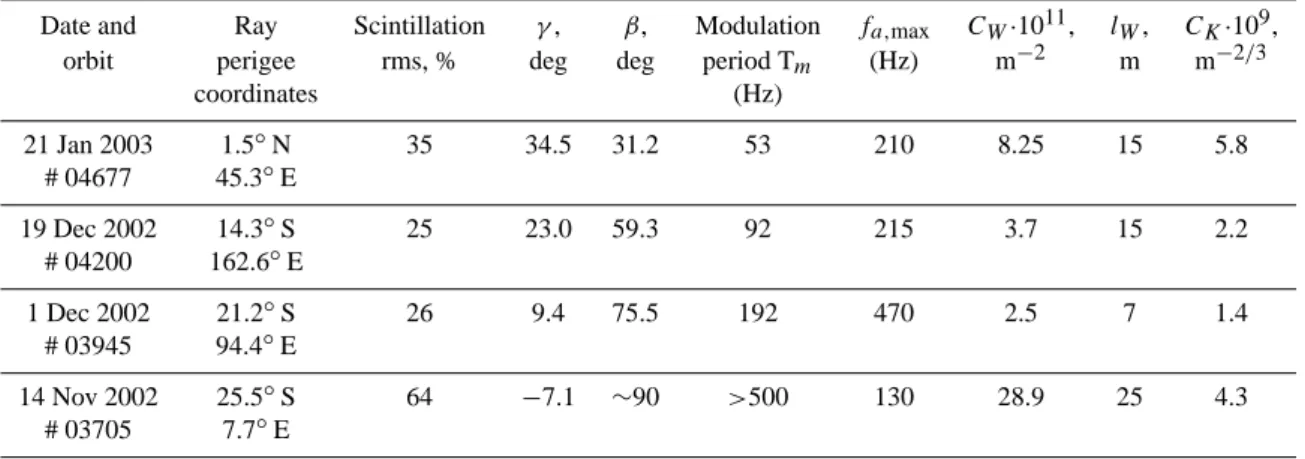
Information about four occultations of α Cru, selected for illustration, is collected in Table 1. The angle β changes from
∼90◦to ∼30◦during the selected time interval. The angle β was computed using the information about vertical velocity and the observed modulation period of the scintillation spec-tra, Eq. (3). The experimental values of the angle β agree well with the theoretical estimations of this parameter, which can be calculated using the occultation geometry. The spa-tial separation of α Cru components is ρ=θ0D≈69 m. The
spatial sampling of GOMOS is from 3 to 8 m, depending on obliquity of an occultation. For processing, we used scin-tillation measurements corresponding to an altitude of ray perigee of ∼34 km, to satisfy the condition of weak scintilla-tions (rms of scintillascintilla-tions are given in Table 1).
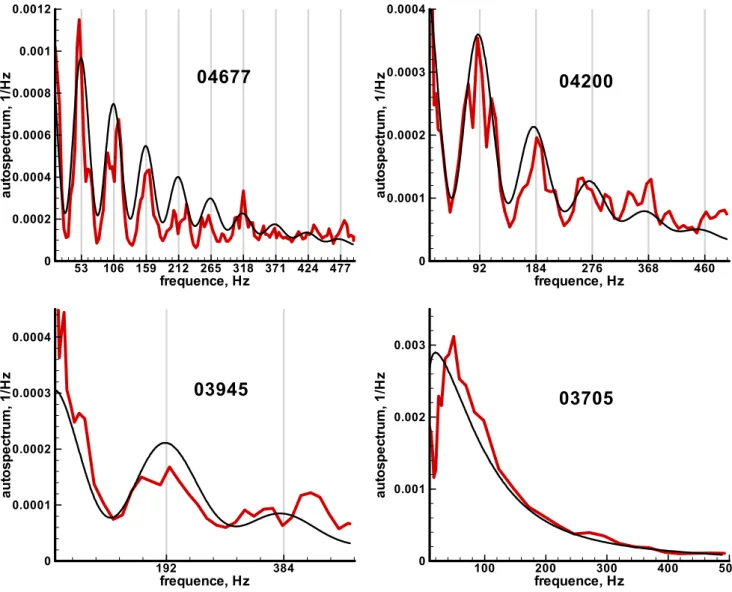
Figure 2 shows the experimental scintillation spectra for the selected occultations (red lines). The experimental spec-tra were computed using the method of smoothed peri-odograms. The periodogram smoothing was performed with the window of variable width, analogous to that discussed in (Gurvich and Chunchuzov, 2005; Sofieva et al., 2007b). Instrumental noise was removed in computing experimental scintillation spectra.
The width of anisotropic scintillation spectra is defined by the vertical inner scale lW: fa,max=vv/ lW (see Table 1).
For frequencies higher than fa,max, the anisotropic
scintilla-tion spectra rapidly decrease. The strong modulascintilla-tion of the scintillation spectra at frequencies f <fa,maxfor orbits 4677,
4200 and 3945 (Fig. 2) is caused by prevailing anisotropic scintillations over isotropic ones in this spectral range. At frequencies f >fa,max, scintillations caused by isotropic
ir-regularities prevail, thus the modulation of scintillation spec-tra rapidly decreases for f >fa,max.
Depending on β, the modulation period changes from 53 Hz for the orbit 4677 to 192 Hz for the orbit 3945. For the orbit 3705, the components of α Cru are located nearly horizontally, their vertical separation was much smaller than
lW. In this case, the anisotropic component of the
scintilla-tion spectrum is nearly the same as for a single star, while the spectral density of the isotropic component is approxi-mately twice as small as that of a single star. The observed scintillation spectrum in this case is not modulated, as seen in Fig. 2.
Black lines in Fig. 2 show the fit of the experimental spec-tral to the modeled scintillation spectra, which were com-puted using the two-component spectral model of air den-sity irregularities, including anisotropic (saturated gravity waves) and isotropic (Kolmogorov turbulence) components (Gurvich and Kan, 2003a; Sofieva et al., 2007b). A brief
8970 V. F. Sofieva et al.: Scintillations of the double star α Cru observed by GOMOS/Envisat
15
frequence, Hz au to sp ec tr u m ,1 /Hz 100 200 300 400 500 0 0.001 0.002 0.00303705
frequence, Hz au to sp ec tr u m ,1 /Hz 192 384 0 0.0001 0.0002 0.0003 0.000403945
frequence, Hz au to sp ec tr u m ,1 /Hz 53 106 159 212 265 318 371 424 477 0 0.0002 0.0004 0.0006 0.0008 0.001 0.001204677
frequence, Hz au to sp ec tr u m ,1 /Hz 92 184 276 368 460 0 0.0001 0.0002 0.0003 0.000404200
Figure 2 Experimental scintillation spectra in linear scale of
α
Cru (red lines) and their fit using the
two-component spectral model of air density irregularities (black lines). Vertical gray lines correspond
to modulation periods
T
m.
Fig. 2. Experimental scintillation spectra on a linear scale of α Cru (red lines) and their fit using the two-component spectral model of air
density irregularities (black lines). Vertical gray lines correspond to modulation periods Tm.
description of this model is given in Appendix A. The com-putation of theoretical scintillation spectra was discussed in detail in (Gurvich and Brekhovskikh, 2001; Gurvich and Chunchuzov, 2005; Sofieva et al., 2007b). This model and Eqs. (1) and (2) were used for fitting 1-D modeled spec-tra to the observations. The estimates of the three parame-ters of the spectral model – the structure characteristic CW
of anisotropic irregularities, vertical inner scale lW, and the
structure characteristic CK of Kolmogorov turbulence –
re-trieved in the fitting, are presented in Table 1. As seen in Fig. 2, the modeled and experimental scintillation spectra are in rather good agreement. The obtained estimates of gravity waves and turbulence parameters are within the range of pre-vious results of the parameter reconstruction (Gurvich and Kan, 2003b; Sofieva et al., 2007b, 2009a).
4 Summary and discussion
We have considered the properties of scintillation spectra of double stars, which are not resolved by the field of view of the detector. The main features of the double-star scintilla-tion are (i) reducscintilla-tion of scintillascintilla-tion variance (compared to that of a single star) and (ii) modulation of the scintillation spectra. It is the consequence of shifted intensity fields corre-sponding to the components of a double star. The period and the depth of the modulation depend on the structure of atmo-spheric irregularities, separation of the star components, ratio of their intensities, and on the observation geometry. The modulation of the observed scintillation spectra is caused mainly by anisotropic irregularities of air density (due to lim-ited resolution of the GOMOS fast photometers, such irreg-ularities play an important role in forming the scintillations observed by GOMOS).
Table 1. GOMOS occultations selected for the comparison.
Date and Ray Scintillation γ, β, Modulation fa,max CW·1011, lW, CK·109,
orbit perigee rms, % deg deg period Tm (Hz) m−2 m m−2/3
coordinates (Hz) 21 Jan 2003 1.5◦N 35 34.5 31.2 53 210 8.25 15 5.8 # 04677 45.3◦E 19 Dec 2002 14.3◦S 25 23.0 59.3 92 215 3.7 15 2.2 # 04200 162.6◦E 1 Dec 2002 21.2◦S 26 9.4 75.5 192 470 2.5 7 1.4 # 03945 94.4◦E 14 Nov 2002 25.5◦S 64 −7.1 ∼90 >500 130 28.9 25 4.3 # 03705 7.7◦E
The experimental scintillation spectra obtained by GO-MOS in occultations of the double star α Cru under dif-ferent observation conditions are adequately (qualitatively and quantitatively) explained, if existence of anisotropic and isotropic irregularities of air density is assumed. Therefore, the performed analysis can serve as an additional confirma-tion of the existence of such irregularities in the atmosphere. The scintillation spectra of double stars are more compli-cated compared to that of a single star, but they are more informative. For example, in (Gurvich and Kan, 2003a, b; Sofieva et al., 2007b), the amplitude of the isotropic component (and the turbulent structure characteristic CK)
was estimated using the high-frequency part of the scintilla-tion spectra f >fa,max. Although the reconstruction of
grav-ity wave and turbulence spectra parameters is formulated via the solution of the corresponding inverse problem in (Sofieva et al., 2007b), the information about the turbulent compo-nent is actually contained only in the high-frequency part of the scintillation spectrum, f >fa,max. For occultations
close to vertical and /or provided the inner scale lW of the
anisotropic component is small, the turbulence parameters cannot be retrieved reliably. For double stars, the detection of the isotropic component (and thus its parameters) can be done in the whole spectral range.
The availability of two photometers at different wave-lengths allows a simultaneous sounding of the atmosphere along the trajectories separated in the vertical direction due to chromatic refraction. The chromatic shift between the sounding trajectories is defined by the mean refractivity; it depends on altitude. For GOMOS photometers, it does not exceed 10 m above 30 km (Dalaudier et al., 2001). Gurvich et al. (2005) have shown that bi-chromatic scintillations open new possibilities in studies of air density irregularities by us-ing the chromatic effects. In particular, it was shown that the coherency spectra and cross-correlation function can be used for indicating regions with high intensity of isotropic turbulence. For a double star, the two GOMOS photometers
perform the sounding of the atmosphere along four separated trajectories. The chromatic separation is variable (in the ver-tical direction), while the separation of stars can be in any di-rection. Smooth changes of occultation obliquity γ and the angle of stellar separation with respect to the local vertical
βin successive occultations (due to satellite precession), can provide data with the distance between the sounding trajec-tories ranging from zero to ρ (depending on γ and β). A fea-sibility study on using double star scintillations for obtaining information about the structure of air density irregularities might be carried out in the future.
Appendix A
The spectral model of refractivity irregularities in the atmosphere. Scintillation spectra
For the optical wavelength range, relative fluctuations of re-fractivity ν=δN/hN i (N is rere-fractivity, angular brackets de-note the statistical mean) are equal to relative fluctuations of air density. hN i depends on altitude with the atmospheric scale height of 6–8 km. The dependence hN i on wavelength is defined by the known dispersion relation for air.
The properties of the refractivity field are characterized by the 3-D spectrum 8ν(κ) of relative refractivity
fluctua-tions, κ=(κx, κy, κz) being a wave vector (z is the vertical
coordinate). Following (Gurvich and Brekhovskikh, 2001; Gurvich and Kan, 2003a), we assume that 8ν is the sum of
two statistically independent components:
8ν=8W+8K (A1)
The anisotropic component 8Wcorresponds to the saturated
gravity wave model (Smith et al., 1987). It has the slope −5 between the inner scale lWand the outer scale LW. The
struc-ture characteristic CWdefines the power of anisotropic
irreg-ularities. The anisotropy coefficient η is defined as a ratio of
8972 V. F. Sofieva et al.: Scintillations of the double star α Cru observed by GOMOS/Envisat the characteristic horizontal and vertical scales. It is assumed
that η=const 1 (Gurvich and Brekhovskikh, 2001; Gurvich and Kan, 2003a; Sofieva et al., 2007b). The associated one-dimensional vertical spectrum has the slope −3, as in the model of saturated gravity waves. The isotropic component
8K corresponds to locally isotropic turbulence (Monin and
Yaglom, 1975) with the slope −11/3 of power spectral den-sity. It has two parameters: the structure characteristic CK
and the inner (Kolmogorov) scale lK. The one-dimensional
spectrum corresponding to 8Kfollows the well-known −5/3
power law.
The scintillation spectra at the observation plane can be computed using the theory of wave propagation in a random media. The main approximations used in the evaluation of the scintillation spectra are:
– frozen field approximation; – phase screen approximation;
– weak scintillation assumption (i.e. rms of scintillation is significantly smaller than 1).
The computation of theoretical scintillation spectra is dis-cussed in detail in (Gurvich and Brekhovskikh, 2001; Gur-vich and Kan, 2003a; Sofieva et al., 2007b).
Since the inner vertical scale lW varies from ∼10 m to
a few tens of meters in the stratosphere, lW>ρF for
satel-lite measurements, where ρF=
√
λD/2π is the Fresnel scale, (ρF≈0.5 m for GOMOS). In this case, the diffractive
ef-fects are not important and the vertical scale of scintillations, which are generated by anisotropic irregularities, is defined by lW. In contrast, scintillations caused by isotropic
irregu-larities are defined by the diffractive effects when ρF>lK. In
this case, the characteristic scale of isotropic scintillations is the Fresnel scale. Scintillations caused by Kolmogorov tur-bulence are not sensitive to the outer scale LK of turbulence
(Tatarskii, 1961, 1971; Gurvich and Chunchuzov, 2005).
Acknowledgements. The authors thank V. V. Vorobjev for useful
discussions and comments. The authors thank ESA, ACRI-ST and the GOMOS team for the GOMOS data. The work of V. Kan and A. S. Gurvich was supported by Russian Foundation for Basic Research, grant 09-05-00180. The work of V. F. Sofieva was supported by the Academy of Finland.
Edited by: P. Bernath
References
Cohen, M. H., Gundermann, E. J., and Harris, D. E.: New limits on the diameters of radio sources, Astrophys. J., 150, 767–782, 1967.
Dalaudier, F., Kan, V., and Gurvich, A. S.: Chromatic refraction with global ozone monitoring by occultation of stars, I. De-scription and scintillation correction, Appl. Optics, 40, 866–877, 2001.
Dalaudier, F., Sofieva, V., Hauchecorne, A., Kyr¨ol¨a, E., Blanot, L., Guirlet, M., Retscher, C., and Zehner, C.: High-resolution density and temperature profiling in the stratosphere using bi-chromatic scintillation measurements by GOMOS, Proceedings of the First Atmospheric Science Conference, European Space Agency, ISBN 92-9092-939-1-ISSN 1609-042X, 2006. Gurvich, A. S.: Fluctuation during observation of extraterrestrial
sources from space through atmosphere of the Earth, Radiophys. Quantum El., 27, 665–673, 1984.
Gurvich, A. S. and Brekhovskikh, V. L.: Study of the turbulence and inner waves in the stratosphere based on the observations of stellar scintillations from space: a model of scintillation spectra, Waves Random Media, 11, 163–181, 2001.
Gurvich, A. and Chunchuzov, I.: Estimates of characteristic scales in the spectrum of internal waves in the stratosphere obtained from space observations of stellar scintillations, J. Geophys. Res., 110, D03114, doi:10.1029/2004JD005199, 2005.
Gurvich, A. S., Dalaudier, F., and Sofieva, V. F.: Study of strato-spheric air density irregularities based on two wavelength obser-vation of stellar scintillation by Global Ozone Monitoring by Oc-cultation of Stars (GOMOS) on Envisat, J. Geophys. Res., 110, D11110, doi:10.1029/2004JD005536, 2005.
Gurvich, A. S. and Kan, V.: Structure of Air Density Irregularities in the Stratosphere from Spacecraft Observations of Stellar Scin-tillation, 1. Three-Dimensional Spectrum Model and Recovery of Its Parameters, Izvestiya, Atmos. Ocean. Phys., 39, 300–310, 2003a.
Gurvich, A. S. and Kan, V.: Structure of air density irregularities in the stratosphere from spacecraft observations of stellar scin-tillation: 2. Characteristic scales, structure characteristics, and kinetic energy dissipation, Izvestiya, Atmos. Ocean. Phys., 39, 311–321, 2003b.
Gurvich, A. S., Sofieva, V. F., and Dalaudier, F.: Global distri-bution of C2T at altitudes 30–50 km from space-borne observa-tions of stellar scintillation, Geophys. Res. Lett., 34, L24813, doi:10.1029/2007GL031134, 2007.
Hubbard, W. B., Lellouch, E., Sicardy, B., Brahic, A., Vilas, F., Bouchet, P., McLaren, R. A., and Perrier, C.: Structure of scin-tillations in Neptune’s occultation shadow, Astrophys. J., 325, 490–502, 1988.
Ishimaru, A.: Wave propagation and scattering in random media, V. 2. Multiple scattering, turbulence, rough surfaces and remote sensing, Academic Press, 572 pp., 1978.
Kyr¨ol¨a, E., Tamminen, J., Leppelmeier, G. W., et al.: GOMOS on Envisat: An overview, Adv. Space Res., 33, 1020–1028, doi:10.1016/S0273-1177(03)00590-8, 2004.
Little, L. T. and Hewish, A.: Interplanetary scintillation and its re-lation to the angular structure of radio sources, Mon. Not. R. As-tron. Soc., 134, 221–237, 1966.
Monin, A. S. and Yaglom, A. M.: Statistical fluid mechanics, v.2, MIT Press, Cambridge, Mass., 1975.
Raynaud, E., Matheva, K., Drossart, P., Roques, F., and Sicardy, B.: A reanalysis of the 1971 Beta Scorpii occultation by Jupiter: study of the temperature fluctuations and detection of wave ac-tivity, Icarus, 168, 324–335, doi:10.1016/j.icarus.2003.10.021, 2004.
Smith, S. A., Fritts, D. C., and VanZandt, T. E.: Evidence of a saturation spectrum of atmospheric gravity waves, J. Atmos. Sci., 44, 1404–1410, 1987.
Sofieva, V. F., Kyr¨ol¨a, E., Hassinen, S., et al.: Global analysis of scintillation variance: Indication of gravity wave breaking in the polar winter upper stratosphere, Geophys. Res. Lett., 34, L03812, doi:10.1029/2006GL028132, 2007a.
Sofieva, V. F., Gurvich, A. S., Dalaudier, F., and Kan, V.: Re-construction of internal gravity wave and turbulence parameters in the stratosphere using GOMOS scintillation measurements, J. Geophys. Res., 112, D12113, doi:10.1029/2006JD007483, 2007b.
Sofieva, V. F., Gurvich, A. S., and Dalaudier, F.: Gravity wave spectra parameters in 2003 retrieved from stellar scintillation measurements by GOMOS, Geophys. Res. Lett., 36, L05811, doi:10.1029/2008GL036726, 2009a.
Sofieva, V. F., Kan, V., Dalaudier, F., Kyr¨ol¨a, E., Tamminen, J., Bertaux, J.-L., Hauchecorne, A., Fussen, D., and Vanhellemont, F.: Influence of scintillation on GOMOS ozone retrievals, Atmos. Chem. Phys. Discuss., 9, 12615–12643, 2009b .
Tatarskii, V. I.: Wave propagation in a turbulent medium, McGraw-Hill, New York, 285 pp., 1961.
Tatarskii, V. I.: The effects of turbulent atmosphere on wave propa-gation, National Technical Information Service, Springfield, Va., 417 pp., 1971.