Differences between spent hens of different genotype in
performance, meat yield and suitability of the meat for sausage
production
Y. Loetscher
1, D. Albiker
2, R. Stephan
3, M. Kreuzer
1†and R. E. Messikommer
11ETH Zurich, Institute of Agricultural Sciences, Universitaetstrasse 2, 8092 Zurich, Switzerland;2Foundation Aviforum, Burgerweg 22, 3052 Zollikofen, Switzerland; 3University of Zurich, Institute for Food Hygiene and Safety, Winterthurerstrasse 272, 8057 Zurich, Switzerland
(Received 3 February 2014; Accepted 20 August 2014; First published online 7 October 2014)
The valorization of spent hens via the food chain has some major limitations, which include low meat yield and tough meat. The latter issue can be overcome by producing convenience foods; thefirst may be alleviated by employing a genotype with higher meatiness. To quantitatively compare two common layer genotypes in production performance, meat yield and sausage quality, 2200 57 weeks old Institut de Sélection Animale (ISA) Warren and Dekalb White hens each were investigated during the last 60 days of egg laying. The hens were housed in an aviary system in 2× 10 compartments (10 compartments/each genotype). Measurements included feed intake, laying performance, egg weight and feed conversion ratio as measured per compartment. BW was determined twice on 10 animals per compartment. Finally, two sub-groups offive hens per compartment were slaughtered, meat yield was recorded and bratwurst-type sausages were produced (n=20 per genotype). Fat proportion, cooking loss, connective tissue properties and Kramer shear energy were measured. After 1, 4, 7 and 10 months of frozen storage, oxidative stability (thiobarbituric acid reactive substances (TBARS)) and microbiological status were determined as shelf-life related criteria. ANOVA was performed considering genotype as the main effect. The ISA Warren hens were inferior in laying performance (−11%) and feed conversion ratio (+10%) compared with Dekalb White, but had the same feed intake. The ISA Warren had higher BW and carcass weight than the Dekalb White. Carcass yield was higher by 5.9%. There were 80 g (23%) more meat available for sausage production from ISA Warren compared with Dekalb White. Sausages prepared from meat of ISA Warren hens contained less fat than those from Dekalb White, but showed the same cooking loss. Although the collagen proportion of the sausages produced from ISA Warren was lower than from Dekalb White, collagen solubility was lower and shear energy was higher. During the 10 months of frozen storage, TBARS increased continuously, but not to an extent that would prevent its use as food. The sausages from the ISA Warren genotype had marginally higher TBARS levels during storage. Total colony counts decreased with storage time, with slightly lower values found in the non-spiced sausage material from the ISA Warren hens. In conclusion, when intending to use spent hens as food, ISA Warren are clearly superior to Dekalb White in meat and sausage yield. When processing the meat to sausages, the higher shear energy is probably advantageous.
Keywords: laying hen, genotype, meat, sausage, lipid oxidation
Implications
Reducing food waste is an important goal in industrialized countries. Carcasses of spent hens are difficult to merchandize and are sometimes even disposed of. This study compared two commercial laying hen genotypes in their suitability to yield a high number of high-quality sausages. In this respect, the heavier brown-layer ISA Warren hens were superior to the Dekalb White hens. Even though this benefit is unlikely to
compensate for the lower laying performance, social and ethical aspects may generate political pressure to promote genotypes with higher meatiness. However, such considera-tions also have to include the lower feed efficiency of such genotypes.
Introduction
In egg production, hens are replaced after 1, sometimes up to 2 years of laying. These so-called spent hens are culled and available for food purpose. However, in the past decades it †E-mail: [email protected]
has become difficult to market the carcasses worldwide (Lee
et al., 1997; Rizziet al., 2007; Chueachuaychooet al., 2011), mainly because the cooking habits in industrialized countries have changed toward a more convenient, short preparation of meals. Thus, the traditional use as stewing hens has become much less common.
Attempts to manufacture convenience products from spent hen meat, like sausages, chicken nuggets or patties, have repeatedly been undertaken since the 1970s (reviewed by Kondaiah and Panda, 1992). In a more recent study, Trindadeet al.(2005) found that up to 60% of beef and lard can be replaced by mechanically deboned spent hen meat without compromising the palatability of mortadella. Biswas
et al.(2006) observed no difference in consumer acceptability between patties produced from broiler and spent hen meat. Thus, different from the unprocessed meat, the increasing meat toughness with animal age seems to be no major drawback for processed foods containing spent hen meat.
The low meat yield, as a consequence of breeding laying hens for low BW and strict partitioning of nutrients to eggs at cost of muscle tissue, may render the processing of spent hens inefficient even though now automatic deboning devices are available. Among modern commercial layer genotypes, particularly the brown layers are heavier (Institut de Sélection Animale (ISA) B.V., 2011 and 2012) and thus likely also have a better meat yield per animal. Yet, thorough comparisons of different layer genotypes, which include the quantification of differences in meat amount and product quality issues, are scarce and sometimes outdated (Kondaiah and Panda, 1992; Rizziet al., 2007; de Souzaet al., 2011) considering the rapid breeding progress in poultry. The latter two studies both dealt with Hy-Line White 36 and Hy-Line Brown hens, but only de Souza et al. (2011) studied a manufactured meat product.
In the present study, coarse, bratwurst-type sausages were manufactured from the meat of two commercial layer hybrids, one laying brown-shelled eggs, the other white-shelled eggs. The underlying experiment included an in depth investigation of production performance, meat yield, general sausage quality and shelf-life related properties. The design of the experiment allowed to test the following hypotheses: (i) layer genotype differences in meat yield are of a magni-tude, which is sufficient to have a significant impact on product quantity; (ii) there is no constraint in the quality of the sausages produced from favorable genotypes that would prevent their commercialization; and (iii) there are no major genotype-dependent differences in the sausages concerning their oxidative stability and microbiological status when stored frozen over an extended period of time.
Material and methods
Animals, housing and experimental design
In 2012, a 60-day experiment was carried out with ISA Warren (brown layer genotype) and Dekalb White (white layer genotype). The experiment was approved by the Cantonal Veterinary Office of Berne (approval no. BE 28/12).
At the start of the experiment, the hens were 57 weeks of age and were slaughtered at 65 weeks of age. They were kept in an aviary system of the Foundation Aviforum, Zollikofen, Switzerland, as described in detail by Lentferet al.
(2013) from the onset of laying and they had been reared in a neighboring building on the same farm. During the experi-ment, the lighting program was 15 h light and 9 h dark. This was kept constant and was the same as pre-experimental. The average ambient temperature in the experiment was 18°C (±2°C) and was well ventilated. A total of 20 compartments (10 per genotype) was stocked with 220 hens each resulting in a stocking density of 7.4 hens/m2. This added up to 4400 experimental hens. Each compartment was equipped with 14.1 m2 of system area on Bolegg terraces (Vencomatic Equipment of Canada, Calgary, Canada), 16.2 m2 of litter area and 2.3 m2of nest area. A protected outside area of 9.8 m2 covered with wood shavings (like the inside floor) fenced on the side and complete with wired grating on top was accessible to the hens daily from 1000 to 1600 h. For another experimental purpose reported by Loetscher et al.
(2014), the hens were sub-divided into three groups, which received slightly deviating diets (without supplementation, with 30 mg vitamin E/kg or with 25 g sage/kg; the latter only during the last 28 days; cf. Table 1) to investigate the influence of antioxidant feed additives on the oxidative stability of the hen’s meat. The dietary composition is given in Table 1. The pre-experimental diet was identical with the
α-tocopherol supplemented diet type used in the experiment. Commercial rearing diets for hens had been used in the rearing period. Feed and water were offered atad libitum
access for the animals.
The diets were analyzed by standard procedures (AOAC, 1997; Mertenset al., 2002) as described in detail in Loetscher
et al.(2013). According to this, they contained on average (per kg as fed): dry matter, 888 g; CP, 163 g; NDF, 148 g; ADF, 61 g; gross energy, 15.3 MJ.
Measurements during the experiment
Per compartment, feed intake and laying performance were determined daily. Four times during the experimental period (on days 20, 34, 48 and 60), the individual weight of each egg was measured. From these data, the feed conversion ratio (g feed/g egg) was calculated. The performance data obtained on these 4 different days were averaged per com-partment resulting in n= 10 replicates per genotype. The hen weight was determined on days 28 and 60 on 10 random animals per compartment and averaged per compartment. Accordingly, the development of BW was also recorded onn= 10 per genotype. However, concerning the final BW,
there weren= 100 replicates per genotype as a consequence
of the slaughtering procedure described below.
Slaughtering procedure and sausage production
On the last day of the experiment, 10 hens of average weight were randomly gathered per compartment. For that, the mean of the BW data from day 28 was used on day 60 to exclude hens, which were outside of this BW range by more
than one standard deviation. The 10 hens per compartment were randomly divided into two independent sub-samples resulting in n= 20 sub-groups per genotype.
These sub-groups were treated completely independent in all subsequent procedures.
The hens were slaughtered under commercial conditions in a small slaughterhouse (Kopp, Heimisbach, Switzerland). The animals were stunned by a sharp blow on the head. After decapitation and exsanguination, the carcasses were scalded and the feathers were removed thereafter. The practice applied is in accordance with the Swiss slaughter legislation. Carcass weight was determined on the eviscerated body without feathers, head, neck, legs and abdominal fat. The abdominal fat was pooled for each sub-group, vacuum
packaged and stored at−20°C for later analysis. Meat from breast and thigh (drumstick, deboned and skinned) was collected from the hot carcasses and defined as sausage meat. Carcass yield and the proportional sausage meat yield were calculated from these data. After storage for 3 days at 4°C, the sausage meat was processed to a coarse, bratwurst-type sausage (a meat product that has to be cooked before consumption). For that, per kg sausage meat, 100 g of lard was added. For each sub-group, a 200 g sample of the non-spiced sausage material was taken to be able to separate the effects of genotype and seasoning in shelf-life associated criteria. The remainder was thoroughly mixed with 100 g water, 16 g NaCl, 5 g organic seasoning (pepper, nutmeg, coriander, marjoram, caraway, ginger and clove; ‘Schweins-bratwurstmischung Knospe’, Geser, Balsthal, Switzerland), 2 g dried onions, and 1 g marjoram/kg of non-spiced sausage material. The spiced sausage material was machine-filled into pork intestine skin aiming at a sausage weight of 120 g. The material was sufficient to produce 12 sausages per sub-group offive hens. The non-spiced sausage material and the spiced sausages were then vacuum packaged and stored at −20°C for ∼1 month before starting the analyses.
Sausage analysis
The Soxhlet fat proportion of the non-spiced sausage mixture and the lard was determined after hydrolyzation in 4 M HCl (method 319 of the Swiss Food Manual; Bundesamt für Gesundheit (BAG) and Lebensmittelbuchkommission, 1999). The proportion of collagen and its solubility in the spiced sausages were calculated from hydroxyproline (Pro-OH) proportion multiplied by 8 according to method 318.1 of the Swiss Food Manual (BAG and Lebensmittelbuchkommission, 1999). For Pro-OH analysis, method 317.1 of the Swiss Food Manual (BAG and Lebensmittelbuchkommission, 1999) was applied. Briefly, the homogenized sample was dissolved in H2SO4 (Merck, Darmstadt, Germany) and the Pro-OH
was oxidized with chloramine T trihydrate (Sigma-Aldrich, St. Louis, MO, USA). The oxidation product was then mixed with 4-dimethylaminobenaldehyde (Sigma-Aldrich) and the resulting color complex was measured at 560 nm wavelength using a UV–Vis double-beam scanning spectrophotometer (model UV-160A; Shimadzu, Kyoto, Japan). To determine the collagen solubility, a sample of 4 g was homogenized with 16 ml¼ strength Ringer’s Solution using a Polytron®(model PT 6000; Kinematica AG, Lucerne, Switzerland) and then heated for 70 min in a 77°C water bath as described by Liuet al.(1996). After centrifugation for 30 min at 3000× g, the resulting pellet was subjected to Pro-OH analysis as described above and the solubility was calculated as the dif-ference between the untreated and heat-treated sample. Insoluble collagen was calculated according to the equation: insoluble collagen content= [total collagen concentration × collagen solubility]− total collagen concentration. The spiced sausages were cooked to a core temperature of 85°C on an electrical double-contact grill (model TURMIX 246; Beer Grill, Zurich, Switzerland) heated to 200°C. Cooking loss was determined as the difference in sausage weight before and
Table 1Feed composition (g/kg)
Experimental diet1 Components (g/kg as fed) Maize 396.7 Mill by-products 45 Sage 8.3 Wheat 80.7
Wheat starch (pregelatinized) 15
Rice (broken) 60 Oat husks 10 Vegetable oil 26 Soybean meal 160 Sunflower cake 48 Maize gluten 29 Limestone grit 88.2 Calcium carbonate 10 Mono-calcium phosphate 8.4 Sodium bicarbonate 2.3 Sodium chloride 2.1
Organic acids (Luprocid®)2 3
Phytase (Natuphos®)2 0.1 Carbohydrase (Natugrain TS®)2 0.1 Quartz grit 3 Mineral–vitamin premix3 2 Pigment premix4 1.2 DL-methionine 0.8 Choline chloride 0.1
Calculated feed composition (per kg of feed)
Metabolizable energy (MJ) 11.6
CP (g) 165
Lysine (g) 7.4
Methionine and cysteine (g) 6.7
Calcium (g) 40
1This diet was either fed unchanged, supplemented with 30 mg/kg
α-tocopherylacetate, or supplemented with 25 g/kg sage (replacing maize: mill by-products at 0.4 : 0.6 during the last 4 weeks of the experiment; c.f. Loetscher
et al., 2014).
2BASF, Ludwigshafen, Germany. 3
Provided per kg of feed: Mn, 80 mg; Zn, 60 mg; Fe, 50 mg; Cu, 6 mg; I, 350µg; Se, 200µg; retinol, 3.75 mg; betaine, 100 mg; cholecalciferol, 75 μg; niacin, 40 mg; pantothenic acid, 15 mg; riboflavin, 5 mg; pyridoxine, 4 mg; menadione, 2.5 mg; thiamine, 2 mg; folic acid, 1.5 mg; biotin, 200µg; cyanocobalamin, 20µg;α-tocopherol, 10 mg.
4
Provided per kg of feed: xanthophylls from red pepper (Capsicum annuum), 6.5 mg; tagetes leaves (Tagetes erecta), 7.8 mg.
after grilling. The grilled sausages were cut into 1 cm thick slices to measure shear energy (N× m). For that a Kramer shear compressing cell, attached to a texture analyzer (TA-HD, Stable Micro Systems, Godalming, UK) with a 50 kg load cell, and a crosshead speed of 2 mm/s was used. The device was equipped with 10 3 mm thick and 80 mm long rectangular aluminum shear blades. The distance between the blades was 5 mm.
In the abdominal fat, the time until secondary oxidation products were detected (induction time) was determined on a Rancimat (model 697; Metrohm, Herisau, Switzerland) as described in Loetscheret al.(2013). To measure the sus-ceptibility to oxidation during frozen storage over 10 months, the sausages were thawed after∼1 month, cut into pieces, vacuum packaged and frozen again. Samples were analyzed for thiobarbituric acid reactive substances (TBARS) according to Tarladgiset al. (1960) as described by Loetscher et al.
(2013) after 1, 4, 7 and 10 months of frozen storage. At these time points, total colony counts (TCC; according to ISO 4833:2003) were assessed in the samples as well. For this, 10 g sample material was homogenized in 100 ml of 0.85% NaCl solution. This was followed by plating the homogenates and decimal dilutions of them on plate count agar (Oxoid Ltd, Basle, Switzerland), and incubation at 30°C for 72 h. The TCC were expressed as log colony-forming units per g sausage (log CFU/g). The detection limit was at 2 log CFU/g. Examination for Salmonella spp. was done after 1 and 10 months of frozen storage using a two-step enrichment procedure following ISO 6579:2006 as described by Althauset al.(2012).
Statistical analysis
The data were analyzed with the MIXED procedure of SAS (SAS, 2011). Genotype, diet and their interaction were con-sidered as main effects. As there was no significant interaction between genotype and diet type in any variable (with few diet type effects in general, discussed in Loetscheret al., 2014), data are presented across diets as overall means of the two genotypes.P-values given in the tables therefore represent the genotype effect alone. Random sub-groups (slaughter traits and physiochemical sausage quality) or compartments
(all other traits) were considered as experimental units, the former including the compartment as random effect in the model. Data on BW, carcass weight and carcass yield were evaluated with a model that considered individual hen nested within the compartment. For TBARS and TCC, storage time was included with a repeated measurement statement. For the direct comparison of non-spiced sausage material and spiced sausage at each time point, the interaction between genotype and sample type was included in the model. Multiple comparisons among TBARS and TCC means were performed with Tukey’s procedure. Linear regression analysis was performed with the REG procedure of SAS on shear energy and collagen data.
Results
Production and slaughter performance
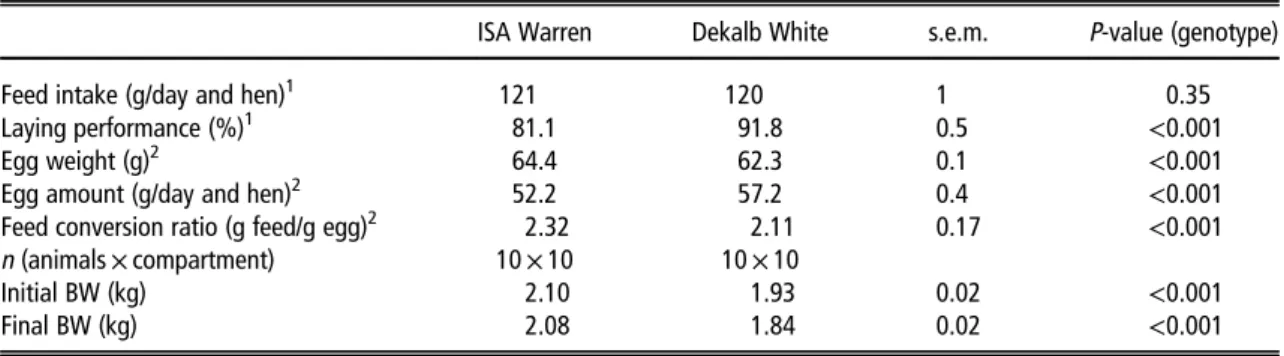
During the 60-day experimental period, the hens of both genotypes had the same feed intake (Table 2;P= 0.35). All
hens were of the same age at the beginning of the experi-ment (57 weeks) and had been in production for 34 weeks. The ISA Warren hens were inferior in laying performance, producing 11% less eggs compared with the Dekalb White layers (P< 0.001). Although the eggs of the ISA Warren hens
were heavier (P< 0.001), the average egg amount produced
per hen per day was still lower for this genotype (P< 0.001).
Thus, also the feed conversion ratio was less favorable (P< 0.001). The ISA Warren hens were heavier than the
Dekalb White layers by on average 8.8% (initial, 57 weeks old) and 13.0% (final, 65 weeks old), respectively (P< 0.001). The increase in this difference resulted from a larger BW decline occurring in the Dekalb White compared with the ISA Warren hens during the experiment.
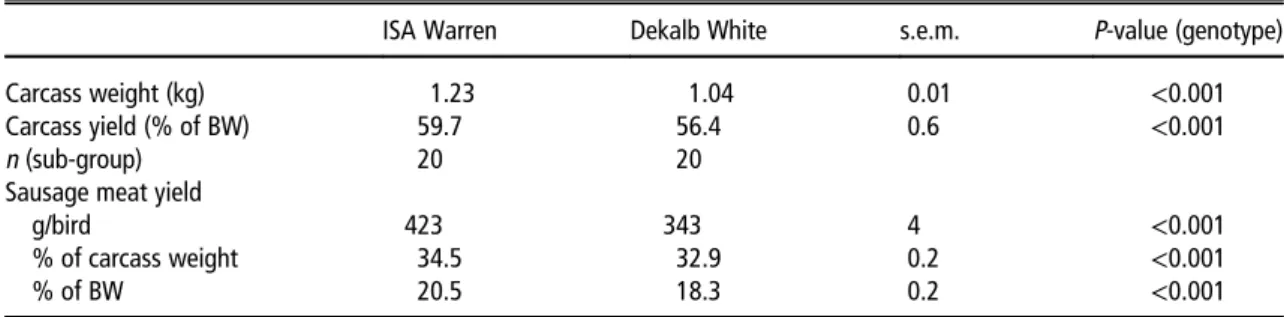
At slaughter, the hens were 65 weeks of age and the carcasses from the ISA Warren hens were heavier than those from the Dekalb White hens (Table 3;P< 0.001). The
geno-type differences were even more pronounced than in BW because the carcass yield was also higher (P< 0.001) in the
ISA Warren hens by 5.9% on average (3.3 percentage units, i.e. the difference between the means). The sausage meat
Table 2 Influence of genotype on laying performance and BW during the last 60 days before slaughter (numbers of observations: 10 compartments per genotype)
ISA Warren Dekalb White s.e.m. P-value (genotype)
Feed intake (g/day and hen)1 121 120 1 0.35
Laying performance (%)1 81.1 91.8 0.5 <0.001
Egg weight (g)2 64.4 62.3 0.1 <0.001
Egg amount (g/day and hen)2 52.2 57.2 0.4 <0.001
Feed conversion ratio (g feed/g egg)2 2.32 2.11 0.17 <0.001
n (animals× compartment) 10× 10 10× 10
Initial BW (kg) 2.10 1.93 0.02 <0.001
Final BW (kg) 2.08 1.84 0.02 <0.001
ISA= Institut de Sélection Animale.
1Average of 60 determinations. 2
yield of the ISA Warren layers was higher than that of the Dekalb White hens by 23% (P< 0.001), and made up 4.9% and 12.0% more when related to carcass weight and BW, respectively (bothP< 0.001).
Sausage quality
The sausages contained less fat when produced from the ISA Warren layers than that from the Dekalb White layers (Table 4;P= 0.014). The lard added contained 773 g fat/kg;
thus, the proportion of the fat present in the sausages, which exclusively originated from the laying hen meat, amounted to 5.1% and 6.8% in ISA Warren and Dekalb White layers, respectively. The cooking loss was the same with meat from both genotypes (P= 0.35). The collagen was lower in
pro-portion (P= 0.009), yet far less soluble (P= 0.015), in the
sausages produced from the ISA Warren hens compared with the Dekalb White layers. Overall, this meant a similar pro-portion of insoluble collagen (P= 0.64). The energy required
to shear the sausage slices was higher by 10% for the ISA Warren hens compared with the Dekalb White hens (P< 0.001). There was no significant correlation between
shear energy and total collagen (r= 0.11).
The non-spiced sausage material containing the meat from the ISA Warren hens was more susceptible to oxidation during frozen storage compared with that of the Dekalb White hens (Table 5;P< 0.001). This difference was masked
by seasoning the material when producing the spiced sausages (P= 0.32). There was a pronounced difference
between non-spiced sausage material and spiced sausages
regarding TBARS (at any time point) with lower values found throughout for the spiced sausages (P< 0.001). Genotype TCC differed only across the time points (P= 0.014) yet there
was no difference when the measurements were conducted at the same time points. The non-spiced sausage material had a lower level after 1 and 4 months of storage than the spiced sausages (P< 0.01), a difference that disappeared thereafter.
At no time point, and in no sausage material type and gen-otype,Salmonellaspp. was detected.
Discussion
Effect of layer genotype on production performance
Overall production performance, when considered for the entire life cycle of the animals, includes laying performance and meat yield when the hens are slaughtered. The perfor-mance realized corresponded well with the values made in the ISA Warren layer management guide (ISA B.V., 2012) of a laying performance of 82.7% to 78.3% in weeks 57 to 65, but the hens ate 6 g/day less and were 20 g heavier than predicted. The experimental Dekalb White layers on the other hand had a better laying performance (91.8%) compared with the predicted values (Dekalb White product perfor-mance guide; ISA B.V., 2012) of 89% to 85% in weeks 57 to 65. Consistent with this, the feed intake was also higher by 8 g/Dekalb White hen and day in the current experiment. With the same feed intake, the average ISA Warren hen produced 11% less eggs and, despite the heavier eggs, on average 5 g/day less egg amount compared with the average
Table 4 Influence of genotype on physico-chemical properties of the spiced sausages (numbers of observations: 20 random sub-groups per genotype)
ISA Warren Dekalb White s.e.m. P-value (genotype)
Fat proportion1(%) 12.8 14.5 0.5 0.014 Cooking loss (%) 23.4 22.4 0.7 0.35 Collagen proportion (%) Total 1.69 1.85 0.04 0.009 Insoluble 1.55 1.53 0.04 0.64 Collagen solubility (%) 7.56 16.50 2.46 0.015
Kramer shear energy (N× m) 1.16 1.05 0.02 0.001
ISA= Institut de Sélection Animale.
1
Determined in the non-spiced sausage material.
Table 3Influence of genotype on slaughter performance (numbers of observations: 5 animals × 20 sub-groups per genotype)
ISA Warren Dekalb White s.e.m. P-value (genotype)
Carcass weight (kg) 1.23 1.04 0.01 <0.001
Carcass yield (% of BW) 59.7 56.4 0.6 <0.001
n (sub-group) 20 20
Sausage meat yield
g/bird 423 343 4 <0.001
% of carcass weight 34.5 32.9 0.2 <0.001
% of BW 20.5 18.3 0.2 <0.001
Dekalb White hen. Accordingly, the feed conversion ratio was less favorable in the ISA Warren hens as well.
These obvious disadvantages of the ISA Warren genotype concerning laying performance were at least partially counterbalanced when considering the meat yield. Rizziet al.
(2007) also found a superior meat yield for Hy-Line Brown hybrids compared with Hy-Line White 36. In the present study, the advantage of the ISA Warren had two compo-nents, a higher BW and a higher carcass yield. The ISA Warren hens used in the present study even had a 2% points higher carcass yield than the Hy-Line Brown hens investi-gated by Rizziet al.(2007). In addition, the sausage meat yield in relation to carcass weight was generally higher in the present study. This could be explained by differences in dressing procedure. There was a difference between the two genotypes in the present study, which was not found by Rizzi
et al.(2007) between the two Hy-Line hybrids. In contrast, de Souzaet al.(2011) reported a generally higher carcass yield than that found in the present study both for Hy-Line White 36 (62%) and Hy-Line Brown (63%) layers. The practical implications of these genotype differences are evident: with the same processing steps and work load, 80 g (23%) more
sausage meat can be obtained from each carcass of ISA Warren hens compared with the Dekalb White hens, making the use of heavier brown spent hens more interesting for food production.
For the overall comparison, another aspect has yet to be considered. Compared with the Dekalb White, the ISA Warren layers needed extra feed resources, the use of which competes with human nutrition, to produce the same overall egg amount: assuming that the difference in feed conversion efficiency between the two genotypes found in the last 60 days of their life would be applicable throughout the entire 1-year production cycle, the 80 g extra sausage meat yielded by the ISA Warren hens correspond to an extra feed expenditure of 4.3 kg/hen to produce an overall egg amount of 19.2 kg (Dekalb White, during 48 weeks). However, when assuming that the carcasses of the lighter genotype would not be considered for sausage production at all, the differ-ence in sausage meat amount obtained would be as high as 423 g, which is equivalent to 10% of the extra amount of feed required during laying. In spite of their less favorable production performance, brown layers are used worldwide; this is because consumers specifically request brown-shelled
Table 5Influence of genotype on shelf-life related sausage (and abdominal fat) properties as depending on storage time (numbers of observations: 20 random sub-groups per genotype)1
Genotype P-values
ISA Warren Dekalb White s.e.m. Genotype Genotype× time
Rancimat induction time (h)2 4.87 5.29 0.29 0.31
TBARS3(mg malondialdehyde/kg)
Non-spiced sausage material (average) 0.353 0.305 0.020 0.001 0.32
1 monthd 0.243 0.158
4 monthsc 0.304 0.245
7 monthsb 0.403 0.363
10 monthsa 0.463 0.452
Spiced sausage (average) 0.218 0.208 0.014 0.32 0.42
1 monthd 0.062*** 0.061***
4 monthsc 0.191*** 0.165***
7 monthsb 0.280*** 0.254***
10 monthsa 0.341*** 0.354**
Total colony counts (log CFU4/g)
Non-spiced sausage material (average) 5.02 5.07 0.04 0.014 0.75
1 montha 5.05 5.14
4 monthsb 4.96 5.00
7 monthsb 4.94 4.99
10 monthsa 5.11 5.15
Spiced sausage (average) 5.20 5.20 0.08 0.85 0.49
1 montha 5.67*** 5.55**
4 monthsb 5.11** 5.19***
7 monthsc 4.89ns 4.92ns
10 monthsb 5.09ns 5.14ns
ISA= Institut de Sélection Animale; TBARS = thiobarbituric acid reactive substances; CFU = colony forming units.
a–dDifferences among storage time means across both genotypes (means not shown). Dates carrying no common superscript are differing atP< 0.05. 1
Samples were stored at−20°C for the times indicated.
2Determined in abdominal fat. 3
Overall effect of storage time wasP< 0.001.
4Overall effect of storage time wasP<0.001.
eggs, because these are perceived of having a particular health and natural image (Scott and Silversides, 2000). Consistently, the demand for brown-shelled eggs is growing even in traditional white-shelled egg markets (Johnston
et al., 2011). Although the main purpose of keeping laying hens is egg production, meat as a by-product of the egg industry has attracted interest as well. These considerations not only involve spent hen meat but also meat from male layer cockerels that represent another non-utilized source. Currently, the latter are sacrificed on the 1st day of life, that is, directly after hatching, because they are not suitable for fattening. This practice is considered by the public as to be not consistent with ethic principles (Verbeke and Viaene, 2000). Attempts to ban this practice are discussed in several countries and will be realized soon in one German federal state (Anonymous, 2013). Approaches to meet these concerns include the development of dual-purpose breeds (Almasiet al., 2011) and fattening of male layer cockerels (Gerkenet al., 2003; Koeniget al., 2012). Koeniget al.(2012) stated that the heavier Lohmann Brown layer cockerels are better suited for fattening than the light Lohmann Selected Leghorn cockerels. Therefore, in spite of the less favorable feed conversion ratio, the ISA Warren genotype has advantages from several other perspectives.
Influence of layer genotype on physicochemical quality of the sausages
Although manufactured according to the same recipe, the sausages produced from meat of the ISA Warren hens contained less fat than those of the Dekalb White hens. This difference does not seem to be limited to the two genotypes investigated. In addition, de Souza et al. (2011) reported a higher fat proportion of the meat from light white hens (Hy-Line W36) compared with those produced from semi-heavy brown hens (Hy-Line Brown). Szentirmaiet al.(2013) stated the same when comparing TETRA SL brown, which were heavier than TETRA BLANCA white layers. Cooking loss from the sausages in the present study was quite high, but still not much higher than the 19% reported by Pawaret al.(2011) for patties manufactured from spent hen meat. In contrast, Biswaset al.
(2006) only noted 10% cooking loss in patties from spent hens. However, different from the present study, these patties were not frozen before cooking, which is a major cause of increased cooking loss (Lee et al., 2008). In addition, fat influences cooking loss, being greater with lower fat proportion (Carballo
et al., 1995). This would be consistent with the presentfindings where the sausages produced from the ISA Warren meat had a lower fat proportion. However, the cooking loss was only numerically, yet not significantly, higher.
The findings on the proportion of collagen, the most important element of the connective tissue, and its solubility in the sausages obtained from the two genotypes were partially counterbalancing, thus resulting in almost the same proportion of insoluble collagen in the sausages. Nevertheless, sausages produced from the ISA Warren hens needed more energy to be sheared than those of the Dekalb White hens and there was no correlation between either
collagen proportion on the one hand and shear energy on the other hand. This indicates that the texture of the sausages, when compared across different genotypes, was not only determined by collagen proportion and solubility. Naveena and Mendiratta (2001) treated spent hen meat containing between 0.8% and 1.2% collagen with ginger extract. This numerically increased an already rather high collagen solu-bility of 35% to 69% and resulted in a significant reduction in shear force. Chueachuaychoo et al. (2011) reported a col-lagen solubility of 19% in spent hen breast muscle, which is in the range obtained in the present study for the Dekalb White group. The large differences reported in the literature for the solubility of chicken collagen may be due to differ-ences in animal age but also in the methods applied. Meat from younger poultry has a higher collagen solubility com-pared with that of old animals, which is a consequence of forming crosslinks between collagen fibers (Kondaiah and Panda, 1992). This, apart from the different mincing and processing techniques, may also explain why only 0.55 J were needed to shear broiler patties with a Kramer texture device (Chen and Marks, 1998) compared with>1 J required for the sausages tested in the present study.
Toughness is a major problem in palatability of spent hen meat eaten unprocessed. As the sheer meat is minced and combined with further ingredients during sausage production, this is likely a smaller problem there. Processed meat products from chicken are even sometimes more preferred when having afirm texture (Kondaiah and Panda, 1992). Concerning geno-types, de Souza et al.(2011) reported better texture scores for chicken mortadella manufactured from Hy-Line Brown (semi-heavy) than from light Hy-Line White layers. Assuming that shear energy of the meat from Hy-Line hens differed alike as that between the two genotypes of the present study, this would support the above mentioned assumption. However, Rizziet al.(2007) did notfind a difference in Warner–Bratzler shear force between breast meat of Hy-Line Brown and White genotypes. In the present study, the Kramer shear device was chosen over the Warner–Bratzler shear device due to the lower sampling error by taking a larger sample size (Szczesniak, 1963). Furthermore, the two devices have been proven equally effective in identifying differences in toughness in spent hen breast meat (Dawsonet al., 1991).
Influence of layer genotype on shelf-life-related properties of the sausages
Shelf life was investigated by three traits, Rancimat induction time in the unprocessed abdominal fat (an analysis that needs a large amount of fat), TBARS and the microbiological status of the sausages (non-spiced sausage material and spiced sausages). It seems that the meat from the ISA Warren hens was inferior in oxidative stability compared with that of the Dekalb White hens. Concerning the abdominal fat, there was a weak trend into the same direction. This suggests that the two genotypes may differ in body tissue accumulation of either unsaturated fatty acids or antioxidants or both. This needs further investigation. However, adding spices to the non-spiced sausage material had a much higher
(antioxidant) effect. This is due to the antioxidant potential of the herbs present in this mixture, as is known fromin vitro
tests (Economouet al., 1991; Shanet al., 2005). Thus, sea-soning masked any genotype differences in the spiced sau-sages. This means that the minor genotype differences found in the non-spiced sausage material were of little importance for practical application because they occurred at a very low TBARS level that is likely far below the detection limit for off-flavors in food. For instance, Tarladgiset al.(1960) estimated the sensory detection threshold in pork to be 0.5 to 1.0 mg MDA/kg meat.
Laying hens are not available in equal amounts year-round. In Western countries, there is commonly a peak around Christmas and Easter. Therefore, frozen storage of the foods obtained seems a feasible option to cope with the irregular supply of spent hen meat. Especially in small-scale, sometimes even on-farm, retail this form of storage facilitates year-round marketing of spent hens and products thereof at times of demand is indicated. For that reason, it is important to know the effect of extended frozen storage on the oxidative and microbiological stability. The results indi-cate that the antioxidant properties of the spice mixture were maintained across the entire storage time of 10 months. The presentfindings disagree with Leeet al.(1997), who repor-ted 10 and 18 times higher TBARS levels in non-spiced and spiced chicken breakfast sausages, respectively, than those found in the present study. This suggests that diets and other factors were largely different between that and the present study. Surprisingly, there was also no difference between non-spiced and spiced sausages in the study by Lee et al.
(1997), even though the spice mixture applied for seasoning contained sage and pepper, both plants with known anti-oxidant properties. The microbial contamination found by Leeet al.(1997) in the breakfast sausages was almost the same (4.7 log CFU/g) than that determined in the present study (5.1 and 5.6 log CFU/g). Within the storage time of 10 months, there was a decrease in microbial contamination, a trend also observed by Leeet al.(1997).
Conclusions
Spent hens from the brown layer genotype ISA Warren were superior to those of the Dekalb White genotype in BW, carcass yield and meatiness of the carcass at slaughter. This confirmed thefirst hypothesis and quantitatively resulted in a 23% higher sausage meat yield per hen. At the same time, the ISA Warren layers were clearly inferior in egg production compared with the Dekalb White layer and, despite larger eggs, also in feed conversion efficiency. However, in situations where not all spent hens are valorized via the food chain, the opportunity is given to primarily process the meat of the heavier brown layers, which are kept besides light white layers in many regions of the world. In terms of meat quality, the higher shear energy necessary to cut through the sausages and the slightly less favorable TBARS values are no real drawbacks because their impact is likely too low to negatively influence product quality. This confirms the second hypothesis, as is
also true for the third hypothesis as differences between the genotypes regarding oxidative stability were minor. The presentfindings may also assist in selecting genotypes for situations where killing of 1-day-old layer cockerels is banned because similar genotype differences can be expected in the males.
Acknowledgments
The authors thank P. Stirnemann and C. Kunz from ETH Zurich for their assistance in the laboratory. Further we appreciate the work from the staff of the Foundation Aviforum in the animal house. The authors thank R. Bickel, C. Kopp and his team for their expertise and support during the slaughter process and sausage production.
References
Almasi A, Suto Z, Fulop T, Kustosne PO, Milisits G and Horn P 2011. Improving thefinal liveweight and growing ability of TETRA-H a dual purpose chicken type by using a new experimental sire line. Agriculturae Conspectus Scientificus 76, 245–248.
Althaus D, Hofer E, Corti S, Julmi A and Stephan R 2012. Bacteriological survey of ready-to-eat lettuce, fresh-cut fruits and sprouts collected from the Swiss market. Journal of Food Protection 75, 1338–1341.
Anonymous 2013. Pressemitteilung: NRW setzt Zeichen für den Tierschutz: Ministerium untersagt massenhaftes Töten männlicher Eintagsküken von Legehennenrassen. Retrieved December 18, 2013, from http://archive.is/Rxx3D AOAC 1997. Official Methods of Analysis. Association of Official Analytical Chemists, Arlington, VA, USA.
Biswas S, Chakraborty A and Sarkar S 2006. Comparison among the qualities of patties prepared from chicken broiler, spent hen and duck meats. The Journal of Poultry Science 43, 180–186.
Bundesamt für Gesundheit (BAG) and Lebensmittelbuchkommission 1999. Schweizerisches Lebensmittelbuch, Bundesamt für Gesundheit, Abteilung Lebensmittelsicherheit, Berne, Switzerland. Retrieved November 19, 2013, from http://www.slmb.bag.admin.ch/slmb/index.html
Carballo J, Barreto G and Colmenero FJ 1995. Starch and egg white influence on properties of bologna sausage as related to fat content. Journal of Food Science 60, 673–677.
Chen H and Marks B 1998. Visible/near-infrared spectroscopy for physical characteristics of cooked chicken patties. Journal of Food Science 63, 279–282. Chueachuaychoo A, Wattanachant S and Benjakul S 2011. Quality characteristics of raw and cooked spent hen Pectoralis major muscles during chilled storage: effect of salt and phosphate. International Food Research Journal 18, 601–613.
Dawson P, Sheldon B and Miles J 1991. Effect of aseptic processing on the texture of chicken meat. Poultry Science 70, 2359–2367.
de Souza KMR, Araujo RB, dos Santos AL, Rodrigues CEC, de Faria DE and Trindade MA 2011. Adding value to the meat of spent laying hens manu-facturing sausages with a healthy appeal. Revista Brasileira de Ciência Avícola 13, 57–63.
Economou K, Oreopoulou V and Thomopoulos C 1991. Antioxidant activity of some plant extracts of the familyLabiatae. Journal of the American Oil Chemists Society 68, 109–113.
Gerken M, Jaenecke D and Kreuzer M 2003. Growth, behaviour and carcass characteristics of egg-type cockerels compared to male broilers. World’s Poultry Science Journal 59, 46–49.
Institut de Sélection Animale (ISA) B.V. 2011. Product performance Dekalb White commercial layer. Retrieved December 18, 2013, from http://www. isapoultry.com/products/dekalb/dekalb-white/
Institut de Sélection Animale (ISA) B.V. 2012. ISA Warren management guide. Retrieved December 18, 2013, from http://www.joiceandhill.co.uk/en/products/ isa-warren/
Johnston NP, Jeffries lK, Rodriguez B and Johnston EE 2011. Acceptance of brown-shelled eggs in a white-shelled egg marked. Poultry Science 90, 1074–1079.
Koenig M, Hahn G, Damme K and Schmutz M 2012. Utilization of laying-type cockerels as‘coquelets’: influence of genotype and diet characteristics on growth performance and carcass composition. Archiv für Geflügelkunde 76, 197–202. Kondaiah N and Panda B 1992. Processing and utilization of spent hens. World’s Poultry Science Journal 48, 255–268.
Lee T, Williams S, Sloan D and Littell R 1997. Development and evaluation of a chicken breakfast sausage manufactured with mechanically deboned chicken meat. Poultry Science 76, 415–421.
Lee Y, Saha A, Xiong R, Owens C and Meullenet J 2008. Changes in broiler breastfillet tenderness, water-holding capacity, and color attributes during long-term frozen storage. Journal of Food Science 73, 162–168.
Lentfer TL, Gebhardt-Henrich SG, Fröhlich EKF and von Borell E 2013. Nest use is influenced by the positions of nests and drinkers in aviaries. Poultry Science 92, 1433–1442.
Liu A, Nishimura T and Takahashi K 1996. Relationship between structural properties of intramuscular connective tissue and toughness of various chicken skeletal muscles. Meat Science 43, 43–49.
Loetscher Y, Kreuzer M and Messikommer RE 2013. Oxidative stability of the meat of broilers supplemented with rosemary leaves, rosehip fruits, chokeberry pomace and entire nettle, and effects on performance and meat quality. Poultry Science 92, 2938–2948.
Loetscher Y, Kreuzer M, Albiker D, Stephan R and Messikommer RE 2014. Effect of replacing dietary vitamin E by sage on performance and meatiness of spent hens, and the oxidative stability of sausages produced from their meat. British Poultry Science, doi:10.1080/00071668.2014.946885.
Mertens DR, Allen M, Carmany J, Clegg J, Davidowicz A, Drouches M, Frank K, Gambin D, Garkie M, Gildemeister B, Jeffress D, Jeon CS, Jones D, Kaplan D, Kim GN, Kobata S, Main D, Moua X, Paul B, Robertson J, Taysom D, Thiex N, Williams J and Wolf M 2002. Gravimetric determination of amylase-treated neutral detergent fiber in feeds with refluxing in beakers or crucibles: collaborative study. Journal of AOAC International 85, 1217–1240.
Naveena B and Mendiratta S 2001. Tenderisation of spent hen meat using ginger extract. British Poultry Science 42, 344–349.
Pawar V, Karthikeyan B, Zanjad P, Machewad G and Chappalwar A 2011. Process optimization for chicken patties manufactured with a combination of spent hen and rabbit meat. Journal of Food Quality 34, 236–244.
Rizzi C, Marangon A and Chiericato G 2007. Effect of genotype on slaughtering performance and meat physical and sensory characteristics of organic laying hens. Poultry Science 86, 128–135.
SAS 2011. Version 9.3 for Windows. SAS Institute Inc., Cary, NC, USA. Scott TA and Silversides FG 2000. The effect of storage and strain of hen on egg quality. Poultry Science 79, 1725–1729.
Shan B, Cai YZ, Sun M and Corke H 2005. Antioxidant capacity of 26 spice extracts and characterization of their phenolic constituents. Journal of Agri-cultural and Food Chemistry 53, 7749–7759.
Szczesniak AS 1963. Objective measurements of food texture. Journal of Food Science 28, 410–420.
Szentirmai E, Milisits G, Donkó T, Budai Z, Ujvári J, Fülöp T, Repa I and Sütő Z 2013. Comparison of changes in production and egg composition in relation to in vivo estimates of body weight and composition of brown and white egg layers during thefirst egg-laying period. British Poultry Science 54, 587–593.
Tarladgis BG, Watts BM, Younathan MT and Dugan L Jr 1960. A distillation method for the quantitative determination of malonaldehyde in rancid foods. Journal of the American Oil Chemists Society 37, 44–48.
Trindade MA, Contreras CC and Felício PE 2005. Mortadella sausage formula-tions with partial and total replacement of beef and pork backfat with mechanically separated meat from spent layer hens. Journal of Food Science 70, 236–241.
Verbeke W and Viaene J 2000. Ethical challenges for livestock production: meeting consumer concerns about meat safety and animal welfare. Journal of Agricultural and Environmental Ethics 12, 141–151.