J Antimicrob Chemother 2010; 65: 1826 – 1837
doi:10.1093/jac/dkq203
Advance publication 9 June 2010
Molecular analysis of
methicillin-resistant Staphylococcus
pseudintermedius of feline origin
from different European countries
and North America
Kristina Kadlec
1, Stefan Schwarz
1*, Vincent Perreten
2,
Ulrika Gro¨nlund Andersson
3, Maria Finn
3,
Christina Greko
3, Arshnee Moodley
4, Stephen A. Kania
5,
Linda A. Frank
5, David A. Bemis
5, Alessia Franco
6,
Manuela Iurescia
6, Antonio Battisti
6, Birgitta Duim
7,
Jaap A. Wagenaar
7, Engeline van Duijkeren
7,
J. Scott Weese
8, J. Ross Fitzgerald
9, Alexandra Rossano
2and Luca Guardabassi
41Institute of Farm Animal Genetics, Friedrich-Loeffler-Institut,
Neustadt-Mariensee, Germany;2Institute of Veterinary Bacteriology, University of Berne, Berne, Switzerland;3National
Veterinary Institute, SVA, Uppsala, Sweden;4Department of Veterinary Disease Biology, Faculty of Life Sciences, University of Copenhagen, Frederiksberg, Denmark;5University of Tennessee, Knoxville, USA;6Istituto Zooprofilattico Sperimentale delle Regioni
Lazio e Toscana, Rome, Italy;7Department of Infectious Diseases and Immunology, Faculty of Veterinary Medicine, Utrecht University, Utrecht, The Netherlands;8University of Guelph, Guelph, Canada;9The Roslin Institute and Centre for Infectious
Diseases, Royal (Dick) School of Veterinary Studies, University of Edinburgh, Edinburgh, UK
*Corresponding author. Institute of Farm Animal Genetics, Friedrich-Loeffler-Institut (FLI), Ho¨ltystr. 10, 31535 Neustadt-Mariensee, Germany. Tel:+49-5034-871-241; Fax: +49-5034-871-246;
E-mail: [email protected]
Keywords:MLST, PFGE, spa typing, genotyping, antimicrobial resistance, cats, zoonosis
Sir,
Staphylococcus pseudintermedius is the most frequent causative agent of canine pyoderma and may also be associated with wound infections, urinary tract infections and otitis externa in dogs.1Although more rarely, S. pseudintermedius causes
infec-tions in cats and has also been identified in infecinfec-tions of humans.1–3The latter observation highlights the zoonotic
poten-tial of S. pseudintermedius. S. pseudintermedius appears to be able to readily accumulate antimicrobial resistance genes1,4 and, in recent years, a rapid increase in methicillin resistance has been observed.5,6A recent multicentre study on
methicillin-resistant S. pseudintermedius (MRSP) of canine origin, obtained in different European countries as well as in the USA and Canada, revealed that most of the canine strains exhibited resistance to virtually all classes of antimicrobial agents approved for veteri-nary use.4 This represents a major therapeutic challenge for veterinarians in Europe and North America. Moreover, this multi-centre study revealed that among MRSP from dogs two distinct, dominant clones—as identified by multilocus sequence typing (MLST), spa typing, SCCmec typing and SmaI PFGE—have dissem-inated across Europe and North America.4 In contrast to the wealth of data available for MRSP isolates of canine origin, little data are available about MRSP from cats.
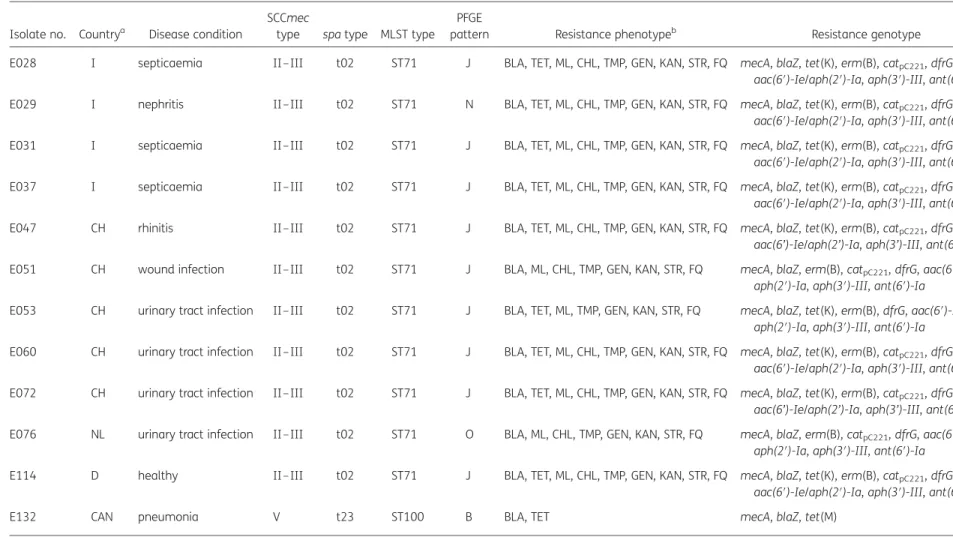
The aim of the present study was to characterize MRSP iso-lates from cats in different countries for their genetic relation-ships and antimicrobial resistance phenotypes and genotypes. Twelve epidemiologically unrelated MRSP isolates of feline origin were identified during 2006–08 in five different countries (Table1). Eleven isolates were from clinical disease conditions, including septicaemia, urinary tract infections, nephritis, rhinitis, wound infection and pneumonia. The remaining isolate was obtained from a nasal swab of an apparently healthy cat (Table1). All isolates were confirmed to be S. pseudintermedius by MboI digestion of a PCR-amplified internal fragment of the pta gene.4For a better comparison with data of canine MRSP iso-lates, MLST,7spa typing,8SmaI PFGE and SCCmec typing was per-formed as recently described.4MICs of 17 antimicrobial agents
were determined using the VetMICTM microdilution panels
(National Veterinary Institute, Uppsala, Sweden) as previously described and evaluated using the breakpoints of the CLSI.4 MICs of rifampicin, mupirocin and quinupristin/dalfopristin were determined by Etestw
(AB Biodisk, Solna, Sweden). Antibiotic resistance genes were detected using either a microarray or specific PCR assays as described previously.4
All 12 feline S. pseudintermedius proved to be MRSP by oxacil-lin MICs of .16 mg/L and carriage of the mecA gene. Despite the diverse geographical origins, the 11 European MRSP isolates shared the same MLST type ST71, spa type t02 and SCCmec type II –III. SCCmec type II –III is a hybrid of SCCmec II (2A) from Staphylococcus epidermidis and SCCmec III from Staphylococcus aureus.9PFGE analysis identified three different patterns J, N and O among these European feline MRSP isolates. The single MRSP isolate from Canada harboured an SCCmec type V element and exhibited spa type t23, MLST type ST100 and PFGE pattern B. A comparison with the data of the multicentre study on MRSP in dogs4revealed that PFGE patterns B, N and O were exclusive to feline MRSP isolates whereas pattern J was the dominant PFGE pattern among European canine MRSP.4 The
Canadian feline MRSP isolate also differed largely in its resistance phenotype and genotype from the European feline MRSP isolates. It was only resistant to b-lactam antibiotics via mecA and blaZ, and to tetracyclines via tet(M). In contrast, the European isolates
#The Author 2010. Published by Oxford University Press on behalf of the British Society for Antimicrobial Chemotherapy. All rights reserved. For Permissions, please e-mail: [email protected]
Table 1. Characteristics of the 12 MRSP isolates from cats investigated in this study
Isolate no. Countrya Disease condition
SCCmec
type spa type MLST type PFGE
pattern Resistance phenotypeb Resistance genotype
E028 I septicaemia II –III t02 ST71 J BLA, TET, ML, CHL, TMP, GEN, KAN, STR, FQ mecA, blaZ, tet(K), erm(B), catpC221, dfrG, aac(6′)-Ie/aph(2′)-Ia, aph(3′)-III, ant(6′)-Ia E029 I nephritis II –III t02 ST71 N BLA, TET, ML, CHL, TMP, GEN, KAN, STR, FQ mecA, blaZ, tet(K), erm(B), catpC221, dfrG,
aac(6′)-Ie/aph(2′)-Ia, aph(3′)-III, ant(6′)-Ia E031 I septicaemia II –III t02 ST71 J BLA, TET, ML, CHL, TMP, GEN, KAN, STR, FQ mecA, blaZ, tet(K), erm(B), catpC221, dfrG,
aac(6′)-Ie/aph(2′)-Ia, aph(3′)-III, ant(6′)-Ia E037 I septicaemia II –III t02 ST71 J BLA, TET, ML, CHL, TMP, GEN, KAN, STR, FQ mecA, blaZ, tet(K), erm(B), catpC221, dfrG,
aac(6′)-Ie/aph(2′)-Ia, aph(3′)-III, ant(6′)-Ia E047 CH rhinitis II –III t02 ST71 J BLA, TET, ML, CHL, TMP, GEN, KAN, STR, FQ mecA, blaZ, tet(K), erm(B), catpC221, dfrG,
aac(6’)-Ie/aph(2’)-Ia, aph(3’)-III, ant(6’)-Ia E051 CH wound infection II –III t02 ST71 J BLA, ML, CHL, TMP, GEN, KAN, STR, FQ mecA, blaZ, erm(B), catpC221, dfrG, aac(6′)-Ie/
aph(2′)-Ia, aph(3′)-III, ant(6′)-Ia E053 CH urinary tract infection II –III t02 ST71 J BLA, TET, ML, TMP, GEN, KAN, STR, FQ mecA, blaZ, tet(K), erm(B), dfrG, aac(6′)-Ie/
aph(2′)-Ia, aph(3′)-III, ant(6′)-Ia E060 CH urinary tract infection II –III t02 ST71 J BLA, TET, ML, CHL, TMP, GEN, KAN, STR, FQ mecA, blaZ, tet(K), erm(B), catpC221, dfrG,
aac(6′)-Ie/aph(2′)-Ia, aph(3′)-III, ant(6′)-Ia E072 CH urinary tract infection II –III t02 ST71 J BLA, TET, ML, CHL, TMP, GEN, KAN, STR, FQ mecA, blaZ, tet(K), erm(B), catpC221, dfrG,
aac(6’)-Ie/aph(2’)-Ia, aph(3’)-III, ant(6’)-Ia E076 NL urinary tract infection II –III t02 ST71 O BLA, ML, CHL, TMP, GEN, KAN, STR, FQ mecA, blaZ, erm(B), catpC221, dfrG, aac(6′)-Ie/
aph(2′)-Ia, aph(3′)-III, ant(6′)-Ia E114 D healthy II –III t02 ST71 J BLA, TET, ML, CHL, TMP, GEN, KAN, STR, FQ mecA, blaZ, tet(K), erm(B), catpC221, dfrG,
aac(6′)-Ie/aph(2′)-Ia, aph(3′)-III, ant(6′)-Ia
E132 CAN pneumonia V t23 ST100 B BLA, TET mecA, blaZ, tet(M)
aI, Italy; CH, Switzerland; NL, the Netherlands; D, Germany; CAN, Canada.
bBLA, b-lactam antibiotics; CHL, chloramphenicol; FQ, fluoroquinolones; GEN, gentamicin; KAN, kanamycin; ML, macrolides/lincosamides; STR, streptomycin; TET, tetracyclines; TMP, trimethoprim.
R
esear
ch
letter
s
1827JA
C
exhibited three different expanded resistance phenotypes and genotypes (Table1). All isolates were resistant to b-lactam anti-biotics (mecA, blaZ), macrolides/lincosamides [erm(B)], gentami-cin/kanamycin [aac(6′)-Ie/aph(2′)-Ia], kanamycin [aph(3′)-III], streptomycin [ant(6′)-Ia], trimethoprim [dfrG] and ciprofloxacin. Moreover, all but one isolate from Switzerland and all but two isolates from Switzerland and the Netherlands were resistant to chloramphenicol (catpC221) and to tetracyclines [tet(K)],
respectively. However, all feline MRSP isolates were susceptible to mupirocin, rifampicin, quinupristin/dalfopristin, linezolid and vancomycin, which are important for decolonization of humans or represent ‘antimicrobial agents of last resort’ for the treat-ment of methicillin-resistant S. aureus (MRSA) infections in humans.
A comparison with the results of the genetic analysis of canine MRSP showed that the Canadian feline MRSP differed in all characteristics, except SCCmec type V, from the dominant canine MRSP clone in North America, which is characterized by ST68 (MLST) –C (PFGE)–t06 (spa)– V (SCCmec).4In contrast, 9 of
the 11 European feline MRSP isolates were identified as members of the previously described dominant clonal lineage among canine MRSP in Europe, which is characterized by ST71 (MLST) –J (PFGE)–t02 (spa)– II–III (SCCmec).4 This observation
strongly suggested an exchange of MRSP isolates between dogs and cats in Europe. Whether the feline MRSP isolate from Canada represents a member of a new MRSP clone with a par-ticular tropism for cats remains to be determined.
Acknowledgements
We are grateful to the institutions and diagnostic laboratories that provided MRSP isolates. We thank Fabiola Feltrin, Serena Lorenzetti, Angela Ianzano, Cinzia Onorati, Mike Schiwek and Kerstin Meyer for expert technical assistance.
Funding
This study is the result of a self-funded project conducted by all the participating institutions.
Transparency declarations
None to declare.References
1 Weese JS, van Duijkeren E. Methicillin-resistant Staphylococcus aureus and Staphylococcus pseudintermedius in veterinary medicine. Vet Microbiol 2010; 140: 418–29.
2 Van Hoovels L, Vankeerberghen A, Boel A et al. First case of Staphylococcus pseudintermedius infection in a human. J Clin Microbiol 2006; 44: 4609– 12.
3 Campanile F, Bongiorno D, Borbone S et al. Characterization of a variant of the SCCmec element in a bloodstream isolate of Staphylococcus intermedius. Microb Drug Resist 2007; 13: 7 –10.
4 Perreten V, Kadlec K, Schwarz S et al. Clonal spread of methicillin-resistant Staphylococcus pseudintermedius in Europe and North America: an international multicentre study. J Antimicrob Chemother 2010; 65: 1145– 54.
5 Loeffler A, Linek M, Moodley A et al. First report of multiresistant, mecA-positive Staphylococcus intermedius in Europe: 12 cases from a veterinary dermatology referral clinic in Germany. Vet Dermatol 2007; 18: 412–21.
6 Bemis DA, Jones RD, Frank LA et al. Evaluation of susceptibility test breakpoints used to predict mecA-mediated resistance in Staphylococcus pseudintermedius isolated from dogs. J Vet Diagn Invest 2009; 21: 53– 8.
7 Bannoehr J, Ben Zakour NL, Waller AS et al. Population genetic structure of the Staphylococcus intermedius group: insights into agr diversification and the emergence of methicillin-resistant strains. J Bacteriol 2007; 189: 8685– 92.
8 Moodley A, Stegger M, Ben Zakour NL et al. Tandem repeat sequence analysis of staphylococcal protein A (spa) gene in methicillin-resistant Staphylococcus pseudintermedius. Vet Microbiol 2009; 135: 320– 6. 9 Descloux S, Rossano A, Perreten V. Characterization of new staphylococcal cassette chromosome mec (SCCmec) and topoisomerase genes in fluoroquinolone- and methicillin-resistant Staphylococcus pseudintermedius. J Clin Microbiol 2008; 46: 1818–23.
J Antimicrob Chemother 2010
doi:10.1093/jac/dkq208
Advance publication 9 June 2010
Molecular characterization of plasmids
encoding CTX-M-15 extended-spectrum
b-lactamase associated with the ST131
Escherichia coli clone in Belgium
Isabel Montesinos
1, Hector Rodriguez-Villalobos
2*,
Ricardo De Mendonc¸a
1, Pierre Bogaerts
3,
Ariane Deplano
1and Youri Glupczynski
31Laboratoire de Bacte´riologie, Hoˆpital Universitaire Erasme,
Universite´ Libre de Bruxelles, B-1070 Bruxelles, Belgium;
2Laboratoire de Bacte´riologie, Cliniques universitaires Saint-Luc,
Universite´ catholique de Louvain, B-1200 Bruxelles, Belgium;
3Laboratoire de Bacte´riologie, Cliniques universitaires de
Mont-Godinne, Universite´ catholique de Louvain, B-5530 Yvoir, Belgium
*Corresponding author. Tel:+32-2-764-67-32; Fax: +32-2-764-94-40; E-mail: [email protected]
Keywords:ESBLs, B2 phylogroup, pEK499, pC15 Sir,
Previous studies performed in a large number of Belgian hospi-tals showed the dissemination of a major clone of the virulent B2 group O25b:H4-ST131 CTX-M-15-producing Escherichia coli.1 This E. coli ST131 clone has been reported worldwide and rep-resents a major public health problem.2 The present study
sought to characterize blaCTX-M-15-containing plasmids
associ-ated with ST131 E. coli CTX-M-15 isolates recovered in Belgian hospitals. This specific clone was detected from clinical speci-mens of patients hospitalized at the Erasme hospital in Brus-sels since 2001, as well as in 18 other Belgian hospitals