Clarity and Complexity:
Designing for an Educational Community
Christine Julia Nugent
Bachelor of Science in Art and Design Massachusetts Institute of Technology
1987
Submitted to the Department of Architecture in partial fulfillment of the requirements for the degree of
Master of Architecture at the
Massachusetts Institute of Technology February, 1992
@ Christine Julia Nugent, 1992. All Rights Reserved.
The author hereby grants to MIT permission to reproduce and to distribute copies of this thesis document in whole or in part.
Signature of Author /sfine C Julia Nugent
Depa ent of Architecture January 17, 1992
Certified by
Thomas Chastain Assistant Professor of Architecture Thesis Supervisor
Accepted by
Renee Chow
Assistantjrofessor of Architecture M 0SETS1Nsmum
Chairperson, Departmental Committee on Graduate Studies OF T egy
M
L
ib ries
Document Services
Room 14-0551 77 Massachusetts Avenue Cambridge, MA 02139 Ph: 617.253.2800 Email: [email protected] http://Iibraries.mit.edu/docsDISCLAIMER OF QUALITY
Due to the condition of the original material, there are unavoidable
flaws in this reproduction. We have made every effort possible to
provide you with the best copy available. If you are dissatisfied with
this product and find it unusable, please contact Document Services as
soon as possible.
Acknowledgements:
The following people have provided the knowledge and
support for this thesis without whom I never would have progressed to my current level: My thesis committee:
Advisor: Fernando Domeyko Readers: Akos Moravansky
and Bill Hubbard. Informative respondants: Rosemary Grimshaw
3
Dr. Philip Hsu Assistance: Sonia Ensenat for ElizabethEvolution and Metamorphosis of Pre-existent Structures:
Lasting Change, Lazarus'Memory
by Richard Keith Olson
SUBMITTED TO THE DEPARTMENT OF ARCHITECTURE
IN PARTIAL FULFILLMENT FOR THE DEGREE OF MASTER OF ARCHITECTURE
6 MAY 1994
ABSTRACT
As society perpetually evolves, retention of selected pre-existent building fragments
(structure and inhabitation, form and use) provides necessary continuity to affirm cultural
and individual identity. Within this framework of continuity, radical transformation may
occur, in line with the evolution of society. This project examines the necessity for such
metamorphoses, working within an existing hotel building in the Boston Back Bay to
5
design guest residences for visiting M.I.T. faculty.
Thesis Supervisor: Fernando Domeyko
Table of Contents
Introduction:
Abstract
5
Introduction
9
Method
19
Design Overview
23
Design:
Site
27
Program
53
Presentation
59
Case Studies:
Barcelona
107
Church Court
145
Institute of Contemporary Art
155
360 Newbury Street
165
Conclusion
177
Credits:
Illustration Credits
179
left: Long exposure of project site at night.
John 11:38 Jesus, once more deeply moved, came to the tomb (of Lazarus). It was a cave with a stone across the entrance. "Take the stone
away," he said.
John 11:43 When he had said this, Jesus called in a loud voice,
"Lazarus, come out!"
John 11:44 The dead man came out, his hands and feet wrapped with strips of linen, and a cloth wrapped around his face.
John 11:45 Jesus said to them, "take off the grave clothes and let him go."
Introduction
Metamorphosis is culture; culture is continuously
changing with society. The building environment
is similarly undergoing continuous
transformation, being closely associated with
culture. For effective transformation to occur, for
transformation to be in line with society, cities and
their constitutive buildings must maintain
continuity both spatially and temporally with
what has preceded. Successful development hinges
upon society's needs (for new housing, for
precisely as an outgrowth of previous
development. At the same time, incorporation of
present-day technology and social awareness
coupled with planning for the future provide
direction and meaning to the transformation.
As this process of development suggests, an
appropriate approach toward transformation of
cities would sometimes partially include
pre-existing conditions, fragments of artifacts in the
built environment. Unlike traditional narrow
concepts of incorporation (such as rehabilitation,
renovation, et. al.), which preclude abandonment,
the approach taken here will instead guide a
continuously transforming building
10
environment, in which change is adopted in line
with transforming social organizations.
What constitutes an effective strategy? There are
at least three distinct approaches to conversion of
pre-existent structures. Conventionally, such
approaches go by varying names; adaptive reuse,
rehabilitation, redevelopment, renovation,
To distinguish between fundamental differences,
descriptions accompany a general term used to
catalog each of three approaches, and then a
specific example is cited to provide an illustration.
Renovation establishes new inhabitation based on
a specific site and program, predicated on the
reallotment of space within an existing structure
such as the Children's Museum, Boston.
Preservation, in a similar fashion, calls for a return
to an antecedent form, as in the case of Ellis
Island, or use (Colonial Williamsburg) dictated by
the original buildings. Both of these design
approaches, however, act as interruptions in the
time-flow process of change, having been wielded
upon abandoned or forgotten environments.
11
Recent efforts in Boston suggest that preservation
is the primary goal in reusing buildings; however,
to adopt this method as a standard is far too
limiting, especially where tight economic
conditions prevail. The preservation agenda
(maintaining the status quo) therefore works
against progress.
Instead, the focus of this thesis will be
reinhabitation based on a third process: temporal
transformation. In essence, designs incorporating
temporal transformation undergo continuous
adaptation and metamorphosis, acknowledging
the temporal context and expanding upon it in
radical transformation. This document holds out
the value, even the necessity to incorporate rather
than destroy fragments so as to enrich experience
and enliven cultural memory.
All buildings (not just historic record buildings) in
fact have a certain "embodiment value", being
made up of precious materials and being artifacts
12
of irrepoducible or expensive craftsmanship.
"Embodiment value", usually thought of in
monetary terms, equates the environmental
impact of construction (a topic of increasing
concern) by weighing the value of existing
material against the replacement cost of new
construction.
indicates the necessity to see buildings and even
cities as equally long-term investments. Recent
projects such as Commercial Wharf in Boston
show progress in this direction by initiating leases
from the city to developers in order to encourage
reuse of buildings. Additionally, other cost
efficiency incentives such as special financing, tax
breaks, and reduced acquisition costs make
adaptive reuse especially desirable.
Even such economic transformation comes about
as a result of superimposing new and old. Present
economic reality points toward rapidly changing
needs and functions (with respect to building
program)]. However continued economic
uncertainty coupled with fast-paced technological
13
advances suggest high-intensity utilization of
existing resources rather than the specificity and
diffusion of resources inherent in completely new
development. So-called temporary building
schemes outlive their occupants in most cases.
This argument, however, for 'continued presence'
only represents the economic aspect of a need for
artifacts. In order for continuous transformation
to be fully understood, it is necessary to weigh not
only the tangible loss of irreplaceable resources
and artistry, but also the intangible loss of
collective memory embodied in artifacts.
While renovation and restoration may
unwittingly destroy the thread of memory,
temporal transformation relies on the life
embodied in an architectural artifact by virtue of
its uninterrupted presence as a useful, inhabited
structure. Implicitly this requires a retention of
some fragments of the original building structure
and inhabitation, although not the building itself.
The extent to which an artifact can be reduced and
the means of enabling its identification are the
subject of this study.
14
I use the story of Lazarus to illustrate this
intangible component of temporal transformation.
In his miraculous rebirth, Lazarus awakens to his
former self, and yet simultaneously prepares to
embark on a new life. Physically, he remains
unchanged, but in fact he has been radically
transformed spiritually. His abandoned tomb in
turn serves as a collective reminder, an element in
the shared memory of those who witness his
resurrection.
One could also consider the writing of this thesis.
Through continuous reworkings of the text and
illustrations, the current form is arrived upon, a
reflection of both the original intent and a clear
result of the process of research. At times the
complete framework is shuffled, even reinvented;
but in the end fragments of the initial proposal
still inhabit the text.
In the same way, buildings occupy our
consciousness, forming collective memories
-stories about the identities of places
-
regarding
physical and social spaces and events. Take the
15
example of Quincy Market in Boston. With the
original grit of its earlier days swept clean, Faneuil
Hall Marketplace still retains its identity as a
market, even though the specificities of the prior
use have been erased. The marks of age contrasted
with the transparency of new use all exist within
the abstract framework of the major structure and
the organization of the shops themselves.
The accumulated growth of existing buildings
serves to illumine the past while simultaneously
promoting a productive future. In Rome, for
instance, the presence of historic monuments does
not in any way inhibit the transformation of these
structures, often for functions completely
unrelated to the original buildings. This process of
regenerative adaptation (outlined by Aldo Rossi
and documented regularly in publications such as
Metamorfosi) actually assures the continued
presence of these artifacts well into the future.
Successful redesign highlights the presence of
new-in-old, rather than hiding it through
16
reconstructed fagades and interiors; and effective
transformations suggest efficient directions for
future growth. Existing facilities can and do
complement new facilities.
Temporal transformation essentially acts as a
continuous extension from existing memorable
features of a place, confirming an established
identity, while relying on traits which order the
use and spatial logic of a pre-existent structure.
These traits naturally differ depending upon the
particular site and program. The examples
analyzed later will illustrate elements of this
process, in order to guide the design phase of the
thesis.
It is the intent of this document to provide a
hopeful approach for reuse of existing buildings,
the hope being that with thoughtful insight,
(re)inhabitation will be regarded with critical
intent in order to transform pre-existing
conditions with utmost concern for spatial logic
and social need.
Method
Exploration of the temporal transformation occurs
here in two parts: one provides conceptual
background through the critical examination of
case studies in order to determine the essential
traits of effective redesign. The other outlines the
development of the design of a specific site, while
incorporating these traits.
The critical studies consist of three projects in
Boston and four in Barcelona, all of which can be
commented upon through first-hand
documentation by the author. They were chosen
to inform positively and negatively the values and
strategies of existing transformation. Church
19
Court in Boston on the Charles River contains
within it a connection between an older and
newer occupations. This connecting space
similarly calls out the inherent potential of the
juxtaposition of past and present. The I.C.A. on
Boylston Street in Boston is a project in which the
original artifact and its use are still very clear, the
original building facade acting as a threshold or
cover for the transformed facilities behind it. 360
Newbury Street (the Tower Records building) in
Boston is presented as a case where the
transformation of the site occurs as a realization of
present needs using an existing structure.
The Olympic/World Expo redevelopment in
Barcelona is used as an example where
revitalization occurs within an existing city
framework. The object of this particular critical
study is of course not to understand the city as a
whole, but rather to glean lessons from the
decisions made in designing selected parts of the
city. In each of the critical studies, first context is
examined. Next the design strategy and potential
20
for transformation are developed. Finally,
individual description of the elements at work
(new and old) and the interaction of those
elements is described.
The true test of this thesis is the resilience of the
identifiable architectural frameworks within
which each temporal increment is essentially
rooted, having been established concurrently with
the design. This term "framework" refers to a set of
qualities governing the form or social role of an architectural program in a built environment. Individual in nature, each framework comprises a logical understanding of an artifact.
The approach assess simultaneity of past
and present, as well as continuity of fragments of structure and/or inhabitation. In the context of the city fabric, visible recognition allows the
project to be read as a succession of previous uses
and occupants, with the potential for continued adaptation. Simultaneity requires that these frameworks be layered to show past, present and future. Continuity suggests that the building
contains within it certain functions or spatial experiences which are permanent or transferrable between old and new.
Design Overview:
The design portion considers an existing artifact
and its environment in order to project the
potential extension of its present use and form.
The outline of the development of the design
specifically demonstrates discovery of the
different major forces acting on the site during the
design process in order to respond to the temporal
frameworks recognizable in the design itself.
These frameworks comprise the specific issues
governing the actual design. These should not be
misconstrued as mere cause-and-effect
observations. In fact analysis would appear to be
entirely different from the design. Analysis
actually exposed the elements which remain
23
through the final design, and opened avenues for
exploration.
Although the temporal transformation approach
could apply to multiple sites and programs, the
selection for this example was limited by specific
criteria which would allow the transformation to
take place. The site chosen for the design is 370
Commonwealth Avenuel, currently used as a
hotel, and includes the courtyard and alley at the
rear. It is located on the southwest corner of the
intersection of Massachusetts Avenue and
Commonwealth Avenue in Boston. Selection
required the potential to extend beyond the
boundaries of the existing building and the ability
to project a recognizable function as read through
the internal and external features of the building.
The structure itself has the advantage of being
identifiable as a hotel, and the overall site allows a
sufficient degree of flexibility for expansion, both
outward and upward.
24
Although research does not depend on the
selection of the site or program, the outcome of
the design will be a direct reflection of the initial
selection of both these factors; for this reason,
having a specific program is critical, but the choice
of program is flexible. Two factors are important:
modest scale and complexity, and multivalent
transformation affecting all levels: the individual
user, the organization housed within the given
building, and the community of which it is part.
The initial phase of the program provides guest
residences for visiting faculty of M.I.T. The
program transforms the existing hotel to include
the residences as well as an auditorium space
which serves as exhibit space and a place for
chamber concerts and presentations. Additionally,
modifications include the addition of a restaurant
and incorporation of the ground floor retail areas.
This work is presented as a series of design
modifications, or basically as incremental steps in
a refinement process, which ultimately generates
understanding of the building itself. The goal of
25
the design is to reach a precise understanding of
Site
left: General view of site (3D AUTOCAD model)
from southeast.
above: View of site to north along Mass Ave.
The site of this thesis is the southwest corner of the intersection between Massachusetts Avenue and Commonwealth Avenue, having a north-south
orientation roughly perpendicular to Comm Ave. The area in the vicinity of 370 Commonwealth, the Back Bay, is itself the product of ongoing urban
transformative forces. As early as 1814, the first traces of urban scale features began to shape this region of the city, when the Cross Dam was built
(corresponding to present-day Massachusetts Avenue). Tidal flats formed by it and the Mill Dam (Beacon Street) were considered unhealthy and unsightly, so the mill activity was transplanted gradually with the 450-acre filling of this area, from Arlington Street west to the Fens, and along the Mill Dam to the north and along the Albany Rail Lines (Massachusetts Turnpike) to the south. Thus a speculative boom was born out of the desire to beautify an area adjacent to the city.
left: View of back of site from south.
above: View of back of site from south, including
surroundings.
The acknowledged purpose of development here was in fact social distinction and snobbery, which
residences surrounding the site provided. Row houses were built with comfort and elegant living conditions in mind. Commonwealth Avenue was in fact one of two (Beacon Street being the other) roads away from Beacon Hill which were the most desirable, and
contained homes belonging in large part to the newly-established wealthy. It (Comm Ave) was modelled in the French style as a wide (200' + 20' setbacks on either
side) boulevard/promenade at the suggestion of architect Arthur Gilman.
Socially and physically, the area was transformed still further during this century. Horse-drawn carriages were supplanted by cars, eventually forcing the underpass beneath Mass. Ave. directly in front of the site. De-gentrification began immediately following the depression and occurred mainly as the result of developers renovating estates for apartments or colleges converting houses to dormitories or offices. The corner lot itself was sold in the same piecemeal
fashion as the other lots in the Back Bay. Initially, the site was occupied by two four-story row houses owned by William Avery (c. 1888). These in turn were purchased and replaced by the single nine-story
residential hotel in 1925 and present there today. The present proposal seeks to reconcile its present role as a
long-term residence for visiting faculty (and also businessmen) and its focal nature (drawing residents,
students, and visitors from nearby Newbury Street, Massachusetts Avenue, and Kenmore Square).
left: Closeup of tunnel to loading area behind hotel.
31
above: Street facade of hotel at night.IWASS
4V.
[WAter
far left: Plan view of site (AUTOCAD, 1"=500').
left, top: Site diagram sketch.
right: Building massing showing cast shadows.
117"00
lo
t'mm
0
0
34
$1
,it
1~~~Eall
far left: Diagram showing built portion of site.
left: Diagram showing all converted buildings in the area (roughly 1 in 5).
above:Retail and commercial buildings (hatched are
combination).
right: Residential buildings (hatched are combination).
A
'
M
far left: Major vehicular traffic.
37
left: Major pedestrian traffic.
above: Diagram of site visibility (hatched represents
visibility from back).
right: Diagram of site boundaries. Hatching represents perceived edge of Back Bay
far left: M.I.T. visible from corner of site.
39
left: View of Mass Ave (site in middle). above: Comm Ave (change in scale).
facing page: Two views of Comm Ave opposite site.
41
this page: Two views along Comm Ave.I~k
42
top: Site sections (1 "=400'). bottom: Comm Ave views.
facing: Closer views of site along Comm Ave.
right, top: Site plan (1 "=200').
right, bottom: Site section (1 "=200').
110 II
facing page: Ceiling deterioration in basement.
47
---- , -4--f -- 4--~--i-- -\ I ~' -, 4 -- t--- -____ _____
1~
--1--
---j-A-I I. II
II
Ii
far left: Structural plan (1 "=32').
left: Existing ground floor (1 "=32').
above: Existing section (1 "=64').
right: Existing upper floor (1"=32').
K
49I
W W M ki 0 W W N W w I, w w w w
W,
w
mH
u
LLIET] LILI L111
EEIEQ LL11 LIM LLEJ LULD LIAL11
EEI ED EEH IN LM MIT]
fw
Kl=:ft- =[Lj F11-:7 ==fl--=
IDED m m LEE] [IT] Cil M EDEEI
pp [IT] LiAll LLII EM Im LilLil LLIJ LiKil
EHIB HE EW fffl WW EM WW Ij-u I I I I I I DO = 1= ffB Hil H :Jh) 4 --=ft= U-Lj mm IM 1.111 ITU
EM Mlil EHffl Imm' [LIU] LmL I
H HE H EER Effl- fflffl EEB fflffl
EM EEO LL11 EM EM EER HB a H-1-i nFFn
50
[ a EE aa riEE13--
R o mEE a M7,
Iaomm
ffi
facing, top: Mass Ave elevation drawing (1 "=25'). facing, bottom: Comm Ave and Mass Ave elevations
(1'=50').
above: Mass Ave elevation.
right: Comm Ave elevation.
Program:
Using experiences detailed in the examples and the guidance of the committee, a program evolved to transform the existing building under the twin forces of external urban growth and internal organizational growth. Both components acted to produce the temporal transformation.
This program consists of the following elements: Guest residences:
left: View into loading area.
inset: Transformed upper plan diagram.
above: Existing entrance.
(35) 600 sf apartments living
working sleeping
(8) 800 sf apartments (on two levels) living
working dining sleeping
V, Affwwr
a t9l
54
left: Inside rear loading area.
inset, top: Existing section diagram (light). inset, middle: Existing section diagram (cellular). inset, bottom: Early section transformation (light in center, double-height units).
above: Inside loading area.
(1) 1500 sf apartment (on two levels)
living working kitchen dining [3] sleeping Public use space:
presentation/performance: 800sf (cap. 75) support booth: 50 sf stage: 200 sf exhibit: 1000 sf conference: 1000 sf restaurant: 1500 sf
cafe expansion potential: +500 sf
The program in fact began purely as residences, a natural outgrowth of the building's present use as a hotel. The introduction of the presentation/exhibit space resulted from the perceived need to
acknowledge the presence (internally) of this special group. By bringing in this public function, it then
.otoviq
0
56
became useful to assess the role of the public in the area. Noting the fact that nearly all the buildings in the neighborhood had invited retail or other public
facilities into the lower floors (the public section of Tower Records occupies three floors), it -seemed reasonable to assume that a similar incorporation
S_3would occur naturally due to the social forces acting
on the site.
0
Although the development process was not nearly this
linear, decisions arose in approximately this fashion.
left: looking out from loading area. 57
inset, top: Existing elevation diagram (night).
inset, bottom: Early transformation elevation diagram (documenting metamorphosis).
Presentation
This section documents design development through photographs and drawings, beginning with early study models exploring site organization and
material. Interspersed are a series of sketches of site organization and experience. A few AUTOCAD 3D models photographs show building massing of the entire site. The last images show the last study model along with developed plans, sections, and elevations (once again sprinkled with a few sketches).
far left: Northwest view of early sketch model. r
61
left, top: Early transformation plan diagram, lower level.
left, bottom:Early transformation plan diagram,
upper level.
62 L
W41
Alliy
E~~1
far left: Early sketch model, south view.
left, top: East-west section transformation sketch. left, bottom: East-west section diagram.
above: Top view of early sketch model.
right: Plan and elevation sketches.
left: Early sketch model (exploring light, internal and
65
external organization, public access).
VZ*- MI AS
IS.-topCo*.A
14*bLA1VW4 * 5
66
left: Early sketch perspective (northeast view).
67
s , ehye7 2 4 .
1111
1I'1
tI
68
msij'
J
left: Early sketch perspective (southwest view).
It-70
left: Early sketch of plan and northwest view. above: Southwest view of sketch model.
left: AUTOCAD model (southwest view into rear
courtyard).
right: AUTOCAD model of site (northwest view).
-tin..,
N
left: AUTOCAD model (northeast view).
75
far left: Entry view.
left: Northeast view.
inset: Gallery/presentation perspective.
above: Northeast perspective.
s
left: View of entrance to gallery/presentation area.
79
above: Entry perspective.
80
*1 ' 1Ii
left: View from south showing double-height units
8
and circulation zone.j VA'
-
~i'RM 'I :1 C 2 I,82
left: View of circulation space. above: View inside circulation space.
right: Interior view of circulation space.
* pie -Iqn--1'
U,'
Eu'
Eu'e
left: View of southern courtyard (uncovered). above: Exploration of bathroom (sink area floating to
define area inside and outside of bathroom).
1 + 8
right, top: View behind facade.
right, bottom: Exploration of bathroom, plans.
I~v *,~ 1-'V 4VA~~
85
1!3!Tl
far left: View out of courtyard from the northeast.
left: Perspective from entry to dwelling.
above: Perspective inside living area of dwelling.
right: View into double-height spaces.
h
I
87
I
I
II M~~4I~fp~
Ia..
a
ftort.
left: View inside replaced multi-story section of \
building.
above: Elevation sketch. I
- I ~1 ~ II Ii I, 1/ ,1 1*~
/
1/
Il//I // U43
I, I,, II II1/
~1 ~1Ii
II 1'!*Ii:
90
i~1w'~I
1/
Ii 391
left: Lower level plan (final, 1"=16'). above: Mass Ave elevation (final, 1"=32').
93
left: Upper level plan (final, 1"=16').
1~~7
71th____
95
left: Plan showing second floor of double height units
(final, 1"=16').
left: Lower level plan design sketch (1 "=16'); marks
97
decision to differentiate new structure,incorporation of utilities.
above: Plan diagram (1 "=32'); shows basic operation
of structural differentiation, definition of
spaces through deployment of larger opaque
98
I.I
_____II
H
~
4r4 XE. iKEII
I II I
IL~T
~ - -.-99
left: Preliminary lower level plan (1"= 16').
above: Original transformation of lower level
left: Upper level plan design sketch (1 "=16');fully
orthogonal exploration utilizing light from glass block stair cores in hall, inhabited plan.
above: Plan sketch (1 "=32'); exploration of bathroom -
-placement and inhabitation of dwelling.
right: Plan sketch (1"=32'); exploration of corridor
r
I I,,,
103
left: Preliminary upper level plan (note rather chaotic use of partitions).
above: Original plan transformation defining
____________ I,
-~-.-I!.
- - -1-1--~--I -1-i
105
left: Preliminary north-south section (1"=32').
Barcelona:
A Visitor's View of the Olympic
Redevelopmenti
above: Swimming and diving venue for 1992 Barcelona Olympics.
Kevin Lynch, in 1959, was one of the first to outline the concept of imageable landscapes explicitly in his book, Image of the City. In it, Lynch refers to imageability as that aspect of the city which is immediately
recognizable, lending character, form, and
organization to its large-scale features (boundaries, landmarks, major thoroughfares, social heirarchies, etc.)
I would further assert that it is the collective memory
of a society which is directly imprinted on the imageability of the environment. What becomes
1. This paper was developed in conjunction with a class taught by Prof.
Akos Moravinsky entitled 'Principles and Problems of Historic Preservation' taught at M.I.T. during the fall term of 1993.
left: Map of the city along the Mediterranean. (Taken
from brochure published by Barcelona Department of Tourism, C1992.)
important in the construction of a fully-formed (physical and social) environment is the continuation or extension of the structure of memory in order to transform an image.
In the case of the redevelopment of Barcelona for the 1992 Olympic Games, there is a clear case to seriously examine the imageability of the city. Barcelona, in hosting the 1992 Olympic Games played a role as international destination and ambassador to the world. The Olympics necessarily provided the city with a goal to redevelop and revitalize its decaying areas.
Reborn from the ashes of a serious recession, Barcelona literally transformed her image from a dying city to a center of living culture. Preceded by crushing oppression of the Catalin culture by the Franco regime, the city, in its impoverished state, acquired numerous public lands. This property in hand, the city proceeded to embark on a mission to recapture its essence. This was accomplished through public works projects (stadiums, parks, housing) designed in many cases by outside architects.
left and above: Cobi, the universal spectator designed
for the Olympic Games by Mariscal. (Taken
from subway passes, Barcelona Department of Transportation, @1992.)
Because outside architects provide much of the new design material in this instance, it becomes clear that the city is indeed imageable in an appearance sense, but is this imageable appearance in reality only skin-deep, rather than the collective cultural sense as suggested by Lynch?
Using the vehicle of the visitor to investigate, this research explores further the idea that the structured environment of a completely foreign place is often very perceivable to an outside observer, either through previous experience (an extension of memory) or prior contact (a continuation of memory). The visitor is also appropriate in this case since the Olympics drew so many people new to the Catalan culture.
The sites chosen for in-depth analysis in the city include: the Passeig de Colom (Moll de la Fusta) which is a waterfront pedestrian park by Manuel de Sola-Morales (1986), and Superunidad 6, which occupies the western edge of the Olympic Village (1988 Martorell, Bohigas, Mackay, Puigdomdnech). Additionally, the reproduction of the 1929 Mies van der Rohe German Pavilion and the proposed
left: Reconstruction of 1929 Barcelona pavillion, Mies Van der Rohe. Reflecting pool, wall, and palace of Alphonse XIII.
above: Ongoing construction of Sagrada Familia,
Gaudi.
completion of the Sagrada Familia Cathedral will be considered as contrasting examples of how
conventional restoration contrasts with the transformation inherent in the Olympic redevelopment.
Olympic (re)designs are specifically geared to affect the city where its built infrastructure is most in need of repair or replacement. These sites are also considered to have the greatest potential as outlets for urban expansion. Individually, all four schemes already contained artifacts from the city framework: varied frameworks resulting from previous development. Design of this sort necessarily requires awareness of previous artifacts of the city, while simultaneously introducing newer elements which establish a dialog (in continuation or opposition) with the existing city fabric.The projects chosen for this research will be examined to show their progress over time, with the specific goal of understanding the limits of continuing the city fabric.
Continuity and transition matter from the standpoint of preserving an architectural identity (in this case an
11i#
clJvwfrt
114
left: Enlarged detail of cranes at work in Barcelona.
inset: Aerial sketch showing city organization.
above: Customers in La Rambla marketplace.
urban culture); this identity represents a direct
reflection of the specifics of a place and its inhabitants. Clearly, preservation in this light is a humanistic
attitude of preserving individual identity (as opposed to a building's), an attitude which relies upon
fragments rather than complete entities.
As the visitor builds an impression from reconstructed portions of the city, a sense of an evolving
consciousness is configured from the visitor's
perceptions of new development; this sense contrasts with ongoing uses in the city. An opportunity to guide perception on such a grand scale such as Barcelona
seldom occurs, being the product of either a singular vision or a singular event. This experience is shaped
from the moment one enters the airport, a facility transformed through redevelopment in the early eighties, and is guided by successive exposure to old city fabric and transformations within it. Travelling by
train from the airport to the city, full automation meets hand labor as one glides above the farms nestled at the edge of Barcelona. These ad hoc but dense settlements
left: Quiet street in La Rambla.
inset: Sketch of sectional experience of Barcelona.
above: View of city's edge from Parque Guell.
occupying the fringe gradually become absorbed by the features of the landscape. Low foothills then swallow the train and when one emerges again into daylight the discovery is of a completely different place, yet still exhibiting some of the qualities of the ad hoc, filled agricultural environment. Once within the city, the transition is to a more regularized urban grid, but one which is mediated at the corners, allowing
further urban settlements to occur: newsstands, cafes, grocery stores, etc.
The surprise of this particular scenario is the
remarkable coherence of Barcelona, despite the fact that redevelopment within this fabric occurs in the hands of many and diverse designers. With the Olympics came the introduction of several outside
'actors': architects foreign to the culture. Isozaki, Foster, Meier, and Calatrava all contributed to the milieu of ideas, while still managing to preserve some sense of the perpetuity of a cultural framework. A thread of eclecticism (in a stylistic sense) runs through the entire city and pervades the designs of the local architects as well as outsiders. This helps to separate observation of form and social use from appearance.
117
R--
-NJ-N
left: Typical center courtyard of city block, Cerda.
(from roof of La Pedrera, Gaudi.) inset, top: Street/block pattern.
inset, middle: Typical block, plan diagram. inset, bottom: Typical block, section diagram.
above: Waterfront bridge along Passeig de Colom.
Dominant elements are felt all through the city fabric. An example of this larger order is the Cerda street grid. Arriving in the city, this grid serves to orient and organize the public/private spaces and the scale. Another major organizer is the landscape itself. Being a sort of bowl-shaped valley at the edge of the sea, the center of the bowl allows the grid of the city to occur; while the sides of the bowl, the mountains, force inhabitation to occur laterally, along the contours of the slope.
It seems appropriate to dub the current projects under examination as a transformation of Barcelona,
containing artifacts in the process of evolution or metamorphosis. They are what de Sola-Morales calls "urban interventions" not simply restored or
preserved, but interchangeable with current or future use. An understanding of transformation would suggest not limiting designs to simple reconstructions. He then proceeds to describe the process of
transformation:
"The architecture of transformation is
conceptual since it keeps a very good record of
[s4ncfv11 vl ~wje4)
4f -4fiz:$. - 'trvi.
120
c
"N"SIleft: Communications tower atop Tibidabo, Foster.
inset, top: Sectional comparison, Cerda-Gaudi. inset, middle: Plan comparison, Cerda-Gaudi. inset, bottom: Elevation study. Height of spires
corresponds to length of block.
the procedure followed; a sharp awareness of what was once there, the memory of the place, accompanies this Protean change."2
Rossi describes the attributes particular to individual cultures: their collective memories:
"The city itself is the collective memory of its people, and like memory it is associated with objects and places. The city is the locus of the collective memory this relationship
between the locus and the citizenry then
becomes the city's predominant image, both of architecture and of landscape, and as certain artifacts become part of its memory, new ones emerge. 3
The physical structure of the central city dates back to 1859, when the city plan was 'regularized' by the urban plan of Cerda blocks (roughly 150m on a side, carved out with major streets in between them). In a
above: bridge, Calatrava. 2. De Solh-Morales, p.43.
3. Rossi, p.130.
4".'
122
scheme
SArWr
wf%, kvcj wt ] A4m -kojow.left: Spires in courtyard of Sagrada Familia.
inset, top: Plan sketch.
inset, bottom: Proposed completion
above: View of corner condition of Cerda block. (taken
from roof of La Pedrera, Gaudi.)
single block, the corners are pulled back at a forty-five degree angle, the extra space allowing for public meeting places. The center is left void for private use
by the residents of the block. Entrance to the central
court is through the middle of the block. The pattern of this city fabric is incorporated into the Sagrada Familia cathedral by Antonio Gaudi (1892-1926). Sagrada Familia in its present form could be viewed as a combined product of the Cerda grid and an ongoing attempt to complete the unfinished cathedral. The initial effect of the cathedral is its immense spires and walls, effectively building the separation which was accomplished collectively through individual
buildings on other blocks. The Cerda grid can be felt most at open sanctuary in the center of the site.
Current aims are at realizing sketches made by Gaudi concerning the overall cathedral. De Sola-Morales describes this desire to complete the form as a "holy dread of destruction". The main towers of the original are now joined by four symmetric duplicates and soon, a nave, currently under construction will 'finish' the cathedral.
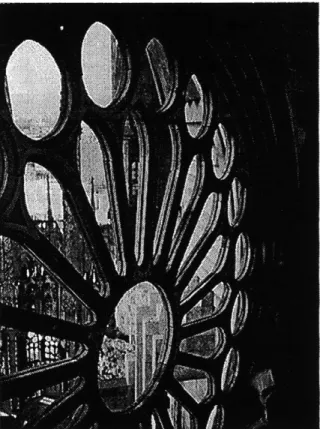
left: View of courtyard from rosette window of
Sagrada Familia.
above: 1929 Barcelona Pavillion.
Because design conformity in this instance is a
function of appearance only, the additions to Sagrada Familia fall outside the 'tradition' of resistance
mentioned previously. Instead of interdependence between past and present, what results is a rather
half-hearted attempt to complete a sketch. The narration of the newer form suggests perversity and garishness, being grotesque paraphrases of the originals, a commentary on the necessity to view forms as complete finished objects.
The Barcelona Pavilion has similar problems
regarding reconstruction. Designed by Ludwig Mies van der Rohe, the German Pavilion of the 1929 Barcelona International Exhibition was built in the shadow of the palace of Alphonso XIII. Because of thecost of the building and the value of the materials, The original structure was returned to Germany upon completion of the Exhibition along with the Kolbe sculpture in the reflecting pool. Its present importance as a landmark of the modern movement was taken as a prompt to begin reconstruction of the site. As early as 1957 Oriol Bohigas approached Mies concerning acquisition of the design drawings, although
4fII1
left: Pedestrians in the city.
above: General organization sketch of palace!
pavillion.
reconstruction did not actually take place until 1984-1986. The intention was that there were to be no conceptual revisions; that the building:
"should be a reconstruction which would reinterpret as faithfully as possible the idea and realization of the 1929 Pavilion."4
Expansion of the city, however, had left the original site with no precise use - its transitional role in the interstitial fabric between lower Barcelona and Montjuic was lost.
Additionally, there was the problem of permanence of the building. The original was conceived as
temporary, to be used and then removed; details of the newer more permanent structure were necessarily transformed, and provision for upkeep, maintenance, and security were developed along with the program. Restoration also included a portion of the palace facade [a backdrop now famous through photographs of the Pavilion], and a colonnade directly in front of
4. De Sole-Morales, p. 118.
the site.
left: Pedestrians in La Rambla.
inset, top: Plan diagram of original organization.
inset, bottom: Plan diagram of transformed site.
above: Pedestrians walking toward the statue of
Christopher Columbus (Montjuic in baciground).
The artifact is meant to confer a sense of subdued monumentality; however, the site itself has
transformed since the exhibition took place, the once-prime location relegated to characterless anonymity. There is also a sense of awkwardness between the Pavilion and a nondescript government building which has sprung up on the site between the Pavilion and the central pedestrian thoroughfare.
Clearly, both of these attempts at preserving and restoring monuments of a previous time are misdirected. Because of the eclectic forces which transformed the environments surrounding each of these buildings subsequent to their completion, both of these restorations were, in a way, doomed to failure. By virtue of their "snapshot" quality, only looking at appearances, the projects failed to account for the fact that the framework of the city had already
transformed around the artifacts.
The remaining examples, linked to redevelopment of the city, represent an attitude more in tune with the
2'h
left: Enlarged view of map showing Passeig de Colom
(Moll de la Fusta).
inset: Diagram of La Rambla (plan).
above: View from Columbus Statue (takenfrom De Sola'-Morales, p.71).
trans-figurative forces of the city. A key distinction between these current examples and the previous two is the fact that the infrastructure of the projects has been reinterpreted to match a modern set of uses, most
notably denser traffic and occupation of the site. Note also that these projects embody a combination of both physical and social actions.
Take for instance the Moll de la Fusta, a pedestrian zone close to an inlet of the Mediterranean.
Undertaken to reclaim a portion of the city's
waterfront, it had the difficult task of fitting into a site which was seemingly inadequate to contain the program. De Soln-Morales describes this process of compressed development as "insertion":
"Reassembling the ruins of a derelict building, an insertion becomes more of a metaphor than a reclamation."5
This metaphoric sense stems from the fact that an "inserted" project can be likened to its predecessor,
5. De Sole-Morales, p.67.
left: Headlights shine through grating on drawbridge.
inset, top: Plan diagram of La Rambla. inset, bottom: Section diagram of La Rambla.
above: View from bridge over depressed vehicular thoroughfare.
despite the differences in form between old occupation and completely new development. However, the dominant carry-over trait of the site is social use.
Physically, the project lays claim to territory above the busy urban thoroughfare. This concept of air rights and the need for this kind of density and overlap are an urban trend. Socially, the promenade is simply an extension of the site's previous use, allowing the metaphoric reference to its previous existence as an active waterfront.One of the major difficulties
confronting the site is the fact that the 'city front' as it might be called - a sort of end facade of the city facing the project - stops short of reaching the water
by roughly fifty meters. The other difficulty is
connection along the water between La Rambla and Barceloneta. This project employs two schemes to fuse these disparate [perpendicular even!] intentions, each being a reflection of existing artifacts and frameworks
and an introduction of entirely new patterns.
At opposing ends of the pedestrian mall [roughly 1km long] are a monument to Christopher Columbus and a
left: Women walking along waterfront.
inset: Section diagram of Passeig de Colom.
above: Pedestrian mall with pavillions.
sculpture by Roy Lichtenstein, and both artifacts serve as a spatial framework to identify scale and location of the site. Visible beyond the Columbus statue is
Montjuic to the west; the Lichtenstein, by contrast, begins the orientation in the opposing direction,
toward the Zoological Gardens. The polar dialog is all the more evincing due to the temporal nature of both artifacts, each very representative of its place in time. Asimilar journey occurs between La Rambla [the oldest surviving section of the city] and Barceloneta, developed only during this century. The compressed time scale is in fact also mediated by the neutral promenade.
Pedestrian access which was once tenuous along the water when it was crowded by traffic is enhanced through increased dimension of the path, now
completely separated from cars, and the introduction of pavilions. The site is further connected back to La Rambla with the intent of capturing the experience of
the oldersection of the city and linking it to the water [which was its original function: an anti-flooding drainage ravine].
I--":
:1-x
.~ ~ ~ ~ ~ ~ ~ ~ p . ... . "Wi I 136 MMI hS WA I~left: Map enlargement showing area of Olympic Village.
above: View of Superunit6, seaside.
The present physical organization retains scars of the former highway which divided the city from the sea. By building up over the highway with the mall, the original three row scheme of
traffic-parking-pedestrians is maintained. The sealing off of the highway is not complete, however - the highway is
reminded of the presence of the mall through periodic openings to the sky. The framework is completed by two drawbridges at either end which serve to connect pedestrians from the city to the sea, and which
provide another unit of scale on the site. Physically, the remnants of the manufacturing warehouses are reinterpreted in the open-air frames of the commercial pavilions along the mall.
The Olympic Village [Nova Ichria] is by contrast filled with greater physical evidence of its previous
existence. Before its life as the heart of the Olympics beyond the Games, Nova Ichria in its most recent use was a manufacturing district, separated from the sea
by the Avignuda d'Ichria. Gradual decline of the
industries in the neighborhood prompted acquisition of properties along the waterfront by the government. Crowding and saturation of the built area of urban
left: Closeup of balconies of Superunit6
inset: Diagram of typical commercial/industrial block.
above: Pedestrian street view, Mediterranean side.
Barcelona suggested utilization of this less restricted area for housing, reconstituting the infrastructure of this area of the city. Untreated sewage from the
neighborhoods surrounding Nova IcAria was released directly into the sea requiring cleanup of the harbor. In its place are left crystal clear pools as a reminder of this now-precious resource.
Starting points for the transformation of Nova Icaria are the traces of the previous forms of the warehouses and the manufacturing district developed [once again] within the Cerd6 grid. The scale and forms of these warehouses are preserved in the design of
Superunidad 6 through its facade elements and exterior organization. The layering of exterior spaces in the manufacturing setting [service access, loading
area/dispatch, campus-type building layout] is
carried over directly to the new design. Basically, the spatial aggregation is achieved through a progression from the exterior mall [service access] to individual courtyards [loading/dispatch] which are built up from the agglomerations of the units themselves [campus-type building layout]. The similarity of scales between the factories and the housing is called out by
left: Closeup of entry.
inset: Plan diagram of Olympic Village.
above: Entry to units in middle of site.
the presence of one of the original factory chimneys, an artifact which comes to stand for the scale of the intervention.
Remnants of the Cerda plan are also present, although these begin to break away from the rigid diagram of Barcelona's core since the necessity for such a
regulated plan on the city's edge dwindles. Instead, once the hard outside edges of the Cerda plan are established the interiors of the blocks are much more free.Memories of the old district of Barcelona, La Rambla, begin to inhabit this interior experience of the site, due to the scale change and the amount of light reaching the street. Simultaneity of the past and present is further enhanced by traces of the celebration left behind after the Games. Olympic memory lingers past the event in the form of banners, poles, and even Cobi. Although occupation of the buildings
themselves was low in January of 1993, it is still too early to tell whether the transformation has fully succeeded. Certainly the frameworks which have been introduced will continue to be felt into the future. For a visitor, the energy and vitality of a city such as
left: View offortress wall (Montjuic). above: Women walking along the waterfront.
Barcelona come from its identity, which in turn is derived from the simultaneity of the temporal layers of memory. This simultaneity is aided in the case of Barcelona by this tradition of eclecticism, providing the necessary freedom to allow for temporal
juxtaposition and reinterpretation. Recognizable fragments of the original city pattern make up this framework and constitute an elaborate thread of memory. Spatial and social frameworks are retained and preserved through successful schemes in
Barcelona the entire city, not in individual buildings. Resistance to conventional or established norms coupled with a fierce sense of pride in culture
predisposes the forms and spaces of Barcelona to have a dual identity. One part expresses modern thought for societal needs while the other reaches deep into the collective memory in order to transform identity. What evolves is the identity of the city in microcosm.