HAL Id: insu-02872008
https://hal-insu.archives-ouvertes.fr/insu-02872008
Submitted on 17 Jun 2020
HAL is a multi-disciplinary open access
archive for the deposit and dissemination of
sci-entific research documents, whether they are
pub-lished or not. The documents may come from
teaching and research institutions in France or
abroad, or from public or private research centers.
L’archive ouverte pluridisciplinaire HAL, est
destinée au dépôt et à la diffusion de documents
scientifiques de niveau recherche, publiés ou non,
émanant des établissements d’enseignement et de
recherche français ou étrangers, des laboratoires
publics ou privés.
Distributed under a Creative Commons Attribution - NonCommercial| 4.0 International
License
Evaluation of bispectrum in the wave number domain
based on multi-point measurements
Y. Narita, K.H. Glassmeier, Pierrette Décréau, T. Hada, U. Motschmann, Y.
Nariyuki
To cite this version:
Y. Narita, K.H. Glassmeier, Pierrette Décréau, T. Hada, U. Motschmann, et al.. Evaluation of
bispec-trum in the wave number domain based on multi-point measurements. Annales Geophysicae, European
Geosciences Union, 2008, 26 (11), pp.3389-3393. �10.5194/angeo-26-3389-2008�. �insu-02872008�
www.ann-geophys.net/26/3389/2008/ © European Geosciences Union 2008
Annales
Geophysicae
Communica
tes
Evaluation of bispectrum in the wave number domain based on
multi-point measurements
Y. Narita1, K.-H. Glassmeier1, P. M. E. D´ecr´eau2, T. Hada3, U. Motschmann4, and Y. Nariyuki5
1Institut f¨ur Geophysik und extraterrestrische Physik, Mendelssohnstr. 3, 38106 Braunschweig, Germany 2LPCE/CNRS and Universit´e d’Orl´eans, Orl´eans, France
3Department of Earth System Science and Technology, Kyushu University, 816-8580, Kasuga, Fukuoka, Japan 4Institut f¨ur Theoretische Physik, Mendelssohnstr. 3, 38106 Braunschweig, Germany
5Department of electrical engineering, Kochi National College of Technology, Monobe-Otsu 200-1, Nankoku, Kochi
783-8508, Japan
Received: 30 July 2008 – Revised: 28 August 2008 – Accepted: 21 October 2008 – Published: 24 October 2008
Abstract. We present an estimator of the bispectrum, a
mea-sure of three-wave couplings. It is evaluated directly in the wave number domain using a limited number of detectors. The ability of the bispectrum estimator is examined numer-ically and then it is applied to fluctuations of magnetic field and electron density in the terrestrial foreshock region ob-served by the four Cluster spacecraft, which indicates the presence of a three-wave coupling in space plasma.
Keywords. Interplanetary physics (Plasma waves and
turbu-lence) – Space plasma physics (Experimental and mathemat-ical techniques; Wave-wave interactions)
1 Introduction
Higher order statistics is of great importance in studying non-linear processes of turbulence. They reflect the shape of probability distribution functions of fluctuations. Theoreti-cal treatments of turbulent fields often assume the Gaussian or almost-Gaussian distribution (called the quasi-normal ap-proximation) to solve the closure problem of turbulence. In the frame of weak turbulence the breakdown of the Gaussian distribution can be interpreted as a sign of phase coherence, e.g. three-wave or four-wave couplings. Estimating the bis-pectrum provides the very means to measure the magnitude of three-wave couplings (see review of Dudok de Wit, 2003). In laboratory and space plasma physics the method of the bis-pectrum has been wodely applied: in ionospheric radio emis-sion (Lagoutte et al., 1989); in laboratory plasmas (Kim and Powers, 1979; Ritz et al., 1989; Brochard et al., 2006); and Correspondence to: Y. Narita
upstream waves of the Earth’s quasi-parallel bow shock (Du-dok de Wit and Krasnosel’skikh, 1995). The bispectrum in-vestigations have been made solely in the frequency domain, as one uses single point measurements and therefore time se-ries data. Also, Taylor’s hypothesis is often applied in a flow-ing medium and the bispectra in the frequency domain reflect that in the wave number domain. However, the wave-wave couplings should be examined in the wave number domain, too, which motivates us to estimate the bispectrum directly in the wave number domain using only a limited number of measurement points. For example, with Taylor’s hypothesis one cannot measure the wave number perpendicular to the flow. Here we present an estimator of the bispectrum. The ability of the estimator is examined numerically and then it is applied to the fluctuations in the Earth foreshock region. While wave-wave interactions are extensively studied with simulation data Nariyuki and Hada (2006), to the authors’ knowledge it is the first time that the wave-wave coupling is identified in the wave number domain with experimental space plasma data.
2 Estimator of bispectrum
Suppose a scalar field A(r, t ) is measured by an N point sen-sor array. The scalar field can be not only density or temper-ature of the medium but also any components of magnetic fields or velocity fields. We determine the state vector in the frequency domain from the measurement as
A(ω) = (A1(ω), A2(ω), · · · , AN(ω)) , (1)
where Ai(ω)denotes the Fourier transform of the scalar field
3390 Y. Narita et al.: Bispectrum state vector is then projected into a scalar a with a suitable
weight vector W as
a(ω,k) = W†(ω,k) · A(ω), (2)
where the dagger † denotes the Hermitian conjugate. The scalar a represents the amplitude of a plane wave with fre-quency ω and wave vector k, retaining phase information. We use Capon’s weight vector (Capon, 1969)
W (ω) = R
−1(ω)H (k)
H†(k)R−1(ω)H (k), (3)
where H (k) is called the steering vector,
H (k) = (exp(ik · r1), · · · ,exp(ik · rN)) (4)
and R(ω) is the covariance matrix of the state vector,
R(ω) = hA(ω)A†(ω)i. (5) The angular bracket h··i denotes the ensemble average. In practice the averaging is made over time-subintervals. Capon’s weight vector stems from an optimization procedure under a certain constraint. Consider to minimize the mean square amplitude of the field h|a|2i (which is the wave en-ergy) under constraint that the weight vector serves as a unit gain, that is
minimize h|a|2i subject to W†·H = 1. (6) This problem can be analytically solved by the method of Lagrangian multiplier, yielding the weight vector in Eq. (3). See Haykin (1991) for its derivation. In principle one could also find another weight vector in such a way that the third order moment is minimized under the unit gain constraint, but the analytical treatment becomes more elaborate. We choose here Capon’s weight vector for the sake of simplicity. Capon’s method can be generalized to vector fields (mag-netic fields, velocities) to determine the wave energy distri-bution in the frequency and wave number domain, referred to as the wave telescope (Motschmann et al., 1996; Glassmeier et al., 2001). The k-filtering (Pinc¸on and Lefeuvre, 1991) is another approach to estimate the energy distribution in the wave number domain.
The projection using the weight vector furthermore en-ables one to determine higher order moments of the fluctua-tions. The third order moment, for example, is expressed as haa0(a00)∗i, where the asterisk∗denotes the complex conju-gate. The prime and the double prime denote that the wave amplitudes are estimated at different frequencies and wave numbers. It is worthwhile to note that the third order moment becomes non-zero only if the three wave fields a, a0, and
a00 are in resonance, satisfying the frequency and the wave number matching, ω+ω0=ω00 and k+k0=k00, otherwise the third order moment vanishes because of random phase mix-ing. The bispectrum in the wave number domain is obtained from the third order moment as
F (k, k0) = 1 T 1k1k0
Z
aa0(a00)∗ dωdω0, (7)
where 1k and 1k0 denote the grid size of the wave num-ber space and T the time length of the measurement. The factor 1/T 1k1k0sets the units of the bispectrum properly. Since the weight vector is dimensionless, the units of the es-timated amplitude is the same as the Fourier transform of the field into the frequency domain, whereas the units of the bis-pectrum are the density of the cubic amplitude in the wave number domain, (amplitude)3/(wave number)2.
3 Applications
3.1 Numerical test
The quality of the bispectrum estimator is examined with a numerical test. We generate waves in the magnetic field and the number density under a three-wave resonance in one-dimension. This type of wave-wave coupling is typical for the parametric instabilities of large amplitude Alfv´en waves (Longtin and Sonnerup, 1986; Terasawa et al., 1986; Wong and Goldstein, 1986). The generated fluctuations are sam-pled at four discrete spatial points in the system. We then evaluate the bispectrum based on the time series at the four points to identify the wave-wave coupling in the wave num-ber domain.
The first component of the wave fields is a magnetic field oscillation, and the second component a density oscil-lation. Their frequencies and wave numbers are randomly chosen (ω1=0.39 rad/s, ω2=0.21 rad/s, k1=0.0059 km−1,
k2=0.0104 km−1). The third wave component is a
mag-netic field oscillation satisfying the resonance condition ω1+ω2=ω3, k1+k2=k3. The amplitudes are 10 nT, 1 cm−3,
9 nT for the three wave fields, respectively. These fluctua-tions are superposed on the background fields (23 nT for the magnetic field and 5 cm−3for the density). In addition we put broadband wave activity with phases random to one an-other. The fluctuations are sampled at four separate positions at distance 100 km, 180 km, 290 km, and 375 km. Figure 1 displays the time series of the magnetic field and the density sampled at the sensor 1.
The bispectrum is then estimated from the four-point mea-surements of the magnetic field and the density fluctuations. First we compute the third order moment
C(ω, ω0, k, k0) =b(ω, k)n(ω0, k0)b∗(ω + ω0, k + k0) , (8) where b and n denote the projection of the state vector of the magnetic field B(ω) and that of the density N (ω0),
b(ω, k) =W†b(ω, k) ·B(ω) (9)
n(ω0, k0) =W†n(ω0, k0) ·N (ω0). (10) We use different weight vectors for the magnetic field and the density, Wb(ω, k) = R−b1(ω)H (k) H†(k)R−1 b (ω)H (k) (11)
Fig. 1. Time series of artificial magnetic field and density
fluctua-tion at the virtual sensor 1.
Wn(ω0, k0) = R −1 n (ω 0)H (k0) H†(k0)R−1 n (ω0)H (k0) , (12)
where Rb(ω)=hB(ω)B†(ω)i and Rn(ω0)=hN (ω0)N†(ω0)i.
The bispectrum is obtained by integrating the third order mo-ment over the two frequency domains,
F (k, k0) = 1 T 1k1k0
Z
C(ω, ω0, k, k0)dωdω0. (13)
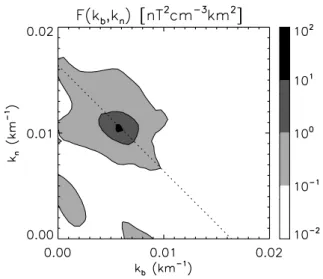
We use a constant grid in the wave number domain 1k=1k0=5×10⁻³km−1 (grid size is limited by compu-tational resource). Figure 2 displays the bispectrum for the numerical data set. The bispectrum exhibits a domi-nant peak just on the resonance condition (the dotted line), k+k0=0.0163 km−1, which confirms the resonance pair of wave numbers. Our bispectral analysis can identify the loca-tion of the wave-wave coupling in the wave number domain, although the broadband wave activity is present.
3.2 Cluster observation in foreshock
The bispectrum estimator is then applied to the fluctuation in the Earth foreshock region. The foreshock is located upstream of the Earth bow shock, typically beyond 20 RE
(Earth radius, ca. 6400 km) ahead of the Earth, where the interplanetary magnetic field contacts the bow shock at an-gles quasi-parallel to the shock normal direction. The fore-shock is one of the active regions of large amplitude Alfv´en waves, since the backstreaming ions from the shock against the solar wind flow provides an energy to excite the Alfv´en waves. It is likely that the foreshock exhibits wave-wave cou-pling processes, as identified by Spangler et al. (1997) in the frequency domain. We use the magnetic field measurement (Balogh et al., 2001) and the electron density measurement (D´ecr´eau et al., 2001) on board the four Cluster spacecraft (Escoubet et al., 2001). In the time interval 18 February
Fig. 2. Bispectrum for the numerical test. The x- and y-axes are
the wave number of the magnetic field and the density fluctuation, respectively.
Fig. 3. Time series of the magnetic field magnitude (top), the
fluc-tuation perpendicular to the mean field (middle), and the electron density fluctuation (bottom) obtained by Cluster-1 in the foreshock region.
2002, 18:05–18:35 UT Cluster encountered the foreshock re-gion in its outbound orbit. The spacecraft separation is about 100 km. The background quantities are 10 nT for the mag-netic field and 16 cm−3 for the electron density. Figure 3
displays the time series of the magnetic field (magnitude and perpendicular component) and the electron density used in the analysis.
3392 Y. Narita et al.: Bispectrum
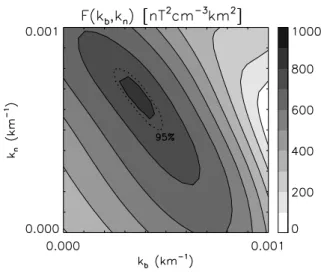
Fig. 4. Bispectrum for the Cluster observation in the foreshock with the same style as Fig. 2. The dotted line denotes the level of 95% confidence.
The bispectrum is determined with the same procedure as that of the numerical test, with the grid size 5×10⁻⁵km−1 (here the grid size is again limited by the computational re-source). We use the perpendicular component of the mag-netic field and the electron density fluctuation associated with wave vectors parallel to the magnetic field. The result is dis-played in Fig. 4. A peak is identified at the pair of wave num-bers around kb=3.5×10⁻⁴km−1 and kn=6.5×10⁻⁴km−1
for the magnetic field and the density fluctuations, respec-tively. Figure 4 also shows the 95% confidence level about the peak. We assume a normal distribution for the evaluation of the bispectrum and use 16 degrees of freedom in frequency estimates (the number of time sub-windows) and in addition 256 in bispectrum estimates. The distribution of the bispec-trum tends to be aligned to a resonance line (straight line with the slope −1, see the dotted line in Fig. 2), but the alignment is slightly steeper than the resonance line.
4 Conclusions
The bispectral analysis provides useful information about wave-wave interactions. However, one should be careful in that the bispectum is a necessary but not a sufficient condi-tion for having three-wave interaccondi-tions. A nonlinearity in the detector, for example, may give rise to a non-zero bispec-trum (Walker et al., 2002), or one may have four-wave inter-actions. Also, the higher order moments may be remnants of wave-wave interactions that took place somewhere upstream and were convected by the flow. However, our method can successfully identify a peak in experimental space plasma data within the limit of the confidence level, which is an in-dication that the three-wave coupling may really be present in space plasma.
Although the number of measurement points is too small to perform the Fourier transform from the spatial coordinate into wave numbers, it is possible to estimate the higher order moments in the wave number domain. This method is useful even in regions like the solar wind where Taylor’s hypothe-sis generally holds because with this hypothehypothe-sis one can esti-mate wave numbers in the flow direction and not perpendicu-lar to the flow. Therefore it is worthwhile performing the bis-pectral analysis in the wave number domain even in the fore-shock or the solar wind. Our method can be used to study the parametric instabilities of large amplitude Alfv´en waves, in which a parent Alfv´en wave collapses into a sound wave and daughter Alfv´en waves (Longtin and Sonnerup, 1986; Tera-sawa et al., 1986; Wong and Goldstein, 1986) in the regions of foreshock (Spangler et al., 1997) or solar wind (Marsch and Tu, 1997).
Acknowledgements. This work was financially supported by Bun-desministerium f¨ur Wirtschaft und Technologie and Deutsches Zen-trum f¨ur Luft- und Raumfahrt, Germany, under contract 50OC0103. Topical Editor I. A. Daglis thanks one anonymous referee for her/his help in evaluating this paper.
References
Balogh, A., Carr, C. M., Acu˜na M. H., et al.: The Cluster magnetic field investigation: overview of in-flight performance and initial results Ann. Geophys, 19, 1207–1217 ,2001.
Brochard, F., Windisch, T., Grulke, O., and Klinger, T.: Experimen-tal evidence of mode coupling in drife wave intermittent turbu-lence using a wave nunber bicoherence analysis, Phys. Plasmas, 13, 122305, doi:10.1063/1.2402131, 2006.
Capon, J.: High Resolution Frequency-Wavenumber Spectrum Analysis, Proc. IEEE, 57, 1408–1418, 1969.
Escoubet, C. P., Fehringer, M., and Goldstein, M.: The Cluster mis-sion, Ann. Geophys., 19, 1197–1200, 2001,
http://www.ann-geophys.net/19/1197/2001/.
D´ecr´eau, P. M. E., Fergeau, P., Krasnoselskikh, V., et al.: Early results from the Whisper instrument on Cluster: an overview, Ann. Geophys., 19, 1241–1258, 2001,
http://www.ann-geophys.net/19/1241/2001/.
Dudok de Wit, T. and Krasnosel’skikh, V. V.: Wavelet bicoherence analysis of strong plasma turbulence at the Earth’s quasiparallel bow shock, Phys. Plasmas, 2, 4307–4311, 1995.
Dudok de Wit, T.: Numerical schemes for the analysis of turbulence – A tutorial, Space Plasma Simulation, edited by: B¨uchner, J., Dum, C. T., and Scholer, M., Springer, Berlin, 315–344, 2003. Glassmeier, K.-H., Motschmann, U., Dunlop, M., et al.: Cluster
as a wave telescope – first results from the fluxgate magnetome-ter, Ann. Geophys., 19, 1439–1447, 2001 (Correction, 21, 1071, 2003).
Haykin, S.: Adaptive filter theory, 2nd ed., Prentice Hall informa-tion and system science series, Prentice-Hall Inc., New Jersey, pp. 396–399, 1991.
Kim, Y. C. and Powers, E. J.: Digital bispectral analysis and its applications to nonlinear wave interactions, IEEE Trans. Plasma Sci., PS-7, 120–131, 1979.
Lagoutte, D., Lefeuvre, F., and Hanasz, J.: Application of bicoher-ence analysis in study of wave interactions in space plasma, J. Geophys. Res., 94, 435–442, 1989.
Longtin, M. and Sonnerup, B.: Modulational instability of circu-larly polarized Alfv´en waves, J. Geophys. Res., 91, 798–801, 1986.
Marsch, E. and Tu, C.-Y.: Intermittency, non-Gaussian statistics and fractal scaling of MHD fluctuations in the solar wind, Nonlin. Processes Geophys., 4, 101–124, 1997,
http://www.nonlin-processes-geophys.net/4/101/1997/.
Motschmann, U., Woodward, T. I., Glassmeier, K.-H., Southwood, D. J., and Pinc¸on, J. L.: Wavelength and direction filtering by magnetic measurements at satellite arrays: generalized minimum variance analysis, J. Geophys. Res., 101, 4961–4965, 1996. Nariyuki, Y. and Hada, T.: Remarks on nonlinear relation among
phases and frequencies in modulational instabilities of parallel propagating Alfvn waves, Nonlin. Processes Geophys., 13, 425– 441, 2006,
http://www.nonlin-processes-geophys.net/13/425/2006/.
Pinc¸on, J. L. and Lefeuvre, F.: Local characterization of homoge-neous turbulence in a space plasma from simultahomoge-neous measure-ment of field components at several points in space, J. Geophys. Res., 96, 1789–1802, 1991.
Ritz, Ch. P., Powers, E. J., and Bengtson, R. D.: Experimental mea-surement of three-wave coupling and energy cascading, Phys. Fluids B, 1, 153–163, 1989.
Spangler, S. R., Leckband, J. A., and Cairns, I. H.: Observations of the parametric decay instability of nonlinear magnetohydro-dynamic waves, Phys. Plasmas, 4, 846–855, 1997.
Terasawa, T., Hoshino, M., Sakai, J.-I., and Hada, T.: Decay insta-bility of finite-amplitude circularly polarized Alfv´en waves: A numerical simulation of stimulated brillouin scattering, J. Geo-phys. Res., 91, 4171–4187, 1986.
Walker, S. N., Balikhin, M. A., Bates, I., and Huff, R.: An investi-gation into instrumental nonlinear effects, Adv. Space Res., 30, 2815–2820, 2002.
Wong, H. K. and Goldstein, M. L.: Parametric instabilities of circu-larly polarized Alfv´en waves including dispersion, J. Geophys. Res., 91, 5617–5628, 1986.