APPLICATION OF LEAN MANAGEMENT PRINCIPLES TO
ELECTION SYSTEMS
by
Tomer Posner
B.S., Biomedical Engineering
Yale University
Submitted to the Department of Mechanical Engineering
in Partial Fulfillment of the Requirements for the Degree of
Master of Science in Mechanical Engineering
at the
Massachusetts Institute of Technology
February 2006
2005 Tomer Posner
All rights reserved
The author hereby grants to MIT permission to reproduce
and to distribute publicly paper and electronic copies of this thesis document
in whole or in part in any medium now known or hereafter created.
Signature of Author...
Certified by....
... ... ...
Department of Mechanical Engineering
ell
December 20, 2005
...
Ted Selker
Associate Professor, MIT Media Lab
Thesis Advisor
(/
Certified by...
...Thomas Sheridan
Professor of Mechanical Engineering
Thesis Supervisor
Accepted by...
...
Professor Lallit Anand
Chairman, Department Committee on Graduate Students
MASSACHUSETTS INSTInUTE OF TECHNOLGY
JUL 14 2006
LIBRARIES
APPLICATION OF LEAN MANAGEMENT PRINCIPLES TO ELECTION SYSTEMS
by
Tomer Posner
Submitted to the Department of Mechanical Engineering on December 20, 2005 in partial fulfillment of the requirements for the
Degree of Master of Science in Mechanical Engineering
ABSTRACT
Lean was first adopted as a management technique for improving results in manufacturing environments. It is based on the 5 principles of identifying the Value to be created, mapping the Value-Stream (incremental addition of value), ensuring process
Flow, orienting the process towards the Pull of the customer and finally eliminating all Waste through a process of continuous improvement. This framework is highly adaptable, and has been applied in recent years to non-manufacturing efforts, such as product development and the retail and service industries.
We explore the application of Lean to voting. Applications can be found in the phases of technology development, production, deployment, poll management and more. By
following a structured approach based on Lean, the efforts to advance voting solutions in the US can gain in efficiency, security, privacy and credibility over their current state. These will be adapted to deal with the voting environment, which imposes a unique set of challenges and follows priorities different from normal corporations. Additional Lean elements, such as eliminating irregularities through standardization, improved training and process transparency will be reviewed.
The development and deployment of Brazilian voting system will be presented as an example of how Lean elements can be used in the voting setting. While not intentionally created by the Lean model, the design, deployment and current use of the Brazilian system is highly complimentary to this model.
Finally, we suggest ways in which such an approach can be applied to the U.S. voting system. With a theoretical structure in place, specific improvement efforts can be devised and applied in the field. This study, therefore, is intended as a preliminary effort of identifying a problem and modeling it. It hopes to induce a commitment to Lean which will put in motion a cycle of implementation, elaboration and continuous improvement.
Thesis Advisor: Ted Selker
Title: Associate Professor, Media Lab, MIT
Thesis Supervisor: Thomas B. Sheridan
ACKNOWLEDGEMENTS
I would foremost like to thank my parents, Orna and Elieser, for providing me with the
opportunity to pursue my goals and for their love and affection, which has helped me through the most trying times. Equal gratitude goes out to my siblings, Gallia and Nimrod.
Special thanks to my cousin Yoni, for his positive attitude and support here in Cambridge. I truly enjoyed the time we spent living together.
I would like to thank my advisor Prof Ted Selker for his guidance and constant
motivation that has enabled me to complete my research work. I would also like to thank him for the opportunities that he has made available to me.
I would like to acknowledge Professors Stephen Graves and Thomas Sheridan for their
insights and input into this project.
Finally, a last hoorah to Jonathan Goler for setting the rusty wheels in motion that got this thing rolling in the first place.
TABLE OF CONTENTS
A B S T R A C T ... 3
ACKNOWLEDGEMENTS... 5
TA B LE O F C O N TEN T S ... 6
LIST O F FIG U R E S... 8
Chapter 1 - Current Difficulties in U.S. Election Management ... 9
1.1 Introduction - Background and History ... 9
Chapter 2 - Introducing Lean ... 13
2.1 The Lean Model Proposal... 13
2.2 A General Adaptation of the Lean Model to Voting Systems ... 15
Chapter 3 - The B razil M odel ... 21
3.1 Introduction - Motivation and Background ... 21
3.1.1 Brazil and the Democratic Process ... 21
3.1.2 Introduction of Electronic Voting in Brazil... 22
3.2 Brazil's Electronic Voting Machine Project ... 26
3.2.1 Strategic P lanning ... 27
3.2.2 Defining Needs and Evaluating Tradeoffs ... 28
3.2.3 The Public Bidding Process - Call for Proposals ... 33
3.2.4 The Public Bidding Process - The Winning Proposal... 36
3.2.5 Development of the Hardware and Software of the Voting Machine...39
3.2.6 Production and Quality Control... 44
3.2.7 Deployment and Use ... 46
3.2.8 Public Education and Awareness... 48
3.3 Feedback, Lessons Learned and Further Development ... 50
3.3.1 Issues w ith System Security ... 51
Chapter 4 - Elaborating the Lean Election Model for the U.S...53
4.1 M ethods of A pplying Lean ... 53
4.2 Applying Lean to US Voting Administration - Divide and Conquer ... 56
4.2.1 C om m itting to Lean ... 56
4.2.2 The Technology Value Stream ... 57
4.2.2.1 Improving the Product Value-Stream ... 57
4.2.2.2 Low Error Voter Interfaces and Verified Voter Trails... 59
4.2.2.3 Secure Architecture for Voting Electronically ... 60
4.2.3 Lean Applications to the Poll Management Value Stream ... 63
4.2.4 The Public Relations and Interface Value Stream...68
4.3 Continuous Improvement and Six-Sigma ... 70
C hapter 5 - C onclusions... 73
R E F E R E N C E S ... 74
APPENDIX A - BRAZIL VOTING SURVEY...77
APPENDIX B - THE LEAN ENTERPRISE MODEL ... 81
LIST OF TABLES
Table 2-1 Values Pertinent to Voting 17
Table 3-1 Comparison of Voting Machine Prototypes 30
Table 3-2 Timeline of Voting Machine Delivery by Unisys Brazil 35
Table 3-3 Voting Machine Proposals of the Tree Major Bidders 38
Table 3-4 Cumulative Voting Machine Data (Brazil) 50
Table 4-1 Differentiating Factors (Brazil vs. US) 54
LIST OF FIGURES
Figure 3-1 Mechanical Card-Punch Machine 23
Figure 3-2 Schematic of the Voting Machine Project 26
Figure 3-3 IBM's Voting Machine Prototype 36
Figure 3-4 Procomp's Voting Machine Prototype 37
Figure 3-5 Unisys's Voting Machine Prototype 37
Figure 3-6 The Unisys Electronic Voting Machine (2002) 40
Figure 3-7 The VM User Interface 43
Figure 4-1 Roadmap to Lean 55
Figure 4-2 LEVI vs. Sequoia Errors 60
Figure 4-3 The Voting Deployment Value Stream 65
Chapter 1
Current Difficulties in U.S. Election Management
1.1 Introduction - Background and History
The voting process is considered by most as the centerpiece of democracy. The contribution of citizens in electing officials and deciding on important matters has been strongly fought for and defended in civil movements and wars throughout history. The turbulence rarely ended once the right was secured. It continued to manifest itself in the debate on the methods of conducting the rite itself.
Entering the 21't century, technology has reached a level at which it can immensely simplify the voting process. Government, academic and private institutions are all in a frenzy to develop and introduce new technologies to address the need for more secure, reliable, accessible and efficient elections. However, the multitude of available technologies of various levels of maturity has met an elections system that is ill-prepared to receive it. Additionally, a lack of planning and goal setting has left engineers developing the future face of voting. Preferably, government and lawmakers should be defining the needs of democracy and use the engineers' help to bring forth technological solutions to meet these goals.
From the technical standpoint, the day is near where citizens could show their support or dissent on a weekly or daily basis. In the UK, cellular-phone based voting has been attempted [1] and in the U.S. several states have implemented internet voting for primary elections [2]. Such technologies offer sustainable platforms for fast-turnover voting. Citizens could be allowed a voice on public referendums, legislature, and impeachment processes, to name a few. One can appreciate the effects of technology can go beyond making processes more efficient - they can enable political and social practices that have previously been regarded unthinkable.
In this work, it will be assumed that current trends in the United States are to be maintained. That means voting is conducted in centralized locations at two year intervals. Voting technology in the US received a sizeable boost of monetary and political resources following the incidents of the year 2000 Presidential elections. As a result, by the 2004 Presidential elections, 20% of U.S. counties had deployed Direct Recording Electronic (DRE) voting machines. These machines allowed as many as 29.5% of eligible voters in the U.S. to vote electronically [3].
On its face, the progress has been positive and was conducted in good stride. While public opinion of electronic voting and its implementation varies [4], no major glitches have occurred thus far with the new technologies.
Upon closer inspection, however, the picture is not so pretty. Abundant literature exists [5] [6] criticizing virtually all elements of voting in the US - from the voting machines, to voting administration, to jurisdiction and oversight. The observations made put in question voting security, reliability, accuracy as well as describing voter dissatisfaction, lack of trust and inconvenience. This is after over 3 Billion US$ have been invested in recent years by public and private institutions in improving voting technology.
This thesis suggests a new approach to the administration of elections and election technology in the US. This approach is based on Lean Principles, initially formulated for manufacturing industries. Facing the challenges of administering efficient, cost-effective,
secure and painless elections will be addressed in terms of defining and augmenting
value, removing waste, introducing standardization, activating flow and pull and seeking perfection.
The transition from paper to electronic voting in Brazil will be used as an example of a well structured process of creating an effective and sustainable voting solution. The report will focus not only on the voting machine itself, but on the process as a whole
deployment and use. While not intentionally conducted according to Lean principles, the process does conform to the Lean model.
With this validation of the Lean approach, the thesis will move on to lay out the ways we hope to apply it in voting. We should note, however, that our use of Lean might have to differ slightly from that of conventional industries. The reason is that we must reprioritize our goals and values as compared to a commercial corporation. Nevertheless, Lean's inherit focus on reliability, timeliness and the human factor should compliment voting quite well.
Chapter 2
Introducing Lean
2.1 The Lean Model Proposal
Lean was first introduced by James Womack, Dan Jones and Daniel Roos in their book
"The Machine That Changed the World" published in 1990 [7]. It is based on the largest
and most thorough study ever undertaken in any industry - the MIT five-million-dollar, five-year, fourteen-country International Motor Vehicle Program's study of the worldwide auto industry. The book brought forth many insights as to differences between traditional mass production employed by the West (US and Europe) and Toyota's highly efficient production system.
The Lean model set forth by Womack, Jones and Roos can be summarized as follows. Organizations must define the value that they produce as the product that best suits their customers' needs. They must then identify and clarify the value stream, the chain of actions that bring the product through design, engineering, planning and production tasks. Next, the Lean enterprise should line up its suppliers with this value stream. In execution, flow must be maintained ensuring uninterrupted value aggregation. Pull, or the constant adaptation of the organization to the customer's needs, should be the driver of the process. Finally, with the entity reengineered toward the creation of value, it should seek to achieve "perfection" through continuous improvement, rooting out all the remaining muda (Japanese for "waste") in the system.
Since the publication of this book, many research and consulting groups have continued to elaborate the initial Lean model. One of the most exhaustive efforts has been conducted by the Lean Aerospace Initiative (LAI) at MIT. This group of academicians, supported by government and aerospace company grants, has evolved Lean models applicable not only to production and manufacturing, but for large multi-faceted companies. The Lean Enterprise Model (LEM) takes in mind the largest of aerospace
consortiums in the world, and lays out a distinct structure that promotes Lean improvement. It also structures a roadmap for enterprises to follow on their pursuit of Lean. I will return to the LEM proposal in Chapter 4 of the thesis, where the methodology of applying Lean will be discussed.
It should be noted that other highly qualified analyses of the Toyota Production System have been performed, producing sets of guidelines both competitive and complimentary of Lean. An example is Spear and Bowen's study "Decoding the DNA of the Toyota Production System" [8]. The authors present a study of TPS which produces the following four rules:
These rules guide the design, operation, and improvement of every activity, connection, and pathway for every product and service. The rules are as follows: Rule 1: All work shall be highly specified as to content, sequence, timing and
outcome.
Rule 2: Every customer-supplier connection must be direct, and there must be an unambiguous yes-or-no way to send requests and receive responses. Rule 3: The pathway for every product and service must be simple and direct. Rule 4: Any improvement must be made in accordance with the scientific method
under the guidance of a teacher, at the lowest possible level in the organization.
Spear and Bowen [8]
The thesis will pursue the Lean model because of the well structured process it affords and its adaptability to non-manufacturing environments.
2.2 A General Adaptation of the Lean Model to Voting Systems
Applying the Lean Model to Voting
In order to apply the Lean model to voting, we must identify the real-world manifestations of each of it principles. Once we have a conceptual model of voting in the familiar Lean framework, we will be better prepared to reevaluate the process and realign it in search of our goals.
At this point it is important to address said goals of the voting process. Obviously, any arbitrary definition here will invoke a heated debate. In the corporate world the ultimate goal is increasing shareholder value. Value for other stakeholders - employees, customers and society in general (and in that order, usually) - comes in a close second. In the voting scenario, the roles reverse significantly. The interests of society come to the frontline, expressed in a secure and reliable voting process. Next come the customers, or citizens, expecting convenience, ease of use and privacy. The employees are to be well coordinated and trained to ensure a smooth democratic process. Finally, shareholder value or cost-benefit considerations tend to be regarded as enabling factors rather than goals to be achieved.
This modified set of goals doesn't exclude the use of the Lean model for voting. It simply requires us to ask different questions throughout our evaluations. For example, not only should enforcing standardized practices be used to reduce costly errors and improve quality, but also to reduce miscounting errors and improve polling efficiency. In fact, the Lean model has already been adapted to various non-commercial environments. For example, GM taught value-stream mapping to the staff at a Michigan State Police crime lab in a successful effort to cut the time needed to analyze evidence'. The Lean
GM helps nab bad guys through DNA evidence. The Detroit News, October 17, 2004.
"In Michigan, a unique partnership between the Michigan State Police and General Motors Corp. is making it possible to more quickly track killers, rapists and other criminals through DNA evidence. Federal grants and a fresh business approach used by GM have enabled crime lab scientists to reduce a 10-year backlog to less than a year and make nearly 10 times the matches of known criminals to evidence left at crime scenes.
[...] Police had heard about a GM system called value stream mapping to identify, assess and solve
model can be used to attain non-monetary goals and needs, as long as they are carefully defined and clear to all stakeholders.
Finally, an enabling factor throughout the process of creating a Lean system is ensuring participant buy-in. This is probably the single most important and most challenging aspect in the creating of a Lean voting system. Buy-in must be assured at all levels if this approach is to succeed - from politicians, to academics, to corporations to the general public. Voting is a national interest for a democratic society, and national buy-in must be
ensured to support it.
Identifying Value
The first step in applying Lean is identifying the Value we are trying to create. However, before we do so, we must define a product towards which we are applying our effort. Let us assume we are producing votes. Each vote should be cast by a single eligible citizen and should result in a unit increment on the final ballot count. However, by simply creating this product we are doing only half the work. Doing so would be analogous to a car manufacturer producing cars and stocking them up unsold in the dealer parking lots. In the same way, the responsibilities of the voting system go far beyond the creation and counting of single votes.
So while it's important to always keep in mind the product we are producing, it's important to focus our activities on the creation of Value. For our purposes, we will use a set of parameters that are widely used to evaluate voting systems that were assembled by members of the MIT Voting Technology Project. The values we are trying to create from the pure voting standpoint are shown in Table 2-1 below.
Value Implication
Inclusion of Citizens Ensuring high voter turnout.
Accessibility Easy to register and vote, regardless of
physical limitations.
Vote Security and Privacy Both at time of voting and by using untraceable ballots.
Positive Poll Environment Timely and convenient voting.
Reliable Results No fraudulent votes, no votes left uncounted.
Auditable Results Traceability, whether electronic or physical (paper trail).
Table 2-1 - Values Pertinent to Voting
Assembled by members of the MIT Voting Technology Project
To these we must add measures of value that surface for other stakeholders in the value stream. For example, OEM's will see their profits and low service costs as important values. The taxpayer sees economical solutions as valuable. The poll worker sees appreciation of her work and decent pay as important values.
Mapping the Value Stream
Before we attempt to introduce improvements to a system, we must have clear knowledge of the processes that drive it. The Value Stream, the chain of actions that contribute to the value of the final product, must be defined for each of the central processes that define voting. Since voting is not a physical product, it is not always evident how value is being added to it. An example of a voting value stream that describes the deployment and management of polling locations (Figure 4-3 in Chapter 4) shows that at many points value is being added in the form of information (votes) or ideas (ballot design). This is in opposition to a manufacturing line, where the value stream can clearly map out the physical transformation of raw materials into a finished product.
Therefore, Value Streams in the voting context should be used as conceptual guidelines on the basis of which actual policies and procedures can be formulated. Their creation helps in visualizing the current state of a system and describing the major linkages in the system - locations where Lean experts would try to improve flow and coordination. To fully achieve this and efficiently run the value stream, Lean calls for just in time supply management, standardization of practices, constant process feedback and transparency. How would these play out in voting?
In the technology value stream, for example, suppliers must be better integrated and encouraged to become partners in achieving Lean goals. The interests of suppliers and government which are usually considered opposed can be shown to coincide. Take for example suppliers of Toyota, the kingfish of Lean manufacturing. Their success depends on Toyota's financial success. Toyota's success relies on a timely supply of quality parts from its suppliers. In the same way, government agencies should create mutually supportive relationships with voting technology companies. The success of new technologies will reinforce public opinion about electronic voting and will drive further progress. At the end of the day, the public enjoys the benefits of well executed voting technology and government agencies benefit from lower administrative and cost overheads and the higher credibility of the voting system.
An important aspect of defining the Value Stream is ensuring all the stakeholders in the process are aware of it. In other words, we seek to increase the transparency of the process. This step has the effect of increasing the understanding of the system and confidence in the system, further helping in its improvement.
Improving Flow
Once the value stream is established, we can start working on improving Flow. Flow entails both lining up suppliers with the value stream, as well as internally assuring the efficient and uninterrupted addition of value. Suppliers of voting technology should be
well informed of expected production requirements and timelines, yet ensure standardization and quality to ease deployment at voting centers. Internally, government agencies to poll workers should create standardized procedures to facilitate improvement and implementation of lessons learned.
Submitting to Pull
In a Lean system, the driver of the entire process is Pull - or the needs of the end users. In the case of voting, this would be the expectation of voters that voting values (see Table 2-1) are being met by the election system. The voting systems produced should match and not exceed demand. They should offer interfaces deemed appropriate by voters, not
by developers. Election results should be processed and distributed promptly. The consumer of voting is the ordinary citizen, and answering his or her needs is the purpose of the voting process. Therefore, the technology offered should meet the requirements of voters, and not be a tour-de-force of rivaling voting technology manufacturers. Machines
should be ranked in reference to reliability, security and usability, and not by LCD screen size, colors, touch-screen capability or processor speed. They should get the job done, and get the job done well.
Seeking Perfection and Achieving Predictable Sustainable Results
Finally, with value and value stream defined, flow and pull ensured, the process can be constantly reengineered towards Perfection. This will be done by constantly reviewing the established practices and eliminating all of the remaining muda (Japanese for
"waste") in the system.
One of the pivotal ways of eliminating waste in the process is by reducing unintended variation. While not one of the five basic elements of Lean, reducing variation is key to eliminating waste in the process and streamlining flow. Selker [9] carefully surveyed
multiple election sites during the 2002 and 2004 elections, finding large amounts of variation in polling site management. Not surprisingly, these locations displayed varying levels of performance in terms of up-time, reliability of vote registration and overall voter
experience. Straying from standardized procedures was closely followed by straying in performance.
The widely varying legislation, voting practices and voting procedures across regions and states in the U.S. might suggest that introducing standardization in voting would be difficult. However, if we take a look at the automotive industry we will notice it deals quite well with requirements for customizable products (whether to country regulations, environmental requirements or market preferences). Standardized procedures and technologies, therefore, do not preclude a highly flexible and adaptive system. What more, automotive companies such as Toyota have proved this flexibility to come at very competitive price.
So while differences in requirements of voting systems across precincts, cities and states are hard to bridge, a standardized system can still handle them, as long is it is customizable. Just like a manufacturing organization has standardized practices but can still create a variety of products and models, election systems must be efficiently standardized yet adaptable. The system changes required to reach better uniformity might require additional investments, yet these will often be offset through economies of scale.
The benefits of standardization are recognized when the system is driven to improvement and higher efficiency. The lessons learned over time are easier to apply system-wide if practices and technologies are standard. As each problem is encountered, a single solution should be applicable if a standardized system is in use. The value is also significant in the training phase of poll workers, as common content can be better controlled and standard procedures more readily overseen.
Chapter 3
The Brazil Model
3.1 Introduction - Motivation and Background
To demonstrate these concepts of value, value stream, flow, pull, eliminating waste and seeking perfection, we will engage in a careful examination of the process that brought about the Brazilian electronic voting system. In 1996, it was the first nation-wide implementation of such a system, and its technical development is highly reminiscent of the Lean approach. After a brief introduction to Brazil and its voting system, this chapter reviews each major step in the design, development, production and deployment of the system and shows what it can teach us about applying Lean to voting.
3.1.1 Brazil and the Democratic Process
Election-day in Brazil is always a national holiday. Elections are held every 2 years on the first Sunday in October and runoff second rounds on the last Sunday of October.
Voting is considered both a right and a duty in Brazil. Accordingly, registration and voting are compulsory between the ages of eighteen and seventy. Illiterates vote, but their voting registration card identifies their status, and they sign the voting list with a fingerprint on election-day. The 1988 constitution made it possible for 16 and 17 year olds to vote on a voluntary basis. In 1994 these young voters totaled 2,132,190 (2.2 percent of the electorate). For these reasons, turnouts for all elections in Brazil are very
high, usually as much as 80%. [10]
Brazil has four types of majority elections: the president, governors, and mayors are elected by absolute majorities; senators, by simple majorities. In elections for president, governors, and mayors of cities with more than 200,000 voters, a runoff is required
between the top two candidates if no one receives an absolute majority in the first round (50 percent plus at least one vote). State and national elections (for president, state governors, and Congress) are two years out of phase with municipal elections. All posts are for 4 year terms.
The elections in Brazil are governed by the Superior Electoral Court (or TSE - Tribunal Superior Eleitora). The government of Getndio Vargas created the TSE in 1932 in an
effort to end election fraud and manipulation. The TSE has jurisdiction over all aspects of elections and regulates the functioning of political parties. Its powers include supervising party conventions and internal elections; granting or canceling registration of parties; registering candidates and certifying those elected; regulating and supervising party
access to free television and radio time during an election; and registering voters [II].
In this context, the TSE's has complete control over voting technology, voting procedures, and polling procedures. It is responsible for collecting, aggregating and publishing local, regional and national election results. Every state has a Regional Electoral Court (or TRE - Tribunal Regional Eleitoral); larger cities have municipal election judges, and smaller towns have local election boards. The execution of the TSE's procedures is siphoned down to these outposts.
3.1.2 Introduction of Electronic Voting in Brazil
Brazil was the first country to adopt a nationwide electronic voting system. The voting system integrates voter registration, the casting of votes and the summation of votes regionally and nationally. Brazil is currently the only country to have such a computerized integrated system in normal operation as the sole method of collecting and counting the peoples' votes. Furthermore, its deployment was done through a transparent publicly viewable process.
In the U.S., many mechanical voting machines had been adopted during the
2 01hcentury.
As a result, a myriad of mechanical systems, which all print or punch on paper are
deployed throughout the nation. In Brazil there was no adoption of such technologies.
As a result, the first deployment of electronic voting met few hurdles
-
its performance
had to exceed only that of paper slips and ballot boxes. Nevertheless, some early
attempts and regional efforts are worth mentioning, as they serve as background for the
revolution in voting technology of 1996.
First mention of using technology in voting was made in the first Brazilian Election Law
of 1932, predicting the use of a voting machine.
In the 1960, the inventor Socrates
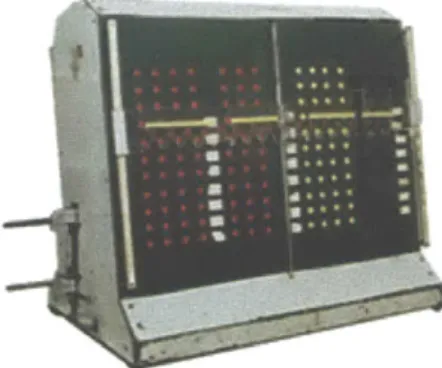
Ricardo Puntel presented the mechanical card-punch machine shown below (Figure 3-1).
The solution was not considered efficient
-
manual counting was still necessary, and the
capital investment was frowned upon
-
resulting in the abandonment of the project.
Figure 3-1 - Mechanical Card-Punch Machine
Introduced by inventor Socrates Ricardo Puntel in 1960,
yet never put to use
What followed, in the late 70's and early 80's, were initiatives taken on by various states
in Brazil. These efforts were localized and not centrally coordinated, but nevertheless
provided experience and knowledge later implemented in the national system. These
include a prototype for mechanized voting presented to the TSE by the TRE of the state
of Minas Gerais (southeast Brazil) and various attempts of automating the registration
process. In 1983, the TRE of the state of Rio Grande do Sul became the first to make an
electronic record of its registered voters.
Motivated by these initiatives, in 1985 the TSE created an electronic national register of
voters for the upcoming 1986 state elections. Each voter received a Voter's Card, printed
with their name, ID number, voter number and voting location. These have similar
function to the Voter's Registration cards U.S. citizens receive at their home addresses.
The responsibility of transcribing voter information, validating it, and issuing voter's
cards were subcontracted to 3 parties. Completed in late 1986, the project resulted in a
consolidated record of Brazil's 70+ million eligible voters.
The next milestone achieved by the TSE was automating the counting, consolidation and
transmission of voting results. Under this scheme, votes counted manually at the ballots
would be summarized in written reports submitted to local transmission points. From
that point on the information would be processed and transmitted digitally to TRE's and
finally to the TSE. The regional (TRE) and national (TSE) agencies would each publish
real-time data reports to the press in 15 to 30 minute intervals.
To support the process of transmission and consolidation of votes, the TSE created a
network of 4,530 desktop computers linked using telephone or data lines to 11 regional
mainframe units, and 7 mainframe units in the TSE center in Brasilia. The system was
put to national use in the 1994 national elections. The field was then set for the final
stage of creating a fully automated electronic voting process.
In the next section, I will review the process that gave birth to the electronic voting
machine. Requiring a mere 20 months from first deliberations to use in national
elections, the project was an amazing political, judicial, managerial and engineering feat.
At the same time, concessions had to be made, and their repercussions will be analyzed.
While the technological solution will be reviewed as part of this discussion, this review
does not aspire to give a full, up-to-date description of Brazil's voting machine
technology.
Such reports can be found elsewhere [12], or on the TSE's website
(http://www.tse.gov.br). In our efforts to apply Lean to voting, our focus will be on the
process by which the voting solution was developed, produced, distributed and implemented. After each major step in the process, a dedicated section reviews its relevance to the Lean model. Thus, we can use the Brazil process as a backdrop for implementation of a Lean system in the US.
3.2 Brazil's Electronic Voting Machine Project
The following section will follow the timeline of planning, development, contracting, production, deployment and use of the electronic voting machine in Brazil. The process was orchestrated by the head of the TSE, Minister Dr. Carlos MArio Velloso, and the head of Information Technology at the TSE, Dr. Paulo Cesar Bhering Camardo. Below (Figure 3-2) is an adapted flow chart of the project based on the schematic given in a book by Dr. Camardo "0 Voto Informatizado: Legitimidade Democrdtica" (Computerized Voting: A Democratic Legitimacy) [13]. The ensuing process description is also heavily based on this manuscript.
Industry, Academic Definition of Selection of
and TRE Input Biking Teiis Wining Proposal
Strategic Plarumng ('emigNed all for
al d Su & 5-and Evaltiaig * a
-8 TadeffsCritena and S fhvare)
Production
Model Production " Distribution Election Post-Election
Approvalloent Evaluation
Production lcto a
Quality Control Final Testnig Perfone Data
Figure 3-2 - Schematic of the Voting Machine Project
3.2.1 Strategic Planning
This first step in the development process was in effect an effort to gather support across the board for the program. This involved lobbying of politicians with executive and legislative powers, as well as organizing the management and oversight of the program within the TSE. At the same time, a publicity effort was launched to inform and ready Brazilian citizens for the upcoming change in the way they vote.
The leaders of the TSE established the main goals of the program, which were to be referred to throughout the development, bidding, acquisition and deployment phases of the project:
1. The system will allow a fully automated/electronic voting experience - from the voting itself, to the counting, to the forwarding of results to the central national database.
2. The system will be deployed throughout the country for the 1996 municipal elections, meaning it will be available in at least all the capitals of Brazil's states.
3. The equipment should be impervious to fraud, and should allow auditing of its function.
4. The system (equipment, programs and processes) should be transparent and gain the approval of citizens, political parties and candidates.
LEAN: Strategic Planning
Careful planning is a condition for the success of any project. From the Lean perspective, planning ahead reduces waste. Mediocre planning results in processes that fail to add value and in result in unnecessary revisions that take up valuable time and resources. Therefore, careful planning is essential even as one is about to embark on developing solutions. In this case, strategic planning helped assure broad support and good communication among stakeholders in the upcoming effort.
3.2.2 Defining Needs and Evaluating Tradeoffs
An elaborate, yet extremely efficient process was used to define the needs and general requirements of the new voting machines. While primarily an engineering challenge, the process began with joint efforts of politicians, legal specialists and engineers. These formed a group - The Commission for the Automation of the 1996 Municipal Elections)
- that met regularly between April and August of 1995, giving forth to the following reports:
Reference Draft of Needs and Requirements
This first deliverable elaborated on the four points of the strategic plan. It is an initial draft of needs and requirements the system was projected to meet:
* The cost of the equipment should be in line with the budget of the TSE. * The system's versatility should allow it to be used outside of election times.* " The system must not create new obligations for the voter, and it should be useable
by individuals of all intellectual and physical capabilities.
* Identification of the voter should be by way of a valid document, in the purpose of limiting fraud and ballot-stuffing.
* When voting for a candidate, the voter should also be allowed to vote by way of writing down the name of the candidate.*
* The system should guarantee the confidentiality and authenticity of the vote, and be resistant to manipulation.
* The option to recount votes and audit the counting should be maintained.
* The voting equipment should guarantee a reliable and uninterrupted voting experience, throughout the election period, with no loss of registered votes.
* The voting equipment should be easy to install and maintain.
* The voting equipment should allow immediate counting and aggregation of votes after the closure of the ballots.
Supporting Legislation
In parallel, an effort was made to adjust the Brazilian Elections Law to accommodate the new system. While the items of this legislature merely reflect the expected performance and accessibility of the system, what should be noted is the relative ease in which this more "political" step was accomplished. This speaks well of the buy-in achieved across the board by the project leaders.
Plenary Decisions
During the months of May through August, the Commission furthered the concept of the new system. As a first step, it gave a go-ahead to various interested parties to start developing concepts for the voting apparatus. Such prototypes were to adhere as much as possible to the Reference Draft drawn above. Next, it secured funding from the TSE for further development of prototypes that best met its criteria.
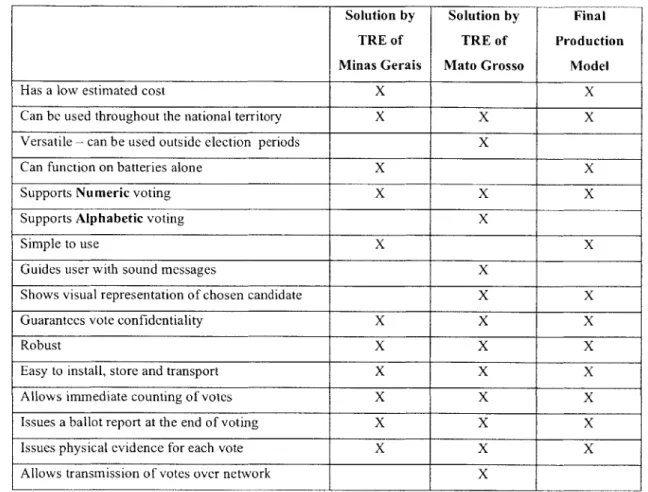
Four TRE's (regional elections committees) and 2 private companies presented concepts and models to the Commission. Two of the solutions stood as the most mature designs. As can be seen in Table 3-1, they each answer a different subset of initial requirements.
Solution by Solution by Final TRE of TRE of Production Minas Gerais Mato Grosso Model
Has a low estimated cost X X
Can be used throughout the national territory X X X
Versatile - can be used outside election periods X
Can function on batteries alone X X
Supports Numeric voting X X x
Supports Alphabetic voting X
Simple to use X X
Guides user with sound messages X
Shows visual representation of chosen candidate X X
Guarantees vote confidentiality X X X
Robust X X X
Easy to install, store and transport X X X
Allows immediate counting of votes X X X
Issues a ballot report at the end of voting X X X
Issues physical evidence for each vote X X X
Allows transmission of votes over network X
Table 3-1 - Comparison of Voting Machine Prototypes The Minas Gerais and Mato Grosso VM prototypes (August 1995)
vs. the final production model (October 1996)
Commission's Final Report
The Commission issued its report at the end of August of 1995, giving its final criteria, observations and guidance. This report formed the basis for the ensuing competitive concept and business-plan generation phase. The following list is a summary of the principle requirements of the new voting system. Since these are meant as conceptual
guidelines, they do not define the technical solutions but rather the needs the engineers should address in their designs.
The equipment should...
1. be easy to install.
2. be easy for voters as well as reception attendees to operate.
3. have a low cost. Bidders should adhere to their initial proposal price allowing for
minor design modifications during development.
4. have an independent energy supply for the case of power shortage.
5. be robust.
6. be controlled remotely from the reception desk in a way that the voter will vote
only once.
7. issue physical proof of the vote which should contain the candidate's name, number and political party.
8. collect the physical proof of the vote without intervention of the voter. 9. allow future updates and upgrades at competitive costs.
10. have a screen that allows easy review of the ballot and other information.
11. be made available in sufficient quantities to allow testing, and later for training of
voting attendants and the general public.
12. display the picture of the chosen political candidate when the voter is asked to confirm their vote.
General Technical Considerations
In addition to the recommendations above, the meetings of the IT team resulted in additional observations regarding the engineering solution. These pertain to engineering trade-offs, directly affecting security, accessibility, lead-time and cost. Interestingly, they have much in common with the dilemmas facing developers of American voting technology today. Their solutions, however, are highly dependant on the cultural, economic, political and technological conditions at the time and place that they are being considered.
Installing the list of registered voters list on the voting equipment - Installing the voters list on the machine would facilitate voter identification, as well as prevent voters from voting more than once. At the same time, it is likely to increase the cost of the system.
Numeric or alphanumeric voting - Numeric voting (voting by way of a numeric code unique to each candidate) simplifies the necessary equipment and makes it easier for illiterates to vote.
Networked or isolated hardware - A networked solution reduces costs and simplifies the
voting units. Networked units introduce risks of communication faults, complicate use in
remote areas and require more complex installation (as of 1995, when wired and wireless networks were not as developed as they are today).
Physical proof of vote - While physical proof of votes acts as backup in case of equipment failure and allows easier recounting and auditing, it also considerably raises costs and complexity.
Custom vs. off-the-shelf equipment and technology - Relying on existing equipment and technology lowers costs and lead times, but makes it harder to create a voting solution best adapted to Brazil's election system.
Use outside of election period - If the equipment is made of off-the-shelf components, it
might be useable outside election periods, getting better return on investment and saving on storage costs.
The scope of the e-voting solution for the 1996 elections - The more regions to be addressed with e-voting in the upcoming elections, the higher the investment and logistics complexity.
Reducing the number of voting precincts - One would expect that e-voting would allow higher voter throughput per center, allowing the reduction in the number of centers required to address the population. However, due to the groundbreaking nature of this project, this is merely an assumption.
LEAN: Defining Needs and Tradeoffs
Meeting the needs of customers or users is the best way of ensuring pull. Carefully considering and deciding on tradeoffs prevents future redesigns and fixes which waste valuable time and resources. By evaluating all these through tightly spaced committee meetings, information is efficiently disseminated to all stakeholders and they are kept focused on the end result and the pathway to achieving it.
When each party knows what information and feedback other parties require, it can align its output to meet those needs. This is the effect of Pull in a design environment. For example, establishing the rate of implementation of the new systems over the subsequent elections allowed assemblers to prepare their manufacturing facilities ahead of time. In turn, their suppliers could start preparing to produce the individual parts necessary for the voting machines.
Finally, committee reports and early contacts with suppliers ensured transparency of the process to all parties involved, further improving the flow of the process.
3.2.3 The Public Bidding Process - Call for Proposals
In September of 1995, the technical group of the TSE started establishing the technical specifications for hardware and software of the voting machines. They started by soliciting information from universities, regional election offices and private sector companies. One objective of the solicitation was to gather opinions of groups with appropriate technological experience regarding possible solutions. Another was to evaluate the production and deployment capabilities of national and international firms, as a way to ensure the executability of the project.
With the support of the parties mentioned above, the technical group was able to establish the technical requirements in the bidding invitation published in December 1995. The following is a description of key products and services to be supplied by the winning
Development
Three models are to be delivered by the winning bidder. The first is an Engineering
Model, to be submitted with the commercial proposal in response to the bidding
invitation. This model will serve to verify the technical capabilities of the bidding party. The second is a Qualification Model, which makes adjustments to the initial engineering model. The solicitation calls for 10 such units for evaluation purposes. The Production
Model is the final production version of the voting machine, of which 3 units are to be
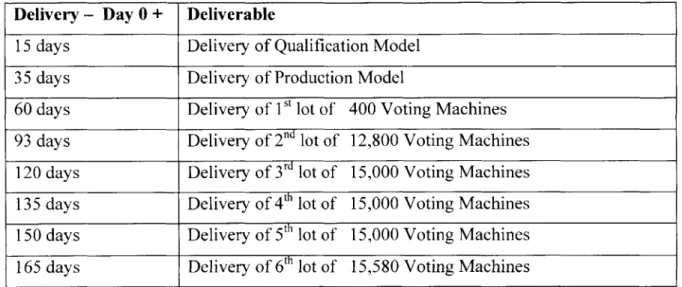
presented for final approval. The timeline for the delivery of these three models is defined in the chronogram below (Table 3-2).
Training
The supplier of the systems will be required to provide instruction in installation, operation and repair of the units.
Technical Support
The supplier is responsible for training and distribution of some 300 technicians for the upcoming elections. In addition to helping with hardware and software installation, they will be responsible for documenting difficulties and usage statistics to improve the system for ensuing elections.
Guarantee
The system should be guaranteed by the supplier for a period of 30 months starting from delivery of the final production lot.
Transparency
Transparency should exist between the supplier and the TSE regarding hardware and software solutions. The technical team of the TSE reserves the right to solicit alterations in the models and software presented by the supplier. It should also have access to the supplier's facilities for the purpose of product and manufacturing inspections.
Timeline
The estimated timeline for development and delivery of the voting machines is shown in
the table below:
Delivery - Day 0 + Deliverable
15 days
Delivery of Qualification Model
35 days
Delivery of Production Model
60 days
Delivery of
1'tlot of 400 Voting Machines
93 days
Delivery of
2"d lot of12,800 Voting Machines
120 days
Delivery of
3 rdlot of 15,000 Voting Machines
135 days Delivery of 4th lot of 15,000 Voting Machines
150 days
Delivery of
5th lot of 15,000 Voting Machines
165 days Delivery of 6 th lot of 15,580 Voting MachinesTable 3-2
-
Timeline of Voting Ilachine Delivery by Unisys Brazil
Since the contracting "Day 0" was considered March
15th,1996, this timeline guaranteed
production of all necessary VM's by August
30th,1996. Actual delivery took slightly
longer since the final VM count was 77,459 vs. the projected 73,780, but was still
concluded well ahead of the October
3rd,1996 municipal elections.
LEAN: The Bidding Process
To become Lean an enterprise must seamlessly integrate its suppliers into its value
stream. In the product development effort, this enables better flow of information for a
fast and efficient development process. It also reduces the chances of major problems at
the manufacturing and distribution stages, allowing tight schedules such as that shown in
Table 3-2.
Therefore, instead of reaching a final concept and licensing production out, the TSE had
chosen to find a company to partner its effort with. This choice makes a lot of sense, and
reflects on how important the project leaders saw good communication between design
and manufacturing. Inviting the supplier to be a part of the design and development
process is mutually beneficial to both parties, and promises to reduce
waste
of time and
resources that come from redesign loops.
3.2.4 The Public Bidding Process
-
The Winning Proposal
The TSE established a special committee for judging the bids of voting machine
suppliers. The international bidding started on February
8th,1996 when three companies
presented their proposals to the TSE. These were:
IBM Brasil Indnstria
-
Maquinas e Servigos Ltda.
Procomp Amaz6nia Indn'stria Eletr6nica Ltda.
Unisys do Brasil Ltda.
The following are images and brief descriptions of the voting machines submitted by
each company:
IBM Model of 1996
This model submitted by IBM was developed at IBM-Japan and was based on a notebook
concept. The Brazilian federal government emitted a provisional law at the time that
exempted suppliers from paying tax and duty fees for importing and sale of voting
equipment to the TSE. This measure was used to encourage a more competitive bidding
environment. Had IBM's bid won, the voting machines would have been completely
fabricated and assembled in Japan and imported by Brazil.
Procomp Model of 1996
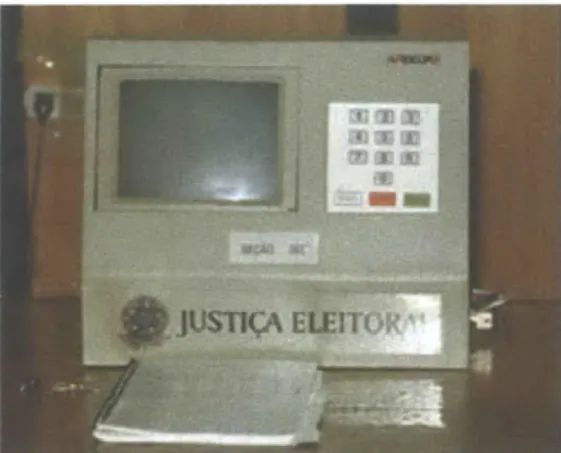
AW-Figure 3-4 - Procomp's Voting Machine Prototype
Weighing in at 551bs and 4 times the size of the Unisys model, the Diebold Procomp
model resembled automated bank tellers. It was, in fact, a common desktop computer
and screen encased in a single tin box. The result was heavy and extremely impractical.
Diebold-Procomp later created a machine almost identical to Unisys's to win a 1998 bid
for 90,000 additional voting machines.
Deliberations included five meetings of the companies with the special committee and the
technical team of the TSE. The technical team conducted exhaustive tests on the
Engineering Models presented by the competitors. On March
14th,1996 Unisys do Brasil
Ltda was chosen as the winning bidder.
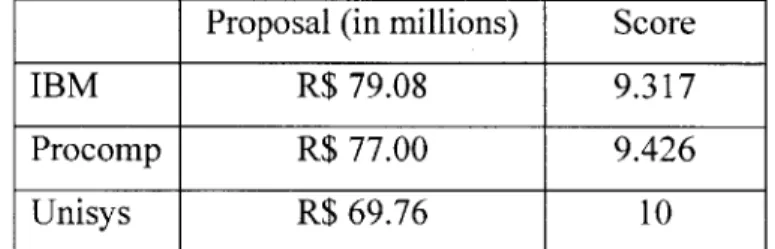
The winning bidder was chosen according to a formula that gave equal weight to the
technical score and the price of each machine. As all companies had been working
together at the technical meetings, it's not surprising the differences in the final score can
be mostly attributed to the final price bids rather than technical differences:
Table 3-3 - Voting Machine Proposals of the Three Major Bidders
LEAN: Bid Selection
Bidding processes are not very characteristic of Lean. Lean manufacturers, such as
Toyota, avoid inducing bidding wars among their suppliers. Instead, they usually stick to highly capable suppliers and maintain long-term working relationships with them, openly sharing technical and business information. This fosters an environment where the parties are mutually financially responsible, information is readily exchanged, designs and specifications rapidly adjusted and effects of general market conditions are smoothed out. In addition, expensive and time-consuming bidding processes are reduced for both sides, eliminating the waste of the two most important resources - money and time.
While confined to the use of a bidding system to secure a supplier, the TSE made the utmost effort to closely follow the development efforts of each bidder. This resulted in 3
Proposal (in millions)
Score
IBM
R$ 79.08
9.317
Procomp
R$ 77.00
9.426
highly competitive solutions in a short amount of time. Fortunately, the most practical
solution in this case was also the lowest priced.
3.2.5
Development of the Hardware and Software of the Voting Machine
The first model delivered, in accordance with the accepted proposal, was the Engineering
Model. The Engineering Model was subsequently submitted to field trials conducted by
several regional elections offices. The operators as well as voters used in these trials
were inexperienced subjects representative of the future users of the system. Based on
the trials, recommendations were issued to enhance usability and voter experience. These
recommendations were reviewed by technical committees that applied the lessons learned
in the Qualification Model and later in the Production Model.
The following is a general description of the hardware and software solutions used in the
final Production Model.
Hardware
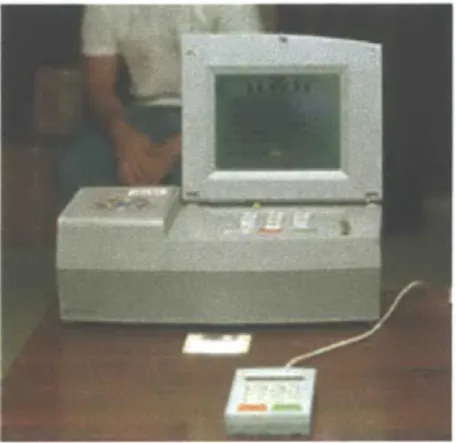
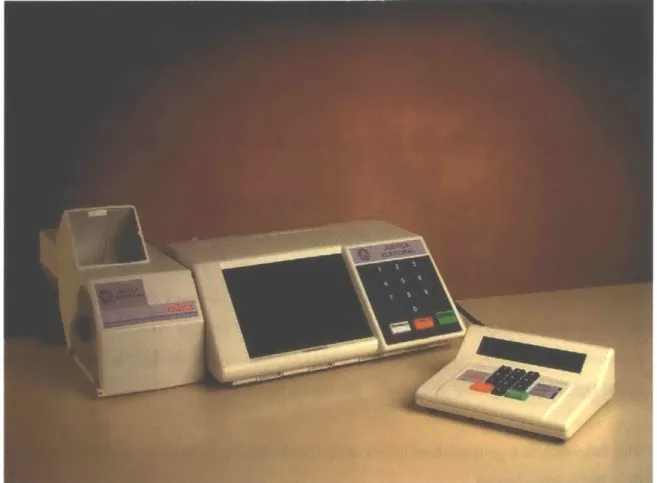
The voting machines deployed at the polling locations are each built of 3 major
components: a Voter Unit, Microterminal and Printer. The Voter Unit features a 9.4"
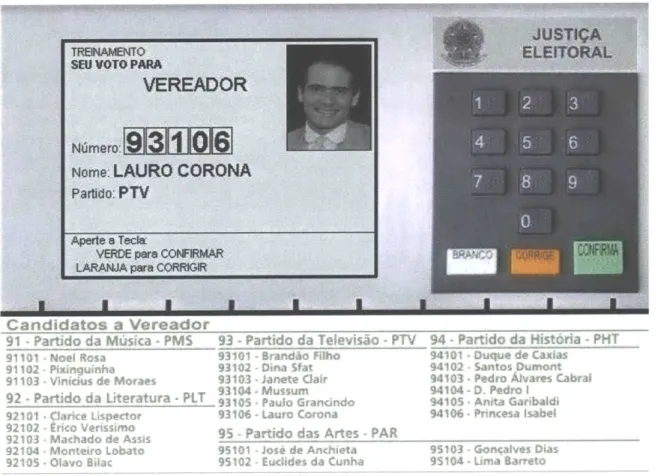
monochromatic LCD display with a 640x480 native resolution. It includes a keypad with
the numbers 0 through 9 and 3 feature keys: a white "BRANCO" key for registering a
neutral vote, a red "CORRIGE" key for clearing entered numbers and a green
"CONFIRMA" key for confirming the vote. All the keys are inscribed with Braille for
the visually impaired. The pressing of any key results in an audible sound.
Inside, the Voter Unit features a 386SX motherboard with a built in display card, a
40MHz processor and 2MB of RAM. The back panel features a parallel port (for printer
and data connections), 2 serial ports and an AC connection. There are 2 disk drives in the
voting machine, and they both accommodate 3.5" HD 1.44MB floppy disks. One is
considered the "internal" drive, and the other the "external" drive.
Figure 3-6 - The Unisys Electronic Voting Machine (2002)
Pictured are the main Voter Unit (center) which is used by the voter, the administer's Microterminal (right) used to key in voters' ID numbers, and the ballot printer (left). Note the black plastic bag behind the printer,
used to collect the printed ballots.
The internal drive contains the operating system, the voting software, and the database of candidates, political parties and voters of the region. The access to this drive is restricted and requires a key held by the ballot administrator. The developers found this solution convenient, as no copying or special uploading were required by administrators, only the insertion of a floppy disk. The external drive is normally kept empty, and comes into play only at the end of the voting session. When voting is completed at the end of the day and a disk is inserted into the external drive, the machine automatically saves what is called a BU ("Boletim de Urna" - Ballot Report). This report contains a summary of the votes placed for each of the candidates/parties.
Finally, an internal 12V, 6.5Ah battery can sustain the unit in case of a power outage for up to 3 hours. When used in remote areas with no available electricity, a larger external battery is made available (or, as in later models, an internal battery that can support the system for up to 13 hours).
The Microterminal unit is connected to the Voter Unit through a long data cable. It is placed on the registration table and remains connected to the Voter Unit which is placed behind a division. The terminal features a numeric keypad and 'cancel' and 'confirm' keys. The two line LCD display prompts the administrator to enter the voter ID number, shows the voter's name, and requests the administrator to confirm the entry. The Printer is also wired to the Voter Unit, and prints on 3" wide paper. After each ballot is printed, it is cut from the roll and allowed to drop into the ballot bag. The voter does not have the option to view this printed ballot.
Software
The voting software was developed through a joint effort of technicians from the TSE and Microbase (a subcontractor for Unisys). The team performed several simulated elections and systems tests with the help of regional elections offices. These experiences helped in formulating the final version for the Production Model. The software for the
voting systems remained proprietary, or "closed source." The contracts with the suppliers allowed them to remain such under the premise of protecting intellectual property. Today, many are pushing for disclosure of the code [14] in order to enable third party auditing.
During the first round of elections technicians of the software group visited technical support points - assisting with software issues and gathering feedback. This process proved itself advantageous, for many issues surfaced that helped make the second round of elections much smoother. Due to the rigid fraud protection algorithms many simple errors by the operators were viewed as violations. This resulted in system lockups forcing the use of the backup "traditional" paper ballots. In the second round, the processes were streamlined, thus eliminating most false-positive fraud lockups.