DESIGN BY SEARCHING:
A SYSTEM FOR CREATING AND EVALUATING COMPLEX
ARCHITECTURAL ASSEMBLIES
by
Matthew Giles Phillips
Bachelor of Architecture
Virginia Polytechnic Institute and State University, 1999
SUBMITTED TO THE DEPARTMENT OF ARCHITECTURE IN PARTIAL
FULFILLMENT OF THE REQUIREMENTS FOR THE DEGREE OF
MASTER OF SCIENCE IN ARCHITECTURE STUDIES
AT THE
MASSACHUSETTS INSTITUTE OF TECHNOLOGY
MAY 2007
Copyright (c) 2007 Matthew Giles Phillips. All Rights Reserved.
The author hereby grants to MIT permission to reproduce
and distribute publicly paper and electronic
copies of this thesis document in whole or in part.
Signature of Author:
Department of Architecture
May 23, 2007
Certified by:
0AOZ13Zd
Kent Larson
Principal Research Scientist in Architecture
Thesis Supervisor
Accepted by:
'
j
Julian
Beinart
MASSACHUSETTS
INSITTE
Professor of
Architecture
OF TECHNOLOGY
Chairman, Committee for Graduate Students
JUN
14 2007
ROTCH
Matthew Giles Phillips
Design By Searching
A System for Creating and Evaluating Complex
Architectural Assemblies
Readers:
Dr. Terry W. Knight Dr. George Stiny Dr. William
J.
MitchellAcknowledgements
To Kent Larson for providing both the opportunity to pursue this work and for your tireless guidance along the way.
To Terry Knight for your tremendous assistance and support in
shaping this research, you have been a guide for me during my time at MIT.
To George Stiny for your thoughtful and practical suggestions.
To Bill Mitchell for your valuable perspective on the issues at the heart of this work.
To my participants for thier time and energy, and for contributing to so much of what this research has to offer.
To Carla Farina for your assistance in preparing numerous materials.
To my family, for believing in me.
To the 32 students lost in Blacksburg, Virginia, April 16th, 2007, may you rest in peace.
I would also like to thank: Dr. Stephen Prince Neeraj Bhatia Lu Ai Jennifer Beaudin Kenneth C. Cheung Christoforos Romanos Michael Fadel
Contents
Design by Searching
A System for Creating and Evaluating Complex
Architectural Assemblies
1 Abstract
9
2 Introduction
10
3 Design by Searching
16
4 The Result Set: Component Based Representations
37
5
The Query: Conceptual, Constructive Interfaces
45
6 User Evaluations and Findings
74
7
Search System Prototype
96
8 Where Do We Go From Here?
125
APPENDICES
Appendix 1: User Exercises
133
Appexdix 2: System Details
153
Abstract
Design by Searching
A System for Creating and Evaluating Complex
Architectural Assemblies
This work investigates a prototypical Web-based search system designed to enable architects and/or developers to engage and educate residential consumers in a new way: as co-designers. The key motivation is to develop software tools that support a feasible industrial process while providing home consumers with a way to conceive of and design spaces, as an alternative to the standardized commodity solutions that are currently available. The basic mode of operation for this work is to combine the structure of the modern computational search with emerging building modeling technologies as a foundation for Web-based participative design tools.
Object-oriented component representations have been utilized to build a solution space that can be searched directly, without indexing. Additionally, conceptual query interfaces have been designed and evaluated through interviews with
volunteer users. The component-based solutions and conceptual queries were then incorporated into a prototype of an architectural search tool which was analyzed to measure its effectiveness.
Thesis Supervisor: Kent Larson
Principal Research Scientist in Architecture
Readers:
Terry W. Knight George Stiny William J. Mitchell
1
Introduction
Architects don't have a meaningful role in the design of most homes. They design the usual avant-garde houses that decorate magazines, and the custom one-off designs that get built for rich people, but these and the other projects that involve architects comprise only a small number of the homes that get built in the
US. The rest of our houses do not involve architects in developing a
solution for individual homeowners, and certainly do not involve the potential homeowners in the design - they are standardized in design to target the center of the home market. This is, of course, a result of the economics of the home market and the developer's production methods: by building standardized, non-variant houses or living units, developers reduce complexity and thus reduce cost. But these homes do not have any direct relation to the potentially changing needs of individuals; the idea is that the standard templates are good enough. The process endures because the people have no vocal chords for expression and thus no voice for complaint - houses are expensive and the process of ownership is complicated and intimidating. Plus, non-standard homes may be difficult to sell, being anomalies in the housing market: wanted by a few people perhaps, if only those people could find them. So the market is built upon our silent acceptance of mass-standardization, because through our limited choice and limited awareness of the market, we the people let it be so.
In the market-driven world of housing development, is there any space for the dreams of humanity in the building process? Can people engage with architects and design on a large scale? Perhaps there is a way. In looking at current trends in the industry, advances in technology may become a facilitator not only for new design processes but for consumer-participative design processes. In
computers, the recent emergence of component-based representations for architectural structure means that software can now know more about the spaces upon which it operates. For example: Autodesk, the market leader for CAD tools, has shifted from their traditional AutoCAD software platform to Revit, which utilizes Building Information Modeling (BIM), a component-based representation.
Their goal in making this shift was to better facilitate information exchange between architects, builders, and engineers. And the new, more detailed computational representations like BIM are already showing the potential to transform the home production process, essentially reducing economic barriers that worked architects out of the loop in the first place, by making it easier to share and communicate and by reducing field labor costs. Reconfigurable, pre-fabricated assemblies, described as a hierarchy of components, can be made and assembled affordably, and described computationally, which may facilitate mass-custom designing on a higher level.
This work explores the potential of emergent technological innovations to facilitate a democratization of the design process, where interested home-buyers can interact with high-level tools that are built on top of more descriptive representations like BIM
-representations which are in turn connected to fabrication processes, thus realizing a new model for mass-customization. One of the key challenges is to find high level representations that allow people to understand and design spaces, according to their own needs and values. Apart from a plethora of web-based, traditionally searchable listings, there are two broad categories of home design tools that are currently available to people. These are simplified narrative "configurator" type tools, and tools that are based upon a 2D or 3D modeling environment. The former is so constrained that truly rich preference specification simply isn't possible, and the latter is very unfamiliar to most users.
Figure 1.1 Different Apartment Layouts
in a component-based representation
K Larson, M G Phillips, C Farina rendering by C Farina
Figure 1.2 Configurator System l dil: A. An example from the automotive industry, CA C'At AR HO"W MRA NW 1, PRINT lewM,
the Maserati car configurator QUATTROPORTE DUOSELECT
http://www.maserati.com
t&A~t~TI WT 7 DIM MO hllI DPID4 M4ADUN. CAAPIIS
Configurator tools (Figure 1.2) are basically narrative scripts that combine different types of representations like text and images to describe the design product to people. As will be described, these tools walk the user through the selection of specific options, using strategies that are essentially simplified expert systems. But even the more easily navigated of these systems give only specific and limited options, creating a process that is not educational, and a product that is only minimally configurable. Expert systems face significant limitations because their abstract needs assessment processes do not work well with an open-ended and unconstrained process like designing. Lucy Suchman notes that "the structure of the interaction is procedural, constituted by a sequence of actions whose order is partially enforced." (Suchman 99) But tools should acknowledge that people learn by observing themselves: "the sequences of operations and procedures we execute; the clues we observe and the rules we follow; or the values, strategies, and assumptions that make up our 'theories' of action." (Schon 25)
At the other end of the spectrum, there are numerous modeling environments that allow everyday users to design a home. But modeling software is not something that's inherently approachable
-most people do not know how to represent their ideas spatially, the way an experienced designer does.
The fundamental issue with both configurators and modeling environments is that of representation. Problems emerge because these systems fail to describe relationships or pieces of information that are not within the representation, but still shape the related
products or processes. Computational representations have this limitation in common with other methods of description, like
architectural drawings or model-making; in fact, in working with any representation, the complexity of the actual design product is stripped away. But just as architects may move between sketches and models to get a sense of the thing they are creating, and to develop their expertise, this research aims to discover whether or not a
computer-based interface can accomplish the same thing through an interactive, multi-representational approach. Towards this end, this research has endeavored to both clarify the parameters of architectural decision-making logic, and to provide constructive, iterative tasks that span multiple distinct representations and facilitate a sort of "learning
by doing" for consumers.1 The fundamental argument is that the establishment of a hands-on, educational design environment is a critical aspect of consumer-based product design systems.
To engage people, this research proposes a direction that is quite different: utilizing search algorithms to enable participative designing. The concepts discussed herein are meant to address the specific and significant problem of spiritless residential architecture, by proposing and evaluating a system for the specification of choice, in the context of residential architecture. The study is constrained to a simplified
context: a middle-income, US-based, multi-family residential development. This context is particularly interesting because of the diverse consumer profiles and the current demands being placed on the industry. As spatial functions and user needs evolve, builders have made increasing efforts to efficiently prefabricate flexible living spaces that are in tune with social context and also adaptable. A decline in the availability of skilled labor and the increased complexity of housing systems has increased the expense of field labor and provided further impetus within the industry to find a new way to build. To promote this effort, the software guidelines developed here are intended to support a new industrial process for architects, developers, and consumers.
Ultimately, this study is founded on the notion that consumer-oriented design systems must support the conceptual exploration and discovery of places, and that they can do so by utilizing the structure of search engines. But this new search must enable the
act of designing, without overly constraining it. To facilitate better conceptualization than that supported by current tools, people need to be able to learn what they want while finding it. Towards this end, search engine tools that have traditionally been tied only to the process of discovery within specific formats, have the potential for expansion into the domain of educational design tools that can attach to multiple representations. The search will be centered upon queries that are spatial and/or diagrammatic, and that may be mapped into a component-based modeling system like Autodesk Revit. Rather than speculate about the effectiveness of any single type of search, the work explores the potential of various types of interfaces for constructive searches, and proposes a common index structure that each of the interfaces could be built upon. The specific bases for the conceptualization interfaces are: natural language, metaphorical role-playing, diagrammatic languages, and flows/sequences.
The primary deliverable of this work is the evaluation of prototypical tools intended to support the conceptualization of spatial configurations. There are two types of tools studied: conceptual querying interfaces and a component-based modeling system.2 Evaluation is done through user studies with volunteers
involving constructive, paper-based exercises; the results of these evaluations are used to design a system prototype that integrates the different interfaces. Figure 1.3 shows various tags that were used in the exercises. Additionally, the integration of this system's design
... ....
Figure 1.3 Tags for User Exercises
Various paper word-tags. These were incorporated in various design exercises
formats with other technologies is explored for both designers and consumers, and speculation is made about the potential effectiveness of these types of systems in improving the sustainability and efficiency of private spaces, and in the opening of service channels between designers, manufacturers, and home consumers.
Apart from describing the mechanics of the system, this work endeavors to create a design context that can improve residential home configurations, in important and diverse ways - primarily through the generation of more generalized, but also individualized, custom designs. But also, indirectly, by improving each consumer's understanding of space and how they exist within it. As Kevin Lynch notes, users derive benefits from a more rich understanding of their environment.3 (Lynch, 111)
The work shown here represents only the first steps towards the generation of a system for consumer-based residential design
- there are many details that still need to be worked out. As such, the prototypes, evaluations, and implementations are of reduced complexity. And ultimately, this work describes only one approach in an area of inquiry where many others may be taken. But if we can engineer search tools that work like those prototyped here, we may provide the foundation for a more efficient industrial process,
by first involving consumers and designers in spatial layouts and
space definitions, and secondly by associating these layouts with autonomous and relatable prefabricated parts.
1. The provision of these tasks is made in support of the idea that
constructive processes are inherently educational. I will look in more detail at various sources for learning by doing: Seymour Papert
-Mindstorms, Donald Schon, and Piaget.
2. Component systems are directly searchable because they can describe each of their parts inherently. Further, in the Society ofMind Marvin Minsky has made assertions about how humans store and relate concepts about functionally autonomous parts, detailed further in his forthcoming book "The Emotion Machine". These various parts will therefore be the basis for the conceptualization tools.
3. The schematic partitioning of space is certainly a much older concept, but Lynch is notable for the specific characterizations made through field observation.
2
Design by Searching
2.1 Design ToolsAs a category of software, current non-expert design tools quickly highlight the most fundamental constraint of any computational system: the limited descriptiveness of the representations the system uses. We arrive at this problem so quickly because non-expert design tools, as a rule, must inject educational, or at a minimum, supportive criticism into whatever representation of choice they happen to be working with, to help guide the user through the process of designing. The criticism structures are tied to and constrained
by those representations. There are two common problems that
rise from this: first, the tools cannot scale beyond the limits of the representation. And secondly, the user's learning support systems are tied to the specific representation of the tool they happen to be using, rather than the conceptual design domain within which the tool is attempting to facilitate the discovery.
Designing in a complicated domain like architecture requires knowledge about forms, structure, lighting, materials, and so on. Moreover, the process is a scalable one; often architects will ignore some details of the problem to address other design concerns, and are constantly shifting their area of focus. For example, an architect may be very concerned with the organization of spaces around a central hall, and may do some design sketches of the plan configuration without trying to work out the details of what the walls and roof will be made of. These other things would be "saved for later". At first glance, the architect may appear to be simultaneously managing all sorts of different design considerations, and selecting between them with computer-like precision until a final design is resolved, complete in every detail. But research has shown that the architect's process is far less controlled, and involves the constant discovery, and re-discovery of problems and solutions within the context of a design.' The professional act of designing is far more of an improvisational act, with some structure provided by project constraints but with tacit knowledge, and reflective learning constantly at play.
The idea of constant discovery is an important one because it highlights one of the most critical functions of an architect, and that is to find and frame problems as a way to steer through the immense potentiality of the physical solution space. Architectural design is like a search for good solutions. But it's a search for the unknown, not a search where you know everything ahead of time. It's like trying to find your ideal mate, not like looking for a penny on the sidewalk. You might know a few things that the person should be or have, but your ideal mate is likely a complex fit -and probably not very easy to describe completely.
The first efforts to make software tools for novice users attempted to engineer professional knowledge that guided people through the architectural design process. These solutions could be described as basic expert systems, where a linear narrative of "value" questions led to a design recommendation. An early example was the ARCHIT expert architectural design system from the 70s (Figure 2.1), which was criticized for its limitations. (Negroponte) The failure of these systems quickly highlighted the problem with their approach: improvisational, tacit designing, which all good architectural design consists of, is not easy to encode as a script. First, the design process is not linear; it may be circular, tangential, or even random. And abstract realms of knowledge, like aesthetics, may be a source of
11 A 6S4K VITIROUl COMM~l gpa017
1) A $Ml vtim W cu111SACE N 011 Wf SIV OIY
31 A SINK VITH CIONTtme aC 0 01M1 51057?
00 YOU MAI'T 9C1I Of YOMl tMMLI TO PIAVE 5111101 LAVATORY FAclUTI11?
WAI 22110 0 or MKS be youl ant raf vole CWITVArr 1)5 uS3 VITVOMI CO0UNT"1 SPAM~
1) SINKS WIT"i COMMZ SPACE an cot slot MAI? It 3211 W17H COU.45 SPA"E 011 1011 S105)1
-I Mar out"3 1.AVATMIC 9O0O Vi I!T
310 a WEST? AVATMY, WIAT 1100 Of $IN f OU AST!
1) TIM SIll VIPAUT COhINIER SPACE?
ft Tot1 TYPE WITR C00*M1) SPACE 40 0111 IM1 OsLy?
111 11H TIlT 1191M 004PTAN SPAE 441 1111 31011? 3100 151FROM 1) $Mow~ 4) 10111 s) nitvia te me ftPnxio 0 4010,009" SPACE st"CASIO01 A 0 C 0 t
is 11513 Siml 1.33 1.40 1.1 all les .13 0=00 I 10- Ilto SBUS5 10" 0.00 Ali3 33 0.000 11 11100 S9p MW8 lo) .40 0.00 1.33 20.3 0400
is 4113? $lip . 1.40 0.00 123 11,04 0090
IPAT IRJI u
305* 312 1 5178 1 Figure 2.1 ARCHIT Screenshot
Example of an early, narrative expert system interface for architectural design
>
user
...
reacts to criticisms modrepresentati
A bes any isms modsystem<
Figure 2.2 Design Critic Cycle The iterative cycle of an embed sub-routine
18
decisions in the design realm. Flat, linear systems simply didn't allow people to relate, in a rich way, their own knowledge to the problem, or to discover their own solution within the problem space.
This incompatibility with abstract design sources points to an important criticism of design engines: the flat-out inability to handle or encourage metaphorical and associative thought. This is something that people are really good at, and something that human designers are constantly doing. For example, the architect may borrow ideas or fragments of structure from other projects to arrive at their own solution. Or the entire design process may be metaphorical: the architect may, for example, try to evoke the nautical sense of a sail with a sweeping roof design. These ideas are context, time and space specific; they may even be discovered by accident. For non-experts, this type of associative virtuosity should also be enabled and supported, for it is the most basic of conceptual structures, and organizes both the design inquiry and the designer's thinking. 2 In
the realm of associative thought, everyone is an expert simply by being alive, aware and human.
More recent consumer design tools have emerged that associate various design interfaces with software critics. (Figure 2.2) These critics are programs that evaluate designs according to a specific, encoded rule-set. 3 For example, R. Williams (MIT House n)
explored methods for training software programs how to criticize a user's designs by comparing those designs to pre-evaluated examples. (Williams) These tools represent a significant improvement over linear scripts because they are iterative in nature and allow the user makes a
ification to make (and learn from) mistakes, by highlighting those mistakes
V in some way. (Figure 2.3) This makes interactivity inherent in
)nl
the process and allows for more self-direction, depending on the representation used. An everyday user could conceivably create a reviewsification simple floor plan by placing pre-arranged room configurations, and upon completion, a critic could be invoked to check out specific properties of the design -for example, to make sure the rooms all connect up, or that the toilet is connected to a water-wall. In application, this works better for someone who is an expert already,
ded critic because having the critic discover more than a few of errors creates
a dizzying scene for a novice, where the logic behind the critic's descri
* Awtodetsk R-vi ftdinimn 9 lPsilrtl 1 oi Pln- I swrd I I Figure 2.3 Design Criticism In Revit
Here, the user has attempted to place a door in the open floor. note the prompt
S
U9 i a x I J pe q c 0 1 Uialdw If w l
'y fte M Z |g 03 03 [p ( R li Deo.h Akin #Spit t Teim Offst [ (
Tag Ceiling Plans Door Levall
~ndsw
tev.e12~~
9 Eleva. (sBuidng East Room Nofth West g*Legends f&eed*
Schedules/Quaie LnS ED Sheets (all 01g0 F irierepestaalJMatrepiate tHost Try sin edeg citeent Hsst Face of ietco
rereintatio and then ea teceuate rocess these iinnfee
Whoerwhelrepresenaton mayu
tha
alowethem
tnoemrleteel
exore poiteniasluisthcriticiutifrfcsrm
quiklsplecdethems out
of discover correctness. The non-expert knows nothing about theserules, which, of course, is why they were encoded in the first place. But this is also their biggest problem: they represent a black-box of hidden mechanisms where confusing outputs frustrate, complicate, or
terminate the design process.
For the everyday user, there's also a problem of distraction. Where the representation may have allowed them to more freely explore potential solutions, the criticism quickly pulled them out of their conceptual problem space. At the lowest level, this is because the criticism is tied directly to the system's representation, and cannot scale to fit different conceptual representations the designer may have been holding in their own mind. So quite simply, things may be surprising or make no sense. As learners, adults are self-directed (Lieb): they must be able to perceive the immediate or long-term benefit of working through a problem, and they must be able to relate the design to their own experiences on a conceptual level. This relation must be allowed to persist throughout the act of designing, because it's the fundamental mechanism for seeking out and selecting
solutions. 2.2 Search tools Archie Gopher Excite Yahoo! Directory WebCrawler Lycos Infoseek AltaVista
Open Directory Project Google
Figure 2.4 Early Web Search Tools
Original tools like Archie and Gopher were essentially list searches
For architectural design tools, the ability for self-directed discovery within the problem domain is highly constrained by the current standards for non-expert technology. The fact that technology is a shaping factor upon the experience of humans is an inevitable dimension of how people interface with their own creations, and is not, inherently, a problem. But when a recognizable need cannot be met, the technology must be either retooled, or we must look elsewhere for a solution. And so, in looking elsewhere for a solution to the integral flaws of expert systems and embedded critics, this research explores that which is arguably most fundamental
to computing: the search itself.
Computing technology is structured around, and perhaps informs, the popular conception that there is some sort of divide between searching and learning - that you must first find some resource, and then, only once you have found it, begin to learn from it. But in everyday life we often observe the contrary: that the act of searching, especially through reflective self-evaluation, is inherently an educational process and the learning is related specifically to that which is being searched for. Consider again the example of finding an ideal mate; many people conceive of the process of dating as a way "to find someone" during which people learn a lot about themselves and what they value in a spouse. The same type of dynamic, reflective searching is particularly true in the context of design.
The rise of the internet and the democratization of information access into more horizontal network structures have naturally led to a parallel rise of web-based search engines that allow people to navigate the immense search space of the internet. (Figure 2.4) In fact, as the primary window into cyberspace, these search tools are in a position of fundamental, central importance: just as Vannevar Bush speculated in the late 40s, it was managing the access and retrieval of an unprecedented amount of information that was key. Prior to the World Wide Web, early search tools like Archie and Gopher allowed people to search file names but not contents. With the
1990 1991 1993
1994
advent of the Web in 1993, search tools that could parse full page contents were already emerging. With the bar raised to full content searches, indexing systems were developed to manage the immense
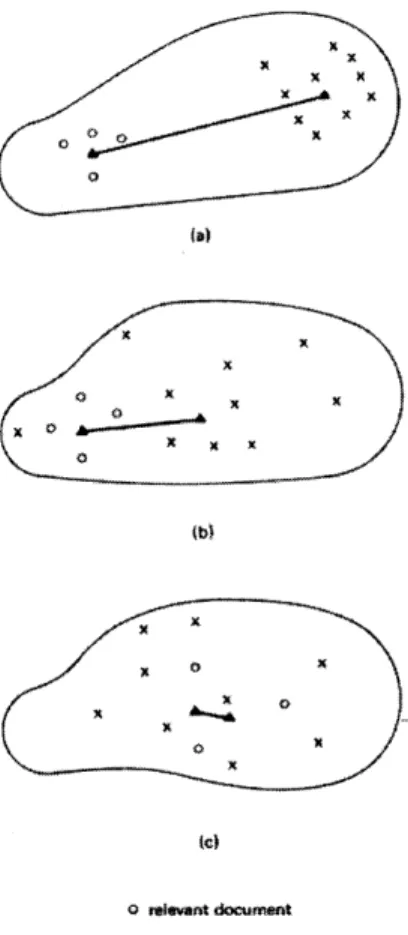
and ever-expanding search space of the Web, and to make searches more efficient in real-time. A pioneering researcher in this aspect of searching was Gerard Salton, whose team developed many algorithms for retrieving information more quickly, including the fundamental concepts of document relevancy by word frequency (Figure 2.5), and the automated indexing of documents to make them simpler to parse. To accomplish this, various crawlers (also known as spider) programs emerged, their purpose was to automatically navigate through sites, following links and writing what they see into a central database. This central database thus becomes the collective index. Of course, the index is never complete and never up-to-date, in the context
of the Web it creates the illusion that the entire Web is searchable when in fact it is not. The phenomena of unreachable, dynamically
generated content that escapes the notice of crawlers became known as the Invisible Web. (Bergman) In fact, the improved search functionality of sorting documents by popularity, which helped Google emerge as the leading search tool from 2000 to present day
(2007), actually increases the tendency to overlook many resources.
(Bergman)
In discovering the Web, one quickly learns that there is a standard format and methodology for searching, and for discovery: a text box that you can put text in, with a button next to it. You type something in, click the button, and up comes a listing of available and matching resources: behind the scenes, the listing may be ranked, cached, intricately sorted, maybe even paid for, but to the user the listing is always conceptually the same: an ordered set of results. If the results aren't quite right, you can use some different words and try again, until you find what you're looking for. All of this is really just a roundabout way of saying that most Web users know how to
search interactively, and most Web users have a mental model for "query", "search submission", and "browse results". This process is fundamental, inseparable from browsing, maybe frustrating at times, maybe educational at others.
Therefore, if we conceive of a search operation as a new
o relevant document
x nonrelevant document
A average item
Figure 2.5 SMART Relevance Feedback
From Introduction to Modern Information
Retrieval by Gerard Salton, 1983 21
user arrives at
search
engine\
user clicks on link to go toresult
user qUEinte
user viewsresults
listing
A enters teiry
rface
xtq
sub~ system performs search of .indexes
crawler runs automaticallyindexing
mechani
Figure 2.6 Web Search Engine
Typical structure of an indexed s crawler runs on its own, asynchr
22
model for a software-based design process, we have the advantage of a democratically accessible and standardized set of primitive components, which we may then overload to support designing.
2.3 Overloading a search
If searching is a fundamental part of designing, then could the computational search engine be utilized as a structural foundation for a design system? This research supports the development of search tools to help everyday people conceptualize and design physical spaces, recognizing that design-based searching should be a more constructive process, and that some new avenues will need to be
nto explored.
4
So, in what ways does the standard conception andimplementation of searches limit the learning of the human who is searching? Could a search be expanded to allow for the user-defined
4j specification of non-textual, spatial-diagrammatic queries, and could
uery
the construction of these queries become an inherently educationaluitted to
system process? Designers must be able to search for solutions by iteratively working through a problem to construct a solution. By examining current search technologies in terms of their constituent parts, we may illuminate potential areas for further study, or for injection of new constructive processes.
Search tools have three primary components: an indexing mechanism that summarizes the search space (typically crawlers or directories), the querying interface where users enter a search term, and the results listing. (Figure 2.6) Web-based search tools are generally indexed for manageability and performance. Most search tools are text-based, such that the query, the results listing, and the searching functions are dealing with natural language handling, parsing, and matching. Some newer search tools integrate the
conceptual or semantic organization of textual terms in a map-like image, but these are still fundamentally text searches. Recent improvements in computer vision algorithms have lead to the development of visual/image search functionality; for example, e-commerce sites that allow consumers to search for products by .arch, comparing items to a source image. The more advanced of these
match between the images, be it color, size, or shape. I For all types of search, the results display will always be sorted: there is an expectation among search users that the top results will be the best by some measure; this measure may be relevance, popularity, influence, or something else. (Fensel, et.al. 18) The query is generally submitted through a simple dialog that then launches the results listing in a discrete page or interface. This allows the search dialog to stay up, and facilitates a smoothly interactive process of query refinement.
Because searching is fundamental, every computer user has some sort of understanding of how a search works. And this is exactly the reason why search functions are such a compelling source for building more powerful design tools: they are fundamental, widespread,
and well-known to virtually all users. What better foundation for enabling the exploration of designs, for a large community of diverse users, than search engines? Everyone who uses a computer has a conceptual model of what a search engine does, and what its basic parts are.
2.3.1 The Query
On computers, the search term, or query, is almost without exception a text string. Various rules may be encoded into it, like quotes to match phrases or meta-rules like the "define:" directive
Google provides. 6 But knowledge of these advanced features isn't necessary, and ultimately, the standard query is still flat, abstract text. Newer interfaces have begun to integrate visual organization into
the query, in an effort to create a process that is more intuitive. For example, some web sites use a semantic diagramming structure; the idea behind this visual representation is that it helps people navigate
the search space by grouping concepts together and relating the groups into a kind of primitive organizational structure. 7 The search
query is still plain text, even though the representation is more visual in nature. But could the process of specifying the query be something more constructive, something that allows users to assemble visual information? Could it be something along the lines of drawing or composing an image, and what would be the benefit of a visual query as opposed to a textual one, in the context of architecture?
The motivation for moving towards constructive queries is to improve the learning supported by the search process in general, and to improve the mapping of search concepts to discovered architectural solutions, in particular. Let's start with the learning part, and Jean Piaget.
Over the course of his life-long research into the cognitive development of children, Piaget closely related the mental
development of children to different types of interaction with the environment. As children grow through various stages of knowing,
their understanding of the world evolves from simple conceptual structures related to movement and objects, to the development of motor skills, followed by logical thinking and ultimately abstract reasoning. (Piaget) 'While there is no clear division between these stages of development, they are all fundamentally about iterative cycles of doing, and they indicate that knowledge is fundamentally constructed internally by the child, through processes of reflection. This new perspective lead Piaget to a set of theories about learning by doing, known as Constructivism.
Others would pick up on this line of inquiry, as did Seymour Papert, who had worked with Piaget in the 1960s. In 1980, Papert published Mindstorms and formally described his concept of Constructionism, which draws in part from Constructivism, but further identifies the process of building things as an intensive and primarily educational mechanism. From his observations, Papert contrasts basic mathematical knowledge developed through traditional methods with Constructionist methods of instruction, finding that the latter lead to concepts that were more relatable to various types of tasks, and also more significant to the children. (Papert, 53) Further, he describes an important point: that the knowledge built through making things can be developed just as effectively by various types of learners, even kids that were previously "mathophobic", because the process of construction enabled them to relate things that were meaningful to them as individuals. (Papert,
63)
To help people learn about architecture, this work tests the Figure 2.7 Children with Turtle
Learning with Logo, from Mindstorms viability and accessibility of spatial or conceptual images that are
The fundamental challenges with this are first creating a way to construct searches that people are comfortable with, and secondly determining the level of descriptive capacity that people really want to have access to, and finally determining whether that level of description can be matched effectively with various computational representations of architecture.
This research is aimed at tools for the potential home owner, and therefore, adults. Adults really aren't as efficient learners as children are, because they're influenced by experiences and expectations. (Minsky 1, 92) There are innumerable reasons this may be the case, but experts in the field generally agree that it has something to do with the following properties of adults. First, they have more
de-motivating roadblocks: they may be short on time, or may have other responsibilities or concerns that prevent them from digging into the task. And they are far more self-directed: adults want to be able to pursue a problem in the way that is most comfortable to them. (Lieb) Finally adults must be able to perceive the immediate benefit of something before committing the time to learn about it: they will have more resistance to learning new things at the onset if the interest isn't there inherently. In the context of a more visual search, this means that the task of image-making, which would probably be new to most users, is potentially daunting. In fact, upon realizing that almost all Web searches are text searches, one might speculate that the general consensus among search developers is that people simply can't or don't want to do searches by image-making.
To get a sense of what may or may not be doable, different types of conceptual querying interfaces that related searchable concepts differently were evaluated. Rather than speculate about what sort of searching interface might be the best one for our purposes, this sort of evaluation gives us a better foundation for future work and opens up the possibility of using different query interfaces, or different combinations of queries, for individual users. This research evaluates the effectiveness of four querying interfaces: text-based, role-playing metaphor, activity-based, and diagrammatic. Chapter 4 will provide a detailed summary of each interface type.
Among those tested, diagrammatic representations are the most difficult to search with, but they're attractive because they have
Figure 2.8 Lynch's Diagram of Boston A problem map that summarizes urban
wayfinding information From The Image of The City
by Kevin Lynch, 1960
26
enough constraint within them to be understood by a computer, and they also make sense to people, as suggested by the work of Marvin Minsky and Kevin Lynch. However, being able to make sense of diagrams and being able to actually create diagrams are two different things; the diagramming process must be approachable. (Lynch
11) Furthermore, because the diagrams are potentially much less
constrained than the parameters of the search space, there is greater potential for the user developing unmet expectations in the act of diagramming. In other words, they may think they are specifying something meaningful as a search criterion, where in fact they are not. This will be discussed in greater detail in the following sections.
In his research about how the human mind may structure and retrieve information or knowledge, Minsky speculates that there are likely many different types of structures at play, with different types of functionality to facilitate different types of knowing. Among them are semantic networks, which relate together the various parts of entities or processes. These networks may be assembled into narrative sequences, which might related to simple constructive processes, like what happens when you move a chair, for example. (Minsky, 137) The fundamental idea here is that people understand that which
they see in terms of their constituent parts or properties, and that these parts might be relatable, or swappable, to facilitate low-level associative thinking. Low-level associative thinking takes many forms and is evidenced by metaphorical relations; for example, thinking of a slice of pie to describe a pie chart.
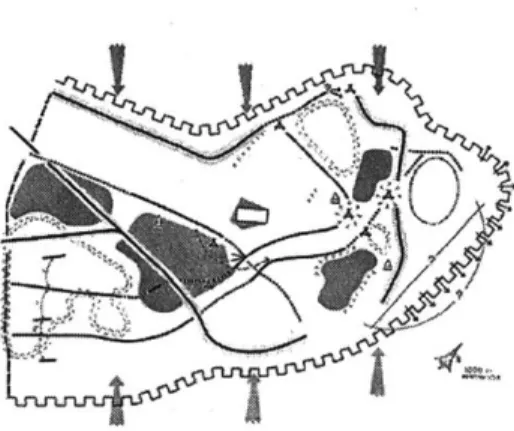
In the specific context of spatial configurations, Kevin Lynch's research on how people understand their environments pointed to a common language of parts for these knowledge networks, at least at a high level. Through evaluation, he discovered that people's conception of space could be generalized into a few specific types: paths, districts, edges, landmarks, and nodes - and that these types of things could be related diagrammatically. (Figure 2.8) He extracted these findings through the case study of specific cities, and conducting interviews with inhabitants. The basic types that Lynch describes are the foundation for the specific diagramming language evaluated herein, where districts and edges taken together are simplified into the cell(s) of a grid. Nodes and Landmarks are characterized as particular
functions or activities granted a specific location. And pathways persist as a way to connect the other primitives together, to create basic assemblies or systems.
Taken together, the work of Minsky and Lynch suggests that simplified diagramming processes may map well to human thought, and specifically human thought about spatial organization. The potential area of difficulty in constructing the diagrams is that making them forces one to think about thinking. Architects for example, seem to love diagrams as a way to organize thoughts about things, this is like a meta-process for them, and inherently reflective. But this type of high-level analysis may be an endeavor that only the experts have the knowledge to pursue. Would beginners even know where to start?
Rather than focus upon just one strategy, this research is exploring the different characteristics of four unique query interfaces. The primary reason for this is to provide users with multiple options for expressing themselves, particularly if one of the interfaces seems difficult or unbeneficial. In addition to the diagramming interface, this work examines an interface that allows users to list out each activity in a routine that happens in their home. Another alternative is tested as well, an interface that allows users to imagine packing up their various possessions, as a way to think about their needs. And finally, text-based checklists are provided as a more standard type of interface. Each of the interfaces is described in detail in Chapter 4.
AS WE MAY THINK
A TO U.L %. SUET FOWUS A POSSLE FUTUE WORU
IN: WICH MAN.MADE MACHINES WILL START 10 THN
W U AZ WE MAY TESr 01- V
2.3.2 The Search
As long as there have been computers, people have been thinking about methods for searching. In his influential 1945 article As We May
Think,
(Figure 2.9) Vannevar Bush cited the need for technological advances in searching: "The summation of human experience is being expanded at a prodigious rate, and the means we use for threading through the consequent maze to the momentarily important item is the same as was used in the days of square-rigged ships." (Bush) Bush was arguing both for the record of data, and forassociative, conceptual tools to help people navigate the data.
By 1965, electromagnetic data storage was more widespread.
Figure 2.9 As We May Think By Vannevar Bush, published in
Altantic Monthly in 1945
attr iutes
define details -
-< tag attribiute="" >
tag defines
slua"* < child tag
, - information </ child tag Lagsae. hieramia < child tag> -. information </ child tag > </tag > Figure 2.10 Hypertext
Example of HTML tagging structure
28
Gerard Salton, a researcher in the then-emerging field of computer science, pioneered the era of modern retrieval algorithms with the SMART information retrieval system. His system introduced important indexing concepts like document frequency, term
frequency, term discrimination, and relevancy feedback for text-based searches. (Salton)
Salton's work introduced concepts that are still very much in use today. At around the same time, Ted Nelson began publishing about his concept of "hypertext", or the embedded tagging of metadata into informational resources to apply structure and accomplish attribution. The World Wide Web would eventually be developed using the idea of hypertext for its fundamental document structure, and the tagging mechanism is what enabled the more efficient and robust indexing mechanisms to be developed. (Figure 2.10)
The work of Salton and Nelson was on the leading edge of search tools that were built to function through indexing. In the context of searches, indexing refers to the retrieval, parsing, and storage of data for improved efficiency. Particularly in the context of the internet it
emerged as a necessary element of search design simply because of the size of the potential search space. When you do a search on Google,
for example, you're not searching the internet in a "live" fashion; you're searching Google's index of Web resources. Google, like all Web search engines developed from 1993 on, utilizes specialized
crawler software to automatically index the Web by navigating through links and parsing the web pages that are encountered. These parsed pages are then stored in Google's databases, which means that the search can be faster and more reliable in terms of delivery, but never completely up-to-date in terms of the content. And because much of the Web is dynamically generated by server-side programs that even the most advanced crawlers cannot parse, much of the Web becomes un-searchable, invisible.
But of course, this is the reality of the immense problem of searching the Web. Apart from global Web search engines, many web sites have their own searches which read through the internal
information that drives the site itself as a way to deliver content. 8 These searches do not need to automatically generate indexes; the
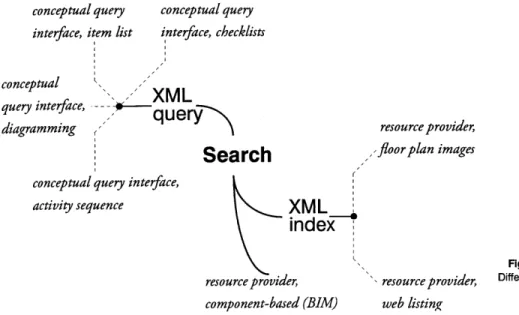
This research explores functionality that is very much like a Federated search, which searches for results from a specific group of known resource providers. (Figure 2.11) In system described here, the providers are builders or developers that want to offer searchable homes. So the system is situated between the small, site-specific solutions and the global, indexed solutions like Google, and will highlight additional problems and complexities. In order to associate
the previously described conceptual query images with various types of architectural representations, we must describe not only a common indexing mechanism, but also a mapping process that translates the conceptual to whatever literal representations we want to be able to search for. The index which is proposed and evaluated is an XML-based record of the conceptual structure. When an image query is constructed and submitted by the user, the XML description is automatically generated. In the search space, resources may have their own XML description which can be compared directly, or
they may be mapped to the query in real-time by an intermediary application. However, this system does not require any automated crawlers to facilitate indexing functions, for several reasons.
First, as opposed to the incalculable size of the internet, our search space is much more constrained. Under the Open Source model and as detailed in the subsequent chapter, a centralized conceptual search may be used to query finite, discrete resources that are offered in various formats by specific developers, builders, or
conceptual query conceptual query interface, item list interface, checklists
conceptual
query interface, -
que
diagramming resource provider,
Search
floorplan imagesconceptual query interface,
activity sequence XM
L
index
Figure 2.11 Proposed Search Structure resource provider, resource provider, Different query building interfaces to search different types of representations
architects. Each of these resources is accessible to the search interface through mapping functions, or by direct comparison of the resources where the representation allows for this. As such, the XML indexes represent more of a common specification, a meta-representation to use between other representations, and the submission becomes a more complex operation of, for example, mapping conceptual searches to JPEGs.
Search submission is most often thought of as a one-way process, but in truth it's far more interactive than that. Using Google as an example: the search term is submitted, and processed against a complex matching algorithm against available resources, where the available resources are the entirely of the Web. Google's result listing allows the user to both reflect upon their query (if the results were unexpected) and to revise and re-submit. So the search process provides criticism and guidance via the relevance measure of the results. In the context of the proposed design tool, let's assume the available resources would be designer-provided floor plans. Each floor plan would further specify a mapping protocol to dictate how the searches' primitive components should map into physical form. It is here, within the submission process, that the essential design criticism may be embedded by describing the relevancy score for each available resource directly within the user's original search image. This enables the relevancy information to provide criticism and
guidance to the user inherently, as part of the searching process. The criticism logic is constrained neither to the conceptual nor the literal representations; it exists between them. The criticism is emergent, derived from the relationship between the query and the results themselves.
In his discussion of the emergence of different and late-period styles in music, Edward Said asserts that part of music's structure and purpose is to remind the musician of the specific styles of the time. He notes: "Were this reminder to be simply a repeated no or this will not do, late style and philosophy would be totally uninteresting and repetitive. There must be a constructive element above all, which animates the procedure." (Said) In the context of the proposed design search, this same sentiment is reflected by the criticism process, which may serve not only as a stylistic guide, but as Said further describes, a
set of parameters within which styles can emerge through constructive and iterative processes.
Structurally, the criticism components would be part of the common XML specification. The act of search submission becomes an important part of the iterative cycle of searching by designing, because it allows the user to instantiate the criticism automatically upon invocation. There are a few reasons that the two-way search process, and thus the posting of criticism functions back into the search dialog, may be challenged as unnecessary.
First, as shown in Figure 2.12, there is an inherent criticism process in the standard search where the user may reflect upon the correctness/effectiveness of their query simply by reviewing the result set to see if it contains what they are looking for. But, the problem with a design search is that the user, in general, will not know what they want. So they won't have a good way to evaluate the utility their search image without a little assistance. Secondly, common
text searches can do things like highlight words in the results listing, to let people see what words matched up. But along those lines and because the source query is a visual one, the relevance of the results is best described visually as well, and in the conceptual context of the query itself. And because of the wide potential for multiple target representations accessible through the mapping functionality, the query image becomes an important common thread that the user may both construct in and evaluate through. The diagrammatic representation can describe how the results are a good fit, and how they are not, simply by highlighting the portions of the diagram that match. This builds upon the inherent iterative cycle of the search but incorporates new spatially organized relevance and scoring strategies, as a way to help the user learn about design parameters.
.>
user
.
reacts to enters or
criticisms adjusts a query
V
conceptual query interface
A
relevancy info searchfinds
posted into best match
query for query
results <
2.3.3 The Results
Web Search results are of a common type - HTML. Powerful search tools can automatically parse related formats, like Google does with PDF, DOC, TXT, RTF files, seeking them out the same way that Web content is searched for. But the search matching is still text to text: even in special contexts like the Google image search,
Figure 2.12 Criticism as Part of Search
Relevancy information provides design guidance to the user.
n0--Index manual or automated generation 6 Raster Image
Figure 2.13 Image with Auxiliary index Different query building interfaces to search
different types of representations
32
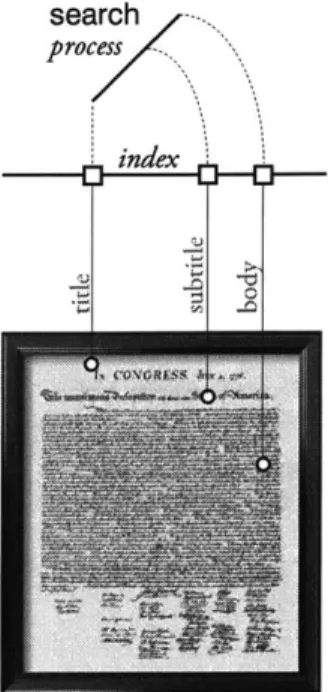
text-based meta-data and text-to-image relational algorithms actually "find" pictures by finding text. ' In the proposed system described here, mapping functions will be explored as a way to relate the search image to any different type of architectural representation: a tagged image, a component-based model, an adjustable vector-based floor plan. This mapping is managed through a common language which, as detailed in the previous chapter, is the XML index. But how would this index get related to various types of representations?
In this sort of scheme, raster images would need to have an XML description generated, and that would be paired with the image as an
index for comparison. (Figure 2.13) While this process of indexing could be either human-managed or automated, it's problematic either way. The development of more advanced computer vision algorithms makes more plausible the idea of using programs to automatically scan and tag raster images, but the level of sophistication to reliably analyze and tag floor plans has not been accomplished. The details of this class of problem in computer vision are outside the scope of this research. And vector compositions and 3D models are problematic in the same way. People could tag these representations themselves using an auxiliary tagging application, perhaps as the designs are being created. However, depending on the complexity of the tags and the number of images to be tagged, this process may or may not be manageable or sustainable.
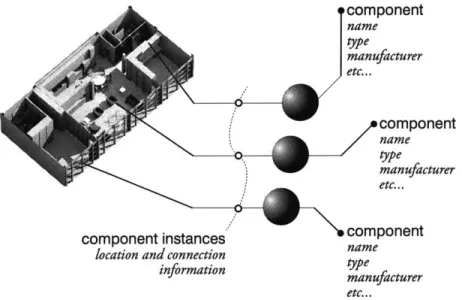
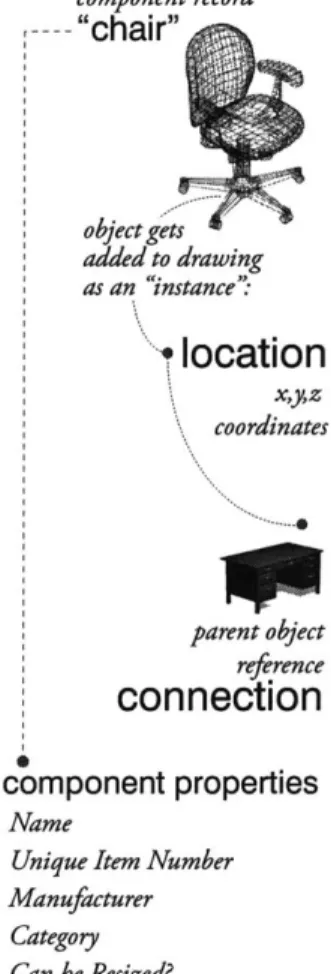
Component-based representations or models solve these basic problems of searchability simply by allowing for the autonomy of parts, but they also lead to new challenges. Because their representation is made of autonomous entities, the computer-based attribution process becomes straightforward. (Figure 2.14) In the current (2007) world of professional tools, we're seeing a shift towards design tools that facilitate the construction of component-based reasons, primarily to build a standardized platform for
interoperability and smoother workflow. In a way, component-based representations are more intelligent about the physical world simply
by virtue of being able to distinguish things. Let us consider, as a case
in point, the evolution of AutoDesk's product offerings. Autodesk was an early developer of CAD systems, and has continued to be an industry leader in their area of specialty, emerging
,component
name typ e manufacturer etc... type manufacturer etc...component instances
'scomponent
location and connection name
information manufacturer
etc...
as the de facto standard of computer-based drafting tools through their leading product: AutoCAD. While developed around specific functions, processes and commands that are inherent to a computer program, AutoCAD, at the lowest level, was designed in mimicry of traditional pen and paper drafting processes. In AutoCAD you're essentially drawing lines, which may be given simple attributes, in terms of how they should be presented: weight, color, and style for example.
In 2002, Autodesk embarked down a different road with the purchase of Revit Technology Corporation and their new modeling tool. Shortly thereafter, upon the release of Revit Building, Autodesk began supporting drawing of an entirely different type: Building Information Modeling (BIM). The main idea behind BIM is that the drawings are no longer made out of lines or vectors, but autonomous components that have specific labels, properties, and functions. The primary motivation behind this type of tool is to streamline the process both for communication between different companies and organizations, and also to simplify the change and revision process.
A recent NIST report estimated conservatively that $15.8 billion
was lost annually by the US facilities industry, because of "the
highly fragmented nature of the industry, the industry's continued
paper-based business practices, a lack of standardization, and
inconsistent technology adoption among stakeholders". (Gallagher, 7) Component-based Solutions like BIM, which structure and support information exchange, are a promising solution. But with this
Figure 2.14 Component-Based Format
Object-oriented representations like BIM relate objects with specific functions and properties, rather than lines
autonomy of parts being inherent in the representation comes many other qualities, one of which, I'll argue, is inherent search-ability; thus, accessibility for consumers as well.
Referring back to the diagrammatic query language, BIM systems would be able to map to searches directly: activities relate to components, zones to containers of components, and connections to the hierarchical relation of components within certain containers. In fact, the conceptual search would prioritize these more expressive component representations simply by finding more relevant results there.
The problem inherent to all of these searches, of course, is how querywell the information they describe or search out may be related to the submited touser')s
actual sense of what they want. Can the simplified relation of
activities in various spaces really give the user a way to describe their architectural preferences? Because these tools are aimed at consumers of all different types and with different motivations, one cannot explore the search potential of BIM, for example, without considering the differentiability of the BIM configurations and how likely the user
query added to would be to search them out.
in V However, as Figure 2.15 suggests, the query could be used for
wiki user views
results more than just searching for available results. For example, searches design ts w n st iki
designcauonomysof patsubten dinret in th reresnttion o
m
esoumany
request providers. This may be particularly useful if the initial search query doesn't lead to any good results, because, as will be discussed, criticism would be tied to the results and would not necessarily be available or adequate. In this case, the user may choose to post their search query to one of the providers, as a design request. This keeps the user, and the user's understanding of their architectural needs (however primitive they may be), at the center of the process, even where the searchability of the representations in the search space is inadequate to map to their search.
In the case of the architect as a resource-provider, this creates the opportunity for a new service-based business channel, one that is
well the inforatio they
accessible and self-selected by the user.
descreboth
Fiue21u~frntQeyDsnto sersata es fwa hywn.Cntesmlfeeaino
Query artifacts could be used for more
It is conceivable that the search
toolcould become a central,
than searching, they could serve asdesign requests when posted to a wiki
organizational structure for
thehomeowner's ideas about their home.
community, for examplesr poteni eample, wout consid
A oeonofstr, a ndr indivduaiedtsearey could
be
psedointo a wiki-style resource full of spatial configurations, with associated comments and other meta-data. Here the search query becomes an artifact, an important node in a collaborative community. Over time, these artifacts could potentially give designers and users insight into the evolution of spatial use, or to improve user understanding of space and space use for better affordability and sustainability.