DeepTuner: A System for Search Technique Recommendation in
Program Autotuning
byKevin Wu
B.S., MASSACHUSETTS INSTITUTE OF TECHNOLOGY (2014)
Submitted to the Department of Electrical Engineering and Computer Science in Partial Fulfillment of the Requirements for the Degree of
Masters of Engineering in Electrical Engineering and Computer Science at the
Massachusetts Institute of Technology
July 2015 C
The author hereby grants to M.I.T. permission to reproduce and to distribute publicly paper and electronic copies of this thesis document in whole and in part in any medium now known or hereafter created.
AUHR:.Signature
redacted
AUTHOR: ... Department of Electrical Engineering and Computer Science
July 17, 2015
CETIIE B:Signature
redacted...
C ERT IFIED BY : ...
Kalyan Veeramachaneni, Thesis Spervisor July 17, 2015
Signature redacted
C ERT IFIED BY : ... Prof. Saman Amarasinghe,
7s
SupJuly 17, 2015
ACETE Y:....Signature
redacted
A C CEPT ED BY : ... ... Christopher J. Terman, Masters of Engineering Thesis Committee
MASSACHUSETTS INSTITUTE
OF TECHNOLOGY
LU
DeepTuner: A System for Search Technique Recommendation in
Program Autotuning
by Kevin Wu
Submitted to the Department of Electrical Engineering and Computer Science July 17, 2015
in partial fulfilment of the requirements for the degree of Master of Engineering in Electrical Engineering and Computer Science
Abstract
OpenTuner can help users achieve better or more portable performance in their specific domain through program autotuning. A key challenge for users seeking good autotuning performance in OpenTuner is selecting a search approach appropriate for problem. However, not only are current in-situ learning search approaches not robust enough to handle all search spaces, but there are also too many possible search approaches for a user to examine manually after factoring in composable techniques.
In this thesis, we introduce DeepTuner, a system for search approach recommendation operating across OpenTuner autotuning sessions to facilitate development of robust transfer learning search approaches. By utilizing historical autotuning data via DeepTuner's technique recommendation endpoints, the new search approaches can efficiently explore the space of possible search approaches and the autotuning space simul-taneously, resulting in an adaptive, self-improving search approach.
We demonstrate the robustness that recommendation brings on nine problems spread over three domains for a variety of initial technique sets. In particular, we show that the new Database Initialized Recommen-dation Bandit Meta-technique is highly robust, performing on par or significantly better than various old in-situ search approaches in OpenTuner. We achieve up to 3.7x performance improvement over the old default in-situ search approach for OpenTuner in the TSP domain.
Acknowledgements
First of all, I'd like to thank my advisors, Saman Amarasinghe and Kalyan Veeramachaneni. Throughout his many roles as an undergraduate advisor, PI, and thesis advisor to me, Saman has consistently provided great ideas and sound advice to keep me on track. His guidance and vision have been indispensable in breaking through (or simply walking around) the roadblocks hindering my progress. I also couldn't have asked for more out of an advisor with Kalyan. His knowledge and experience, combined with a tireless dedication to his projects and advisees, made working with him an absolute pleasure. His easy going personality and willingness to share new tools with me to make my life easier were the icing on the cake. This thesis definitely wouldn't have been possible without the support of these two amazing individuals and the great feedback they've given me. I'm truly grateful for all for their time and efforts.
Next, I'd like to thank the many talented members of the COMMIT group -past and present -for making my CSAIL experience great. Particular affirmations to Jason for his patience with helping me understand the ins and outs of OpenTuner; Jeffrey for many keen insights, his no-nonsense practical advice, and a uniquely dry sense of humour; Shoaib for help working with so many different languages and systems, despite being one of the busiest people I've ever met; Charith for some fun times with Helium; and finally my fellow MEng-ers Giuseppe and Yoana.
Also, I want to thank MIT for being the awesome, intellectually stimulating, open-to-anything and supportive community that enabled me to pursue so many of my different interests. I don't think anywhere else could have put up with the academic ADHD of my undergraduate years. I couldn't have asked for a better place to learn. Along those lines, here's a shout-out to all the great friends I've made at MIT. MIT would have been 99.9% less enjoyable without all of you brilliant people!
Last but not least, I'd like to thank my family. Without their unwavering support, I wouldn't have been able to focus on and enjoy my experience at MIT to the extent that I did. I feel truly blessed to have been raised by such devoted parents.
Contents
List of Figures List of Tables 1 Introduction 1.1 Program Autotuning . . 1.2 OpenTuner 1.3 1.4 1.5 DeepTuner . . . . Contributions . . . . Organization . . . . 2 Related Work 2.1 Autotuning Frameworks . . . . . 2.1.1 Linear Algebra . . . . 2.1.2 Signal Processing . . . . . 2.1.3 Stencil Computations . . 2.1.4 Runtime Systems . . . . . 2.2 Search Technique Hybridization .2.3 Algorithm Recommendation . . . .
3 The OpenTuner Framework
3.1 Problem Definition . . . . 3.2 Search Approach . . . .
3.2.1 AUC Bandit Meta-Technique
4 Search Technique Composition
4.1 Creating a Technique Base . . . .
6 8 9 9 . . . . 10 12 16 17 18 . . . . 1 8 . . . . 1 8 . . . . 1 9 . . . . 1 9 . . . . 2 0 . . . . 2 0 21 22 . . . . 2 2 . . . . 2 4 . . . . 2 4 26 27 . . . . . . . .
4.2 Choosing a Set of Operators . . . . 4.2.1 Param eter Types . . . . 4.2.2 Available Operators . . . .
5 The Cross-session Database
5.1 D atabase Schem a . . . . 5.1.1 Storing Representation Parameter Structure . . . . 5.2 Encoding Search Approach Data . . . . 5.2.1 Tracking Hyper-parameter Information . . . . 5.2.2 O perator M aps . . . . 5.3 Uploading Tuning Data . . . . 5.4 Historical Tuning Run Data Generation . . . . 5.4.1 Using the Cross-session Database . . . .
6 A Recommender System
6.1 The Recommendation Bandit Meta-Technique . . . . 6.2 An Example of the Recommendation Process . . . . 6.3 Advantages of the Recommendation Bandit Meta-Technique . . . .
7 Results
7.1 Testing Protocol . . . . 7.1.1 Meta-techniques Tested . . . . 7.2 Search Approach Performance Comparisons . 7.2.1 H alide . . . . 7.2.2 Petabricks . . . . 7.2.3 Travelling Salesman Problem... 7.3 Key Findings . . . .
8 Future Work
8.1 Expanding Recommendation in DeepTuner . . . 8.2 Search Affinity Metrics . . . . 8.3 Other Modes for Transfer Learning . . . . 8.4 Addressing Privacy Concerns . . . . 8.5 Developing New Parameter Types and Operators
28 30 30 36 36 37 37 38 38 39 39 39 43 45 49 51 52 . . . . 5 2 . . . . 5 2 . . . . 5 4 . . . . 5 5 . . . . 5 5 . . . . 6 2 . . . . 8 0 82 . . . . 8 2 . . . . 8 2 . . . . 8 3 . . . . 8 3 83
9 Conclusion 84
Bibliography 85
A Appendix A: Definitions and Terminology 90
A.1 Basic Autotuning Terminology ... . 90
A.2 Autotuner Specification ... . 91
A.3 Search Approach ... ... 92
A.4 Search and Evaluation . . . . 94
List of Figures
1.1 Levels of learning in OpenTuner search approaches . . . . 13
1.2 Autotuning performance of an in-situ learning vs. a transfer learning search approach . . . . 16
3.1 Structure of a problem definition . . . . 23
4.1 Hierarchy of OpenTuner's built-in parameter types . . . . 31
5.1 Database schema for the cross-session database . . . . 42
6.1 Specifying a search approach in OpenTuner . . . . 44
6.2 Search process for the the recommendation bandit meta-technique . . . . 48
7.1 Search approach performance in Halide bilateral grid by initial technique set . . . . 56
7.2 End of autotuning execution times for the Halide bilateral grid benchmark . . . . 57
7.3 Search approach performance in the Halide bilateral grid benchmark . . . . 58
7.4 Search approach performance in Petabricks matrix approximation by initial technique set . . 59
7.5 End of autotuning execution times for the Petabricks matrix approximation benchmark . . . 60
7.6 Search approach performance in the Petabricks matrix approximation benchmark . . . . 61
7.7 Search approach performance in Petabricks Strassen by initial technique set . . . . 63
7.8 Search approach performance in the Petabricks Strassen benchmark . . . . 64
7.9 Search approach performance in TSP att48 by initial technique set . . . . 65
7.10 Search approach performance in TSP dantzig42 by initial technique set . . . . 66
7.11 Search approach performance in TSP att48 . . . . 68
7.12 End of autotuning best route lengths for the TSP att48 benchmark . . . . 69
7.13 Search approach performance in TSP dantzig42 . . . . 70
7.14 End of autotuning best route lengths for the TSP dantzig42 benchmark . . . . 71
7.16 End of autotuning best route lengths for the ATSP ftv44 and ftv170 benchmarks . . . . 74
7.17 Database initialized search approaches in the ATSP ftv44 and ftv170 benchmarks . . . . 75
7.18 Search approach performance in the ATSP rbg323 representation . . . . 76
7.19 End of autotuning best route lengths for the ATSP rbg323 benchmark . . . . 77
7.20 Search approach performance in the ATSP p43 representation . . . . 78
List of Tables
1.1 Number of operators for parameter types in the Halide domain . . . . 11
1.2 Aggregate search affinity for technique classes on the brazil58 TSP benchmark . . . . 14
4.1 Implemented technique bases in OpenTuner . . . . 29
4.2 Descriptions of parameter types in OpenTuner . . . . 30
4.3 Available operators in OpenTuner by parameter type . . . . 33
4.4 Available operators in OpenTuner by parameter type (continued) . . . . 34
4.5 Available operators in OpenTuner by parameter type (continued) . . . . 35
5.1 Tuning run data contained in the cross-session database by representation . . . . 40
6.1 Example performance data in the cross-session database . . . . 49
6.2 Example search affinity similarity between representations in the cross-session database and att48... ... .. ... 50
7.1 Labels for tested search approaches . . . . 54
7.2 Benchmarks in the TSP autotuner . . . .. . . . . 67
Chapter 1
Introduction
1.1
Program Autotuning
Program autotuning has seen increased use in performance-critical domains as a supplement - or even replacement - for traditional human-guided optimization of programs. By delegating the exploration of the space of possible optimizations or alternate implementations to an automated search process, a programmer can save the time and effort of having to manually generate and test program variants. This also allows for the search of larger spaces. In addition, autotuning increases performance portability of programs. An autotuner can be easily re-run to determine new optimal settings when the underlying architecture or environment changes, unlike with hand-tuning where an experienced programmer must repeat the entire hand-tuning process again.
Despite increased use of autotuners in specific projects, the development of general, project-agnostic autotuning frameworks has been much more difficult. This is due to the combination of several properties of problem search spaces.
First, is the size of the search space. Autotuning search spaces are often exponentially large due to the combinatorial nature of optimization choices, making exhaustive search intractable. It is possible to prune the search space and artificially constrain its size. However, this introduces programmer bias in terms of which configurations will be examined, so excessive pruning can easily result in overlooking good configurations that were not intuitive to the programmer. Thus, having an intelligent machine learning search approach is critical to discover good configurations in these massive search spaces within a small number of evaluations. However, autotuning search spaces are highly diverse in topography and complexity, both of which affect the way a particular technique interacts with the space. For example, for some simple search spaces that are
relatively smooth and monotonic, a hill climbing technique would perform reasonably well. But in practice, search spaces can have multiple hills, discontinuities, plateaus, and other complexities like interdependencies or coupling between parameters. As a result, there is no guarantee that the same hill-climbing technique, or any technique for that matter, will perform well on a different, arbitrarily chosen problem. To complicate matters further though, the same problem can often be projected into multiple different parameters in the
representation (see Appendix A.2), resulting in wildly different search spaces. If the selected search approach interacts too poorly with the parameters in the representation, then the autotuner will be unable to find good configurations in a reasonable amount of time.
Thus, the key challenge for making a general autotuning framework lies in being able to select a search ap-proach that can efficiently search a representation that is arbitrarily defined by the user. And unfortunately, taking the naive search approach of just using a single technique is highly insufficient.
1.2
OpenTuner
OpenTuner provides a general framework for domain-specific autotuner creation that tackles this challenge [5]. OpenTuner features a library of extensible parameters that allows for the support of the arbitrary data-types are required to define a representation for a problem. An extensible library of techniques in OpenTuner helps to ensure that for any representation, there will be a technique that performs reasonably well.
Meanwhile, OpenTuner improves upon the naive search approach by utilizing in-situ learning (see Ap-pendix A.3) to exploit knowledge gained during the scope of the autotuning session. By bundling ensembles of individual techniques in a meta-technique and running them simultaneously to generate desired results, techniques that discover good configurations can be allocated larger testing budgets, while poorly performing techniques are given smaller budgets or disabled.
This was achieved in OpenTuner using the multi-armed bandit with sliding window, area under the curve credit assignment (AUC Bandit) meta-technique, building on previous work using a similar technique for operator selection rather than technique selection in [22].
In addition, techniques in a meta-technique can share information through a local results database, resulting in a collaborative effect that further improves search performance. As a result, an OpenTuner meta-technique provides an in-situ learning search approach whose search affinity (see Appendix A.5) for a representation exceeds that of the most efficient technique in the bundle. This makes in-situ learning search approaches significantly more robust to variations in representation when compared to a naive search approach.
Parameter Type Number of Operators PermutationParameter 12 Halide ComputeAtScheduleParameter 12 ScheduleParameter 12 BooleanParameter 4 PowerOfTwoParameter 6 Total Combinations 41472
Table 1.1: Number of operators for parameter types in the Halide domain
Each parameter type may take several different operators. Combining these give 41472 different choices for operator sets. The Halide ComputeAtScheduleParameter is a custom parameter type extending the
Sched-uleParameter. See Chapter 4 for more about parameter types and operators.
introduction of composable techniques (see Appendix A.3) presented in this thesis, the number of potential techniques to use for a representation has exploded even further. This is because every combination of
operator choices with a technique base results in a different technique.
For instance, representations in the Halide domain contain five different kinds of parameter types, as seen in Table 1.1. For each parameter type, we choose one from the multiple operators available. Combining these choices yields over 40,000 different choices for picking operators per technique base, and this number
will only grow further as new operators are developed and introduced.
This far outstrips the number of techniques that can be reasonably bundled within an in-situ technique. A typical tuning run may end before even 1000 configurations are tested, meaning the meta-technique will not even have time to try all of the meta-techniques, let alone determine their relative performance.
As a result, an in-situ learning search approach may still perform poorly despite its robustness if the meta-technique happens to lack a technique with good search affinity with the representation. With so many techniques, performing an exhaustive or manual search to determine which techniques to include for every new representation is also highly impractical for a user. Trying to account for collaborative effects only exacerbates the issue, as entire sets of techniques must be considered, of which there are exponentially many in the number of techniques.
As shown in this thesis, the default in-situ learning search approach in OpenTuner is indeed no longer sufficient for some problems, creating a need for a more robust search approach capable of efficiently and intelligently exploring the vast space of techniques. So, to achieve this, just as OpenTuner used the meta-technique to take the naive search approach to the next level of in-situ learning, this thesis presents Deep-Tuner, a recommender system, to take the in-situ learning search approach to the next level of transfer
learning (see Appendix A.3).
1.3
DeepTuner
The problem of choosing the right techniques to use for a given representation reflects the "deep" nature of general program autotuning. Just as the original problems in OpenTuner can be cast as a search space of configurations and explored using various search approaches, at the next level, the choice of search approach could in turn be cast into a search space and explored using some other search algorithm. In essence, the autotuning process itself could be framed as an autotuning problem. Extending this notion leads to infinitely many layers in autotuner systems, each being tuned by the layer above.
Each successive layer neccessarily operates over a larger scale of data, as a single configuration in the search space of one layer is an entire tuning process consisting of the evaluation of many configurations in the layer below it. As such, in-situ knowledge from a single tuning run is no longer sufficient for operating at the next layer of autotuning to efficiently explore the space of techniques. Rather, search approaches capable of transfer learning are required.
As seen in Figure 1.1, a transfer learning search approach in DeepTuner takes the in-situ search approach of OpenTuner to the next level from a machine learning aspect. A naive search approach, only performs learning using evaluation results within the scope of a single technique. An in-situ search approach built on this by using a meta-technique and performing learning using results within the scope of the entire local autotuning session. In a transfer learning search approach, the meta-technique not only uses evaluation results from within the current local autotuning session, but also uses global results from past autotuning sessions.
In this thesis, we present DeepTuner as a proof of concept to demonstrate the power of transfer learning over traditional in-situ learning methods in OpenTuner. DeepTuner is an open source extension to Open-Tuner providing a global data repository and technique recommendation service hosted on a private cloud to enable knowledge transfer across OpenTuner tuning runs.
DeepTuner leverages a cross-session database (see Appendix A.5) which stores historical search
affin-ity (see Appendix A.5) between techniques and representations across old tuning runs. The cross-session
database not only provides quick access to aggregate statistics over historical data about particular tech-niques or representations, but also enables DeepTuner to perform intelligent technique recommendation, even for new representations that have not been encountered. Recommendation of techniques on new represen-tations is achieved by comparing historical search affinity data with ongoing evaluation results to determine representations that may have a similar topography. DeepTuner's recommendation endpoints then facilitate
- - - - -
--I
NaTve Learning
Individual
Technique
-
Search--Data
Technique
--- ---...In-Situ
Search
Technique
-
Learning
j-oa
Meta-Technique
Autotuning
-
-
I
.1
Search
-
A
Session
Technique
-Ssi
---~~~~~---
1---
L---
Global
-
Global Autotuning Search Data
-
Cross-session
- Transfer
.Data
iearning
Figure 1.1: Levels of learning in OpenTuner search approaches
Deeper levels of learning exploit data from wider scopes. While naive and in-situ learning only interact with data from the local tuning run, transfer learning makes use of global data from historical tuning runs the creation custom meta-techniques that can take advantage of transfer learning.
Thus, the recommendation layer provided by DeepTuner essentially acts as the next autotuning layer above OpenTuner. These recommendation algorithms fill the role of search algorithms exploring the space of search approaches. Recommended search approaches are "evaluated" by transmitting recommended changes to meta-techniques in OpenTuner via DeepTuner's endpoints, followed by receiving performance feedback from those meta-techniques. The received feedback informs future recommendation, allowing for further fine tuning of the transfer learning meta-technique.
The end result is a more robust search approach that can simultaneously search the space of config-urations while efficiently exploring the space of techniques for a technique with good search affinity for the representation. In other words, DeepTuner essentially autotunes and improves the search approach in OpenTuner as that search approach is autotuning the user's problem.
Search Technique Class GreedyComposableTechnique PSO (particle swarm optimization) AUCBanditMutationTechnique GGA (global genetic algorithms)
RandomThreeParentsComposableTechnique NormalGreedyMutation PatternSearch PseudoAnnealingSearch DifferentialEvolution UniformGreedyMutation GA (genetic algorithms) PureRandom Search Affinity 0.02255 0.01288 0.01288 0.00481 0.004606 0.00453 0.00435 0.00097 0.00079 0.00075 0.00075 0.00068
Table 1.2: Aggregate search affinity for technique classes on the brazil58 TSP benchmark
The search affinity is aggregated over the historical autotuning data in the cross-session database (see Section 5.4) and obtained using one of DeepTuner's auxiliary endpoints (see Section 5.4.1).
and problems that DeepTuner can now address:
1. What is the best technique base for my problem?
A developer interested in contributing to the library of techniques may often be interested in the relative search affinities of existing techniques. Because of how the cross-session database tracks search affinities for all techniques across past tuning runs, finding out this type of information is now much more straight forward. For instance, if the developer wants to create a technique for a particular domain, they may wish to know which technique base currently has the greatest search affinity. The user can obtain a set of search affinities for all techniques, filtered by the particular domain they are interested in. Thanks to the standardization of default technique names, the technique base of a technique can be determined using the root of the default name or through a lookup of the default library of technique names distributed with OpenTuner. Using this, the search affinities can be aggregated by the technique base to get relative search affinities of the technique bases.
For example, Table 1.2 gives the list of technique classes sorted by their overall search affinity on the brazil58 benchmark for the travelling salesman problem autotuner. This same filtering and aggregation could be applied at different levels, such as the domain level instead of the problem level or the operator level rather than the technique base level, to answer a variety of similar questions.
2. Is my representation good?
Users implementing an autotuner in OpenTuner are often interested in whether a new representation they have created for their problem is "good". More specifically, they wish to know whether there is good search affinity for techniques interacting with the new representation. The cross-session database of DeepTuner allows the user to compare the best search affinity achieved by techniques in the new representation to that of alternative representations. This gives a way to measure how easily searched the new representation is relative to some baseline, even if the parameters in the representation or objective function have changed significantly to the point where different techniques are optimal. 3. How similar is my problem to other problems?
While problems within the same domain tend to be related, the degree to which they differ can vary. Using DeepTuner's cross-session database, a user can not only compare the similarity of autotuning search spaces on the basis of their parameters in the representation, but can also compare their to-pographies based on their interaction with various techniques. Performing statistical correlation on the relative search affinities of techniques between two problems gives a measure of similarity that better accounts for the topography of the autotuning space instead of just the dimensions of the autotuning space. Performing this for problems within a domain can sometimes reveal clustering of problems and other insights.
4. Given a new problem, what search approach do I use?
Before, when faced a new representation, an OpenTuner user would often select or search for the best in-situ search approach from a very small set of pre-made search approaches. Even for old representations, this selection process was often anecdotal, with user A choosing an in-situ search approach other than the default because user B said it "worked well" for some other representation. Exploring in-situ search approaches outside of the pre-made sets by choosing a custom bundle of techniques was even less common.
With DeepTuner, we introduce meta-techniques taking advantage of the recommendation endpoints. By utilizing the data from the current tuning run and past tuning runs, these meta-techniques make use of transfer learning and intelligently search the space of techniques to use. These new search approaches effectively act as in-situ search approaches that update the techniques in their bundles to approach a near optimum. Thus we get a more robust self-optimizing, self-updating search approach that essentially automates the old process of manually searching for the right search approach to use. Figure 1.2 shows the difference between the default in-situ learning search approach in OpenTuner and
bndtA -1.2.- 105 .rec-bndt-dbi --....-1-105 C 80,000 60,000---. 0 500 1,000 1,500 2,000 2,500 3,000
Number of Configurations Requested
Figure 1.2: Autotuning performance of an in-situ learning vs. a transfer learning search approach
Best route length found as a function of configurations tested for the Travelling Salesman Problem att48 benchmark. Performance is shown as the median over 75 tuning runs and lower route lengths are better. The current default in-situ learning search approach in OpenTuner (bndt-A) performs much worse than a
transfer learning search approach (rec-bndt-dbi).
the DBI recommendation bandit meta-technique introduced in Section 6.1 which can take advantage of transfer learning.
1.4
Contributions
We consider the work in this thesis to have the following contributions:
* While there has been work on the past on creating hybrids of different heuristic techniques, we make an attempt to formalize technique composition. This enables us to easily express a variety of new technique variants in OpenTuner.
" We introduce DeepTuner which maintains a cross-session database for historical autotuning data to provide technique recommendation on top of OpenTuner. This facilitates the creation of new meta-techniques -the recommendation bandit technique and DBI recommendation bandit
meta-technique - used for transfer learning search approaches.
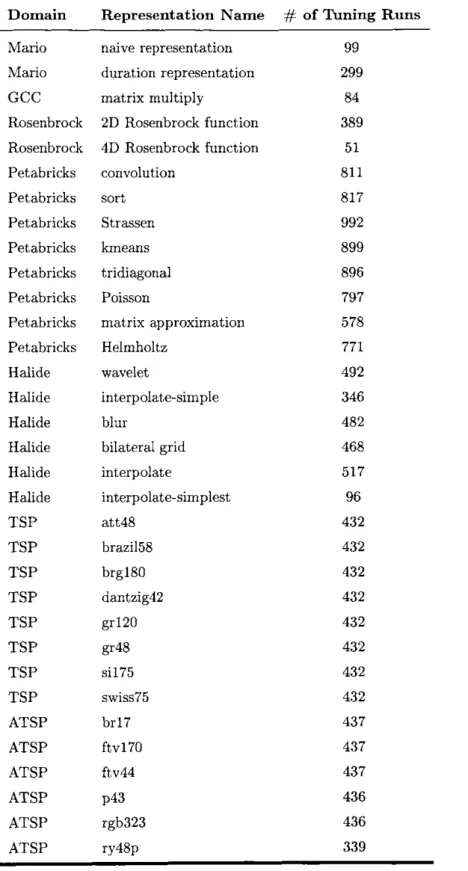
" We demonstrate the robustness of the new search approaches by comparing the recommendation bandit meta-technique to the traditional in-situ learning AUC bandit meta-technique on nine representations
across three domains using a variety of initial technique sets. For almost all representations and initial technique sets, the recommendation bandit meta-technique achieves performance on-par with or significantly greater than that of the in-situ learning search approaches.
9 We present a self-initializing and self-updating search approach using the DBI recommendation ban-dit meta-technique, essentially automating the old user-controlled process of selecting a good search approach. The new search approach matches the performance of the old search approaches typically se-lected by OpenTuner users in the PetaBricks and Halide domains, and achieves up to 3.7x improvement over the old default search approach on TSP benchmarks.
1.5
Organization
This thesis introduces several new terminologies which are defined in Appendix A. The remainder of this thesis is organized as follows:
Chapter 2 discusses related works.
Chapter 3 summarizes the original OpenTuner framework.
Chapter 4 introduces technique composition.
Chapter 5 details the cross-session database used by DeepTuner
Chapter 6 discusses search approach recommendation in DeepTuner and introduces the recommendation bandit meta-technique, which takes advantage of technique recommendation in DeepTuner.
Chapter 7 presents autotuning performance results.
Chapter 2
Related Work
To the best of our knowledge, a system for formalizing technique hybridization and for technique recommen-dation in a general autotuning framework has not been attempted before. Instead, we discuss related work on the major components that DeepTuner brings together: autotuning frameworks, technique hybridization, and algorithm recommendation.
2.1
Autotuning Frameworks
While several program autotuning systems and frameworks exist outside of OpenTuner, they are often not as general in scope and aimed towards specific domains.
2.1.1
Linear Algebra
ATLAS is an autotuning system aimed towards linear algebra kernels, which produces a highly optimized matrix multiply for a given architecture [32]. This is achieved by exhaustive search where a variety of generated alternate implementations are empirically evaluated.
In a similar vein, OSKI providing a library of several self-tuning sparse matrix kernels including sparse matrix-vector multiply and sparse triangular solve [301. The kernels are are tuned at runtime through a combination of exhaustive search and heuristics to select the fastest implementation in OSKI for the given machine and matrix.
Additional work has been done by Choi et al. on an autotuning framework specifically for sparse matrix-vector multiply on GPUs using performance models to guide the autotuning process [6].
2.1.2
Signal Processing
The SPIRAL system provides a platform-tuned library of linear signal processing transform algorithms [24]. SPIRAL achieves this by combining formula generation of alternate high-level algorithms for a particular signal processing transform with code generation of possible implementations for a chosen formula to obtain a space of possible alternate implementations. This space is searched using a combination of naive search ap-proaches including exhaustive search, dynamic programming, random search, a hill-climber, and a stochastic evolutionary algorithm.
Within this space, the FFTW library utilizes autotuning to yield machine-optimized discrete Fourier transform computations [13]. FFTW works by recursively decomposing a DFT problem - defined by the shape of the input data -into smaller sub-problems. This continues until sub-problems are sufficiently small, at which point FFTW selects from a variety of alternate optimized codelets that directly solve the sub-problem. The space of possible decompositions is explored using a combination of exhaustive search and
dynamic programming.
2.1.3
Stencil Computations
Program autotuning has also seen very successful application to the domain of stencil-based computation
-kernels operating over a possibly multi-dimensional array in a fixed manner. A general autotuning framework for transforming serial stencil expressions in Fortran 95 into tuned parallel implementations in Fortran, C, or CUDA can show performance gains of up to 22x speedup [17].
Rather than using explicit code, the autotuning framework PATUS generates stencil computation kernels for multicore CPU and GPU from a stencil specification using a C-like syntax [7]. Alternate implementations are generated according to a strategy template outlining how the kernel should be optimized and parallelized. The strategy can be either chosen from a pre-defined set or custom-designed, and the final set of alternates is explored by a user-specified naive search approach such as multi-run Powell search, Nelder-Mead, or an evolutionary algorithm.
Sepya, a domain-specific language for stencils embedded in Python, utilizes an autotuning compiler to output high-performance stencil code [18]. User-defined stencils in Sepya are transformed using a proved set of optimizations to target multi-core CPUs specifically, and the best implementation is determined via exhaustive search.
Meanwhile, PARTANS provides an autotuning framework specifically for distributing a stencil computa-tion kernel across multiple GPUs [20].
2.1.4
Runtime Systems
The Active Harmony framework is aimed towards autotuning of runtime applications, which is enabled by infrastructure for exposing multiple variants of underlying libraries [28]. The space of possible combinations of variants is searched using a Nelder-Mead simplex method. Active Harmony was combined with CHiLL, a compiler framework for automatically generating alternate implementations of code, to achieve autotuning of compiler-generated code [291.
2.2
Search Technique Hybridization
Our decision to attempt to formalize technique composition in OpenTuner stems from the success that hybrid techniques have shown in various domains.
For example, a hybrid search algorithm combining a genetic algorithm (GA) with simulated annealing has seen successful application in flow-line scheduling, with the hybrid algorithm outperforming both of the original algorithms [231. A GA and simulated annealing hybrid has also been applied to flow shop scheduling [21].
The emerging class of memetic algorithms also exhibit technique hybridization. Memetic algorithms extend population-based global search algorithms such as evolutionary algorithms with methods for local optimization. For instance, memetic algorithms combining an evolutionary algorithm with a hill-climbing crossover have been applied to a wide range of problems [19],[31].
Genetic algorithms have also been combined with particle swarm optimization (PSO) by incorporating swarm behaviour into the genetic algorithm. Work has been done showing that a hybrid of GA and PSO outperforms both GA and PSO in recurrent network design problems [16]. Similar success was also demon-strated for a PSO-GA hybrid in the context of optimizing several benchmark non-linear functions [261. The hybrid showed faster convergence and a higher ability to find the global optimum over both PSO and GA, . Hybridization of PSO and GA has also been attempted in the other direction using PSO as the base. This was achieved by incorporating GA operators into the velocity and update rules of PSO and the resulting hybrid was again capable of outperforming both PSO and GA on quality-of-service multiast routing problems [3]. In addition, PSO has been hybridized using a differential evolution operator, which showed similar positive results
[34].
2.3
Algorithm Recommendation
Recommendation systems for algorithmic approaches have been successfully applied in several other domains besides search approach recommendation in program autotuning.
One such system is Delphi, a machine learning as a service system that both automates and optimizes the classifier selection process [10]. Given a dataset and performance metric by the user, Delphi recommends a fully trained and parametrized classifier that best satisfies that performance metric. This entails selection of a type of classifier algorithm, such as a support vector machine using a radial basis function kernel or a decision tree with entropy cuts, along with any parameters needed for the algorithm. This parallels our process of recommending fully specified techniques that best search a representation given by the user.
Work has also been done by Stephenson on collaborative compilation [27]. In collaborative compilation, clients opt to insert low-overhead instrumentation code to measure the effectiveness of different compiler optimizations on their given application and data set. The cross-compilation instrumentation data is aggre-gated in a global knowledge base, and is then used to perform transfer learning on what compiler heuristics and optimizations work best. The best predicted optimizations are then recommended back to clients as a policy for meta-optimizing the compiler algorithm.
Chapter 3
The OpenTuner Framework
OpenTuner treats autotuning as a search problem. Each point in the search space is a configuration
-a concrete -assignment of v-alues to -a set of p-ar-ameters. See Section 4.2.1 for more on p-ar-ameter types available. We call this set of parameters that defines the dimensions of the search space the parameters in
the representation. A result is the evaluation of a configuration according to a user defined objective function.
The combination of the parameters in the representation and the objective function specify the topography of the search space. These are specified for an autotuner implemented in OpenTuner when a user creates a
problem definition.
The search space is then explored by a user-specified search approach, which makes requests for con-figurations to be evaluated. These requests are called desired results. This interaction between the search approach and the problem definition makes up the search aspect of autotuning in OpenTuner.
Actual measurement of desired results is handled separately by a minimal measurement driver, which is a thin wrapper around the user defined objective function. This abstraction allows for parallelism in mea-surement. It also separates the details of obtaining measurements for configurations from the search process which we focus on in the rest of the thesis. The results from the measurement process are communicated through a results database, which tracks results collected during a tuning run along with metadata about the problem definition and search approach for the tuning run.
3.1
Problem Definition
Because of their generic nature, autotuning frameworks like OpenTuner require some specification by users to construct an autotuner for their particular application. We refer to this process of defining the autotuning problem as the creation of a problem definition. Conceptually, a problem definition has a hierarchical
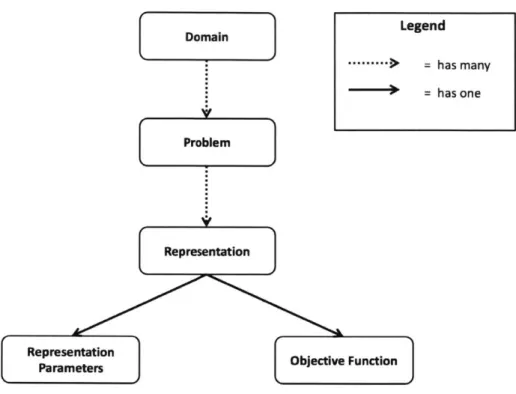
Domain Legend ---.---> = has many = has one Problem Representation Representation OjcieFnto Parameters
OjcieFnto
Figure 3.1: Structure of a problem definition
An autotuner implemented in OpenTuner applies over a single domain. Within this domain, the user may have many different problems that require optimization. Each can be mapped into multiple representations understood by OpenTuner. A representation consists of a set of parameters in the representation and an
objective function, which OpenTuner uses as the dimensions and evaluation function for the autotuning space.
structure as seen in Figure 3.1, which consisting of a domain containing multiple problems, each of which has one or more representations.
For example, in the Mario autotuner mentioned in [5] , the domain would be beating a level in Super Mario. The problem would be the particular level we are trying to beat (e.g. World 1-1). As for the representation, we could use a naive representation consisting of many booleans, each corresponding to whether a particular input button is being pressed at a particular frame. Or, we could use a representation encapsulating the idea of durations, with several enumeration parameters choosing movement direction paired with integer parameters specifying the duration of the movement. This is decoupled from jumping, which is encoded with integer parameters specifying which frames to jump on and the duration that each jump
3.2
Search Approach
After creating a problem definition, the user can then proceed to autotune a particular problem using one of the defined representations. At the start of the autotuning session or tuning run, the user specifies the name of a search approach from a registry of named, instantiated search approaches. The search approach decides how the search driver explores the autotuning space by controlling which desired results the limited testing resources of the measurement driver will be spent on. The desired results are generated by using various techniques in OpenTuner's extendible library of techniques. Each technique can be either an implementation of known search algorithm - such as differential evolution, Nelder-Mead or Torczon hillclimbers, pattern search, or particle swarm optimization -or could be a generated composable technique. See Chapter 4 for more detail on technique composition in OpenTuner.
An individual technique can be instantiated as a naive search approach. However, these are often unable to handle the diverse range of search spaces. In order to provide more robust search approaches that take advantage of in-situ learning, Opentuner uses meta-techniques - collections of individual techniques. A meta-technique acts as an ensemble of techniques where the meta-technique decides which techniques gets to submit the next desired result. Even the simplest meta-technique, such as a round robin meta-technique which cycles through techniques in order, can take advantage of in-situ learning as results from all techniques are shared through the results database. Thus, individual techniques are able to learn about and benefit from good configurations discovered by other techniques in the ensemble. This collaborative effect boosts the performance of the search approach as a whole.
3.2.1
AUC Bandit Meta-Technique
The core meta-technique used for in-situ learning in OpenTuner is the multi-armed bandit with a sliding window, area under the curve credit assignment (AUC Bandit) meta-technique. This extensible meta-technique is based on an optimal solution to the multi-armed bandit problem presented by Fialho et al. in the slightly different context of operator selection [111. In the multi-armed bandit problem, there are multiple levers on a slot machine, each with an unknown probability of paying out. The goal is to pick lever-arms in a way to maximize the expected pay out. In the context of OpenTuner, the levers correspond to the techniques and their payouts correspond to autotuning performance of the technique. The multi-armed bandit problem encapsulates the problem of trading off between exploitation (using the best known technique) and exploration (estimating the performance of each technique).
The AUC Bandit meta-technique assigns each technique, t, a score based on a sliding window of recent history and assigns testing resources to the technique with the highest score. The score is calculated according
to the formula
2 log H AUCt +C
where AUCt is the credit assignment term quantifying performance of t, C is the constant determining the exploitation-exploration trade-off, H is the length of the sliding window, and Ht is the number of times t has been used within the sliding window of history. AUCt acts as the exploitation term that increases with better technique performance within the history window, while the second term acts as the exploration term and decreases as t is used more by the meta-technique. Values for C and H are hyper-parameters for the AUC Bandit meta-technique and are fixed upon instantiation.
AUCt is calculated according to the area under the curve assignment mechanism based on Fialho et al.'s work [12]. For each t, we draw a curve by based on the history of results for t within the sliding window and whether or not each result was a new best. Traversing the history for t chronologically, each new best increases the height of the curve, while results that were not new bests do not change the height. Calculating the area under the curve, scaled to a maximum value of 1 if all results were new bests, gives AUCt. In other words,
AUCt= 2
Ht(Ht + 1) 'zvt
where V,i is an indicator variable with value 1 if the ith use of t in the sliding history window resulted in a new best and with value 0 otherwise.
By weighing exploration against exploitation, the AUC Bandit meta-technique effectively performs an extra layer of in-situ learning during the tuning run to dynamically favor better performing techniques, resulting in more robust autotuning performance.
Chapter 4
Search Technique Composition
Ultimately, search approaches in OpenTuner rely on the efficacy of the individual techniques. Many recent works have shown the effectiveness of composite techniques - for instance insertion of a PSO enhancement step for elites in an evolutionary algorithm, or replacement of standard crossover operator of an evolutionary algorithm with a hill-climbing operator [16],[19]. However, we recognize that writing an entirely new tech-nique from scratch for each potential composition is inefficient and not scalable. In this work, we make an attempt to formalize the process of creating composite techniques through the idea of composable techniques, which allow for easy substitution of newly developed operators, such as a new crossover for permutations, to generate new techniques.
We break techniques into three primary stages when generating configurations to test: 1. Selection of parent configurations
Conceptually, all configurations generated by a technique are derived from some original set of con-figurations. This set could be a single random configuration, or a subset of a population satisfying a some criteria (like having the highest fitness scores).
2. Generation of a child configuration
After getting a set of parent configurations, a child configuration is generated as a testing candidate by combining the parameter values of the parents in some fashion, whether it's through crossovers or
mutations, or something else altogether.
Because combining values of different types of parameters is impractical, the generation of a child can be further partitioned into a set of independent operations over each parameter. We refer to these operations that combine parameter values as operators.
3. Update of technique state
Finally, the fitness of the generated child is used to update the technique state to inform behaviour in following iterations. This state is often tracked through some population.
For example, the technique could choose to replace a random population member with a lower fitness than the child configuration with the child configuration.
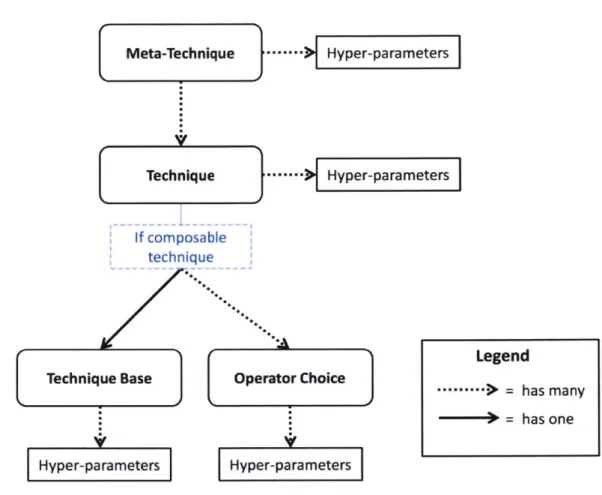
In traditional techniques for search and optimization, these stages -especially the selection of parents and the methodology for generating a child -were not considered independently. However, we note that they are in fact completely independent. So, we choose to separate a technique into two major components: the set of operators controlling the primary aspects of child generation and a technique base defining the parent selection and update processes.
By modularizing a technique this way, the technique base becomes the base for technique composition. On top of this, the choice of operators can be interchanged to generate a wide range of composite techniques. This style of technique composition offers several advantages for developing new techniques.
First, by abstracting out operators, developers can now focus their efforts on particular aspects of a technique. For instance, one could choose to solely research new operators for PermutationParameters to improve search performance over representations with permutations. Or, one could focus only on exploring variations in population reproduction for evolutionary algorithms to develop new technique bases.
Secondly, technique composition aids in the integration of new parameter types and operators. Previ-ously, the introduction of new parameter types or operators required overhauling existing techniques to take advantage of them. However, this often required intimate knowledge of old techniques that the developer of the operator lacked. With composable techniques, the new operators or parameter types can simply be swapped into the operator map, without knowledge of how the underlying technique base operates.
Finally, composable techniques greatly reduce the amount of code needed to express a much richer set of possible technique base - operator choice pairings, as the number of possible operator choices grows combinatorially with number of parameter types and operators per parameter type.
4.1
Creating a Technique Base
To make the development of composable techniques capable of technique generation easier, we present the ComposableEvolutionary Technique class as an extendible class for specifying new technique bases. Imple-menting a new technique base only requires defining the following methods corresponding to the three primary stages:
* getparents (population)
Given the current population, this method returns a list of configurations to use as parents. One of these is specified as the primary parent.
" select _parameters(params)
Given the set of all parameters in a configuration, this method returns a subset of parameters to apply operators to when combining configurations. This controls the extent to which parent configurations are combined.
" updatepopulation(config, population)
Given a configuration that has been evaluated and the original population, this method should update the state of the population.
An initialized technique base generates configurations during a tuning run by first initializing a popu-lation of configurations, then calling the above methods in succession to generate new configurations. The configurations are generated from the parents by applying a set of operators specified by an operator map. If there is no operator specified for a particular parameter type, then a default operator is used. This is the "no-op" operator unless otherwise overridden by the creator of the technique base.
The population consists of instances of a PopulationMember class, which is a thin wrapper around a configuration. This class can be extended by a technique base developer to provide custom functionality if needed. The size of the population is specified as a hyper-parameter to the technique base which defaults to 30.
Currently, the OpenTuner's technique library contains two technique bases based on existing techniques. Their behaviours are summarized in Table 4.1.
4.2
Choosing a Set of Operators
The set of operators to use with a technique base is specified during instantiation by the operator map. An operator map is a dictionary from OpenTuner parameter types to the name of an operator method associated with that parameter type. The operator map also tracks any user specified operator hyper-parameter -value pairs, such as the crossover length in a permutation operator, as well as a list of any additional arguments. This data structure is initialized or can be randomly generated when instantiating a technique base and allows for easy creation of hybrid techniques.
GreedyComposable Technique
get _parents(population) Cycles through each population member, selecting that pop-ulation member along with the global best configuration as parents. The population member is specified as the primary parent.
select _parameters(params) Each parameter has a random probability to be chosen. The probability is controlled by a crossover rate hyper-parameter to the technique base.
update_ population(config, population) If the child configuration is better than the original popu-lation member, then the original popupopu-lation member is re-placed by the new configuration
Random ThreeParents Compos able Technique
get_ parents(population) Three parents are randomly selected from the configuration. There is a fixed probability of including the global best con-figuration as one of the parents. This probability is controlled by a hyper-parameter to the technique base.
select _parameters(params) Each parameter has a random probability to be chosen. The probability is controlled by a crossover rate hyper-parameter to the technique base.
update_ population(config, population) The child configuration replaces the oldest member of the population.
Table 4.1: Implemented technique bases in OpenTuner
The GreedyComposable Technique is based on the many greedy search techniquesin OpenTuner. The
4.2.1
Parameter Types
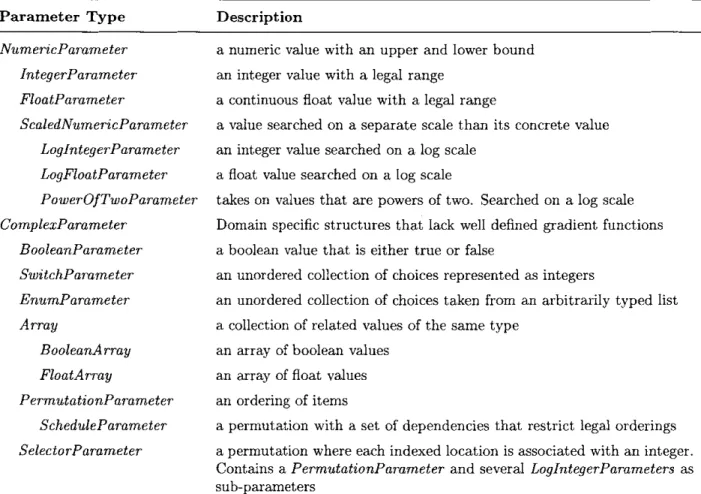
OpenTuner supports a hierarchy of built-in parameter types for representing tuning variables in problems, as seen in Figure 4.1. This hierarchy can be extended by users as needed to make custom parameters. A parameter inherits properties of its superclass, including any operators.
The parameters can be split into two main groups: PrimitiveParameters (also called NumericParameters) and ComplexParameters. These and their subtypes are described in Table 4.2.
Parameter Type NumericParameter IntegerParameter FloatParameter ScaledNumericParameter LogIntegerParameter LogFloatParameter PowerOfTwoParameter ComplexParameter BooleanParameter SwitchParameter EnumParameter Array BooleanArray FloatArray PermutationParameter ScheduleParameter SelectorParameter Description
a numeric value with an upper and lower bound an integer value with a legal range
a continuous float value with a legal range
a value searched on a separate scale than its concrete value an integer value searched on a log scale
a float value searched on a log scale
takes on values that are powers of two. Searched on a log scale Domain specific structures that lack well defined gradient functions a boolean value that is either true or false
an unordered collection of choices represented as integers
an unordered collection of choices taken from an arbitrarily typed list a collection of related values of the same type
an array of boolean values an array of float values an ordering of items
a permutation with a set of dependencies that restrict legal orderings a permutation where each indexed location is associated with an integer. Contains a PermutationParameter and several LogIntegerParameters as sub-parameters
Table 4.2: Descriptions of parameter types in OpenTuner
4.2.2
Available Operators
Each parameter has a set of operators. These operators take in a set of parent configurations and mutate the corresponding parameter value in the first configuration according to the parent values. The operators form the set of available transformations for generating new configurations.
OpenTuner standardizes naming for operator methods, which can be identified by the prefix 'op#_', where
#
is the number of required input configurations. The prefix 'opn_' specifies an arbitrary numberU o 0 0 " (U LA E -0 0 I .2 00 M _ (UU aEA zWM Mi -E z 4
Figure~
~ ~ ~
4.:Heacyoopnuesbiti aaee yeOpenune coes ithsevral araete tyes ommnly sedin utounes. he pramtertyps cn(b
of inputs as a list. The first argument into an operator is always the configuration that will be mutated. This is followed by the required parent configurations, then any required arguments, and finally optional arguments.
To prevent passing insufficient parent configurations into a operator, all technique bases are defined with
a value for the minimum number of parents guaranteed by the get_ parents (population) function. A technique
base is prevented from using any operator requiring more input configurations than it can guarantee. Tables 4.3, 4.4, and 4.5 list out and briefly describe the available operators for each parameter type. Note that operators are inherited, so we do not re-list operators for sub-classes unless the behaviour changes. In the descriptions, the parameter value refers to the value of the parameter for the configuration being mutated (i.e. the child configuration).
Parameter
opinoop the null operator. Does nothing.
op _randomize sets the parameter's value to a random value
op3_swarm stochastically moves the parameter's value towards the values in the other two parent configurations. This attempts to simulates the update step in particle swarm optimization for the general case.
op4_set _linear sets the parameter value to a linear combination of 3 other configurations. Takes in weights for the parent configurations as additional arguments. opn _stochastic mix stochastically recombines the list of parent values to obtain the final
pa-rameter value. This is done by randomly taking the value of parent ac-cording to a list of weights given as an additional argument.
NumericParameter
opiscale scales the parameter's value by a constant factor given as an additional argument.
op3_difference sets the parameter's value to the difference between two parent values. opnsum sets the parameter's value to the sum of the parent values.
IntegerParameter
op3_swarm performs a single update step in particle swarm optimization for integers, returning the new velocity
c * velocity + r1 * c1 * (cfg1 - cfg) + r2 * c2 * (cfg2 - cfg)
where cfg is the original parameter value; cfg, and cfg2 are the parent
values; c, ci, and c2 are hyper-parameter weights; velocity is an additional argument representing the old swarm velocity; and ro and r1 are random values between 0 and 1. The parameters's value is set to the new velocity with gaussian noise added. The standard deviation of the gaussian is an additional hyper-parameter
FloatParameter
op3_swarm performs a single update step in particle swarm optimization for floats, returning the new velocity
c * velocity + ri * c1 * (cfgi - cfg) + r2 * c2 * (cfg2 - cfg)
where the values are as in the operator for IntegerParameters. The pa-rameters's value is set to the new velocity.