Publisher’s version / Version de l'éditeur:
Vous avez des questions? Nous pouvons vous aider. Pour communiquer directement avec un auteur, consultez la
première page de la revue dans laquelle son article a été publié afin de trouver ses coordonnées. Si vous n’arrivez pas à les repérer, communiquez avec nous à [email protected].
Questions? Contact the NRC Publications Archive team at
[email protected]. If you wish to email the authors directly, please see the first page of the publication for their contact information.
https://publications-cnrc.canada.ca/fra/droits
L’accès à ce site Web et l’utilisation de son contenu sont assujettis aux conditions présentées dans le site LISEZ CES CONDITIONS ATTENTIVEMENT AVANT D’UTILISER CE SITE WEB.
Internal Report (National Research Council of Canada. Institute for Research in Construction), 2000-09-01
READ THESE TERMS AND CONDITIONS CAREFULLY BEFORE USING THIS WEBSITE. https://nrc-publications.canada.ca/eng/copyright
NRC Publications Archive Record / Notice des Archives des publications du CNRC :
https://nrc-publications.canada.ca/eng/view/object/?id=8cbc5ebc-af92-41af-abe2-b2c160cb86bf https://publications-cnrc.canada.ca/fra/voir/objet/?id=8cbc5ebc-af92-41af-abe2-b2c160cb86bf
NRC Publications Archive
Archives des publications du CNRC
For the publisher’s version, please access the DOI link below./ Pour consulter la version de l’éditeur, utilisez le lien DOI ci-dessous.
https://doi.org/10.4224/20331350
Access and use of this website and the material on it are subject to the Terms and Conditions set forth at
FIERAsystem t2 Fire Development Model Report
Se+
I
1I*I
National Research Conseil national Council Canada de recherches CanadaR 4 2 7
I
Institute for lnstitut de Research recherche in Construction en construction
FIERLIsystem
Fire Development Model
Reporf
David Torvi, Ph.D., P.Eng., Don Raboud, Ph.D.,
George Hadjisophocleous, Ph.D., P.Eng., and Irene Reid
Internal Report 786
FlERAsystem t2 Fire Development Model Report
David T o ~ i , Ph.D., P.Eng., Don Raboud, Ph.D., George Hadjisophocleous, Ph.D., P.Eng. and Irene Reid
The FlERAsystem
f
Fire Development Model calculates quantities thatcharacterize a fire as a function of time, such as heat release rates, temperatures and heat fluxes. Most of the equations used in this model are standard engineering correlations taken from fire protection engineering handbooks. Results from this fire development model are used by other FlERAsystem models in order to determine the effects of fire on occupants, and the building and its contents.
NOMENCLATURE
Notation
area (rn2) diameter (m)
radiation view factor
fraction considered to be radiative height (m)
factor for openings mass flow rate (kgls) heat release rate (kW) heat flux (kw/m2) radius (m) safety factor temperature ("C) time (s) width (m) distance (m) Greek Letters
C( coefficient for a ?fire
0 angle Subscripts 160 160 kW/m2 a air amb ambient c ceiling, compartment e effective, emissive ep effective plume eq equivalent f fire, flame, fuel FC fuel controlled fo flashover max maximum nom nominal o opening P peak, plume T total
V portion that can be viewed
FlERAsystem t2 Fire Development Models Report
David Torvi, Ph.D., P.Eng., Don Raboud, Ph.D., George Hadjisophocleous, Ph.D., P.Eng. and Irene Reid
1.0 INTRODUCTION
As Canada and other countries move from prescriptive-based building codes to performancelobjective-based codes, new design tools are needed to support these new codes. One such tool is the computer model FiRECAMTM, which has been developed over the past decade by the Fire Risk Management Program of the Institute for
Research in Construction at the National Research Council of Canada (NRC).
FiRECAMTM is a computer model for evaluating fire protection systems in residential and office buildings that can be used to compare the expected safety and cost of candidate fire protection options.
To evaluate fire protection systems in light industrial buildings, a new computer model is being developed. This model, whose current focus is aircraft hangars and warehouses, is based on a framework that allows designers to establish objectives, select fire scenarios that may occur in the building and evaluate the impact of each of the selected scenarios on life safety, property protection and business interruption. The new computer model is called FlERAsystem, which stands for Fire Evaluation and Risk Assessment system.
FlERAsystem uses time-dependent deterministic and probabilistic models to evaluate the impact of selected fire scenarios on life, property and business interruption. The main FlERAsystem submodels calculate fire development, smoke movement through a building, time of failure of building elements and occupant response and evacuation. In addition, there are submodels dealing with the effectiveness of fire suppression systems and the response of fire departments.
In FIERAsystem, Fire Development Models are used to simulate selected fire scenarios. Each model has its own user interface and is designed as a stand-alone piece of software. These Fire Development Models can also be used in conjunction with other FlERAsystem models in order to conduct a complete hazard or risk analysis. In the latter case, the Fire Development Models provide information that other models will
utilize in order to calculate the spread of fire between compartments and to determine the effects of selected fire scenarios on occuDants. the buildina and its contents. For example, the Life Hazard Model [I] uses heat fluxes at variousdistances from the fire to determine the probability of death due to hiah heat fluxes in an individual compartment in the building.
This report describes the theory underpinning the FlERAsystem
f
FireDevelopment Model. The choice to use this particular fire development model is made by the FlERAsystem user, based on their knowledge of the building being evaluated and its occupancy, fuel loads, etc. This fire development model calculates the quantities which characterize the fire (heat release rate, temperature and thermal radiation heat fluxes) as a function of time. The equations, used in this fire development model, are taken from The SFPE Handbook of Fire Protection Engineering [2] and SlNTEFs
Handbook for Fire Calculations and Fire Risk Assessment in the Process Industry [3]. The user should consult these references for information on the assumptions and
limitations inherent in these equations before using this or any other FlERAsystem Fire Development Model.
2.0 DEVELOPMENT OF
f
FIRESIn a
f
fire, the heat release rate is assumed to be proportional to the square of the elapsed time. Each of the calculations in thef
Fire Development Model is described in this report.2.1
Heat Release Rate
o f fFires
The heat release rate is calculated using the following equation: Q(t) = atZ
Where:
Q = the heat release rate of the fire at any time (kW); and
a =the coefficient for a
f
fire, which is fuel dependent.The user can enter a value of CY or select one of the following values of a [4]: Description of Fire Value of a (kW/s2)
Slow 0.00293
Medium 0.01 172
Fast 0.0469
Ultrafast 0.1876
This heat release rate is limited to a maximum fuel controlled heat release rate (QF~), which is specified by the user. The
f
Fire Development Model also checks to see i f sufficient oxygen can be supplied to the fire from the compartment and through ventilation openings in the compartment to achieve this peak heat release rate.First, the air supply rate into the compartment is calculated. For a compartment with n openings with height
H,
and width W,, the air supply rate is given by theexpression 131:
i=l
(2) Where:
ma = the mass flow rate of air supplied to the compartment (kgts); k = is a factor for openings;
= 0.5 for normal sized openings (e.g. windows, doors etc.);
= 0.1 3 for the case where any opening has either a height or width of greater than 5 m; and
H e
=the effective height for multiple openings, given by theFor a single opening, Equation (2) reduces to:
The maximum heat release rate for a ventilation-controlled fire (Qvc) is then calculated using equation (5), which is valid for most fuels 151:
The maximum fuel controlled heat release rate entered by the user is compared with the ventilation controlled heat release rate, and the smaller of these two values is used as the peak heat release rate in subsequent calculations.
For example, if the fire is ventilation controlled, then the duration of the fire is adjusted using the equation:
FC
t,_, = t f
-
Qvc Where:tcvc the duration of a ventilation controlled fire(s); and tt the duration of the fire entered by the user.
For example, if the ventilation controlled heat release rate is 50% of the peak heat release rate specified by the user, the fire will last twice as long. For simplicity, this calculation has assumed that no fuel is vaporized and leaves the compartment (i.e., all the fuel is consumed within the compartment).
2.2 Duration and Diameter o f f Fires
The duration of the t2 fire (tf) is specified by the user.
The model calculates the time-dependent diameter of the fire as follows. First, the nominal diameter of the fire, ,,D,, is input by the user. As discussed later in Section
3.1, the program also assumes that the heat flux within the fire is 160 kW/m2. In order to ensure that the nominal diameter of the fire is realistic for the heat release rate specified, the program calculates the diameter, D,,, at which a heat flux of 160 kW/m2 would be predicted using a simple point source representation of the fire.
Where:
f =the fraction of the total heat release rate that is considered to be radiative (user-specified); and
Q, ( t
) =the maximum heat release rate (kW); and
qn(t) =the maximum in flame heat flux (kw/m2) = 160 kw/m2
While the point source model generally underpredicts heat fluxes relatively close to a fire, it still provides a simple method of ensuring that the nominal diameter is realistic for the particular fire being modelled.
The program also assumes that the initial diameter of the fire is 0.3 m. This diameter corresponds to the Dl,, value calculated using Equation (7) for a 100 kW fire, that is 45% radiative, which is about the size of a fire in a small wastepaper basket. This is thought to be a good estimate of the initial size of any fire that would be of interest to engineers using FIERAsystem.
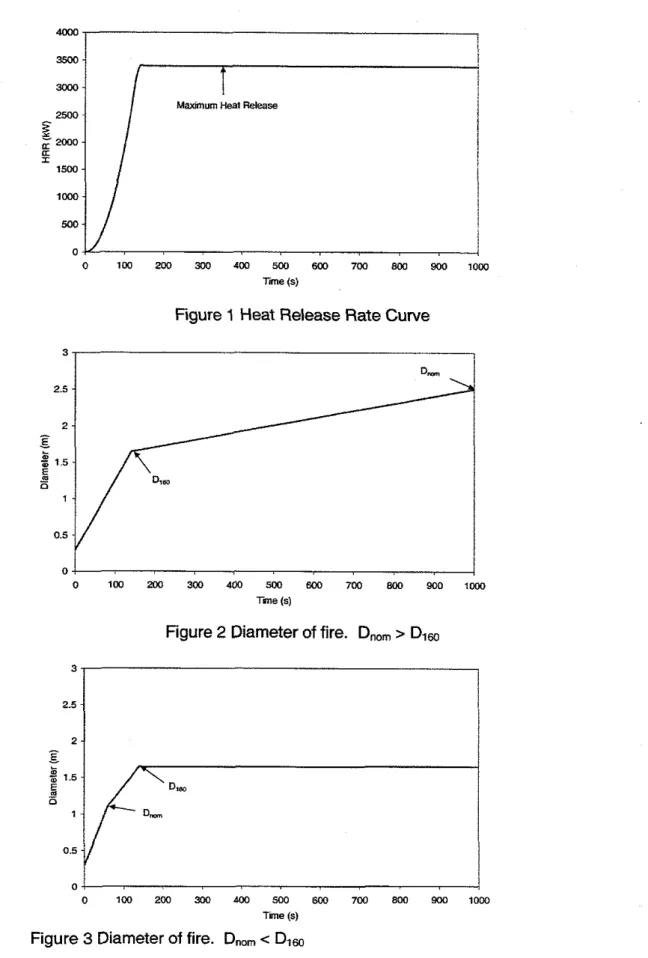
The diameter of the fire with time is then calculated as follows. The maximum fuel controlled heat release rate of a fire is a function of the area of the fire, which is a function of the square of the diameter of the fire. Therefore, as a ?fire assumes that the heat release rate is a function of the square of the elapsed time, it follows that the
diameter will be a linear function of time for a
f
fire. The diameter of the fire starts at 0.3 m and then increases linearly until it reaches either the value of D,, or Dl,,whichever is smaller. If the nominal diameter of the fire is smaller, then the time at which this occurs, ,,,,t can be calculated by rearranging Equations (1) and (7)
where
If DIM) is smaller, then the fire will reach this diameter at the time at which the
heat release rate reaches its maximum value.
The diameter of the fire then increases linearly to the value of ,D,. or Dl,,
whichever is larger. If the nominal diameter is larger, then this will occur at the
maximum time before the fire begins to decrease in size. If Dl,, is larger, then the fire
will reach this diameter at the time at which the heat release rate reaches its maximum value. This entire process is summarized in Figures 1, 2, and 3 below.
i
T
I1
Mamum Heat Release
1
I
I
j
I
1
i 1 0 l W 2 W 3 M 4 W 5 W 6 0 0 7 W 6 0 0 9 W 1 O W Tme (s)Figure 1 Heat Release Rate Curve
Figure 2 Diameter of fire. D,, > D,,
2.3 Height of Flame Above
f
FiresThe height of the flames above the fire is calculated using Heskestad's Correlation , as suggested by Alpert and Ward 161:
H, (t) = 0.1743(k~(t)y (1 0) Where:
k = a factor to take into account the effect of the compartment walls on the temperature of the hot plume gases;
= 1 (if no walls are nearby);
= 2 (if the fire is close to one wall -default value); and = 4 (if the fire is in a corner).
The flame height calculated using Equation (10) is compared with the height of the compartment, and a height of 1 m, which is assumed to be the height of the midsection of a person. The flame height is set to the height of the compartment if the height of the flame is greater than that of the compartment. The flame height is set to 1 m if the calculated height of the flame is less than this value.
3.0 HEAT TRANSFER FROM
f
FIRESHeat transfer from fires includes both thermal radiation heat transfers from the flames to the surrounding objects, as well as convection heat transfer. Convection heat transfer from the flames to engulfed objects is important particularly in calculating the response of boundaries to the fire.
3.1 Thermal Radiation Heat Fluxes
The heat fluxes from the
f
fire to a point located 1 m from the ground at various distances are calculated using the solid flame model of Mudan and Crocem.
The following equation is used to calculate thermal radiation heat fluxes at a distance from the fire.Where:
q'k
=the emissive power of the t2fire (kw/m2), (assumed to be 160 kW/m";F(t) =the view factor from the ?fire to the point, calculated using the procedure outlined in Appendix A (0 5 F I 1);
t = atmospheric transmissivity (assumed to be 1 .O, because of the relatively short distances considered); and
SF = a safety factor (default value = 1).
A height of 1 m was chosen so as to be representative of the midsection of a person.
At each time step, the heat flux from the fire is calculated at the outside of each of 10 rings located from the centre of the room to the buildina of the comDartment.
These heat fluxes are used by the Life Hazard model to calculate the probability of death from exposure to high heat fluxes at each of the locations. The first ring is located at the initial diameter of the fire, 0.3 m, and the last ring is located at the diameter of an
equivalent circular compartment with the same floor area. ,)D,( which is calculated using the following equation:
Where:
A, =the area of the compartment (m2).
At each time step, the heat flux within the diameter of the fire is assumed to be 160 kw/m2.
3.2 Convective Heat Fluxes
In order to calculate the convective heat fluxes from the fire to the boundaries of the compartment, the flame temperature and the ceiling impingement temperature are calculated. First the temperature at the centreline of the visible portion of the flame (T,) is assumed to be 1023°C and the emissivity of the fire is assumed to be 1 .O. This temperature and emissivity correspond to the thermal radiation heat flux of 160 kW/m2 assumed earlier for the visible portion of the flame.
The ceiling impingement temperature (T,) at any time is calculated using the following equation [6].
T,
(t) = Tam,+
0.22
(kQ(t)I2"H
y
Where:
Tam(t) = the ambient temperature ("C); and HC =the compartment height
(m).
Alpert and Ward [6] state that Equation (13) is derived from empirical data and is not valid when the flames are either very close to the ceiling or very far away from the ceiling; and that it cannot predict temperatures greater than 825°C accurately.
Therefore, the model limits the ceiling impingement temperature to the flame temperature (1023°C).
Effective plume temperatures based on the flame and ceiling impingement temperatures are then sent to the Building Element Failure Model [8] in order to
Details of how these effective plume temperatures are calculated can be found in Appendix B.
3.3 Critical Time for Occupant Response, Evacuation and Life Hazard Models The Occupant Response and Evacuation [9] and Life Hazard Models [ I ] require a critical time, which is the time after which occupants will be unable to evacuate the compartment. As one of the possible values of this critical time, the Fire Development
Model calculates the time required for flashover to occur, using Thomas' Flashover Correlation [4]:
Where:
Q ~ o = heat release rate at flashover (kW);
AT =total surface area of the compartment (m2);
A, =total area of openings (m2); and
He = equivalent height of openings (m).
The time to flashover is determined by comparing the time-dependent heat release rate data calculated earlier with the heat release rate necessary for flashover.
4.0 REFERENCES
1. Torvi, D., Raboud, D. and Hadjisophocleous, G., "FIERAsystem Theory Report:
Life
Hazard Model", IRC lnternal Report, Institute for Research in Construction, National Research Council, Ottawa, ON, IRC-IR-781
2. SFPE Handbook of Fire Protection Engineering, Second Edition, National Fire Protection Association, Quincy, MA, 1995.
3. Handbook for Fire Calculations and Fire Risk Assessment in the Process Industry, Scandpower AJS and SINTEF- NBL, Kjeller, Norway, 1992.
4. Evans, D.D., "Ceiling Jet Flows", SFPE Handbook of Fire Protection Engineering, Second Edition, National Fire Protection Association, Quincy, MA, 1995, pp. 2-32
-
2-39.5. Walton, W.D. and Thomas, P.H., "Estimating Temperatures in Compartment Fires", SFPE Handbook of Fire Protection Engineering, Second Edition, National Fire Protection Association, Quincy, MA, 1995, pp. 3-134
-
3-147.6. Alpert, R.L. and Ward, E.J., "Evaluation of Unsprinklered Fire Hazards", Fire Safety Journal, Vol. 7, 1984, pp. 127-143.
7. Mudan, K.S. and Croce, P.A., "Fire Hazard Calculations for Large Open
Hydrocarbon Pool Fires", SFPE Handbook of Fire Protection Engineering, Second Edition, National Fire Protection Association, Quincy, MA, 1995, pp. 3-197
-
3-240. 8. Benichou, N. and Hadjisophocleous, G., "FIERAsystem Theory Report: BuildingElement Failure Model", IRC lnternal Report, lnstitute for Research in Construction, National Research Council, Ottawa, ON (in press). IRGIR-796
9. Hadjisophocleous, G.V., Proulx, G. and Raboud, D.W., "FIERAsystem Theory Report: Occuoant Response and Evacuation Models." IRC Internal Reoort. Institute for
~esearch in cbnstruction, National ~esearch Council ~anada,' Ottawa, ON, (in press). IRGIR-792
10. Torvi, D., Raboud, D. and Hadjisophocleous, G., "FIERAsystem Theory Report: Suppression Effectiveness Model", IRC lnternal Report, lnstitute for Research in Construction, National Research Council, Ottawa, ON (in press). IRC-IR-787
5.0 APPENDIX A
-
VIEW FACTOR CALCULATIONSThe equations used to calculate the view factor between the fire and a point are taken from Mudan and Croce
m.
The equations assume that the fire is a verticalcylinder with a diameter equal to that of the fire, and that the receiving element is a point located a distance, X, from the base of the cylinder (Figure A.l). In general the view factor is calculated using Equation A.l
H
I
I
I
receiving pointFigure A. 1 Quantities Used to Calculate View Factor
cos '3, cos '3
4 = # rZ ZdA,
Where:
'31 = the angle made by the normal of an element dA, on the flame surface;
'32 = the angle made by the normal of an element dA2 on the receiving
element; and
r =the distance between the fire element and the receiving element. The integration is carried out over the entire surface of the flame. Assuming the point of interest to be a vertical receiving element (i.e., a person standing up), the view factor for the case shown in Figure A.l is
m:
Where:
a = 2H(t) / D(t); and b = 2X
I
D(t).To account for the fact that the target is located at a height of 1 m, rather then at the same height as the base of the fire, the cylinder used to represent the flame is divided into two parts: one above the height of the receiving point (fecd in Figure A.l) and one below the height of the receiving point (abef). The view factor from the entire flame is simply the sum of the view factors from each of the two cylinders to the receiving point.
6.0 APPENDIX B
-
HEAT TRANSFER TO BUILDING ELEMENTSThe FlERAsystem Building Element Failure Model (BEFM) [8] contains four sub- models that accommodate three types of materials: steel, concrete and wood. The BEFM predicts the time to failure of construction building elements, namely, steel columns and beams, concrete slabs and roofs, wooden beams, columns and assemblies, and thermal failure of wood stud assemblies.
Some of these calculations are based on fire temperature histories provided by the t2 Fire Development Model, which are then modified by the FlERAsystem
Suppression Effectiveness Model to account for the effect of automatic suppression systems on the fire
[lo].
In the case of a ceiling, the ceiling impingement temperature is used to calculate the heat transfer to the compartment building. The equations used to calculate this ceiling impingement temperature are dependent on the heat release rate (e.g., see Equation (13)). The FlERAsystem Suppression Effectiveness Model is able to take into account the effect of suppression systems on heat transfer to the ceiling by recalculating the ceiling impingement temperature using the modified heat release rate[91.
The walls of the compartment will be subjected to convective and radiative heat fluxes from both the flame and the plume gases. The FlERAsystem Building Element
Failure Model [8] uses only a single temperature to represent the effects of the fire on the walls (e.g., the hot gas temperature in a fire resistant test furnace). Therefore, the
FlERAsystem t? Fire Development Model calculates an effective plume temperature (T,) to account for heat transfer from both the visible flame and the hot gases in the fire
plume above the visible flame to the walls. This effective plume temperature is
calculated based on a simple model of the thermal radiation heat transfer from the flame and hot gases. The view factors from the flame and hot gases are assumed to be proportional to their surface areas, and hence their heights. The initial wall temperature is assumed to be close to ambient. All emissivities are assumed to be one, and only
thermal radiation heat transfer between the walls and the flame and hot gases are considered. The total thermal radiation heat flux from the flames and hot gases is then equated with the thermal radiation heat flux calculated using a single effective plume temperature:
Where:
H,(t) = the height of the flame (m); and Hc =the height of the compartment (m). Tc = ceiling impingement temperature
Tf = flame temperature
T
,
,
= effective plume temperatureThis effective plume temperature is output to the Suppression Effectiveness Model for each time step. The Suppression Effectiveness Model then modifies these temperatures at each time step based on the effect of suppression systems on the flame height, then outputs the modified effective plume temperature to the Building Element Failure Model to determine the time to failure for each of the walls of the compartment.