HAL Id: hal-01436850
https://hal.inria.fr/hal-01436850
Preprint submitted on 16 Jan 2017
HAL is a multi-disciplinary open access
archive for the deposit and dissemination of
sci-entific research documents, whether they are
pub-lished or not. The documents may come from
teaching and research institutions in France or
abroad, or from public or private research centers.
L’archive ouverte pluridisciplinaire HAL, est
destinée au dépôt et à la diffusion de documents
scientifiques de niveau recherche, publiés ou non,
émanant des établissements d’enseignement et de
recherche français ou étrangers, des laboratoires
publics ou privés.
HAP: Building Pipelines with Heterogeneous Data and
Hive
Damien Graux, Pierre Genevès, Nabil Layaïda
To cite this version:
Damien Graux, Pierre Genevès, Nabil Layaïda. HAP: Building Pipelines with Heterogeneous Data
and Hive. 2017. �hal-01436850�
HAP: Building Pipelines with Heterogeneous Data and Hive
Damien Graux
Inria
[email protected]
Pierre Genev`
es
Cnrs
[email protected]
Nabil Laya¨ıda
Inria
[email protected]
January 15, 2017
Abstract
The increasing number of available datasets gives op-portunities to build large and complex applications which aggregate results coming from several sources. These emerging usecases require new systems where combinations of heterogeneous sources are both al-lowed and efficient.
To tackle these challenges, we provide a simple high-level set of primitives – called Hap – to easily describe processing chains. These descriptions are then com-piled into optimized sql queries executed by Hive.
1
Introduction
The increasing availability of data under free licenses (open data) allows to develop innovative applications that combine and enrich data. These applications often have to deal with heterogeneous data – i.e. represent-ing various kinds of information and structured usrepresent-ing various standards – of diverse size – e.g. datasets size are spread over several orders of magnitude – and of various natures since some datasets are more dynamic than others.
The possible combinations of these three degrees of freedom conducted to designs of specific applica-tions dedicated to each single case, for instance effi-cient evaluators of a chosen query language (e.g. sql, sparql. . . ) in a distributed context. However, in some usecases, existing delineations of field have to be over crossed; indeed, aggregating results extracted from sev-eral datasets might be required to build more complex answers. Such a need implies to be able to efficiently query several kinds of data structures while being able to merge the obtained sub-results also efficiently.
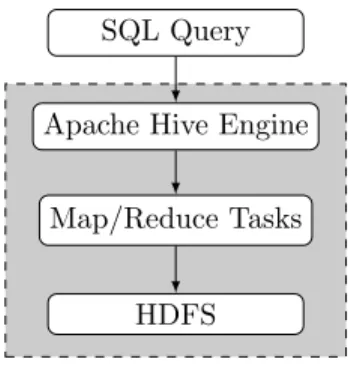
Apache Hive [11] is an open-source data warehousing solution built on-top of Apache Hadoop [3]. As a sequence, it takes as file system the hdfs [10] and con-verts sql (technically Hive-QL – but the fragment we consider allow us to use the exact sql syntax –) queries
SQL Query
Apache Hive Engine
Map/Reduce Tasks
HDFS
Figure 1: Query Evaluation Architecture.
EVAL i d ( ( columns ) ) [ [ q u e r y ] ] CONNECT i d i d i d ( ( columns ) ) [ [ c o n d i t i o n s ] ] FILTER i d i d ( ( columns ) ) [ [ f i l t e r s ] ] RETURN i d
Figure 2: Hap Syntax.
in sequences of MapReduce jobs executed directly on Hadoop, see e.g. Figure 1. Therefore, Apache Hive allows to query large datasets distributed across clus-ter of nodes using a relational language while providing resiliency thanks to Hadoop.
In this demonstration, we present a simple set of primitives called Hap which uses an intermediate lan-guage to describe processing chains which are then compiled into a single sql query executed with Apache Hive (for scalability and resiliency). First, Hap al-lows to design pipelines dealing with several kinds of data structures queried by their conventional lan-guages. Second, thanks to rewriting rules and statistics on data, Hap is able to compute optimizations that the Hive engine is not able to infer and realize.
EVAL 1 ( ( dep , a r r , depHour , a r r H o u r , s t o p ) ) [ [ Q−p l a n e ] ] EVAL 2 ( ( p l a c e , r e s t a u ) ) [ [ Q−d i n e r ] ] EVAL 3 ( ( l o c a t i o n , p o i ) ) [ [ Q−t o u r i s m ] ] CONNECT 1 2 x ( ( dep , a r r , depHour , a r r H o u r , s t o p , r e s t a u ) ) [ [ p l a c e=s t o p ] ]
FILTER x y ( ( dep , a r r , depHour , a r r H o u r , s t o p , r e s t a u ) ) [ [ a r r H o u r −depHour > k ] ] CONNECT 3 y f ( ( dep , a r r , p o i , depHour , a r r H o u r , s t o p , r e s t a u ) ) [ [ l o c a t i o n=s t o p ] ] RETURN f
(a) Hap primitives of the Demonstration Example.
EVAL k ((name)) [[select x ...]] RETURN i ( select x as name
from ( select * from i select x ...
) as inik ) as k
CONNECT i j k ((name)) [[key]] FILTER a b ((name)) [[condition]] ( select name ( select name
from i from a
join j where condition ) as b on ( key ) ) as k
(b) Partial Translations for each Primitive.
select *
from ( select dep arr poi depHour arrHour stop restau from ( select location poi
from ( Q-tourism ) as ini_3 ) as 3
join ( select dep arr depHour arrHour stop restau from ( select dep arr depHour arrHour stop restau
from ( select dep arr depHour arrHour stop from ( Q-plane) as ini_1
) as 1
join ( select place restau from ( Q-diner) as ini_2 ) as 2 on ( place=stop ) ) as x where arrHour-depHour > k ) as y on ( location=stop ) ) as f
(c) “Naive” Translation using Figure 3b.
Figure 3: Demonstration Example.
2
HAP Syntax
We propose a set of high-level primitives – called Hap – to easily design pipelines that are compiled and pro-cessed by Hive.
Syntax We propose four primitives, see Figure 2 for their syntax. Each primitive deals with a set of columns and defines also a unique identifier.
First, the initial instruction named EVAL allows to evaluate an existing query (see Section 4 for a descrip-tion of accepted languages). Its syntax implies to give an ID to the task and to named the returned columns. Second, CONNECT gives the opportunity of combining sets of columns – results of queries by extension – ac-cording to keys. Third, FILTER allows to give condi-tions to refine a set of columns. Finally, RETURN is used to have a starting point in the compilation process and designates the set of columns (thanks to an identifier) that should be returned. The combination of these four primitives gives users the possibility of combining – in few lines – subresults of already existing queries they have without the need of rewriting them.
Technically, only one RETURN is tolerated per
pro-gram. In addition, there must obviously be unicity of output identifiers whereas it is not the case as input identifiers; indeed, a same result can be used at sev-eral places in the process, in other words a “split” of a branch can be done. Because of the restriction on the RETURN number, we are sure that the process can be translated into on single Hive query, which possibly contains nested sub-queries. Thereby, the translation algorithm is the following: starting from RETURN, it constructs the tree of sub-queries using the paths of identifiers defined by the CONNECT and FILTER primi-tives until it reaches a stop condition with an EVAL.
Demonstration Example For instance, we con-sider the following process. Suppose one has a tourism agency with several already stored datasets in a Hive warehouse such as transportation timesheets (e.g. planes and/or trains), restaurant list, description of points of interest (POIs). . . and several already ex-isting services to query each single dataset for example “give me the next plane leaving London for NYC” or “list the 1-star restaurants in Paris”. One possible new usecase could be: “I want to travel from one place to
an other one as a tourist and if it exits a long enough connexion (more than k hours) I’d like to go to the restaurant.” This application needs to combine results extracted from various datasets. Considering that Q-plane, Q-diner and Q-tourism respectively extract rel-evant information from the plane, the restaurant and the POIs databases, the final results might be obtained using our primitives as shown in Figure 3a.
These primitives make it possible to generate a sin-gle query directly executable by Hive. For example, the Hap demonstration example (Figure 3a) can be trans-lated into the query of Figure 3c using the translation rules of Figure 3b. Their advantage is that they allow to apply a range of analysis and optimizations in the query generation process which we now describe.
3
Optimizations
Indeed, an advantage of Hap is that it does not im-ply users to rewrite everything but instead offers the possibility of setting up processes in few lines while op-timizing automatically the treatment. Even if Hive is able to reason under specific conditions (e.g. convert-ing joins over multiple tables into a sconvert-ingle MapReduce job if for every table the same column is used in the join clauses), using Hap makes it possible to merge and reorder sub-queries or filters.
3.1
Using Statistics on Data
As shown in Figure 1, Hive translates its queries into sequences of MapReduce stages. As a consequence, it will have to decide for each MapReduce stage of a join which sequence is streamed through the reducers. Con-ventionally, the last specified table is always chosen to be streamed whereas the others are buffered. Thefore, it helps to reduce the memory needed in the re-ducer – for buffering the rows for a particular value of the join key – by organizing the tables such that the largest tables appear last in the sequence.
Hap attributes a weight w(id) to each identifier id. These weights – which refer to the estimated size of the sets – are computed using statistics on data. To do so, Hap stores for each table T having a set of fields {fT
1, . . . , fnT} the following information: the
num-ber of tuples in the table nT, the numbers of
dis-tinct values in each field v(f1T),. . . ,v(fnT). We assume that each value appears with equal probability (uni-form distribution) in a column. Therefore, considering a CONNECT to obtain id3 between id1 and id2
accord-ing to [[ fiT1=fjT2 ]], we define the obtained weight
(1) – Joins at the same level
Default =⇒
coli⊂ colb∪ cola
Optimized
SELECT colf
FROM ( SELECT colc FROM C) JOIN (
SELECT coli
FROM ( SELECT colb FROM B) JOIN ( SELECT cola FROM A) ON . . .
) ON . . .
SELECT colf
FROM ( SELECT colc FROM C) JOIN ( SELECT colb FROM B)
ON . . .
JOIN ( SELECT cola FROM A) ON . . . A B C A B C
(2) – Merging duplicate branches
Default =⇒
coli⊂ cola∪ colb Optimized SELECT colf
FROM ( SELECT cola FROM A) JOIN (
SELECT coli
FROM ( SELECT cola FROM A) JOIN ( SELECT colb FROM B) ON c o n d i 1
) ON c o n d i 2
SELECT colf
FROM ( SELECT cola FROM A) JOIN ( SELECT colb FROM B) ON ( c o n d i 1 AND c o n d i 2 ) A
B
A B
(3) – Pushing down conditions
Default =⇒
filter2 refines cola
Optimized
SELECT colf FROM ( SELECT cola
FROM A WHERE f i l t e r 1 ) WHERE f i l t e r 2 SELECT colf FROM A WHERE f i l t e r 1 AND f i l t e r 2 A Filter1 Filter2 A Filter1 Filter2
Figure 4: Rewriting Rules.
w(id3) as follows: w(id3) = min w(id1).w(id2) v(fT1 i ) ,w(id1).w(id2) v(fT2 j ) !
Similarly, the weight of an EVAL identifier is computed going directly in the query using the same strategy as above.
As a consequence, Hap can reorder the identifiers of a CONNECT using the respective weights to guar-antee that the estimated largest table is the last of the sequence. Indeed, “CONNECT i j k . . . ” becomes “CONNECT j i k . . . ” if w(i) > w(j).
3.2
Rewriting Rules
A round of static rewriting is also realized. Actually, Hap tries to reorder the primitives according to the rules schematically presented in Figure 4.
Nested Queries First of all, Hap tries to limitate the number of nested sub-queries in order to increase
select dep arr poi depHour arrHour stop restau from ( select dep arr depHour arrHour stop
from ( Q-plane ) as ini_1 where arrHour-depHour > k ) as 1
join ( select place restau from ( Q-diner ) as ini_2 ) as 2 on ( place=stop ) join ( select location poi
from ( Q-tourism ) as ini_3 ) as 3 on ( location=stop )
Figure 5: Optimized Query of the Example.
the Hive parallelism level. As shown in Figure 4, try-ing to group the connections and avoidtry-ing duplications can be done if the selected columns remain the same between levels i.e. no new column is created (by ag-gregation for instance).
Condition push down In a second time, Hap tries to execute filters as soon as possible in order to limit (at most) the size of intermediate results. To do so, Hap pushes down filters while the columns involved in the conditions are located on the same branch.
Considering the example shown Figure 3a, the previ-ous optimization strategies lead to the query obtained Figure 5. Actually, compared to Figure 3c, the FILTER has been pushed closed to Q-plane, there is one nested query level less and the Q-tourism query is last since there are more POIs than planes or retaurants.
4
Heterogeneous Sources
We also extend the number of supported query lan-guages which can be used in pipelines. Indeed, Hap allows to query other data structures (than relational) using the conventional language of each structure. Hap is then able to compiled into a single query this ag-gregation of different queries while optimizing (1) the translation of each non-sql query and (2) the final out-put query (see Section 3).
RDF & SPARQL The Resource Description Framework (rdf) is a language standardized by w3c to express structured information on the Web as graphs [6]. rdf data is structured in triples written (s p o). sparql is the standard rdf query language [9]. In this context, we propose and share RDFHive: a dis-tributed rdf datastore benefiting from Apache Hive.
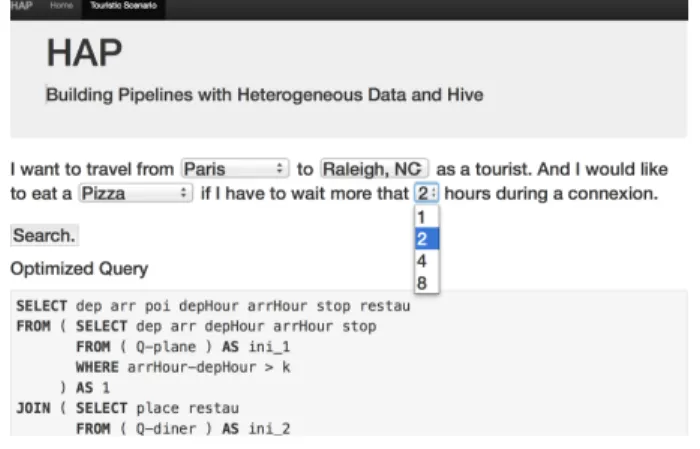
Figure 6: Application Screenshot.
RDFHive is designed to leverage existing Hadoop in-frastructures for evaluating sparql queries. RDFHive relies on an optimized translation of sparql queries into sql queries that Hive is able to evaluate.
The sources of RDFHive are openly available un-der the cecill1 license from: https://github.com/ tyrex-team/rdfhive
JSON & JSONPath Json2 is an open-standard format that uses human-readable text to trans-mit data objects consisting of attribute-value pairs. JsonPath [5] is a component allowing to find and ex-tract relevant portions out of Json structures. The Hive built-in get json object function supports a lim-ited fragment of JsonPath. Thereby, Hap can also aggregate results extracted from Json files.
XML & XPath The Extensible Markup Language (xml) is a w3c markup language that defines a set of rules for encoding documents in a format that is both human-readable and machine-readable [1]. XPath [2] is a query language for selecting nodes from an xml document.
When xml documents are loaded as single
string columns, Hap accepts the Hive built-in set of functions related to XPath e.g. xpath(xml string,xpath expression string).
5
Demonstration Details
The typical demonstration scenario is based on the touristic example introduced in Section 2 where infor-mation about planes, points of interest and restaurants are aggregated. This scenario, which widely extends
1CeCILL v2.1:http://www.cecill.info/index.en.html 2
the example previously presented, highlights several advantages of Hap:
1. Datasources have various structures which implies the use of various query languages e.g. POIs are stored in rdf – they should be queried with sparql – whereas restaurants are stored in rela-tional csv files.
2. Datasources have also different size spread over orders of magnitude e.g. GBs of POIs and only some kBs of planes.
3. The FILTER primitives needed in this usecase are complex e.g in “real” datasets, locations are given trough their latitude and longitude, thereby com-puting distances implies to use the Haversine for-mula.
Actually, attendees will be able to interact directly by writing Hap programs around this usecase. More-over, the whole process will be runnable step-by-step in order to show the various optimizations realized, see e.g. Figure 6.
6
Related Work & Conclusion
Accessing heterogeneous datasources can be done us-ing multi-database systems [8] or data integration sys-tems [4]. The typical solution is to define a com-mon intermediate data model and also to provide a query language. The dominant state-of-the-art archi-tectural model is the mediator/wrapper architecture: each datasource has an associated wrapper which is in charge of the translations between the datasets and the mediator which centralizes information. However, this architecture, used e.g. in [7], might suffer from the centralization of the mediator and the frequent trans-lations done by the wrappers when datasources have to be distributed across a cluster. On the other hand, some systems – such as Hue3 – aggregate only
dis-tributed components in order to have an end-to-end distributed pipeline.
Hap tries to benefit from both strategies: (1) the executions remain in a distributed context at any time since pipelines are in fine translated into MapReduce tasks, (2) it gets rid of wrappers/mediator bottlenecks by storing heterogeneous datasets directly in the Hive warehouse and (3) it uses a set of primitives which al-lows several levels of optimization while being concise.
3Hue website:http://gethue.com/
References
[1] T. Bray, J. Paoli, C. M. Sperberg-McQueen, E. Maler, and F. Yergeau. Extensible markup lan-guage (xml). World Wide Web Consortium Rec-ommendation REC-xml-19980210, 16:16, 1998. [2] J. Clark, S. DeRose, et al. Xml path language
(xpath) version 1.0, 1999.
[3] J. Dean and S. Ghemawat. Mapreduce: simplified data processing on large clusters. Communications of the ACM, 51(1):107–113, 2008.
[4] A. Doan, A. Halevy, and Z. Ives. Principles of data integration. Elsevier, 2012.
[5] S. Goessner. Jsonpath-xpath for json, 2007. [6] P. Hayes and B. McBride. RDF semantics. W3C
recommendation, 10, 2004. www.w3.org/TR/rdf-concepts/.
[7] B. Kolev, P. Valduriez, C. Bondiombouy, R. Jim´enez-Peris, R. Pau, and J. Pereira. Cloud-mdsql: Querying heterogeneous cloud data stores with a common language. Distributed and Parallel Databases, pages 1–41, 2015.
[8] M. T. ¨Ozsu and P. Valduriez. Principles of dis-tributed database systems. Springer Science & Business Media, 2011.
[9] E. PrudHommeaux, A. Seaborne, et al. SPARQL query language for RDF. W3C recommendation, 15, 2008. www.w3.org/TR/rdf-sparql-query/. [10] K. Shvachko, H. Kuang, S. Radia, and
R. Chansler. The hadoop distributed file sys-tem. In Mass Storage Systems and Technologies (MSST), 2010 IEEE 26th Symposium on, pages 1–10. IEEE, 2010.
[11] A. Thusoo, J. S. Sarma, N. Jain, Z. Shao, P. Chakka, S. Anthony, H. Liu, P. Wyckoff, and R. Murthy. Hive: a warehousing solution over a map-reduce framework. Proceedings of the VLDB Endowment, 2(2):1626–1629, 2009.